How did the US nuclear industry fare in 2022?
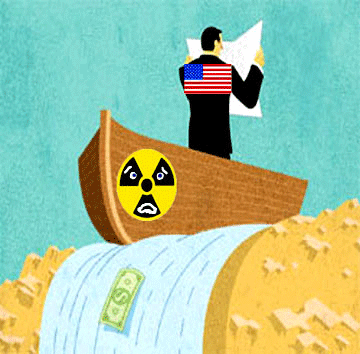
Nuclear plants big and small are getting support from the feds. Still, problems persist — TerraPower can’t source fuel, Oklo and NuScale are tangled in red tape, and more.
Canary Media 28 December 2022 Eric Wesoff
The U.S. nuclear power market continued to sputter in 2022 as it faced regulatory, technical and financial setbacks — despite solid support from the federal government.
This mirrors the global nuclear scene; plant closings and construction delays have resulted in nuclear falling to just 9.8 percent of global power generation in 2021, its lowest level since the 1980s, according to the World Nuclear Industry 2022 annual report.
The United States generates more nuclear power than any other country in the world, with about 95 gigawatts of capacity, followed by China, but construction of new plants has been plagued by cost and schedule overruns, as well as an inability to keep up with the plunging costs of natural gas and renewable energy sources. Still, nuclear power provides a crucial 20 percent of U.S. electricity from the 92 light-water reactors that were built in a seemingly unreplicable construction binge in the 1970s and ‘80s.
Some of these plants are struggling financially, many are approaching their decommission dates, and the only new large reactors constructed in recent memory, at the Plant Vogtle in Georgia, have been calamitous money pits brimming with incompetence and even fraud.
Here are the U.S. nuclear industry’s highs and lows from 2022.
Diablo Canyon lives
Diablo Canyon, California’s last remaining nuclear plant, was granted up to $1.1 billion in support from the U.S. Department of Energy in November, which might allow the two-reactor plant to remain in business. ……………..
Still, Diablo faces a reckoning with the federal Nuclear Regulatory Commission regarding its license, as the plant must now confront years of deferred maintenance in the run-up to its anticipated retirement.
Fuel loading at Vogtle
On October 17, Georgia Power reported that “fuel load” into the Plant Vogtle Unit 3 reactor core had been completed, marking an overdue milestone in the bumpy journey of getting two new reactors at this power plant up and running. During the fuel-loading process, technicians and operators transferred scores of fuel assemblies one by one to the Unit 3 reactor…………………….
On December 7, Vogtle’s Unit 4 completed cold hydro testing, the penultimate step before hot functional testing, which is scheduled to begin early next year.
The two units are the first new nuclear units to be built in the U.S. in more than three decades — and they haven’t made nuclear power look good. The project is six years overdue and will cost utility customers over $30 billion, more than double the original price tag. DOE’s Loan Programs Office provided more than $12 billion in loan guarantees to help complete Vogtle’s expansion.
DOE and IRA love nuclear power
The Biden administration is committed to maintaining the existing nuclear fleet and bringing innovative, new nuclear-reactor designs to market.
The Inflation Reduction Act provides generous production credits for existing nuclear plants and added premiums for meeting prevailing-wage requirements. These credits offer a potential $30 billion lifeline to struggling plants at risk of early retirement.
The IRA also provides a tax credit for advanced nuclear reactors and a credit of up to 30 percent for microreactors, while devoting $700 million to support the development of high-assay low-enriched uranium (HALEU), the highly enriched fuel used in many advanced nuclear reactors.
This funding is in addition to the 2021 Bipartisan Infrastructure Law’s $6 billion Civil Nuclear Credit program, which lets existing U.S. reactors bid on credits to help support their continued operations. The DOE’s Loan Programs Office also has $11 billion in funding for nuclear plants and nuclear supply chains, according to Jigar Shah, director of the office.
………………………….. TerraPower and dozens of other advanced nuclear startups require a concentrated form of fuel — HALEU. But the only current commercial supplier of HALEU is Tenex, a Russian state-owned company. That wasn’t a great situation even before Russia invaded Ukraine.
In mid-December, TerraPower announced that it has pushed back the planned start date for its reactor because depending on HALEU sourced from Russia had become an unworkable business plan. “Given the lack of fuel availability now, and that there has been no construction started on new fuel enrichment facilities, TerraPower is anticipating a minimum of a two-year delay to being able to bring the Natrium reactor into operation,” said CEO Chris Levesque.
The world’s fleet of light-water reactors runs almost entirely on fuel enriched to 3 to 5 percent U-235, which is classified as low-enriched uranium (LEU). In contrast, the vast majority of non-light-water reactor designs in development, like TerraPower’s, run on enrichments of 5 to 20 percent (HALEU).
X-energy goes public via SPAC
X-energy, a developer of small modular nuclear reactors and fuel, is going public through the magic of a merger with Ares Acquisition Corporation, a publicly traded special-purpose acquisition company…………… Once the disreputable domain of pink-sheet over-the-counter stocks, SPACs have become an acceptable way for companies to go public without the burden of revenue or the actual due diligence most public companies go through. ………………………………………………..
NuScale’s NRC blues………….
https://www.canarymedia.com/articles/nuclear/how-did-the-us-nuclear-industry-fare-in-2022—
US spies pushed Twitter to censor ‘anti-Ukraine narratives’ – media
more
https://www.rt.com/news/568879-twitter-files-cia-collusion/ 28 Dec 22
New batch of of files exposes collusion with ‘other government agencies’.
The Pentagon, CIA and other US intelligence and law-enforcement agencies became increasingly “more aggressive” with takedown requests, the latest trove of Twitter files has revealed. The documents suggest the agencies were effectively pushing the platform to censor foreign-policy stories that ran against the Washington-approved narrative.
The files show the FBI acting as doorman to a vast program of social media surveillance and censorship, encompassing agencies across the federal government – from the State Department to the Pentagon to the CIA,” journalist Matt Taibbi wrote in the Christmas Eve edition of the Twitter Files, released with the blessing of the social media platform’s owner, Elon Musk.
Thousands of censorship requests flowed to Twitter from what were termed OGA” in the documents, or “Other Government Organizations,” through the FBI’s Foreign Influence Task Force.
Twitter executives often struggled to validate government claims, but were under constant pressure to find evidence to blame any foreign actor, Russia in particular.
“Found no links to Russia,” an unnamed analyst said in one of the emails, later suggesting he could “brainstorm” to “find a stronger connection.” Former Trust and Safety chief Yoel Roth admitted in another instance that he’d found “no real matches using the info.”
Internal communications show that Twitter had been getting so many requests that its executives had to improvise a system for prioritizing them. The feds had dedicated personnel tasked with tailoring takedown requests to Twitter’s policies for faster processing, which the execs acknowledged as “odd,” but even then the company often struggled to justify censorship.
“Many people wonder if Internet platforms receive direction from intelligence agencies about moderation of foreign policy news stories. It appears Twitter did, in some cases by way of the FITF/FBI,” Taibbi wrote. At least some of these directives originated at the CIA, according to former agent and whistleblower John Kiriakou, who said he “recognized the formatting.”
The feds sometimes sent massive batches of over 1,000 accounts lined up for “digital execution,” with only a brief explanation of the alleged problems. On multiple occasions they accused “Russian agents” of directing accounts that highlighted “predominantly anti-Ukraine narratives” or documented “purported rights abuses committed by Ukrainians.”
Another intelligence assessment sent to Twitter claimed that accounts spreading information about “neo-Nazis” in Ukraine were part of a Kremlin-controlled propaganda campaign and must be banned.
In what Taibbi called a “damning admission,” an unnamed former CIA-turned-Twitter executive once noted that the “government partners” were getting increasingly “aggressive” with their takedown requests.
In what Taibbi called a “damning admission,” an unnamed former CIA-turned-Twitter executive once noted that the “government partners” were getting increasingly “aggressive” with their takedown requests.
“Due to a lack of technical evidence on our end, I’ve generally left it be, waiting for more evidence,” he said about the InfoBRICS account. He further argued that since “BRICS is an inherently Russia-dominated economic organization” it was “always likely…directed by the Kremlin.”
“Our window on that is closing, given that government partners are becoming more aggressive on attribution and reporting on it…I’m going to go ahead with suspension and marking the domain UNSAFE.”
Spearheaded by Taibbi in cooperation with fellow reporters Bari Weiss, Lee Fang, and others, the Twitter Files have shed light on several controversial decisions made by the company, including material surrounding the suspension of ex-President Donald Trump, the practice of shadow banning, as well as a site-wide ban on a New York Post report about the foreign business dealings of Hunter Biden, the son of President Joe Biden.
The files also explained how the US intelligence community worked hand-in-glove with the platform to flag speech for suspension that the US government deemed “misinformation,” and showed how the FBI and Twitter locked horns over the agency’s claims of increased activity by ‘propaganda’ bots, of which Twitter said it found no evidence.
Every social media firm censors for US government – Musk
Platforms remove content at the “explicit direction” of US federal agencies, the Twitter CEO has claimed.
Rt.com 28 Dec 22,
All social media platforms work with the US government to censor content, Twitter CEO Elon Musk claimed on Tuesday. Documents released by Musk following his purchase of Twitter showed that the platform colluded with the FBI, CIA, Pentagon and other government agencies to suppress information on elections, Ukraine, and Covid-19.
“*Every* social media company is engaged in heavy censorship, with significant involvement of and, at times, explicit direction of the government,” Musk tweeted, adding that “Google frequently makes links disappear, for example.”
Musk was referring to internal Twitter communications published by journalist Matt Taibbi with his approval, which suggested that the platform’s senior executives held regular meetings with members of the FBI and CIA, during which the agencies gave them lists of “hundreds of problem accounts” to suspend in the run-up to the 2020 election.
In addition to Twitter, the government was in contact “with virtually every major tech firm,” Taibbi claimed. “These included Facebook, Microsoft, Verizon, Reddit, even Pinterest.” CIA agents “nearly always” sat in on meetings of these firms with the FBI’s Foreign Influence Task Force, Taibbi claimed, explaining that although this task force was convened to fight alleged election interference by foreign states, it made “mountains of domestic moderation requests.”
A lawsuit filed earlier this year by the attorneys general of Missouri and Louisiana alleges that officials from no fewer than 12 government agencies met weekly with representatives of Twitter, Facebook, and other Big Tech firms in 2020 to decide which narratives and users to censor, with topics ranging from alleged election interference to Covid-19…………………………….
https://www.rt.com/news/569016-musk-social-media-censorship/
“Nuclear Sharing” – USA’s obscene system to turn non-nuclear weapons countries into nuclear attackers/targets.

The Steadfast Noon exercise will practice a controversial arrangement known as nuclear sharing, under which the United States installs nuclear equipment on fighter jets of select non-nuclear NATO countries and train their pilots to carry out nuclear strike with U.S. nuclear bombs.
NATO Steadfast Noon Exercise And Nuclear Modernization in Europe,
By Hans Kristensen • October 17, 2022,
Today, Monday October 17, 2022, the North Atlantic Treaty Organization (NATO) will begin a two-week long exercise in Europe to train aircrews in using U.S. non-strategic nuclear bombs. The exercise, known as Steadfast Noon, is centered at Kleine Brogel Air Base in Belgium, one of six airbases in Europe that store U.S. nuclear bombs. The exercise takes place midst significant modernizations at nuclear bases across Europe.
The arrangement is controversial because the United States as a party to the nuclear Non-Proliferation Treaty (NPT) has promised not to hand over nuclear weapons to other countries, and the non-nuclear countries in the sharing arrangement have promised not to receive nuclear weapons from the nuclear weapon states. In peacetime the nuclear weapons are under U.S. control, but the arrangement means that they would be handed over to the non-nuclear country in war time. The arrangement was in place before the NPT was signed so it is not a violation of the letter of the treaty. But it can be said to violate the spirit and has been an irritant for years.
Steadfast Noon exercises are held once every year, but this year is unique because the exercise will take place during the largest conventional war in Europe since World War II with considerable tension and uncertainty resulting from Russia’s war in Ukraine. Moreover, Steadfast Noon is expected to more or less coincide with a large Russian strategic nuclear exercise. For NATO officials, other than Putin’s war in Ukraine, this is all routine. But for the public, it is but the latest development in rising tensions and unprecedented fears about nuclear war.
According to NATO, Steadfast Noon will involve 14 countries (less than half of the 30 NATO allies) and up to 60 aircraft. That involves fourth-generation F-16s and F-15Es as well as fifth-generation F-35A and F-22 fighter jets. A number of tankers and surveillance aircraft will also take part. Although the exercise is practicing NATO’s non-strategic nuclear forces, a couple of U.S. strategic B-52 bombers will also participate. Training flights will take place over Belgium and the United Kingdom as well as over the North Sea. There might also be flights over Germany and the Netherlands.
Practicing Nuclear Bomb Sharing
The Steadfast Noon exercise will practice a controversial arrangement known as nuclear sharing, under which the United States installs nuclear equipment on fighter jets of select non-nuclear NATO countries and train their pilots to carry out nuclear strike with U.S. nuclear bombs.
“If NATO was to conduct a nuclear mission in a conflict,” NATO says, “the B-61 [sic] weapons would be carried by certified Allied aircraft…However, a nuclear mission can only be undertaken after explicit political approval is given by NATO’s Nuclear Planning Group (NPG) and authorisation is received from the US President and UK Prime Minister.” It is unclear why the U.K. Prime Minister would have to authorize employment of U.S. nuclear weapons, and unless NATO territory had been attacked with nuclear weapons first, it seems unlikely that the 29 countries in the NPG would be able to agree to approve of employment of non-strategic nuclear weapons from bases in Europe.
NATO disclosed earlier this year that seven NATO countries contribute dual-capable aircraft to the nuclear sharing mission. The countries were not identified but five are widely known: Belgium, Germany, Italy, Netherlands, and the United States. The sixth country is probably Turkey (despite rumors that it was no longer part of the mission), in which case some Turkish F-16s are still equipped to deliver B61 bombs. The seventh country is a mystery, but might possibly be the United Kingdom, in which case some British Eurofighters would have a nuclear mission with U.S. bombs [Note: a UK role has not been confirmed].
Nuclear Base Modernizations
During the past several years, the nuclear bases and the infrastructure that support the nuclear sharing mission in Europe have been undergoing significant upgrades, including cables, command and control systems, weapons maintenance and custodial facilities, security perimeters, and runway and tarmac areas.
There are currently six active sites in Europe that store U.S. nuclear bombs: Kleine Brogel air base in Belgium, Büchel air base in Germany, Aviano and Ghedi air bases in Italy, Volkel air base in the Netherlands, and possibly Incirlik in Turkey. The estimated number of weapons at each site is based on the number of active vaults, aircraft, and other information:
Each of these bases have one or two dozen active vaults (Weapons Storage Security System, WS3) inside as many protective aircraft shelters. Ramstein air base in Germany used to be the largest storage site in Europe but only 7 vaults remain active possibly for training and transfer. All weapons were withdrawn from Lakenheath before 2007 but the United Kingdom was recently added to the nuclear infrastructure storage modernization program, which means there are now eight active WS3 sites in Europe:
The modernizations at the various bases vary depending on capacity, location, and host country. At Kleine Brogel Air Base in Belgium,…………………………
At Büchel Air Base in Germany…………………….
At Volkel Air Base in the Netherlands,…………
Ghedi Air Base in Italy………….
Upgrades of Aviano Air Base in Italy and Incirlik Air Base in Turkey……….
Weapons Modernization……………………..

Finally, the existing B61 nuclear bombs will soon be replaced by the enhanced B61-12 guided nuclear bomb. Development is essentially complete and full-scale production of about 480 B61-12s is expected to begin soon. The new weapon is thought to have the same yield range as the current B61-4: 0.3, 1.5, 10 and 50 kilotons. Training of the units in Europe to receive the new weapon is scheduled to begin in early-2023 and the first weapons potentially arriving at the first base in late-2023 or 2024.
In addition to the non-strategic fighter jets F-15E, F-16, F-35A, and Tornado, the B61-12 will also be integrated on the B-2 and B-21 strategic bombers. ecause of the increased provided by the tail kit, all the digital aircraft that can make use of it (all except F-16 and Tornado) will be able to hold at risk a wide range of targets. The combination of increased accuracy and lower-yield options on non-strategic and strategic stealth aircraft will significantly increase the capability of the gravity bomb mission.
Calling nuclear fusion a potential ‘climate solution’ may undermine actual solutions
The latest fusion breakthrough is scientifically important, but the technology’s timeline just doesn’t match up with the urgency of climate change.
Grid Dave Levitan 28 Dec 22 Climate Reporter
When scientists at Lawrence Livermore National Laboratory announced a “breakthrough” in nuclear fusion research this month, many eyes quickly turned to climate change. Stories from the BBC, CNN and other major outlets mentioned the potential for “limitless” clean energy and discussed fusion’s place as a global warming fix within their opening paragraphs. Even Secretary of Energy Jennifer Granholm, in announcing the new result, touted its potential to provide “clean power to combat climate change.”
From a purely theoretical standpoint, this makes some sense. Fusion power, in an idealized, storybook form, turns the world’s energy system on its head, offering an emissions-free way to keep the lights on. And the latest advance sounds truly impressive: Using enormously powerful lasers, scientists at Livermore’s National Ignition Facility (NIF) managed to create a split-second fusion reaction — mimicking that which takes place on a massive scale inside the sun — that produced more energy than it consumed.
But the world doesn’t live in that storybook. On a practical, near-term level, nuclear fusion and climate change have almost nothing to do with each other. One remains in more-or-less scientific infancy, many years away from even a hint of usable form; the other gets more urgent by the day, requires immediate intervention and has some readily available tech being deployed as we speak.
“A lot of people are desperate for some sort of silver bullet climate solution that will help to bypass the hard work of actually getting political agreements and policymaking and sacrifice to eliminate fossil fuels,” said Edwin Lyman, a physicist and director of nuclear power safety for the Union of Concerned Scientists. “It would just be easier if there were this panacea out there that would transform everything, but of course that’s totally unrealistic.”
Celebrating scientific advances is important. But linking that science with an urgent global need that it cannot on relevant time scales address may offer false hope and potentially undermine the more banal climate progress — dramatic renewable energy expansion, efficiency improvements, vehicle electrification and so on — that is possible today.
Ignition achieved
The old joke about nuclear fusion is that it is always 20 — or 30 or 50 — years away. Taking hydrogen atoms and fusing them into helium, in the process releasing energy that theoretically can be used to power the electric grid, is so technically challenging that despite well over a half-century of advances, the joke still more or less holds true…………………. more https://www.grid.news/story/climate/2022/12/26/calling-nuclear-fusion-a-potential-climate-solution-may-undermine-actual-solutions/
NuScam’s small nuclear reactors have both regulatory and financial woes.

How did the US nuclear industry fare in 2022? Canary Media 28 December 2022 Eric Wesoff
“……………………………………………………………………….. NuScale’s NRC blues, NuScale Power has led the charge on small nuclear reactors for more than a decade but is still struggling with the NRC, as well as facing rising costs on a crucial first-of-a-kind 462-megawatt project in Idaho.
The proposed project from NuScale and Utah Associated Municipal Power Systems, a group of 50 municipal utilities spanning seven Western states, was initially slated to begin operation of the first of six small modular reactors in 2029. But according to December reporting in E&E News, “NuScale’s first reactor now faces sharply higher construction cost estimates, due to inflation and higher interest rates. If projected costs rise above $58 per megawatt-hour, it would trigger an up-or-down vote as early as next month from the project’s anchor customers.” E&E also reported that the costs of construction materials such as steel plate and carbon steel piping have skyrocketed since the project was approved in 2020.
In addition to cost issues, NuScale has run into a regulatory snag. The company replaced its NRC-approved 50-megawatt design and now needs to gain regulatory approval for the 77-megawatt module it plans to use in the UAMPS project. Utility Dive reported in November that the NRC has concerns about the new design, writing in a letter to NuScale that the company’s proposed module raised “several challenging and/or significant issues” with its draft application.
Small module reactor architecture is an unproven solution to the nuclear industry’s cost and schedule overruns. Scaling down new reactors in power output and size theoretically enables small modular and micro solutions that can be constructed less expensively off-site using fewer custom components with lower total project costs.
But even NuScale’s design, a small modular reactor that bears some resemblance to existing light-water reactors, poses challenges to the testing and approval processes of the NRC. NuScale says it has spent over $500 million and expended more than 2 million labor hours to compile the information needed for its design-certification application.
And it’s not just the nuclear regulators, engineers and politicians who need to weigh in on this project. These days, it’s the nuclear accountants who have the final say. And so far, small reactors have not proven to be a financial or regulatory slam dunk. …………… https://www.canarymedia.com/articles/nuclear/how-did-the-us-nuclear-industry-fare-in-2022
Canada’s first new nuclear power reactor in 30 years has embarked on a crucial review. Can it pass quickly?

GE says it’s the simplest reactor it has ever designed. Such claims are common among SMR developers, and are almost entirely untested.
“The vendors would really like to have basically no guards with guns at a reactor site, if they can avoid it,”
While a solar or wind farm can typically be built in a few years, nuclear reactors have been known to take a decade or longer. With governments and utilities pondering how to achieve net-zero greenhouse emissions by mid-century, this has proved to be a significant competitive disadvantage for nuclear power.
Globe and Mail, Dec. 28, 2022, Matthew McClearn
On the shores of Lake Ontario, about 70 kilometres east of Toronto, something is happening that hasn’t happened in Canada in well over a generation: Workers are breaking ground for a new nuclear reactor.
Ontario Power Generation plans to construct a GE-Hitachi BWRX-300 at its Darlington Nuclear Generating Station in Clarington. To do that it needs permission from the Canadian Nuclear Safety Commission (CNSC)
The utility’s application to the CNSC, which it submitted in the fall, will be the first real test of GE-Hitachi’s claims about the reactor, a new model that is not yet used anywhere else in the world. The uncertain process could have dramatic implications for what this new reactor will ultimately cost, how long it will take to build – and whether anyone else will want to build one.
The reactor’s design is novel in several respects. At 300 megawatts, the BWRX-300 is marketed as a small modular reactor, or SMR. (Darlington’s existing four reactors each produce 935 megawatts.) In considering the application, the CNSC will be the first regulator in the world to review an SMR for large-scale power generation.
This will be the first large nuclear power reactor the CNSC has reviewed since 1993. And, if built, it would be the first nuclear power reactor in Canadian history that wasn’t of the homegrown CANDU design.
GE-Hitachi has said the BWRX-300 will be 60 per cent less expensive per megawatt than a typical reactor, making it the cheapest SMR on the market, and that it can be built in as few as 24 months. And the company has touted “passive safety systems.” Even if operators walked away, it has said, the reactor would cool itself without power for a whole week, at minimum. The company also claims the BWRX-300′s environmental footprint is less than that of larger reactors. GE says it’s the simplest reactor it has ever designed.
Such claims are common among SMR developers, and are almost entirely untested. The BWRX-300 “has not gone through any licensing review anywhere, in any country,” said M.V. Ramana, a professor at the University of British Columbia’s School of Public Policy and Global Affairs who researches nuclear energy. “When a design is submitted to a regulator for safety review, the regulators ask questions, and the design starts being changed. And so there is going to be this process of evolution.”…………………………………
Allison Macfarlane, director of UBC’s School of Public Policy and Global Affairs, said SMR vendors have also sought smaller emergency-planning zones in the U.S. And she noted that some vendors argue that SMRs will require less physical security than larger reactors. “The vendors would really like to have basically no guards with guns at a reactor site, if they can avoid it,” she added.
Acquiring regulatory approval to build a newly designed reactor within two or three years is not the norm.
Prof. Macfarlane said there is no hard rule on how long the process takes. The fastest application she has seen before the NRC was a request by the U.S. Navy for an informal review of a reactor for a nuclear aircraft carrier. (The Navy didn’t actually require NRC approval.) The NRC’s review took 18 months, she said.
For a power reactor, the best case scenario before the NRC is three to four years. At worst, the process can stretch out for a decade.
“Usually, there’s just this endless back and forth,” she said.
Prof. Ramana is also skeptical of OPG’s timeline. Most nuclear projects suffer delays, he said. “When it comes to a new reactor design, those delays tend to be much larger. … It should not be a surprise to anyone if this design is going to be quite delayed.”
That accords with GE-Hitachi’s own experiences in the U.S. The company applied to the NRC for final design approval for its Economic Simplified Boiling Water Reactor in 2005. The reactor wasn’t certified until nine years later, in 2014. In 2011, the company applied to the NRC to renew the design certification for its Advanced Boiling Water Reactor, which had first been certified in the 1990s. That process took about a decade.
Even if the CNSC does grant OPG its construction license in record time, delays are not uncommon after construction has commenced. One notorious example is Westinghouse’s AP1000 reactor, which made an outsized contribution to that company’s filing for bankruptcy protection in 2017.
“In the case of the AP1000, the delays happened well after the design was licensed to be constructed,” Prof. Ramana said.
That historical experience notwithstanding, OPG, various levels of government and voices from across the nuclear industry have said that this new reactor will be in service as early as 2028. Meeting that deadline is a matter of no small urgency for the nuclear industry. While a solar or wind farm can typically be built in a few years, nuclear reactors have been known to take a decade or longer. With governments and utilities pondering how to achieve net-zero greenhouse emissions by mid-century, this has proved to be a significant competitive disadvantage for nuclear power…………………..
The CNSC is an administrative tribunal that reports to Parliament through the Minister of Natural Resources. While it doesn’t answer to him, that minister, Jonathan Wilkinson, has promoted SMRs in recent statements. By adopting them early, he said in October, “Canada could realize a significant share of the global exports of technology, goods and services.” In its most recent budget, the federal government earmarked nearly $51-million to improve the CNSC’s capacity to regulate SMRs.
CNSC president Rumina Velshi is also a vocal supporter. She declared in October that SMRs “are likely to be an important part of the next generation of nuclear” and that they “will need to be deployed quicker, less expensively and much more widespread than reactors of the past.” The CNSC has established a new group focused exclusively on SMRs, which will “guide the entire organization on SMR readiness.”
Earlier this year, Ms. Velshi told attendees of a summit on advanced reactors that the CNSC would rise “to the challenge of conducting SMR licensing reviews efficiently and effectively.”
Ms. Velshi is enthusiastic about the CNSC harmonizing its codes and standards with those of regulators of other countries. She has said this is “essential” for SMR deployment worldwide, and has signalled her intent to work closely with the NRC.
In September, the two regulators signed an agreement to collaborate on reviewing the BWRX-300.
Allison Macfarlane, director of UBC’s School of Public Policy and Global Affairs, said SMR vendors have also sought smaller emergency-planning zones in the U.S. And she noted that some vendors argue that SMRs will require less physical security than larger reactors. “The vendors would really like to have basically no guards with guns at a reactor site, if they can avoid it,” she added.
Acquiring regulatory approval to build a newly designed reactor within two or three years is not the norm.
Prof. Macfarlane said there is no hard rule on how long the process takes. The fastest application she has seen before the NRC was a request by the U.S. Navy for an informal review of a reactor for a nuclear aircraft carrier. (The Navy didn’t actually require NRC approval.) The NRC’s review took 18 months, she said.
For a power reactor, the best case scenario before the NRC is three to four years. At worst, the process can stretch out for a decade.
“Usually, there’s just this endless back and forth,” she said.
Prof. Ramana is also skeptical of OPG’s timeline. Most nuclear projects suffer delays, he said. “When it comes to a new reactor design, those delays tend to be much larger. … It should not be a surprise to anyone if this design is going to be quite delayed.”
That accords with GE-Hitachi’s own experiences in the U.S. The company applied to the NRC for final design approval for its Economic Simplified Boiling Water Reactor in 2005. The reactor wasn’t certified until nine years later, in 2014. In 2011, the company applied to the NRC to renew the design certification for its Advanced Boiling Water Reactor, which had first been certified in the 1990s. That process took about a decade.
Even if the CNSC does grant OPG its construction license in record time, delays are not uncommon after construction has commenced. One notorious example is Westinghouse’s AP1000 reactor, which made an outsized contribution to that company’s filing for bankruptcy protection in 2017.
“In the case of the AP1000, the delays happened well after the design was licensed to be constructed,” Prof. Ramana said.
That historical experience notwithstanding, OPG, various levels of government and voices from across the nuclear industry have said that this new reactor will be in service as early as 2028. Meeting that deadline is a matter of no small urgency for the nuclear industry. While a solar or wind farm can typically be built in a few years, nuclear reactors have been known to take a decade or longer. With governments and utilities pondering how to achieve net-zero greenhouse emissions by mid-century, this has proved to be a significant competitive disadvantage for nuclear power.
A successful, quick application would bode well for further BWRX-300 construction, in Canada and beyond. OPG’s environmental impact statement suggests the utility could deploy up to four at Darlington, with the last one completed in 2035.
Earlier this year, SaskPower, Saskatchewan’s main electric utility, selected the BWRX-300 for “potential” deployment in the province in the mid-2030s. (It won’t make a firm decision until 2029.) A U.S. utility, the Tennessee Valley Authority, also plans to build a BWRX-300.
The CNSC is an administrative tribunal that reports to Parliament through the Minister of Natural Resources. While it doesn’t answer to him, that minister, Jonathan Wilkinson, has promoted SMRs in recent statements. By adopting them early, he said in October, “Canada could realize a significant share of the global exports of technology, goods and services.” In its most recent budget, the federal government earmarked nearly $51-million to improve the CNSC’s capacity to regulate SMRs.
CNSC president Rumina Velshi is also a vocal supporter. She declared in October that SMRs “are likely to be an important part of the next generation of nuclear” and that they “will need to be deployed quicker, less expensively and much more widespread than reactors of the past.” The CNSC has established a new group focused exclusively on SMRs, which will “guide the entire organization on SMR readiness.”
Earlier this year, Ms. Velshi told attendees of a summit on advanced reactors that the CNSC would rise “to the challenge of conducting SMR licensing reviews efficiently and effectively.”
Ms. Velshi is enthusiastic about the CNSC harmonizing its codes and standards with those of regulators of other countries. She has said this is “essential” for SMR deployment worldwide, and has signalled her intent to work closely with the NRC.
In September, the two regulators signed an agreement to collaborate on reviewing the BWRX-300.
| Reply |
What’s not to like about nuclear fusion?
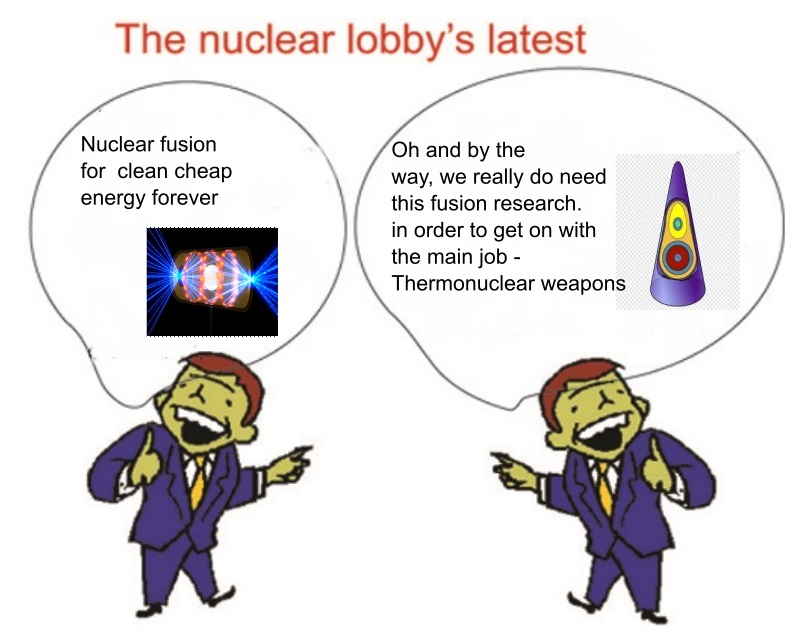
If one of these approaches is eventually successful in generating electricity continuously, the earliest we could expect commercial nuclear fusion reactors would be around 2050
The proponents remain silent about its applications to nuclear weapons. Fusion produces a stream of neutrons that can convert the common form of uranium, Uranium-238, into Plutonium-239, and common thorium into Uranium-233. Both Pu-239 and U-233 are nuclear (fission) weapons explosives
https://johnmenadue.com/whats-not-to-like-about-nuclear-fusion/— Mark Diesendorf , Dec 27, 2022
Headlines shout ‘Breakthrough in nuclear fusion could mean “near-limitless energy”’ and, one with a note of caution, ‘At last, we’ve found our energy source for the future (if we have one)’.
The publicity followed an experiment, conducted at the Lawrence Livermore National Laboratory in California, in which slightly more fusion energy output was obtained than the vast amount of energy input.
Nuclear fusion results from forcing together the nuclei of light atoms, against their electrostatic forces of repulsion, to form heavier nuclei, with the release of energy. It is the reaction that gives our Sun and the other stars their energy. In the centres of stars, the nuclei are forced together by the immense pressure due to gravity. But in the laboratory on Earth, confining the system and achieving controlled fusion is much more difficult.
One approach is to heat the system to hundreds of millions of degrees while confining it with intense magnetic fields. This is the method used in a multinational, multi-billion dollar experiment to build the International Thermonuclear Experimental Reactor (ITER), currently under construction in France. The researchers and investor governments hope that the huge size of the system will eventually enable energy break-even.
Another method, the one used at Livermore, is to bombard a pellet comprising two isotopic forms of hydrogen, deuterium and tritium, with 192 high-powered lasers. Energy breakeven was achieved for a fraction of a second.
If one of these approaches is eventually successful in generating electricity continuously, the earliest we could expect commercial nuclear fusion reactors would be around 2050, probably too late to contribute to climate mitigation and almost certainly unnecessary. By 2050, the whole world’s electricity generation will likely be renewable, mostly from wind and solar photovoltaics supplemented by hydro. This can be achieved at a fraction of the cost of any nuclear energy technology, fission or fusion.
The hype for fusion claims limitless, safe, zero-carbon energy, negligible nuclear wastes, and no risk of devastating nuclear accidents. So, what’s not to like about nuclear fusion?
The proponents remain silent about its applications to nuclear weapons. Fusion produces a stream of neutrons that can convert the common form of uranium, Uranium-238, into Plutonium-239, and common thorium into Uranium-233. Both Pu-239 and U-233 are nuclear (fission) weapons explosives.
Even more dangerous is the potential use of the neutron stream to convert lithium, which is common, into large quantities of tritium, a rare isotope of hydrogen. Tritium is an essential component of compact nuclear weapons, enabling them to be made small enough to fit into missiles. The principal purpose of the Lawrence Livermore Lab is research and development of nuclear weapons. Indeed, a former member of the research staff described it to me as ‘a nuclear bomb factory’.
The desirability of ‘near-limitless energy’ also needs critical examination. The economic system is driven, to a large degree by energy consumption, and vice versa. Energy and economy are closely coupled. Furthermore, economic activity is a major driver of environmental impacts. Already, at the present level of global GDP and global energy consumption, we have massive impacts on our forests, soils, freshwater, biodiversity and biogeochemical flows such as phosphorus and nitrogen. Although we humans are totally dependent upon nature, we (especially rich countries and rich individuals) are destroying our life support system. A further expansion of energy consumption and associated economic activity, even if energy generation is zero-carbon, could finish the job of destroying human civilisation this century.
There is growing evidence of the need for the world to transition to a steady-state economic system, that is, one with no growth in the use of energy, materials and land, and no growth in population. The interdisciplinary field of ecological economics is based on this goal. Since low-income countries must continue to grow, this means that the rich countries must commence a process of planned degrowth to an ecologically sustainable, socially just socioeconomic system. Planned degrowth, which is very different from a recession, is discussed in recent books by Jason Hickel (Less is More), Giorgos Kallis (The Case for Degrowth) and Matthias Schmelzer (The Future is Degrowth).
Sunak’s wrongheaded renewables tax risks trashing Britain’s wind and solar ambitions.
DR NINA SKORUPSKA: Sunak’s wrongheaded renewables tax risks trashing
Britain’s wind and solar ambitions. The Government must change course,
otherwise we will see winters even more painful than this one.
Call it what you will – a windfall tax, a clawback, a levy – the fact remains that the
Electricity Generator Levy (EGL), in its current form, is set to cause
irreparable damage to Britain’s green energy industry by stalling
investment. In principle, our sector is certainly not against the
Government’s policy to require generators to help pay for energy bill
support.
However, we would question the wisdom of subjecting the cheaper,
greener renewable power sector to a more punishing tax regime than its oil
and gas counterparts. It is an inexplicable disparity – our sector is key
to tackling the volatile costs of fossil fuels at the heart of rising
energy bills. Treatment should be fair and equitable in relation to the oil
and gas sector.
Telegraph 23rd Dec 2022
Dounreay pushes forward plans to build new 37-metre-high stack at prototype fast breeder reactor.
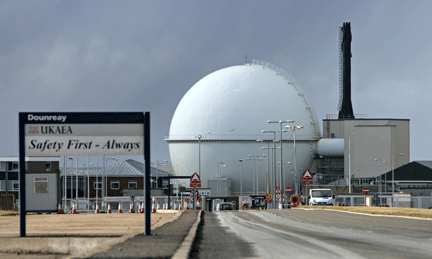
Dounreay pushes forward plans to build new 37-metre-high stack at reactor.
Dounreay’s operators are looking to clear the way to progress long-delayed
plans to replace the discharge stack at the site’s prototype fast reactor.
Dounreay Site Restoration Limited (DSRL) is seeking Highland Council’s
agreement to approve a design for the system to vent authorised emissions
of gases, including radionuclides. Last year, it awarded a £7 million
contract to US conglomerate Jacobs to carry out the work.
Concrete foundations and a steel framework would support the proposed new 37-metre
high stack which would house a plant room containing an extract fan, filter
units, stack sampling and control panels. The contract involves removal of
the existing vent and the design, manufacturing, testing, installation and
commissioning of its replacement. The new stack is earmarked to go up on
the seaward side of the reactor and be in place by October 2024.
John O Groat Journal 21st Dec 2022
UK tipped to export even more energy to France despite blackout fears.
UK tipped to export even more energy to France despite blackout fears.
France’s nuclear power output has plunged to a 30-year low – and the UK is
expected to continue to part ways with its energy supplies despite shortage
fears this winter.
A nuclear expert has warned that the UK may have to send
more energy across the Channel to help keep the lights on in France. This
is despite fears that Britain could be weeks away from its own shortages
this winter.
France has taken 16 of its 56 nuclear reactors offline due to
corrosion issues, causing nuclear power output levels to plummet in recent
months. Making matters worse, Paris confirmed last week that maintenance
halts at two of Electricite de France SA’s reactors – and that it will last
for an extra four months. It may also have to carry out lengthy repairs at
seven other reactors next year, too.
Under normal circumstances, France is
a net exporter of energy, sending some of this to the UK via
interconnectors. While the exchange of energy from the UK to France has
been happening regularly for a number of months, Dr Paul Dorfman, a nuclear
expert from Sussex University, has warned that the UK could ramp up its
exports to France, despite its own domestic energy issues.
Express 24th Dec 2022
https://www.express.co.uk/news/science/1711900/uk-energy-france-nuclear-blackout-edf
The Ukraine Arms Drain

New Eastern Outlook, Brian Berletic 23 Dec 22
After months of feigned confidence and optimism from both the West and Ukraine’s senior military leadership, cracks are beginning to appear. During Ukrainian Commander-in-Chief General Valery Zaluzhny’s recent interview with the Economist, Ukraine’s desperate need for additional arms and the consequences for not receiving them was made very clear.
The discussion revolved around the desperate need for resources – everything ranging from air defense missiles to tanks, armored vehicles, artillery pieces and artillery shells themselves – all things that both the West and now Ukraine are admitting are in short supply, and perhaps cannot be supplied any time in the near or intermediate future.
From “Extending Russia” to “Demilitarizing” NATO
Washington’s proxy war against Russia in Ukraine is the manifestation of the RAND Corporation’s 2019 paper “Extending Russia” which recommended US policymakers to “provide lethal aid to Ukraine” hoping it would expand hostilities in eastern Ukraine and “increase the costs to Russia, in both blood and treasure, of holding the Donbass region.”
The paper had hoped that Russian losses in equipment and lives in the Donbass would replicate the costs the Soviet Union suffered in Afghanistan. While the Russian Federation is indeed facing mounting costs in Ukraine, it can easily be argued that the US, the rest of NATO, and most of all – Ukraine itself – are suffering at least as much if not more.
What’s perhaps more important than how much either side is losing in the conflict is how much either side can afford to lose because of their respective military industrial capacity to regenerate manpower and equipment throughout the fighting. After nearly a year of fighting, it is clear that Russia’s stockpiles and military were prepared for this type of protracted, intense, large-scale military conflict. Ukraine and its Western sponsors were not.
Ukraine’s General Zaluzhny shared with the Economist a “wishlist” of weapons he claimed he needed in order to restore the February 23, 2022 borders of what Kiev claims is Ukraine. The list included 300 tanks, 600-700 infantry fighting vehicles, and 500 howitzers – numbers NATO couldn’t provide Ukraine no matter how much it wants to.
This “wishlist” follows Ukraine expending a massive reserve made up of weapons, vehicles, and ammunition the collective West transferred to Ukraine ahead of the so-called Kharkov and Kherson offensives. In addition to losing multiple brigades worth of men, huge amounts of equipment were also lost as Russian ground forces withdrew and instead used long-range weapons to strike at Ukrainian forces now out from behind well-laid defenses.
The temporary political points Ukraine’s offensives gained by taking territory came at the cost of expending the vast majority of what the West could afford to transfer to Ukraine.
A growing number of admissions are now being made regarding the limits of Western aid to Ukraine……………………………………………….. more https://journal-neo.org/2022/12/23/the-ukraine-arms-drain/
Feverishly Racing Toward Our Own Destruction…

End of the American Dream by Michael
After months of feigned confidence and optimism from both the West and Ukraine’s senior military leadership, cracks are beginning to appear. During Ukrainian Commander-in-Chief General Valery Zaluzhny’s recent interview with the Economist, Ukraine’s desperate need for additional arms and the consequences for not receiving them was made very clear.
The discussion revolved around the desperate need for resources – everything ranging from air defense missiles to tanks, armored vehicles, artillery pieces and artillery shells themselves – all things that both the West and now Ukraine are admitting are in short supply, and perhaps cannot be supplied any time in the near or intermediate future.
From “Extending Russia” to “Demilitarizing” NATO
We are careening directly into an abyss of war, pain and misery, and our leaders are thunderously applauding as it happens. Ukrainian President Volodymyr Zelenskyy came to Washington this week because he wanted more money, and our politicians in Washington definitely did not disappoint him. Even though we had already given Ukraine far more money than the rest of the world combined, our politicians agreed to give him another colossal mountain of cash. On some level, we all have to respect Zelenskyy’s skills as a con man. Even though he has banned the main opposition party in Ukraine, and even though he has banned all television stations that were critical of him, and even though he just banned an entire ancient Christian denomination, our politicians continue to worship him like some sort of a pop music star. Zelenskyy has become an extremely oppressive dictator that has set himself up to rule Ukraine for as long as he wants, but members of Congress from both parties continue to hail him as a “champion of democracy” that deserves our unquestioning support.
What makes this so dangerous is that Zelenskyy has been trying very hard to pull the United States into his war with Russia.
Throughout 2022 the U.S. has been getting increasingly involved in the conflict, and at this point we are “providing most of the funding, most of the equipment, most of the ammunition, most of the high level intelligence and much of the training” for the international army that is fighting the Russians in Ukraine.
In other words, we are essentially a direct participant in the war.
For years I have been warning my readers that there would be a war with Russia, and now it is here.
If we had rational leaders in Washington, they would be trying to end this conflict before the nukes start flying.
But instead, they are pledging to give Zelenskyy whatever he needs for as long as it takes to defeat the Russians.
When Zelenskyy visited Washington this week, the White House literally rolled out the red carpet for him.
To see such an honor bestowed upon a cruel foreign dictator that is ruthlessly oppressing anyone that opposes him should nauseate all of us.
And when Zelenskyy arrived to deliver his speech to a joint session of Congress, he was greeted with a standing ovation.
It isn’t just the Democrats that have fallen for Zelenskyy’s act.
At this point, Mitch McConnell says that showering Ukraine with money should be our “number one priority”…………………………………….
once a con man has identified a “golden goose”, he is just going to keep coming back again and again.
So even though we have already given Ukraine more money than everyone else combined, it will never be enough to satisfy Zelenskyy…………………………….
In addition to cold, hard cash, the U.S. also continues to give the Ukrainians some of our best military equipment.
The Biden administration just agreed to send Patriot missile systems to Ukraine, and that represents another huge escalation…………….
If both sides just keep escalating matters, we will eventually reach a point where somebody crosses a line that will never be able to be uncrossed.
We have been pushed to the brink of nuclear war, and the Russians are getting ready to officially deploy their new Sarmat intercontinental ballistic missiles in January…….
The Sarmat is the most advanced intercontinental ballistic missile in the entire world by a wide margin, and we have no way to defend against them.
So maybe we should think twice before getting into a nuclear war with Russia.
Unfortunately, our leaders seem to have gone completely mad at this point, and of course our leaders in Washington are simply a reflection of what has happened to the rest of our society. http://endoftheamericandream.com/feverishly-racing-toward-our-own-destruction/
Media hype about nuclear fusion is designed to make research on thermonuclear weapons look acceptable
Gordon Edwards, 26 Dec 22, The recent worldwide media hype about fusion energy saving the world by providing clean energy in the foreseeable future, based on a single 85 nanosecond burst of fusion heat triggered by a battery of 192 lasers focussed on a peppercorn-sized pellet at a US weapons laboratory, is extraordinarily unbalanced and deceptive reporting. I believe it to be fundamentally fraudulent, and quite contrary to the Pugwash movement’s commitment to promoting scientific, evidence-based policymaking.
The distortion of truth on this topic is designed to make research on thermonuclear weapons more acceptable to the public and to elected representatives. It will have no near-term applications that will be of any use in tackling climate change. To assert the contrary is naive at best, or manipulative and dishonest at worst.
A balanced debate is not achievable when one side of the debate is so unbalanced to begin with. It is not advisable to dilute every climate change discussion by giving equal time to climate deniers, nor to include creationist theories in every discussion of evolution, nor to invite anti-vaxers in all discussions of the covid pandemic. Similarly it is not helpful to have fusion energy enthusiasts distracting our attention completely away from the military nature of the National Ignition Facility at Lawrence Livermore National Labs,
The following two paragraphs by M.V. Ramana put the matter quite succinctly:(
See https://thewire.in/the-sciences/nuclear-fusion-energy-breakthrough-celebration )
“On December 13, the US Department of Energy (DOE) announced that the National Ignition Facility (NIF) at the Lawrence Livermore National Laboratory had reached a “milestone”: the achievement of “ignition” in nuclear fusion earlier in the month. That announcement was hailed by many as a step into a fossil fuel free energy future. US senate majority leader Charles Schumer, for example, claimed that we were “on the precipice of a future no longer reliant on fossil fuels but instead powered by new clean fusion energy”.
“But in truth, generating electrical power from fusion commercially or at an industrial scale is likely unattainable in any realistic sense, at least within the lifetimes of most readers of this article. At the same time, this experiment will contribute far more to US efforts to further develop its terrifyingly destructive nuclear weapons arsenal.”
Why all the hysteria over not clapping for Zelensky?

Tucker Carlson rips comparisons of Ukraine’s Zelenskyy to Winston Churchill
Fox News 23 Dec 22 You can’t even really call it news anymore. It’s some kind of “Lucy in the Sky with Diamonds” scenario on display every single day. Yesterday, last night, the president of Ukraine showed up in Congress wearing a green sweatshirt and cargo pants for maximum disrespect, and demanded the United States continue to spend more on his country’s border security than we spend on our own. That actually happened.
It was a pretty cheeky performance if you think about it. But like Sam Bankman-Fried before him, Zelenskyy put a salesman’s gloss on what otherwise might look very much like a scam. So the tens of billions of dollars you’ll be sending me is not charity, Zelenskyy explained. It’s not a gift. It’s not like the 20 bucks you gave the homeless guy at Union Station this morning for a quart of vodka. No, it’s not that at all. This money, Zelenskyy said, is, quote, “an investment.” Oh, an investment.
So what exactly are the terms of this investment now that we’re talking finance? When do we get our dividend checks? Well, Zelenskyy didn’t specify that. Though, at one point in his speech, he did provide a hint. Are the tens of billions of dollars you’re sending me with no audit and no concrete proof of what I’m actually doing with it, will all that money be “enough,” Zelenskyy asked rhetorically. Answer: “Not really.”
“Not really.” In other words, the return on our investment in Ukraine will be more pitches for more investments in Ukraine. Give me money so I can demand more money. That’s what Zelenskyy promised us last night.
And under certain circumstances, that might actually be fine. If nothing else, Zelenskyy is quite an audacious young entrepreneur with the kind of pluck and fast-talking shamelessness where you think, “This guy is either going to wind up in prison or very rich, and maybe both.” And there are times when you might want to throw a kid like that a few bucks just to see where it goes. You don’t know.
But unfortunately, this is not one of those times. The United States is flat out of money and not just in some abstract PowerPoint presentation kind of way, where we show you graphs of the national debt and we all pretend to be shocked and horrified. No, no, no. The United States is broke in a real way, meaning we can no longer afford to take care of our citizens.
For example, 15 million Americans are about to lose their healthcare coverage under Medicaid. Now, these are people who got coverage during COVID, but will now lose that coverage thanks to a provision in the $1.7 trillion spending bill that’s about to become law. As CNBC reports, governors of various states have informed the Biden administration that the cost of keeping all those people on Medicaid is “too high.” And it is high. Undoubtedly, it is high.
How high is it? Well, over the last three years since COVID began, the federal government spent about $100 billion in extra Medicaid payments to Americans. That’s a lot of money. How much is it? Well, it turns out that $100 billion is roughly what Congress has sent to our fast-talking Ukrainian friend in the sweatshirt in less than a single year. Just for comparison, just you would know what the priorities are in Washington, your health care is just too expensive. Sorry. And your border is too. Can’t afford it. But for the strongman who runs Ukraine, no cost is too high……………………………………………
But here’s the interesting thing. Almost every person in the room clapped like a seal. So no matter what that man said — Send me more money! I command you! Send me more money! We’re taking care of it the most responsible ways — they applaud, all of them, almost like they have to. …………
Now there are 435 members of the House of Representatives, and they’re Republicans and Democrats. And famously, they don’t get along. They don’t agree on anything. They can’t even pass a budget because they disagree on everything very bitterly. And yet, when a foreign leader shows up in cargo pants to tell them lies and give them orders, they all applaud. That’s pretty weird behavior in a democracy if you think about it. The fractious debate we hear so much about doesn’t exist. And in fact, looking at the screen last night, it didn’t really look like a democracy, to be honest.
Clapping is mandatory as long as Zelenskyy is speaking. Now there were a few who didn’t obey. That would include Matt Gaetz of Florida, Lauren Boebert of Colorado. And when they didn’t stand up and applaud, they found out the hard way what happens to people who dare not to applaud.
NBC News took off right after them. That was the headline for NBC. Its house “historian” Michael Beschloss declared this: “For any members of Congress who refuse to clap for Zelenskyy, we need to know from them exactly why. We need to know why.” Thought crime alert. You’ve been reported as not applauding. Explain yourself, pleb. And then Beschloss went on television to drive home the point. Our sources have reported you are not clapping. Watch this.[on original]
……………………………. Why wouldn’t you clap for a man who banned a Christian denomination? A man who arrested priests, raided monasteries, seized churches outlawed opposition media outlets, outlawed political parties that opposed him, threw his primary political opponent in jail. Why would you applaud for a man like that? Do you love Putin? Are you opposed to democracy? Explain yourself. That’s what he’s saying. That’s what they’re all saying.
It’s absurd. What they’re describing is the opposite of democracy. There’s no democracy in Ukraine, obviously. Banning a Christian denomination. Shut up. But he did. ………….
Is it possible that the more ludicrous the lie they tell you, the fewer questions they can tolerate about it, the less dissent they can put up with because they fear the whole edifice might crumble if they allow one person to ask one reasonable question. It’s possible that’s what’s happening. ……………………………………….
GEN. BARRY MCCAFFREY: This is a historical figure. This guy actually can be compared to Winston Churchill, to Lincoln in 1860.
So that kind of solves a mystery from last night. How can any self-respecting American sit there when some foreign dictator shows up wearing his workout clothes in the US Congress and starts demanding, with a very apparent lack of gratitude, that we send him tens of billions of dollars when we’re running out of money? How could you sit and put up with that? And then drapes a Ukrainian flag in our Congress. How could you put up with that?
Well, because you’re not a self-respecting American. You have no self-respect. You have no dignity. You don’t care. You’ll say anything. You’ll tell any lie. You’ll repeat any talking point. And when someone from the DNC or the White House sends you a note by text, saying, “Compare him to Churchill,” you do because you have no self-respect. That’s the problem. So while millions of Americans can’t afford to go to the doctor and we have no border, our leaders and our media are imagining they’re very close to Winston Churchill. ………………….
none of the lawmakers who clapped yesterday had any idea either. They’re clapping for regime change. They’re clapping for an uncertain and incredibly dangerous future. It’s not getting the Russian military out of Ukraine. It’s much more than that. And they don’t want to know more.
And you know what they don’t care about? You, your health care, your southern border, your children, your schools, your country. They don’t care. https://www.foxnews.com/opinion/tucker-carlson-why-all-hysteria-not-clapping-zelenskyy—
1 This Month

Read the Public Inquiry Report, the Commissioners’ report, Surrendering Australia: The AUKUS Deception is available to download for free at aukuspublicinquiry.com. Or just watch the replay of the National Press Club Luncheon.


19 November – Webinar – The Reality of Reprocessing
Time: 11:00 AM Pacific Time (US & Canada) / 2:00 PM Eastern / 7:00 PM UK / 8:00 PM CET
Register for the Zoom Event Here



Shut down the radiation-damaged Heysham nuclear reactors now
To see nuclear-related stories in greater depth and intensity – go to https://nuclearinformation.wordpress.com

Say No to NASA’s Reckless Nuclear Reactor on the Moon
Say No to NASA’s Reckless Nuclear Reactor on the Moon
-
Archives
- November 2026 (103)
- October 2026 (302)
- September 2026 (339)
- August 2026 (330)
- July 2026 (355)
- June 2026 (287)
- May 2026 (306)
- April 2026 (356)
- March 2026 (251)
- February 2026 (267)
- January 2026 (308)
- December 2025 (358)
-
Categories
- 1
- 1 NUCLEAR ISSUES
- business and costs
- climate change
- culture and arts
- ENERGY
- environment
- health
- history
- indigenous issues
- Legal
- marketing of nuclear
- media
- opposition to nuclear
- PERSONAL STORIES
- politics
- politics international
- Religion and ethics
- safety
- secrets,lies and civil liberties
- spinbuster
- technology
- Uranium
- wastes
- weapons and war
- Women
- 2 WORLD
- ACTION
- AFRICA
- Atrocities
- AUSTRALIA
- Christina's notes
- Christina's themes
- culture and arts
- Events
- Fuk 2022
- Fuk 2023
- Fukushima 2017
- Fukushima 2018
- fukushima 2019
- Fukushima 2020
- Fukushima 2021
- general
- global warming
- Humour (God we need it)
- Nuclear
- RARE EARTHS
- Reference
- resources – print
- Resources -audiovicual
- Weekly Newsletter
- World
- World Nuclear
- YouTube
-
RSS
Entries RSS
Comments RSS

