Stop or START? — Shouldn’t we ban, rather than limit, nuclear weapons?

Shouldn’t we ban, rather than limit, nuclear weapons?
Stop or START? — Beyond Nuclear International
Does an arms reduction treaty matter when zero nuclear weapons is the only safe number?
By Linda Pentz Gunter
After writing an initial quick reaction piece about Russian president Vladimir Putin’s decision to suspend his country’s participation in the New START Treaty, there has been time for some logic to set in. In other words, I have thought more about this and something doesn’t add up.
What doesn’t make sense is the inherent contradiction of, on the one hand, condemning Putin’s decision to step back from the last treaty that limits the US and Russia’s nuclear weapons arsenals, but on the other, espousing a conviction that there can never be few enough nuclear weapons unless that number is zero.
Why does it matter, then, whether the two nuclear super powers agree to cap their arsenals at “only” 3,000 or so lethal nuclear missiles and warheads each? Given the utter destruction of planet Earth that these would cause if used, an escalation (or even a decrease) seems irrelevant.
Dr. Ira Helfand of International Physicians for the Prevention of Nuclear War put this case all too clearly in a February 22 appearance on Democracy Now! when he told host, Amy Goodman: “The New START treaty, while somewhat useful, is a very limited document and a very inadequate treaty. It still allows the United States and Russia to maintain — and they do — 3,100 strategic nuclear weapons, ranging in size from 100 kilotons to 800 kilotons. That is six to 50 times more powerful than the bombs which destroyed Hiroshima.”
It’s a treaty, Helfand said, that “allows both the United States and Russia to maintain arsenals which are capable of destroying modern civilization six times over.”
So is there any point to START, “New” or otherwise? Surely we need to stop the manufacture, possession, siting (including in other people’s countries), and especially the use of nuclear weapons and get rid of them altogether? And the only instrument equipped to do that is the Treaty on the Prohibition of Nuclear Weapons……………………………….
more https://beyondnuclearinternational.org/2023/02/24/stop-or-start/—
North Korea test-fires four missiles to show ability to launch nuclear attack
Guardian, 24 Feb 23,
Strategic cruise missiles hit a target after travelling 2,000km, says state media, to demonstrate ‘war posture’ of nuclear force.
North Korea test-fired four strategic cruise missiles during a drill designed to demonstrate its ability to conduct a nuclear counterattack against hostile forces, its state media said.
The exercise on Thursday involved an apparently operational strategic cruise missile unit of the Korean people’s army, which fired the four Hwasal-2 missiles in the area of Kim Chaek city, North Hamgyong province, towards the sea off the east coast of the Korean peninsula, the news agency KCNA said. Other units conducted firepower training at hardened sites without live firing.
The four strategic cruise missiles hit a preset target after travelling the “2,000km-long [1,243-mile] elliptical and eight-shaped flight orbits for 10,208 seconds to 10,224 seconds”, the English-language report said.
The drill demonstrated “the war posture of the DPRK nuclear combat force bolstering up in every way its deadly nuclear counterattack capability against the hostile forces”, KCNA said…………………………. more https://www.theguardian.com/world/2023/feb/24/north-korea-test-fires-four-missiles-to-show-ability-to-launch-nuclear-attack
Canada launches $30 million small modular reactor funding program

Kevin Clark, 2.23.2023, Power Engineering
Canada is launching a new funding program to help promote the commercial deployment of small modular reactors (SMRs). The announcement was made Feb. 23 at the Canadian Nuclear Association’s annual conference.
The program would provide $29.6 million over four years to develop supply chains for SMR manufacturing and fuel supply and security. Funding would also be used for research on safe SMR waste management solutions.
Eligible applicants could include private companies, utilities, provinces and territories, universities and Indigenous groups………………………………….
A few months prior to the contract signing, the Canada Infrastructure Bank (CIB) committed C$970 million ($708 million) in debt financing toward the Darlington SMR. This is the bank’s largest investment in clean [?] power to date.
The CIB-financed phase 1 work covers all preparation prior to nuclear construction, including project design, site preparation, procurement of long lead-time equipment, utility connections, digital strategy and other project management costs. https://www.power-eng.com/nuclear/canada-launches-30-million-small-modular-reactor-funding-program/
Belarus’ second nuclear reactor is far behind schedule, while Unit 1 reactor remains unstable.
The Unit 2 reactor at the Belarusian Nuclear Power Plant — built to
showcase Russian state nuclear corporation Rosatom’s AES-2006 reactor
design in a foreign setting — has not yet been put into operation and
work on it is far behind schedule. The Unit 1 reactor at the station is
unstable and has been idle for almost half the time since its grand opening
in November of 2020. Against this backdrop, President Alexander Lukashenko
and his Ministry of Energy have declared their intention to build a second
nuclear plant amid Western sanctions and the Belarusian regime’s support
for Russia’s aggression against Ukraine.
Bellona 23rd Feb 2023
Belarus hints at building a second nuclear power plant without resolving problems at its first
Seoul offers radiation tests to N Korea defectors as group flags nuclear risks

By Kelly Ng and Jean Mackenzie, BBC News, 24 Feb 23
South Korea will offer radiation testing to 881 North Korean defectors after concerns were raised about their exposure to the North’s nuclear tests.
It comes after a research report warned that residents around Punggye-ri, the main nuclear testing site, could be exposed to radioactive leaks in water.
The Transitional Justice Working Group (TJWG) estimates that up to half a million residents are at risk.
It also potentially affects people in China, South Korea and Japan.
The group – which was established in Seoul in 2014 by activists and researchers from South Korea, North Korea, US, UK and Canada – analysed publicly available data and open-source intelligence for its latest report.
North Korea last tested a nuclear bomb in 2017 – the most powerful of six tests conducted at Punggye-ri.
It said the tests were conducted safely, but scientists have long raised fears that radioactive material might have escaped into the surrounding soil and groundwater.
North Korean defectors, who once lived near the site, have previously reported seeing strange illnesses in their communities, but scientists have not been able to establish a link.
Authorities in Seoul are now inviting all North Koreans, who escaped from nearby towns near the site, to be tested for signs of radiation.
Nuclear experts the BBC spoke to largely agree with the possibility of nuclear contamination laid out in TJWG’s report but say its extent will be hard to determine.
Nuclear radiation can damage living cells partially or completely, sometimes resulting in cancer. As with most toxins, the risks associated with radioactive materials depend on the amount of exposure.
The Ministry of Unification, an executive department in South Korea promoting Korean reunification, stopped testing defectors for radiation exposure in 2019.
Nine of the 40 defectors tested in 2017 and 2018 showed “worrying levels” of genetic abnormalities, the group said in its report. While the TJWG did not directly attribute these to radiation exposure, it noted higher radiation doses for those who showed more abnormalities.
In particular, the TJWG flagged the leakage of radioactive materials into groundwater as a particular concern, given people’s growing tendency to consume groundwater.
North Korea’s 2008 census data shows that a sixth of households in the northernmost province of North Hamgyong, where Punggye-ri is located, use groundwater as drinking and agricultural water.
This proportion is likely to have gone up due to a chronic shortage of electricity across the country. Electricity is supplied only on a part-time basis even in the capital Pyongyang, which is always prioritised in resource allocation…………………………………………………………..
The group has urged South Korean and Chinese authorities to disclose results of past tests, for radiation exposure. It is also calling for an international inquiry into the radiation risks for communities around Punggye-ri. https://www.bbc.com/news/world-asia-64714337
Vladimir Putin vows to strengthen Russia’s nuclear forces to guarantee its sovereignty
Thu 23 Feb 2023 ABC News
Russian President Vladimir Putin says Moscow will boost its nuclear forces by deploying a much-delayed new intercontinental ballistic missile, rolling out hypersonic missiles and adding new nuclear submarines.
Key points:
- During a speech to mark a Soviet victory public holiday, Mr Putin said Russia needed modernised armed forces to guarantee its sovereignty
- Mr Putin says the Sarmat silo-based intercontinental ballistic missiles will be deployed this year
- He says Russia will also continue mass production of air-based hypersonic Kinzhal systems and start mass supplies of sea-based Zircon hypersonic missiles
A year since ordering the invasion of Ukraine, Mr Putin has signalled he is ready to rip up the architecture of nuclear arms control — including the big powers’ moratorium on nuclear testing — unless the West backs off in Ukraine.
Mr Putin on Tuesday sought to underscore Russian resolve in Ukraine by suspending a landmark nuclear arms control treaty, announcing new strategic systems had been put on combat duty and warning Moscow could resume nuclear tests.
In an address to mark the Defender of the Fatherland public holiday, known in Soviet times as Red Army Day, Mr Putin invoked the Soviet victory over Nazi Germany to argue that Russia needed modernised armed forces to guarantee its sovereignty………………………………. more https://www.abc.net.au/news/2023-02-23/vladimir-putin-says-russia-to-deploy-sarmat-nuclear-missiles/102016510
China’s Position on the Political Settlement of the Ukraine Crisis
2023-02-24 https://www.fmprc.gov.cn/mfa_eng/zxxx_662805/202302/t20230224_11030713.html
1. Respecting the sovereignty of all countries. Universally recognized international law, including the purposes and principles of the United Nations Charter, must be strictly observed. The sovereignty, independence and territorial integrity of all countries must be effectively upheld. All countries, big or small, strong or weak, rich or poor, are equal members of the international community. All parties should jointly uphold the basic norms governing international relations and defend international fairness and justice. Equal and uniform application of international law should be promoted, while double standards must be rejected.
2. Abandoning the Cold War mentality. The security of a country should not be pursued at the expense of others. The security of a region should not be achieved by strengthening or expanding military blocs. The legitimate security interests and concerns of all countries must be taken seriously and addressed properly. There is no simple solution to a complex issue. All parties should, following the vision of common, comprehensive, cooperative and sustainable security and bearing in mind the long-term peace and stability of the world, help forge a balanced, effective and sustainable European security architecture. All parties should oppose the pursuit of one’s own security at the cost of others’ security, prevent bloc confrontation, and work together for peace and stability on the Eurasian Continent.
3. Ceasing hostilities. Conflict and war benefit no one. All parties must stay rational and exercise restraint, avoid fanning the flames and aggravating tensions, and prevent the crisis from deteriorating further or even spiraling out of control. All parties should support Russia and Ukraine in working in the same direction and resuming direct dialogue as quickly as possible, so as to gradually deescalate the situation and ultimately reach a comprehensive ceasefire.
4. Resuming peace talks. Dialogue and negotiation are the only viable solution to the Ukraine crisis. All efforts conducive to the peaceful settlement of the crisis must be encouraged and supported. The international community should stay committed to the right approach of promoting talks for peace, help parties to the conflict open the door to a political settlement as soon as possible, and create conditions and platforms for the resumption of negotiation. China will continue to play a constructive role in this regard.
5. Resolving the humanitarian crisis. All measures conducive to easing the humanitarian crisis must be encouraged and supported. Humanitarian operations should follow the principles of neutrality and impartiality, and humanitarian issues should not be politicized. The safety of civilians must be effectively protected, and humanitarian corridors should be set up for the evacuation of civilians from conflict zones. Efforts are needed to increase humanitarian assistance to relevant areas, improve humanitarian conditions, and provide rapid, safe and unimpeded humanitarian access, with a view to preventing a humanitarian crisis on a larger scale. The UN should be supported in playing a coordinating role in channeling humanitarian aid to conflict zones.
6. Protecting civilians and prisoners of war (POWs). Parties to the conflict should strictly abide by international humanitarian law, avoid attacking civilians or civilian facilities, protect women, children and other victims of the conflict, and respect the basic rights of POWs. China supports the exchange of POWs between Russia and Ukraine, and calls on all parties to create more favorable conditions for this purpose.
7. Keeping nuclear power plants safe. China opposes armed attacks against nuclear power plants or other peaceful nuclear facilities, and calls on all parties to comply with international law including the Convention on Nuclear Safety (CNS) and resolutely avoid man-made nuclear accidents. China supports the International Atomic Energy Agency (IAEA) in playing a constructive role in promoting the safety and security of peaceful nuclear facilities.
8. Reducing strategic risks. Nuclear weapons must not be used and nuclear wars must not be fought. The threat or use of nuclear weapons should be opposed. Nuclear proliferation must be prevented and nuclear crisis avoided. China opposes the research, development and use of chemical and biological weapons by any country under any circumstances.
9. Facilitating grain exports. All parties need to implement the Black Sea Grain Initiative signed by Russia, Türkiye, Ukraine and the UN fully and effectively in a balanced manner, and support the UN in playing an important role in this regard. The cooperation initiative on global food security proposed by China provides a feasible solution to the global food crisis.
10. Stopping unilateral sanctions. Unilateral sanctions and maximum pressure cannot solve the issue; they only create new problems. China opposes unilateral sanctions unauthorized by the UN Security Council. Relevant countries should stop abusing unilateral sanctions and “long-arm jurisdiction” against other countries, so as to do their share in deescalating the Ukraine crisis and create conditions for developing countries to grow their economies and better the lives of their people.
11. Keeping industrial and supply chains stable. All parties should earnestly maintain the existing world economic system and oppose using the world economy as a tool or weapon for political purposes. Joint efforts are needed to mitigate the spillovers of the crisis and prevent it from disrupting international cooperation in energy, finance, food trade and transportation and undermining the global economic recovery.
12. Promoting post-conflict reconstruction. The international community needs to take measures to support post-conflict reconstruction in conflict zones. China stands ready to provide assistance and play a constructive role in this endeavor.
Chomsky: A Stronger NATO Is the Last Thing We Need as Russia-Ukraine War Turns 1

It is becoming increasingly obvious that this is now a U.S./NATO-Russia war via Ukraine, Noam Chomsky argues. By C.J. Polychroniou , TRUTHOUT, February 23, 2023
he war in Ukraine is almost a year old, with no end in sight to the fighting, suffering and destruction. In fact, the war’s next phase could turn into a bloodbath and last for years, as the U.S. and Germany agree to supply Ukraine with battle tanks and as Volodymyr Zelenskyy urges the West to send long-range missiles and fighter jets.
It is becoming increasingly obvious that this is now a U.S./NATO-Russia war, Noam Chomsky argues in the exclusive interview for Truthout that follows, excoriating the idea that, in light of Russia’s invasion of Ukraine, there needs to be a stronger NATO rather than a negotiated settlement to the conflict. “Those calling for a stronger NATO might want to think about what NATO is doing right now, and also about how NATO depicts itself,” Chomsky says, warning of “the growing threat of steps up the escalation ladder to nuclear war.”
……………………………. Noam Chomsky: We can usefully begin by asking what is not on the NATO/U.S. agenda. The answer to that is easy: efforts to bring the horrors to an end before they become much worse. “Much worse” begins with the increasing devastation of Ukraine, awful enough, even though nowhere near the scale of the U.S.-U.K. invasion of Iraq or, of course, the U.S. destruction of Indochina, in a class by itself in the post-WWII era.
………………………………………………………………. What’s probably coming next is not concealed. The press has just reported that the Pentagon is calling for a top-secret program to insert “control teams” in Ukraine to monitor troop movements. It has also revealed that the U.S. has been providing targeting information for all advanced weapon strikes, “a previously undisclosed practice that reveals a deeper and more operationally active role for the Pentagon in the war.” At some point there might be Russian retaliation, another step up the escalation ladder.
Persisting on its present course, the war will come to vindicate the view of much of the world outside the West that this is a U.S.-Russian war with Ukrainian bodies — increasingly corpses. The view, to quote Ambassador Chas Freeman, that the U.S. seems to be fighting Russia to the last Ukrainian, reiterating the conclusion of Diego Cordovez and Selig Harrison that in the 1980s the U.S. was fighting Russia to the last Afghan.
………………………………… It’s a bonanza for major sectors of the U.S. economy, including fossil fuel and military industries. In the geopolitical domain, it resolves — at least temporarily — what has been a major concern throughout the post-WWII era: ensuring that Europe remains under U.S. control within the NATO system instead of adopting an independent course and becoming more closely integrated with its natural resource-rich trading partner to the East.
…………………….. Is there any hope for diplomatic efforts to escape the steady drift to disaster for Ukraine and beyond? Given Washington’s lack of interest, there is little media inquiry, but enough has leaked out from Ukrainian, U.S., and other sources to make it reasonably clear that there have been possibilities, even as recently as last March. We’ve discussed them in the past and more bits of evidence of varying quality keep trickling through.
Do opportunities for diplomacy still remain? As fighting continues, positions predictably harden. Right now, Ukrainian and Russian stands appear irreconcilable. That is not a novel situation in world affairs. It has often turned out that “Peace talks are possible if there is a political will to engage in them,” the situation right now, two Finnish analysts suggest. They proceed to outline steps that can be taken to ease the way toward further accommodation. They rightly point out that the political will is there in some circles: among them the chairman of the Joint Chiefs of Staff and senior figures in the Council of Foreign Relations. So far, however, vilification and demonization are the preferred method to deflect such deviation from the commitment to “much worse,” often accompanied by lofty rhetoric about the cosmic struggle between the forces of light and darkness………………………………………………………….
Those calling for a stronger NATO might want to think about what NATO is doing right now, and also about how NATO depicts itself. The latest NATO summit extended the North Atlantic to the Indo-Pacific, that is, all the world. NATO’s role is to participate in the U.S. project of planning for a war with China, already an economic war…………………………………………………………………………………………………….. more https://truthout.org/articles/chomsky-a-stronger-nato-is-the-last-thing-we-need-as-russia-ukraine-war-turns-1/?eType=EmailBlastContent&eId=da654450-6ace-4f52-b5e8-4ab0cb44901c,
Boris Johnson demands that UK government declares nuclear to be “a green energy” source, and boosts the industry .
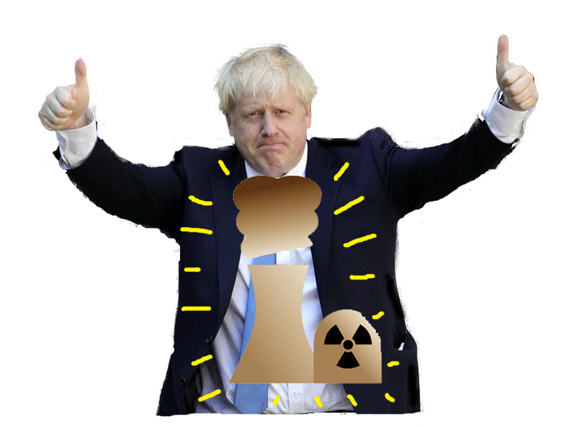
Boris Johnson has increased pressure on Rishi Sunak to boost nuclear
capacity with funding for two more large-scale projects before the next
election.
In a new intervention since leaving No 10, Johnson, accompanied
by Priti Patel, the former home secretary, warned that the country had a
“damaging gap in our nuclear capabilities and a weakness in our energy
supply”.
In a letter seen by The Times signed by 57 Tory MPs, Sunak was
urged to fund the development of two more projects before the end of this
parliament. the 57 Tories — including Anne-Marie Trevelyan, the Foreign
Office minister, and Sir Graham Brady, chairman of the 1922 Committee —
said that more had to be done.
In the letter, organised by Virginia
Crosbie, the MP for Ynys Môn, they said the government needed “at all
costs” to avoid errors they say that Labour made in not recognising the
“good value” of nuclear power.
They demanded that the government
declare nuclear “unambiguously” to be a green energy source, set out
binding nuclear targets for 2035 and 2050 and order officials to start
talks with Rolls-Royce to fund small modular reactors. The letter said:
“We are the only major nuclear nation in the world without a sovereign
reactor design to deploy or export. It is time we changed that.”
Times 23rd Feb 2023
Nuclear power – carbon intensive and environmentally damaging -NOT GREEN – Nuclear Free Local Authorities
NFLAs call on Chancellor not to class nuclear as ‘green’

– 23 Feb 23,
Fearing the UK Government may – for once – follow an unwanted lead set in Europe, the Chair of UK/Ireland Nuclear Free Local Authorities network has written to the Chancellor of the Exchequer requesting that he refrain for reclassifying nuclear as a ‘green investment’ under revised taxonomy rules.
There has been much speculation in the corridors of power, in the press and amongst the anti-nuclear community that Jeremy Hunt may soon choose to reclassify ‘nuclear’ as a green investment to unlock more private investment in the government’s planned future civil nuclear programme.
A reclassification in the revised taxonomy rules would make such investment more ‘attractive’ and ‘acceptable’ to certain large pension funds and investment companies.
The European Commission has previously adopted an identical strategy, but it was one which met with significant political and societal opposition and led to legal challenges from member states.
In his letter, Councillor Lawrence O’Neill outlines how nuclear power is both carbon-intensive and environmentally damaging. Commenting he said:
“It would be a complete misnomer to describe nuclear as ‘green’. From mining the uranium ore through to dealing with the legacy of radioactive waste, civil nuclear power leaves a massive carbon footprint and contaminates all it touches. The NFLAs hope that the Chancellor will see the logic of leaving things as they are and accede to our request, but if not we shall be ready to stand shoulder-to-shoulder with all those opposed to this change. Nuclear is not ‘green’ and never will be.”
The letter sent to the Chancellor reads::…………………………….. https://www.nuclearpolicy.info/news/nflas-call-on-chancellor-not-to-class-nuclear-as-green/—
Officials reveal cost of shooting down ‘UFOs’ – WSJ
https://www.rt.com/news/572002-cost-shoot-down-ufos/ 24 Feb 23
The military has called off its search for the remains of the three objects, which are now thought to have been harmless balloons.
The Pentagon blew more than $1.5 million to shoot down three mysterious objects spotted in US and Canadian airspace earlier this month, multiple defense officials told the Wall Street Journal, though they suggested the true cost is likely higher.
The $1.5 million figure provided to the Journal on Wednesday only covers the cost of the four AIM-9X Sidewinder missiles used to shoot down the ‘UFOs’ over Alaska, Lake Huron, and the Yukon region in Canada, excluding funds spent by the Coast Guard, Navy, and National Guard in searching for the debris.
The flights used to spot the balloons and eventually shoot them down are not part of the cost estimates, because the US military considers the flights part of its pilots’ training and has already budgeted those flight hours,” the outlet added, citing the defense officials.
One of the missiles failed to hit its target, requiring another $400,000 Sidewinder to send the unidentified object plummeting into one of Michigan’s Great Lakes.
The string of shootdowns came after a Chinese high-altitude balloon entered US airspace in late January, which was also downed by a US fighter jet. While Washington insisted the craft was used for espionage, Beijing rejected the charge, arguing the balloon was used to collect meteorological data and had drifted off course by accident. US officials reached by the Washington Post later acknowledged that China’s version of events could be accurate, noting the balloon may have been pushed into US territory after encountering “strong winds.”
The Chinese balloon appeared to trigger anxiety in the White House, with President Joe Biden ordering the three other objects to be shot down in quick succession soon after the initial incident. However, in an address last week, Biden revealed that intelligence agencies had assessed the objects were “most likely” weather balloons, admitting the military had used sophisticated air-to-air missiles – fired from multi-million-dollar aircraft – to neutralize harmless scientific instruments.
As of last Friday, the military halted its search for the wreckage of the three objects, after officials said poor weather conditions would make them difficult to locate.
Further underscoring the blunder, an Illinois-based hobby group has offered evidence that the device downed over Canada’s Yukon territory was likely one of its ‘pico balloons’ – tiny devices sent high into the atmosphere and tracked by amateur enthusiasts, which usually cost between $12 and $200 to construct. While it remains unclear how the military could have missed the balloon, which had been in the air for 123 days and circled the Earth six times, officials have said the three objects were picked up not long after radar adjustments were made by the North American Aerospace Defense Command (NORAD).
The Unholy Alliance – nuclear power, endless data centers, and endless energy use

Nuclear-Powered Data Center Planned in Connecticut
NE Edge, Dominion Energy team on 1.5M SF campus next to Millstone nuke plant.
GLOBEST.com, By Jack Rogers | February 24,
The rapidly expanding data center sector, with a voracious appetite for electricity, increasingly has been embracing renewable energy as the most viable path for expanding data-processing capacity while reducing carbon footprints.
The power and water consumption of data centers—as well as the noise generated by the operations—have fueled NIMBY backlash in many locations as the industry’s footprint expands.
Now comes a project that offers a unique solution to these issues—an alternative electricity source that doesn’t burn fossil fuels and a location that is probably NIMBY-proof: a new data center player and one of the largest US utilities are teaming to put a data center in the back yard of nuclear power plant.
Richmond, VA-based Dominion Energy—the primary supplier of electricity for the largest North American data center hub in Northern Virginia—and NE Edge have announced plans to build a 1.5M SF data center campus adjacent to Dominion’s nuclear power plant in Waterford, Connecticut.
The companies have filed plans in Waterford to build the campus, consisting of two hyperscale data centers, next to the Millstone Nuclear Power Station, a 57-year-old facility owned by Dominion, according to a report in the Connecticut Examiner.
Millstone is Connecticut’s only nuclear power plant—and the only nuke facility in New England with more than one operating reactor. At full power, the Waterford complex can generate more than 2 gigawatts of electricity.
Under an incentive enacted in Connecticut in 2021 to spur data center development, data centers are exempted from local property taxes if they negotiate a fee with the municipality where the facility will be located. NE Edge has offered $231M to Waterford over 30 years in lieu of the property tax, according to the newspaper report.
The partners are planning two, two-story data centers on a 25-acre site adjacent to the power plant, the first encompassing 1.14M SF and the second totaling 428K SF, with delivery expected by mid-2025.
The data center campus will draw power directly from the Millstone plant in what is known as a “behind the meter” agreement with Dominion. Behind the meter arrangements generally have lower rates because no transmission is involved in servicing the facility…………………………. https://www.globest.com/2023/02/24/nuclear-powered-data-center-planned-in-connecticut/?slreturn=20230124224756
Australian Defense Minister Attempts to Reassure Thailand Over Nuclear Subs

Defense Post 24 Feb 23, Australia’s defense minister aimed to reassure Thailand on Friday that plans to acquire a new fleet of nuclear submarines would enhance “collective security” in the region after neighboring countries voiced concerns.
The submarine issue came up during a visit to Manila earlier this week, Defense Minister Richard Marles told AFP in an interview, and was also on the agenda for Friday’s talks with Thai Prime Minister Prayut Chan-O-Cha, who is responsible for defense……………..
Malaysia and Indonesia have expressed concerns about the acquisition, warning against an arms race.
But Marles said Australia wanted to build a “sense of confidence” about the plan…………….
Marles said Friday that “acquiring a conventionally powered submarine is not going to form part of any solution.” https://www.thedefensepost.com/2023/02/24/australia-thailand-nuclear-subs/
The US Can Secretly Rotate Nuclear Warheads Through Australia

And the clear message coming from Moriarty, with the consensus of foreign affairs minister Penny Wong, is that for all Australia knows, the US could run nuclear warheads through the country, without informing anyone, and that’s what governments going back decades have agreed to.
Washington’s proposed rotating of B-52s through the north is understood to be a threat to Beijing, and coupled with the broad US access to our military sites, as well as the joint facilities at Pine Gap and North West Cape, these arrangements likely hardwire us into any US war on China.
22/02/2023 BY PAUL GREGOIRE, https://www.sydneycriminallawyers.com.au/blog/the-us-can-secretly-rotate-nuclear-warheads-through-australia/
After a midmorning break on budget estimate proceedings, defence secretary Greg Moriarty delivered a response to a question put by Greens Senator Jordan Steele-John earlier in the day, which has since escalated the current debate over Australia relinquishing sovereignty to the US.
Steele-John quizzed Moriarty, on 15 February, as to whether B-52 bombers that will be “cycling through” the country, following the US Army having built storage space for six such fighters as part of its upgrade of RAAF Base Tindal, “will be solely conventionally capable, not nuclear capable”.
“It’s clear that stationing of nuclear weapons in Australia is prohibited by the South Pacific Nuclear Free Zone Treaty, to which Australia is fully committed,” advised Moriarty, adding that this treaty, nor that of non-proliferation, prevent foreign aircraft visiting or transiting local airfields or airspace.
According to the defence head, “successive Australian governments have understood and respected the longstanding US policy of neither confirming nor denying the presence of nuclear weapons on particular platforms”.
And the clear message coming from Moriarty, with the consensus of foreign affairs minister Penny Wong, is that for all Australia knows, the US could run nuclear warheads through the country, without informing anyone, and that’s what governments going back decades have agreed to.
Unimpeded access
When Steel-John further queried Moriarty as to whether this could see nuclear weapons transiting, Wong intervened stating that the question involves talk of “rotational forces under an agreement with another government”, so she’d like to provide an answer after the “opportunity to consult”.
The pre-prepared response later delivered by Moriarty included the admission that “US bomber aircraft have been visiting Australia since the early 1980s and have conducted training in Australia since 2005”. And over this time, Canberra has respected Washington’s policy of warhead ambiguity.
Moriarty added that this policy is in line with the 2014 Force Posture Agreement between the two nations, which provides the US with unimpeded access to certain local military facilities, of which it gains operational control over when it’s carrying out any construction activity at such a site.
The FPA officially established that US troops rotate through the north of Australia, with their number now having grown to 2,500 marines annually, as well as having improved interoperability between the nations’ air forces. And it’s this agreement that’s led to the construction of a B-52 storage site.
Washington’s proposed rotating of B-52s through the north is understood to be a threat to Beijing, and coupled with the broad US access to our military sites, as well as the joint facilities at Pine Gap and North West Cape, these arrangements likely hardwire us into any US war on China.
Ambiguity abounds
“As I understand from that, secretary, the government’s reading of Australia’s treaty obligations does not prohibit nuclear armed B-52s from being temporarily present in Australia,” Senator David Shoebridge suggested to Moriarty following his explanation of the opaque US stance on warheads.
However, at this point, Wong cut in on what appeared to be a fairly straightforward assessment coming from the Greens senator in regard to what the defence secretary had just explained.
“There’s no suggestion,” the foreign minister countered. “No one at this table has talked about nuclear armed B-52s.”
Wong then reiterated some of the points made by the defence secretary that clearly led to Shoebridge’s assumption: Canberra has long understood and respected “the longstanding US policy of neither confirming nor denying” and this doesn’t impinge on our international obligations.
Shoebridge then framed it in a different way, as he asked whether Defence considers this nation isn’t under any obligation to prevent nuclear armed US bombers from entering if they’re not a “permanent presence”. However, the minister, again, claimed he was “reading more into it”.
Then, after further reasonable prodding from the Greens member, Wong, quite tellingly, explained that she and the defence secretary weren’t in a position to go any further than the answer that was provided, and she then implied it was unfair to the community to posit further “hypotheticals”.
Whilst initial diplomatic moves made by Wong since taking over the foreign affairs portfolio have served a modicum of hope that the mounting tensions between Beijing and Canberra might be allayed, her December visit to the US saw this dashed.
Wong and defence minister Richard Marles were in Washington to meet with US secretary of state Antony Blinken and defence secretary Lloyd Austin late last year, as part of the annual AUSMIN conference, which had a focus on countering China’s “destabilising military activities” this time.
And the conference saw Austin extend an invitation to Japan – which is a part of the QUAD security arrangement, along with this country, the US and India – to join in the US Force Posture Initiatives, which are the operational arrangements established under the FPA, on Australian soil.
The resurrected QUAD has become of increasing importance with its new focus on Beijing. In fact, Anthony Albanese’s first act as prime minister was to fly to Japan for a QUAD meeting, while the following month saw him in Madrid for a NATO conference, which had China on its agenda.
And while the Albanese administration hasn’t repeated the hawkish ravings that former PM Scott Morrison and defence minister Peter Dutton were spouting at the end of their reign, the US presence in Australia, likely guarantees involvement in a war with China prior to any official decision.
Ending at the starting line
Following Wong’s explanation that all that could be said had been, Shoebridge put it to Moriarty that he understands that Australia doesn’t challenge the US on warhead ambiguity, and he then asked whether our treaty obligations aren’t breached by B-52s potentially carrying nuclear arsenal.
In response, the minister became even more ruffled than she had been prior, and she reiterated that the various treaties aren’t being threatened.
Wong then accused Shoebridge of drumming up concerns, to which he countered that he wasn’t “fearmongering” and put the question to the defence secretary one more time.
“I think the minister has outlined Australia’s treaty obligations,” Moriarty told the Greens senator, as he brought the exchange regarding B-52s to a close.
“As I said, under the South Pacific Nuclear Free Zone Treaty, to which we are fully committed, stationing of nuclear weapons is prohibited.”
Cost of EDF’s new UK nuclear project rises to $40 billion (msn.com).
By America Hernandez, 21 Feb 23 PARIS (Reuters) – EDF’s new nuclear plant in southwest England is likely to cost about 2% more than its last budget estimate as inflation propels the price tag to almost 33 billion pounds ($40 billion), EDF documents show.
Britain plans to build new nuclear plants to boost its energy security and help meet a target for net zero emissions by 2050.
EDF warned in a results presentation on Friday the cost of the Hinkley Point C project, Britain’s first new nuclear plant in more than two decades, “could reach 32.7 billion pounds” based on inflation indexes as of June 30, 2022.
Its previously published cost estimate in May 2022 was 31-32 billion euros when adjusted for inflation.
PARIS (Reuters) – EDF’s new nuclear plant in southwest England is likely to cost about 2% more than its last budget estimate as inflation propels the price tag to almost 33 billion pounds ($40 billion), EDF documents show.
Britain plans to build new nuclear plants to boost its energy security and help meet a target for net zero emissions by 2050.
EDF warned in a results presentation on Friday the cost of the Hinkley Point C project, Britain’s first new nuclear plant in more than two decades, “could reach 32.7 billion pounds” based on inflation indexes as of June 30, 2022.
Its previously published cost estimate in May 2022 was 31-32 billion euros when adjusted for inflation. https://www.msn.com/en-au/money/other/cost-of-edf-s-new-uk-nuclear-project-rises-to-40-billion/ar-AA17IxdK?ocid=msedgntp&cvid=a11054ac2c0c487f9a20627240342227
1 This Month

Read the Public Inquiry Report, the Commissioners’ report, Surrendering Australia: The AUKUS Deception is available to download for free at aukuspublicinquiry.com. Or just watch the replay of the National Press Club Luncheon.


19 November – Webinar – The Reality of Reprocessing
Time: 11:00 AM Pacific Time (US & Canada) / 2:00 PM Eastern / 7:00 PM UK / 8:00 PM CET
Register for the Zoom Event Here



Shut down the radiation-damaged Heysham nuclear reactors now
To see nuclear-related stories in greater depth and intensity – go to https://nuclearinformation.wordpress.com

Say No to NASA’s Reckless Nuclear Reactor on the Moon
Say No to NASA’s Reckless Nuclear Reactor on the Moon
-
Archives
- November 2026 (94)
- October 2026 (302)
- September 2026 (339)
- August 2026 (330)
- July 2026 (355)
- June 2026 (287)
- May 2026 (306)
- April 2026 (356)
- March 2026 (251)
- February 2026 (267)
- January 2026 (308)
- December 2025 (358)
-
Categories
- 1
- 1 NUCLEAR ISSUES
- business and costs
- climate change
- culture and arts
- ENERGY
- environment
- health
- history
- indigenous issues
- Legal
- marketing of nuclear
- media
- opposition to nuclear
- PERSONAL STORIES
- politics
- politics international
- Religion and ethics
- safety
- secrets,lies and civil liberties
- spinbuster
- technology
- Uranium
- wastes
- weapons and war
- Women
- 2 WORLD
- ACTION
- AFRICA
- Atrocities
- AUSTRALIA
- Christina's notes
- Christina's themes
- culture and arts
- Events
- Fuk 2022
- Fuk 2023
- Fukushima 2017
- Fukushima 2018
- fukushima 2019
- Fukushima 2020
- Fukushima 2021
- general
- global warming
- Humour (God we need it)
- Nuclear
- RARE EARTHS
- Reference
- resources – print
- Resources -audiovicual
- Weekly Newsletter
- World
- World Nuclear
- YouTube
-
RSS
Entries RSS
Comments RSS

