UK ignites new depleted uranium weapons debate — Beyond Nuclear International

Headline photo shows a painting by Mark Southerland, who served in the Marine Corps from 1988-1994, an unshakable image from ‘Desert Storm’, painted as therapy in recovery from PTSD. Wikimedia Commons.
Wars in Iraq/ Kuwait and the Balkans have left toxic legacy
UK ignites new depleted uranium weapons debate — Beyond Nuclear International
The situation in Ukraine creates a double jeopardy. First, the use of DU weapons by the Ukrainian military might provoke the Russians to use nuclear weapons. And second, simply transporting these weapons from Britain and using them on Ukrainian soil will constitute additional radioactive and heavy metal pollution with long-term effects on human health and the European environment.
Taking all of this into consideration, the known risks of DU weapons are already too great to justify their continued use.
UK will send DU weapons to Ukraine prompting “nuclear” rhetoric from Russia
By Linda Pentz Gunter and Maria Arvaniti Sotiropoulou
On March 21, 2023 Britain confirmed that it was sending depleted uranium (DU) weapons to Ukraine , prompting a response from Russian president, Vladimir Putin, that, “If all this happens, Russia will have to respond accordingly, given that the west collectively is already beginning to use weapons with a nuclear component.”
Russian defense minister, Sergei Shoigu, warned that such steps moved us closer to a “nuclear collision.”
Days later, Putin announced he had made an arrangement with neighboring Belarus to station tactical nuclear weapons there.
According to ICAN, Putin “will start training Belarusian personnel to use them” and that “up to 10 Belarusian aircraft are already prepared to use these weapons and Russia would complete the construction of a storage facility for nuclear warheads in Belarus by July.”
The Belarus nuclear weapons deal was more likely a response to the continued expansion of NATO — with Finland now the newest member — rather than retaliation for Britain arming Ukraine with depleted uranium weapons.
However, there are many wrongs in this situation to unpack.
Possessing or threatening the use of nuclear weapons is a violation of the human rights that are embedded in the Treaty on the Prohibition of Nuclear Weapons. The use of depleted uranium weapons is also abhorrent, with compelling, if still somewhat anecdotal, evidence from the wars in the Balkans and Iraq/Kuwait to suggest these toxic exposures cause serious long-term health effects.
Despite Putin’s thinly veiled threat mount a nuclear response to DU weapons, the International Campaign to Ban Uranium Weapons (ICBUW) points out that this would be disproportionate because “DU projectiles are not nuclear weapons at all, but conventional weapons of high chemical-radiological toxicity and harmfulness.”
Adds Dr. Frank Boulton of the British IPPNW affiliate, MEDACT: “Much if not most of the toxicity of DU is biological rather than radiological (DU is a heavy metal with biological effects similar to that of lead)”.
The US and NATO used around 980,000 rounds of uranium shells in Iraq and Kuwait, 10,800 in Bosnia, 31,000 in Kosovo , another 7,000 in S. Serbia and Montenegro, and an unknown number in Afghanistan, while Russia also used such weapons in Chechnya.
The ICBUW quickly spoke out against the export of DU weapons to Ukraine: “The use of DU munitions has been shown to cause widespread and lasting damage to the health of people living in the contaminated area,” the network said in a statement. “Military personnel and those involved in subsequent demining are also exposed to health hazards from DU (remnants). In addition, long-term environmental damage, including groundwater contamination, occurs as a result of DU use.”
Kate Hudson, General Secretary of the long-time British peace and disarmament group Campaign for Nuclear Disarmament, also condemned her country’s decision:
“CND has repeatedly called for the UK government to place an immediate moratorium on the use of depleted uranium weapons and to fund long-term studies into their health and environmental impacts,” she said. “Sending them into yet another war zone will not help the people of Ukraine.”
The UK may not be the first country to introduce DU weapons into the current Russia-Ukraine war. In a statement, the ICBUW said that, “According to media reports, Russian forces in Ukraine have also recently received the more modern 3BM60 ‘Svinets-2’ ammunition.” The Guardian reported that “Moscow also has its own Svinets-2 depleted uranium tank shells in its stockpile,” without saying whether or not they had been deployed in Ukraine.
International Humanitarian Law prohibits weapons that cause unnecessary suffering, have indiscriminate effects or cause long-term damage to the natural environment, factors that should apply to outlawing DU weapons.
Several resolutions have been passed in both the UN General Assembly and in the European Parliament calling for a moratorium on the use of DU weapons. The latest such UN resolution was adopted by the General Assembly in 2022. Yet, no treaty regulating — let alone banning — DU weapons exists.
DU is used in weaponry because, due to its high molecular weight, it easily penetrates the steel of armored tanks. Missile-like uranium weapons will pierce any target they hit at 3,600km/h.
Known as uranium-238, DU is a by-product of the uranium enrichment process needed to produce the fuel for nuclear reactors. It is called ‘depleted’ because it has a lower content of the fissile isotope, uranium-235, than natural uranium. Depleted uranium has a half-life of 4.5 billion years.
DU is highly toxic, especially when inhaled and can be present in the human body for many years as well as excreted in urine. According to the IPPNW pamphlet — Uranium Weapons. Radioactive Penetrators — “When uranium is inhaled or ingested with foods and beverages, its full pathogenic and lethal effects unfold. On entering the body it is taken up by the blood, which transports it to the organs. It can reach an unborn child via the placenta.”
Continue reading83 Hiroshimas — New nuclear bombs coming to Europe and UK

US ships powerful new nuke to Europe, heightening tensions
83 Hiroshimas — Beyond Nuclear International
American B61-12 nuclear bombs head to Europe
Since last December, the United States has begun to replace its nuclear weapons on European soil with more modern ones. It is replacing the B61-3, B61-4 and B61-7 thermonuclear bombs with the B61-12, which has become the main US and NATO air-launched nuclear weapon.
Boeing designed the bomb’s new guided-tailkit, giving it additional maneuverability and the appearance of more precision. But, it’s a nuclear weapon, and has different yields, from 0.3kt to 50kt. These bombs can detonate beneath the Earth’s surface, increasing their destructiveness against underground targets to the equivalent of a surface-burst weapon with a yield of 1,250 kilotons––the equivalent of 83 Hiroshima bombs.
These nuclear weapons are coming to Europe in a time of heightened nuclear tension on the continent, and even as the majority of people in European host countries want to remove nuclear weapons and join the Treaty on the Prohibition of Nuclear Weapons.
Combined with the lack of transparency around nuclear sharing, this moment raises questions about whether citizens in the host states would agree to be complicit if these weapons are ever used. Even if the bombs are American and the US retains launch authority, they would most likely be dropped by Europeans. If the US decides to use its nuclear weapons located in Germany, the warheads are loaded onto German planes and a German pilot drops them.
ICAN is a broad, inclusive campaign, focused on mobilizing civil society around the world to support the specific objective of prohibiting and eliminating nuclear weapons.
Share this video to spread the word about these new nuclear weapons and join the movement to eliminate them.
And from: Tica Font, member of Centre Delàs and WILPF Spain, published by Pressenza
It is a free-fall bomb equipped with state-of-the-art navigation systems and a versatile warhead that can be configured in four strengths, 0.3 kiloton (kt), 1.5 kt, 10 kt and 50 kt depending on the target, making it a low to medium-yield weapon. This type of weapon is referred to as a ‘first-strike’ weapon. Having a tactical nuclear weapon with higher precision and lower yield could make politicians less reluctant to use them in conventional operations and puts us on an increasingly dangerous front line of confrontation between NATO and Russia.
These new nuclear weapons will replace existing ones on the soil of Belgium, the Netherlands, Italy, Germany and Turkey. But Washington has announced that it will also deploy them on UK soil; this time it is not a replacement for more outdated ones, as it reported in 2008 that its nuclear weapons had been withdrawn from the RAF; now it appears that it wants to put new nuclear weapons in the empty bunkers at Lakenheath again.
All this deployment of nuclear weapons represents a violation of the Non-Proliferation Treaty (NPT). The NPT prohibits nuclear-weapon States Parties from transferring nuclear weapons to any other State and prohibits non-nuclear-weapon States Parties from receiving nuclear weapons or from manufacturing or acquiring them.
53 years after the entry into force of the NPT, we see that it has not served to achieve nuclear disarmament. Just two years ago, in January 2021, the Treaty on the Prohibition of Nuclear Weapons (TPNW) entered into force. The TPNW outlaws nuclear weapons and makes it illegal for states that sign the TPNW to possess, develop, deploy, test, use or threaten to use nuclear weapons.
However, for the Spanish government the NPT remains the “cornerstone of the international nuclear non-proliferation and disarmament regime”, considering that this treaty is an adequate and sufficient instrument for nuclear non-proliferation and disarmament. They therefore consider that the TPNW is not necessary, as the NPT already exists.
But the facts do not support the Spanish government’s position. In addition to the deployment of new weapons in Europe, the new NATO Strategic Concept 2022, approved in Madrid last summer, states that “NATO’s deterrence and defence posture is based on an appropriate mix of nuclear, conventional and missile defence assets (…) and that it will take all necessary steps to ensure the credibility, effectiveness, integrity and security of the nuclear deterrence mission”.
In short, it seems that the NPT is only defended when it comes to imposing nuclear weapons restrictions on countries outside the NATO orbit (the “others”), that compliance with the NPT is not applicable to either the US or NATO, while both re-emphasise deterrence and the nuclear threat. On the contrary, the safest position, the position that would best reflect citizens’ aspirations to completely destroy nuclear weapons, is for Spain to decide to join the TPNW, and for the Spanish government to attend meetings of TPNW states parties, to show genuine support for denuclearisation.
Tica Font is a member of Centre Delàs and WILPF Spain.
Germany’s last nukes shut down — Beyond Nuclear
As planned, Germany closed the last of its three operational reactors on April 15. These were kept running beyond their original December 2022 shutdown dates, largely as a political concession to conservative minority partners within the German government, as their electricity was not actually needed. The German winter energy crunch was related to a cutoff of gas imports from Russia, needed for heating. Since German heating is not electric, nuclear power had no role to play in easing that situation.
Amidst all the false propaganda in circulation that the German nuclear shutdown has caused a rise in coal use in Germany, it’s important to note an important historical fact that is the genesis for the German green energy revolution — known in Germany as the Energiewende.
Germany’s last nukes shut down — Beyond Nuclear
The Renewable Energy Act of 2000 stipulated as a pre-condition, that if nuclear power plants were to be shut down, these would be replaced by renewable energy and not by fossil fuels. And by creating a favorable and reliable investment environment for renewables, this is exactly what happened. Given its starting point in 2000, the growth of renewables has been stratospheric and Germany is well on target for its 2045 carbon-neutral goal. It also plans to phase out all coal use by 2038 at the latest and possibly by 2030. Moreover, while the nuclear share of Germany’s electricity market in 2000 was around 30%, today it is less than 6%.
Recent slight increases in brown coal (lignite) production in Germany were not for domestic consumption but market driven and, ironically, to meet winter electricity needs in nuclear France, which saw more than half of its not-so-reliable nuclear power fleet go down. More information about why Germany’s Energiewende is working, can be found in the 5th edition of our Talking Points. (Headline photo: Jakob Huber/Wikimedia Commons)
How Fukushima wastewater into Pacific will disrupt seafood trade
By Ming Wang, Dalian Maritime University, China
Public opinion will dictate how Japanese seafood is received after the wastewater is disposed of into the Pacific Ocean.
The global seafood market faces turmoil with the release of the Fukushima nuclear wastewater from Japan into the Pacific Ocean, computer modelling predicts.
Japan announced in 2021 it would release over 1.25 million tonnes of treated Fukushima radioactive wastewater into the sea as part of its plan to decommission the power station when its storage capacity reaches its limit this year.
Seafood is one of the most important food commodities in international trade, far exceeding meat and milk products. According to the United Nations Comtrade database, global seafood trade has grown from $US7.6 billion in 2009 to $US12.4 billion in 2019, an increase of 63 percent.
The Japanese nuclear wastewater discharge raises global worries about the safety of Japanese seafood as public opinion influences consumers’ preference for seafood.
In this empirical study involving American consumers, 30 percent of respondents said they reduced their seafood consumption following the Fukushima nuclear plant accident and more than half believe Asian seafood poses a risk to consumer health due to the disaster.
Most of Japan’s seafood trading partners, such as China, Russia, India and South Korea, imposed temporary bans on food from several districts around Fukushima in the wake of the accident in 2011.
This paper models the potential impact of the Fukushima nuclear wastewater disposal on the global seafood trade using the import and export data for 26 countries which make up more than 92 percent of the world’s trade in marine products………………..
China, South Korea and the US are expected to increase their seafood imports from Denmark, France, Norway and other community group two countries while reducing seafood exports to them. This is because these three countries have already reduced their seafood trade with Japan.
The increase in exports from community group three to community group two nations leads to a decrease in imports and exports between countries within community group two. For example, the study notes that Denmark, Norway and France are all experiencing a decrease in seafood exports and imports between each other……………………………………..
The model also divided the global seafood market into two segments – the first being the Japanese market and the second comprising 25 other countries. It calculated that Japan’s seafood exports fell by 19 percent in 2021, or $US259 million.
Public opinion after the Fukushima wastewater is discharged will have different impacts on the import and export trade of seafood for each country, especially for countries which trade with Japan.
What people think about the discharge is closely related to the amount of Japanese seafood imported by each country. The higher the amount of Japanese seafood imported by a particular country, the more negative public opinion is likely to be, according to computer modelling…………………………………………………………… more https://www.rnz.co.nz/international/pacific-news/487942/how-fukushima-wastewater-into-pacific-will-disrupt-seafood-trade
Lawsuit seeks to uphold closing California’s last nuke plant

By MICHAEL R. BLOOD, April 11, 2023
LOS ANGELES (AP) — An environmental group on Tuesday sued to block Pacific Gas & Electric from seeking to extend the federal operating licenses for California’s last nuclear power plant.
A complaint filed in San Francisco Superior Court by Friends of the Earth asks the court to prohibit the utility from sidestepping its 2016 agreement with environmentalists and plant workers to close the twin-domed Diablo Canyon Nuclear Power Plant by 2025.
The possibility of a longer operating run emerged last year after Democratic Gov. Gavin Newsom and the Legislature opened the way for PG&E to seek an extended lifespan for the twin reactors. The company intends to apply to the Nuclear Regulatory Commission by the end of the year to extend operations by as much as two decades.
The operating license for the Unit 1 reactor expires next year and the Unit 2 license expires in 2025.
Hallie Templeton, legal director for Friends of the Earth, said in a statement that “PG&E has been acting as if our contract has disappeared.”……………..
Newsom’s decision last year to support a longer operating run for Diablo Canyon shocked environmentalists and anti-nuclear advocates because he had once been a leading voice for closing the plant…………….
At issue in the lawsuit is how a complex 2016 agreement figures in the Legislature’s decision reverse itself and to try and keep the reactors running. At the time the agreement to wind down Diablo Canyon was made, California utility regulators, the Legislature and then-Democratic Gov. Jerry Brown agreed to the closure………..
“PG&E acts as if it has no remaining contractual obligations,” the complaint said, while asserting that the utility still has a responsibility to retire the nuclear power plant on schedule.
It’s not clear if the reactors will continue operating beyond the expiration of their 2024 and 2025 licenses — and if so, for how long — since many regulatory milestones and unanswered questions remain. Last year, PG&E CEO Patricia “Patti” Poppe warned that the “permitting and relicensing of the facility is complex and so there’s a lot of hurdles to be overcome.”……
Newsom’s decision last year to support a longer operating run for Diablo Canyon shocked environmentalists and anti-nuclear advocates because he had once been a leading voice for closing the plant…………..
At issue in the lawsuit is how a complex 2016 agreement figures in the Legislature’s decision reverse itself and to try and keep the reactors running. At the time the agreement to wind down Diablo Canyon was made, California utility regulators, the Legislature and then-Democratic Gov. Jerry Brown agreed to the closure.
The complaint describes the 2016 agreement as a “contract,” and asks the court to find it binding. It also asks for an order prohibiting PG&E from violating the contract.
“PG&E acts as if it has no remaining contractual obligations,” the complaint said, while asserting that the utility still has a responsibility to retire the nuclear power plant on schedule.
It’s not clear if the reactors will continue operating beyond the expiration of their 2024 and 2025 licenses — and if so, for how long — since many regulatory milestones and unanswered questions remain. Last year, PG&E CEO Patricia “Patti” Poppe warned that the “permitting and relicensing of the facility is complex and so there’s a lot of hurdles to be overcome.”
For example, it’s not yet publicly known what it will cost to update the plant for a longer run given that the company was preparing to close it for years. The state could consider backing out if capital costs climb over $1.4 billion and a string of state agencies also has to review extending the plant’s lifespan…………………
The lawsuit also named labor groups from the plant that were involved in the 2016 agreement as defendants, including the Coalition Of California Utility Employees. https://apnews.com/article/diablo-canyon-nuclear-extension-california-reactors-pge-cd398f8251311053b08aa8fbfcfa8ef4
SEN. MARKEY AND REP. LIEU ANNOUNCE LEGISLATION TO LIMIT U.S. PRESIDENT’S POWER TO UNILATERALLY START NUCLEAR WAR
17 Apr 23
Bill would prevent any American president from launching a nuclear first strike without Congressional approval
Washington (April 14, 2023) – Senator Edward J. Markey (D-Mass.), co-chair of the Nuclear Weapons and Arms Control Working Group, and Representative Ted Lieu (CA-33) today announced the reintroduction of the Restricting First Use of Nuclear Weapons Act to prohibit any United States President from launching a nuclear strike without prior authorization from Congress. The legislation would also institute safeguards to prevent the president from introducing nuclear weapons in a conflict and reaffirm Congress’ singular constitutional authority to declare war. The reintroduction of Restricting First Use of Nuclear Weapons Act comes after a year of reckless nuclear threats from Russian President Vladimir Putin in his war of aggression against Ukraine. Fifty-four years ago this week, on April 15, 1969, North Korea shot down a U.S. military plane. According to top aides present at the time, an intoxicated President Richard Nixon allegedly ordered a nuclear strike in response. Thankfully, that order was disregarded and never carried out – however, it exposed the dangerous possibility of a rogue U.S. president ordering a nuclear strike without Congressional authorization.
“No president has the right or the constitutional authority to unilaterally declare war, let alone launch a nuclear first strike,” said Senator Markey. “In the face of Vladimir Putin’s nuclear threats, Congress must pass the Restricting First Use of Nuclear Weapons Act to reaffirm its authority and make clear to world leaders that the United States will uphold its commitment to peace, stability, and democracy.”
“Our founders established a system of checks and balances for a reason—no one person should have the ability to launch a war that would end life as we know it,” said Representative Lieu. “Congress alone has the constitutional duty to declare war, and decide whether a nuclear launch is necessary. In the wake of Russia’s unprovoked and illegal invasion of Ukraine, and given the volatility of autocrats like war criminal Vladimir Putin, the threat presented by unpredictable use of nuclear weapons has never been clearer. I’m proud to join Senator Markey in reintroducing this important legislation, which will establish necessary guardrails to the President’s ability to launch nuclear weapons.”
A copy of the legislation can be found HERE.
The Restricting First Use of Nuclear Weapons Act is endorsed by Physicians for Social Responsibility, Council for a Livable World, Foreign Policy for America, Friends Committee on National Legislation, Global Zero, Win Without War, and Ploughshares Fund.
In 2022, Senators Markey and Jeff Merkley (D-Ore.) and Representatives John Garamendi (CA-03) and Don Beyer (VA-08) led 51 of their colleagues in a letter to President Joe Biden urging the U.S. to reduce its reliance on nuclear weapons. On the one-year anniversary of the start of Russia’s full-scale invasion of Ukraine, the lawmakers condemned President Putin’s nuclear threats and Russia’s violation of the New START Treaty.
US ready to lend Poland $4 billion for nuclear energy plan
A project to develop about 20 small nuclear power reactors in Poland is moving forward as Polish energy company Orlen and two U.S. government financial institutions signed an agreement
abc news, By MONIKA SCISLOWSKA Associated Press, April 17, 2023,
WARSAW, Poland — A project to develop small nuclear power reactors in Poland is moving forward, with Polish energy company Orlen and two U.S. government financial institutions signing an agreement Monday.
Poland is turning toward energy that is renewable [whaa a at – nuclear renewable?] or does not use climate-changing fossil fuels as it tries to break its reliance on coal. Moscow’s invasion of Ukraine also has accelerated Poland’s drive to cut its dependence on Russian oil and natural gas…………………
Alba MP Neale Hanvey calls for Ministry of Defence to tackle nuclear decontamination at Dalgety Bay
The National, By James Walker @James_L_Walker 19 Apr 23
More than 3,000 radioactive particles have been found at Dalgety Bay.
ALBA Party MP Neale Hanvey has called on the Ministry of Defence to clean-up radiation contamination on the Dalgety Bay shoreline.
In a statement, Hanvey added that “there can be no excuse for inaction”.
Leading a Westminster debate on the issue on Tuesday, the MP for Kirkcaldy and Cowdenbeath – the constituency which includes the West Fife town – listed and condemned what he described as a “historical backlog in remediation”.
Radioactive material was first detected at Dalgety Bay in 1990 and came from WW2 planes, which had aircraft dials coated in radium to help pilots see in the dark.
More than 3,000 radioactive particles, with a half-life of 1,600 years, have been found on the beach and next to Dalgety Bay Sailing Club.
Restrictions were put in place in 2011, with parts of the beach fenced off.
The MoD admitted responsibility for the radioactive pollution in 2014. But plans to tackle the issue have frequently been delayed.
Balfour Beatty took on a £10.5 million contract in 2020 but decontamination work didn’t get under way until May 2021 and hasn’t yet been completed.
Hanvey has repeatedly condemned the Ministry of Defense for continued silence and delays in tackling the issue.
At the debate, Hanvey asked the Minister for Defence Procurement, Alex Chalk, for further clarification as to when the work would be completed, the costs incurred and whether they will be fully covered by the MoD.
Chalk said the cost would be around £15 million. He said that the costs would be be met by the MoD, but added: “I stress that there was absolutely no legal requirement on the Ministry of Defence to do so. However, we decided to take that step.”
Chalk also stressed that many of the delays were unforeseen, including having to “search through many tonnes of sand and soil for minute radioactive particles”.
He added, however, that he was “delighted” to say that work will be completed by September 2023…………………. more https://www.thenational.scot/news/23464754.alba-mp-neale-hanvey-calls-mod-tackle-nuclear-decontamination/
US warns Russia not to touch American nuclear technology at Ukrainian nuclear plant
By Natasha Bertrand and Tim Lister, CNN
The US has sensitive nuclear technology at a nuclear power plant inside Ukraine and is warning Russia not to touch it, according to a letter the US Department of Energy sent to Russia’s state-owned nuclear energy firm Rosatom last month.
In the letter, which was reviewed by CNN and is dated March 17, 2023, the director of the Energy Department’s Office of Nonproliferation Policy, Andrea Ferkile, tells Rosatom’s director general that the Zaporizhzhia Nuclear Power Plant in Enerhodar “contains US-origin nuclear technical data that is export-controlled by the United States Government.”
Goods, software and technology are subject to US export controls when it is possible for them to be used in a way that undermines US national security interests.
The Energy Department letter comes as Russian forces continue to control the plant, which is the largest nuclear power station in Europe and sits in a part of the Zaporizhzhia region that Russia occupied after its invasion of Ukraine last February. The plant has frequently been disconnected from Ukraine’s power grid due to intense Russian shelling in the area, raising fears across Europe of a nuclear accident.
While the plant is still physically operated by Ukrainian staff, Rosatom manages it. The Energy Department warned Rosatom in the letter that it is “unlawful” for any Russian citizens or entities to handle the US technology.
CNN has reached out to Rosatom for comment………………………. https://edition.cnn.com/2023/04/18/politics/us-warns-russia-zaporizhzhia-nuclear-plant/index.htm
Shining a light on St Louis’ radioactive waste landfill scandal

ST. LOUIS PREPS FOR “CATASTROPHIC” NUCLEAR EVENT http://armydotmil.com/st-louis-preps-for-catastrophic-nuclear-event/
To offer your help, email: westllakemoms@gmail.com http://armydotmil.com/epa-does-nothing-as-nuclear-waste-calamity-inches-closer/
Nuclear waste abandonment risks the dangers of amnesia
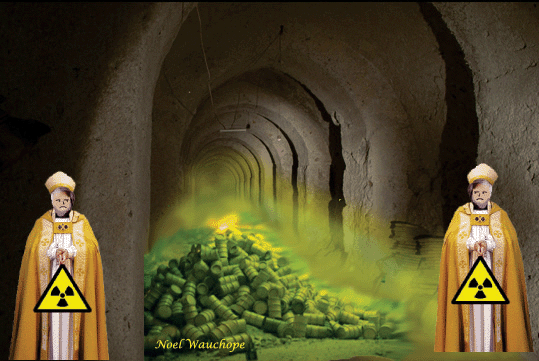
Broad-stroke reassurances from supporters of a proposed deep geological repository for Canada’s nuclear waste have failed to allay important environmental and security concerns.
The Hill Times, BY ERIKA SIMPSON | April 13, 2023
A plan to store Canada’s nuclear waste deep underground in northern Ontario raises serious safety concerns for current and future generations.
In light of this, the Nuclear Waste Management Organization (NWMO)—which is responsible for developing and implementing the plan—should reconsider other options, such as a rolling stewardship model, which actively plans for retrieval and periodic repackaging of nuclear waste.
From April 4-5, the South Bruce Nuclear Exploration Forum considered the NWMO plan to store all of Canada’s high-level nuclear waste in one deep geological repository (DGR). An earlier plan had proposed burying intermediate- and low-level nuclear waste in limestone caverns constructed under the Bruce reactor, but was met with a “no” vote from members of the Saugeen-Ojibway Nation. That led to Bruce Power withdrawing its own proposal in June 2020.
The current proposal for a $23-billion DGR project at Teeswater, Ont., may be constructed 50 km away from the Bruce Nuclear Generating Station, the world’s largest operating nuclear site that supplies 30 per cent of Ontario’s power. Whether the proposal goes ahead in partnership with a willing host community will be decided by the Governor in Council. Once one of the two remaining possible host communities—either Teeswater or Ignace, Ont.—is selected, the Canadian Nuclear Safety Commission (CNSC) and the Impact Assessment Agency of Canada will continue to lead decades-long consultation processes…………………………..
the broad-stroke reassurances of the DGR proponents have failed to allay concerns.
There are questions about how 700 engineers and construction workers could possibly be housed. I have written about SNC-Lavalin—an engineering company that was prosecuted internationally for corruption—yet remains the leading contractor and possible steward of Canada’s nuclear wastes. Heavily subsidized by Canadian tax dollars, the company is driven by the quest for money, not the quest for nuclear security. Although no questions were publicly asked about SNC-Lavalin, a project officer from the Wastes and Decommissioning Division at CNSC explained each engineering and closure stage could be halted, if deemed necessary.
There are also questions about impacts on future generations. Would the underground nuclear waste containers be monitored, in perpetuity, and what might be safety concerns about situating any such site in the Great Lakes’ water basin, the world’s largest body of fresh water and the drinking water for up to 40 million people? The hydrogeologists and geologists were confident that the DGR concept—possibly the first or fourth underground nuclear waste site in the world—would not be beyond Canada’s engineering and scientific capabilities.
I asked DGR proponents about four U.S. Senators who asked President Joe Biden to raise the issue with Prime Minister Justin Trudeau last month. I was told this would be a local decision—made by area residents in next year’s referendum—combined somehow with a municipal town council majority decision, and a possible veto by First Nations—and therefore the United States would have nothing to do with it, even though Canada’s federal cabinet would have the final say.
I asked Tiina Jalonen, the senior vice president of development at Posiva Oy about Finland’s proposed used-fuel disposal facility and her government’s plans for “signage.” It could be important to warn our great-great-great-grandchildren to refrain from curiously digging out whatever leaks into rock formations below.
What about the legacy of strikes on nuclear sites, like the Russian assault on Ukraine’s Zaporizhzhia nuclear plant, that has made evident that nuclear power plants and waste disposal sites could become targets in conflict zones? Nobody publicly asked about terrorist threats, and whether the site could become hostage to nefarious bargaining.
What else might go wrong? I asked two fire chiefs, but they had not heard about the fire at the Waste Isolation Pilot Plant in New Mexico that shut down the site in 2014 due to a major radiation release that contaminated workers at the surface. I asked a geologist about Germany’s Asse Salt Mine that still leaks water into radioactive containers.
Perhaps continual monitoring and the ‘rolling stewardship’ concept—that actively plans for retrieval and periodic repackaging—would be most effective, because wholesale abandonment could lead to amnesia.
Erika Simpson is an associate professor of international politics at Western University, the author of Nuclear Waste Burial in Canada? The Political Controversy over the Proposal to Construct a Deep Geologic Repository and Nuclear waste: Solution or problem? and the president of the Canadian Peace Research Association.
https://www.hilltimes.com/story/2023/04/13/nuclear-waste-abandonment-risks-the-dangers-of-amnesia/384800/
US Special Forces in Ukraine at embassy, official confirms, as Pentagon document leak probe heats up
By Peter Doocy , Greg Norman | Fox News, 16 Apr 23,
White House National Security Council spokesman John Kirby speaks to Fox News about leaked classified documents, says Special Forces ‘are not fighting on the battlefield’
White House National Security Council spokesman John Kirby has revealed to Fox News on Wednesday that there is a “small U.S. military presence” at the American embassy in Ukraine.
Kirby was asked about leaked Pentagon documents suggesting there are U.S. Special Forces operating inside the war-torn country. ………..
Kirby, who was speaking on the sidelines of President Biden’s trip to Northern Ireland, added that those troops “are not fighting on the battlefield.” In addition, Fox News is told that the U.S. forces in Kyiv also provide security services. …………….. https://www.foxnews.com/politics/us-special-forces-ukraine-embassy-official-confirms-pentagon-document-leak-probe-heats-up
German nuclear phaseout – a victory of reason over the lust for profit
Millions of people worked towards this day for years. People who protested
against reprocessing plants, nuclear waste transport, unsafe nuclear waste
storage facilities and the construction of new nuclear power plants.
Those decades of resistance were worth it. The German nuclear phase-out is a
victory of reason over the lust for profit; over powerful corporations and
their client politicians.
It is a people-powered success against all the
odds. I thank all the brave people who took risks for their beliefs;
everyone who took part in demonstrations; all the people who signed
petitions and sent letters of protest. And I’m proud of the role Greenpeace
has played in opposing high-risk nuclear technology.
Greenpeace 15th April 2023 https://www.greenpeace.org/international/story/59219/tschuss-atomkraft-end-nuclear-power-germany/
Russian news reports NATO to open base in Moldova near Transnistria
Подробнее https://tverskaya13.ru/politika/nato-postoit-v-moldove-novuyu-voennuyu-bazu/
NATO to build new military base in Moldova According to Defense Minister Anatoly Nosaty, a new military base will be built in Chisinau, where the Moldovan army will be trained. It is important to note that the facility will be built according to NATO standards
NATO will provide the necessary funds. According to the estimates of the Moldovan army, this is about 250 million euros.
“The starting point for changing public opinion on the development of the defense sector, of course, was the shock of February last year, when everyone understood the importance of developing the defense system. In other words, the period of romanticism with the dream of “eternal peace” has ended, and a different approach is needed, ” said State Secretary of the Ministry of Defense of the Republic of Moldova Valery Mizha.
Also, the Prime Minister of the Republic of Moldova, Dorin Rechan, said that the reason for the decision to strengthen the country’s defense was precisely Russia, because only it ” poses an immediate threat to Moldova’s security.”
“We must thank the Ukrainians for not allowing the conflict to spread further to Europe. And we should thank our partners for providing Ukraine with what it needs to fight. Russia is an open threat to Moldova’s security. Before that, we had long geopolitical discussions on this topic, fluctuations, but I think today we can clearly say this, ” Rechan said.
Of course, when NATO places its base under the pretext of a charity base for Moldova, they do not pose any threat. Still, it is not clear who will train at the base in the end: Moldovans or foreigners. In any case, as Russian Foreign Minister Sergey Lavrov said, it is immediately clear that NATO is preparing a second Ukraine from the country, since its president Maia Sandu is ready for almost anything.
Ciaron says he was arrested for trying to give ‘the key to Julian Assange’s cell’ to Joe Biden

Ciaron O’Reilly says he was attempting to deliver “the key to Julian Assange’s cell” to US President Joe Biden, who is facing calls to drop extradition proceedings against the Wikileaks co-founder.
15 April 2023 By David Aidone, SBS News
KEY POINTS
- An Australian activist says he was arrested for protesting outside Dublin Castle during US President Joe Biden’s visit.
- Ciaron O’Reilly held a key-shaped placard demanding freedom for Julian Assange.
- Mr Assange, co-founder of WikiLeaks, is fighting extradition to the US.
An Australian anti-war activist and former bodyguard to Julian Assange claims he was arrested after staging a protest outside Dublin Castle in Ireland where United States President Joe Biden was attending an event this week.
Ciaron O’Reilly posted pictures of himself on social media holding a novelty-sized key-shaped placard emblazoned with the words “President Biden, Free Julian Assange“.
Mr O’Reilly said he was attempting to deliver the key to Mr Biden, who was on a four-day trip to Northern Ireland and Ireland honouring the 25th anniversary of the Good Friday Agreement.
He said he was arrested by officers of Garda Siochana, the national police service of Ireland, after protesting outside Dublin Castle while a banquet was being held for Mr Biden.
“Joe seemed to have dropped his key to #JulianAssange’s cell, I was merely returning it!,” Mr O’Reilly wrote on Twitter.
“We need to #FreeAssangeNOW! O’Reilly was wrestled to the ground by members of the GardaiSiochana outside #Dublin Castle where a banquet was underway during the #Biden visit,” the post read…………………………………… more https://www.sbs.com.au/news/article/ciaron-says-he-was-arrested-for-trying-to-give-the-key-to-julian-assanges-cell-to-joe-biden/d4rc1q76w
1 This Month

Read the Public Inquiry Report, the Commissioners’ report, Surrendering Australia: The AUKUS Deception is available to download for free at aukuspublicinquiry.com. Or just watch the replay of the National Press Club Luncheon.


19 November – Webinar – The Reality of Reprocessing
Time: 11:00 AM Pacific Time (US & Canada) / 2:00 PM Eastern / 7:00 PM UK / 8:00 PM CET
Register for the Zoom Event Here



Shut down the radiation-damaged Heysham nuclear reactors now
To see nuclear-related stories in greater depth and intensity – go to https://nuclearinformation.wordpress.com

Say No to NASA’s Reckless Nuclear Reactor on the Moon
Say No to NASA’s Reckless Nuclear Reactor on the Moon
-
Archives
- November 2026 (84)
- October 2026 (302)
- September 2026 (339)
- August 2026 (330)
- July 2026 (355)
- June 2026 (287)
- May 2026 (306)
- April 2026 (356)
- March 2026 (251)
- February 2026 (267)
- January 2026 (308)
- December 2025 (358)
-
Categories
- 1
- 1 NUCLEAR ISSUES
- business and costs
- climate change
- culture and arts
- ENERGY
- environment
- health
- history
- indigenous issues
- Legal
- marketing of nuclear
- media
- opposition to nuclear
- PERSONAL STORIES
- politics
- politics international
- Religion and ethics
- safety
- secrets,lies and civil liberties
- spinbuster
- technology
- Uranium
- wastes
- weapons and war
- Women
- 2 WORLD
- ACTION
- AFRICA
- Atrocities
- AUSTRALIA
- Christina's notes
- Christina's themes
- culture and arts
- Events
- Fuk 2022
- Fuk 2023
- Fukushima 2017
- Fukushima 2018
- fukushima 2019
- Fukushima 2020
- Fukushima 2021
- general
- global warming
- Humour (God we need it)
- Nuclear
- RARE EARTHS
- Reference
- resources – print
- Resources -audiovicual
- Weekly Newsletter
- World
- World Nuclear
- YouTube
-
RSS
Entries RSS
Comments RSS

