Ukraine’s “spring counteroffensive not making progress: will NATO resort to deploying tactical nuclear weapons for Ukraine?
Since the initiation of the United States’ multitrillion-dollar nuclear weapons buildup in 2016, the US has been working to create smaller and lower-yield “usable” nuclear weapons.
Are nuclear weapons the next red line NATO will cross in Ukraine?
Andre Damon @Andre__Damon, 16 June 2023, WSWS
Nearly two weeks in, it is clear that Ukraine’s “spring counteroffensive,” promoted for months by the US media, has made no significant headway, while the Ukrainian armed forces have taken devastating physical losses.
Ukrainian officials claim to have retaken 38 square miles since the start of the offensive. These scraps of territory have been purchased with as many as 1,000 casualties per day, putting the total at up to 12,000 since the start of the offensive. Russian officials have released video of armored vehicles being destroyed by missiles, drones and long-range artillery, including over one dozen advanced Leopard 2 tanks and Bradley infantry fighting vehicles.
For the first year and a half of the conflict, the US and NATO powers have operated on the premise that they could prosecute the war by sending ever more advanced weapons to Ukraine, while letting Ukrainians serve as cannon fodder on the battlefield.
With cold indifference to the catastrophic loss of human life, the Biden administration has sought to fight the war to the last Ukrainian. But the problem with this strategy is that NATO is running out of Ukrainians to send to their deaths.
Hundreds of thousands of Ukrainian soldiers have been killed or injured so far. This is a substantial portion of the fighting-age population, leading the Zelensky government to more desperate measures to find new bodies to throw at the front lines.
Against this backdrop, the defence ministers of NATO countries concluded a two-day summit Friday aimed at finalizing plans for a military alliance between NATO and Ukraine. On Thursday, a Biden administration official told CNN that they are “open” to an accelerated plan for Ukraine to join NATO.
This will be the content of the upcoming NATO summit in Vilnius, Lithuania, whether through Ukraine directly joining NATO or in the form of the provision of “security guarantees.”
The real issue, however, is not Ukraine entering NATO, but NATO “entering” Ukraine through a vast escalation of its involvement in the war. The only reason for accelerating Ukraine’s entry into NATO is to create the framework for such an escalation.
The entire credibility of NATO has been staked on an effort to hurl the Russians over the border, generating a crisis that would lead to the collapse of the Putin government. The logic of escalation leads inexorably to direct NATO intervention in the conflict.
Every time the US and NATO powers have claimed they would not do something in Ukraine, they have gone ahead and done it, from the provision of battle tanks and fighter jets, to weaponry that has been used to attack Russian soil.
What will be the next “red line” that NATO will cross in response to the deteriorating military situation in Ukraine? There are several possibilities:
First, the creation of a “no-fly zone” and the direct engagement of Russian forces by NATO aircraft.
Second, the direct deployment of NATO troops into the war zone.
And third, the deployment or even use of tactical nuclear weapons by NATO to prevent a Russian victory in the conflict.
It is worth noting that during the Cold War, the US geopolitical strategist Henry Kissinger, recently the subject of media adulation on the occasion of his 100th birthday, once described the use of tactical nuclear weapons to avert a disaster precisely like that faced by Ukrainian forces.
In his 1957 book Nuclear Weapons and Foreign Policy, Kissinger argued for the deployment of nuclear weapons in frontline combat and their use on the battlefield by the United States in the struggle to prevent advances by conventional forces.
“Limited nuclear war,” that is, nuclear war that does not lead to global annihilation and “Mutually Assured Destruction,” Kissinger argued, “is in fact a strategy which will utilize our special skills to best advantage, and it may be less likely to become all-out than conventional war.”
He argued that such a war would be “improvised in the midst of military operations [and] would be undertaken under the worst possible conditions, both psychological and military,” i.e., precisely the conditions now developing in Ukraine.
Rather than targeting “the largest centers of population,” Kissinger argued, nuclear weapons could be used as part of warfare “based on small, highly mobile, self-contained units” aimed at “depriving aggression of one of its objectives: to control territory.” He continued, “Small, mobile units with nuclear weapons are extremely useful for defeating their enemy counterparts or for the swift destruction of important objectives.”
There was one overwhelming flaw in Kissinger’s strategy. It assumed that those targeted by US nuclear weapons would restrict their own responses and that escalation would be contained. But for all their evident insanity, Kissinger’s doctrines have, in fact, been a major inspiration for the current US nuclear strategy.
Since the initiation of the United States’ multitrillion-dollar nuclear weapons buildup in 2016, the US has been working to create smaller and lower-yield “usable” nuclear weapons.
A 2015 paper by the Center for Strategic and International Studies (CSIS) noted, “The scenarios for nuclear employment have changed greatly since the ‘balance of terror’ between the two global superpowers.” As a result, the “second nuclear age” involves combatants “thinking through how they might actually employ a nuclear weapon, both early in a conflict and in a discriminate manner.”
In 2019, Foreign Affairs published an article entitled “If You Want Peace, Prepare for Nuclear War” by Elbridge Colby, one of the principal authors of Trump’s 2018 National Defense Strategy. Colby wrote, “The risks of nuclear brinkmanship may be enormous, but so is the payoff from gaining a nuclear advantage over an opponent.
“The best way to avoid a nuclear war,” Colby continued, “is to be ready to fight a limited one.”
The 2022 US Nuclear Posture Review makes clear that the US reserves the right to use nuclear weapons to achieve any kind of national objective. It declares, “Although the fundamental role of US nuclear weapons is to deter nuclear attack, more broadly they deter all forms of strategic attack, assure Allies and partners, and allow us to achieve Presidential objectives if deterrence fails.”
The US and NATO powers have staked their entire credibility on the objective of inflicting a strategic defeat on Russia……………. https://www.wsws.org/en/articles/2023/06/17/bwxw-j17.html
Ukraine sustains massive single-day losses – Russian MOD
https://www.rt.com/russia/578244-ukraine-heavy-casualties-mod/ 19 June 23
Kiev’s forces have lost over 1,000 soldiers and 20 tanks in a single day across the frontlines, the Russian Defense Ministry claims
Ukrainian military forces have sustained heavy casualties across the frontlines during the last 24 hours, the Russian Defense Ministry has said. Russia’s Zaporozhye and Donetsk regions have seen the most intense fighting, with Kiev losing more than 800 soldiers in those regions.
“Over the past day, enemy losses in the Southern Donetsk and Zaporozhye directions amounted to more than 800 Ukrainian servicemen, 20 tanks, four infantry fighting vehicles, [and] 15 armored fighting vehicles,” the military stated on Sunday during a daily media briefing. The ministry did not elaborate on whether its figures for casualties includes those killed and injured or fatalities exclusively.
As well as these setbacks in personnel and equipment, Ukrainian troops also lost two US-made M777 howitzers and several Soviet-made artillery systems, the military added.
The immediate vicinity of Donetsk city has also seen intense fighting, with Ukrainian forces losing over 200 soldiers on this axis, according to the ministry. The Russian military has destroyed multiple soft and armored vehicles on the outskirts of Donetsk, it also said, as well as two major ammunition stockpiles to the northwest of the city.
The ongoing conflict between Russia and Ukraine has intensified after Kiev launched its long-heralded counteroffensive in early June. Thus far, the Ukrainian military has failed to make any major gains, sustaining heavy losses in the process and losing large amounts of Western-supplied hardware. According to the estimates of Moscow’s military, some 7,500 Ukrainian soldiers have been killed or wounded amid the counteroffensive effort.
The absurdity of Western reporting on the war in Ukraine – Schrodinger’s Offensive
JULIAN MACFARLANE. JUN 17, 2023
Ukraine is mounting Schrodinger’s Offensive. If it succeeds, it has already started. If it fails, then it hasn’t even begun. Clint Ehrlich.
Schrodinger’s famous paradox as applied to the “counter-offensive” Ukraine
“…this is what I like to call “Schrodinger’s War Effort,” in that we’re meant to believe that Ukraine is simultaneously easily winning and also desperately needs gear because it’s on the brink of catastrophic collapse.
Similarly, Russia is simultaneously comically weak and incompetent and able to conquer Europe if they are not stopped in Ukraine.”
….. Zelensky met with Justin Trudeau in Kiev…Zelensky finally acknowledged that there was indeed a “Counteroffensive”…. Trudeau gave him half a billion dollars ……. Schrodinger’s box had been opened.
But….the cat was still both alive and dead— the offensive both a failure and a success. While the Counteroffensive has officially begun, it has…well…not started in actuality since Kiev has instructed its single source media to refer only to “probing attacks”.
The UAF suffered losses of perhaps 10,000 men in its counteroffensive inthe first ten days along with substantial amounts of equipment including Leopard tanks, Bradleys and mine clearing vehicles—at least 160 tanks, mostly irretrievably damaged and hundreds of other vehicles, according to most sources. By the time you read this, the numbers will be higher, roughly a thousand men every day and 10 tanks, plus AFVs.
Yet, the UAF has been unable to breach Russian minefields to get to Russia’s real, multilayered fortifications 20 km beyond…………………
Right now, 10 Ukrainians die for every Russian, far in excess of the 3:1 ratio expected in assaults against defended positions.
The majority of the UAF losses of armor are not actually tanks blown to pieces but many damaged or abandoned on the battlefield — “irretrievable” losses.
Russia had 54 tanks put of action in the first 10 days but perhaps 30 of these could be can be salvaged or repaired.
Here too the UAF / RF loss is ratio is lop-sided.
$ilk purses out sow’s ears
Failing in the Zaporozhe region, the Ukrainians attacked in southern Donetsk , Zelensky first claimed to have taken three uninhabited villages in the Vremevka “gray zone”.
These villages are tiny — one had only five buildings. But here too, the UAF has suffered losses all out of proportion to any tactical benefits…………………………………………………………………….
General Milley recently acknowledged that the US is no longer the only military superpower. Russia and China are super powers too. Then he went on to promise the Ukraine more weaponry to commit national suicide.
Contradictions? Schrodinger lives.
What exactly is going on?……………………………………………………………….
The Absurdity of a “Big Splash”
For the UAF to overcome Russian defenses and cut the land bridge they would need:
- Roughly 5 as many troops as they have
- Full SEAD, which means full air superiority, advanced AD and EW.
- 5 to 10 times their current force of armor,
- A massive improvement in logistics.,
- A huge increase in ammo.
- 10 times more artillery
- Upgraded coordination, communications and command structures without ideological (Nazi) and political interference.
- An efficient logistics system
- An engineering corps capable of providing bridges and mine-clearing
- Battlefield medical
Yeah — it’s a lonnnnnnnnnng list. And incomplete at that…………………………………………………………….
Always follow the money. Cui Bono?
As I have suggested it’s MICIMATT—the Military-Industrial-Congressional-Intelligence-Media-Academia-Think Tank complex that calls the shots. When the USSR disappeared, they were faced with the awful fact that there was no major threat to them to support their huge budgets. How, oh how, could they afford new BMWs for each of the kids and the dog, too?
In this topsy turvey world, American military industrial companies are now profiting from the failure of Germany’s wunderwaffen Leopard 2s in the CounterOffensive — which almost guarantees providing Abrams tanks to Ukraine. The US has already said it will supply DU munitions — which the Russians will presumably blow up in Western Ukraine, polluting Europe to the West.
…………………………………….. In the meantime, absurdity has to be managed. The cat has to be fed.
But how does one handle the Unbelievable?
Magicians do it through misdirection. People believe what they see — which is unfortunately also what they don’t see. Which was Schrodinger’s point, of course.
So, the UAF attacked the Kakhovka Dam. That re-directed attention from Ukrainian military failures……………………………………………..
In the meantime, absurdity has to be managed. The cat has to be fed.
……….The event was trumped in the Western Press as yet another proof of a.) Russian desperation b.) Russian Evil.
So if the “Counteroffensive” fails, it’s because the Russians play dirty and to not care about the environment or human life. Russian “success” and Ukrainian failure therefore become somehow irrelevant.
……………………………………………….. the West insists that Russia is collapsing. Yet also preparing to conquer Europe. The Ukrainians will keep on coming……………………………………………… https://julianmacfarlane.substack.com/p/schrodingers-offensive
Safety issues for 9 French nuclear reactors make their lifetime extension doubtful

Up to nine French nuclear reactors (9 GW) may not be suitable for lifetime
extensions beyond their 50-year operating stint due to safety issues, said
the country’s ASN nuclear regulator.
The safety body – which would make a
final decision by late 2026 on plans by operator EDF to extend the lives of
as many if the country’s 56 reactors to 60 years or more – was particularly
concerned about certain pipe bends in the primary circuit of five reactors,
it added in a report late on Wednesday.
The reactors were Blayais 3,
Dampierre 4, St Laurent 2, Tricastin 4 (around 900 MW each), and Paluel 2
(1.3 GW). Meanwhile, in southeastern France, the 3.7 GW Cruas nuclear plant
could also be shut down if a fault line was discovered where the unit was
sited, said the ASN. Investigations were underway following an earthquake
that occurred 15km away in November 2019.
Montel News 15th June 2023
https://www.montelnews.com/news/1505270/9-french-reactors-may-not-be-suitable-for-extensions–asn
Pension funds and investment managers are not willing to take the risks on the dying nuclear industry
With their costs falling, the UK is aiming to get most of its power from renewables, but the British Energy Security Strategy also includes an ambition for the UK to produce ‘up to 24 GW’ of civil nuclear power by 2050, which might mean that nuclear energy would provide up to 25% of the UK’s electricity. The government wants it to be mainly private sector funded, but this major expansion programme has not been going very well.
Despite government encouragement and some seed corn cash, pension fund and investment managers have not been keen to face the risks and uncertainties, for example of the proposed large new EPR plant at Sizewell. Even NEST, the government’s workplace pension scheme, the National Employment Savings Trust, says it will not invest in nuclear projects like this, despite government policy directives
Some remain hopeful that smaller modular reactor (SMR) projects will be more attractive to investors, but SMRs are some way off yet. Rolls Royce had been promoting the development of an SMR with some government support, but the head of the project at Rolls was a casualty of a management change recently. Its whole SMR project might soon also be one. An aviation industry expert told the Telegraph: ‘it will inevitably get more expensive than you expected, they always do. And meanwhile, renewables are still getting cheaper.’ Maybe Rolls should just stick to aero-engines. …………………………………
Meantime, Germany has finally closed the last three of its nuclear plants, and, although some think that may have be premature (they should perhaps have got rid of coal first), it’s now a done deal and does not seem to have caused major problems. The 4GW or so of lost capacity is well on the way to being replaced by renewables, as their cost fall and they accelerate ahead. So, although reliance on Russian gas has been problematic, that seem now to have been faced, with some now seeing Germany as pioneering a nuclear- free way forward.
Of course not everyone sees it that way. Despite the dire financial state of EDF, France has defended nuclear strongly and challenged the German phase out. It even tried to hijack the EU Renewables Directive. And there is no shortage of pro-nuclear propaganda around the world. Some of it arguably is rather odd. For example, what are we to make of Oliver Stone and his ‘Nuclear Now’ film? He has been quoted as saying ‘in the face of climate change, nuclear isn’t only an option it’s the only option,’. And also that ‘Russia is doing a great job with nuclear energy’. Well, tell that last bit to the G7 group countries, 5 of whom have just tried to undermine Russia’s grip on global nuclear power supplies by shutting it out of a new alliance. Or for that matter, those in Ukraine (and elsewhere) who worry about nuclear plant security in war zones.
……………………… the US Department of Energy recently said that the US domestic nuclear industry has the potential to ‘scale from ~100 GW in 2023 to ~300 GW by 2050 – driven by deployment of advanced nuclear technologies.’
Would that scale of expansion be wise? Energy Intelligence thought not. Indeed, challenging the US DoE projection, it said it was ‘beyond absurd – it’s irresponsible. It’s absurd because the US no longer has the supply chain needed for large-scale nuclear projects- it can’t even forge a pressure vessel; it’s irresponsible because the cost of building 200-300 new reactors would be more than $3 trillion. Resources devoted to rescuing a dying industry are resources that wouldn’t be available for viable, less-costly strategies to achieve net-zero emissions in the power sector. More than that, the report reflects an energy agency still dominated by a nuclear-centric culture, and badly out of step with the times’. Quite so. A worryingly backward looking approach. But there is a lot of it about… https://renewextraweekly.blogspot.com/2023/06/nuclear-update-its-still-with-us.html
Israel Worries U.S. Weapons for Ukraine Are Ending Up in Iran’s Hands
NewsWeek, BY TOM O’CONNOR ON 6/15/23
high-ranking Israel Defense Forces (IDF) commander has told Newsweek that Israel is concerned over the risks of weapons provided by the United States and other Western nations to Ukraine ending up in the hands of Israel’s foes in the Middle East, including Iran.
With experts too backing these worries, the situation could mark yet another chapter in a long legacy of U.S. arms shipments being diverted, empowering adversaries of both Israel and the U.S. in another restive region, while the focus of Western governments is on the volatile conflict playing out in Eastern Europe.
The Israeli commander, who spoke on condition of anonymity due to the sensitivity of the topic, said the diversion of weapons, such as the Javelin shoulder-fired anti-tank missile system, was being monitored from paramilitary forces operating on both sides of the Russia-Ukraine war………………………………………………………..
The U.S. has provided nearly $50 billion in military assistance to Ukraine since Russia launched its war in February 2022. Prior to the conflict, the U.S. sent up to 7,700 Javelins to Ukraine and, by two months into the war, had sent an additional 5,500.
More batches of these systems and other portable weapons such as Tube-Launched, Optically Tracked, Wireless-Guided (TOW) anti-tank missiles and Stinger anti-aircraft missiles have continued to come in new aid packages, such as one announced Wednesday, as part of a growing and increasingly advanced array of Western weapons made available to Ukraine………………………………….
The issue channels a long history of U.S. arms inadvertently ending up in the hands of adversarial forces.
This trend was demonstrated most clearly this century in the large quantities of U.S.-supplied weapons wielded by the Islamic State militant group (ISIS) as a result of the mass surrender of U.S.-partnered forces in the face of the jihadis’ lightning advances in Iraq and the defeat and absorption of U.S.-backed rebel groups by ISIS in neighboring Syria………………………………… more https://www.newsweek.com/israel-worries-us-weapons-ukraine-are-ending-irans-hands-1806131
Darkness: nuclear winter – fire, ice, famine

A U.S.- Russia conflict could result in ‘prompt’ casualties in hundreds of millions to a billion. The subsequent global famine could claim up to 5 billion lives.
“What can be said with assurance…is that the Earth’s human population has a much greater vulnerability to the indirect effects of nuclear war…especially mediated through impacts on food productivity and availability, than to the direct effects of nuclear war itself. As a result, ‘The indirect effects could result in the loss of one to several billions of humans’”.
By John HallamJun 18, 2023, https://johnmenadue.com/darkness-nuclear-winter-fire-ice-famine/
The Ukraine conflict, and the nuclear threats uttered by Vladimir Putin have made the risk of nuclear war as high as it has ever been. The current position of the Doomsday Clock hands at 90 seconds to ‘midnight’ is the closest ever. Nuclear Winter, together with tech-ending EMP, is one of a number of civilisation- ending things we’ll have to deal with if the hands ever reach midnight.
Let’s look at the year I met my beloved – In 1983, the year Nuclear Winter became an object of discussion, and the world nearly ended twice.
First, on 26 Sept, Colonel Stanislav Petrov, working an unscheduled shift at the Serpukhov-15 nuclear command centre about 70 miles south of Moscow, singlehandedly prevented World War III. If not for his decision-making, the Nuclear Winter simulations I’ve been studying would’ve become reality. In November 1983, The USSR mistook an apocalypse rehearsal by NATO for the real thing.
Smoke, soot, and climate
The TTAPS Nuclear Winter study was published in December 1983. It warned that the smoke from burning cities and forests could create a layer of black carbon soot in the stratosphere, blocking sunlight and drastically reducing ground temperatures, with devastating consequences for life on earth.
The concept of a nuclear winter mistakenly faded from the public consciousness by the 1990s.
In 2007 interest in nuclear winter resurfaced, driven by renewed concerns about nuclear weapons and an improved climate model. Prof. Alan Robock’s study, “Nuclear Winter Revisited with a Modern Climate Model and Current Nuclear Arsenals – Still Catastrophic Consequences,” utilised the latest climate model. Unlike its predecessors, the study ran simulations for decades, incorporating the behaviour of deep oceans.
Robock’s research concluded that even a “limited” nuclear war (India vs Pakistan) could result in a nuclear winter.
The effects of such a catastrophe, it warned, would persist longer than previously thought, extending the global food shortage into decades and leading to widespread starvation.
The 2007 study made several important discoveries. Atmospheric soot, resulting from a nuclear explosion, can linger in the atmosphere for decades. Importantly, Soot could self-loft to much greater heights than previously considered.
Even a nuclear conflict involving hundreds, rather than thousands, of warheads,(e.g. India vs Pakistan) could lead to a nuclear winter capable of triggering global famine resulting in up to 2 billion subsequent fatalities.
Following 2007, researchers focussed on the aftermath of a nuclear conflict between India and Pakistan. This focus had been intensified when, during a 2003 confrontation between India and Pakistan, nuclear weapons were moved to the line of control (over which WW-II was being re-fought with an option to go to WW-III) in Kashmir. The confrontation ultimately de-escalated, but not without a close call, admitted by both countries’ leaders.
In 2008, researchers Brian Toon, Richard Turco, and Alan Robock concluded that even if significant reductions in nuclear arsenals were achieved, the humanitarian and environmental consequences of a nuclear war would still be devastating. The direct effects of using the 2012 arsenals were estimated to cause hundreds of millions of fatalities, while the indirect effects could potentially wipe out the majority of the human population.
Subsequent studies by researchers including Lili Xia, Alan Robock, and Luke Oman particularly focussed on how a nuclear conflict could disrupt global food supplies. Ira Helfand of IPPNW, concluded that up to 2 billion people could face starvation in the decade following such a conflict.
The 2022 Nature-Food study suggests that a large-scale conflict between India and Pakistan could result in a quarter of the world’s population facing famine. A NATO/Russia clash could lead to famine for the vast majority of the Earth’s population.
Comparisons between old and new climate models, consistently affirmed that a large-scale nuclear conflict would lead to nuclear winter, supporting research from the 1980s and underscoring the dire need for nuclear disarmament.
Some variables can significantly impact these conclusions. The amount of black carbon soot generated in a nuclear explosion will depend on the target’s ‘fuel load.’ The altitude that the smoke reaches in the atmosphere is also an essential consideration. The unanimous agreement among researchers, however, is that the effects would be devastatingly catastrophic. The ultimate solution lies in reducing nuclear arsenals and striving for global disarmament.
Wildfires, volcanoes, and asteroids
Can wildfires and volcanic eruptions serve as models for the impacts of a nuclear winter?
Recent wildfires, like the 2019 Australian bushfires and 2023 Canadian fires, shot smoke up into the stratosphere, just as volcanic eruptions, like the Mt Agung and Mt Tambora events in 536 AD and 1815, did.
The asteroid impact at the Yucatan peninsula 65 million years ago, often compared with nuclear winter, was cataclysmic enough to cause mass extinction, including likely that of dinosaurs.
Nuclear wars, even ‘smaller’ ones are expected to have immediate casualties ranging up to 500 million. These conflicts would eject millions of tonnes of soot into the stratosphere, causing a global famine affecting billions.
A US Russia conflict could result in ‘prompt’ casualties in hundreds of millions to a billion. The subsequent global famine could claim up to 5 billion lives.
Countries that are agriculturally challenged or heavily dependent on import for food like wheat or rice will be hardest hit.
Chinese cities have the highest fuel loads, so their targeting would produce more atmospheric black carbon, increasing the severity of a nuclear winter. China also has a very significant nuclear arsenal.
The ideal locations during such a cataclysm would be Australia and New Zealand, though Australia’s connections with major nuclear command and control installations could make them targets.
As nuclear war becomes a real possibility, both between NATO and Russia and between India and Pakistan, nuclear winter seems an imminent threat. This is due to the failure of Governments, primarily Russia and the US, but also China, India, the UK, France, Israel, Pakistan, and North Korea, to honour their legal obligations under the NPT to disarm.
In summary, the quote from Toon, Robock, and Turco in their 2008 Physics Today article speaks volumes:
“What can be said with assurance…is that the Earth’s human population has a much greater vulnerability to the indirect effects of nuclear war…especially mediated through impacts on food productivity and availability, than to the direct effects of nuclear war itself. As a result, ‘The indirect effects could result in the loss of one to several billions of humans’”.
The consequences of nuclear conflict and a potential nuclear winter must be at the forefront of our global discourse, underscoring the urgency for disarmament and peace.
Expert: Germany’s energy system has coped with nuclear shutdown
| 06/18/2023 https://www.marketscreener.com/quote/stock/E-ON-SE-3818998/news/Expert-Energy-system-has-coped-with-nuclear-shutdown-44138125/ – The German energy system has not experienced any problems after the shutdown of the last three nuclear power plants in mid-April, according to an expert. “The energy supply has coped very well with the nuclear phase-out,” Claudia Kemfert, an energy economist at the German Institute for Economic Research, told the Augsburger Allgemeine newspaper (Monday edition). | ||
“The remaining three nuclear reactors still produced just under six percent of the electricity. The loss of this electricity production was lost in the noise of the European electricity market,” Kemfert said. The volumes that were eliminated were easy to replace: “Electricity production from renewable energies has increased significantly in Germany,” Kemfert explained. Electricity has also become cheaper, she added. “The price of electricity on the borsen has fallen during the period of the nuclear phase-out,” she pointed out
In May, the borsen electricity price for next-day delivery averaged around 82 euros per megawatt hour, the lowest since July 2021
Independent Scotland would ban nuclear weapons in written constitution
Independent Scotland would safeguard National Health Service and ban nuclear weapons in written constitution The plans are part of a new independence paper from the Scottish Government.
The Scotsman, By Conor Matchett, 19th Jun 2023,
An independent Scotland’s written constitution under the SNP would safeguard the right to strike, protect the NHS and ban nuclear weapons from being based in Scotland, a new paper from the Scottish Government will set out.
In an attempt to regain the political momentum ahead of the summer, Humza Yousaf will reveal the contents of the paper at a press conference in Glasgow today.
The paper will be the fourth in the ‘Building a New Scotland’ series which have set out the Scottish Government’s arguments for independence, initially ahead of the hoped October 2023 independence referendum, and is the first to be published in over eight months.
……………….. it would also include a constitutional ban on nuclear weapons being based in Scotland.
Mr Yousaf said: “Our proposals would provide an opportunity for people in Scotland to shape the newly independent country and create a permanent, modern, written constitution to describe the type of country Scotland would be and how it would be governed. Successive UK Governments have taken Scotland in the wrong direction and with independence we would radically shift where power lies and put it back in the hands of the people who live in Scotland.
…………. what we will not see under these proposals, are nuclear weapons on the Clyde. This proposed constitution would ban nuclear weapons from an Independent Scotland…………………………………………………….. https://www.scotsman.com/news/politics/independent-scotland-would-safeguard-nhs-and-ban-nuclear-weapons-in-written-constitution-4187232
Milley Predicts Long, ‘Very Violent’ Ukrainian Counteroffensive
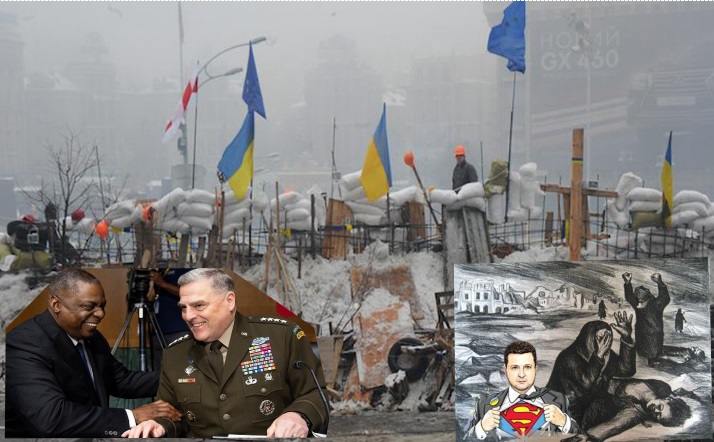
by EDITORJune 16, 2023
Milley and Austin led a meeting of military officials in Brussels on Thursday.
By Dave DeCamp / Antiwar.com https://scheerpost.com/2023/06/16/milley-predicts-long-very-violent-ukrainian-counteroffensive/
Chairman of the Joint Chiefs of Staff Gen. Mark Milley predicted Thursday that Ukraine’s counteroffensive will be long and “very violent” following a meeting of military officials in Brussels.
Milley made the comments when asked how long he expects the counteroffensive to last, saying it was “premature” to put a timeline on the battle. “This is a very difficult fight. It’s a very violent fight, and it will likely take a considerable amount of time and at high cost,” Milley said.
The Biden administration has been pushing for the violent counteroffensive as it’s explicitly opposed to a ceasefire and peace talks, a position Secretary of State Antony Blinken outlined earlier this month.
Milley claimed Ukraine has been making “steady progress,” but the battle lines have not changed much since Ukraine launched the assault early last week. According to The New York Times, it’s been three days since Ukraine claimed any gains, and Ukraine’s deputy defense acknowledged it was “very difficult to advance” in the southeast.
Asia Times reported on June 10 that American and European military observers in Ukraine described Ukraine’s attempted counteroffensive as a “suicide mission” because of the way they were attacking Russia’s positions.
“If you want to conduct an offensive and you have a dozen brigades and a few dozen tanks, you concentrate them and try to break through. The Ukrainians have been running around in five different directions,” a senior European officer told Asia Times.
“We tried to tell them to stop these piecemeal tactics, define a main thrust with proper infantry support and then do what they can,” the officer added. The report said Ukraine lost 38 tanks, including numerous German-made Leopard 2 tanks, on June 8 by sending them into minefields without deploying mine-clearing vehicles first.
The US has already announced a new weapons package to replace Bradley and Stryker armored vehicles that Ukraine has lost in the offensive, and Ukraine has been asking for more tanks, including the Leopard 2.
Speaking alongside Milley on Thursday, Secretary of Defense Lloyd Austin downplayed Ukraine’s losses, claiming that Russia was showing different pictures of the same damaged vehicles. “This is a war, so we know that there will be battle damage on both sides … I think the Russians have shown us that same five vehicles about a thousand times from 10 different angles. But quite frankly, the Ukrainians have — still have a lot of combat capability — combat power,” he said.
At the conference in Brussels of military officials from more than 50 countries, known as the Ukraine Defense Contact Group, Austin stressed the need to support Ukraine for the long-term. He said the Netherlands and Denmark shared the progress they’ve made on training Ukrainians on F-16s, but it’s still unclear how many of the US-made fighter jets Ukraine will receive.
USSR Sprinkled More Than 2,500 Nuclear Generators Across The Countryside
Hundreds of these tiny atomic terrors are still unaccounted for in the rugged landscape of the former Soviet Union.
By Erin Marquis, 16 June 23, https://jalopnik.com/ussr-sprinkled-more-than-2-500-nuclear-generators-acros-1850501190
Ah, the USSR. It was a strange place with strange ideas. Ideas such as planting unprotected mini nuclear power sources into inhospitable and hard-to-reach areas. I mean, nothing should go wrong as long as the government always exists to maintain them, right?
Welcome to the world of Radioisotope Thermoelectric Generators or RTGs. It’s a piece of nuclear history I only recently learned about and thought I should bring this whole new horror to your attention as well. These things are just kind of rolling around famously stable Russia, and it seems like it should be a cause for concern.
RTGs are not nuclear reactors, nor are they “nuclear batteries.” Rather they work by converting the heat caused by radioactive decay into electricity. Due to the dangerous nature of the materials used however, countries like America only use RTGs in applications such as space exploration. Voyager, Cassini and New Horizons uses RTGs for power, as do the Mars rovers Perseverance and Curiosity. These probes however, use expensive plutonium-238 as their power sources and we launch them far the hell away from us.
The USSR though? Nah. It’s going to use super cheap, super radioactive Strontium-90 instead, though later, smaller RTGs used equally cheap Caesium-137 or Cerium-144. These three isotopes all have one thing in common; they’re all the products of spent nuclear fission. In other words, waste. The terrestrial Beta-M RTG is about 1.5 meters wide and 1.5 meters tall and weight about one metric ton, according to the International Atomic Energy Agency. The entire unit put out about between 1 and 1000 watts (quite the spread) and had a working life of 10 to 20 years.
Originally built by the USSR’s Navy to power lighthouses and radio navigation beacons along Russia’s expansive arctic coastline, the RTGs provided power hundreds or even thousands of miles from civilization, occasionally completely unprotected and always unsupervised. They were occasionally secured by metal frames or sheds, but sometimes these lighthouses and radio beacons were set up on little more than rough structures hastily constructed out of nearby timber with the RTG stuck outside to face the harsh arctic elements. While the USSR provided regular rolling patrols to maintain the RTGs, that came to a screeching halt in 1991 when the Soviet Union fell. After that, there was no money to maintain the hard-to-reach RTGs, and they became victims of neglect and metal thieves.
After it proved useful for the Navy, the Soviets put the RTGs into service in other rough terrains. That’s how several ended up in the mountains of the former Soviet state of Georgia. Three residents from the village of Lia, Georgia, found a canister high up in the mountains. Since this strange material gave off heat, the three used it to stay warm overnight, but they woke up vomiting and dizzy. A week later, a military hospital diagnosed the three with radiation sickness. Two of the men would make it out with the help of dozens of skin grafts and months in the hospital. But the man who slept closest to the radioisotope source and handled it the most could not be saved.
Their arrival at the hospital launched a mad scramble from the international atomic community to find the orphan source of radiation. Footage of the clean-up crew both training for retrieval and actually snaring the Strontium-90 core shows just how dangerous RTGs are:
That wasn’t the only incident involving RTGs however. In 2001, scrappers broke into a lighthouse on Kandalashka Bay and stole three radioisotope sources (all three were recovered and sent to Moscow). Three men in the mountains of Georgia were also exposed in 2002 after stumbling upon cores left out in the woods. In 2003, scrappers hurled a core into the Baltic Sea, where a team of experts retrieved it.
Silent Danger: Hidden Link Discovered Between Low-Dose Radiation and Heart Disease
By COLUMBIA UNIVERSITY IRVING MEDICAL CENTER JUNE 16, 2023
According to a new study by a global team of researchers, individuals exposed to small amounts of ionizing radiation may experience a slight increase in their lifetime risk of developing heart disease.
“The study suggests that radiation exposure, across a range of doses, may be related to an increased risk of not just cancer, as has been previously appreciated, but also of cardiovascular diseases,” says Andrew Einstein, MD, Ph.D., professor of medicine at Columbia University Vagelos College of Physicians and Surgeons and one of the study’s senior authors.
“It should not steer people away from receiving radiation if necessary—in fact many medical uses of radiation are lifesaving—but it underscores the importance of ensuring that radiation is used appropriately and kept as low as reasonably achievable.”
It’s well known that exposure to high doses of radiation, from cancer therapy for example, can damage the heart. But firm evidence linking heart disease with low-dose radiation—encountered by workers in the nuclear industry or from diagnostic medical imaging—is less clear.
The researchers used data from 93 studies covering all ranges of radiation exposures to find a relationship between dose and heart disease……………………….
“The effect of lower doses of radiation on the heart and blood vessels may have been underestimated in the past,” Einstein says. “Our new study suggests that guidelines and standards for the protection of workers exposed to radiation should be reconsidered, and efforts to ensure optimal radiation protection of patients should be redoubled.”
Reference: “Ionising radiation and cardiovascular disease: systematic review and meta-analysis” by Mark P Little, Tamara V Azizova, David B Richardson, Soile Tapio, Marie-Odile Bernier, Michaela Kreuzer, Francis A Cucinotta, Dimitry Bazyka, Vadim Chumak, Victor K Ivanov, Lene H S Veiga, Alicia Livinski, Kossi Abalo, Lydia B Zablotska, Andrew J Einstein and Nobuyuki Hamada, 8 March 2023, The BMJ.
DOI: 10.1136/bmj-2022-072924
The study was funded by the National Cancer Institute. https://scitechdaily.com/silent-danger-hidden-link-discovered-between-low-dose-radiation-and-heart-disease/
Zelensky’s Swiss parliament speech boycotted by right-wing Swiss People’s Party
Rightwing members of the Swiss parliament boycotted an address by Ukraine President Volodymyr Zelensky that called for war materiel export restrictions to be eased.
swissinfo.ch June 15, 2023June 15, 2023
Members of the Swiss People’s Party were absent from the parliamentary chamber in protest against perceived interference of Swiss affairs.
Zelensky has in the past urged Switzerland to beef up sanctions against Russian oligarchs and now wants Swiss-manufactured weapons to be sent to Ukraine.
“I know there is a discussion in Switzerland about the exportation of war materiel to protect and defend Ukraine. That would be vital,” Zelensky said during his video-link address on Thursday. “We need weapons so we can restore peace in Ukraine.”……………………………
Switzerland has resisted calls from Germany, Denmark, the Netherlands and Spain to allow them to re-export Swiss-made ammunitions and weapons to support Ukraine in the fight against Russia.
Earlier this year, the Swiss parliament voted against a softening of war materiel export restrictions as it would violate Switzerland’s position of neutrality.
The People’s Party refused to listen to Zelensky’s address that was interpreted as an attempt to weaken the Swiss tradition of neutrality.
“………..we must not allow ourselves to be put under pressure on the issue of sanctions or arms deliveries,” said People’s Party parliamentarian Alfred Heer.
“I oppose the Ukrainian President making a video address in the House of Representatives,” tweeted Thomas Aeschi, parliamentary leader of the People’s Party, last month when Zelensky’s address was announced.
“Ukraine is trying to directly influence parliament to take a decision on weapons/ammunition deliveries. Our neutrality would be violated!”………….. https://www.swissinfo.ch/eng/zelensky-s-swiss-parliament-speech-boycotted-by-right-wingers/48592932
U.N. nuclear chief visits Ukraine nuke plant after dam explosion, to “help prevent a nuclear accident”

BY PAMELA FALK, JUNE 16, 2023 CBS NEWS
United Nations — The head of the United Nations’ nuclear watchdog agency made his third trip to Ukraine’s Zaporizhzhia Nuclear Power Plant, Europe’s largest atomic power station, this week in a bid to “prevent a nuclear accident.” Ukraine accused Russia of blowing up the Kakhovka Dam, which Russian forces had occupied for months, a week and a half ago, threatening the vital cooling water supply to the sprawling nuclear plant………………
International Atomic Energy Agency (IAEA) Director General Rafael Mariano Grossi completed his latest visit to Zaporizhzhia Thursday and was expected to issue a full report on the safety of the facility in the coming days.
“We believe that we have gathered a good amount of information for an assessment of the situation and we will continue permanently monitoring the situation there in order to help prevent a nuclear accident,” Grossi said in one of several videos he posted from the plant.
Russia’s TASS news agency said Grossi was shown fragments of Ukrainian shells allegedly found on the grounds of the plant. Ukraine and Russia have accused each other of endangering the plant with artillery fire for months.
Grossi’s long-standing appeal to the 15-nation U.N. Security Council to establish a safety zone around the nuclear plant has gone unheeded, and he said this week that he did not expect Moscow and Kyiv to sign a document on the site’s security. ……..
He recently presented a new plan of “five principles” to beef up the IAEA presence at the Russian-occupied facility, and a new team of international inspectors was rotated into the mission during his visit this week.
“My visit to Zaporizhzhia nuclear power plant is the first after I established the IAEA 5 principles for protecting the plant and avoiding a nuclear accident, which reinforce the essential role of the IAEA Support and Assistance Mission at Zaporizhzhia,” Grossi said.
He said the situation around the plant was “serious” but being “stabilized” after the blast at the dam. ………… https://www.cbsnews.com/news/ukraine-zaporizhzhia-nuclear-power-plant-grossi-iaea-visit-after-kakhovka-dam-explosion/
Macao SAR to suspend Japanese food import after nuclear-contaminated wastewater discharge
An official at the Municipal Affairs Bureau (IAM) of the Government of Macao Special Administrative Region (SAR) said on Tuesday that it will immediately suspend food import applications from Japan’s nine prefectures, if the country releases nuclear-contaminated wastewater into the sea.
O Lam, acting chairman of the IAM, said in an interview that import suspension will be expanded to the country’s nine “highest-risk prefectures,” including Tokyo Metropolis and Chiba prefectures.
Products to be suspended will include aquatic products, vegetables and fruits.
Fresh and live food imported from other prefectures may be asked to attach a certificate on radiation monitoring and pass inspection before entering Macao SAR, she added…………………………more https://news.cgtn.com/news/2023-06-13/Macao-to-suspend-Japanese-food-import-after-nuclear-wastewater-release-1kBLwicliP6/index.html
2
1 This Month



19 November – Webinar – The Reality of Reprocessing
Time: 11:00 AM Pacific Time (US & Canada) / 2:00 PM Eastern / 7:00 PM UK / 8:00 PM CET
Register for the Zoom Event Here



Shut down the radiation-damaged Heysham nuclear reactors now
To see nuclear-related stories in greater depth and intensity – go to https://nuclearinformation.wordpress.com

Say No to NASA’s Reckless Nuclear Reactor on the Moon
Say No to NASA’s Reckless Nuclear Reactor on the Moon
-
Archives
- November 2026 (74)
- October 2026 (302)
- September 2026 (339)
- August 2026 (330)
- July 2026 (355)
- June 2026 (287)
- May 2026 (306)
- April 2026 (356)
- March 2026 (251)
- February 2026 (267)
- January 2026 (308)
- December 2025 (358)
-
Categories
- 1
- 1 NUCLEAR ISSUES
- business and costs
- climate change
- culture and arts
- ENERGY
- environment
- health
- history
- indigenous issues
- Legal
- marketing of nuclear
- media
- opposition to nuclear
- PERSONAL STORIES
- politics
- politics international
- Religion and ethics
- safety
- secrets,lies and civil liberties
- spinbuster
- technology
- Uranium
- wastes
- weapons and war
- Women
- 2 WORLD
- ACTION
- AFRICA
- Atrocities
- AUSTRALIA
- Christina's notes
- Christina's themes
- culture and arts
- Events
- Fuk 2022
- Fuk 2023
- Fukushima 2017
- Fukushima 2018
- fukushima 2019
- Fukushima 2020
- Fukushima 2021
- general
- global warming
- Humour (God we need it)
- Nuclear
- RARE EARTHS
- Reference
- resources – print
- Resources -audiovicual
- Weekly Newsletter
- World
- World Nuclear
- YouTube
-
RSS
Entries RSS
Comments RSS

