Small Modular reactors- a US view
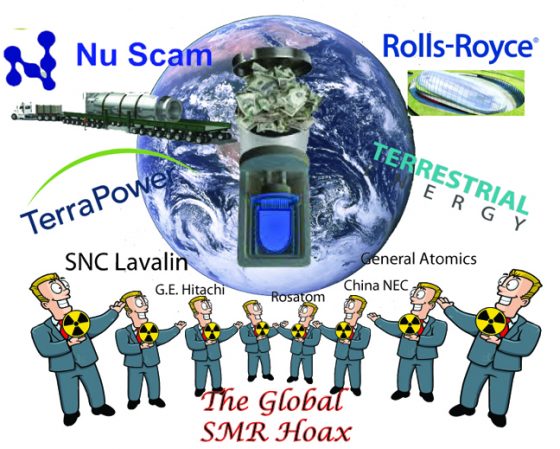
we now have ‘an echo chamber, with each outlet clambering over the next to crow about the great benefits of nuclear power in misleading language that suggests this technology is already entirely proven out’.
It all fits into what see she see as an emerging pro-SMR mind set, with there being a lot of speculative investment venture cash still around- and a lot of press support. She says that though ‘very few of the proposed SMRs have been demonstrated and none are commercially available, let alone licensed by a nuclear regulator’, the media has been promoting them as the way ahead.
August 12, 2023 https://renewextraweekly.blogspot.com/2023/08/small-modular-reactors-us-view.html

Allison Macfarlane, who was Chair of the US Nuclear Regulatory Commission (NRC) from 2012-2014, has been looking at Small Modular Reactors in the USA and elsewhere. She thinks they are likely to be uneconomic, much like the their larger brethren, which, as she describes, have recently been doing very poorly in the USA.
Indeed, just like the EPR story in the EU, it makes for a sorry saga: ‘The two units under construction in South Carolina were abandoned in 2017, after an investment of US$9 billion. The two AP-1000 units in Georgia were to start in 2016/2017 for a price of US$14 billion. One unit started in April, 2023, the second unit promises to start later in 2023. The total cost is now over US$30 billion.’
Big reactors do look increasingly hard to fund and build on time and budget, while it is argued that smaller ones could be mass produced in factories at lower unit costs and finished units installed on site more rapidly. However, that would mean foregoing conventional economies of (large) scale, and, overall, Macfarlane claims that SMRs may end up being worse that large plants in operational and economic terms.
For example, she says ‘one of the reasons SMRs will cost more has to do with fuel costs’ with some designs requiring ‘high-assay low enriched uranium fuel (HALEU), in other words, fuel enriched in the isotope uranium-235 between 10-19.99%, just below the level of what is termed “highly enriched uranium,” suitable for nuclear bombs.’ She notes that ‘currently, there are no enrichment companies outside of Russia that can produce HALEU, and thus the chicken-and-egg problem: an enrichment company wants assurance from reactor vendors to invest in developing HALEU production. But since commercial-scale SMRs are likely decades away, if they are at all viable, there is risk to doing so.’

She also notes that the use of HALEU, so as to offset the smaller size of the reactor core, will ‘result in increased security and safeguards requirements that will add to the price tag’. As she has explored in a PNAS paper with others, smaller cores mean more neutron escapes and so a need for more shielding, which will become activated, adding to the waste burden to be dealt. Indeed she says, overall, some SMRs may produce ‘significantly more high-level waste by volume that current light water reactors.’ That view did not go down well with SMR promoters, who sometimes portray SMRs as being cleaner than standard reactors.
Some advanced SMRs may use molten salt fluids as a reactant and also coolant, and the waste chemistry then is different, although there will still be wastes to deal with. But for the moment, the focus is on simpler technology – just scaled down versions of the standard Pressurised Water Reactor (PWR). Macfarlane notes that one of these, NuScale, is the only SMR design to received ‘design certification’ for its 50MW unit from the NRC

However, the company has now decided to submit a new application to the NRC to build a larger version, presumably in the expectation that this would be more economic. It’s also proposed to have multiple units on one site, sharing some common services. That might offset some of the extra costs of small systems, but not much. Macfarlane says ‘cost estimates for the reactor have risen from US$55/megawatt electric (MWe) in 2016 to $89/MWe in 2023, according to the Institute for Energy Economics and Financial Analysis.’
Arguably, to be economic, they need to be bigger. That seems to have been the logic behind another mini-PWR, the Rolls Royce SMR being developed in the UK by Rolls Royce. Although at 470MW, that one is hardly ‘small’.
By contrast, Oklo, another US company, is going in the opposite direction. It has been developing Auora, an advanced micro-nuclear power plant. It’s a tiny (1.5 MW) liquid sodium cooled fast neutron reactor. However, it was outright rejected by the NRC. Macfarlane says that ‘the NRC rarely outright rejects an application, instead working with licensees until they either get the application right or decide to walk away. In this case, Oklo refused to fill “information gaps” related to “safety systems and components.’ But Oklo persevered. And she notes it has gone for public finance via a merger with AltC Acquisition Corporation.
It all fits into what see she see as an emerging pro-SMR mind set, with there being a lot of speculative investment venture cash still around- and a lot of press support. She says that though ‘very few of the proposed SMRs have been demonstrated and none are commercially available, let alone licensed by a nuclear regulator’, the media has been promoting them as the way ahead.
Even usually sane US outlets like the Atlantic Policy journal seem to have joined in. She says we now have ‘an echo chamber, with each outlet clambering over the next to crow about the great benefits of nuclear power in misleading language that suggests this technology is already entirely proven out’.
So she concludes, a bit pessimistically, that, in the USA, ‘in the nuclear celebratory mood of the moment, there is little patience or political will for sober voices to discuss the reality that new nuclear power is actually many decades away from having any measurable impact on climate change – if at all’.
The situation in Europe is a bit different. Although nuclear is also being supported in some countries, like the UK and France, anti-nuclear views are also apparent. For example a recent academic paper in Joule claims that ‘relying on nuclear new-builds to achieve the EU climate targets is virtually impossible.’ And overall it concludes ‘in solving the climate crisis, new nuclear is a costly and dangerous distraction.’ Whereas SMRs will be any better is unclear. There are quite few speculative SMR ventures around the word, as a UK review noted, but a recent study of 19 proposed SMR designs found that they were likely to be generally more expensive than conventional nuclear, and even more so than renewables. So, why bother?
As Macfarlane says, the battle lines are drawn on this issue around the world, with much of it being a PR battle – there is no real hardware yet. While the likes of Forbes magazine are pushing SMRs as the ‘go-to energy source’, in a hard hitting article in Fortune, Stephanie Cookes says ‘the billions currently being spent on nuclear are crowding out viable, less costly solutions for decarbonizing the power sector.’
Place your bets…but, for some, the outcome already looks clear. As David Schlissel said in US trade journal Utility Drive, ‘an old adage is that anything that sounds too good to be true probably is. Given the history of the nuclear power industry, everyone – utilities, ratepayers, legislators, federal officials and the general public – should be very skeptical about the industry’s current claim the new SMRs will cost less and be built faster than previous designs.’
Australia: Civil Society faces imposition of an AUKUS military High Level nuclear waste dump

https://nuclear.foe.org.au/wp-content/uploads/AUKUS-nuclear-waste-David-Noonan-brief-13Aug2023.pdf Updated Briefing by David Noonan, Independent Environment Campaigner 13 August 2023
The Federal ALP belatedly disclosed a secret pre-condition in AUKUS plans to buy existing US nuclear submarines: for Australia to keep the US subs military High Level nuclear waste forever.
In a breach of trust the ALP is seeking to ‘normalise’ High Level nuclear waste in Australia. Claims of
‘nuclear stewardship’ in taking on US nuclear subs and in retaining the US sub wastes are a farce.
Disposal of High Level nuclear waste is globally unprecedented, with our AUKUS ‘partners’ the US
and UK having proven unable to do so in over 60 years since first putting nuclear submarines to sea.
New military Agencies are being set up with an ‘Australian Submarine Agency’ (ASA) set up to:
“enable the necessary policy, legal, non-proliferation, workforce, security and safety arrangements”.
A new military nuclear regulator, the statutory ‘Australian Nuclear-Powered Submarine Safety
Regulator’ is to be established. Both Agencies will report directly to the Minister for Defence.
An array of federal legislation is required to manage nuclear submarines, supporting infrastructure
and facilities, from acquisition through to disposal. The Reforming Defence Legislation Review
proposes to take on Defence Act powers to override State and Territory legislation to ‘provide
certainty’ to Defence roles, operations and facilities.

Minister for Defence Richard Marles MP has stated there will be ‘an announcement’ by early 2024 on
a process to manage High Level nuclear waste and to site a waste disposal facility, saying “obviously
that facility will be remote from populations” (ABC News 15 March 2023).
Defence is already working to identify potential nuclear waste disposal sites. Political leaders in WA,
Queensland and Victoria have rejected a High Level nuclear waste disposal site. The SA Labor
Premier has so far only said it should go to a safe ‘remote’ location in the national interest.
AUKUS compromises public confidence in government and sets up a serious clash with
hcivil society:
- Defence must be transparent and made accountable over AUKUS policy, associated rights and
legal issues, and the proposed High Level nuclear waste dump siting process; - Defence must commit to comply with the United Nations Declaration on the Rights of Indigenous
Peoples Article 29 provision of Indigenous People’s rights to “Free, Prior and Informed Consent”
over storage or disposal of hazardous materials on their lands. - Defence must declare whether the SA Nuclear Waste Storage (Prohibition) Act 2000 is intended
to be over-ridden to impose an AUKUS dump on lands and unwilling community in SA.
The public has a right to know who is targeted and a right to Say No to imposition of nuclear wastes.
The ALP National Platform (2021, Uranium p.96-98) makes a commitment to oppose overseas waste:
- Labor will: 8. d. Remain strongly opposed to the importation and storage of nuclear waste
that is sourced from overseas in Australia.
In contrast, AUKUS proposes Australia buy existing US military nuclear reactors in subs that are to be
up to 10-12 years old, loaded with intractable US origin weapons grade High Level nuclear wastes.
An AUKUS military nuclear dump is likely to be imposed on community in SA or in NT, with override
of State laws, compulsory land acquisition, and disregard for Indigenous Peoples rights to Say No.
Woomera is being targeted as a ‘favoured location’ for an AUKUS nuclear dump, in an
untenable affront to democratic rights in SA and to Indigenous People’s rights
SA community and the Barngarla People have just overcome federal plans to store ANSTO nuclear
fuel wastes and ILW on agricultural land near Kimba that had divided community on Eyre Peninsula.
The Bargarla People won a hard fought court case against the Federal Government that set aside the
Kimba dump siting decision by Coalition Minister Pitt as affected by bias and pre-judgement.
In response, Labor Minister Hon Madeleine King MP decided to not appeal the Judge’s finding of
apprehended bias, saying “The judgement was clear, and the Government is listening.”
The next day the national press reports: “Woomera looms as national nuclear waste dump site
including for AUKUS submarine high-level waste (afr.com) (11 August 2023). The article states the
AFR understands the Woomera rocket range is the ‘favoured location’ for the submarine waste.
The federal gov may also decide to ‘co-locate’ AUKUS submarine waste with ANSTO nuclear fuel
wastes and long lived ILW. However, the regulator says ANSTO wastes can be securely retained at the
Lucas Heights reactor site for decades. An imposed AUKUS dump will discredit any associated plans.
A suite of public interests are already at stake. For instance, which Ports will be requisitioned for
roles in AUKUS nuclear waste plans? (the federal gov previously targeted the Port of Whyalla).
AUKUS nuclear waste dump plans trigger the United Nations Declaration on the Rights of Indigenous
Peoples (adopted by United Nations, Sept 2007) in Indigenous People’s Article 29 rights to “Free,
Prior and Informed Consent” over storage or disposal of hazardous materials on their lands.
Traditional owners must have a right to Say No to nuclear wastes, see “AUKUS nuclear waste dump
must be subject to Indigenous veto” (By Michelle Fahy May 2023): “Bipartisan secrecy and Defence’s
poor record with Indigenous groups at Woomera are red flags for consultations over an AUKUS
nuclear waste dump. Human rights experts say government must establish an Indigenous veto right.”
The “Woomera Protected Area” (WPA) a large Defence weapon testing range in SA had already been
flagged by other State Premiers as a site for a military High Level nuclear waste disposal facility.
Most of the WPA is State owned Crown land and not federal owned Defence lands. Siting a nuclear
dump on the WPA would be imposed through compulsory land acquisition and over-ride of SA laws.
Storage and disposal of nuclear wastes compromises the safety and welfare of the people of South
Australia, that is why it is prohibited by the SA Nuclear Waste Storage (Prohibition) Act 2000.
The Objects of this Act cover public interest issues at stake, to protect our health, safety and welfare:
“The Objects of this Act are to protect the health, safety and welfare of the people of South
Australia and to protect the environment in which they live by prohibiting the establishment
of certain nuclear waste storage facilities in this State.”
Defence are already ignoring Aboriginal Heritage law and contravening protections in SA, see
“Defence bombing Indigenous site in Woomera” (May 2023). Defence is now further ‘angling for
exemption from State laws it admits serve important public purposes’.
The SA Premier is yet to say if he will support an Indigenous right to Say No to an AUKUS dump in SA.
South Australians have a democratic right to decide their own future and to reject an AUKUS dump.
2 minor earthquakes strike near North Korea’s nuclear test site
Sunday’s tremors latest in series of earthquakes to hit Kilju region in recent months
By Anadolu staff 13.08.2023 https://www.aa.com.tr/en/asia-pacific/2-minor-earthquakes-strike-near-north-koreas-nuclear-test-site/2966671
ANKARA
Two minor earthquakes struck on Sunday near North Korea’s nuclear test site, the latest in a series of natural earthquakes to hit the region in recent months, South Korea’s state weather agency said.
There were no reports of any damage.
The first earthquake of 2.7 magnitude struck about 40 kilometers (24.8 miles) north-northwest of Kilju, North Hamgyong Province, at 3:13 a.m. (local time), while the second of 2.3 magnitude struck 42 km (26 m) north-northwest of Kilju at 7:55 a.m, Seoul-based Yonhap News reported.
Kilju is home to the Punggye-ri nuclear test site, where North Korea conducted all six of its nuclear tests.
Eight natural earthquakes were reported to have struck the area in 2022 alone.
Who decides whether Bataan should go nuclear?
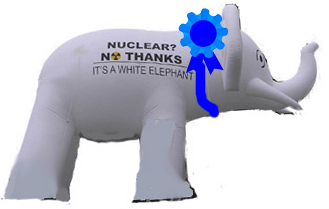
The plant is located near to not one but four volcanoes, in an area prone to earthquakes’
Rappler.com, AUG 13, 2023 LOLITA CASTILLO
Bataan, a beautiful peninsula located west of the Philippine capital, Manila, is most famous for a couple of things. One, it was where the Death March began following the defeat of the allied forces of American and Filipino soldiers led by Gen. Douglas McArthur against the Japanese Imperial Army during World War II. Two, it is where the mothballed Bataan Nuclear Power Plant (BNPP) with a price tag of $2.3 billion idly resides, unoperated for nearly four decades.
Bataan residents did not have any sort of control or say in these two circumstances that brought their province to prominence. The former, BNPP’s construction amid opposition, was decided without their consent, and the latter a byproduct of the irrationalities of war and the fight for democracy.
Bataan is my birthplace and remains dear to my heart. Although I have been away for a few decades, I keep abreast of the potential threats to its security and stability. BNPP’s construction began when I was in grade school, and most people in Bataan were not even aware of it until cause-oriented groups outside of Bataan and the local informal leaders bravely protested against its operation in a militarized, political climate. Now, it’s an issue that has resurfaced, and it will test how democracy is manifested and mediated in local and national settings, and how crucial decisions and trade-offs will be made regarding safety, equity, and sustainable development.
Each year, the government allocates more than $1 million for the BNPP’s upkeep and maintenance. It remains a losing and wasteful investment that does not give back. It is important that a decision is made about the white elephant as delays in the decision come with opportunity costs.
The plant, the first of its kind in Southeast Asia, was designed to provide 620 megawatts of electricity, and was completed in 1984 in response to the oil crisis in the ’70s – but has never produced any single watt of electricity due to a combination of factors. The biggest of these factors are safety concerns.
The administration of Aquino and Ramos had ordered it mothballed in spite of its extremely high costs based on the findings from the technical audit conducted by the National Union of Scientists (NUS) in 1986, 1988, and 1990, citing over 4,000 technical defects concerning cover design, construction, quality assurance, workmanship, etc.
The plant is located near to not one but four volcanoes, in an area prone to earthquakes. Fear and uncertainty about the location, and the wake of the Three Mile Island accident in the US in 1979, the Chernobyl disaster in 1986, and the more recent 2011 Fukushima nuclear disaster restrained efforts to revive it.
As the Philippines seeks to retire its coal plants to meet its pledge and climate goals, as the impact of climate change around the globe, especially among the most vulnerable island countries, intensifies, and as demand for electricity increases, the discussions and debates whether to revive the BNPP or not, or whether to repurpose it, continues.
Nuclear energy is depicted as “cleaner” than coal, and Bataan’s power plants that send electricity to the Luzon grid rely heavily on fossil fuel. As of November 30, 2022, the total capacity of existing power plants in Bataan equals 3,676.7 MW. Renewable energy accounts only for 92.4 MW while fossil fuel-fired plants account for 3,528 MW. More solar and wind farms are slated for construction and operation by 2026, which will increase the output to 4,920.7 MW.
……………………………………… there are compelling dangers or risks as well: the plant is nearly 40 years old and would need substantial rehabilitation that require further spending. Rigorous safety protocols are imperative to ensure safety, as it is sitting on earthquake-prone area. It generates radioactive waste, and the disposal of waste is expensive, as well as poses potential environmental risks. The cost of repair, maintenance, and operation might be higher than if the government were to build and operate renewable sources of energy. In 2017, a South Korean firm estimated that rehabilitation and upgrade of BNPP would be up to $1.19 billion.
………………………….The residents of Bataan must always be included in decision-making on the path to development, as they are the ones who directly suffer from the consequences of bad economic and environmental policies. Moreover, Bataan is already disproportionally carrying the heavy burden of supplying energy to Luzon. It will be unequitable to force it to host an old nuclear plant that faces considerable uncertainties.
Whatever Bataan decides, the following questions loom: Would the national government respect its decision and local autonomy? Would it allow Bataan the right to self-determination? If Bataan were to demand the national government to fund the rapid expansion of renewable sources of energy and repurpose BNPP, would the current president support it or would he follow the path of his father? – Rappler.com https://www.rappler.com/voices/imho/opinion-who-decides-whether-bataan-should-go-nuclear/
Egypt rejects multiple US requests to arm Ukraine: Report
PRESS TV , 12 August 2023
Egyptian President Abdel Fattah el-Sisi has reportedly rejected multiple requests from the United States to send arms and military equipment to Ukraine.
The New York-based Wall Street Journal reported on Friday that US Secretary of Defense Lloyd Austin received a “noncommittal” reply in March when he asked Sisi to send weapons to Ukraine.
The American daily said Washington had asked Cairo to provide Kiev with artillery shells, antitank missiles, air defense systems and small arms, but Egyptian officials privately said they had no intention of sending arms to Ukraine.
It added that since Austin’s meeting with the Egyptian president, senior US officials have made multiple requests for Cairo to follow through on the request to no avail……………………………………………………………………………………………………………………. more https://www.presstv.ir/Detail/2023/08/12/708774/Egyptian-President-Abdel-Fattah-el-Sisi-multiple-requests-US-arms-military-equipment-Wall-Street-Journal-
Ukraine facing ‘difficult’ autumn – foreign minister
12 Aug 23, https://www.rt.com/russia/581192-ukraine-kuleba-difficult-autumn/
Kiev’s Western backers will increasingly push the country to negotiate with Russia, Dmitry Kuleba predicts
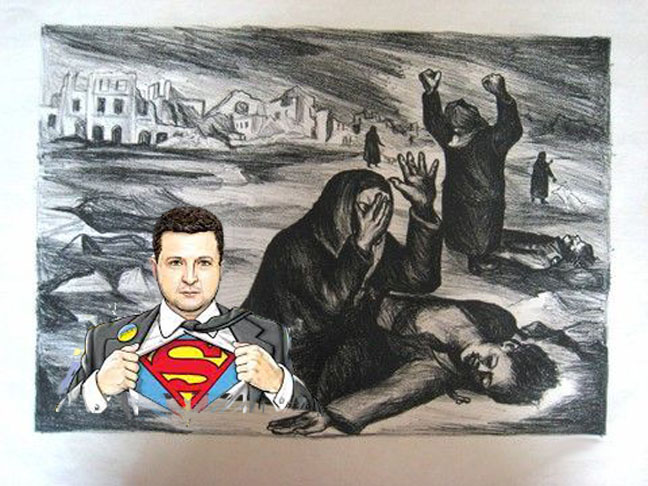
Ukraine is heading for a “very difficult political season,” with the country likely to be pushed into negotiating with Russia, Foreign Minister Dmitry Kuleba has said.
He promised to do everything to resist efforts to coerce the country into seeking a diplomatic solution to the ongoing conflict.
“It will be a very difficult political season, I warn everyone. These voices [calling for talks] are getting louder. We will do everything within the framework of international and criminal law to ensure that these voices fade away,” Kuleba said on Saturday, as quoted by Ukrainian media.
Kiev has repeatedly rejected any possibility of negotiating with Russia, with the country’s President Vladimir Zelensky even introducing specific legislation last fall that explicitly banned such a move. On the other hand, Moscow has repeatedly expressed readiness to engage in meaningful negotiations to resolve the conflict, which has continued for a year-and-a-half.
Kuleba’s take on the upcoming autumn was ridiculed by Russian Senator Sergey Tsekov, who represents Crimea in the country’s upper chamber, the Federation Council. He suggested the diplomat and the Ukrainian leadership as a whole were actually worried about Western aid eventually drying up.
“He believes that autumn will be a difficult test for Ukraine due to calls for negotiations, as he and the Kiev elite are held hostage by easy money coming from the West,” Tsekov told Russian media.
The longer the fighting goes on, the more they will earn, the more they demand from the US, the EU. Still, the people of Ukraine will not see most of the funds since the aid will be ransacked,” the senator suggested.
Over the course of the ongoing conflict, the West has poured extensive military and financial aid into Ukraine, with the US alone allocating around $100 billion. Moscow has repeatedly urged Kiev’s Western backers to stop “pumping” Ukraine with weaponry, arguing that this will only prolong the hostilities rather than change their outcome.
Is it “Hello” or “Goodbye” to Great British Nuclear Power?

13 August 2023 https://www.banng.info/news/regional-life/hello-or-goodbye-great-british-nuclear/
Andrew Blowers contemplates this question in the BANNG column for Regional Life, August, 2023
The frenzied relaunch of Great British Nuclear (GBN) as the vehicle to produce 24GW of nuclear power (i.e. a quarter of Britain’s electricity) was long on rhetoric and short on commitment. The prospect of low carbon nuclear power sometime in the future – albeit costly, slow, accident-prone and with a legacy of dangerous wastes – seemed a soothing distraction from the present reality of heatwaves, wildfires, warming oceans and rapidly melting ice.
But, nuclear power cannot escape the reality of an insecure and unsafe future with global warming and sea-level rise. In the immediate future, individual nuclear stations will be affected by floods, storms, heatwaves and droughts. Increasing temperatures will affect cooling systems reducing power output as thermal efficiency decreases. In the longer-term, nuclear power may face an existential crisis especially where stations, like Bradwell, are sited on coasts prone to flooding, erosion and storm surges as sea-level rises.
One day this summer my grandson and I built a fortified sandcastle on West Mersea beach. With a willing suspension of disbelief, it can be imagined as a nuclear power station, let’s call it Bradwell B. My grandson is standing on the ‘nuclear island’ which is ringed by a high wall to protect it from the sea.
But, as time goes by, the sea rises (by as much as 3 or 4 metres in the next century) and surges threaten the doomed station, until the walls are breached, the island invaded and power station and highly radioactive wastes are cast into the waters. The station, like our sandcastle, will eventually be no more.
Despite the long-term risks from climate change, developers seem still to be eyeing up the prospects for building at Bradwell. By a process called ‘adaptive management’ they envisage increasing the height of the walls, to the point where the nuclear island becomes, literally, an island. If such an idea sounds crazy, that’s because it is.
In 1953 The Great Tide surged down the East Coast, flooding the Essex coastlands, leaving death and destruction in its wake.
Back then, the floods receded and the land was reclaimed. Under climate change there will be no turning back and the land and all that is upon it will be gone for ever.
Sooner or later, GBN will signify “Good-Bye” Nuclear.
McCarthyism Is Back, and It’s Coming for the Peace Movement
https://portside.org/2023-08-12/mccarthyism-back-and-its-coming-peace-movement
With rising global tensions, unsurprisingly the same old McCarthyite playbook is again being dusted off. We reject these smears.
Defending Rights & Dissent condemns in the strongest possible terms the increasing McCarthyite attacks on leftwing and peace groups critical of US-policy towards China. As tensions between the US and China escalate, we have unsurprisingly seen attacks against those who dissent from the prevailing foreign policy orthodoxy.
Over the weekend, the New York Times published an inflammatory regurgitation of innuendo, aspersions, and propaganda focusing on a number of groups, including Code Pink and the People’s Forum.
With the “paper of record” giving these smears a veneer of legitimacy, Senator Marco Rubio sent a letter to the Department of Justice urging them to investigate these activist groups under the Foreign Agents Registration Act. This would not be the first time that biased reporting was used to predicate an FBI investigation.
Defending Rights & Dissent has worked with Code Pink for decades. Just days before the Times published their hit job, we joined with Code Pink to deliver a letter to the State Department about imprisoned journalist Julian Assange. In 2020, we launched our report Still Spying on Dissent: The Enduring Problem of FBI First Amendment Abuse at the People’s Forum. We also co-sponsored the New York session of the Belmarsh Tribunal, which was held at the People’s Forum. In spite of the attempted intimidation of Sen. Rubio, Defending Rights & Dissent fully plans to continue working with both Code Pink and the People’s Forum.
Code Pink has been a courageous and bold voice and the People’s Forum has been an invaluable space for activists. These efforts to silence them have far-reaching implications beyond just US-China policy.
On October 10, 1960, Defending Rights & Dissent was formed as the National Committee to Abolish the House Un-American Activities Committee. The New York Times covered the event, regurgitating the press release issued by the House Un-American Activities Committee (HUAC), which noted that HUAC had accused six of our founders of being Communists. Over a decade later when we sued the FBI under the Freedom of Information Act, it was revealed the FBI were the true authors of the HUAC press-release the New York Times dutifully parroted.
In those days, merely opposing HUAC or questioning the FBI’s vast domestic surveillance leviathan was enough to tar someone with suspicion of something sinister. During the Cold War, J. Edgar Hoover’s FBI, HUAC, and other forces of political repression all treated the holding of verboten views on anything from civil rights to foreign policy as evidence the speaker was part of a subversive plot. According to Hoover, although it was difficult to prove membership in the Communist Party, it was easy to prove they were speaking the “Communist Line.” The FBI compiled reports on the “Communist Line” and did side-by side comparisons with activist groups or political publications. Both membership in a subversive organization or the belief that one may be influenced by subversives opened one up to the same intensive surveillance and dirty tricks of the FBI.
After restrictions were placed on the FBI in the 1970s, the FBI used its nebulous foreign counterintelligence powers to say it was combatting “active measures” in the form of Soviet disinformation and international terrorism to target dissent. The official reasoning may have changed, but the internal logic was the same, and the FBI set out in pursuit of opponents of Ronald Reagan’s murderous Central American policy arguing they were “foreign agents” or supporting terrorism as evidenced by their political views.
We saw this same playbook repeated again after September 11, 2001 and applied to critics of the US wars in Iraq and Afghanistan, as well as the suppression of civil liberties at home. Repeatedly, supporters of Palestinian rights have also been subject to similar McCarthyite tactics. In many cases, the FBI justified its investigations and inquiries based on information coming from right wing groups. That is precisely what Sen. Rubio and others are hoping will be the result of the Times piece.
With rising global tensions, unsurprisingly the same old McCarthyite playbook is again being dusted off. We reject these smears.
Racism and the choice to bomb Hiroshima and Nagasaki

Dehumanizing of “others” began but did not end with Japan
By Linda Pentz Gunter, Aug 13 2023, e https://beyondnuclearinternational.org/2023/08/13/the-choice-to-bomb-hiroshima-and-nagasaki/
The debate about whether the United States “needed” to drop atomic bombs on Japan will likely be waged indefinitely. Was it to end the war, save American lives, test the bomb or send a message to Stalin?
Amidst all the theories, some of which are disputed and a few disproven, one over-riding motivation remains: racism.
After the bombing of Pearl Harbor, a highly effective propaganda campaign was waged in the US to paint Japanese people as sub-human or worse. The Japanese were depicted as predators and vermin. During reporting from Iwo Jima, Time magazine, pronounced the Japanese people “ignorant” and went on speculate: “Perhaps he is human. Nothing. . . indicates it.”
Today, the posters and rhetoric in circulation then would be considered abhorrent hate speech. But in the 1940s, it instilled enough revulsion in the American public to justify the annihilation of at least 200,000 human beings in Hiroshima and Nagasaki.
And it was only the beginning. After World War II, the newly emergent atomic powers began testing their weapons of annihilation on Indigenous communities far away. The Americans bombed the Marshall Islanders; the British targeted Aboriginal lands in Australia and the islands of Micronesia; the French went to Algeria and then Polynesia; the Soviet Union chose Kazakhstan.
The Marshallese, like the Japanese before them, were characterized as subhuman. They were deliberately experimented on, to see what would happen to human beings living in a highly radioactive environment. This included returning the people of Rongelap to their atoll just three years after they were removed to make way for the enormous and disastrous Castle Bravo test on March 1, 1954. They were returned, because, said, Merril Eisenbud, director of the U.S. Atomic Energy Agency’s health and safety laboratory, “That island is by far the most contaminated place on Earth and it will be very interesting to get a measure of human uptake when people live in a contaminated environment.”
Much of this was celebrated by the US military brass. The Marshallese victims of atomic tests were brutally denigrated as uncivilized, albeit they were, conceded Eisenbud in one his most appalling statements, “more like us than mice”.
The uranium needed for atomic weapons was mined in places such as the Congo in Africa, and on Native American and First Nations lands in North America.
Today, France still gets at least half of the uranium needed to power its commercial nuclear reactors from Niger, although the recent coup there may have put that supply chain in jeopardy. But many of the people who mine it live without electricity and running water and suffer the health consequences of the radioactive tailings and waste left behind in their environment.
Of course, it’s not an entirely racist story. Atomic veterans the world over have struggled for recognition of their suffering and for compensation, largely unsuccessfully. Many experienced the tests directly. Others were sent in later to “clean up” the radioactive mess left behind.
In the US, citizens of Nevada and surrounding states were shocked to learn that their own government was willing to treat them like guinea pigs. The more than one thousand atomic tests carried out at the Nevada Test Site, situated on Western Shoshone land, contaminated communities across multiple US states.
Those communities were not warned or protected. Indeed, the Nevada tests were treated as something thrilling. Las Vegas even promoted them as some sort of bizarre tourist attraction. One postcard of the time depicts a massive mushroom cloud rising behind the “Desert Inn” in Las Vegas as an American family unpack their luggage. But the postcard was no mere fantasy. Photographs of the time show Las Vegas hotel guests around a swimming pool watching a mushroom could rise in the distance.
Still today, sickeningly, you can buy Fat Man and Little Boy earrings at the National Atomic Testing Museum in Las Vegas.
The United States has never officially apologized — to the people of Japan, or the Marshall Islands, or New Mexico, where the first Trinity test took place, or Nevada and the neighbouring states. Nor has France for its part in bombing Algerians in the Sahara and French Polynesians in the South Pacific. The UK has neither apologized to, nor agreed to compensate, its atomic veterans for their exposures during atomic tests on Australian Aboriginal land and the Line Islands of the Pacific.
The dehumanizing of other human beings, mostly on the basis of what we erroneously call “race” (we are all the same “race”) is of course not restricted to the nuclear sector. Communities of color, at least in the United States, are routinely targeted by the fossil fuel and chemical industries and by industrial and inhumane factory farming.
In North Carolina, for example, where a large portion of the country’s horrendous hog factory farms are located — known as Concentrated Animal Feeding Operations or CAFOs — there are 10 million pigs, about one per person. However, these are concentrated in a handful of mainly African American counties. As the Rachel Carson Council describes it in its report, Pork and Pollution, in one predominantly North Carolina African American county alone there are 2.3 million hogs.
Addressing the fundamental crime of racism is an essential step if we are to eliminate the existential threats of nuclear war and the climate catastrophe now upon us.
This article is adapted from a blog entry originally published by Scottish CND and a subsequent webinar presentation for Scottish CND on August 8. For an essential deep look at racism and the nuclear sector, read Vincent Intondi’s excellent book, African Americans Against The Bomb.
Sweden’s “Energiforsk” should remove misleading reports on nuclear power”.
Do you want an energy policy based on opinions and misleading information
or should we demand an energy policy based on research and facts?
Basing our energy policy on opinions without factual basis is bad, but even worse
is that the research company Energiforsks is currently providing Sweden’s
politicians with incorrect and misleading information about the
possibilities of nuclear power, writes energy consultant Hugo Franzén in a
debate post on SMB.
Some time ago I met a politician who claimed that we
must invest in nuclear power if we want a sustainable energy supply. The
politician was adamant in his conviction and referred to a “research report
from the UN where the authors concluded that nuclear power is an
indispensable tool for achieving the global sustainability goals formulated
in Agenda 2030″.
I work as an energy consultant and know that the UN does
not take such positions and was then curious about the source. I searched
and found the mentioned report on Energiforsk’s website, see further on
this link. On the website, Energiforsk highlights the report and writes,
among other things, “The 155-page long report states that nuclear power is
an indispensable tool for achieving the global sustainability goals
formulated in Agenda 2030″.
I emailed Energiforsk’s CEO, Markus Vråke, and
asked if it was a fact-based conclusion that was presented on the website
and that Energiforsk stood behind. Markus then replied “We do not stand
behind other people’s messages”. Now that Energiforsk’s CEO admits that it
is not a conclusion that can be drawn from the report but rather an
opinion, or a message from the report authors, I suggested that they should
remove the report from the website, or alternatively be clear that the
report is misleading and has no scientific support . Markus Vråke did not
respond to my email but continues to mislead by highlighting the report on
the website as a credible source of knowledge.
Supermiljobloggen 12th Aug 2023
Famed director Oliver Stone gets it so very wrong about nuclear power

1Courting controversy. Famed director misses the fact that further spending on nuclear power wastes billions of dollars that should go to renewables
Beyond Nuclear Inteenational By John Dudley Miller, 13 Aug 23
Nuclear Now, the latest documentary from controversial writer/director Oliver Stone, argues that an undetermined large number of new nuclear power plants must be built quickly to power the world with clean energy, or it will not be possible to halt global warming at 2 degrees Celsius above preindustrial levels by 2050. If we exceed that limit, devastating climate changes will strike, causing killing heat, monster hurricanes, record-setting droughts, and the displacement of millions of people.
Over the years, Stone has drawn criticism for allegedly misstating historical facts in his movies (“Platoon,” “JFK,” “Natural Born Killers”), creating conspiracies where detractors claim there really were none. Appropriately, this new film begins by claiming a conspiracy against nuclear power. It asserts that nuclear has always been criticized unfairly, particularly by the oil industry, which it alleges has long exaggerated the harm that radiation from nuclear power plants causes.
But on the other hand, the next year the same man helped finance the first Earth Day, which was not and still is not anti-nuclear. That leaves it ambiguous whether his gift to Friends of the Earth was intended explicitly to oppose nuclear power or merely to support the environment.
The documentary states that it is based on a 2019 book, A Bright Future, which also calls for building much more nuclear power quickly. Although one of the book’s authors, Joshua Goldstein, is a non-scientist, international trade expert, the other, Staffan Qvist, is trained as a nuclear engineer and says he works as a “clean-energy” engineer. Stone and Goldstein are co-authors of Nuclear Now. Neither claims any formal training in nuclear engineering………………………………..
The documentary and book take an oddly casual view of the problems of storing spent nuclear fuel while it’s still radioactive. In a very controversial statement, the film claims that “Scientists actually know that nuclear waste doesn’t travel very far” if it leaks out of an underground repository. Since radiation is all around us, the book adds, it wouldn’t be “catastrophic” if some leaked out.
Contrary to the film’s cavalier assertion, however, every reactor fueled with Uranium-238 will automatically produce Plutonium-239 after fissioning, and that deadly element must not be allowed to leak out for the next 241,000 years, because it can cause fatal lung cancer if breathed in. No one can predict for certain what will happen underground that long from now. Homo Sapiens did not exist 241,000 years ago, only its precursor species. It is unlikely that any human-built structure has ever remained completely leak-tight for even 1,000 years.
Rather than tackle that problem, however, the book recommends leaving the waste in above-ground concrete casks for 100 years while some of the radioactivity decays and then letting our great-great-grandchildren worry about it. Why should they mind being saddled with our mess?
The documentary defends nuclear power as the safest energy source of all time. It misleadingly claims that no one died at Three Mile Island or Fukushima, when it’s still not certain that no one will ever die from cancer from those accidents, because radioactivity was released by both of them.
The documentary also presents as fact that only about 50 people died at the scene at Chernobyl, and that only about 4,000 more people will die later from radiation-caused cancers. However, the 2006 TORCH report (The Other Report on Chernobyl), commissioned by the European Parliament’s Green Party and analyzed by two British radiation biologists, estimated that somewhere between 30,000 and 60,000 people will ultimately die from Chernobyl cancers.
……………………………………………………………………. The New York Times reviewer Brandon Yu claims that the documentary “makes a compelling case for [nuclear power] as the energy source that can most reasonably and realistically help us face the [climate] crisis.” In fact, it does no such thing. Yu never compared the evidence for nuclear power to that of its main alternative, renewable power. So, he doesn’t know which one is preferable.
Yu didn’t compare the two energy sources because neither the book nor the documentary ever presents a head-to-head comparison of the costs and construction times necessary to build enough nuclear or renewable power fast enough. What viewers need is a formal cost and construction-time analysis. Instead, they’re left with the book’s unsubstantiated claim: “What the world already knows how to do in 10 or 20 years using nuclear power would take more than a century using renewables alone.” In truth, the needed number of new nuclear plants worldwide could never be built in two decades, judging from how long other reactors have typically required. According to the World Nuclear Industry Status Report 2022, the 62 reactors completed worldwide in the decade between 2012 and 2021 took an average of 9.2 years to build.
The only nuclear plant now under construction in the United States, Vogtle 3 and 4 in Georgia, has been markedly slow and expensive to build. The Vogtle 3 reactor and its twin built on the same site, Vogtle 4, were begun in 2009 and were supposed to be finished in seven years. Fourteen years later, Unit 3 finally entered commercial service on July 31 after several false starts. Unit 4 should be finished early next year. Originally estimated to cost $14 billion altogether, they have already cost $35 billion.
According to the U.S. Energy Information Administration Annual 2023 Energy Outlook, a large nuclear power plant that begins construction this year will, when completed, sell its electricity at 17 cents per kilowatt-hour. But both wind and solar plants begun this year will ultimately sell their power at 4 cents per KW-hr, one-quarter as expensive.
In addition, many American experts believe that large nuclear plants have become so prohibitively expensive that no more will ever be built in the U.S. Instead, small modular reactors (SMRs), creating 30 percent or less of the power of large ones, will take their place.
However, even the model of SMR most similar to current reactors and closest to being constructed, the NuScale reactor, recently announced that it expects to sell its electricity at 11.9 cents per unsubsidized KW-hr, before a years-long, 3-cent per KW-hr temporary subsidy is subtracted. That equals three times the expected cost of renewable power. Since the NuScale has never been built anywhere before and its reactor must first be redesigned, its price per KW-hr may well wind up costing as much or more than the 17 cents that large reactors would.
As expensive as the NuScale reactor may turn out to be, it’s clear that it will be cheaper than all the other proposed “advanced” SMRs that the Department of Energy is building, because none of them utilize water for cooling. Instead, they use exotic coolants like liquid sodium, molten salt or inert gas. Large-size versions of all these other reactors failed in the marketplace between the 1950s and the 1980s, so as new SMRs, they will be extremely expensive to engineer.
In addition, Stanford Professor Mark Z. Jacobson calculates from the exorbitant cost of the Vogtle reactors that any new nuclear power plants of any size will cost five to ten times as much as renewable plants, not just three to four times as much.
What all these analyses further make clear is that Congress should stop allocating billions of dollars to the Department of Energy to subsidize SMRs. Being so much more expensive than renewable power plants, these small plants will never be able to compete with renewables economically. Once DoE stops subsidizing them, they will go out of business. No utility wants to spend what will likely be much, much greater than 12 cents per KW-hr for nuclear power when they can buy renewable power for 4 cents per KW-hr.
Yet another reason why Congress should stop subsidizing SMRs is that they are inherently less economical than large nuclear plants, because they must spread fixed costs like salaries over the fewer kilowatt-hours of energy they create relative to higher-powered reactors. That makes their electricity cost more per KW-hr than that of much more powerful reactors. This built-in diseconomy of scale makes it quite possible that no SMR will ever be able to turn a profit, even if it could somehow find customers willing to pay three to ten times what renewable power costs.
Finally, there is considerable evidence now that renewables alone can be built fast enough to stop all power plant fossil fuel emissions by 2050. The 2021 Princeton University Net-Zero America report shows that that goal can be met in the U.S. The 2023 book by Stanford Professor Jacobson, No Miracles Needed, presents detailed evidence that 139 nations around the world can all meet that deadline if adequately funded………………………………………………….
more https://beyondnuclearinternational.org/2023/08/13/courting-controversy/—
more https://beyondnuclearinternational.org/2023/08/13/courting-controversy/—more https://beyondnuclearinternational.org/2023/08/13/courting-controversy/—
more https://beyondnuclearinternational.org/2023/08/13/courting-controversy/—more https://beyondnuclearinternational.org/2023/08/13/courting-controversy/—
more https://beyondnuclearinternational.org/2023/08/13/courting-controversy/—more https://beyondnuclearinternational.org/2023/08/13/courting-controversy/—
more https://beyondnuclearinternational.org/2023/08/13/courting-controversy/—more https://beyondnuclearinternational.org/2023/08/13/courting-controversy/—
more https://beyondnuclearinternational.org/2023/08/13/courting-controversy/—more https://beyondnuclearinternational.org/2023/08/13/courting-controversy/—
more https://beyondnuclearinternational.org/2023/08/13/courting-controversy/—more https://beyondnuclearinternational.org/2023/08/13/courting-controversy/—
more https://beyondnuclearinternational.org/2023/08/13/courting-controversy/—
Scottish ministers test attitudes to building radioactive waste facilities near homes

The Scottish Government said the work was ‘very long-term’ and no decisions had been made regarding locations
Ministers are looking to test public attitudes to radioactive waste management, including potentially building facilities near where people live.
The Scottish Government has budgeted up to £30,000 to commission a survey of public
opinion, documents published online show. Questions will cover topics such
as trust in the government and the nuclear industry, as well as “attitudes
towards constructing facilities for radioactive waste in proximity to where
people live, if proven to be safe and resulting in significant economic
benefits”.
The move forms part of the Higher Activity Waste Implementation
Strategy, which was published in 2016 and sets out long-term plans for
disposing of such material. The Scottish Government said it was a “very
long-term programme of work” and no decisions had been made regarding
locations.
A tender document says the work “will help improve Scotland’s
environment by informing radioactive waste policy makers about the views of
Scottish citizens, as storage and disposal options are considered as part
of Scottish ministers’ obligations to manage the nuclear legacy clean-up
programme”.
It adds: “The nuclear waste landscape in Scotland remains
complex, with a mixture of civilian and military nuclear waste liabilities
requiring careful management to help protect people and the environment.
The Scottish Government is responsible for developing national radioactive
waste plans to help manage this nuclear legacy and in 2016, published its
Higher Activity Waste (HAW) Implementation Strategy. This strategy included
an illustrative timeline towards construction of a national nuclear waste
repository and a commitment to undertake various research activities such
as carrying out public attitude surveys and developing near-surface
disposal concepts.”
Scotsman 13th Aug 2023
Concrete tomb filled with deadly nuclear waste is leaking as it’s starting to crack
Joe Harker, 12 August 2023 https://www.unilad.com/news/world-news/qin-xi-huang-tomb-china-emperor-terracotta-army-345786-20230809
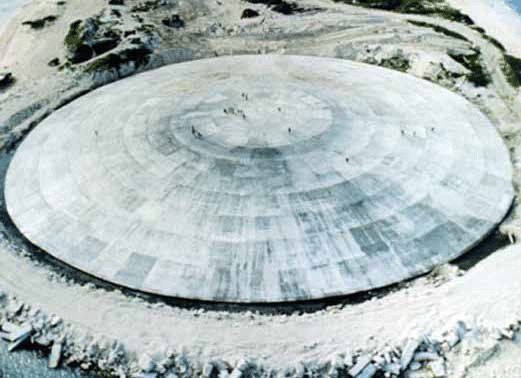
43 years ago a concrete container of nuclear waste was constructed on a tiny island in the Pacific Ocean, but there’s a big problem with that, it’s leaking.
During the Cold War, the US used islands in the Pacific to test nuclear weapons, and between 1946 and 1958 carried out a series of tests on Enewetak Atoll.
Of course, nuclear bombs poison the ground around them and the waste from these weapons is a dangerous commodity in and of itself. So between 1977 and 1980, a concrete dome was built to store the nuclear waste from the bomb tests.
That ended up being called the Runit Dome, because it was located on Runit Island, though it was also referred to as ‘the tomb’.
Housing radioactive debris, including poisonous plutonium, thousands of people scraped nuclear waste into a blast crater and covered it over with concrete to stop it from getting out.
Unfortunately that plan isn’t going quite so well as, according to IFL Science, a report from 2019 warns that changing conditions on the island are causing the concrete dome to crack.
Increasing temperatures are not helping the problem, while a rise in sea levels is also compounding the problem as the dome is not elevated off the ground, and the lapping waters of the sea are eroding it further.
This is all resulting in radioactive material bleeding out into the ground on the rest of the island and leaking out into the sea as well.
As long as the plutonium stays within the crater covered by the dome then it won’t be a major new source of contamination into the ocean.
That could all change if the cracking dome were to give way and seawater was able to flow in and out of the crater.
This concrete tomb could be a cracking nuclear coffin with a monster inside just waiting to be released, but for now things are still within acceptable levels.
According to the Woods Hole Oceanographic Institution, marine radioactivity expert Dr Ken Buesseler said they’d ‘known for years that the dome is leaking’, but for now only a ‘small amount of radioactivity’ was getting out.
For context, this isn’t putting the surrounding area beyond safety standards just yet, and the plutonium sealed beneath the Runit Dome is only a fraction of what was released during nuclear testing.
While he said things were alright at the moment, he warned that they ‘hadn’t considered sea level rise in the 1970s when they built this’, and said the dome would be ‘at least partially submerged by the end of this century’.
In South Korea, activists march against Tokyo’s waste plan
Hundreds of people in South Korean took to the streets of Seoul on Saturday
to protest against Japan’s contentious plan to release treated nuclear
wastewater into the Pacific Ocean. Tokyo is set to release the water from
the tsunami-hit Fukushima nuclear plant later this month. It has been
approved by the UN nuclear watchdog, and a South Korean assessment found it
meets international standards. But protesters fear marine life will be
destroyed and seafood contaminated. Marching in central Seoul, they held
signs reading “Protect the Pacific Ocean” and “Nuclear Power? No Thanks!”.
BBC 12th Aug 2023
The BRICS Revolt: How Ukraine War Eroded U.S. Authority
SCHEERPOST, by Glenn GreenwaldAugust 13, 2023 he proxy war in Ukraine has presented a grand opportunity for competitors of the U.S. — a chance to exploit longstanding resentments of American empire throughout the international community, and present these nations with compelling economic alternatives to the U.S.
1
1 This Month



19 November – Webinar – The Reality of Reprocessing
Time: 11:00 AM Pacific Time (US & Canada) / 2:00 PM Eastern / 7:00 PM UK / 8:00 PM CET
Register for the Zoom Event Here



Shut down the radiation-damaged Heysham nuclear reactors now
To see nuclear-related stories in greater depth and intensity – go to https://nuclearinformation.wordpress.com

Say No to NASA’s Reckless Nuclear Reactor on the Moon
Say No to NASA’s Reckless Nuclear Reactor on the Moon
-
Archives
- November 2026 (74)
- October 2026 (302)
- September 2026 (339)
- August 2026 (330)
- July 2026 (355)
- June 2026 (287)
- May 2026 (306)
- April 2026 (356)
- March 2026 (251)
- February 2026 (267)
- January 2026 (308)
- December 2025 (358)
-
Categories
- 1
- 1 NUCLEAR ISSUES
- business and costs
- climate change
- culture and arts
- ENERGY
- environment
- health
- history
- indigenous issues
- Legal
- marketing of nuclear
- media
- opposition to nuclear
- PERSONAL STORIES
- politics
- politics international
- Religion and ethics
- safety
- secrets,lies and civil liberties
- spinbuster
- technology
- Uranium
- wastes
- weapons and war
- Women
- 2 WORLD
- ACTION
- AFRICA
- Atrocities
- AUSTRALIA
- Christina's notes
- Christina's themes
- culture and arts
- Events
- Fuk 2022
- Fuk 2023
- Fukushima 2017
- Fukushima 2018
- fukushima 2019
- Fukushima 2020
- Fukushima 2021
- general
- global warming
- Humour (God we need it)
- Nuclear
- RARE EARTHS
- Reference
- resources – print
- Resources -audiovicual
- Weekly Newsletter
- World
- World Nuclear
- YouTube
-
RSS
Entries RSS
Comments RSS

