Absence of Evidence: Israel’s Case Against UNRWA
We got hold of Israel’s dossier against UNRWA – why did the donors including the UK withdraw funding on such flimsy unproven allegations before an investigation?”
the summary did “not provide evidence to support its claims.”
February 11, 2024 by: Dr Binoy Kampmark,
https://theaimn.com/absence-of-evidence-israels-case-against-unrwa/
Statistics are often given lanky legs that take their user far. But how they are used, and how they are received, is striking. The current figure of 27,500 dead is a blighting, grotesque fact. But as they are Palestinians, the issue is less significant to certain parties than, say, 140 Israeli hostages being held in Gaza.
As with much in the noisy clatter of Middle Eastern violence, the value attributed to numbers alters in the shade of ideology and self-interest. Massacres become acts of self-defence; acts of self-defence become unconscionable inflictions of murder. It also follows that an organisation of 30,000 employees, working in the field of humanitarianism, aid and salvation, can be plastered as terrorist sponsors for having 12 individuals in their service allegedly involved in a murderous assault on Israel on October 7, 2023. Despite the relative smallness of this figure, the entire organisation itself becomes a target.
Israel was initially adamant that 12 such individuals in UNRWA (United Nations Relief and Works Agency for Palestine Refugees in the Near East) had participated in the October 7 attacks by Hamas, sharing the details on January 29 with several media outlets. The accusations were made via a thin dossier amounting to no more than six pages. Little by way of evidence was supplied, though Israel was content to make further claims that almost 10% of the agency’s staff had ties to Hamas. As UN Crisis Group expert Daniel Forti writes, “Thus far, Israel has not provided evidence in writing to the UN to substantiate its allegations.”
For a gaggle of Western states and donors, that hardly mattered. The mere mention of the Satanic Twelve had made their way into public and political consciousness, and something had to be done about it. Funding to the aid body was swiftly suspended by the United States, Germany, the European Union, Sweden, Canada, Australia and the United Kingdom. The organisation was smeared and threatened with functional incapacity and prospective oblivion, an outcome that would also, inevitably, doom Palestinians. Unchallenged accusations that the agency had long been a Hamas front – an article of faith among Israeli nationalists – were bandied about with abandon.
The United Nations, for its part, was unusually fleet footed in responding to the dossier. Contracts were terminated. Inquiries were announced, along with promises of stern self-examination, purging and cleansing. On February 5, the UN Secretary General António Guterres announced that an independent panel had been created with the specific purpose of assessing “whether the agency is doing everything within its power to ensure neutrality and to respond to allegations of serious breaches when they are made.” The panel will be chaired by former French Foreign Minister Catherine Colonna, who will work alongside a Scandinavian complement of the Raoul Wallenberg Institute in Sweden, the Chr. Michelsen Institute in Norway and the Danish Institute for Human Rights.
With the setting up of such heavy machinery, the picture started getting foggier. Then a smiting report from the British news outlet Channel 4 took issue with the scanty material supplied in the document. As the network’s Lindsey Hilsum stated, “We got hold of Israel’s dossier against UNRWA – why did the donors including the UK withdraw funding on such flimsy unproven allegations before an investigation?”
Channel 4 goes on to reveal that the dossier “contains no evidence to support Israel’s explosive new claim other than stating, ‘From intelligence information, documents, and identity cards seized during the course of the fighting, it is now possible to flag around 190 Hamas and Palestinian Islamic Jihadi terrorist operatives who serve as UNRWA employees. More than 10 UNRWA staffers took part in the events of October 7.”
Even the usually less than critical CNN network reported that it had “not seen the intelligence that underlies the summary of allegations”, going on to mention that the summary did “not provide evidence to support its claims.”
-ADVERTISEMENT-
When Ophir Falk, an advisor to Israeli Prime Minister Benjamin Netanyahu, was asked by CNN anchor Anna Coren to provide evidence of the claims, he refused to do so. When asked why the alleged culprits had not been arrested, he merely replied that “the first step is for them to be fired.”
Outlets such as The New York Times and Wall Street Journal were less than concerned by the gaping lacunae and skimpiness of Israel’s case. Instead, the latter could even go so far as to claim that the dossier provided “the most detailed look yet at the widespread links between the UNRWA employees and militants.” The ABC World News Tonight was clumsy enough to suggest that the UN had “not denied the claims”, implying a veneer of veracity.
Now, other countries are finding absence of evidence from the Israeli side more than awkward. Australia’s Foreign Minister, Penny Wong, had to also admit that she had not been furnished with much in the way of evidence. “We have spoken to the Israelis and we have asked for further evidence,” she told the Australian Broadcasting Corporation’s 7.30. When asked why she did not ask UNRWA chief Philippe Lazzarini about the subject, she simply reiterated the point that she had asked the Israelis directly and was not aware if Lazzarini had evidence. “He may, I don’t know what he has.”
With trademark oiliness, Wong countered that the allegations were what mattered. “I think it is clear from UNRWA’s own actions that they regard these allegations as serious.” They had done so by “terminating the employment of a number of employees and putting in place an inquiry – in fact, there are two inquiries.” Effectively, the agency was to be punished for its own enterprising efforts to investigate the claims, leaving the accusers free to level whatever charges they saw fit.
In the meantime, Lazzarini has been scrambling to fill the funding void, making visits to the United Arab Emirates, Qatar, and Kuwait. The dying and starvation in Gaza continue with the prospect of even more horror as Israel’s armed forces prepare their offensive on Rafah. A fine thing, then, to see donor countries for UNRWA, some of whom continue funding Israel’s military efforts, to moralise about terrorists and the agency.
Israeli PM orders evacuation of last Gaza ‘safe zone’
https://www.rt.com/news/592207-israel-plans-rafah-civilian-evacuation/ 11 Feb 24
Benjamin Netanyahu has directed his military to prepare for moving civilians out of Rafah ahead of a major ground offensive
Israeli Prime Minister Benjamin Netanyahu has ordered his military to make plans for evacuating over a million Palestinian civilians crowded into Rafah, the last remaining refuge for displaced residents of the war-ravaged Gaza Strip. Israeli troops are preparing to launch a massive ground offensive against Hamas fighters in the area.
Netanyahu’s office announced the directive on Friday, saying the Israel Defense Forces (IDF) needed a “combined plan” for the mass evacuation of civilians and the destruction of the last Hamas stronghold in the Palestinian enclave. “It is impossible to achieve the goal of the war of eliminating Hamas by leaving four Hamas battalions in Rafah,” the statement said. “On the contrary, it is clear that intense activity in Rafah requires that civilians evacuate the areas of combat.”
The UN has estimated that around 1.4 million displaced Gazans have taken refuge in Rafah, located on the besieged enclave’s border with Egypt, since the Israel-Hamas war began in October. The city, which normally has a population of some 280,000, has become the last so-called “safe zone” for civilians as the IDF levels much of Gaza in its hunt for Hamas fighters.
The evacuation directive comes as the US and other allies step up pressure on West Jerusalem to reduce civilian casualties. The US State Department warned on Thursday that an Israeli military operation in Rafah without “serious planning” for protection of civilians would be disastrous. US President Joe Biden told reporters on Thursday night that the IDF’s operations in Gaza had been “over the top,” marking his most pointed criticism of Israeli war tactics since the conflict began.
Biden’s administration has refused so far to press for a ceasefire in Gaza and has criticized allegations that Israel is committing genocide against the Palestinians. About 28,000 people have been killed in the territory since the war began, according to local health authorities. The UN has reported that 85% of the population has been displaced from their homes, and 570,000 Gazans are starving.
The war started when Hamas fighters launched surprise attacks against Israeli villages, killing more than 1,100 people and taking hundreds of hostages back to Gaza.
UK steps up war on whistleblower journalism with new National Security Act

KIT KLARENBERG, ·FEBRUARY 9, 2024, The GrayZone
Under a repressive new act, British nationals could face prison for undermining London’s national security line. Intended to destroy WikiLeaks and others exposing war crimes, the law is a direct threat to critical national security journalism.
It was the afternoon of May 17 2023 and I had just arrived at London’s Luton Airport. I was on my way to the city of my birth to visit my family. Before landing, the pilot instructed all passengers to have their passports ready for inspection immediately upon disembarking the plane. Just then, I noticed a six-strong squad of stone-faced plainclothes British counter-terror officers waited on the tarmac, intensely studying the identification documents of all travelers.
As soon as the cops identified me, I was ordered to accompany them into the airport terminal without explanation. There, I was introduced to two officials whose names I could not learn, who subsequently referred to each other using nondescript callsigns. I was invited to be digitally strip searched, and subjected to an interrogation in which I had no right to silence, no right to refuse to answer questions, and no right to withhold pin numbers for my digital devices or sim cards. If I asserted any rights to privacy, I faced arrest and up to 48 hours in police custody.
I chose to comply. And so it was that over the next five hours, I sat with a couple of anonymous counter-terror cops in an airless, windowless, excruciatingly hot back room. They fingerprinted me, took invasive DNA swabs, and probed every conceivable aspect of my private and professional life, friend and family connections, and educational background. They wanted to know why I write, say and think the things I do, the specifics of how I’m paid for my investigative journalism, and to which bank account.
I had been detained under Britain’s 2019 Counter-Terrorism and Border Security Act, which the UN has branded draconian and repressive. Under its Schedule 3 powers, anyone entering British territory suspected of “hostile activity” on behalf of a foreign power can be detained, interrogated for six hours, and have the contents of their digital devices seized and stored. “Hostile acts” are defined as any behavior deemed threatening to Britain’s “national security” or its “economic well-being.”
More disturbingly, Schedule 3 is suspicionless. Under its terms, “it is immaterial whether a person is aware that activity in which they are or have been engaged is hostile activity, or whether a state for or on behalf of which, or in the interests of which, a hostile act is carried out has instigated, sanctioned, or is otherwise aware of, the carrying out of the act.” It must be quite an elaborate conspiracy when conspirators do not even know they’re conspiring.
It turns out the British state wrongly believed The Grayzone had a relationship with Russia’s notorious FSB security service. They based their assumption not on any evidence, but on our knack for producing factual investigative journalism based on documents passed to this outlet anonymously, via burner email accounts. Such activity is common practice for Western media outlets, rights groups, and much venerated “open source” investigative outfits like the US-government sponsored Bellingcat. If I and the rest of The Grayzone made any mistake, it was in publishing material the US-UK national security state does not want in the public domain.
Now, the British government is taking its war on investigative journalism to a new level through its little-known National Security Act. Under this law, authorities in London have granted themselves the power to surveil, harass, and ultimately imprison any British citizens they wish on similarly suspicionless grounds. Dissidents of every stripe must now worry that everything they do or say could land them in jail for lengthy terms, simply for failing to toe London’s rigid national security line.
Among the top lobbyists for these authoritarian measures is Paul Mason, the celebrity journalist who posed as a leader of the British left until The Grayzone unmasked him as a security state collaborator hellbent on destroying the antiwar movement from within.
Inspired by the US Espionage Act, designed to criminalize whistleblowing
In December 2023, after processing for 18 months through parliamentary procedures, the British National Security Act came into force. Under the aegis of protecting Britain from the threat of espionage and sabotage by hostile actors at home and abroad, the law introduces a number of completely new criminal offenses with severe penalties — and wide-ranging consequences for freedom of speech. Indeed, the law’s terms are so broad, individuals will almost inevitably break the law without wanting to, intending to, or even knowing they have.
Because no one has been prosecuted under the Act to date, its full ramifications remain unclear. However, London’s security and intelligence apparatus now enjoy far-reaching powers to police what can be said about the British government’s activities abroad.
Given the frightening implications of the Act, UK journalists, press rights groups, and civil liberties organizations should be up in arms. Yet serious criticism of the law was largely absent from mainstream publications throughout various phases of debate in parliament.
Scrutiny of the anti-free press Act has been left almost entirely to independent journalists like Mohamed Elmaazi. Writing for Consortium News in July 2022, Elmaazi noted that it “shares many elements” with Washington’s “draconian 1917 Espionage Act,” which is currently being used to prosecute WikiLeaks founder Julian Assange…………………………………………
Act specifically intended to criminalize WikiLeaks threatens whistleblowers
During the 2022 House of Commons debate, knighted Conservative MP Sir Robert Buckland led the charge against WikiLeaks. Buckland, who was responsible in his former role as Secretary of State for Justice for “upholding the rule of law and protecting judicial independence,” argued that the National Security Act was a vital tool to prosecute “those such as Julian Assange who dump data in a way that has no regard for the safety of operatives and other affected people.” He later remarked, “none of us [in Parliament] wants to see Julian Assange and his type carry sway here.”
The UK Supreme Court expressed a very different view when, in 2018, it held in a unanimous decision that cables published by WikiLeaks are admissible as evidence in court proceedings…………………………………………………………………………
Should authorities in London merely suspect someone might in some way benefit from possessing “information” provided to them by an unknown “foreign” power, that they may have stumbled across on the internet or been provided one way or another without their express request or consent, they could be branded as a criminal and locked away.
British journalists more compliant to authoritarian measures than ever
The British state’s campaign to muzzle dissenting voices draws on London’s operation of a little-known but devastatingly effective censorship mechanism known as the Defense and Security Media Advisory (DSMA) Committee.
Comprised of representatives of the security and intelligence services, military veterans, high-ranking government officials, press association chiefs, editors and journalists, the committee determines behind closed doors which national security related-issues can be covered by the press, and in what fashion.
On occasion, the Committee issues what are known as “D-notices.” Theoretically, these are voluntary requests for news outlets to not broadcast particular pieces of information, or to omit details deemed harmful to national security. While recipients are not legally obliged to comply, they are fully aware that a refusal could mean prosecution under the Official Secrets Act 1989, especially if the information in question results from an “unauthorised disclosure.” Alternatively, an offending journalist might simply be blacklisted, losing access to on and off-the-record briefings and privileged information from officials, which would then threaten their employment. As a result, examples of outlets ignoring “D-notices” are few and far between…………………………………………………………………………………….
Paul Mason suggests The Grayzone be prosecuted for exposing him
In June 2022, The Grayzone exposed British reporter Paul Mason for his collusion with a senior British Foreign Office intelligence officer in a clandestine campaign to brand the British antiwar left as a vehicle for the Russian and Chinese governments. The publication of the material, which was sent to this outlet via anonymous burner accounts, was clearly in the public interest………………………………… more https://thegrayzone.com/2024/02/09/uk-national-security-act-wikileaks/—
REVIEW CONFERENCE: CLIMATE CRISIS – WHY NUCLEAR IS NOT HELPING
In October 2019, a conference was held by “Don’t Nuke the Climate” and GLOBAL 2000 against nuclear energy as a supposed climate savior.
Recently, the nuclear lobby has been trying to present itself as the “green” technology that can produce electricity for the energy transition in a “CO2-free and reliable” manner, thereby enabling the exit from dirty energy sources such as oil and coal. Entire conferences on “Atoms4Climate” are organized with this in mind. At the climate conferences, the nuclear lobby acts aggressively and advertises subsidies – only through subsidies can nuclear power be expanded and kept running.
It has long been clear that nuclear power cannot be part of the urgently needed climate protection measures. On the contrary. According to the independent scientists, tackling the climate crisis is about saving CO2 as quickly – and as cost-effectively – as possible.
Nuclear power cannot make a contribution here – it is the most expensive technology – and is far too complex and slow to build to be able to make any contribution at all in the period of the next ten years that is relevant to the climate crisis. The construction time alone of the few reactors that went into operation in recent years took more than 10 yearsexternal link, opens in a new tab, plus there were planning and approval times of another decade.
Even the basic argument of “CO2-free” nuclear power plants is untenable – nuclear power is not a climate saver: The uranium mining chain and the construction and operation of nuclear power plants cause far more greenhouse gas emissions than renewable energies, depending on the uranium content The ore releases between 88 and 146 grams of CO2 per kilowatt hour.
The conference
The international conference “Climate Crisis – Why nuclear is not helping”, organized by “Don’t Nuke the Climate” and GLOBAL 2000, took place in October 2019 at the same time as the first IAEA Nuclear Climate Conference. Over two days, facts and figures about nuclear energy were presented and strategies were discussed to keep outdated technology out of the fight against the climate crisis. Key questions were:
- Are the pro-nuclear energy arguments correct or influenced by outside sources?
- And can new technologies such as “Small Modular Reactors” improve the situation or are they uneconomical and not yet developed far enough?
The questions were developed in lectures and workshops and discussed in lively exchanges. The documents for reading the conference can be found below. The event was held in English, which is why most of the documents were written in English. You can download the program for reading here . The slides for the presentations (mostly in English) can be found here . We have collected photos of the event and a protest in front of the IAEA at the start here .
………………………………………………………………………………………………………………………… The international conference organized by “Don’t Nuke the Climate” and GLOBAL 2000 that took place at the same time as IAEA’s very first climate conference in Vienna in October 2019 has examined the hard evidence-base, the facts and figures – in order to prepare strategies to keep fresh money for the outdated technology that is nuclear. Key questions included: Whether those forecasts which support new nuclear are accurate – or are they unfairly biased? And whether any novel nuclear technology, such as Small Modular Reactors, are viable – or are they uneconomic and very far from deployment?
The program of the conference can be found here . All slides from the presentations are here , and pictures from the conference and the protest beforehand are collected here .
Role of nuclear and climate goals in IEA, IAEA, IPCC scenarios
Critical look at forecasts – Overestimated for nuclear and underestimated for renewables? Nuclear generation increases, on average by around 2.5 times by 2050 in the 89 mitigation scenarios considered by the IPCC. What the IPCC report also says about nuclear (leukemia, proliferation)
Speaker: Georg Günsberg, Strategy Consultant Climate and Energy Politics, Vienna
Presentation Major Energy Scenarios
Can we afford nuclear power to save us from global warming?
Speaker: Steve Thomas, University of Greenwich, UK
Presentation Cost Of Nuclear Power
Small Modular Reactors (SMRs): Findings from a key report by Paul Dorfman, MV Ramana and Sean Morris
Speaker: Paul Dorfman, The Energy Institute, University College London
Presentation of Small Modular Reactors
Operating a very old fleet of nuclear power plants
Is it the most realistic scenario? Can aging plants contribute to energy security and which additional risks will arise due to climate change phenomena?
Speaker: Oda Becker, Independent technical consultant, Hanover
Presentation of old nuclear plants
Propaganda versus reality of new generation of reactors (GEN IV)
Speaker: Christoph Pistner, Nuclear Engineering & Facility Safety, Ökologieinstitut Darmstadt
Presenting Reality New Reactors
Exclusive Presentation of the WNSIR 2019 by Mycle Schneider and the author of the special chapter on Nuclear Power and Climate Change by Amory Lovins RMI
For nuclear to be considered a viable option in managing the decline of the fossil fuel economy, new reactors must be economically viable and built on-time – however, practical experience demonstrates that nuclear is hugely expensive and very much behind schedule. Nuclear costs and risks mean that plants can only be built with vast state aid (public subsidies), including loan guarantees and long-term power purchase agreements.
Speaker: Mycle Schneider and Amory Lovins – via video conferencing with Q&A
Presentation Nuclear Power and Climate Change
Nuclear power powers the bomb
Speaker: Angelika Claußen, IPPNW president for Europe, Germany
Presentation Nuclear Powers Bombs
Nuclearization of Africa and the role of IAEA
Speaker: Makoma Lekalakala, Earthlife South Africa
Presenting Human Rights Issues
Billions for EURATOM (in German)
Speaker: Christoph Rasch
First results of working paper on climate crisis and NPP
Energiaklub Presentation of the first results about NPP safety and operation under climate crisis condition.
Speaker: Eszter Mátyás, CEU PhD
Presentation Climate and Paks NPP
Presentation Nuclear and Safety
The European Nuclear Power Risk Study 2019
Doctors study analyzes accident consequences based on real weather situations (France, Swiss NPP) and shows the high risks arising from severe nuclear accidents also for neighboring countries.
Speaker: Claudio Knüsli, IPPNW
The conference & workshop day were organized by the Don’t Nuke the Climate network of anti-nuclear organizations and networks from all over the globe, that work together to keep nuclear out of the climate agreements and the Paris agreement: The conference
was organized by Don’t Nuke the Climate Network of anti-nuclear organizations and networks from around the world working together to keep nuclear energy out of the climate agreements and the Paris Agreement:
…………………………………………………….. www.dont-nuke-the-climate.org/about-us https://www.global2000.at/news/nachlese-konferenz-climate-crisis-why-nuclear-not-helping
France’s Flamanville EPR has numerous technical problems which mean that its safety issues are not “now closed”
Response from GLOBAL CHANCE to the ASN consultation on the request for
authorization to commission the Flamanville EPR reactor.
Contrary to what the President of the ASN stated on January 30, 2024 in his conference press
and the presentation of one’s wishes, numerous technical subjects which are
as much potential problems for the proper functioning of the EPR and which
call into question the reactor safety, cannot be considered “now closed”.
The problems that hamper the operation and safety of the EPR are numerous.
Most serious are presented in the following chapters in two parts: severe
and persistent then severe and whose solutions are risky. They lead to
asking questions including the answers do not appear in any of the
documents which constitute the file released made available to the public
by the ASN
Global Chance 9th Feb 2024
Why Biden’s $61 billion in weapons for Ukraine won’t prevent inevitable defeat
Walt Zlotow, West Suburban Peace Coalition, Glen Ellyn IL 11 Feb 24
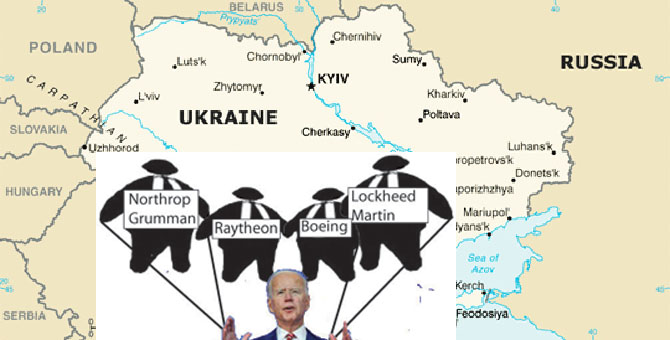
For 4 months President Biden has been beseeching Congress to grant another $61 billion in aid to Ukraine to continue their 2 year war with Russia. This is on top of $113 billion that has made no dent in Ukraine’s efforts to prevail against overwhelming Russian forces.
Biden could give Ukraine a trillion dollars in aid but it’s essentially worthless because Ukraine is running out of soldiers to use US weapons.
A dozen Ukrainian soldiers and commanders told the Washington Post that personnel deficits are at their lowest point ever.
One mechanized brigade battalion commander advised he’s down to 40 soldiers from a normal 200 to hold off the Russian advance. Another mentioned the same shortage in his unit.
Replacements are scares since August when Zelensky fired all recruitment office heads due to corruption. That’s caused a dramatic decline in replacements still not solved.
But if Biden gets his $61 billion he’d be better off tossing it into a bonfire instead of squandering it on more weapons for Ukraine. That will only prolong a war that was lost on Day One, 717 days ago. Had Biden not torpedoed a peace deal nearly inked in the first month, over 400,000 Ukrainian soldiers would still be alive, the Ukraine economy would not be devastated, and Ukraine may not have lost a single square mile of territory.
Biden knows the $61 billion more will not turn the tide. But as Pete Seeger sang about LBJ continuing to fight a lost war in Vietnam 57 years ago, in today’s White House…’The Big Fool says to push on.’
France’s EDF shuts down two nuclear reactors after fire at Chinon plant

Reuters, February 11, 2024, https://www.reuters.com/business/energy/frances-edf-shuts-down-two-nuclear-reactors-after-fire-chinon-plant-2024-02-10/
—
Nuclear energy operator EDF has shut down two reactors at Chinon in western France after a fire in a non-nuclear sector of the plant in the early hours of Saturday, the company said.
The fire has been extinguished, it said.
“Production unit number 3 at the Chinon nuclear power plant has shut down automatically, in accordance with the reactor’s safety and protection systems,” EDF said in a statement, adding it also shut down reactor number 4, which is coupled to number 3.
France’s nuclear safety watchdog said in a separate statement the fire had led to an electricity cut at the plant that triggered the automatic shutdown.
Chinon is one of France’s oldest nuclear plants.
Reporting by Tassilo Hummel; editing by Barbara L
Pushing Gazans Into Rafah And Then Attacking Rafah, Killing UNRWA Funding Without Evidence
CAITLIN JOHNSTONE, FEB 10, 2024, Caitlin’s newsletter.
Notes From The Edge Of The Narrative Matrix
Israel is reportedly preparing to launch a ground assault on Rafah, the southernmost part of the Gaza Strip where Gazans have been pushed to flee to. Israel has instructed the 1.4 million refugees sheltering there to evacuate, along with the hundreds of thousands of people who were already living there before, but there doesn’t seem to be anywhere for them to go. This could wind up being the single deadliest phase of Israel’s onslaught to date.
So to summarize, the IDF has been packing the population of Gaza into the southernmost part of the enclave like toothpaste toward the end of a tube, and now they’re going to attack that southernmost part, but it’s totally not genocide and you’re an evil Nazi if you say it is.
This genocide is not a genocide. Ceci n’est pas une pipe.
Can we all just stop and marvel at how successful Israel and its allies have been at moving the conversation from “The ICJ ruled that Israel needs to immediately cease killing Palestinians” to “Is it right or wrong to starve two million people based on unevidenced claims?”
Australian foreign minister Penny Wong has acknowledged that Canberra joined the US, UK and other allies in cutting off UNRWA funding without having seen proof of Israel’s claims against the organization. Empire managers are now openly admitting they suspended aid to Gaza without having seen evidence of the claims that call was based on; they cut the aid because they were told to, then waited for narratives to be provided to them as to why this was a good and righteous decision.
If you’re going to say that a bad thing happened and we therefore need to cut off aid to the most aid-dependent population on earth, then you’d better at least be able to prove the bad thing actually happened. If evidence exists, then show it. If you insist on starving two million people, you can’t do it on vibes alone.
How is this not obvious to everyone? How was it not immediately obvious the instant it came up? Time and time again we are asked to consent to the empire doing the most heinous things to the most vulnerable populations on secret, invisible evidence. We are expected to trust their secret evidence without getting to look at it, even though they’ve been caught lying about things like this over and over and over again.
They think we’re idiots……………………………………………………………….. https://www.caitlinjohnst.one/p/pushing-gazans-into-rafah-and-then?utm_source=post-email-title&publication_id=82124&post_id=141542598&utm_campaign=email-post-title&isFreemail=true&r=1ise1&utm_medium=email—
European Union now promoting the lie that nuclear power is “green”

Nuclear power officially labelled as ‘strategic’ for EU’s decarbonisation, By Paul Messad | EURACTIV.fr | translated by Anne-Sophie Gayet, 7 Feb 24
The Council of EU member states and the European Parliament agreed on Tuesday (6 February) to label nuclear power as a strategic technology for the EU’s decarbonisation, following months of intense negotiations in Brussels over the Net-Zero Industry Act (NZIA).
…………….. The agreement encompasses tried and tested nuclear technologies as well as future third and fourth generation ones, i.e. small modular reactors (SMRs) and advanced nuclear reactors (AMRs). Their fuel cycles are also included in the text.
“The message is clear: the EU recognises that we need nuclear power to achieve the objectives of the Green Deal,” the French MEP told Euractiv. https://www.euractiv.com/section/energy-environment/news/nuclear-power-officially-labelled-as-strategic-for-eus-decarbonisation/
EDF’s nuclear struggles dampen EU nuclear prospects – the industry “on a slow descent to hell”.

MURIEL BOSELLI, Paris, France, 08 Feb 2024 19:48
(Montel) The latest setbacks at the UK’s new Hinkley Point C nuclear power plant have cast a shadow over Europe’s nuclear revival, experts told Montel, with one former EDF executive saying France’s nuclear industry was “on a slow descent to hell”.
A feud between Paris and London over who should fork out an extra EUR 6-8bn for Hinkley Point C’s (HPC) cost overruns was tarnishing the nuclear industry’s image as pro-nuclear nations try to promote atomic power in the battle against climate change, experts said.
HPC faces a new four-year delay and may not be commissioned until 2031, with completion costs now forecast at between GBP 31-34bn,… (Subscribers only)
Montel 8th Feb 2024
https://www.montelnews.com/news/1537139/edfs-nuclear-struggles-dampen-eu-nuclear-prospects
Escalating to de-escalate with nuclear weapons: Research shows it’s a particularly bad idea

How well does escalate to de-escalate work? Escalate to de-escalate strategies appear at first to be logically appealing. Upon deeper investigation, however, the potential for the strategy’s success is likely to be outweighed by the potential for its failure. The high chance of failure lies in potential escalation outcomes on the receiving side of the escalating attack.
The Bulletin, By Daniel R. Post | February 9, 2024
The growth of Chinese nuclear capabilities and the ongoing Russian invasion of Ukraine have brought “great power competition” back to the center of United States national security strategy. With that competition have come calls for increasing US tactical nuclear weapons capabilities. A primary justification for increasing these capabilities is that they provide additional options at different potential levels of conflict escalation and can help stop a conventional-turned-nuclear war before it becomes a full-scale nuclear exchange.
In fact, many in the US strategic community believe that “escalate to de-escalate” strategies—which threaten early and significant escalations, such as limited nuclear use, followed by demands for immediate war termination—are a desirable approach for nuclear deterrence, and a viable option if deterrence fails.
But how likely is it that even a “limited” nuclear war could be kept to a level at which the benefits of fighting outweigh the costs if deterrence fails? Could escalating from conventional weapons to nuclear ones have a de-escalatory impact on a conflict? Should the United States or other countries pursue the development of relatively low-yield nuclear weapons for this purpose? My research, as well as other recent work, strongly suggests that this kind of thinking is theoretically unsound, fraught with danger, and likely to drastically increase the risk of escalation in a nuclear conflict if attempted.
What is escalating to de-escalate? In this strategy, escalation is a deliberate action taken primarily for the purpose of ending a conflict without any further increase in the intensity or level of fighting. The strategy aims to achieve de-escalation by signaling capability and commitment. Escalate to de-escalate relies on psychological responses wherein the other side comes to see the conflict as too costly to continue at the new potential level of violence. The goal of escalation is not to completely disable or defeat the enemy, but rather to compel the adversary to decide to end the conflict—on terms set by the escalating state. The strategy is meant to be both bold and restrained.
When escalation involves a nuclear attack, the attacker is expecting to increase the likelihood of coercive advantages or to end the war altogether. Nuclear weapons generate and heighten fear, increase the risk of further escalation, and are the ultimate signal of strength and resolve.
A Russian strategy? Much of the contemporary discussion about escalating to de-escalate is rooted in an assertion by experts that it is an accurate interpretation of Russian strategy. The 2018 version of the United States’ Nuclear Posture Review, for example, stated that “Russian strategy and doctrine emphasize the potential coercive and military uses of nuclear weapons. It [sic] mistakenly assesses that the threat of nuclear escalation or actual first use of nuclear weapons would serve to ‘de-escalate’ a conflict on terms favorable to Russia.”
Katarzyna Zysk, a senior fellow at the Atlantic Council, has argued that this assessment is essentially correct, ………………………………………………
However, some experts disagree with this assessment of Russian strategy. Their arguments typically acknowledge Russian willingness to use nuclear weapons in a limited fashion under certain circumstances but characterize escalate to de-escalate as too simple an interpretation, incomplete, or inaccurate. Instead, these experts say, Russian plans to use nuclear weapons should be considered as part of a broader strategic deterrence, counter-escalation, and warfighting strategy.
How well does escalate to de-escalate work? Escalate to de-escalate strategies appear at first to be logically appealing. Upon deeper investigation, however, the potential for the strategy’s success is likely to be outweighed by the potential for its failure. The high chance of failure lies in potential escalation outcomes on the receiving side of the escalating attack……………………………………………………
positive outcomes, however, are theoretically counteracted—and upon empirical investigation, very often outweighed—by incentives to continue to resist. There are several reasons for this. First, escalation is likely to be a public and observable strategy, especially if it involves using a nuclear weapon, and giving in to such a demand comes with higher reputational costs than does refraining from retaliation. This exacerbates worries over precedent setting and future vulnerability.
Second, the receiving state may not get the intended signal, or may misinterpret, misunderstand, mistrust, or misperceive the intended signal. This sort of misperception has long been identified as a problem in international relations. Additionally, if the escalation violates an important norm—for example, the non-use of nuclear weapons, or the targeting of civilians—this effect may be amplified. In this situation, decision makers on the receiving side are likely to be willing to accept more risk to resist the escalation and prevent further losses.
A third reason escalate to de-escalate may result in continued resistance is that the attempt heightens the perceived stakes. In addition to the original stakes of the conflict, once a “red line” has been crossed (particularly the nuclear threshold), the stakes may increase dramatically. This again exacerbates concerns over precedent and reputation.
Can nuclear weapons help? The answer is likely no. Escalate to de-escalate may fail often in a nuclear setting because a limited nuclear attack against a nuclear-armed adversary will aggravate reputational and precedent-setting concerns. Because the stated purpose of nuclear weapons is (at a minimum) to deter a nuclear attack, when a nuclear state gives in to a limited nuclear attack the entire purpose of its nuclear deterrent has been negated. Giving in to a nuclear attack, then, drastically weakens future deterrence.
Also, escalating with nuclear weapons is likely to produce stronger negative effects than conventional attacks, because violating the norm of nuclear non-use may trigger stronger reactions than violating other norms of armed conflict (like killing unarmed civilians) that are routinely violated and are not as black and white as nuclear use.
Third, nuclear weapons cause effects that other types of weapons do not, such as radioactive fallout, electromagnetic pulse damage, and increased blast and fire impacts. These capabilities add an immense amount of uncertainty to a nuclear attack. This uncertainty will increase the incentives for decision makers to engage in worst-case scenario planning.
……………………………………. likely for the receiving side to think that the aggressor who first uses nuclear weapons has begun to behave irrationally or has abandoned these norms.
In sum, using nuclear weapons will increase incentives for the receiving state to continue to resist the attacker.
Slim chance of success. My ongoing research strongly supports claims regarding the likelihood that escalate to de-escalate will fail. I have conducted several surveys among two US populations (a general population and a military population) and found that respondents are overwhelmingly more likely to favor continued resistance when placed on the receiving end of escalate to de-escalate attempts. In the civilian sample, only 30.6 percent of respondents chose to de-escalate in response. In the military sample, that number was a measly 6.9 percent…………………………………….
If both sides in a conflict subscribe to escalate-to-de-escalate-type thinking, the logical outcome is an endless escalatory cycle. This outcome is distinctly at odds with a strategy aimed at de-escalation. Scholars and practitioners should beware of seeing a limited nuclear attack as some sort of resolve-demonstrating “trump card.” https://thebulletin.org/2024/02/escalating-to-de-escalate-with-nuclear-weapons-research-shows-its-a-particularly-bad-idea/
Tribes condemn start of uranium mining at Pinyon Plain Mine south of Grand Canyon

ADRIAN SKABELUND Sun Staff Reporter, Jan 13, 2024,
https://azdailysun.com/news/local/tribes-condemn-start-of-uranium-mining-at-pinyon-plain-mine-south-of-grand-canyon/article_13efb3b0-b16a-11ee-973a-c789810e105e.html
Two northern Arizona tribes this week condemned the start of operations at a uranium mine just south of the Grand Canyon.
The statements came after Denver-based company Energy Fuels Inc. announced last month that operations at its Pinyon Plain Mine had commenced.
“It is with heavy hearts that we must acknowledge that our greatest fear has come true,” a statement from the Havasupai Tribal Council read.
Meanwhile, Navajo Nation President Buu Nygren said in a statement that mining remains opposed “by all neighboring tribes that have forever called Grand Canyon their home.”
The Havasupai Tribe, along with many conservation groups, have long worried that the mine could contaminate area groundwater.
The Pinyon Plain Mine, previously known as the Canyon Mine, sits above the Redwall-Muav aquifer, which acts as a source of water for countless seeps and springs throughout the Grand Canyon, and is the sole source of drinking water for the Havasupai.
The mine also sits near Red Butte, an area with deep cultural importance to the Havasupai.
Energy Fuels has insisted that mining poses no risk to groundwater in the area.
Energy Fuels Vice President of Marketing and Development Curtis Moore said last month that the concerns over contamination were unfounded and designed to scare the public and push an antinuclear political agenda.
But those statements provided little comfort to those opposed to the mine.
“As guardians of the Grand Canyon, we the Havsuw ‘Baaja, the Havasupai Tribe, have opposed uranium mining in and around our reservation and the Grand Canyon since time immemorial. We do this to protect our people, our land, our water, our past, our present and our future,” a statement from the Havasupai Council read. “And yet, despite the historic and current assistance and advocacy from numerous allies, and the countless letters, phone calls and personal pleas, our urgent requests to stop this life-threatening action have been disregarded.”
Nygren on Thursday called on the federal government to protect tribes from the impact of new mining.
“I join our neighboring tribes and the many non-Native organizations to implore the federal government to uphold its promise to protect us,” Nygren wrote. “We are very concerned about the impending transport of radioactive materials from the Pinyon Plain/Canyon uranium mine to White Mesa Mill in Utah.”
The statements came as activists say they have observed uranium ore being stockpiled at the mine site.
Moore previously told the Arizona Daily Sun they didn’t yet know when they would begin to haul ore from the mine to the Utah Mill for processing. He said it was likely to begin within the year, however.
In 2012, the Navajo Nation passed a law banning the transportation of uranium ore within Navajo lands. That law does not impact federal highways that cross tribal lands.
There are two potential routes trucks bringing uranium ore from the mine to the Utah mill could take. One would direct trucks through Flagstaff, while a second would utilize ranching roads to skirt north of the city. Still, both routes pass through the Navajo Nation on U.S. Route 89.
Nygren also said he was disappointed that he and other tribal officials only learned mining operations had commenced through media reports, as opposed to hearing the news from federal partners.
“Despite all of our objections through the years, we learn through the media, rather than from our federal trustee — the U.S. Department of Agriculture, U.S. Forest Service and U.S. Department of the Interior/Bureau of Land Management — as would correctly expect, that our land and water will again be threatened with contamination,” he said. “Our relatives, the Havasupai, Hualapai and other tribes along the Colorado River, are bracing themselves for renewed anxiety, worry and constant unease about the safety of their resources and homelands.”
There is a long and controversial history of uranium mining within northern Arizona.
Throughout the Cold War era, nearly 30 million tons of uranium ore were extracted and often processed from Navajo Nation lands. Hundreds of those mines, often near Navajo communities, were then abandoned by the companies operating them.
More than 500 contaminated sites remain across the Navajo Nation.
Israel Does Not Speak for Jews Like Us
SCHEERPOST, byEDITOR,February 8, 2024
In the midst of the ongoing destruction of Gaza and the slaughter of Palestinians, the identity and authenticity of Jewish people calling into question the actions of Israel are being tarnished. A greater discussion of what it means to be Jewish, what it means to have a Jewish state and what Judaism has historically taught people is taking place among Jews around the world.
On this episode of the Scheer Intelligence podcast, Heyday Books publisher and former LA Times book editor Steve Wasserman and host Robert Scheer commit themselves to this conversation as Jews who have experienced these questions firsthand through their families in addition to having explored and reported on this topic throughout their careers.
Whether it was through Scheer’s reporting (with research by a youthful Wassernan) on the “Jews of L.A.” series for the Los Angeles Times and his reporting on the Six Day War in Israel and Gaza or Wasserman’s work with authors exploring Zionism and Israel, the pair have dealt in depth with the issue at hand.
Both stress the importance of Jewish culture in shaping their upbringing and viewing the world from a progressive, inclusive lens. Wasserman explains that for him Judaism encapsulates “The idea of being an honorable, ethical person, about making the world better, performing tikkun, helping to heal the world.”
As it pertains to his own familial history, Wasserman explains his mother’s brothers’ sacrifice: “They were premature anti-fascist. And they were eager to fight Hitler. And, they were killed within a week of each other… My mother has never gotten over their sacrifice. So, yes, we shed blood in the war against fascism.”
While delving into the idea of Israel, the two acknowledge the complexities of the history as it relates to the struggles of the diaspora and the Holocaust, but still, Wasserman acknowledges, “I’ve never thought that Israel or the State of Israel spoke for everyone. I’m a disciple of I.F. Stone, who said that all governments lie, including governments that you might be attached to for emotional and historical reasons.”
Transcript
……………………………………………………………………………………………………………………………………………………………… Scheer. I felt at home with the survival of a certain, international Jewish concern for the other, which, of course showed up in the American civil rights movement, with the important participation of American Jews.
Now, you look at Israel, and it’s a totally different picture, where the more fundamentalist religion is critical and indeed a formal part of the government, supported by very prominent right wing Jews like the late Sheldon Adelman and others in the United States, the leader of Israel and Netanyahu actually came to the United States when Obama was president and challenged his peace initiative with Iran in the US Congress, almost unheard of………………………………………………………………………………………………………………………………
What counts is the emotional attachment that peoples on every side, each of whom are hostage to fanatics and fundamentalists and extremists, but who believe with all their might that they have a near God given right to this bit of desert, and they are going to squander their best, the flower of their youth and the murderous rage to claim a right to live there. So, now we have 25,000 and counting deaths, many of them women and children. A murderous, vengeance, criminally prosecuted by a power-mad guy called Netanyahu. Other extremists on the other side. And as the old slogan in the ‘60s had, war is bad for every living thing. And, I see, at the moment, a pretty, forlorn and, hopeless situation here because, what Israel has done in its acts of vengeance is simply created, they have sowed the seeds for the dragon teeth that will arise.
Every Palestinian will seek revenge down the centuries. And the place is cursed. Reason has taken flight. Sobriety is nowhere in the picture. And we have a fever dream of nationalist yearnings by two peoples who somehow cannot find a way to live together in peace and harmony and the squandering of their national treasure, as I say, the flower of their youth is a heartbreak for everyone. So the question of the endangerment of Jews everywhere. I’ve never thought that Israel or the State of Israel spoke for everyone. I’m a disciple of I.F. Stone, who said that all governments lie, including governments that you might be attached to for emotional and historical reasons.
………………………………………………………………………………………………………………And it was also, as I say, a convenient copout for the rulers of England and the United States and the Soviet Union to embrace Zionism. Good, the Jews who are troublemakers, they’re progressive, they’re radical, they write too much, they think too much. There is a wonderful tradition which you summarized before. They’re a threat to our stability wherever they are. Let them have a state of their own. Okay. So there was a cynicism that underwrote this, that Zionism could play on. ……………………………………………………………………………………………………………………………………………………..
https://scheerpost.com/2024/02/08/israel-does-not-speak-for-jews-like-us/
Rolls-Royce snubbed for UK’s first private small nuclear reactor plant
Proactive, Philip Whiterow, 08 Feb 2024
Rolls-Royce Holdings PLC (LSE:RR.)‘s mini-nuclear plans have seemingly suffered a setback with the UK’s first privately funded station to use reactors built by Westinghouse.
The US group said it signed an agreement with Community Nuclear Power to install four AP300 small modular reactors (SMRs) at the North Teesside project to generate up to 1.5 gigawatts of power or enough for up to two million homes.
Westinghouse added it hopes to have the first AP300 operating unit available in “the early 2030s”…………………………………..
Mini-reactors or SMRs were a key plank of former prime minister Boris Johnson’s plans to rejuvenate Britain’s nuclear industry and hit his green energy targets.
…………………………………….
Lord Houchen, the mayor of Tees Valley, said one of the major issues it faced was the lack of policy clarity in the UK over SMRs.
Although reportedly ahead of the competition, Rolls-Royce’s SMR is still said to be only mid-way through the UK approval process.
The new power station is being entirely privately funded and will be sited at Seal Sands, a former chemical works. https://www.proactiveinvestors.co.uk/companies/news/1040531/rolls-royce-snubbed-for-uk-s-first-private-nuclear-plant-1040531.html
Nuclear expert Mycle Schneider on the COP28 pledge to triple nuclear energy production: ‘Trumpism enters energy policy’.

The entire logic that has been built up for small modular reactors is with the background of climate change emergency. That’s the big problem we have………………… Climate change emergency contains the notion of urgency. And so we are talking about something where the time factor needs to kick in………………….. And if we are talking about SMRs picking up any kind of substantial amounts of generating capacity in the current market, if ever, we’re talking about the 2040s at the very earliest.
Now, we’re talking of tens of $billions that are going into subsidizing nuclear energy, especially as I said existing nuclear power plants.
The pledge was worded as a commitment “to work together to advance a global aspirational goal of tripling nuclear energy capacity from 2020 by 2050″………… “This pledge is completely, utterly unrealistic.”…………………….“It’s like Trumpism enters energy policy.”

The Bulletin, By François Diaz-Maurin | December 18, 2023
Last week, a group of independent energy consultants and analysts released the much-anticipated 2023 edition of the World Nuclear Industry Status Report 2023 (WNISR). In over 500 pages, the report provides a detailed assessment of the status and trends of the international nuclear industry, covering more than 40 countries. Now in its 18th edition, the report is known for its fact-based approach providing details on operation, construction, and decommissioning of the world’s nuclear reactors. Although it regularly points out failings of the nuclear industry, it has become a landmark study, widely read within the industry. Its release last week was covered by major energy and business news media, including Reuters (twice) and Bloomberg.
On December 2, the United States and 21 other countries pledged to triple the global nuclear energy capacity by 2050. The declaration, made during the UN climate summit of the 28th Conference of the Parties (COP28) in Dubai, United Arab Emirates, sought to recognize “the key role of nuclear energy in achieving global net-zero greenhouse gas emissions-carbon neutrality by or around mid-century and in keeping a 1.5-degree Celsius limit on temperature rise within reach.” The pledge was worded as a commitment “to work together to advance a global aspirational goal of tripling nuclear energy capacity from 2020 by 2050.” It was aspirational—and ambitious.
To discuss this pledge against the nuclear industry’s current trends and status, I sat down with Mycle Schneider, lead author of the World Nuclear Industry Status Report.
………… Diaz-Maurin: It’s undoubtedly a landmark report. With over 500 pages, it’s also massive. In a nutshell, what should our readers know about the main developments in the world nuclear industry over the past year?
Schneider: It really depends on from which angle you approach the issue. I think, overall, the mind-boggling fact is that the statistical outcome of this analysis is dramatically different from the perception that you can get when you open the newspapers or any kind of media reporting on nuclear power. Everybody gets the impression that this is kind of a blooming industry and people get the idea that there are nuclear power plants popping up all over the world.
But what we’ve seen is that some of the key indicators are showing a dramatic decline. In fact, the share of nuclear power in the world commercial electricity mix has been dropping by almost half since the middle of the 1990s. And the drop in 2022 was by 0.6 percentage points, which is the largest drop in a decade, since the post-Fukushima year 2012.
We have seen a four percent drop in electricity generation by nuclear power in 2022, which, if you take into account that China increased by three percent and if you look at the world, means that the drop was five percent outside China. So it’s significantly different from the perception you can get, and we can dig into some of the additional indicators. For example, constructions [of new reactors] give you an idea what the trends are and what the dynamic is in the industry. And so, when you look at constructions you realize that, since the construction start of Hinkley Point C in the United Kingdom in late 2019 until the middle of 2023, there were 28 construction starts of nuclear reactors in the world. Of these, 17 were in China and all 11 others were carried out by the Russian nuclear industry in various countries. There was no other construction start worldwide.
………………………………………………………………………………..The point is that we have had actually an increasing capacity that generates less. And, for obvious reasons, the most dramatic drop was in France. The French reactor performance has been in decline since 2015. That is, to me, one of the really remarkable outcomes in recent years. If you compare the year 2010 to 2022, in France, the drop [in electricity generated] was 129 terawatt hours. What happened is basically that, from 2015 onward, the trend line was toward a reducing electricity generation due to an accumulation of events, which are important to understand.
It’s not so much the stress corrosion cracking [in reactor vessels] that everybody has been talking about or another technical phenomenon that hit the French nuclear power plants worst, although it’s true it had a significant impact and was totally unexpected. So, it’s not an aging effect, although you do have aging effects on top of it because a lot of reactors are reaching 40 years and need to pass inspections and require refurbishment, etc. But you had climate effects in France too. And strikes also hit nuclear power plants. You don’t have that in other countries. So, it’s the accumulation of effects that explain the decline in electricity generation. This unplanned and chaotic drop in nuclear power generation in France compares with the loss of nuclear generation in Germany of 106 terawatt hours between 2010 and 2022, but in this case due to a planned and coordinated nuclear phaseout.
Diaz-Maurin: That is an interesting way to look at the data. What is the biggest risk of keeping existing reactors operating up to 80 years, as some suggest, or even more?
Schneider: Well, nobody knows. This has never been done. It’s like: “What’s the risk of keeping a car on the street for 50 years?” I don’t know. It’s not the way you do things, usually. First, I should say that we’re not looking at risk in that Status Report. This is not the subject of the report. But the lifetime extension of reactors raises the questions of nuclear safety—and security, which has always been a topic for the Bulletin.
If you have a reactor that has been designed in the 1970s, at the time nobody was talking or even thinking about drones or hacking, for example. People think of drones in general as a means to attack a nuclear power plant by X Y, Z. But in fact, what we’ve seen in the past are numerous drone flights over nuclear facilities. And so, there is the danger of sucking up information during those overflights. This raises security risks in another way. So, this idea of modernizing nuclear facilities continuously is obviously only possible to some degree. You can replace everything in a car, except for the body of the car. At some point, it’s not the same facility anymore. But you can’t do that with a nuclear power plant.
Diaz-Maurin: Talking about old facilities, Holtec International—the US-based company that specializes in nuclear waste management—say they want to restart the shutdown Palisades generating station in Michigan. Is it good news?
Schneider: To my knowledge, the only time that a closed nuclear power plant has been restarted was in Armenia, after the two units had been closed [in 1989] after a massive earthquake. We don’t have precise knowledge of the conditions of that restart, so I’m not so sure that this would be a good reference case. One has to understand that when a nuclear reactor is closed, it’s for some reason. It is not closed because [the utility] doesn’t like to do this anymore. In general, the most prominent reason [for closing reactors] over the past few years was poor economics.
This is, by the way, one of the key issues we’ve been looking at in the 2023 report: These entirely new massive subsidy programs in the US in particular didn’t exist [a year ago]. There were some limited programs on state level. Now these state support programs have been increased significantly and they are coupled in with federal programs, because the reactors are not competitive. So we’re talking really about a mechanism to keep these reactors online. That Palisades would restart is unique, in Western countries at least. For a plant that has been set to be decommissioned to restart, this has never been done. And, by the way, Holtec is not a nuclear operator. It is a firm that has specialized in nuclear decommissioning.
Now, that companies like Holtec can actually buy closed nuclear power plants and access their decommissioning funds with the promise to dismantle faster than would have been done otherwise, this is an entirely recent approach with absolutely no guarantee that it works. Under this scheme, there is no precedent where this has been done from A to Z. And obviously, there is the risk of financial default. For instance, it is unclear what happens if Holtec exhausts the funds before the decommissioning work is complete. Holtec’s level of liability is unclear to me prior to the taxpayer picking up the bill.
Diaz-Maurin: At Palisades, Holtec’s plan is to build two small modular reactors.
Schneider: Holtec is not a company that has any experience in operating—even less constructing—a nuclear power plant. So having no experience is not a good sign to begin with. Now, when it comes to SMRs—I call them “small miraculous reactors”—they are not existing in the Western world. One must be very clear about that. There are, worldwide, four [SMR] units that are in operation: two in China and two in Russia. And the actual construction history [for these reactors] is exactly the opposite to what was promised. The idea of small modular reactors was essentially to say: “We can build those fast. They are easy to build. They are cheap. It’s a modular production. They will be basically built in a factory and then assembled on site like Lego bricks.” That was the promise.
For the Russian project, the plant was planned for 3.7 years of construction. The reality was 12.7 years. In China, it took 10 years instead of five. And it’s not even only about delays. If you look at the load factors that were published by the Russian industry on the Power Reactor Information System (PRIS) of the IAEA, these SMRs have ridiculously low load factors, and we don’t understand the reasons why they don’t produce much. We know nothing about the Chinese operational record.
Diaz-Maurin: Last month, NuScale, the US-based company that develops America’s flagship SMR, lost its only customer, the Utah Associated Municipal Power System, a conglomerate of municipalities and utilities. This happened allegedly after a financial advisory firm reported on NuScale’s problems of financial viability. Have you followed this demise?
Schneider: Yes, of course. What happened there is that NuScale had promised in 2008 that it would start generating power by 2015. We are now in 2023 and they haven’t started construction of a single reactor. They have not even actually a certification license for the model that they’ve been promoting in the Utah municipal conglomerate. That’s because they have increased [the capacity of each module] from originally 40 megawatts to 77 megawatts.
Diaz-Maurin: Why is that? Is it a matter of economy of scale?
Schneider: Yes, of course. You need to build many modules if you want to get into economies of scale by number, if you don’t get into it by size. This is actually the entire history of nuclear power. So NuScale sought to increase the unit size in Utah. But then the deal with the municipalities collapsed after the new cost assessment in early 2023 showed that the six-module facility NuScale had planned would cost $9.3 billion, a huge increase over earlier estimates. It’s about $20,000 per kilowatt installed—almost twice as expensive as the most expensive [large-scale] EPR reactors in Europe.
Diaz-Maurin: Is it the same with the waste generated? Some analysts looking at the waste streams of SMRs conclude that smaller reactors will produce more radioactive materials per unit of kilowatt hour generated compared to larger reactors.
Schneider: That’s the MacFarlane and colleagues’ paper, which is pretty logical if you think about it. If you have a small quantity of nuclear material that irradiates other materials, then it’s proportionally more per installed megawatt than for a large reactor in which there is a larger core.
,………………Schneider: many technologies have been supported under the Inflation Reduction Act and many others will continue to receive significant support. But the problem here is different. The entire logic that has been built up for small modular reactors is with the background of climate change emergency. That’s the big problem we have.
Diaz-Maurin: Can you explain this?
Schneider: Climate change emergency contains the notion of urgency. And so we are talking about something where the time factor needs to kick in. If we look at how other reactor technologies have been introduced, a lot of them were supported by government funding, like the EPR in Europe or Westinghouse’s AP-1000 in the United States. Comparatively, the current status of SMR development—whether it’s NuScale, which is the most advanced, or others—corresponds to that of the middle of the 1990s [of the large light-water reactors]. The first EPR started electricity generation in 2022 and commercial operation only in 2023. And it’s the same with the AP-1000. By the way, both reactor types are not operating smoothly; they are still having some issues. So, considering the status of development, we’re not going to see any SMR generating power before the 2030s. It’s very clear: none. And if we are talking about SMRs picking up any kind of substantial amounts of generating capacity in the current market, if ever, we’re talking about the 2040s at the very earliest.
Diaz-Maurin: And that’s exactly where I want to turn the discussion now: nuclear and climate. At the COP28 last week in Dubai, 22 countries pledged to triple the global nuclear energy capacity of 2020 by 2050. What do these countries have in common when it comes to nuclear energy? In other words, why these 22 countries and not others?
Schneider: Most of them are countries that are already operating nuclear power plants and have their own interest in trying to drag money support, most of which by the way would go into their current fleets. Take EDF [France’s state-owned utility company], for example. Through the French government, EDF is lobbying like mad to get support from the European Union—European taxpayers’ money—for its current fleet. It’s not even for new construction, because the French know that they won’t do much until 2040 anyway. There is also another aspect that is related and that illustrates how this pledge is completely, utterly unrealistic.
The pledge to triple nuclear energy capacity is not to be discussed first in terms of pros or cons, but from the point of view of feasibility. And from this point of view, just looking at the numbers, it’s impossible. We are talking about a target date of 2050, which is 27 years from now. In terms of nuclear development, that’s tomorrow morning. If we look at what happened in the industry over the past 20 years since 2003, there have been 103 new nuclear reactors starting operation. But there have been also 110 that closed operation up until mid 2023. Overall, it’s a slightly negative balance. It’s not even positive. Now if you consider the fact that 50 of those new reactors that were connected to the grid were in China alone and that China closed none, the world outside China experienced a negative balance of 57 reactors over the past 20 years.
………………………………………….Now, if we look forward 27 years, if all the reactors that have lifetime extension licenses (or have other schemes that define longer operation) were to operate until the end of their license, 270 reactors will still be closed by 2050. This is very unlikely anyway because, empirically, reactors close much earlier: The average closing age over the past five years is approximately 43 years, and hardly any reactor reached the end of its license period. But even if they did, it would be 270 reactors closed in 27 years.
You don’t have to do math studies to know that it’s 10 per year. At some point it’s over. Just to replace those closing reactors, you’d have to start building, operating, grid connecting 10 reactors per year, starting next year. In the past two decades, the construction rate has been of five per year on average. So, you would need to double that construction rate only to maintain the status quo. Now, tripling again that rate, excuse me, there is just no sign there. I am not forecasting the future, but what the industry has been demonstrating yesterday and what is it is demonstrating today shows that it’s simply impossible, from an industrial point of view, to put this pledge into reality. To me, this pledge is very close to absurd, compared to what the industry has shown.
Diaz-Maurin: Based on your report, just to replace the closures, the nuclear industry would need to build and start operating one new reactor of an average size of 700-megawatt per month. And tripling the global capacity would require an additional 2.5 new reactors per month.
Schneider: Exactly; it’s a little less if you talk in terms of capacity. The capacity to be replaced by 2050 of those 270 units would be 230 gigawatts. Now, if small modular reactors were to be a significant contributor to this pledge, hundreds or even thousands of these things would need to be built to come anywhere near that objective. It’s impossible. We should come back to reality and discuss what’s actually feasible. Only then can we discuss what would be the pros and cons of a pledge.
But there was another pledge at the COP28, which is to triple the output of renewable energies by 2030. That’s seven years from now. To me, this pledge on renewable energy, if implemented, is the final nail in the coffin of the pledge on nuclear energy. It is very ambitious. Don’t underestimate that. Tripling renewables in seven years is phenomenally ambitious.
Diaz-Maurin: Is it feasible?
Schneider: Very difficult to say. But one important thing is that it’s not 22 countries. It’s over 100 countries that have already pledged their commitment to this objective. Also, a key player—if not the key player—is China. An important finding of our Status Report is that China generated for the first time in 2022 more power with solar energy than with nuclear energy. And this happened despite China being the only country to have been building [nuclear capacity] massively over the past 20 years. But still, the country is now generating more power with solar than with nuclear. The good news for the [renewable] pledge is that China is more or less on track with that tripling target. The rest of the world would have to speed up on renewables in a dramatic way to achieve this pledge. But at least China’s example shows that it’s feasible. That’s the interesting part. Because, on the contrary, there is no country—not even China—demonstrating that the nuclear pledge is possible.
Diaz-Maurin: If it’s not feasible, does the nuclear pledge impede other climate actions that are urgently needed then?
Schneider: That’s a good question. I think it’s a terrible signal, indeed. It’s like Trumpism enters energy policy: It’s a pledge that has nothing to do with reality, and it doesn’t matter. It is giving you the impression that it is feasible, that it is possible. And all that completely dilutes the attention and capital that are urgently needed to put schemes into place that work. And it doesn’t start with renewables, that’s very important to stress. It starts with sufficiency, efficiency, storage, and demand response. Only later comes renewable energy.
But these options are all on the table. They’re all demonstrated to be economic and competitive. That’s not the case with nuclear energy. It’s a pledge that has no realistic foundation that is taking away significant funding and focus. It used to be negligible funding. Up until a few years back, we were talking at most tens of millions of dollars. Now, we’re talking of tens of billions that are going into subsidizing nuclear energy, especially as I said existing nuclear power plants………………………………………………………………………………………………………………………………..
Schneider: What really has motivated most of my work over the past decades is that I can’t stand what you would call today “fake news.” All my work since the 1980s has been actually driven by the attempt to increase the level of information in—and having some kind of impact on—the decision-making process. To offer a service to civil society so it can take decisions based on facts, not beliefs. When I see what happens in terms of misinformation around nuclear power, it’s scary.
I think, today, the Status Report is probably more important than ever. Because there’s such an unbelievable amount of hype out there. It’s almost becoming an issue for psychologists. It has less and less to do with rationality because the numbers are clear. They are utterly clear: The cost figures are clear; the development is clear; the trend analysis is clear. So it is clear, but it doesn’t matter. It’s like the claim of stolen elections of Trump supporters. All court cases have shown that this was not the case. But, for half of the US population, it doesn’t matter. And I find this absolutely scary. When it comes to issues like nuclear power, it’s fundamental that decisions are made on the basis of facts.
Diaz-Maurin: Why is that?
Schneider: Because the stakes are incredibly high. First because of the capital involved. Researchers studying corruption cases know that the size of large projects’ contracts is a key driver for corruption. And the nuclear industry has been struggling with all kinds of mechanisms that are fraud yields. Financial corruption is only one issue.
Another is falsification. For a long time, we thought Japan Steel Works [JSW] was the absolute exemplary industry. Japanese factories used to build high quality and highly reliable key forged parts for nuclear power plants. It turns out, they have been falsifying quality-control documentation in hundreds of cases for decades. Corruption and falsification are two of the issues affecting the nuclear industry.
And, of course, the Bulletin has had a long focus on military issues related to nuclear energy. When we are talking about issues like SMRs, the key issue is not whether they are going to be safer or not, because there are not going to be many around anyway. So, safety is not the primary issue. But once you start signing cooperation agreements, it opens the valves to the proliferation of nuclear knowledge. And that is a big problem, because this knowledge can always be used in two ways: One is military for nuclear explosives, and the other is civilian for nuclear electricity and medical applications. Opening these valves on the basis of hype or false promise is a disaster. And the ones most actively opening these valves are the Russians. They are educating thousands of people from all around the world in nuclear materials and nuclear technology. In the United States, part of the thinking appears to say: “Oh, for God’s sake, better we train these people.” https://thebulletin.org/2023/12/nuclear-expert-mycle-schneider-on-the-cop28-pledge-to-triple-nuclear-energy-production-trumpism-enters-energy-policy/?utm_source=Newsletter&utm_medium=Email&utm_campaign=MondayNewsletter12182023&utm_content=NuclearRisk_TripleNuclear_11182023
1 This Month



19 November – Webinar – The Reality of Reprocessing
Time: 11:00 AM Pacific Time (US & Canada) / 2:00 PM Eastern / 7:00 PM UK / 8:00 PM CET
Register for the Zoom Event Here



Shut down the radiation-damaged Heysham nuclear reactors now
To see nuclear-related stories in greater depth and intensity – go to https://nuclearinformation.wordpress.com

Say No to NASA’s Reckless Nuclear Reactor on the Moon
Say No to NASA’s Reckless Nuclear Reactor on the Moon
-
Archives
- November 2026 (22)
- October 2026 (302)
- September 2026 (339)
- August 2026 (330)
- July 2026 (355)
- June 2026 (287)
- May 2026 (306)
- April 2026 (356)
- March 2026 (251)
- February 2026 (267)
- January 2026 (308)
- December 2025 (358)
-
Categories
- 1
- 1 NUCLEAR ISSUES
- business and costs
- climate change
- culture and arts
- ENERGY
- environment
- health
- history
- indigenous issues
- Legal
- marketing of nuclear
- media
- opposition to nuclear
- PERSONAL STORIES
- politics
- politics international
- Religion and ethics
- safety
- secrets,lies and civil liberties
- spinbuster
- technology
- Uranium
- wastes
- weapons and war
- Women
- 2 WORLD
- ACTION
- AFRICA
- Atrocities
- AUSTRALIA
- Christina's notes
- Christina's themes
- culture and arts
- Events
- Fuk 2022
- Fuk 2023
- Fukushima 2017
- Fukushima 2018
- fukushima 2019
- Fukushima 2020
- Fukushima 2021
- general
- global warming
- Humour (God we need it)
- Nuclear
- RARE EARTHS
- Reference
- resources – print
- Resources -audiovicual
- Weekly Newsletter
- World
- World Nuclear
- YouTube
-
RSS
Entries RSS
Comments RSS

