Why UK Government nuclear quango has ruled out Trawsfynydd from initial mini-nuke rollout
The site in Gwynedd could still be considered later on in the process
Owen Hughes, Business correspondent, 3 MAY 2024
A UK Government nuclear quango has dropped Trawsfynydd from the initial rollout of small modular reactors. Former Prime Minister Boris Johnson had said in 2022 that the UK Government are “looking to build another small modular reactor(SMR) on the site at Trawsfynydd”.
The Nuclear Decommissioning Authority (NDA) and Welsh Government owned Cwmni Egino had been working up plans for a new nuclear station close to the former power station, which stopped generating in 1991 and is in the long process of being decommissioned. The location had also previously been tipped by Rolls Royce SMR as a location for an SMR.
But those hopes have been dealt a blow after Great British Nuclear(GBN) said the site would not be considered in its initial rollout phase. It is understood the size of the site and the volume of cooling water counted against it. They also said it may not be able to deploy as quickly as some other sites.
It has though not been ruled out completely and could play a part in the future. A source explained that the initial rollout was looking at locations that could host four or five SMRs, which Traws does not have capacity for.
But once these larger sites are developed a further rollout would consider smaller sites that could host one or two SMRs, with would put the Gwynedd site back in contention.
On Anglesey, UK Government is buying the Wylfa site in a bid to progress nuclear development on the island after two failed attempts for a Wylfa B. This could be used for four or five SMRs or a single large scale nuclear power station…………………………………
GBN’s plans for its first phase of work for SMRs proposes to make decisions on investments by 2029, with power on the grid by the mid-2030s. https://www.dailypost.co.uk/news/north-wales-news/uk-government-nuclear-quango-ruled-29108206
Banned By Germany
Apr 30, 2024 YANIS VAROUFAKIS
Germany recently prohibited a Palestinian Congress from taking place in Berlin, arrested its Jewish supporters, and barred one of its organizers, Greece’s former finance minister, from entering the country. But the turn to repression is powerful evidence that the country’s pro-Israel political consensus is breaking down.
ATHENS – Three weeks ago, I was banned from entering Germany. When I asked the German authorities who decided this, when, and under what rationale, I received a formal reply that, for reasons of national security, my questions would receive no formal reply. Suddenly, my mind raced back to another era when my ten-year-old self thought of Germany as a refuge from authoritarianism.
During Greece’s fascist dictatorship, listening to foreign radio broadcasts was banned. So, every evening, at around nine, my parents would huddle under a red blanket with a short-wave wireless, straining to hear Deutsche Welle’s dedicated Greek broadcast. My boyish imagination was propelled to a mythical place called Germany – a place, my parents told me, that was “the democrats’ friend.”
Years later, in 2015, the German media presented me as Germany’s foe. I was aghast; nothing could be further from the truth. As Greece’s finance minister, I opposed the German government’s monomaniacal insistence on harsh universal austerity, not merely because I thought it would be catastrophic for most Greeks, but also because I thought it would be detrimental to most Germans’ long-term interests.
The specter of deindustrialization that today casts a depressing shadow across Germany is consistent with my prognosis.
In 2016, when choosing a European capital to launch DiEM25, the pan-European political movement that I helped to found, I chose Berlin. At Berlin’s Volksbühne Theatre, I explained the reason: “Nothing good can happen in Europe if it does not begin in Berlin.” To reinforce the point, in the 2019 European Parliament elections I chose symbolically to be DiEM25’s candidate not in Greece (where I could win easily) but in Germany.
Given my lengthy relationship with the land of Goethe, Hegel, and Brecht, the German center-left government’s decision to ban me is more bewildering than even my nearest and dearest can imagine. I shall leave to my lawyers the legality of being denied the right to know the rationale behind the ban, and I will set aside the threat to my safety from the reckless insinuation that I am, somehow, a threat to Germany’s national security. Nor will I delve into what my ban means for a European Union where free movement and association are singular virtues. Instead, I want to focus on the ban’s deeper significance.
The trigger for banning me was a Palestinian Congress co-organized by DiEM25’s German party (MERA25), various Palestinian support groups and, crucially, the German organization Jewish Voice for a Just Peace. But the writing had been on the wall well before that.
Last November, Iris Hefets, a friend and member of the aforementioned Jewish organization, staged a one-woman protest in Berlin. Walking alone, in silence, she held a placard on which she had written: “As an Israeli and as a Jew, stop the genocide in Gaza.” Astonishingly, she was arrested for anti-Semitism. Soon after, the bank account of her organization was frozen – by officials unable to grasp the irony, indeed the horror, of the German state seizing Jewish assets and arresting peaceful Jews in Berlin.
In the run-up to our Palestinian Congress, a coalition of political parties representing almost the entire German political spectrum (including two leaders of my former comrades in the Left party) took the extraordinary step of creating a dedicated website for denouncing us. Their charges?
First, they branded us as “terrorism trivializers” vis-à-vis Hamas’s October 7 attacks in Israel. It was not enough for them that we had condemned as war crimes all acts of violence against civilians (regardless of the identity of perpetrator or victim). They wanted us to condemn resistance to what even Tamir Pardo, the former Mossad director, described as an apartheid system designed to push Palestinians either into exile or into permanent servitude.
Second, they claimed that we were “not interested in talking about possibilities for peaceful coexistence in the Middle East against the background of the war in Gaza.” Seriously? All participants in our Congress are committed to equal political rights for Jews and Palestinians – and many of us, taking our cue from the late Edward Said, support a single federal state as the solution to the conflict.
Dismissing their groundless accusations, let me home in on the central question: How could almost the entire German political class embrace this denunciation, which prepared the ground for the subsequent police action? How could they remain silent as the police arrested Udi Raz (another Jewish comrade), prohibited our conference and, yes, banned me from entering Germany – even from connecting via video link to any event in the country?
Their most likely answer is the German state’s official semi-rationale, or Staatsräson: the protection of Jewish lives and Israel’s security. But the German state’s recent behavior is not at all about protecting Jews (especially my friends Iris and Udi) or Israel. The purpose is to defend Israel’s right to commit any war crime its leaders choose in the process of enforcing an agenda whose goal is to render impossible the two-state solution that the German government claims to favor.
If I am right, something else is behind the current political consensus in Germany. My hypothesis is that Germany’s political class has a penchant for national catechisms that unite its members behind a common will: net exports as Germany’s strength; China as German industry’s playground; Russia as its source of cheap energy; and Zionism as proof that it has turned a page, morally.
Once such a catechism is established, debating it rationally becomes next to impossible. Moreover, the fear of being denounced for abandoning it motivates the concerted denunciation of any apostate who questions it.
A silver lining here is that young Germans, seeing the bodies piling up in Gaza, are not afraid that they will be denounced if they challenge a catechism that has jeopardized German democracy, the rule of law, and basic common sense. This is why, despite the ban, I am not giving up on Germany.
US cutoff of Russian uranium imports viable but costly to replace
The Sun, 3 May 24
WASHINGTON: The United States’ move toward banning imports of Russian uranium will be viable but replacing that supply will be costly to fund the necessary investment needed to meet the growing demand, a leading US uranium firm and expert told Sputnik.
The US Senate on Tuesday passed the Prohibiting Russian Uranium Imports Act, sending it to President Joe Biden’s desk to be signed into law. The legislation bans US imports of unirradiated low-enriched uranium produced in Russia or by a Russian entity and measures to close loopholes.
However, the legislation allows waivers should the US determine that no alternative viable source of low-enriched uranium is available to sustain the continued operation of a US nuclear reactor or nuclear energy company, or if it also determines the importation of uranium is in the national interest. Any waiver issued by the US Energy Department must terminate by January 1, 2028, while the ban expires on December 31, 2040.
Scott Melbye, executive vice president of Uranium Energy Corporation and president of Uranium Producers of America, told Sputnik that the ban will mean the US will boost uranium production in the coming years, but also noted that significant new investment will be needed for that to happen.
“The US and its close allies have sufficient mineral resources, technologies, and companies to regain this level of leadership, however, significant capital needs to be deployed to make that a reality,“ Melbye said…………………………………………………………………….
The industry executive noted that the US, Canada, Japan, and the United States plan to mobilise US$4.2 billion to promote a reliable global nuclear energy supply chain, which presents strong export opportunities for American uranium.
The EIA notes that during 2022, 3 per cent of the uranium loaded into US civilian nuclear power reactors was US-origin uranium and 97 per cent was foreign-origin uranium. The United States purchased a total of 32.1 million pounds of uranium concentrate from abroad in 2022.
In 2022, Russia supplied almost a quarter of the enriched uranium used to fuel America’s fleet of more than 90 commercial reactors.
Princeton University Professor Frank Von Hippel, who has served as the US Assistant Director for National Security in the White House Office of Science and Technology Policy, also believes the plan is possible, but will require Western nuclear utilities to spend more.
“It would require the Western nuclear utilities to buy more uranium and to pay more for enrichment work,“ Von Hippel told Sputnik. “The US utilities, at least, are notoriously sensitive to even small cost increases. That is why it has taken two years for Congress to get to this point. And… they are allowing escape clauses if any utility really gets desperate.”
The legislation is meant to cut off a source of revenue to Russia amid its special military operation in Ukraine, but Von Hippel said he does not expect it to make much of a difference considering Russia gets most of its foreign exchange from selling oil and gas.
Russian nuclear company Rosatom could be expected to lose some reactor sales and some fuel sales in some other countries because of the ban, but other countries that have already signed contracts for new reactors, and have them under construction, are locked in, Von Hippel added.
Sarah Fields, programme director for environmental group Uranium Watch, said that although her group supports cutting off revenue to Russia, they also urge the United States to end its reliance on nuclear power.
“The United States should end its reliance on nuclear power, which is not a viable solution to climate change,“ Fields told Sputnik. “Uranium Watch does not support the expansion of uranium fuel production in the United States. With no national repository for long-term care and disposal of spent nuclear fuel, it is irresponsible and foolish to continue to extend the lives of existing nuclear reactors and support the development of new reactors.”
Fields further said that uranium mining is the least regulated part of the nuclear fuel chain and continues to pollute land, air, and water as well as expose rural and Indigenous communities to radiological emissions and contamination……………………………. https://thesun.my/world/us-cutoff-of-russian-uranium-imports-viable-but-costly-to-replace-DG12413527
Georgia’s Vogtle 2 nuclear reactors cost over $30Billion, – but were meant to cost $14Billion
Georgia Power announced this week that the 1,114-megawatt (MW) Unit 4
nuclear power reactor at Plant Vogtle near Waynesboro, Georgia, entered
into commercial operation after connecting to the power grid in March 2024.
The commercial start of Unit 4 completes the 11-year expansion project at
Plant Vogtle.
No nuclear reactors are under construction now in the United
States.
Vogtle Unit 3 began commercial operation in July 2023. The plant’s
first two reactors, with a combined 2,430 MW of nameplate capacity, began
operations in 1987 and 1989. The two new reactors bring Plant Vogtle’s
total generating capacity to nearly 5 gigawatts (GW), surpassing the
4,210-MW Palo Verde plant in Arizona and making Vogtle’s four units the
largest nuclear power plant in the United States.
Construction at the two
new reactor sites began in 2009. Originally expected to cost $14 billion
and begin commercial operation in 2016 (Vogtle 3) and in 2017 (Vogtle 4),
the project ran into significant construction delays and cost overruns.
Georgia Power now estimates the total cost of the project to be more than
$30 billion.
US Energy Information Administration 1st May 2024
US Air Force pays $13 billion for new ‘doomsday’ planes that protect president during a nuclear attack – sparking fears America’s preparing for WWIII

- The contract is to replace the four doomsday planes in use due to them ageing
- The fleet is used to protect the president in the event of a nuclear attack
- READ MORE: America’s ‘doomsday’ plane was sent on a four-hour training
By STACY LIBERATORE FOR DAILYMAIL.COM, 30 April 2024
American is set to get a new fleet of ‘doomsday planes’ that some have said signal the nation could be preparing for World Ward III.
The US Air Forced announced a $13 billion contract to develop craft to replace the aging Boeing planes that are used to protect the president during a nuclear attack.
The funds were awarded to Sierra Nevada Corp, which will design a successor to the E-4B ‘Nightwatch’ that features a mobile command post capable of withstanding nuclear blasts and electromagnetic effects.
The project, called Survival Airborne Operations Center, is expected to be completed by 2036…………………..
The Air Force has a fleet of four E-4Bs, with at least one on alert at all times, but the Boeings are aging and many parts have become obsolete.
Sierra Nevada Corporation (SNC), an American aerospace company, said: ‘SNC is building the airborne command center of the future!………………………………..
Boeing was let go as the sole provider of the doomsday planes in December 2023 after the company and US military could not agree on pricing for the next-generation fleet.
Details of SNC’s design have not been shared, but the craft will likely resemble the current E-4B ‘Nightwatch.
The current doomsday plane includes an advanced satellite communications system, nuclear and thermal effects shielding, acoustic control and an advanced air-conditioning system for cooling electrical components.
The planes can also be refueled in the air and have remained airborne and operational for as long as 35.4 hours in one stint.
The engine can produce 52,500 pounds of thrust and the plane can carry up to 800,000 pounds.
Each E-4B ‘Nightwatch’ is 231 feet long with a 195-foot wingspan – and cost $223 million to make.
The Air Force said in the FY2024 budget request that SAOC will provide ‘a worldwide, survivable, and enduring node of the National Military Command System (NMCS) to fulfill national security requirements throughout all stages of conflict,’ according to SWNS.
As a command, control and communications center directing US forces, executing emergency war orders and coordinating the activities of civil authorities including national contingency plans, this capability ensures continuity of operations and continuity of government as required in a national emergency or after negation/destruction of ground command and control centers,’ the military branch added.
‘SAOC will fulfill the requirements of the AF Nuclear Mission by providing Nuclear Command, Control and Communications (NC3) capabilities to enable the exercise of authority and direction by the President to command and control US military nuclear weapons operations.’
SNC has not revealed what airframe they will use for their doomsday planes.
The E-4Bs are operated by the First Airborne Command and Control Squadron of the 595th Command and Control Group, are coordinated by the United States Strategic Command and are stationed near Omaha, Nebraska, at the Offutt Air Force Base.
One of the doomsday planes was sent on a four-hour training flight in 2022 after Vladimir Putin placed Russia’s nuclear forces on high alert.
Military flight tracking sites showed the modified Boeing 747 had departed from the US Air Force base in Lincoln, Nebraska and carried out a training flight with other specialist military aircraft. https://www.dailymail.co.uk/sciencetech/article-13363035/US-Air-Force-pays-13-billion-new-doomsday-planes-protect-president-nuclear-attack-sparking-fears-Americas-preparing-WWWIII.html
To find a place to store spent nuclear fuel, Congress needs to stop trying to revive Yucca Mountain

Bulletin, By David Klaus | April 30, 2024
A recent congressional hearing strangely resembled the film Groundhog Day. The hearing—titled “American Nuclear Energy Expansion: Spent Fuel Policy and Innovation”—not only rekindled a decades-old debate about whether to recycle spent nuclear fuel from reactors; it also provided a platform to relive yet again the fantasy that somehow the US government can resolve all of the political, legal, and technical issues necessary to build a permanent nuclear waste storage facility at Yucca Mountain, Nevada.
The Republican leadership of the House Committee on Energy and Commerce clearly supported one path forward for commercial spent fuel. In her opening remarks, committee chair Cathy McMorris Rodgers, a Republican from Washington state, urged the committee to “update the law and build state support for a permanent repository at Yucca Mountain.” In his own opening remarks, Jeff Duncan, a South Carolina Republican and chair of the subcommittee hosting the hearing, lamented that “[u]nfortunately, the political objections of one state, NOT based on scientific reality, blocked the [Yucca Mountain] repository from being licensed and constructed.” Yucca Mountain was a recurrent theme in witness testimony and congressional questioning throughout the hearing.
But to really advance federal policy and innovation on spent nuclear fuel, Congress needs to learn the lessons of Yucca Mountain and to stop trying to revive it.
In the 2020 presidential campaign, Donald Trump and Joe Biden agreed there shouldn’t be an underground repository to permanently store nuclear waste at Yucca Mountain in Nevada, and that it was time for everyone else to accept that the project was finally off the table. As was the case four years ago, it is very unlikely the next administration, be it led by President Biden or President Trump, is going to reverse its position and attempt to revive a multibillion-dollar infrastructure project that has been dormant for over a decade.
Even if support were to emerge at the federal level, attempting to obtain permits for the facility would create an extraordinary legal and regulatory morass. The state of Nevada alone had filed over 200 objections to the Yucca Mountain construction and operating permits that the Nuclear Regulatory Commission (NRC) was considering before the process for considering them was suspended in 2011…………………………………………………………………………………… more https://thebulletin.org/2024/04/to-find-a-place-to-store-spent-nuclear-fuel-congress-needs-to-stop-trying-to-revive-yucca-mountain/
Israel’s Finance Minister Smotrich calls for ‘total annihilation’ of Gaza
Julia Conley. Common Dreams, Wed, 01 May 2024, https://www.sott.net/article/491110-Israels-Finance-Minister-Smotrich-calls-for-total-annihilation-of-Gaza
In just the latest example of a top Israeli official openly calling for the elimination of Gaza and the 2.3 million Palestinians who live there, Finance Minister Bezalel Smotrich on Tuesday demanded the destruction of cities and refugee camps in the blockaded enclave.
“There are no half measures,” said Smotrich at a government meeting. “Rafah, Deir al-Balah, Nuseirat — total annihilation.”
“‘You will blot out the remembrance of Amalek from under heaven,'” he added, quoting the biblical story of the nation of Amalek, whose people God commanded the Israelites to exterminate and which right-wing Israeli leaders have long invoked to justify the killing of Palestinians.
Prime Minister Benjamin Netanyahu also referenced Amalek in the first weeks of Israel’s current escalation against Gaza; Smotrich’s comments came as he and other government officials pushed Netanyahu to forge ahead with a planned attack on the southern city of Rafah, where more than 1.5 million people have been displaced as other cities across Gaza have been decimated by Israeli forces.
Ibrahim Hooper, national communications director for the Council on American-Islamic Relations (CAIR), called on President Joe Biden to stop condemning thousands of U.S. college students who have demanded a cease-fire and an end to military aid for Israel and direct his ire toward the Israeli government, which he has repeatedly insisted is targeting Hamas despite its genocidal statements and indiscriminate attacks.
“In case the Israeli government’s genocidal intent in Gaza was unclear to anyone despite its daily war crimes against the Palestinian people, Israeli Finance Minister Bezalel Smotrich’s words should serve as another wake-up call,” said Hooper. “The intent of the Netanyahu government has always been Palestinian land without Palestinians, and violence has always been the route to achieve that heinous goal. Instead of condemning college students, President Biden must condemn Israeli leaders for making and acting on their genocidal threats.”
In recent months, Israeli officials have stated that the “migration” of Gaza residents is their ultimate goal in relentlessly attacking the enclave, that all Palestinians in Gaza are “responsible” for a Hamas-led attack on southern Israel in October and are legitimate targets, that the enclave should be “flattened,” and that the Israel Defense Forces is fighting “human animals.”
Comment: And total annihilation seems to be Israel’s final solution.
Journalist Mehdi Hasan sardonically suggested that Smotrich’s comments will be deemed acceptable by the Biden administration, members of Congress, and the U.S. corporate media because he didn’t “say it on a college campus.”
“Finance Minister Bezalel Smotrich, a member of the security cabinet, ought to be fired immediately over his latest remarks,” read an editorial in Haaretz Tuesday night that was published as police in New York were storming Columbia University to arrest students.
Comment: It’s notable that Haaretz published that editorial, however the majority of Israelis still support their government’s genocide, and a significant minority claim it is not being aggressive enough.
“That’s how any properly run country would act, and all the more so a country against which the International Court of Justice in The Hague has issued provisional measures requiring it to refrain from genocide, including one requiring it to deal properly with incitement to genocide.”
Smotrich and others have objected to what National Security Minister Itamar Ben Gvir on Tuesday called a “reckless” deal that would allow for the release of scores of Israeli hostages being held by Hamas in exchange for Palestinian prisoners who have long been detained in Israeli jails. The deal would include a 40-day halt in fighting.
CAIR also pointed out Tuesday that five units of Israel’s security forces have been accused of committing a “gross violation of human rights,” according to a U.S. State Department analysis.
“Our nation’s repeated claim that it supports international law and human rights,” said national executive director Nihad Awad, “is a cruel illusion.”
US State Department says Israeli units committed ‘gross violations of human rights’ prior to Oct. 7,

Comment: But don’t expect anything to be done about it.
By Ryan King, New York Times. April 29, 2024
Five Israel Defense Force units committed “gross violations of human rights” outside of the Gaza Strip prior to the Oct. 7, 2023, Hamas attack that killed hundreds, the State Department announced Monday.
Four of the IDF units have been “remediated” by Israel, a spokesman said, adding an unidentified fifth unit is still subject to review about whether the US should impose penalties — including cutting off military training, equipment and other aid.
“We continue to be in consultations and engagements with the Government of Israel. They have submitted additional information as it pertains to that unit,” State Department principal deputy spokesperson Vedant Patel told reporters.
Under the Leahy Laws, the US is bared from assisting military units accused of violating human rights law.
On April 19, Secretary of State Antony Blinken said he had made “determinations” on accusations of human rights violations in the West Bank, triggering speculation that sanctions were imminent.
However, in a letter last week to House Speaker Mike Johnson (R-La.), Blinken revealed that the department had received new information about the fifth unit, widely reported to be the Netzah Yehuda battalion — made up primary of ultra-Orthodox nationalist Jews.
“The government of Israel has submitted additional information. We are currently reviewing it,” he said. “We’re engaging with them in a process and we’ll make a decision from there when that process is complete.”
Patel was coy about the timeline of events and when a final decision on sanctions would be made.
“The standard of remediation is that these respective countries take effective steps to hold the accountable party to justice. And that is different on a country-by-country basis,” he said.
Patel also underscored that the incident “does not have a bearing on the broader security relationship” between the US and Israel.
Reporters grilled Patel about whether the State Department was itself in compliance with the Leahy Laws by giving Israel an opportunity to remediate the situation, forcing the spokesman to deny that the Jewish state was receiving “special treatment” from Washington.
The Netzah Yehuda battalion was accused of wrongdoing in the death of 78-year-old Palestinian American Omar Assad, who died of a heart attack in January 2022 following his arrest at an Israeli military checkpoint……………………………………………………………………………….
The State Department announcement came down after reports emerged that the International Criminal Court is considering levying war crimes charges against Israeli leaders over the conduct of the war against Hamas in the Gaza Strip
“On this investigation, our position is clear,” Patel said. “We continue to believe that the ICC does not have jurisdiction over the Palestinian situation.”
The Israeli Embassy in Washington did not immediately respond to a request for comment. https://www.sott.net/article/491118-US-State-Department-says-Israeli-units-committed-gross-violations-of-human-rights-PRIOR-to-Oct-7
As Peace Protests Are Violently Suppressed, CNN Paints Them as Hate Rallies
JULIE HOLLAR, 3 May 24, https://fair.org/home/as-peace-protests-are-violently-suppressed-cnn-paints-them-as-hate-rallies/
As peace activists occupied common spaces on campuses across the country, some in corporate media very clearly took sides, portraying student protesters as violent, hateful and/or stupid. CNN offered some of the most striking of these characterizations.
Dana Bash (Inside Politics, 5/1/24) stared gravely into the camera and launched into a segment on “destruction, violence and hate on college campuses across the country.” Her voice dripping with hostility toward the protests, she reported:
Many of these protests started peacefully with legitimate questions about the war, but in many cases, they lost the plot. They’re calling for a ceasefire. Well, there was a ceasefire on October 6, the day before Hamas terrorists brutally murdered more than a thousand people inside Israel and took hundreds more as hostages. This hour, I’ll speak to an American Israeli family whose son is still held captive by Hamas since that horrifying day, that brought us to this moment. You don’t hear the pro-Palestinian protesters talking about that. We will.
By Bash’s logic, once a ceasefire is broken, no one can ever call for it to be reinstated—even as the death toll in Gaza nears 35,000. But her claim that there was a ceasefire until Hamas broke it on October 7 is little more than Israeli propaganda: Hundreds of Palestinians were killed by Israeli forces and settlers in the year preceding October 7 (FAIR.org, 7/6/23).
‘Hearkening back to 1930s Europe’
Bash continued:
Now protesting the way the Israeli government, the Israeli prime minister, is prosecuting the retaliatory war against Hamas is one thing. Making Jewish students feel unsafe at their own schools is unacceptable, and it is happening way too much right now.
As evidence of this lack of safety, Bash pointed to UCLA student Eli Tsives, who posted a video of himself confronting motionless antiwar protesters physically standing in his way on campus. “This is our school, and they’re not letting me walk in,” he claims in the clip. Bash ominously described this as “hearkening back to the 1930s in Europe.”
Bash was presumably referring to the rise of the Nazis and their increasing restrictions on Jews prior to World War II. But while Tsives’ clip suggests protesters are keeping him off UCLA campus, they’re in fact blocking him from their encampment—where many Jewish students were present. (Jewish Voice for Peace is one of its lead groups.)
So it’s clearly not Tsives’ Jewishness that the protesters object to. But Tsives was not just any Jewish student; a UCLA drama student and former intern at the pro-Israel group Stand With Us, he had been a visible face of the counter-protests, repeatedly posting videos of himself confronting peaceful antiwar protesters. He has shown up to the encampment wearing a holster of pepper spray.
One earlier video he made showing himself being denied entry to the encampment included text on screen claiming misleadingly that protestors objected to his Jewishness: “They prevented us, Jewish students, from entering public land!” (“You can kiss your jobs goodbye, this is going to go viral on social media,” he tells the protesters.) He also proudly posted his multiple interviews on Fox News, which was as eager as Bash to help him promote his false narrative of antisemitism.
‘Attacking each other’
UCLA protesters had good reason to keep counter-protesters out of their encampment, as those counter-protesters had become increasingly hostile (Forward, 5/1/24; New York Times, 4/30/24). This aggression culminated in a violent attack on the encampment on April 30 (Daily Bruin, 5/1/24).
Late that night, a pro-Israel mob of at least 200 tried to storm the student encampment, punching, kicking, throwing bricks and other objects, spraying pepper spray and mace, trying to tear down plywood barricades and launching fireworks into the crowd. As many as 25 injuries have been reported, including four student journalists for the university newspaper who were assaulted by goons as they attempted to leave the scene (Forward, 5/2/24; Democracy Now!, 5/2/24).
Campus security stood by as the attacks went on; when the university finally called in police support, the officers who arrived waited over an hour to intervene (LA Times, 5/1/24).
(The police were less reticent in clearing out the encampment a day later at UCLA’s request. Reporters on the scene described police in riot gear firing rubber bullets at close range and “several instances of protesters being injured”—LA Times, 5/3/24.)
The mob attacks at UCLA, along with police use of force at that campus and elsewhere, clearly represent the most “destruction, violence and hate” at the encampments, which have been overwhelmingly peaceful. But Bash’s description of the UCLA violence rewrote the narrative to fit her own agenda: “Pro-Israel and pro-Palestinian groups were attacking each other, hurling all kinds of objects, a wood pallet, fireworks, parking cones, even a scooter.”
When CNN correspondent Stephanie Elam reported, later in the same segment, that the UCLA violence came from counter-protesters, Bash’s response was not to correct her own earlier misrepresentation, but to disparage antiwar protesters: Bash commended the Jewish Federation of Los Angeles for saying the violence does not represent the Jewish community, and snidely commented: “Be nice to see that on all sides of this.”
‘Violence erupted’
Bash wasn’t the only one at CNN framing antiwar protesters as the violent ones, against all evidence. Correspondent Camila Bernal (5/2/24) reported on the UCLA encampment:
The mostly peaceful encampment was set up a week ago, but violence erupted during counter protest on Sunday, and even more tense moments overnight Tuesday, leaving at least 15 injured. Last night, protesters attempted to stand their ground, linking arms, using flashlights on officers’ faces, shouting and even throwing items at officers. But despite what CHP described as a dangerous operation, an almost one-to-one ratio officers to protesters gave authorities the upper hand.
Who was injured? Who was violent? Bernal left that to viewers’ imagination. She did mention that officers used “what appeared to be rubber bullets,” but the only participant given camera time was a police officer accusing antiwar students of throwing things at police.
Earlier CNN reporting (5/1/24) from UCLA referred to “dueling protests between pro-Palestinian demonstrators and those supporting Jewish students.” It’s a false dichotomy, as many of the antiwar protesters are themselves Jewish, and eyewitness reports suggested that many in the mob were not students and not representative of the Jewish community (Times of Israel, 5/2/24).
CNN likewise highlighted the law and order perspective after Columbia’s president called in the NYPD to respond to the student takeover of Hamilton Hall. CNN Newsroom (5/1/24) brought on a retired FBI agent to analyze the police operation. His praise was unsurprising:
It was impressive. It was surprisingly smooth…. The beauty of America is that we can say things, we can protest, we can do this publicly, even when it’s offensive language. But you can’t trespass and keep people from being able to go to class and going to their graduations. We draw a line between that and, you know, civil control.
CNN host Jake Tapper (4/29/24) criticized the Columbia president’s approach to the protests—for being too lenient: “I mean, a college president’s not a diplomat. A college president’s an authoritarian, really.” (More than a week earlier, president Minouche Shafik had had more than a hundred students arrested for camping overnight on a lawn—FAIR.org, 4/19/24.)
‘Taking room from my show’
Tapper did little to hide his utter contempt for the protesters. He complained:
This is taking room from my show that I would normally be spending covering what is going on in Gaza, or what is going on with the International Criminal Court, talking about maybe bringing charges. We were talking about the ceasefire deal. I mean, this—so I don’t know that the protesters, just from a media perspective, are accomplishing what they want to accomplish, because I’m actually covering the issue and the pain of the Palestinians and the pain of the Israelis—not that they’re protesting for that—less because of this.
It’s Tapper and CNN, of course, who decide what stories are most important and deserve coverage—not campus protesters. Some might say that that a break from CNN‘s regular coverage the Israel’s assault on Gaza would not altogether be a bad thing, as CNN staffers have complained of “regurgitation of Israeli propaganda and the censoring of Palestinian perspectives in the network’s coverage of the war in Gaza” (Guardian, 2/4/24)
The next day, Tapper’s framing of the protests made clear whose grievances he thought were the most worthy (4/30/24): “CNN continues to following the breaking news on college campuses where anti-Israel protests have disrupted academic life and learning across the United States.”
TODAY. Small modular reactors – yes -the nuclear lobby will keep hyping them – no matter what!
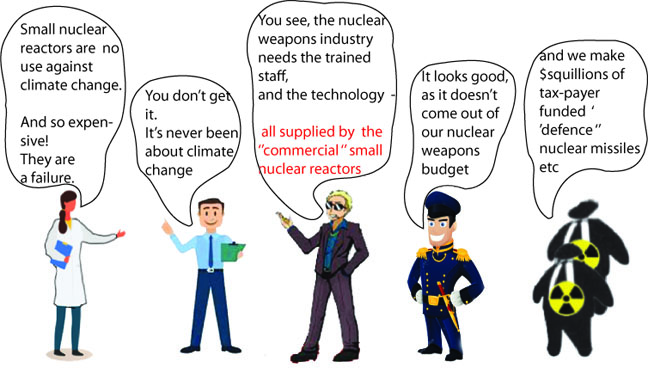
Well, we all do know why. The small nuclear reactor (SMR)power industry – moribund though it is, is essential for the nuclear weapons industry – for a number of reasons, but importantly – to put a sweet gloss on that murderous industry.
Never mind that USA’s NuScale’s SMRs were a resounding flop – NuScale is still being touted, along with all the other little nuclear unicorns manouvreing to get tax-payer funding.
The facts remain, and apparently just need to be hammered again and again:
SMRs are not cheap, not safe, do not reduce wastes, are not reliable for off-grid power, are not more efficient fuel users than are large reactors.
The latest hyped -up push for SMRs is in Canada – with the boast that they will benefit indigenous communities . Successful bribery of indigenous people would give a huge boost to the global nuclear lobby, – as indigenous people have historically been the most distrustful of uranium mining and of the whole nuclear fuel chain.

The gimmicks this time are floating nuclear power plants – barges carrying Westinghouse’s eVinci microreactors. These would take over from the current deisal power plants serving remote communities. There are already some solar, wind and battery projects – frowned upon by the nuclear lobby, of course.
These projects are being strongly promoted, but poorly explained to indigenous communities, would bring radiological hazards along Canada’s Northern shoreline
And what really are the chances that these little nuclear power sources would be effective anyway? Recent reports by the International Atomic Energy Agency (IAEA) reveal that while 83 small nuclear reactors are “in development”, but there are only 2 in operation.
In both cases, the development of the reactors was a very lengthy and expensive process.
The Chinese SMR HTR-PM- “Between January and December 2022, the reactors operated for only 27 hours out of a possible maximum of 8,760 hours. In the subsequent three months, they seem to have operated at a load factor of around 10 percent.”
For the Russian SMR – “The operating records of the two KLT-40S reactors have been quite poor. According to the IAEA’s PRIS [Power Reactor Information System] database, the two reactors had load factors of just 26.4 and 30.5 percent respectively in 2022, and lifetime load factors of just 34 and 22.4 percent.”
Will Canada’s remote indigenous communitites buy the duplicitous nuclear lobby’s propaganda on SMRs ? And then, subsequently, will the rest of us buy it, despite the facts. I guess that the corporate media will help, – if lies are repeated often enough, people come to believe them.
Small modular reactors aren’t the energy answer for Canada’s remote communities and mines
The energy costs associated with small modular reactors exceed those of diesel-based electricity. Policy-makers should focus on renewables.
by Sarah Froese, Nadja Kunz, M. V. Ramana August 26, 2020 https://policyoptions.irpp.org/magazines/august-2020/small-modular-reactors-arent-the-energy-answer-for-remote-communities-and-mines/
A new type of theoretical nuclear power plant design called small modular reactors (SMRs) has been in the news of late. Earlier this year, at the 2020 Canadian Nuclear Association conference, Minister of Natural Resources Seamus O’Regan announced that the federal government will release an SMR Action Plan this fall. Ontario, New Brunswick and Saskatchewan have announced their backing and possibly some financial support for the development of these reactors.
Promoters suggest that remote communities and off-grid mining operations are promising markets for SMRs in Canada. These communities and mines pay a lot for electricity because they are reliant on diesel generators, and transporting and storing diesel to these locations can be very expensive. Thus, supporters hope, SMRs might be a way to lower electricity costs and carbon dioxide emissions.
We examined this proposition in detail in a recently published paper and concluded that this argument has two problems. First, the electricity that SMRs produce is far more expensive than diesel-based electricity. Second, even ignoring this problem, the total demand for electricity at these proposed markets is insufficient to justify investing in a factory to manufacture the SMRs.
SMRs have been proposed as a way to deal with many problems associated with large nuclear power plants, in particular the high costs of construction, running to tens of billions of dollars. SMR designs have much in common with large nuclear reactors, including, most basically, their reliance on nuclear fission reactions to produce electricity. But they also differ from large nuclear reactors in two ways. First, they have electricity outputs of less than 300 megawatts (MW) and sometimes as low as a few MW, considerably lower than the outputs of 700 to 1500 MW typical of large nuclear reactors. Second, SMR designs use modular means of manufacturing, so that they need only be assembled, rather than fully constructed, at the plant site. While large reactors that have been constructed in recent years have also adopted modular construction, SMR designers hope to rely more substantially on these techniques.
A standard metric used to evaluate the economics of different energy choices is called the levelized cost of energy (LCOE). We calculated that the LCOE for SMRs could be over ten times greater than the LCOE for diesel-based electricity. The cheapest options are hybrid generation systems, with wind or solar meeting a part of the electricity demand and diesel contributing the rest.
Why this high cost? The primary problem is that the small outputs from SMRs run counter to the logic of economies of scale. Larger reactors are more cost-efficient because they produce more electricity for each unit of material (such as concrete and steel) they use and for the number of operators they employ. SMR proponents argue that they can make up for this through the savings from mass manufacture at factories and the learning that comes with manufacturing many reactors. The problem is that building a factory requires a sizable market, sometimes referred to as an order book. Without a large number of orders, the investment needed to build the factory will not be justified.
We estimated the potential market for SMRs at remote mines and communities in Canada. We drew primarily upon two databases produced by Natural Resources Canada regarding mining areas and remote communities. As of 2018, there were 24 remote mining projects that could be candidates for SMR deployment within the next decade. Currently, these projects use diesel generators with a total installed capacity of 617 MW. For remote communities, we calculated a fossil fuel (primarily diesel) generation capacity of 506 MW. But many of these communities had demands that were too low for even the smallest-output SMR under review at the Canadian Nuclear Safety Commission.
Even if all these potential buyers want to adopt SMRs for electricity supply, without regard to the economic or noneconomic factors weighing against the construction of nuclear reactors, the combined demand would likely be much less than 1000 MW. The minimum demand required to justify the cost of producing SMRs would be three to seven times higher.
Furthermore, we concluded that the economics of SMRs don’t compete when compared with other alternatives. The cost of electricity from SMRs was found to be much higher than the cost of wind or solar, or even of the diesel supply currently used in the majority of these mines and communities.
Of course, our estimates for the LCOEs of different sources are dependent on various assumptions. We tried varying these assumptions within reasonable limits and found that the main result — that electricity from SMRs is far more expensive than the corresponding costs of generating electricity using diesel, wind, solar or some combination thereof — remains valid. All else being equal, the assumed capital cost of constructing a SMR would have to decline by over 95 percent to be competitive with a wind-diesel hybrid system. The limited experience with SMRs that are being built around the world suggests that construction costs will be higher, not lower, than advocates promise.
Meanwhile, renewables and storage technologies have seen substantial cost declines over the past decades. Recent estimates place wind, solar and hybrid systems at costs competitive with diesel power. Successful demonstrations suggest that renewable hybrid applications are becoming increasingly feasible for heavy industry, and the implementation of numerous numerous projects in northern communities suggests a high level of social acceptance. Many northern and, in particular, Indigenous communities have an interest in self-determined decision-making and maintaining a good relationship with the land. In June 2019, for example, the Anishinabek Chiefs-in-Assembly, representing 40 First Nations across Ontario, unanimously expressed opposition to SMRs. Grand Council Chief Glen Hare announced that the Anishinabek Nation is “vehemently opposed to any effort to situate SMRs within our territory.”
Instead of focusing on SMRs, policy-makers should bolster support for other renewable generation technologies as key mechanisms to reduce carbon emissions and align with community values.
Gaza Journalists Killed by Israel Honored on World Press Freedom Day
“To claim these deaths are accidental is not only incredulous, it is insulting to the memory of professionals who lived their lives in service of truth and accuracy,” said one expert.
Common dreams JESSICA CORBETT, May 03, 2024
As the international community marked World Press Freedom Day on Friday, journalists and advocates across the globe mourned and celebrated those killed in Israel’s ongoing assault on the Gaza Strip.
The U.S.-based Committee to Protect Journalists (CPJ) has publicly identified at least 97 media workers killed since Israel launched its retaliatory war on October 7: 92 Palestinian, three Lebanese, and two Israeli reporters.
Since the Israel-Gaza war began, journalists have been paying the highest price—their lives—to defend our right to the truth. Each time a journalist dies or is injured, we lose a fragment of that truth,” said CPJ program director Carlos Martínez de la Serna in a Friday statement. “Journalists are civilians who are protected by international humanitarian law in times of conflict. Those responsible for their deaths face dual trials: one under international law and another before history’s unforgiving gaze.”
Reporters Sans Frontières (RSF)—or Reporters Without Borders—puts the journalist death toll in Gaza above 100. Middle East Monitorreports at least 144 members of the press are among the 34,622 Palestinians that Israeli forces have killed in less than seven months in what the International Court of Justice has called a plausibly genocidal campaign.
RSF on Friday released its annual Press Freedom Index. In its section on the Middle East, the group states:
Palestine (157th), the most dangerous country for reporters, is paying a high price. The Israel Defense Forces (IDF) have so far killed more than 100 journalists in Gaza, including at least 22 in the course of their work. Since the start of the war, Israel (101st) has been trying to suppress the reporting coming out of the besieged enclave while disinformation infiltrates its own media ecosystem……………………………………………………..
The Paris-based group nominated Palestinian journalists covering Gaza for an annual award from the United Nations Educational, Scientific, and Cultural Organization (UNESCO)—an honor they received during a ceremony on Thursday.
“Each year, the UNESCO/Guillermo Cano Prize pays tribute to the courage of journalists facing difficult and dangerous circumstances,” said Audrey Azoulay, the U.N. organization’s director-general. “Once again this year, the prize reminds us of the importance of collective action to ensure that journalists around the world can continue to carry out their essential work to inform and investigate.”…………………………………….
While Israel has repeatedly claimed—as it did to CNN on Friday—that “the IDF has never, and will never, deliberately target journalists,” members of the press and others have cast doubt on such comments.
“For far too long Israel has been able to operate with impunity in the occupied Palestinian territory, and this has included occasionally killing reporters, like the Palestinian-American journalist Shireen Abu Akleh, in 2022,” Simon Adams, president of the Center for Victims of Torture, told the Inter Press Service.
Given the number of journalists killed in Gaza since October, he said, “to claim these deaths are accidental is not only incredulous, it is insulting to the memory of professionals who lived their lives in service of truth and accuracy.”…………………………… more https://www.commondreams.org/news/gaza-journalists
A Closer Look at Two Operational Small Modular Reactor Designs
There are literally dozens of small modular reactor (SMR) and microreactor designs being developed by different companies around the world, and some of the work has been going on for decades. Yet, only two designs have actually been built and put into commercial operation. POWER takes a closer look at both of them.
Power, by Aaron Larson 1 May 24
Many nuclear power supporters have long thought small modular reactors (SMRs) would revolutionize the industry. Advocates expect SMRs to shorten construction schedules and bring costs down through modularization and factory construction. They often cite numerous other benefits that make SMRs seem like no-brainers, and yet, only two SMR designs have ever been built and placed in commercial operation.
The International Atomic Energy Agency (IAEA) publishes booklets biennially on the status of SMR technology. In the IAEA’s most recent booklet, it notes 25 land-based water-cooled SMRs and another eight marine-based water-cooled designs are under development globally. It also lists 17 high-temperature gas-cooled SMRs, eight liquid-metal-cooled fast-neutron-spectrum SMRs, 13 molten-salt SMRs, and 12 microreactors. If you do the math, that’s 83 SMR designs under development, but only the KLT-40S and HTR-PM are actually operational.
KLT-40S
The KLT-40S is a pressurized water reactor (PWR) that was developed in Russia. It is an advanced version of the KLT-40 reactor, which has been used in nuclear-powered icebreakers. The first KLT-40S units, and, to date, the only two of these units to enter commercial operation, were deployed in the Akademik Lomonosov—the world’s first purpose-built floating nuclear power plant (FNPP, Figure 1 on original).
Main Design Features.………………………………………………………………………………………………………….
Deployment Details.…………………………….
Construction and testing of the FPU was completed in 2017 at the Baltic shipyard. In May 2018, the vessel was towed 4,000 kilometers (km), around Finland and Sweden, to Murmansk, completing the first leg of its journey to Pevek. Fuel loading was completed in Murmansk in October 2018. First criticality was achieved in November 2018, then in August 2019, the vessel embarked on the second leg of its journey—a distance of 4,700 km—towed by two tugboats to the Arctic port town of Pevek, where it was connected to the grid on Dec. 19, 2019. Akademik Lomonosov was fully commissioned on May 22, 2020, and it currently provides heat to the town of Pevek and supplies electricity to the regional Chaun-Bilibino power system.
HTR-PM
On Dec. 6, 2023, China National Nuclear Corp. announced it had commenced commercial operation of the high-temperature gas-cooled modular pebble bed (HTR-PM) reactor demonstrator. The HTR-PM project was constructed at a site in Rongcheng, Shandong Province, roughly midway between Beijing and Shanghai in eastern China…………………………………
Main Design Features.…………………………………………………………………………………………………..
Deployment Details.……………………………………………………………………. The civil work for the nuclear island buildings was completed in 2016 with the first of two reactor pressure vessels installed in March that year. The fuel plant reached its expected production capacity in 2017. Startup commissioning and testing of the primary circuit were finished by the end of 2020. The HTR-PM achieved first criticality in September 2021, and was ultimately grid connected on Dec. 20, 2021.
Spotty Results at Best
While it is laudable that these SMRs—the KLT-40S and HTR-PM—have been placed in commercial operation, their performance since entering service has come under fire. In The World Nuclear Industry Status Report 2023 (WNISR), a Mycle Schneider Consulting Project, co-funded by the German Federal Ministry for the Environment, Nature Conservation, Nuclear Safety, and Consumer Protection, it says both designs have operated at low capacity factors recently.
Concerning the Chinese HTR-PM, the WNISR says, “Between January and December 2022, the reactors operated for only 27 hours out of a possible maximum of 8,760 hours. In the subsequent three months, they seem to have operated at a load factor of around 10 percent.” The Russian units’ performance has been nearly as dismal. “The operating records of the two KLT-40S reactors have been quite poor. According to the IAEA’s PRIS [Power Reactor Information System] database, the two reactors had load factors of just 26.4 and 30.5 percent respectively in 2022, and lifetime load factors of just 34 and 22.4 percent. The reasons for the mediocre power-generation performance remain unclear,” the report says.
Meanwhile, the promises of shortened timelines and lower costs were not borne out by these projects. “The experience so far in constructing these two SMRs as well as estimates for reactor designs like NuScale’s SMR show that these designs are also subject to the historical pattern of cost escalations and time overruns. Those cost escalations do make it even less likely that SMRs will become commercialized, as the collapse of the Carbon Free Power Project involving NuScale reactors in the United States illustrated,” the WNISR says………….. https://www.powermag.com/a-closer-look-at-two-operational-small-modular-reactor-designs/
Jewish Groups Decry House Passage of Bill Defining Criticism of Israel as ‘Antisemitism’
“Antisemitism is a serious problem, but codifying a legal definition could have dangerous implications for free speech,” said one campaigner.
BRETT WILKINS, May 01, 2024, Common Dreams,
House lawmakers voted overwhelmingly Wednesday to approve legislation directing the U.S. Department of Education to consider a dubious definition of antisemitism, despite warnings from Jewish-led groups that the measure speciously conflates legitimate criticism of the Israeli government with bigotry against Jewish people.
House members approved the Antisemitism Awareness Act—bipartisan legislation introduced last year by Reps. Mike Lawler (R-N.Y.), Josh Gottheimer (D-N.J.), Max Miller (R-Ohio), and Jared Moskowitz (D-Fla.) in the lower chamber and Sen. Tim Scott (R-S.C.) in the Senate—by a vote of 320-91.
Both progressive Democrats and far-right Republicans opposed language in the bill. The former objected to conflating criticism of Israel with hatred of Jews, while the latter bristled at labeling Christian scripture—which posits that Jews killed Jesus—as antisemitic.
“Antisemitism is the hatred of Jews. Unfortunately, one doesn’t need to look far to find it these days. But the supporters of this bill are looking in the wrong places,” Hadar Susskind, president and CEO of the Jewish-led group Americans for Peace Now, said following Wednesday’s vote.
“They aren’t interested in protecting Jews,” he added. “They are interested in supporting right-wing views and narratives on Israel and shutting down legitimate questions and criticisms by crying ‘antisemite’ at everyone, including Jews” who oppose Israel’s far-right government………………………………………………………………………………………………………… more https://www.commondreams.org/news/antisemitism-awareness-act
ARC might need to redesign its SMR technology: former president + US bans import of enriched uranium + more to the story
Susan O’Donnell, 2 May 24 To clarify, there’s currently no enrichment plant in the US that produces HALEU (fuel enriched between 5 and 20 percent), as far as I’m aware. Any nuclear fuel enrichment happening in the U.S. would be for the existing light-water reactors that use fuel enriched to less than 5 percent. My take: the idea that the ARC reactor design could change from using HALEU fuel to low enriched uranium is frankly ridiculous. It would not be the same reactor at all, it would be a completely different design. Quote: “It’s not something that can’t be fixed,” Sawyer said. Fixed? WTF? This whole project is a scam. |
U.S. Senate passes Russian uranium import ban
https://www.ukrinform.net/rubric-economy/3858689-us-senate-passes-russian-uranium-import-ban.html
The article above is about the shortage of HALEU, the fuel currently only available in Russia that is needed by the designs of advanced reactors cooled by liquids other than water. The design for the ARC reactor slated for Point Lepreau in New Brunswick requires HALEU.
New Brunswick’s Telegraph Journal:
ARC might need to redesign its SMR technology: former president
Norm Sawyer points to other companies around the world that pivoted quickly to address the lack of enriched uranium available
Adam Huras
Published May 01, 2024
The former president and CEO of ARC Clean Technology says the company might need to redesign its small modular nuclear reactor technology.
Norm Sawyer points to other companies around the world that pivoted quickly to address the lack of enriched uranium available.
Brunswick News reported earlier this week that ARC is still in search of a new enriched uranium supplier, after it originally planned to buy from Russia.
Meanwhile, Energy Minister Mike Holland says he has been assured that “there’s a queue for North American enriched uranium and we’re in it,” maintaining the company that the Higgs government spent $20 million on won’t be shut out.
Firms around the world developing a new generation of small nuclear reactors to help cut carbon emissions have been forced to face a big problem: The only company that sells the enriched fuel they need is Russian.
“It’s not only ARC, the industry in general is really dealing with the fallout of the war,” Sawyer said, who is now a nuclear consultant through his own firm. “Russia is the main supplier of HALEU around the world.”
High-assay low-enriched uranium (HALEU) is an integral component of the company’s ARC-100 sodium-cooled fast reactor, as well as a number of other advanced reactors currently in development attempting to achieve smaller designs.
But it’s not as simple as finding that enriched uranium closer to home.
While Canada mines uranium – there are currently five uranium mines and mills operating in Canada, all located in northern Saskatchewan – it does not have uranium enrichment plants.
The U.S. opened its first and only enrichment plant last year, operated by Centrus Energy in Ohio, amid a federal push to find a solution to the Russia problem.
It remains the only facility in the U.S. licensed to enrich uranium.
It currently has contracts with two American companies pursuing SMR technology, although it says it could rapidly expand production with federal investment.
One of those, TerraPower, a nuclear reactor developer founded by Bill Gates, has said Russia’s invasion would mean a delay to the deployment of its Natrium reactor by at least two years.
Other companies have pivoted.
Sawyer pointed to Denmark’s Seaborg Technologies that announced last year it would be changing its proposed SMR fuel from HALEU to low-enriched uranium “due to the risks associated with developing a sufficient supply.”
That resulted in design changes.
It was a move the company said was necessary to meet its planned timeline to see a first group of SMRs ready by 2028……………………………………………………..
What I’ve been told that there are a number of things taking place to ensure that there’s a queue for North American enriched uranium and we’re in it,” Holland said.
“That’s what I’ve been told and told definitively.”
Holland said the U.S. has a “vested interest” in aiding Canada and its SMR technology because Canada has the uranium they’re going to need as well.
“There are people saying ‘hey, if Canada is going to be your large supplier we’re going to have to work out, quid pro quo, that we don’t get excluded,’” he said.
Holland maintained that “our toe is stuck in the door so we have an opportunity to be part of that supply chain………………………………..
Sawyer said making a change to a different fuel means components will need to be redesigned.
“Obviously, you design a reactor for the type of fuel you’re going to use so there’s obviously some work to be done to realign the reactor core to the new type of fuel,” he said. “Is it easy? I’m not sure if it’s easy. There is some work to be done, there’s no doubt.”
Sawyer added that there’s two components to SMRs: the reactor design, construction and deployment, and then the fuel.
“Any delay on either one of those sides of the equation could cause a delay later on,” he said.
1 This Month



Shut down the radiation-damaged Heysham nuclear reactors now
To see nuclear-related stories in greater depth and intensity – go to https://nuclearinformation.wordpress.com

Say No to NASA’s Reckless Nuclear Reactor on the Moon
Say No to NASA’s Reckless Nuclear Reactor on the Moon
-
Archives
- October 2026 (256)
- September 2026 (339)
- August 2026 (330)
- July 2026 (355)
- June 2026 (287)
- May 2026 (306)
- April 2026 (356)
- March 2026 (251)
- February 2026 (267)
- January 2026 (308)
- December 2025 (358)
- November 2025 (359)
-
Categories
- 1
- 1 NUCLEAR ISSUES
- business and costs
- climate change
- culture and arts
- ENERGY
- environment
- health
- history
- indigenous issues
- Legal
- marketing of nuclear
- media
- opposition to nuclear
- PERSONAL STORIES
- politics
- politics international
- Religion and ethics
- safety
- secrets,lies and civil liberties
- spinbuster
- technology
- Uranium
- wastes
- weapons and war
- Women
- 2 WORLD
- ACTION
- AFRICA
- Atrocities
- AUSTRALIA
- Christina's notes
- Christina's themes
- culture and arts
- Events
- Fuk 2022
- Fuk 2023
- Fukushima 2017
- Fukushima 2018
- fukushima 2019
- Fukushima 2020
- Fukushima 2021
- general
- global warming
- Humour (God we need it)
- Nuclear
- RARE EARTHS
- Reference
- resources – print
- Resources -audiovicual
- Weekly Newsletter
- World
- World Nuclear
- YouTube
-
RSS
Entries RSS
Comments RSS

