The secret nuclear influencer in the heart of Moscow.
Dr Eva Stegen 21st Jan 2026
Nuclear energy does not appear in any of the 19 EU sanctions packages, thanks to a key individual. Former nuclear power executive Henri Proglio has maintained several consulting offices in Moscow, the heart of Putin’s power, for the past 10 years. The former head of the state-owned Électricité de France (EdF) still sits on the international advisory board of Putin’s nuclear power conglomerate Rosatom.
Déjà vu: A wave of outrage swept through Germany when the “family business owners” tested the boundaries by extending an invitation to the AfD. The business lobby group eventually backtracked. The German “corporate families” may have been inspired by French far-right extremists who have been casting their nets into corporate boardrooms for some time. The French trial balloon was launched two years ago, a few months before the elections, and provoked a media frenzy. Marine Le Pen, the presidential candidate of the National Rally (RN), orchestrated a meeting with an extremely polarizing manager: Henri Proglio. He was one of the country’s most powerful business leaders until he was deemed inferior at the nuclear power company Électricité de France (EdF).
Critics consider the self-proclaimed Putin supporter, who calls himself a “killer ,” to be “not as successful as he would have people believe .” They claim he has “developed a system of clans, gangs, and sinecures” that promoted nuclear technology exports to crisis regions. Under his leadership (2009-2014), he forged ties with Chinese rulers, the Libyan dictator Gaddafi , the Saudi Bin Laden Group, and other dubious business partners. His mentor, Nicolas Sarkozy, was imprisoned over the Libya affair. Another key figure in this corrupt clique, the secret protector of Proglio’s career, “Monsieur Alexandre,” also received a prison sentence. Proglio’s enforcer, a former gang leader from the Parisian suburbs , knows prison from the inside. The middleman rose from the underworld to the highest circles of politics and business: “I hold them all by the balls .”……………………………………………………………………………………………………………………………………………
Proglio and the National Rally (RN) are advocating for a “Frexit,” wanting to withdraw from the EU electricity market and give preferential treatment to French companies. These ideas of European division are welcomed by the Kremlin. ………………………………
the fact that “the fuels that power our nuclear power plants largely
come from Russia” amounts to nothing less than import dependency . And this is with a high-risk technology of civil-military relevance.
“Why is the nuclear industry spared?”
Investigate Europe and Tagesspiegel asked back in 2022. Nuclear power does not appear in a single one of the (now 19) EU sanctions packages. In their joint research, they show:
“ The close connection between the French and Russian nuclear industries is exemplified not least by Henri Proglio , the former CEO of the French state-owned electricity supplier EDF, who still sits on the international advisory board of Rosatom ,” the Russian nuclear conglomerate used by Vladimir Putin as a geopolitical instrument to expand his influence in Europe.
No nuclear sanctions – thanks to import dependency and a key personnel decision
In addition to his position at Rosatom, Proglio has maintained several consulting offices in Moscow for the past ten years, profiting handsomely from Putin’s war in Ukraine and orchestrating shady deals, including in the nuclear sector. This is particularly sensitive because he is privileged to the most closely guarded secrets of France, a civilian-military nuclear power. While he can keep secrets—he even concealed the lucrative activities of companies like ‘Henri Proglio Consulting’ and ‘HP Energy Advisory’ in Moscow from the parliamentary inquiry committee—it is highly questionable whether this is always in the best interests of France or Europe.
……………………….He believes the existing reactors should be allowed to operate until a medium-power reactor (1000 MW) is developed. He himself is responsible for the sale of the intellectual property rights for precisely this technology to China. That was the death knell for the French reactor manufacturer Areva.
ts engineers were stunned when they discovered a Chinese pirated copy of their plans, developed with Japanese colleagues for a 1000 MW reactor. Proglio was behind it:
“We will build Franco-Chinese reactors. And we will also build Franco-Russian reactors.” He himself was present at the clandestine signing of far-reaching contracts , which amounted to a ticket into the heart of France’s highly sensitive nuclear infrastructure. ………………………………………………………………………………………………………………………………………………………………………………………………………..
Rosatom’s geostrategy for global dependence
According to its own statements, “Rosatom is the only company worldwide that possesses all technologies of the nuclear fuel cycle .” The nuclear giant, with its 450 arms, employs around 420,000 people and aims to establish itself as the world market leader in the entire nuclear process chain, from uranium mining through conversion, enrichment, fuel element production, reactor construction, operation, maintenance and decommissioning, to waste management…………………………………………………………………………………….https://www-eva–stegen-de.translate.goog/blog/atom-Influencer-im-herzen-moskaus.html?_x_tr_sl=de&_x_tr_tl=en&_x_tr_hl=de&_x_tr_pto=wapp
Zionism: The Etymological and Ideological Unpacking of a “Political Pathogen”

22 January 2026 Dr Andrew Klein, P https://theaimn.net/zionism-the-etymological-and-ideological-unpacking-of-a-political-pathogen/
The term “Zionism,” the modern political ideology advocating for a Jewish homeland in Palestine, is often analysed through the lenses of history, politics, and conflict. However, to understand its full potency and impact – to see it as a “political pathogen” – we must first dissect the linguistic and cultural DNA from which it was synthesised. This paper posits that Zionism is a European ideological construct, born of a specific historical moment, which instrumentalised ancient religious and cultural symbols to forge a modern nationalist movement. Its power and subsequent global impact stem from this fusion of the ancient and the modern, a fusion that has proven both resilient and, in the view of its critics, deeply destructive.
I. The Etymological Core: From Sacred Hill to Nationalist Ideology
The linguistic root of “Zionism” is the Hebrew word “Zion” (Ṣîyyôn), originally referring to a specific hill in Jerusalem. Over millennia, particularly following the Babylonian Exile, “Zion” transformed from a geographic location into a potent synecdoche and poetic symbol for the entire Land of Israel and the Jewish people’s spiritual yearning for return. This meaning was deeply embedded in Jewish messianic belief, envisioning a future redemption.
The transformation into a modern political “-ism” occurred in late 19th-century Europe. The term “Zionism” (Zionismus) is first credibly attributed to the Austrian Jewish intellectual Nathan Birnbaum in an 1890 article. It was coined in reference to the activities of the Hovevei Zion (“Lovers of Zion”), proto-Zionist groups that promoted Jewish agricultural settlement in Ottoman Palestine. The movement was catapulted onto the world stage by Theodor Herzl, whose 1896 pamphlet Der Judenstaat (The Jewish State) and the subsequent founding of the Zionist Organization in 1897 popularised the term and defined its political objectives. The choice of “Zion” was deliberate: it grafted the new secular nationalist project onto the deep-rooted, sacred longings of Jewish tradition, providing an immediate and powerful historical legitimacy.
II. The European Crucible: Birth of an Ideology
Zionism did not emerge in a vacuum. It was a direct product of, and reaction to, the specific conditions of European society in the 19th century.
The “Jewish Question” in Europe: Zionism arose as one answer to the pervasive “Jewish Question” – the problem of how Jews, perceived as an unassimilable minority, could exist within European nation-states defined by ethnic homogeneity. Faced with persistent antisemitism, from violent pogroms in Eastern Europe to institutional discrimination in the West, thinkers like Herzl concluded that assimilation was impossible and that Jews constituted a distinct nation requiring sovereignty in their own land.
The Influence of European Nationalism: Zionism was fundamentally shaped by the Romantic nationalist movements sweeping Europe, which argued that every “people” or “nation” (Volk) required a state for its full expression. Zionists applied this model to Jews, asserting their right to national self-determination. The movement also internalised contemporary colonial and racial thinking, with early leaders at times explicitly framing a Jewish state in Palestine as a European outpost or “colonial” endeavour that would bring progress to the region.
Internal Jewish Debates: It is critical to note that Zionism was a contested ideology from its inception. Significant Jewish movements, most notably the socialist Bund in Eastern Europe, vehemently opposed it. These anti-Zionists argued that fleeing antisemitism validated the persecutors’ logic, that the diaspora was a legitimate and rich Jewish homeland, and that the future lay in fighting for socialist revolution and equality within Europe.
III. The Ideological Structure: Core Tenets and Internal Divergence
While unified by the core goal of a Jewish homeland, Zionism was never monolithic. Its internal structure comprised several competing strands:
Political Zionism (Herzl): Focused on achieving a Jewish state through high-level diplomacy and international legal charters.
Practical Zionism: Emphasized the “conquest of land” through immediate agricultural settlement in Palestine.
Labor Zionism: Merged socialist principles with nation-building, promoting collective enterprises like the kibbutz and forming the ideological backbone of Israel’s early leadership.
Revisionist Zionism (Jabotinsky): Advocated for a more militant, maximalist approach to establishing a Jewish state on both banks of the Jordan River, emphasizing military strength and capitalist development.
Cultural Zionism (Ahad Ha’am): Prioritised the creation of a new Jewish spiritual and cultural center in Palestine over immediate political sovereignty.
Religious Zionism: Fused Jewish religious messianism with nationalist politics, viewing the Zionist project as the beginning of divine redemption.
Despite these differences, a critical consensus emerged across most Zionist thought: the necessity of establishing a Jewish demographic majority in Palestine. This demographic imperative, confronting the reality of a majority Arab population, led to the conceptualisation of “transfer” – a euphemism for the removal or ethnic cleansing of Palestinians – as a logical, if debated, solution within mainstream Zionist discourse from the movement’s early decades.
IV. The “Pathogen” Metaphor: Mechanisms of Global Impact
Viewing Zionism through the lens of a “political pathogen” requires examining its replication and impact beyond Palestine/Israel. Its global influence operates through several key mechanisms:
The Logic of Domination: Scholar Vincent Lloyd reframes Zionism’s outcome as a transition from a movement seeking liberation from European domination to one that institutes a new structure of domination over Palestinians. This system is maintained through military occupation, legal discrimination, and the systemic denial of Palestinian dignity and political rights.
Christian Zionist Symbiosis: A critical vector for the ideology’s spread is Christian Zionism, particularly within Protestant evangelicalism. This theology supports Jewish return to Israel not out of solidarity with Jews, but as a prerequisite for the Second Coming of Christ, after which non-converted Jews are often envisioned to be destroyed. This creates a powerful, theologically motivated political lobby (especially in the United States) that reinforces Israeli state policy.
Global Export of “Security” Models: Israel has leveraged its experience controlling Palestinian populations to become a leading global exporter of surveillance technology, weapons, and counter-insurgency tactics. This “laboratory” of repression markets its products to other states and regimes, embedding Zionist-derived models of population control into global security infrastructures.
Conflating Critique with Antisemitism: A potent defensive mechanism has been the strategic effort to equate criticism of Zionism or Israeli state policy with antisemitism, as seen in debates over definitions like the IHRA working definition. This conflation seeks to immunise the ideology from political critique by framing opposition as a form of racial or religious hatred.
Conclusion: A Tale That Found a Home
Zionism is indeed “a tale that found a home.” It is a modern European nationalist tale, constructed from the ancient lexicon of Jewish prophecy and the contemporary grammar of 19th-century racial and colonial thought. It found a home through a deliberate and violent process of settlement and state-building, necessitating the displacement and continued subjugation of another people.
Its “pathogenic” quality lies in its resilience and adaptability – its ability to graft itself onto different host ideologies, from socialist pioneering to evangelical Christian millennialism, and to replicate its core logic of ethnic dominance in new contexts. The language that shaped it provided a bridge between deep history and political modernity, creating an ideology of immense persuasive power and tragic consequence. To understand the ongoing conflict and its global resonances, one must first understand this foundational synthesis of word, idea, and power.
References…………………………..
They’re Trying To Sneak Israel’s President Into Australia Without Anti-Genocide Protests
And Other Notes
Caitlin Johnstone, Jan 23, 2026, t.one/p/theyre-trying-to-sneak-israels-president?utm_source=post-email-title&publication_id=82124&post_id=185482225&utm_campaign=email-post-title&isFreemail=true&r=ln98x&triedRedirect=true&utm_medium=email
Israeli president Isaac Herzog is expected to visit Australia at the invitation of the Australian government, with anonymous sources telling the Israeli press that he’s scheduled to arrive on February 7, but so far Canberra itself has been very opaque about the time and nature of the visit. We can surmise from this that they’re currently trying to come up with a strategy for how to sneak the president into the country without the spectacle of him getting confronted by throngs of anti-genocide protesters.
Again: they’re trying to sneak the president into the country for a visit to protect him from anti-genocide protesters. Really think about what that means, and what it says about Australia as a country.
When you are doing things like this, you’re on the wrong side of history.
As soon as the UK listed Palestine Action as a terrorist group it was made clear to the entire western world that there is no limit to how far our governments will go to stomp out speech that is critical of Israel. Literally no limit. Once you’re arresting old ladies in wheelchairs for holding a sign that says “I oppose genocide, I support Palestine Action,” you’re making it clear that there’s nothing you won’t do to bludgeon the populace into line regarding this one particular foreign state.
That was a real turning point for western society, in retrospect. Up until then it’d been horrific genocidal depravity in Gaza and some ugly shenanigans with TikTok and university campuses, but actually proclaiming that an activist group is a terrorist organization and arresting anyone who supports it was a wildly unprecedented escalation. From that point on it’s been clear to every decent person throughout the western world that we’re in the imperial crosshairs now.
They’re coming for us directly. Our rights are on the chopping block. There’s no limit to how dark and dystopian things can get from here.
I’m not trying to be antisemitic or anything but I personally think it should be legal to voice criticisms of the military activities of a foreign state.
❖
One of the many reasons I’m so hostile to authoritarian efforts to stomp out pro-Palestine speech in Australia is because there’s something deep inside me that would find it intolerable for us to be worse than the Brits.
There should be a mandatory six-month “cooling off period” between any mass shooting or act of terrorism and any legislation purportedly put out in response to it, because the emotional immediate aftermath is always when lawmakers try to roll out their most authoritarian agendas.
I’ve said it before and I will say it again: nobody actually believes the Bondi attack had anything to do with Palestinians or pro-Palestine protests. Anyone who claims they believe that is lying. They’re just pretending there’s a connection in order to stomp out pro-Palestine speech and activism in Australia.
International social media has rediscovered video footage of the Sydney Harbour Bridge protest last year, and it is very impressive to revisit. A massive line of hundreds of thousands of people holding umbrellas and Palestinian flags in opposition to their government’s complicity in the holocaust in Gaza.
It must have left a mark, because the Israel lobby has been on the warpath frantically trying to crush our right to protest ever since. People sometimes knock the effectiveness of peaceful demonstrations, but if they didn’t make a difference tyrants wouldn’t hate them so much.
The reason I’ve been talking about the Australian Israel lobby so much lately is because it has made itself my problem. Kwame Ture said “If a white man wants to lynch me, that’s his problem. If he’s got the power to lynch me, that’s my problem.” I find his logic sound.
The Israel lobby in Australia has shown it has the power to successfully pressure governments to advance laws and policies which threaten the speech of people like myself who speak critically of the state of Israel. That makes them my problem.
There are more important and urgent things going on in the world than the lobbying efforts of an apartheid state in a peripheral nation of the imperial core, to be sure. I’d rather be writing about those matters. But the Australian Israel lobby has made itself my problem, so I need to mention its abusive behaviors from time to time.
I know my name has appeared on lists. I know I’ve been the subject of private discussion among people I’d have preferred not to receive attention from. I know I share a country with people who would openly celebrate if I was imprisoned for the things I have said about Israel and Zionism. So I’ve got a vested interest in calling attention to the forces that are working to assault the civil rights of people like myself, and to my government’s inexcusable advancement of those agendas.
And all decent Australians have that same vested interest, to be clear. Every person of conscience who wishes to be able to speak out against their government’s facilitation of mass murder and abuse has a personal stake in this debate. Because we’ve each got a target on our voice box now. We all need to speak out while we still can.
The brave journalists of the old-fashioned media.
21 January 2026, Noel Wauchope, https://theaimn.net/the-brave-journalists-of-the-old-fashioned-media/
It’s not easy being a journalist in a paid job in corporate print, TV or radio media. You have to toe the corporate line. It’s best to be writing on a specialised topic where you’re likely to not offend the powerful. Cooking, gardening, sport -are good, though even in them, hazardous aspects can arise – like race, religion, gender, sexuality.
But when it comes to environment, current affairs, politics, business – the prudent journalist needs to tread warily, lest he/she loses the job.
This is an awful pity. Although writers have always had to be careful about offending business owners and governments, It hasn’t always been as dangerous as it is now. And for us, the “consumers of media”, the advantages of “mainstream” media are great. There is funding to enable strong investigative journalism. There is fact-checking, meaning that the readers/viewers, listeners, can have confidence in the facts of the story. Heck! the editors even check grammar and spelling (well, mostly). And these are the reasons why I still like “mainstream” media.
And so, as I’m pondering on journalists and their contributions to society, I am very aware of those journalists who, still hanging on to their corporate-controlled jobs, manage to sneak in, or even state boldly, some unwelcome realities.
Nowhere is the media’s craven subservience to the powerful more obvious than in journalism’s coverage of the nuclear industry. Any day at all, if you bother to search “nuclear” on Google News, there will be a stream of articles describing the nuclear industry in positive terms, even with breathless enthusiasm.
I think that the nuclear lobby has done a fine job in teaching the world that no-one but nuclear industry experts can possibly understand nuclear issues – so journalists find it easiest and prudent to just regurgitate nuclear industry handouts. (Heaven forfend that we should fall for the message of a Dr Helen Caldicott – explaining that nuclear power is just an expensive way to boil water. Albert Einstein thought the same thing).
It’s not a Russia-China versus the West thing, as ALL these powerful governments are enthusiasts for nuclear power. So the critics of nuclear power are not “Left” or “Right”: they are simply critics of nuclear power.
So, in this climate of journalists playing safe, and not upsetting government or industry, I have to admire those who stay on in their media jobs, try not to offend, but communicate the facts, and manage to include some negative aspects of nuclear power.
Here’s one example, although he did not last long in his job in Russia. Vladimir Slivyak, a patriotic Russian, taught at the Moscow School of Economics. And that was alright for a while. But the coal and nuclear industries are highly treasured in Russia, and Slivyak wrote powerful articles, criticising them. You can’t get away with attacking Russian government policies for long, and the government eventually classified him as a foreign agent, and he had to emigrate to Germany. Silvyak is an unfailing critic of bad environmental policies of whatever government, so, now in the West, he continues to expose bad nuclear policies of the European countries, particularly France, and their continued dependence on Russian uranium.
It should be easier for writers in the West, with our famed “freedom of speech, freedom of the press”, but it’s not, really. Fearful not only of the disapproval of authorities, but also of showing their ignorance of matters nuclear, journalists find the publicity handouts and worthy utterances of nuclear experts to be the safest bet for informing the public. Hence, even if they do have their doubts, the vast majority of journalists practise self-censorship on those doubts.
Once a writer has become known as an opponent of the nuclear industry, he or she becomes not only unemployable in the mainstream media, but is widely disparaged as an eccentric, a ratbag, a communist tool, or like Dr Helen Caldicott: “hysterical” “crazy”. It doesn’t matter if, like Arnie Gunderson, they’re a nuclear engineer – they’re still a crank and not to be trusted.
So, the admirable skill, is to be able to write authoritatively on nuclear matters, and still sneak in those damning questions, those subtle criticisms. Physicist Dr Edwin Lyman managed this for a long time, actually advising the nuclear industry and USA Government on safety matters. But in more recent years, he’s gone a bit too definite in his views on nuclear unsafety:
“Be wary of new ‘smaller’ kinds of nuclear power plants“, with the result that nuclear expert Dr Al Scott and others have judged Lyman to be extreme in his views.
My favourite journalist within this narrow category of “staying inside media respectabilia” is a Canadian data journalist. I hesitate to name him – I’d hate to cast a gloom on his career. He writes for the Globe and Mail, and his articles are not anti-nuclear. They’re factual, but he’s inclined to point out things like:
“In a January report, the International Energy Agency said costs must come down; Small Modular Reactors need to reach US$4.5-million per megawatt by 2040 to enjoy rapid uptake, far less than Ontario Power Generation (OPG)’s estimated costs.”
“… the commissioners heard concerns from intervenors that GE-Hitachi hadn’t yet finished designing the reactor, raising questions about how its safety could be analyzed properly.”
His series on Canada’ s nuclear developments are detailed, and certainly not opposing the industry. It’s just that his facts on the need for taxpayer support, on fuel supply problems and costs, on the comparative economics of renewable energy – these facts are not encouraging for nuclear power.
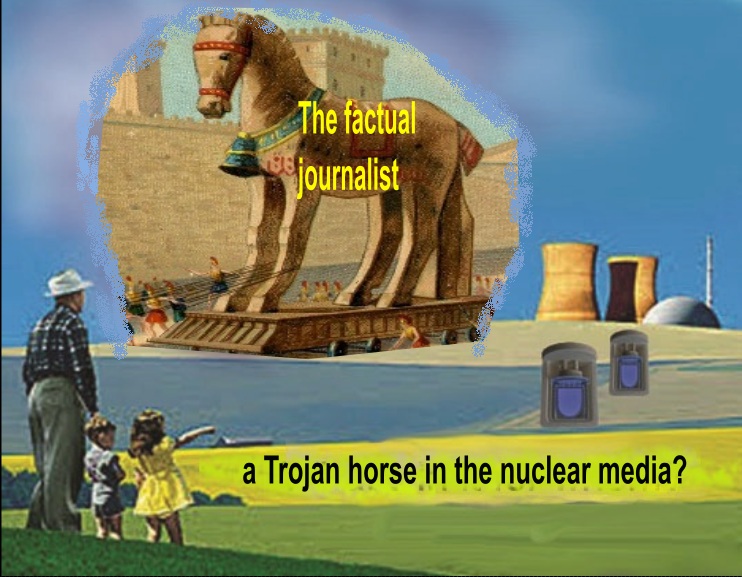
I ponder that these kinds of critics, just gnawing away at the edges of the nuclear industry’s gospel, might be more effective opponents of that industry than the many articulate and impressive anti-nuclear activists. A subtle “Trojan horse” style of journalism?
What Canada’s nuclear waste plan means for New Brunswick
by Mayara Gonçalves e Lima, January 20, 2026, https://nbmediacoop.org/2026/01/20/what-canadas-nuclear-waste-plan-means-for-new-brunswick/
Canada is advancing plans for a Deep Geological Repository (DGR) to store the country’s used nuclear fuel. In early 2026, the Nuclear Waste Management Organization (NWMO) entered the federal regulatory process by submitting its Initial Project Description — a major step in a project with environmental and social implications that will last for generations.
The implications of this project matter deeply to New Brunswickers because the province is already part of Canada’s nuclear legacy through the Point Lepreau Nuclear Generating Station. The proposed repository in Ontario is intended to become the final destination for used nuclear fuel generated in New Brunswick, currently stored on site at Point Lepreau.
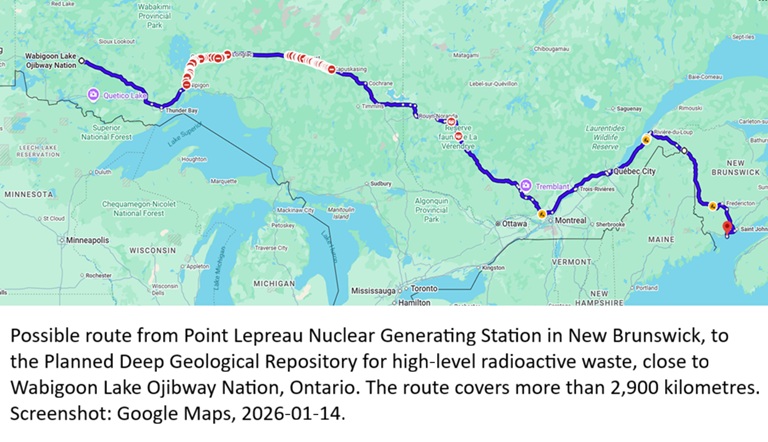
If the project goes ahead, highly radioactive nuclear waste would be transported across New Brunswick. Current NWMO plans envision more than 2,100 transport packages of New Brunswick’s used nuclear fuel travelling approximately 2,900 kilometres, through public roads in the province and across Canada, over a period of 10 to 15 years.
For many residents, the project raises long-standing concerns about safety, accountability, and cost — especially as NB Power continues to invest in nuclear technologies and considers new reactors. Decisions about the DGR will influence how long New Brunswick remains tied to nuclear power, carrying the risks of waste that remains hazardous far beyond any political or economic planning horizon.
This is a critical moment because public input is still possible — but the comment period window is narrow. Environmental organizations and community advocates are calling for extended consultation timelines, full transparency on transport risks, and meaningful consent from affected communities. Several groups have organized a sign-on letter that readers can review and support.
How New Brunswickers respond now will help determine whether these decisions proceed quietly — or with public accountability.
Unproven science and public concerns
Globally, no deep geological repository for high-level nuclear waste has yet operated anywhere on the planet. Finland’s Onkalo facility is often cited as the first of its kind, but it remains in testing, relies on unproven assumptions about geological containment, and will not be fully sealed for decades.
The lack of proven DGR experience matters for Canada because the proposed repository would be among the world’s earliest attempts to isolate high-level radioactive waste “forever,” despite the absence of any real-world proof that such facilities can perform as claimed. Canada’s decision therefore sets not only a national course, but a global precedent built on uncertain science and long-term safety assumptions.
The proposed DGR would be built 650 to 800 metres underground in northwestern Ontario, near the Township of Ignace and Wabigoon Lake Ojibway Nation (WLON), in Treaty #3 territory. Its purpose is to bury and abandon nearly six million bundles of highly radioactive used nuclear fuel, attempting to isolate them from the biosphere for hundreds of thousands of years.
The Nuclear Waste Management Organization describes the site selection as “consent-based,” but this framing raises difficult questions. Consent in economically marginalized regions — particularly where long-term funding, jobs, and infrastructure are promised — is not the same as free, prior, and informed consent, especially when the risks extend far beyond any western planning horizon.
In 2024, the Assembly of First Nations held dialogue sessions on the transport and storage of used nuclear fuel. Communities raised serious concerns that the proposed DGR could harm land, water, and air — all central to Indigenous culture and way of life.
Guided by ancestral knowledge and a duty to protect future generations, the Assembly warned that the DGR threatens sacred sites, ecosystems, and groundwater, including the Great Lakes. Climate change and natural disasters heighten these risks, exposing the limits of the current monitoring plan and prompting calls for life-cycle oversight.
A token consultation for a monumental project
As anticipated, the Initial Project Description raises serious concerns about the DGR process itself. One of the most serious flaws is the stark mismatch between the project’s scale and the time allowed for public input. Although the DGR is framed as a 160-year project with risks lasting far longer, communities, Indigenous Nations, and civil society groups have been given just 30 days to review the Initial Project Description, with submissions due by February 4.
Thirty days to read dense technical documents, consult communities, seek independent expertise, formulate questions, and respond meaningfully to a proposal that will affect land, water, and people for generations. This is not a generous consultation — it is the bare legal minimum under federal impact assessment rules.
While regulators emphasize that the overall review will take years, this early stage is crucial in shaping what will be examined and questioned later. Rushing public input at the outset risks reducing participation to a procedural checkbox rather than a genuine democratic process, particularly for a decision whose consequences cannot be undone.
The overlooked threat of waste transport
Another serious shortcoming in the project proposal is a failure to adequately address the nationwide transport of radioactive waste. Transporting highly radioactive material through communities by road or rail is central to the project and carries significant safety and environmental risks that remain largely unexamined.
By excluding radioactive waste transportation from the Initial Project Description, the Nuclear Waste Management Organization is effectively removing it from the scope of the comprehensive federal Impact Assessment. If transport is not formally included at this stage, it will not receive the same level of environmental review, public scrutiny, or interdepartmental oversight as the repository itself.
Instead, transportation would be left primarily to the Canadian Nuclear Safety Commission and Transport Canada to assess under the existing regulations — an approach that is fragmented and insufficient given the scale, duration, and risks of moving highly radioactive waste through communities.
The transport of radioactive waste is a critical yet often overlooked issue. As Gordon Edwards, president of the Canadian Coalition for Nuclear Responsibility notes, Canada has no regulations specifically governing the transport of radioactive waste — only rules for radioactive materials treated as commercial goods. This gap matters because radioactive waste is more complex, less predictable, and potentially far more dangerous.
Transporting high-level nuclear waste is inherently risky: the material remains hazardous for centuries, and accidents, equipment failures, extreme weather, security breaches, or human error can still occur despite careful planning. Unlike other hazardous materials, radioactive contamination cannot be easily contained or cleaned up, leaving land, water, and ecosystems damaged for generations. Even a single transport incident could have lasting, irreversible consequences for communities along the route.
Radiation risks extend beyond transport workers. People traveling alongside shipments may face prolonged exposure, while those passing in the opposite direction are briefly exposed in much larger numbers. Residents and workers along transport routes can experience repeated exposure, and accidents or unplanned stops could result in localized contamination. Emergency response is further complicated by leaks or hard-to-detect releases, with standard spill or firefighting methods potentially spreading contamination.
These risks are not hypothetical. Last summer, Gentilly-1 used fuel was transported from Bécancour, Quebec, to Chalk River, Ontario, along public roads — without public notice, consultation, Indigenous consent, or clear evidence of regulatory compliance — underscoring the ongoing risks to our communities.
According to the 2024 Assembly of First Nations report, at least 210 First Nations communities could be affected by shipments of radioactive waste traveling from nuclear reactors to the repository via railways and major highways, though the full scope may be even larger when considering watersheds and alternative routes.
Given this reality, it is unacceptable that the DGR Project Description largely ignores waste transport. Any credible assessment must examine how waste will be moved, who will be affected, what rules apply, who is responsible for oversight, and how workers, communities, and the environment will be protected in emergencies. It is the job of the Impact Assessment Agency of Canada to examine these plans in depth.
A high-stakes decision that demands public voice
Canada’s proposed Deep Geological Repository is one of the most ambitious and high-stakes projects in nuclear waste management. Framed as a permanent solution, it remains untested — no country has safely operated a deep repository for used nuclear fuel over the long term. Scientific uncertainty and multi-decade timelines make its risks profound and enduring.
Dr. Gordon Edwards warns: “The Age of Nuclear Waste is just beginning. It’s time to stop and think. […] we must ensure three things: justification, notification, and consultation — before moving any of this dangerous, human-made, cancer-causing material over public roads and bridges.”
Now is the moment for public voices to be heard. Legal Advocates for Nature’s Defence (LAND), an environmental law non-profit, has prepared a sign-on letter and accompanying press release calling for a more precautionary, transparent, and democratic approach to the Deep Geological Repository. This is your chance to have a say in decisions that could expose you, your neighbours, and your communities to serious environmental and health risks.
The letter urges federal regulators to extend public consultation timelines, require that the Impact Assessment Agency of Canada conduct a comprehensive Impact Assessment that includes the transportation of radioactive waste, and uphold meaningful consent and accountability.
New Brunswickers and allies across the country are encouraged to read the letter, add their names, and speak up before decisions are finalized. How Canada handles nuclear waste today will shape risks borne by our communities for generations.
The DGR is more than a technical project; it is a test of democratic process, scientific caution, and intergenerational responsibility. Canadians deserve a transparent, thorough, and precautionary approach to ensure that decisions made today do not compromise the safety of future generations.
Mayara Gonçalves e Lima works with the Passamaquoddy Recognition Group Inc., focusing on nuclear energy. Their work combines environmental advocacy with efforts to ensure that the voice of the Passamaquoddy Nation is heard and respected in decisions that impact their land, waters, and future.
Danish MP Warns US Takeover of Greenland Will Start a War
by Kyle Anzalone , January 21, 2026 , https://news.antiwar.com/2026/01/20/danish-mp-warns-us-takeover-of-greenland-will-start-a-war/
Trump has placed tariffs on Europeans nations that oppose the US seizing Greenland
Amid threats from President Donald Trump to take over Greenland, a Danish politician said that if the US seized the colony, a war would break out.
Danish MP Rasmus Jarlov said that if the US military invades Greenland, “it would be a war, and we would be fighting against each other.”
“There’s no threat, there’s no hostility. There’s no need, because the Americans already have access to Greenland, both militarily and in all other ways.” He continued, “There are no drug routes. There is no illegitimate government in Greenland. There is absolutely no justification for it– no historical ownership, no broken treaties, nothing can justify it.”
In recent weeks, President Trump said the US will take control of Greenland. The President argues it is a matter of national security, as Russia or China will seize Greenland from Denmark if the US does not gain control first.
In response to Trump’s threats, Denmark has begun increasing its military presence in Greenland.
Trump’s plan to take Greenland has met stiff opposition in Europe. The President has slapped 10% tariffs on eight European countries. Trump said the tariffs would increase if those nations did not change policy and support the US seizure of Greenland.
An executive at Deutsche Bank suggested that European countries could pressure the US to back away from Greenland by refusing to buy US bonds. George Saravelos, head of FX research, explained, “For all its military and economic strength, the US has one key weakness: it relies on others to pay its bills via large external deficits.”
Trump and Treasury Secretary Scott Bessent downplayed the risk of a currency war with Europe. “The media has latched on to this. I think it is a completely false narrative. It defies any logic,” he said Tuesday.
“If you look, the US Treasury market was the best-performing market in the world, or the best G7-performing bond market, and we had the best performance since 2020. It is the most liquid market.” Bessent continued,” It is the basis for all financial transactions, and I am sure that the European governments will continue holding it.”
The President said he did not expect Europe to push back too much if he annexed Greenland. “I don’t think they are going to push back too much,” he said, adding, “We have to have it.”
Australia’s Frightening New “Hate Speech” Laws Are Clearly Aimed At Pro-Palestine Groups
Caitlin Johnstone, Jan 21, 2026, https://www.caitlinjohnst.one/p/australias-frightening-new-hate-speech?utm_source=post-email-title&publication_id=82124&post_id=185285586&utm_campaign=email-post-title&isFreemail=true&r=1ise1&triedRedirect=true&utm_medium=email
Australia’s Labor government has successfully passed a “hate speech” bill that’s plainly aimed, at least in part, at suppressing pro-Palestine organizations as “hate groups”.
Free speech advocates are sounding the alarm about the new laws, saying their extremely vague wording, lack of procedural fairness and low thresholds for implementation mean groups can now be banned if they make people feel unsafe or upset without ever actually posing any physical harm to anyone.
For me the most illuminating insight into what these laws are actually designed to do came up in an ABC interview with Attorney-General Michelle Rowland on Tuesday. Over and over again throughout the interview Rowland was asked by ABC’s David Speers to clarify whether the new laws could see activist groups banned for criticizing Israel and opposing its genocidal atrocities in a way that causes Jewish Australians to feel upset feelings, and she refused to rule out the possibility every single time.
“Let’s just go to what it means in practice: would a group be banned if it accuses Israel of genocide or apartheid, and as a result, Jewish Australians do feel intimidated?” Speers asked.
Rowland didn’t say no, instead saying “there are a number of other factors that would need to be satisfied there” and saying that agencies like the AFP and ASIO would need to make assessments of the situation.
“Okay, just coming back to the practical example though, if a group is suggesting that Israel is guilty of genocide, what other measures or factors would need to be met before they can be banned?” Speers asked.
“Under the provisions that are now before the parliament, there would also need to be able to demonstrate that there are for example, some aspects of state laws that deal with racial vilification that have been met as well,” Rowland responded, again leaving the possibility wide open.
(It should here be noted that Greens justice spokesperson David Shoebridge has pointed out that “state laws that deal with racial vilification” can include “tests like ‘ridicule’ and ‘contempt’,” meaning people could wind up spending years in prison for associating with groups that were essentially banned for upsetting someone’s feelings.)
“Just to be clear, if a group is saying Israel is engaged in genocide, or they’re saying that Israel should no longer exist, that is not enough for that group to be banned?” asked Speers.
“Well, again, that would depend on the other evidence that is gathered, David, so I would be reluctant to be naming and ruling in and ruling out specific kinds of conduct that you are describing here,” Rowland replied.
All this waffling can safely interpreted as a yes. Rowland is saying yes. Speers pushed this question three different times from three different angles because it’s the most immediate and obvious concern about these new laws, and instead of reassuring the public that they can’t be used to target pro-Palestine groups and aren’t intended for that purpose, the nation’s Attorney General confirmed that it was indeed possible.
So that’s it then. Under the new laws we can expect to see the Israel lobby crying about Jewish Australians feeling threatened and unsafe by every pro-Palestine group under the sun, and then from there all it takes is the thumbs-up from ASIO to put the group on the banned list and cage anyone who continues associating with it for up to 15 years.
The bill that ended up making it through Parliament is actually a narrowed down version of an even scarier bill that was scrapped by Labor due to lack of support which went after individuals as well as groups. The earlier version contained “racial vilification” components which could have been used to target any individual who voices criticisms of Israel or Zionism — so it doesn’t look like I’ll be doing any prison time for my writing any time soon. The new version moved its crosshairs to groups with the obvious intent to disrupt pro-Palestine organizing in Australia.
And we’re already seeing the Israel lobby pushing to resurrect the laws targeting individuals. A new ABC article titled “Jewish leaders call for vilification offence to be revisited as Coalition splits over watered-down hate laws” cites Zionist Federation of Australia president Jeremy Leibler and Executive Council of Australian Jewry co-chief executive Peter Wertheim arguing that the new laws don’t go far enough.
So we can expect the Australian Israel lobby to both (A) push to get pro-Palestine groups classified as “hate groups” under the new laws and (B) keep pushing to make it illegal for individuals to criticize Israel in the form of new “racial vilification” laws. They’ll keep trying over and over again, from government to government to government, until they get their way.
This comes after Australia/Israel & Jewish Affairs Council Executive Manager Joel Burnie publicly stated that he wants to ban pro-Palestine protests and criticism of Israel throughout the nation, and as prosecutors drag an Australian woman to court for an antisemitic hate crime because she accidentally butt-dialed a Jewish nutritionist and left a blank voicemail.
So things are already ugly, and they’re getting worse.
It’s so creepy knowing I share a country with people who want to destroy my right to normal political speech. It would never occur to me to try to kill Zionists’ right to free speech, but they very openly want to kill mine. They want to permanently silence me and anyone like me. I find that profoundly disturbing.
Israel supporters are horrible people. And I hope my saying that hurts their feelings.
Chernobyl power plant LOSES external power supply after Russian attacks on Ukraine’s energy infrastructure, IAEA warns.

However, last month, Russia was thrown into complete darkness due to a power outage after Ukraine launched a series of drone strikes on Moscow.
Daily Mail By TARYN KAUR PEDLER, FOREIGN NEWS REPORTER, 21 January 2026
The Chernobyl power plant has lost its external power supply after a series of Russian attacks on Ukraine‘s energy infrastructure, the IAEA has warned.
The International Atomic Energy Agency Director General, Rafael Grossi, reported this morning that several Ukrainian power substations had been affected by large-scale military activity.
One of these was the Chernobyl Nuclear Power Plant, which lost all external power supply, as well as several other power lines to other nuclear plants.
‘The IAEA is actively monitoring developments to assess the impact on nuclear safety,’ added Director General Grossi.
It comes just a day after military intelligence officers in Ukraine warned that Russian missile strikes against the country’s power grid could lead to a ‘second Chernobyl’.
Ukrainian experts say that Vladimir Putin‘s ongoing bombardment of Ukraine’s power grid, cutting electricity and heating in freezing temperatures, could trigger a major disaster.
Serhiy Beskrestnov, a Ukrainian expert in electronic warfare, said that the missiles being launched at energy infrastructure are landing in close proximity to nuclear reactors – some just 300 metres away.
If a Russian strike against sucha substation were to miss, it could trigger a disaster, he warned.
He compared the impact of such an attack to the 1986 Chernobyl disaster, when a catastrophic explosion at the Chernobyl Nuclear Power Plant unleashed huge amounts of radiation, forcing hundreds of thousands of evacuations.
Taking to his Telegram channel on Monday, he said: ‘A miss by an Iskander or a Kinzhal could turn into a second Chernobyl’.
He added that the combination of a Russian strike against such substations, in an attempt to cause a nationwide blackout, as well as their track record for missing targets, made for a very dangerous situation……………………………………….
Ukrainian officials have introduced emergency measures, including temporarily easing curfew restrictions, allowing people to go to public heating centres set up by the authorities, Shmyhal said.
However, last month, Russia was thrown into complete darkness due to a power outage after Ukraine launched a series of drone strikes on Moscow.
Footage emerged from the Russian capital, showing entire tower blocks without light and dead street lamps due to the widespread blackout.
According to the Russian power company PAO Rosseti, over 100,000 residents of Ramensky, Zhukovsky, and Lytkarino were left without electricity in the dead of winter.
Russia claimed the power outage occurred due to an automatic shutdown at a high-voltage electricity substation, though it was unclear whether this was the cause or if it resulted from a Ukrainian drone strike.
Ukrainian President Volodymyr Zelensky’s former press secretary, Iuliia Mendel, said at the time: ‘Total blackout hits Moscow region is reported on social media.
‘Over 600,000 people plunged into darkness for more than four hours — no electricity, no mobile signal, total isolation. Drone threat declared across the oblast right now.’
The strike came in the dead of winter, with images revealing a thick layer of snow covering the frigid Moscow streets.
The reported attacks came just a day after Russia accused Ukraine, without providing evidence, of trying to attack President Vladimir Putin’s residence……. https://www.dailymail.co.uk/news/article-15480223/Chernobyl-power-plant-LOSES-external-power-supply-Russian-attacks-Ukraines-energy-infrastructure-IAEA-warns.html
This country wants to build a nuclear power plant on the moon.
The project aims to supply energy for its lunar space programme
Guy Faulconbridge, Tuesday 20 January 2026, https://www.independent.co.uk/space/russia-china-space-race-moon-nuclear-b2904029.html
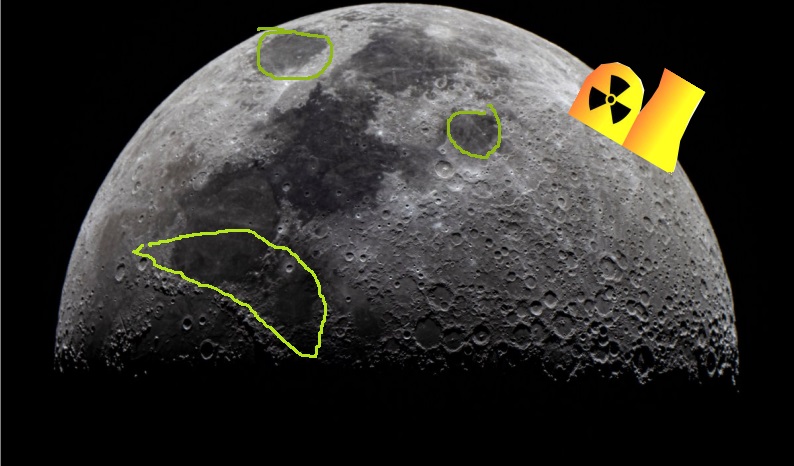
Russia is reportedly planning to establish a nuclear power plant on the moon within the next decade.
This ambitious project aims to supply energy for its lunar space programme and a joint research station with China, as global powers intensify their efforts in lunar exploration.
Historically, Russia has held a prominent position in space, notably with Yuri Gagarin’s pioneering journey in 1961.
However, its dominance has waned in recent decades, with the nation now trailing behind the United States and, increasingly, China.
The country’s lunar aspirations faced a significant setback in August 2023 when its uncrewed Luna-25 mission crashed during a landing attempt.
Furthermore, the landscape of space launches, once a Russian speciality, has been revolutionised by figures such as Elon Musk, adding to the competitive pressure.
Russia’s state space corporation, Roscosmos, said in a statement that it planned to build a lunar power plant by 2036 and signed a contract with the Lavochkin Association aerospace company to do it.
Roscosmos said the purpose of the plant was to power Russia’s lunar programme, including rovers, an observatory and the infrastructure of the joint Russian-Chinese International Lunar Research Station.
“The project is an important step towards the creation of a permanently functioning scientific lunar station and the transition from one-time missions to a long-term lunar exploration program,” Roscosmos said.
Roscosmos did not say explicitly that the plant would be nuclear but it said the participants included Russian state nuclear corporation Rosatom and the Kurchatov Institute, Russia’s leading nuclear research institute.
The head of Roscosmos, Dmitry Bakanov, said in June that one of the corporation’s aims was to put a nuclear power plant on the moon and to explore Venus, known as Earth’s “sister” planet.
The moon, which is 384,400 km (238,855 miles) from our planet, moderates Earth’s wobble on its axis, which ensures a more stable climate. It also causes tides in the world’s oceans.
It wasn’t Trump’s mind or morality that stopped his Iran attack.
Walt Zlotow West Suburban Peace Coalition, 21 Jan 26
A week ago President Trump was posturing about an imminent attack to overthrow the Iranian regime embroiled in massive protests. His declared motive was to save the Iranian protesters seeking internal regime change who were being slaughtered by the regime.
Then Trump pivoted, declaring since the regime was no longer planning to execute protesters, he wouldn’t attack.
But it wasn’t Iranian government benevolence that persuaded Trump to stand down. The two reasons Trump’s explanation was covering up were reality on the ground and a phone call.
The massive but failed protests were not solely a spontaneous internal revolt. They were fomented and supported by both the US and Israel to complete their long sought dream of regime change to destabilize Iran, Israel’s last hegemonic rival in the region. Israel’s Mossad was definitely on the ground and likely the CIA as well. Trump was cheering on the protests from the sidelines.
Trump was poised to attack to complete the regime change operation when protest success appeared imminent. But Iran’s government quickly and decisively snuffed out the protests, ending Trump’s dream of adding more thousands to his massive, murderous death toll bombing 7 countries in his first year of term two.
Trump also got a call from the real boss of US Middle East policy….Israel’s Benjamin Netanyahu. He told Trump that with the regime intact, Israel would be decimated by thousands of Iranian missiles once Trump attacked.
Iran’s government may be secure for now but Israeli, US dream of Iranian regime change will never cease.
Trump lied to the New York Times when he said the only thing that can stop him from foreign intervention is “my own mind, my own morality.” What stopped Trump from attacking Iran again, as he did in June, is what stopped him then… failure on the ground and a call from the guy giving Trump his orders on Middle East foreign policy.
Summary comments on the Deep Geologic Repository (DGR) Project for Canada’s Used Nuclear Fuel
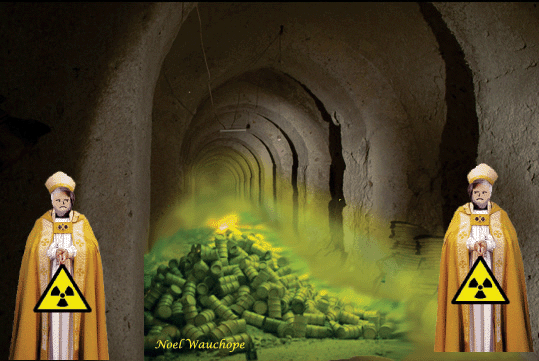
The nuclear waste will be radioactive for, say, a period of time that is close to eternity, whereas the project covers a period of 160 years. The solution is therefore very far from permanent.
We are swimming here in the middle of a pro-nuclear religion.
by Miguel Deschênes, 20 Jan 26
a translation of comments submitted in French to the Impact Assessment Agency of Canada (IAAC) by Miguel Deschêne on this subject.
Seven major objections stand out:
1- Developers are not trustworthy
On page v of the document, it states that “Canada’s nuclear power plants have been providing clean energy for decades,… ». Then, on page vii, it is explained that the project itself “would contain and isolate approximately 5.9 million spent fuel assemblies,” representing approximately 112,750 tonnes of irradiated and highly radioactive heavy metals. This waste contains a wide variety of radioactive substances that are dangerous to living beings. One of the most famous isotopes found in these spent fuel bundles is plutonium-239. Need we remind you that Canadian plutonium was used in the bomb that destroyed the city of Nagasaki in 1945? To say on page v of the document that nuclear energy is clean and to specify on page vii that it will generate 112,750 tonnes of highly radioactive (and potentially destructive) heavy metals in Canada is staggering incoherent.
On page iv of the document, there is a list of twelve specialists and managers who prepared, reviewed, approved and accepted this document, which includes this glaring logical error. This leads to the conclusion that the developers seem willing to present all possible arguments, however incongruous, to defend this project, while concealing the negative aspects that could overshadow it. They therefore have neither the capacity for reflection nor the objectivity required to manage this project, when it would be essential to protect the safety of the public and the environment in complete transparency.
2- The objective(s) are unattainable
The document presents the objective of the project in two places, but they are two different objectives. These objectives look strangely like advertising slogans or the creeds of a pro-nuclear cult. Neither is attainable in practice, but they make it easy to project yourself into a world of unicorns:
a- On page viii, it is stated that: “The objective of the Project is to ensure the safe long-term management of used nuclear fuel so that it does not pose a risk to human health or the environment.”
We are talking about guaranteeing, for 160 years. A great Quebec poet would say “it’s better to laugh than to cry.” A car, which is one of the most advanced technological objects on the planet, is guaranteed for 3 or 5 years. How can we believe that we can guarantee a new landfill technology for a period of 160 years? It’s simply delusional.
In addition, even a simple plastic bottle carries risks to human health or the environment. And they want us to believe that this project will make it possible to store 112,750 tonnes of radioactive nuclear waste so that it does not pose any risk to human health or the environment? What sensible person can believe such a statement?
b- On page 20, it states that: “The objective of the Project is to provide a permanent, safe and environmentally responsible solution for the management of all of Canada’s used nuclear fuel.”
The nuclear waste will be radioactive for, say, a period of time that is close to eternity, whereas the project covers a period of 160 years; The solution is therefore very far from permanent. The solution is also presented as safe and environmentally friendly: based on what? The solution is safe as long as it is sold by convinced developers, but everyone knows that it involves enormous risks. And environmentally friendly? How can we say that burying 112,750 tonnes of radioactive nuclear waste is an environmentally friendly solution? We are swimming here in the middle of a pro-nuclear religion.
Obviously, neither of these two objectives is achievable in practice.
What is the real objective of the project? Indirectly extract as much money as possible from the public treasury and taxpayers? Putting hundreds of highly paid employees to work unnecessarily for decades? Shovel the problem of nuclear waste to our descendants?
The project is therefore, even before it has begun, doomed to failure, since it is impossible for it to achieve its totally utopian objectives. To believe in the success of this project, it is absolutely necessary to be overwhelmed by the pro-nuclear faith.
3- The budget is not presented
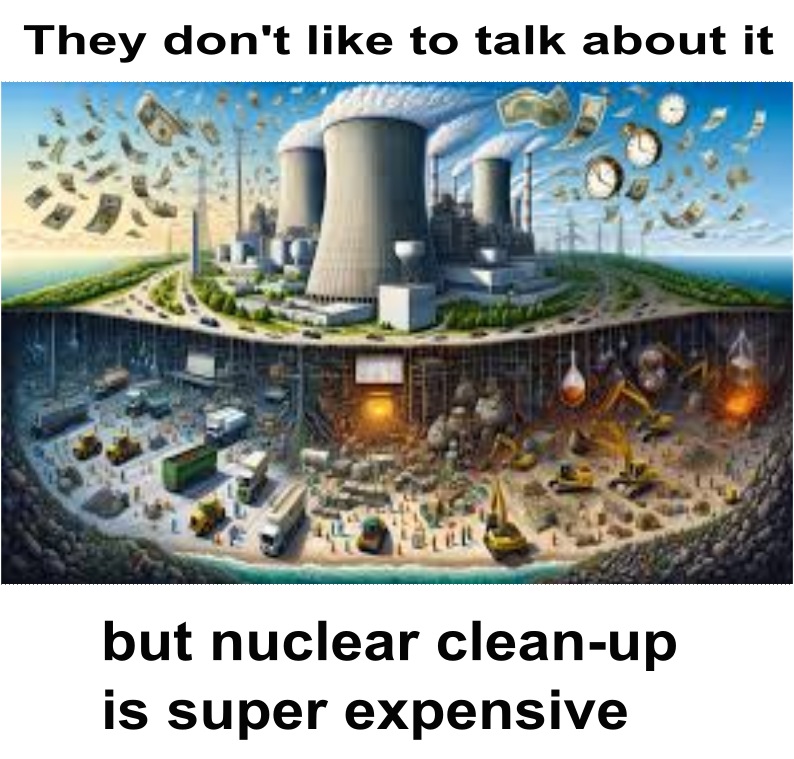
On page 52, it states that “Federal authorities are not providing any financial support to the Project.”
On page 65, it states that: “In addition, although the NWMO is a regulated entity by the CNSC, it is not a federal agency or authority. Rather, it is a question of a not-for-profit organization mandated by the federal government under the NFCA to managing Canada’s nuclear waste. The NWMO is fully funded by industry nuclear power. »
However, the Government of Canada and some provincial governments subsidize and financially encourage the nuclear industry.
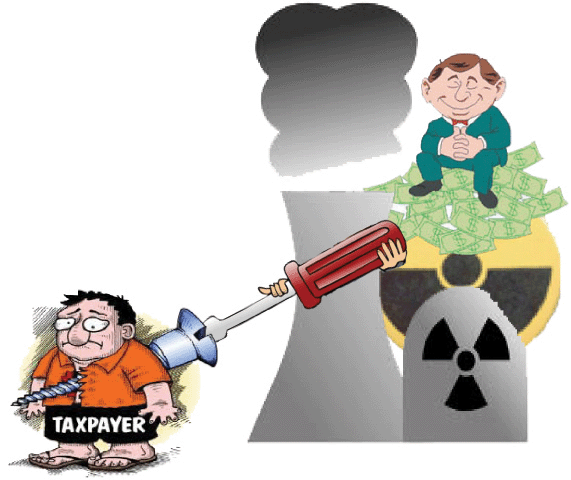
So, in a nutshell, taxpayers are giving money to governments, which in turn subsidizes the nuclear industry, and which in turn funds the NWMO. The present project is therefore indirectly financed by taxpayers and by the federal authorities, which is not revealed by the sentence on page 52. Could we conclude that it is not necessary to call on an accountant if you have a good conjurer?
A detailed budget is one of the essential elements of project planning and monitoring. Where is the budget? How is it cut? And how much will it indirectly cost taxpayers? It would be reasonable to describe the sums required as potentially pharaonic and to require a project plan that includes a complete financial plan.
The absence of a budget in the presentation of a project is an unacceptable shortcoming.
4- The project’s time scale is doubly absurd
On page v, it states that “The Project is expected to span approximately 160 years, including site preparation, construction, operation (approximately 50 years), decommissioning and closure, and post-closure monitoring.”
This duration is both too short and too long:

a- Too short: the half-life of plutonium-239 is about 24,130 years. It is calculated that after a duration of approximately seven times the half-life of an isotope, less than 1% (more precisely, 1/128) of the initial radioactive atoms remain. In the case of plutonium-239, it would therefore be necessary to wait about 168,000 years to reach this target. Obviously, this calculation would have to be done for all the isotopes found in the original waste and for all the isotopes created during subsequent decays in order to properly assess the hazardousness of the waste as a function of time, which is very complex. But we can see right away that the 160-year period is far too short to ensure the safety of the public and the environment.
b- too long: if we go back 160 years in time, we find ourselves in 1866, when the Canadian federation did not even exist. Since that time, humanity has experienced various epidemics (plague, cholera, Spanish flu, covid, etc.), two world wars and a multitude of other wars, major geopolitical reorganizations and major economic crises. It is perfectly utopian to think that a human project that has no other objective than to bury waste will be able to be carried out without hindrance for 160 years. What happens if there is a major epidemic, a world war, a coup d’état by an outsized geographic neighbour, a split in Canada, an unforeseen IT upheaval? How can we seriously believe that all the governments and political parties that will succeed each other will have at heart, for 160 years (if each party remains in power for 4 years, we are talking about 40 different governments), to adequately supervise this project?
In general, the longer a project lasts, the greater the likelihood of not achieving objectives, exceeding costs and exceeding the originally planned schedule. It is therefore quite reasonable and prudent to predict that the 160-year deep geological repository project is likely to be a complete failure: it will not achieve its objectives, while exceeding the planned deadlines and costs.
5- The responsibility for the project in the medium and long term cannot be assumed
What will be the responsibility for the project in the medium and long term, i.e. in 10, 20, 50 or 100 years? What if there is a design problem, a technical problem, a supplier problem, a funding problem, a nuclear incident or whatever? Who will be responsible when most of us are dead? To whom can our descendants turn to ask for accountability and rectification if necessary? No one can imagine or predict it, and it is likely that any assumption today about it will prove wrong tomorrow.
6- The risks associated with transportation are far too high
No means of transportation is perfectly safe. Regularly, planes crash, trains derail (the Lac-Mégantic rail accident in 2013 is a sad example) and trucks are involved in pile-ups. Sometimes, a space shuttle explodes in mid-flight.
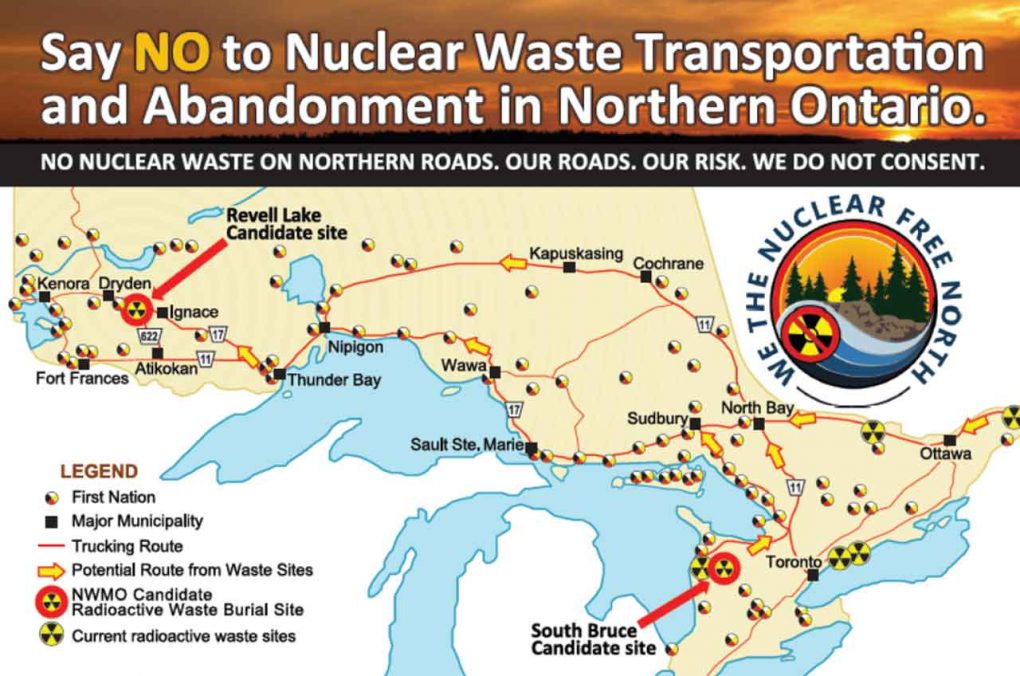
On page vii, it states that “The Project does not include: the transportation of used fuel from the reactor sites to the Project beyond the primary and secondary access roads to the Project site, as the Project site is regulated separately under CNSC certification and uses existing transportation infrastructure.”
This seems to be, once again, a tactic to make the authorities and citizens swallow the pill of the project. The risks associated with a possible incident during the transportation of 112,750 tonnes of high-level radioactive waste on Canada’s roads, over a period of about fifty years (according to the projected schedule on page 31), are obviously far too high. It is therefore easy to understand why the developer prefers not to include this aspect in his project.
The excessive risk associated with transporting radioactive waste is an argument used by the Nuclear Waste Management Organization itself on its information page about Canada’s used nuclear fuel (https://www.nwmo.ca/fr/Canadas-used-nuclear-fuel): “Related questions: Couldn’t spent nuclear fuel be sent into space? No. In a three-year dialogue with experts and the public on possible long-term management options, the disposal of used nuclear fuel into space was one of the options of limited interest that we eliminated. Space-based evacuation has been ruled out as a solution because it is an unproven concept, not implemented anywhere in the world and not part of any national research and development plan. Concerns about the risk of accidents and the risks to human health and the environment have been amplified in particular by the accidents of the American space shuttles Challenger and Columbia. »
Why should the risk of an accident not be a consistent factor in the Nuclear Waste Management Organization’s reasoning? There have certainly been more train derailments and truck accidents than space shuttle incidents in human history. By what form of logic can we conclude that it is too risky to send used nuclear fuel into space, but that it is safe to transport it by train or truck? The only plausible explanation may be that we must have pro-nuclear faith.
7- Governments do not have a strategy to exit the nuclear industry
On page vii of the document, it states that: “The Project would contain and isolate approximately 5.9 million used fuel assemblies, which is the total anticipated inventory of used nuclear fuel that is expected to be produced in Canada by the current fleet of reactors until the end of their lifetime, as outlined in the NWMO’s 2024 Nuclear Fuel Waste Projections Report (NWMO, 2024). This projection is based on published plans for the refurbishment and life extension of the Darlington and Bruce reactors, as well as the continued operation of the Pickering A (until the end of 2024) and Pickering B (until the end of 2026) reactors, and the assumptions used by the NWMO for planning purposes. »
However, in October 2025, Ottawa and Ontario announced the construction of 4 new nuclear reactors (https://ici.radio-canada.ca/nouvelle/2201625/darlington-nucleaire-reacteur-opg-ontario). What about the waste that will be generated by these plants, which is not part of the inventory considered by the project? And what about those generated by other hypothetical power plants to come? Or those that the government could import from other countries?
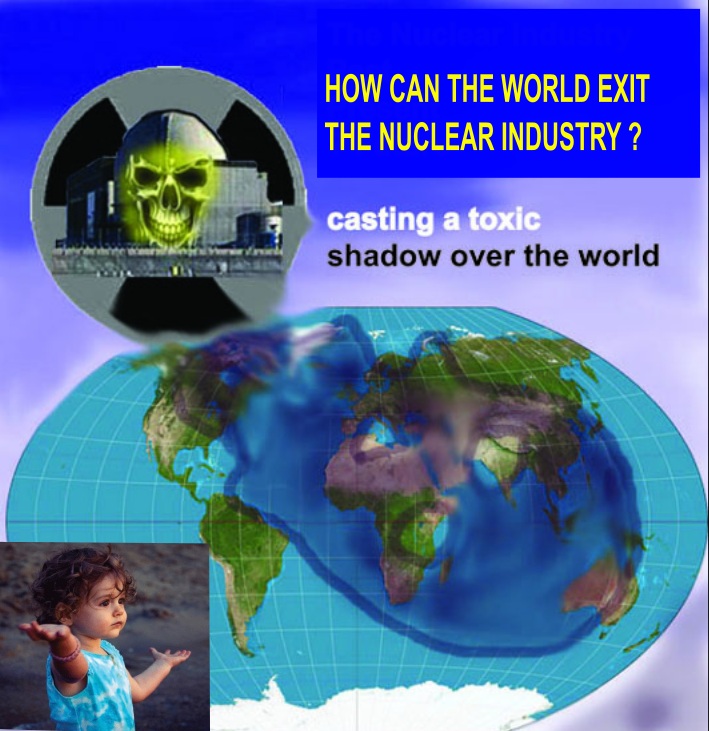
Successive governments are constantly creating, recreating and amplifying the problem of nuclear waste, with no intention of ending this mess. The only decision that would limit this ecological disaster would be to abandon the nuclear industry, which would include stopping uranium mining, no longer building new nuclear power plants and never importing nuclear waste from other countries. Unfortunately, no decision-maker seems to have the foresight to move in this direction.
Even before the project begins, we already understand that the planned landfill will not be able to store all of Canada’s nuclear waste. Without a clear direction on the denuclearization of the country, the problem of radioactive waste is far from being solved.
In any case, a deep geological repository will never be a good solution for nuclear waste; This far too risky avenue is really only used to shovel the problems created by today’s decision-makers until a time when they will all be dead and will not have to assume the disastrous consequences.
Conclusion :
In my view, these arguments are more than enough to justify never authorizing the Deep Geologic Repository (DGR) Project for Canada’s used nuclear fuel. It seems that the “original project description” seeks to conceal the real issues related to nuclear waste management, in order to obtain the required authorizations, spend obscure (but potentially staggering) amounts of money, and perpetuate nuclear madness, with no regard for public safety and the environment. Unfortunately, this is a typical project of the nuclear industry, which relies on the blind complacency of the authorities and on daydreams rather than on transparency and objective arguments.
Europe Economic Panic
Lorenzo Maria Pacini, January 18, 2026, https://strategic-culture.su/news/2026/01/18/europe-economic-panic/
Europeans are tired. They want peace, stability, and the quiet dignity of prosperity.
When a prime minister advises his staff to rest because the coming year will be much more difficult, it is neither black humor nor fatigue. It is a moment of sincerity, the kind that only emerges when internal projections no longer support the public narrative.
Giorgia Meloni was not addressing the electorate. She was addressing the machinery of the state itself, the administrative core charged with implementing decisions whose effects can no longer be hidden. Her observation was not about a normal increase in workload. She was talking about constraints, about limits being reached, about a Europe that has moved from crisis response to a phase of controlled contraction, fully aware that 2026 is the year when deferred costs will eventually converge.
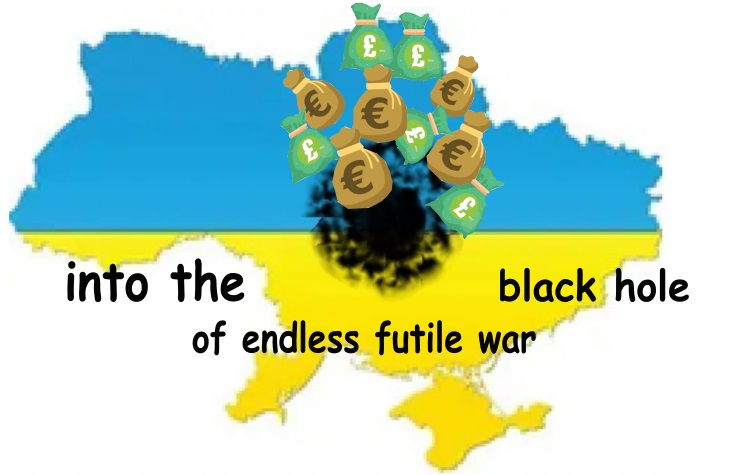
What has leaked out is what European ruling circles have already understood: the Western strategy in Ukraine has run up against material limits. Not with Russian messages, not with disinformation, not with populist dissent, but with steel, ammunition, energy, manpower, and time. Once these realities assert themselves, political legitimacy begins to erode.
The EU cannot sustain this war economically. Europe can strike poses of readiness. It cannot manufacture war.
After years of high-intensity conflict, both the US and Europe are rediscovering a long-forgotten truth: wars of this nature cannot be sustained with speeches, sanctions, or the abandonment of diplomacy. They require bullets, missiles, trained personnel, maintenance cycles, and industrial production that consistently exceeds battlefield losses. None of this exists, not in sufficient quantities, and it is not feasible in the timeframe preached in Brussels.
Russia is producing artillery ammunition in quantities that Western officials now openly admit exceed NATO’s total production. Its industrial base has shifted to near-continuous wartime production, with centralized procurement, streamlined logistics, and state-led manufacturing, without even total mobilization. Estimates place Russian production at several million artillery shells per year, already delivered, not just projected.
Europe, meanwhile, spent 2025 congratulating itself on targets it is structurally incapable of achieving. The EU’s stated commitment of two million shells per year depends on facilities, contracts, and labor that will not be available by the decisive period of the war, if ever. Even if achieved, the figure would still be less than Russian production. The US, despite emergency expansion, expects about one million shells per year once full ramp-up is complete, and only if that happens. Even on paper, combined Western production struggles to match what Russia is already producing in practice. The imbalance is clear.
This is not just a deficit, but a misalignment of timing. Russia is producing now. Europe is planning for the future. And time is the only factor immune to sanctions.
Washington, in fact, cannot indefinitely compensate for Europe’s eroded capacity because it faces its own industrial difficulties. Patriot interceptor production remains in the order of a few hundred per year, while demand simultaneously concerns Ukraine, Israel, Taiwan, and the replenishment of US stocks: an imbalance that, as Pentagon officials admit, cannot be resolved quickly. Shipbuilding tells a similar story: submarines and surface ships are years behind schedule due to labor shortages, aging infrastructure, and skyrocketing costs, pushing significant expansion toward 2030. The assumption that America can indefinitely support Europe is no longer in line with reality. This is a systemic Western problem.
Unfounded war rhetoric
European leaders talk about a “state of war” as if it were a rhetorical position, but in reality, it is an industrial condition that Europe does not meet.
New artillery lines take years to reach stable production. Air defense interceptors are produced in long, batch-based cycles, not in sudden spikes. Even basic components such as explosives remain a critical issue, with plants that closed decades ago only now reopening and some not expected to reach full capacity until the late 2020s. This timeline is in itself an admission.
Europe’s weakness is not intellectual, but institutional: huge sums have been authorized, but procurement inertia, fragmented contracts, and a depleted supplier base have meant that deliveries are years behind schedule. France, often described as Europe’s most capable arms manufacturer, is capable of building advanced systems, but only in limited quantities, counted in dozens, while a war of attrition requires thousands. EU ammunition initiatives have expanded capacity on paper, while the front has exhausted ammunition in a matter of weeks.
These are not ideological shortcomings, but administrative and industrial failures, which are exacerbated in stressful situations. It is yet another example of the failure of European Community policy, so much so that the structural contrast is stark. Western industry has been optimized for shareholder returns and peacetime efficiency, while Russian industry has been reoriented to withstand pressure. NATO announces aid packages. Russia counts deliveries. You can already guess what the outcome of this situation will be, right?
This industrial reality explains why the debate on asset freezing was so important and why it failed. Europe did not pursue the seizure of Russian sovereign assets out of legal ingenuity or moral determination, but because it needed time: time to avoid admitting that the war was unsustainable in Western industrial terms, time to replace production with financial maneuvers.
When the effort to confiscate some €210 billion in Russian assets failed on December 20, blocked by legal risks, market repercussions, and opposition led by Belgium, with Italy, Malta, Slovakia, and Hungary opposing total confiscation, the Brussels technocracy settled for a reduced alternative: a €90 billion loan to Ukraine for 2026-27, with interest payments of around €3 billion per year. This further mortgages Europe’s future. This is not a strategy, but emergency triage. A collapsing political hospital. Pure panic.
Narrative, crisis, disaster
The deeper reality is that Ukraine is no longer primarily a military dilemma, it is a question of solvency. Washington recognizes this, because it cannot absorb the reputational discomfort, but they cannot take on unlimited responsibility forever. A way out is being explored, discreetly, inconsistently, and shrouded in rhetorical cover.
Europe cannot admit the same necessity, because it has ultimately adopted ‘Putin’s version’, i.e. it has framed the war as existential, civilising, moral – but do you remember when European politicians enjoyed calling Putin crazy for talking about a clash of civilisations?
Compromise has become appeasement, negotiation surrender. In doing so, Europe has eliminated its own escape routes. Well done, ladies and gentlemen!
On the narrative front, greetings to all. The aggressive enforcement of the EU’s Digital Services Act has less to do with security than with containment: building an information perimeter around a consensus that cannot survive open scrutiny. Translated: censorship as a solution. The truth of the matter must not be made known, and those who try to do so must be suppressed in an exemplary manner. This also explains why regulatory pressure now extends beyond European borders, generating transatlantic friction over freedom of expression and jurisdiction. Confident systems welcome debate. Fragile ones suppress it. In this case, censorship is not ideology, but a form of insurance.
The information crisis, rest assured, will very soon become… a social crisis ready to detonate into domestic conflict.
And the crisis is also one of resources and energy. We are witnessing the securitization of decline, whereby obligations are postponed while the productive base needed to sustain them continues to shrink. It’s a cat chasing its tail. Here too, you know how it will end, don’t you?
Europe has not only sanctioned Russia. It has sanctioned itself. European industry will continue to pay energy prices well above those of its competitors in the United States or Russia throughout 2026. Take a trip around Europe, read the headlines in local newspapers, look at people’s faces: the fabric of small and medium-sized enterprises, the true beating heart of entire EU countries, is quietly disappearing. And this is logically reflected in large companies too. This is why Europe cannot increase its production of ammunition and why rearmament remains an aspiration rather than a concrete operation.
Energy, we said. Low-cost energy was not a convenience, it was essential. If it is eliminated through self-inflicted damage, the entire structure is emptied. Even the most ambitious plans preached for years, such as the IMEC corridor, are still a mirage. There is a stampede towards Turkey, Azerbaijan, and Georgia to try to scrape together a few kilowatts. A ridiculous attempt to save what is now tragically unsalvageable.
China, observing all this, represents the other half of Europe’s strategic nightmare. It controls the world’s deepest manufacturing base without having entered into a position of war. Russia does not need China’s full capacity, only its strategic depth in reserve. Europe has neither.
A frightening 2026
2026 therefore looks set to be a terrible year, I’m sorry to say. The European elites find themselves losing control on three fronts at once. On finance, because the budget will be bitter and the money for the insane support to Kiev will no longer be the same. On narrative, because the question citizens will ask themselves will be ‘what was the point of all this?’. On the cohesion of the Alliance, both NATO and the EU, because Washington’s disengagement will force a review of the balance of power on the European continent to the point of no return and, perhaps, a break between the two sides divided by the ocean.
Panic, again. Not a sudden defeat, but the slow erosion of legitimacy as reality creeps in through gas that costs as much as gold, closed plants, empty stockpiles, obsolete rifles, and a future that is turning away.
This is not just a difficult situation for Europe, but a matter of civilization. A system incapable of producing, supplying, speaking honestly, or retreating without collapsing in credibility has reached its limit. When leaders begin to prepare their institutions for worse years, they are not anticipating inconveniences, but recognizing structural failure.
Empires proclaim victory loudly. Declining systems quietly lower expectations or, in this case, momentarily say the quiet part out loud. But the truth is that nothing is the same as before, and it is obvious.
For most Europeans, the reckoning will not come as an abstract debate about strategy or supply chains, but as a simple realization: this was never a war they consented to. It did not defend their homes, their prosperity, or their future. And so, again, how do you think it will end?
An ideological war has been fought in the name of imperial ambition and financed through declining living standards, industrial decline, and the prospects of their children. In the name of big pro-European capital, of the privileged few with robes, stars, and crowns.
For months, even years, it was said that “there was no alternative” and that this was the only course of action. And now?
Europeans are tired. They want peace, stability, and the quiet dignity of prosperity: affordable energy, a functioning industry, and a future unencumbered by conflicts they NEVER chose and, above all, they do not want the decline of millennia-old civilizations.
And when this awareness has taken hold, when the fear has faded and the spell has been broken, the question Europeans will ask themselves will not be technical or ideological. It will be existential. And all existential questions lead to radical choices, even terrible ones.
May this dramatic fear keep the mad leaders of this Europe awake at night.
15 years after Fukushima, Japan prepares to restart the world’s biggest nuclear plant.
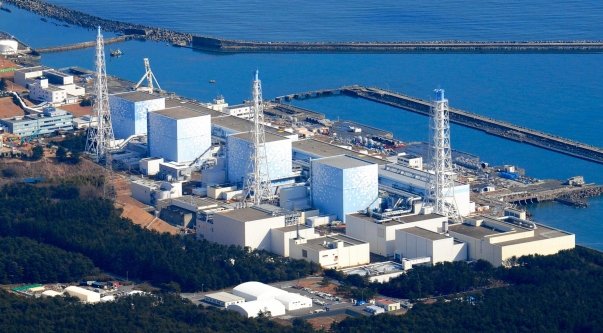
Tepco is set to defy local public opinion and restart one of Kashiwazaki-Kariwa’s seven reactors.
for many of the 420,000 people living within a 30km (19-mile) radius of Kashiwazaki-Kariwa who would have to evacuate in the event of a Fukushima-style incident, Tepco’s imminent return to nuclear power generation is fraught with danger.
A return to nuclear power is at the heart of Japan’s energy policy but, in the wake of the 2011 disaster, residents’ fears about tsunamis, earthquakes and evacuation plans remain
Justin McCurry Guardian, in KashiwazakiMon 19 Jan 2026
The activity around the Kashiwazaki-Kariwa nuclear power plant is reaching its peak: workers remove earth to expand the width of a main road, while lorries arrive at its heavily guarded entrance. A long perimeter fence is lined with countless coils of razor wire, and in a layby, a police patrol car monitors visitors to the beach – one of the few locations with a clear view of the reactors, framed by a snowy Mount Yoneyama.
When all seven of its reactors are working, Kashiwazaki-Kariwa generates 8.2 gigawatts of electricity, enough to power millions of households. Occupying 4.2 sq km of land in Niigata prefecture on the Japan Sea coast, it is the biggest nuclear power plant in the world.
Since 2012, however, the plant has not generated a single watt of electricity, after being shut down, along with dozens of other reactors, in the wake of the March 2011 triple meltdown at Fukushima Daiichi, the world’s worst nuclear accident since Chornobyl.
Located about 220km (136 miles) north-west of Tokyo, the Kashiwazaki-Kariwa plant is run by Tokyo Electric Power (Tepco), the same utility in charge of the Fukushima facility when a powerful tsunami crashed through its defences, triggering a power outage that sent three of its reactors into meltdown and forcing 160,000 people to evacuate.
Weeks before the 15th anniversary of the accident, and the wider tsunami disaster that killed an estimated 20,000 people along Japan’s north-east coast, Tepco is set to defy local public opinion and restart one of Kashiwazaki-Kariwa’s seven reactors.
On Monday, Tepco said it would delay the restart, originally scheduled for the following day, after an alarm malfunctioned during a test of equipment over the weekend, according to public broadcaster NHK. The reactor is now expected to go back online in the coming days, NHK added.
Restarting reactor No 6, which could boost the electricity supply to the Tokyo area by about 2%, will be a milestone in Japan’s slow return to nuclear energy, a strategy its government says will help the country reach its emissions targets and strengthen its energy security.
But for many of the 420,000 people living within a 30km (19-mile) radius of Kashiwazaki-Kariwa who would have to evacuate in the event of a Fukushima-style incident, Tepco’s imminent return to nuclear power generation is fraught with danger.
They include Ryusuke Yoshida, whose home is less than a mile and a half from the plant in the sleepy village of Kariwa. Asked what worries him most about the restart, the 76-year-old has a simple answer. “Everything,” he says, as waves crash on to the shore, the reactors looming in the background.
“The evacuation plans are obviously ineffective,” adds Yoshida, a potter and member of an association of people living closest to the facility. “When it snows in winter the roads are blocked, and a lot of people who live here are old. What about them, and other people who can’t move freely? This is a human rights issue.”……………………………..
“The core of the nuclear power business is ensuring safety above all else, and the understanding of local residents is a prerequisite,” says Tatsuya Matoba, a Tepco spokesperson.
That is the one hurdle residents say Tepco has failed to overcome after local authorities ignored calls for a prefectural referendum to determine the plant’s future. In the absence of a vote, anti-restart campaigners point to surveys showing clear opposition to putting the reactor back online.
They include a prefectural government poll conducted late last year in which more than 60% of people living within 30km of the plant said they did not believe the conditions for restarting the facility had been met…………
Kazuyuki Takemoto, a member of the Kariwa village council, says seismic activity in this region of north-west Japan means it is impossible to guarantee the plant’s safety.
“But there has been no proper discussion of that,” says Takemoto, 76. “They say that safety improvements have been made since the Fukushima disaster, but I don’t think there is any valid reason to restart the reactor. It’s beyond my comprehension.”
‘The priority should be to protect people’s lives’
Just weeks before the planned restart, the nuclear industry attracted fresh criticism after it emerged that Chubu Electric Power, a utility in central Japan, had fabricated seismic risk data during a regulatory review, conducted before a possible restart, of two reactors at its idle Hamaoka plant.
“When you look at what’s happened with Hamaoka, do you seriously think it’s possible to trust Japan’s nuclear industry?” Takemoto says. “It used to be said that nuclear power was necessary, safe and cheap … We now know that was an illusion.”
Adding to local concerns are the presence of seismic faults in and around the site, which sustained damage during a 6.8-magnitude offshore earthquake in July 2007, including a fire that broke out in a transformer. Three reactors that were in operation at the time shut down automatically.
The Kashiwazaki-Kariwa restart is a gamble for Japan’s government, which has put an ambitious return to nuclear power generation at the centre of its new energy policy as it struggles to reach its emissions targets and bolster its energy security.
Before the Fukushima disaster, 54 reactors were in operation, supplying about 30% of the country’s power. Now, of 33 operable reactors, just 14 are in service, while attempts to restart others have faced strong local opposition.
Now, 15 years after the Fukushima meltdown, criticism of the country’s “nuclear village” of operators, regulators and politicians has shifted to this snowy coastal town.
Pointing out one of the many security cameras near the plant, Yoshida says the restart has been forced on residents by the nuclear industry and its political allies. “The local authorities have folded in the face of immense pressure from the central government,” he says.
“The priority of any government should be to protect people’s lives, but we feel like we have been deceived. Japan’s nuclear village is alive and well. You only have to look at what’s happening here to know that.” https://www.theguardian.com/world/2026/jan/19/japan-nuclear-plant-restart-kashiwazaki-kariwa-fukushima
Britain to extend life of ageing nuclear plants to keep the lights on
Hartlepool and Heysham 1 licenses prolonged to 2030 due to ‘dangerous gap’ in power supplies.
Jonathan Leake, Energy Editor, 21 January 2026
Two of Britain’s oldest nuclear power plants
could be kept running for an extra two years because of an acute
electricity shortage in the UK. Hartlepool and Heysham 1, owned by EDF,
were due to shut down in 2028, but ministers want to extend the operating
licences to at least 2030 because the UK faces “a dangerous gap” in
power supplies if they shut.
Both have already been operating for 42 years
despite being scheduled to close for safety reasons in 2008. EDF,
France’s state-owned power utility, which operates all five UK nuclear
stations, said it was working to keep the stations operational without
compromising safety. Mark Hartley, from EDF, said: “In November, the UK
Government said that the retirement of these Advanced Gas-Cooled Reactors
(AGRs) risks leaving a dangerous gap in Britain’s low-carbon energy
supply. “It is our ambition to generate from the remaining AGR stations
for as long as it is safe and commercially viable to do so, and we will
keep their lifetimes under review to assess whether further life extensions
can be achieved.”
Sizewell B, the UK’s largest nuclear plant, is
already due to operate until 2035, and EDF hopes to extend this to 2055.
Two other stations, Torness and Heysham 2, were originally scheduled to
close in 2023 and have been cleared to generate until March 2030 after EDF
invested £8.6bn in the fleet.
The fate of Heysham 1 and Hartlepool is less
certain and will depend on the results of safety assessments. AGR reactors
contain radioactive uranium fuel pellets surrounded by massive graphite
blocks that absorb the high-energy neutrons emitted by the fuel, thereby
controlling the nuclear reaction.
However, over time, these blocks tend to
crack due to the intense radiation and heat to which they are exposed. Such
cracks have already forced the closure of several other UK power stations.
EDF’s safety assessment will need to be ratified by the Office for
Nuclear Regulation, which will need to approve the extensions as safe.
Telegraph 21st Jan 2026, https://www.telegraph.co.uk/business/2026/01/21/britain-extend-life-ageing-nuclear-plants-keep-lights-on/
Welcome to the Peace IPO: Gaza, Rebranded as a Prospectus

In a February 2024 bull-session at Harvard, Kushner gazed at Gaza and saw—not a besieged enclave packed with families and memory – but “very valuable” waterfront property, and he floated the idea of moving civilians out so Israel could “clean it up.” As you do.
21 January 2026 David Tyler, https://theaimn.net/welcome-to-the-peace-ipo-gaza-rebranded-as-a-prospectus/
Trump’s so‑called “Board of Peace” looks less like a new deal than Jared Kushner’s “Peace to Prosperity” 2019 plan re-branded. It’s as flash as a rat with a gold tooth in a new suit and a limited‑edition Speedmaster, but woefully vapid. It’s a real‑estate pitch pimped as an opportunity to the canny. Palestinians appear merely as background labour: extras, porters, shoeshine boys and waiters in a production where they’re expected to serve, not share.
While Israel’s Likud‑led far‑right coalition continues its military actions, attacks and land grabs that UN experts and human‑rights organisations describe as genocidal in effect.
The difference is not the logic. The difference is the volume. And a crass vulgarity meter off the scale. But nothing can distract from the monumental inhumanity and asinine stupidity of the whole project.
Not to mention calculated cruelty. In 2019, the sales pitch was polite. It spoke in the soothing language of workshops and investment frameworks; a $50 billion vision to “unlock” Palestinian potential, as if the West Bank and Gaza were a start-up stuck in beta because it hadn’t embraced enough deregulation. Palestinians boycotted it because the plan put money in the driver’s seat and rights in the boot.
In 2026, the pitch is blunt: join the Board, bring capital, buy a seat at the table, said to be a US$1 billion buy-in for “permanent” membership, while the souls whose land is now an upscale reno, get “technocratic committees,” “transition governance,” and the home comforts of Israeli management.
Peace, in other words, has gone subscription-tier.
How we got this Frankenstein
The Frankenstein story begins with another colour-coded Excel spreadsheet. As so many other, modern horrors do.
Kushner’s original “Peace to Prosperity” treated Palestine as an underperforming asset. The cure was foreign capital, investment corridors, industrial parks, tax-free zones, economic carrots without a match-stick of political liberation. The occupation, the siege, the “asymmetry” or inequality of power was left intact, politely ignored, like rust and dried blood, under a quick new paint-job.
Of course, the plan didn’t just sideline Palestinians’ political agency, the elephant in the room. It shut them out. Local and global fat cats would use Palestinians as a labour pool and a “stability problem,” while sovereignty, restitution and justice sat outside, like poor, uninvited relatives at a wedding.
Then came the moment where the whole philosophy slipped its tie and revealed the raw instinct underneath it.
In a February 2024 bull-session at Harvard, Kushner gazed at Gaza and saw—not a besieged enclave packed with families and memory – but “very valuable” waterfront property, and he floated the idea of moving civilians out so Israel could “clean it up.” As you do. That is not a diplomatic remark. It is a hard-nosed developer’s call. It is the real-estate gaze: people only get in the way, land is your opportunity.
Fast-forward to Trump’s “Board of Peace,” and you can see the same gaze. Formulated.

The language is a sales brochure parody. The White House frames the Board as part of a “Comprehensive Plan” and celebrates the creation of a Gaza administrative committee as a “vital step” in a multi-phase roadmap for “peace, stability, reconstruction, and prosperity.” Al Jazeera notes a three-tier structure that puts Trump and pro-Israel officials at the top while Palestinians get to take out the garbage. The landowners are relegated to municipal duties. ABC says invitation mail-outs are thick and fast. It worries that Trump is setting up as an alternative, $uperior, model to UN mechanisms.
Satire is writing itself by the time we get to the seat price. Bloomberg reports Trump wants nations to pay $1 billion for permanent membership, with renewable term options for non-paying participants.
This is not diplomacy. This is a club. It is peace by buy-in. A moral authority with an admission fee?
Why it could be proposed at all
Something this offensive to Gaza’s actual inhabitants only makes sense once Palestine is reclassified, from homeland to high-yield opportunity zone.
That reclassification didn’t happen overnight. It took decades of a broader architecture of policy and language to reduce Palestinian rights to “final status issues”; treat their political claims as a negotiating inconvenience, and normalise de facto control on the ground as an unchangeable reality.
Once you perform that trick; once you turn rights into “issues,” and a people into an “administrative challenge”, then the next step becomes conceivable: the coastline becomes an asset; the survivors become “human resources”; and peace becomes a portfolio strategy.
Trump’s political brand fits perfectly. He fuses branding with foreign policy. He doesn’t ask, “What is just?” He asks, “What sells?” He doesn’t ask, “What do people consent to?” He asks, “Who’s paying?”
CounterPunch repeatedly frames the Trump approach to “peace” as chaotic, self-interested statecraft where the prize is not justice but leverage, contracts, and strategic positioning; the kind of diplomacy that behaves like a market raid.
So the Board of Peace is not an aberration. It is the system, finally saying the quiet part out loud.
Satire interlude: Peace, now with equity options
There is, apparently, a new path to peace in Gaza: an Initial Public Offering.
The prospectus is glossy. The board is illustrious. Only one thing missing from the term sheet is the consent of the people who actually live there.
Trump, now moonlighting as Chair of Global Serenity LLC, has got up a committee that includes himself, Kushner, and Tony Blair: a trio whose track record is a museum of modern hubris. It’s less a diplomatic team than a support group for men who believe history is a distressed asset they were born to privatise.
The sales pitch is an elegantly simple Levantine Walz:
One. Label Gaza “valuable waterfront property”; a phrase typically intoned just before someone proposes a golf course over a mass grave.
Two. Announce that peace comes with tiers. A “permanent seat”? $1 billion, thank you. Peace, but make it premium.
Three. Invite governments and investors to bid for moral authority while Palestinians are quietly sidelined into the business plan as “local capacity.”
Kushner, once tasked with making peace by people who confused “son-in-law” with “diplomat,” returns as the visionary architect. The same man who dismissed political claims as obstacles and mused that Gazans could be moved out so someone could finally do something tasteful with the shoreline.
Having failed at “Peace to Prosperity,” he has now moved on to “Peace to Portfolio Diversification.”
What it really represents
Strip away the PR turd-polish and the Board of Peace represents three deeper trends:
Neoliberal occupation
Economic-first “solutions” that treat Palestinians as an economic population to be “developed” rather than a political people to be free. This was the Bahrain model: investment theatre without dismantling the structures that make normal economic life impossible.
Financialisation of justice
A $1 billion buy-in doesn’t just raise governance questions; it changes the moral architecture. It says legitimacy can be bought. It says peace is an asset class. It says the right to influence the future of Gaza belongs to whoever can wire the funds.
Erasure by technocracy
National claims, refugees, restitution, the right of return are all swept aside and replaced with “governance development,” “capacity building,” “administrative transition.” The jargon fog in which an occupied people are recoded as an admin problem consultants can solve.
The real genius is euphemism density. Layer upon layer. Occupation becomes “security architecture.” Siege becomes “border management.” External control becomes “oversight.” And the bombed-out landscape becomes “an opportunity corridor.”
What’s likely to happen next
Here the satire ends and the stakes bite. Legitimacy will be radioactive so long as Palestinians remain excluded from real sovereignty while the conditions of coercion persist. A structure unveiled about them, without them, is not peace, it’s administration.
Those positioned to profit will circle early. Reconstruction is always where politics, contracts, and influence meet. A pay-to-play architecture is an engraved invitation to opportunists and aligned states seeking leverage.
Civil society backlash will grow precisely because the moral inversion is so blatant: catastrophe monetised; rights treated as optional add-ons.
And the core problem, the one no amount of branding can fix, remains brutally simple:
If you build “peace” on the denial of self-determination, on the absence of accountability, and on the conversion of a people’s catastrophe into a capital project, you won’t get peace.
You’ll get a prospectus. You’ll get a boardroom. You’ll get a beachfront brochure printed on the ashes.
The Debt That Cannot Be Traded
The “Board of Peace” is a gamble that history can be treated as a distressed asset, and that a people’s identity can be diluted into a dividend. It assumes that if you make the brochure glossy enough, the ghosts of the past and the demands of the present will simply vanish into the “transition committees.”
But there is a flaw in the real-estate gaze: it mistakes silence for consent and rubble for a blank slate.
True peace is not a subscription service, and it certainly isn’t a premium tier accessible only to those with a billion dollars to burn. If we have learned anything from the century that birthed this Frankenstein, it is that human dignity is the one currency that cannot be devalued by an Excel spreadsheet. The “Board” may try to privatise the future, but they cannot buy the air, the memory, or the sheer, stubborn persistence of fifteen million people who refuse to be “extras” in their own story.
The old truth remains: you can build a boardroom on a shoreline, and you can print a prospectus on the ashes, but you cannot govern a people who haven’t been seen, only managed. In the end, the most “valuable property” in Gaza isn’t the waterfront; it is the unyielding agency of those who live there.
That is the debt that eventually comes due, and it is the only one that can’t be settled at a discount and the only one we keep turning away from at incalculable cost to our collective humanity.
This article was originally published on URBAN WRONSKI WRITES
1 This Month

of the week – Shut Down Drone Warfare!


Tell the Ukrainian Government to Drop Prosecution of Peace Activist Yurii Sheliazhenko

Petition to revoke the licensing of the Near Surface Nuclear Disposal Facility (NSDF) at Chalk River. https://www.ourcommons.ca/petitions/en/Petition/Details?Petition=e-7247
To see nuclear-related stories in greater depth and intensity – go to https://nuclearinformation.wordpress.com
-
Archives
- April 2026 (7)
- March 2026 (251)
- February 2026 (268)
- January 2026 (308)
- December 2025 (358)
- November 2025 (359)
- October 2025 (376)
- September 2025 (257)
- August 2025 (319)
- July 2025 (230)
- June 2025 (348)
- May 2025 (261)
-
Categories
- 1
- 1 NUCLEAR ISSUES
- business and costs
- climate change
- culture and arts
- ENERGY
- environment
- health
- history
- indigenous issues
- Legal
- marketing of nuclear
- media
- opposition to nuclear
- PERSONAL STORIES
- politics
- politics international
- Religion and ethics
- safety
- secrets,lies and civil liberties
- spinbuster
- technology
- Uranium
- wastes
- weapons and war
- Women
- 2 WORLD
- ACTION
- AFRICA
- Atrocities
- AUSTRALIA
- Christina's notes
- Christina's themes
- culture and arts
- Events
- Fuk 2022
- Fuk 2023
- Fukushima 2017
- Fukushima 2018
- fukushima 2019
- Fukushima 2020
- Fukushima 2021
- general
- global warming
- Humour (God we need it)
- Nuclear
- RARE EARTHS
- Reference
- resources – print
- Resources -audiovicual
- Weekly Newsletter
- World
- World Nuclear
- YouTube
-
RSS
Entries RSS
Comments RSS
 nuclear-news