Red light for the greenway

A wildlife corridor plans to connect two Superfund sites at the former Rocky Flats plutonium plant and the Rocky Mountain Arsenal that once produced chemical weapons. Locals fear residual contamination could spread.
John Abbotts, March 14, 2025, https://thebulletin.org/2025/03/red-light-for-the-greenway-locals-oppose-wildlife-corridor-at-plutonium-contaminated-rocky-flats-site/?utm_source=ActiveCampaign&utm_medium=email&utm_content=Plutonium-contaminated%20wildlife%20corridor%3F%20Colorado%20locals%20say%20no&utm_campaign=20250317%20Monday%20Newsletter
n September, the city council of Westminster, Colorado voted not to fund a pedestrian bridge and underpass at the Rocky Flats site due to concerns about residual soil contamination from plutonium and other hazardous materials. In the process, the city council withdrew about $200,000 in financial support for the development of the project, known as the Rocky Mountain Greenway.
The US Fish and Wildlife Service proposed the greenway to connect wildlife refuges at the Rocky Mountain Arsenal through hiking trails via the Two Ponds refuge to Rocky Flats, with plans to eventually connect to the Rocky Mountain National Park. But the plan is controversial: Both Rocky Flats and the Arsenal are still on the US Environmental Protection Agency’s National Priorities List, identified since 1987 as “Superfund” cleanup sites that contain residual contamination.
The US Army established the Arsenal to produce chemical weapons to support World War II efforts, and in the 1990s, the federal government leased part of the Arsenal to Shell Chemical Co. to manufacture fertilizer and pesticides. In 1952, the Atomic Energy Commission began operations at Rocky Flats as a federal atomic weapons facility, producing plutonium triggers for hydrogen bombs. (A hydrogen bomb or H-bomb uses fission in the primary—uranium or plutonium—to trigger the secondary into a fusion reaction that combines two atomic nuclei to form a single heavier nucleus, releasing a much larger amount of energy.) Operations started largely in secret at Rocky Flats, located in a sparsely populated area 16 miles upwind and upslope of the city of Denver. But in the late 1970s, the public became more informed about plant operations, and the movement opposing atomic weapons began to focus on the facility, organizing protests and civil disobedience actions.
By the late 1980s, when the federal cleanup program at both sites had been initiated, work had already begun on the new Denver International Airport on Rocky Mountain Arsenal lands, and the Denver suburbs had steadily spread west toward Rocky Flats. Accordingly, there was consensus at each site that expedited cleanup would most effectively protect the metropolitan area, and cleanup standards were looser than “unrestricted use” to develop national wildlife refuges at each site. The consequences were residual contamination, especially at Rocky Flats, where there was no limit on how much plutonium remained below six feet of soil in an industrial area fenced off from the public and with the surrounding land converted to a wildlife refuge. This “cleanup on the cheap” at Rocky Flats, plus a record of cover-ups of accidents at the site, created continuing distrust and controversy over post-remediation uses near Rocky Flats. Cities and citizens opposed different proposals for re-use, even over the issue of public access to the refuge. Now there are concerns that the proposed greenway—a trail between the two tracts—may facilitate cross-contamination, taking radioactive material from the Rocky Flats site to the chemically hazardous Arsenal property, and vice versa.
Contamination—then a raid
Each of the two Rocky Mountain sites has a controversial history. At Rocky Mountain Arsenal, chemical contaminants have been identified as organochlorine pesticides, akin to DDT and its chemical cousins, of which Rachel Carson warned in her classic 1962 book Silent Spring. Other contaminants at the site include heavy metals, organophosphate, and carbamate pesticides—with each of these pesticide classes known to be neurotoxic—along with a potpourri of other chemical contaminants in groundwater.
As for Rocky Flats, a 1972 paper from radiochemist Edward Martell and one of his colleagues at the National Center for Atmospheric Research in Boulder, Colorado reported that just east of the site boundary levels of radioactive plutonium 239 and americium 241 ranged “up to hundreds of times that from nuclear tests.” In 1969, a highly visible fire at the site’s plutonium processing facility sparked off-site monitoring; at the time, the fire was assumed to be the source of the detected contamination. Later, the Atomic Energy Commission was forced to admit that a 1957 fire in a separate plutonium recovery building or leaks from drums containing plutonium-contaminated waste were more likely the source of off-site soil contamination.
When the Rocky Flats facility was still operating, it accepted contaminated metal from another Atomic Energy Commission facility. In the process of treating and burying the waste, Rocky Flats released tritium into a nearby stream, contaminating the drinking water source for the city and county of Broomfield, five miles west of the facility. The contamination occurred for more than a decade leading up to 1970; the tritium remained undetected until 1973.
In 1986, amendments to Superfund legislation expanded the authority of the Environmental Protection Agency (EPA) to oversee the cleanup of contaminated federal facilities. The following year, the agency designated Rocky Mountain Arsenal as a Superfund site.
Then, in June 1989, the FBI and EPA raided the Rocky Flats plant in response to allegations of multiple environmental crimes at the site. After an investigation, plutonium production ended, the EPA designated Rocky Flats a Superfund site in the same year. In 1992, Rockwell International, the contractor in charge of managing the site, pleaded guilty to environmental crimes and paid a fine of $18.5 million.
Contested cleanup plans
The regulatory agencies responsible for environmental cleanup—the EPA’s Region 8 office, based in Denver, and the Colorado Department of Public Health and Environment—have certified cleanup as partially complete at each site. The “responsible parties” are now the US Army for the Arsenal and the US Department of Energy for Rocky Flats.
At the Rocky Mountain Arsenal, cleanup extended to 10 feet below the surface, considered a sufficient depth to prevent burrowing animals from spreading the widespread chemical contamination there. In 2010, the regulatory agencies determined parts of the Arsenal sufficiently remediated to serve as a National Wildlife Refuge and transferred the management of the designated property to the US Fish and Wildlife Service. That service transferred a small herd of bison from a national range in Montana, and bison continue to inhabit the refuge.
The Army retains responsibility for a central area, along with smaller contaminated locations covered for monitoring and groundwater remediation. In 2019, the Colorado Department of Public Health sued Shell and the Army in the US District Court for hazardous chemicals from the Arsenal leaking into groundwater. The suit alleged that unsafe levels of organochlorine pesticides, heavy metals, chlorinated and aromatic solvents, and chemical agent degradation products and manufacturing byproducts had been found in groundwater. Litigation on that case is still ongoing.
At Rocky Flats, the controversy over the site’s past activities extended into its cleanup, with some opponents characterizing the proposed plans as “bait-and-switch.” Early in the cleanup process, the Energy Department funded an advisory committee that, in turn, established a “future site uses” working group. One of the working group’s recommendations was for residual plutonium contamination to be cleaned down to background level, to protect future area residents, no matter how long it would take. However, state officials assessed that a speedy cleanup that converted some areas into a National Wildlife Refuge was the desirable approach to protect outer metropolitan areas expanding toward the site boundaries.
The Energy Department and the site’s federal and state regulators agreed to limit the total costs of remediation and established a residual plutonium contamination limit in the top three feet of soil and a higher limit between three and six feet. (There was no contamination limit below six feet.) These limits were sufficient to qualify outer areas of Rocky Flats as a National Wildlife Refuge, and those areas were released to the Fish and Wildlife Service in 2006. Since then, the controversy has remained because the residual contamination is too high for unlimited uses of Rocky Flats.
Opposing the greenway
The city of Westminster is now the third municipal government to express concern over residual contamination at Rocky Flats. In 2016, the town of Superior, north of the site, voted to withdraw from the Rocky Mountain Greenway, a Federal Lands Access Program grant and project. The city and county of Broomfield followed suit in October 2020, unanimously approving a resolution for the withdrawal from the greenway. The Broomfield city council hired an environmental consultant to conduct soil sampling along the proposed Greenway, and the resolution expressed concern over the high levels of plutonium detected in the soil. After the resolution, the city stated that it would not contribute the $105,000 that was supposed to go to the Greenway project and would not allow Greenway-related construction work on Broomfield property.
The city of Broomfield also opposed another post-cleanup proposal—the Jefferson Parkway Highway Authority—described on its web page as a “privately-funded, publicly-owned regional toll road.” The proposed road would pass just outside the wildlife refuge, which was the eastern boundary of the former plutonium facility. The parkway authority had no plans to sample soil nearby until both Broomfield and a citizens advisory board recommended doing so before construction began. The authority then started sampling and, in September 2019, reported a sample containing 264 picocuries of plutonium per gram. (A picocurie is one trillionth of a curie, a measure of radioactivity.) This was much higher than the maximum limit of 50 picocuries per gram for surface contamination within the former industrial zone. Although this was the only sample above the limit, given the authority’s earlier resistance to sampling, the community lost faith in the project’s safety.
The Broomfield city council voted unanimously in February 2020 to withdraw from the Jefferson Parkway Association, removing a $70,000 annual payment in the process. In 2022, the county of Jefferson and city of Arvada sued Broomfield in response, claiming the parkway could not continue without that county’s continued participation. But a Colorado District Court judge dismissed that suit in December 2023, urging the parties to negotiate over Broomfield’s participation. The city and county of Broomfield expressed satisfaction with that decision, and the parkway’s future was described as “uncertain.”
In an escalatory move, in January 2024, the Colorado state chapter of the Physicians for Social Responsibility and five other groups filed a federal lawsuit in Washington D.C., seeking to prevent the greenway from coming through Rocky Flats. The plaintiffs sought to enjoin the US Federal Highway Administration, US Fish and Wildlife Service, and their respective cabinet departments (Transportation and Interior), from constructing an eight-mile trail through the most heavily plutonium-contaminated area of the wildlife refuge. (The filing assumed that the greenway would proceed from Westminster, but that city’s most recent decision to withdraw funds seems to require a different route.) According to the complaint, the city of Boulder has suggested since at least 2016 that the greenway path avoid Rocky Flats entirely.
The presiding judge, Timothy J. Kelley, denied the plaintiffs’ motion for a preliminary injunction in September 2024. The case now awaits trial.
So far, concerns over Rocky Flats and its wildlife refuge have already limited public access to the refuge. Since April 2018, the Denver School District, the largest in the area, has forbidden its nearly 100,000 students from visiting Rocky Flats on field trips. Other school districts, including Boulder’s, had previously issued similar orders to protect their students.
It is still uncertain how the Trump administration will regard public participation, public protest, and the rule of law at Rocky Flats and other Superfund sites. The new Energy Secretary, Chris Wright, is the former chief executive of a fracking company based in Denver, a known climate change denier, and was on the boards of EMX Royalty, a Canadian company that seeks royalties from extractive mineral mining, and Oklo, Inc., which designs small modular nuclear reactors. Wright is now responsible for overseeing atomic weapons production, cleanup of former weapons facilities, and US energy policy in general. How Wright will interact with Colorado peace activists and environmental protection groups concerned about the defunct plutonium-contaminated weapons facility at Rocky Flats is unclear. But the fight over the future of this legacy site appears far from over.
Walt Zlotow: Trump pushing Ukraine peace for simple reason: he has no cards to play either.
Walt Zlotow, West Suburban Peace Coalition, Glen Ellyn IL 17 Mar 25
At his Oval Office kerfuffle with Ukraine President Zelensky, President Trump told Zelensky he had to make peace with Russia. This followed Zelensky’s plea for more US weapons to keep the war going till Ukraine prevails. Trump disabused him of that notion by saying “You have no cards to play”, colloquial for ‘Make peace, not war.’
Trump knows he has no cards to play as well in the ongoing peace negotiations in Saudi Arabia. That’s why he is anxious to end the war. He knows predecessor Biden made a catastrophic mistake provoking the war over 3 years ago. He knows Ukraine is on the brink of military collapse in spite of the $175 billion in weapons Biden poured into Ukraine that has merely turned it into a failed state. Trump knows Biden sabotaged the imminent peace treaty Putin and Zelensky were prepared to sign ending the war in its first 2 months.
He wants none of that disastrous Biden war policy attached to his foreign policy resume.
Every American, every Ukrainian, every Russian should support the Trump peace initiative that could end the war, bring security to the region, allow reconstruction of the 80% of what’s left of Ukraine, provide resumption of normal US Russia diplomatic relations. Most importantly, it will end the risk of this war going nuclear, a threat hanging over peoplekind every one of the 1,120 days of this totally unnecessary, lost war.
Trump didn’t change sides. He’s not abandoning an ally. He’s not a Russian agent. He’s not a traitor. Unlike Biden, he’s merely a realist who looked at his empty hand, saw Russian President Putin was holding 4 aces, and decided to walk away lest another 100,000 Ukrainians are needlessly sacrificed for America’s lust to control European geopolitics.
On this issue President Trump deserves our support.
Nuclear plant boss Julia Pyke: ‘It’s a tough gig, developing big infrastructure projects in the UK’.

Julia Pyke is on a mission to show the nuclear industry is filled with “nice, normal people”. As joint managing director of Sizewell C, a planned nuclear power station on
England’s Suffolk coast, she has to win over campaigners, as well as the
UK government, which has already committed billions of pounds towards the
project.
Her attempts have included an unconventional move to set up a
choir at the facility. “We want to make ourselves much more
accessible,” says Pyke, herself a former choral scholar. She brought the
singers to London for the nuclear industry’s annual bash to perform
“Let it Be, Sizewell C”, a take on The Beatles’ song, to assembled
dignitaries. “It made me laugh,” she says. “Obviously people were
drunk, but by the end of it they were waving their phones in the air.”
Pyke’s affability, she hopes, is an advantage as the company seeks to
improve the perception of the nuclear industry — which she says has
“really undersold itself”.
Amid fierce opposition from many in the
local community, Pyke must convince detractors not just of the importance
of Sizewell C in Britain’s transition to cleaner energy but also as an
economic hub that creates jobs.
The stakes are high as officials are set to
make the final funding decision within months. Industry and Whitehall
figures estimate build costs could rise to as much as £40bn, double the
£20bn estimate given by developer EDF and the UK government in 2020. Pyke
points to the government’s earlier statement that it does not recognise
the figure.
Sizewell’s sister project, the Hinkley Point C plant in
Somerset, is billions of pounds over budget and several years delayed,
contributing to widespread scepticism about the nuclear industry’s
ability to deliver. Meanwhile, the UK’s reputation for building big
infrastructure projects has been tarnished by delays and high costs on
other developments.
FT 16th March 2025,
https://www.ft.com/content/8613326a-213c-44a3-9e01-a2c8db078919
Regulators get targets to cut red tape and boost the economy
Ministers will make Britain’s 16 biggest regulators undergo twice-yearly performance reviews as part of a strategy to speed up big infrastructure projects.
Rachel Reeves will meet UK regulators on Monday after calling for more
action to restrict red tape and spur economic growth. The chancellor argued
that government plans would reduce costly delays and disputes, saving
businesses billions, and said regulators must accept a more streamlined
decision-making process. Reeves is expected to use the meeting to announce
more detail on how the government will cut the cost of regulation by a
quarter and set out plans to slim down or abolish regulators themselves.
High on the chancellor’s target list are the costly hold-ups to major
infrastructure projects when environmental concerns are raised.
Guardian 17th March 2025, https://www.theguardian.com/business/2025/mar/17/reeves-to-outline-plan-to-cut-regulation-costs-and-boost-growth
Europe’s ‘nuclear umbrella’ risks catastrophic escalation

political leaders need to get a grip on reality. Bankrupting Britain and Europe in some desperate attempt to replace the US’s $800 billion military spending in Nato will destroy our societies and worsen all these global crises.
Morning Star 15th March 2025,
https://morningstaronline.co.uk/article/europes-nuclear-umbrella-risks-catastrophic-escalation
As Macron and Merz propose French nuclear-armed jets be stationed in Poland and Germany, the dangerous implications for peace and the possibility of nuclear confrontation grow, warns SOPHIE BOLT
AS Trump brutally hammers out a settlement for Ukraine and Russia, he’s also been hammering Europe for vast, cold-war levels of military spending. And European leaders seem very keen to oblige.
Along with Keir Starmer’s so-called peace plan for a 30,000-strong European army, France’s Emmanuel Macron and Germany’s chancellor-in-waiting Friedrich Merz are pushing for a European “nuclear umbrella” — where France could deploy its nuclear-capable jets outside its borders. Merz also wants Britain to step up and deploy its British nuclear submarines to “defend” Europe against Russian aggression.
So what does this “nuclear umbrella” really mean in practice — and what are the risks?
Currently, France has 290 warheads that can be launched by nuclear-capable fighter jets and nuclear-powered submarines. While France’s nuclear weapons doctrine states the weapons are to “defend” its “vital interests,” in 2020, Macron announced that France’s “vital interests now have a European dimension.”
However, he also stated in 2022 that France’s vital interests “would not be at stake if there was a nuclear ballistic attack in Ukraine or in the region.” So, Macron would have to radically shift French nuclear doctrine if the “defence” of Ukraine was to be incorporated. It would mean France being prepared to launch a nuclear strike on Russia, a country that currently possesses over 5,000 nuclear weapons.
Speculation about how this nuclear umbrella would work includes the possibility of nuclear-armed jets being stationed in Germany or Poland (both countries have expressed interest).
Stationing nuclear weapons in countries that don’t have them — known as nuclear sharing — is in violation of the Nuclear Non-Proliferation Treaty. If a nuclear-sharing agreement was secured between France and Poland, nuclear-armed jets could be deployed along Poland’s 130-mile border with Russia.
If a future ceasefire arrangement was breached, could French nuclear jets deployed in Germany and Poland be used against Russia?
Another suggestion is that these French bombers could patrol European borders. Would such borders also include Ukraine’s? In the event of a ceasefire breach, would nuclear-armed French bombers also be deployed in Ukraine?
While Macron’s “nuclear umbrella” idea is getting widespread coverage, these terrifying scenarios — and the human cost of such confrontations — are not.
Behind these wild proposals is the speculation that the US under Trump will withdraw its military and nuclear presence in Europe — and turn off the nuclear tap for its “critical” partner, Britain.
In Britain, figures like former defence secretary Malcolm Rifkind are arguing that Britain has to work more closely with France in case “US reliability ever came into question” in “defending Europe against Russian aggression.”
It has also prompted more challenges to Britain’s so-called special relationship with the US. And shone a welcome spotlight on Britain’s nuclear dependence, with widespread reporting that the ballistic missiles launched from Britain’s nuclear submarines are leased from the US, and that the warheads are a US design.
In fact, the whole nuclear weapons system is under US-led Nato command. So, if Britain wanted its nuclear-armed submarines to be part of a European nuclear umbrella, it would effectively have to get permission from US President Donald Trump.
In response, military analysts like Marion Messmer argue that to end its nuclear dependence on the US, Britain should build an entirely new, air-launching nuclear weapons system. Paid for, no doubt, by British and French taxpayers.
This would be on top of the £205 billion the British government is already wasting on the system’s replacement. A programme the government’s own watchdog has labelled as “unachievable” and unaffordable.
Prime Minister Keir Starmer is silent on the European nuclear umbrella. Having positioned himself against Trump, as champion of Ukraine’s Nato membership, he shifted rapidly to parroting Trump’s “peace through strength” rhetoric.
He now argues that his “peace plan” should be made “in conjunction with the US” because “it’s that ability to work with the US and our European partners that has kept the peace for 80 years now.”
Such an alliance has, of course, totally failed to keep peace, and instead has driven war and poverty globally, causing humanitarian catastrophe, economic crises and environmental devastation.
Instead, political leaders need to get a grip on reality. Bankrupting Britain and Europe in some desperate attempt to replace the US’s $800 billion military spending in Nato will destroy our societies and worsen all these global crises.
Sustainable peace for Europe, Ukraine and Russia cannot be achieved by troops and missiles, backed by the constant, looming threat of nuclear war. That means developing a sustainable security architecture that can ensure long-term peace and prosperity for the entire region.
It means withdrawing US nukes from Europe and Russian ones from Belarus. And it means the US, Russia, Britain and France developing programmes to get rid of their own nuclear weapons. As Trump has said he wants nuclear disarmament, Starmer should be working with him to do so.
Sophie Bolt is general secretary of the Campaign for Nuclear Disarmament.
27-year-old chemist discovers a process for recycling rare earths.

Gordon Edwards, 17 Mar 25 – The article copied below, translated by Google Translate, adds an optimistic note to the rise of renewables as the most affordable choice for rapidly reducing greenhouse gas emissions.
Toxic materials are often used in the construction and operation of industrial infrastructure of many kinds. This includes renewable energy equipment such as wind, solar, geothermal and other renewables.
The so-called “rare earths” (also named “lanthanides”) are a group of 17 metals in the
periodic table that have unusual properties that are ideal for use in electronic and electricity generating devices. Mining these metals is very dangerous for the workers and the environment. The metals themselves have a high chemical toxicity. But they are needed for renewable energy systems as well as many other electronic applications.
Note, however, that wind and solar do not create toxic waste. They simply make use of these naturally-occurring toxic materials that can, in principe, be recycled and used again and again. Recycling and reusing such toxic materials ought to be an essential built-in requirement of renewable energy systems.
Nuclear power, on the other hand, literally creates hundreds of highly toxic new elements that cannot be recycled or re-used for civilian purposes simply because they are too radioactive – meaning their atoms are unstable and will spontaneously disintegrate, giving off biologically damaging atomic radiation. A radioactive variety (“isotope”) of any given element is always much more toxic than the non-radioactive variety of the same element.
Even the finest stainless steal and zirconium-alloy structures used in the core of a nuclear reactor will have to be kept out of the environemnt of living things for thousands of years as radioactive waste. These originally non-radioactive metals have become intensely radioactuve.
Such is not the case with materials used in wind and solar. No new toxic materials are created, and those toxics that are used can be recycled and reused many times.
Ironically, one of the reasons why rare earths are so dangerous to mine is because of the inevitable presence of radioactive elements – uranium, thorium and their decay products – leading to excessive exposure to radon gas and radioactive dust that can be very harmful over the long term. It turns out that rare earths have a strong geochemical affinity with uranium and thorium, the two principle primordial radionuclides on Earth.
P.S.
One of the reasons why Donald Trump wants to acquire Greenland is because there is a mountain of rare earth ores near the Inuit community of Narsaq. Thanks to Nancy Covington and the International Physicians for the Prevention of Nuclear War, Canada (IPPNWC) (then called Physicians for Global Survival) I was sent to Narsaq in 2016 to explain the radioactive dangers of mining that mountain, called Kvanefjeld in Danish or Kuannersuit in Greenlandic (the native Inuit language).
ETH Chemist Discovers Process for Recycling Rare Earths
The mining of rare earths is environmentally harmful and controlled by China. Chemist Marie Perrin (27) has developed a method that could solve both problems.
“Why is the sky blue? How do clouds form?” Marie Perrin asked herself as a child. “Even then, I was very curious,” she recalls. Her curiosity not only ensured that the daughter of two scientists understood the world around her better with each passing year. It could also soon be a reason why this world is changing. The now 27-year-old and her team at ETH Zurich have developed a method for recycling rare earths.
Important Resource for the Energy Transition
Rare earths are 17 metals that are used in all modern devices: in batteries, smartphones and computers, in wind turbines and electric cars. “They’re all around us,” says Perrin, “but only one percent of all rare earths are recycled.” Recycling is important because the energy transition is requiring ever more rare earths. Their extraction is not only expensive but also highly harmful to the environment and often releases radioactivity.
There’s also a geopolitical problem looming over them: Around 70 percent of rare earths are mined in China. What this could mean for the rest of the world became clear in 2010, when a conflict arose between China and Japan. China informally stopped exports of rare earths to Japan. Prices rose by over 1,000 percent, and supply shortages arose around the world. “If you compare it to oil, the largest exporting countries have a market share of 30 to 40 percent,” explains Marie Perrin.
Lightbulbs made from ETH waste
“We were lucky to have discovered this method,” recalls Perrin. Originally, her research had nothing to do with the recycling of rare earths. But she discovered that the molecules she was studying had the potential to do just that. The chemist devoted herself to her research: “I fished old energy-saving light bulbs out of the ETH recycling bins and experimented with them in the lab,” says Perrin. Until she succeeded in separating the rare earth europium from the light bulb.
Perrin compares the process to baking pizza: Imagine mixing a pinch of salt into pizza dough. How can you recover the salt that has now dispersed throughout the dough? You need something that can distinguish and separate the elements in the dough from those in the salt.
In Marie Perrin’s case, this ingredient is called tetrathiometalate. “Using the known methods, this process had to be repeated several times,” explains Perrin. “This requires an enormous amount of resources.” With Perrin’s process, the rare earth europium can be separated from the other elements in a light bulb in a high degree of purity in a single step.
Initiative Required
Perrin’s research team published their results in the journal Nature Communications, filed a patent, and was faced with the question: What next? “Either you sell the license to larger chemical companies or you develop the technology further in-house,” explains Perrin. “It was clear to me that I wanted to do it myself.” The risk of the process gathering dust in a drawer at a large company was too great for her – as was her curiosity to find out where the technology could lead her.
Together with an old school friend and her doctoral supervisor, Marie Perrin founded the startup REEcover. The goal: to make the process scalable with light bulbs in a first step. In a second step, it will be expanded to include other of the 16 remaining rare earths. “I’m a researcher and had no entrepreneurial experience,” says the Frenchwoman. But her curiosity drives her forward here too: “There’s something new every day, which is fun.
“A Promising Future“
Our timing is good,” Perrin is aware. The European Union passed a law on critical raw materials in 2024. One of the goals of the law is to reduce dependence on rare earths from China. This is another reason why REEcover is considered one of the most promising startups at ETH.
The Script of Anxiety: Poland’s Nuclear Weapons Fascination
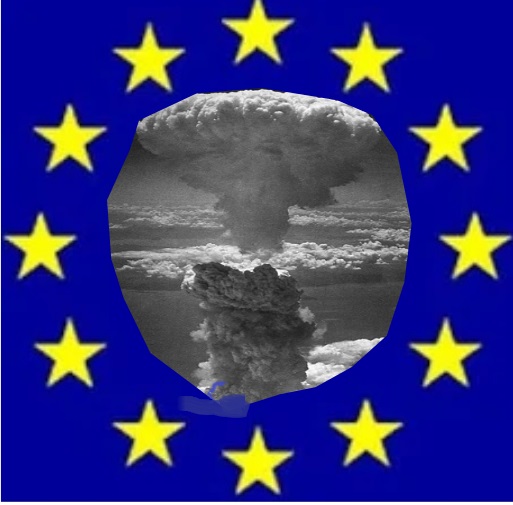
we can only assume that the desire to have massively lethal weapons on one’s own soil that would risk obliterating life, limb and everything else is but a sporting parlour game of misplaced assumptions.
March 17, 2025 Dr Binoy Kampmark , https://theaimn.net/the-script-of-anxiety-polands-nuclear-weapons-fascination/
With the Ukraine War and the retreat of the United States from what has routinely been called Europe’s security architecture, states are galloping to whatever point of presumed sanctuary is on offer. The general presumption is that the galloping is done in the same step and rhythm. But Europe, for all the heavy layers of union driven diplomacy, retains its salty differences.
Poland is particularly striking in this regard, having always positioned itself as a defender against the continent’s enemies, perceived or otherwise. This messianic purpose was well on show with the exploits of King John III Sobieski in his triumphant defence of Vienna against the Ottoman Empire in 1683. The seemingly endless wars against Russia, including the massacres and repressions, have also left their wounding marks on a fragile national psyche. These marks continue to script the approach of Warsaw’s anxiety to its traditional enemy, one that has become fixated with a nuclear option, in addition to a massive buildup of its armed forces and a defence budget that has reached 4.7% of its national income. While there is some disagreement among government officials on whether Poland should pursue its own arsenal, a general mood towards stationing the nuclear weapons of allies has taken hold. (As a matter of interest, a February 21 poll for Onet found that 52.9 percent of Poles favoured having nuclear weapons, with 27.9 percent opposed.)
This would mirror, albeit from the opposite side, the Cold War history of Poland, when its army was equipped with Soviet nuclear-capable 8K11 and 3R10 missiles. With sweet irony, those weapons were intended to be used against NATO member states.
The flirtatious offer of French President Emmanual Macron to potentially extend his country’s nuclear arsenal as an umbrella of reassurance to other European states did make an impression on Poland’s leadership. Prudence might have dictated a more reticent approach, but Prime Minister Donald Tusk would have none of that before the Polish parliament. In his words, “We must be aware that Poland must reach for the most modern capabilities also related to nuclear weapons and modern unconventional weapons.” According to the PM, “this is a race for security, not for war.”
The Polish President, Andrzej Duda, is also warm to the US option (he has been, over his time in office, profoundly pro-American), despite Tusk’s concerns about a “profound change in American geopolitics.” He was already ruminating over the idea in 2022 when he made the proposal to the Biden administration to host US nuclear weapons, one that was also repeated in June 2023 by then-Prime Minister Mateusz Morawiecki. To have such weapons in Poland was a necessary “defensive tactic […] to Russia’s behaviour, relocating nuclear weapons to the NATO area,” he explained to the BBC. “Poland is ready to host this nuclear weapon.”
Duda then goes on to restate a familiar theme. Were US nuclear weapons stored on Polish soil, Washington would have little choice but to defend such territory against any threat. “Every kind of strategic infrastructure, American and NATO infrastructure, which we have on our soil is strengthening the inclination of the US and the North Atlantic Alliance to defend this territory.” To the Financial Times, Duda further reasoned that, as NATO’s borders had moved east in 1999, “so twenty-six years later there should also be a shift of the NATO infrastructure east.”
Much of this seems like theatrical, puffy nonsense, given Poland’s membership of the NATO alliance, which has, as its central point, Article 5. Whether it involves its protection by a fellow NATO ally using conventional or nuclear weapons, hosting such nuclear weapons is negated as a value. Poland would receive collective military aid in any case should it be attacked. But, as Jon Wolfsthal of the Federation of American Scientists reasons, an innate concern of being abandoned in the face of aggression continues to cause jitters. Tusk’s remarks were possibly “a signal of concern – maybe to motivate the United States, but clearly designed to play on the French and perhaps the British.”
The crippling paranoia of the current government in the face of any perceived Russian threat becomes even less justifiable given the presence of US troops on its soil. According to the government’s own information, a total of 10,000 troops are present on a rotational basis, with US Land Forces V Corps Forward Command based in Poznań. In February, Duda confirmed to reporters after meeting the US envoy to Ukraine Gen. Keith Kellogg that there were “no concerns that the US would reduce the level of its presence in our country, that the US would in any way withdraw from its responsibility or co-responsibility for the security of this part of Europe.”
Duda goes further, offering a sycophantic flourish. “I will say in my personal opinion,America has entered the game very strongly when it comes to ending the war in Ukraine. I know President Donald Trump, I know that he is an extremely decisive man and when he acts, he acts in a very determined and usually effective way.” With those remarks, we can only assume that the desire to have massively lethal weapons on one’s own soil that would risk obliterating life, limb and everything else is but a sporting parlour game of misplaced assumptions.
Most Scots disagree with Anas Sarwar about building new nuclear plants
The National 16th March 2025 https://www.thenational.scot/politics/25012201.scots-disagree-anas-sarwar-building-new-nuclear-plants/
DOESN’T the government wanting to build new nuclear plants in Scotland (Sunday National, Mar 16) betray why the UK subjugates Scotland as a vassal state to dump the nuclear garbage it doesn’t want polluting England onto we Scots? Like their dangerous weapons of mass destruction that Westminster doesn’t want located adjacent to the cossetted wealthy south-east; let’s just dump it on the Scots.
NO! NO! NO!
Not only don’t we want nuclear plants here in Scotland, we want England to bear the burden and risk of the obscenity that is nuclear weapons.
Anas Sarwar says it’s not the archaic planning rules that restrict development of nuclear plants, but the “intransigence of the ideologically rigid Scottish Government”. Sarwar fails to understand that this policy of the Scottish Government is widely supported by Scots; it is he who is out of step promoting a polluting, dangerous technology that is so 20th century. Here in the 21st century we’re already well served by hydro, wind and solar power with huge potential for further development. And there are hydrogen and tidal technologies among others to be developed, to build the broad mix of green energy without any need for nuclear power.
Isn’t Scottish Labour MPs changing their minds to accord with Starmer and Milliband’s diktat a clear case of them placing their own personal political careers before the wishes of the people they are supposed to represent and take instruction from? How is this democracy?
Who is surprised about anything emanating from this group of shape-shifting Labour MPs who lied to voters to get elected? Scots voted for them in desperation to rid us of the worst Tory government in history, sick fed up of being continually hammered by draconian policies that created financial hardship for those least well-off. Their reward for placing trust in Labour was to get a government that simply picked up the Tories’ baton of austerity hardship and is intent to press on and finish the race to bottom for ordinary folks, pensioners, those on fixed income and benefits, while ensuring that the wealthy who should and can afford to make a just contribution are left unscathed.
This desire of Starmer and his henchmen to dump nuclear plants on Scotland should prove to Scots that Westminster will never willingly allow us to secede from this iniquitous union that values Scotland only as a cash cow, somewhere to dump the dangerous stuff they don’t want in their back yard. If we want to live in a just land, won’t we have to prise ourselves from this UK union? We will have to take back our independence despite Westminster.
At the General Election, Scots voted in a poor electoral system for Labour. We received more tory; this time red-tory Labour.
If we are to benefit from real change, the Scottish Parliament elections in 2026 have got to be used as a concerted effort, with all pro-indy interests working together to demonstrate we’ve had enough of more than 300 years of failure and use the strength of feeling for indy to justify us taking back our independence.
One issue: independence. We vote SNP 1 with no SNP candidates on the list. Other indy-supporting parties under an umbrella group created for the election on the list, position by agreement, to achieve the supermajority that makes the case for indy irresistible.
They had a fairytale American childhood – but was radiation slowly killing them?

Decades later, federal investigators acknowledged an increased cancer risk for some people who played in the creek as children,
Sophie Williams, BBC News, Washington DC, 16 Mar 25
After Kim Visintine put her son to bed every night at a hospital in St Louis, Missouri, she spent her evening in the hospital’s library. She was determined to know how her boy had become seriously ill with a rare brain tumour at just a week old.
“Doctors were shocked,” she says. “We were told that his illness was one in a million. Other parents were learning to change diapers but I was learning how to change chemotherapy ports and IVs.”
Kim’s son Zack was diagnosed with a glioblastoma multiforme. It is a brain tumour that is very rare in children and is usually seen in adults over 45.
Zack had chemotherapy treatments but doctors said there was no hope of him ever recovering. He died at just six years old.
Years later, social media and community chatter made Kim start to think that her son was not an isolated case. Perhaps he was part of a bigger picture growing in their community surrounding Coldwater Creek.
In this part of the US, cancer fears have prompted locals to accuse officials of not doing enough to support those who may have been exposed to radiation due to the development of the atomic bomb in the 1940s.
A compensation programme that was designed to pay out to some Americans who contracted diseases after exposure to radiation expired last year – before it could be extended to the St Louis area.
This Radiation Exposure Compensation Act (Reca) provided one-time payouts to people who may have developed cancer or other diseases while living in areas where activities such as atomic weapons testing took place. It paid out $2.6bn (£2bn) to more than 41,000 claimants before coming to an end in 2024.
Benefits were paid to such neighbours, frequently called “downwinders”, in Arizona, Utah and Nevada, but not New Mexico, where the world’s first test of a nuclear weapon took place in 1945. Research published in 2020 by the National Cancer Institute suggested that hundreds of cancers in the area would not have occurred without radiation exposure.
St Louis, meanwhile, was where uranium was refined and used to help create the atomic bomb as part of the Manhattan Project. After World War Two ended, the chemical was dumped near the creek and left uncovered, allowing waste to seep into the area.
Decades later, federal investigators acknowledged an increased cancer risk for some people who played in the creek as children, but added in their report: “The predicted increases in the number of cancer cases from exposures are small, and no method exists to link a particular cancer with this exposure.”
The clean-up of the creek is still ongoing and is not expected to finish until 2038.
A new bill has been put forward in the House, and Josh Hawley, a US senator representing Missouri, says he has raised the issue with President Donald Trump.
When Kim flicks through her school yearbook, she can identify those who have become sick and those who have since passed away. The numbers are startling.
“My husband didn’t grow up in this area, and he said to me, ‘Kim, this is not normal. It seems like we’re always talking about one of your friends passing away or going to a funeral’,” she says.
Just streets away from the creek, Karen Nickel grew up spending her days near the water picking berries, or in the nearby park playing baseball. Her brother would often try and catch fish in Coldwater Creek.
“I always tell people that we had just the fairytale childhood that you would expect in what you consider suburban America,” says Karen. “Big backyards, big families, children playing out together until the street lights came on at night.”
But years later, her carefree childhood now looks very different.
“Fifteen people from the street I grew up on have died from rare cancers,” she says. “We have neighbourhoods here where every house has been affected by some cancer or some illness. We have streets where you can’t just find a house where a family has not been affected by this.”
When Karen’s sister was just 11 years old, doctors discovered that her ovaries were covered in cysts. The same had happened to their neighbour when she was just nine. Karen’s six-year-old granddaughter was born with a mass on her right ovary.
Karen helped found Just Moms STL, a group that is dedicated to protecting the community from future exposures that could be linked to cancers – and which advocates for a clean-up of the area.
“We get messages every day from people that are suffering from illnesses and are questioning whether this is from exposure,” she says. “These are very aggressive illnesses that the community is getting, from cancers all the way to autoimmune diseases.”
Teresa Rumfelt grew up just a street away from Karen and lived in her family home from 1979 until 2010. She remembers every one of her animals passing away from cancer and her neighbours getting ill from rare diseases.
Years later, her sister Via Von Banks was diagnosed with amyotrophic lateral sclerosis (ALS), a form of motor neurone disease. Some medical studies have suggested there could be a link between radiation and ALS, but this is not definitive – and more research needs to be done to firm it up.
That does not reassure people like Teresa who are concerned that more needs to be done to understand how locals are being affected.
“ALS took my sister at 50,” Teresa says. “I think it was the worst disease ever of mankind. When she was diagnosed in 2019, she’d just got her career going and her children were growing. She stayed positive through all of it.”
Like Hawley, Just STL Moms and other community members want the government’s compensation act to be expanded to include people within the St Louis area, despite the programme being in limbo after expiring.
Expanding it to the Coldwater Creek community would mean that locals could be offered compensation if they could prove they were harmed as a result of the Manhattan Project, during which the atomic bomb was developed with the help of uranium-processing in St Louis. It would also allow screenings and further study into illnesses other than cancer.
In a statement to the BBC, the US government’s Environmental Protection Agency (EPA) said it took concerns very seriously and had actively worked with federal, state and local partners – as well as community members – to understand their health concerns, and to ensure community members were not exposed to the Manhattan Project-era waste.
The BBC has also contacted the US Army Corps of Engineers, which is leading the clean-up – but has not received a response to a request for comment.
“My sister would have loved to be part of the fight. She’d be the first to picket,” says Teresa of her efforts to get greater support from the government.
The trend in people around Coldwater Creek getting unwell has not gone unnoticed among healthcare professionals.
Dr Gautum Agarwal, a cancer surgeon at Mercy Hospital in St Louis, says he has not noticed a “statistical thing”, but notes that he has seen husbands and wives and their neighbours presenting cancers.
Now, he ensures that his patients are asked where they live and how close they are to Coldwater Creek.
“I tell them that there’s a potential that there’s a link. And if your neighbours or family live near there, we should get them screened more often. And maybe you should get your kids screened earlier.”
He hopes that over time more knowledge will be gained about the issue, and for a study into multi-cancer early detection tests to be introduced that could help catch any potential cancers, and help reassure people in the area……….. https://www.bbc.com/news/articles/c2e7011n03vo
Risk of Radiation Carcinogenesis

There is not currently thought to be a notable risk of a crewmember developing clinically detectable cancer during a mission due to spaceflight exposure.
Robert E. Lewis, NASA, 11 Mar 25, https://www.nasa.gov/directorates/esdmd/hhp/risk-of-radiation-carcinogenesis/
Increased radiation exposure in the spaceflight environment outside of low-Earth orbit may contribute to an increased risk of developing cancer later in an astronaut’s life. Shielding is effective against some radiation exposure, such as solar particle events (SPE) but does not mitigate Galactic Cosmic Radiation (GCR) exposure. Primary contributors to development of cancer later in life are dependent on mission parameters and duration, solar conditions, body structures present, individual radiosensitivity, and age at exposure. The effects of other sources of uncertainty that may modify radiation risk (e.g., secondary spaceflight hazards) are being characterized but cannot be estimated or integrated currently. Terrestrial cancer therapies continue to progress and may be able to mitigate cancer outcomes. There is not currently thought to be a notable risk of a crewmember developing clinically detectable cancer during a mission due to spaceflight exposure.
Canada to review the purchase of US-made F-35 fighter jets in light of Trump’s trade war
By ROB GILLIES, March 16, 2025
TORONTO (AP) — Canada’s new Prime Minister Mark Carney has asked Defense Minister Bill Blair to review the purchase of America’s F-35 fighter jet to see if there are other options “given the changing environment,” a spokesman for Blair said Saturday.
Defense ministry press secretary Laurent de Casanove said the contract to purchase U.S. military contractor Lockheed Martin’s F-35 currently remains in place and Canada has made a legal commitment of funds for the first 16 aircraft. Canada agreed to buy 88 F-35’s two years ago.
Carney, who was sworn in on Friday, has asked Blair to work with the military “to determine if the F-35 contract, as it stands, is the best investment for Canada, and if there are other options that could better meet Canada’s needs,” de Casanove said……………………………………………………………………………………………………..more https://apnews.com/article/f35-canada-trump-0d3bf192d3490d87570d48475ff2c3a6
Towards a Eurobomb: The Costs of Nuclear Sovereignty
it would be much better if the leaders of the EU spend as much time on diplomacy with Russia than in building up European defense.
Instead of investing in weapons of mass destruction, making EU defense more efficient should be the priority as well as integrating Russia into a larger collective security organization
Tom Sauer |11.03.2025 , https://www.aa.com.tr/en/opinion/opinion-towards-a-eurobomb-the-costs-of-nuclear-sovereignty/3505915
The author is a professor in International Politics at the University of Antwerp in Belgium.
- If American soldiers or the tactical nuclear weapons are withdrawn, the odds are that the Europeanization of the French (and maybe British) nuclear weapons in one way or another may indeed become reality
ISTANBUL
The Trump administration’s recent isolationist statements, amid the talks of war in Europe, have revived discussions on Europeanizing French (and possibly British) nuclear weapons. After 75 years of NATO, concerns over US abandonment are increasingly shaping European foreign policy discussions. In the past, the French idea of a “dissuasion concertée (concerted deterrence) was mostly met with silence, especially in Germany. This time around the conservative leader Friedrich Merz seems in favor despite the fact that NATO is still alive and the US still has 100,000 soldiers and 100 tactical nuclear weapons in Europe. These weapons are stationed in Türkiye, Germany, Italy, the Netherlands, and Belgium. If the soldiers or the tactical nuclear weapons are withdrawn, the odds are that the Europeanization of the French (and maybe British) nuclear weapons in one way or another may indeed become reality.
There are different scenarios imaginable. The first step is for European nuclear states to declare that their “national interests” align with “European interests,” a principle already reflected in the Lisbon Treaty. The latter, by the way, also contains a collective defense clause similar to NATO’s Article 5. Further steps could be imagined to make these statements more credible: information exchange, consultation, joint planning, joint exercises, and co-financing. Another step could involve deploying French dual-capable aircraft in Germany or Poland. A final step would be the creation of an EU nuclear bomb in a European Defense Union (EDU). It remains, however, still to be seen how the Ukraine war will accelerate the pace towards such an EDU.
What are the costs of Europeanization of nuclear weapons?
First of all, the assumption that nuclear deterrence works is uncertain. Advocates of nuclear weapons believe that it works. They forget that in history many nuclear weapon states (including Israel, India, the UK) have been attacked by non-nuclear weapon states. In theory, it is very hard to make it work as it assumes for instance a rational enemy. It also assumes that the possessor is really prepared to use them. However, if used on a massive scale, it means the annihilation of the planet. In the war in Ukraine, French President Emmanuel Macron for that reason stated that even if Russia uses a tactical nuclear weapon in Ukraine, France would not retaliate with nuclear weapons.
Secondly, emerging and disruptive technologies (like AI) and weapon systems (like hypersonic missiles) will further undermine the so-called nuclear stability. Ideally, conventional deterrence (using hypersonic missiles) could and should replace nuclear deterrence on the condition that all nuclear states agree.
Thirdly, extended nuclear deterrence, read the atomic umbrella, is even more incredible. As early as the 1970s, Henry Kissinger cautioned Europeans against assuming that the US would employ nuclear weapons for their defense. That is also the reason why France did not want to shelter under the US umbrella, and why it built its own nuclear arsenal in the 1950s. Ironically, France now offers its umbrella to its European partners.
Fourthly, as long as there is no EDU, the question will be whose finger will be on the button. Macron is very clear: it will be his finger. The question then becomes whether German taxpayers would be interested in co-financing a strategic weapon system that they cannot control in times of war.
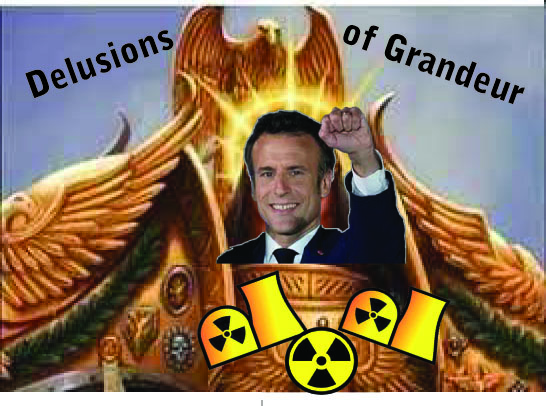
Fifthly, by Europeanizing the French nuclear weapons, the EU legitimizes nuclear weapons. This complicates the fight against proliferation. How sustainable is it to ask Iran not to produce nuclear weapons when the EU itself is setting up a nuclear arsenal?
There are also concerns about whether Europeanization aligns with the Nuclear Non-Proliferation Treaty, particularly if Germany and Poland were to develop their own nuclear capabilities. Both ideas also go against the spirit and the letter of the Treaty on the Prohibition of Nuclear Weapons (2017) that in the meantime has been signed by more or less 100 states.
Sixthly and lastly, it would be much better if the leaders of the EU spend as much time on diplomacy with Russia than in building up European defense. It is high time that the war in Ukraine ends, not only for humanitarian but also economic reasons. A peace agreement ideally includes a beginning of a restructuring of the European collective security architecture that includes both Russia and Ukraine, either in a transformed NATO or an upgraded Organization for Security and Cooperation in Europe (OSCE). If such an agreement is reached, there would be little justification for further fragmenting European defense into over 25 separate, small-scale military forces. Nowadays already the European NATO member states spend $485 billion on defense, much more than Russia ($120 billion). The primary challenge for EU defense today is not the absence of a Eurobomb but the lack of coordination in pooling, sharing, and specialization. Instead of investing in weapons of mass destruction, making EU defense more efficient should be the priority as well as integrating Russia into a larger collective security organization.
Delusional, ruinous and obsolete -the ITER nuclear fusion project
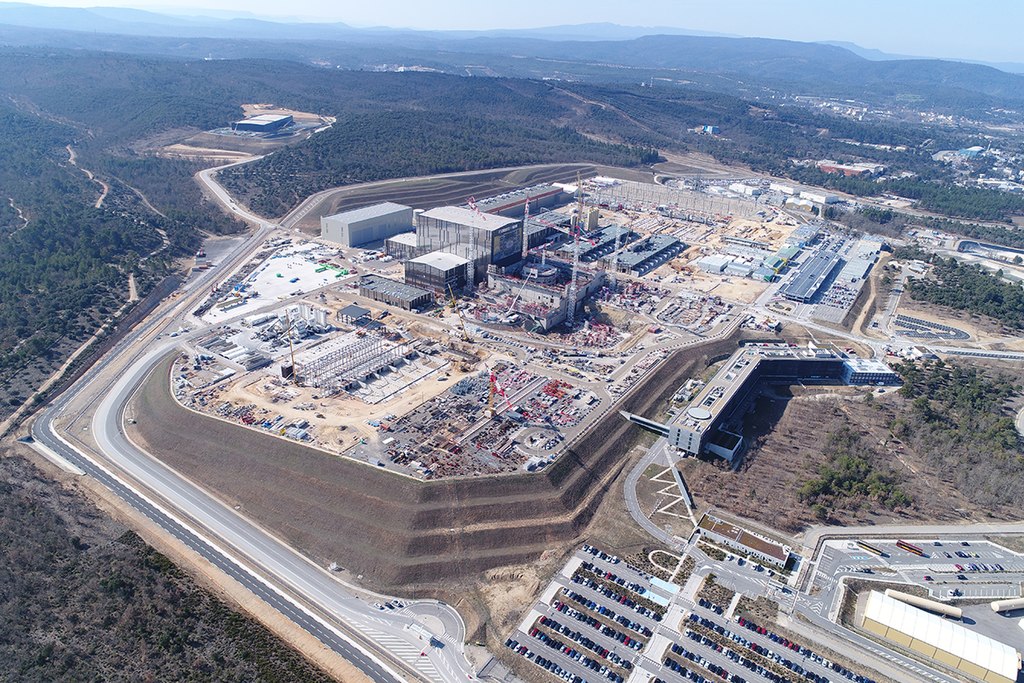
The ITER fusion project is 18 years late and can do nothing about climate change, writes Antoine Calandra
https://beyondnuclearinternational.org/2025/03/16/delirante-ruineuse-et-obsolete/
ITER (International Thermonuclear Experimental Reactor) is an international tokamak nuclear fusion research and engineering project, which has been significantly over budget and schedule, and is currently under construction next to the Cadarache nuclear facility in southern France.
India is one of the seven partner countries in the ITER project, along with the European Union, Russia, Japan, the United States, China, and South Korea. Macron may boast as much as he likes, but ITER is a complete fiasco, a delusional, ruinous, and obsolete project.
On November 14, 2024, the annual public meeting entitled: ITER, 15 years: what assessment? was held in Peyrolles.
I was expecting a big event and to get some recent information on the ITER construction site…But surprise, none of that!
A nondescript multipurpose room, no decor, no documents available, unpleasant white light, around forty people present, only interns (CEA ITER* employees, CLI members, local elected officials, a few union members)
For the event, the tables and chairs were arranged differently, “for a more convivial, cabaret-like atmosphere,” I heard. Oh!?
Pietro Barabaschi, Director General of ITER, was not there.
No agenda to announce the evening’s schedule with the names of the speakers, as in previous occasions. A very meager presentation of the ITER project (5 or 6 images) and that was it. And “time for questions from the audience.” Ah!
In short, the most pathetic ITER public meeting I have ever attended. A public meeting that reflects the ITER assessment.
ITER, what is the outcome?….a disaster!
We already wrote in 2005 with the MEDIANE association: “ITER, a dangerous, ruinous and doomed nuclear project”
The latest important news regarding ITER came on July 3, 2024, during the press conference of Pietro Barabaschi, the current ITER Director General, news that had been expected for a year.
A new calendar: 9 more years late!
The first plasma was originally scheduled for 2016, then postponed to 2025. It has been postponed to 2034. We are 18 years behind schedule.
And with the new calendar, an additional cost of €5 billion!
That’s at least €25 billion of public money to date, a cost multiplied by five. And in reality, more than €40 billion, including the in-kind contributions from the project’s partner countries.
The ITER Director acknowledged that “Fusion cannot come in time to solve the problems our planet faces today, and investments in other technologies, both known and unknown, are absolutely necessary.”
However, the speeches and commitments to get this nuclear fusion project accepted were completely different in 2006 at the time of this charade of public debate.
It was even possible to read that after ITER, DEMO, a pre-industrial demonstrator, was planned to “prove the industrial feasibility of this technology around 2040 and demonstrate that fusion can, by 2050, produce electricity on an industrial scale.”
Once again, the seven partner countries (the European Union, Russia, Japan, the United States, China, India, and South Korea) have agreed to pay more. But the ITER Director is now considering finding private actors to try to fill this financial gap.
Several private companies no longer expect anything from ITER, but they firmly believe in nuclear fusion and promise electricity production in a shorter timeframe.
Some even claim that ITER will be obsolete by the time it is commissioned.
I would add that ITER will probably not work and that there will never be industrial production of electricity through nuclear fusion.
Nuclear fusion will be neither “a revolution for humanity” nor “the energy of the future.”
It is not clean energy, nor even abundant energy. It is dangerous to human health and produces radioactive waste.
Its interest is above all military and to try to save the nuclear industry which has been in a bad state for several years.
ITER will probably never work and will end in total fiasco, worse than SuperPhénix*, which was supposed to be the flagship of the French nuclear industry.
But by squandering all these billions, the ITER monster will have succeeded in blocking any progress towards another energy model and imposing the continuation of the nuclear industry for years to come.
This myth of free and inexhaustible energy that allows for indefinite consumption and waste must be eradicated from people’s minds once and for all. It is also time to put an end to this gigantism and centralization of production in the hands of powerful, commanding states that serve the richest.
The solutions for the future have been known for a long time:
save energy, put an end to waste, develop and improve renewable energies (solar, wind, hydraulic) the only truly clean and future energies.
And not to develop them in an industrial and centralized manner, which is obviously and unfortunately the case.
The industrialization of the world must be fought. A new social project is a prerequisite for any energy project.
The future lies in small production units, local or regional, with technology accessible to the greatest number, low energy consumption, avoiding the cost of distribution.
Nuclear fusion, like fission, is a dangerous, dirty, and expensive energy source. It’s a complex, centralized technology reserved for wealthy countries, leading to proliferation, dependency, injustice, and war.
* CEA: Atomic Energy Commission
* CLI: Local information commission
* SuperPhénix, a former nuclear reactor, commissioned in 1986 and definitively shut down in 1997, is a prototype of a sodium-cooled fast neutron reactor. A dangerous machine that consumed more than 60 billion francs while operating for only thirty months in its twelve years of existence.
Antoine Calandra is a former administrator of the “Sortir du nucléaire” network and a member of the Médiane association. This article was first published in French on Mediapart.
Australia’s Trump cards
by Rex Patrick | Mar 16, 2025, https://michaelwest.com.au/tariffs-australias-trump-cards/

Australia does have Trump cards; North West Cape, Pine Gap, US Marine Rotational forces in Darwin, AUKUS and/or critical minerals that the US needs. Perhaps it’s also time to cancel the traitorous quantum computing development contract given to a US company over Australian companies.
These are things that we can put on the table. But doing that requires a measure of boldness. Our problem is our Prime Minister doesn’t have the ticker. Neither does the opposition leader. They are with Trump internationally as they are with the gas cartel domestically; owned and weak.
Anthony Albanese has it all wrong, writes former senator and submariner Rex Patrick. He’s trying to bribe Trump with sweeteners in response to trade tariffs. Instead, he needs to tell Trump he’s prepared to take things away.
US nuclear deterrent
Deep beneath the Indian Ocean, USS Kentucky, a nuclear-powered Ohio Class Ballistic Missile Submarine (SSBN) ploughs its way through the water. Contained within its 18,750 tonne pressure hull structure are 24 Trident ballistic missiles, each capable of carrying eight nuclear warheads to targets up to 12,000 km away.
The launch of all of USS Kentucky’s missiles would, quite literally, change the world by exacting severe destruction on whole societies.
This ability to inflict damage on an exceptionally large scale is the basis of the SSBN’s deterrent capability. Unlike silo based missiles, which are vulnerable to a first strike, or aircraft delivered nuclear weapons, which can be pre-emptively hit or shot down, SSBNs are essentially invisible. They provide certainty of response.
SSBNs serve as the ultimate nuclear deterrent. They’re extremely important to the US, whose navy possesses 14 of them. At any one time six to eight will be at sea, with four of them always on deterrent patrol. They are spread about the globe giving the US President the ability to quickly deliver return-fire with nuclear warheads at any adversary.
24/7 Operation
The primary performance metric for an SSBN is to be able to deliver its nuclear weapons with reliability, timeliness and accuracy.
The Commanding Officer of USS Kentucky must be able to loiter undetected in a place suited for the launching of weapons, be able to receive an order to launch, have an understanding of the submarine’s exact navigational position to a high degree of accuracy and have the ability to launch the weapons quickly and reliably once that order arrives.
Loitering undetected and being able to receive an order to launch is challenging. When a submarine is near the surface, their hulls can be seen by aircraft, and raised periscopes and communications masts can be seen visually and on radar. Operating a submarine at shallow depth can also result in acoustic counter-detection.
The Commanding Officer of USS Kentucky knows that deep is the place to be.
But being deep frustrates a submarine’s ability to receive communications, particularly an ‘emergency action message’.
And that’s were Very Low Frequency (VLF) communications stations come into play. In conjunction with a submarine’s buoyant wire antenna – a long wire that sits just below the sea surface – they can receive a launch command from the President.
The US has a network of these VLF communication stations around the world including in Maine, Washington state and North West Cape, Australia.
North West Cape
The VLF Communication Facility at North West Cape (NAVCOMMSTA Harold E Holt) has been in operation since 1967. Born of secrecy, it was at first exclusively US operated until 1974 when the facility became joint and started communicating with Australian submarines. In 1991 it was agreed that Australia would take full command in 1992 and US Naval personnel subsequently left in 1993.
The facility’s deterrence support role now rests on a 2008 treaty which, ratified in 2011, is formally titled the “Agreement between the Government of Australia and the Government of the United States of America relating to the Operation of and Access to an Australian Naval Communication Station at North West Cape in Western Australia”.
The station’s antenna is 360 meters high, with a number of supporting towers in a hexagon shape connected to it by wires. Considered to be the most powerful transmitter in the southern hemisphere, it transmits on 19.8 kHz at about 1 megawatt.
The station enables emergency action messages to be relayed to submerged SSBNs, like USS Kentucky, when operating in the Indian and Western Pacific oceans.
If the facility was taken out by a first strike nuclear attack, the US Air Force can temporarily deploy Hercules ‘TACAMO’ aircraft, with a long VLF wire they deploy while airborne. It’s a back-up measure with much lower transmission power capabilities.
A bedrock of certainty
After US steel and aluminium tariffs were put into play, the Australian Financial Review ran with a headline “How Australia was blindsided on the US tariffs”. The article opened with, “Australia pulled out all stops to avoid Donald Trump’s duties on steel and aluminium, but it’s impossible to negotiate with someone who doesn’t want anything”.
But the US does want something.
A fact not so well appreciated with respect to nuclear deterrence is it must be seen to be a robust and continuous capability. Onlookers must see a 24/7 capability including deployable submarines manned by well-trained crews, proven and reliable missile systems, an organised strategic command, a continuous communication system that reliably links that strategic command to the submarines with appropriate redundant communication pathways, training facilities and maintenance support.
Potential adversaries must know that they could be struck by an SSBN that could be lurking anywhere in the world’s major oceans.
Effective nuclear deterrence must be built on a bedrock of operational certainty.
Remove the transmitter keys
North West Cape forms part of that certainty.
Australia has the keys to take some certainty away. Without our cooperation the US can’t operate a certain global deterrent capability. Turning off transmissions at North West Cape reduces the effectiveness of the US nuclear deterrence while eliminating one Australian nuclear target
The North West Cape Treaty provides leverage. While the agreement has another decade to run, Article 12 provides that “either Government may terminate this Agreement upon one year’s written notice to the other Government.”
It’s open to Australia to signal or give actual notice of termination. That would focus up policy makers in Washington.
Would we do that to a mate? No, but the US is showing they are not a mate. They are not showing us the loyalty we have shown them. Other actions; abandoning Ukraine, threatening Greenland and Panama and a not so subtle push to annex Canada have also shown they are an unreliable ally who doesn’t share our values.
Trump cards
In negotiating with President Zelensky over the war in Ukraine, President Trump told him in no uncertain terms. “We’re going to feel very good and very strong. You’re, right now, not in a very good position. You’ve allowed yourself to be in a very bad position. You don’t have the cards right now with us.”
But Australia does have Trump cards; North West Cape, Pine Gap, US Marine Rotational forces in Darwin, AUKUS and/or critical minerals that the US needs. Perhaps it’s also time to cancel the traitorous quantum computing development contract given to a US company over Australian companies.
These are things that we can put on the table. But doing that requires a measure of boldness. Our problem is our Prime Minister doesn’t have the ticker. Neither does the opposition leader. They are with Trump internationally as they are with the gas cartel domestically; owned and weak.
Things have changed
Alliances are means to ends, not an end in themselves; and, as pointed out above, things have changed. We can pretend everything is okay, but that doesn’t make it so.
But the bureaucracy is unlikely to advise the Government of alternatives.
Our uniformed leaders are locked into AUKUS, a program that gives them relevance at the big table; something they wouldn’t otherwise have with the depleted Navy they’ve built out of their procurement incompetence. They’re clinging to that relevance, despite all signs showing the program is running aground.
Our spooks are in the same place. In response to calls to put Pine Gap on the table, former Home Affairs Secretary Mike Pezzullo (sacked for failing to safeguard sensitive government information) spoke out, putting the facility ahead of trade interests and Aussie jobs.
The bulk of the intelligence from Pine Gap is very usable for the US and rather less so for Australia. Senior spooks just want to maintain their own relevance in the Five Eyes club; but it’s a mistake to conflate their interest with our national interest.
We should be prepared to play our Trump cards and we should be prepared to face the national security consequences.
If that means an Australia that‘s more independent and more self-reliant, that would be a very good thing. If there’s a shock to the system, then all well and good, because in the changing world we find ourselves in, it might be the only thing that wakes the Canberra bubble from its stupor and pushes us to actually be prepared.
In these uncertain times, there are no hands more trustworthy than our own.
Rex Patrick is a former Senator for South Australia and earlier a submariner in the armed forces. Best known as an anti-corruption and transparency crusader, Rex is running for the Senate on the Lambie Network ticket next year – www.transparencywarrior.com.au.
Putin Signals He’s Open to Ceasefire as Witkoff Arrives for Talks.
An aide to Putin said the proposal would only help Ukraine regroup and that it would need to be adjusted to meet Moscow’s position
by Dave DeCamp March 13, 2025, https://news.antiwar.com/2025/03/13/us-envoy-arrives-in-russia-to-discuss-30-day-ceasefire-proposal-with-putin/
Russian President Vladimir Putin has signaled that he’s open to a ceasefire in Ukraine but that he has “questions” about the 30-day US-Ukraine proposal that need to be discussed.
“The idea itself is the right one, and we definitely support it,” Putin said, according to The New York Times. “But there are questions that we need to discuss, and I think that we need to talk them through with our American colleagues and partners.”
The Russian leader listed potential conditions for a 30-day truce, including a guarantee that Ukraine wouldn’t be supplied with more weapons. “We also want guarantees that during the 30-day ceasefire, Ukraine will not conduct mobilization, will not train soldiers, and will not receive weapons,” he said, according to RT.
Putin also questioned who would monitor the ceasefire. “Who will determine where and who has violated a potential ceasefire agreement along a 2,000-kilometer line? Who will attribute blame for any violations? These are all questions that require thorough examination from both sides,” he said.
The Russian leader said any long-term peace deal needs to address the “root causes” of the war. He made the comments as US envoy Steve Witkoff arrived in Russia to discuss the proposal. Yuri Ushakov, a Kremlin official, said Witkoff would be holding a closed-door meeting with Putin.
Ushakov also said the US-Ukraine proposal would only give Ukraine a chance to regroup, and it would need to be adjusted to meet Moscow’s interests.
“As for the 30-day temporary ceasefire, what is it about? There is nothing in it for us. It will only provide the Ukrainians with the opportunity to regroup and gain strength to continue doing what they are doing,” he said, according to Russia’s TASS news agency.
“These are some hasty actions that do not benefit a long-term settlement … We will need to work on it, to think it over so that it reflects our position, too. It reflects only Ukraine’s stance at this point,” he added.
Ushakov said that Russia wanted a long-term peace deal and that the “official” Russian position on the US-Ukraine proposal would be formulated by Putin.
Russian Foreign Minister Sergey Lavrov made similar comments opposing the idea of a temporary ceasefire, pointing to the Minsk Accords, which were first reached in 2014 for a truce in Ukraine’s eastern Donbas region. Lavrov also mentioned the “Istanbul agreement,” referring to a peace deal that was on the table in March and April 2022, which was discouraged by the US and its allies.
“I’m talking about the Minsk Accords, the deal that was discarded after the 2014 coup, and the Istanbul agreements. All of those included a ceasefire. And every time, it turned out that they had lied to us. The Ukrainians lied with the support of their European partners,” Lavrov said.
A joint statement between the US and Ukraine that was released after talks in Saudi Arabia on Tuesday said that Ukraine had “expressed readiness to accept the US proposal to enact an immediate, interim 30-day ceasefire, which can be extended by mutual agreement of the parties, and which is subject to acceptance and concurrent implementation by the Russian Federation.”
The statement also said that the US had resumed military aid and intelligence sharing for Ukraine, which was briefly paused. US Secretary of State Marco Rubio has said that if Russia doesn’t accept the 30-day proposal, the US would then know who the “impediment” to peace is, signaling he wants the proxy war will continue as usual if a deal isn’t reached.
1 This Month
15 October. Joint Appeal for Nuclear Abolition Day -presentation to the UN on October 15 will be live on UNWebTV
Endorse the Nuclear Abolition Day Appeal
23-25 October – on Zoom – World BEYOND War’s annual global conference

To see nuclear-related stories in greater depth and intensity – go to https://nuclearinformation.wordpress.com
-
Archives
- October 2026 (131)
- September 2026 (339)
- August 2026 (330)
- July 2026 (355)
- June 2026 (287)
- May 2026 (306)
- April 2026 (356)
- March 2026 (251)
- February 2026 (267)
- January 2026 (308)
- December 2025 (358)
- November 2025 (359)
-
Categories
- 1
- 1 NUCLEAR ISSUES
- business and costs
- climate change
- culture and arts
- ENERGY
- environment
- health
- history
- indigenous issues
- Legal
- marketing of nuclear
- media
- opposition to nuclear
- PERSONAL STORIES
- politics
- politics international
- Religion and ethics
- safety
- secrets,lies and civil liberties
- spinbuster
- technology
- Uranium
- wastes
- weapons and war
- Women
- 2 WORLD
- ACTION
- AFRICA
- Atrocities
- AUSTRALIA
- Christina's notes
- Christina's themes
- culture and arts
- Events
- Fuk 2022
- Fuk 2023
- Fukushima 2017
- Fukushima 2018
- fukushima 2019
- Fukushima 2020
- Fukushima 2021
- general
- global warming
- Humour (God we need it)
- Nuclear
- RARE EARTHS
- Reference
- resources – print
- Resources -audiovicual
- Weekly Newsletter
- World
- World Nuclear
- YouTube
-
RSS
Entries RSS
Comments RSS

