No Victory in Ukraine: The Costs of Western Delusion
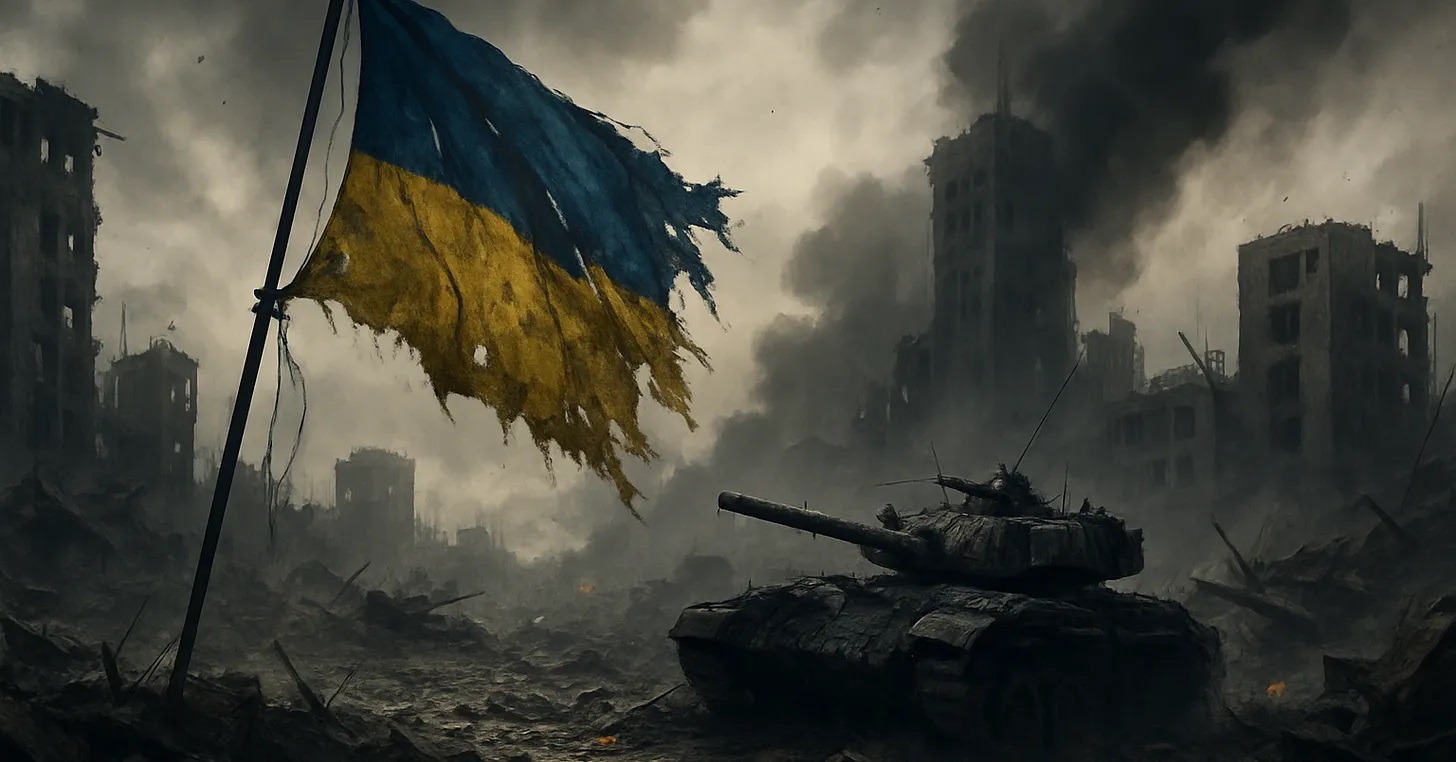
Having invested enormous political capital in the narrative of Ukrainian success, Western governments now face a stark choice: admit failure or fabricate further illusions.
A negotiated settlement can succeed only if it acknowledges Russia’s control over key Ukrainian territories and guarantees that Kyiv will not join NATO. Anything less is strategic fantasy.
Analyzing the impending failure of Ukraine’s war effort and the urgent need for strategic realism in U.S. and European policies.
POST-LIBERAL DISPATCH, Apr 29, 2025, https://postliberaldispatch.substack.com/p/no-victory-in-ukraine-the-costs-of?utm_source=post-email-title&publication_id=4747899&post_id=162368952&utm_campaign=email-post-title&isFreemail=true&r=ln98x&triedRedirect=true&utm_medium=email
The conflict in Ukraine represents not merely a military failure but a profound collapse of political imagination and strategic discipline across the West. To evaluate this ongoing debacle through the lens of political realism and realpolitik demands dispensing with sentimental narratives, ideological attachments, and moralized illusions that have distorted serious analysis for years. Strategic clarity begins with the uncomfortable but inescapable fact: Ukraine’s defeat, whether through a forced diplomatic settlement or battlefield collapse, is no longer a possibility to be debated—it is an inevitability. The West’s refusal to acknowledge this reality stems less from misunderstanding battlefield dynamics and more from a systemic dysfunction wherein political leadership has fused strategic aims with public relations imperatives, thereby serving neither effectively.
At the core of Western miscalculation lies a fatal contradiction. Ukraine was encouraged—indeed, materially and rhetorically incentivized—to resist with the implicit, sometimes explicit, promise of ultimate victory. Yet Western capitals were neither prepared to mobilize the industrial base, financial resources, nor political will necessary to sustain the prolonged total war required to defeat a nuclear-armed Russia. This contradiction was not an accident; it arose naturally from the structural incentives within Western democracies, where leaders needed to appear resolute without assuming the irreversible costs and risks that genuine strategic victory would demand. Thus, Western “support” was expansive in quantity but defective in quality—sufficient to prolong Ukraine’s resistance but insufficient to enable decisive success.
This dynamic exposes why further support—whether billions of dollars in aid, advanced weapons, or rhetorical escalations—cannot now alter the outcome. Ukraine’s manpower shortages, industrial exhaustion, and political fragmentation cannot be reversed by external injections of matériel or funding. The critical variable—human capacity—has been irreversibly degraded. Realpolitik demands the recognition that no arsenal of Western weapons can compensate for a collapsing force structure facing an adversary that enjoys both conventional and nuclear escalation dominance.
The strategic illusion driving continued support is not born of a sincere belief in Ukrainian victory but rather of a desperate attempt to delay political reckoning. Having invested enormous political capital in the narrative of Ukrainian success, Western governments now face a stark choice: admit failure or fabricate further illusions. In this sense, Ukraine’s war effort has been subordinated to Western political needs rather than judged on its own strategic merits. This helps explain why Ukrainian leadership was encouraged to reject diplomatic offramps like the Istanbul talks: the West preferred a failed gamble on battlefield reversal to an early settlement that would have publicly exposed the limits of Western power and credibility.
This leads to an unavoidable truth: Ukraine has been treated less as a sovereign actor and more as an instrument of Western strategic signaling. The dominant objective was never the restoration of Ukraine’s 1991 borders—an outcome unattainable without direct NATO intervention—but the maintenance of an image of Western resolve against authoritarian revisionism. Once battlefield success proved elusive, the war transformed into a conflict of perception, with Ukrainians paying the real, human cost for abstract political imperatives.
Against this backdrop, Trump’s blunt diplomacy is not a betrayal but rather a belated reassertion of strategic rationality. The alternative—prolonging Ukraine’s suffering for a fantasy of reversal—serves no tangible Western interest. Trump’s reported willingness to “walk away” unless a settlement is reached recognizes a fundamental truth of realpolitik: power is the only currency in negotiation. With no remaining strategic leverage, Ukraine must accept the least unfavorable terms while it still retains a semblance of bargaining power. Otherwise, total military collapse and unconditional surrender will be the inevitable conclusion.
This analysis must also grapple with the secondary consequences. Ukraine’s defeat will undoubtedly damage U.S. credibility in the eyes of key allies such as Taiwan, Japan, and South Korea. Yet political realism demands prioritization. The Indo-Pacific, not Eastern Europe, is now the primary theater of geopolitical competition. Resources, strategic focus, and credibility are finite. Every dollar expended in Ukraine without materially altering the balance of power weakens Washington’s ability to contain China, the only peer competitor capable of fundamentally reshaping the global order. From a purely interest-based perspective, retrenchment from Ukraine in favor of bolstering Indo-Pacific commitments is not only logical but strategically imperative, however politically unpalatable it may seem.
Nor should any illusions persist about containing Russia through continued proxy conflict. Prolonged war has already incentivized deepening Russian-Chinese strategic alignment, revealed political fractures within NATO, and accelerated the global shift toward a multipolar order. The longer the West clings to the illusion of salvaging Ukraine’s position, the more divisive it will become at home—and the more strategic ground it will cede abroad. Realpolitik demands ruthless triage: sacrifice what cannot be saved to consolidate and defend what remains viable.
Finally, it must be recognized that Russia, having paid the costs of prolonged conflict, has no rational incentive to settle for partial gains. Political realism teaches that actors seek to translate battlefield success into maximal political objectives. Unless confronted by overwhelming force or existential risk—neither of which the West is prepared to employ—Russia will continue pressing its advantage. A negotiated settlement can succeed only if it acknowledges Russia’s control over key Ukrainian territories and guarantees that Kyiv will not join NATO. Anything less is strategic fantasy.
The dominant narratives that have framed Western engagement in Ukraine—invocations of democracy, sovereignty, and resistance to aggression—may possess emotional resonance, but they have been strategically catastrophic. They obscured the real stakes, concealed the true balance of forces, and ultimately subordinated hard strategic interests to soft illusions. In the brutal calculus of international politics, sentimental attachments are liabilities, not assets. Strategic clarity demands recognizing irretrievable losses, minimizing further damage, and reallocating resources to theaters where the balance of power can still be decisively shaped.
For second time in 3 years Zelensky sabotages Ukraine war peace deal.

Walt Zlotow, West Suburban Peace Coalition, Glen Ellyn IL 30 Apr 25
Does Ukraine President Zelensky enjoy watching his citizens die needlessly in a US provoked war he could have ended twice?
Zelensky helped ensure Russia would invade February 22, 2022 by pushing NATO membership for Ukraine and massing 60,000 elite troops on the Donbas border to finish off the Russian leaning Donbas Ukrainians seeking independence from Kyiv destroying their culture along with their lives.
But Zelensky sensibly negotiated a peace agreement with Russia in the first two months (Istanbul Agreement) that would have ended the war with no loss of Ukraine territory albeit with no Ukraine NATO membership and independence for the beleaguered Donbas Ukrainians. That was statesmanship of the highest order.
But the US and UK saw a golden opportunity to weaken Russia if not change out the Vladimir Putin regime. What to do? Got it. Send US Defense Secretary Lloyd Austin and UK Prime Minister Boris Johnson to Kyiv to disabuse Zelensky of making peace. Hey, with a couple of hundred billions in US/NATO weapons but no soldiers, you can win Zelensky and go out the George Washington of Ukraine..
The result? Three years on Ukraine is largely destroyed with millions fled, over a hundred thousand casualties, 45,000 square miles gone forever and a shattered economy.
But new sheriff in town Trump brokered a new peace deal which would have ended the war with no further casualties or lost territory, Astonishingly, Zelensky rejected it again, this time of his own free will. He cited both his desire to require Crimea, lost 5 years before he became president, and his goal of Ukraine joining NATO.
So despite a 3 day Russian truce in in the offing over its May celebration of its WWII victory, the dying soldiers and expanding Russian buffer zone in Ukraine to prevent further long range Ukrainian missile attacks will go on till Ukraine simply collapses.
Maybe Zelensky has a nationwide death wish. Maybe he’s delusional or too stupid to realize his leading Ukraine to certain destruction. Or maybe it’s simply his way of telling the US and UK that he’s capable of blowing up a sensible peace agreement all by himself.
Europe is drilling for World War III
NATO is conducting exercises for “a broad offensive from Vilnius to Odessa” at “a scale unseen in decades.”
Alex Krainer, May 01, 2025
[Originally published at I-System TrendCompass] Russia’s military victory over Ukraine has been a near-certainty for months now. Ukraine’s total defeat is only a matter of time, but as that time approaches, European powers have been increasingly determined not to let the war die and are now actively preparing to take it up where Ukraine stumbles. Our liberal democracies are as precious as they are fragile and every precaution must be taken to defend them from the Asiatic hordes gathering in the east.
While our valiant bankers are arranging to allocate trillions of euros of our children’s and grandchildren’s wealth for defense spending, our militaries are diligently exercising and preparing for war, hidden from ordinary Europeans who aren’t exactly enthused about World War 3. But the Russians have noticed: presidential aide and former National Security Adviser Nikolai Patrushev recently stated that, for a second consecutive year, NATO has been
“conducting exercises at our borders at a scale unseen in decades. … They are training for conducting a broad offensive from Vilnius to Odessa, seizing Kaliningrad region, imposing a naval blockade in the Baltic and the Black Seas and executing preventive strikes on the staging locations of Russian nuclear deterrence forces.”
If Mr. Patrushev is correct, it would appear that London, Paris, Berlin and Brussels are actively preparing for war against Russia. But his statement that the exercises are “at a scale unseen in decades,” needs to be put in context.
NATO’s provocations far predate Ukraine war
NATO has been involved in increasingly aggressive military maneuvers at Russia’s doorstep for many years now, especially after the 2014 Euromaidan coup in Kiev. During that time, NATO forces have been conducting as many as 40 major military exercises per year along Russia’s borders.
Movement of their military assets evolved from purely reconnaissance hardware to battle ready ships and aircraft equipped with precision munitions and cruise missiles which would frequently approach Russian territory to as close as 15 km (9.3 miles). On these occasions, they often activated their missiles in repeated mock attacks on Russian targets. In September 2020, chief of operations of Russia’s high command, General Sergey Rudskoi stated that NATO was staging between 33 and 40 such flight approaches per week using fighter jets from Sweden, Germany, Ukraine and Italy.
This suggests that the exercises Mr. Patrushev referred to aren’t Europe’s reaction to Russia’s aggressiveness but a continuation of policy that far predates the Ukraine war. In June 2021, still more than six months before Ukraine war, NATO’s then Secretary General Jens Stoltenberg boasted that,
“Perhaps the most important thing we have done is that for the first time in NATO’s history, we have combat-ready troops in the eastern part of the Alliance. New battle groups are deployed to the Baltic countries and Poland, we have tripled the size of the NATO readiness force.”
In a 2016 radio-interview with John Bachelor, late professor Stephen Cohen noted that,
“NATO has decided to quadruple its military forces on Russia’s borders or near Russia’s borders… The last time there was this kind of Western hostile military force on Russia’s borders was when Nazis invaded Russia in 1941. There has never been anything like this. During the 40-year Cold War there was this vast buffer zone that ran from the Soviet borders all the way to Berlin. There were no NATO or American troops there. This is a very radical departure on the part of the [Obama] administration. … Russia is not threatening any country on its border.”
$75 trillion worth of democracy and freedom
Professor Cohen was right. Russia really wasn’t threatening any of its neighbors, and no Russian leader has either explicitly or implicitly expressed any territorial pretentions against any European nation. The deranged claims that once they are done with Ukraine, the Russians will continue on to Poland, the Baltic states, Finland and then, who knows, perhaps Paris and London, are based on nothing but European leaders reckless fear mongering, aimed at justifying NATO’s continuing preparations for war.
The ultimate reason isn’t the belief that Russia will launch a medieval invasion of Europe and deprive us of our democracy and freedom, but the certain knowledge that Russia is sitting on an estimated $75 trillion of our freedom and democracy. Those precious resources are utterly wasted on the unworthy Russians. Here’s what the Iron Lady Margaret Thatcher once said (video at this link):
“If you were to make a table of countries in proportion to the natural resources they have, the top one would almost certainly be Russia. She has everything. Oil, gas, diamonds, platinum, gold, silver, all the industrial metals, marvelous standing timber, a wonderfully rich soil. But countries are not rich in proportion to their natural resources. Countries are rich whose governments have policies which encourage essential creativity, initiative and enterprise of man and recognize his desire to do better for his family.”…………………………………………………………………………………………………………. https://alexkrainer.substack.com/p/europe-is-drilling-for-world-war?utm_source=post-email-title&publication_id=1063805&post_id=162553198&utm_campaign=email-post-title&isFreemail=true&r=1ise1&triedRedirect=true&utm_medium=email
Australian Government ignores AUKUS ‘very high risk’ warning from the Admiral in charge

Admiral Mead sought to bell the cat while Defence Minister Marles has not been straight with the Australian people about the very high risks of AUKUS, even though he has been briefed on and appears to have informed Cabinet of those risks.

Marles should front up about this concealment without delay.
Labor not blameless
by Rex Patrick | Apr 29, 2025, https://michaelwest.com.au/government-ignores-aukus-high-risk-warning-from-the-admiral-in-charge/
The AUKUS submarine project faces huge risks, and Cabinet knows. But as the Government ships $2B of taxpayers’ money to the US this year, with much more to follow, the taxpayer is not being told. Rex Patrick reports.
On 26 February this year, Vice Admiral Jonathan Mead, the man in charge of AUKUS, advised the Senate that the AUKUS submarine program was “very high risk”. He said, “We’ve made that clear to government, and the government has made that clear to the public.”
However, it has not.
I follow AUKUS closely and had not heard that publicly before. Whilst it is absolutely the case, and something MWM has reported on extensively, this was the first public admission of the very high risk nature of the project from the Australian Submarine Agency.
Concerns about US submarine production rates and the weakness of the UK’s submarine industrial base have generated grave doubts about whether the $368B AUKUS scheme will deliver nuclear-powered submarines for Australia.
Moreover, former Prime Minister Malcolm Turnbull has revealed, after conversations with insiders, that there is no Plan B.
“Plan B is that we will not get any submarines.”
FOI ahoy
I was somewhat surprised by Admiral Mead’s unusual candour, so on 27 February, I moved to test the veracity of his remarks with an FOI application directed at the Australian Submarine Agency (ASA) seeking access to “any ministerial submission or briefing provided by ASA to the Minister for Defence … that refers to the AUKUS nuclear submarine program as involving ‘high risk’ or ‘very high risk’.”
I also sought access to ‘any statement made by the Minister for Defence or the Minister for Defence Industry and Capability Delivery that refers to the AUKUS nuclear submarine program as involving ‘high risk’ or ‘very high risk’.”
A decision on those was made this week. FOI applications can reveal the truth by what is disclosed, by what is withheld, and by confirming what doesn’t exist.
ASA confirmed the existence of a ministerial briefing characterising the AUKUS submarine program as involving ‘high risk’ or ‘very high risk’, but refused access to that briefing on national security and Cabinet secrecy grounds. Significantly, ASA’s refusal decision confirmed this document was produced for the dominant purpose of briefing a Minister on an attached Cabinet submission.
In effect, the Submarine Agency confirmed Admiral Mead’s statement that ASA has briefed the government on the ‘high risk’ or ‘very high risk’ nature of the AUKUS project, and that briefing was submitted to the Defence Minister for Cabinet consideration.
“That high-risk assessment has gone to the very top of the Government.”
Alarm bells should be ringing.
Misleading the public
But the FOI decision also reveals that Defence Minister Richard Marles has not been forthcoming with the Australian public about the full hazards of AUKUS.
In relation to statements the minister has made to the public on the risk status of the project, the Australian Submarine Agency advised that ‘no in scope documents were identified’ that show the Defence Minister has made any public statement that acknowledges the ‘high’ or ‘very high’ risk of the AUKUS scheme.
The agency was able to find only a handful of statements referring to risk management in general and assertions that the United Kingdom will carry the primary risks of the AUKUS-SSN construction.
Admiral Mead was not correct in his statement to the Senate, but more importantly, the Government has been caught red-handed fudging the risks associated with the AUKUS scheme. The public has been misled.
Admiral Mead sought to bell the cat while Defence Minister Marles has not been straight with the Australian people about the very high risks of AUKUS, even though he has been briefed on and appears to have informed Cabinet of those risks.
Marles should front up about this concealment without delay.
Labor not blameless
Last week, at a pre-polling booth, I was standing next to a Labor volunteer who was handing out how-to-vote cards for the seat of Adelaide. An elderly gentleman stuck out his hand and asked the volunteer for a how-to-vote card.
“We have to stop the Liberals getting in”, he said. “We don’t need nuclear power”.
I couldn’t resist. “But you’re taking a Labor how-to-vote”, I said. He gave me a strange look. “What about the eight naval reactors?” I queried. “A naval reactor is a reactor, and naval nuclear waste is nuclear waste”.
Many in the Labor camp think AUKUS is Morrison’s (and Peter Dutton’s) baby. But for Labor, that’s just a convenient mistruth. In September 2021, Morrison announced AUKUS. But he only announced a study. It was Prime Minister Anthony Albanese at the March 2023 San Diego “kabuki show” (as described by Paul Keating) that turned it into a formal Defence project behemoth with a projected cost of $368 billion.
Pre-polling booths are a good place to hang out for political gossip. I also held a discussion with a long-standing grassroots Labor Party member who proceeded to tell me how he had been sidelined for his opposition to AUKUS.
There’s no doubt the Labor rank-and-file have been cut out of the party’s decision-making with the Labor leadership ramming an AUKUS endorsement through the party’s 2023 national conference. Since then, the dissenting views of many, perhaps even a majority of Labor members, have been marginalised and suppressed.
AUKUS to be torpedoed
Politics aside, any project manager worth their salt would put an end to AUKUS. It’s a looming procurement shipwreck.
The US will not be able to supply the Virginia Class submarines to the Royal Australian Navy. The US Congressional Research Service has calculated a US build rate of 2.3 boats per annum is necessary to enable the US to provide boats to Australia without harming US undersea warfare capability. The current build rate is somewhere between 1.1 and 1.3 boats per annum.
The British submarine industry is one big cluster fiasco. Fruit that will flow from that program will be late, possibly rotten, and far more expensive than planned.
Meeting delivery obligations by the US and UK under the program will be really hard. And the fact that the Australian Government can’t even be up front and honest about the program
Rex Patrick is a former Senator for South Australia and earlier a submariner in the armed forces. Best known as an anti-corruption and transparency crusader, Rex is running for the Senate on the Lambie Network ticket next year – www.transparencywarrior.com.au.
“suggests there is no chance of success.”
But Albanese need not worry, nor Marles. By the time all of this sinks in, they’ll be out of the system. It will be our children who suffer from the tens of billions wasted and the massive hole in our national security capability.
Rex Patrick
Covering up Ukrainian Nazis is nothing new – the Canadians have been doing it for almost eighty years

Ian Proud, April 29, 2025. https://strategic-culture.su/news/2025/04/29/covering-up-ukrainian-nazis-nothing-new-canadians-have-been-doing-it-for-almost-eighty-years/
A number of topics remain taboo in discussing the war in Ukraine. Busification, Zelensky’s democratic mandate, Ukraine’s casualty numbers and anything suggesting that Ukraine cannot win are all off limits. Likewise the problem of alleged neo-Nazis in Ukraine.
One of the most embarrassing episodes since the Ukraine war started in 2022, was when Yaroslav Hunka, was given two standing ovations in the Canadian House of Commons public gallery by MPs during the visit of President Zelensky in 2023. Hunka has been accused by Russia of genocide, because of his alleged involvement in the Huta Pieniacka massacre of February 28 1944 in which more than 500 ethnic Poles were murdered in a village, in what is now western Ukraine. Hunka was a member of the SS Galicia Division, a mostly Ukrainian unit of the Waffen SS, which Commissions in Germany and Poland later found guilty of war crimes.
This was shocking because it opened the lid on a topic of conversation that has been largely silenced by the western mainstream media since the beginning of the war: Ukraine’s contemporary challenge of far-right ultranationalism. But the Hunka case also illustrates how western authorities airbrushed discussion of nazis in Ukraine after World War II too.
On 13 July 1948 the British Commonwealth Relations Office, what is now part of the Foreign Commonwealth and Development Office, sent a telegram to Commonwealth governments, proposing an end to Nazi war crimes trials in the British zone of Germany. “Punishment of war crimes is more a matter of discouraging future generations than of meting out retribution to every guilty individual… it is now necessary to dispose of the past as soon as possible.”
After the conclusion of the Nuremberg War Trials in 1946 the western world faced a new enemy in the Soviet Union. Limited security resources in cash-strapped Albion and its colonies were re-deployed to uncover suspected Soviet agents and Communists, rather than to identify and track down lower-order Nazi war criminals.
Around this time, many Ukrainians fled the Soviet Union to settle in Canada. In the thirty-year period after the start of Operation Barbarossa, the Ukrainian population in Canada almost doubled, from 300,000 to almost 600,000 people. While most of them, I am sure, would not have been Nazi collaborators, some, undoubtedly, were. They were joined by lesser numbers of Latvians, Hungarians, Slovaks and others.
Within that exodus would have been so-called “lesser” war criminals; persons who had organised the transportation of Jews, Slavs, gypsies and homosexuals to death camps, acted as informers, committed murders, or become involved in war crimes as other ranks and non-commissioned officers in death squads. They were the lower echelon collaborators, acting as the instruments of the genocide initiated by the Nazis.
Yet, following the British instruction, Canada progressively relaxed its immigration policy between 1950 and 1962, steadily removing restrictions against the entry of German nazis and non-German members of German military units like the SS Galicia Division.
However, in 1984 the Simon Wiesenthal Center wrote a letter to the Canadian government claiming to have obtained evidence that the ‘Angel of Death’ Josef Mengele had applied for a landed immigrant visa to Canada in 1962. Though this proved to be incorrect, it caused such outrage among Canada’s Jewish community that a Commission of Inquiry on War Criminals in Canada was established in 1985.
Known as the Deschênes Commission, it uncovered a list of 774 persons who had allegedly entered Canada and who required further investigation. Of that list, only 28 underwent serious investigation and trial.
Michael Pawlowski, accused of murdering 410 Jews and 80 non-Jewish Poles in Belarus in 1942, was acquitted as judges blocked the prosecution from gathering evidence in the Soviet Union.
Stephen Reistetter of Slovakia was not tried for allegations that he kidnapped 3000 Jews to have them sent to Nazi death camps while serving in the Hlinka party, a far right clerical-fascist movement with Nazi leanings. His case fell apart because a witness died.
Erich Tobias, was accused of involvement in the execution of Latvian Jews but died before his case went to court.
By 1995, with no convictions for war crimes having been secured, the Canadian Justice Department cut the size of its war crimes unit from 24 to 11 people. In the absence of criminal prosecutions, the Canadian Government tried civil proceedings to revoke citizenship from alleged war criminals.
Wasily Bogutin collaborated with the Nazi occupation forces in the town of Selidovo, in Donetsk, and was personally and directly involved in effecting the roundup of young persons for forced labour in Germany. In February 1998, Judge McKeown, of the Trial Division of the Federal Court, found that Bogutin had concealed his role in war crimes, but he died before he could be extradited.
Joseph Nemsila, who commanded a Slovak unit that sent civilians to Auschwitz died in 1997 after a decision not to revoke citizenship was overturned, but death prevented exportation.
In only 7 cases was order made for the suspect to be extradited or exported. This included Ladislaus Csizsik-Csatary, accused of involvement in the confinement of thousands of Hungarian Jews and their subsequent deportation to death camps. In July 1997, just before his trial was to begin, he decided not to oppose the loss of his citizenship and voluntarily left the country.
Vladimir Katriuk was accused of having taken part in the Khatyn Massacre in Belarus and Wasyl Odnynsky, a guard at SS labour camps at Trawniki and Poniaka. Moves were made to revoke their citizenship, but they were allowed to remain in Canada until all court proceedings were lifted in 2007.
Progress in prosecuting alleged war criminals in Canada was always slow, often held up by foot-dragging by often reluctant judges, and a refusal to allow for the gathering of evidence in the Soviet Union.
Today, the media and Jewish groups still pressure the Canadian government to reveal the names of all of the 774 persons considered by the 1985 Deschênes Commission with so far little success.
An American academic recently discovered what is believed to be a similar list of 700 suspects which included Volodymyr Kubiovych, a Ukrainian Nazi collaborator who helped organize the SS Galicia division and who was editor in chief of the Encyclopedia of Ukraine compiled at the University of Alberta. A photograph of a parade in Lviv, Ukraine, in July, 1943, shows Mr. Kubiovych making a Nazi salute alongside Otto Wächter, a senior member of the SS who also served as governor of Galicia and Krakow.
Yaroslav Hunka was not on that list, raising questions about how many Nazi collaborators in Canada were never discovered.
I don’t think that Ukraine today is a Nazi society and, even at its high watermark, the Svoboda party only garnered 10% of the national vote. But ultranationalism is a major problem, particularly in the west of Ukraine, in that area known as Galicia during World War II. And the refusal of western governments to acknowledge the issue of ultranationalism in Ukraine or speak out means that we are turning a blind eye once more to activity that we would never tolerate in our own countries.
Congressional Budget Office (CBO) predicts US nuclear weapons will cost nearly a trillion dollars over the coming decade.

Greg Mello, Los Alamos Study Group, 30 Apr 25
Albuquerque, NM — Last week, the Congressional Budget Office (CBO) released its latest biennial estimate of the costs of nuclear weapons over the coming decade (2025-2034).
CBO’s nuclear weapons cost estimates are built from the budget projections of the Department of Defense (DoD) and the Department of Energy’s (DOE’s) National Nuclear Security Administration (NNSA), as well as CBO’s own estimates of likely cost increases for these programs over the period in question, based on CBO’s historical records for comparable programs.
CBO estimates that nuclear weapons will cost a total of $946 billion (B) over the coming decade, an average of about $95 B per year. This is $190 B (25%) higher than CBO’s estimate from two years ago.
Albuquerque, NM — Last week, the Congressional Budget Office (CBO) released its latest biennial estimate of the costs of nuclear weapons over the coming decade (2025-2034).
CBO’s nuclear weapons cost estimates are built from the budget projections of the Department of Defense (DoD) and the Department of Energy’s (DOE’s) National Nuclear Security Administration (NNSA), as well as CBO’s own estimates of likely cost increases for these programs over the period in question, based on CBO’s historical records for comparable programs.
CBO estimates that nuclear weapons will cost a total of $946 billion (B) over the coming decade, an average of about $95 B per year. This is $190 B (25%) higher than CBO’s estimate from two years ago.
In the case of the Sentinel silo-based missile system, CBO’s estimates explicitly “do not include all of the cost growth that the program is likely to experience” (pp. 6-7). In other words, CBO knows its estimate is too low but cannot provide a defensible better one, because it would only be a guess at this point. In other words, neither DoD nor CBO have any real idea what Sentinel will cost.
Many nuclear weapons-related costs, such as DOE environmental cleanup, are not included.
The report breaks down its findings in several ways, all clearly presented. Year-by-year estimates are not provided.
CBO’s findings include these items of particular interest regarding NNSA:
- NNSA’s facility modernization plans are likely to cost $72 B over the coming decade, out of a total of $110 B that NNSA will spend on facilities over this period (p. 5). NNSA’s facilities will thus cost much more than the $16 B earmarked for “stockpile services” (NNSA’s part in maintaining existing weapons), or the $67 B to be spent on “other stewardship and support activities” (p. 4).
- “CBO projects that the costs of nuclear acquisition programs would represent 11.8 percent of DoD’s total planned acquisition costs over the next decade as outlined in the 2025 budget submission…Competition for funding among
acquisition programs will force DoD to make difficult choices about which programs to pursue.” (pp. 5-6). - NNSA’s projected total 10-year costs have increased by 27% over just the past two years. Some 85% ($45 B / $83 B) of these costs are not associated with any particular warhead but are rather expenses associated with NNSA’s capabilities overall (p. 10). CBO believes NNSA’s programs will cost an extra $11 B over the decade beyond NNSA’s projections, a little more than $1 B per year.
- Regarding NNSA’s cost increase, “[a]bout 60 percent of the total increase comes from higher expected costs for operation and modernization of infrastructure, including establishing and operating new pit production facilities, secondary production facilities, tritium production facilities, and domestic uranium enrichment facilities. About 30 percent comes from support programs, such as scientific research to improve the weapon production and sustainment process, and federal employee oversight of contractors operating laboratories.” The balance of the NNSA increase comes from new programs and projects, leading to higher annual spending in the 2032-2034 years than in 2023-2024 years, which are now in the rear-view mirror.
- “CBO’s estimates come with substantial uncertainty stemming mainly from two sources: Future plans may not be achievable, leading to cost growth and delays; and the costs of developing, producing, and operating weapon systems are uncertain even when the plans are fully determined” (p. 8).
Study Group director Greg Mello:
“As CBO notes, most nuclear weapons costs are incurred by modernizing the arsenal and its production facilities, not by deploying and maintaining existing weapons.
“NNSA insists that its entire growing portfolio of projects and programs is necessary. There is no distinction between “needs” and “wants.” NNSA also believes, and has said, it is no longer “cost-constrained” [NNSA: “Evolving the Nuclear Security Enterprise,” Sep 2022, p. 3]. Under these assumptions, NNSA’s costs are certain to continue growing rapidly. If the present growth rate continues, NNSA’s warhead budget will double in less than 8 years.
“There is one high-dollar NNSA infrastructure program that is not generic to all warheads but rather needed solely for just one, namely pit production at LANL. LANL pit production is explicitly directed to the W87-1 warhead for the Sentinel missile and is unlikely to be sustainable beyond the needs of that program, if indeed it can be established at all. The jury is still out on whether LANL pit production will be possible, or stable and if so, for how long.
“NNSA will not be able to operate two pit facilities, even if it can set one up at LANL. Once the pit facility at the Savannah River Site begins production, every budget hawk on Capitol Hill and the Pentagon will eye LANL’s gerry-rigged pit program for closure, assuming it operates at all.
“As CBO notes, there will be increased competition for defense dollars as nuclear weapons programs grow. The huge expenses tallied in this report were not anticipated at the outset of the nuclear modernization program. Since 2015, and with every report, estimated nuclear weapons costs have increased beyond prior predictions, from $348 B in 2015 to $946 B today. The opportunity costs are staggering.
“CBO devotes two big text boxes to the troubled Sentinel program — why they can’t estimate its cost, etc. The buzzards are circling. The coming year will bring more revelations about Sentinel and they won’t be good. The White House and Congress should pull the plug on Sentinel now, however difficult that would be.
“In every report since 2015, CBO has revised its estimate of future cost overruns. This year’s prediction will also be too low, especially for Sentinel and NNSA.
“The problems faced by nuclear weapons programs cannot all be fixed by pouring in more money. There are very real material and human limitations involved. There will be no return to the ‘heroic mode of production’ for nuclear weapons. Even if Congress dumped $100 or $200 billion more on nuclear weapons, the system that produces them would not ‘jump to the task’ for years, if at all. The people, the skills, the facilities, the motivation — none of these are in place for a nuclear arms race, especially if the U.S. is going to build its manufacturing back and repair its sorry civilian infrastructure. The neocons who want to ramp up nuclear production are ignorant about what that would really entail. They are going to be sorely disappointed.
“Practical problems aside, ‘peace through strength’ is a mistaken idea in this place and time, especially as regards nuclear weapons. No thoughtful strategy supports the proliferation of US nuclear weapons. Quite the contrary — present policies are driven by organized greed and fear. US nuclear weapons policies, and as we see here their costs, are out of control.”
As US military prepares for war on China, Silicon Valley tech oligarchs are profiting
Hegseth is a far-right theocratic extremist. He published a book in 2020 called “American Crusade”, in which he proudly declared that the US right is in a “holy war” against the international left, China, and Islam.
Hegseth revealed that the US military is making “real war plans” for China, over Taiwan.
The US military is preparing for war on China. It has missile systems in the Philippines aimed at major Chinese cities. Defense Secretary Pete Hegseth says the USA is turning “Japan into a war-fighting headquarters”. Silicon Valley Big Tech oligarchs are making hugely profitable investments.
By Ben Norton, https://geopoliticaleconomy.com/2025/04/28/us-military-war-china-silicon-valley/
Evidence grows showing that the US military is setting the stage for war on China.
A leaked memo obtained by the Washington Post reveals that the US Department of Defense has made preparing for war with China into its top priority, giving it precedence over all other issues.
The Pentagon is concentrating its resources in the Asia-Pacific region as it anticipates fighting China in an attempt to exert US control over Taiwan.
US Defense Secretary Pete Hegseth, a fundamentalist self-declared “crusader” who called for overthrowing the Chinese government, took a trip in March to Japan and the Philippines, where he repeatedly threatened Beijing and boasted of US “war-fighting” preparations and “real war plans”.
In 2024, the US military installed its Typhon missile system in the northern Philippines. This has a range of 1,240 miles (roughly 2,000 kilometers), and can hit most major cities on the Chinese mainland.
The United States has access to at least nine military bases in the Philippines.
The Wall Street Journal reported that this “new U.S. missile system deployed in the Philippines puts key Chinese military and commercial hubs within striking distance”.
The newspaper added that it “is the first time since the Cold War that the U.S. military has deployed a land-based launching system with such a long range outside its borders”.
This blatant US provocation has caused outrage in Beijing, which sees the Pentagon’s move as a significant escalation of Washington’s new cold war on China.
Cold War Two
Cold War Two has more and more parallels to Cold War One.
Students in US schools are often taught that the Soviet Union’s deployment of nuclear weapons to Cuba in the 1962 missile crisis was an act of “aggression”. Their classes usually omit the fact the United States first put nuclear weapons in NATO member Turkey in 1959, provoking Moscow.
Today, Washington is provoking Beijing in many domains.
Donald Trump launched a unilateral, aggressive trade war on China in 2018, during his first term.
Trump’s Democratic successor, Joe Biden, not only continued this trade war but expanded it further, adding more tariffs and export restrictions in an attempt to strangle China’s high-tech sector.
Now in his second term, Trump has waged a nuclear trade war on China, threatening tariffs of 245%.
This new cold war has become a lucrative enterprise for some US oligarchs.
Silicon Valley oligarchs hope to profit from US war on China
Big Tech capitalists in Silicon Valley have poured money into new weapons systems, hoping to profit off of war on China.
The Wall Street Journal published an article in 2024 titled “Tech Bros Are Betting They Can Help Win a War With China”. It featured an interview with right-wing billionaire Palmer Luckey, a former Facebook executive who founded the arms manufacturer Anduril Industries.
Anduril has established itself as a significant Pentagon contractor, with its work developing advanced autonomous weapons.
The Wall Street Journal wrote (emphasis added):
These weapons, Luckey argues, are needed for a potential conflict with China, which the Pentagon two years ago announced is the greatest danger to U.S. security. The U.S. military, Luckey and others say, needs large numbers of cheaper and more intelligent systems that can be effective over long stretches of ocean and against a manufacturing and technological power like China.
Anduril is so focused on a conflict with Beijing, Luckey says, that many teams inside the company are building only weapons that can be completed by 2027—the year Chinese President Xi Jinping has said his country should be prepared to invade Taiwan. The fictional sword for which Anduril is named [from the Lord of the Rings] is also called the “Flame of the West.”
“We keep our eyes on the prize, which is great-power conflict in the Pacific,” Luckey said.
The newspaper highlighted how the US military-industrial complex has become increasingly privatized.
There has been a rapid influx of venture capital funds into weapons corporations in recent years. The Wall Street Journal reported (emphasis added):
Anduril is part of one of the largest shifts to take place in the defense sector since World War II: the flow of venture-capital funding into defense-technology companies.
For decades, the U.S. government funded defense companies, like Lockheed Martin, to develop new weapons, ranging from stealth aircraft to spy satellites. But as the private-sector money available for research and development has outstripped federal-government spending, particularly in areas like AI, a new cohort of defense startups is using private capital to develop technology for the Pentagon.
The amount of private capital flowing into the venture-backed defense-tech industry has ballooned, with investors spending at least 70% more on the sector each of the past three years than any prior year. From 2021 through mid-June 2024, venture capitalists invested a total of $130 billion in defense-tech startups, according to data firm PitchBook. The Pentagon spends about $90 billion on R&D annually.
A major investor in Anduril is Founders Fund, the Silicon Valley venture capital firm co-founded by Peter Thiel.
Thiel is a far-right billionaire oligarch who has strongly supported Donald Trump and has funded Republican politicians. He even previously employed US Vice President JD Vance, and bankrolled his successful 2022 Senate campaign.
A former FBI informant, Thiel co-founded another major Pentagon contractor, Palantir, which the CIA helped to fund.
Thiel is also an extreme anti-China hawk. He openly defends monopolies, arguing “competition is for losers”, and wants to ban Chinese competitors to US Big Tech monopolies.
Like Thiel, Anduril founder Palmer Luckey is staunchly pro-Trump. He is from the same community of far-right Silicon Valley oligarchs.
The Financial Times reported that Thiel’s Palantir, Luckey’s Anduril, and Elon Musk’s SpaceX sought to create a “consortium” — or, rather, a cartel — to jointly bid for US government contractors.
US Defense Secretary Pete Hegseth wages “holy war” on China, from Japan and the Philippines
Trump has surrounded himself with a team of war hawks, including neoconservative Secretary of State Marco Rubio, National Security Advisor Mike Waltz, and Defense Secretary Pete Hegseth.
Hegseth personally signed the Pentagon document obtained by the Washington Post that showed that the number one priority of the US military is preparing for war with China over Taiwan.
In this memo, which is officially known as the “Interim National Defense Strategic Guidance”, the Pentagon wrote, “China is the Department’s sole pacing threat, and denial of a Chinese fait accompli seizure of Taiwan — while simultaneously defending the U.S. homeland is the Department’s sole pacing scenario”.
The Washington Post revealed that several parts of this document were copied word-for-word from a vehemently anti-China report published by the Heritage Foundation, a right-wing Washington, DC-based think tank that is funded by large corporations and conservative billionaires.
The oligarch-backed Heritage Foundation organized the notorious Project 2025, which crafted a detailed policy program for the Trump administration to implement.
Hegseth is a far-right theocratic extremist. He published a book in 2020 called “American Crusade”, in which he proudly declared that the US right is in a “holy war” against the international left, China, and Islam.
“Communist China will fall—and lick its wounds for another two hundred years”, Hegseth pledged in the book. He wrote, “If we don’t stand up to communist China now, we will be standing for the Chinese anthem someday”.

In March 2025, Hegseth traveled to Asia to pressure US allies to join Washington in its new cold war on China. The Wall Street Journal summarized his trip with the headline “Hegseth Tells Asian Allies: We’re With You Against China”.
When he spoke in Japan, Hegseth vowed to “strengthen our bilateral bonds and deepen our operational cooperation” against Beijing.
The US defense secretary stated that the Pentagon is turning “Japan into a war-fighting headquarters”.
Japan previously colonized China. The Japanese empire, which later allied with Nazi Germany and Fascist Italy, killed tens of millions of people in China and other parts of Asia in the 1930s and ’40s.
“America and Japan stand firmly together in the face of aggressive and coercive actions by the Communist Chinese”, Hegseth asserted, fearmongering about “the severe nature of the threat”.
“Those who long for peace must prepare for war”, the US defense secretary said. “We must be prepared. We look forward to working closely together as we improve our war-fighting capabilities, our lethality, and our readiness”.
Hegseth articulated “three pillars” of the Trump administration’s Pentagon strategy: “Reviving the warrior ethos, rebuilding our military, and restoring deterrence”.
The US defense secretary made similarly aggressive comments in the Philippines, blasting what he called “communist China’s aggression in the region”.
Hegseth revealed that the US military is making “real war plans” for China, over Taiwan.
At a press conference in the Philippines, Hegseth spoke of Admiral Samuel Paparo, the commander of the US Indo-Pacific Command. He said (emphasis added):
It’s not my job to determine where the Seventh Fleet goes. I defer to Admiral Paparo and his war plans. Real war plans. Admiral Paparo understands the situation, understands the geographic significance, understands the urgency, and is prepared to work with those in the region to ensure we are leaning forward in our posture. Not waiting for events to develop, not retrograding to places further from the front, but deploying capabilities forward, posturing and creating dynamics and strategic dilemmas for the Communist Chinese, that help them reconsider whether or not violence or action is something they want to undertake.
During the first cold war, the US hosted a military base on Taiwan, where it stored nuclear weapons.
In the second Taiwan Strait crisis in 1958, top US military officials wanted to attack the Chinese mainland with nuclear bombs, but President Dwight D. Eisenhower preferred conventional weapons.
The ICJ, Israel and the Gaza Blockade

“The humanitarian aid system is facing total collapse. This collapse is by design.”
April 30, 2025 Dr Binoy Kampmark , https://theaimn.net/the-icj-israel-and-the-gaza-blockade/
The murder and starvation of populations in real time, subject to rolling coverage and commentary, is not usually the done thing. These are the sorts of activities kept quiet and secluded in their vicious execution. In the Gaza Strip, these actions are taking place with a confident, almost brazen assuredness.
Israel has the means, the weapons and the sheer gumption to do so, and Palestinians in Gaza find themselves with few options for survival. The strategic objectives of the Jewish state, involving, for instance, the elimination of Hamas, have been shown to be nonsensically irrelevant, given that they are unattainable. Failed policies of de facto annexation and occupation are re-entering the national security argot.
In yet another round of proceedings, this time initiated by a UN General Assembly resolution, the International Court of Justice is hearing from an array of nations and bodies (40 states and four international organisations) regarding Israel’s complete blockade of Gaza since March 2. Also featuring prominently are Israel’s efforts to attack the United Nations itself, notably UNRWA, the relief agency charged with aiding Palestinians.
As counsel for the Palestinians, Blinne Ní Ghrálaigh outlined the central grievances. The restrictions on “the fundamental rights of the Palestinian people, [Israel’s] attacks on the United Nations and on UN officials, property and premises, its deliberate obstruction of the organisation’s work and its attempt to destroy an entire UN subsidiary organ” lacked precedent “in the history of the organisation.” Being not only “antithetical to a peace-loving state”, such actions were “a fundamental repudiation by Israel of its charter obligations owed both to the organisation and to all UN members and of the international rule of law.
Israel had further closed all relevant crossings into the Strip and seemingly planned “to annex 75 square kilometres of Rafah, one-fifth of Gaza, to [its] so-called buffer zone, permanently. This, together with Israel’s continuing maritime blockade, cuts Gaza and its people off from direct aid and assistance and from the rest of the world.”
The submission by Ní Ghrálaigh went on to document the plight of Palestinian children, 15,600 of whom had perished, with tens of thousands more injured, missing or traumatised. Gaza had become “home to the largest cohort of child amputees in the world, the largest orphan crisis in modern history, and a whole generation in danger of suffering from stunting, causing irreparable physical and cognitive impairments.”
South Africa, which already has an application before the Court accusing Israel of violating the UN Genocide Convention, pointed to the international prohibition against “starvation as a method of warfare, including under siege or blockade.” Its representative Jaymion Hendricks insisted that Israel had “deployed the full range of techniques of hunger and starvation” against “the protected Palestinian population, which it holds under unlawful occupation.” The decision to expel UNRWA and relevant UN agencies should be reversed, and access to food, medicine and humanitarian aid resumed.
In a chilling submission to the Court, Zane Dangor, director general of South Africa’s Department of International Relations and Cooperation, detected a scheme in the cruelty. “The humanitarian aid system is facing total collapse. This collapse is by design.”
Israel’s response, one increasingly rabid to the obligations of humanitarian and international law, was best stated by its Foreign Minister, Gideon Sa’ar. In announcing that Israel would not participate in oral proceedings derided as a “circus”, he restated the long held position that UNRWA was “an organisation infiltrated beyond repair by terrorism.” Courts were once again being abused “to try and force Israel to cooperate with an organisation that is infested with Hamas terrorists, and it won’t happen.”
Then came an agitated flurry of accusations shamelessly evoking the message from Émile Zola’s “J’Accuse” note of 1898, penned during the convulsions of the Dreyfus Affair: “I accuse UNRWA. I accuse the UN. I accuse the Secretary General, I accuse all those that weaponize international law and its institutions in order to deprive the most attacked country in the world, Israel, of its most basic right to defend itself.”
The continuing blackening of UNRWA was also assured by Amir Weissbrod of Israel’s foreign ministry, who reiterated the claims that the organisation had employed 1,400 Palestinians with militant links. Furthermore, some had taken part in Hamas’ October 7, 2023 attacks on Israel. That such a small number had participated was itself striking and should have spared the organisation the savaging it received. But Israel has longed for the expulsion of an entity that is an accusing reminder of an ongoing, profane policy of oppression and dispossession.
In her moving address to the Court, Ní Ghrálaigh urged the justices to direct Israel to allow aid to enter Gaza and re–engage the offices of UNRWA. Doing so might permit the re-mooring of international law, a ship increasingly put off course by the savage war in Gaza. The cold, somewhat fanatical reaction to these proceedings in The Hague by Israel’s officials suggest that anchoring international obligations, notably concerning Palestinian civilians, is off the list.
Chernobyl’s Hidden Impact: Disinformation and Nuclear Politics

And yes it is oxymoronic to have the same agency being responsible for safety and promotion of nuclear power
Chernobyl is not the past.
every nuclear power plant ever built assumes there will never be a war on the site.
Chernobyl explosion was “perhaps the real cause of the collapse of the Soviet Union.” According to Mikhail Gorbachev who was the last leader of the Soviet Union and was in power during the meltdown. But perhaps the more important lesson from the Chernobyl catastophe is that disinformation can kill you. It is important to remember that the largest and most deadly nuclear accident in the world was not even reported initially by the secretive and corrupt Soviet Union. It was not until 2 days after the meltdown that the Forsmark Nuclear Power Plant in Sweden detected the radiation and forced the Soviets to admit there had been an accident. Forsmark is 1100 km from Chernobyl.
Disinformation about Chernobyl is not confined to the Soviet Union, western nations and especially the UN played a critical role in down playing and distorting information about the effects of the disaster. This is most obvious in the fatality estimates associated with the catastrophe.
In 1959, the powerful UN agency responsible for both promoting and monitoring nuclear power, the IAEA, signed an agreement with the UN’s health monitoring agency, WHO, that restricted them from reporting on nuclear accidents. And as part of the western public relations cover up, 4 months after the meltdown the then general director of the IAEA, Hans Blix, would affirm: “The world could tolerate a nuclear accident as serious as Chernobyl every year.” WHO was blocked from releasing any independent Chernobyl studies and ultimately the IAEA (with WHO) would officially report that there were only between 4000 to 9000 deaths. [And yes it is oxymoronic to have the same agency being responsible for safety and promotion of nuclear power.]
Consensus is not your friend. There have been many scientific studies of the affects of Chernobyl. Greenpeace did an anthology of these studies at the 25th anniversary and estimated that at least 93,000 people will have died and the actual total is likely well be over 200,000 premature deaths. Why the big difference between the UN’s official tally and independent scientists? The answer is consensus. The IAEA has representatives from pro-nuclear states on it’s Chernobyl Forum, they release their reports operating by consensus and those invested in nuclear energy have a strong interest in down playing the effects of accidents. Independent scientists have also found radiation levels in the exclusion zone to be over three times higher than the IAEA reports.
How effective is this western mis/disinformation campaign? Check out Wikipedia or ask any AI. You will quickly find the IAEAs 4000 person fatality rate. Depending on the source more accurate information is either buried or not revealed in your first responses. Lots of people on the nuclear payrolls have put a bunch of effort into minimizing the impact of all nuclear accidents. This is not a (known) conspiracy, per se, but rather contemporary industrial capitalism functioning as designed. But perhaps more revealing is that almost no mainstream news sources are covering this years 39th anniversary. Far more important in our attention economy is that Trump is going to the Pope’s funeral and we are arresting judges in the US.
Chernobyl is not the past. In February of this year a relatively low cost attack drone blew a hole in the second $1.7 billion Chernobyl sarcophagus. The fire from this attack burned for 3 weeks, requiring technicians to make further holes in the exterior shell in a high stakes game of “nuclear whack a mole”
“We did a lot of safety analysis, considering a lot of bad things that could happen,” said a senior technical adviser on the project. “We considered earthquakes, tornadoes, heavy winds, 100-year snowfalls, all kinds of things. We didn’t consider acts of war.”
It is worth pointing out that every nuclear power plant ever built assumes there will never be a war on the site. Assuming otherwise would be yet another in the long list of reasons why nuclear power should not be considered or continued. Other major problems with civil nuclear power include: subsidized insurance, proliferation risks, uneconomic construction and operation, perverse effects on avoiding climate disruption and the threat to democracy. The total cost of the Cheronbyl accident has been estimated at $700 billion which is about 5 times the Ukraines average GDP for the last 10 years.
The only good nuclear news on this anniversary is the complexity of nuclear power plants combined with the previous globalization of the nuclear construction and fuel supply chain mean that Trump’s tariffs may put the breaks on any new nuclear construction in the US. Or perhaps more sadly, these Trump taxes will just increase the already ridiculous price of nuclear power to both taxpayers and ratepayers.
Why Military Neutrality is a Must for Australia

Embrace military neutrality. Australia faces a choice: join declining empires or lead in peace. Discover why neutrality is the way forward in a multipolar world.
April 30, 2025 , By Denis Hay, Australian Independent Media
Introduction: A Nation at the Crossroads
Picture this: It’s 2030. Australian submarines sail under U.S. command in the Taiwan Strait. Canberra receives intelligence briefings written in Washington. The media frames any dissent as disloyalty. Ordinary Australians ask: “How did we get dragged into another war we never voted for?”
Rewind to 2025: our foreign policy is shaped not by peace or diplomacy, but by deals like AUKUS, designed to entrench Australia within the military-industrial interests of a declining superpower. Meanwhile, the world is shifting. BRICS is rising. The U.S. is losing credibility. And Australia must decide: Will we continue to act as a pawn, or will we embrace military neutrality and sovereignty through peace?
The Global Realignment: The World Beyond the U.S.
U.S. Decline and the Rise of Multipolarity
In 2015, analysts inside global financial circles began quietly withdrawing from the U.S. The reasons were clear:
• America’s fertility rate had fallen to 1.8 (below replacement).
• Civil unrest, mass shootings, and institutional collapse painted a picture of chaos.
• Trust in government and media plummeted (Edelman Trust Barometer, 2021).
Meanwhile, the BRICS+ bloc was expanding rapidly. By 2024, Saudi Arabia, UAE, and Iran had joined, and member nations began transacting in local currencies. The world was no longer unipolar—and Australia must adapt.
The BRICS+ Bloc and the Global South
The global South is now:
• Home to the largest youth populations (India, Nigeria, Indonesia)
• Receiving billions in tech investment (e.g., Microsoft’s $1B in African AI infrastructure)
• Transitioning to local currency trade
Australia can no longer afford to cling to outdated alliances that tie us to declining powers.
Why Australia Must Reassess Its Strategic Alliances
The Cost of U.S. Dependence
Our military is deeply entwined with U.S. command structures:
• AUKUS submarine deal: $368 billion to be tied into U.S. war planning
• Hosting U.S. troops, ships, and bombers in the Northern Territory
The Failure of U.S. Militarism
• Iraq and Afghanistan: trillions spent, no peace achieved
• Ukraine: Proxy war fuelled by NATO expansion and U.S. arms interests
Quote from the video: “America is being phased out… not because they hate it, but because it’s obsolete.”
What the OCGFC Knows – And Why We Should Listen
The Owners and Controllers of Global Financial Capital (OCGFC) have already moved on from America. They’re investing in the South. Australia should follow their strategy—but for peace, not profit.
The Case for Military Neutrality
What Is Military Neutrality?
Military neutrality means:
• No participation in military blocs
• No hosting of foreign military bases
• No involvement in foreign wars
Example of military neutrality: Switzerland has remained neutral for over 200 years. Reference: https://worldpopulationreview.com/country-rankings/neutral-countries
Benefits of Military Neutrality for Australia
• Enhanced sovereignty: Canberra decides, not Washington
• Improved regional trust
• Reduced risk of becoming a target in U.S.-China conflict
Strategic Independence……………………………………………………………………………….
Australia is now home to:
The Pine Gap spy base, integral to U.S. drone warfare and nuclear targeting
Rotational deployments of U.S. marines and bombers in the Northern Territory
Massive investment under AUKUS, where Australia receives nuclear-powered submarines it will not command independently
Growing integration into U.S. war planning around China and the South China Sea
The Quiet Absorption of Sovereignty
These developments raise serious questions:
If we cannot deny access to foreign troops on our soil, are we still sovereign?
If our military relies on foreign command systems, do we retain independent defence?
This is not a conspiracy theory. This is creeping dependency. Sovereignty is rarely lost overnight. It is eroded decision by decision, treaty by treaty, base by base—until there is nothing left to reclaim.
The Choice Before Us
We must confront an uncomfortable possibility: Australia is at risk of becoming a de facto 51st state – not through constitutional change, but through military submission.
The warning signs are clear. If we continue down this path unquestionably, we may find ourselves unable to make decisions without a nod from Washington.
Neutrality offers a way out. …………………………………………………………………………………………………… https://theaimn.net/why-military-neutrality-is-a-must-for-australia/
Danger of an India-Pakistan war and Canada’s Reactors
Normand Lester, Journal de Montréal, 27 avril 2025, https://www.journaldemontreal.com/2025/04/27/danger-de-guerre-indo-pakistanaise-et-nos-candu
An individual with dual Canadian and Pakistani citizenship has just been arrested in the USA for attempting to acquire technology for Pakistan’s nuclear weapons program and smuggle it through Canada.
The case comes to light as tension mounts between India and Pakistan following the massacre of 26 Indian tourists in the disputed region of Kashmir. New Delhi accuses Pakistan of being responsible. The latter denies being behind the attack. India has annexed Muslim-majority Kashmir, which is claimed by Pakistan. China is a major ally of Pakistan, while India has close defense ties with the United States.
Clashes between the two armies increased, raising fears of a large-scale military conflict. Peace has never really been restored since 1947, when the British Indian Empire was violently partitioned into two independent states: Muslim-majority Pakistan and Hindu-majority India. The war of religious partition is thought to have claimed between one and two million lives, and led to the massive displacement of between 12 and 20 million people.
A-bomb: thanks to Canada
India and Pakistan have already fought two major wars, in 1965 and 1971, before acquiring nuclear weapons… with the help of Canada. Any war between them could therefore turn into a nuclear exchange.
Since then, India and Pakistan have experienced a major border skirmish in 1999, which left at least 1,000 people dead.
After donating one nuclear reactor to India in 1956, Ottawa heavily subsidized the purchase of another by India in 1963. As part of this purchase, Canada trained 271 Indian scientists, engineers and technicians, who went on to develop New Delhi’s atomic bomb.
In 1971, Canada built a 137-megawatt CANDU nuclear reactor in Karachi, Pakistan. The contract also included a heavy water production facility. Three years later, in 1974, India detonated its first nuclear device, dubbed the “Smiling Buddha”, using plutonium from the reactor donated by Ottawa in 1956.
According to experts, Canadian reactors are ideal for producing weapons-grade plutonium, and Ottawa hasn’t even asked India to comply with the safeguards required by the International Atomic Energy Agency (IAEA).
Canada sneaks away
U.S. Secretary of State Henry Kissinger then roundly criticized Canada, telling the media that the Indian nuclear explosion had been carried out using material diverted from a Canadian reactor lacking the appropriate safeguards.
With its guilt exposed, Canada quietly withdrew from the Indian CANDU project. It also stopped supplying uranium to Karachi, and withdrew from the Pakistani project. This did not prevent it from carrying out its first nuclear test in 1998.
If India and Pakistan ever wage nuclear war on each other, Canada will have to assume – in part – the moral responsibility.
Why is No. 1 US bombing No. 137 Yemen?
Walt Zlotow, West Suburban Peace Coalition, Glen Ellyn IL,
Is there a bigger bully in the world than President Trump?
Trump’s current effort is bullying the hapless innocents in Yemen. Trump will never war against anyone his own size. His No. 1 $30.5 trillion economy singled out for destruction No. 137, the $17.4 billion economy of Yemen.
Trump has launched 750 airstrikes against Yemen since March 15, killing and injuring over thousand innocents. His latest strike on Yemen’s Ras Isa fuel port in Hodeidah Province killed 95 and injured 192. Defense Secretary Pete Hegseth, in a nod to America’s all time premier warmonger Teddy Roosevelt, has dubbed the bombing campaign Operation Rough Rider. Ouch.
As with every US bombing campaign against innocents in weak countries, Congress simply rolls over allowing these grisly, unconstitutional wars to proceed without an iota of pushback.
Why is Trump bullying pitifully poor Yemen? Because Yemen is interfering in the ongoing Israeli/US genocide in Gaza. Yemen has largely shut down vital (tho not to US) Red Sea shipping with drone attacks to degrade Israel’s Gaza genocide campaign. Trump’s futile bombing campaign, which will never stop the Yemeni Houthis from opposing genocide, has no connection to US national security interests whatsoever.
That is unless our national security interests include enabling Israel to complete their genocidal ethnic cleansing of Gaza so Trump can kick off his dream real estate development, creating Trump Gaza Mediterranean to expand Greater Israel.
Robotic arm struggles to take fuel sample from Fukushima plant

By KEITARO FUKUCHI/ Staff Writer, April 28, 2025, https://www.asahi.com/ajw/articles/15704793
A narrow, attic-like space lies directly below the No. 5 reactor at the Fukushima No. 1 nuclear power plant, showing the difficult route a robotic arm must take to collect samples of melted fuel debris in a sister reactor.
The robotic arm is 22 meters long, weighs 4.6 tons and has 18 articulatable joints.
It has been developed to retrieve samples from the No. 2 reactor of Tokyo Electric Power Co.’s Fukushima No. 1 plant—which was crippled when the 2011 Great East Japan Earthquake and tsunami triggered a nuclear disaster at the facility.
To this day, an estimated 880 tons of melted fuel debris remain in the No. 1 through No. 3 reactors, and recovering this material is considered the most challenging phase in the long decommissioning process.
After more than six years of development using taxpayer money and undergoing numerous setbacks, the robotic arm may go on its first real debris retrieval mission later this fiscal year—or face being scrapped.
“The latest attempt may prove a failure since numerous trials have produced no successful outcomes so far,” said a nuclear industry insider. “The robot arm might be left to gather dust without ever being used.”
News reporters were given a tour in January of the crippled power plant’s No. 5 reactor, which is the same model and reportedly has the same dimensions as the No. 2 reactor, to see the route the arm must take if it is to succeed.
THE MISSION
To reach the debris, the arm will have to be navigated—by remote control—through the same narrow route at the No. 2 reactor that the reporters traversed at its twin.
The first step will be to carefully insert the arm, which is 40 centimeters tall, through an opening with an inner diameter of just 55 cm.
Once inside the 1.5-meter-tall space directly under the reactor, the approximately 4-meter-long tip of the arm will be slowly rotated and lowered to reach the fuel debris at the bottom of the containment vessel.
“Adjusting the joints’ angles is particularly difficult,” said a TEPCO public relations representative. “Even a single error can cause the device to hit its surroundings.”
TRIAL AND ERROR
The robotic arm has been under development since fall 2018 by Mitsubishi Heavy Industries Ltd. and a British company from the nuclear power industry. As much as 7.8 billion yen ($53.1 million) in taxpayers’ money has been invested in the arm and related projects.
However, the project has faced numerous setbacks.
The government and TEPCO initially planned to debut the arm in a debris retrieval test in 2021, but the device was unable to move with the necessary precision, causing delays.
When the first retrieval test was finally undertaken in November 2024, a simpler device with a solid track record in past applications was used instead. The same device was used in the second retrieval test earlier this month—while revisions on the robotic arm continued.
Because the arm’s weight is supported at its base, the device tends to bend and move unsteadily when extended.
“They are working hard to carry out this difficult procedure under particularly challenging conditions,” said Hajimu Yamana, president of the Nuclear Damage Compensation and Decommissioning Facilitation Corp. (NDF), which serves as an adviser on the decommissioning work.
As the arm’s development dragged on for more than half a decade, new problems arose in and after August 2024.
Disconnection of motor cables that had deteriorated over time was detected, as was a failure in the arm’s obstacle removal mechanism.
In December that year, the robotic arm came into contact with a model of the containment vessel during a test. However, it later safely passed through the opening without encountering any obstructions after its operators fine-tuned the insertion point.
“New issues arise each time a test is conducted,” lamented Yusuke Nakagawa, a TEPCO group manager involved in the project. “We just have to address them one by one again and again.”
TEPCO began dismantling part of the robotic arm in February to examine the deteriorated cable. The inspection is expected to take three to four months, and the arm will likely undergo additional operational tests after that.
THE FUTURE
For now, TEPCO plans to put the robotic arm to practical use at the site in the latter half of fiscal 2025.
“The final decision (on whether to actually use the arm on site) will be made after taking into account the results of the envisioned operational tests,” said Akira Ono, president of TEPCO’s Fukushima Daiichi Decontamination and Decommissioning Engineering Co.
The future of the robotic arm is still unclear given that its official introduction has already been delayed four times.
Officials involved are expressing a growing sense of alarm.
Toyoshi Fuketa, an ex-chairman of the Nuclear Regulation Authority, calls for reviewing the current plan.
“Never changing a plan once it has been decided upon, even if it does not work properly, is a bad habit of Japan,” he noted. “People should have the courage to back down at times (by giving up on the robotic arm).”
Victory for Greenpeace Luxembourg against EDF in court transparency ruling

Thomas Toussaint – Adapted by RTL Today, Update: 28.04.2025 ,
https://today.rtl.lu/news/luxembourg/a/2297912.html
In a landmark decision for nuclear transparency, the Strasbourg administrative court has ordered energy giant EDF to disclose information previously kept under wraps about the Cattenom nuclear power station, marking a major victory for Greenpeace Luxembourg.
Greenpeace went to court to challenge EDF’s refusal to provide information on “the possible use within the Cattenom nuclear centre of parts manufactured by the Italian company Tectubi, their destination and their conformity.”
The parts had previously been inspected by Italy’s Nuclear Safety Authority, which identified shortcomings in their production process.
The suspect parts were alleged to have been used to address the well-known issue of stress corrosion, detected in several nuclear power plants, including Cattenom. Greenpeace therefore requested to be informed of the possible use of these parts at the Moselle power station.
In response, the plant’s management refused, citing trade secrecy under the Code of Public Administration Relations. This left Greenpeace with no alternative but to turn to the administrative court in July 2023.
In a ruling on 24 April 2025, the Strasbourg court confirmed that the documents requested by Greenpeace Luxembourg were not subject to secrecy and ordered the director of Cattenom to provide the information within two months. EDF has also been ordered to pay €1,500 to Greenpeace Luxembourg.
“The decision by the administrative court is an important victory for transparency and nuclear safety,” said Roger Spautz, nuclear campaigner at Greenpeace Luxembourg. “EDF cannot continue to conceal crucial information regarding reactor safety, especially when issues such as stress corrosion and cracking are concerned.”
Pope Francis Refused to Be Silent on Gaza. Will His Successor Follow Suit?
Even from his hospital bed, Pope Francis continued his near-daily video calls in solidarity with Palestinians in Gaza
By Seraj Assi , Truthout, April 27, 2025
Pope Francis, who died on April 21, was a rare beacon of hope for many Palestinians in the long months of the Gaza genocide. The pope refused to be silent on Gaza. For 18 months, he made nearly daily video calls in solidarity with Palestinians in Gaza, including recent calls he made from his hospital bed. He rang the Holy Family Church in Gaza City every night, speaking with church leaders and displaced Palestinians sheltering there, usually for about 15 minutes.
Pope Francis began one of his most memorable calls to parishioners in Gaza earlier this year by saying “As-salaam Alaikum” (“Peace be upon you”). The video of that call showed his intimate relationship with the small Palestinian Christian community that remains in Gaza, many of whom he came to know by name. His final call to the Gaza Strip, made two days before his death, lasted 30 seconds.
For many in Gaza, those phone calls were a ray of light that shone through the horrors of Israeli genocide, which has killed over 51,000 Palestinians, most of them women and children. “His Holiness the pope was not an ordinary person,” Musa Antone, a Christian resident of Gaza, told CNN. “He was a man of faith who inquired about both Christians and Muslims.”
The surviving Christian community in Gaza now mourns Francis’s loss. “We felt like ‘Oh my God, we’re like orphans now,’” lamented George Anton, a local Catholic, and the emergency coordinator in the Holy Family church. “He was a real father to us. Pope Francis was like a shield for the Christians in the enclave. He was the fighter. He was fighting for our rights and for our protection.”
Kamal Anton, a 72-year-old who had taken shelter at the church amid the genocide, said: “During his call, he prayed for peace and resilience for us in Gaza. He never forgot the word ‘peace’ in any of his calls with us throughout the war. His support included all of us — Christians and Muslims alike. He prayed daily for our safety.”……………………………………………
In a tribute to the late pope, Palestinian theologian Munther Isaac wrote Monday: “He conveyed true compassion to Palestinians, most notably to those in Gaza during this genocide. The pope left our world today, and the occupation and the wall remained. Even worse, he left our world while a genocide continues to unfold.”
Pope Francis’s last public appearance was a plea to end the war in Gaza. In an Easter message one day before his death, the pope, visibly very sick, renewed his call for a ceasefire
The appeal culminated Francis’s months-long antiwar legacy in Gaza. In 2024, the pope wrote that, “what is happening in Gaza has the characteristics of a genocide,” while calling for an international investigation. He called Israel’s genocide in Gaza “shameful,” “deplorable” and a “useless slaughter” of civilians. He also labeled Israel’s massacres of civilians in Gaza “terrorism.” In December, after an Israeli strike in Gaza killed Palestinian children, he said: “Children have been bombed. This is cruelty. This is not war. I wanted to say this because it touches the heart.”…………………………………
Last Christmas, in a bold symbolic gesture against genocide, Francis unveiled a Nativity scene portraying baby Jesus in a crib lined with a Palestinian Keffiyeh, which was likely inspired by Palestinian Rev. Munther Isaac’s iconic “Christ in the Rubble” Christmas sermon in Bethlehem………
Pope Francis’s support for the Palestinian people was not merely humanitarian; he also unequivocally recognized Palestinian independence and freedom. Ten years ago, when he visited Bethlehem, widely recognized as the birthplace of Jesus, he referred to the land as “the State of Palestine.” Shortly after, the Vatican signed a treaty recognizing the State of Palestine. “Yes, it’s a recognition that the state exists,” affirmed Rev. Federico Lombardi, the Vatican spokesman.
Pope Francis’s unwavering solidarity with Gaza stood in sharp contrast with the shameful complicity of the Western political class. “This campaign has made Pope Francis arguably the most consistent high-profile defender of the humanity of the Palestinian people during a period when the Israeli assault on Gaza has been pursued with relentless violence,” wrote John Nichols ………………………………………..
In a move that has caused some controversy within Israel, according to the Israeli news site Ynet, the foreign ministry in Israel sought to prevent its ambassadors from expressing condolences following the pope’s passing. Middle East Eye reports: “Without providing an explanation, the ministry instructed its missions and diplomats to delete any social media posts mourning the former pope, according to Yedioth Ahronoth” (a major Israeli newspaper). Meanwhile, Israeli Prime Minister Benjamin Netanyahu waited more than three days after Pope Francis’s death before finally offering his own condolences on Thursday, following backlash over the foreign ministry’s deletion of condolence tweets.
Certainly, Francis’s broad antiwar vision, which made him a champion of nuclear disarmament who opposed and denounced nuclear weapons as “immoral,” did not endear him to warmongers………………………………..
Amid urgent concerns about the ongoing genocide in Gaza and rising attacks on the LGBTQ community in the U.S. and beyond, Palestinians and progressive supporters of the church are nervously awaiting news about who the pope’s successor will be.
One notable candidate to replace Pope Francis is the Latin Patriarch of Jerusalem, Cardinal Pierbattista Pizzaballa, a longtime advocate for the Christian minority in the Holy Land.
Cardinal Pizzaballa has praised the late pope’s moral clarity on Gaza, saying:
War is not just weapons. War is sometimes words. Pope Francis recently, especially in the last year, has been very outspoken about the situation of the Holy Land, calling for the liberation of the hostages, but also condemning the dramatic situation, the ongoing war in Gaza and the situation for Palestinians.
Cardinal Pizzaballa, an Italian Franciscan prelate, is the top Catholic in the Middle East with an archdiocese encompassing Israel, Palestine, Jordan and Cyprus. He has appealed for peace from both sides, and led a Christmas mass both in Gaza and Jerusalem. The cardinal, who visited Gaza in May 2024 after months of ceasefire negotiations, nearly one year after he offered to be exchanged for Gaza hostages, would be expected to continue some aspects of Francis’s leadership of the church……………………………………………………………
Cardinal Sarah, who has branded himself as a “parallel authority” to Pope Francis, has defended clerical celibacy, denounced “gender ideology,” and refused any “theological dialogue” with Islam –– a stark departure from the late pontiff’s legacy, who made notable progress in interfaith relations, particularly with Muslims. As Katherine Kelaidis writes at Vox, it’s important to note that “millions of dollars have been spent pushing a conservative social agenda in Africa” — a dynamic at play in the rise of socially conservative church leaders like Cardinal Sarah…………………………………………………………..
Another more progressive candidate is Luis Antonio Gokim Tagle, who hails from the Philippines. Described by some commentators as “Asian Francis,” the Filipino prelate has been praised for his commitment to social justice and equality, particularly for marginalized groups like LGBTQ people and the poor, though he simultaneously maintains a hardline anti-abortion stance.
……………………………………………. like most of the candidates, Cardinal Tagle’s views on the Gaza genocide remain to be seen.
Meanwhile, Raymond Burke, the Wisconsin-born cardinal, and Trump’s favorite candidate — a rabid Islamophobe who is highly conservative and clashed with Pope Francis on issues ranging from LGBTQ rights and the role of women in the church, to immigration — is perfectly positioned to become Trump’s papal puppet in the Vatican if he is chosen.
Pope Francis’s bold political stance on Palestine will put to the test the apolitical and eerie silence among his progressive successors, few of whom have expressed substantial views on Palestine. One of the few who have done so is Matteo Zuppi, the cardinal from Bologna, who was Francis’s peace envoy between Russia and Ukraine, and has worked extensively to broker peace there. He been outspoken in the wake of October 7, calling for peace, urging the need to understand the “root causes” of the conflict. He also called Hamas “the worst enemy of the Palestinian people.” He visited Bethlehem, called for a ceasefire, and highlighted the suffering of Palestinian children.
The other candidate who has publicly expressed a view on Palestine is Pietro Parolin,the first person Francis made a cardinal, in 2014. As secretary of state, he was involved in the George W. Bush administration’s attempts to revive the Israeli-Palestinian peace talks. He argued against deportation of Palestinians in Gaza in a rebuke to Trump’s plan, urged for lasting peace in Gaza and called for respect for humanitarian law. But he is hardly a liberal………………………
Most of the other candidates have hardly ever addressed Palestine, save for general allusions to peace. The issues of Palestine, social justice and immigration are inexorably linked, and many Palestine solidarity activists are hoping that the next pope will not fail to see that justice should be whole and not selective or partial.
Pope Francis, the first Latin American pontiff, brought a limited yet desperately needed progressive spirit to the Catholic Church. For all his reluctance to bring about church reforms on social issues, he will still go down as a symbol of a more compassionate and tolerant Christianity; a steadfast voice of peace and opponent of genocide; and a defender of the oppressed in Gaza, immigrants and the poor. Judging from the list of potential candidates, a move rightward seems likely………………………………………………….
Seraj Assi is a Palestinian writer living in Washington, D.C. and the author, most recently, of My Life as an Alien (Tartarus Press).
-
Archives
- October 2026 (120)
- September 2026 (339)
- August 2026 (330)
- July 2026 (355)
- June 2026 (287)
- May 2026 (306)
- April 2026 (356)
- March 2026 (251)
- February 2026 (267)
- January 2026 (308)
- December 2025 (358)
- November 2025 (359)
-
Categories
- 1
- 1 NUCLEAR ISSUES
- business and costs
- climate change
- culture and arts
- ENERGY
- environment
- health
- history
- indigenous issues
- Legal
- marketing of nuclear
- media
- opposition to nuclear
- PERSONAL STORIES
- politics
- politics international
- Religion and ethics
- safety
- secrets,lies and civil liberties
- spinbuster
- technology
- Uranium
- wastes
- weapons and war
- Women
- 2 WORLD
- ACTION
- AFRICA
- Atrocities
- AUSTRALIA
- Christina's notes
- Christina's themes
- culture and arts
- Events
- Fuk 2022
- Fuk 2023
- Fukushima 2017
- Fukushima 2018
- fukushima 2019
- Fukushima 2020
- Fukushima 2021
- general
- global warming
- Humour (God we need it)
- Nuclear
- RARE EARTHS
- Reference
- resources – print
- Resources -audiovicual
- Weekly Newsletter
- World
- World Nuclear
- YouTube
-
RSS
Entries RSS
Comments RSS

