Trump warns Netanyahu off Iran strike as nuclear talks continue
28 May,2025 https://www.aljazeera.com/news/2025/5/28/trump-warns-netanyahu-off-iran-strike-as-nuclear-talks-continue
US president says an Israeli strike ‘would be inappropriate to do right now because we’re very close to a solution.’
United States President Donald Trump has said that he told Israeli Prime Minister Benjamin Netanyahu to hold off on any strike against Iran to give his administration more time to push for a new nuclear deal with Tehran, as several rounds of talks have been held in Oman and Italy.
Trump told reporters on Wednesday at the White House that he relayed to Netanyahu a strike “would be inappropriate to do right now because we’re very close to a solution”
The Israeli leader has been threatening a bombardment of Iranian nuclear facilities. Iran has said it would respond with severity if any such attack were launched.
In the meantime, Iran may pause uranium enrichment if the US releases frozen Iranian funds and recognises its right to refine uranium for civilian use under a “political deal” that could lead to a broader nuclear accord, two Iranian official sources told the Reuters news agency.
The sources, close to the negotiating team, said on Wednesday that a “political understanding with the United States could be reached soon” if Washington accepted Tehran’s conditions. The sources told Reuters that under this arrangement, Tehran would halt uranium enrichment for a year.
The latest developments came as the head of the UN’s atomic watchdog group said that “the jury is still out” on negotiations between Iran and the US over Tehran’s rapidly advancing nuclear programme. But Rafael Mariano Grossi described the ongoing negotiations as a good sign.
“I think that is an indication of a willingness to come to an agreement. And I think that… is something possible.”
The 2015 nuclear deal, formally known as the Joint Comprehensive Plan of Action (JCPOA), placed limits on Iran’s nuclear programme in exchange for sanctions relief.
It collapsed after Trump unilaterally withdrew the US from the agreement in 2018, leading to a sharp escalation in tensions and a breakdown in diplomatic relations.
The key sticking point
US officials have repeatedly said that any new deal must include a firm commitment from Iran to halt uranium enrichment, which they view as a potential pathway to building nuclear weapons.
However, Iran has consistently denied seeking nuclear arms, insisting its programme is solely for civilian purposes. It has rejected Washington’s demand to eliminate enrichment capabilities, calling it an infringement on national sovereignty.
It remains the critical sticking point after negotiators for Tehran and Washington met for a fifth round of Oman-mediated talks in Rome.
Instead, Iran has reportedly proposed that the US publicly recognise Tehran’s right to enrich uranium under the Nuclear Non-Proliferation Treaty (NPT), and approve the release of Iranian oil revenues frozen under US sanctions.
Roads to War: The EU’s Security Action for Europe Fund
May 29, 2025 Dr Binoy Kampmark, https://theaimn.net/roads-to-war-the-eus-security-action-for-europe-fund/
As the world was readying for the Second World War, the insightful humane Austrian author Stefan Zweig made the following glum observation: “Openly and flagrantly, certain countries express their will to expand and make preparations for war. The politics of rearmament is pursued in broad daylight and at breakneck speed; every day you read in the papers arguments in favour of armaments expansion, the idea that it reduces unemployment and provides a boost to the stock exchange.”
This is not so different from the approval by European Union countries on May 27 of a €150 billion loan program known as the Security Action for Europe (SAFE) borrowing scheme. A press release from the European Council stated that the scheme “will finance urgent and large-scale investments in the European defence technological and industrial base (EDTIB)” with the intention of boosting “production capacity, making sure defence equipment is available when needed, and to address existing capability gaps – ultimately strengthening the EU’s overall defence readiness.”
The statement also makes a central rationale clear: that SAFE will enable continued European support for Ukraine, linking its defence industry to the program. Despite not being an EU member, Kyiv will be able to participate in the scheme. Interestingly enough, the United Kingdom, despite leaving the EU, will also be able to participate via a separate agreement.
Disbursements to interested member states upon demand, considered along national plans “will take the form of competitively priced long-maturity loans, to be repaid by the beneficiary member states.”
The scheme further anticipates the types of weaponry, euphemistically titled “defence products”, that will feature. As outlined by the European Council on March 6, these will comprise two categories: the first covering, amongst others, such products as ammunition and missiles, artillery systems, ground combat capabilities with support systems; the second, air and missile defence systems, maritime surface and underwater capabilities, drones and anti-drone systems and “strategic enablers” including air-to-air refuelling, artificial intelligence and electronic warfare.
The broader militarisation agenda is confirmed by linking SAFE with broader transatlantic engagement and “complementarity with NATO.” It will “strive to enhance interoperability, continue industrial cooperation, and ensure reciprocal access to state-of-the-art technologies with trusted partners.”Significantly, the emphasis is on collaboration: a minimum of three countries must combine when requesting funding for SAFE defence projects.
There seems to be something for everyone: the militarist, the war monger and the merchants of death. Global Finance, a publication dedicated to informing “corporate financial professionals”, was already praising the SAFE proposal in April. “The initiative has the potential to transform the business models of many top European defense groups – like Saab, which has traditionally relied on contracts from the Swedish state to grow its sales.” What a delight it will be for such defence companies to move beyond the constraints on sales imposed by their limiting governments. A veritable European market of death machinery is in the offing.
The fund is intended for one, unambiguous purpose: war. The weasel word “defence” is merely the code, the cipher. Break it, and it spells out aggression and conflict, a hankering for the next great military confrontation. The reason is traditional, historic and irrational: the Oriental despotic eminence arising from the Asian steppes, people supposedly untutored in the niceties of European good manners and democracy. Not that European manners and democracy is in splendid health. A mere glance at some of the candidates suggests decline in institutional credibility and scepticism. But we can always blame the Russians for that, deviously sowing doubt with their disinformation schemes.
The initiative, and its tightening of ties with arming Ukraine, has made such critics as Hungary’s Prime Minister Viktor Orbán sound modestly sensible. “We need to invest in our own armies, but they expect us to fund Ukraine’s – with billions, for years to come,” he declared in a post on X. “We’ve made it clear: Hungary will not pay. Our duty is to protect our own people.”
The approval of the fund by the European Commission has also angered some members of the European Parliament, an institution which has been treated with near contempt by the European Commission. European Parliament Presidente Roberta Metsola warned Commission President Ursula von der Leyen earlier in May to reconsider the use of Article 122 of the EU Treaty, which should be used sparingly in emergencies in speeding up approvals with minimal parliamentary scrutiny. Bypassing Europe’s invigilating lawmakers risked “undermining democratic legitimacy by weakening Parliament’s legislative and scrutiny functions.” The Council’s resort to Article 122 potentially enlivened a process that could see a legal case taken to the European Court of Justice.
The European Parliament’s Legal Affairs Committee (JURI) has also supported a legal opinion repudiating the Commission’s cavalier approach in approving the fund. According to that tartly reasoned view, Article 122 was an inappropriate justification, as the threshold for evoking emergency powers had simply not been met.
Ironically, the rearmament surge is taking place on both sides of the Atlantic, at both the behest of the Trump administration, ever aggrieved by Europe not pulling its military weight,and Moscow, characterised and caricatured as a potential invader, the catalyst for decorating a continent with bristling weaponry. The former continues to play hide and seek with Brussels while still being very much in Europe, be it in terms of permanent garrisons and military assets; the latter remains a convenient excuse to cross the palms of the military industrial establishment with silver. How Zweig would have hated it.
US protects Israel as Netanyahu vows to ‘take over’ Gaza, using hunger as as weapon
Israel’s Prime Minister Netanyahu vowed to colonize Gaza, saying, “We will take control of all the territory of the Strip”. He is using starvation as a weapon, as Donald Trump tries to expel Palestinians to Libya or other countries. The US imposed sanctions on the International Criminal Court (ICC) to protect Israeli war criminals.
GeoPoliticalEconomy, By Ben Norton, 22 May 25
Prime Minister Benjamin Netanyahu has admitted that Israel’s goal is to colonize Gaza.
“We will take control of all the territory of the [Gaza] Strip”, Netanyahu pledged on 19 May.
Israel had agreed to a ceasefire in January, but unilaterally violated the agreement in March and restarted its brutal war on Gaza.
Donald Trump personally gave Israel the green light to break the truce, according to Israeli officials.
Israeli minister boasts: “We’re destroying everything… We are conquering, cleansing, and remaining in Gaza”
Israel’s extreme-right Finance Minister Bezalel Smotrich, a member of the Israeli security cabinet and Netanyahu ally, boasted that the IDF is “destroying everything left in the Gaza Strip”, and that “the army is leaving no stone unturned”, reported the top Israeli newspaper Haaretz.
Smotrich admitted that Israel is intentionally killing civilian members of the government of Gaza, including those who are not part of Hamas. “We’re eliminating ministers, bureaucrats, money handlers”, he said with pride.
“We are conquering, cleansing, and remaining in Gaza until Hamas is destroyed”, bragged Smotrich.
In January 2023, before the latest Gaza war, Smotrich described himself as a “fascist homophobe”, telling Israel’s LGBT community, “I won’t stone gays, [as long as] you won’t feed me shrimp”.
In November 2023, just a few weeks after the war started, Smotrich publicly called for the mass expulsion of Palestinians from Gaza, through so-called “voluntary migration”.
Then, in April 2024, Smotrich demanded the “total annihilation” of Gaza. He invoked a Biblical passage in which God ordered the complete destruction of the nation of Amalek, including the killing of all women and children: “You will blot out the remembrance of Amalek from under heaven”. This was an explicit call for genocide.
After Donald Trump won the US presidential election in November 2024, Smotrich tweeted that 2025 would be the year when Israel fully colonized and officially annexed “Judea and Samaria”, the term Israeli settlers use for the West Bank — which according to international law is Palestinian territory that has been illegally occupied by Israel since 1967.
In Gaza, Israel uses starvation as a “bargaining chip”, UN humanitarian chief says
As Israel unilaterally restarted its brutal war in March, it also imposed a suffocating blockade on Gaza, preventing food and medicine from entering the densely populated strip.
The UN humanitarian chief, Tom Fletcher, stated on 13 May that all 2.1 million Palestinians trapped in Gaza faced famine conditions.
Fletcher called on the UN Security Council (UNSC) “to stop the 21st-century atrocity to which we bear daily witness in Gaza”.
The UNSC has been unable to take action, however, because it has been paralyzed by the United States, which has repeatedly used its veto power to protect Israel. This was true under the Joe Biden administration, and it has continued since Trump returned to the White House in January.
Fletcher serves as the United Nations under-secretary-general for humanitarian affairs and emergency relief coordinator.
“I can tell you from having visited what’s left of Gaza’s medical system that death on this scale has a sound and a smell that does not leave you”, Fletcher recalled. “As one hospital worker described it, ‘children scream as we peel burnt fabric from their skin’”.
The UN humanitarian chief stated that “Israel denies us access, placing the objective of depopulating Gaza before the lives of civilians”.
Instead of allowing in UN aid, the US and Israel created an alternative mechanism that Fletcher described as a “cynical sideshow” and “deliberate distraction”, which is merely a “fig leaf for further violence and displacement”.
The US-Israeli plan for Gaza “makes starvation a bargaining chip”, the UN humanitarian chief said.
A week later, on 19 May, Fletcher warned, “There are 14,000 [Palestinian] babies that will die in the next 48 hours unless we can reach them”.
“We run all sorts of risks trying to get that baby food through to those mothers who cannot feed their children right now because they’re malnourished”, the UN humanitarian chief explained.
Israel’s mass starvation strategy
Israel is using mass starvation as a tactic to try to ethnically cleanse Palestinians from Gaza, or kill those who refuse to leave.
The independent website Drop Site News reported on speeches given by Prime Minister Netanyahu and Finance Minister Bezalel Smotrich, which frankly outline their sadistic strategy.
Netanyahu revealed that he only allowed a few aid trucks to enter Gaza in order to minimize international condemnation and ensure continued US support………………………………………………………….
Trump plans to expel Palestinians and ethnically cleanse Gaza
Trump has floated various plans to try to ethnically cleanse Gaza and expel Palestinians to another country………………………………………………………………………
Trump’s ICC sanctions paralyze the Hague, protecting Israel from legal consequences
The International Criminal Court (ICC) issued an arrest warrant in November 2024 for Israel’s Prime Minister Netanyahu and former Defense Minister Yoav Gallant, accusing them of committing crimes against humanity and war crimes in Gaza.
In February 2025, just two weeks after he returned to the White House, Trump imposed sanctions on the ICC, accusing it of “engag[ing] in illegitimate and baseless actions targeting America and our close ally Israel”.
“The ICC’s recent actions against Israel and the United States set a dangerous precedent, directly endangering current and former United States personnel, including active service members of the Armed Forces, by exposing them to harassment, abuse, and possible arrest”, the White House warned.
The Trump administration invoked the 2002 American Servicemembers’ Protection Act. This law, which was passed under the George W. Bush administration, is commonly known as the “Hague Invasion Act”, and threatens military intervention in the Netherlands to stop the prosecution of US officials and their allies.
The US-based Center for Constitutional Rights denounced Trump’s sanctions on the ICC as a “direct attack on the rule of law” that is “intended to embolden perpetrators across the world and to inhibit the pursuit of international justice against the most powerful”.
The Associated Press reported in May that Trump’s sanctions on the ICC have paralyzed the Hague and prevented it from investigating the crimes committed by top Israeli officials.
The ICC’s chief prosecutor, Karim Khan, who is a British citizen, had his bank accounts in the UK frozen.
Microsoft even cancelled Khan’s email account.
Microsoft has provided the Israeli military with advanced artificial intelligence (AI) and cloud computing services during its genocidal war on Gaza, the Israeli newspaper Haaretz reported.
A non-governmental organization that helps the ICC compile evidence had to move its money out of US bank accounts, due to Trump’s sanctions, according to the AP.
“The Hague-based court’s American staffers have been told that if they travel to the U.S. they risk arrest”, the AP added. https://geopoliticaleconomy.com/2025/05/23/us-israel-netanyahu-take-over-gaza-hunger/
US Has 500 Troops in Taiwan in Major Challenge to China
The number of US troops in Taiwan was disclosed by a retired US Navy rear admiral in a recent congressional hearing
by Dave DeCamp May 26, 2025, https://news.antiwar.com/2025/05/26/us-has-500-troops-in-taiwan-in-major-challenge-to-china/
A retired US Navy admiral recently revealed that the US has 500 troops in Taiwan, a major challenge to Beijing’s red lines related to the island.
Ret. Adm. Mark Montgomery made the disclosure at a House hearing on May 15, where he was arguing that the US should send more military personnel to Taiwan.
“We absolutely have to grow the joint training team in Taiwan. That’s a US team there that’s about 500 people now, it needs to be 1,000,” said Montgomery, who now works for the Foundation for the Defense of Democracies (FDD), an extremely hawkish think tank.
“If we’re going to give them billions of dollars in assistance, sell them tens of billions of dollars worth of US gear, it makes sense that we’d be over there training and working,” he added.
So far, the Pentagon has not confirmed the number, but due to the sensitivity of the matter, the US military typically offers few details about its operations in Taiwan.
After Washington severed diplomatic relations with Taipei in 1979, the US would still deploy a handful of military trainers to Taiwan. The small US presence was always an open secret but wasn’t officially confirmed until 2021, when then-President Tsai Ing-wen became the first Taiwanese leader to acknowledge US troops were on the island since 1979.
At the time of Tsai’s acknowledgment, only a few dozen US troops were believed to be on the island for training purposes. In 2023, media reports said the US was increasing its military presence to about 200 soldiers.
Last year, Taiwan confirmed that some of the US military trainers were deployed to Kinmen, a group of islands that are controlled by Taiwan but located just off the coast of mainland China.
The US has significantly increased military support for Taiwan in recent years despite constant warnings from China that the island is the “first red line” in US-China relations that must not be crossed.
Experts warn Trump’s nuclear blitz could trigger ‘Next Three Mile Island’
Brett Wilkins, Common Dreams, May 24, 2025 https://www.rawstory.com/trump-nuclear-2672196220/?fbclid=IwY2xjawKjnDZleHRuA2FlbQIxMQBicmlkETEzMGNjOWI3bFRMSEJiaUlwAR4t6X-H7T5I-o-kJ91nrJSopEuECY5lTfTvuemKX7ecn0rbBfTP2vKInLv2Wg_aem_YNxd4-jClVC7LuYhQWfF_A
U.S. President Donald Trump on Friday signed a series of executive orders that will overhaul the independent federal agency that regulates the nation’s nuclear power plants in order to speed the construction of new fissile reactors—a move that experts warned will increase safety risks.
According to a White House statement, Trump’s directives “will usher in a nuclear energy renaissance,” in part by allowing Department of Energy laboratories to conduct nuclear reactor design testing, green-lighting reactor construction on federal lands, and lifting regulatory barriers “by requiring the Nuclear Regulatory Commission (NRC) to issue timely licensing decisions.”
The Trump administration is seeking to shorten the yearslong NRC process of approving new licenses for nuclear power plants and reactors to within 18 months.
White House Office of Science and Technology Director Michael Kratsios said Friday that “over the last 30 years, we stopped building nuclear reactors in America—that ends now.”
“We are restoring a strong American nuclear industrial base, rebuilding a secure and sovereign domestic nuclear fuel supply chain, and leading the world towards a future fueled by American nuclear energy,” he added.
However, the Union of Concerned Scientists (UCS) warned that the executive orders will result in “all but nullifying” the NRC’s regulatory process, “undermining the independent federal agency’s ability to develop and enforce safety and security requirements for commercial nuclear facilities.”
“This push by the Trump administration to usurp much of the agency’s autonomy as they seek to fast-track the construction of nuclear plants will weaken critical, independent oversight of the U.S. nuclear industry and poses significant safety and security risks to the public,” UCS added.
Edwin Lyman, director of nuclear power safety at the UCS, said, “Simply put, the U.S. nuclear industry will fail if safety is not made a priority.”
“By fatally compromising the independence and integrity of the NRC, and by encouraging pathways for nuclear deployment that bypass the regulator entirely, the Trump administration is virtually guaranteeing that this country will see a serious accident or other radiological release that will affect the health, safety, and livelihoods of millions,” Lyman added. “Such a disaster will destroy public trust in nuclear power and cause other nations to reject U.S. nuclear technology for decades to come.”
Friday’s executive orders follow reporting earlier this month by NPR that revealed the Trump administration has tightened control over the NRC, in part by compelling the agency to send proposed reactor safety rules to the White House for review and possible editing.
Allison Macfarlane, who was nominated to head the NRC during the Obama administration, called the move “the end of independence of the agency.”
“If you aren’t independent of political and industry influence, then you are at risk of an accident,” Macfarlane warned.
On the first day of his second term, Trump also signed executive orders declaring a dubious “national energy emergency” and directing federal agencies to find ways to reduce regulatory roadblocks to “unleashing American energy,” including by boosting fossil fuels and nuclear power.
Trump’s role in provoking Russia’s destruction of Ukraine should not be ignored

May 28, 2025 AIMN Editorial By Walt Zlotow, , West Suburban Peace Coalition, Glen Ellyn IL , https://theaimn.net/trumps-role-in-provoking-russias-destruction-of-ukraine-should-not-be-ignored/
Russia invaded Ukraine under President Biden’s presidency, beginning its destruction as a viable state. Biden directly provoked the invasion in several ways.
He refused to promote implementing the Minsk II Accords which would have given the Russian cultured Ukrainians in Donbas independence and security from Kyiv nationalists killing them since 2014. He kept pushing for Ukraine to join NATO, a red line guaranteeing eventual Russian intervention. Seasoned US diplomates were apoplectic about that to no avail. He kept arming the Kyiv neofascists to complete victory over the Donbas separatists and further isolate Russia from Western Europe.
Worst of all Biden essentially told Russia to ‘piss off’ when they begged him to consider Russia’s valid security concerns over NATO expansion and sabotaging Minsk II. For Biden, Russia’s security concerns were simply “not subject for discussion.”
Trump campaigned for re-election charging the Russian invasion was solely Biden’s fault.
Big lie.
Trump spent his entire term keeping alive eventual Ukraine NATO membership. Worse, Trump set the stage for Biden’s duplicity by revering predecessor Obama’s prohibition on arming the Kyiv regime to both destroy the Donbas separatist movement and prepare for possible war with Russia. Trump didn’t interfere with Germany, France and UK using the promise of Minsk II independence to stall for time allowing Ukraine to build up its military capability mainly provided by Trump.
Trump now finds himself bollixed up from his stupid promise to end the war in one day. On day 127 he’s completely outmaneuvered by Russia which holds all the cards for completing their takeover of the eastern fifth of Ukraine, administering a crushing defeat to US plans to weaken/destroy the Russian regime while bringing Ukraine into NATO.
Historians will assign Biden’s unhinged Ukraine policy promoting Ukraine NATO membership, arming Ukraine to finish off Donbas separatists and dismissal of Russia’s security concerns as the primary causes of America’s failed proxy war against Russia in Ukraine.
But they should include Trump’s reckless, duplicitous Ukraine policy preceding Biden’s igniting the invasion in their history of this totally senseless, unnecessary war.
Ukraine ‘can’t afford’ it if US quits conflict – top Zelensky aide
Once Kiev’s top donor, Washington has shifted under Donald Trump from arming Ukraine to focusing on mediating peace with Moscow.
25 May, 2025 https://www.rt.com/russia/618112-ukraine-us-quit-podoliak/
Ukraine can’t afford to lose US military aid in its conflict with Russia, Mikhail Podoliak, adviser to Ukrainian leader Vladimir Zelensky, told the French newspaper Le Point on Friday. According to the official, US support is “essential” for Kiev’s war effort.
Under the previous US administration, Washington was Kiev’s largest donor. Since returning to office earlier this year, however, US President Donald Trump has not approved any new military aid for Ukraine, while the last remaining assistance package authorized under former President Joe Biden is expected to run out by mid-summer.
Despite pledging on the campaign trail to end the Ukraine conflict within 24 hours, Trump has recently warned he may “back away” from peace mediation unless Kiev and Moscow reach a deal. He has also questioned US commitments to NATO allies unless they boost defense spending, repeatedly insisting the EU should handle its own security and regional conflicts without depending on Washington.
Podoliak praised Europe for taking a firm pro-Ukrainian stance in the current conflict, but said it is currently too busy with its own rearmament to sufficiently support Kiev.
“Europe is rearming and changing its foreign and military policy… however, this transformation takes time. Unfortunately for Ukraine, that time is measured in lives lost,” he stated.
“We cannot afford to let the United States disengage from this war, because its military support is essential for both Europe and Ukraine,” he said, reiterating Kiev’s warnings that Russia “is a threat to Europe” and “wants to dominate” it – claims that Moscow has repeatedly dismissed as nonsense.
Russia has repeatedly condemned Western military aid to Ukraine, stating that it merely prolongs the conflict and hinders peace efforts. Last week, Russia and Ukraine held their first direct peace talks in three years in Istanbul. Both delegations agreed to stay in contact and to carry out a 1,000-for-1,000 prisoner-of-war swap, which transpired on Sunday.
Russian Foreign Minister Sergey Lavrov said Moscow and Kiev are expected to exchange draft ceasefire proposals once the swap is finished.
Rise in nuclear-related incidents deeply worrying

Scottish Greens 26th May 2025, https://greens.scot/news/rise-in-nuclear-related-incidents-deeply-worrying
Scottish Green MSP Ross Greer raises alarm on radioactive leaks at Faslane.
A concerning rise in nuclear-related incidents at the Faslane naval base should “sound the alarm” across Scotland, warns the area’s Scottish Green MSP, Ross Greer.
In an article in The Ferret, it was revealed that since 2023, 12 incidents occurred that could have led to radioactive materials leaking into the Gare Loch, Loch Long and the Firth of Clyde. However, the Ministry of Defence refused to give details of any specific incidents or leaks.
In the first four months of 2025, there were three incidents which had “actual or high potential for radioactive release to the environment”, the highest for the time period in 17 years.
In 2020 Ross Greer highlighted the issue of nuclear leaks at Faslane, with over 6,000 Scots signing a campaign to stop the Ministry of Defence from increasing the volume of radioactive materials such as cobalt-60 and radioactive tritium that it discharged into the waters around the base.
Scottish Greens MSP Ross Greer said:
“Another report on radioactive leaks at Faslane is deeply worrying but not surprising news for people living around the Gare Loch and Loch Long. For too long, the threat of a serious radioactive incident at the base has loomed over communities across the West of Scotland.
“The increasing number of incidents is just one of the many examples of the huge danger posed by Britain’s ageing nuclear arsenal. We have the right to sound the alarm and demand answers, but of course the Ministry of Defence regularly refuses to answer.
“For decades the Scottish Greens have raised concerns about Faslane. The weapons of mass slaughter houses there would be quite literally world-ending if they were ever used, but even their storage and the transportation of nuclear and explosive materials by road from England is a totally unacceptable risk.
“Of course, the only way to rid Scotland of these evil weapons and use the base for more conventional purposes instead is for Scotland to become an independent nation. Westminster will never give up an arsenal which allows it to continue pretending that Britain is a global superpower, even if it costs hundreds of billions of pounds which could otherwise be spent on our crumbling public services
“As an independent nation, we can remove these mass murder devices from Scotland and work toward a world without nuclear weapons.”
David Lowry : Nuclear power has no role in “clean energy” because it isa very dirty technology!

The significant problem of long term stewardship
of radioactive waste has not been solved, notwithstanding the development
of experimental burial caverns in Finland and Sweden.
Nuclear operations
crept very large scale decommissioning challenges with vast buildings
radioactively and toxicologically contaminated. Moreover, there is
widespread radioactive and toxic contamination caused at uranium mines and
milling plants.
It is simply dishonest to persistently mislabel nuclear as
“clean.” The Nuclear Fuel production line also emits significant
quantiles of greenhouse gases, especially in the highly energy intensive
uranium enrichment. Nuclear is also not carbon-free or emission-free or
zero carbon, as it is often portrayed by its proponents. I would have
thought these points should have been put in your conference. Please assure
me that they will be. I will listen in on line to find out if this is so.
Linkedin 26th May 2025,
https://www.linkedin.com/feed/update/urn:li:ugcPost:7332803157393149953/
Europe’s defence without the U.S.: What does the new cost report say?
Strategic Culture, Erkin Oncan, May 23, 2025
A US draw‑down would leave a large “defence gap” for NATO’s European members.
The London‑based International Institute for Strategic Studies (IISS) has published a report entitled “Defending Europe Without the United States: Costs and Consequences.”
Founded in 1958, the IISS examines global security, defence and geopolitical issues, and its reports are frequently cited by NATO, the United Nations and national defence ministries.
Authored by Ben Barry, Douglas Barrie, Henry Boyd, Nick Childs, Michael Gjerstad, James Hackett, Fenella McGerty, Ben Schreer and Tom Waldwyn, the report concludes that if the United States withdrew from NATO, European countries would need to allocate USD 1 trillion to defence over the next 25 years.
That would mean raising defence spending to 3 percent of GDP.
According to the scenario, roughly 50 percent of total expenditure would go to procuring military equipment (tanks, armoured vehicles, aircraft, ships, missiles, UAVs, etc.); 25 percent to developing intelligence assets, space forces and command‑and‑control systems; 20 percent to equipping, training and logistically supporting personnel; and 15 percent to investments in the defence industry and purchases from abroad.
These hefty sums are based on a scenario in which all 128,000 US troops and their equipment are fully withdrawn from Europe by 2027.
What’s in the report?
The 32‑page report divides the threats Europe faces into two main headings.
The first points to Russia’s military power, noting:
“Russia’s economy is on a war footing and its defence industry is running at full capacity. Even if the fighting in Ukraine stops, Russia could rebuild its forces against NATO‑Europe.”
The second major problem is the shifting focus of the United States:
“Europe can no longer rely on automatic US support. Former President Donald Trump’s rhetoric on NATO and Secretary of Defense Pete Hegseth’s 2025 remark that ‘Europe must now shoulder its own defence’ show that Washington’s attention has pivoted to the Pacific. European allies therefore must build capabilities that can deter Russian aggression without US backing.”
The core assumption
The report assumes a mid‑2025 cease‑fire in Ukraine, after which the US begins to withdraw from NATO and pull troops out of Europe………………………………………………………………………………………………………………………………………………………………………………………………………………………………https://strategic-culture.su/news/2025/05/23/europe-defence-without-us-what-does-new-cost-report-say/
Trump’s Golden Dome: Star Wars is back
Bruce Gagnon is coordinator of the Global Network Against Weapons & Nuclear Power in Space. He offers his own reflections on organizing and the state of America’s declining empire….
Saturday, May 24, 2025, https://space4peace.blogspot.com/2025/05/trumps-golden-dome-star-wars-is-back.html?utm_source=substack&utm_medium=email
Today the Military Industrial Complex is marching towards world dominance through space technology on behalf of global corporate interests. To understand how and why the space program will be used to fight all future wars on Earth from space, it’s important to understand how the public has been misled about the origins and true purpose of the space program.
Trump calls for a renewal of Ronald Reagan’s 1980’s vision of SDI (Strategic Defense Initiative), popularly called Star Wars. The program is a massive boondoggle in the works. Early estimates are that Trump’s ‘Golden Dome’ would cost from $500 billion to trillions of dollars. The recipients of this largess would be weapons corporations like Lockheed Martin, Raytheon and Space X.
Major cutbacks in social and environmental programs will be required to help fund this insanity.
Golden Dome would spur a new space weapons arms race that will destabilize our planet and beyond.
This documentary Arsenal of Hypocrisy features Global Network Coordinator Bruce Gagnon, Noam Chomsky and Apollo 14 astronaut Edgar Mitchell talking about the dangers of moving the arms race into space.
The one-hour production includes archival footage of Nazi rocket tech brought to U.S. after WW2, Pentagon documents, and clearly outlines the U.S. plan to “control and dominate” space and the Earth below.
The video spells out the dangers of the Bush-era “Nuclear Systems Initiative” that will expand the use of nuclear power in space by building Project Prometheus — the nuclear rocket.
Mitchell, the 6th man to walk on the Moon, warns that a war in space would create massive bits of space junk that would create a mine field surrounding the Earth making it virtually impossible to launch anything into the heavens. Mitchell calls space a fragile environment that must be protected.
Noam Chomsky talks about how the U.S. intends to use space technology to control the Earth and reminds the viewer that the U.S. has refused for many years to negotiate a global ban on weapons in space at the United Nations. He also speaks about the role of the media in suppressing this important issue.
The video also contains archival sound of President Dwight Eisenhower in 1961 warning the American people about the power of the military industrial complex.
Arsenal of Hypocrisy was produced in 2003 by filmmaker Randy Atkins from Gainesville, Florida. It is still highly relevant today.
The video was featured at the New York International Independent Film and Video Festival 2004.
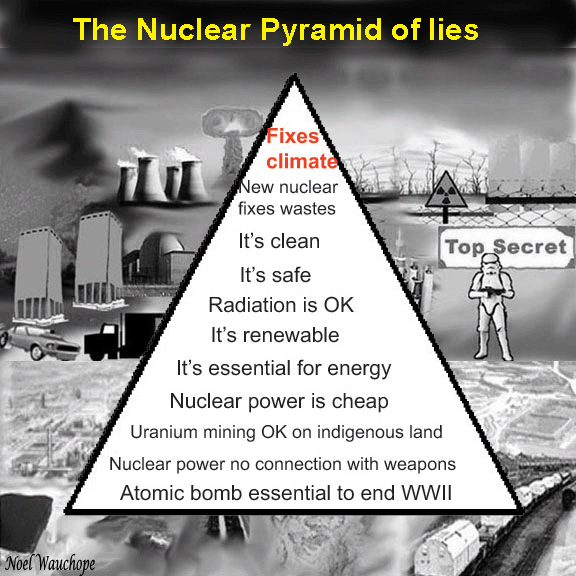
How does the nuclear industry get away with its persistent, repetitive lies?
Radiation Free Lakeland * nuclear landfill/geological dump * NO TA!
Steve Wallis , 25 May 25.
Thoughts on the nuclear industry and how it is “run” and perceived by the people who work in the industry and how it is “sold” to the public. An earlier thread details Trump’s executive orders re “new” nuclear and the lies spouting forth about new this, new safety that, and not like the other nukes nonsense.
There are a few things that are very puzzling when it comes to the nuclear industry, perhaps the main one is why tell lies and why these lies are believed. Before talking about this I am interested in the “new” nuclear and the growing criticism concerning lack/lapse of regulation, mainly to build them quicker, cheaper and more of them. For example the SMR’s in the US will not fall under the current impact surveys for standard nuclear plants, re environmental/public safety.
Trump mentions SMR’s as if they already exist. This is not true, the modular means these reactors are built on a production line and then assembled on site. No factory production line exists at the moment.
Then the question is how does the nuclear industry get away with telling the same lies over and over, which it always does? Maybe this is because of regulatory capture, when a regulatory agency becomes dominated by the industry it is meant to regulate, and therefore does not protect public interest. Sellafield is an example of this over and over.
So why does the public believe Trump and the nuclear industry who are liars? This brings me to The Nietzsche Thesis, in his words we will accept and look for “truth” only when it has “pleasant, life-preserving consequences.” Conversely, we are hostile “to potentially harmful and destructive truths.” So, I will accept what is said if it preserves my view of the world, conversely I present a hostile reaction to harmful truths. Surveys asking Trump supporters how they feel about the lies are unconcerned because the lies fulfil their goals, and do not threaten their status. Likewise, despite loads of nuclear accidents people still believe the industries lies about providing safe, clean and cheap energy.
The nuclear industry always tells the public it is safe, and how it prides itself on providing the safest form of energy. It is as if all the nuclear accidents simply never happened and the public tend to believe this lie rather than the truth.
Extermination as negotiation: Understanding Israel’s strategy in Gaza

Behind the language of planning lies a campaign of sterilization and condensation — a vision of Gaza not as a home, but as a holding site. Leaked reports whisper of forced transfers, of Palestinians being sent to Libya or elsewhere in Africa, sketching futures of removal dressed in the language of pragmatism. In other words, Israel maneuvers, cajoles, agrees, renges, returns to blood, and ultimately remains hesitant in fulfilling even its own plans.
Whether it’s total conquest or managed containment, Israel doesn’t have a single grand strategy for Gaza, but it uses the possibility of both to prolong the war.
Mondoweiss, By Abdaljawad Omar May 23, 2025
In the weeks since the unveiling of “Operation Gideon’s Chariots,” the renewed Israeli offensive to permanently “conquer” all of Gaza, it has become increasingly clear that Israel’s internal decision-making is not oriented toward a singular strategic endgame, but toward a recursive logic of exhaustion.
Israel isn’t choosing between total conquest and technocratic containment via an Arab-brokered ceasefire plan. Instead, it is deploying these options as devices to stretch the war and weaponize its duration rather than end it. Neither is an actual alternative to the other.
This is not a paradox, but a method. “Gideon’s Chariots,” with its objective to concentrate over two million Palestinians in Rafah and “cleanse” the remainder of Gaza, is not merely a plan of conquest. It is a fantasy of sterilization dressed in logistical rationality. Its brutality lies not only in its intentions — military and demographic — but also in its open-endedness, because it will be an occupation without governance or responsibility.
It imagines Gaza as a surgical field: empty of social density and politics, a flattened terrain where the Israeli army may operate unhindered and where civilians are transformed into captives or debris. This is where extermination can proceed behind the veil of humanitarian logistics. But this is the thing: while Israel announces its plan and leaks many of its contours, making sure that the endgame of extermination is out in the open, it also delays its fulfillment.
The rejection of the Egyptian proposal for Gaza’s postwar governance, meanwhile, functions less as a strategic rebuttal and more as a temporal maneuver: it defers the stabilization of Gaza, suspends the possibility of a postwar architecture, and secures Israel’s role as the sole arbiter of movement, aid, reconstruction, and survival. The proposal — which secured the backing of the Arab League — offered a ceasefire, the release of prisoners, and the creation of a Palestinian technocratic administration in Gaza under regional and international auspices. The governing authority would be civilian, non-Hamas, and possibly linked to the Palestinian Authority. Arab security forces, primarily from Egypt and the UAE, would maintain public order. Israel, in theory, would retain the ability to strike if Hamas rearmed, but the core logic was one of pacified governance and externally monitored reconstruction.
But this alternative, while marketed as pragmatic containment, reveals its own structure of control. It does not offer Palestinains liberation or sovereignty. It does not restore Palestinian political life. Instead, it imagines a depoliticized Gaza, administered through foreign technocrats, where governance is reduced to management and resistance is metabolized into security threats.
Yes, it ends the massacres, but it continues the process of unmaking through other means. Yes, it stops ethnic cleansing and genocide, but it only offers a minimum respite. ……………………………………………………………………………………………………………………………………………………………
Behind the language of planning lies a campaign of sterilization and condensation — a vision of Gaza not as a home, but as a holding site. Leaked reports whisper of forced transfers, of Palestinians being sent to Libya or elsewhere in Africa, sketching futures of removal dressed in the language of pragmatism. In other words, Israel maneuvers, cajoles, agrees, renges, returns to blood, and ultimately remains hesitant in fulfilling even its own plans.
………………………………..rather than shift course, Israel doubles down, leaning into ambiguity and attrition, hoping to exhaust global outrage the way it hopes to exhaust Palestinian resistance: through delay, confusion, the normalization of collapse, and of course, through coercion by the weaponization of antisemitism.
In this moment, what Israel seeks is a “stable instability” in which Gaza is rendered uninhabitable yet governed, massacred yet silent, present yet politically nullified. Both plans — the one it executes and the one it rejects — serve this grammar. Whether through total war or managed containment, the objective remains: to erase Palestine as a subject of history, and to replace it with a population that can be controlled, administered, or vanished. Whether this will succeed remains uncertain. But the cracks are visible in the disillusionment of soldiers and in the rage of Israeli prisoners’ families. ……………………………………………………………………………………………………………………………. https://mondoweiss.net/2025/05/extermination-disguised-as-negotiation-understanding-israels-strategy-in-gaza/?fbclid=IwY2xjawKiJnVleHRuA2FlbQIxMQBicmlkETFhMVJScjZYcDE0UEpFRko2AR6Ov_j6MzhAmpAl-ntfqrrz9g7gbweyo2JQZgXmQD20EFcLFNN_7U3rbw1FBA_aem_EoA46q1R_Hz9m5KhsFpSqw
Why the US Won’t Be Able to Help Build Taiwan’s Nuclear Future
Washington itself hasn’t solved the problems that fed into Taiwan’s nuclear phase-out: waste storage and high costs.
By Benjamin Yang and M.V. Ramana, May 26, 2025, https://thediplomat.com/2025/05/why-the-us-wont-be-able-to-help-build-taiwans-nuclear-future/
When the 40-year operating license of Taiwan’s last remaining commercial nuclear reactor expired on May 17, the country realized its nuclear phase-out policy after decades of politicized debates.
If anything, though, the imminent decommissioning of the Maanshan Nuclear Power Plant’s second reactor has only fueled another round of heated discussions on the potential role of nuclear power in Taiwan’s energy future.
On May 13, the Legislative Yuan – Taiwan’s national legislature, where opposition parties currently hold a majority – passed amendments to the Nuclear Reactor Facilities Regulation Act, allowing nuclear power plant operators to apply for a 20-year license renewal beyond the original 40-year cap and easing restrictions on their restarts. In the meantime, it also passed a proposal from the Taiwan People’s Party (TPP) for a referendum on restarting the Maanshan plant, which is now set to take place in August.
Such renewed interest in nuclear energy is a result of a few compounding factors: power shortage concerns amid grid-induced blackouts over the past few years and growing power demands from the semiconductor and AI industries; rising electricity prices that pro-nuclear groups have framed as a result of phasing out nuclear; stalled momentum in renewable energy development; and national security threats of a naval blockade from China.
At the same time, there are several reasons why nuclear power may not really address these questions, most notably the high costs and long construction times of building nuclear plants. Meanwhile, proponents of the nuclear phase-out point to the risks of accidents associated with nuclear reactors and the lack of a demonstrated solution to managing radioactive wastes of different kinds produced by the nuclear fuel chain.
Amid this domestic debate in Taiwan over nuclear power, Director Raymond Greene of the American Institute in Taiwan, the de facto U.S. embassy, added a new twist. In a recent interview, he announced that the United States stands ready to introduce “existing and new technologies such as SMRs (small modular reactors) and to help Taiwan address its nuclear waste storage challenges.” Can U.S. support on SMRs and nuclear waste storage help with the challenges that led Taiwan to phase out nuclear power?
The problem with nuclear waste is two-fold: a shortage of short-term storage capacity at some sites, and the complete absence of a long-term option. Currently, Taiwan has over 21,500 spent fuel rods from almost five decades of operation; all but 112 of these are stored on-site, either in their respective reactor cores or spent fuel pools. Only a portion from the Chinshan Nuclear Power Plant has been moved to a dry storage facility. In July 2021, Taiwan Power Company, the state-owned utility that owns and operates all of Taiwan’s nuclear power plants, had to take unit 1 of the Kuosheng Nuclear Power Plant offline five months before the expiry of its operating license due to the lack of used fuel storage capacity. These are just the problems with short-term storage. In the long term, there is just no plan: the government has yet to create regulations governing the disposal of high-level waste.
With local government concerns over wastewater runoff pollution hampering progress on constructing dry storage facilities and a final disposal repository nowhere in sight, creating more nuclear waste through extensions, restarts, or even building new SMRs will only aggravate this unsolved issue.
The United States has no long-term plan for its nuclear waste, either. Yucca Mountain, the site selected back in 1987 under the 1982 Nuclear Waste Policy Act, proved to be technically problematic, because it had an oxidizing environment and, despite being advertised as a very dry site, proved to allow seepage of lots of water. No alternative site has been seriously considered since Yucca Mountain was picked, although high level committees like the Blue Ribbon Commission set up by President Barack Obama have recommended setting up a process to find a new site. In short, the United States has no successful experience to point to if it intends to help Taiwan with its nuclear waste.
The story is similar with SMRs, the other part of the offer from Greene. Despite much media attention and hype, the United States has so far not constructed a single small modular reactor. In terms of planning, the most advanced SMR project was proposed by the Utah Associated Municipal Power System. Announced in 2015, the UAMPS project was initially expected to start operations “around 2023” at an “overnight cost” of $3 billion. The estimated costs of the project subsequently rose to $6.1 billion, and finally $9.3 billion in 2023. That last figure was for a mere 462 megawatts of electricity capacity. Later that year, the project was canceled because of a lack of demand.
When viewed in terms of the cost per unit of power capacity (i.e., dollars per megawatt), the cost of the UAMPS project was higher than even the most expensive nuclear power plant built in the United States, the Vogle project in Georgia, which cost $36.8 billion. This is to be expected. Small modular nuclear reactors, which produce less than 300 megawatts of power as compared to the roughly 1,000 megawatts for the typical reactors that have been constructed in recent decades, are more expensive per unit of power capacity due to diseconomies of scale.
The underlying reason is that the cost of constructing or operating a nuclear reactor is not directly proportional to the amount of power it is designed to generate. SMRs, therefore, start off with an economic disadvantage and will further undermine the financial viability of nuclear plants.
In the United States, nuclear plants are the most expensive way to supply electricity and building SMRs will make nuclear power even less competitive, especially in comparison to solar and wind energy, with or without electricity storage. No wonder renewables constitute the vast majority of new electricity installations in the United States. Also growing rapidly are energy storage technology, geothermal technologies, and grid resilience innovations such as virtual power plants. If the U.S. is serious about addressing Taiwan’s energy situation, maybe these are the technologies it should be offering.
In the end, the decommissioning of Taiwan’s final nuclear reactor marks a critical crossroads in its energy transition. Every choice Taiwan makes at this juncture would need to tackle the multitude of challenges that come with balancing rising demands, economic development, national security, climate action, and public safety. With the storage solutions for existing nuclear waste yet to appear and the costliness of constructing SMRs both in terms of time and capital, nuclear is unable to serve as a safe, cost-effective, and timely climate solution – even with U.S. support.
Israeli Military Says It Will Occupy 75% of Gaza Within Two Months, ‘Concentrate’ the Civilian Population
The IDF’s plan is to force civilians into three small areas in Gaza
by Dave DeCamp May 25, 2025 , https://news.antiwar.com/2025/05/25/israeli-military-says-it-will-occupy-75-of-gaza-within-two-months-concentrate-the-civilian-population/
The Israeli military expects that it will occupy 75% of Gaza’s territory within two months and plans to “concentrate” the entire civilian population into three small areas in the Strip.
According to Israeli media, Palestinian civilians will be confined to the center of Gaza City, a strip of land in central Gaza’s Deir el-Balah and Nuseirat, and an area in al-Mawasi on the coast in southern Gaza.
The IDF said the purpose of the offensive is to destroy Hamas infrastructure, although previous reports have said the plan is to destroy every remaining building in Gaza.
Israeli Prime Minister Benjamin Netanyahu has already made clear that Israel’s goal was the full military occupation of Gaza and the ethnic cleansing of the territory, which he calls the “Trump plan,” although it’s unclear where the Palestinian population could go.
The IDF announcement about its offensive comes as a new US and Israeli-backed aid scheme is expected to be launched in Gaza, but there are conflicting reports about when it will actually start. According to Haaretz, the aid distribution, which will involve private American security contractors, will start Monday, although other Israeli media reports say it has been postponed.
The aid scheme has been rejected by the UN and other aid agencies that operate in Gaza, and it has been condemned as a transparent effort to forcibly displace starving Palestinian civilians into concentration camps. Amid the criticism, Jake Wood, the CEO of the Gaza Humanitarian Foundation (GHF), which was created for the US-Israeli aid plan, announced his resignation.
“The aid program cannot be implemented while adhering to humanitarian principles of humanity, neutrality, fairness, and independence – principles I will not abandon,” Wood said. He called on Israel to “significantly expand aid delivery to Gaza through all possible means.”
-
Archives
- October 2026 (104)
- September 2026 (339)
- August 2026 (330)
- July 2026 (355)
- June 2026 (287)
- May 2026 (306)
- April 2026 (356)
- March 2026 (251)
- February 2026 (267)
- January 2026 (308)
- December 2025 (358)
- November 2025 (359)
-
Categories
- 1
- 1 NUCLEAR ISSUES
- business and costs
- climate change
- culture and arts
- ENERGY
- environment
- health
- history
- indigenous issues
- Legal
- marketing of nuclear
- media
- opposition to nuclear
- PERSONAL STORIES
- politics
- politics international
- Religion and ethics
- safety
- secrets,lies and civil liberties
- spinbuster
- technology
- Uranium
- wastes
- weapons and war
- Women
- 2 WORLD
- ACTION
- AFRICA
- Atrocities
- AUSTRALIA
- Christina's notes
- Christina's themes
- culture and arts
- Events
- Fuk 2022
- Fuk 2023
- Fukushima 2017
- Fukushima 2018
- fukushima 2019
- Fukushima 2020
- Fukushima 2021
- general
- global warming
- Humour (God we need it)
- Nuclear
- RARE EARTHS
- Reference
- resources – print
- Resources -audiovicual
- Weekly Newsletter
- World
- World Nuclear
- YouTube
-
RSS
Entries RSS
Comments RSS

