Inside the Dirty, Dystopian World of AI Data Centers
The race to power AI is already remaking the physical world
The Atlanic By Matteo Wong, Photographs by Landon Speers, April 2026
s we drove through southwest Memphis, KeShaun Pearson told me to keep my window down—our destination was best tasted, not viewed. Along the way, we passed an abandoned coal plant to our right, then an active power plant to our left, equipped with enormous natural-gas turbines. Pearson, who directs the nonprofit Memphis Community Against Pollution, was bringing me to his hometown’s latest industrial megaproject.
Already, the air smelled of soot, gasoline, and asphalt. Then I felt a tickle sliding up my nostrils and down into my throat, like I was getting a cold.
This is Colossus: a data center that Musk’s artificial-intelligence company, xAI, is using as a training ground for Grok, one of the world’s most advanced generative-AI models. Training these models takes a staggering amount of energy; if run at full strength for a year, Colossus would use as much electricity as 200,000 American homes. When fully operational, Musk has written on X, this facility and two other xAI data centers nearby will require nearly two gigawatts of power. Annually, those facilities could consume roughly twice as much electricity as the city of Seattle.
To get Colossus up and running fast, xAI built its own power plant, setting up as many as 35 natural-gas turbines—railcar-size engines that can be major sources of smog—according to imagery obtained by the Southern Environmental Law Center. Pearson coughed as we drove by the facility. The scratch in my throat worsened, and I rolled up my window. As we approached, I heard the rumble of cranes and trucks, and then from behind a patch of trees emerged a forest of electrical towers. Finally, I saw it—a white-walled hangar, bigger than a dozen football fields, where Elon Musk intends to build a god.
To get Colossus up and running fast, xAI built its own power plant, setting up as many as 35 natural-gas turbines—railcar-size engines that can be major sources of smog—according to imagery obtained by the Southern Environmental Law Center. Pearson coughed as we drove by the facility. The scratch in my throat worsened, and I rolled up my window.
xAI’s rivals are all building similarly large data centers to develop their most powerful generative-AI models; a metropolis’s worth of electricity will surge through facilities that occupy a few city blocks. These companies have primarily made their chatbots “smarter” not by writing niftier code but by making them bigger: ramming more data through more powerful computer chips that use more electricity. OpenAI has announced plans for facilities requiring more than 30 gigawatts of power in total—more than the largest recorded demand for all of New England. Since ChatGPT’s launch, in November 2022, the capital expenditures of Amazon, Microsoft, Meta, and Google have exceeded $600 billion, and much of that spending has gone toward data centers—more, even after adjusting for inflation, than the government spent to build the entire interstate-highway system. “These are the largest single points of consumption of electricity in history,” Jesse Jenkins, a climate modeler at Princeton, told me……………………………………………………………………….(Subscribers only) https://www.theatlantic.com/magazine/2026/04/ai-data-centers-energy-demands/686064/
Trump’s $200 billion Iran spending request reveals scale of US war plans.
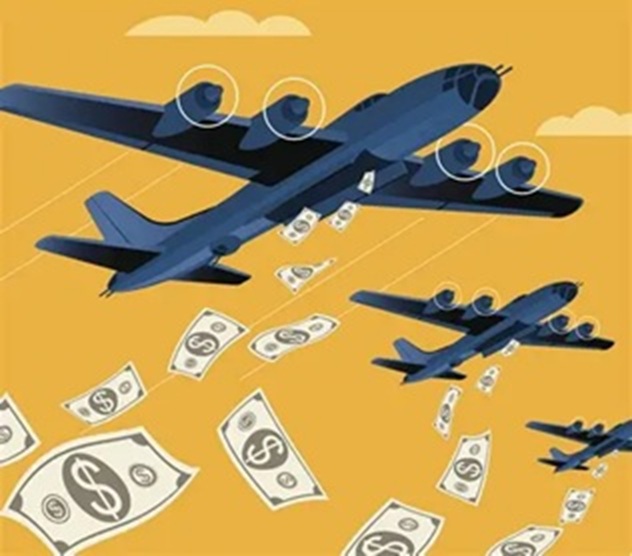
In reality, the administration is planning the most endless of all endless wars—an open-ended invasion aimed at subjugating or destroying a country of 90 million people.
The $200 billion is a supplemental—on top of the $839 billion defense bill Congress already passed for fiscal year 2026, the largest military budget in American history. If approved, direct military spending this year will exceed $1 trillion. US President Donald Trump has called for a $1.5 trillion military budget for fiscal year 2027—a 50 percent increase.
Andre Damon, 19 March 2026, https://www.wsws.org/en/articles/2026/03/20/iuck-m20.html
The Washington Post reported Wednesday that the Trump administration is seeking more than $200 billion to fund the war against Iran.
At a press briefing Thursday, a reporter asked Defense Secretary Pete Hegseth “why a package this large is necessary?” Hegseth not only confirmed the $200 billion figure but suggested it could grow. “I think that number could move,” he said. “It takes money to kill bad guys. So we’re going back to Congress to ensure that we’re properly funded for what’s been done, for what we may have to do in the future.”
And what, exactly, are these unspecified things the administration “may have to do”?
In 2003, when 150,000 American soldiers invaded and occupied Iraq, Congress appropriated $51 billion—a quarter of what the Trump administration is requesting before a single ground soldier has entered Iran. At the height of the 2007-2008 surge, when nearly 170,000 American soldiers occupied the country, the war cost roughly $144 billion a year.
In reality, the $200 billion is not about “what we may have to do in the future” but about what the White House is actively conspiring to do in the present. The budget request comes as the administration prepares a ground invasion of Iran, deploying 5,000 Marines from the Pacific to the Middle East amid demands by the Wall Street Journal and leading Republicans for the seizure of Kharg Island and the Strait of Hormuz.
Reuters reported Wednesday that the Trump administration has discussed sending ground forces to seize Kharg Island, the hub for 90 percent of Iran’s oil exports, and has separately discussed deploying US forces to secure Iran’s stocks of highly enriched uranium. They are operational plans for the invasion and occupation of Iranian territory—and they explain why the administration is demanding more money than was appropriated for any single year of the Iraq invasion.
Just as with the months and years of planning that preceded the US-Israeli attack on Iran, the ground invasion is being prepared behind the backs of the American people, who overwhelmingly oppose the war. Trump called the war an “excursion.” Vice President JD Vance promised it would not become a “quagmire.” At the same briefing where he confirmed the $200 billion request, Hegseth told reporters: “The media wants you to think, just 19 days into this conflict, that we’re somehow spinning toward an endless abyss or a Forever War or a quagmire. Nothing could be further from the truth.”
In reality, the administration is planning the most endless of all endless wars—an open-ended invasion aimed at subjugating or destroying a country of 90 million people.
The administration sees the Iran war as a prelude to an effort to subjugate China, the world’s largest economy by purchasing power parity. As former Republican Congressman Patrick McHenry put it on ABC’s This Week, the wars in Venezuela and Iran are “targets of opportunity to reshape the world.” He added: “Venezuela was in service to American energy dominance. The issue with Iran was a target of opportunity… The results here will mean that, with China, the president’s hand will be enhanced.”
The $200 billion is a supplemental—on top of the $839 billion defense bill Congress already passed for fiscal year 2026, the largest military budget in American history. If approved, direct military spending this year will exceed $1 trillion. US President Donald Trump has called for a $1.5 trillion military budget for fiscal year 2027—a 50 percent increase.
And $200 billion is only what the administration will admit to. In 2002, Bush’s chief economic adviser Lawrence Lindsey was fired for estimating the Iraq war would cost $100 to $200 billion. Defense Secretary Donald Rumsfeld put the figure at “something under $50 billion.” When told outside estimates ran to $300 billion, Rumsfeld replied: “Baloney.” Deputy Defense Secretary Paul Wolfowitz assured Congress that Iraqi oil revenues would pay for reconstruction. The actual cost, including veterans’ care, disability payments and interest on the debt, is now estimated by Brown University’s Costs of War Project at more than $8 trillion.
The waging of continuous wars, combined with the 2008 and 2020 bank bailouts, has produced an explosion of US debt. In 2000, before the Iraq war, the national debt stood at $5.7 trillion. By 2010, after the Iraq surge and the $700 billion TARP bank bailout, it had reached $12.3 trillion. By 2020, after $4.6 trillion in COVID bailouts, it hit $27 trillion. It now stands at $39 trillion—nearly seven times what it was a quarter century ago.
The United States credit rating has been downgraded three times—by Standard & Poor’s in 2011, Fitch in 2023 and Moody’s in 2025—each time because of military spending and the refusal of either party to cut the military budget. The Vietnam War destroyed Lyndon Johnson’s Great Society programs and produced the inflation of the 1970s, which the ruling class broke through the Volcker shock—mass unemployment to crush wages. The Iraq and Afghanistan wars were waged alongside tax cuts for the wealthy and the gutting of public services.
Trump’s “One Big Beautiful Bill,” signed last July, imposed $1 trillion in cuts to Medicaid over the next decade, $536 billion in cuts to Medicare and $186 billion in cuts to food assistance through the Supplemental Nutrition Assistance Program (SNAP)—the largest cut to food aid in American history. The fiscal year 2026 budget slashed domestic spending by 22.6 percent—cutting the Department of Housing and Urban Development (HUD) by 44 percent, the Centers for Disease Control and Prevention (CDC) by 44 percent and the National Institutes of Health (NIH) by $18 billion—while increasing the military budget by 13 percent.
Within 24 hours of the administration confirming it is seeking $200 billion for the war, the Postmaster General testified to Congress that the United States Postal Service (USPS) could run out of cash as soon as October—with just $8.2 billion in reserves, enough to cover 33 days of operations. The USPS employs more than 500,000 workers and holds billions in pension and retirement obligations. The manufactured insolvency is a pretext for raiding those funds—taking workers’ pension money and spending it on the war.
Medicare, Medicaid and Social Security represent trillions more. The ruling class sees these programs as money to be seized. The administration does not see pensions and healthcare as social programs. It sees them as collateral.
Trump has promised the economic pain will be a temporary “blip.” This will not pass in weeks. It will mean a permanent reduction in working-class living standards, just as the Iraq war did.
The struggle to defend Medicare, Medicaid, Social Security, pensions and public services cannot be separated from the struggle against war. They are the same struggle. The $200 billion the administration demands is money taken from the programs working people depend on to survive.
The Democrats have systematically enabled Trump’s wars. In January, as Trump declared that a massive armada was steaming toward Iran, every leading Democrat in Congress voted for the $839 billion military budget—Minority Leader Hakeem Jeffries, Minority Whip Katherine Clark, Senate Minority Leader Chuck Schumer and Minority Whip Dick Durbin all voted in favor. Their criticism of the war has centered on procedural issues, along with demands that US imperialism direct its fire at Russia and China.
Opposition must come from below—from workers in the United States, in Iran, across the Middle East and around the world—organized independently of both capitalist parties, armed with a socialist and internationalist program, and fighting to build the International Committee of the Fourth International (ICFI) as the revolutionary leadership of the working class. The fight against imperialist war is the fight against the capitalist system that produces it.
UK’s Astute nuclear submarine timeline is very unlikely to be met.

Brief Update on the SSN Programme
17.03.2026, https://www.nuclearinfo.org/article/brief-update-on-the-ssn-programme/
The Astute project has the objective of delivering conventionally armed, nuclear-powered submarines for the Royal Navy, otherwise acronymised as SSNs. Seven submarines are planned to be delivered, with five currently operational: HMS Astute, HMS Ambush, HMS Artful, HMS Audacious, and HMS Anson. During February, HMS Anson arrived in Australia at HMAS Stirling. This visit was intended to be for maintenance and a symbolic demonstration of the trilateral AUKUS partnership between the UK, US, and Australia, which aims to develop nuclear-powered submarines with advanced conventional capabilities. AUKUS submarines are planned to succeed the Astute class. The sixth Astute-class submarine, HMS Agamemnon, was commissioned into the Royal Navy and completed its first dive last year, while HMS Achilles is currently under construction. The seven Astute submarines were once hoped to be delivered by the end of this year, but this timeline is very unlikely to be met.
This reflects the persistent challenges that have long bedevilled submarine construction in the UK, including delays, technical issues, accidents, and rising costs. HMS Anson itself for instance was delayed (among other factors) due to setbacks with HMS Audacious, while the 2024 fire in Barrow, the main shipyard for manufacturing the UK’s nuclear submarines, will further delay progress on the final Astute submarine. Also, AUKUS may generate geopolitical tensions among its partners. A US Congressional report earlier from this year has raised the possibility of withholding submarines from Australia due to concerns that the sale may divert US submarine capacity from a potential conflict with China. Meanwhile, some analysts question the strategic trade-offs of deploying HMS Anson to the Indo-Pacific, given the UK’s defence commitments in Europe and the Atlantic. These issues point to dual risks facing the SSN programme: first, achieving successful and timely delivery, and second, achieving agreement among allies over its strategic objectives and operational use.
Next-gen nuclear has a chicken-and-egg problem
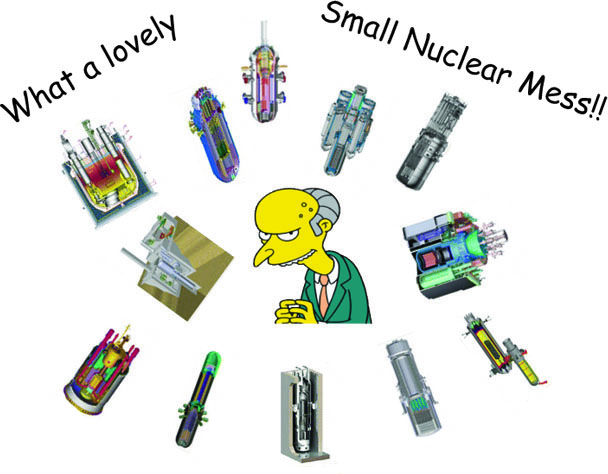
A new report suggests that advanced reactor companies face a difficult path to success — and that the U.S. would be better off narrowing in on fewer designs.
By Alexander C. Kaufman, 20 March 2026, https://www.canarymedia.com/articles/nuclear/scaling-construction-supply-chain-challenges
Nuclear energy developers have historically operated by a simple principle: Go big.
Reactors cost a lot of money to build, so the logic has been that it’s easier to recoup that investment if the project produces more electricity. Of late, a new generation of companies has made waves by bucking that conventional wisdom and instead aiming to build smaller reactors that can be made cheaper through bulk orders and mass production.
But with few advanced reactors built to date, that argument remains theoretical — and a new report shared exclusively with Canary Media suggests the path to proving it out is harder than many in the industry acknowledge.
It’s a chicken-and-egg situation. Next-gen nuclear startups must establish supplies of rare and legally sensitive types of fuel while also competing for a small pool of skilled workers and a limited output of valves, pumps, heat exchangers, and other equipment. Manufacturers are hesitant to ramp up production without a clear signal that advanced reactors will pan out. Investors, in turn, are leery of reactors meant for mass production that rely on unprepared supply chains.
That’s the core takeaway from the new analysis by the Nuclear Scaling Initiative, a campaign by the nonprofits Clean Air Task Force, the EFI Foundation, and the Nuclear Threat Initiative. The Nuclear Scaling Initiative launched in 2024 and aims to promote fleet-scale construction of reactors in a bid to start bringing at least 50 gigawatts of atomic power capacity online worldwide every year at some point in the 2030s.
The study, conducted by the nuclear consultancy Solestiss, highlights two paths it says are promising for the industry: either sticking to proven designs or simplifying supply chains to tap into the traditional nuclear business’ existing materials and know-how.
It comes as the Trump administration pumps billions of dollars into advanced reactors while also courting developers of more conventional large-scale reactors — and amid a high-stakes debate over which approach is best.
Earlier this month, the Bill Gates-backed TerraPower won the Nuclear Regulatory Commission’s approval to begin construction on the country’s first commercial plant with sodium-cooled fast reactors in Wyoming. In December, the decommissioner-turned-developer Holtec International won a $400 million Department of Energy grant to build its first 300-megawatt small modular reactors in Michigan, using a pressurized-water-cooled design. The DOE awarded another $400 million grant to help American-Japanese joint venture GE Vernova Hitachi Nuclear Energy build its first 300-megawatt SMR in Tennessee, based on a traditional boiling water design.
The Trump administration, meanwhile, is trying to get developers to commit to building more AP1000s — the flagship large-scale reactor from Westinghouse Electric Co. The only two nuclear reactors designed and constructed in the U.S. this century used the Westinghouse design. (A third came online in 2016 but first started construction in 1973.)
The variety of designs racing to become the nation’s fourth new reactor in decades calls into question the feasibility of rapidly scaling up production of any one model.
“We can do any one of these first projects all at once. But can we sustain a build-out of TerraPower, GE, Westinghouse, and Holtec? All the ones that are just moving forward right now? The answer to that is not yet,” said Dillon Allen, president of the advisory services division at Solestiss, who started his career working on nuclear propulsion in the U.S. Navy before moving into the utility business. “Once you’re building four to eight AP1000s and a handful of SMRs of other sizes, you start to run into smaller component bottlenecks.”
Those bottlenecks would worsen if microreactor companies succeed in their objective of securing dozens and dozens of orders for their designs.
“While small reactors have been tried before, mass-manufactured small reactors have not,” Aalo Atomics CEO Matt Loszak, whose 10-megawatt reactors also use liquid sodium as a coolant, wrote in a post on X this week. “Small is more expensive than large, if you only make one reactor. But if you make 1000s per year, small could be cheaper than large. This is what Aalo is setting out to prove.”
One major obstacle to this plan is transportation. To build something and send it without prior testing is no problem, since a reactor that hasn’t been fired up and irradiated “is just a big hunk of metal,” Allen said. But once it’s irradiated, it’s subject to different considerations.
National laboratory researchers have started to discuss a framework for a U.S.-wide transportation network with established logistics and safety standards, the report notes, but no such rules have yet materialized.
The biggest barrier for next-gen nuclear, however, is likely to be the fuel supply. Some small reactor companies have been proactive here. Aalo, for example, has opted for the most commonly used reactor fuel on the planet, low-enriched uranium, so it can tap into the existing global supply chain.
But most advanced nuclear startups are banking on what’s known as fourth-generation reactors. These designs rely on coolants other than water and mostly aim to use one of two types of fuel: high-assay low-enriched uranium, commonly known as HALEU (pronounced HAY–loo), or tristructural isotropic fuel, for which HALEU is typically an input. Tristructural isotropic fuel is also known as TRISO.
HALEU, which firms like TerraPower and microreactor developer Oklo plan to use, is only really produced at a commercial scale by Russian and Chinese state-owned companies. Efforts to bring new centrifuges online in America are slow-going. Meanwhile, the TRISO fuel that startups such as Valar Atomics or Radiant need requires not only securing HALEU but also separating that enriched uranium into ceramic-coated pellets the size of poppy seeds. Manufacturers admit that TRISO may never cost less than low-enriched uranium.
The complications don’t stop there. Because HALEU is up to four times more enriched than traditional reactor fuel, it comes with stricter regulations. On the Nuclear Regulatory Commission’s security-clearance scale of category one, which allows for handling normal reactor fuel, to three, which includes military-grade enrichment levels, facilities with HALEU need to be rated at a category two. No such facilities exist in the U.S. today, though the commission just issued its debut permit for one last month.
As for traditional fuel, the existing supply of low-enriched uranium falls short of what would be required to meet the U.S. goal of quadrupling the nation’s nuclear capacity to 400 gigawatts by 2050.
“The supply chain is pretty well suited to support a fleet of 100 operating reactors,” Allen said, referring to the 94 commercial reactors in service in the U.S. “But then you can have 150, then 180, and pretty soon 200 after that. If you double that demand on the LEU supply, it’s not just the enrichment” that’s a limiting factor.
It’s also, he said, the production of raw uranium and the facilities to carry out conversion, where purified uranium ore is turned into a gas, and deconversion, where it’s solidified once again.
Expanding these upstream operations may be challenging, but it isn’t impossible. In fact, Allen said he came away from writing the report with the impression that supply chains are more capable of scaling up than he previously thought. But his team’s work demonstrates the steep obstacles faced by the entire industry — not only advanced reactor firms — as it attempts to bolt into action following decades of anemic construction in America.
The biggest impression the research left on Allen, he said, is that the AP1000 has a good shot at becoming the next reactor built in the U.S. Its costs are more predictable — and thus easier to finance — thanks to the lessons learned during construction of the two units that came online at Southern Co.’s Alvin W. Vogtle Electric Generating Plant in central Georgia in 2023 and 2024.
“I’m more bullish on the AP1000 than I was when I started this effort,” he said. “I’m broadly bullish on the supply chain.”
The DOE is considering alternatives to the AP1000 to satisfy President Donald Trump’s order to facilitate construction on at least 10 large-scale reactors by the end of the decade. In response to the news that the administration held talks with its rivals, Westinghouse said the AP1000 is“the only construction-ready, gigawatt-scale, advanced modular reactor that is fully licensed and operating in the U.S.”
The U.S. ultimately should focus on designs it can scale up rather than spreading its efforts in many different directions, said Stephen Comello, the executive director of the Nuclear Scaling Initiative. At that point, nuclear power will become cheap enough to be “boring.”
“Once you start accumulating that knowledge from repetition, nuclear construction becomes boring — just like natural gas combined-cycle plants, just like all other complex megaprojects and energy infrastructure that’s out there,” he said.
There’s little doubt that the AP1000 has a well-established supply chain and data showing it runs well, he said.
The question is, “Can you do it in a repeatable, cost-effective way? That’s where the risk lies with the AP1000,” Comello said. “It runs, the technology is great. But we have to prove to investors that we can overcome the execution risk. But here’s the thing: All reactors share execution risk to some extent. Others have a technology risk because they are still not proven at scale.”
Nuclear Deregulation – DOGE Goes Nuclear: How Trump Invited Silicon Valley Into America’s Nuclear Power Regulator

ProPublica, by Avi Asher-Schapiro, March 20, 2026
Reporting Highlights
- Fast Nuclear Buildout: The Trump administration is rapidly rewriting rules to support the development of nuclear power plants.
- Aligning With Industry: Staffers from DOGE are revamping rules in ways to ease regulations and provide financial breaks for industry.
- “No Longer Independent”: Nuclear Regulatory Commission veterans say the administration is limiting oversight in dangerous ways.
Last summer, a group of officials from the Department of Energy gathered at the Idaho National Laboratory, a sprawling 890-square-mile complex in the eastern desert of Idaho where the U.S. government built its first rudimentary nuclear power plant in 1951 and continues to test cutting-edge technology.
On the agenda that day: the future of nuclear energy in the Trump era. The meeting was convened by 31-year-old lawyer Seth Cohen. Just five years out of law school, Cohen brought no significant experience in nuclear law or policy; he had just entered government through Elon Musk’s Department of Government Efficiency team.
As Cohen led the group through a technical conversation about licensing nuclear reactor designs, he repeatedly downplayed health and safety concerns. When staff brought up the topic of radiation exposure from nuclear test sites, Cohen broke in.
“They are testing in Utah. … I don’t know, like 70 people live there,” he said.
“But … there’s lots of babies,” one staffer pushed back. Babies, pregnant women and other vulnerable groups are thought to be potentially more susceptible to cancers brought on by low-level radiation exposure, and they are usually afforded greater protections.
“They’ve been downwind before,” another staffer joked.
“This is why we don’t use AI transcription in meetings,” another added.
ProPublica reviewed records of that meeting, providing a rare look at a dramatic shift underway in one of the most sensitive domains of public policy. The Trump administration is upending the way nuclear energy is regulated, driven by a desire to dramatically increase the amount of energy available to power artificial intelligence.
Career experts have been forced out and thousands of pages of regulations are being rewritten at a sprint. A new generation of nuclear energy companies — flush with Silicon Valley cash and boasting strong political connections — wield increasing influence over policy. Figures like Cohen are forcing a “move fast and break things” Silicon Valley ethos on one of the country’s most important regulators.
The Trump administration has been particularly aggressive in its attacks on the Nuclear Regulatory Commission, the bipartisan independent regulator that approves commercial nuclear power plants and monitors their safety. The agency is not a household name. But it’s considered the international gold standard, often influencing safety rules around the world.
The NRC has critics, especially in Silicon Valley, where the often-cautious commission is portrayed as an impediment to innovation. In an early salvo, President Donald Trump fired NRC Commissioner Christopher Hanson last June after Hanson spoke out about the importance of agency independence. It was the first time an NRC commissioner had been fired.
During that Idaho meeting, Cohen shot down any notion of NRC independence in the new era.
“Assume the NRC is going to do whatever we tell the NRC to do,” he said, records reviewed by ProPublica show. In November, Cohen was made chief counsel for nuclear policy at the Department of Energy, where he oversees a broad nuclear portfolio.
The aggressive moves have sent shock waves through the nuclear energy world. Many longtime promoters of the industry say they worry recklessness from the Trump administration could discredit responsible nuclear energy initiatives.
“The regulator is no longer an independent regulator — we do not know whose interests it is serving,” warned Allison Macfarlane, who served as NRC chair during the Obama administration. “The safety culture is under threat.”
A ProPublica analysis of staffing data from the NRC and the Office of Personnel Management shows a rush to the exits: Over 400 people have left the agency since Trump took office. The losses are particularly pronounced in the teams that handle reactor and nuclear materials safety and among veteran staffers with 10 or more years of experience. Meanwhile, hiring of new staff has proceeded at a snail’s pace, with nearly 60 new arrivals in the first year of the Trump administration compared with nearly 350 in the last year of the Biden administration…………………………………………………………………………………………………………………………………………………………………………………………………………………………………………………
Meanwhile, some staff members, other career officials say, are afraid to voice dissenting views for fear of being fired. “It feels like being a lobster in a slowly boiling pot,” one NRC official who has been working on the rule changes told ProPublica, describing the erosion of independence.
………………………………………………………………………………………………………………….. “Nuke Bros” in Silicon Valley
One Trump administration priority has been making it easier for so-called advanced reactor companies to navigate the regulatory process. These firms, mostly backed by Silicon Valley tech and venture money, are often working on designs for much smaller reactors that they hope to mass produce in factories.
“There are two nuclear industries,” said Macfarlane, the former NRC chair. “There are the actual people who use nuclear reactors to produce power and put it on the grid … and then there are the ‘nuke bros’” in Silicon Valley.
………………………………………………………………………………………………………… https://www.propublica.org/article/trump-nuclear-power-nrc-safety-doge-vought
No Good Exit

21 March 2026 David Tyler, Australian Independent Media
John Mearsheimer sees war with Iran as a strategic folly, arguing it is unwinnable, will not destroy Iran’s nuclear knowledge, and could, instead, boost Iran’s interest in acquiring nuclear weapons.
No stranger to irony, or paradox, Dr Mearsheimer does not mince words. The West Point graduate and former Air Force Captain, now a distinguished scholar at Cornell, has spent two decades documenting exactly how an American Eagle could get sucked into the vortex of wars that serve its bovver-boy, or Middle-East proxy, Israel, and its bellicose aspirations at enormous cost.
When Mearsheimer speaks about a US military adventure in Iran, he is not waffling. He is quoting from the autopsy he wrote in advance. And Mearsheimer’s verdict on Operation Epic Fury, is that Trump has dug himself into a deep hole; an opinion all the more damning for its formal, almost courteous understatement:
“I think President Trump has put himself in a situation where he really doesn’t have a good exit strategy.”
Trump’s catastrophe may be complex and irretrievable, but it was not inevitable. It was predicted, in detail, by experts whose job it was to predict it, and who were systematically ignored, discredited or sacked for saying so. Trump ignored the experts. This is how he can always snatch defeat from the jaws of victory.
The pretext for the attack doesn’t bear scrutiny. Before the first double-tap Tomahawk missile crushed and burned alive 168 schoolchildren on 28 February, Oman’s Foreign Minister Badr Al-Busaidi was announcing what could have been a diplomatic coup: Iran had agreed to never stockpile enriched uranium, had accepted full IAEA verification, and was prepared to irreversibly downgrade its enriched uranium to the lowest level possible.
Peace, he said, was “within reach.” Further talks were due to resume on 2 March.
Iran now says that the US President never intended to avoid war and that the talks were a ruse to get more time to set up a military attack. It’s true. It’s also true that Trump and Netanyahu are driven by the need to stay out of court. Both are hell-bent in quest of a more enduring diversion-and both would have always pulled the trigger anyway. Even without Saudi encouragement……………………………………………………………………………………………………………………………………….
Iran now says that the US President never intended to avoid war and that the talks were a ruse to get more time to set up a military attack. It’s true. It’s also true that Trump and Netanyahu are driven by the need to stay out of court. Both are hell-bent in quest of a more enduring diversion-and both would have always pulled the trigger anyway. Even without Saudi encouragement.
……………………………………….. Many missile strikes in the war’s opening phase are seen by UN human rights experts as potential war crimes under the Rome Statute. At least a million Lebanese people have been displaced.
https://googleads.g.doubleclick.net/pagead/ads?gdpr=0&client=ca-pub-3072351457465524&output=html&h=280&adk=2235633406&adf=387799125&w=678&fwrn=4&fwrnh=100&lmt=1774125889&rafmt=1&armr=3&sem=mc&pwprc=5956714339&ad_type=text_image&format=678×280&url=https%3A%2F%2Ftheaimn.net%2Fno-good-exit%2F&host=ca-host-pub-2644536267352236&fwr=0&pra=3&rh=170&rw=678&rpe=1&resp_fmts=3&fa=27&uach=WyJXaW5kb3dzIiwiMTkuMC4wIiwieDg2IiwiIiwiMTQ2LjAuNzY4MC44MCIsbnVsbCwwLG51bGwsIjY0IixbWyJDaHJvbWl1bSIsIjE0Ni4wLjc2ODAuODAiXSxbIk5vdC1BLkJyYW5kIiwiMjQuMC4wLjAiXSxbIkdvb2dsZSBDaHJvbWUiLCIxNDYuMC43NjgwLjgwIl1dLDBd&abgtt=7&dt=1774125788538&bpp=1&bdt=3727&idt=0&shv=r20260318&mjsv=m202603170101&ptt=9&saldr=aa&abxe=1&cookie=ID%3Dd85616c6c9bd2a6c%3AT%3D1770448449%3ART%3D1774125788%3AS%3DALNI_MbtaAxRxG9MqgIcWMShV7avYd9mzg&gpic=UID%3D000011f58c2d07ec%3AT%3D1770448449%3ART%3D1774125788%3AS%3DALNI_MasvLU7CXh2jEp0EwTeqK932dwU3A&eo_id_str=ID%3D1b13a2c219278375%3AT%3D1770448449%3ART%3D1774125788%3AS%3DAA-AfjYkqjLrM9kIjGmfRgvZ6J5n&prev_fmts=0x0%2C678x280%2C678x280%2C1265x585%2C1265x122%2C678x280%2C678x280%2C678x280%2C678x280&nras=10&correlator=6552144162929&frm=20&pv=1&u_tz=660&u_his=2&u_h=720&u_w=1280&u_ah=672&u_aw=1280&u_cd=32&u_sd=1.5&dmc=8&adx=117&ady=5250&biw=1265&bih=585&scr_x=0&scr_y=2914&eid=95378429%2C95384535%2C42533294%2C95383746%2C95386039%2C95379823&oid=2&psts=AOrYGslFnD4MCobWfWWaTnZO58i7aVt7D29MIFScmcewoQBVZjRgX1f3b9NwGtVkwcGa5Z-1eoPb2VtruRZFG8PO7KJlApj9H8fZyI5zqVkCG4CmXvZmwQ3Box5rCHMTD73x%2CAOrYGslqDhuWvVFLDi_GZC5QcWZeq0_skU9KxspMCRk4eB7tugVH2yaIxi5G3F9O2Lf92rq8U8mMNGoqiazmp1b23UZ4BdLvnwQ3WxWxgRykEZSB%2CAOrYGskeRH4aNaTYW0JyG3hzeADf9iRr0p5FcMslU9tcjQOmsfMxJqNzQgBma4wHaEq5_EyPCfryTvgRCXzrdNA6zXpsYzi2aGa6YBEEsIrD4jk%2CAOrYGsnZlMGylK-NV6L01yQbFeOM_0OyuT3kK6KdRWPAa0ZJ-_fUiqW2vcAZvsE7G9PHnZ_OKbVa1uJ56Zi1H-BaO31G2fiS7gxE7wk%2CAOrYGskrNVCKFAP1enIxqXLvS3enuTJ1vSXSpDKMa_FTU_LIa3i733aUFije2OhcKHUesjN9G6616z_zZ30fUvobJwp9R63Myz8XDtyBjjQdpDmpSw%2CAOrYGsnrFCx6HaDRyuw7FJgzshe7poT_x7bpz6edsQFJsiawAUvVj1cdcmwj8C0dhnUgTtbxVbGZiUsGMRomL8AnScaaQ9jMiTGt-38YWkcIDhQ%2CAOrYGsmGx2dhmzE4w3QV-X9NmiFCpDNgjknMYKowrNLwx0eLRev6mAN_VRDxDLeClYOlXHDvSoaiEQKey8wTUJbgVV1DbfGqHw1h5d1Wiu7sDg&pvsid=5130612622751585&tmod=1337930814&uas=1&nvt=1&fc=1408&brdim=0%2C0%2C0%2C0%2C1280%2C0%2C1280%2C672%2C1280%2C585&vis=1&rsz=%7C%7Cs%7C&abl=NS&fu=128&bc=31&bz=1&pgls=CAEaBTYuOS40~CAEQBBoHMS4xNzQuMA..&num_ads=1&ifi=8&uci=a!8&btvi=8&fsb=1&dtd=M
Meanwhile, Donald Trump, on his Truth Social, calls Iran “militarily ineffective and weak.”…………………………………………………………………………………..
Trump is demanding NATO allies help secure the Strait of Hormuz. NATO is, to put it charitably, otherwise engaged.
Retreat? Mearsheimer is equally clear-eyed. Declare victory and withdraw, and it will be “perceived as a humiliating defeat for the US.” And that assumes Iran cooperates. “They have many cards to play,” he notes. “They can inflict significant losses. Therefore, even if we retreat, it’s unclear whether this will solve the problem.”
Trump promised a generation of winning. He has delivered a generation’s worth of losing, compressed into twenty days. And let’s not forget his Latin American fiasco. El Presidente, who endeared himself to millions south of the border with his talk of “shithole” countries, has rather a lot of Venezuelans on the warpath after his regime change curdled almost on contact into a neocolonial farce, with Maduro gone, sovereignty shredded and the gringos already with their fingers in the till.
Cuba could be next on Hegseth’s hit-list? Trump does need to keep the distractions going. Meanwhile disinformation is being pumped as vigorously as the Ford plumbing. And with similar effect.
Fox News cheerleaders and the Netanyahu communications office have been carefully not telling the American public: Iran is not the isolated, backward, sanction-crippled military of the pre-war briefings.
It is fighting with Russian eyes and Chinese precision. Together, those two contributions have changed the strategic calculus in ways that neither Washington nor Tel Aviv appear to have seriously gamed………………………………………………………………………………………………………………………………………………………………………………….
The Netanyahu Factor: Closing Every Window
Mearsheimer’s analysis cuts deepest on the question of diplomacy.
On Day 19, Israeli strikes killed two of Iran’s most consequential figures: security chief Ali Larijani and Basij commander Gholamreza Soleimani. Larijani’s death was not a military decapitation strike in the conventional sense. It was the targeted elimination of Iran’s most experienced nuclear negotiator; a pragmatic, sophisticated operator whom analysts had consistently identified as one of the few figures capable of opening a negotiated exit.
Israel killed the man who could have brokered the ceasefire Netanyahu claims to want.
Netanyahu told Sean Hannity that Operation Epic Fury “will usher in an era of peace that we haven’t even dreamed of” and create conditions for Iranians to form “their own democratically elected government.” He said something substantially similar about Iraq in 2003. About Libya in 2011. The script is laminated. The outcomes are identical. The lesson is never drawn.
He is currently in a bunker, hinting with characteristic coyness that perhaps the Iranian regime survives after all. Of course it does. The Islamic Republic has outlasted everything the West has thrown at it: the Iran-Iraq war, decades of sanctions, assassination campaigns, Stuxnet, and the twelve-day bombing campaign of last June………………………………………………………………………………………………………………..
The Intelligence Scandal Underneath It All
One more thread demands to be pulled. Tulsi Gabbard, Director of National Intelligence, has been accused of altering her Senate testimony on Iran; specifically, of omitting intelligence details that contradicted Trump’s claim that Tehran posed an imminent threat. The IAEA had found no evidence Iran was moving toward a nuclear weapon. Oman had just brokered what its foreign minister described as a breakthrough agreement……………………………….
What Australia Needs to Ask
An Iranian projectile struck near Australia’s military headquarters in the UAE this week. Anthony Albanese confirmed it. Then said nothing else useful.
Pine Gap is almost certainly providing targeting intelligence that has enabled strikes now characterised by UN human rights experts as potential war crimes. Under laws amended by the Howard government in 2001 and never restored, the Prime Minister can take Australia to war on Cabinet agreement alone, no parliamentary debate, no public mandate, no vote. Nobody in the national media is asking whether that authority has been invoked. Nobody is asking whether it should be.
The question Mearsheimer asks about Washington; what’s the exit, and who owns the consequences, deserves to be asked in Canberra. With the same urgency. And considerably more honesty than we are currently getting.
……………………. Trump got his war with Iran, on the urging of a foreign government, on the basis of intelligence his own Director of National Intelligence allegedly falsified, over a diplomatic resolution that was days from signature.
History won’t be interested in who did the urging. He owns this. Every schoolgirl in Minab. Every barrel at Ras Laffan. Every day the Hormuz stays closed.
It has, as Mearsheimer warned, no good exit. https://theaimn.net/no-good-exit/
Trump ready to put boots on the ground in Iran
Pentagon draws up plans to seize strategic Kharg Island after US president calls Nato allies ‘cowards’
Benedict Smith US Reporter, in Washington. Henry Bodkin Jerusalem Correspondent, 21 Mar 26
Donald Trump is considering putting American troops on the ground in Iran.
The Pentagon has drawn up plans that could involve seizing Kharg Island,
Iran’s key oil terminal in the Persian Gulf. Mr Trump’s top spokeswoman
confirmed the details to The Telegraph but cautioned that the president had
not made a final decision.
Telegraph 21st March 2026,
https://www.telegraph.co.uk/world-news/2026/03/20/us-launch-offensive-reopen-strait-of-hormuz-iran-war-drones/
Tremors in MAGA: Joe Kent, the Iran War and the Antisemitism Smear
21 March 2026 Dr Binoy Kampmark, https://theaimn.net/tremors-in-maga-joe-kent-the-iran-war-and-the-antisemitism-smear/
Joe Kent, the now former US Director of the National Counterterrorism Center, always seemed a bit off, especially to liberals. As a combat veteran of MAGA pedigree, he found favour with President Donald J. Trump, who rewarded him for his conspiracy blustering in a manner befitting other nominees baptised in the truth repelling River of Fox News. But the mindless adventurism in attacking Iran in league with Israel was a step too far.
In his resignation letter, Kent asserted that he could not “in good conscience support the ongoing war in Iran. Iran posed no imminent threat to our nation, and it is clear that we started this war due to pressure from Israel and its powerful American lobby.” Till June 2025, the President had “understood that the wars in the Middle East were a trap that robbed America of the precious lives of our patriots and depleted the wealth and prosperity of our nation.”
Then came the machinations of “high-ranking Israeli officials and influential members of the American media” with their “misinformation campaign that wholly undermined your America First platform and sowed pro-war sentiments to encourage a war with Iran.” From there came the “echo chamber” that deceived Trump “into believing Iran posed an imminent threat to the United States, and that should you strike now, there was a clear path to a swift victory.” The same tactics had been used by Israel in drawing the US “into the disastrous Iraq War that cost our nation the lives of thousands of our best men and women.”
Israel comes in for a further lashing for having left its personal mark on Kent’s life. “As a veteran who deployed to combat 11 times and as a Gold Star husband who lost my beloved wife Shannon in a war manufactured by Israel, I cannot support sending the next generation off to die in a war that serves no benefit to the American people nor justifies the cost of American lives.”
The portrait of Kent is an unremittingly spiky and jarring one. Even before the resignation, he was already under investigation by the FBI’s criminal division for alleged leaks of classified information, which should commend him to the fifth estate. (Such leaks in any administration, and most certainly one like the Trump administration, should be treasured, not abominated.) Former deputy White House chief of staff Taylor Budowich was of the view that Kent was “often at the centre of national security leaks” and “spent all his time working to subvert the chain of command and undermine the President of the United States.”
The language of the resignation note was also bound to stir the blood of those willing to see antisemitism rearing its vast, deformed head. This was made easier given Kent’s checkered history, a point made by the Anti-Defamation League (ADL) and the Southern Poverty Law Center (SPLC) during last year’s confirmation hearings on Capitol Hill. In a February 2025 statement, the ADL noted his tendency to promote “multiple conspiracy theories” and forge links “with individuals who have extremist ties, including to groups such as the Proud Boys, Groypers and Three Percenters, some of which have a history of violence.”
In a June 2025 joint letter authored with the Western States Center, the SPLC similarly noted a past heavily salted with conspiracy theorising and links to right wing extremism and white supremacists. Kent had not only “embraced discredited anti-government conspiracy theories – including that the FBI and the intelligence community were involved in the January 6, 2021 deadly attacks at the US Capitol” but had “connections with bigoted individuals, far right violent extremists, and anti-democratic movements.” He had, for instance, discussed social media strategy with the white nationalist and antisemite Nick Fuentes and conducted an interview with Greyson Arnold, a live streamer who thought Hitler “a complicated historical figure which many people misunderstand.”
The ADL and the American Israel Public Affairs Committee (AIPAC) who nakedly operate as open fronts of Israeli opinion, were bound to play the ad hominem game in attacking the man over opinion. According to the ADL, Kent’s letter trafficked “in old-age antisemitic tropes.” It was hardly a “surprise that he would blame Israel and the media for pushing the President into war against the Iranian regime.” Refusing to consider the pathological lunacy underlying the pre-emptive war on Iran, Ilan Goldenberg of the liberal pro-Israel advocacy group J Street could only see “ugly stuff that plays on the worst antisemitic tropes.”
These inane airings are unsurprising. The ADL refuses to acknowledge the sheer depth of Israeli involvement and support in the US
political and religious establishment, much of it unhealthy and a good deal of it undemocratic. Suggestions that Israel might be distorting the perspective of US strategists and policy makers are shouted down in frothing fury. The organisation can barely stomach the term “Israel lobby,” something evidenced in the organisation’s travesty of a review of a work bearing that name by John J. Mearsheimer and Stephen M. Walt. Here was, in the words of the ADL’s unlettered hatchet job, “a classical conspiratorial anti-Semitic analysis invoking the canards of Jewish power and Jewish control.” Unmissable here is that Mearsheimer and Walt had, like Kent, also noted the poisonous hold Israel had exerted over the Washington establishment in encouraging the pre-emptive, illegal war waged against Iraq in 2003. The lie of the imminent threat has some form.
Kent also had another handicap from the past that was bound to be exploited by the administration. On that platform of handy bile and venom called Truth Social, Trump posted a tweet from January 2020 in which Kent encouraged attacking Iran. “We should not sit and wait for the next attack, wipe Iran’s ballistic capability out and get our troops out of Iraq – they are only targets now.” The post on what was then Twitter was made in the aftermath of Trump’s order to assassinate the Iranian commander of the Quds force, General Qassem Soleimani. “No US WIA/KIA is a tribute to the professionalism of our military and intel professionals not Iranian restraint.”
As the letter itself indicates, Kent may have changed his mind. He even acknowledged that Soleimani’s assassination was a decisive application “of military power without getting us drawn into never ending wars.” (MAGA is for slaying foreign officials, as long as the operation is scrupulously limited.) For the dogmatist followers of the Trump MAGA brand, something deeper is underfoot. The prospects for conscientious objections to the war by service members reluctant to serve in the conflict have also improved. Prolonging the absurd, illegal, and increasingly catastrophic war against Iran will prove telling in that regard. And just because it is deemed such by a person as sketchy as Kent is hardly a reason to ignore the premise.
Russia summons Israeli envoy over missile strike on journalists in Lebanon- Zakharova: “Cannot be called accidental”
Russia has told Israeli envoy Oded Joseph that Moscow wanted an investigation into the attack in southern Lebanon wherein two Russian state TV journalists were injured.
Sharangee Dutta, India Today, Fri, 20 Mar 2026, https://www.sott.net/article/505250-Russia-summons-Israeli-envoy-over-missile-strike-on-journalists-in-Lebanon-Zakharova-Cannot-be-called-accidental
The Russian Foreign Ministry summoned Israeli envoy Oded Joseph on Friday to lodge a formal protest over an Israeli missile strike in southern Lebanon in which two Russian state TV journalists were injured, TASS reported. Moscow has told Joseph that they want an investigation into the attack, which happened on Thursday, and want assurances that such incidents would not be repeated.
A video of the strike, which landed barely 10 metres away from the filming location of RT correspondent Steve Sweeney and his cameraman Ali Rida, was captured on the latter’s camera. Sweeney ducked for cover just in time with the viral clip showing how the strike turned the site into a massive ball of fire.
Both of them survived the attack and received treatment at a local hospital. In one of the videos posted by Rida, doctors are seen removing shrapnel from Sweeney’s arm. The cameraman alleged that Israel intentionally struck the area despite their jackets displaying press credentials.
Russian Foreign Ministry spokesperson, Maria Zakharova, echoed Ali Rida, and condemned the strike. Taking to Telegram, she posted that the attack on the journalists wearing press jackets “cannot be called accidental” considering the killing of 200 correspondents in Gaza.
“Especially since the rocket did not hit a ‘significant strategic military facility’, but rather the location where the report was being filmed,” Zakharova wrote on the social media platform, adding that Moscow was waiting for a response from the international organisation.
Sweeney and Rida were filming near a local military base in southern Lebanon, close to the Al-Qasmiya Bridge. The site is a crucial crossing point over the River Litani, which has faced constant Israeli strikes over the past few days. Israel has claimed that the river crossings are being used by the Iran-supported group Hezbollah to move fighters and weapons amid the war.
In response, Israel said that it had repeatedly given warnings for civilians and residents to move out of the area and that the strike was launched after adequate time had passed. It also stressed that Tel Aviv does not target civilians or journalists and functions in accordance with international law.
The Depletion of Judgement Capital
21 March 2026 Roger Chao, Australian Independent Media
We have been asking the wrong question about artificial intelligence. For several years now, the dominant public debate has revolved around a familiar set of concerns. Will AI take jobs? Will it spread misinformation? Will it amplify bias? Will it concentrate power? Will it make certain professions obsolete? These are serious questions, but they are not the deepest question.
The central danger of AI is that, if deployed carelessly and at scale, it may erode the human and institutional capacities on which sound judgment depends. Once those capacities weaken, authority loses legitimacy and self-government becomes harder to trust.
The issue is what people and institutions may cease to be able to do if they increasingly rely on AI to perform the slow work of interpretation and deliberation through which mature judgment is built. AI is an extractive technology. And what it threatens to extract is judgment capital.
Judgment capital is the accumulated human and institutional capacity to perceive reality clearly and interpret ambiguity without flinching. It is what allows people to weigh competing considerations and justify decisions in public. It also includes the willingness to bear responsibility for those decisions, and to train successors who can renew those capacities across generations. It is among the most important forms of wealth any society, profession, or civilisation possesses. Yet unlike financial capital, it rarely appears on a balance sheet. It is invisible until it begins to fail…………………………………………………………………………………………………………………………………………………………………………
The question is whether AI will be deployed in ways that augment and deepen human judgment, or in ways that quietly mine it. That distinction may determine more than the future of individual organisations. It may shape the future of institutions and professions. It may also shape democratic life, perhaps civilisation itself. We usually recognise civilisation by what can be seen from the outside – its laws, its institutions, the visible machinery of common life. But beneath all of these lies a more fundamental inheritance – the capacity of human beings to judge.
Civilisation is held together by disciplined human judgment when the ground is unclear and interests collide. In law, legitimacy rests on people who can tell evidence from assertion and principle from preference. Markets depend on decision-makers who can read signals sceptically and know where responsibility lies. Democratic life depends on the same thing. So do universities and the professions – people able to face reality and weigh competing goods, then answer for what they decide……………………………………………………………………………………………………………………………………………………………………………………………………………………………………………………………………………… https://theaimn.net/the-depletion-of-judgment-capital/
War Becomes Spectacle in Trump’s Horrific Propaganda Promoting War in Iran
The White House has circulated videos that fuse footage of bombing raids with visuals from video games and action films.
By Henry A. Giroux , Truthout, March 21, 2026
During his presidential campaign, Donald Trump promised to be an antiwar candidate, boasting that, unlike his predecessors, he would end endless wars and keep the United States out of new military conflicts. Yet the trajectory of his presidency has unfolded in the opposite direction. From expanding military confrontations in the Caribbean to the escalating war with Iran, launched through large-scale strikes that risk igniting a wider regional catastrophe, Trump’s rule has increasingly relied on the language and machinery of war. As Zachary Basu points out in Axios, “he has attacked seven nations [and] authorized more individual air strikes in 2025 than President Biden did in four years.”
What makes this moment particularly disturbing is not only the violence itself, but also the way it is staged and celebrated. As the conflict with Iran intensified, the White House circulated promotional videos that fused real footage of bombing raids with visuals drawn from video games and action films, transforming acts of destruction into a spectacle of national triumph. In such images, war appears not as tragedy or political catastrophe but as thrilling display, inviting viewers to admire the technological performance of power while remaining detached from the human suffering it produces. These spectacles are more than crude propaganda.
They reveal a deeper shift in political culture in which violence is aestheticized, cruelty normalized, and militarism staged as entertainment, training the public to experience domination not as a catastrophe but as an exhilarating display of power.
We live in an age of monsters. More than two centuries ago, Francisco Goya captured such a moment in his haunting 1799 etching, “The Sleep of Reason Produces Monsters,” an image that now reads less like a relic of the Enlightenment than a prophecy of our own time. The Italian political thinker Antonio Gramsci described moments like this as periods of historical crisis, writing that “the crisis consists precisely in the fact that the old is dying and the new cannot be born; in this interregnum a great variety of morbid symptoms appear.” Our present moment bears all the marks of such an interregnum.
We inhabit a time in which the promise of democracy has been kidnapped, stripped of its moral language, and cast into the abyss of authoritarian rule. Reason, once the fragile guardian of justice and collective responsibility, now suffocates beneath what Jeffrey Edward Green describes as an ocular politics of lies, corruption, and organized cruelty. It has been subordinated to a visual culture that “sparks deep emotional responses” while deriding solidarity, democratic values, and informed judgment. Justice itself has been weaponized, transformed into an instrument of state terror wielded by an army of thugs who abduct, assault, and kill protesters, migrants, and people of color. Hope is mocked as naïveté, memory is erased, and historical consciousness is censored in a political culture where resistance itself is treated as a crime…………………………………………………………………………………………………………………………………………………………………………………………………………………………………..
Susan Sontag anticipated this danger in her reflections on photography and war imagery. Sontag argued that modern visual culture has the capacity to transform suffering into a spectacle. Images that depict violence may initially provoke shock or anger, but repeated exposure can produce a form of moral anesthesia. The viewer becomes fascinated by the visual power of the image itself while the suffering it represents recedes into abstraction…………………………………………………………………………………………………
A society that learns to watch war as if it were a video game risks losing the capacity to recognize the humanity that disappears behind the screen. The danger lies not only in the violence such spectacles celebrate but also in the sensibility they cultivate, one that numbs moral judgment and prepares the ground for authoritarian rule. Resisting this culture of cruelty demands more than outrage or cosmetic reform. It requires a broad democratic awakening capable of confronting the economic and political system that feeds on war and inequality……………………………… https://truthout.org/articles/war-becomes-spectacle-in-trumps-horrific-propaganda-promoting-war-in-iran/?utm_source=Truthout&utm_campaign=4da2782418-EMAIL_CAMPAIGN_2026_03_21_07_27&utm_medium=email&utm_term=0_bbb541a1db-4da2782418-650192793
This Infamous Radioactive ‘Tomb’ Is Leaking, And Experts Are Worried
20 March 2026, ByJess Cockerill, https://www.sciencealert.com/this-infamous-radioactive-tomb-is-leaking-and-experts-are-worried
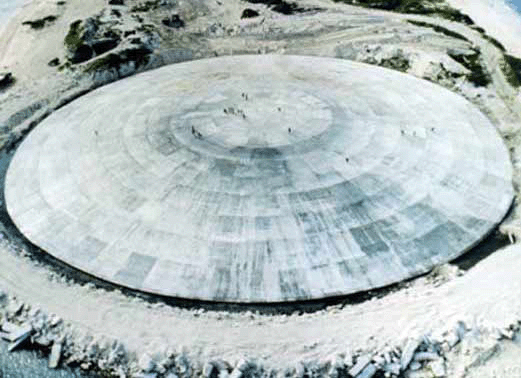
A gaping hole was left on a small island in the Pacific Ocean when the United States military released an 18-kiloton nuclear blast in 1958, known as the ‘Cactus‘ test.
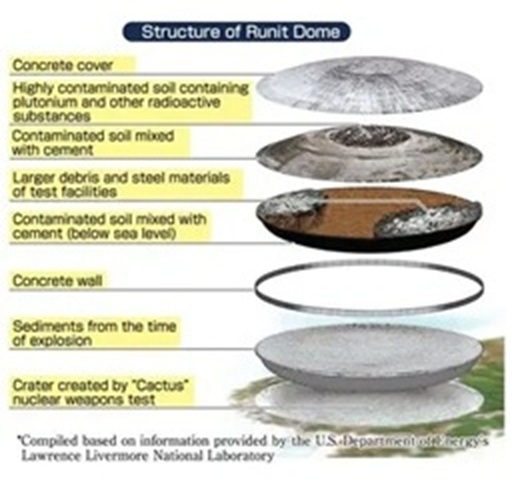
After the blast took place on the Marshall Island’s Runit Island, the military filled it in with contaminated soil and debris, creating a ‘tomb’ of nuclear waste known now as the Runit Dome.
Almost 50 years after the dome’s construction, experts are concerned that cracks in the concrete-capped radioactive landfill indicate just how vulnerable the site is to rising seas encroaching upon the narrow island’s shores.
The 115-meter (377 feet)-wide dome, built between 1977 and 1980 as part of military cleanup efforts, rests above more than 120,000 tons of material that were contaminated by US nuclear testing across Enewetak Atoll, including lethal quantities of plutonium.
The dome was intended as a temporary solution to contain material left behind by the nuclear tests, some of which exceeded the magnitude of Hiroshima and Nagasaki 1,000 times over.
But since its construction, groundwater has penetrated the otherwise-unlined crater, beneath which there lies a bed of porous coral sediment. So far, this is the main source of leaks, but there are concerns that layers of the dome intended to sit above sea level are not going to stay above water much longer.
In 2020, following a major report by the Los Angeles Times, Woods Hole Oceanographic Institute marine radioactivity expert Ken Buesseler pointed out that radioactive leaks from the Runit Dome are, so far, “relatively small,” in an interview for the institute’s journal
“As long as the plutonium stays put under the dome, it won’t be a large new source of radiation to the Pacific Ocean,” Buesseler told journalist Evan Lubofsky at the Los Angeles Times.
“But a lot depends on future sea-level rise and how things like storms and seasonal high tides affect the flow of water in and out of the dome. It’s a small source right now, but we need to monitor it more regularly to understand what’s happening, and get the data directly to the affected communities in the region.”
Columbia University chemist Ivana Nikolic-Hughes has been involved in ongoing research into the persistent contamination of the Marshall Islands following nuclear testing, and recently told journalist Kyle Evans at the Australian Broadcasting Corporation that she saw the dome’s cracks first-hand while taking soil samples on the island back in 2018.
In her research, Nikolic-Hughes has found elevated radiation levels and significant quantities of five radionuclides in soil samples from the island, outside the dome.
This could be evidence of the nuclear tomb leaking – though it may also be the result of the haphazard nature of the cleanup efforts, which also resulted in much waste being dumped into the lagoon.
Either way, the presence of plutonium-239, a component of nuclear weapons that remains dangerous for more than 24,000 years, warrants grave concerns about its vulnerability to rising sea levels and climate change.
“Given that sea levels are rising and there’s indications storms are intensifying, we worry the integrity of the dome could be in jeopardy,” Nikolic-Hughes told Evans.
“Runit is about 20 miles from where people live and they use the lagoon, so the implications are potentially devastating.”
In 2024, the US Department of Energy’s Pacific Northwest National Laboratory conducted an investigation into the potential impacts of climate change on the Runit Dome site, finding that storm surges and gradual sea level rise would indeed be the biggest factor in spreading radionuclides through the atoll.
Most of Runit Island sits just 2 meters (6.5 feet) above sea level.
Viewed from above, it is easy to imagine what an impact just 1 meter of extra water could do to the atoll and Runit Island’s crumbling nuclear tomb. That is the amount of sea level rise climate scientists predict for the Marshall Islands by 2100.
Related: Parts of The Marshall Islands Are Now More Radioactive Than Chernobyl, Study Finds
Nikolic-Hughes and her fellow researcher Hart Rapaport have previously urged the United States to take responsibility for proper cleanup of nuclear waste on the islands, as one part of ensuring a safe future for Marshallese residents.
As United Nations special rapporteur Paula Gaviria Betancur said back in 2024: “Legacies of nuclear testing and military land requisitions by a foreign power have displaced hundreds of Marshallese for generations, while the adverse effects of climate change threaten to displace thousands more.”
The Nightmare of Fukushima 15 Years Later

SCHEERPOST, By Joshua Frank, March 20, 2026
“…………………………………………………………………………………… The Fukushima Daiichi nuclear plant, built by General Electric (GE) in the mid-1960s, was designed to withstand natural disasters, but its creators never foresaw an earthquake like that. When the plant’s sensors detected the quake, its reactors automatically shut down. That emergency shutdown (or scram) halted its fission process, triggering backup power to keep cold seawater flowing through the reactors and spent-fuel containers to prevent overheating. Things at Fukushima were going according to plan until that massive tsunami battered the plant, washing away transmission towers and damaging electrical systems. There were backup generators in the basement, but those, too, had been inundated by waves of seawater, and an already bad situation was about to get far worse.
A power outage at a nuclear power plant is known as a “station blackout.” As you might imagine, it’s one of the worst scenarios any nuclear facility could possibly experience. If all electricity is lost, that means water is no longer being pumped into the reactor’s scalding-hot core to cool it down. And if that core isn’t constantly being cooled, one thing is certain: disaster will ensue. The fission process itself may be complicated, but that’s basic physics. To make matters worse, there were three operating reactors at Fukushima Daiichi. Luckily, three others had already been shut down for maintenance. If power wasn’t restored in short order, that would mean that all three of Fukushima’s reactors were in very big trouble.
We would later learn that no one — not at TEPCO, GE, or among Japanese regulators — had ever considered the possibility that all the reactors might lose electricity at once. They had only drawn up plans for one reactor to go down, in which case the others could keep the plant running. But all of them offline, and every generator out of commission? There was no precedent or playbook for that.
The nuclear industry has a reasonably polite name for a disaster like the one that was rocking Fukushima. They refer to it as a “beyond design-basis accident” because no single nuclear plant design can account for every possible problem it might encounter in its lifetime. The fact that there’s a term for this should make you anxious.
Meltdowns and Fallout
Over the next several days, the emergency at Fukushima Daiichi only worsened. Every effort to restore power to its reactors hit a dead end. On-site radiation-detection equipment, which would have triggered warnings and guided evacuation efforts for those in danger, was no longer functioning. Plans to pump water into the reactors to cool them had faltered. Their cores kept overheating, and the boiling pools of spent fuel were at risk of drying out, potentially triggering a massive fire that would release extreme amounts of radiation.
Within three days, following a series of fires, hydrogen explosions, and panic among those aware of what was happening, Fukushima’s Units 1, 2, and 3 experienced full-scale core meltdowns. Over 150,000 people within an 18-mile radius had already been forced to evacuate, and radiation plumes would take two weeks to spread across the northern hemisphere, although the Japanese government wouldn’t admit publicly that any meltdown had occurred until June 2011, three months later.
The only good news for the 13 million people living 150 miles south in Tokyo was that, during and immediately after the meltdowns, prevailing winds carried much of Fukushima’s radioactive material away from the smoldering reactors and out to sea. It’s estimated that 80% of the fallout from Fukushima ended up in the ocean, meaning most of it headed east rather than toward population centers to the south and west. The other fortunate news was that the spent fuel containers had somehow survived it all. If their water levels in the pools had been drained, far more radiation would have been released.
But Tokyo wasn’t completely spared. After years of research, scientists discovered that cesium-rich microparticles had blanketed the greater Tokyo area, an unpopular discovery that drew backlash and threats of academic censorship. Areas around the Fukushima exclusion zones recorded the highest radiation levels. Japanese government officials continually downplayed the dangers of the accident and were reluctant to even classify the event as a Level 7 nuclear disaster, the highest rating on the International Nuclear Event Scale, which would have placed it on a par with the 1986 Chernobyl nuclear disaster. Japanese officials have also failed to conduct long-term epidemiological studies that would include baseline measurements of cancer rates, which has cast doubt on thyroid screenings that found troubling incidents of cancer far higher than researchers expected.
Radioactive Fish
Prior to the earthquake, the ocean’s cesium-137 levels near Fukushima were 2 Becquerels (a unit of radioactivity) per cubic meter, well below the recommended drinking water threshold of 10,000 Becquerels. Just after March 11, 2011, cesium-137 levels there spiked to fifty million before decreasing as sea currents dispersed the radioactive particles away from the coast. The ocean, however, had been poisoned.
In the years that followed the Fukushima nuclear disaster, researchers documented a frightening, yet predictable trend. Radioactive isotopes in seawater were taken up by marine plants (phytoplankton), which then moved up the food chain into tiny marine animals (zooplankton) and, eventually, to fish.
Cesium-137 consumed by fish can reside in their bodies for months, while Strontium-90 remains in their bones for years. If humans then eat such fish, they will also be exposed to those radioactive particles. The more contaminated fish they eat, the greater the radioactive buildup will be.
In 2023, over a decade after the incident, radiation levels remained sky-high in black rockfish caught off the Fukushima coast. Other bottom-dwelling species have been found to be laden with radioactivity, too, including eel and rock trout. Further concerns have been raised about the treated radioactive water that TEPCO continued to release into the ocean, prompting China to suspend seafood imports from Japan. Aside from those findings, there have been very few studies examining the effects of Fukushima’s radiation on ecosystems or on the people of Japan.
“Japan has clamped down on scientific efforts to study the nuclear catastrophe,” claims pediatrician Alex Rosen of International Physicians for the Prevention of Nuclear War. “There is hardly any literature, any publicized research, on the health effects on humans, and those that are published come from a small group of researchers at Fukushima Medical University.”
Recognizing such levels of radiation, even if confined to the waters near Fukushima, would cast the country’s nuclear industry as a significant threat — not only to Japan but globally. Any admission that Fukushima’s radiation is linked to increased cancer rates would raise broader concerns about nuclear power’s future viability. Radiation exposure is cumulative and, although Fukushima didn’t immediately cause mass casualties, it wasn’t a benign accident either. It took decades before it was accepted that Chernobyl had caused tens of thousands of excess cancer deaths. It may take even longer to completely understand Fukushima’s full effects. In the meantime, the still ongoing cleanup of the burned-out facilities may cost as much as 80 trillion yen ($500 billion).
It’s been 15 years since Fukushima’s reactors experienced those meltdowns and we still don’t fully understand their long-term repercussions. Nuclear power advocates will argue that Fukushima wasn’t a serious incident and that nuclear technology is still safe. They’ll minimize radiation threats, remain optimistic that new reactor designs will never falter, dismiss the fact that there’s simply no permanent solution for radioactive waste, and overlook the inseparable connection between nuclear power and atomic weapons. After all, among other things, we’ll undoubtedly need nuclear energy to help power the artificial intelligence craze, right?………………………………………………………………………………………………………………………………………………………………………. With nine nuclear-armed nations and roughly 12,000 nuclear warheads on this planet, worries about nuclear war are unavoidable. However, the danger of a nuclear disaster at a seemingly “peaceful” nuclear facility is often ignored. The future of atomic energy remains uncertain, but it is our duty to eliminate this hazardous energy source before another Fukushima triggers a war-like catastrophe all its own.mhttps://scheerpost.com/2026/03/20/searching-for-solace-in-a-nuclearized-world/
Joshua Frank, a TomDispatch regular, is co-editor of CounterPunch and co-host of CounterPunch Radio. He is the author of Atomic Days: The Untold Story of the Most Toxic Place in America, and the forthcoming Bad Energy: AI Hucksters, Rogue Lithium Extractors, and Wind Industrialists Who are Selling Off Our Future, both with Haymarket Books.
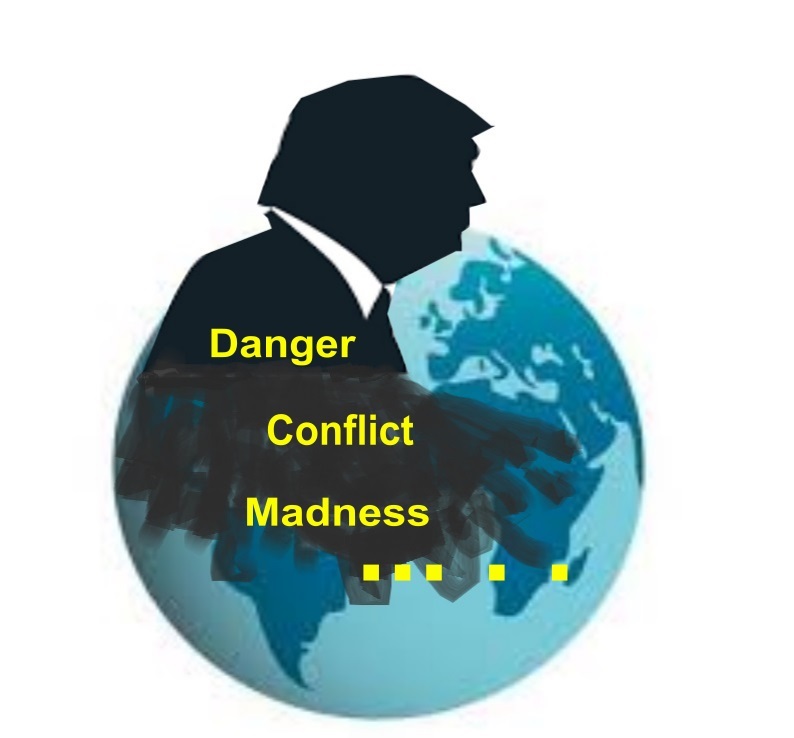
Trump is the most dangerous man in the world
By Mark Beeson | 21 March 2026, https://independentaustralia.net/politics/politics-display/trump-is-the-most-dangerous-man-in-the-world,20838
Trump’s Iran war raises fears of global conflict — while allies stay silent and diplomacy collapses, writes Mark Beeson.
U.S. PRESIDENT DONALD TRUMP is the most dangerous man in the world. Why are we supporting him?
Many people were concerned about what a second Trump presidency might look like, but it’s uncontroversial to claim that it’s much worse than even the gloomiest pessimists feared.
It has been plain for a long time that Trump has little regard for the truth and is determined to silence independent media. But the one thing his supporters and the world in general might have hoped for was that he wouldn’t have gone back on his promise to not start unnecessary, ill-conceived wars, especially in the Middle East.
And yet, not only has Trump launched an illegal war with Iran, which has already resulted in the deaths of thousands, including innocent schoolgirls, but he is also displaying a psychopathic delight in using America’s overwhelming military might ‘just for fun’.
Given that the assault on Iran is being conducted with – or even on behalf of – Israel there is a breathtaking irony in the fact that Trump is displaying the same sort of indifference to human suffering that allowed individual Nazis to take part in the ‘final solution’ and the murder of six million Jews.
It is, of course, entirely possible that Trump doesn’t really know what’s going on given his increasingly obvious cognitive decline, but he has never exhibited much human empathy and is a compulsive liar and confabulator. These qualities arguably made him unfit to be a property developer, much less the most powerful man on Earth.
Given his famously child-like need for attention and adulation, which his courtiers and cronies are only too willing to provide, there is absolutely no chance of him changing. On the contrary, his belief that God is proud of him ought to alarm ought to alarm friend and foe alike.
After all, this is a man with the capacity to blunder into World War 3 without having any idea what he’s doing. The complete absence of any plan or exit strategy in the escalating conflict with Iran demonstrates that even the most apocalyptic of unforeseen consequences cannot be ruled out.
While an international economic crisis may not be the worst thing that could happen, for those of us fortunate enough to live in peaceful Australia it really ought to demonstrate that Trump is a threat to supposed friends and allies, as well as the innocent Iranians he promised to help.
If nothing else, Trump’s behaviour should make the danger and folly of relying on someone quite so delusional and self-obsessed clear to even our most unthinking policymakers. Trump will be satisfied with nothing less than the complete support and cooperation of allies, no matter how misguided or inhuman his policies may be.
Given the decades of uncritical fealty Australia’s leaders have displayed to the United States, it is no surprise that there has generally been an uncomfortable silence about ‘our’ response to the latest American-led fiasco.
Penny Wong wrote:
‘We (sic) support the United States acting to prevent Iran from obtaining a nuclear weapon and to prevent Iran continuing to threaten international peace and security.’
It’s worth remembering that Iran was attacked while trying to negotiate a new agreement to replace the one Trump tore up, a tactic that may have allowed the U.S. to decapitate Iran’s leadership but won’t making resolving the conflict any easier. Truth, diplomacy and trustworthiness are clearly for losers. Might clearly does make right in Trump-world. This reality may help to explain why the Albanese government is keeping its collective head down.
Other leaders have not been quite so supine and gutless, however. German Chancellor Friedrich Merz, after fruitless attempts at ingratiating himself with Trump, unambiguously stated that the “government will not participate in this war”. Moreover, Merz pointed out that Trump’s war had nothing to do with NATO, which was a defensive alliance, not one designed for wars of aggression.
Trump responded in his usual fashion with threats and bluster, suggesting a failure to support his ill-conceived war would be ‘very bad’ for NATO. Although we have learned not expect truth or consistency when dealing with Trump, suggesting that the foundation of the Western alliance may be in jeopardy is hardly a minor threat. Trump’s great friend Vladimir Putin must be delighted.
If our leaders are too unimaginative and cowardly to speak up in defence of international law, or to criticise unilateralism and the intensification of great power politics, civil society must do what it can. The absence of the sort of activism and protests that characterised opposition to the equally ill-conceived and pointless Vietnam War is disappointing and revealing, however. Perhaps it takes 500 actual combat deaths and the prospect of being called-up to bring home the reality of war to Australians.
Or perhaps rising interest rates, the cost of filling up a monstrous SUV, or re-routing your European holiday might do the trick. Either way, it’s reassuring to know that President Trump thinks the war with Iran is going so well that he gives if 15 out of 10. Nothing for our leaders to worry about after all.
1 This Month

of the week – Shut Down Drone Warfare!


Tell the Ukrainian Government to Drop Prosecution of Peace Activist Yurii Sheliazhenko

Petition to revoke the licensing of the Near Surface Nuclear Disposal Facility (NSDF) at Chalk River. https://www.ourcommons.ca/petitions/en/Petition/Details?Petition=e-7247
To see nuclear-related stories in greater depth and intensity – go to https://nuclearinformation.wordpress.com
-
Archives
- March 2026 (237)
- February 2026 (268)
- January 2026 (308)
- December 2025 (358)
- November 2025 (359)
- October 2025 (376)
- September 2025 (257)
- August 2025 (319)
- July 2025 (230)
- June 2025 (348)
- May 2025 (261)
- April 2025 (305)
-
Categories
- 1
- 1 NUCLEAR ISSUES
- business and costs
- climate change
- culture and arts
- ENERGY
- environment
- health
- history
- indigenous issues
- Legal
- marketing of nuclear
- media
- opposition to nuclear
- PERSONAL STORIES
- politics
- politics international
- Religion and ethics
- safety
- secrets,lies and civil liberties
- spinbuster
- technology
- Uranium
- wastes
- weapons and war
- Women
- 2 WORLD
- ACTION
- AFRICA
- Atrocities
- AUSTRALIA
- Christina's notes
- Christina's themes
- culture and arts
- Events
- Fuk 2022
- Fuk 2023
- Fukushima 2017
- Fukushima 2018
- fukushima 2019
- Fukushima 2020
- Fukushima 2021
- general
- global warming
- Humour (God we need it)
- Nuclear
- RARE EARTHS
- Reference
- resources – print
- Resources -audiovicual
- Weekly Newsletter
- World
- World Nuclear
- YouTube
-
RSS
Entries RSS
Comments RSS
 nuclear-news