Now By Fire, Next by Quake, then by Apocalyptic Radiation: Will Gavin Newsom’s Diablo Canyon Atomic Folly Kill Us All?

Los Angeles is now being destroyed by fire.
by Harvey “Sluggo” Wasserman, January 11, 2025, more https://freepress.org/article/now-fire-next-quake-then-apocalyptic-radiation-will-gavin-newsoms-atomic-folly-kill-us-all-0
Los Angeles is now being destroyed by fire.
Next will be the “Big One” earthquake everyone knows is coming.
And then—unless we take immediate action—Diablo Canyon’s radioactive cloud will make this region a radioactive dead zone.
My family is now besieged by four fires raging less than four miles away. We don’t know how long our luck will hold.
We are eternally grateful to the brave fire-fighters and public servants who are doing their selfless best to save us all.
We are NOT grateful that Gavin Newsom has recklessly endangered us by forcing continued operation at two unsafe, decrepit nuclear power plants perched on active earthquake faults, set to pour radioactive clouds on us from just four hours north of here.
The Nuclear Regulatory Commission’s resident site inspector—Dr. Michael Peck—after five years at Diablo warned that it cannot withstand the earthquakes we all know are coming.
In 2006 the NRC confirmed that Unit One was already seriously embrittled. Its fragile core makes a melt-down virtually certain to cause a catastrophic explosion, shooting a lethal apocalyptic cloud right at us…and then across the state and continent.
These wildfires make clear that these city, state and federal governments—maybe NO government ANYWHERE—can begin to cope with these kinds of mega-crises.
Imagine watching our public servants trying to cope while dressed in radiation suits, knowing everything around us has been permanently contaminated.
Imagine leaving all you own forever behind while racing to get yourself and your family out of here under the universal evacuation order demanded by radioactive clouds like those that decimated the downwind regions from Chernobyl and Fukushima, not to mention Santa Susanna and Three Mile Island, Windscale and Kyshtym.
Pre-empting such a catastrophe was a major motivation for the 2018 plan to phase out the two Diablo nukes in 2024 and 2025,
That landmark blueprint was crafted over a two-year period with hundreds of meetings, scores of hearings involving the best and brightest in energy, the economy, the ecology and the hard engineering realities of aging atomic power reactors.
It was signed by the then-Governor (Jerry Brown), Lieutenant Governor (Gavin Newsom), state legislature, state regulatory agencies, the Nuclear Regulatory Commission, plant owner (PG&E), labor unions, local governments, environmental groups and many more, .
The economic and energy security goals of this plan have been far exceeded by advances in renewable generation and battery storage. California now regularly gets 100% of its electricity from solar, wind and geothermal. Battery back-up capabilities exceed Diablo’s capacity by a factor of four or more. Its inflexible baseload productions unfortunately interferes with far cheaper renewables filling our grid.
The grid’s most serious blackout threats now come from disruptive malfunctions and potential disasters at Diablo Canyon.
All this has been well known since 2018, when Newsom signed the Diablo agreement.
The phase-out proceeded smoothly for four years, largely exceeding expectations.
But in 2022, Newsom strongarmed the legislature into trashing the phase-out plan. His Public Utilities Commission decimated the statewide rate structure, costing our solar industry, billions in revenues and at least 17,000 jobs.
Instead Newsom fed PG&E about $1.4 billion in public subsidies and $11 billion in over-market charges to keep Diablo running through 2030.
Neither the NRC nor state nor PG&E have done the necessary tests to guarantee Diablo’s safety, refusing to re-test for embrittlement even though such defects forced the NRC to shut the Yankee Rowe reactor in 1991.
Diablo has no private liability insurance. Should it irradiate Los Angeles, NONE of us can expect compensation.
So as we shudder amidst the horrors of this firestorm, we know that our loss of life, health and property will be orders of magnitude—literally, infinitely—more devastating when, by quake or error, the reactors at Diablo Canyon melt and explode.
Responsibility for this needless, unconscionable threat lies strictly with Gavin Newsom. There is no sane economic, electric supply or common sense reason for him to impose this gamble on us.
Governor Newsom: NOTHING can make public sense of this radioactive throw of the dice.
We respectfully beg, request, demand, beseech that you honor the sacred word you gave in 2018 to phase out the Diablo Canyon atomic reactors.
As we see the devastation engulfing us, and the inability of government to make it right, there is zero mystery as to why these nukes must shut.
NOW!!!
How to dismantle the deadly arms trade
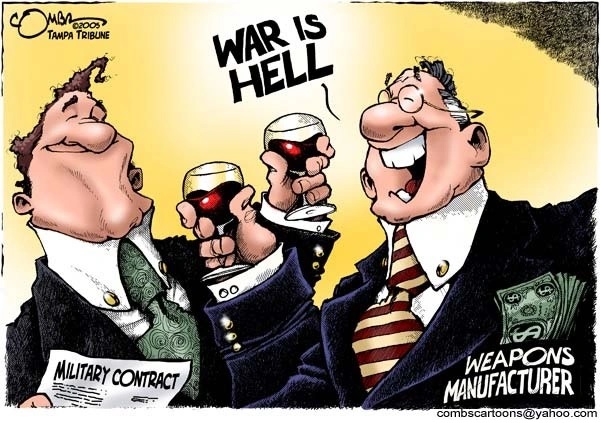
The devastating human impact of the arms industry is clear, but war is good news for industry shareholders. The market value of military equipment manufacturers in the US and Europe increased by nearly 60 per cent between February 2022 and March 2024, thanks to the wars in Ukraine and Palestine.
Activists forced Canadian Bank of Nova Scotia to halve its stake in Elbit Systems, Israel’s biggest arms company. In October 2024, Elbit shut down its promotional booth at the Japan International Aerospace Exhibition in Tokyo after protests.
New Internationalist, Amy Hall, 6 Jan 25
People across the world are standing up to the power of the arms trade. Amy Hall explores its threat to life and democracy.
It’s a cold, bright morning on a narrow street in Brighton, on the south coast of England. Neighbours are peering through windows, or coming out onto the pavement, to see why around 15 protesters are standing outside the business premises at the end of the road with a banner declaring: ‘Genocide in Gaza made in Brighton’.
The answer is that the campaigners say they saw this company, London & Brighton Plating – which specializes in metal coating and plating used in a range of industries, including aerospace – delivering to L3Harris. The latter is one of the world’s biggest arms companies, and makes bomb release mechanisms for fighter jets used by Israel at its site on the outskirts of the city.
At least here in Brighton we have a strong protest movement,’ says Gummy Bear, one of the protesters. They point to the number of Palestinians who have been killed in Gaza. On 14 November 2024, the day of the protest, the death toll stood at well over 43,000. ‘We’re calling on supplier companies to divest from L3Harris and to stop working with them. We want L&B Plating to end their contract.’
Before they decided to form this picket, the Stop L3Harris group says it tried to contact L&B Plating in other ways but not had any response; they did not respond to New Internationalist’s request for comment either. The campaigners have drawn up a list of companies that they believe are working with L3Harris. While the group has held several protests and actions at the factory itself, it is also working along the supply chain to try and make it harder for L3Harris to stay open in their city.
The trading of arms and military equipment has always faced opposition, but since 7 October 2023, when Israel began its genocidal assault on Gaza, there has been an explosion of activism against the arms industry. In neighbourhoods across the world, people are taking action – from shutting down shipyards or destroying equipment, to encampments at universities and divestment campaigns.
The devastating human impact of the arms industry is clear, but war is good news for industry shareholders. The market value of military equipment manufacturers in the US and Europe increased by nearly 60 per cent between February 2022 and March 2024, thanks to the wars in Ukraine and Palestine.
But despite the might of the industry, many ordinary people around the world have been winning where they have acted against it. Activists forced Canadian Bank of Nova Scotia to halve its stake in Elbit Systems, Israel’s biggest arms company. In October 2024, Elbit shut down its promotional booth at the Japan International Aerospace Exhibition in Tokyo after protests. And in November, Palestine Action – a group which has been taking direct action against Elbit Systems since 2020 – announced that Hydrafeed, which had been supplying equipment to Elbit, had cut ties with the arms company ‘as a direct result’ of the group’s actions.
‘I’ve never see this level of activism against the arms trade,’ says Emily Apple of Campaign Against Arms Trade (CAAT).
People are not just taking action over Palestine. There has been a growing campaign against the United Arab Emirates (UAE) for its complicity in the war in Sudan, which has killed up to 150,000 people. In England, activists have protested outside Arsenal football club’s Emirates Stadium in north London, due to its sponsorship from the airline Emirates, which is owned by the UAE state. There have also been demonstrations in a number of cities calling on the British government to take action.
Some of the most inspiring solidarity has come from workers normally key to the arms trade’s operation. After Israel’s latest assault on Gaza began, Palestinian trade unions called for support from fellow workers – and many answered. In November 2024 dockers in the Moroccan port of Tangiers refused to load a ship belonging to the logistics company Maersk, after the vessel was found to have received a number of US military shipments bound for Israel. The month before, members of a Greek dock-workers’ union in Athens Pireaus port blocked the loading of a container of ammunition on its way for use in Gaza.
Nor is Palestine the only cause that provokes such practical solidarity. Since 2019 workers in Genoa, Italy have declared a ‘war against the war’ in Yemen, refusing to load ships with weapons or other military equipment that could be used to kill civilians.
A global industry
Another frontier of the movement is the legal system, as campaigning lawyers push governments to stop arming the violence of states such as Israel. Palestinian human rights organization Al-Haq and the Global Legal Action Network (GLAN) have been fighting the British state over its arms exports to Israel……………………………………………………………………………………….. more https://newint.org/arms/2025/how-dismantle-deadly-arms-trade?utm_source=ni-email-whatcounts%20&utm_medium=1%20NI%20Main%20List1%20-%20enews%20-%20International%20AND%20North%20America&utm_campaign=2025-01-10%20enews
Lancet Study: Gaza Health Ministry Undercounted Death Toll By 41%

The study doesn’t account for indirect deaths caused by the Israeli siege
by Dave DeCamp January 9, 2025, https://news.antiwar.com/2025/01/09/lancet-study-gaza-health-ministry-undercounted-death-toll-by-41/
A new study published in the British medical journal The Lancet found that the Health Ministry in the Gaza Strip has significantly undercounted the number of Palestinians killed by Israel’s genocidal war.
The study reviewed the period between October 7, 2023, and June 30, 2024, and found there were 64,260 “traumatic injury deaths” in that timeframe. At the end of June 2024, Gaza’s Health Ministry said there were 37,877 dead, an undercount of about 41%.
As of October 2024, the study said the number of Palestinians killed by Israeli military action likely exceeds 70,000. The latest numbers from Gaza’s Health Ministry put the death toll at 46,006.
Explaining the methodology, the study said it used “capture-recapture methods to estimate total deaths from traumatic injury in the Gaza Strip from Oct 7, 2023, to June 30, 2024. By combining three data lists—official hospital lists, an MoH survey, and social media obituaries—we provide an estimate of mortality that accounts for under-reporting.”
The study accounts only for deaths caused by violence and not indirect deaths caused by the Israeli siege and the destruction of medical and other civilian infrastructure.
The figures coming from Gaza’s Health Ministry have been under significant scrutiny from Israeli officials and their supporters in the West. In the early days of the genocidal war, President Biden cast doubt on their accuracy, but a high-level US State Department official later acknowledged the real number of dead was likely higher than what the Health Ministry was reporting.
The number of indirect deaths caused by the Israeli siege is unclear but is likely significantly higher than the violent deaths. A letter written by experts and published by The Lancet in July 2024 estimated that if the war ended at that time, the conflict could account for 186,000 deaths, including 37,396 violent deaths (based on June 2024 Health Ministry figures) and indirect deaths.
Judge Orders Britain’s Crown Prosecution Service (CPS) to Come Clean on Deleted Assange Docs

A judge in London has ruled that Britain’s Crown Prosecution Service (CPS) must explain what happened to certain documents in the Julian Assange case that it claims no longer exist, reports Joe Lauria.
By Joe Lauria, Consortium News, January 10, 2025, https://consortiumnews.com/2025/01/10/judge-orders-cps-to-come-clean-on-deleted-assange-docs/
Italian journalist Stefania Maurizi has been waging a legal battle for seven years against the Crown Prosecution Service to discover the truth about a CPS claim that it deleted a number of documents Maurizi has sought in a Freedom of Information request about the case of Julian Assange.
Now a judge on the London First-tier Tribunal has ruled that the CPS must explain to Maurizi what it knows about when, why and how the documents were allegedly destroyed. The Jan. 2 ruling was first reported by Maurizi’s newspaper il Fatto Quotidiano on Friday.
Judge Penrose Foss has given the CPS until Feb. 21 to respond or it could be held in contempt of court.
The ruling says:
The Crown Prosecution Service must, by no later than 4.00 p.m. on 21 February 2025:
- (1) Confirm to the Appellant whether it held recorded information as to when, how and why any hard or electronic copies of emails referred to in the Appellant’s request to the Crown Prosecution Service of 12 December 2019 were deleted;
- (2) If it did hold such information, either supply the information to the Appellant by 4.00 p.m. on 21 February 2025 or serve a refusal notice under section 17 of the Freedom of Information Act 2000, identifying the grounds on which the Crown Prosecution Service relies.A failure to comply with this Substituted Decision Notice could lead to contempt proceedings.”
Swedish Case
The documents Maurizi seeks were in relation to Sweden’s request to the U.K. for Assange’s extradition.
Her argument was heard before the three judges of the tribunal on Sept. 24, 2024. The allegedly deleted emails involved a CPS exchange with Sweden about a Swedish prosecutor’s attempt, beginning in 2010, to extradite the WikiLeaks publisher from Britain.
Assange was wanted at the time in Sweden for questioning during a preliminary investigation into allegations of sexual assault, which was dropped three times, definitively in 2017. He was never charged. After losing his battle against extradition to Sweden at the U.K. Supreme Court, Assange took refuge in the Ecuadorian embassy in June 2012, fearing that Sweden would send him to the United States.
Assange spent seven years in the embassy protecting himself from arrest until April 2019, when British police dragged him from the diplomatic mission and threw him into London’s maximum security Belmarsh prison.
It was only when the U.S. realized it would lose on appeal after a four-year extradition battle that the Department of Justice cut a plea deal with Assange who was released on June 24, 2024 and returned to his native Australia.
Assange had been charged in the United States under the Espionage Act for possessing and publishing defense information, which revealed evidence of U.S. war crimes. Britain took an active role in Assange’s prosecution.
In the earlier Swedish case, the CPS sought to stop Sweden from going to the embassy to question him.
Seeking to learn more about Britain’s role, Maurizi first made a Freedom of Information Act (FOIA) request in 2015 for all emails between the British and Swedish governments concerning Assange.
Some of the emails she obtained showed political motivation on the part of the lead British prosecutor, Paul Close.
One email Maurizi obtained from the Swedish Prosecution Authority (SPA) revealed that Close appeared to be pressuring Swedish prosecutors to continue seeking Assange’s extradition instead of dropping the case or questioning him at the Ecuadorian embassy, where Assange had been granted asylum.
“My earlier advice remains, that in my view it would not be prudent for the Swedish authorities to try to interview the defendant [Julian Assange] in the UK,” Close wrote to the SPA, in 2011, according to one of the emails obtained by Maurizi.
Keir Starmer, the British prime minister, was head of the CPS at this time. He led the service from 2008 to 2013, though it is unknown what role Starmer may have played in this correspondence.
“Don’t you dare get cold feet!!!,” he wrote to Marianne Ny, Sweden’s director of public prosecutions, in 2012. A year after that, Close wrote, “Please do not think this case is being dealt with as just another extradition.”
After Maurizi noticed a sizeable gap in the emails released to her she filed another FIOA seeking to obtain the missing emails.
The CPS first claimed that it had destroyed the emails. It said that when Close retired, his account along with his emails, were automatically destroyed.
But Maurizi did not buy it. She asked the court at the hearing last month to order the CPS to turn over “metadata” — data about data, such as file creation and modification dates, email sender and recipient addresses, timestamps, email routing information, keywords, and subject lines — proving the emails really were deleted and when.
“We have NO certainty whatsoever” that the emails were destroyed, Maurizi wrote in a message to Consortium News. Maurizi went to court because she believes the allegedly deleted emails could provide additional evidence of a politically motivated prosecution of Assange.
She also wants metadata on a CPS document that it says is from 2012 explaining the CPS’ email deletion policy, which was only sent to her in 2023.
The supposed 2012 policy document says that 30 days after an email account is disabled, the “email data” associated with it “will be automatically deleted and no longer accessible.”
“How is it possible that they provided this document only in 2023, after multiple requests, multiple appeals, no-one ever mentioned it or knew about it?” Maurizi told CN.
Such a policy does not explain why thousands of emails related to an ongoing case would be deleted.
Denied on the Metadata
In order to figure out whether the 2012 policy document on deletions is genuine, Maurizi requested the relevant metadata of the file. She wanted to make sure it was not created years later as an attempt at retroactively justifying the deletion of Close’s emails.
Judge Foss for the Tribunal, however, ruled against Maurizi on the release of the metadata. Foss ruled
“In our view there was nothing in the letter or spirit of the 2019 Request as to when, how and why the emails of the CPS lawyer were deleted, which required the CPS to disclose the metadata of any document which substantiated the information it provided in response to that request. […]
It would be extraordinary, in our view, if every time a public authority was presented with a request for information recorded in such a way as to have meant that the creation of that record generated metadata, the request should be taken inevitably to require the metadata behind the form of record.”
Unsatisfactory Explanations
It is simply “not credible” Maurizi’s lawyer argued during the September hearing that Close neither sent nor received emails to Swedish prosecutors when Sweden issued the arrest warrant for Assange; when Assange took refuge in the embassy; and when he was granted asylum by Ecuador.
“[I]t has never been established that there was anything untoward in those gaps, that there were emails that weren’t published,” argued Rory Dunlop KC, on behalf of the prosecution authority, during his closing remarks.
“The CPS are keen to make clear that it has never been accepted and [it has] never been established one way or another,” he insisted. Over the years, in response to FOIA requests and appeals, the CPS’ position on the deletion of Close’s account has varied.
For example, in 2017, after Maurizi challenged the gap in the emails, a CPS employee said in a witness statement that, “If there ever existed further emails they were not printed off and filed” and therefore “are no longer in the possession of the CPS.”
According to an article by Maurizi in il Fatto Quotidiano, five years later, the CPS said in response to a separate FOIA request from Labour MP John McDonnell that “deletion of an email account of a former member of staff at the time would not have led to the deletion of emails held on the case file.”
The CPS also admitted to McDonnell that they are only aware of one other case in the last decade which resulted in the premature destruction of case materials, according to Maurizi’s article.
The Sept. 24 tribunal also heard that the CPS’ Records Management Manual states that general correspondence “should be retained in the case file within five years from the date of the most recent correspondence,” which would not allow for deletion upon retirement by the prosecutor on the case.
Mohamed Elmaazi contributed to this article.
Are Blinken and Biden’s Gaza genocide denials any different than Nazi WWII genocide denials?

Walt Zlotow, West Suburban Peace Coalition, Glen Ellyn IL , 12 Jan 25.
Secretary of State Antony Blinken told the NY Times he’s not worried about history judging him as a genocide enabler.
When asked he replied, “No. It’s not (genocide), first of all. Second, as to how the world sees it, I can’t fully answer to that.”
Blinken will deny to his death his $22 billion in weapons that Israel has used to utterly destroy sustainable life for 2,300,000 Palestinians in Gaza’s 139 square miles is genocide. But the entire world aside from the Biden administration is correct in viewing it as genocide
It isn’t that Blinken “Can’t answer to that” (the world viewing it as genocide). He simply won’t answer to what is the most monstrous crime a national leader can commit. From Day 1 in the genocide Israel embarked upon in response to the October 7, 2023 Hamas attacks, Blinken and his boss Biden have been calling the genocide their weapons enable ‘self-defense.’
Denying genocide is what the Nazi war criminals did to a man at the Nuremberg War Crime Trials after WWII.
There will be no war crime trials for Blinken and Biden for the genocide that could not take place their tens of billions in weapons, vetoes of ceasefire resolutions in the US Security Council, public support and their endless ‘self-defense’ refrain.
In a bitter irony for humanity, it was the US which helped establish the International Criminal Court (ICC) in 1998 to ferret out and prosecute war criminals. But with criminal US wars devastating Afghanistan and Iraq, the US has turned on the ICC in fear of becoming ICC war crime targets. The US has abstained from membership and has blasted the ICC indicting Israeli Prime Minister Benjamin Netanyahu for his Gaza genocide. President Biden called the indictment “outrageous” and declared “We will always stand with Israel.”
Is that any different from denying, even condoning WWII Nazi genocide?
Blinken and Biden, barreling toward historical infamy with their blank check enabling Israeli genocide in Gaza.
2024 confirmed as first year to pass 1.5C threshold

Scientists warn efforts to limit the long-term temperature rise to 1.5°C will fail as data confirms 2024 was the hottest year in human history
New Scientist, By James Dinneen and Madeleine Cuff, 10 January 2025
Hopes of keeping global warming below 1.5°C above pre-industrial levels have been all but extinguished after new data confirmed 2024 was the first calendar year to see average temperatures breach that critical threshold.
Last year was the hottest ever recorded in human history, the World Meteorological Organization (WMO) declared on 10 January, in the latest stark warning that humanity is pushing Earth’s climate into uncharted territory.
The average global temperature for the year exceeded 1.5°C above the pre-industrial baseline for the first time, the agency also confirmed, temporarily breaching the threshold set by the Paris Agreement.
The WMO’s assessment is calculated using the average global temperature across six datasets, with the period of 1850 to 1900 used to provide a pre-industrial baseline. Temperature datasets collected by various agencies and institutions around the world vary slightly, mainly due to differences in how ocean temperatures have been measured and analysed over the decades. Some of those datasets come in just below the 1.5°C mark, but others are well above.
The UK’s Met Office weather service puts 2024’s average temperature at 1.53°C above pre-industrial levels, with a margin of error of 0.08°C. That is 0.07°C above 2023, the previous warmest year on record. Meanwhile, the European Union’s climate change service Copernicus has 2024 temperatures at 1.6°C above pre-industrial levels, 0.12°C above 2023’s record.
Berkeley Earth, a climate research group in California, finds a rise of 1.62°C, the second time in its dataset the rise in global average temperatures has breached 1.5°C, after 2023. Temperature data from NASA puts the rise in temperature a bit lower at 1.47°C above pre-industrial levels, and the US National Oceanic and Atmospheric Administration finds a 1.46°C rise above pre-industrial levels. The WMO finds an average rise of 1.55°C across the six datasets, with a margin of error of 0.13°C.
Scientists agree that the surge in temperature was caused mostly by the continuation of human-caused climate change and an El Niño weather pattern, which tends to push up global temperatures. But the scale and persistence of the heat has shocked many experts, who expected temperatures to subside once El Niño ended in May 2024. Instead, they remained at record levels throughout the rest of the year.
The world’s oceans have been most affected, with sea surface temperatures staying at record levels for most of 2024, playing havoc with marine ecosystems. The year also brought no shortage of extreme weather on land, with fierce heatwaves, sharp declines in polar ice, deadly flooding and uncontrollable wildfires. “This was a year when the impacts of climate change are right across the planet,” says David King, former chief scientific adviser to the UK government and founder of the Climate Crisis Advisory Group.
Technically, the Paris Agreement target of limiting warming to below 1.5°C is calculated using a 20-year average, so a single year above the threshold doesn’t signal a formal breach of the target. But given the pace of warming in recent years, many scientists say the long-term Paris goal is now out of reach………………………………………..
https://www.newscientist.com/article/2463480-2024-confirmed-as-first-year-to-breach-1-5c-warming-limit/
Lawsuit challenges NRC on SMR regulation

Friday, 10 January 2025, https://www.world-nuclear-news.org/articles/lawsuit-challenges-nrc-on-smr-regulation
The States of Texas and Utah and microreactor developer Last Energy Inc are challenging the US regulator over its application of a rule it adopted in 1956 to small modular reactors and research and test reactors.
Under the US Nuclear Regulatory Commission (NRC) Utilization Facility Rule, all US reactors are required to obtain NRC construction and operating licences regardless of their size, the amount of nuclear material they use or the risks associated with their operation. The plaintiffs say this imposes “complicated, costly, and time-intensive requirements that even the smallest and safest SMRs and microreactors – down to those not strong enough to power an LED lightbulb” must satisfy to secure the necessary licences. This does not only affect microreactors: existing research and test reactors such as those at the universities in both Texas and Utah face “significant costs” to maintain their NRC operating licences, the plaintiffs say.
In the filing, Last Energy – developer of the PWR-20 microreactor – says it has invested “tens of millions of dollars” in developing small nuclear reactor technology, including USD2 million on manufacturing efforts in Texas alone, and has agreements to develop more than 50 nuclear reactor facilities across Europe. But although it has a “preference” to build in the USA, “Last Energy nonetheless has concluded it is only feasible to develop its projects abroad in order to access alternative regulatory frameworks that incorporate a de minimis standard for nuclear power permitting”.
Noting that only three new commercial reactors have been built in the USA over the past 28 years, the plaintiffs say building a new commercial reactor of any size in the country has become “virtually impossible” due to the rule, which it says is a “misreading” of the NRC’s own scope of authority.
They are asking the court to set aside the rule, “at least as applied to certain small, non-hazardous reactors”, and exempt their research reactors and Last Energy’s small modular reactors (SMRs) from the commission’s licensing requirements.
Houston, Texas-based law firm King & Spalding said the lawsuit, if it is successful, would “mark a turning point” in the US nuclear regulatory framework – but warns that it could also create greater uncertainty as advanced nuclear technologies get closer to commercial readiness.
“Regardless the outcome, the Plaintiffs’ lawsuit highlights the challenges in applying the Utilization Facility Rule to the advanced nuclear reactors now under development in the US,” the company said in in analysis released on 9 January.
But the NRC is already addressing the issue: in 2023, it began the rulemaking process to establish an optional technology-inclusive regulatory framework for new commercial advanced nuclear reactors, which would include risk-informed and performance-based methods “flexible and practicable for application to a variety of advanced reactor technologies”. SECY-23-0021: Proposed Rule: Risk-Informed, Technology-Inclusive Regulatory Framework for Advanced Reactors is currently open for public comment until 28 February, and the NRC has said it expects to issue a final rule “no later than the end of 2027”.
The lawsuit has been filed with the US District Court in the Eastern District of Texas.
Trident nuclear submarines leave UK reliant on the US, in lockstep with the US.
By Lynn Jamieson and Samuel Rafanell-Williams
The special relationship has meant that UK leaders typically fall in lockstep with US superpower logic, most catastrophically in Iraq, no matter how devastating the consequences.
An important and easily overlooked reason why Westminster is so willing to
do Washington’s bidding is the reliance of our supposedly
“independent” nuclear weapons capability on US military infrastructure
and technology.
The nuclear weapons based on the west coast of Scotland,
are arguably more of a US technology than British. The submarines, whilst
built in Barrow-in-Furness in England, are assembled according to US
blueprints and with US components. The Trident missiles fired by the
submarines are built, supplied and maintained in the US.
The National 10th Jan 2025,
https://www.thenational.scot/politics/24846637.trident-nuclear-submarines-leave-uk-reliant-us/
When Carter met Kim – and stopped a nuclear war

Tessa Wong, Asia Digital Reporter, BBC News, 11 Jan 25 https://www.bbc.com/news/articles/cpee202y907o—
Three decades ago, the world was on the brink of a nuclear showdown – until Jimmy Carter showed up in North Korea.
In June 1994, the former US president arrived for talks in Pyongyang with then leader Kim Il-sung. It was unprecedented, marking the first time a former or sitting US president had visited.
But it was also an extraordinary act of personal intervention, one which many believe narrowly averted a war between the US and North Korea that could have cost millions of lives. And it led to a period of greater engagement between Pyongyang and the West.
All this may not have happened if not for a set of diplomatic chess moves by Carter, who died aged 100 on 29 December.
“Kim Il-sung and Bill Clinton were stumbling into a conflict, and Carter leapt into the breach, successfully finding a path for negotiated resolution of the standoff,” North Korean expert John Delury, of Yonsei University, told the BBC.
In early 1994, tensions were running high between Washington and Pyongyang, as officials tried to negotiate an end to North Korea’s nuclear programme.
US intelligence agencies suspected that despite ongoing talks, North Korea may have secretly developed nuclear weapons.
Then, in a startling announcement, North Korea said it had begun withdrawing thousands of fuel rods from its Yongbyon nuclear reactor for reprocessing. This violated an earlier agreement with the US under which such a move required the presence of inspectors from the International Atomic Energy Agency (IAEA) nuclear watchdog.
North Korea also announced it would withdraw from the IAEA.
American suspicion spiked as Washington believed Pyongyang was preparing a weapon, and US officials broke off negotiations. Washington began preparing several retaliatory measures, including initiating UN sanctions and reinforcing troops in South Korea.
In subsequent interviews, US officials revealed they also contemplated dropping a bomb or shooting a missile at Yongbyon – a move which they knew would have likely resulted in war on the Korean peninsula and the destruction of the South’s capital, Seoul.
It was in this febrile atmosphere that Carter made his move.
For years, he had been quietly wooed by Kim Il-sung, who had sent him personal entreaties to visit Pyongyang. In June 1994, upon hearing Washington’s military plans, and following discussions with his contacts in the US government and China – North Korea’s main ally – Carter decided to finally accept Kim’s invitation.
“I think we were on the verge of war,” he told the US public broadcaster PBS years later. “It might very well have been a second Korean War, within which a million people or so could have been killed, and a continuation of the production of nuclear fissile material… if we hadn’t had a war.”
Carter’s visit was marked by skillful diplomatic footwork – and brinkmanship.
First, Carter had to test Kim’s sincerity. He made a series of requests, all of which were agreed to, except the last: Carter wanted to travel to Pyongyang from Seoul across the demilitarised zone (DMZ), a strip of land that acts as a buffer between the two Koreas.
“Their immediate response was that no-one had ever done this for the last 43 years, that even the United Nations secretary-general had to go to Pyongyang through Beijing. And I said, ‘Well, I’m not going, then’,” he said.
A week later, Kim caved.
The next step for Carter was harder – convincing his own government to let him go. Robert Gallucci, the chief US negotiator with North Korea at the time, later said there was “discomfort in almost all quarters” about the US essentially “subcontracting its foreign policy” to a former president.
Carter first sought permission from the State Department, who blanked him. Unfazed, he decided to simply inform then-US president Bill Clinton that he was going, no matter what.
He had an ally in vice-president Al Gore, who intercepted Carter’s communication to Clinton. “[Al Gore] called me on the phone and told me if I would change the wording from “I’ve decided to go” to “I’m strongly inclined to go” that he would try to get permission directly from Clinton… he called me back the next morning and said that I had permission to go.”
The trip was on.
‘Very serious doubts’
On 15 June 1994, Carter crossed over to North Korea, accompanied by his wife Rosalyn, a small group of aides and a TV crew.
Meeting Kim was a moral dilemma for Carter.
“I had despised Kim Il-sung for 50 years. I was in a submarine in the Pacific during the Korean War, and many of my fellow servicemen were killed in that war, which I thought was precipitated unnecessarily by him,” he told PBS.
“And so I had very serious doubts about him. When I arrived, though, he treated me with great deference. He was obviously very grateful that I had come.”
Over several days, the Carters had meetings with Kim, were taken on a sightseeing tour of Pyongyang and went on a cruise on a luxury yacht owned by Kim’s son, Kim Jong-il.
Carter discovered his hunch was right: North Korea not only feared a US military strike on Yongbyon, but was also ready to mobilise.
“I asked [Kim’s advisers] specifically if they had been making plans to go to war. And they responded very specifically, ‘Yes, we were’,” he said.
“North Korea couldn’t accept the condemnation of their country and the embarrassment of their leader and that they would respond.
“And I think this small and self-sacrificial country and the deep religious commitments that you had, in effect, to their revered leader, their Great Leader as they called him, meant that they were willing to make any sacrifice of massive deaths in North Korea in order to preserve their integrity and their honour, which would have been a horrible debacle in my opinion.”
Carter presented a list of demands from Washington as well as his own suggestions. They included resuming negotiations with the US, starting direct peace talks with South Korea, a mutual withdrawal of military forces, and helping the US find remains of US soldiers buried in North Korean territory.
“He agreed to all of them. And so, I found him to be very accommodating,” Carter said. “So far as I know then and now, he was completely truthful with me.”
Crucially, Carter came up with a deal where North Korea would stop its nuclear activity, allow IAEA inspectors back into its reactors, and eventually dismantle Yongbyon’s facilities. In return, the US and its allies would build light-water reactors in North Korea, which could generate nuclear energy but not produce material for weapons.
While enthusiastically embraced by Pyongyang, the deal was met with reluctance from US officials when Carter suggested it in a phone call. He then told them he was going on CNN to announce details of the deal – leaving the Clinton administration little choice but to agree.
Carter would later justify forcing his own government’s hand by saying he had to “consummate a resolution of what I considered to be a very serious crisis”. But it did not go down well back home – officials were unhappy at Carter’s “freelancing” and attempt to “box in” Clinton, according to Mr Gallucci.
Near the end of the trip, they told him to convey a statement to the North Koreans, reiterating Clinton’s public position that the US was continuing to press for UN sanctions. Carter disagreed, according to reports at that time.
Hours later, he got on the boat with Kim, and promptly went off-script. As TV cameras rolled, he told Kim the US had stopped work on drafting UN sanctions – directly contradicting Clinton.
An annoyed White House swiftly disowned Carter. Some openly expressed frustration, painting a picture of a former president going rogue. “Carter is hearing what he wants to hear… he is creating his own reality,” a senior official complained at the time to The Washington Post.
Many in Washington also criticised him for the deal itself, saying the North Koreans had used him.
But Carter’s savvy use of the news media to pressure the Clinton administration worked. By broadcasting his negotiations almost instantaneously, he gave the US government little time to react, and immediately after his trip “it was possible to see an almost hour-by-hour evolution in US policy towards North Korea” where they ratcheted down their tone, wrote CNN reporter Mike Chinoy who covered Carter’s trip.
Though Carter later claimed he had misspoken on the sanctions issue, he also responded with typical stubbornness to the blowback.
“When I got back to Seoul, I was amazed and distressed at the negative reaction that I had from the White House. They urged me not to come to Washington to give a briefing, urged me to go directly to… my home,” he said.
But he went against their wishes.
“I decided that what I had to offer was too important to ignore.”
A final dramatic coda to the episode happened a month later.
On 9 July 1994, on the same day as US and North Korean officials sat down in Geneva to talk, state media flashed a stunning announcement: Kim Il-sung had died of a heart attack.
Carter’s deal was immediately plunged into uncertainty. But negotiators ploughed through, and weeks later hammered out a formal plan known as the Agreed Framework.
Though the agreement broke down in 2003, it was notable for freezing Pyongyang’s nuclear programme for nearly a decade.
‘Carter had guts’
Robert Carlin, a former CIA and US state department official who led delegations in negotiations with North Korea, noted that Carter’s real achievement was in getting the US government to co-operate.
“Carter was, more or less, pushing on an open door in North Korea. It was Washington that was the bigger challenge… if anything, Carter’s intervention helped stop the freight train of US decision-making that was hurtling toward a cliff,” he told the BBC.
Carter’s visit was also significant for opening a path for rapprochement, which led to several trips later, including one in 2009 when he travelled with Clinton to bring home captured US journalists.
He is also credited with paving the way for Donald Trump’s summit with Kim Jong Un – Kim Il-sung’s grandson – in 2018, as “Carter made it imaginable” that a sitting US president could meet with a North Korean leader, Dr Delury said.
That summit failed, and of course, in the long run Carter’s trip did not succeed in removing the spectre of nuclear war, which has only grown – these days North Korea has missiles regarded as capable of hitting the US mainland.
But Carter was lauded for his political gamble. It was in sharp contrast to his time in office, when he was criticised for being too passive on foreign policy, particularly with his handling of the Iran hostage crisis.
His North Korea trip “was a remarkable example of constructive diplomatic intervention by a former leader,” Dr Delury said.
His legacy is not without controversy, given the criticism that he took matters in his own hands. His detractors believe he played a risky and complicated game by, as CNN’s Mike Chinoy put it, “seeking to circumvent what he viewed as a mistaken and dangerous US policy by pulling the elements of a nuclear deal together himself”.
But others believe Carter was the right man for the job at the time.
He had “a very strong will power”, but was also “a man of peace inside and out,” said Han S Park, one of several people who helped Carter broker the 1994 trip.
Though his stubbornness also meant that he “did not get along with a lot of people”, ultimately this combination of attributes meant he was the best person “to prevent another occurrence of a Korean War”, Prof Park said.
More than anything, Carter was convinced he was doing the right thing.
“He didn’t let US government clucking and handwringing stop him,” says Robert Carlin. “Carter had guts.”
Ireland formally joins ICJ genocide case against Israel

Ireland is the latest country to join South Africa in attempting to hold Israel accountable at the International Court of Justice in the Hague
News Desk, JAN 7, 2025, https://thecradle.co/articles/ireland-formally-joins-icj-genocide-case-against-israel
Ireland has submitted a declaration to join South Africa’s case at the International Court of Justice (ICJ) accusing Israel of genocide.
“Ireland, invoking Article 63 of the Statute of the Court, filed in the Registry of the Court a declaration of intervention in the case concerning Application of the Convention on the Prevention and Punishment of the Crime of Genocide in the Gaza Strip,” or South Africa versus Israel, the ICJ said in a statement on 7 January.
Under Article 63, any state party to a convention that is under judicial consideration has the right to intervene, making the ICJ’s interpretation of that convention binding on them as well.
Irish Foreign Minister Micheal Martin announced in December his government would join the ICJ case.
Israel closed its embassy in Dublin in response, while the Israeli Foreign Minister, Gideon Saar, described Ireland’s Prime Minister, Simon Harris, as antisemitic.
Harris responded by saying, “You know what I think is reprehensible? Killing children, I think that’s reprehensible. You know what I think is reprehensible? Seeing the scale of civilian deaths that we’ve seen in Gaza. You know what I think is reprehensible? People are being left to starve, and humanitarian aid is not flowing.”
US-Palestinian entrepreneur and art curator Faisal Saleh said he has begun efforts to lease the closed Israeli embassy building and convert it into a Palestinian museum.
“This will be a very powerful symbolic move where Palestinian art replaces the genocidal entity representation in Ireland,” Saleh told Anadolu Ajansi on 3 January.
Israel began its war on Gaza in October 2023, placing the strip under total siege and unleashing a horrific bombing campaign targeting Palestinian civilians and Hamas fighters alike.
In December of that year, South Africa filed an application instituting proceedings against Israel, claiming its actions in Gaza were in violation of the Genocide Convention.
Several countries have since joined the case, including Nicaragua, Colombia, Libya, Mexico, Palestine, Spain, and Turkiye.
In fifteen months of war, Israeli forces have killed over 46,000 Palestinians in Gaza, mostly women and children, while injuring over 105,000.
The campaign has laid waste to much of the enclave, including homes, mosques, schools, hospitals, universities, agricultural land, and water infrastructure, making Gaza largely unlivable.
Israeli soldiers and politicians have declared it their goal to forcibly expel all 2.3 million Palestinians from Gaza and to build Jewish settlements on the ruins of the destroyed Palestinian cities and refugee camps.
Together Against Sizewell C letter to National Audit Office SZC Value for Money concerns 06.01.25

Assessment of the true costs of the project could lead to Sizewell C failing the value for money assessment
TASC 6th Jan 2025
Dear Mr Davies,
SIZEWELL C
Whilst acknowledging your previous comments regarding TASC’s concerns for the UK taxpayer in relation to the Sizewell C project, TASC wishes to make further representations regarding more recent developments which highlight a risky project proceeding by stealth with no transparency regarding Value for Money (VfM). The Sizewell C DCO was approved based on an estimated capital cost of £20 billion, but with announcements that the sister project at Hinkley Point C is estimated to cost (at current prices) £46 billion and in the knowledge that the Sizewell site is a more difficult site to develop, it is not credible to suggest, as one of the developer’s joint managing directors did in 2024[1], the cost to build Sizewell C remains at £20 billion.
With reference to your letter of 17th June, TASC fully appreciates that it is a government decision whether to proceed with Sizewell C and we advise that we are not expecting the NAO, at the current time, to pre-judge the final decision or to review the current negotiations with potential investors. However, what is clear from recent developments is that the growing and already substantial government financial support for the project has been split into two separate funding streams, the first being for the period leading to the potential Final Investment Decision (FID), and the other being part of the FID should it be agreed. TASC has considerable concerns about the decision-making at this pre-FID stage of the project due to the risk to public finances and the lack of transparency regarding the VfM assessment which is being used to justify the current funding.
On 30th August 2024, DESNZ published details of the Sizewell C Development Expenditure
(Devex) Subsidy Scheme no. SC11179 (the ‘Devex’ scheme) which authorises a total subsidy of £5.5 billion, up to the date of a potential FID, the first tranche of which, amounting to £1.2 billion, was allocated without any transparency or announcement on 20th September 2024 (details of this payment were first disclosed to the public on the subsidy scheme website on 5th
December)[2]. Combined with the £2.5 billion granted through the ‘SZC Investment Funding Scheme (SC10655)’, this will take total taxpayer exposure to £8 billion. If we then add the £2.7 billion allocated to the project in the recent budget which, if not part of the Devex scheme, the exposure of public funds would extend to £10.7 billion – for a project that is not guaranteed to go ahead should there be no FID or satisfactory resolution of the many other key matters relating to the project. The Devex scheme states that allocations will be supported by VfM assessments.
In your letter of 15th May 2024, you advised that you were anticipating that FID would occur during the period of the previous Parliament. According to the Devex scheme, FID may not happen till June 2026. It is worth recalling that when EDF first proposed Sizewell C, they budgeted the costs to get to FID to be £458 million. With a £2.5 billion spend by the previous Tory government, £5.5 billion authorised by this government under the Devex Scheme and an estimated £700 million invested by EDF, the cost of getting to FID is approximately 1,900% of the original budget. Even by EDF’s previous underbudgeting history, this uplift is quite staggering, yet there has been no explanation as to why these costs are so astronomically higher than the original estimate, how such increases have been justified and how much more public funding is likely to be assigned to what many observers are calling ‘Labour’s HS2’.
TASC call on the NAO to carry out a review of the Value for Money assessment supporting the government decision to use up to £10.7 billion of public funding without any guarantee that the project will go ahead. There are many facets to the Sizewell C project that will have an impact on its viability and TASC take this opportunity to remind you of some of the risks why the project may not proceed:-
- Insufficient external funding, perhaps due to the many cost uncertainties raised in our letter of 29th April 2024, meaning that a final investment decision cannot be made.
2. Assessment of the true costs of the project could lead to Sizewell C failing the value for money assessment, particularly as the government has advised that by 2030, the UK will be a net exporter of electricity[3] meaning that if and when Sizewell C ever becomes operational in the late 2030’s, it is likely to be surplus to the UK’s needs: even though Sizewell C’s DCO approval was justified on the grounds of ‘Imperative Reasons of Overriding Public Interest’.
3. Sizewell C is proposed to be sited on one of Europe’s fastest eroding coastlines, yet there is still no final design of the sea defences required to keep it safe from the effects of climate change, so there is no guarantee that the Office for Nuclear Regulation (ONR) will be satisfied that the site can be kept safe for its full lifetime i.e. until the late 2100s. The future need for a final design of the sea defences, including the flood risk implications of the 20-year extension to the site lifetime (to that approved in the DCO) and the need to justify the proposed nuclear platform height, was recognised by the ONR when they issued a Nuclear Site Licence to Sizewell C in May 2024. If the ONR are not satisfied with the outstanding proposals, they will not licence Sizewell C’s operations.
4. The project’s safety case currently being assessed by the ONR is materially different from the project that was approved in the DCO i.e. in respect of the commitment Sizewell C Ltd have made to install ‘Overland Flood Barriers’ and the 20-year extension to the site’s lifetime, meaning that the Secretary of State should review the updated project before opining whether the changes are acceptable.
5. Sizewell C Ltd have still not completed investigations into the ground conditions beneath the nuclear site, much of which was originally marshland, to determine how and if the cut-off wall – essential to enable the dewatering of the whole nuclear site – can be constructed. Without the cut-off wall, Sizewell C cannot be built. TASC are not aware that ground testing has even started for the area that will be covered by the hard coast sea defences.
6. Despite being located in the UK’s driest region, there is still no guaranteed sustainable source or agreement for the provision of the 2.2 million litres of potable water per day essential for Sizewell C’s sixty years of operation, meaning that the nuclear plant could be built but unable to operate.
TASC draw your attention to the evidence given by GBN’s interim CEO, Simon Bowen, at the 20th November 2024 meeting of the ESNZ Parliamentary committee[4], at which he indicated that one of the reasons for the delay in Sizewell C achieving a FID is, quote, “technical issues in getting the design to the stage where you can take it to final investment decision” and following a discussion about nuclear projects achieving value for money and how projects can be de-risked he said, quote, “How do you de-risk in the way that you do across all infrastructure projects? Well, you do not dig a hole until you have completed the design. It is as basic as that.” He then went on to say “If we can get to that stage, first, it makes it more investable for the private sector…”
In the light of Simon Bowen’s evidence and in recognition that the Sizewell C project is already digging a significant number of large holes throughout East Suffolk building or preparing projects which without Sizewell C would not be justified and are totally unnecessary. Such potentially redundant projects include:-………………………………………………………………………..
Why Greenland Is Of Growing Strategic Significance
Donald Trump seems more insistent than ever on controlling Greenland, but regardless of his controversial intentions, the island is of real strategic importance
Thomas Newdick, THE WARZONE, 9 Jan 25
Donald Trump wouldn’t categorically rule out using the U.S. military to take control of Greenland, saying that America needs it — as well as the Panama Canal — for “economic security.” Amid intense kickback from Denmark — a NATO ally of which Greenland is an autonomous territory — and other countries, it’s worth looking in more detail at the significance of the island, which is one of the world’s largest, in economic, geostrategic, and, above all, military terms…………………………………….. more https://www.twz.com/news-features/why-greenland-is-of-growing-strategic-significance
Germany deploys 16.2 GW of solar in 2024

Germany installed 16.2 GW of solar in 2024, bringing total PV capacity to
99.3 GW by the end of December 2024, according to the Federal Network
Agency (Bundesnetzagentur).
PV Magazine 8th Jan 2025
https://www.pv-magazine.com/2025/01/08/germany-deploys-16-2-gw-of-solar-in-2024/
US to study proliferation risk of HALEU nuclear fuel, after warning by scientists

By Timothy Gardner January 10, 2025
WASHINGTON, Jan 8 (Reuters) – The U.S. agency in charge of nuclear security is commissioning a study on the proliferation risks of a more-enriched uranium fuel that nuclear power developers want to fuel new high-tech reactors, the head of the agency said this week.
Jill Hruby, administrator of the National Nuclear Security Administration, said in a statement published in the journal Science that it is important to address proliferation concerns of so-called high assay, low-enriched uranium fuel, or HALEU.
“NNSA recognizes that reactor type, fuel enrichment level, fuel quantity, and fuel form are important factors in evaluating proliferation risks and believes that risk-informed and adaptive approaches to the proliferation challenges inherent in nuclear energy are warranted,” Hruby said.
Planned new nuclear plants, known as small modular reactors, or advanced reactors, must set high standards for safety and security, “especially considering Russia’s takeover of Ukraine’s largest nuclear power plant,” she said.
Russia in 2022 took the Zaporizhzhia plant, the largest nuclear plant in Europe, by force after it invaded Ukraine.
Hruby’s statement was in response to an article published last year in which scientists said HALEU poses a security risk because it can be used without further enrichment as fissile material in a crude nuclear weapon.
HALEU is uranium fuel enriched up to 20% instead of the 5% level of uranium fuel used in today’s commercial reactors.
Several companies are hoping to develop a wave of reactors that would use HALEU, including the Bill Gates-backed TerraPower, which wants to build a $4 billion plant in Wyoming by 2030. Nuclear has gotten attention from technology companies seeking new ways to power data centers and as U.S. power demand is growing for the first time in decades. None of the plants have yet to be built.
TerraPower did not immediately respond to a request for comment.
In October, the U.S. Energy Department rolled out initial contracts to four companies hoping to produce HALEU domestically. Currently, commercial amounts of HALEU are only produced in Russia. The U.S. contracts will last up to 10 years and each awardee received a minimum of $2 million, with up to $2.7 billion available subject to congressional appropriations.
Hruby said NNSA has regularly collected data and evaluated HALEU risks, and is finalizing plans to commission a National Academies report. The reports are largely classified, she said. But the information will be used to inform programs, develop actions, and make recommendations to stakeholders.
Edwin Lyman, a physicist at the Union of Concerned Scientists and an author of last year’s report, said he appreciated that Hruby is asking for the independent review of HALEU by the National Academies. “We are hopeful that this effort will lead to tighter security controls on HALEU to prevent its misuse by proliferators and terrorists.”
The authors had written that if HALEU enrichment is limited to 10% to 12%, the supply chain would be far safer with only modest costs.
China Is Not Our Enemy
So I coordinate our CODEPINK’s China is our enemy campaign, and the campaign was created in response to this rise in recent years of anti-China sentiments and the actions that our government has been taking to accelerate the new Cold War offensive against Beijing, and that includes spending billions of dollars militarizing Asia Pacific region, utilizing military economic coercion to push US interests outright labeling China an enemy, demonizing essentially anything China does, and all of which has led to a rise in Asian American hate around the country.
So the campaign seeks to do two things. The first is to educate the public how their minds are being shaped for war. And we do this by teaching our audience about China, dismantling the lies being told by the media, by politicians, and then also informing on all the tax dollars being spent preparing for war with China. And the second thing that we try to do is redirect all that energy into a push for peace. And that’s why we emphasize the need for friendship and cooperation with China for working together on climate justice, nuclear disarmament and other extremely important issues today.
SCHEERPOST, 10 Jan 25, Robert Scheer interviews Megan Russell, a writer, academic and CODEPINK’s China is Not Our Enemy Campaign Coordinator.
…………………………………………………………………………………………………………………………………. in the past 50 or so years, you know, China has accomplished an incredible amount of progress, something they don’t talk about enough, in my opinion, is how China managed to eradicate extreme poverty. And that’s not just a minimum income level. It also means access to food, to clothes, health care, clean housing, free education, you know, means infrastructure, means functioning systems and and through the past half a century, you know, through market reforms, rural collectivization and other poverty alleviation programs, China was ultimately successful in its in its mission. And by 2021, I believe the last 100 million people were taken out of extreme poverty, which was nearly 900 million people total. And many UN officials call it the greatest anti-poverty achievement in history, which it is. That’s 1.4 billion people without extreme poverty. That’s about the entire continent of Africa or the US and Europe combined.
…………………………………………….This turn toward China, and this new narrative that China is some sort of existential threat to us, even though China has never threatened war or even invaded or intervened in a nation for 50 years, which is a sharp contrast to US history, which is very heavily involved in overseas conflicts. But, you know, China’s been focused on its internal growth and accomplishing its own goals. And non interventionism, of course, is one of its foundational policy pillars.
The American saber-rattling against China has been increasing almost as fast as China’s own development in the past few years. China’s economic prosperity and international influence is undeniable yet American politicians continue to treat their rise as a threat to their global hegemony. Joining host Robert Scheer on this episode of Scheer Intelligence is Megan Russell, a writer, academic and CODEPINK’s China is Not Our Enemy Campaign Coordinator.
Scheer is quick to point out the intergenerational dynamic between his own work on China as a fellow in the Center for Chinese Studies at the University of California, Berkeley in the 1960s and Russell’s recent experience living in China and studying in Shanghai. Both witnessed and experienced the American perspective of China and how it has continued to undermine it. Scheer and Russell focus on her latest article, which calls out New York Times columnist Thomas Friedman for his portrayal of China and how his deficient op-ed mirrors the broader perception of China in the United States. While many may think that China is an authoritarian country with people living under the heel of Xi Jinping, the actual material conditions of its population are often left out.
“Something [people] don’t talk about enough, in my opinion, is how China managed to eradicate extreme poverty. And that’s not just a minimum income level, it also means access to food, to clothes, healthcare, clean housing, free education. It means infrastructure, means functioning systems,” Russell says.
People also point to working conditions and the outsourcing of American jobs to China as a means of attacking them. To this, Russell explains, “All China has done is use the system in place to develop and try to provide opportunities to its incredibly vast population, while still maintaining its proto-socialist policies. It’s us that has exported the production of all our goods to make a few more dollars.”
In the end, the US stands to lose, not only in a trade war, but also in the climate aspect, since China has also made great strides towards combatting the climate crisis. Russell cites their plan of reaching carbon neutrality by 2060 and tells Scheer, “China has really undergone this internal green energy revolution, doing far more than any other country to combat climate change.”
………………………………………………………………………………………………………………………………………….. Megan Russell
…………………………………………………………………………………..Megan Russell
Yeah, you know, a lot of times the first thing people ask me when they hear that I lived in China was that was “Was it scary?” Did I feel threatened and watched? Someone actually just asked me that yesterday, and it’s very real to them, though it always sounds a little silly to me, because I actually felt very safe in China more than I felt in most other countries, I would say, maybe all of them. And that’s, you know, my honest answer. You know, crime rates are very low in China. I never had any safety issues. I lived there a year. I traveled extensively by myself to many provinces on all sides of the country. I never felt unsafe. I never worried about pickpockets. I never worried about being robbed. I never felt the discomfort of being a woman alone. You know, everyone has a different experience, but this was my experience,
……………………………………………………………………………………………………… the success of China is, you know, very triggering to this idea of Western exceptionalism. You know that any form of socialism could actually improve the lives of the people, could actually obtain any measure of success. And this exceptional exceptionalism is based on ideals, right on this imagined perfection of free markets and democracy, yes, but also on colonial racist doctrines. And that’s really, you know, at the root of it, a lot of this negativity as well. Unfortunately, though, it’s, you know, often disguised or dressed up like something else. It’s at the root of it, a dehumanization of China and Chinese people that they are worth less, that they aren’t deserving of of jobs or opportunities or of success. And I think this manifests itself very easily into a global system that is, you know, inherently based on a division of humanity that we have been forced to accept as normal and and that doesn’t just go for China, of course, but the entire Global South……………………………………………………………………………..
Robert Scheer…………………………………………………………………… you know, we need to manufacture consent for militarization, for war, because it’s far easier with public support, and it helps maintain internal stability here as well. And this is why you’ve seen, you know, this steady rise of anti-China messaging and and fear mongering. You know, just last fall, the House passed a bill to fund $1.6 billion to anti-China propaganda around the world. You know, that’s $1.6 billion of going to information warfare. Because, you know, in order to pursue this agenda, you need to convince the rest of the world that, or at least the United States, that China is a threat and and many people aren’t, you know, convinced enough. And also, along with that, you know, there was a whole China week where they passed 25 anti China bills, including the propaganda Bill, you know, all with the end goal of countering the influence of the Communist Party of China………………………………………………………………………………………………………………………………………………………………… more https://scheerpost.com/2025/01/10/china-is-not-our-enemy/
1 This Month
29 Jan. Thursday 7-8 p.m. Webinar – World’s Largest Nuclear Station in Port Hope, ON?
To see nuclear-related stories in greater depth and intensity – go to https://nuclearinformation.wordpress.com/

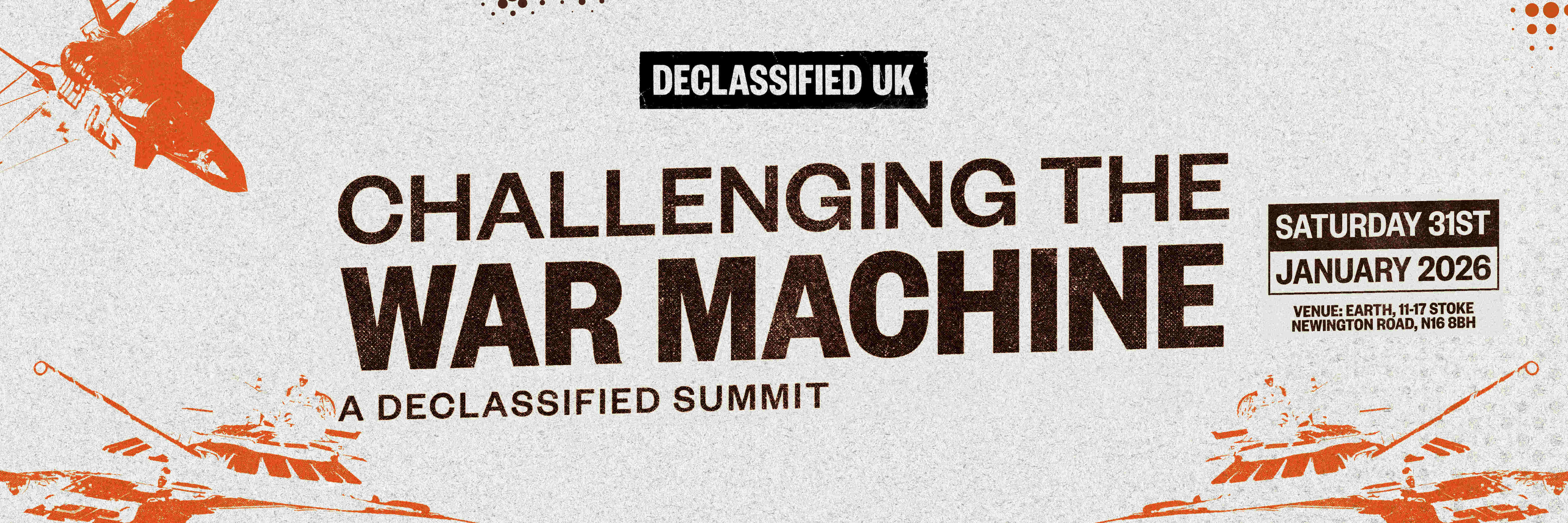
31st January – Challenging the War Machine – a DECLASSIFIED UK SUMMIT


Website of the Week
Now until to February 10, 2026 Radioactive waste storage in France: the debate is finally open! How to participate?
-
Archives
- January 2026 (283)
- December 2025 (358)
- November 2025 (359)
- October 2025 (376)
- September 2025 (258)
- August 2025 (319)
- July 2025 (230)
- June 2025 (348)
- May 2025 (261)
- April 2025 (305)
- March 2025 (319)
- February 2025 (234)
-
Categories
- 1
- 1 NUCLEAR ISSUES
- business and costs
- climate change
- culture and arts
- ENERGY
- environment
- health
- history
- indigenous issues
- Legal
- marketing of nuclear
- media
- opposition to nuclear
- PERSONAL STORIES
- politics
- politics international
- Religion and ethics
- safety
- secrets,lies and civil liberties
- spinbuster
- technology
- Uranium
- wastes
- weapons and war
- Women
- 2 WORLD
- ACTION
- AFRICA
- Atrocities
- AUSTRALIA
- Christina's notes
- Christina's themes
- culture and arts
- Events
- Fuk 2022
- Fuk 2023
- Fukushima 2017
- Fukushima 2018
- fukushima 2019
- Fukushima 2020
- Fukushima 2021
- general
- global warming
- Humour (God we need it)
- Nuclear
- RARE EARTHS
- Reference
- resources – print
- Resources -audiovicual
- Weekly Newsletter
- World
- World Nuclear
- YouTube
-
RSS
Entries RSS
Comments RSS
 nuclear-news