Idle boasts and blatant lies: Debunking Trump’s egregious distortions in Knesset speech
Press TV, 15 October 2025
US President Donald Trump basked in adulation on Monday at the Israeli Knesset, where he was hailed as “the president of peace,” even as regime lawmakers laughed at his jokes, applauded his idle boasts, and rose for more standing ovations than one could count.
Behind the theatrics, Trump’s address was marked by wilful distortion and obfuscation of facts. We identified a series of false or misleading claims on topics ranging from October 7 to the Iranian nuclear program, Hezbollah, US politics, Israel and the self-fashioned mythology he sought to project
Israeli lawmaker Ofer Cassif, who was brutally manhandled and whisked out of the hall for interrupting the speech, captured the day’s irony with biting precision. Writing on Facebook, he remarked:
“During the speech of lies by the war criminal Netanyahu — I preferred to read about the truth.”
He was reading noted Israeli historian Ilan Pappé’s The Ethnic Cleansing of Palestine, a symbolic act of quiet defiance as Trump, Israeli Prime Minister Benjamin Netanyahu, and other masterminds of the genocide in Gaza congratulated each other on killing nearly 70,000 Palestinians over two years.
Trump’s boastful speech unfolded as part show, part sermon, part self-congratulation and blended grandiose claims of “peace” in West Asia with sweeping falsehoods.
He exaggerated ceasefire achievements, distorted economic figures, misrepresented his own diplomatic record, and even belittled serious corruption charges facing Netanyahu.
Fact-checkers worldwide have since flagged his remarks as a performance of fiction than facts.
Here is a breakdown of some of Trump’s most glaring fabrications and distortions from the Knesset podium, including his portrayal of Iran and its nuclear program, his revisionist take on US foreign policy, and his persistent habit of rewriting his own presidency as a miracle of peace.
On Iran
1. “So we dropped 14 bombs on Iran’s key nuclear facilities, totally, as I said originally, obliterating them. That’s been confirmed.”
The Pentagon’s own intelligence assessment contradicts this claim, declaring that US strikes on Iran’s nuclear facilities did not destroy the country’s nuclear program. The June report confirmed that centrifuges remained “largely intact” and the damage was limited to above-ground structures.
2. “Together we stopped the number one state sponsor of terror from obtaining the world’s most dangerous weapons. They would have it in two months or less.”
The annual US intelligence threat assessment report released in March categorically stated that Iran was not building a nuclear weapon, echoing similar reports in the past…………………
3. “They (Iran) want a peace deal. I think they are tired; they want to survive.”
In September, Ayatollah Khamenei rejected Washington’s demands regarding nuclear negotiations.
He warned that talks with the US under current conditions would bring “no benefit” and instead cause “serious and possibly irreparable harms” to the country.
Iran has already denounced Trump’s claims and his offer of friendship, calling them “shameful”, coming just months after a US-Israeli aggression against the country, which killed over a thousand people. https://www.presstv.ir/Detail/2025/10/14/756900/from-idle-boasts-blatant-lies-debunking-trump-egregious-distortions-knesset-speech
Israeli Historian Ilan Pappé: Despite Ceasefire, Palestinians Still Face “Elimination, Genocide”
October 13, 2025, Democracy Now – https://www.youtube.com/watch?v=0VBDIaaryG8
Renowned Israeli historian, author and professor Ilan Pappé discusses the postwar prospects of Palestinian statehood and of Israeli Prime Minister Benjamin Netanyahu, who is under investigation for corruption in Israel and subject to an international arrest warrant from the International Criminal Court. Despite the newly implemented Gaza ceasefire, says Pappé, Israeli political leaders have not changed their policy aim to ethnically cleanse Palestinians from their remaining territory. “Nothing has changed in the dehumanization and the attitude of this particular Israeli government and its belief that it has the power to wipe out Palestine as a nation, as a people and as a country,” he explains. Pappé’s latest book is titled Israel on the Brink: And the Eight Revolutions That Could Lead to Decolonization and Coexistence.
Transcript……………………………..
ILAN PAPPÉ:………………………………………….. I don’t think we are in such an historical moment as President Trump claimed in his speech in the Knesset and beforehand. We are not at the end of the terrible chapter that we have been in it for the last two years. And that chapter is an Israeli attempt by a particularly fanatic, extremely right-wing Israeli government to try and use ethnic cleansing in the West Bank and genocide in Gaza to downsize the number of Palestinians in Palestine and impose Israel’s will in a way that they hope would be at least endorsed by some Arab governments and the world. And so far, they have an alliance of Trump and some extreme right-wing parties in Europe.
And now I hope that the world will not be misled that Israel is now ready to open a different kind of page in its relationship with the Palestinians………………nothing has changed in the dehumanization and the attitude of this particular Israeli government and its belief that it has the power to wipe out Palestine as a nation, as a people and as a country. And I hope the world will not stand by, because up to now it did stand by when the genocide occurred in Palestine………..
…………………………………………….. it is the nature of the Israeli government that was elected in November 2022, this alliance between a very opportunistic politician, who’s only interested in surviving and keeping his position as a prime minister, alongside messianic, neo-Zionist politicians who really believe that God has given them the opportunity to create the Greater Israel, maybe even beyond the borders of Palestine, and, in the process, eliminate Palestinians. I think that his [Netanyahu’s] consideration should all — are always about his chances of survival. …..
………… My greatest worry is that he does believe that his only chance of being reelected is still to have a war going on, either in Gaza or in the West Bank or against Iran or in the north with Lebanon. We are dealing here with a reckless, irresponsible politician, who is even willing to drown his own state in the process of saving his skin and his neck. And the victims will always be, from this adventurous policy, the Palestinians…….
…………………. I do hope that political elites will understand their — especially in the West, their role now is not to mediate between Israelis and Palestinians. Their role now is to protect the Palestinians from destruction, elimination, genocide and ethnic cleansing. ……………………………………………………https://www.democracynow.org/2025/10/13/ilan_pappe_israel_on_the_brink
Nobel Peace Prize winner supports Israel’s genocide & Trump’s war on Venezuela
Nobel Peace Prize laureate María Corina Machado is a far-right Venezuelan coup-plotter funded by the US government. She supports Israel as it commits genocide and is central to Trump’s regime-change war against President Maduro.
By Ben Norton, Geopolitical Economy 13 Oct 25– https://www.youtube.com/watch?v=ks9uDtd7Msc
The 2025 Nobel Peace Prize has been awarded to María Corina Machado, a far-right coup leader in Venezuela who has been funded by the US government for decades.
Machado has openly called for the US military to invade Venezuela, in order to overthrow the revolutionary Chavista government of President Nicolás Maduro.
She is at the heart of the war that Donald Trump has waged on Venezuela. Machado has endorsed the US military’s extrajudicial executions of Venezuelans in boats in international waters, echoing the Trump administration’s unsubstantiated, evidence-free claims that it is supposedly killing “drug traffickers”.
Machado also supports the illegal, unilateral US sanctions that have killed hundreds of thousands of Venezuelans.
Likewise, Machado has expressed staunch support for Israel as it carried out genocide against the Palestinian people in Gaza.
Nobel Peace Prize for war criminals
The fact that a pro-war, far-right coup-plotter like Machado was given a Nobel Peace Prize demonstrates how extremely hypocritical the award is.
This hypocrisy is far from new.
US imperial planner Henry Kissinger was given a so-called Nobel Peace Prize in 1973, despite the fact that he was one of the worst war criminals in modern history, with the blood of millions of victims on his hands, in Vietnam, Cambodia, Laos, Bangladesh, Chile, and beyond.
Former US President Barack Obama also won a so-called Nobel Peace Prize in 2009. His administration then went on to wage nonstop war. Obama bombed seven countries: Afghanistan, Iraq, Libya, Pakistan, Somalia, Syria, and Yemen.
This is by no means the first time that the Norwegian Nobel Committee has been hypocritical. But giving the prize to María Corina Machado is especially outrageous, because it comes precisely at a moment when, one, she has been supporting Israel’s genocide in Gaza; and two, she is working with Donald Trump to wage war and use violence to try to overthrow Venezuela’s government.
María Corina Machado supports Israel’s genocidal regime
Machado has openly praised Israel as it has carried out a genocide against the Palestinian people.
A United Nations commission led by renowned experts on international humanitarian law stated clearly that Israel has committed genocide in Gaza.
In January 2025, Machado held a call with Israel’s Minister of Foreign Affairs Gideon Sa’ar. She expressed her “gratitude to the Ministry of Foreign Affairs of Israel”, adding that she “immensely values the support of the government of Israel”.
The genocidal Israeli regime has refused to recognize the government of Venezuela’s constitutional, internationally recognized President Nicolás Maduro, and has instead recognized US-backed coup leader Edmundo González, who lives in Spain and is a proxy for Machado.
In April 2024, Israel attacked Iran in an act of aggression, and Tehran hit back in self-defense. Machado immediately took to Twitter to condemn Iran. She emphasized her “solidarity with the State of Israel amid the direct aggression by the Iranian regime”………………………………………………………………………………………………………………………………………………………………
María Corina Machado is at the center of Donald Trump’s regime-change war on Venezuela
Giving the so-called Nobel Peace Prize for María Corina Machado is even more outrageous considering that she is at the heart of a war that the US government is currently waging against Venezuela.
Donald Trump has launched multiple military attacks, killing dozens of Venezuelans without charge or trial. In flagrant violation of international law, the US military has repeatedly bombed boats surrounding Venezuela in international waters, claiming without any evidence that they were full of people trafficking “drugs”.
Machado has supported Trump’s attacks on her country, including his extrajudicial executions of Venezuelans without charge or trial.
The Financial Times interviewed Machado, and she admitted that she is working with the US government to try to overthrow Venezuela’s President Maduro……………………………………………………….. https://geopoliticaleconomy.com/2025/10/13/maria-corina-machado-israel-genocide-trump-war-venezuela/
Palestinians freed from Israeli prison denied reunion with families as Trump claims a ‘forever’ peace
At the end of the prisoner exchange, between 9,000 and 10,000 Palestinians will remain behind bars, including around 5,000 Palestinians who are being held without charge or trial, and without clear release dates, under Israel’s system of “administrative detention.”
Palestinians gathered in the West Bank to reunite with loved ones set to be released as part of the prisoner exchange between Israel and Hamas. But many were devastated to learn that Israel had deported them instead.
Mondoweisss, By Qassam Muaddi October 13, 2025
Palestinians in Gaza lived another day without bombs dropping over their heads as the first phase of the ceasefire between Israel and Hamas continued into Monday, which saw the release of Israeli captives from Gaza and the release of 1,718 out of 10,000 Palestinians held in Israeli prisons.
At around 8:00 a.m. local time, Hamas’s armed wing, the al-Qassam Brigades, handed the first group of seven Israeli captives to the International Committee of the Red Cross in Gaza, without any ceremonies or media exposure. The second group of 13 Israeli captives came an hour later. Meanwhile, the Israeli prison services moved hundreds of Palestinians out of its detention centers.
Palestinians in Gaza lived another day without bombs dropping over their heads as the first phase of the ceasefire between Israel and Hamas continued into Monday, which saw the release of Israeli captives from Gaza and the release of 1,718 out of 10,000 Palestinians held in Israeli prisons.
At around 8:00 a.m. local time, Hamas’s armed wing, the al-Qassam Brigades, handed the first group of seven Israeli captives to the International Committee of the Red Cross in Gaza, without any ceremonies or media exposure. The second group of 13 Israeli captives came an hour later. Meanwhile, the Israeli prison services moved hundreds of Palestinians out of its detention centers.
A total of 1,718 Palestinians were released into the Gaza Strip, all of whom were abducted by Israeli forces from within Gaza during the past two years. In addition, Israel released 250 Palestinians who had been serving high or life sentences in Israeli prisons, 88 of whom were released in the West Bank, while the rest were deported to Gaza and Egypt.
In the town of Beitunia, adjacent to Ramallah, dozens of Palestinians gathered in expectation of the released prisoners, who were announced to be released from Israel’s Ofer detention center just outside of the town. Israeli drones flew over the gathering, dropping leaflets that read “we are watching you everywhere. If you show any support for a terrorist group, you will expose yourself to arrest and punishment.”
At around 11:00 a.m., two Red Cross-marked buses drove through Beitunia as Palestinians waved at the released prisoners along the way, in decidedly smaller numbers than the crowds that had received released prisoners during the previous January-March ceasefire.
At the Ramallah Cultural Palace, prisoners’ families and crowds of Palestinians gathered to receive the released prisoners. In the crowds, the family of a prisoner, Murad Abu al-Rub, 45, including two of his sisters, his cousin, and his paralyzed mother, stood on a sidewalk trying with difficulty to get a glimpse of the Red Cross buses as they arrived.
“He has been in jail for 19 years with a life sentence, and the last time we visited him was before October 2023,” the cousin told Mondoweiss. “For more than two years, we haven’t seen him, and the news we have had about him through lawyers is very limited.”
“His father and one of his brothers died during his time in jail,” the cousin explained. “And his mother suffered a stroke last year that left her unable to move or speak. But we brought her because she has been very anxious to see him.”
The family left Jenin in the northern West Bank at 6 a.m. to avoid the Israeli army’s expected road closures, as it did during the previous ceasefire. “The Israeli Shabak came to our house yesterday and warned us not to show any signs of celebration, and they told us that Murad will be released here.”
After all the prisoners left the bus, the family discovered that Murad wasn’t among them. Minutes later, they received confirmation from the Red Cross that he had been deported to Egypt.
As the cousin shared the news, the elderly mother broke into tears and random screams in her wheelchair. As her daughters helped her into the car, one of them tried to console her. “He went to Egypt to study! He’ll be back later,” she said. The mother moved her hand in an apparent refusal to hear, continuing to weep.
Meters away, the older brother of Abdallah Barham, 40, one of the prisoners set to be released, had just learned that he, too, had been deported. The brother was in Ramallah by 7 a.m. to wait for Abdallah, who had served 18 years of his life sentence in Israeli prison.
“The family and the entire village are waiting in Kufr Qadoum to celebrate his release,” he explained. “And the Shabak came yesterday and warned us not to celebrate.”
“Our younger brother and our mother died during his period of imprisonment,” he continued. “And our father has been waiting for this day for the past 18 years. The feeling is tragic.” ………………………………………………………………………………..
At the end of the prisoner exchange, between 9,000 and 10,000 Palestinians will remain behind bars, including around 5,000 Palestinians who are being held without charge or trial, and without clear release dates, under Israel’s system of “administrative detention.”……………………………….
Donald Trump speaks before the Knesset, Sharm al-Sheikh summit
……………………………………. In his speech, Trump said it was a “historic dawn of a new Middle East” and the beginning of a “grand concord and lasting harmony for Israel.” Trump praised Netanyahu, whom he called “hard to deal with.” The U.S. President also lauded special envoy Steve Witkoff and his son-in-law, Jared Kushner, whom he said was “called in” to draft the plan for the end of the war, all with a wave of applause by the Knesset members. Trump also thanked the Arab and Muslim countries that participated in his plan for the end of the war, which did not receive any applause from the Knesset.
During Trump’s speech, Palestinian Knesset member Ayman Odeh and left-wing anti-Zionist Knesset member Ofer Kasif raised signs calling for the recognition of Palestine as a state, and were forcibly removed from the hall
…………………………………………………………… Israel and Hamas still have to negotiate terms for the definitive end to the war based on Trump’s plan. This includes the body meant to rule over the Strip, which Hamas and Palestinian factions insist must be an independent Palestinian body of technocrats. In contrast, Trump’s plan would include a “board of peace” headed by Trump himself that would be in charge of running Gaza.
Another point to be negotiated is the disarmament of Hamas and other Palestinian resistance factions. Palestinian factions, including Hamas, insist that they would lay down their arms upon the establishment of a Palestinian state, while Trump’s plan would see the resistance movement’s disarmament and makes no mention of Palestinian statehood. https://mondoweiss.net/2025/10/palestinians-freed-from-israeli-prison-denied-reunion-with-families-as-trump-claims-a-forever-peace/
The UN nuclear watchdog seeks a local truce to restore power to the Zaporizhzhia plant
By ASSOCIATED PRESS, 14 October 2025
VIENNA (AP) – The U.N. nuclear watchdog is pushing Ukraine and Russia to agree to local ceasefires so that external power can be restored to Ukraine´s huge nuclear power plant in Zaporizhzhia, two diplomats familiar with the plan told The Associated Press.
The plant is in an area under Russian control since early in Moscow’s full-scale invasion of Ukraine and is not in service, but it needs reliable power to cool its six shutdown reactors and spent fuel, to avoid any catastrophic nuclear incidents.
It has been operating on diesel generators since Sept. 23 when its last remaining external power line was severed in attacks that each side blamed on the other. The International Atomic Energy Agency has repeatedly expressed alarm about the nuclear plant, Europe’s biggest.
The agency is proposing to restore external power to the plant in two phases, according to a European diplomat briefed on the proposal by the IAEA Director General Rafael Grossi. A Russian diplomat confirmed some aspects of the plan.
Both diplomats spoke on condition of anonymity because they were not authorized to discuss the confidential negotiations publicly.
During the first phase, a 1.5-kilometer-radius (1-mile-radius) ceasefire zone would be established to allow repair of the Dniprovska 750-kilovolt line, the main power line to the plant that has been damaged in an area under Russian control.
During the second phase, a second such ceasefire zone would be established to repair the Ferosplavna-1 330-kilovolt backup line, which is in area under Ukraine’s control.
IAEA experts would be on hand to monitor the repairs, which originally were proposed for a 7-day period from Oct. 11 to Oct. 17, according to the European diplomat and confidential documents seen by the AP.
However, although the Ukrainian side has given necessary guarantees of safe passage for repair crews, Russia did not give such guarantees in time for the work to start under that timetable, according to the European diplomat.
The Russian diplomat, on the other hand, said that preparations for the repairs are under way and that they can start very soon.
The IAEA declined to comment on the timing, saying only that Grossi was engaging “intensively with both sides” to enable the reconnection of power and to “help prevent a nuclear accident.”
Grossi held talks with both Ukraine and Russia last month. He met with Ukrainian Foreign Minister Andrii Sybiha on Sept. 29 at the Warsaw Security Forum, following meetings in Moscow with Russian President Vladimir Putin on Sept. 25 and Rosatom Director General Alexei Likhachev on Sept. 26.
The IAEA warned that if diesel generators fail, “it could lead to a complete blackout and possibly causing an accident with the fuel melting and a potential radiation release into the environment, if power could not be restored in time.”
The latest blackout is the tenth time that the Zaporizhzhia plant has lost all external power, and is by far the longest since the start of the war. The 330-kilovolt backup line was lost in May, and the main line was disconnected on Sept. 23.
The plant is close to the front line and has been occupied by Russia since March 2022. Ukraine and Russia have traded blame for shelling close to the plant……. https://www.dailymail.co.uk/wires/ap/article-15188795/The-UN-nuclear-watchdog-seeks-local-truce-restore-power-Zaporizhzhia-plant.html
Trump Keeps Admitting That He Is Bought And Owned By The World’s Richest Israeli
Caitlin Johnstone, Oct 14, 2025, https://www.caitlinjohnst.one/p/trump-keeps-admitting-that-he-is?utm_source=post-email-title&publication_id=82124&post_id=176098622&utm_campaign=email-post-title&isFreemail=true&r=1ise1&triedRedirect=true&utm_medium=email
It’s bizarre how little mainstream attention is given to the fact that the president of the United States has repeatedly confessed to being bought and owned by the world’s richest Israeli, especially given how intensely fixated his political opposition was on the possibility that he was compromised by a foreign government during his first term.
During a speech before the Israeli parliament on Monday, President Trump once again publicly admitted that he has implemented Israel-friendly policies at the behest of Israeli-American billionaire Miriam Adelson and her late husband Sheldon, this time adding that he believes Adelson favors Israel over the United States.
Here’s a transcript of Trump’s remarks:
“As president, I terminated the disastrous Iran nuclear deal, and ultimately, I terminated Iran’s nuclear program with things called B2 bombers. It was swift and it was accurate, and it was a military beauty. I authorized the spending of billions of dollars, which went to Israel’s defense, as you know. And after years of broken promises from many other American presidents — you know that they kept promising — I never understood it until I got there. There was a lot of pressure put on these presidents. It was put on me, too, but I didn’t yield to the pressure. But every president for decades said, ‘We’re going to do it.’ The difference is I kept my promise and officially recognized the capital of Israel and moved the American Embassy to Jerusalem.
“Isn’t that right Miriam? Look at Miriam. She’s back there. Stand up. Miriam and Sheldon [Adelson] would come into the office and call me. They’d call me — I think they had more trips to the White House than anybody else, I guess. Look at her sitting there so innocently — got $60 billion in the bank, $60 billion. And she loves, and she, I think she said, ‘No, more.’ And she loves Israel, but she loves it. And they would come in. And her husband was a very aggressive man, but I loved him. It was a very aggressive, very supportive of me. And he’d call up, ‘Can I come over and see you? I’d say ‘Sheldon, I’m the president of the United States. It doesn’t work that way.’ He’d come in. But they were very responsible for so much, including getting me thinking about Golan Heights, which is probably one of the greatest things ever happened. Miriam, stand up, please She really is, I mean, she loves this country. She loves this country. Her and her husband are so incredible. We miss him so dearly. But I actually asked her, I’m going to get her in trouble with this. But I actually asked her once, I said, ‘So Miriam, I know you love Israel. What do you love more? The United States or Israel?’ She refused to answer. That means — that might mean Israel, I must say, we love you. Thank you, darling, for being here. That’s a great honor. Great honor. She’s a wonderful woman. She is a great woman.”
Sheldon Adelson reportedly gave Trump and the Republicans over $424 million in campaign funding from 2016 up until his death in 2021. His widow Miriam continued her husband’s legacy and poured a further $100 million into Trump’s 2024 presidential campaign.
On the 2024 campaign trail Trump also admitted to being controlled by Adelson cash. Here’s a transcript of those remarks:
“Just as I promised, I recognize Israel’s eternal capital and opened the American embassy in Jerusalem. Jerusalem became the capital. I also recognized Israeli sovereignty over the Golan Heights.
“You know, Miriam and Sheldon would come into the White House probably almost more than anybody outside of people that work there. And they were always after — and as soon as I’d give them something — always for Israel. As soon as I’d give them something, they’d want something else. I’d say, ‘Give me a couple of weeks, will you, please?’ But I gave them the Golan Heights, and they never even asked for it.
“You know, for 72 years they’ve been trying to do the Golan Heights, right? And even Sheldon didn’t have the nerve. But I said, ‘You know what?’ I said to David Friedman, ‘Give me a quick lesson, like five minutes or less on the Golan Heights.’ And he did. And I said, ‘Let’s do it.’ We got it done in about 15 minutes, right?”
Legitimizing Israel’s illegal annexation of the Golan Heights and moving the US embassy from Tel Aviv to Jerusalem were two of the most controversial moves Trump made in Israel’s favor during his first term, which have now been eclipsed by his backing the genocide in Gaza and his bombings of Iran and Yemen.
And here is his, openly admitting that his billionaire Zionist megadonors have been using the access their donations bought them to push him to take drastic action in favor of Israel.
Just imagine for a second if someone had leaked documents to the press proving that Trump and received extensive financial backing from a Russian oligarch to whom he doled out favors of immense geopolitical consequence. It would be the biggest scandal in the history of American politics, bar none. But because it’s an Israeli oligarch, he can admit to it openly and repeatedly without anyone batting an eye.
During Trump’s first term his political rivals spent years pushing a bogus conspiracy theory that he was controlled by Vladimir Putin, despite his having spent that entire term aggressively ramping up cold war hostilities against Russia. Entire political punditry careers were birthed trying to create a scandal out of a narrative that could be plainly seen as false just by looking at the movements of the US war machine and Washington’s actions against Moscow.
But here’s Trump openly admitting to bending over backwards to give an Israeli oligarch whatever she wants because she gave his campaign huge sums of money, while pouring weapons into Israel to facilitate its mass atrocities and engaging in acts of war on Israel’s behalf. And it barely makes a blip in mainstream western politics or media.
This is because mainstream western politics and media understand that we are living in an unofficial oligarchic empire to which both the US and Israel belong. They never acknowledge it, they never talk about it, but all high-level politicians, pundits and operatives in the western world understand that they serve a globe-spanning power structure run by a loose alliance of plutocrats and empire managers. They understand that states like Israel are a part of said power structure, while states like Russia, China and Iran are not. So they spend their time normalizing the corruption and abuses of imperial member states while facilitating the empire’s efforts to attack and undermine the states which have successfully resisted being absorbed into the imperial power umbrella.
I’ve said it before and I’ll say it again, the only thing I like about Donald Trump is his infantile tendency to say the quiet part out loud. He advances the same kinds of abuses as his predecessors who were no less corrupt and controlled, but he exposes the underlying mechanics of those abuses in ways that more refined presidents never would.
Democratic lawmakers request probe into Jared Kushner after Reuters Saudi report

By Aram Roston and Alexandra Ulmer, October 25, 2024
- Summary
- Wyden and Raskin request special counsel to investigate Kushner
- Concerns over Kushner’s influence on U.S. foreign policy and potential conflicts of interest
WASHINGTON, Oct 24 (Reuters) – The Democratic chair of the U.S. Senate Finance Committee and a prominent Democratic congressman asked the U.S. attorney general on Thursday to appoint a special counsel to investigate whether Jared Kushner, former President Donald Trump’s son-in-law, was functioning as an unregistered foreign agent for Saudi Arabia, according to a letter from the lawmakers.
The letter from U.S. Senator Ron Wyden and U.S. Representative Jamie Raskin cited an Oct. 4 Reuters report that revealed that Kushner on multiple occasions had discussed U.S.-Saudi diplomacy concerning Israel with Saudi Arabia’s de facto ruler, Crown Prince Mohammed bin Salman, since leaving government.
“This revelation is deeply disturbing, as Mr. Kushner appears to be influencing U.S. foreign policy by acting as a political consultant to the Saudi government while also accepting their money,” Wyden and Raskin wrote in the eight-page letter to Attorney General Merrick Garland. The letter has not been previously reported.
“Mr. Kushner’s proximity to President Trump and the potential for political interference warrants the appointment of a Special Counsel,” the letter added.
Saudi Arabia has invested $2 billion into a private equity fund, Affinity Partners, that Kushner, who was a top adviser on the Middle East during Trump’s administration, founded in 2021 after leaving government, according to congressional investigators………………………
The Department of Justice acknowledged receipt of the letter but declined further comment.
The Saudi Arabian embassy did not immediately respond to requests for comment.
Saudi Arabia’s investments in Kushner’s fund have been criticized by ethics experts, Democrats in Congress and some Republicans, who have expressed concern that Saudi Arabia’s stake can look like a payoff since Kushner worked on Saudi issues before leaving Trump’s White House.
“There is substantial reason to believe,” the letter wrote, “that the Saudi government’s decision to engage Affinity for investment advice is a fig leaf for funneling money directly to Mr. Kushner and his wife, Ivanka Trump.”……………………………………..https://www.reuters.com/world/us/democratic-lawmakers-request-probe-into-trump-son-in-law-after-reuters-saudi-2024-10-24/
Putin and Trump, between the war of deadly Tomahawks and the peace of disarmament “START 3”.

by Alfredo Jalife-Rahme, Translation, Maria Poumier
Source La Jornada (Mexico) The world’s largest Spanish-language daily newspaper. Voltaire Network | Mexico City (Mexico)
| October 11, 2025, https://www.voltairenet.org/article222961.html
Donald Trump and Vladimir Putin are trying, against the instincts of their administrations, to end the confrontation between their two countries since the Cold War. The American president is balancing threats and peace proposals, while his Russian counterpart is showing patience. Will the two men succeed in freeing their countries from the trap they have built for eighty years and which is closing in on them?
The relationship between Putin and Trump has reached a turning point that will decide between war and peace, between the two greatest nuclear superpowers in the Milky Way [ 1 ] . Catholic Vice President JD Vance told FoxNews Sunday that “the United States is reviewing Ukraine’s request for long-range Tomahawk missiles” that would strike deep into Russian territory. The young millennial vice president added that President Trump would make the “final decision
On the other hand, retired General Keith Kellogg, 81, Trump’s special envoy to Ukraine, has byzantinely declared that Russia—against all tangible evidence on the battlefield where Ukraine is currently being thrashed—”lost the war” because “it failed to destroy Ukraine [ 3 ] .” It should be noted that General Kellogg’s daughter is addicted to the illegitimate regime of Khazarian comedian Zelensky, who is also delusional, trying to make people believe that he is “winning the war.”
If Ukraine, a vassal of NATO and the European Union, was indeed “winning the war,” why would it need the help of the fearsome Tomahawks, which can carry US-NATO nuclear weapons? At the same time, the genocidal Netanyahu is planning to deliver Patriot defense systems to his Khazarian coreligionist in kyiv….
Russian philosopher and geopolitician Alexander Dugin claims that “delivering the Tomahawks to Kiev would be a pure disaster” that “would irreversibly damage Russian-American relations”: the “neoconservatives’ dream would be to drag the United States into a third world war
[ 4 ] “, which would tragically be nuclear in nature.
Contrary to the drums of war that are sounding more forcefully within the European NATO countries, President Putin, during his participation in the plenary meeting of the Valdai Club in Sochi, invited Trump to “peaceful coexistence [ 5 ] “.
Regarding the hypothetical delivery to Ukraine of deadly Tomahawk missiles—with a range of 2,500 kilometers and a cost of $1.3 million each, capable of reaching Moscow and beyond—Putin said that this would not change the irreversible course of the war, which is now favorable to Moscow, but that it would constitute “a new step in the escalation,” because Ukraine cannot use these sophisticated missiles without the control of the US military.
India ‘s Economic Times speculates that “the US is unlikely to send Tomahawk missiles to Ukraine” because “it faces obstacles related to stockpiles committed to its navy operations.” This appears to be a Trump-like bargaining chip.
Since last year, the neoliberal think tank American Enterprise Institute (AEI) has denounced the sharp decline in the number of these deadly US missiles, already widely used in Yemen against the Ansar Allah guerrillas
[ 6 ] .
China ‘s Global Times highlights Putin’s warning about delivering Tomahawks to Ukraine, as the Russian president “praised U.S. President Donald Trump’s efforts to help broker peace in Ukraine,” calling his August summit in Alaska “productive,” while “reiterating Russia’s confidence in its nuclear shield. ” [ 7 ]
Putin told members of the Russian Security Council that “Moscow will respect the limits set on nuclear weapons for one more year, after the expiration on February 5, 2026, of the “START 3” nuclear treaty (Treaty on the Reduction of Strategic Nuclear Arms) with the United States [ 8 ] . Trump responded that Putin’s nuclear proposal was “a good idea” [ 9 ] .
The world is anxiously awaiting Trump’s final decision on the Tomahawks, a decision he appears to have already made, but which he will keep secret until he deems the time opportune [ 10 ] , while waging a veritable “civil war” from Oregon to Illinois against what he calls the terrorist group Antifa, financed by George Soros and his son Alex.
References ……………………………………………………………………………..
Israeli Soldiers Torched Food, Homes, and a Critical Sewage Treatment Plant in the Wake of Ceasefire Announcement
Soldiers called the mass arson of Gaza City their “final touches.”
Drop Site, Younis Tirawi and Yaniv Cogan, Oct 13, 2025
In the immediate aftermath of Donald Trump’s announcement on Thursday that both Hamas and Israel had signed off on an agreement to stop the fighting, the Israeli military launched an arson spree, setting fire to civilian infrastructure, including the destruction of an essential sanitation plant in Gaza City. After publication, the Israel Defense Forces told Drop Site it “is aware of the incident and it is being reviewed.”
The destruction of Palestinian structures following the departure of soldiers who had used them as temporary bases has been a hallmark of Israel’s approach to Gaza for two years. In July, Israeli reporter Yuval Abraham collected testimonies from soldiers describing a myriad of arson methods. “Every Arab house we entered had olive oil […] We poured the oil on the sofas, on anything flammable in the apartment, and then we ignited [it] or threw in a smoke grenade. This was a common practice,” one of them described.
The agreement came after months of a concerted effort to render Gaza uninhabitable by destroying residences and civilian infrastructure, culminating in the ground invasion of Gaza City and the leveling of several high rises in Gaza City. In September, Israeli government minister Gila Gamliel told Channel 7 News, “We have already completely annihilated 75% of the entire [Gaza] Strip. There remains 25%, which, as you know, it too…we are now taking over [the city of] Gaza—there will be nothing left there that would really [have] the potential to be habitable.”
The scope of the arson perpetrated in Gaza City on the night of October 9th and early morning of October 10—Thursday night into Friday, just after the ceasefire was agreed to but before Israel’s cabinet approved it—was broader than at any other time Drop Site has tracked during the assault on the strip. …………………………………………………………………………………………………………………….
The Torching of Gaza City’s Sewage Treatment Plant: “[One] last memory”……………………………………………………………………………………………
Mass Arson Campaign Around Sheikh Radwan Market, Gaza City……………………………………………………………………………………………..
Burning Homes Across Gaza City Israeli troops also shared photos of torched houses in other locations accompanied by captions musing about the arson. One soldier dubbed the burning of several buildings the “finishing touches.”……………………………………………………………………………………..
As the ceasefire takes hold, Gaza has already been rendered largely uninhabitable. One Israeli colonel recently bragged to the Israeli media, “We are leaving behind us only dust. There’s nothing here.” For officials like Gamliel, who have expressed satisfaction with the level of destruction in Gaza, the upshot is clear:
“Look at the hypocrisy of all European countries. They constantly go ‘starvation, starvation’ Well…? Open [your] doors! Why, when it was about Ukraine, it was fine, when it was about Syria, it was fine. When it comes to the Palestinians, they want to perpetuate this conflict structurally.
Now, just for your information: one million and seven hundred thousand inside the Gaza Strip are defined as UNRWA refugees. Meaning, once they get out of there, they are not coming back! Because as refugees, this is not the place where they actually have the right of basic belonging.” https://www.dropsitenews.com/p/israel-idf-soldiers-set-fire-food-homes-sewage-treatment-plan-after-ceasefire-announced
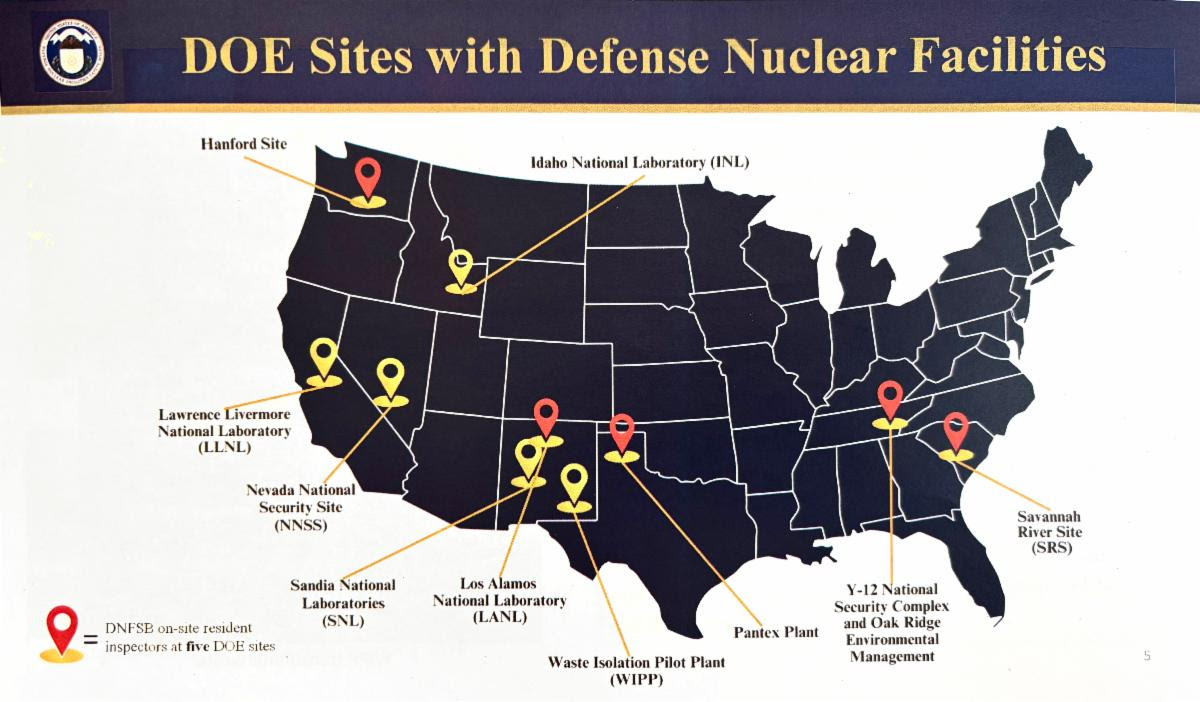
URGENT ACTION NEEDED to Help Protect the Defense Nuclear Facilities Safety Board!
Nuclear Watch, Jay Coghlan, Executive Director, Scott Kovac, Research Director, Sophie Stroud, Digital Content Manager and Youth Specialist, 13 Oct 25
| The government is still shut down (unfortunately). But it does mean there’s still time to ask Congress to get a provision in the pending Continuing Resolution to keep the government running that will help save the Defense Nuclear Facilities Safety Board (DNFSB). |
Background: The Defense Nuclear Facilities Safety Board is an independent agency within the executive branch of the Federal Government. The DNFSB is chartered with the responsibility to provide recommendations and advice to the Secretary of Energy regarding public health and safety issues at Department of Energy (DOE) nuclear weapons facilities, including with the health and safety of employees, contractors, and nearby communities (for more see www.dnfsb.gov).
Congress established the Board in 1988 in response to increasing reports of nuclear safety risks impacting workers and the public. Since early this year, the Board has been reduced to just two Members out of five, with a temporary one-year statutory bridge to constitute a quorum that is drawing to a close. In addition, the current Acting Chairman’s term expires this October 18, ending the Board’s functioning quorum. Without it, the DNFSB cannot effectively carry out its critical nuclear safety oversight mission. The public would simply not know about the DOE’s chronic nuclear safety problems without the Board. This is critically important today given expanding production of nuclear weapons.
| Specific request: There should be a provision in any Continuing Resolution for FY 2026 that would temporarily extend the authority of the Defense Nuclear Facilities Safety Board by allowing the Acting Chair to serve until the end of January 2027. The overriding purpose is to enable the Safety Board to fully continue operations and provide more time for the President to nominate, and the Senate to confirm, new Safety Board Members. |
| Congress must take action to protect nuclear safety by preserving DNFSB’s quorum! |
Contact Senator Martin Heinrich through his official website, his Washington, D.C. office, or any of his New Mexico State offices:…………………………………………………………
Contact Senator Ben Ray Luján through his official website, his Washington, D.C. office, or any of his New Mexico State offices:………………………………………………….
Contact Senator John Thune through his official website, his Washington, D.C. office, or any of his South Dakota State offices:…………………………………………….
Contact Senator Chuck Schumer through his official website, his Washington, D.C. office, or any of his New York State offices:……………………………………………. https://nukewatch.org/action-item/urgent-action-needed-to-help-protect-the-defense-nuclear-facilities-safety-board/
The Troubling Data on Data Centers

Below is an extract from a pro nuclear article. It was rather subtly pro-nuclear. But I decided not to give its rather dubious pro nuclear arguments any publicity on this ste.
One example – the author praises the “cheapness” of France’s nationalised nuclear power, ignoring its downside of debt and climate-accelerated shutdowns.
Nuclear Is Here To Save AI. But What About Your Energy Bills? October 12, 2025, Brian Boyle, The Daily Upside
A nuclear boom is directly downstream from the AI boom, with $350 billion in nuclear spending in the US planned by 2050, per Bloomberg.
The artificial intelligence revolution is officially upon us. If the abrupt improvement in your co-worker’s email grammar didn’t tip you off, the drastic increase in your power bill is a hard-to-miss clue. (And if your bill hasn’t changed much yet, consider yourself lucky.)
As the massive, power-hungry data centers that power AI’s expansion come online, they’re competing for power with everyone else. That’s driving up energy bills for industry and consumers alike, while testing the limits of US energy production capacity and stressing an aging power grid.
Silicon Valley has a solution: nuclear energy. Big Tech is investing heavily in the long-shunned (in the US, at least) energy source to power its AI moment, mostly in the form of so-called small nuclear reactors (SMRs), the next-gen version of nuclear tech that can (theoretically) be mass-produced and strategically deployed. (For the uninitiated, it might be helpful to think of SMRs as gas generators on radioactive steroids.) Now, a nuclear boom is directly downstream from the AI boom: According to a recent Bloomberg Intelligence report, soaring power demand from AI will spur $350 billion in nuclear spending in the US by 2050.
The US government, which views dominance in the AI sphere as crucial to continued economic and geopolitical dominance around the globe, is entirely on board. In a rare instance of bipartisan consensus, both the current and previous administrations have moved fast to cut red tape, overhaul oversight processes, and pour capital into the resurgent nuclear industry.
“We’re in a very serious bind. We’ve already tapped out traditional oil and gas technologies. There’s an eight-, nine-year queue for diesel generators, the most expensive form of energy, and now also gas turbines,” Kevin Kong, founder and CEO of AI-driven nuclear compliance platform Everstar, told The Daily Upside. “Renewables are not dense enough … Data centers run 24/7, and are extremely power-dense. And so the only technology that’s left that was overlooked and under-invested in is nuclear.”
In other words, if we’re going to have an AI revolution, we’ll need plenty of nukes. But will the industry insulate Americans from rising energy bills? Maybe.
The Troubling Data on Data Centers
For years, experts had estimated energy demand growth in the years and decades to come based on banal drivers such as population growth, economic expansion and development of emerging economies, as well as the electrification of everything, including major industries like manufacturing and transportation. It would be predictable and hence manageable, they believed.
Then came ChatGPT. Now? Most estimates predict that global energy demand will nearly double by 2050. A recent report from the International Energy Agency (IEA) found that over 50% of that growth will be driven by AI expansion. For example, a ChatGPT query requires roughly 10 times the energy, on average, needed for a Google search. To put it in even starker perspective, the IEA estimates that a typical AI-focused data center consumes as much electricity as 100,000 homes, while the largest such data centers consume 20 times that amount.
According to a recent Goldman Sachs report, data center power demand is expected to increase 160% by 2030 alone, and meeting 60% of that demand will require new energy generation capacity. Meanwhile, a report produced by Lawrence Berkeley National Laboratory and published by the Department of Energy estimates that data centers will consume more than 12% of total US electricity by 2028, up from 4.4% in 2023.
The triple-digit growth figures are already having a triple-digit impact on those suddenly, and sometimes unwillingly, competing with data centers for electricity. According to a recent Bloomberg analysis of energy data, monthly electricity costs in areas near data centers are now 267% higher than just five years ago, at the dawn of the AI age (that compares with a cumulative overall inflation rate of about 25%).
“Without mitigation, the data centers sucking up all the load is going to make things really expensive for the rest of Americans,” said David Crane, chief executive officer of Generate Capital…………………………………………………………………………………………………..
One Bubble After Another: While SMRs are likely to deliver consistent energy supplies to massive data centers, a valuable proposition in its own right, not everyone is convinced it will be delivered cheaply.
According to data from Wood Mackenzie recently seen by the Financial Times, the “levelised cost of energy” for SMRs, or the cost for power that should be charged for the project to break even, will be around $182 per megawatt hour in 2030. That compares to $133 per megawatt-hour from traditional nuclear power plants, such as Vogtle, $126 for natural gas, and even less for wind and solar. https://www.thedailyupside.com/technology/artificial-intelligence/nuclear-is-here-to-save-ai-but-what-about-your-energy-bills/
Worlds Extinguished: Hostage Returns, Central Casting and the Gaza Ceasefire
14 October 2025 Dr Binoy Kampmark, https://theaimn.net/worlds-extinguished-hostage-returns-central-casting-and-the-gaza-ceasefire/
Depending on which source you consult, the twenty-point peace plan of President Donald Trump for securing peace in Gaza shows much exultance and extravagant omission. The exultance was initially focused on the return of the hostages. It then shifted to the broader strategic goals of the various parties. Commentary on this point, even as the living Israeli hostages convalescence after their exchange for Palestinian detainees, sidesteps the Palestinian people, those fly in the ointment irritants who never seem to exit the political scene.
The peace plan, in effect, is being executed to eliminate Hamas and any semblance of a Palestinian militant movement in favour of an Israel-Arab-US axis of preferment and normalisation. Doing so puts a firm lid on Palestinian sovereignty and statehood in favour of sounder relations between Israel and the Arab states.
Consider, for instance, the views from the American Jewish Committee in their October 10 assessment. “President Trump’s unconventional approach created new diplomatic realities and forced Israel and key Arab states to align in new ways.” The peace plan was “the most credible framework to date for advancing Israeli-Arab peace, creating new opportunities for regional engagement, and countering Hamas’ ideology through a united alliance of Israel and Arab nations committed to peace, security, and prosperity.” Clearly, Palestinians are, if not footnotes, then invisible ink lines in such arrangements.
This attitude is also echoed in remarks made by the US Vice President, J.D. Vance. Palestinian subservience is assumed in any new proposed arrangement which prioritises Israeli security and a collective of overseeing nation states that will guard against any mischief in the Strip. “The President convinced the entire Muslim world really, both the Gulf Arab states, but as far as South-East Asia as Indonesia, to really step up and provide ground troops so that Gaza could be secured in safety.”
Egyptian Foreign Minister Badr Abdelatty gave some sense of what is expected. “We are going to support and commit troops within specific parameters,” he told CBS. A UN Security Council mandate would be required, along with clear specifications for what the mission of the troops on the ground would be, “which will be peacekeeping and providing training to Palestinian police.”
Trump’s near cinematic appearance on October 13 in the compact, claustrophobic Knesset after the handover of the hostages set the scene for Israeli grandstanding, staged mawkishness and denial. Netanyahu was in typical form, accusing Israel’s friends of blood libel stupidity for recognising Palestine; in doing so, they had effectively committed acts of antisemitism, buying “into Hamas’s false propaganda.” Massacring and starving those in the Gaza Strip warranted no mention, but disarming Hamas and demilitarising the enclave did. With praise for both himself and Trump, Netanyahu spoke of jointly forging “a path to bring the remaining hostages home and end the war. End a war in a way that ensures the disarming of Hamas, the demilitarisation of Gaza, and that Gaza would never again pose a threat to Israel.”
He also thanked Trump for “fully” backing the decision to make the last murderous assault into Gaza City. This “military pressure” provided momentum that eventually saw Hamas capitulate. The US President then “succeeded in doing something that no one believed was possible. You brought most of the Arab world, you did, you brought most of the world behind your proposal to free the hostages and end the war.”
Opposition leader Yair Lapid, for his part, explicitly denied any genocide or “intentional starvation” of the Palestinians, then proceeded to overlook them in calling on “all the nations of the Islamic world” to engage Israel.
Trump’s own speech was meandering, personal and free of complex turns. He spoke about his envoy Steve Witkoff as a Henry Kissinger who did not leak, an emissary of singular genius. An interruption by Hadash lawmakers Ayman Odeh and Ofer Cassif, both demanding that Palestine be recognised, did not faze him. And then came mention of theUkraine War, and Russian President Vladimir Putin and more adulatory remarks for the US delegates who have paid homage to the US God King. They were all part of “central casting.”
Not a sliver of reference to the Palestinian cause for sovereignty made an appearance, which continues to moan under the strategic expediency of it all, the residents of Gaza doomed to indefinite invigilation at the hands of Trump’s “Board of Peace.” More to the point, he was happy to admit providing weapons at the request of “Bibi” at a moment’s notice. The US made “the best weapons in the world, and we’ve given a lot to Israel, … and you used them well.” But the slaughter could not continue, and the Israeli PM would be remembered “far more” for accepting the peace agreement. “The timing for this is brilliant. I said, ‘Bibi you’re going to be remembered for this far more than if you kept this thing going, going, going, kill, kill, kill.’”
The Palestinians, granted brief respite from military violence, will be desperately wary. When Lapid mentioned that Trump had “saved far more than one life, and life is an entire world,” it can also be assumed that killing one life kills a world. Some 68,000 Palestinian worlds (a conservative estimate) were extinguished by the munitions and weapons of Israel and its backers. As humanitarian workers return to Gaza, they see the horrors of a lunarscape of devastation. If only Trump had considered paying a visit to that particular part of earth.
Could Trump’s peace capsize the undead British Empire?
Peace in the Middle East and the defeat in Ukraine will prove extremely embarrassing for Britain.
Alex Krainer, Oct 14, 2025, https://alexkrainer.substack.com/p/could-trumps-peace-capsize-the-undead?utm_source=post-email-title&publication_id=1063805&post_id=176048481&utm_campaign=email-post-title&isFreemail=true&r=1ise1&triedRedirect=true&utm_medium=email
It’s only been four days since the Israeli cabinet approved Donald Trump’s Middle Eastern peace deal. In spite of much entrenched pessimism and incidents like the suspicious death of four Qatari negotiators in Egypt, so far the regional players have taken the deal seriously and it seems that their commitment is for real. My hunch, which I shared in Friday’s TrendCompass report, was that this development could turn out to be a “massive defeat for the Empire,” and that if the peace holds “the implications for the region would be nothing short of massive.”
Apart from repurposing the region’s “unsinkable aircraft carrier,” which could complicate the Empire’s efforts in prevention of peace, it seems that Trump has now wrested the loyalty of states like Qatar, Egypt and Saudi Arabia away from the Empire. Here’s what I mean by that: it is important for us not to regard the United States as a monolith. By “the Empire” I’m referring to the City of London with its satellites on Wall Street, in Paris, Frankfurt, Basel, Tokyo, etc. Also, its lackeys in the British government along with the American Neocons Jake Sullivan, Victoria Nuland and Antony Blinken. It also includes the Empire’s minions staffing the key positions in the EU and NATO.
I believe that President Trump and his government (some of them at least), are NOT part of this imperial cabal. Of course, it is possible, as some say, that Trump is “controlled opposition” and that we’re witnessing an elaborate deception. However, I believe that this is unlikely. Such deception would be needless and overly elaborate; I can’t imagine why keeping it up would even be necessary. At any rate, Trump’s peace deal in the Middle East indicates that his government is real, not controlled, opposition and it has now put the imperial cabal in a bind: where were they while Trump and other leaders in the region worked to stop the genocide? Suddenly, they seem to be in a damage-control mode.
Scrambling for moral high grounds
UK’s education secretary Bridget Phillipson, who had vocally opposed any ceasefire in Gaza, went to SkyNews yesterday (Sunday, 12 October 2025) to claim credit for the Middle East peace deal:
“We have played the key role behind the scenes in shaping this. It’s right that we do so because it’s in all of our interests, including our own national interest, that we move toward a lasting peace in the region.”
When her interviewer asked her to specify, “when you say, ‘behind the scenes,’ – like what?” Phillipson launched into an eloquent-sounding but hollow word salad that sounded like a student explaining the plot of “Ana Karenina” after she never read the book:
“These are complex matters of diplomacy that we are involved in, but we do welcome and recognize the critical role that the American government played in moving us to this point…”
It’s complex, you see, so I don’t want to burden you with the details, but look how noble and magnanimous we are in welcoming and recognizing the role of the American government: they too contributed a little bit. But it seems that Ms. Phillipson either doesn’t know, or pretended she didn’t, that the Empire created Israel precisely for the purpose of preventing a lasting peace from breaking out in the region. If you’re in the Empire’s camp, you don’t want peace and that’s why you exerted no effort towards it. Then you explain the perpetual war you engineered as something that’s near-impossible to solve: it’s the “centuries-old hatreds” that are incomprehensible to us pure-hearted Westerners.
Then Trump swaggered into the region and solved it (at least for now), forcing the obvious question: why wasn’t this done at any point after 7 October 2023, hundreds of thousands of dead Palestinians ago? If it wasn’t too complicated for Trump, how was it too complicated all the sophisticated folks with posh accents in London? These uncomfortable questions are reason why Bridget Phillipson went to SkyNews yesterday. She herself spent months explaining why her government was staunchly against any ceasefire and did less than nothing to de-escalate the conflict.
Nobody’s buying it anymore
But her disingenuous attempt to usurp credit for the peace deal didn’t go unnoticed and it was torpedoed in very undiplomatic terms. U.S. Ambassador to Jerusalem, Mike Huckabee posted the clip of her statement on X and commented that, “I can assure you that she’s delusional. She can thank @realDonaldTrump just to set the record straight.” That post got 2.4 million views in under 24 hours. Even if it’s from Mike Huckabee, it’s not bad. For the British government, that was a humiliating rebuke, and it wasn’t the only one!
Italy’s Giorgia Meloni was sharper still, publicly blasting Phillipson’s boss Sir Keir: “If anything [Keir Starmer] harmed peace negotiations, trying to impose his master Tony Blair on Palestinians. Now he wants to get a photo op and claim he helped.” She added: “He should stop wasting his time meddling in international affairs and sort out his own country, the people are fed up.”
Namely, documents have been leaked online showing that Johnson has profited from the ongoing conflict in Ukraine. According to The Guardian reports published on Friday, 10 October, Johnson visited Ukraine in September 2023 together with his billionaire donor Christopher Harborne, who donated £1 million to a private company he founded after resigning as Prime Minister. For Johnson, that was killing one stone with three birds: striking at Russia, contributing to depopulation (-1.7 million Ukrainian men) and making a buck quid in the process. No wonder Johnson felt as jubilant at the time (video at link):
It’s only a few bad apples, you see…
But the Middle East peace isn’t the only piece of bad news for London. There’s also Ukraine, which is being lost… Inevitably, if the Empire loses in Ukraine, it will also lose the opportunity to craft the dominant narrative. Britain’s role there, and particularly Boris Johnson’s consistent efforts to sabotage peace in April 2022, after only 5 weeks of hostilities, will prove extremely embarrassing. To contain the damage, it seems that the cabal is ready to throw Johnson overboard and cast the blame for the whole fiasco on him and another few bad apples.
Namely, documents have been leaked online showing that Johnson has profited from the ongoing conflict in Ukraine. According to The Guardian reports published on Friday, 10 October, Johnson visited Ukraine in September 2023 together with his billionaire donor Christopher Harborne, who donated £1 million to a private company he founded after resigning as Prime Minister. For Johnson, that was killing one stone with three birds: striking at Russia, contributing to depopulation (-1.7 million Ukrainian men) and making a buck quid in the process. No wonder Johnson felt as jubilant at the time (video at link):
Johnson dismissed this report, calling it a “pathetic non-story” derived from an “illegal Russian hack.” Of course: everything we hate is Russian, so please disperse, there’s nothing to see here… But through history, losing a war came with severe costs, and today may be no different. However, rather than taking the pain itself, the Empire will attempt to cast the blame to its unruly minions and push them under the bus.
Then, the narrative will be changed once more: we’ve always only wanted to be at peace with Eurasia but for a handful of corrupt bad apples… Once we’ve dealt with them, we’ll join the victory parade and celebrate the peace in which we ourselves played the key role, you see, behind the scenes we did, of course. By now however, anyone who’s paid any attention can see through this sinister game.
We want to keep Ukraine fighting and desire an all-out war with Russia!
In all this, the Empire’s scriptwriters and propagandists always counted on the public having low IQs and a short attention spans. But in the age of the Internet and social media, the same formula no longer works. In addition to throwing Boris Johnson and Christopher Harborne overboard, they’ll also have to explain Lieutenant General Charlie Stickland’s Project Alchemy which brought together a whole group of bad apples from Britain’s academic, military and intelligence institutions to put forward an array of plans “to keep Ukraine fighting,” along with plans to “aggressively pursue” and “dismantle” independent media outlets.
Project Alchemy’s “elders” were united by a desire for an all-out war between Russia and the West. That’s a very monstrous and sinister desire: the last time they orchestrated such a war, some 60 million people perished across Europe. What could possibly be the reason for desiring such a thing? The elders were kind enough to spell it out: in order to “defeat Putin in Ukraine and set the conditions for the reshaping of an open international order of the future.” Here are the full 36 pages of their monstrous recommendations:
Ukraine’s Next Chapter – Elders Grand Strategy Options Paper.
The fact that any group of “elders” would take such a cavailer attitude with a world war begs the question of whether there are any good apples in their ranks at all? Or is being a degenerated genocidal maniac a job requirement where they work? Judging by the quality of characters that have floated up to the top in the British institutions of power, and by the enterprise’s track record around the world over the past 300 years, this definitely seems to be the case.
The same system promotes individuals like Tony Blair and Boris Johnson to the very top while mercilessly destroying those like Andrew Bridgen, George Galloway and Jeremy Corbyn is selecting for dishonesty, degeneracy, and ruthlessness. Being a bad apple is par for the course and probably has been for centuries.
Hopefully, with the Empire’s defeat in Ukraine and Trump’s peace in the Middle East, the old, undead Empire will finally capsize along with its cabal’s dreams of an all-out war against Russia. That should be a good day for the rest of humanity, including for the people of the British isles.
Generational RADIATION IMPACT Project

Uncovering Radiation’s Hidden Dangers
Protecting Women and Future Generations
Our Mission
The Generational Radiation Impact Project (GRIP) leads a global effort to bring gender-specific insights into radiation safety. Women are twice as likely to develop radiation-related cancer, yet this crucial fact is missing from most regulations. We aim to change that by conducting groundbreaking research, educating the public, and advocating for policy change. We envision a future where everyone has access to information about radiation risks, especially women and children, who are disproportionately affected. Learn more about how radiation affects women.
Why This Matters Now
Every day, millions of women and children are exposed to radiation through medical treatments, environmental pollution, and consumer goods. Yet, safety standards are based on outdated models that overlook biological differences between men and women. This leaves women—especially those of reproductive age—at greater risk for radiation-induced cancers. We are working to change this. With your support, we will continue our research to inform better policies and protect future generations.
…………………… Generational Radiation Impact Project works at the intersection of public health, medicine, and public policy. We are an educational and funding group that brings together top thinkers to understand the role biological sex plays in harm from radiation.
While this public health threat impacts us all, the risk is dramatically greater for girls and women. For every two men who develop cancer through exposure to ionizing radiation, three women will get the disease. Now we must learn why. https://www.radiationproject.org/
‘Solar for All’ should mean just that.

by beyondnuclearinternational, https://beyondnuclearinternational.org/2025/10/12/solar-for-all-should-mean-just-that/
An EPA decision to cancel a solar grant to tribal nations is a hard hit, writes Cody Two Bears
The EPA’s decision to cancel its Solar for All grant to our coalition of tribal nations is more than a policy reversal—it’s a gut punch to communities that believed they were finally being seen.
Our coalition of 14 tribal governments spanning North Dakota, South Dakota, Montana, Wisconsin, and Wyoming came together around a once-in-a-generation opportunity: to deploy $100 million in solar infrastructure to more than 3,500 tribal homes, while training Native youth and veterans in a clean energy workforce that could serve their own communities.
That promise is now gone. And we are not alone.
This past month, dozens of other states, cities, and communities—red and blue alike learned that their own Solar for All awards contracts will be terminated. Across the country, tens of thousands of low-income households are being told that the solar systems they were promised won’t be installed. That the jobs and training they applied for may not materialize. That another chance to turn energy burden into energy security has slipped away.
In Indian Country, the pain is particularly deep. We’ve been here before. Our communities are used to being promised opportunities that never arrive. But that doesn’t make this one hurt any less.
Solar for All wasn’t just about installing solar. It was about building a future that Native communities have been fighting for—one where we control our own energy, reduce crushing utility bills, and create jobs that allow our youth to stay and serve their people.
It was about growing Native-owned solar businesses, launching the first tribally led operations and maintenance teams in the Northern Plains, and helping each other stand up community-driven energy programs built to last.
Our coalition’s plan would have installed thousands of solar and battery systems and saved Native households over $300 million over the next 25 years. Those savings matter.
Many tribal households already pay double or even triple what the average U.S. household pays for energy. And just like the rest of the country, we’re bracing for steep increases in electricity rates in the years ahead. In communities where winter electric heating bills can exceed $600, solar isn’t just smart policy—it’s a matter of survival. We knew this wouldn’t be easy. But we showed up anyway. Tribal councils passed resolutions. Apprenticeship programs were designed. Community outreach had already begun. In some communities, program managers had been hired and work was underway.
Now, much of that momentum has been lost.
To say we’re disappointed is an understatement. But we’re not giving up. As tribal nations, we have always walked a harder path—but never without purpose. We remain grounded in our values: self-determination, stewardship, and the belief that our communities deserve to lead in this transition—not be left behind by it.
And we will lead. Solar for All gave us a platform to organize, build relationships, and design solutions tailored to our communities. We are keeping that vision alive—with or without this federal funding. But we won’t pretend this isn’t a major setback.
And we want to be clear: we are doing this anyway.
Because no matter what anyone says about solar, we have the laws of physics and economics on our side. The sun will keep shining. Panels will keep getting cheaper. And every kilowatt we produce locally is one less dollar sent off the reservation. The long-term math is in our favor—and we’re building for that future, even when the politics fall short.
Now is the time for philanthropic partners, private investors, and aligned institutions to step forward and help us carry this work forward. We have the plans, the partnerships, and the people. What we need is support—and the courage from others to believe in this vision, even when Washington doesn’t follow through.
Tribes don’t need handouts. We need the means to build what we’ve already envisioned.
Solar for All was supposed to be just that—for all. For red states and blue, for tribal communities and rural towns, for people who’ve too often been left behind in the energy transition. With its cancellation, a lot of doors just slammed shut.
But we’ll keep knocking. Because this is what leadership looks like in Indian Country: standing up, standing together, and staying the course—especially when the promises are broken.
Cody Two Bears is the Founder and CEO of Indigenized Energy and a member of the Standing Rock Sioux Tribe. He is a nationally recognized leader in the movement for tribal energy sovereignty, combining Indigenous knowledge with Western science to bring renewable energy solutions to Native communities. In response to the 2016 #NoDAPL movement, Cody launched Indigenized Energy and led the development of North Dakota’s largest solar project on Standing Rock. A shorter version of this article was published as a letter to the editor in The Washington Post.
1 This Month





PLEASE OPPOSE HR 8255 AND S.3639 – bills would accelerate satellite deployment, with no environmental review or safeguards – https://ncstd5li.quorum.us/campaign/169331/
To see nuclear-related stories in greater depth and intensity – go to https://nuclearinformation.wordpress.com
-
Archives
- October 2026 (58)
- September 2026 (339)
- August 2026 (330)
- July 2026 (355)
- June 2026 (287)
- May 2026 (306)
- April 2026 (356)
- March 2026 (251)
- February 2026 (267)
- January 2026 (308)
- December 2025 (358)
- November 2025 (359)
-
Categories
- 1
- 1 NUCLEAR ISSUES
- business and costs
- climate change
- culture and arts
- ENERGY
- environment
- health
- history
- indigenous issues
- Legal
- marketing of nuclear
- media
- opposition to nuclear
- PERSONAL STORIES
- politics
- politics international
- Religion and ethics
- safety
- secrets,lies and civil liberties
- spinbuster
- technology
- Uranium
- wastes
- weapons and war
- Women
- 2 WORLD
- ACTION
- AFRICA
- Atrocities
- AUSTRALIA
- Christina's notes
- Christina's themes
- culture and arts
- Events
- Fuk 2022
- Fuk 2023
- Fukushima 2017
- Fukushima 2018
- fukushima 2019
- Fukushima 2020
- Fukushima 2021
- general
- global warming
- Humour (God we need it)
- Nuclear
- RARE EARTHS
- Reference
- resources – print
- Resources -audiovicual
- Weekly Newsletter
- World
- World Nuclear
- YouTube
-
RSS
Entries RSS
Comments RSS

