Renewables Mix Beats Nuclear on Price in Future Energy Systems

A new way of assessing costs of different energy sources shows that an
optimal mix of renewables will be cheaper than nuclear power in future
energy systems, where linking different sectors together drives down costs.
David Pickup, manager of the electricity program for the Pembina Institute,
told The Energy Mix the new study, published in the journal Energy, echoes
what’s been shown in other analyses, that “a range of different
electricity supply types is needed to deliver the lowest-cost system.”
“It also highlights that growing low-cost wind and solar energy goes hand
in hand with smart and flexible electrification, including energy storage,
electric vehicle charging, and heat pumps,” he added.
Cost comparisons of
different energy sources are often presented through the levelized cost of
electricity (LCOE) metric, which identifies the cost of the production of
one unit of electricity, factoring in investment costs, a power plant’s
operation and maintenance costs, fuel costs, and other elements. But LCOE
only tells part of the story because it excludes the costs or savings of
operating that source within a larger energy system. Any given energy
source may be more or less expensive depending on the wider system into
which it is integrated.
The Energy Mix 30th April 2026, https://www.theenergymix.com/renewables-mix-beats-nuclear-on-price-in-future-energy-systems/
Why Expanded Plutonium Pit Production is Wrong.

30 April 26, https://nukewatch.org/wp-content/uploads/2026/04/Primer-Pit-Production-is-Wrong.pdf
The Department of Energy’s (DOE’s) semi-autonomous National Nuclear Security Administration (NNSA) is aggressively expanding the production of plutonium pits, the radioactive cores or “triggers” of nuclear weapons. Their production has been the choke point of resumed industrial-scale U.S. nuclear weapons production ever since a 1989 FBI raid investigating environmental crimes shut down the Rocky Flats Plant near Denver.
In 1996 production was transferred back to the Los Alamos National Laboratory (LANL) in New Mexico, but capped at no more than 20 pits per year. In 2018 NNSA declared it would produce at least 30 pits per year at LANL and 50 per year at the Savannah River Site (SRS) in South Carolina. NNSA now plans to produce up to 205 pits every year for the new arms race.
| Expanded plutonium pit bomb core production is wrong because: |
| • No future production is to maintain the safety and reliability of the existing, tested stockpile. New pits are for new nuclear weapons designs, specifically the W87-1 ICBM and the W93 sub-launched warheads. New designs can’t be tested under the global testing moratorium, thereby perhaps degrading stockpile confidence. Or the U.S. could resume testing, after which other countries would surely follow. • There are existing, lasting pits. An expert 2006 study showed most pit types have minimum lives over 100 years and those that don’t have clear fixes. A 2012 study reaffirmed that. Pits are now around 43 years old. More than 15,000 existing pits are already stored at NNSA’s Pantex Plant near Amarillo, TX. • Pit production is NNSA’s most expensive program ever, with $5 billion to be spent over each of the next six years and at least $60 billion over the next 20 years. However, the independent Government Accountability Office has repeatedly found that NNSA has no credible cost estimates. • The rad waste problem: The New Mexico Environment Department (NMED) is demanding that DOE prioritize LANL’s Cold War wastes for disposal at the Waste Isolation Pilot Plant in southern New Mexico instead of new plutonium pit bomb wastes. NMED is also requiring DOE to look for a new out-of-state dump. In short, there is no certain path for the safe disposal of future radioactive bomb wastes. • LANL’s existing limited pit production capability should be sufficient should stockpile problems arise in the future. It should not be expanded. Pit production at SRS should be vigorously opposed because it could be scaled up way beyond LANL for the new nuclear arms race. In addition, DOE is legally required to remove plutonium from South Carolina, not add plutonium because of pit production • LANL’s pit production facility is outdated and unsafe: Known as “PF-4,” it is 48 years old, not designed for mass production, and has a long history of nuclear safety infractions. Moreover, DOE is “deferring” comprehensive cleanup at the Lab until pit production is done (which in effect means never). • DOE ordered a “special assessment” of NNSA’s troubled pit production program scheduled for completion in mid-December 2025. It is being covered up and should be immediately released. • Planned plutonium pit production for the next 50 years violates the 1970 NonProliferation Treaty’s requirement for nuclear weapons states to enter into negotiations leading to disarmament. • NNSA illegally pursued expanded pit production without completing required National Environmental Policy Act review. However, it is being forced to do so by co-plaintiffs’ (including NukeWatch) successful lawsuit. Hearings for a draft Pit Production Programmatic Environmental Impact Statement are being held this May. We strongly encourage concerned citizens to fully participate. |
Three Recent Examples Of AI Being Used For Empire Propaganda
Julian Assange was warning years ago that we could one day expect artificial intelligence to be used in this way, saying that the growing ability of the powerful to manipulate public opinion using AI “differs from traditional attempts to shape culture and politics by operating at a scale, speed, and increasingly at a subtlety, that appears likely to eclipse human counter-measures.”
Caitlin Johnstone, Apr 28, 2026, https://www.caitlinjohnst.one/p/three-recent-examples-of-ai-being?utm_source=post-email-title&publication_id=82124&post_id=195741327&utm_campaign=email-post-title&isFreemail=true&r=1ise1&triedRedirect=true&utm_medium=email
In the last few days I’ve seen three separate instances of generative AI being used to promote propaganda for US-Israeli war agendas which are worth paying attention to.
Firstly, an Israel-based company called Generative AI for Good has been creating deepfakes of supposedly real women who say they were sexually assaulted by government forces in Iran.
The Canary reports:
“An Israel-based AI firm, Generative AI for Good, claims to be using deepfake technologies for positive ends. ‘Positive’ appears to mean creating deepfake videos to help the illegal US-Israel war on Iran.
“Generative AI for Good claims that it uses AI to ‘help survivors testify safely — in their real voice, without revealing their identity’. But Israel and its mouthpieces have been shown to have used false allegations of rapes and other atrocities on 7 October 2023 to justify its genocide in Gaza.”
The Canary notes that Generative AI for Good is staffed with Israelis who have very conspicuous agendas, including a creative director who pushes the discredited narrative about mass rapes on October 7, a marketing manager who served in the IDF’s “Psychotechnical Headquarter”, and a founder who said in early 2024 that “Artificial intelligence is a secret weapon of ours” in using the revolutionary technology to bolster the military’s efforts both online and on the ground in the information war being waged alongside the military battlefields in Gaza.
An Israeli company generating AI videos of anonymous Iranian women describing sexual abuse at the hands of their government should obviously be considered a deceitful propaganda operation until proven otherwise. The line between using AI to help real victims protect their identities when describing real events and using AI to generate fake atrocity propaganda is far too nebulous to be taken seriously, especially in the hands of wildly biased Israelis. You should trust it about as far as you’d trust a hungry crocodile.
Secondly, users of the graphic design platform Canva have been complaining that the company’s AI service has been translating the word “Palestine” to “Ukraine” without prompting or permission. Complaints went viral, compelling Canva to address the issue.
The Verge reports:
“One of Canva’s new AI features has been caught replacing the word ‘Palestine’ in designs. The Magic Layers feature — which is designed to break flat images out into separate editable components — isn’t supposed to make visible alterations to user designs, but it was found by X user @ros_ie9 to automatically switch the phrase ‘cats for Palestine’ to ‘cats for Ukraine.’
“The issue was seemingly limited specifically to the word ‘Palestine,’ as @ros_ie9 noted that related words like ‘Gaza’ were unaffected by the feature. Canva says it has now resolved the issue and is taking steps to prevent it from happening again.”
Thirdly, a Spanish-language tweet about Israel from user @maps_black was auto-translated into English by Elon Musk’s AI Grok in a way that added entirely new sentences to the social media post to frame the Zionist state in a sympathetic light.
The original tweet read simply, “¿Cuál es tu opinión sobre ISRAEL?”, which of course translates to “What is your opinion about Israel?” But Grok translated the post into English as “My opinion on Israel? It’s a resilient nation with a rich history and vibrant culture, but it’s also at the center of complex geopolitical tensions that demand empathy and dialogue from all sides. What’s yours?”
Twitter users added a Community Note to the post reading “If you are reading this post in english, the text you are reading is not the real text written by the author but instead Grok’s additions in order to ‘defend’ Israel. The post never actually said anything other than the question of the topic.”
Someone removed Grok’s propagandistic translation after outcry on the platform, but the Community Note remains.
None of these instances look particularly significant or impactful on their own, and right now they only scan as ham-fisted efforts to manipulate public opinion in ways that are far too obvious to do much damage. But we can be sure that we’ll be seeing a lot more AI-driven propaganda in the future, and we can expect its manipulations to become much more sophisticated as the technology develops and grows more influential in shaping the information ecosystem. American tech plutocrats are only ever allowed to ascend to billionaire status when they collaborate with the imperial machine.
Julian Assange was warning years ago that we could one day expect artificial intelligence to be used in this way, saying that the growing ability of the powerful to manipulate public opinion using AI “differs from traditional attempts to shape culture and politics by operating at a scale, speed, and increasingly at a subtlety, that appears likely to eclipse human counter-measures.”
Pointing out how AI could already outmaneuver even the greatest chess players in the world, Assange described in 2017 how programs which can operate with exponentially more tactical intelligence than the human mind can manipulate the field of available information so effectively and subtly that people won’t even know they are being manipulated. People will be living in a world that they think they understand and know about, but they’ll unknowingly be viewing only empire-approved information.
“When you have AI programs harvesting all the search queries and YouTube videos someone uploads it starts to lay out perceptual influence campaigns, twenty to thirty moves ahead,” Assange said. “This starts to become totally beneath the level of human perception.”
Anyway. Something to keep an eye on.
‘Spies inside the Holy See’: Report reveals US espionage campaign targeting Pope Leo XIV

Independent US journalist Ken Klippenstein says Washington stepped up intelligence activities against the Vatican following Trump’s spat with the Pope
News Desk, APR 24, 2026, https://thecradle.co/articles/spies-inside-the-holy-see-report-reveals-us-espionage-campaign-targeting-pope-leo-xiv
The administration of US President Donald Trump has been “spying” on Pope Leo XIV as part of a years-long intelligence campaign by Washington against the Vatican, US investigative journalist Ken Klippenstein said in a report released on 24 April.
Klippenstein – an independent, Washington-based investigative journalist who formerly wrote for The Intercept – cited sources as saying that Trump’s recent comments on the new Pope were taken by the intelligence community as “a directive to prioritize spying on the Vatican.” Trump had said earlier this month that Pope Leo was “terrible on foreign policy” and “weak on crime.”
According to Klippenstein’s sources, Washington has “for years” been spying on the Vatican.
“The CIA has human spies working inside the Holy See bureaucracy. The NSA and CIA seek to intercept telecommunications, emails, and texts. The FBI investigates crimes committed against and by the Vatican. The State Department closely follows the ins and outs of Papal diplomacy and politics. All of these agencies liaise with the Vatican’s own foreign policy, intelligence, and law enforcement agencies,” the report stated.
Klippenstein pointed to a “longstanding – and quietly extensive – relationship between the US national security apparatus and the Vatican” involving diplomatic, law enforcement, and cybersecurity cooperation.
Much of it is “genuine” but also serves as a “convenient cover for collecting intelligence.”
“The first Trump administration sought to beef up its coordination with Italian intelligence agencies and Vatican officials on things like cybersecurity, white collar crime, human trafficking, art theft, and other issues. One particular project was to help the Vatican actively thwart cyber intrusions into its networks. The FBI also regularly provides threat intelligence to the Pope during his travels,” Klippenstein cited FBI documents as saying.
“The State Department, meanwhile, maintains a daily Vatican-centric news digest circulated to diplomats worldwide … The department’s Bureau of Intelligence and Research has analysts dedicated to producing classified assessments on Vatican affairs,” he added, referring to other documents he obtained.
“Even the US military has a Vatican-specific language code on its books as a distinct linguistic capability. ‘QLE’ designates Ecclesiastical Latin – the Vatican’s preferred liturgical register – as distinct from classical Latin.”
The report follows recent tensions between Trump and the Holy See.
“Pope Leo is WEAK on Crime, and terrible for Foreign Policy. I don’t want a Pope who thinks it’s OK for Iran to have a Nuclear weapon. I don’t want a Pope who thinks it’s terrible that America attacked Venezuela, a Country that was sending massive amounts of Drugs into the US … And I don’t want a Pope who criticizes the President of the US,” Trump said earlier this month.
Prior to that, the pope had condemned what he called the “delusion of omnipotence,” fueling the US-Israeli war against Iran.
“Enough of the idolatry of self and money! Enough of the display of power! Enough of war!” he said.
The pope also recently said that a “handful of tyrants” were ruling the world, before later clarifying that his comments were not meant as a jab at Trump and were written before the US president criticized him.
Additionally, the papacy referred to Trump’s threat to wipe out the Iranian civilization as unacceptable.
Pope Leo’s remarks came weeks after dozens of US lawmakers demanded a probe due to hundreds of complaints from service members saying that military commanders portrayed the war on Iran as “divinely ordained” and linked to biblical prophecy, including claims that Trump had been “anointed by Jesus.”
Well over 2,000 people have been killed by the US-Israeli war on Iran, and the country’s infrastructure has been ravaged.
Only about one-third of the infrastructure destroyed in Iran’s capital during the US-Israeli war was military-linked, Bloomberg revealed on 21 April in an analysis of the damage caused by Washington and Tel Aviv.
State Dept. spills the beans…’Bibi made Trump do it’

“the United States is engaged in this conflict at the request of and in the collective self-defense of its Israeli ally”
Walt Zlotow West Suburban Peace Coalition Glen Ellyn IL, 28 Apr 26
Apparently, State Dept. legal advisor Reed Rubinstein didn’t get Trump’s memo to erase Israel’s major involvement in Trump’s failed war on Iran.
It’s bad enough the war is a complete failure, accomplishing none of Trump’s objectives while precipitating global economic decline. If stopped today, it would take months to fully restore the economic calamity engulfing the world. Further delay, currently conducted by Trump desperately seeking an off ramp, spells economic catastrophe.
As horrendous as Trump’s war is, it wasn’t even his idea. Trump was simply following orders from his real boss, Israeli Prime Minister Benjamin Netanyahu. On February 11, Netanyahu arrived at the White House with Mossad Director David Barnea. They encouraged if not demanded invasion. The Netanyahu-Barnea tag team argued Iran would collapse within a couple of days from a combination of assassinating Iran’s leader Ali Khamenei, massive bombing, Mossad-fomented civil unrest and ground incursions by Kurdish fighters. Not surprisingly, the opposite occurred. The Iranian people rallied around their government in as existential battel to the death. Iran closed the Strait of Hormuz choking off a fifth of world oil supply and inflicted massive damage on Israel and US Gulf States bases with thousands of missiles. The Netanyahu-Barnea presentation was a blizzard of lies Trump swallowed whole in spite of Intelligence assessments to the contrary.
Trump blundered into the biggest military disaster in America’s 250 years. But he refuses to tell the truth Netanyahu made him do it because he must maintain the fiction the war is necessary to protect the Homeland from an imaginary Iranian nuke fired from an imaginary Iranian ICBM. Gifting Netanyahu with a favor to obliterate his arch enemy Iran is not in the US rulebook for allowing 13 US servicepersons killed and over 400 injured in furtherance of a lost war.
Of course anyone following the war knows the sordid truth. Under pressure Trump blatantly lied: “Israel never talked me into the war with Iran. The results of Oct. 7th, added to my lifelong opinion that IRAN CAN NEVER HAVE A NUCLEAR WEAPON. I watch and read the FAKE NEWS Pundits and Polls in total disbelief. 90% of what they say are lies and made up stories, and the polls are rigged, much as the 2020 Presidential Election was rigged.”
But Rubenstein punctured that fiction with this public statement: “As the United States has explained in multiple letters to the UN Security Council, including most recently on March 10, the United States is engaged in this conflict at the request of and in the collective self-defense of its Israeli ally as well as in the exercise of the United States’ own inherent right of self-defense,”
Good grief. Trump launched a failed criminal war blowing up the world economy because he had to enable an ally rid itself of an imaginary threat. Trump forgot Diplomacy 101 which teaches Allies don’t let allies launch criminal wars, much less take the lead in that murder and mayhem.
Reining In The Pentagon – Can the Military-Industrial Beast Be Tamed?

On the campaign trail in 2024, Donald Trump pledged to drive the “war profiteers” and “war mongers” from Washington, suggesting that they like wars because “missiles cost $2 million each,” while bragging that, in his first term in office, “I had no wars.”
the Golden Dome concept is so delusional that it barely merits a detailed critique
Another reason AI-driven weapons may not be as cheap as advertised is that Luckey, Thiel, and their merry band of unhinged techno-optimists want to eliminate virtually any oversight of their activities.
we really don’t need ever more new weaponry that kills even faster. We need to stop the killing
William D. Hartung, SCHEERPOST, April 28, 2026
Right at this moment, we are witnessing an unprecedented shift of resources from domestic investments in the United States to the military-industrial complex (aka the war machine). The only comparable period in our history was the buildup to World War II, when the United States confronted a powerful adversary in Nazi Germany with designs to control not just Europe, but the world. The current buildup is breathtaking in scope and will certainly prove devastating in its impact — not just on this country’s foreign and domestic policies but also on the economic prospects of average Americans.
When, in 2023, my colleague Ben Freeman and I first conceived of our book, The Trillion Dollar War Machine, we viewed it in part as a cautionary tale about just how high the Pentagon budget might rise in the years to come (absent pushback from Congress and the taxpaying public). By the time our book came out in November 2025, however, the Pentagon budget had already topped the $1 trillion mark and, only recently, President Trump has proposed to instantly add another $500 billion to that already staggering figure and to do so in a single year’s time. And imagine this: such a proposed increase alone is higher than the total military budget of any other nation on Earth. Mind you, the current high levels of spending have already underwritten a provocative, unnecessary intervention in Venezuela and a region-wide war in the Middle East, and the larger costs of all this in human lives and damage to the global economy are guaranteed to shape the lives of the rest of us globally for years to come.
To add insult to injury, the Pentagon announced that it would seek a $200 billion supplemental appropriation to pay for its war on Iran, which has spread across the Middle East. That $200 billion would have been in addition to the $1.5 billion proposed for the Pentagon’s future budget. According to an analysis by Pentagon budget expert Stephen Semler, the Iran war, which started on February 28th with Israeli and U.S. air strikes on that country, cost the United States more than $28 billion just in its first two weeks. And to put that in perspective, $28 billion is more than three times the Trump administration’s proposed annual budgets for the Centers for Disease Control and Prevention and the Environmental Protection Agency (at a time when the climate crisis and the need to head off future pandemics are essential to the health and security of all Americans). Worse yet, it’s all for a completely senseless war that should never have been started.
As President Trump alternates between engaging in negotiations to end the war and threatening to wipe Iran off the map — or even just walking away to bomb another day — there are reports that the supplemental budget request to pay for the war on Iran will shrink from the proposed $200 billion to $98 billion. And that $98 billion will include other things in addition to war costs, including disaster relief and aviation modernization.
The Garrison State and the Reign of the War Profiteers
On the campaign trail in 2024, Donald Trump pledged to drive the “war profiteers” and “war mongers” from Washington, suggesting that they like wars because “missiles cost $2 million each,” while bragging that, in his first term in office, “I had no wars.”
And his rhetoric as the ultimate champion of peace has continued during his second term, even as he has indeed launched reckless wars guaranteed to fill the coffers of the “war profiteers” he railed against on the campaign trail. He has, however, also pledged to help the weapons industry quadruple production of the same sort of “$2 million bombs” he decried during the campaign, plus — even better for the arms makers — missile interceptors that cost up to $12 million each. Worse yet, the demands of the current war on Iran, coupled with support for Israel’s war on Gaza and Ukraine’s efforts to defend itself from Russia, have left the Pentagon and the giant weapons corporations complaining that, if the U.S. doesn’t radically increase its production of artillery shells, bombs, and missiles, the cupboard could soon be bare.
Of course, filling that cupboard again to the tune of staggering sums of money is exactly the wrong solution. The answer to the current munitions shortage is not to further supersize this country’s arms manufacturing base, but to refrain from supplying the weapons used by Israel to commit genocide in Gaza and ethnic cleansing in Lebanon, or to fuel unjustified wars like the current conflict with Iran. The best policy to prevent such stocks of military equipment from running low would, of course, be a more discriminating approach to military aid and a more restrained approach to U.S. foreign policy and war-making (writ large).
Washington should, in fact, put diplomacy first and only engage in military action if there is a genuine threat to the United States itself. We need a smarter policy toward military procurement and military strategy, not the garrison state with its “military-industrial complex” that President Dwight D. Eisenhower warned us against more than six decades ago.
In addition, of course, the Pentagon needs to shift its procurement strategy toward producing more reliable weapons at a more reasonable cost, while avoiding unnecessary complexity so that they can be made more rapidly and spend more time ready to be used and less time down for maintenance. Such a formula was a watchword of the bipartisan congressional military reform caucus of the 1980s, which at one point included more than 100 members of Congress and helped roll back the extremes of the military buildup launched by President Ronald Reagan.
The Diminishing Economic Returns of Pentagon Spending
In a detailed forthcoming study for the Transition Security Project and in her own writings, investigative journalist Taylor Barnes of Inkstick Media has charted the diminishing returns from Pentagon spending. Despite a soaring Pentagon budget, direct jobs in arms production are now one-third of what they were 30 years ago, down from three million then to 1.1 million now, according to the arms industry’s own trade association. Unionization rates in the arms production sector are also down sharply, with some big weapons firms like Northrop Grumman having unionization rates of less than 10%. In keeping with that trend, Lockheed Martin moved the production of its F-16 fighter — a staple of foreign arms exports — to the anti-union state of South Carolina.
Even worse, many states provide special tax breaks and other subsidies to attract or keep weapons factories — and that’s on top of the hundreds of billions the industry receives in federal tax dollars. In Utah, the state government staunchly refused to reveal how many jobs Northrop Grumman had promised in return for state subsidies, with one official claiming it would “compromise” the interests of the company to do so. Meanwhile, Northrop Grumman’s work on the Sentinel, the newest intercontinental ballistic missile (ICBM), has been a poster child for dysfunctional weapons development, with the estimated cost of the program as a whole growing by 81% in just a few years. Part of the problem was that Northrop Grumman somehow managed to ignore the fact that its new missile would be too large to fit in existing silos, creating the need for further costly new construction efforts.
The spending of scarce tax revenues goes to ICBMs that former Secretary of Defense William Perry once labeled “one of the most dangerous weapons we have.” After all, a president might literally have only minutes to decide whether to launch them on being warned of a potential enemy attack, greatly increasing the risk of an accidental nuclear war prompted by a false alarm. And there have been many false alarms and nuclear accidents in the nuclear age (even if not yet an actual nuclear attack loosed on the world), as meticulously documented in Eric Schlosser’s essential book Command and Control.
Then there’s the Golden Dome missile “defense” system, a fantasy of President Trump’s that, in reality, could never provide the promised “leakproof” protection against weaponry ranging from ICBMs and hypersonic missiles to low-flying drones. By now, more than 40 years after President Ronald Reagan promised a perfect defense against ICBMs in his 1983 “Star Wars” speech, it should be all too obvious that such a leakproof shield is physically impossible, since enemy ICBMs with nuclear warheads would come in at 15,000 — and no, that is not a misprint! — miles per hour and could be surrounded by large numbers of decoy balloons that would be indistinguishable from a warhead when floating in space. There could be hundreds of such incoming warheads in a full-scale nuclear attack. To even have a chance of intercepting all of them, a defensive system would have to devote as many as 1,600 interceptors to take down incoming missiles. An analysis by the conservative American Enterprise Institute estimates that a full-blown effort to build a comprehensive Golden Dome shield could cost $3.6 trillion just to construct.
In fact, the Golden Dome concept is so delusional that it barely merits a detailed critique, though many such analyses are available. A more reasonable way to deal with it would, of course, be ridicule.
…………………………………………………………………………………………………………………………………………………………………………………………………………………………………………… Another reason AI-driven weapons may not be as cheap as advertised is that Luckey, Thiel, and their merry band of unhinged techno-optimists want to eliminate virtually any oversight of their activities, whether through independent testing of their new systems or measures to prevent price gouging by unscrupulous contractors. At present, the motto of the military tech sector is “trust me.” I don’t know about you, but I’d prefer to have someone minding the store, so that the tech billionaires don’t simply rob us blind.
Of course, what would it mean if Silicon Valley could deliver cheaper, more deadly advanced weaponry? After all, artificial intelligence systems were indeed used in recent times to accelerate targeting during Israel’s genocidal war on the people of Gaza, and they have been used in President Trump’s disastrous assault on Iran. And neither of those situations has yet had a happy ending. But that’s the point. The truth is we really don’t need ever more new weaponry that kills even faster. We need to stop the killing. And that means blunting the political influence of the warmongers and war profiteers that Donald Trump criticized on the campaign trail in 2024 and then so warmly embraced as president.
And to put all of this in grim perspective, he is now presiding over perhaps the most corrupt, incompetent, repressive regime in the history of this republic. And worse yet, some of his most dismal policies — like unstinting support for Israeli aggression — have, sadly enough, had bipartisan backing in Washington. In short, he has taken what were already some of the worst American policies and accelerated them, even as he destroys positive aspects of the government like the U.S. Agency for International Development’s provision of food, clean water, and public health services abroad or any further engagement in constructive international institutions.
Among other things, he is now narrowing America’s foreign policy options by dismantling civilian tools of statecraft, while doubling down on military approaches that haven’t “won” a war in this century (or the second half of the last one either). Meanwhile, the economic damage and humanitarian costs are spreading globally, including to his own supporters.
The challenge now is to build a movement that not only turns back Trump’s policies, but gets at the underlying economic, political, and cultural forces that have kept the United States in a permanent state of war for so long, while robbing us of opportunities to build a better, more peaceful, tolerant, and just future. Given the pace of destruction and chaos being visited upon us, it’s important to act now and continue to do so until we build enough power to rein in the war machine and begin creating actual structures of peace. https://scheerpost.com/2026/04/28/reining-in-the-pentagon-2/
‘Spring 2026’ Flotilla Sets Sail From Sicily To Break Gaza Blockade.
April 28, 2026 , https://english.palinfo.com/news/2026/04/27/362011/
The “Spring 2026 mission,” part of the Global Sumud Flotilla, set sail on Sunday from the Italian island of Sicily, aiming to break the Israeli blockade on the Gaza Strip and deliver humanitarian aid to Palestinians.
According to flotilla sources, the vessels had arrived in Sicily on 23 April after departing from Barcelona on 12 April. They were later joined by additional boats and activists from across Italy, particularly through the ports of Syracuse and Augusta.
The number of participating vessels rose to 65 boats at the Augusta marina before completing final departure procedures. The flotilla then began sailing gradually into the Mediterranean Sea in coordinated stages during the afternoon.
While at sea, the flotilla was joined by a vessel affiliated with Greenpeace, which expressed support for the mission.
As the boats departed the port, activists chanted “Free Palestine” and lit flares, bidding farewell to one another with the phrase “See you in Gaza.”
Turkish activist Ali Deniz, who joined the flotilla from Barcelona, described the atmosphere as highly energized. “There is great enthusiasm here, just as we saw in Spain,” he said, expressing confidence that the flotilla would reach Gaza’s port and meet children there.
Italian activist Martina said the Palestinian people continue to demonstrate strong resilience, adding that participants see their role as serving the Palestinians.
She criticized governments for failing to act, noting that activists decided to mobilize independently with a large number of vessels.
German activist Tom, one of the youngest participants at 19, said his motivation stemmed from what he described as his country’s complicity in what is happening in Palestine.
He stressed that injustice and human rights violations are unacceptable, adding that he believes a genocide is unfolding in plain sight, which compelled him to take action.
US to give $100 million to repair damaged Chornobyl nuclear shelter, Kyiv says
By Reuters, April 30, 2026, Reporting by Max Hunder Editing by David Goodman
The U.S. will give $100 million towards repairs of the vast radiation containment dome at the Chornobyl plant in northern Ukraine, site of the world’s worst atomic accident in 1986, after the dome was damaged by a Russian drone, Kyiv’s energy minister, Denys Shmyhal, said on Wednesday.
One of Chornobyl’s four reactors exploded in 1986 and is now enclosed by a shelter to contain the lingering radiation. A Russian drone hit that structure in February last year.
In a post on Telegram, Shmyhal said funding for repairs of the dome, at an estimated cost of 500 million euros ($584.95 million), was discussed with international partners at a recent conference about the plant.
Rosyth councillor Brian Goodall wants public consultation.
29th April, By Ally McRoberts, Content Editor, https://www.dunfermlinepress.com/news/26063183.rosyth-councillor-brian-goodall-wants-public-consultation/
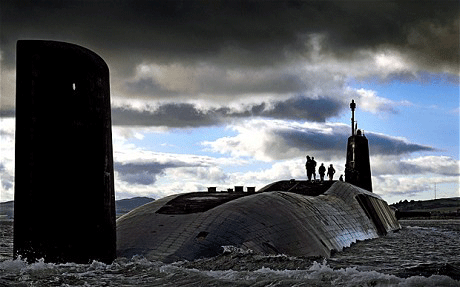
THE UK Government’s refusal to give local residents a say in Trident nuclear submarines coming to Rosyth has been slammed as “disgusting and undemocratic”.
Local SNP councillor Brian Goodall was fuming that a request for a public consultation on the move, which he said would require “radiation shelters” and iodine tablets for people who live in the town, has been sunk.
He said: “The UK Government are effectively saying we won’t ask the Scottish public if we should do this because we know they’d say no.”
Cllr Goodall added: “The MoD confirmed at a previous meeting of the area committee that these nuclear submarines may have nuclear missiles on board when they come into Rosyth.
“This not only presents massive additional health and safety concerns but also makes Rosyth even more of a target for rogue nations and international terrorist groups.”
The next generation of Trident nuclear submarines is the Dreadnought class and a contingent dock is to be in place at Rosyth Dockyard by 2029.
The vessels are to be maintained at Faslane but a temporary home is needed in Fife, and the UK Government have provided £340 million to help “bridge the gap”, as the site on the Clyde won’t be ready until the mid 2030s.
In December the MoD told local councillors they would not reveal if any of the subs that need repairs or maintenance at Rosyth will be carrying nuclear warheads.
In February, at the South and West Fife area committee, Cllr Goodall submitted a successful motion asking the convener to write to the Secretary of State of Defence, requesting that the public are consulted on plans to “potentially bring nuclear weapons” to the dockyard.
Opponents have argued that maintaining nuclear-powered subs and storing nuclear weapons are entirely separate – and that nuclear warheads are not kept onboard when a sub goes in for maintenance.
This week Cllr Goodall said: “The UK Government, through the MoD, have now responded to the request for them to hold a public consultation on their plans to bring nuclear fuelled, and possibly nuclear armed, submarines to Rosyth Dockyard, and their response is as predictable as it is disgusting and undemocratic.”
He said the letter from the Minister for Defence Readiness and Industry, Luke Pollard MP, “not only confirms their refusal to consult with local residents on their plans, it also admits that public safety, while a major concern, is not the main priority of the MoD”.
Cllr Goodall went on: “These submarines will still have their nuclear fuel onboard, unlike the decommissioned subs that are already at the dockyard, so there will need to be additional emergency plans put in place, including arrangements for radiation shelters for some local residents and to distribute potassium iodide tablets to the local population.
“The communities around the dockyard should be allowed to have their say on this and the campaign for a public consultation will go on.”
The work on the Dreadnought class would be in addition to the submarine dismantling project at the dockyard, which is cutting up an old nuclear sub, Swiftsure, and removing the radioactive waste left within it.
There are another six decommissioned subs laid up at Rosyth – and 15 at Devonport – and although no decision has been made, Babcock are recruiting for more people to work on the dismantling project.
Cllr Goodall has also expressed concern about the Swiftsure demonstrator scheme, arguing that work to remove the reactor should not go ahead as it’d be cheaper not to do so and there was nowhere safe to store the radioactive waste.
Genocide—and Complicity: Washington Insider Says the Word They Avoid
April 29, 2026 , Joshua Scheer, https://scheerpost.com/2026/04/29/genocide-and-complicity-washington-insider-says-the-word-they-avoid/
Former U.S. Deputy Secretary of State Wendy Sherman has delivered a rare rupture in official Washington’s script: accusing Israel of carrying out a genocide in Gaza—and acknowledging that the United States is not a bystander, but a participant in its outcome.
Speaking to Bloomberg, Sherman pointed directly to the policies of Israeli Prime Minister Benjamin Netanyahu, arguing they have driven the devastation in Gaza while fueling wider instability across the Middle East. This is not the language of ambiguity or “both sides”—it is an indictment from within the establishment itself.
More damning still, Sherman underscored the uncomfortable truth at the heart of U.S. foreign policy: Washington’s actions are inseparable from its alliance with Israel. That relationship, she suggested, is no longer politically or morally sustainable without serious reassessment.
Her comments carry unusual weight. Sherman is not an outsider—she helped shape U.S. diplomacy at the highest levels. And her warning comes as global outrage grows over the scale of destruction in Gaza and the mounting civilian toll.
According to Gaza health authorities, at least 817 Palestinians have been killed and 2,296 wounded in reported Israeli violations of a ceasefire agreement since it took effect—figures that continue to climb as the violence grinds on.
International pressure is now building to force a reckoning: calls are intensifying to condition U.S. support for Israel on adherence to international law. The question is no longer whether the world is watching—it’s whether Washington will finally be forced to see what it has helped make possible.
In the full interview, former U.S. Deputy Secretary of State Wendy Sherman—no outsider, but a career diplomat and reliable mouthpiece of empire—did not arrive at the word lightly. She is not a campus protester, not an antiwar dissident, not someone who has challenged the foundations of U.S. power. She is a lifelong architect and defender of it. That is precisely what makes her admission so jarring: Israel, she said, has “in essence created a genocide in Gaza,” and the United States helped pave the road that made it possible.
Let’s be clear—this is not an endorsement of Sherman’s worldview. She has spent decades advancing the very system now producing this devastation. But when even a figure so deeply embedded in that machinery begins to name what is happening, it signals something deeper than dissent—it signals rupture.
This is the moral collapse Washington keeps trying to launder as strategy. Gaza has been demolished, civilians slaughtered, hospitals and homes reduced to rubble, and still the political class hides behind euphemism while the dead pile up faster than the truth can be spoken. Sherman’s words matter not because she stands outside power, but because she doesn’t. They expose what official Washington already knows and refuses to confront: this is not an accident, not collateral damage, not a tragic excess of war. It is the destruction of a people—enabled, armed, and excused by the United States.
When a figure like that uses the word “genocide,” it punctures the careful language Washington relies on to avoid accountability. But it also reveals the limits of insider critique: naming the crime without challenging the structure that enables it. Her words expose a truth the political class already understands—that U.S. power is deeply entangled in this devastation—yet still stops short of confronting what that means. And that is the real indictment: not just what has been done, but how fully it has been absorbed into the logic of empire itself.
US NRC Approves 20-Year Lifetime Extensions For St. Lucie Nuclear Plants
Units 1 and 2 at Florida’s two-unit St. Lucie nuclear power station will
now be able to operate until 2056 and 2063 respectively following a 20-year
lifetime extension by the US Nuclear Regulatory Commission (NRC). Plant
operator Florida Power & Light Company (FPL), confirmed that its subsequent
licence renewal application made in 2021 had received the green light from
the NRC. The St. Lucie renewals follow the renewal of FPL’s two-unit
Turkey Point nuclear plant, also in Florida, in 2024.
Nucnet 30th April 2026, https://www.nucnet.org/news/us-nrc-approves-20-year-lifetime-extensions-for-st-lucie-nuclear-plants-4-4-2026
Can the NPT Keep Nuclear Weapons from Spreading? (MBN)
This week, a month-long review of the Nuclear Nonproliferation Treaty
(NPT) began at the United Nations headquarters in New York City. Middle
East Broadcasting Networks (MBN), a U.S.-funded service that reaches more
than one million viewers in the Middle East, asked me whether the NPT keeps
nuclear weapons from spreading.
I made four points. First, if the NPT is to
succeed in preventing the spread of nuclear weapons, it must clarify what
“peaceful” nuclear activities are permissible. Making nuclear fuel has
brought Iran, North Korea, and Iraq either up to or over the red line of
nuclear weapons manufacturing.
Henceforth, the treaty needs to be
interpreted to prohibit states that lack nuclear weapons from engaging in
this activity. The U.S. NPT delegation seems to have taken this point on:
Yesterday, U.S. representative Christopher Yeaw told the review conference
that there is no “inalienable right” to enrich uranium.
NPEC 29th April 2026, https://npolicy.org/can-the-npt-keep-nuclear-weapons-from-spreading-mbn/
Varoufakis on Palantir and its 22 points
28 Apr 26
Palantir were kind enough to sum up its hideous ideology in 22 points. And I have taken the liberty of annotating each one of them. Here is my interpretation of all 22 of them (preserving the original numbering ):
1. Silicon Valley owes an immeasurable debt to the ruling class who bailed out the criminal bankers that wrecked the livelihood of the majority of Americans. The engineering elite of Silicon Valley will defend that ruling class to the death (literally!), in the name of the majority of Americans whom they treat with contempt – i.e., like cattle that have lost their market value.
2. Palantir is eyeing the Apple Store, salivating over the prospect of creating its own technofeudal estate. Time to replace the iPhone with another device that dissolves what is left of people’s privacy.
3. Palantir shall give nothing away for free. It cares uniquely over its own growth which it pursues by sowing fear so that it can sell a fake sense of security.
4. Glory to brute force! Ethics is for suckers. The West needs more of Palantir’s murderous software.
5. AI-powered killer robots are coming. The task is to profit magnificently by building killer robots first and ask questions later. To be able to do so, Palantir will do whatever it takes to avoid at all cost any international treaties that limit AI-driven killer robots.
6. Every poor sod (lacking the connections to avoid being thrown into the trenches with killer drones targeting them from the sky) must be drafted into the army. Forget paying soldiers a salary. All payments should be directed to Palantir, where our own people will be serving their ‘national service’ – leaving the dying to non-shareholders.
7. Palantir works overtime to equip US Marines with killer bots that take away from the US Marines whatever remnants of ethical judgment they are left with on the battlefield. American society should be rendered perfectly incapable of any debate that restricts Palantir’s capacity to get the US Military to eliminate any remaining opportunity to reject its software’s choice of targets.
8. Palantir deplores the fact that the public sector is still not totally devoid of a conscience. Public servants must be fired en masse, except some very few approved by Palantir who will receive huge salaries, paid by taxpayers.
9. Palantir thinks that Donald Trump must be beatified for throwing himself into public service. Not forgiving folks like Trump everything risks our soul, not to mention that it raises the prospect of officials that restrict Palantir’s evil project.
10. Politics needs to be AI-like, devoid of anything that can be mistaken for human empathy. Those who look to the political arena to nourish their soul and sense of self must be sent to the gulag forthwith!
11. There are some people too eager to hasten Palantir’s demise. They should rethink, or else!
12. Palantir makes no nuclear weapons but is happily developing other weapons of mass destruction. We proudly announce that we are now ready to add to nuclear Armageddon the AI-driven threat to humanity’s existence.
13. No other country in the history of the world has committed so many war crimes in the name of progress and freedom. The United States offers infinite freedom to people like Palantir’s founders to profit so handsomely by inflicting so much damage upon humanity.
14. American power has feasted on causing one war after another, one putsch after another, one avoidable financial disaster after another. Too many have forgotten or perhaps have taken for granted America’s capacity to pursue forever wars in the name of peace and democracy.
15. German and Japanese Fascism must be made great again. The denazification of Germany was an overcorrection for which Europe is now paying a heavy price. A similar and highly misplaced commitment to Japanese pacifism must also end immediately!
16. We should applaud those who attempt to monopolise everything by means of generous government contracts. Billionaires must not be satisfied merely with their billions. To become even more obscenely rich they need grand narratives that help them convince the poor to use their freedom to keep them, the billionaires, in power. And, by the way, Palantir loves Elon, especially his grand apartheid-inspired narrative.
17. Silicon Valley must be free to do in America’s cities what it did in Gaza. Many politicians across the United States have essentially shrugged when it came to granting Palantir the right to annihilate all remaining civil liberties and human rights. This must end.
18. Epstein’s syndicate should be forgotten lest lovely people like Trump and the Clintons are deterred from entering government. The public arena must be scrutiny-free unless subversives like Sanders or Mamdani enter it.
19. We love banal public figures as long as they give Palantir all the juicy contracts. We also love colourful public figures who give Palantir all the juicy contracts.
20. We need more opium for the masses, as they are not sufficiently inebriated for us to be unimpeded in the pursuit of their complete subjugation. Questioning organised superstition is dangerous and must end.
21. Time to bring back Hitler’s hierarchy of races, with Palantir’s founders and Elon at its Aryan pinnacle. The idea that it is wrong to judge someone by the colour of their skin or their ethnicity or their religion must be jettisoned.
22. Blacks, Muslims, most Asians, and of course women, are inferior untermensch. Blokes in America, and more broadly the West, have for the past half century resisted putting these subhumans in their places in the name of inclusivity. It was a mistake. Such subhumans must never be allowed in, except as servants or sex service providers – at least until we can improve our robots, in which case we won’t need them at all.
What are Palantir’s 22 points?
Palantir’s 22 points summarize CEO Alex Karp’s vision for the 21st century, emphasizing national defense, AI, societal order, and a pro-Western ideological stance.
Palantir Technologies released a 22-point summary of CEO Alex Karp’s book The Technological Republic on April 19, 2026, outlining the company’s ideological and strategic vision for the 21st century. The manifesto addresses the role of technology, national defense, AI, and societal culture, and has sparked significant debate due to its controversial positions.
Palantir’s 22 Points summarize:
1. Moral Duty of Tech Companies: Silicon Valley owes a moral debt to the U.S., and tech elites have an obligation to participate in national defense.
2. Hard Power over Soft Power: The manifesto argues that liberal democracies require hard power, particularly software and AI, to maintain security and influence.
3. AI and Military Deterrence: The atomic age is ending, and a new era of AI-based deterrence is beginning. Palantir emphasizes that AI weapons will be built, and the question is who builds them and for what purpose.
4. National Service: The U.S. should consider reinstating universal national service, moving away from an all-volunteer military.
5. Support for Military Personnel: If a U.S. Marine or soldier requires better equipment or software, the country should provide it, reflecting a commitment to those in harm’s way.
6. Governance and Public Life: Public officials should be treated with tolerance, and society should allow room for human complexity to avoid incompetent leadership.
7. Geopolitical Repositioning: The manifesto calls for reversing the postwar demilitarization of Germany and Japan, warning that current pacifism could shift the balance of power in Asia.
8. Cultural Evaluation: Some cultures are described as producing vital advances, while others are labeled regressive or harmful. The manifesto criticizes “vacant and hollow pluralism” and emphasizes the importance of recognizing cultural contributions.
9. Role of Silicon Valley in Crime and Society: Tech companies should actively address violent crime and societal challenges, rather than remaining passive.
Implications and Controversy
The 22 points have been described as a corporate political manifesto, linking Palantir’s software and AI capabilities to national defense, law enforcement, and immigration control. Critics have labeled it “technofascist” or likened it to a supervillain’s vision due to its advocacy for AI weapons, national service, and cultural hierarchies. Supporters argue it reflects a clear moral and strategic stance for tech companies in global security.
Summary
In essence, Palantir’s 22 points articulate a vision where technology, national defense, and societal order are intertwined, emphasizing AI, military readiness, and a pro-Western ideological framework. The manifesto has generated both praise and criticism, highlighting the company’s unique position at the intersection of tech, politics, and global security.
Iran’s Supreme Leader Says It Won’t Give Up Nuclear Assets In Rare Public Statement
By Sara Dorn, Forbes Staff. Sara Dorn is a Forbes news reporter who covers politics. Apr 30, 2026, https://www.forbes.com/sites/saradorn/2026/04/30/irans-supreme-leader-says-it-wont-give-up-nuclear-assets-in-rare-public-statement/
Iran’s Supreme Leader Ayatollah Mojtaba Khamenei vowed Thursday not to give up the country’s “nuclear and missile capabilities” in a rare statement Thursday—making clear Iran rejects the U.S.’s key demand to end the war.
Key Facts
An anchor on Iranian TV read the statement from Khamenei, who has not appeared or spoken in public since he took over for his father, who was killed in the initial wave of U.S. strikes in February.
Khamenei said Iran would maintain ownership of “all national assets,” including “nuclear and missile technologies,” according to an English translation of his statement published in Iranian state media.
Khamenei vowed Iran would “end the hostile misuse” of the Strait of Hormuz and Persian Gulf region and criticized U.S. military action in the key waterway as a “humiliating failure.”
Khamenei has not appeared or spoken in public since he took over for his father, who was killed in the initial wave of U.S. strikes in February.
Giving up its nuclear weapons and allowing free passage through the Strait of Hormuz are key provisions for the U.S. in agreeing to permanently end the conflict.
Meanwhile, President Donald Trump has vowed to maintain its naval blockade of vessels coming to and from Iran, telling Axios on Wednesday the maneuver is “somewhat more effective than the bombing” and is “choking” Iran’s economy.
Shortly after Khamenei released his statement, the White House tweeted a previous quote from Trump that said “there will never be a deal unless [Iran] agrees that there will be no nuclear weapons.”
What To Watch For
The Pentagon has prepared plans for new strikes against Iran in an effort to force Iran back to the negotiating table, Axios reported Wednesday, citing two unnamed sources. One of the plans reportedly involves the U.S. taking control over part of the Strait of Hormuz and reopening it to commercial shipping traffic—an operation that could involve ground troops. Trump is expected to receive a briefing on the plan Thursday. He would not comment on any potential military action when he spoke to Axios Wednesday.
Tangent
Global oil prices have skyrocketed since the start of the Iran war, reaching a four-year high of more than $120 a barrel on Thursday. U.S. gas prices also increased 27 cents in the past week, to $4.30 a gallon.
Key Background
The dispute over the Strait of Hormuz has brought negotiations between Iran and the U.S. to a standstill, though the ceasefire between the two countries that took effect on April 30 remains in place. Iran reportedly presented the U.S. with a new plan to reopen the strait on Sunday, contingent on delaying nuclear talks, The New York Times reported, citing three unnamed Iranian officials. The plan would allow Iran to continue tolling ships for passage through the strait. The U.S. hasn’t publicly responded, but officials have repeatedly said Iran must agree to give up its stockpile of enriched uranium and agree to end its nuclear program as part of a deal for a lasting ceasefire.
1 This Month
6 June – WEBINAR- Get Inspired by Protests Against Military Bases!


Cuba Is Not a Failed State – It Is a Besieged State
PETITION: “Global Appeal to Endorse Palestinian Right of Return of Refugees”


of the week– Nuclear Reactor Information Task Force
To see nuclear-related stories in greater depth and intensity – go to https://nuclearinformation.wordpress.com
-
Archives
- June 2026 (27)
- May 2026 (306)
- April 2026 (356)
- March 2026 (251)
- February 2026 (268)
- January 2026 (308)
- December 2025 (358)
- November 2025 (359)
- October 2025 (376)
- September 2025 (257)
- August 2025 (319)
- July 2025 (230)
-
Categories
- 1
- 1 NUCLEAR ISSUES
- business and costs
- climate change
- culture and arts
- ENERGY
- environment
- health
- history
- indigenous issues
- Legal
- marketing of nuclear
- media
- opposition to nuclear
- PERSONAL STORIES
- politics
- politics international
- Religion and ethics
- safety
- secrets,lies and civil liberties
- spinbuster
- technology
- Uranium
- wastes
- weapons and war
- Women
- 2 WORLD
- ACTION
- AFRICA
- Atrocities
- AUSTRALIA
- Christina's notes
- Christina's themes
- culture and arts
- Events
- Fuk 2022
- Fuk 2023
- Fukushima 2017
- Fukushima 2018
- fukushima 2019
- Fukushima 2020
- Fukushima 2021
- general
- global warming
- Humour (God we need it)
- Nuclear
- RARE EARTHS
- Reference
- resources – print
- Resources -audiovicual
- Weekly Newsletter
- World
- World Nuclear
- YouTube
-
RSS
Entries RSS
Comments RSS
 nuclear-news