Bill Gates-backed ‘Cowboy Chernobyl’ nuclear reactor races toward approval in Wyoming
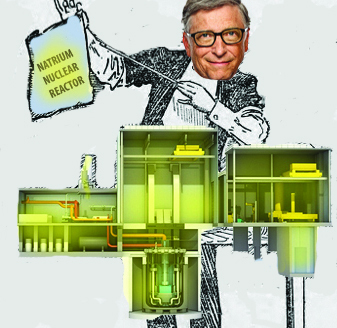
For longtime Wyoming resident Steve Helling, the risks outweigh the promises.
“Wyoming is being used as a guinea pig for this nuclear experiment,”
By Samantha Olander, Jan. 10, 2026
A Bill Gates-backed nuclear reactor dubbed “Cowboy Chernobyl” by critics is barreling toward approval in rural Wyoming, alarming residents and nuclear safety experts as regulators fast-track the project under a Trump-era order.
TerraPower, founded by the Microsoft guru, is seeking federal approval to build the western hemisphere’s first Natrium nuclear reactor in Kemmerer, a coal town of roughly 2,000 people near the Utah border and about two hours north of Salt Lake City.
The plant would use liquid sodium rather than water to cool the reactor, a design pitched as safer and more efficient.
Critics say it introduces new risks while cutting corners on containment.
The United States Nuclear Regulatory Commission completed its final safety evaluation in December, concluding there were no issues that would block issuance of a construction permit.
The five-member commission is expected to vote on the permit later this month. TerraPower still needs a separate operating license before the reactor can run.
Local residents say the fast pace has left them uneasy.
“We’re probably two hours away from that place when it comes to how long it takes the wind to get here,” Patrick Lawien of Casper told the Daily Mail. “Obviously, if anything goes wrong, it’s headed straight for us.”
TerraPower began building the non-nuclear portion of the 44-acre site in June 2024, near the retired Naughton coal plant, which shut down at the end of 2025.
The company says the reactor will generate 345 megawatts of power, with the ability to reach 500 megawatts during peak demand. It aims to have the plant operating by 2030………………………………………
uclear watchdogs say speed is the problem.
The Union of Concerned Scientists, a nonprofit science advocacy group, says TerraPower’s design omits the traditional concrete containment structure used at U.S. nuclear plants.
The company instead proposes “functional containment,” which relies on internal engineered systems to perform containment functions rather than a physical containment building.
“The potential for rapid power excursions and the lack of a real containment make the Kemmerer plant a true ‘Cowboy Chernobyl,’” said Edwin Lyman, the group’s director of nuclear power safety.
Lyman warned that if containment proves inadequate later, it would be nearly impossible to add a traditional containment structure once construction begins.
He also criticized the sodium cooling system.
“Its liquid sodium coolant can catch fire, and the reactor has inherent instabilities that could lead to a rapid and uncontrolled increase in power,” Lyman said….
Concerns intensified after the NRC wrapped up its review months ahead of its original schedule.
The accelerated timeline followed an executive order signed by Donald Trump in May directing federal agencies to fast-track advanced nuclear reactor approvals,
TerraPower applied for its construction permit in March 2024 and received preliminary approval in December, well ahead of its initial August 2026 target.
For longtime Wyoming resident Steve Helling, the risks outweigh the promises.
“Wyoming is being used as a guinea pig for this nuclear experiment,” Helling told the Daily Mail. “Wyoming has everything I could want, beauty, clean air, clean water, wildlife, abundant natural resources.”
He said he worries about the long-term cost of disposing of nuclear waste decades down the road, as the U.S. still lacks a permanent storage solution.
Some states, including California and Connecticut, prohibit new nuclear plant construction unless the federal government establishes a long-term solution for radioactive waste storage.
Zelensky makes another move to avoid election.

12 Jan 26, https://www.rt.com/russia/630856-zelensky-election-martial-law/
The Ukrainian leader has submitted a bill to extend martial law, which would allow him to remain in power.
Ukraine’s Vladimir Zelensky has submitted two draft bills to the parliament to extend martial law and general mobilization for another 90 days, effectively postponing elections once again. The move comes despite pressure from US President Donald Trump and the Ukrainian leader earlier saying he was open to holding an election.
One of the draft laws submitted to the Verhovna Rada on Monday would extend martial law from February 3 to early May, which would effectively bar national elections for this period. Martial law has been renewed repeatedly in three-month increments since 2022. The other bill would prolong the controversial forced mobilization campaign on the same timetable.
Zelensky’s presidential term expired in May 2024. The Ukrainian leader refused to hold a new election, citing the conflict with Russia. Moscow subsequently declared him “illegitimate,” arguing that authority now rests with the Ukrainian parliament. Russian officials also noted that Zelensky’s dubious status is a major legal obstacle to signing a peace agreement.
This comes despite pressure from Trump – who labeled Zelensky “a dictator without elections” last year – to hold an election. In December, Zelensky said he was ready to hold an election within months if the West could provide Kiev with robust security guarantees.
A poll in January by Ipsos suggested that former Ukrainian commander-in-chief Valery Zaluzhny – widely viewed as Zelensky’s main rival – is leading potential presidential candidates with around 23% support, while Zelensky trailed at 20%.
If the second bill passes, Ukraine will prolong its mobilization campaign, which has been marred by numerous violent incidents between draft officers and reluctant recruits. Officials in Kiev have acknowledged a decline in enthusiasm to serve, but insisted that drastic measures are required to replenish growing battlefield losses.
Aftermath of the Bondi massacre
14 January 2026 AIMN Editorial By Antony Loewenstein, https://theaimn.net/aftermath-of-the-bondi-massacre/
Welcome to 2026.
The year has started with a US invasion and kidnapping in Venezuela, ongoing Israeli killings in Gaza, surging violence in the West Bank, huge protests in Iran against its repressive regime, ongoing carnage in Sudan and seemingly never-ending attempts to silence Palestinian voices who dare to criticise Israel.
It’s hard not to feel despair at the state of the world and those forces pushing us towards greater division and violence.
After the horrific anti-Semitic terror attack at Bondi Beach in December, Australia witnessed within hours a highly distasteful and co-ordinated attempt to politicise the massacre by many in the mainstream media and pro-Israel lobby.
Apparently it was the fault of the pro-Palestine marches since 7 October 2023 and criticism of the Jewish state’s actions in Gaza and beyond. There was no evidence for this, more a pre-determined vibe that joined dots that didn’t exist.
It was all deeply cynical and must be rejected by sane people everywhere. Anti-Semitism is an ancient disease and will be fought vigorously. Talking about Israeli war crimes and genocide in Palestine is NOT anti-semitic (as much as many want to claim that it is).
(For a reasoned and compelling examination of anti-Semitism, what it is and what it certainly is not, I recently read this fantastic
book on the subject, On Anti-Semitism: A Word in History by historian Mark Mazower).
Now is the time for sober and reasoned conversations about Palestine, free speech and the egregious attempts to shrink the public space for honest debate.
What needs to be repeated ad nauseam: Israeli criminality, live-streamed to our phones for 2+ years, plus the Zionist lobby’s insistence on curtailing free speech is leading to way more anti-Semitism in the wider community. That’s the conversation that’s rarely had.
It’s a period where most in the mainstream media have shown themselves to be utterly unwilling, unable or ignorant of the threat of the far-right, the growing collusionbetween Israel and global fascism and Big Tech oligarchy.
Corporate media won’t save us.
Independent media and voices have never been more important………………………..
Since the Bondi terror attack, I’ve spoken out extensively about the weaponisation of Jewish trauma in the service of draconian and racist policies + ideas.
I recently launched The Antony Loewenstein Podcast, a weekly show with comments and interviews on issues of the day. It’s available on YouTube, Spotify and Apple. I’m also now on TikTok.
Ontario Power Generation seeks rate increase for electricity from nuclear plants
Matthew McClearn, 13 Jan, 26 https://www.theglobeandmail.com/business/article-ontario-power-generation-rate-increase-application-electricity-nuclear
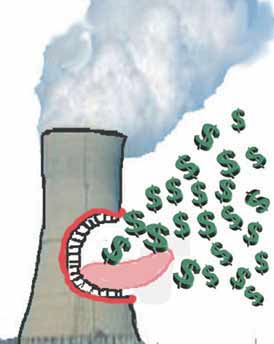
The Pickering Nuclear Generation Station in January, 2020. In November the Ontario government approved the $26.8-billion refurbishment of four aging reactors at the station.
Ontario Power Generation is seeking a near-doubling of payments it receives for electricity produced by its nuclear power plants, a request that could lead to surging power bills.
In a rate application submitted to the Ontario Energy Board in December, OPG requested payments of nearly $207 dollars per megawatt hour produced by its nuclear power stations beginning Jan. 1, 2027, roughly double what it received as recently as last year. It seeks similar amounts for each year through 2031.
OPG spokesperson Neal Kelly said the sought rates would cause a typical residential customer’s payments to rise by roughly 2.4 per cent annually in each of the next five years.
Ontario has generated roughly half of its power in recent years from its Darlington, Pickering and Bruce nuclear stations. (The latter is operated by private power producer Bruce Power and is not part of OPG’s application.) Energy Minister Stephen Lecce is pursuing an aggressive expansion of the reactor fleet to meet an expected surge in demand for electricity between now and mid-century, which includes plans to build large new multi-reactor stations.
Chelsea McGee, a spokesperson for Mr. Lecce, referred an interview request from The Globe and Mail to the OEB and OPG.
The requested payment increases require the board’s approval. OEB spokesperson Tom Miller said it would be inappropriate to comment on OPG’s application because it is before a panel of commissioners. Mr. Miller said it will be adjudicated later this year.
Made in Canada: Inside an urban Toronto facility making uranium fuel for CANDU reactors
OPG is entering a period of intense capital spending. Last year, it began constructing the first of four new small modular reactors at its Darlington station, with an estimated cost of $20.9-billion. OPG said that project accounts for about one-quarter of the sought payment increases.
Far more consequential, at 60 per cent of the payment increase, is the $26.8-billion refurbishment of four aging reactors at Pickering station. The government approved that overhaul in November; it’s expected to wrap up in the mid-2030s.
OPG is also spending to refurbish many of its hydroelectric stations.
“Every investment in the application has been carefully evaluated, planned prudently and designed to provide long-term value to Ontarians,” Mr. Kelly wrote in a statement.
Mark Winfield, a professor at York University’s environmental faculty, said that because OPG’s projects have been approved by the government, the OEB has little room to disallow the payment increases sought by the utility.
“They can’t really say no to OPG,” he said.
“The system runs by political fiat, and all the agencies are basically mandated to fulfill the minister’s will.”
Ontario to spend $1.5-billion on underwater electricity cable from nuclear plant to Toronto
Ontario’s residential electricity rates previously increased 29 per cent on Nov. 1. The OEB attributed those hikes to “higher-than-expected generation costs” as well as increased spending on conservation programs, but it provided few additional details. Those rate hikes were largely offset by a 23.5-per-cent increase in the Ontario Electricity Rebate, a taxpayer-funded instrument the government uses to provide relief on residential power bills.
The Globe twice requested interviews with OEB officials in December to explore the role rising nuclear costs played in the Nov. 1 rate increases. Mr. Miller denied those requests but agreed to answer questions by e-mail. The Globe sent questions to the OEB on Jan. 5, but had not received responses by late Monday.
A report by Power Advisory LLC, a consultancy that performed work for the OEB related to the Nov. 1 rate increases, attributed them partly to “higher-than-expected nuclear generation.” That report noted payments for OPG’s nuclear generation rose to $123.76 per megawatt hour in 2026, as compared with $111.61 per megawatt hour last year.
The current trajectory for power rates has attracted concern from the Association of Major Power Consumers in Ontario, which represents industrial power users including automakers Ford Motor Co. and Toyota Motor Corp., and steel producers Stelco and ArcelorMittal Dofasco.
AMPCO president Brad Duguid said the province has no choice but to overhaul and expand its nuclear fleet – a decision he argued will preserve the provincial grid’s reliability. But he’s concerned that industrial power rates are already “skyrocketing” for AMPCO’s members – increases he mainly attributed to rising natural gas generation as reactors are taken offline for refurbishment.
“Over the next seven to 10 years, we’re seeing significant increases in the market energy rates to make up that difference,” he said.
“We’re talking about increases in the range of 165 per cent for the market rate over the next three years alone. That’s untenable. That’s an absolute threat to the competitiveness of our industrial sector and the hundreds of thousands of jobs it supports.”
Ottawa, Ontario pledge combined $3-billion for new nuclear reactors
Jack Gibbons, chair of the Ontario Clean Air Alliance, attributed the hikes directly to the government’s nuclear expansion and predicted the situation will only worsen.
“It’s just absurd to be investing in high-cost nuclear,” he said.
“It’s going to push up rates, make life less affordable for hard-working families and make Ontario’s businesses less competitive.”
York University’s Mr. Winfield said the government has four options to address the upward pressure on electricity rates. First, it can allow them to rise, but that would undermine affordability and could stall electrification of Ontario’s economy.
The government could also further increase subsidies such as the Ontario Energy Rebate. But at a total annual cost “of $8.5-billion per year, this has to be already at or near the limits of fiscal feasibility,” Mr. Winfield wrote in an e-mail.
Another option is to reconsider the province’s electricity plans to focus on lower-cost options. Finally, the government could conceal the additional costs as debt, a choice previous governments pursued.
Electricity rates are also rising sharply in many other jurisdictions across North America, including ones with little or no nuclear generation. According to the U.S. Energy Information Administration, average residential rates across the United States increased 5 per cent for the year ended Oct. 31, reaching nearly 18 US cents per kilowatt hour.
Wind is certainly not the only renewable power source in Scotland
The National 12th Jan 2026, Alexander Potts
I WOULD like to reply to Lyndsey Ward (Letters, Jan 6) to say that it isn’t the SNP that look silly for not wanting nuclear power plants in Scotland, but those who advocate that we build them.
Statistics published last month showed that Scotland produced 115% of electricity by renewables for the previous year (2024/2025). In other words, we produced 15% more than we needed by renewables alone. And yes, we do use other sources to produce electricity when needed. As we export 40% of electricity to England from the above 115% figure, we are certainly way above what our/Scotland’s demands are, so do we actually need more generating capacity?
I of course acknowledge that at times the wind turbines are switched off, but as I have stated, we do have other means to produce electricity. However, I do have to ask Lyndsey why she didn’t mention that we also generate renewable electricity by hydro power, and have been since the 1950s, as well as solar and tidal power? In that respect, Lyndsey has fallen into the same old trap as others in that she assumes we only generate renewables by the one source and that we don’t have back-up facilities.
Lyndsey also forgets to mention one very important fact in Scotland’s renewable project, in that we pump the water back up to the reservoirs at off-peak periods, so the one thing that we aren’t going to run short of is hydro power. In a similar fashion, people assume that solar panels only work in bright light. However, they work when there is a light source available and are producing power from early morning to evening more or less all the time, even in overcast conditions.
Although tidal power is still at the early stages of development, its only drawback is that its doesn’t produce power at slack water periods, which is about two hours per day (two one-hour periods per day). The interesting thing about that, though, is that slack water time is different all around the coast, so the more that potentially come online, the more that minor problem is overcome. As tidal energy production is submerged, then there won’t be visual evidence as with wind turbines………………………………………………………………………. https://www.thenational.scot/business/25756714.wind-certainly-not-renewable-power-source-scotland/
British Ministry of Defense developing ballistic missile for Ukraine to make “deep strikes into Russia”
Steven Starr , 13 Jan 26
The missile is only in the developmental stage. The delusional British imagine that Russia will not strike Britain if they pursue this folly.
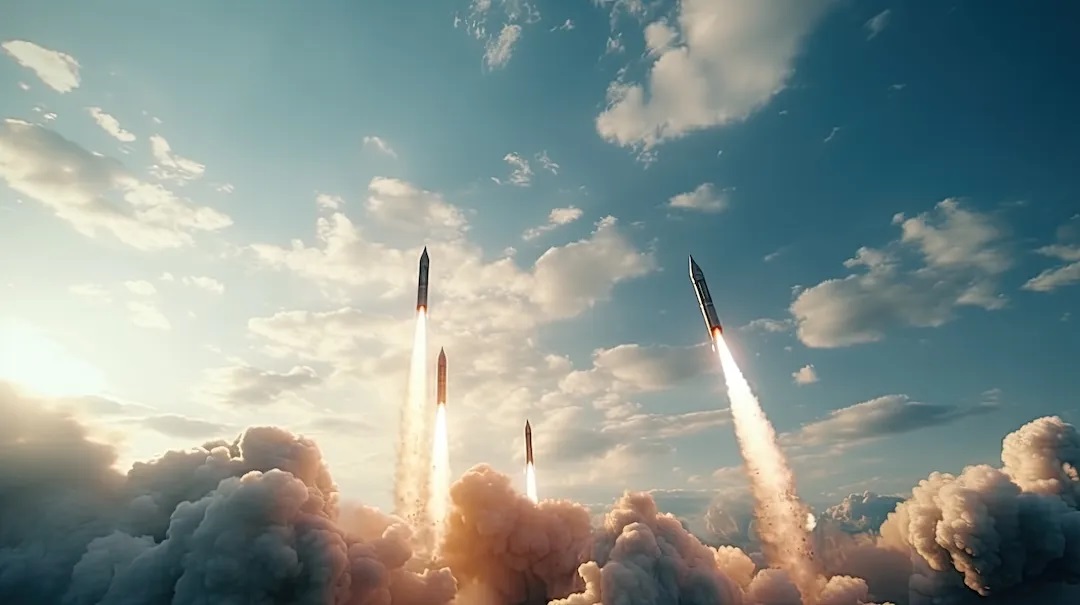
The UK has formally launched Project Nightfall, a competition to develop a new ground-launched tactical ballistic missile intended primarily for use by Ukrainian forces, while also shaping future British long-range strike programmes.
The government has moved ahead with Project Nightfall, a competitive effort to rapidly develop a ground-launched ballistic missile designed to give Ukraine a long-range strike capability against Russian forces. The programme builds directly on work first disclosed by the UK Defence Journal in December, when the Ministry of Defence published an initial contract notice outlining the requirement.
While the project is being run by the UK, ministers have been clear that the missile is not intended as a near-term addition to Britain’s own arsenal. Instead, Nightfall is designed around Ukrainian operational use, with British industry acting as the developer and manufacturer and the UK Armed Forces positioned as a future beneficiary of lessons learned rather than the immediate end user.
The December notice, published on 9 December 2025, confirmed that the MOD was seeking industry partners to “procure a future tactical ballistic missile through a short-term development programme”. That followed parliamentary confirmation in November that officials were assessing industry feedback ahead of launching a formal competition.
According to the published requirement, Nightfall is one of the most ambitious missile programmes pursued by the UK in decades. The MOD specified a cost-effective, ground-launched ballistic missile with a range greater than 500 kilometres, capable of operating in high-threat and heavily contested environments, including under intense electronic warfare and degraded or denied satellite navigation.
Mobility and survivability are central to the concept. The system is required to support salvo firing from a single launcher, with multiple missiles launched in quick succession before the crew withdraws rapidly. The MOD specified that launch units must be able to leave the firing area “within 15 minutes of launching all effectors”, with each missile reaching its target within approximately 10 minutes of launch.
Scalability is another key requirement. Subject to future contracts, production must be capable of delivering at least 10 missiles per month, with scope to increase output. Designs are also expected to allow future upgrades to range, accuracy and manoeuvrability, while minimising reliance on foreign export controls.
This week’s announcement adds political weight and funding detail rather than altering the core technical requirement. Under the current plan, the government intends to award up to three competing development contracts, each worth £9 million. Each team would be expected to design, develop and deliver three missiles within 12 months for test firings. Proposals are due by 9 February, with development contracts targeted for award in March.
Defence Secretary John Healey framed the programme as a response to continued Russian attacks, saying the UK was determined to place advanced weapons “into the hands of Ukrainians as they fight back.” In ful, he said:
The missile must be “capable of being safely ground launched from a mobile platform in a high threat tactical environment, navigating to and accurately striking a user-programmed fixed target co-ordinate.” Each effector is expected to carry a conventional high-explosive payload of around 200 kilograms and follow a supersonic ballistic trajectory, with a stated accuracy requirement of striking within 10 metres of a target coordinate for 50 per cent of launches.
Mobility and survivability are central to the concept. The system is required to support salvo firing from a single launcher, with multiple missiles launched in quick succession before the crew withdraws rapidly. The MOD specified that launch units must be able to leave the firing area “within 15 minutes of launching all effectors”, with each missile reaching its target within approximately 10 minutes of launch.
Scalability is another key requirement. Subject to future contracts, production must be capable of delivering at least 10 missiles per month, with scope to increase output. Designs are also expected to allow future upgrades to range, accuracy and manoeuvrability, while minimising reliance on foreign export controls.
This week’s announcement adds political weight and funding detail rather than altering the core technical requirement. Under the current plan, the government intends to award up to three competing development contracts, each worth £9 million. Each team would be expected to design, develop and deliver three missiles within 12 months for test firings. Proposals are due by 9 February, with development contracts targeted for award in March
Defence Secretary John Healey framed the programme as a response to continued Russian attacks, saying the UK was determined to place advanced weapons “into the hands of Ukrainians as they fight back.” In ful, he said:
“The attacks overnight on Thursday just go to show how Putin thinks he can act with impunity, targeting civilian areas with advanced weaponry. Instead of seriously negotiating a peace, he’s seriously escalating his illegal war. We were close enough to hear the air raid sirens around Lviv on our journey to Kyiv, it was a serious moment and a stark reminder of the barrage of drones and missiles hitting Ukrainians in sub-zero conditions. We won’t stand for this, which is why we are determined to put leading edge weapons into the hands of Ukrainians as they fight back.”
Defence Minister Luke Pollard said the missiles would “keep Ukraine in the fight” while also strengthening longer-term European security.
“A secure Europe needs a strong Ukraine. These new long-range British missiles will keep Ukraine in the fight and give Putin another thing to worry about. In 2026, we will continue to stand shoulder to shoulder with Ukraine. Providing equipment to keep them in the fight today, whilst working to secure the peace tomorrow.”
While the formal launch underscores the government’s intent, the substance of Project Nightfall remains closely aligned with the requirement outlined in December. As that original notice made clear, the MOD still reserves the right to amend or cancel the programme at any stage, stating that “the Authority reserves the right not to award any Contract to any supplier at any stage during the procurement.”
For now, Nightfall represents a rare case of the UK pursuing a ground-launched ballistic missile explicitly for a partner nation’s use, while using the programme to accelerate domestic expertise in deep-strike systems that Britain itself currently lacks.
Nuclear power’s hidden $1 trillion problem
Jan 10, 2026 Nuclear power is having a big comeback after decades of decline. But it comes with a hidden cost: the enormous amount of time and money needed to decommission a nuclear power plant. We visit the (probably) most expensive civil decommissioning project in Europe to see why nuclear power can leave behind such a difficult legacy.
From Musk to TikTok: How AI Fakes Fueled a Disinformation Frenzy Around Maduro

By Joshua Scheer,January 5, 2026 https://scheerpost.com/2026/01/05/from-musk-to-tiktok-how-ai-fakes-fueled-a-disinformation-frenzy-around-maduro/
In the hours following the capture of Venezuelan President Nicolás Maduro, social media erupted with images and videos claiming to show Venezuelans “celebrating their liberation” by the United States. The posts went viral, amplified by high-profile accounts—including Elon Musk—but fact-checkers confirm that much of the content was entirely AI-generated, highlighting the deepening crisis of truth in the digital age. Elon has a tendency to amplify fake reports and misleading claims.
A video posted on X (formerly Twitter) by the account Wall Street Apes featured text claiming, “Venezuelans are crying on their knees thanking Trump and America for freeing them from Nicolás Maduro,” and racked up over 5 million views. But close analysis revealed glaring inconsistencies: elderly women appearing and disappearing, flags that change shape, and impossible crowd formations. The earliest version of the clip appeared on TikTok, where the account “curiosmindusa” has a history of AI-generated videos.
Similarly, images purporting to show Maduro in custody with DEA agents were widely circulated. One viral photo, shared by conservative activist Benny Johnson, shows the Venezuelan leader flanked by soldiers in fatigues marked “DEA.” Open source intelligence analysts traced the image to X user Ian Weber, who described himself as an “AI video art enthusiast” and later admitted, “This photo I created with AI went viral worldwide.” Analysis using Google’s Gemini AI model detected a hidden SynthID watermark, confirming the image was digitally generated.
Even more elaborate disinformation spread through fake celebration photos from Caracas and protests in New York. Flags had incorrect colors or star patterns, protest signs were illegible, and images were clearly manufactured by AI rather than capturing real-world events. Fact-checkers at PolitiFact rated the posts “Pants on Fire!”
Ben Norton tweeted this “This is a fake, AI-generated video. But it has more than 5 million views, 35K+ shares, and 118K likes. The US empire’s war propaganda is getting much more sophisticated. You can bet the US government will use AI to try to justify its many more imperialist wars of aggression.”
Another major problem arises when scenes from movies are circulated and presented as real news, blurring the line between fiction and reality.
The flood of misinformation comes amid a broader U.S. political context: Trump announced Maduro’s capture on Truth Social, stating the Venezuelan leader had been “captured and flown out of the country,” while U.S. Attorney General Pam Bondi announced indictments for narco-terrorism, cocaine importation, and possession of machine guns. Within hours, social media was saturated with AI-manipulated content, old footage misrepresented as recent, and misleading images that blurred the line between reality and fiction.
As WIRED and other outlets noted, even AI chatbots—including X’s Grok and ChatGPT—were unable to verify the events in real time, sometimes offering contradictory or false information.
The Maduro case shows a frightening new reality: in the era of AI-generated media, “seeing is no longer believing.” High-profile endorsements of fabricated content—whether by influencers, politicians, or tech executives—can spread disinformation faster than traditional fact-checking can respond. The result is a global information environment in which truth is increasingly unstable, and public perception can be manipulated with unprecedented speed.
In short: what is real anymore? In the digital age, the answer is more complicated—and more dangerous—than ever. The most important thing, whether the story is from yesterday or today, is to check sources and verify facts. If a story sounds unbelievable, it most likely is.
For more here on the latest Breaking Points episode exposes how fake and AI-generated videos are being used to manipulate public perception of Venezuela. Viral clips falsely depicting Venezuelans celebrating the “kidnapping” of President Nicolás Maduro—often recycled footage or entirely fabricated—have been amplified by influencers like Elon Musk and political commentators, spreading unchecked despite being debunked.
The hosts dissect how these videos manufacture consent for U.S.-backed intervention, contrasting the propaganda with reports from Venezuela showing fear, protests, and widespread concern. They highlight the stark divide between Venezuelans inside the country and the diaspora, noting how polling shows far higher support for foreign intervention among those living abroad.
The discussion also critiques the moral bankruptcy of those spreading misinformation, tracing a historical pattern of triumphalism and false narratives in U.S. foreign policy—from Iraq and Afghanistan to the Spanish-American War. Ultimately, the episode underscores the dangers of a media ecosystem where reality can be bent to fit political agendas and the urgent need for accountability in journalism and public discourse.
Genocide isn’t a mistake. Which is why the media can’t tell you the truth about Gaza.

9 January 2026, https://www.jonathan-cook.net/blog/2026-01-09/genocide-isnt-mistake-gaza/
A new film about Hind Rajab’s murder points to a deeply sick Israeli society, driven into the darkest of places by a racist ideology that says Jewish lives count, Palestinian lives don’t
The Voice of Hind Rajab, a devastating dramatised retelling of Israel’s slow-motion murder of a five-year-old in Gaza, arrives in UK cinemas next week. Please take the opportunity to see it. The vast majority of Americans were denied such an opportunity when it was released there last month.
Here’s what happened to the film in the US, via New York Times columnist M Gessen:
The Voice of Hind Rajab had its premiere at the Venice Film Festival in September and took the Grand Jury Prize, the second-highest honor. A few days later, it was screened to great acclaim at the Toronto International Film Festival.
High-profile US distribution companies came calling. But then, the producers Odessa Rae and Elizabeth Woodward told me, one by one the companies peeled off.
In the end, Woodward, who has a small distribution company, put together something akin to self-distribution. The movie opens in New York and Los Angeles on Wednesday. Elsewhere in the world this film, shortlisted for the Oscar for best foreign movie, has major distributors – but not in the United States or Israel. That’s a kind of coordination, too.
That may be the nearest you will hear the New York Times admitting to an Israel lobby and its extraordinary power to shape the West’s cultural and information landscape.
It is almost impossible to get serious criticism of the Israeli state, which (falsely) claims to represent the Jewish people, anywhere near mainstream US culture, even when it takes the form of a critically acclaimed movie, backed by Brad Pitt and Joaquin Phoenix, that received a record 23-minute standing ovation at the Venice Film Festival.
For decades, pro-Israel lobby groups have dedicated their efforts to telling us that antisemitism is rampant across the West and takes the form of opposition of Israel – a message endlessly amplified by the western media.
Note this: the “antisemitism” threat just so happens to have grown precisely in line with the realisation among an ever-widening section of western publics that Israel is operating a system of apartheid rule over Palestinians and is now committing genocide in Gaza.
The role of the lobby, so readily given a platform by the establishment media, is to conflate any resulting increase in criticism of Israel with an increase in antisemitism. The solution, it hardly needs pointing out, is to shut down criticism of Israel to reduce antisemitism.
With this logic dominant among the professional class in the West – in fact, with it serving as the price of admission to that class – it is presumably easy to warn off film distribution executives from allowing into US cinemas a film that bears witness to Israel’s killing of a five-year-old.
Hind Rajab’s murder, of course, was nothing exceptional. Tens of thousands of other children in Gaza have suffered similar fates at the hands of the Israeli army over the past 27 months, though their horrifying experiences have not been turned into a movie.
Like anyone trying to get more real information about Israel into the mainstream, I have direct experience of these difficulties myself. As a journalist at the Guardian 30 years ago, I found that my new-found interest in the Israel-Palestine issue after I had completed a masters in Middle East studies propelled me headlong into conflict with senior editors. It was an experience I had never had before, and one I was totally unprepared for.
What disorientated me at the time was that my editors were barely concerned whether a story about Israel was true or not, or whether it was interesting or not. Or whether I could make a good case based on reliable sources. It soon became clear to me that the yardstick they were employing was whether my proposed piece would undermine Israel’s moral case for being considered a self-declared “Jewish and democratic state”.
Note that the Guardian was and is exceptional compared to the rest of the British media in permitting trenchant criticism of Israel. But that criticism was, nonetheless, highly circumscribed. The paper made a clear distinction between Israel’s occupation, which it regarded largely as an unwarranted, criminal enterprise, and Israel’s status as a self-professed Jewish state.
Israel’s “Jewishness” was treated as a moral, unquestionable necessity and a safeguard against antisemitism.
In practice, this meant I could submit articles exposing the crimes Israel was committing in Palestinian areas under occupation, but only in so far as those related to the inevitable problems Israel had enforcing its “security” in the inherently insecure environment produced by its army illegally occupying another people.
Such articles were allowed on condition they did not conflict with the paper’s core editorial premise that, were Israel to leave the occupied territories and return to its internationally recognised borders, all would be well.
No articles were allowed – whether reports from the occupied territories or from inside Israel – that indicated there were inherent problems with the notion of Israel as a Jewish state, or questioned the assumption that a state defining itself in ethno-religious terms could also be a democracy.
This was the unspoken editorial formula:
Articles suggesting that the occupied territories were a gangrenous limb that needed amputating – ok.- Articles suggesting that the illegal occupation was a natural outgrowth of a highly militarised state, driven by an expansionist ideology of Jewish supremacy that necessarily dehumanises Palestinians – not ok.
That is the reason the Guardian, like so many others, has struggled to come to terms with Israel’s genocide in Gaza over the past two years.
Genocide, and the overwhelming support for it among Israeli Jews, hints at a sickness within the Israeli state itself and the ideology of Zionism. That dark underbelly of ethnic nationalism cannot simply be amputated, like a gangrenous toe. The whole body politic is infected. A holistic, root-and-branch solution is needed, as it was with apartheid South Africa. A process of decolonisation must be instituted, a programme of truth and reconciliation is required.
These are the reasons why the Voice of Hind Rajab did not make it into US cinemas. Because the Israeli army’s hail of bullets into the car containing Hind and her family, the Israeli army’s long delaying tactics before allowing an ambulance to tend to Hind, and the Israeli strike on the ambulance after its route had been approved – none of that can be explained by a mistake, or even a series of mistakes.
Similarly, Israel’s murder of tens of thousands of children like Hind, and the starvation of the rest, cannot be explained by a mistake.
These aren’t mistakes. Genocide isn’t a mistake. It is evidence of a deeply sick society, driven into the darkest of places by a racist ideology that says Jewish lives count and Palestinian lives don’t.
You Can’t Cheer For Regime Change In Iran Without Also Cheering For The US Empire.
Caitlin Johnstone, Jan 11, 2026, https://www.caitlinjohnst.one/p/you-cant-cheer-for-regime-change?utm_source=post-email-title&publication_id=82124&post_id=184201179&utm_campaign=email-post-title&isFreemail=true&r=1ise1&triedRedirect=true&utm_medium=email
The western press are reporting that Trump is considering another attack on Iran as protests heat up amid a government crackdown and internet blackout. The president had previously announced that he will intervene militarily if the Iranian government starts killing protesters.
At this point it’s probably worth recalling that earlier this month Mike Pompeo tweeted that Mossad agents were intimately involved in the unrest, saying, “Happy New Year to every Iranian in the streets. Also to every Mossad agent walking beside them.”
Pompeo was secretary of state during Trump’s first term, and was Trump’s CIA director prior to that. The claim that Mossad agents are active among the protesters has also been circulated by the Israeli press.
As secretary of state, Pompeo said during a 2020 interview that the goal of the crushing sanctions the US had imposed on Iran was not to pressure the Iranian government to change, but to pressure the Iranian people to change the government. He told former acting CIA director Mike Morrell that while he didn’t expect the sanctions to change Tehran’s behavior, he believed that “what can change is the people can change the government.”
Pompeo was confessing that Washington’s starvation sanctions were directed not at the Iranian government, but at the people of Iran. The goal has been to make them so miserable and impoverished that they turn to civil war against their government out of desperation. Economic strife is widely cited as a driving motivator for the protests.
Deliberately immiserating a population in order to cause a civil war is a profoundly evil thing to do. And it becomes all the more evil when you understand that it is only being done for power and geostrategic domination.
If you think of yourself as a leftist or an opponent of the US murder machine, there is no valid excuse for you to support regime change in Iran. It’s not okay to be a grown adult and pretend this is all happening in a vacuum like it’s somehow separate from all these foreign abuses that have been calculatingly engineered to give rise to the unrest we are seeing in Iran today, and act like this wouldn’t directly benefit the most murderous and tyrannical regime on this planet.
I find it so offensive when I see anarkiddies and NATO progressives supporting the regime change agendas of the CIA and the Pentagon like it somehow makes the world less tyrannical when yet another nation gets absorbed into the folds of the imperial blob. If they do get their wish and Tehran is toppled, all that will happen is that the US-centralized empire will gain that much more power and the worst people on earth will get big smiles on their faces. It gives the most powerful and destructive power structure on earth even more control over the fate of our species, and these infantile human livestock are clapping along with it and pretending they’re sticking it to the man.
It’s a completely nonsensical position to support the downfall of any government before the fall of the western empire, because that is the most deadly and abusive power structure in existence, and because it directly benefits whenever it succeeds in absorbing a noncompliant state into its power umbrella. If you actually oppose tyranny and support freedom, it’s absurd to desire the fall of the empire’s enemies while the empire itself remains standing, because every win for the empire makes the world less free.
I don’t know what’s going to happen in Iran, but I hope the empire fails its regime change operation. I hope the western empire gets weaker, not stronger, because it is only getting more and more despotic and deadly as the years go on, and the last thing we need is for it to shore up even more control over our planet. Humanity won’t have a shot at real freedom until that power structure has been thoroughly dismantled.
Senate Republicans edging toward War Powers Resolution to curb Trump’s crazed Venezuelan war
Walt Zlotow West Suburban Peace Coalition Glen Ellyn IL, 11 Jan 26
In a rare pushback to one of Trump’s many illegal wars, 5 Senate Republicans joined all 47 Democrats to advance a War Powers Resolution to prevent President Trump from launching another attack on Venezuela without congressional authorization.
The procedural vote allows passage of the Senate resolution next week by simple majority (no filibuster allowed). Once approved it will go to the House where it’s also likely to pass. Alas, it’s unlikely to receive a veto proof majority, meaning it’s sure to be vetoed by war loving Trump who made Venezuela the seventh country he’s bombed in his first year of term two.
However, it might make Trump pause. In 2019 Congress passed a War Powers Resolution against Trump’s support of Saudi Arabia’s war on Yemen. Tho Trump vetoed it, he did cease refueling Saudi bombers shortly thereafter. We can only hope it may give him pause on further Venezuelan military action.
The vote is significant because it reverses the Venezuelan War Powers Resolution that failed last November when only 2 Senate Republicans joined the 47 Democrats voting in favor of returning the war power responsibility to Congress.
Trump howled in protest, clamoring that all 5 Republicans who vote against unilateral presidential war making should never be reelected to Congress.
Let’s hope more Senate and House Republicans will pivot from giving Trump unchecked war making power. Hopefully, they understand that even their MAGA base is not enamored of endless, senseless warfare while the economy remains gloomy for everyone but the billionaire class
Sanctions, Strategy and Spin: Venezuela Lobbying Soars Under Trump.

By Emma Sullivan, January 12, 2026, https://www.opensecrets.org/news/2026/01/sanctions-strategy-and-spin-venezuela-lobbying-soars-under-trump
An analysis of lobbying filings shows that U.S. energy companies and organizations linked to the Venezuelan government increased their influence campaigns on issues related to the South American nation in 2025, as the Trump administration intensified military and financial pressure in the run-up to the Jan. 3 capture of President Nicolás Maduro.
After months of U.S. escalation – including strikes on Venezuelan vessels, the seizure of oil tankers, and an expanded military presence off the country’s coast – U.S. forces captured Maduro and his wife, Cilia Flores, on Saturday. Trump has said the United States would assume control over Venezuela’s vast oil reserves and enlist U.S. companies to invest billions in rebuilding the oil industry. Venezuela holds the world’s largest proven crude oil reserves — about 303 billion barrels, or roughly 17 percent of global reserves.
As U.S. policy toward Venezuela hardened over the course of the year, federal lobbying activity accelerated. Twenty-three organizations reported lobbying on issues related to Venezuela through the third quarter of 2025, according to an OpenSecrets analysis of lobbying disclosure reports. According to data going back to 2008, an average of 11 organizations have lobbied on Venezuela each year, with 2025 having the second highest number of clients (23) after 2019, during which lobbyists reported representing 34 clients on such issues. (Lobbyists must report their fourth-quarter activities by Jan. 20.)
Energy and oil companies accounted for much of the lobbying, pressing U.S. officials on Treasury licenses, sanctions implementation, and regulatory rules governing Venezuelan oil and gas activity. The 23 that lobbied on Venezuela issues during the first nine months of 2025 are:
- American Seniors Housing Association
- Americas Alliance for Liberty & Prosperity
- Amnesty International USA
- Blockchain Association
- CASA de Maryland
- Chevron Corporation
- Footwear Distributors & Retailers of America
- FP Advocacy
- Friends Committee on National Legislation
- Human Rights First
- Mare Finance Investment Holdings
- Maurel & Prom
- National Cattlemen’s Beef Association
- National Pork Producers Council
- PBF Energy
- Phillips 66
- Shell Plc
- Sisters of Good Shepherd National Advocacy Center
- Solana Policy Institute
- Texas Cattle Feeders Association
- Tiryaki Agro Gida Sanayi Ve Ticaret
- U.S. Chamber of Commerce
- Women In Need (New York)
U.S. energy companies ramp up lobbying efforts
In 2007, then-President Hugo Chávez moved to bring Venezuela’s foreign oil projects under state control, prompting ExxonMobil and ConocoPhillips to exit the country while Chevron remained as a minority partner in joint ventures with PDVSA, the state-owned oil company. During Trump’s first term, the United States imposed sweeping sanctions on PDVSA, effectively barring most U.S. firms from dealing in Venezuelan crude without Treasury Department authorization. Chevron is the only major U.S. oil company authorized to operate in Venezuela.
Chevron mentioned Venezuela 12 times in its 2025 lobbying filings, up from eight mentions in both 2023 and 2024, citing “Venezuela energy issues” and “Venezuela sanctions.” The company engaged Washington on sanctions and authorization issues tied to maintaining its joint ventures and ongoing operations under U.S. policy. Chevron’s ability to expand oil exports is limited under U.S. sanctions on PDVSA. With the Trump administration now seeking to redirect Venezuelan crude away from China and instead toward U.S. ports and increase sanctioned sales to U.S. refiners, Chevron may stand to benefit from higher volumes of Venezuelan oil flowing to the U.S. market, according to Reuters.
Shell USA, the U.S. subsidiary of Shell Plc, also lobbied U.S. officials in 2025 over its role in Dragon, a proposed gas project off the coasts of Venezuela and Trinidad and Tobago, that requires authorization under U.S. sanctions. Earlier in the year, the Treasury Department’s Office of Foreign Assets Control revoked licenses that had allowed Shell to advance the project, halting plans to extract Venezuelan gas and pipe it to Trinidad for processing, before later issuing a narrower authorization reopening limited negotiations and preparatory work.
Notably, Gulf Coast refiners Phillips 66 and PBF Energy each cited Venezuela in their 2025 lobbying filings after not mentioning it in 2023 or 2024, signaling renewed engagement with U.S. energy and sanctions policy. According to Reuters, refiners are structurally well-positioned to process heavy, high-sulfur Venezuelan crude – the type that dominated U.S. imports before sanctions – and analysts have noted that a resumption or expansion of Venezuelan exports to the United States could lower fuel production costs, allowing refiners to make greater use of existing capacity if sanctions are eased or reconfigured.
But lobbying is not the only form of influence. The oil and gas businesses collectively donated $25.8 million to Trump’s 2024 campaign and outside groups that supported his candidacy, ranking the industry among his biggest supporters. Chevron also donated $2 million to Trump’s second inauguration, and Shell gave $500,000.
Energy Secretary Chris Wright outlined U.S. plans for selling Venezuelan oil on Wednesday. Wright, who founded an oilfield services company in 2011, owned between $500,000 and $1 million worth of stock in Chevron before joining the administration, but he sold those shares in February 2025.
State-linked entities increase foreign agent spending
Oil and financial authorities linked to the Venezuelan government also ramped up spending in recent years to influence U.S. policy on sanctions, control of frozen assets, and which entities are recognized as authorized to manage Venezuela’s oil revenue.
In 2024, government-linked entities reported more than $3.5 million in foreign-agent spending — including $1.1 million from the Banco Central de Venezuela’s ad hoc board, a U.S.-recognized authority created to manage the country’s overseas assets, and $2.5 million from the opposition-appointed of PDVSA, according to OpenSecrets data. Through the first three quarters of 2025, government-linked organizations already exceeded 2024 totals, reportedly spending more than $4.1 million.
U.S. lobbying by Venezuelan entities
Through September, the Venezuelan government and businesses had spent $4.5 million on lobbying in the United States. With final 2025 lobbying reports due Jan. 20, the country is on pace to shatter its previous lobbying record of $4.9 million, set in 2022.
The Foreign Agents Registration Act, a federal law enacted in 1938, requires foreign agents engaged in lobbying in the United States to register with the Department of Justice and disclose information about their relationships, activities and compensation. FARA filings show that U.S. agents conducted direct outreach to Congress on behalf of the opposition-appointed and U.S.-recognized PDVSA board in 2025 and advised on the legislative process. Other filings show that, alongside legal work, U.S. lobbying firms carried out advocacy and public relations efforts aimed at U.S. officials as litigation over control of PDVSA assets intensified in 2024 and 2025, including the creation of U.S.-facing websites and strategic advice on government affairs and sanctions-related legal issues tied to asset disputes.
The surge in lobbying and foreign-agent spending reflects an intensifying scramble by U.S. energy firms and Venezuelan state-linked actors alike to shape U.S. policy before the Trump administration locks in the rules governing sanctions, oil flows and control of Venezuelan assets.
Somaliland: Longtime Zionist Colonisation Target
Kit Klarenberg, January 12, 2026 , https://www.kitklarenberg.com/p/somaliland-longtime-zionist-colonisation
On December 26th, the Zionist entity recognised Somaliland – historic Somalian territory that has claimed independence since 1991 – as a state, the first country in the world to do so. The move sparked widespread outcry and international condemnation, with the African Union demanding it be revoked. Undeterred, Israeli Foreign Minister Gideon Sa’ar visited Hargeisa on January 6th, signing a memorandum of understanding on cooperation in multiple areas, including ‘defence’. President Abdirahman Mohamed Abdullahi hailed the visit as a “historic milestone” in Somaliland’s quest for international legitimacy.
These developments are of significant concern to Somaliland’s neighbours throughout the Horn of Africa, with which the statelet has extremely strained relations, that have boiled over into all-out conflict on numerous occasions over decades. Fears are understandably widespread an Israeli – if not accompanying US – military presence locally will embolden breakaway authorities to intensify their belligerence, and seize contested territory claimed by both Hargeisa and Somalia. But grave anxieties are also felt throughout West Asia
Speculation has long-swirled Somaliland is viewed as a potential dumping ground for Gaza’s population by the US and Israel, to clear the way for further Zionist settlement and Palestine’s total erasure. Recognition appears to be a move in that monstrous direction. Moreover, in November 2025 the highly influential Tel Aviv-based Institute for National Security Studies published a paper explicitly stating Somaliland was “an ideal candidate” for “strategic” cooperation, in service of numerous geopolitical and military objectives. Chief among them, a “future campaign” against Yemen’s AnsarAllah.
Throughout the Gaza genocide, God’s Partisans have stood defiant in their defence of the Palestinian people. This has included direct strikes into the heart of the Zionist entity with drones and hypersonic missiles, and a blockade of the Red Sea. The latter effort endured for almost two years, causing immense disruption to global trade and crippling Israel’s ports, to the extent of outright closure. Along the way, AnsarAllah resoundingly defeated two grand Anglo-American air and naval efforts to regain control of the Sea.
The INSS paper noted Somaliland’s geographical position offers the Zionist entity “potential access to an operational area close to the conflict zone.” Put simply, an Israeli military presence in the would-be country would make striking AnsarAllah considerably easier in a future war. Entity military and political officials have for months made clear they have not jettisoned reveries of crushing the Resistance, despite the embarrassing failure of Tel Aviv’s 12-day-long broadside against Iran in June 2025.
Nonetheless, there may be other motivations underpinning Israel’s recognition of Somaliland – for the territory has long-been a subject of literally religious fascination for Zionists. In 1943, the Harrar Council was founded in New York to pursue the dream of Hermann Fuernberg, who fantasised for years about forging a “permanent home for a large Jewish population” in “Harrar” – land spanning Ethiopia and then-British Somaliland. World War II provided Fuernberg and his adherents an ideal opportunity to put their plan into action – or so they thought.
The Council had high hopes of success. First and foremost, Ethiopia’s Emperor Haile Selassie was supposedly a “descendant of the House of David”, and “successor of King Solomon.” The sense the organisation believed God was on their side is writ large in private communications with the monarch. Jewish scripture stating “the Diaspora will come to an end when Jews enter the Land of Cush” is repeatedly cited. The Council elaborated, “Cush is no other than Ethiopia, of which Harrar forms a part.”
‘Heroic Achievements’
The Harrar Council is largely forgotten today, the only vestiges of its existence correspondence between its representatives and British, Ethiopian, and US officials, and promotional pamphlets. The little-known material contains a number of extraordinary insights, not merely into the ultimately failed project itself, but Zionist settlement of Palestine more widely, and how the repulsive colonial ideology of Zionism grew from a niche political project into a dominant force within Judaism.
Some of the most incendiary excerpts can be found in a pamphlet authored by Hermann Fuernberg in early 1943, The Case Of European Jews. Repeated reference is made throughout to the urgent necessity of resolving the “Jewish problem” once World War II was over, and how the Holocaust had significantly strengthened arguments for the creation of a Jewish state. However, Fuernberg was critical of the Zionist colonial movement for its exclusive focus on Palestine as a destination:
“The Zionist program has as its goal the creation of a Jewish state in Palestine and the regeneration – cultural, political and religious – of the Jewish people within the framework of this Palestinian state. Their extensive program is so set they cannot deviate from it to take account of current events and urgent problems. Thus Zionism believes that every attempt at collective emigration which Jews may undertake on a non-Zionist basis may easily damage the Zionist cause and therefore the Zionists oppose all such attempts.”
Fuernberg noted how Adolf Hitler’s ascent to power in Germany “gave Zionism…a great increase of strength,” boosting “both legal and illegal” immigration to Palestine. However, this led to “increasing resistance…to Jewish immigration (infiltration)” locally – “not only from the Arab world.” In particular, ever-increasing Zionist demands for further territory, including lands belonging to nearby states such as Jordan, arrayed international opinion against the settler colonial project. In practical terms too, due to its size and existing population, Palestine was unable to “absorb” the world’s Jews in their entirety.
While hailing Zionism’s “many admirable and heroic achievements,” Fuernberg lamented how the ideology “has not been able to convert to its side the great mass of the Jewish people,” despite “40 years of propaganda”. While US Jews provided “the bulk of the funds” for Palestine’s colonisation, and “80% of the Jewish press is Zionist dominated,” Stateside Zionist organisations boasted meagre memberships, representing a tiny percentage of the world’s Jewish population. Nazi rule in Germany had failed to shift this needle significantly outside Europe.
In the same four-decade-long period, “Zionists were able to build a number of quasi-political organizations, which…assumed greater importance” for Jews in lieu of alternative movements opposing Hitler. Despite their putative clout though, “these organizations had never been capable of arousing even among their own adherents sufficient political understanding…so as to make the cry for a Jewish state the united demand of a whole people.” Vast sums reaped by these entities was provided out of “charity and piety”, not support for colonising Palestine.
‘Equitable Proportion’
So it was in early 1944, the Harrar Council, led by Fuernberg, submitted a detailed proposal to Ethiopia’s Emperor on establishing a “permanent home for a large Jewish population” in his country, and neighbouring Somaliland. In an accompanying letter to the US State Department, the organisation spelled out the perceived benefits of this land grab. For one, the proposed territory was “large enough to accommodate the very large number of Jews, whose emigration from Europe will become inevitable in the near future.”
Furthermore, “climatic conditions are such that fruit, grain and vegetables grown in Europe can also be grown in Harrar, thus assuring favorable living conditions for a people emanating from Central Europe.” Best of all, “the territory is very sparsely populated, so that the political and racial obstacles to a free development found elsewhere” – ie Palestine – “are not likely to arise.” Fuernberg stressed to US officials, “our project is in no way a rival to Palestine,” but instead complemented the settler colonial effort.
In submissions to Ethiopia’s Emperor, the Council made a number of bold pledges. All Jews settling in Harrar province would “swear allegiance to Your Majesty,” the territory’s “internal affairs” would be administered by an elected governing body and “governor-royal or viceroy,” English would be the colony’s official language, and the Emperor would “be entitled to an agreed equitable proportion of certain taxes to be levied…an income which will increase with the growth of the industrial and cultural life of the province.”
It was promised Harrar’s imported population would be “law-abiding, orderly and loyal citizens,” inspired by the “autonomy and the possibility of free development” granted by Ethiopian authorities. Palestine was cited as “an excellent example” of how Jews could “build up an agricultural and colonial settlement and to develop it successfully.” This would greatly “enrich” Ethiopia, offering “vast markets for the products of your land and stimulate the development of its natural resources.”
The Council signed off, “if a harassed and persecuted people can be turned into a happy and prosperous community, the whole of Ethiopia will thereby also be enriched and Your Majesty will rightly be regarded as one of the great benefactors of humanity.” In secret discussions with the State Department, the organisation bragged it had “reason to believe” the Emperor was “favorably inclined towards the Jewish people,” and there was “a fair probability that he will be willing to cooperate to a large extent.”
However, this was not to be. In July 1944, the Emperor’s subordinates politely informed the Council that while Ethiopia had eagerly “afforded asylum to many refugees from Europe,” authorities rejected any suggestion “an entire province” be given to “one group of refugees.” Resultantly, the Emperor demanded “the proposal…be now abandoned.” There is no indication the British or US governments were possessed of such opposition. Now, over 80 years later, the Harrar Council’s designs may be on the verge of becoming reality.
‘Uninvestable’: Oil execs rebuff Trump’s demands for $100bn investment in Venezuela
The US Energy Secretary denies ‘stealing’ Venezuelan oil, despite a plan to hold revenues in offshore accounts under US control
News Desk, JAN 10, 2026, https://thecradle.co/articles/uninvestable-oil-execs-rebuff-trumps-demands-for-100bn-investment-in-venezuela
At a meeting at the White House on 9 January, the CEOs of major US energy firms expressed skepticism about participating in President Donald Trump’s scheme to invest $100 billion to “revive” Venezuela’s sanctions-battered oil sector.
The meeting took place one week after US Special Forces abducted Venezuelan President Nicolas Maduro and his wife and transferred them to New York to stand trial on trumped-up “narco-terrorism” charges.
After abducting Maduro, Trump said the US would “take over” Venezuela’s oil reserves, which are considered the largest in the world.
“It’s uninvestable,” ExxonMobil CEO Darren Woods told White House officials after hearing Trump’s proposal to invest in the country.
“There are a number of legal and commercial frameworks that would have to be established to even understand what kind of returns we would get on the investment.”
CNN reported that other executives “expressed similar reluctance,” warning Trump would need to provide extensive security and financial guarantees before beginning a long-term effort to revive an oil sector battered by decades of US sanctions.
ConocoPhillips CEO Ryan Lance and Chevron Vice Chairman Mark Nelson attended. Executives from oil services providers Halliburton, Valero, and Marathon were also present, among others.
Trump wants US oil companies will spend at least $100 billion to rebuild Venezuela’s energy sector, saying that the US military will provide security and protection so “they get their money back and make a very nice return.”
After the CEOs of the major energy firms hesitated to commit to Trump’s plan, he claimed that other smaller oil firms want the opportunity.
“If you don’t want to go in, just let me know, because I’ve got 25 people that aren’t here today that are willing to take your place,” he told the executives.
In addition to security concerns, multiple executives expressed concern that Trump could not guarantee that any deals he strikes with companies will remain in force after he leaves office or in the event of a future regime change in Venezuela.
Trump sought to reassure the group that they would have “total safety, total security,” but did not provide details of how he would do so, or how he would pay for it.
Before the meeting, Trump claimed he would decide which oil companies would be allowed to enter Venezuela, and that the White House would “cut a deal with the companies” within a few days.
“One of the things the United States gets out of this will be even lower energy prices,” Trump claimed.
Venezuela is estimated to have the largest proven crude oil reserves in the world at 303 billion barrels or about 17 percent of the global total.
In the 1990s, Venezuela’s oil production was 3.5 million barrels per day (bpd). However, decades of US sanctions have left its oil industry in poor condition.
Currently, Venezuela’s output has dropped to about 800,000 bpd, based on data from energy consulting firm Kpler.
Chevron is the only US oil company currently operating in Venezuela through a joint venture with state oil company Petróleos de Venezuela (PDVSA)
Exxon and Conoco exited the country after former President Hugo Chavez nationalized their assets in 2007.
“We’ve had our assets seized there twice, and so you can imagine, to re-enter a third time would require some pretty significant changes from what we’ve historically seen,” Exxon’s Woods said.
After the meeting, Energy Secretary Chris Wright stated that the US has taken control of Venezuela’s oil exports to pressure the government in Caracas.
He said that Venezuela will ship tens of millions of barrels to the US, which the Trump administration will then sell, holding the proceeds in offshore, but US-controlled, accounts.
The US is not stealing Venezuela’s oil, the energy secretary claimed.
“We need to have that leverage and that control of those oil sales to drive the changes that simply must happen in Venezuela,” Wright said.
Trump said Wednesday that the revenue from the oil will be used to purchase US-made products.
Faslane nuclear base tugboats may be built in China
UK Defence Journal By George Allison, January 12, 2026
New tugboats intended to support operations at HM Naval Base Clyde, the UK’s nuclear submarine hub at Faslane, may be constructed in China under a major fleet replacement programme, depending on how the contractor applies its global production model.
The vessels form part of the Defence Maritime Services Next Generation programme, under which Serco is replacing a wide range of Royal Navy harbour and support craft. The programme covers tugs, pilot boats and barges used at naval bases across the UK, including Faslane, which hosts the UK’s continuous at-sea nuclear deterrent.
Under the current arrangements, the Ministry of Defence pays Serco to provide support services at the Royal Navy’s principal bases, and allows Serco, as the prime contractor, to determine its own supply chain for vessel replacement.
Build locations and Damen’s production model
Damen operates a distributed shipbuilding model, with construction spread across a network of yards in Europe and Asia depending on vessel type and production capacity. The company has historically built a range of smaller commercial and support vessels at yards in China and Vietnam, including certain classes of tugboats, while other workboat types are constructed at European facilities in countries such as Poland and Romania. Final outfitting, integration and delivery preparation are often carried out in the Netherlands or at European partner yards, depending on the contract.
Neither Serco nor Damen has publicly confirmed the specific build locations for individual vessels within the programme. However, Damen’s established production model suggests that some tugboats could be built outside Europe, including at shipyards in China that form part of Damen’s wider manufacturing network……………………………………………………………………………………………….
Not the first time
A similar issue emerged in Australia in 2025, when the national broadcaster ABC reported that a new fleet of tugboats ordered for the Royal Australian Navy had been built in China under a contract awarded to Dutch shipbuilder Damen. The report said certification documents showed the vessels were constructed at Damen’s Changde shipyard in China, before being delivered to Australia under a civilian-operated support arrangement.
In response to the reporting, Australia’s Department of Defence confirmed that the tugboats had been built in China, while stating that they were not commissioned naval vessels and would be operated by a civilian contractor. Defence officials emphasised that sustainment activity would take place domestically and that the vessels were intended for harbour support roles rather than frontline operations…………………….
Wider security context
In a separate but related context, the Ministry of Defence has in recent months issued internal guidance concerning the use of vehicles containing Chinese-manufactured components, amid broader concerns about information security and connected systems. Media reporting has said warning notices were placed in some MoD-leased vehicles advising personnel not to discuss sensitive matters inside them or connect official devices, and that certain vehicles were restricted from accessing sensitive military sites. The measures were described as precautionary, with no publicly confirmed security breach.
Parliamentary questions have also raised wider issues about reliance on overseas-manufactured systems within defence and government operations. Ministers have acknowledged the need to assess potential vulnerabilities linked to global supply chains, while maintaining that decisions are taken on a case-by-case basis and that there has been no evidence of compromise.
Competing views on cost, transparency and social value
Those defending the programme argue that the arrangements reflect commercial shipbuilding norms rather than a deliberate policy decision. They note that hull construction in Asia can reduce costs and production timelines, with final outfitting, systems integration and acceptance carried out later in Europe under established regulatory oversight. Critics argue that the lack of transparency over build locations risks undermining confidence, especially where vessels operate at nuclear sites. They contend that clearer public disclosure is needed on where vessels are constructed and what safeguards apply during the build process.
Louise Gilmour, secretary of GMB Scotland, said the decision to source the workboats overseas represented a missed opportunity to support domestic shipbuilding capacity, particularly at Ferguson Marine, where the union represents the largest section of the workforce. She said the vessels were well suited to the type of work the yard had carried out for generations and argued that contracts of this scale could play a role in sustaining skills and employment in Scotland.
https://ukdefencejournal.org.uk/faslane-nuclear-base-tugboats-may-be-built-in-china/
1 This Month
To see nuclear-related stories in greater depth and intensity – go to https://nuclearinformation.wordpress.com/
12 February – Webinar The Big Push: New Nuclear Projects in Canada
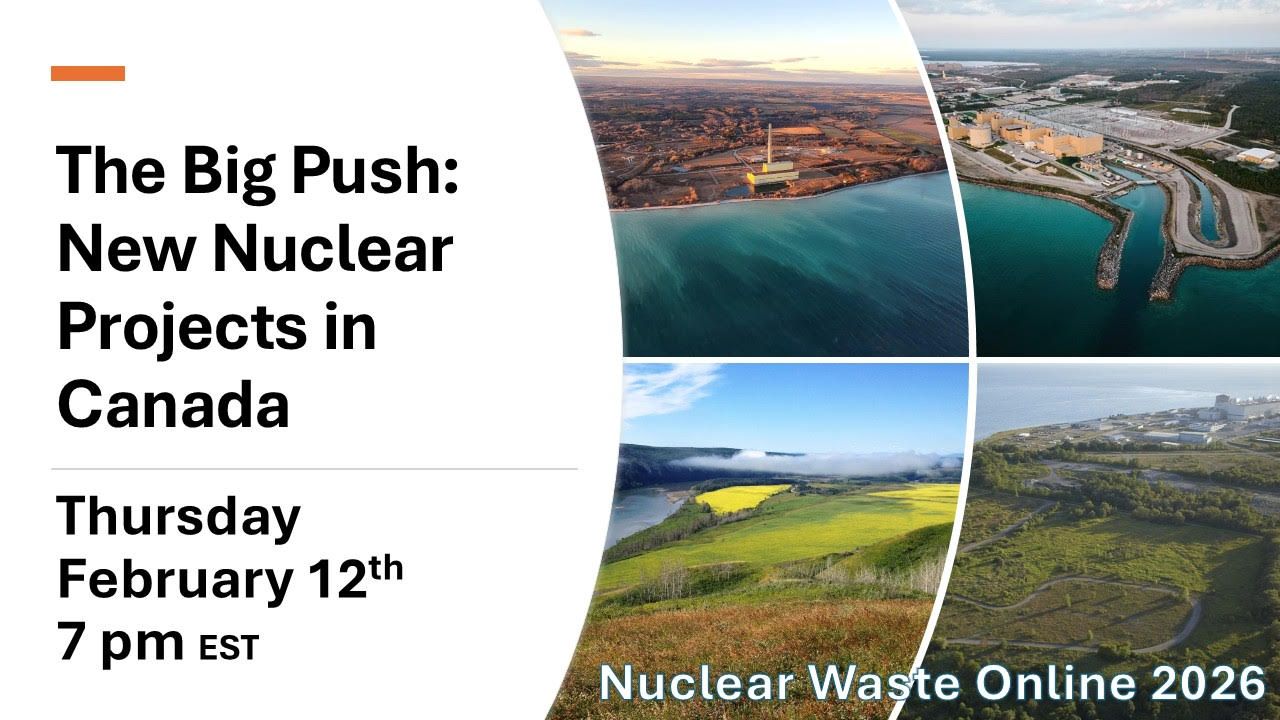
Thursday, February 12, 7 pm Eastern | 2nd of 4 sessions in the 2026 Nuclear Waste Online webinar series
Join a webinar on the push for new nuclear generation in Canada. Go to Northwatch.org to register or use the registration link https://us02web.zoom.us/webinar/register/WN_ZfWOf1GITqSRIZX8CB-A9w

-
Archives
- February 2026 (127)
- January 2026 (308)
- December 2025 (358)
- November 2025 (359)
- October 2025 (376)
- September 2025 (258)
- August 2025 (319)
- July 2025 (230)
- June 2025 (348)
- May 2025 (261)
- April 2025 (305)
- March 2025 (319)
-
Categories
- 1
- 1 NUCLEAR ISSUES
- business and costs
- climate change
- culture and arts
- ENERGY
- environment
- health
- history
- indigenous issues
- Legal
- marketing of nuclear
- media
- opposition to nuclear
- PERSONAL STORIES
- politics
- politics international
- Religion and ethics
- safety
- secrets,lies and civil liberties
- spinbuster
- technology
- Uranium
- wastes
- weapons and war
- Women
- 2 WORLD
- ACTION
- AFRICA
- Atrocities
- AUSTRALIA
- Christina's notes
- Christina's themes
- culture and arts
- Events
- Fuk 2022
- Fuk 2023
- Fukushima 2017
- Fukushima 2018
- fukushima 2019
- Fukushima 2020
- Fukushima 2021
- general
- global warming
- Humour (God we need it)
- Nuclear
- RARE EARTHS
- Reference
- resources – print
- Resources -audiovicual
- Weekly Newsletter
- World
- World Nuclear
- YouTube
-
RSS
Entries RSS
Comments RSS
 nuclear-news