Nuclear has highest investment risk; solar shows lowest, say US researchers
Nuclear power plants exceed construction budgets by an average of 102.5%, costing $1.56 billion more than planned, according to a study by Boston University’s Institute for Global Sustainability.
May 21, 2025 Pilar Sánchez Molina, https://www.pv-magazine.com/2025/05/21/nuclear-power-carries-highest-investment-risk-solar-shows-lowest-say-us-researchers/
A new study by the Institute for Global Sustainability at Boston University found that energy infrastructure projects exceeded planned construction costs in more than 60% of cases. Researchers analyzed data from 662 projects across 83 countries, spanning builds from 1936 to 2024 and totaling $1.358 trillion in investment.
The study covered a wide range of project types. These included thermoelectric power plants fueled by coal, oil or natural gas, as well as nuclear reactors, hydroelectric facilities and wind farms. It also examined large-scale PV and concentrated solar installations, high-voltage transmission lines, bioenergy and geothermal plants, hydrogen production sites, and carbon capture and storage systems
Researchers modeled projects with minimum thresholds: power plants with more than 1 MW of installed capacity, transmission lines over 10 km, and carbon capture systems processing more than 1,000 tons of CO₂ per year.
In the study, “Beyond economies of scale: Learning from construction cost overrun risks and time delays in global energy infrastructure projects,” published in Energy Research & Social Science, the authors found that energy infrastructure construction takes 40% longer than planned – on average, a delay of roughly two years.
Nuclear power plants had the highest cost overruns and delays, with average construction costs exceeding estimates by 102.5%, or $1.56 billion. Hydroelectric projects followed at 36.7%, then geothermal (20.7%), carbon capture (14.9%), and bioenergy (10.7%). Wind projects averaged a 5.2% cost increase, while hydrogen projects came in at 6.4%.
By contrast, PV plants and transmission infrastructure recorded cost underruns of 2.2% and 3.6%, respectively.
Construction delays also varied by technology. Nuclear, hydro, and geothermal projects experienced average delays of 35, 27, and 11 months, respectively. PV and transmission builds had the best performance, typically completing ahead of schedule or with only minimal delays – averaging one month if delayed at all.
The study concluded that projects exceeding 1,561 MW in capacity face significantly higher cost escalation risks, while smaller, modular renewable builds may lower financial exposure and improve forecasting. Once construction delays surpassed 87.5%, cost increases rose sharply.
A tale of two dodgy domes.
24 May 25 https://theaimn.net/a-tale-of-two-dodgy-domes/
Reuters on May 21st 2025 outlined Donald Trump’s plan for a Golen Dome missile defense shield:
The aim is for Golden Dome to leverage a network of hundreds of satellites circling the globe with sophisticated sensors and interceptors to knock out incoming enemy missiles after they lift off from countries like China, Iran, North Korea or Russia.
A network to knock out intercontinental ballistic missiles during the “boost phase” just after lift-off – Once the missile has been detected, Golden Dome will either shoot it down before it enters space with an interceptor or a laser, or further along its path of travel in space with an existing missile defense system that uses land-based interceptors stationed in California and Alaska.
Beneath the space intercept layer, the system will have another defensive layer based in or around the U.S.
Reuters names several companies that will build this system, with Elon Musk’s Space X as a frontrunner, but does not give details on the costs – estimates go from $175 billion upwards.
There is much scepticism about this plan.
I particularly enjoyed Rex Huppke ‘s sarcastic offering “I wrote a speech for Trump’s Golden Dome defense. Get ready to feel something”.
Huppke ‘s speech extols Trump’s popularity, and his promise that the system will be up an running in less than 4 years.
Huppke then studies “Golden” and “Dome’. He advises as much gold as possible to be used in the new structures, in keeping with Trump’s previous buildings. But suggests that the dome should be an unusually shaped dome – a flat-rectangular -shaped dome to fit in with the shape of America.
It’s all easy to fund, by simply cutting services to ungrateful Americans – “large is good, we love large” — cuts to Medicaid and Medicare while also adding trillions to the debt – “they’ll know their hunger is worth it for our protection.” As everyone knows, everything I’ve ever built is perfect and infallible.
Huppke does sum it up beautifully. Other commentators have questioned the extreme cost, the impracticality, the weapons proliferation risks of the Golden Dome project. Based on Israel’s “Iron Dome” this project has to cover an area 490 times the size of Israel.
So – it’s a dodgy dome that is attracting a lot of questions and criticism.
Now for that other dodgy dome that has attracted even more questions, and over many years. Yes, it’s Donald Trump’s own ever-evolving personal dome at the top of his head.
The hair has always been important to Trump. Like the spray-on tan, it goes to portray his image young, virile, strong, can conquer anything. Seth Rogan reported recently, comparing Donald Trump to Samson:
“He felt as though his power rested in his hair” https://www.youtube.com/watch?v=kvs0MAkJY-Q
Trump’s hair has been a source of wonder for many years. He’s been reported as having taken hair regrowth drug Propecia (finasteride) and had flap procedures. In flap procedures small areas of bald scalp are removed and patches of hair-covered skin are used to replace the bald areas, requiring careful combing over of bald patches. Trump’s scalp reductions were even mentioned by Ivana Trump in their 1990 divorce. A scalp reduction involves removing areas of bald patches and stretching hair-covered skin over them.
Dr. Gary Linkov, a plastic surgeon and hair loss expert, told the Daily Mail in August that he guesses Trump has had five hair transplants thus far in his lifetime.
I think, in its latest iteration, Trump’s hair is a metaphor for his dome idea, and whatever else is going on in his head. Past versions have appeared with his hair thick, combed in various ways, dyed in various shades of brown and gold. Now it’s described as ghostly white, a fluffy white cloud – with a lot of scalp peeking out.
The hair is looking thin, wispy, without real substance. It’s doubtful if he can keep up that strong confident appearance, as the head of the world that he’s supposed to be.
This White Dome sits atop the strange brain that has just conjured up the Golden Dome – neither of them are really to be trusted.
Civil society says nuclear deserves no place in Prime Minister Carney’s “Energy Superpower” project.

Gordon Edwards, May 21, 2025
Today 131 civil society and Indigenous groups representing many thousands of members across Canada reminded Prime Minister Mark Carney that climate action requires renewable – not nuclear – energy.
In an open letter to Prime Minister Carney, available HERE, representatives from the civil society and Indigenous groups wrote that building more nuclear reactors is not a cost-effective, clean or smart climate option. The government’s “Energy Superpower” project should include renewable energy and exclude nuclear reactor development from public subsidies.
The groups reminded the Prime Minister that, as an economist, he must appreciate that energy efficiency, renewables and energy storage are the best investments for energy supply, requiring less capital investment and providing the best return on the dollar for energy production, job creation, and rapid greenhouse gas reduction.
New nuclear projects are already far more expensive than proven renewable energy sources and there is no guarantee that new nuclear reactor designs will ever generate electricity safely and affordably. Spending on nuclear development is wasting time that must be spent urgently on genuine climate action.
“The nuclear industry, led by American corporations and start-ups, has failed to convince us that new reactor designs will address the climate crisis and overcome the exorbitant cost, toxic radioactive waste and threats of nuclear disasters that have plagued the nuclear industry for decades,” said Dr. Gordon Edwards, president of the Canadian Coalition for Nuclear Responsibility (CCNR).
“Quebec has rejected nuclear power. We object to our federal taxpayer dollars being spent on developing more nuclear reactors that could be abandoned in place, ultimately transforming communities into radioactively contaminated sites and nuclear waste dumps that will require more federal dollars to clean up,” said Jean-Pierre Finet, spokesperson for le Regroupement des organismes environnementaux en énergie (ROEÉ).
The groups are asking for a meeting with Prime Minister Carney to discuss Canada’s energy future.
Read the letter HERE with the list of 131 signatory groups.
Solar Power Set to Surpass Nuclear Generation This Summer
By Tsvetana Paraskova – May 21, 2025, https://oilprice.com/Latest-Energy-News/World-News/Solar-Power-Set-to-Surpass-Nuclear-Generation-This-Summer.html
This summer, solar power generation globally could exceed electricity from nuclear power plants for the first time ever, as solar capacity soars and sunlight and daylight hours are long in the northern hemisphere.
Global solar power generation jumped by 34% in the first quarter of 2025 from the same period in 2024, according to data from Ember cited by Reuters columnist Gavin Maguire.
If the pace of growth is sustained though June, July, and August, solar output is set to top 260 terawatt hours (TWh) in the summer months. This would beat the average 223 TWh of global nuclear power generation from 2024, Maguire notes.
Last year, record growth in renewables led by solar helped push clean power above 40% of global electricity in 2024, Ember said in its Global Electricity Review 2025 last month. However, heatwave-related demand spikes led to a small increase in fossil generation, too, the clean energy think tank said.
“Solar generation has maintained its high growth rate, doubling in the last three years, and adding more electricity than any other source over that period,” Ember’s analysts wrote in the report.
More than half, or 53%, of the increase in solar generation in 2024 was in China, with China’s clean generation growth meeting 81% of its demand increase in 2024, according to Ember.
China and Europe are driving solar power’s global surge, but in Europe, the solar boom has led to negative power prices more frequently.
At the end of April, for example, a sunny weekend in northwest Europe plunged power prices in the region to hundreds of euros below zero as solar generation soared.
Negative power prices, while beneficial for some consumers in some countries, generally discourage investments in new capacity as renewable power generators don’t profit from below-zero prices.
The more frequent occurrences of negative prices amid soaring solar output aren’t conducive to increased investment in generation only, and highlight the need of energy storage solutions to store the excess power and discharge it at evenings when it’s most needed.
US House seeks to create another Ukraine disaster in Georgia
Walt Zlotow, West Suburban Peace Coalition, Glen Ellyn IL, 22 May 25
Not satisfied with destroying Ukraine to weaken Russia, the US House passed a deranged bill to set the stage for a Ukraine redo, this time in tiny former Soviet republic Georgia.
It overwhelmingly passed the Mobilizing and Enhancing Georgia’s Options for Building Accountability, Resilience, and Independence Act (MEGOBARI Act) by a vote of 349 to 42.
MEGOBARI may be the stupidest acronym ever. But its intent is even stupider.
The bill is simply a Ukraine style regime change ploy to kick Russia out of its neighbor Georgia’s polity so Georgia can join NATO and the EU.
MEGOBARI doesn’t mince niceties” “[T}he consolidation of democracy in Georgia is critical for regional stability and United States national interests… (so it is) the policy of the United States to support the constitutionally stated aspirations of Georgia to become a member of the European Union and NATO,” to “continue supporting the capacity of the Government of Georgia to protect its sovereignty and territorial integrity… (and) to combat Russian aggression, including through sanctions on trade with Russia and the implementation and enforcement of worldwide sanctions on Russia.”
The US regime change party, including all but 34 Republican and 8 Democrats, can’t tolerate the duly elected Russian aligned Georgian Dream Party ruling Georgia. Claiming this tiny spec of a country with just 3.8 million souls and a miniscule $35 billion GEP is essential to US national security interests is preposterous.
Georgia has suffered thru senseless US intervention for 22 years beginning with the 2003 CIA aided Rose Revolution that eventually installed pro US puppet Mikheil Saakashviili as president, ousting pro Russian
Eduard Shevardnadze. Hear echoes of Ukraine there?
Five years later, goaded by the US, Saakashvili tried to reclaim 2 breakaway Georgian provinces aligned with Russia. Big mistake. His attack provoked a Russian pushback that crushed the Georgian intervention. At the start, premier US war lover Sen. John McCain shouted “Today we are all Georgians.” When Georgia caved so did McCain, likely channeling SNL’s Roseanne Roseannadanna’s ‘Oh, never mind.’
But here we are 17 years on and US war lovers are at it again in the ‘Weaken Russia’ game with patsy Georgia. MEGOBARI even includes the ominous directive that allows Congress “…in consultation with the Secretary of Defense… to expand military co-operation with Georgia, including by providing further security and defense equipment ideally suited for territorial defense against Russian aggression and related training, maintenance, and operations support elements.”
Might be time for all 349 clueless congresspersons supporting MEGOBARI to be flown to Ukraine’s eastern war front to see just how glorious their ‘Weaken Russia’ campaign is going with our hapless Ukrainian proxies.
Govt Eyes Reuse of Fukushima Soil at PM’s Office

Tokyo, May 23 (Jiji Press) https://jen.jiji.com/jc/eng?g=eco&k=2025052300665
–The Japanese government is considering reusing soil removed from the ground during radiation decontamination work after the 2011 nuclear reactor meltdowns in Fukushima Prefecture in the grounds of the prime minister’s office in Tokyo, informed sources have said.
The government hopes to promote public understanding over the reuse of the soil from the decontamination work in the northeastern Japan prefecture, home to Tokyo Electric Power Company Holdings Inc.’s disaster-stricken Fukushima No. 1 nuclear power plant.
The move came after planned pilot projects for using the soil in Tokyo and its northern neighbor, Saitama Prefecture, have stalled due to opposition from local residents.
The government plans to compile a basic policy on the recycling and final disposal of the soil shortly, including its use at the prime minister’s office. It also plans to draw up a specific road map by around this summer.
Some 14 million cubic meters of the soil from the decontamination work is currently stored at interim facilities in the Fukushima towns of Okuma and Futaba, where the TEPCO plant is located.
Drone attacks Zaporizhia NPP training centre third time this year – IAEA
Zaporizhia Nuclear Power Plant (ZNPP) told the team of the International
Atomic Energy Agency (IAEA) based at the Plant that the drone hit the roof
of the training centre located just outside the ZNPP site perimeter on May
21, according to an update on the situation in Ukraine on the IAEA website
late on Wednesday.
The drone hit the roof, without causing any casualties
or major damage. It was not immediately known whether the drone had
directly struck the building or whether it crashed on the structure after
being shot down. The IAEA said that it was the third time this year that
the training centre was reportedly targeted by such an unmanned aerial
vehicle.
Interfax Ukraine 22nd May 2025, https://en.interfax.com.ua/news/general/1073812.html
Revealed: three tonnes of uranium legally dumped in protected English estuary in nine years
Expert raises concerns over quantities allowed to be discharged from nuclear fuel factory near Preston
Pippa Neill, 23 May 2025 , https://www.theguardian.com/environment/2025/may/22/revealed-uranium-from-uk-nuclear-fuel-factory-dumped-into-protected-ribble-estuary
The Environment Agency has allowed a firm to dump three tonnes of uranium into one of England’s most protected sites over the past nine years, it can be revealed, with experts sounding alarm over the potential environmental impact of these discharges.
Documents obtained by the Guardian and the Ends Report through freedom of information requests show that a nuclear fuel factory near Preston discharged large quantities of uranium – legally, under its environmental permit conditions – into the River Ribble between 2015 and 2024. The discharges peaked in 2015 when 703kg of uranium was discharged, according to the documents.
Raw uranium rock mined from all over the world is brought to the Springfields Fuels factory in Lea Town, a small village roughly five miles from Preston, where the rock is treated and purified to create uranium fuel rods.
According to the factory’s website, it has supplied several million fuel elements to reactors in 11 different countries.
The discharge point for the uranium releases is located within the Ribble estuary marine conservation zone – and about 800m upstream of the Ribble estuary, which is one of the most protected sites in the country, classified as a site of special scientific interest, a special protection area (SPA) and a Ramsar site (a wetland designated as being of international importance).
The government’s latest Radioactivity in Food and the Environment report, published in November 2024, notes that in 2023 the total dose of radiation from Springfields Fuels was approximately 4% of the dose limit that is set to protect members of the public from radiation.
However, Dr Ian Fairlie, an independent consultant on radioactivity in the environment, who was a scientific secretary to the UK government’s committee examining radiation risks of internal emitters, said that in terms of radioactivity, the discharges from Springfields Fuels were a “very large amount”.
“I’m concerned at this high level. It’s worrying”, he said, referring specifically to the 2015 discharge.
In a 2009 assessment, the Environment Agency concluded that the total dose rate of radioactivity for the Ribble and Alt estuaries SPA was “significantly in excess” of the agreed threshold of 40 microgray/h, below which regulators have agreed there would be no adverse effect to the integrity of a protected site. The report found the calculated total dose rate for the worst affected organism in the estuary was more than 10 times higher than this threshold, with discharges of radionuclides from the Springfields Fuels site to blame.
As a result, a more detailed assessment was undertaken. In this latter report, it was concluded that based on new permitted discharge limits, which had been lowered due to planned operational changes at Springfields Fuels, the dose rates to wildlife were below the agreed threshold and therefore there was no adverse effect on the integrity of the protected site.
Under the site’s current environmental permit, there is no limit on the weight of uranium discharges, which in itself has raised eyebrows. Instead, the uranium discharge is limited in terms of its radioactivity, with an annual limit of 0.04 terabecquerels. Prior to this, the discharge limit in terms of radioactivity was 0.1 terabecquerels.
A terabecquerel is a unit of radioactivity equal to 1tn becquerels. One becquerel represents a rate of radioactive decay equal to one radioactive decay per second.
Despite this tighter limit having been agreed six years ago, experts have raised concerns over the continued authorised discharges from the site.
Fairlile specifically questioned the Environment Agency’s modelling of how this discharge level could be classified as safe. “This is a very high level. The Environment Agency’s risk modelling might be unreliable. Which would make its discharge limits unsafe”, he said.
The Environment Agency said its processes for assessing impacts to habitats were “robust and follow international best practice, including the use of a tiered assessment approach”.
Dr Patrick Byrne, a reader in hydrology and environmental pollution at Liverpool John Moores University, said the 703kg of uranium discharged in 2015 was an “exceptionally high volume
Dr Doug Parr, a policy director at Greenpeace UK, said: “Discharges of heavy metals into the environment are never good, especially when those metals are radioactive.”
An Environment Agency spokesperson declined to comment directly, but the regulator said it set “strict environmental permit conditions for all nuclear operators in England, including Springfields Fuels Limited”.
It said these permits were based on “detailed technical assessments and are designed to ensure that any discharges of radioactive substances, including uranium, do not pose an unacceptable risk to people or the environment”.
While the government’s Radioactivity in Food and the Environment report found sources of radiation from Springfield Fuels were approximately 4% of the dose limit to members of the public, it also concluded that radionuclides – specifically isotopes of uranium – were detected downstream in sediment and biota in the Ribble estuary due to discharges from Springfields.
This is not the first time uranium levels in the estuary silt have been noted. Research conducted by the British Geological Survey (BGS) in 2002 detected “anomalously high” concentrations of uranium in a silt sample downstream of the Springfields facility.
The highest level recorded in the BGS report was 60μg/g of uranium in the silt – compared with a background level of 3-4μg/g. The researchers described this as a “significant anomaly”.
The UK is looking to expand its nuclear fuel production capabilities, including at Springfields Fuels. This is in order to increase energy security and reduce reliance on Russian fuel, and to deliver on a target of 24GW of new nuclear capacity by 2050.
A spokesperson from Westinghouse Electric Company UK, the operator of the factory), said: “Springfields is committed to strong environmental stewardship in our Lancashire community. The plant is monitored and regulated by the Environment Agency and operates well within those regulations. For nearly the past 80 years, Springfields has provided high-quality jobs to the local community and the fuel we provide to the UK’s nuclear power plants has avoided billions of tonnes of CO2 from fossil fuels.”
An Environment Agency spokesperson said: “The Environment Agency strictly regulates Springfields Fuels through robust environmental permits that control radioactive discharges, ensuring they pose no unacceptable risk to people or the environment. These permits are based on international best practice and are routinely reviewed, including detailed habitat assessments. Discharge limits have been progressively reduced over time, and monitoring by both the operator and the Environment Agency confirms no cause for alarm.
Top nuke officials admit staffing challenges after DOGE layoffs, hiring freeze
Testifying to a Senate committee, National Nuclear Security Administration leaders acknowledged staffing woes after DOGE-led reductions.
Davis Winkie. USA TODAY, https://www.usatoday.com/story/news/politics/2025/05/21/nuclear-weapons-leaders-describe-workforce-woes-doge/83770727007/
Key Points
- During May 20 testimony, top acting officials from the National Nuclear Security Administration acknowledged the risk and impact of workforce vacancies caused by Elon Musk’s DOGE.
- A USA TODAY investigation published May 18 detailed the potential impact of endemic federal staffing shortages at NNSA recently exacerbated by the Trump administration’s cuts to the federal workforce.
WASHINGTON − Top leaders of the agency responsible for the U.S. nuclear weapons stockpile admitted to DOGE-related staffing challenges at a Senate hearing.
Asked by Sen. Angus King, I-Maine, if a hiring freeze, resignations and attrition could bring “some pretty important vacancies,” acting National Nuclear Security Agency defense programs head David Hoagland said, “That’s very true.” Hoagland said at the May 20 hearing that his office had “shifted people around” to meet “critical needs.”
Hundreds of NNSA staff were fired by Elon Musk‘s Department of Government Efficiency earlier this year, amid a $1.7 trillion nuclear weapons upgrade, in a chaotic wave of layoffs. Most were later rehired. Other critical staffers agreed to leave their jobs under DOGE’s “fork in the road” resignation offer.
King said NNSA claims that staffing shortages hadn’t placed agency’s mission at short term risk “strikes me as implausible.”
The NNSA struggled with staffing and talent pipeline issues for decades before the new Trump administration, a recent USA TODAY investigation found. Then Musk launched efforts to reduce the federal workforce, which further destabilized the NNSA workforce, experts said.
The agency currently faces a near-total hiring freeze and lost more than 130 of its 2,000 federal employees to the DOGE deferred resignation program. More than 300 more employees were fired and reinstated in February damaging morale.
NNSA’s acting principal deputy administrator, James McConnell, said told senators on a subcommittee of the Armed Services Committee the agency could handle the losses “in the short term,” but he said the NNSA needs to “make sure that our resources are adequate.”
Experts told USA TODAY sustained staffing shortages could cause further delays and cost overruns on the agency’s beleaguered portions of the nation’s broader $1.7 trillion nuclear arsenal modernization effort. USA TODAY documented billions of dollars in overruns, as well as safety issues, at NNSA facilities that were attributed to staffing shortages.
Marv Adams, Hoagland’s Senate-confirmed predecessor atop NNSA’s defense programs, said in an interview that during his tenure, “our federal [warhead] program offices struggled to keep up and not get behind because of understaffing.”
The agency’s field offices faced similar strain, according to David Bowman, a retired civil servant and former manager of the NNSA’s Nevada Field Office. From 2020 until his retirement in the fall of 2024, Bowman oversaw operations at the expansive Nevada National Security Site.
NNSA field offices must review and approve much of the work the agency’s massive contractor workforce does on the nuclear arsenal, as well as safety management plans. In an interview, Bowman said such review “requires … technical experts who are feds.”
“If the field offices or the safety experts are short staffed, the work is going to back up,” he said.
Bowman described finding qualified staff for his far-flung office northwest of Las Vegas as “the big challenge we had.”
Contributing: Cybele Mayes-Osterman, USA TODAY
Atomic bombs destroyed their lives – now they want Russia to pay
“People living around the test site “became unwitting test subjects, and their lives were treated with casual disregard due to racism and ignorance,”
“It was a crime of negligence, whereby secrecy, control, and the acquisition of more powerful nuclear weapons were prioritised over the lives of local people.”
Amid calls to restart nuclear testing, families are still suffering from mutations passed down through the generations
Arthur Scott-Geddes. Simon Townsley Photographer, in Semey, Telegraph, 21 May 2025
The Geiger counter came to life as we trudged toward the lip of the crater, its clicks becoming frantic before giving way to an alarm.
“This is the Atomic Lake,” said the hazmat-suited guide, throwing out his arms against the wind to encompass the circular expanse of water below. “Don’t get too close to the edge.”
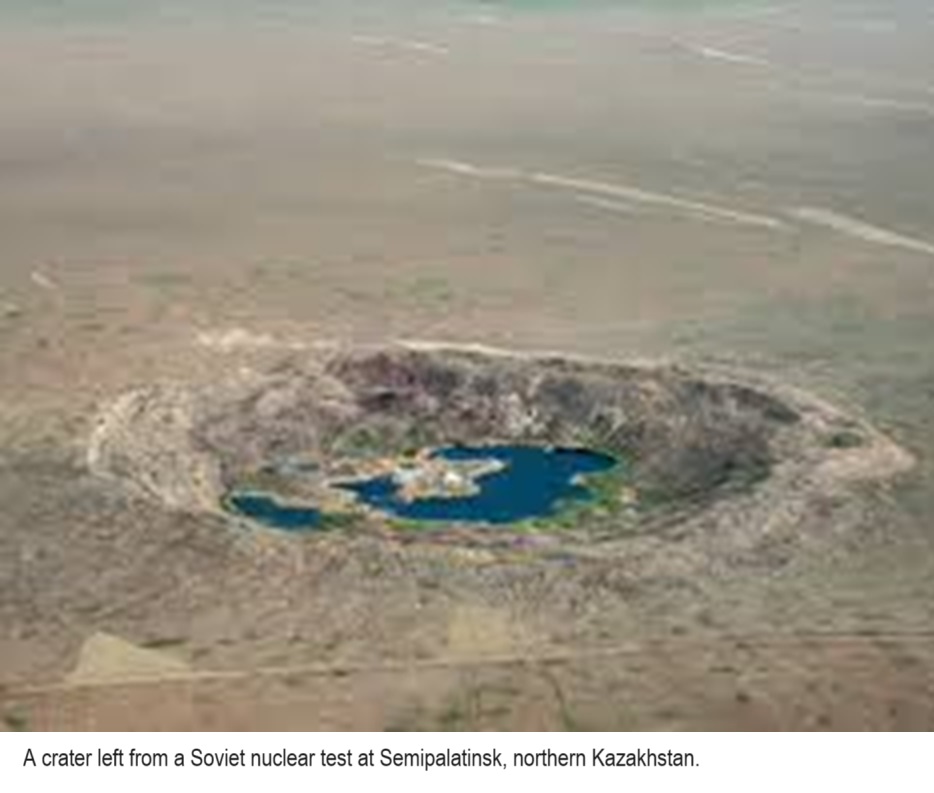
Sixty years ago a nuclear bomb ten times more powerful than the one that destroyed Hiroshima exploded at the bottom of a 178-metre shaft in this remote (but not unpopulated) corner of Kazakhstan.
The blast excavated a basin a quarter of a mile wide and several hundred feet deep, sending up a plume of pulverised rock and radioactive material that was detected as far away as Japan.
It was not a one off. The hydrogen bomb was one of 456 nuclear weapons detonated by the Soviet Union at the Semipalatinsk Test Site, a 7,000 square mile swathe of steppe known as the Polygon.
The tests started in 1949 and continued right up until 1989 and the fall of the Berlin wall. They account for a quarter of all the nuclear explosions in history, creating an ongoing health crisis of a scale and nature that is hard to fathom.
The Kazakh authorities estimate that one-and-a-half million people living in nearby cities, towns and villages were exposed to the residual fallout.
The region has elevated rates of cancer, heart disease, birth defects and fertility problems – all linked to the tests. Suicides are common and the area’s graveyards are filled with people who died young.
But as well as sickening those who were directly exposed, the fallout has worked its way into the population’s DNA, leading to mutations that have been passed down through the generations.
‘There were so many children born with different mutations’
Almost everyone who grew up in Semey, a city of about 350,000 that lies only 75 miles from the Polygon, was affected in some way by the testing programme.
Olga Petrovskaya, the 78-year-old chair of Generation, a campaign group founded in 1999 to petition the government for greater support for the victims of the tests, remembers explosions shaking the city.
“We would be taken out of the classroom because they were worried about the windows shattering,” she said. “But nobody would explain why it was happening.”
White dust would sometimes fall on the city, causing sores to form on exposed skin. It was not long before people started dying.
“When we were six years old, at nursery school, there was a girl who died of leukaemia,” she said. “And then at [primary] school our classmates were also dying of cancerous diseases.
“Cancer became a very common diagnosis – there is no family that hasn’t been affected by it – and there were so many children born with different mutations.”
Ms Petrovskaya lost her brother, her aunt and her in-laws to cancer in the 1960s. She herself suffered numerous miscarriages and still has debilitating headaches and dizzy spells that she believes are linked to the radiation.
Her group of activists has dwindled as its members succumbed to their illnesses. There are now only a handful of them left.
The Soviet testing programme has been frequently criticised for its recklessness.
For instance, the first test of a two-stage hydrogen bomb created a blast much more powerful than anticipated, causing a building to collapse and killing a young girl in Kurchatov, the closed-off city 40 miles away where the tests were directed from
But the scientists and military personnel responsible understood the risks inherent in what they were doing. Modelling has shown that people who lived through all 456 tests received doses of radiation up to 120 times greater than survivors of the Hiroshima bombing.
“The Soviet authorities were absolutely not ignorant of the dangers of nuclear weapons testing,” said Dr Becky Alexis-Martin, a Lecturer in Peace, Science, and Technology at the University of Bradford.
“The tests occurred long after the Hiroshima and Nagasaki bombings, and records from the time reveal that the scientists involved in the Polygon tests had expert understandings of the impacts of ionising radiation on health.”
People living around the test site “became unwitting test subjects, and their lives were treated with casual disregard due to racism and ignorance,” added Dr Alexis-Martin
“It was a crime of negligence, whereby secrecy, control, and the acquisition of more powerful nuclear weapons were prioritised over the lives of local people.”
There is a growing body of evidence showing that radiation-induced mutations can be passed down multiple generations.
In 2002, an international study of 20 families living around the Semipalatinsk test site showed that exposure to fallout nearly doubled the risk of inherited gene mutations.
“Genetic consequences manifest in many different ways and any gene can be affected by radioactive exposure. Some gene changes are invisible beyond our DNA – but others can have harmful and intergenerational impacts,” said Dr Alexis-Martin.5
“We often think of birth defects when we think of radiation exposure, but hereditary heart conditions, blindness, and deafness can also arise.”
Today many Kazakh families still bear the marks of the tests several generations after the explosions stopped.
‘I will not live much longer’
Read more: Atomic bombs destroyed their lives – now they want Russia to pay
Asel Oshakbayeva was born in 1997, eight years after the last atomic detonation at the Polygon.
Yet she soon began to have seizures, and at the age of three months suffered a brain haemorrhage that left her blind and unable to speak, move or eat.
“She was in a coma, she couldn’t see anything,” said her mother, Sandugush.
The family sold their home and two cars to fund experimental surgical treatment in Russia that, after 14 operations, repaired damage to her optic nerve, partly restored her speech and made it possible for her to eat again.
But she remains totally dependent on her mother, and the pair left Semey and now live cheek-by-jowl with five other relatives in a small flat in Astana, the capital.
Sandugush, like her parents before her, was exposed to high levels of radiation while living near the Polygon.
In total, three generations of her family have now been officially recognised as victims of the testing, including her daughter. Her husband died of cancer 10 years ago, and she herself has a host of unusual health complaints.
“I will not live much longer,” she said, gesturing to her side where surgeons removed cancerous tumours from her breast and lymph nodes.
She now worries who will look after her daughter in the future. “She has the mind of a ten-year-old. If I die, what will happen?”
Despite the high prevalence of disability in the communities affected by the Polygon, a stigma around the children born with deformities persists.
Maira Zhumageldina, 56, lived for a time in the area of maximum radiation risk and gave birth to her daughter Zhannur in 1992.
Zhannur’s ribcage, spine and limbs never properly formed, leaving her permanently disabled – unable to walk, talk or feed herself.
When the extent of Zhannur’s disability became clear, Ms Zhumageldina came under pressure to give her up, even from her own family.
“When I had Zhannur about 13 or 14 children were born with different kinds of disabilities, so some were abandoned and some died at early ages,” she said.
“My parents-in-law said: ‘Why don’t you leave her?’ But I said ‘this is my child’ I could never leave her.”
A well-thumbed album of photographs documents the 28 years that Ms Zhumageldina devoted to caring for her daughter.
She trained as a massage therapist to ease her pain, and took her to Astana for specialised treatment……………………………………………………………………………………………………………………
‘The slow genocide’
……people whose families have been torn apart by the tests accuse the government of a “genocide” by inaction.
Reluctant to cough up the cash to properly support the hundreds of thousands of people sickened by the radiation and unwilling to press Russia for help in fear of provoking a diplomatic row, the government, they say, is simply waiting for them to die.
………Most of the fallout came their way – the Soviet scientists in Kurchatov made sure not to detonate any weapons while the wind was blowing towards them.
Hardly anyone here lives to retirement age, and cancer and birth defects are common.
“It’s a genocide,” said Acen Kusayenuli, 59, a veteran of the war in Afghanistan who recently had a portion of his lung removed after being diagnosed with cancer. He cannot afford chemotherapy so instead chews herbs to fight the disease.
“We were just like mice,” he said. “Why else would they not relocate the people and animals? They wanted to see how we would be affected.”
Even the landscape has suffered……..
the villagers, always kept in the dark about what was going on, bore the burden of death with a strange stoicism common to many parts of the former Soviet Union.
“We just accepted that whoever gets sick, gets sick,” she said……………………..
“The nuclear weapons tests were undertaken in the knowledge that the local ethnic Kazakhs could be harmed or even gradually eradicated,” said Dr Alexis-Martin.
“The lack of impetus and action across the decades by successive Soviet, Russian, and Kazakhstan governments and the global community amounts to ‘slow genocide’ – this arises when an ethnic or cultural group is gradually and systematically destroyed due to cumulative and sustained harm over time.”
Seventy-five miles further down the road is the village of Kaynar, which sits in the shadow of a rock formation overlooking the test site. Older residents remember climbing to the top to watch the explosions. ……………………………………………………………
Dr Saule Isakhanova, the head doctor of the Abralinski Regional Hospital which looks after around 2,100 people in Kaynar and the surrounding villages, said nearly half of her patients had health problems linked to the tests.
Her husband, the former mayor, was one of those who used to go out into the steppe to collect grass. He now has bowel cancer.
She said the effects of the tests could continue to harm people living in the area for a long time.
“Research shows that particles of these elements can remain in the dust for 300,000 years,” she said, referring to the radionuclides released by the bombs. “Those particles, once you breathe them in, they get into your bones.”
While much of the research attention has so far focused on rates of cancer and birth defects, little has been done to understand the prevalence of developmental disorders among children affected by the tests.
……………………………………………………..Dr Talgat Moldagaliyev, the former Director of the Institute of Radiation Medicine and Oncology in Semey, said more work is needed to understand the effects the tests are continuing to have.
“It’s a living experimental zone, but not enough research has been done.”
‘It should never happen again’
Most of the victims of the Polygon only learned the truth about what had been happening to them after the Soviet Union collapsed and Kazakhstan gained independence.
That moment gave rise to Kazakhstan’s first civil society movement, which connected survivors of the Polygon tests with communities affected by American nuclear testing in Nevada.
Over 35 years since the last nuclear explosion at the Polygon, there is a renewed push to win justice for those affected by the radiation.
Maira Abenova, the founder of Committee Polygon 21, an advocacy group representing the victims, lost her mother, brother, sister and husband to diseases related to the Polygon and now suspects she has cancer herself.
She wants the world to recognise that the suffering did not end with the closure of the test site.
“Currently the law recognises as a survivor of the nuclear tests only those people who lived in four regions around the Polygon from 1949 to 1991,” she said, referring to a law brought in in 1992 which gave people who qualified a “radiation passport” certifying their exposure to the radiation.
Those given the small, beige documents, which bear a blue mushroom cloud stamp on the cover, receive a small amount of compensation and other benefits including longer holidays.
While older survivors of the tests say the system worked at first, many of the families The Telegraph spoke to, particularly those in the hard-hit villages, said it was difficult to get official recognition for their children.
Rising medical costs far outstrip benefits worth around $40 a month and moving away from the villages, even to seek better medical care, disqualifies survivors from support.
Ms Abenova has been petitioning government agencies, who are more interested in collaborating with Russia on nuclear energy and turning the test site into a dark tourism destination, to take action on a grander scale.
“You cannot solve the problem just by paying small additional payments, you have to upgrade the economy in the region,” she said.
United Nations resolutions and the sustainable development goals (SDGs) should also be used to improve the lives of those living in the areas affected by the tests, and a new law is needed “which recognises all the survivors,” she said.
Committee Polygon 21 was among several Kazakh civil society groups to appeal to the UN in New York urging global action on justice for the testing victims.
After Vladimir Putin, the Russian President, withdrew his country’s ratification of the global treaty banning nuclear weapons tests, and with advisers of Donald Trump urging him to restart US testing, Ms Abenova hopes her work will also energise calls for disarmament.
“Kazakhstan suffered from nuclear tests […] Our people should use this opportunity to appeal to other countries that it should never happen again,” she said.
Meanwhile, how safe it is to live in the area around the Polygon remains unclear.
The site itself has been picked over by scavengers looking for – often highly irradiated – scrap metals.
Some 116 bombs were detonated in the atmosphere, but 340 exploded underground, and a secretive joint US-Russian-Kazakh cleanup programme to secure fissile material and even bomb components left behind by the Soviets in tunnels and shafts was only made public after it ended in 2012.
Those living nearby still do not know if their food and water is safe.
……………………..https://www.telegraph.co.uk/global-health/terror-and-security/soviet-union-nuclear-testing-atomic-bomb-kazakhstan/
The nuclear divide: Why are women cautious of nuclear energy?
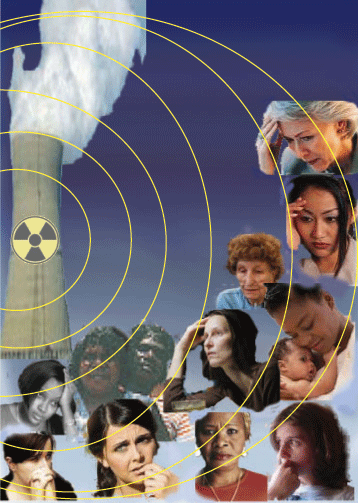
Women are consistently more skeptical than men, and not just marginally so. The gender divide is greater for nuclear technology than for any other energy source.
Their concerns are justified. Studies show women are twice as likely to develop radiation-related cancers, yet safety regulations often rely on the so-called “Reference Man” standard, ignoring biological differences.
by Emma Fackenthall, May 19, 2025, https://nbmediacoop.org/2025/05/19/the-nuclear-divide-why-are-women-cautious-of-nuclear-energy/
As many countries scramble toward a net-zero future, some are betting on nuclear energy to reach their goal. However, a quiet but profound gender divide is growing around nuclear energy.
While nuclear power is often hailed as a critical tool in the climate fight, a growing body of research suggests that fewer women than men support nuclear power. This divide can be explained by safety concerns, ecofeminist ethics of care, and the nuclear industry’s macho culture.
The striking gender divide is another reason to question the viability of nuclear energy to attain climate justice and energy democracy.
Despite the foundational contributions of female scientists to the nuclear field (think Marie Curie, Lise Meitner, and Chien-Shiung Wu) the industry is currently male-dominated. According to a recent international report, women make up only 25 per cent of the nuclear workforce. Among new hires, 28.8 per cent are women, reflecting slow progress. Of that, a mere 18.5 per cent hold leadership roles.
Meanwhile, public opinion surveys spanning 20 countries show a persistent gender difference in support for nuclear energy. Women are consistently more skeptical than men, and not just marginally so. The gender divide is greater for nuclear technology than for any other energy source. Women cite safety risks and the potential to delay the rollout of renewable energy as primary reasons for their lack of support for nuclear energy.
Their concerns are justified. Studies show women are twice as likely to develop radiation-related cancers, yet safety regulations often rely on the so-called “Reference Man” standard, ignoring biological differences. Initiatives like the Gender and Radiation Impact Project are now working to redefine safety metrics using the “Reference Girl,” highlighting the systemic underrepresentation of women in regulatory science.
Indeed, more and more attention is being placed on the lack of female representation in science and society. Books like Unwell Women, Invisible Women, and Feminist City recount these enduring systemic misrepresentations.
The nuclear industry has noted the low female support. A 2023 report by the Nuclear Energy Agency declared the gender gap an “existential challenge” for achieving climate targets. One of its key recommendations? Attract more women through targeted communication campaigns.
The response has been… complicated. Enter the “nukefluencers”: social media-savvy women – many of them models and beauty queens – paid by the nuclear industry to tout the supposed benefits of nuclear power on Instagram and TikTok.

Posts often blend lifestyle content with pro-nuclear messaging, echoing the corporate “girl boss” ethos. But while these accounts aim to appeal to women, a brief analysis reveals that most engagement comes from men. It raises the question: who is this campaign really reaching?
Ecofeminist ethics offer another possible explanation for women’s reluctance to support nuclear energy. This perspective ties environmental degradation to systems of patriarchy and domination, arguing that the same forces that exploit nature also marginalize women, Indigenous peoples, and racialized communities.
Women, therefore, may be more attuned to nuclear energy’s ethical and social implications. Research shows women are 2.5 times more likely to demand climate action and that women-led companies tend to have stronger climate performance.
The “macho mentality” embedded in nuclear culture is another reason. Nuclear power is often portrayed in the media as powerful and dangerous, tapping into masculine ideals. From post-apocalyptic video games to radioactive superheroes, pop culture reinforces the narrative of nuclear as bold and aggressive.
In contrast, renewable energy is frequently associated with care, sustainability, and cooperation – all traits traditionally coded as feminine and therefore undervalued in male-dominated spheres.
Even nuclear industry branding can reflect this gender divide. Some nuclear companies employ harsh, bold typography and stark color schemes that psychological and communications studies believe subconsciously project strength and authority, often masculine traits.
Others, like the nuclear companies in New Brunswick, are attempting to greenwash their image with soft fonts, green logos, and lowercase letters, perhaps in a bid to court a more gender-diverse audience. Ironically, this might alienate men, who may perceive these aesthetic cues as less aligned with masculine identity.
You might think a simple change of font would not have the power to deter men, but studies have shown that men are more concerned with gender-identity maintenance than women and simple things like fonts can deter men due to the risk of harming masculine perception.
Nuclear energy’s gender divide is interwoven in many different ways, but the implications remain far-reaching. If nuclear expansion continues to ignore gendered perceptions and safety concerns, it risks exacerbating conflicts rather than resolving them. Climate justice and social justice are interlinked, ignoring one will equally harm the other.
If we want real change, we need women and other marginalized groups at the decision-making tables. If women are reluctant to support nuclear energy, their reasons need to be understood. Their voices against nuclear energy are important and need validation.
More than just a public opinion gap, the nuclear gender divide is a signal that the future of energy must be inclusive, equitable, and just. Without considering the concerns of women, no technological solution, however potentially powerful, will be truly sustainable.
Emma Fackenthall is a research assistant with the CEDAR project at St. Thomas University. She will be presenting a version of this research in Montreal this May at The Great Transition event.
We’re all pretending to be mad at Israel now that 14,000 babies are starving to death

At least we’re proving we’re serious about our opposition to genocide though. So serious, in fact, that the RAF is conducting surveillance flights and helping Israel select targets to bomb with the F-35s we helped build. Makes you proud to be British, doesn’t it?
This is about saving our reputations and avoiding arrest…
Laura and Normal Island News, May 21, 2025, https://www.normalisland.co.uk/p/were-all-pretending-to-be-mad-at?utm_source=post-email-title&publication_id=1407757&post_id=164073303&utm_campaign=email-post-title&isFreemail=true&r=ln98x&triedRedirect=true&utm_medium=email
As a journalist in the mainstream media, I have proudly defended Israel for the last 19 months, but now that everyone is realising how bad they are (and more ICC arrest warrants are coming), I would like to express my genuine anger at the killers I encouraged.
While I took no issue with the bombing of apartment buildings and hospitals and schools and universities and food distribution centres and aid vehicles and tents and even my fellow journalists, I have suddenly my found my conscience, which is a real thing that definitely exists.
The mass murder of civilians was fine while we could get away with blaming everything on Hamas, but now that Israel is starving 14,000 babies to death and openly boasting about it and saying not even the west can stop us, I’m shitting myself to be honest. I’m worried the International Criminal Court might see Normal Island News in the same light as Radio Rwanda.
I feel particularly bad for you, my obsessed readers, who face the real prospect of no more Normal Island News unless I act. If anyone knows a quick way to purge the internet of everything I’ve ever written it would be most appreciated.
I’m not alone in shitting myself because not only is almost every western journalist finding their conscience at the very last moment, but we’ve even seen Lammy and Starmer pretend to be mad at Israel in parliament. I say “pretend”, but they genuinely are mad, just not about the babies. They’re mad that Israel is making them look really fucking bad.
The foreign secretary has shrewdly noticed Israel has been blocking food for 11 weeks and Gaza’s babies look like skeletons. He has even noticed the genocidal words of Israeli ministers like Smotrich and Ben Gvir, but I’m unclear if he has noticed all the buildings have been destroyed and Gaza has the largest cohort of child amputees in history.
When discussing Netanyahu’s plans to take over Gaza and minimise food distribution, Lammy told MPs: “We must call this what it is. It is extremism… It is monstrous. I condemn it in the strongest possible terms.” He insisted the extremists have a right to defend themselves though and said he believes in their cause. Warms your heart, doesn’t it?
Sadly, Lammy’s olive branch was not enough to appease Israel whose spokesperson insisted Britain has an “anti-Israel obsession” and still thinks it is a colonial power. Obviously, Israel is the only colonial power in this equation.
Sadly, we’re all getting smeared now, apart from Priti Patel who is the only person in parliament still backing Israel. Turns out, Priti is as stupid as she is evil because she said she didn’t want to let Hamas win by feeding babies. She seemed blissfully unaware she could end up in jail for this. When the time comes, I will be more than happy to throw Priti under a bus to save my own skin.
As you can imagine, the Westminster WhatsApp group has been in panic mode so we’ve knocked together a cover story. The short version is that everything is Jeremy Corbyn’s fault. The long version is that we were so ashamed by the Labour antisemitism scandal (that we fabricated) that we felt the need to support Israel, no matter what. Our genocide support was our way of saying sorry about all those lefties who knew Israel was genocidal before it was cool.
Since 2015, the Corbynistas had accused Israel of being a genocidal state that would not stop until all the Palestinians were gone. It was antisemitic of them to be correct about Israel, every step of the way, long before the rest of us caught up.
Please understand it was our sense of national shame (combined with generous lobbying and threats from Mossad) that made us cheer for genocide for 19 straight months. Why did the Corbynistas make us do this? Why?
Thankfully, the prime minister is taking a principled stand against Israel by suspending trade talks. You know how we spent forever insisting BDS was antisemitic? Well, we’re now threatening Israel with sanctions which is a bit embarrassing, isn’t it? It’s gonna be so awkward if taking a stand works now when we’ve spent 19 months insisting nothing we could do would make a difference.
At least we’re proving we’re serious about our opposition to genocide though. So serious, in fact, that the RAF is conducting surveillance flights and helping Israel select targets to bomb with the F-35s we helped build. Makes you proud to be British, doesn’t it?
The prime minister said the suffering in Gaza is “utterly intolerable” which is quite the U-turn on that time he said Israel has the right to withhold food, water and medicine. I’m unclear if we’re supposed to be using the “G” word in public so I messaged Starmzy for an update, but I’m not getting a read receipt, presumably because his phone might explode for no apparent reason.
By the way, Spain’s mobile network coincidentally went down right after its government criticised Israel, just like that time its power grid went down right after it criticised Israel, so if the same happens to us, please remember to blame Jeremy Corbyn. If anyone blows up Starmer’s phone it will be him
We did the math on AI’s energy footprint. Here’s the story you haven’t heard
Tallies of AI’s energy use often short-circuit the conversation—either by scolding individual behavior, or by triggering comparisons to bigger climate offenders. Both reactions dodge the point: AI is unavoidable, and even if a single query is low-impact, governments and companies are now shaping a much larger energy future around AI’s needs.
“It’s not clear to us that the benefits of these data centers outweigh these costs,”
Tallies of AI’s energy use often short-circuit the conversation—either by scolding individual behavior, or by triggering comparisons to bigger climate offenders. Both reactions dodge the point: AI is unavoidable, and even if a single query is low-impact, governments and companies are now shaping a much larger energy future around AI’s needs.
“It’s not clear to us that the benefits of these data centers outweigh these costs,”
The emissions from individual AI text, image, and video queries seem small—until you add up what the industry isn’t tracking and consider where it’s heading next.
James O’Donnell, Casey Crownhart, MIT Technology Review, May 20, 2025
AI’s integration into our lives is the most significant shift in online life in more than a decade. Hundreds of millions of people now regularly turn to chatbots for help with homework, research, coding, or to create images and videos. But what’s powering all of that?
Today, new analysis by MIT Technology Review provides an unprecedented and comprehensive look at how much energy the AI industry uses—down to a single query—to trace where its carbon footprint stands now, and where it’s headed, as AI barrels towards billions of daily users.
This story is a part of MIT Technology Review’s series “Power Hungry: AI and our energy future,” on the energy demands and carbon costs of the artificial-intelligence revolution.
We spoke to two dozen experts measuring AI’s energy demands, evaluated different AI models and prompts, pored over hundreds of pages of projections and reports, and questioned top AI model makers about their plans. Ultimately, we found that the common understanding of AI’s energy consumption is full of holes.
We started small, as the question of how much a single query costs is vitally important to understanding the bigger picture. That’s because those queries are being built into ever more applications beyond standalone chatbots: from search, to agents, to the mundane daily apps we use to track our fitness, shop online, or book a flight. The energy resources required to power this artificial-intelligence revolution are staggering, and the world’s biggest tech companies have made it a top priority to harness ever more of that energy, aiming to reshape our energy grids in the process.
Meta and Microsoft are working to fire up new nuclear power plants. OpenAI and President Donald Trump announced the Stargate initiative, which aims to spend $500 billion—more than the Apollo space program—to build as many as 10 data centers (each of which could require five gigawatts, more than the total power demand from the state of New Hampshire). Apple announced plans to spend $500 billion on manufacturing and data centers in the US over the next four years. Google expects to spend $75 billion on AI infrastructure alone in 2025.
This isn’t simply the norm of a digital world. It’s unique to AI, and a marked departure from Big Tech’s electricity appetite in the recent past. From 2005 to 2017, the amount of electricity going to data centers remained quite flat thanks to increases in efficiency, despite the construction of armies of new data centers to serve the rise of cloud-based online services, from Facebook to Netflix. In 2017, AI began to change everything. Data centers started getting built with energy-intensive hardware designed for AI, which led them to double their electricity consumption by 2023. The latest reports show that 4.4% of all the energy in the US now goes toward data centers.
the US average.
Given the direction AI is headed—more personalized, able to reason and solve complex problems on our behalf, and everywhere we look—it’s likely that our AI footprint today is the smallest it will ever be. According to new projections published by Lawrence Berkeley National Laboratory in December, by 2028 more than half of the electricity going to data centers will be used for AI. At that point, AI alone could consume as much electricity annually as 22% of all US households.
Meanwhile, data centers are expected to continue trending toward using dirtier, more carbon-intensive forms of energy (like gas) to fill immediate needs, leaving clouds of emissions in their wake. And all of this growth is for a new technology that’s still finding its footing, and in many applications—education, medical advice, legal analysis—might be the wrong tool for the job or at least have a less energy-intensive alternative.
Tallies of AI’s energy use often short-circuit the conversation—either by scolding individual behavior, or by triggering comparisons to bigger climate offenders. Both reactions dodge the point: AI is unavoidable, and even if a single query is low-impact, governments and companies are now shaping a much larger energy future around AI’s needs.
We’re taking a different approach with an accounting meant to inform the many decisions still ahead: where data centers go, what powers them, and how to make the growing toll of AI visible and accountable.
That’s because despite the ambitious AI vision set forth by tech companies, utility providers, and the federal government, details of how this future might come about are murky. Scientists, federally funded research facilities, activists, and energy companies argue that leading AI companies and data center operators disclose too little about their activities. Companies building and deploying AI models are largely quiet when it comes to answering a central question: Just how much energy does interacting with one of these models use? And what sorts of energy sources will power AI’s future?
This leaves even those whose job it is to predict energy demands forced to assemble a puzzle with countless missing pieces, making it nearly impossible to plan for AI’s future impact on energy grids and emissions. Worse, the deals that utility companies make with the data centers will likely transfer the costs of the AI revolution to the rest of us, in the form of higher electricity bills.
It’s a lot to take in. To describe the big picture of what that future looks like, we have to start at the beginning.
ning.
Part One: Making the model|…………………………………………………………………………………………………………………………………………………………………………………………………………………………………….
At each of these centers, AI models are loaded onto clusters of servers containing special chips called graphics processing units, or GPUs, most notably a particular model made by Nvidia called the H100.
This chip started shipping in October 2022, just a month before ChatGPT launched to the public. Sales of H100s have soared since, and are part of why Nvidia regularly ranks as the most valuable publicly traded company in the world.
Other chips include the A100 and the latest Blackwells. What all have in common is a significant energy requirement to run their advanced operations without overheating.
A single AI model might be housed on a dozen or so GPUs, and a large data center might have well over 10,000 of these chips connected together.
Wired close together with these chips are CPUs (chips that serve up information to the GPUs) and fans to keep everything cool.
Some energy is wasted at nearly every exchange through imperfect insulation materials and long cables in between racks of servers, and many buildings use millions of gallons of water (often fresh, potable water) per day in their cooling operations.
Depending on anticipated usage, these AI models are loaded onto hundreds or thousands of clusters in various data centers around the globe, each of which have different mixes of energy powering them.
They’re then connected online, just waiting for you to ping them with a question.
Part Two: A Query……………………………
Part Three: Fuel and emissions………………………………………………………
Part four: The future ahead|……………………………………………………………………………………..
The Lawrence Berkeley researchers offered a blunt critique of where things stand, saying that the information disclosed by tech companies, data center operators, utility companies, and hardware manufacturers is simply not enough to make reasonable projections about the unprecedented energy demands of this future or estimate the emissions it will create. They offered ways that companies could disclose more information without violating trade secrets, such as anonymized data-sharing arrangements, but their report acknowledged that the architects of this massive surge in AI data centers have thus far not been transparent, leaving them without the tools to make a plan.
“Along with limiting the scope of this report, this lack of transparency highlights that data center growth is occurring with little consideration for how best to integrate these emergent loads with the expansion of electricity generation/transmission or for broader community development,” they wrote. The authors also noted that only two other reports of this kind have been released in the last 20 years.
We heard from several other researchers who say that their ability to understand the emissions and energy demands of AI are hampered by the fact that AI is not yet treated as its own sector. The US Energy Information Administration, for example, makes projections and measurements for manufacturing, mining, construction, and agriculture, but detailed data about AI is simply nonexistent.
Individuals may end up footing some of the bill for this AI revolution, according to new research published in March. The researchers, from Harvard’s Electricity Law Initiative, analyzed agreements between utility companies and tech giants like Meta that govern how much those companies will pay for power in massive new data centers. They found that discounts utility companies give to Big Tech can raise the electricity rates paid by consumers. In some cases, if certain data centers fail to attract the promised AI business or need less power than expected, ratepayers could still be on the hook for subsidizing them. A 2024 report from the Virginia legislature estimated that average residential ratepayers in the state could pay an additional $37.50 every month in data center energy costs.
“It’s not clear to us that the benefits of these data centers outweigh these costs,” says Eliza Martin, a legal fellow at the Environmental and Energy Law Program at Harvard and a coauthor of the research. “Why should we be paying for this infrastructure? Why should we be paying for their power bills?”
When you ask an AI model to write you a joke or generate a video of a puppy, that query comes with a small but measurable energy toll and an associated amount of emissions spewed into the atmosphere. Given that each individual request often uses less energy than running a kitchen appliance for a few moments, it may seem insignificant.
But as more of us turn to AI tools, these impacts start to add up. And increasingly, you don’t need to go looking to use AI: It’s being integrated into every corner of our digital lives.
Crucially, there’s a lot we don’t know; tech giants are largely keeping quiet about the details. But to judge from our estimates, it’s clear that AI is a force reshaping not just technology but the power grid and the world around us.
We owe a special thanks to Jae-Won Chung, Mosharaf Chowdhury, and Sasha Luccioni, who shared their measurements of AI’s energy use for this project. https://www.technologyreview.com/2025/05/20/1116327/ai-energy-usage-climate-footprint-big-tech/?utm_source=Global+Energy+Monitor&utm_campaign=689b47e840-EMAIL_CAMPAIGN_2025_05_19_12_14&utm_medium=email&utm_term=0_-689b47e840-621514978
The Ethnic Cleansing of Gaza: Israel’s Operation Gideon’s Chariots

a broader, ever more lethal offensive was in the offing with five new IDF divisions even as aid was being provided. This was implicitly telling. Did Palestinian civilians matter in so far as they should be fed, even as they were being butchered and encouraged into fleeing?
May 21, 2025 Dr Binoy Kampmark, https://theaimn.net/the-ethnic-cleansing-of-gaza-israels-operation-gideons-chariots/
The latest phase of slaughter and seizure on the part of Israeli forces in Gaza has commenced. Following relentless airstrikes that have left hundreds of Palestinians dead, Operation Gideon’s Chariots is now in full swing, begun even as Israel and Hamas concluded a second day of ceasefire talks in Doha. The intention, according to the Israeli Defense Forces, is to expand “operational control” in the Strip while seeking to free the remaining Israeli hostages. In the process, it hopes to achieve what has, to date, been much pie in the sky: defeating Hamas and seizing control of the enclave.
The mendacious pattern of the IDF and Netanyahu government has become clearer than ever. It comes in instalments, much like a distasteful fashion show. The opening begins with unequivocal, hot denial: famine is not taking place, and any aid to Gaza has been looted by the Hamas authorities; civilians were not targeted, let alone massacred; aid workers were not butchered but legitimately killed as they had Hamas militants among them. And there is no ethnic cleansing and genocide to speak of. To claim otherwise was antisemitic.
Then comes the large dollop of corrective, inconvenient reality, be it a film, a blatant statement, or some item of damning evidence. The next stage is one of quibbles and qualifications: Gaza will receive some necessaries; there is a humanitarian crisis, because we were told by the United States, our main sponsor, that this was the case; and there might have been some cases where civilians were killed, a problem easily rectified by an internal investigation by the military.
Just prior to the latest assault, Israeli Prime Minister Benjamin Netanyahu, in leaked quotes, revealed another dark purpose of the new military operation. “We are destroying more and more homes. They have no nowhere to return to,” he said in testimony before the Knesset’s Foreign Affairs and Defence Committee. “The only inevitable outcome will be the desire of Gazans to emigrate outside the Gaza Strip.” Here was a state official’s declaration of intent to ethnically cleanse a population.
Finance Minister Bezalel Smotrich was even blunter, something praised by Netanyahu. Israel’s objective, he revealed in a statement on March 19, was to destroy “everything that’s left of the Gaza Strip.” What was currently underway involved “conquering, cleansing, and remaining in Gaza until Hamas is destroyed.”
The Netanyahu government has also added another twist to the ghastly performance. On March 18, the provision of various “basic” forms of humanitarian aid into Gaza was announced. The measure was approved by a security cabinet meeting pressed by concerns from military officials warning that food supplies from UN sources and other aid groups had run out. The pressure had also come from, in Netanyahu’s words in a March 19 video address, Israel’s “greatest friends in the world”, the trying sort who claimed that there was “‘one thing we cannot stand. We cannot accept images of hunger, mass hunger. We cannot stand that. We will not be able to support you’.” How inconveniently squeamish of them.
That same day, United Nations aid chief Tom Fletcher said nine aid trucks had been cleared by Israeli authorities to enter Gaza through the Karem Abu Salem crossing. This was an absurd, ineffectual number, given the 500 trucks or more that entered Gaza prior to October 2023.
Fanatics who subscribe to the ethnic cleansing, rid-of-Palestine school were understandably disappointed, even at this obscenely modest provision of aid. “Any humanitarian aid that enters the Strip… will fuel Hamas and give it oxygen while our hostages languish in tunnels,” moaned National Security Minister Itamar Ben Gvir. “We must crush Hamas, not simultaneously give it oxygen.” He also wished that Netanyahu “explain to our friends in the White House the implications of this ‘aid’, which only prolongs the war and delays our victory and the return of all our hostages.”
Israel’s Heritage Minister Amichai Eliyahu, also of Ben Gvir’s Otzma Yehudit party, was in a similar mood, making the farcical resumption of aid sound like criminal salvation for a savage people. “This is our tragedy with Netanyahu’s approach. A leader who could have led to a clear victory and be remembered as the one who defeated radical Islam but who time after time let this historic opportunity slip away. Letting humanitarian aid in now directly harms the war effort to achieve victory and is another obstacle to the release of the hostages.”
The picture emerging from Israel’s latest mission of carnage is one of murderous dysfunction. It made little sense to Knesset member Moshe Saada, for instance, that a broader, ever more lethal offensive was in the offing with five new IDF divisions even as aid was being provided. This was implicitly telling. Did Palestinian civilians matter in so far as they should be fed, even as they were being butchered and encouraged into fleeing?
The extent of the horror has now reached the point where it is being acknowledged in the capitals of Israel’s close allies. A joint statement from the UK, France and Canada affirmed opposition to “the expansion of Israel’s military operations in Gaza.” Israel’s permission of “a basic quantity of food into Gaza” was wholly inadequate in the face of “intolerable” human suffering. Denying essential humanitarian assistance to the Palestinian population in the Strip “is unacceptable and risks breaching International Humanitarian Law. We condemn the abhorrent language used recently by members of the Israeli Government, threatening that, in their despair at the destruction of Gaza, civilians will start to relocate.”
For much time, the notion of consciously eliminating the Palestinian presence in Gaza, through starvation, massacre and displacement, was confined to the racial, ethnoreligious fringes of purist lunacy typified by Smotrich and Ben Gvir. Their vocal presence and frank advocacy have now made that ambition a grotesque, ongoing reality.
NNSA completes assembly of the first B61-13 nuclear gravity bomb ahead of schedule

Major nuclear stockpile milestone assembled almost a year ahead of target date through streamlined production
National Nuclear Security Administration, May 19, 2025
MARILLO, TX – U.S. Secretary of Energy Chris Wright announced at the Pantex Plant today that the Department of Energy’s National Nuclear Security Administration (DOE/NNSA) has completed the manufacture of the first B61-13 gravity bomb, the latest modification to the B61 family of nuclear weapons. The first unit was assembled almost a year before the original target date and less than two years after the program was first announced, making the B61-13 one of the most rapidly developed and fielded weapons since the Cold War.
“Modernizing America’s nuclear stockpile is essential to delivering President Trump’s peace through strength agenda,” said Secretary of Energy Chris Wright. …………………………………………………………………………………………………………………… https://www.energy.gov/nnsa/articles/nnsa-completes-assembly-first-b61-13-nuclear-gravity-bomb-ahead-schedule
1 This Month


31st January – Challenging the War Machine – a DECLASSIFIED UK SUMMIT


Website of the Week
Now until to February 10, 2026 Radioactive waste storage in France: the debate is finally open! How to participate?
-
Archives
- January 2026 (227)
- December 2025 (358)
- November 2025 (359)
- October 2025 (377)
- September 2025 (258)
- August 2025 (319)
- July 2025 (230)
- June 2025 (348)
- May 2025 (261)
- April 2025 (305)
- March 2025 (319)
- February 2025 (234)
-
Categories
- 1
- 1 NUCLEAR ISSUES
- business and costs
- climate change
- culture and arts
- ENERGY
- environment
- health
- history
- indigenous issues
- Legal
- marketing of nuclear
- media
- opposition to nuclear
- PERSONAL STORIES
- politics
- politics international
- Religion and ethics
- safety
- secrets,lies and civil liberties
- spinbuster
- technology
- Uranium
- wastes
- weapons and war
- Women
- 2 WORLD
- ACTION
- AFRICA
- Atrocities
- AUSTRALIA
- Christina's notes
- Christina's themes
- culture and arts
- Events
- Fuk 2022
- Fuk 2023
- Fukushima 2017
- Fukushima 2018
- fukushima 2019
- Fukushima 2020
- Fukushima 2021
- general
- global warming
- Humour (God we need it)
- Nuclear
- RARE EARTHS
- Reference
- resources – print
- Resources -audiovicual
- Weekly Newsletter
- World
- World Nuclear
- YouTube
-
RSS
Entries RSS
Comments RSS
 nuclear-news