Anti-nuclear Group Criticizes Short Consultation over Trawsfynydd Lake Radioactive Contamination
An anti-nuclear group concerned over low level radioactive contamination
at Trawsfynydd lake has blasted a recent. government consultation as “too
short, ill timed and clumsy.”
It concerns proposals for changes to a permit over decommissioning work at the former Trawsfynydd nuclear power station. Natural Resources Wales had called for opinions after the Nuclear Restoration Services Limited (NRS) submitted an application to change its
environmental permit
Proposed work would to leave low-level radioactive
building waste in-situ at the site which closed in 1991.As part of the
application NRS (formerly Magnox) plans the demolition, infilling, and
capping of the Trawsfynydd Ponds Complex, a set of buildings running
alongside the two reactor buildings. T
The Nuclear Free Local Authorities
group, which oppose civil nuclear power said it “remained fearful” over
the potential for “low level radioactive contamination at Trawsfynydd
Lake.” It felt the four week consultation – which ended on August 6 –
had not given people enough time to respond, was unhappy that a fee had
been charged for some documents and had noted delays. It had noted that
“a typical consultation period in the nuclear industry” was twelve
weeks.
North.Wales 10th Aug 2024
Alliance Takes Nuclear Waste Opposition Message to Communities Throughout Northwestern Ontario

We the Nuclear Free North, 5 August 24, Dryden
– A northern Ontario alliance opposed to plans to transport and bury nuclear waste in northwestern Ontario is taking its message to more than a dozen communities across northern Ontario this month, doing one-day stops with an information table, displays and children’s activities.
The all-volunteer effort organized by We the Nuclear Free North began an eight-day tour on August 1st, with visits in Fort Frances, Sioux Lookout, Kenora and Vermilion Bay. Locations were organized with the respective municipalities, and selected for high visibility and pedestrian traffic.
“The public response has been very positive”, commented Brennain Lloyd, project coordinator with Northwatch and tour organizer.
“People are approaching the table looking for a petition to sign and ideas about how they can express their opposition to this project. Many are commenting on how they can’t believe that it has gone this far, and they feel an urgency to see it brought to a stop”.
On July 10th the Township of Ignace delivered their “willingness decision” to the Nuclear Waste Management Organization, which locked the Township into an agreement signed on March 18th, committing the current and future Township councils to supporting the project.
“We’re spending time in communities that are downstream of the NWMO’s candidate site (between Ignace and Dryden) and along the transportation route”, explained Wendy O’Connor, a member of Nuclear Free Thunder Bay.
“Outside of Ignace, there is real frustration with the NWMO having positioned Ignace as their proxy decision-maker, while shutting out all of the other communities that will be impacted if this project were ever to go through.”
There is broad opposition to the NWMO project from individuals, community and citizens’ groups, municipalities, and First Nations. In addition to criticism of the project itself due to the negative impacts on the environment and human health during transportation and operation and after radioactive waste abandonment, the NWMO siting process and the Township of Ignace’s approach have also been soundly criticized for being secretive, undemocratic, and lacking scientific and technical rigour.
The tour is being supported by local volunteers in each of the stops, which continues today in Sioux Lookout, followed by stops in Dryden, Wabigoon and Atikokan. A second leg of the tour will take place in late August, with stops in Wawa, White River, Marathon, Schreiber, Nipigon and Longlac. https://wethenuclearfreenorth.ca/
Japan, U.S. urged to work for nuclear abolition at symposium
By NAOKI NAKAYAMA/ Staff Writer, July 28, 2024
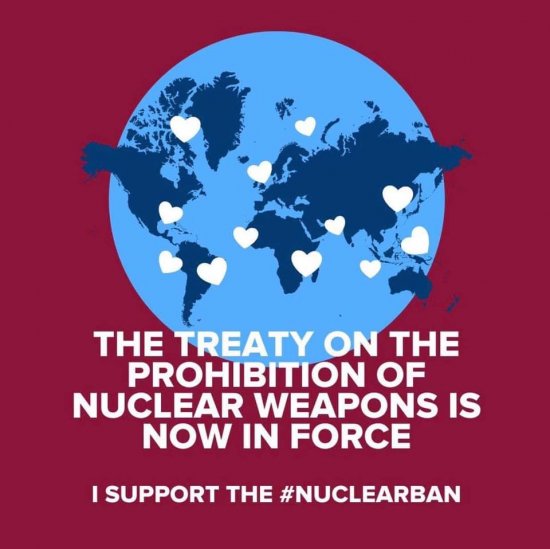
NAGASAKI–Japan and the United States have a “special responsibility” to lead efforts to abolish nuclear weapons, the head of a U.S. nongovernmental organization told a 30th international peace symposium.
Ivana Hughes, president of the Nuclear Age Peace Foundation, was speaking at the “International Symposium for Peace: The Road to Nuclear Weapons Abolition” held at the Nagasaki Atomic Bomb Museum on July 27.
She said damage from radiation is still an issue in the Marshall Islands in the Pacific Ocean 70 years after the largest U.S. hydrogen bomb test at Bikini Atoll.
“After all, although for different reasons, the United States and Japan both have a special responsibility to not only join the Treaty on the Prohibition of Nuclear Weapons, but to lead efforts toward its full and complete implementation and total elimination of nuclear weapons,” Hughes said as she wound up her keynote speech.
Many speakers felt that the global situation surrounding nuclear weapons has deteriorated over the past 30 years, with nuclear disarmament stalled, and expressed concerns about growing international tensions, citing Russia’s war in Ukraine and the Israel-Hamas conflict.
“We should think about nuclear abolition from the perspective of the security of ‘mankind,’ not of nations,” said Mitsuru Kurosawa, an expert on nuclear disarmament and professor emeritus at Osaka University.
Batyrkhan Kurmanseit, minister-counselor at the Kazakhstan Embassy in Japan, said Kazakhstan is the only former Soviet republic that ratified the Treaty on the Prohibition of Nuclear Weapons. He said an international framework for nuclear abolition has never been more needed than right now.
The Asahi Shimbun has been a co-sponsor of the annual symposium, which has alternately been held in Hiroshima and Nagasaki with the municipal governments and local peace organizations every summer since 1995.
Terumi Tanaka, a hibakusha atomic bomb survivor and co-chair of the Japan Federation of A- and H-Bomb Sufferers Organization (Nihon Hidankyo), and Seiko Mimaki, an associate professor at Doshisha University’s graduate school specializing in U.S. politics and diplomacy, also participated in the symposium’s panel discussion.
In a speech, Kan Sang-jung, president of Chinzei Gakuin University in Nagasaki Prefecture, emphasized the importance of listening to hibakusha, saying that many lives have been lost as countries clash over what they believe is just amid the post-Cold War rise of nationalism.
Hibakusha Shizuko Mitamura read a hand-made picture card show that tells the story of what happened to her on Aug. 9, 1945, when the city of Nagasaki was leveled by atomic bombing, and the loss of her daughter to cancer in 2010, when she was 39.
Blackwater Against New Nuclear Power Group (BANNG)campaigners say company’s claims over Bradwell B are false
Maldon Standard, By Brandon Penny, 31st July 24
A CAMPAIGN group has hit out at claims a potential site for a new nuclear power station is “well connected.”
The current government nuclear policy statement identifies Bradwell as a site for nuclear energy until the end of 2025.
Plans for a Chinese-led nuclear power station in Bradwell, known as Bradwell B, are no longer progressing.
Campaigners Blackwater Against New Nuclear Power Group (BANNG) claim EDF, the French company which own Bradwell’s nuclear site, has “no idea what it is talking about”.
They claim there are no grid connections, no rail connection with the closest station being eight miles away in Southminster and no local skilled workforce.
BAANG’s chairman, Professor Andy Blowers said: “EDF cannot be allowed to get away with the false and misleading claims it is making in an obvious attempt to attract developers to its site on the Essex coast adjacent to Bradwell-on-Sea. “This is a site already abandoned by EDF’s one-time partner, the Chinese developer CGN. It is a site that is wholly unsuitable for nuclear development.
“EDF have previously claimed that Bradwell and other sites it owns, offer land, grid and rail connections, a skilled workforce and support communities which makes them compelling locations for small and advanced modular reactors.”
Mr Blowers continued saying: “It’s obvious EDF has no idea what it is talking about with respect to new nuclear development at Bradwell.”
BAANG have also said: “The noise, disruption and blight imposed on a tranquil rural area over many years would be intolerable.”…………… https://www.maldonandburnhamstandard.co.uk/news/24483433.baang-group-claim-edfs-claims-false-misleading/—
Young Changemakers Advocate for Nuclear-Free Future through Educational Journey in Kazakhstan

The Astana Times – bringing Kazakhstan to the world, By Assel Satubaldina , 29 July 2024
ASTANA—A group of 20 young changemakers from Kazakhstan and Germany recently embarked on a week-long educational journey through Kazakhstan to explore the country’s nuclear past, meet policymakers, and talk to affected communities.
The tour took the group to the ministerial halls in Astana, activists in Almaty, researchers, and the nuclear-affected communities in Semei, which was once the site for the Soviet-run nuclear test site. This educational tour, organized by the Friedrich Ebert Foundation in Kazakhstan, ICAN Germany, and Kazakhstan’s STOP (Steppe Organization for Peace) youth initiative, aimed to foster a deeper understanding of nuclear non-proliferation and amplify the voices of affected communities.
Kazakhstan’s Semipalatinsk nuclear test site was a venue for the Soviet Union to test nuclear weapons. Official data indicates that 456 nuclear tests between 1949 and 1989, including 340 underground and 116 atmospheric tests, were conducted at the test site, with an area of 18,300 square kilometers.
Around 1.5 million people have been affected by radiation exposure over the years, including health consequences such as an increase in cancer rates, birth defects, and other radiation-related illnesses among the local population. The long-term effects are still present for generations.
Meeting with government officials in Astana
Astana was the first stop on the trip. The group visited the Kazakh Ministry of Foreign Affairs. There, Arman Baissuanov, the head of the ministry’s international security department, briefed them on the country’s nuclear history and its leading role in global non-proliferation efforts. He also discussed Kazakhstan’s role in the Central Asian Nuclear Weapon Free Zone and the Treaty on the Prohibition of Nuclear Weapons (TPNW).
Among other officials, the group met with Roman Podoprigora, a judge of the Constitutional Court of Kazakhstan, who spoke about recommended changes to the 1992 law on those affected by the nuclear tests, and Nurlan Auesbaev, a member of the Parliament.
Yerdaulet Rakhmatulla, co-organizer of the study tour, described it as a positive sign that civil society representatives could visit the ministry and productively discuss the nuclear politics and more. According to him, it is quite a rare occasion.
“I think just this step from their side was a great sign of progress in our bilateral relationships as state, as government and civil society,” he said in a comment for this story.
Officially titled the law on social protection of citizens who suffered from nuclear tests at the Semipalatinsk nuclear test site, the document envisioned measures to address the severe health and social impacts. However, experts say the law has many shortcomings, including a limited scope of financial compensation, which is insufficient to cover the long-term health needs of the affected population. The law’s criteria to identify affected individuals have also been seen as too narrow.
Сonfronting the human impact of nuclear testing
Understanding Kazakhstan’s tragic nuclear past would not be complete without visiting the region where thousands of people witnessed the tests firsthand and have borne the consequences for many years since. In Semei, the young people met with people still grappling with the legacy of the Soviet-era tests, listening to their stories that, for some reason, often remain unheard.
Maira Abenova, a survivor of the Soviet nuclear tests in Semei and founder of the Polygon 21, an institution that advocates for the rights of Semipalatinsk nuclear test survivors, helped the group to meet those affected in Semei and Astana.
During the meeting in Semei, many of the survivors reported on their health problems, such as cancer and heart disease, according to a press report from ICAN Germany. They said they hope their voices will be heard internationally. Their voices “do not yet reach as far as those of Hiroshima and Nagasaki,” say the survivors.
For Rakhmatulla, these meetings were “extremely special………………………………………………………………………………………………..
Lessons learned
Janina Ruther, a participant of the tour and project manager at ICAN Germany, spoke to The Astana Times, sharing her impressions and key takeaways from the educational tour.
Because of her experience with ICAN, she got to know more about Kazakhstan and the country’s history with nuclear weapons.
Ruther said what made the trip so special was the variety of places they visited and the diverse range of people they spoke to in different contexts.
“That was so special, and it made it a once-in-a-lifetime experience,” she added. “I think I don’t have words for that because we talked to so many people who were actually surviving all these tests. It was so brave that they talked to us because I cannot imagine how hard it must be.”
She also shared meeting young people at the universities and experiencing the night train journey was unforgettable.
She described the tour using a quote from one of the meetings: “The more we educate young people, the greater the hope for a world without nuclear weapons.”
She stressed that the primary goal was to reach young people who could spread the message and educate others. Equally important was understanding the needs and desires of the people affected by nuclear testing in Kazakhstan and bringing their voices to an international level. https://astanatimes.com/2024/07/young-changemakers-advocate-for-nuclear-free-future-through-educational-journey-in-kazakhstan/
Nuclear energy not the way to go: coalition Taiwan
By Yang Yin-ting and Jonathan Chin / Staff reporter, with staff writer, https://www.taipeitimes.com/News/taiwan/archives/2024/07/27/2003821385
Relying on nuclear power is the wrong strategy for Taiwan to achieve net zero emissions, a coalition of environmental groups said yesterday, amid rising calls from some lawmakers and government officials in support of it.
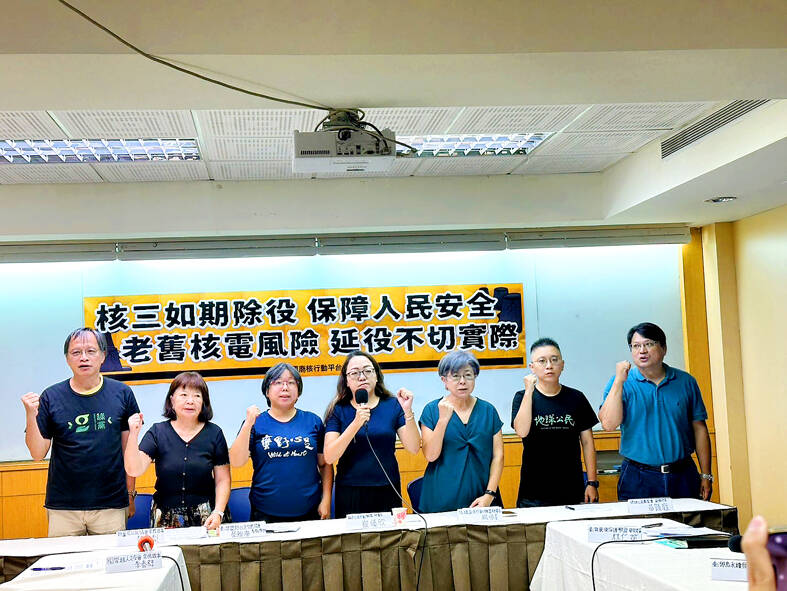
The National Nuclear Abolition Action Platform held a news conference in Taipei yesterday — two weeks before the National Climate Change Response Committee’s inauguration meeting, which is expected to discuss nuclear power.
The Chinese Nationalist Party (KMT) has indicated that it would seek to extend the operations of the nation’s nuclear reactors, including the ones at the Ma-anshan Nuclear Power Plant in Pingtung County, a coalition spokesperson said.
The Ma-ashan plant’s first reactor, which has reached the end of its 40-year service life limit, is to be deactivated today, while its second reactor is scheduled for decommissioning in May next year, it said.
The KMT’s failure to acknowledge the public security risks posed by the nation’s aged reactors or the problem of nuclear waste disposal has exposed the recklessness of the party’s energy policy, it said.
Lawmakers should drop proposed amendments to the Nuclear Reactor Facilities Regulation Act (核子反應器設施管制法) and allow the Ma-anshan plant to be decommissioned as planned, the spokesperson said.
Green Citizens’ Action Alliance secretary-general Tsuei Su-hsin (崔愫欣) said that high operating costs and the lack of suitable sites for waste disposal make the bid to continue generating nuclear power impractical for Taiwan.
Taiwan Environmental Protection Union executive Lin Ren-pin (林仁斌) said that global energy production trends point to a decline in nuclear energy.
China — which has built more new nuclear reactors than any country in the world — reported that renewables experienced faster growth than nuclear energy, he added.
The Ma-anshan plant straddles a geological faultline in the Hengchun Peninsula and has a terrible safety record, Lin said.
The scarcity of land, high population density and propensity to build nuclear power plants on soft rock strata are a recipe for disaster on the scale of the partial meltdown at Japan’s Fukushima Dai-ichi nuclear power plant, he said.
Moms Love Taiwan Association secretary-general Yang Shun-me (楊順美) said that the Jinshan Nuclear Power Plant is practically decommissioned, as the lion’s share of its equipment and transmission towers had already been removed.
The remaining facilities at the power plant has not been maintained for many years, she added.
The Guosheng Nuclear Power Plant has two inoperable reactors, while the Ma-anshan plant cannot resume operations without a full shutdown and replacing critical components, Yan said.
This means none of the nation’s three nuclear power plants stand a chance of contributing to emissions reduction, she said.
Citizen of the Earth Taiwan deputy director Huang Ching-ting (黃靖庭) said opposition lawmakers were making untruthful claims about a purported energy shortage.
Citing Taiwan Power Co’s electricity supply report this month, he said that Taiwan has enough energy to keep the nighttime reserve margin above 10 percent through 2030, which does not indicate a shortage.
Nuclear power plants must obtain safety certifications and replace key components before lengthening their service life, he said, adding that the process is estimated to take five to 10 years.
The Ma-anshan plant is rightly decommissioned since the facility’s reactors generate a marginal amount of electricity compared with the safety risks they represent, he said.
Altogether, there is virtually no chance that Taiwan could get any of its old nuclear power plants back online before 2030, Huang said.
Using nuclear energy to reduce emissions is impractical and impossible to implement in time, he said
ICAN Statement on Nuclear Sharing to the 2024 Non-Proliferation Treaty Preparatory Committee.

https://www.icanw.org/ican_statement_to_npt_prepcom_2024 23 July 24
The Second Session of the Preparatory Committee for the Eleventh Nuclear Non-Proliferation Treaty (NPT) Review Conference is taking place in Geneva from July 22 to August 2nd. On the second day of the meeting, Naomi Zoka from Pax Christi Flanders (Belgium) delivered ICAN’s statement to the states parties. Please find the full statement below.
Distinguished Delegates,
Nuclear risks are on the rise. The chance of nuclear weapons use are higher than at any other time in my- and many others in this room’s- lifetime. Nuclear-armed States are launching threats faster than they are test-launching delivery systems, resulting in a less stable, less secure and more dangerous world.
That is not the world in which we want to live. We cannot abide by policies in which one -or nine – countries are allowed to hold the rest of the world hostage through weapons of mass destruction, because the use of those weapons knows no borders. A conflict involving nuclear weapons thousands of miles from this conference room will still cause chaos and catastrophe to all of us, our families, and our future.
We do not need to see nuclear weapons used in war again to know their impact. As W.J. Hennigan wrote in the New York Times, recently:
The United States and the Soviet Union might have narrowly avoided mutual destruction, but there was a nuclear war: The blitz of testing left a wake of illness, displacement and destruction, often in remote locations where marginalized communities had no say over what happened on their own land.
The over 2000 nuclear tests – conducted primarily by the nuclear weapons states in this room- forever altered the lives of these thousands of women, men and children, and of little girls in particular, as girls exposed to nuclear weapons use and testing got cancer at twice the rate as the boys. Even before their creation, nuclear weapons have facilitated suffering amongst the oppressed. From the Shinkolobwe mines in Eastern DRC where locals were forced into Uranium mines by their colonial rulers, to the multiple generations still battling life threatening diseases. Nuclear weapons have and always will be a tool for oppression regardless of which state possesses them.
Today, many survivors are demanding justice and accountability, and that nuclear weapons be eliminated once and for all, so that what happens to them, may never happen again.
Yet the nuclear-armed countries are recklessly embarking on a new nuclear arms race.
Every year, the International Campaign to Abolish Nuclear weapons, ICAN, exposes the unacceptable nuclear weapons. Despite their commitments under NPT’s Article VI, the nuclear-armed states in the NPT spent $86 billion dollars on their arsenals in 2023.
US spending accounts for 54% of the global total, at $51.5 billion, while China and Russia also spent exorbitant amounts at $11.8 billion and $8.3 billion respectively. The UK increased spending by 17% from the previous year. Across the board, every nuclear-armed state increased the amount spent on their arsenals. Meanwhile the profit-seeking private industry hires powerful lobbyists to secure billion dollar contracts to develop these weapons of mass destruction.
Runaway nuclear spending is increasing the risks of nuclear weapons use- as are the applications of emerging technologies to nuclear weapons command, control, communications and delivery systems. We are entering an era of AI assisted information gathering to facilitate decision making.
But reducing the time needed to reach the only conclusion in the interest of humanity puts catastrophe seconds, instead of minutes away, as Annie Jacobsen’s “Nuclear War: A Scenario” recently reminded us. The decision whether or not to use nuclear weapons doesn’t need artificial intelligence – common sense says that it must always be no.
Another growing concern is the proliferation of nuclear weapons deployed on foreign territories. With Russia’s stationing of weapons in Belarus, and the continued US deployment of weapons in Belgium, Germany, Italy, the Netherlands and Türkiye, the NPT is failing to meet its first principles.
Nuclear weapons deployed in Europe are designed to be used in Europe. But the consequences will not stay on this continent- and this continued deployment is decreasing security for others.
The weapons in Europe illustrate another problem with nuclear weapons, one that is often raised in these rooms- and that is the lack of transparency. As citizens in the countries hosting nuclear weapons, we have repeatedly called for the bombs to be removed, but our governments claim they cannot discuss the issue- that it is not something they can confirm or deny.
It seems that governments who support the use of nuclear weapons on their behalf believe in just enough transparency to make nuclear threats credible, but not enough transparency to enable effective democracy.
The practice of nuclear sharing has been allowed to continue for far too long, and now it is spreading. How will the governments currently defending the practice feel when weapons start to appear in countries outside of Europe? There are proposals out there that would spread nuclear weapons around the world- the very antithesis of the treaty we’re here to discuss. Nuclear sharing is unacceptable.
That is why the Treaty on the Prohibition of Nuclear Weapons is so clear on the matter. Under the TPNW, a state cannot put the population of another state in jeopardy by deploying nuclear bombs in their country. It is clear, and clarity provides safety, security and reassurance.
The TPNW is also where progress is happening on disarmament. The robust intersessional process, the dynamic and highly engaging Meetings of States Parties, and the commitment to the same tenets that underpin the NPT and form its preamble, are sincere.
It is in the TPNW that the girls harmed by nuclear weapons use and testing are finding a pathway to justice. It is in the TPNW that the security concerns of all states, not just a few, are taken seriously and given due consideration.
The path to a world without nuclear weapons lies through the TPNW, and we invite all states to join us as we move closer to it without delay.
Thank you.
Nuclear Free Local Authorities back joint statement condemning AUKUS nuclear proliferation

The UK/Ireland Nuclear Free Local Authorities have joined environmental and peace groups around the world in endorsing a statement that will be delivered to a conference at the United Nations.
The 2024 Nuclear Non-Proliferation Treaty Preparatory Committee will meet today to begin work to make preparations for the next conference of signing to the Nuclear Non-Proliferation Treaty (or NPT).
The statement will be delivered to committee delegates by Jemila Rushton, Acting Director of the International Campaign to Abolish Nuclear Weapons Australia. The NFLAs are a member of ICAN.
Particular reference is made to the adverse impact of AUKUS, the military alliance forged between Australia, the United Kingdom, and the United States in opposition to China, on geopolitics in the Pacific.
Amongst its more controversial elements is the provision of nuclear-powered submarines by the other partners to Australia. We share the concern of other signatories that AUKUS violates in spirit both the Nuclear Non-Proliferation Treaty and the Rarotonga – South Pacific Nuclear Free Zone Treaty. The submarines will be powered by weapons-grade nuclear fuel, supplied by the other partners and will operate from Australian bases within a nuclear free zone.
Although present plans provide for these submarines to be conventionally armed, it is not inconceivable that over time they could be rearmed with nuclear weapons. The Leader of the Opposition in the Australian Parliament, Peter Dutton, is currently actively lobbying for Australia to establish a civil nuclear programme and such a programme is critical to support the development of nuclear weapons capacity.
The statement has also been endorsed by our colleagues Labrats, CND Cymru and Together against Sizewell C.
For more information please contact the NFLA Secretary Richard Outram by email to richard.outram@manchester.gov.uk
Progress is Slow in ASEAN’s Anti-Nuclear Pact: Indonesia
Jayanty Nada Shofa, July 25, 2024, https://jakartaglobe.id/news/progress-is-slow-in-aseans-antinuclear-pact-indonesia
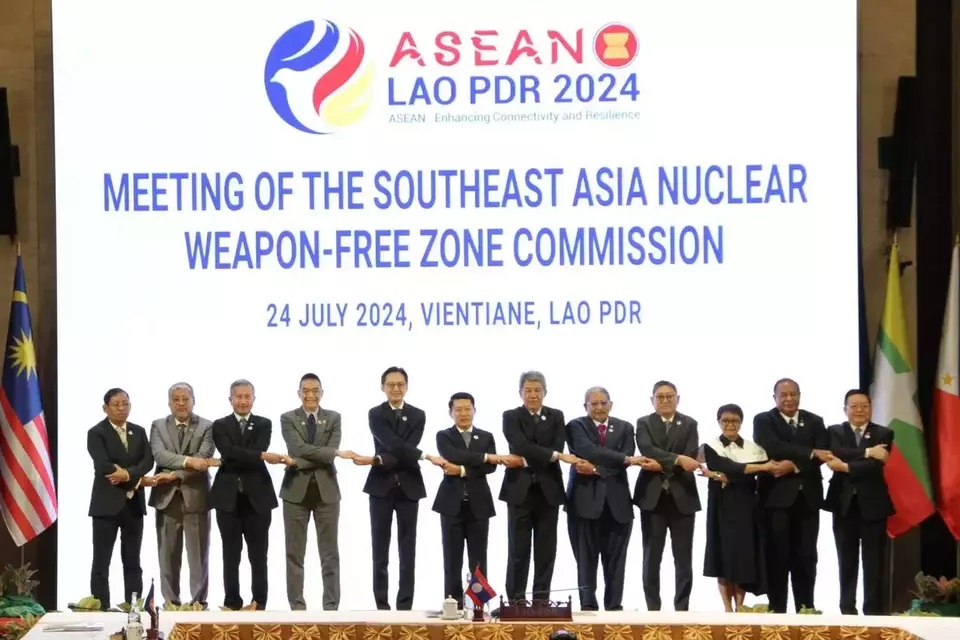
Jakarta. The progress is slow in bringing nuclear-possessing countries to promise that they would keep the Southeast Asian region nuke-free, Indonesia told fellow ASEAN members.
Foreign Affairs Minister Retno Marsudi is currently in Laos to discuss the bloc’s matters with her ASEAN counterparts. The group’s Southeast Asia Nuclear Weapon-Free Zone (SEANWFZ) pact became one of the major themes in the discussions.
The treaty aims to create a peaceful Southeast Asia region that is free from nuclear weapons. The pact has legally binding protocols for the five nuclear-weapon states — China, France, Russia, the UK, and the US — to sign and ratify. By signing, these five countries would promise to not use or threaten to use nukes in the region. Although the SEANWFZ dates back to 1995, no nuclear weapon state has signed the protocol so far.
“There has not been any significant progress from the nuclear-weapon states in regards to the SEANWFZ protocol,” Retno said in a press statement on Wednesday evening.
Amidst the sluggish progress, Indonesia thinks it is about time that ASEAN should involve experts in their efforts.
“Indonesia suggests that we should appoint experts, including legal experts from every ASEAN country, to give their inputs in the next SEANWFZ Commission meeting with a clear and measurable timeline,” Retno said.
Of all five nuclear-weapon states, China appears to be the one who is the closest to signing the pact. Last year, Malaysia’s then-Foreign Affairs Minister Zambry Abdul Kadir said that China had given its word to sign the protocol “unconditionally”.
Kadir made the remarks on the sidelines of an ASEAN foreign ministerial meeting in Jakarta last July. Not long after Kadir’s statement, Secretary-General Kao Kim Hourn also dropped a similar hint that Beijing had shown a “strong desire” to sign the SEANWFZ protocol. But again, China has yet to keep its promise.
Nuclear convoys travelling to Coulport should be peacefully stopped
The National, Brian Quail, Glasgow, 17 July 24
IN this time of post election soul-searching, I would like to present your readers with two simple but vital facts. First, there are two roads by which heavy-duty vehicles can cross the border between England and Scotland, and two only. Secondly, to stop vehicles is a routine matter for Police Scotland
The MoD frequently sends convoys carrying Trident warheads from Aldermaston in Berkshire to Coulport in Scotland. They have to do this regularly to make sure that when they are fired, they will actually work and kill thousands of innocent people (this is called “integrity verification”, I kid you not). Indiscriminate slaughter is the one and only thing they are designed to do.
But the Treaty for the Prohibition of Nuclear Weapons (TPNW) entered into force in January 2021 at the United Nations and is supported by 122 states. Thus, the highest court in the world has specifically condemned nuclear weapons as illegal. This ruling is “jus cogens” or compulsory law; that is, a peremptory norm from which there is no derogation (like FGM, piracy, genocide, or enslavement), as opposed to customary law, where parties make mutual agreement.
A Trident warhead is a hydrogen bomb. and by the TPNW, undeniably illegal. To stop these convoys at the border and refuse to allow them to continue their criminal enterprise requires nothing more than normal police procedures; in fact, those guilty could also be arrested and charged with criminal conspiracy. This is enforcement of the law.
Humanity has at last “banned the bomb”, and we must act accordingly.
The appreciation of the logic of this is axiomatic for both the demand for independence and the praxis of self-governance. As long as we cravenly accept this criminal imposition on our land, we do not have independence because we do not deserve it.
As long as we continue with our present craven acceptance of our abject role playing Tonto to the British Lone Ranger in his lunatic nuclear fantasies, we can forget about independence. Marches and demonstrations have their place in this campaign but total commitment demands much more. This demands action.
This direct action is something we can and should do, now. The nuclear convoys should be peacefully and non-violently stopped. This would be an effective technique to obtain independence, and an unambiguous expression of being a normal legal state.
Hundreds of Scientists Urge Biden to Cancel $100 Billion Nuclear Weapons Boondoggle

“There is no sound technical or strategic rationale for spending tens of billions of dollars building new nuclear weapons,” an expert said.
Edward Carver, Common Dreams. JULY 11, 2024 https://www.commondreams.org/news/scientists-end-land-based-nuclear-weapons
More than 700 scientists on Monday called for an end to the United States’ land-based nuclear weapons program that’s set to be replaced, following a Pentagon decision to approve the program despite soaring costs.
In an open letter to President Joe Biden and Congress, the Union of Concerned Scientists (UCS) argued that the new intercontinental-range ballistic missile system, known as Sentinel, was “expensive, dangerous, and unnecessary.”
The Department of Defense on Monday certified the continuation of the project, releasing the results of a review that was legally required when the cost estimate ballooned to “at least” $131 billion earlier this year, which drew the scrutiny of some Democrats in Congress, according toThe Hill.
The Defense review found that Sentinel was “essential to national security,” but the scientists disagreed with the assessment.
“There is no sound technical or strategic rationale for spending tens of billions of dollars building new nuclear weapons,” Tara Drozdenko, director of UCS’ global security program, said in a statement.
Nobel Prize-winning physicist Barry Barish, a signatory to the letter, was also harshly critical of the Pentagon’s approach.
“It is unconscionable to continue to develop nuclear weapons, like the Sentinel program,” he said.
The soaring costs of Sentinel, which is overseen by the defense contractor Northrup Grumman, have been the subject of media attention. The program will cost an estimated $214 million per missile, far more than originally expected, Bloombergreported on Friday.

However, the cost is hardly the only reason to cancel the program, UCS scientists argue. The silos that house the nuclear missiles, which are found in North Dakota, Montana, Wyoming, Colorado, and Nebraska, are vulnerable to attack—in fact, they are designed to draw enemy weapons away other U.S. targets, according toScientific American. Such an attack would expose huge swaths of the American population to radioactive fallout.
Because they are a likely target, the siloed missiles are kept on “hair-trigger” alert so the U.S. president can launch them within minutes. This “increases the risk of nuclear war” that could start from false alarms, miscalculations, or misunderstandings, the UCS letter states.
The scientists further argue that there’s no need for a land-based nuclear weapons system given the effectiveness of nuclear-armed submarines—one of the other parts of the nuclear triad, along with bomber jets. Such submarines are “hidden at sea” and “essentially invulnerable to attack,” according to the letter. Moreover, the submarine missiles are just as accurate as land-based missiles, and already have “destructive capability than could ever be employed effectively,” it states.
The submarine system is also being overhauled, as is the ‘air’ component of the nuclear triad. In total, the U.S. military plans to spend more than $1 trillion over 30 years on renewing the nuclear arsenal, according to the Arms Control Association.
The U.S. leads the way in a surge of global spending on nuclear arms, according to two studies published last month, one of which found that nearly $3,000 per second was spent in 2023.
Campaigners against Sizewell C hopeful new MPs will take their concerns to parliament

The campaign group Stop Sizewell C says it’s heard from several MPs already
Jasmine Oak, 10th Jul 2024, https://hellorayo.co.uk/greatest-hits/west-norfolk/news/stop-sizewell-c-campaigners-new-mp-hopes/
Campaigners are calling on the new Government to consider scrapping plans to build a nuclear power plant on the Suffolk Coast
Once up and running, it’s thought Sizewell C will power up to six million homes, but activists say it’s going to devastate our countryside
Alison Downes is from ‘Stop Sizewell C’ group – and says Sir Kier Starmer needs to listen to their concerns: “The priority needs to be preventing there being any more unnecessary damage to the local environment.
“We have already seen a fair amount of damage, but that’s nothing compared with what’s to come…
“The government needs to resist any pressure from the nuclear industry for a hasty decision, especially as Sizewell C is going to take a long time, and a lot of money, to build.”
Alison’s hoping the local area’s new MPs will voice their concerns in Parliament: “Our new MP has publicly said that Stop Sizewell C was the first group she met with when she was elected.
“We also have the co-leader of the Green Party, Adrian Ramsay, in Waveney Valley. He’s been very vocal against Sizewell C.”
A spokesperson for EDF Energy has previously told us: “Our proposals for Sizewell C will see the creation of a 3.2 gigawatt power station that will create low-carbon electricity that will supply 6 million homes.
“This will be delivering clean, reliable, and affordable power for generations.”
First Nation challenges nuclear waste decision in federal court

By Natasha Bulowski & Matteo Cimellaro | News, Urban Indigenous Communities in Ottawa | July 12th 2024Observer
A First Nation concerned about approval of a nuclear waste disposal facility near the Ottawa River was before federal court this week to challenge the decision.
The Canadian Nuclear Safety Commission greenlit the project on Jan. 9 and less than one month later, Kebaowek First Nation filed for a judicial review.
Kebaowek’s legal challenge is centred on the United Nations Declaration Act (UNDA), which enshrined the United Nations Declaration on the Rights of Indigenous Peoples (UNDRIP) into Canadian law. The declaration specifically references the need for free, prior and informed consent when hazardous waste will be stored in a nation’s territory.
Kebaowek argued in court that Canadian Nuclear Laboratories — the private consortium responsible for managing the Chalk River nuclear site — did not secure the First Nation’s free, prior and informed consent during the licensing process, as mandated under Canadian law, when it was looking to store the waste at a site about a kilometre from the Ottawa River. The Ottawa River (known as the Kichi Sibi in Algonquin) holds immense spiritual and cultural importance for the Algonquin people and is a source of drinking water for millions.
Canadian Nuclear Laboratories wants to permanently dispose of one million cubic metres of radioactive waste in a shallow mound as a solution to waste accumulated over the last seven decades of operations and into the future. The company said the containment mound will only hold low-level waste.
A former employee at Chalk River told Canada’s National Observer a portion of the waste destined for the mound is a “mishmash” of intermediate- and low-level radioactivity because prior to 2000 there were inadequate systems to properly label, characterize, store and track what was produced at Chalk River or shipped there from other labs. Intermediate-level waste remains radioactive for longer than low-level waste and requires disposal deeper underground.
“It’s such a huge project that I don’t think most people are aware of just how big this is,” Coun. Justin Roy of Kebaowek First Nation told Canada’s National Observer in an interview after a press conference in Ottawa on July 10.
“We’re not talking about a pipeline that might not be there in a couple dozen years, or a mine that’s going to be up and running and close in 20 years, or a bridge that might be torn down one of these days. We’re talking about a huge mound that has a life expectancy, expectancy upwards of 500 years,” Roy said.
The First Nation is asking the Federal Court of Appeals to reject the nuclear safety commission’s decision to greenlight the facility and declare that the commission breached its duty to consult Kebaowek.
Kebaowek was in federal court July 10 and 11 to make its case that the project approval should be set aside or reconsidered. The First Nation argued two main points: First, that the nuclear safety commission refused to take the Canadian UNDRIP act into consideration, and that means the consultation process was flawed from the outset.
Second, the nation argues the project will rely largely on a forest management plan that has yet to be created to mitigate environmental impacts, Coun. Justin Roy of Kebaowek First Nation told Canada’s National Observer in an interview.
Canadian Nuclear Laboratories’ lawyers argued the commitment to create a forest management plan and have it approved by the nuclear safety commission is appropriate, and disagreed with Kebawoek’s description of it as a “blank piece of paper,” saying it is intended to be a “living document” and respond to different situations yet to arise. The company’s testimony on July 11 also highlighted different instances — letters, phone calls, in-person meetings — where it engaged with Kebaowek First Nation.
Justice Julie Blackhawk will issue a decision at a later date.
A ‘litmus test’
When Parliament was in its consultation process regarding the United Nations Declaration Act, First Nation leadership across Canada spoke up because chiefs thought the legislation “needed to have teeth,” Lance Haymond, Chief of Kebaowek First Nation said in an interview. However, the legislation was never re-written to give it weight, leading to a “failure of implementation from the beginning,” he explained.
“Here we are stuck with a piece of legislation that could be stronger,” Haymond said of testing the United Nations Declaration Act (UNDA) in court over the nuclear waste facility. The success or failure of the judicial review will serve as a litmus test of how much sway the new Canadian law holds in the courts, Haymond said.
“Our case will hopefully demonstrate how it can be applied in a real world situation,” he added.
This judicial review is one of three legal challenges against the near surface disposal facility.
At a July 10 press conference, Sébastien Lemire, Bloc Québécois MP for Abitibi-Témiscamingue, emphasized his party’s support for the legal challenge. Lemire also promised continued support at future press conferences, in Question Period and in work at committees like the Standing Committee on Indigenous and Northern Affairs.
Canadian Nuclear Laboratories is run by a consortium of private companies (including AtkinsRéalis, formerly known as SNC-Lavalin) and is contracted by the federal government to operate its laboratories and deal with waste.
Over 75 years, Chalk River Laboratories developed CANDU reactors, did nuclear weapons research, supplied the United States’ nuclear weapons program with plutonium and uranium, and at one time was the world’s largest supplier of medical isotopes used to diagnose and treat cancers.
About 60 people attended a public rally in front of the Supreme Court on July 10 to support the First Nation, according to Vi Bui with the Council of Canadians.
It’s not the first time the public has given their support.
Kebaowek’s legal fund has been largely crowdfunded and supported by Raven Trust, a charity that raises legal funds for Indigenous nations, Haymond said.
If Kebaowek loses, it’s still unclear if they will appeal the decision, he added.
“Our ancestors would probably roll over in their graves if they were to hear that we would just allow a nuclear waste dump that’s going to hold one million cubic metres of waste adjacent to the Ottawa River,” Roy said. “We are people who have been here since time immemorial; this mound, if it proceeds, it can maybe outlast all of us here.”
Anti-nuclear protestors to march from Norwich to Lakenheath

By Jude Holden, 12 July 24 https://www.edp24.co.uk/news/24449062.anti-nuclear-protestors-march-norwich-lakenheath/
A 10-day peace camp against nuclear weapons being stationed in Suffolk will begin with demonstrators walking 40 miles from Norwich to Lakenheath.
The protest follows reports that the United States Air Force base, RAF Lakenheath is preparing facilities to house and guard nuclear bombs.
Around 150 members from the Lakenheath Alliance for Peace are expected to walk and cycle from Norwich to Lakenheath on Saturday, July 13.
This is expected to take up to three days before the group establishes a vigil for peace at the base’s main gate.
A hand delivered letter is set to be delivered to the base commander with more people expected to arrive at the camp.
The Alliance aims to be at the base between July 15 until Thursday, July 25.
Lakenheath Alliance for Peace activist, Alison Lochhead said this will be a peaceful protest “We have absolutely no intention of being arrested whatsoever, we are there for a peaceful vigil”, she said.
But added: “However, if the powers that be decide to arrest us, well that’s another thing altogether.
“We’re there to raise awareness about the situation.”
Ms Lochhead continued: “Our cause is essential. All these proposals go on behind closed doors. They are bringing back nuclear weapons onto UK soil without any debate whatsoever.
“It is really important that people raise their voices in any way they can.
“That could mean joining us on the walk, or writing a letter to their MP or standing outside the base or even just talking to friends and relations about it.”
She added: “At the moment the military tensions in this world are so high. It is scary.
“We really don’t need to crank it up further and I think people just need to say please deescalate all of this, there are other ways to solve conflict.”
The walk will start outside Norwich City Hall at 10am and the group will then go via the Peace Pillar in Chapelfield Gardens, then on to Unthank Road, Newmarket Road, through Cringleford and on towards Hethersett and Wymondham.
The vigil, which will go on round the clock.
First Nations and allies resist proposed radioactive waste repository

The site-selection process has been riddled with controversy. The nuclear industry funds the NWMO and appoints its board members. As a result, despite being structured as a not-for-profit corporation, the NWMO is effectively controlled by industry. In some cases, the large sums of money the NWMO has paid Indigenous and municipal governments as part of its site selection process have led to accusations of governments being bought off by the nuclear industry. Communities downstream from the repository site, as well as the many along the transportation route, are effectively excluded from the ‘willingness’ decision.
the process is unfolding in the context of ongoing poverty and economic deprivation in many Indigenous communities in Canada, making it incredibly difficult for many First Nations to say “no”
If Canada is to have a just transition away from fossil fuels, then it cannot be based on nuclear power
Canadian Dimension, Warren Bernauer, Laura Tanguay, Elysia Petrone, and Brennain Lloyd / June 28, 2024
On April 30, 2024, First Nations leaders organized a rally in Anemki Wequedong (Thunder Bay) to protest a proposed nuclear waste repository in northwestern Ontario between Ignace and Dryden. The speakers included representatives of Grassy Narrows First Nation, Kitchenuhmaykoosib Inninuwug, Ojibways of Onigaming First Nation, Gull Bay First Nation, and Fort William First Nation.
Michele Solomon, Chief of Fort William First Nation, welcomed all the participants to her traditional territory and stated that her community is “strongly opposed to the transportation of nuclear waste through our territory and we will stand by that, we will continue to stand by that, and we stand with all those who are also opposed.”
Another leader from the Robinson-Superior Treaty area, Chief Wilfred King of Gull Bay First Nation, told the crowd, “We fully support the First Nations that are against the burying of nuclear waste in our territories. …. we vehemently oppose the transportation of any nuclear waste through our territory.” According to King, his community’s position was grounded in concerns with potential accidents along the transportation route. “We have many rivers and tributaries that intersect the Trans Canada Highway and we feel that this will have a very serious impact to our resources and our territory should there be a spill.”
A similar position was expressed by Rudy Turtle, Chief of Grassy Narrows, whose traditional territories are situated in Treaty 3 and downstream from the proposed repository. “[A]s Grassy Narrows First Nation we are saying no to nuclear waste. We are saying no to any kind of dumping within our traditional territory.” Turtle continued, “I’m thinking ahead I’m thinking of two, three, four, generations ahead and I know I won’t be around, but I hope that one day one of my great-grandchildren will say great-grandpa stood up for us, great-grandpa stood up for us spoke up for us now we’re able to enjoy our Earth.”
Environmental injustice by design
The proposal for a repository in the Ignace area is being advanced by the Nuclear Waste Management Organization (NWMO), a not-for-profit corporation comprised of the nuclear power companies that generate and own the radioactive wastes. The 2002 Nuclear Fuel Waste Act required Canada’s nuclear power generation companies (Ontario Power Generation, New Brunswick Power Corporation and Hydro-Québec) to establish and fund the NWMO and tasked them with the long-term management of Canada’s used nuclear fuel. After an initial study, in 2005 the NWMO submitted a plan to the federal government to dispose of Canada’s used nuclear fuel in a deep geological repository (DGR). Two years later the federal government agreed.
The NWMO’s process to select a site for the DGR officially began in 2010, when it opened calls for “expressions of interest” from potential host communities. After initially examining over 20 communities, in 2020 the NWMO short-listed two Ontario municipalities as potential “hosts” for all of Canada’s high-level nuclear waste: Ignace and South Bruce. Both municipalities have signed hosting agreements with the NWMO, and have committed to deciding whether or not they are “willing hosts” by the end of 2024.
In both cases, the NWMO has indicated that the proposed DGR would only move forward with the support of adjacent Indigenous communities. South Bruce, neighbouring the Bruce Nuclear Generating Station, lies within the traditional territory of the Saugeen Ojibway Nation, which includes Saugeen First Nation and Chippewas of Nawash Unceded First Nation. Ignace, located on the Trans-Canada Highway, is a small community reliant on forestry and eco-tourism. It lies on the traditional territory of the Wabigoon Lake Ojibway Nation and the Ojibway Nation of Saugeen.
The site-selection process has been riddled with controversy. The nuclear industry funds the NWMO and appoints its board members. As a result, despite being structured as a not-for-profit corporation, the NWMO is effectively controlled by industry. In some cases, the large sums of money the NWMO has paid Indigenous and municipal governments as part of its site selection process have led to accusations of governments being bought off by the nuclear industry. Communities downstream from the repository site, as well as the many along the transportation route, are effectively excluded from the ‘willingness’ decision. In the case of the proposed DGR in northwestern Ontario, the NWMO’s “host” community of Ignace is 45 kilometres east of the proposed DGR site and is not just upstream but in a different watershed. There are smaller communities closer to the site who are not part of the NWMO’s “willingness process.” While the NWMO has stated that the DGR would not proceed without the support of Wabigoon Lake Ojibway Nation, other First Nations with historic and ongoing land use near or overlapping the project area are not being afforded the same respect.
The process is an example of structural injustice. By seeking ‘expressions of interest’ from individual communities, the industry made it inevitable that the poorest communities—including those with the fewest resources to represent their residents’ interests vis-à-vis the nuclear industry—would be the first to step forward. And the process is unfolding in the context of ongoing poverty and economic deprivation in many Indigenous communities in Canada, making it incredibly difficult for many First Nations to say “no” to most proposals for what is presented as development or the more benign sounding advance funding agreements to “learn more” about the project. The fact that a nuclear waste dump appears to be an opportunity to some people and municipalities in northwestern Ontario says more about the deplorable track record of capitalist development in the North than it says about the actual benefits associated with the NWMO’s proposal.
Environmental risk
One of the nuclear industry’s favourite promotional lines about deep geological repositories is that there is an “international consensus” about DGRs being the best option for containing nuclear fuel wastes. But it’s a consensus largely limited to the nuclear establishment, while the reality is that there is no approved and operating DGR for high level waste anywhere in the world, despite decades of effort and hundreds of millions of dollars spent in pursuit of an operating licence. These nuclear waste burial schemes create substantial risk—risk to the environment, and risk to human health—at each of the several steps between current storage and any eventual stashing of these hazardous materials deep underground.
Those risks will begin at the reactor site, when the waste must be transferred from the current storage systems into transportation casks. All of Canada’s commercial reactors are the CANDU design, where 18 months in the reactor core turns simple uranium into an extremely complex and highly radioactive mix of over 200 different radioactive ingredients. Twenty seconds exposure to a single fuel bundle would be lethal within 20 seconds. As a result, the fuel bundles are handled so there is no exposure to air. The bundles are moved underwater from the reactor core into the irradiated fuel bays. After a minimum of 10 years, dry storage containers are submerged for loading into that same pool that has been cooling and shielding the wastes until the temperature is low enough for transfer. The dry storage containers are then moved to on-site storage buildings.
However, the NWMO has been silent on how the transfers from the dry storage containers to the transportation containers (for shipment via road or rail) would be carried out, saying only that it’s up to the “waste owners.” Keep in mind that there has been no internal monitoring of the fuel bundles, and their condition after as long as several decades in dry storage is unknown. At this and later stages, defects in the fuel bundles is a significant concern, as the more damaged a fuel bundle is, the higher the radiation dose will be, potentially affecting both workers and the environment.
According to the NWMO’s conceptual transportation plans, the wastes will be shipped in two to three trucks per day for fifty years, in one of three potential containers. One, the “basket container” is still in the conceptual stage. The second potential container was designed for moving dry storage containers very short distances within the reactor stations. The third was designed by Ontario Hydro in the 1980s and subjected to limited and not wholly successful drop tests of a half-scale model before being certified by the Canadian Nuclear Safety Commission. This third design has since been warehoused by Ontario Hydro (with its certification renewed by its replacement utility, Ontario Power Generation) before being taken over by the Nuclear Waste Management Organization. None of these transportation packages have been subject to full scale testing.
There are two sets of risks during transportation. During normal operations there will be low levels of radiation emanating from each shipment. The NWMO did calculations in 2012 and 2015 and concluded that the levels of radiation exposure will be “acceptable.” Yet radioactive exposure is a combination of dose, distance and duration, so if any of the variables are different than those NWMO plugged into their calculation, the risk factors change. The second set of risks during transportation are those that would result from an accident, particularly one where the container was breached.
When the waste arrives at the repository site it will again be transferred, this time from the transportation containers to the containers for underground placement. Those transfers will happen in a facility euphemistically named the “Used Fuel Packaging Plant,” employing a series of hot cells in which the waste bundles will be exposed to air for the first time since they were created in the reactor core. These transfers will be technically challenging and potentially highly contaminating.
During operations of the deep geological repository, water will become contaminated during the washing down of the nuclear waste transportation packages. Contaminated water will be pumped from the underground repository. Operations will also generate low and intermediate level wastes, both solid and liquid.
Once deposited underground, the nuclear waste itself will contaminate the deep groundwater in the near or long term and that contamination will eventually reach surface water in the vast watershed.
The NWMO’s candidate site in Northwestern Ontario is located half-way between Ignace and Dryden. Because it is at the height of land for the Wabigoon and the Turtle River systems, there are concerns about releases to the downstream communities, including Rainy River and Lake of the Woods. If and when the radioactive releases occur from the deep geological repository, there will be no means to reverse the impacts.
Decades of opposition
This is not the first nuclear waste repository proposed in Northwestern Ontario. In the 1970s, 1980s, and 1990s, Atomic Energy Canada Limited (AECL)—a federal Crown corporation focused on nuclear technology—was directed by the governments of Canada and Ontario to develop a repository for spent nuclear fuel. Northern Ontario, with its supposedly stable rock formations, was deemed ideal for a DGR.
However, public opposition repeatedly put a wrench into AECL’s plans. Many municipal and First Nations governments passed resolutions and issued statements opposing the disposal of nuclear waste in the region. In 1998 a federal environmental assessment panel concluded that AECL’s concept lacked public acceptance and had not been demonstrated “safe and acceptable.” The proposal was subsequently shelved, until the NWMO, which was established four years later, revived it, adopting an approach very similar to the previous AECL concept as the basis of its 2005 recommendation to the federal government.
The establishment of the NWMO did not quell Indigenous, municipal, and grassroots resistance to nuclear waste disposal…………………………………………………………………………………………………..
A number of grassroots groups opposed to the disposal of nuclear waste in Northern Ontario have emerged over the past decade, including No Nuclear Waste in Northwestern Ontario, the Sunset Country Spirit Alliance, and Nuclear Free Thunder Bay. These groups have united with other groups and individuals to form We The Nuclear Free North, an alliance of Indigenous and non-Indigenous people and groups dedicated to stopping the proposed DGR that includes the longstanding groups Environment North and Northwatch, who have decades of experience as critics of the nuclear industry’s various attempts to move radioactive wastes from southern to northern Ontario.
A new Indigenous-led anti nuclear group, called Niniibawtamin Anishinaabe Aki (“standing up for the land”), was established in 2023. With members from Treaty 3, Treaty 9, and Robinson Treaty territories, Niniibawtamin Anishinaabe Aki’s mission is to support grassroots Indigenous activists opposing the NWMO’s proposal.
Plebiscites and online polls
This groundswell of Indigenous and public opposition notwithstanding, the position of the municipalities and First Nations adjacent to the proposed DGR sites is less certain. Ignace and South Bruce have both signed hosting agreements with the NWMO, which commit both municipalities to decide whether or not they are “willing hosts” in the coming months. The City of Dryden has signed a series of “Significant Neighbouring” agreements with the NWMO that includes funding and confidentiality provisions, and is currently in the process of negotiating a Benefits Agreement.
In late April, Ignace held an online poll to gauge local support for the proposed DGR. South Bruce and Saugeen Ojibway Nation will hold formal plebiscites on the issue later this year.
The Municipality of Ignace’s approach to the proposed DGR has drawn significant criticism from some observers. n 2021 the Township Council passed a resolution that it would be Council who made the decision and there would not be a municipal referendum, such as South Bruce is holding. The online poll results (which have not been released to the public) are to be combined in a consultants’ report with findings from the consultants’ interviews, and will then be delivered to an “ad hoc willingness committee” appointed by the township council in February 2024. That committee will then make a recommendation to Council, and Council will make the decision. There’s a $500,000 signing bonus if they deliver a “willingness decision” by the end of June 2024. In contrast, the South Bruce referendum is not until October 28, 2024 and Saugeen Ojibway Nation leadership has recently been reported by the media as saying they are unlikely to make their decision before the end of the year.
Hosting agreements
In March 2024, the municipality of Ignace and the NWMO signed a controversial and divisive hosting agreement for the proposed DGR. If ratified through a declaration of willingness, the agreement would require the municipality to support the DGR in perpetuity. This includes supporting the NWMO’s proposal in all future regulatory processes, as well as attending meetings to speak in support of the proposal at the NWMO’s behest. Even if the scope and nature of the proposal changes significantly, the agreement would still require the municipality to support the DGR publicly and though all future regulatory processes.
The hosting agreement would also give the NWMO significant control over how the municipality communicates with its residents and participates in future regulatory processes regarding the DGR.
…………………………………….Ignace is thereby ceding an excessive degree of control to the NWMO for a rather paltry sum of money. The total payments to Ignace during the life of the project will amount to roughly $170 million…………………………………………
Towards a nuclear phase-out
The NWMO claims that it is solving Canada’s high-level nuclear waste problem by moving it into a DGR. Yet the most dangerous wastes—those that have been freshly removed from a reactor and are too hot to transport for at least a decade—will remain dispersed at reactor sites. What’s more, the nuclear industry hopes to expand rapidly by siting new small modular reactors across Canada, including in remote and rural regions, further dispersing nuclear waste.
The only way to truly solve Canada’s problem with radioactive waste, however, is to stop making more of it. In other words, we need to phase out nuclear power.
………………………………………………Indigenous communities have always been at the forefront of struggles against the nuclear industry on Turtle Island. The current battles against nuclear waste disposal in northwestern Ontario are no different. If Canada is to have a just transition away from fossil fuels, then it cannot be based on nuclear power.
Warren Bernauer is a non-Indigenous member of Niniibawtamin Anishinaabe Aki and research associate at the University of Manitoba where he conducts research into energy transitions and social justice in the North.
Laura Tanguay is a doctoral candidate at York University researching the politics of nuclear waste in Ontario
Brennain Lloyd is project coordinator for Northwatch and member of We The Nuclear Free North.
Elysia Petrone is a lawyer and activist from Fort William First Nation and a member of Niniibawtamin Anishinaabe Aki. https://canadiandimension.com/articles/view/nuclear-waste-in-northwestern-ontario
1 This Month

of the week – Shut Down Drone Warfare!


Tell the Ukrainian Government to Drop Prosecution of Peace Activist Yurii Sheliazhenko

Petition to revoke the licensing of the Near Surface Nuclear Disposal Facility (NSDF) at Chalk River. https://www.ourcommons.ca/petitions/en/Petition/Details?Petition=e-7247
To see nuclear-related stories in greater depth and intensity – go to https://nuclearinformation.wordpress.com
-
Archives
- April 2026 (68)
- March 2026 (251)
- February 2026 (268)
- January 2026 (308)
- December 2025 (358)
- November 2025 (359)
- October 2025 (376)
- September 2025 (257)
- August 2025 (319)
- July 2025 (230)
- June 2025 (348)
- May 2025 (261)
-
Categories
- 1
- 1 NUCLEAR ISSUES
- business and costs
- climate change
- culture and arts
- ENERGY
- environment
- health
- history
- indigenous issues
- Legal
- marketing of nuclear
- media
- opposition to nuclear
- PERSONAL STORIES
- politics
- politics international
- Religion and ethics
- safety
- secrets,lies and civil liberties
- spinbuster
- technology
- Uranium
- wastes
- weapons and war
- Women
- 2 WORLD
- ACTION
- AFRICA
- Atrocities
- AUSTRALIA
- Christina's notes
- Christina's themes
- culture and arts
- Events
- Fuk 2022
- Fuk 2023
- Fukushima 2017
- Fukushima 2018
- fukushima 2019
- Fukushima 2020
- Fukushima 2021
- general
- global warming
- Humour (God we need it)
- Nuclear
- RARE EARTHS
- Reference
- resources – print
- Resources -audiovicual
- Weekly Newsletter
- World
- World Nuclear
- YouTube
-
RSS
Entries RSS
Comments RSS
 nuclear-news