Nuclear industry frantically lobbying, as world turns against it
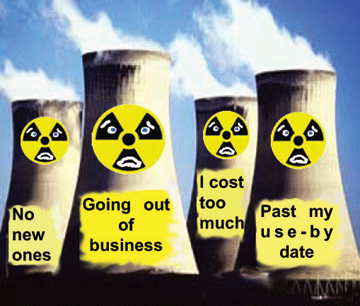 rejection of nuclear energy is growing among people the world over — and building new reactors makes no sense in economic terms…..
Nuclear lobby’s frantic attempts to downplay the nuclear meltdown in Fukushima, with
the aim of nipping the debate about nuclear safety in the bud
Undeterred by Fukushima, Nuclear Lobby Pushes Ahead with New Reactors, Spiegel Online, 13 March 12, One year after the reactor accident in Fukushima, resistance to nuclear energy is growing around the world.
But the atomic industry continues to push for the construction of new reactors, primarily in
emerging economies…… Continue reading
Across Japan thousands protest against nuclear power
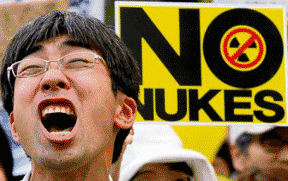 Antinuclear protests held across Japan on anniversary of disaster, Mainichi Daily News, http://mdn.mainichi.jp/mdnnews/news/20120312p2g00m0dm069000c.html 12 March 12, TOKYO (Kyodo) — Antinuclear protesters took to the streets in Tokyo and elsewhere in Japan on Sunday, the one-year anniversary of the massive earthquake and tsunami which triggered the nuclear crisis at the Fukushima Daiichi power plant.
Near the head office of Tokyo Electric Power Co., the operator of the crippled Fukushima complex, demonstrators called for the country to abandon nuclear power generation and restore Fukushima Prefecture, where more than 100,000 residents were forced to relocate.
Some 16,000 people attended an antinuclear gathering in the city of Koriyama in Fukushima and rallied in the city, calling for scrapping all nuclear reactors in Japan. The country has 54 commercial nuclear reactors, which provided a third of Japan’s electric power prior to the Fukushima plant disaster.
In Shizuoka Prefecture in central Japan, about 1,100 people gathered to call for scrapping Chubu Electric Power Co.’s nuclear reactors at its Hamaoka power plant. Those reactors were halted last May after then prime minister Naoto Kan asked the utility to suspend their operation due to concern about a powerful quake in that area of Shizuoka Prefecture.
About 1,200 people including members of antinuclear citizens’ groups marched in the city of Tsuruga, Fukui Prefecture, which hosts the prototype fast-breeder reactor Monju and Kansai Electric Power Co.’s nuclear reactors.
They voiced objection to restarting two of the reactors at Kansai Electric’s Oi power plant in the prefecture after the country’s nuclear safety agency approved results of safety tests conducted on the reactors idled for a regular checkup and left a final decision on whether to restart them to the government of Prime Minister Yoshihiko Noda.
“What we need to do, after witnessing how tragic Tokyo Electric’s Fukushima Daiichi nuclear plant accident is, is to build a society which does not rely on nuclear plants,” said Fujio Yamamoto, who leads a group which organized the protest.
Similar protests were also held in other prefectures which host nuclear power plants or related facilities, including Saga and Aomori.
In the cities of Hiroshima and Nagasaki, atomic bomb survivors took part in antinuclear protests and urged the country to stop relying on nuclear power.
Anti nuclear rallies around the world
 Protesters link arms around the world to decry nuclear power, Google News, France 24, 11 March 12, AFP – Tens of thousands of anti-nuclear protesters across the globe called for an end to nuclear power as they marked the first anniversary of the earthquake and tsunami at Japan’s Fukushima power plant. Continue reading
Big turnout of protestors blockading UK’s Hinkley nuclear site

 Activists blockade nuclear plant, Google News, (UKPA) 12 Mar 12, Anti-nuclear protesters have completed a 24-hour blockade of the entrance to Hinkley Point nuclear power station, marking the first anniversary of the disaster at the Fukushima power station in Japan. The Stop New Nuclear alliance hailed the rally as the “largest anti-nuclear protest in three decades” with up to 1,000 demonstrators surrounding the site on Saturday.
Protesters were also demonstrating over plans to build the first new nuclear reactors in Britain on the site. A number of protesters stayed overnight with over 100 people blocking the main entrance, stopping all traffic from entering or leaving the site, which is about 10 miles from Bridgwater, in Somerset…..
Hinkley Point is seen by protesters as the new “front line” in the fight against the use of nuclear power. Nancy Birch, spokeswoman for the alliance said: “We’ve successfully concluded the first ever 24-hour blockade of a UK nuclear power station.
“This is a major victory for the anti-nuclear movement and a sign that the tide is turning against the government’s nuclear renaissance. “A mini tent city emerged as over 100 people remained outside the main gate at Hinkley overnight – camping on the tarmac in makeshift tents.”
The blockade formally ended when Japanese Buddhist monks performed a prayer for the victims of the tsunami that precipitated the Fukushima disaster. http://www.google.com/hostednews/ukpress/article/ALeqM5jjnCvxI8QTlU3mTeTo-q0bR3PaFw?docId=N1027381331401975467A
Protest rally for a nuclear free Taiwan

 About 2,000 Taiwanese stage anti-nuclear protest, Mainichi Daily News, TAIPEI, Taiwan (AP) 12 March 12, — About 2,000 people have staged an anti-nuclear protest in Taiwan’s capital as they observed a moment of silence to mourn the victims of the massive earthquake and tsunami that hit Japan one year ago.
The protesters paraded in Taipei on Sunday to renew calls for a nuclear-free island by taking lessons from Japan’s disaster on March 11, 2011, which triggered meltdowns at three nuclear reactors.
They want the government to scrap a plan to operate a newly constructed nuclear power plant — the fourth in densely populated Taiwan.
Scores of aboriginal protesters demanded the removal of 100,000 barrels of nuclear waste stored on their Orchid Island, off southeastern Taiwan. Authorities have failed to find a substitute storage site amid increased awareness of nuclear danger over the past decade. http://mdn.mainichi.jp/mdnnews/international/news/20120311p2g00m0in035000c.html
Nobel Laureate urges India to abandon harmful nuclear energy
 Nobel laureate says nuclear energy can harm Times of India, TNN | Mar 10, 2012, “… a specialist in the field, Hans-Peter Durr, director emeritus at the Max-Planck Institute in Munich, Germany, says nuclear energy poses serious threat to public health and encourages a major financial drain on national economies. Durr won the Nobel peace prize in 1995.
He delivered the TAG-VHS diabetes research speech on ‘nuclear power and energy hunger’ in the city on Friday in the presence of Consul General of the Federal Republic of Germany Stefan Weckbach and an auditorium filled with scientists, doctors, businessmen and retired government officials. … Durr said we would be able to produce adequate energy from soft sources like the sun. “No one in the world knows what they should be doing with the waste generated from the nuclear waste, except for bombs. Even hiding the waste under the sea won’t help as its half life is several hundred years,” he said.
Earlier at a press conference on Thursday, Durr said government of India and Tamil Nadu should look at alternative sources to tap energy instead of opening a nuclear power plant inKudankulam. …. http://timesofindia.indiatimes.com/city/chennai/Nobel-laureate-says-nuclear-energy-can-harm/articleshow/12203134.cms
Patrick Moore praises nuclear power, but the world does not believe him!
Dramatic fall in new nuclear power stations after Fukushima, Fiona Harvey in Brussels, John Vidal and Damian Carrington. guardian.co.uk, 8 March 2012 The drop in construction work on new reactors may reflect waning interest in nuclear after the shutdown of the Japan reactor a year ago
The number of new nuclear power stations entering the construction phase fell dramatically last year compared with previous years, in the aftermath of the incident at the Fukushima nuclear plant in Japan last March.
From 2008 to 2010, construction work began on 38 reactors around the world, but in 2011-12, there were only two construction starts, according to Steve Thomas, professor of energy studies at the University of Greenwich. Continue reading
77% of Americans want government loans for renewable energy, not nuclear
More than three out of four Americans (77 percent) would support “a shift of federal loan-guarantee support for energy away from nuclear reactors” in favor of wind and solar power.

 Survey: Americans Not Warming Up to Nuclear Power One Year After Fukushima, Market Watch, WASHINGTON, March 7, 2012 Contrary to Industry Predictions, Reactor Disaster Seen As Having a”Lasting Chill” on Perceptions;
It’s Not All Fukushima: 3 in 5 Americans Less Supportive Due to Woes of U.S. Nuclear Industry in Last Year. Continue reading
Quebec rejects uranium mining
 Quebec Says No to Uranium World Business Report, 4 Mar 12, In 2009, on the North-Shore of Quebec, the population of Sept-ÃŽles, with the help of “Sept-ÃŽles sans uranium”, had expressed its opposition against Terre Venture. The population won, and the company abandoned its project. Continue reading
Forceful opposition to renewing license for Pilgrim nuclear power plant
Pilgrim is one of the 23 reactors in the United States that is of the exact same design of the Fukushima reactors
Ms. Lampert also accused the federal government of bowing to corporate interests by disregarding the NRC’s own cautionary findings that these types of reactors should not be allowed to operate.
a 1990 Massachusetts Department of Health study pointed out elevated levels of leukemia among residents living in the region around Pilgrim Power
Opponents To Pilgrim Nuclear Power Plant Turn Out In Force For Panel Discussion, Cape News.net, 24 Feb 12 “……The panel they came to hear from included Carolyn O’Connor, director of external affairs for ISO New England, the entity that oversees the power grid in the region, state Senator Daniel A. Wolf, and Mary E. Lampert, founder and director of Pilgrim Watch and a longtime health and safety advocate.
Entergy Nuclear, the owner of the Pilgrim plant, declined an invitation to have a representative speak at the forum. Continue reading
Taiwanese will march for a nuclear power free homeland
Anti-nuclear rallies set for March 11 Taipei Times, Staff Writer, with CNA 25 Feb 12, Nearly 20 local non-governmental organizations (NGO) yesterday urged the public to take to the streets on March 11, the first anniversary of Japan’s devastating earthquake and tsunami, to demand that the government scrap plans for further construction of nuclear power plants.
The organizers said they hope to draw more than 10,000 demonstrators in rallies to be held in Taipei, Greater Taichung and Greater Kaohsiung. The march would mark continuing efforts to build local momentum amid global concerns over nuclear safety, the organizers said.
The action is also aimed at pushing the government to commit to a nuclear-free homeland, said Tsui Su-hsin (崔傃欣), secretary-general of the Green Citizens’ Action Alliance, one of the participating NGOs. Continue reading
India’s peaceful, fasting, anti nuclear protestors face armed police
 Around 500 police personnel were deployed near the road leading to
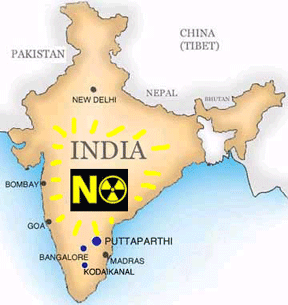 the project site on Monday and commandos have been positioned at the main gate of the KKNPP premises with automatic weapons.
Anti-nuclear protesters embark on 72-hour fast, THE HINDU, 22 Feb 2012 P. SUDHAKAR Even as a two-member International Atomic Energy Agency (IAEA) team is camping at the Kundakulam Nuclear Power Project site for a routine annual review of reactors that fall under IAEA monitoring, anti-nuke protesters have announced a 72-hour-long fast in protest against the State Experts’ Panel convener S. Iniyan’s assertions that the panel members would not meet the protesting villagers.
“The 72-hour long struggle will commence from Monday midnight as Maha Sivaratri falls on this day. Continue reading
Developing world is losing its faith in nuclear power
Globally nuclear power is unpopular and has become even more so after Fukushima. A 24 country public opinion study carried out in May 2011 by IPSOS Mori found that 62% of those asked now opposed it, with opposition is some developing countries being very high, and similar to that in much of Europe.
Nuclear power and the developing world, Environmental Research Web, 20 Feb 12, “…….There seems to be a belief in the region, similar to that that existed in the 1970s in Japan, that buying in advanced nuclear technology is the way ahead. It may then have come as a shock when, after the major nuclear disaster at Fukushima in March 2011, Japan decided to abandon its nuclear expansion plans, and high tech Germany launched a nuclear phase out programme- both of them backing renewables instead. So did Switzerland. Italy too backed off nuclear, thus joining Austria, Denmark, Ireland, Norway, Portugal and Greece as non-nuclear states.
China is also reassessing its nuclear programme. It currently gets under 2% of its electricity from nuclear and had planned to expand that to around 4% by 2020. That may be a small percentage, but given the size of the country it represents a very large programme. However it may be cut back to 63 GW, compared to the current official 2020 target of 80 GW. But to put that in perspective, China is aiming to get 15% of its total energy (not just electricity) from renewable and other low carbon options by 2020. Its wind potential is huge – 1000 GW or more. Continue reading
Protestors occupy Hinkley nuclear site, accuse EDF of pre-empting permission
Activists occupying new nuclear site accuse EDF of ‘ignoring democracy’ John Vidal, environment editor guardian.co.uk, Friday 17 February 2012 The energy company has started work on the £10bn Hinkley Point C power station without permission to build Environmental activists have occupied the site of what is planned to be Britain’s first new nuclear power station since 1995, and on Friday accused EDF of “ignoring democracy” and starting work on the £10bn project without permission to build the station….. Continue reading
In Japan thousands rally for “Sayonora to nuclear plants,”
Thousands rally against nuclear power in Japan Business Recorder FEBRUARY 12, 2012 Thousands demonstrated in Tokyo on Saturday against nuclear power generation, 11 months after a massive earthquake and tsunami sparked reactor meltdowns at the Fukushima nuclear power plant.
Kenzaburo Oe, the 1994 Nobel prize winner for literature, told a central rally at Yoyogi Park, “Radioactive waste from nuclear power plants will be borne by generations to come.” Continue reading
1 This Month
19 November – Webinar – The Reality of Reprocessing
Time: 11:00 AM Pacific Time (US & Canada) / 2:00 PM Eastern / 7:00 PM UK / 8:00 PM CET
Register for the Zoom Event Here

Tell Congress: Prevent Nuclear Catastrophe in Iran

Tell Congress: Prevent Nuclear Catastrophe in Iran

Read the Public Inquiry Report, the Commissioners’ report, Surrendering Australia: The AUKUS Deception is available to download for free at aukuspublicinquiry.com. Or just watch the replay of the National Press Club Luncheon.


Shut down the radiation-damaged Heysham nuclear reactors now
To see nuclear-related stories in greater depth and intensity – go to https://nuclearinformation.wordpress.com

Say No to NASA’s Reckless Nuclear Reactor on the Moon
Say No to NASA’s Reckless Nuclear Reactor on the Moon
-
Archives
- November 2026 (166)
- October 2026 (302)
- September 2026 (339)
- August 2026 (330)
- July 2026 (355)
- June 2026 (287)
- May 2026 (306)
- April 2026 (356)
- March 2026 (251)
- February 2026 (267)
- January 2026 (308)
- December 2025 (358)
-
Categories
- 1
- 1 NUCLEAR ISSUES
- business and costs
- climate change
- culture and arts
- ENERGY
- environment
- health
- history
- indigenous issues
- Legal
- marketing of nuclear
- media
- opposition to nuclear
- PERSONAL STORIES
- politics
- politics international
- Religion and ethics
- safety
- secrets,lies and civil liberties
- spinbuster
- technology
- Uranium
- wastes
- weapons and war
- Women
- 2 WORLD
- ACTION
- AFRICA
- Atrocities
- AUSTRALIA
- Christina's notes
- Christina's themes
- culture and arts
- Events
- Fuk 2022
- Fuk 2023
- Fukushima 2017
- Fukushima 2018
- fukushima 2019
- Fukushima 2020
- Fukushima 2021
- general
- global warming
- Humour (God we need it)
- Nuclear
- RARE EARTHS
- Reference
- resources – print
- Resources -audiovicual
- Weekly Newsletter
- World
- World Nuclear
- YouTube
-
RSS
Entries RSS
Comments RSS

