Seven Canadian environmental groups challenge the nuclear industry’s false claims

Seven Canadians from environmental organizations submitted a complaint to the Competition Bureau on Oct. 16, 2024, asking the Bureau to take action against the Canadian Nuclear Association (CNA) and its members for falsely promoting nuclear energy as “clean” and “non-emitting.” These industry claims constitute misleading and deceptive marketing practices prohibited under Section 9 of the Competition Act.
The complaint demonstrates that the nuclear industry emits radioactive toxic pollutants during uranium mining and milling, and during the routine operation of nuclear reactors. Producing toxic pollutants which must be stored for hundreds of thousands of years is not “clean.” Annual releases from routine operations of all Canadian nuclear facilities are listed on a federal government website, HERE.
The same group of Canadians filed an earlier complaint in February, which the Competition Bureau dismissed, stating that the CNA’s claims of “clean” and “non-emitting” nuclear energy were “political statements” and not a priority for the Bureau. This new complaint makes it clear that the CNA’s false and misleading claims are promotional and aimed at portraying a “green” image to the public. The industry directly targets children with its teachnuclear.ca learning modules designed for schools, teachers and students.
The false “clean” image is intended to generate support for nuclear energy now when there is public concern about climate change. Nuclear energy’s high costs and toxic emissions, and the cost and time over-runs of new reactor builds have led to a declining share of global energy production over the past three decades. However the “clean” rhetoric has gained traction. Branding nuclear as “green” is a crucial step to unfairly gaining access to public funds, tax breaks and subsidies earmarked for real clean energy options.
The October complaint to the Competition Bureau can be downloaded HERE.
After two months, Nuclear Free Local Authorities receive vague response on Advanced’ Gas-Cooled Reactors (AGRs)
After a two month wait, the UK/Ireland Nuclear Free Local Authorities has just received a cryptic reply from Labour’s Nuclear Minister in response to our concerns about the future of Britain’s aging ‘Advanced’ Gas-Cooled Reactor (AGR) plants.
Four AGR plants – Hartlepool, Heysham-1, Heysham-2, and Torness – remain operational, each equipped with two gas cooled reactors. They first began generating in either 1983 or 1988, with an estimated operational life of 30 years. The plants are currently expected to cease operations by 2028, but in the Labour Party energy manifesto ‘Mission Climate’, the party pledged to ‘extend the lifetime of the existing plants until 2030’.
The AGR fleet has been operating for many years longer than intended. The NFLAs are concerned that the graphite moderators within each reactor are degenerating, compromising safety. We have previously raised our concerns with senior officials in the Office for Nuclear Regulation (ONR). It is our view that it is this independent regulator which has the expertise and the legal responsibility to determine whether to further extend the operating dates that should do so, and that it is ‘frankly not the business of Ministers’.
Consequently in his letter to Nuclear Minister Lord Hunt, NFLA Chair Councillor Lawrence O’Neill posed the central question:
‘Can the Minister therefore please reassure me that Labour Ministers will not seek to apply pressure on EDF to make an application to operate these plants beyond 2028, unless they genuinely wish to do so, and more importantly will not apply pressure on the independent regulator ONR to automatically sign off on any application without rigorous scrutiny?’
In his reply, Lord Hunt says cryptically that:
‘Decisions regarding the future operation of the Advanced Gas-cooled Reactor fleet or any nuclear power station in Great Britain would be for the operator, EDF Energy, (and) the ONR. The ONR would not allow a reactor to operate, return to service or extend its operating life if it judged that it was not safe to do so’.
We are hoping that the Minister means that it will fall to the operator EDF Energy to determine if it wishes to apply to the ONR for permission to extend the operating life of any, or all, of the AGR plants, but that it will be the responsibility of the ONR to decide if it can grant that permission based upon the safety case submitted.
This is a situation that the NFLAs shall continue to watch.
Campaigners slam chancellor Rachel Reeves for £2.7 billion pledge to nuclear power station

Rachel Reeves pledged £2.7 billion to nuclear power station
31st October, By Dominic Bareham, https://www.eadt.co.uk/news/24689882.rachel-reeves-pledged-2-7-billion-nuclear-power-station/
Campaigners opposed to the new Sizewell C nuclear power station have slammed chancellor Rachel Reeves for continuing to back the project in her budget. In her first budget, she pledged a further £2.7 billion of government funding for the new dual reactor power station, which is expected to cost £20 billion.
But campaign groups opposed to the project, including Together Against Sizewell C (TASC) and Stop Sizewell C, were “appalled” at the news.
TASC chair Jenny Kirtley said: “TASC find this decision appalling – Labour promised ‘change’ but there is no change here as they quietly splurge a further £2.7 billion on Sizewell C, a Boris Johnson vanity project, despite the poor state of this country’s finances and the lack of transparency surrounding the full cost of the project.”
And Alison Downes, from Stop Sizewell C, said: “For a government that criticised the opposition for playing fast and loose with the nation’s finances, the Chancellor is surprisingly happy to do the same, allocating another £2.7 billion of taxpayers’ money on risky, expensive Sizewell C, without making any guarantee of a Final Investment Decision being taken.
“Including £2.5 billion already spent, this means £5.2 billion of our money will be spent on a project that cannot even help Labour achieve its energy mission and is looking increasingly toxic to private investors.”
The campaigners are opposed to Sizewell C because they fear the impact the new power station will have on the surrounding environment, particularly nearby Areas of Outstanding Natural Beauty and Sites of Special Scientific Interest.
They also fear for the nature reserve at RSPB Minsmere.
Gravelines nuclear power plant: EDF refuses to respond on flood risks and tries to silence whistleblowers

Greenpeace France reminds that Monday morning’s action in the perimeter of the Gravelines power plant carries a message of public interest on the risks of marine submersion and flooding on the Gravelines power plant, an area combining climatic, industrial and nuclear vulnerabilities. For Greenpeace France, in light of the forecasts of scientists and the large uncertainties of the different climate scenarios, it is too dangerous to build two new nuclear reactors on this site, as EDF aims to do.
Greenpeace France 30th Oct 2024, https://www.greenpeace.fr/espace-presse/gravelines-edf-refuse-de-repondre-sur-les-risques-dinondations-et-tente-de-faire-taire-les-lanceurs-dalerte/
After more than 48 hours of deprivation of liberty, 10 of the 12 activists arrested have just been released. This arrest follows the action of Greenpeace France in the perimeter of the Gravelines power plant . Since 9 a.m. this morning, a gathering has been taking place in front of the Dunkirk Judicial Court, at the initiative of several local organizations that came to support the activists. The court informed the activists that a trial would be held on March 3, 2025 at 1:30 p.m. for intrusion into a civil facility housing nuclear materials in assembly. EDF has filed a complaint [1].
After spending two nights in police custody, the activists were brought before the Dunkirk Judicial Court in the early morning, at the request of the public prosecutor. The first activist to be released was deprived of his liberty for a total of 52 hours.
Greenpeace France reminds that Monday morning’s action in the perimeter of the Gravelines power plant carries a message of public interest on the risks of marine submersion and flooding on the Gravelines power plant, an area combining climatic, industrial and nuclear vulnerabilities. For Greenpeace France, in light of the forecasts of scientists and the large uncertainties of the different climate scenarios, it is too dangerous to build two new nuclear reactors on this site, as EDF aims to do.
While EDF refused to respond to Greenpeace France’s questions sent during the summer concerning the consideration of the impacts of climate change on the choice of the Gravelines site and the construction of new nuclear reactors, Greenpeace France dug into the subject and examined EDF’s project file, which resulted in the publication of a report on October 3 demonstrating the underestimation of the seriousness of climate change and the risks inherent in this project to build new reactors.
Greenpeace France also got involved in the consultation areas, particularly the ongoing public debate in Gravelines, and repeated its questions to obtain information on flood risks and the protective measures planned for the new reactors, ahead of the meetings on nuclear safety (theme of 19 November) and climate change (theme of 10 December). After Monday’s action, media reported that EDF did not wish to comment.
For Pauline Boyer, Energy Transition campaign manager at Greenpeace France: ” EDF is ignoring our questions about the risks that the construction of the two EPR2 reactors in Gravelines would create for the population, the workers at the plant and for the environment. In line with its behavior during the public debate for its similar project in Penly, it is clearly sending a signal of contempt for questions from the public, whether NGOs or residents. EDF is operating a diversion strategy by taking activists to court over the form of their action, in order to better evade the substantive issues. EDF is losing more points of trust. EDF will not succeed in gagging the whistleblowers. “
For Marie Dosé, the activists’ lawyer: ” The custody measures are unjustified and have only one purpose: to dissuade activists from alerting the population on a subject of general interest. All of them could have been the subject of a free hearing but, once again, the prosecuting authority preferred to make them sleep two nights in cells and bring them hastily before the court. “
Two activists remain in court at the time of writing this press release.
South Bruce Deep Geological Repositary (DGR) opposition promises to keep fighting
Scott Dunn, Oct 29, 2024 Owen Sounds Sun Times
A group opposed to burying high-level nuclear waste in South Bruce says it will keep fighting because having just 78 more votes in favour than against the project in Monday’s referendum isn’t a “compelling” demonstration of community support.
Bill Noll, the co-chair of Protect Our Waterways – No Nuclear Waste, said in an interview that that’s part of what will be argued at regulatory hearings if Nuclear Waste Management Organization selects South Bruce as its preferred site.
Council for Ignace Township in Northern Ontario, the other site remaining in the running, has already voted in favour of being a willing host, after residents voted in favour of the proposal. First Nations in both locations must still decide if they’re in favour too.
“People are still concerned, a large group of people in South Bruce who are saying no to this project,” said Noll, a retired electrical engineer who lived in South Bruce for 15 years before moving to near Ottawa to be near family.
There were 51.2 per cent, or 1,604 voters saying yes, and 48.8 per cent, or 1,526, who voted no, according to unofficial results posted by the municipality Monday night. Eight electors declined their ballot.
The vote result “doesn’t really give the council a mandate to say we won this,” Noll said.
But council is expected to ratify the result which Mayor Mark Goetz said is binding on council, even as he acknowledged it was a close vote, at a special council meeting Nov. 12. ………………………….
Now it will be up to Saugeen Ojibway Nation to decide if it would be a willing host, he said.
…………………………………………Both Ignace and South Bruce have signed agreements with NWMO that would see them receive millions of dollars over the lifespan of the project — $418 million over 138 years in South Bruce and $170 million over 80 years in Ignace.
………………………………………………………..Noll credited Protect Our Waterways for obtaining a referendum vote by insisting on a study of the community’s willingness because otherwise, it was going to be done by council vote.
“NWMO said in their early stages that the community needed to have two things: one, they needed to demonstrate a compelling willingness and the other thing was they needed to be informed,” Noll said.
“Well, I don’t think either of those conditions have been met at this stage. So that will be our agenda when we get into the regulatory process.” https://www.owensoundsuntimes.com/news/local-news/south-bruce-dgr-opposition-promises-to-keep-fighting
‘Nuclear waste would be disaster for our seaside’
BBC News, Paul Murphy, Environment Correspondent, 21 Oct 24
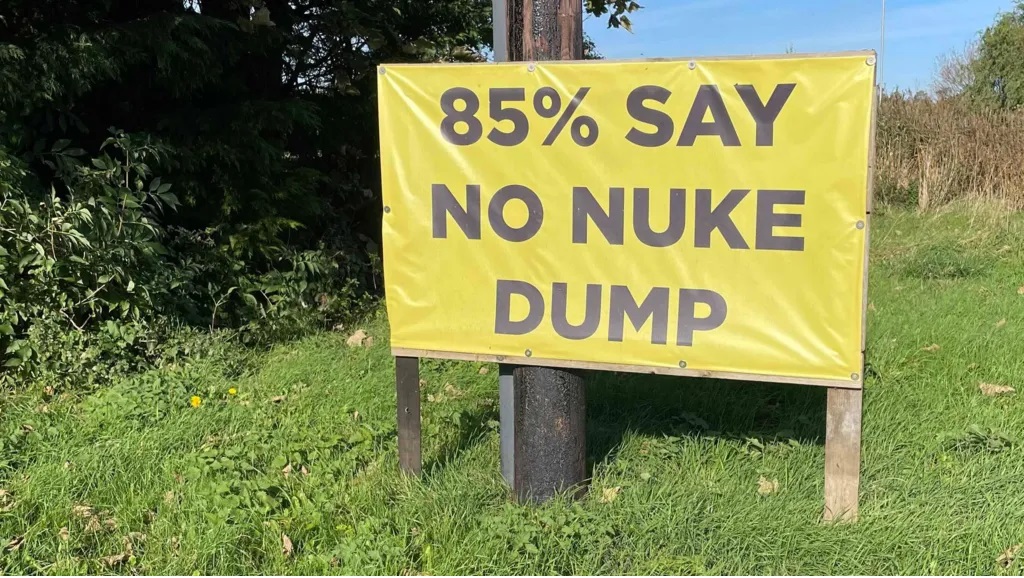
Campaigners opposed to plans for a nuclear waste disposal site on the Lincolnshire coast say it could be “disastrous” for the seaside economy.
The former Theddlethorpe gas terminal on the Lincolnshire coast is one of three sites being considered for an underground facility.
Guardians of the East Coast (GOTEC) said a survey of more than 1,000 visitors to the resorts of Mablethorpe and Skegness found the “great majority” would be put off coming to the area.
GOTEC said it had carried out “extensive research” into the potential impact of the facility.
The group has produced a 60-page booklet called The Nuclear Option.
According to chairman Mike Crookes, the facility would “blight this area” and the economic impact on tourism could be “profound” and “catastrophic”.
“The tourism industry in this area brings £600m of economic benefit and 8,000 jobs,” he said. “We need to protect this at all costs.”
A survey of 1,100 people along the coastline from Mablethorpe to Skegness, carried out by GOTEC, found “83% of them would not visit this area if that facility was built”, Mr Crookes added.
NWS is considering the site for what is known in the waste industry as a geological disposal facility (GDF).
Other possible sites have been mooted in Hartlepool and Cumbria………………………………………………………………………..
Most of the radioactive waste generated by the UK’s nuclear power stations is being temporarily stored at Sellafield in Cumbria, but longer term storage is needed for substances that remain hazardous for many thousands of years.
The idea of a nuclear waste site, or GDF, was first proposed for Theddlethorpe more than three years ago.
Local councillors have called for a referendum on the development.
According to the Theddlethorpe GDF Community Partnership, a facility would only be built in an area where the community “demonstrates if it is willing to host one”, following a “test of public support“, such as a referendum or consultation.
…………………………………… “The government has committed to providing multi-million-pound investment to the community that hosts a GDF. This investment could support better transport links which could help to enhance tourism in a local area.”
https://www.bbc.co.uk/news/articles/cy4d3y33y3go
Open Letter to the Department for Energy Security -new nuclear power ‘a catastrophically poor bargain’.
1 Open Letter to the Department for Energy Security and Net Zero. Senior
academics, former civil servants, nuclear regulators, and NGOs write to
ESNZ, NAO, PAC, saying new nuclear power ‘a catastrophically poor bargain’………………………………………. signatures,
Bylines Scotland 14th Oct 2024
https://bylines.scot/environment/open-letter-to-the-department-for-energy-security-and-net-zero/
Campaigners welcome international investors to UK summit but urge them to boycott “toxic investment” Sizewell C 14.10.24
Campaigners opposed to Sizewell C unfurled two banners saying “Sizewell
C is a Toxic Investment” this morning outside the City of London’s
Guildhall. The protest took place as world business leaders gathered for
Labour’s first International Investment Summit, and the Labour government
launched its Industrial Strategy consultation.
A Sizewell C Final Investment Decision (FID) has been delayed and rumours are swirling around about which, if any, of the small pool of private investors reported to be
taking part in the equity raise are still involved. Alison Downes of Stop
Sizewell C said “It’s fantastic that Britain is open for business, but
we’re here to tell international investors that, unless they want to find
themselves embroiled in another HS2, they should put their money into
renewables instead of slow, risky, expensive, “toxic” Sizewell C. The
reality is that Sizewell C cannot help the Labour government achieve its
Energy Mission, and if UK investors won’t touch it, neither should
international ones, nor the taxpayer.” https://tasizewellc.org.uk/campaigners-welcome-international-investors-to-uk-summit-but-urge-them-to-boycott-toxic-investment-sizewell-c-14-10-24/
Stop Sizewell C 14th Oct 2024
Planned nuclear plant in a Kenyan top tourist hub and home to endangered species sparks protest

Daily Mail. By Associated Press, 12 October 2024
KILIFI, Kenya (AP) – Dozens rallied against a proposal to build Kenya’s first nuclear power plant in one of the country’s top coastal tourist hubs which also houses a forest on the tentative list of the UNESCO World Heritage site.
Kilifi County is renowned for its pristine sandy beaches where hotels and beach bars line the 165-mile-long coast and visitors boat and snorkel around coral reefs or bird watch in Arabuko Sokoke forest, a significant natural habitat for the conservation of rare and endangered species, according to the U.N. organization.
The project, proposed last year, is set to be built in the town of Kilifi – about 522 kilometers (324 miles) southeast of the capital, Nairobi. Many residents have openly opposed the proposal, worried about what they say are the negative effects of the project on people and the environment, leading to a string of protesters which at times turned violent.
Muslim for Human Rights (MUHURI) led the march Friday in Kilifi to the county governor´s office where they handed him a petition opposing the construction of the plant.
Some chanted anti-nuclear slogans while others carried placards with “Sitaki nuclear”, Swahili for “I don´t want nuclear.”
The construction of the 1,000MW nuclear plant is set to begin in 2027 and be operational by 2034, with a cost of 500 billion Kenyan shillings ($3.8 billion).
Francis Auma, a MUHURI activist, told the Associated Press that the negative effects of the nuclear plant outweigh its benefits.
“We say that this project has a lot of negative effects; there will be malformed children born out of this place, fish will die, and our forest Arabuko Sokoke, known to harbor the birds from abroad, will be lost,” Auma said during Friday´s protests.
Juma Sulubu, a resident who was beaten by the police during a previous demonstration, attended Friday’s march and said: “Even if you kill us, just kill us, but we do not want a nuclear power plant in our Uyombo community.”
Timothy Nyawa, a fisherman, participated in the rally out of fear that a nuclear power plant would kill fish and in turn his source of income. “If they set up a nuclear plant here, the fish breeding sites will all be destroyed.”
Phyllis Omido, the executive director at the Centre for Justice Governance and Environmental Action, who also attended the march, said Kenya´s eastern coastal towns depended on eco-tourism as the main source of income and a nuclear plant would threaten their livelihoods.
“We host the only East African coastal forest, we host the Watamu marine park, we host the largest mangrove plantation in Kenya. We do not want nuclear (energy) to mess up our ecosystem,” she said.
Her center filed a petition in Nov. 2023 in parliament calling for an inquiry and claiming that locals had limited information on the proposed plant and the criteria for selecting preferred sites. It also raised concerns over the risks to health, the environment and tourism in the event of a nuclear spill, saying the country was undertaking a “high-risk venture” without proper legal and disaster response measures in place. The petition also expressed unease over security and the handling of radioactive waste in a country prone to floods and drought.
The Senate suspended the inquiry until a lawsuit two layers filed in July seeking to stop the plant´s construction, claiming public participation meetings were rushed and urging the Nuclear Power and Energy Agency (Nupea) not to start the project, was heard………………………. https://www.dailymail.co.uk/wires/ap/article-13952403/Planned-nuclear-plant-Kenyan-tourist-hub-home-endangered-species-sparks-protest.html
Nuclear power stations are neither wanted nor needed in Scotland.
I REFER to the letter headed “Vote Sarwar if you want broken nuclear future” (Sunday National, Oct 6) from Leah Gunn Barret in which she summarises why Scotland doesn’t need nuclear power as proposed by the Labour government.
This is a position adopted by HANP (Highlands
Against Nuclear Power) since our formation. It appears that a lot more
lobbying and campaigning is needed, as the position taken by, for example,
environmental campaigner George Monbiot, is that nuclear is a clean energy
and needs to be “part of the mix” of energy sources.
Long-standing and new supporters of nuclear seem to ignore the reasons for nuclear not
needing to be “part of the mix” including: Generating electricity
through nuclear is twice as expensive as through renewables, and when
construction costs can’t be raised from the private sector the taxpayer
will pick up the bill.
Nuclear is not “carbon-free” or green, as uranium
has to be mined as the raw material required and there are high CO2
emissions during the average 15-year build period. All nuclear power
stations pose a risk to health and the environment both during operation
and decommissioning. Years after the fast breeder at Dounreay closed, there
are still radioactive particles being found on the foreshore around
Dounreay and there have been leaks of radioactive sodium.
The National 10th Oct 2024
The National 10th Oct 2024 https://www.thenational.scot/community/24644810.nuclear-power-stations-neither-wanted-needed-scotland/
The Anishinaabe community fighting nuclear waste dumping, one step at a time‘
‘There’s more fresh water in this part of the country than there is in the Great Lakes, and they want to destroy that’
Ricochet, Crystal Greene, September 23 2024
Every September long weekend for the past five years, Indigenous and non-Indigenous allies have walked together along the TransCanada Highway 17 to peacefully protest the proposed dumping of nuclear waste on Treaty 3 lands in northwestern Ontario.
Among the walkers at the annual Walk Against Nuclear Waste was an Anishinaabe grandmother, who started the walk in hopes that more people will “wake up” to what’s at stake with the possibility of a deep geological repository (DGR) that would contain all of Canada’s high-level nuclear waste within their watershed.
“This is my last year and I feel like I’m gonna miss it, but it was a good awareness. I’m okay with that,” Darlene Necan, told Ricochet Media as vehicles zoomed by on TransCanada Highway 17, many beeping their horns in support throughout the roadside interview.
On September 1, two groups left from Ignace and Wabigoon at the same time. Over two days the group of about 30 participants walked about 40 kilometres from each direction.
They all met up at a rest stop near Revell Lake, the site where the Nuclear Waste Management Organization has done exploration drilling for the potential $26-billion DGR, which would sit at headwaters of the Wabigoon River and Turtle River watersheds. The underground facility would be used to bury and abandon millions of bundles of spent fuel from Canadian nuclear power plants.
“We cannot foresee the future, but what if it does happen? What if there’s a leak?” Necan said. “The creator gifted us this beautiful land for all of us to live, but who are these people to come here and economically destroy it? Money is never going to last.”
Necan, 65, is also known for asserting Anishinaabe title by building a cabin on her traditional territory at Savant Lake, Ontario, without permits, after she grew tired of waiting for housing from her band, Ojibway Nation of Saugeen #258. She was charged under the Public Lands Act with construction on so-called Crown land.
It’s no surprise that she took on the responsibility to alert others about the NWMO’s plan to transport, bury and abandon the waste.
There is a strong sense of urgency as the NWMO is set to finalize its chosen waste site, narrowed down from a list of 22 locations in Canada, a process that began in 2010.
By the end of the year, NWMO will choose either the Revell Lake site, near where the walk ended, or a Bruce County site in southwestern Ontario.
Rather than having the radioactive waste shipped by truck or train for the next 50 plus years —which they foresee is an accident waiting to happen — walkers say they want to see the waste all kept where it originated from, and for Canada to stop producing nuclear energy altogether.
The NWMO is an industry-funded organization made up of representatives from Canada’s nuclear power industry who’ve been looking for a way to deal with the approximately 100,000 tonnes of waste they’ve produced that will be radioactive for tens of thousands of years.
In a report to the Standing Committee on Environmental and Sustainable Development, a northwestern Ontario coalition “We the Nuclear Free North” describes the flaws and weaknesses of the DGR project along with the serious risks expressed by experts.
“Numerous experts in the fields of geology, chemistry and physics warn of the insufficiency of current scientific knowledge to guide a project of the nature and magnitude of the NWMO’s proposed plan,” the coalition wrote .
Their report broke down NWMO’s “conceptual” plan.
The waste would be transported by truck and received at a fuel packaging plant where it would be placed into containers.
The water used during the process to decontaminate the devices used for the waste in-transit would become contaminated with radionuclides and moved into a tailings pond, and be contained as a low-to-medium level radioactive liquid waste.
The waste in containers would be lowered to the DGR underground storage facility, made up of rooms blasted out of precambrian rock, 500 to 1000 metres below the Earth’s surface.
Since there is no way for the high-level radioactive nuclear fuel to deactivate, except for time, it would continue to generate heat, years after being stored. It could lead to pressure build-up, causing fractures in the DGR walls, where the groundwater would seep in and mix with water-soluble radionuclides.
Eventually, the free-moving contaminated water would reach the two watersheds, through cracks in the DGR, and a sump pump would need to be used to bring liquid to a surface tailings pond.
Another risk to hosting a DGR in the Revell Lake area are low magnitude earthquakes that have been documented by Environment Canada. A quake could fracture the DGR and increase flow of water into the facility and send contaminated water into the watersheds…………………………………………………………. more https://ricochet.media/indigenous/the-anishinaabe-community-fighting-nuclear-waste-dumping-one-step-at-a-time/
“Drop Out of Nuclear Dump Plan” Message to Nuclear Waste Services “Drop In”
By mariannewildart, https://mariannewildart.wordpress.com/2024/09/30/drop-out-of-nuclear-dump-plan-message-to-nuclear-waste-services-drop-in/—
“Drop Out of Nuclear Dump Plan” was the message from campaigners at the Nuclear Waste Services “Drop In” at the Beacon Portal, Whitehaven on Saturday 28th September.
The Plan
Should Nuclear Waste Services plan in Cumbria be taken to conclusion a giant mine as deep as Scafell is high at 1000m and larger than the City of Westminster at 25km square would be excavated under the Irish Sea in order to bury the UK’s high level nuclear wastes in the hope that it would stay buried. The above ground area of a Geological Disposal Faciity (GDF) at 1km square, would be nearly as big as Hyde Park in London and would sit alongside the National Park boundary on the Lake DIstrict coast. Lakes Against Nuclear Dump (LAND) a Radiation Free Lakeland campaign chatted with members of the public on Saturday outside Nuclear Waste Services event. LAND were thanked by members of the public for showing resistance to the plan for a deep nuclear dump or Geologicial Disposal Facility under the Lake District’s coast.
Irish Sea Geology a Giant Heat Sink?
Lakes Against Nuclear Dump LAND campaigner Marianne Birkby said “no other industry would have the sheer brass neck to plan to use the geology of the supposedly protected Irish Sea as a gigantic heat sink for their ever increasing wastes. No other industry produces heat generating nuclear wastes . The reason the infamous leaks at the once state of the art Magnox silos at Sellafield are impossible to find and stop is precisely because the silos are buried 6 metres underground.” Campaigners asked how long it would take the heat from buried high level nuclear wastes to reach the Irish Sea bed. Nuclear Waste Services staff replied that they would “find out” It is clear that alongside the radiological impacts the industry cannot point to any research on the short or long term impacts of thermal heating of the deep geology and ocean specifically of the Irish Sea from a Geological Disposal Facility.
Earthquakes and Plutonium
Campaigners asked about the earthquake risks of deep mining so close to the plutonium stockpiles at Sellafield and were told that “the government is working on a plan for the plutonium so it won’t be a problem at the time mining begins”. LAND Campaigners say that the Nuclear Decommissioning Authority’s “preferred” option is to use plutonium as MOX fuel . MOX (mixed oxide) fuel contains a tiny amount of plutonium blended with uranium.
The net result is the production of ever more plutonium for “reuse as fuel in reactors followed by disposal (of unusable plutonium) in a GDF.” Much more land would be required for MOX fabrication facilities. The NDA say “The policy position recognises that not all the inventory could be reused; therefore, any strategy will also require the development of approaches to immobilise plutonium for storage pending disposal.” Nuclear Waste Services assurance to the public at the “drop in” that the plutonium problem “will not exist when mining begins” is clearly at odds with reality. LAND say “burning MOX fuel would increase the nuclear sprawl at Sellafield and would increase, not decrease the plutonium stockpiles. Instead of reducing the “exceptional circumstances” of a severe accident at Sellafield the nuclear industry and government seem hell bent on increasing the likelihood of severe accident with proposing earthquake inducing mining to bury high level nuclear wastes while at the same time proposing increasing the plutonium mess at Sellafield.”
Orange Harbour a Visual Reminder of Fragile Area
The continuing acid mine pollution pouring into Whitehaven Harbour for two years with no end in sight is a terrible visual reminder that deep mining in this fragile area of West Cumbria should be banned and that is say campaigners without the area containing the world’s largest stockpiles of plutonium.
Most Dangerous Experiment Since Splitting the Atom
Lakes Against Nuclear Dump say The potential disastrous impacts of the plan could be on planetary scale but a future “test of public support” is limited to those who are now benefitting from £millions for every year the manufactured “Community Partnership” with Nuclear Waste Services continues along the “Journey to GDF” aka Nuclear Dump Under the Lake District Coast
References:…………………………………………….
Campaigners against government scheme boost for Sizewell C

“Funds wasted on Sizewell C would be better spent on measures such as insulation and energy efficiency that could reduce bills now.”
By Oli Picton, 31st August, https://www.lowestoftjournal.co.uk/news/24554123.campaigners-government-scheme-boost-sizewell-c/
The government has announced billions of pounds in funding is available to Sizewell C in a proposal that has been branded “appalling” by campaigners.
Together Against Sizewell C (TASC) responded to the government’s announcement that up to £5.5 billion has been unlocked for a new nuclear power station subsidy scheme – with Sizewell C Limited set to be the main beneficiary.
Approval for the building of a third site at the coastal town was granted in 2020 under the previous Conservative government.
………………….A department spokesperson said: “Subject to all the relevant approvals we aim to reach a final investment decision before the end of the year, and we have established a new subsidy scheme of up to £5.5 billion to provide certainty and ensure the project has access to the necessary financial support to remain on track………
However, TASC argue that the project will be “slow to build”, harm nearby habitats and damage the tourism around Suffolk’s coastline.
Jenny Kirtley, chairperson for TASC, said: “We find this announcement appalling – Labour promised ‘change’ but there is no change here.
“Funds wasted on Sizewell C would be better spent on measures such as insulation and energy efficiency that could reduce bills now.”
“Labour complained about a black hole in the country’s finances yet now they are proposing to dig still further.”
In July, Chancellor Rachel Reeves warned that there was a £22 billion “black hole” left by the previous government, encouraging Labour to reduce the winter fuel allowance for millions of pensioners across the country.
Lakenheath Alliance for Peace (LAP) will have an ongoing presence at American air force base.

Lakenheath Alliance for Peace / NFLAs Joint Media Release – Watching
Lakenheath. Following the successful two-week peace walk and camp in July,
Lakenheath Alliance for Peace (LAP) will have an ongoing presence at USAF
Lakenheath.
The base, the largest American air force base in the UK, is
preparing to accept weapons of mass destruction once more. LAP will hold a
further 10-day peace camp next Easter, from 14th-25th April 2025, and
monthly vigils in the meantime, from 12-2 on the last Saturday each month
(except December). The first of these will be on Saturday August 31st, noon
till 2 pm outside the Main Gate to RAF Lakenheath on the A1065. The
location is Brandon Rd, Lakenheath IP27 9PS.
NFLA 28th Aug 2024
Nuclear Free Local Authorities send message of solidarity to Canadian First Nations opposed to nuke dump

14th August 2024
Following the United Nations’ International Day of the World’s Indigenous Peoples (9 August), the UK/Ireland Nuclear Free Local Authorities have joined the Cumbrian campaign group, Lakes against Nuclear Dump (LAND) in sending a message of solidarity and support to the Canadian First Nations who have publicly declared their opposition to the development of an underground nuclear waste dump at Ignace, Ontario.
On July 15, the Anishinaabeg of Kabapikotawangag Resource Council (the “AKRC”), representing five tribal groups, published their Declaration of Opposition in which the Council states declared that the Deep Geological Repository proposed near Ignace ‘poses and unprecedented threat to the integrity, safety, and sanctity of Kabapikotawangag and its surrounding environments. It has the potential to compromise the health, welfare, and cultural heritage of our Anishinaabeg people.
As stewards of the lands and waters in our territory, we have not provided our free, prior, and informed consent. We have a duty to protect and safeguard Kabapikotawangag (also known as Lake of the Woods). We cannot let this type of project move forward.’
The Nuclear Waste Management Organisation was established by the Canadian nuclear industry to lead the effort to find a location for an underground nuclear waste repository. Its attempt to foist a nuclear waste dump on First Nation land near Ignace, in collaboration with provincial and local authorities, appears to contravene the legal obligations made originally by the British Government to the First Nations under Treaty 3 and the commitments made by the Canadian Government in signing the UN Declaration on the Rights of Indigenous People.
………………………………………………………………………………………..This represents another example of ‘nuclear colonialism’, in which militaries, the nuclear industry, and their supporters in government disproportionately locate their activities in lands traditionally occupied by Indigenous People, impacting their environment, health, culture and future. At the first and last of the nuclear cycle, from the mining of uranium to the disposal of radioactive waste, the lands of Indigenous people are seen as fair game by big business, whilst their land has also been seen as ideal for nuclear weapons testing by the major powers.
The NFLAs have participated in several online meetings with campaign groups in the UK and Canada which are opposed to nuclear waste dumps in their locality. We are delighted now to be in contact with the Canadian First Nations. https://www.nuclearpolicy.info/news/nflas-send-message-of-solidarity-to-canadian-first-nations-opposed-to-nuke-dump/
1 This Month

of the week – Shut Down Drone Warfare!


Tell the Ukrainian Government to Drop Prosecution of Peace Activist Yurii Sheliazhenko

Petition to revoke the licensing of the Near Surface Nuclear Disposal Facility (NSDF) at Chalk River. https://www.ourcommons.ca/petitions/en/Petition/Details?Petition=e-7247
To see nuclear-related stories in greater depth and intensity – go to https://nuclearinformation.wordpress.com
-
Archives
- April 2026 (68)
- March 2026 (251)
- February 2026 (268)
- January 2026 (308)
- December 2025 (358)
- November 2025 (359)
- October 2025 (376)
- September 2025 (257)
- August 2025 (319)
- July 2025 (230)
- June 2025 (348)
- May 2025 (261)
-
Categories
- 1
- 1 NUCLEAR ISSUES
- business and costs
- climate change
- culture and arts
- ENERGY
- environment
- health
- history
- indigenous issues
- Legal
- marketing of nuclear
- media
- opposition to nuclear
- PERSONAL STORIES
- politics
- politics international
- Religion and ethics
- safety
- secrets,lies and civil liberties
- spinbuster
- technology
- Uranium
- wastes
- weapons and war
- Women
- 2 WORLD
- ACTION
- AFRICA
- Atrocities
- AUSTRALIA
- Christina's notes
- Christina's themes
- culture and arts
- Events
- Fuk 2022
- Fuk 2023
- Fukushima 2017
- Fukushima 2018
- fukushima 2019
- Fukushima 2020
- Fukushima 2021
- general
- global warming
- Humour (God we need it)
- Nuclear
- RARE EARTHS
- Reference
- resources – print
- Resources -audiovicual
- Weekly Newsletter
- World
- World Nuclear
- YouTube
-
RSS
Entries RSS
Comments RSS
 nuclear-news