Political opposition to Miami Nuclear Plant
Tallahassee Rep. To Oppose Miami Nuclear Plant Expansionhttp://news.wjct.org/post/tallahassee-rep-oppose-miami-nuclear-plant-expansion By JESSICA PALOMBO May 13, 2014 A Tallahassee lawmaker and a South Florida mayor are planning to ask Florida Gov. Rick Scott to stop the expansion of a Miami nuclear power plant. Scott and his cabinet will hear from Florida Power and Light Tuesday about its plans to add reactors to its Turkey Point plant.
Florida Power and Light’s proposal includes two new nuclear reactors and 89 miles of transmission wires to stretch across nearby towns. The wires are a sticking point for Pinecrest Mayor Cindy Lerner. Lerner is slated to attend the meeting alongside state Rep. Michelle Rehwinkel Vasilinda (D-Tallahassee), who says an expansion of nuclear power has statewide implications.
“What’s really happening is we’re pushing out the desire and need for other innovations and for other renewable energy answers,” she says.
Vasilinda has unsuccessfully sponsored bills repealing power companies’ ability to charge customers for nuclear plants that are never built, as happened recently in Levy County. And she says she’s concerned about the safety of all nuclear reactors as sea levels continue rising.
Lin Yi-hsiung will continue his fight against nuclear power in Taiwan
 Hunger Striker Ends Fast, but Not Fight, Against Nuclear Power in Taiwan NYT, By AUSTIN RAMZY MAY 1, 2014, A former head of Taiwan’s Democratic Progressive Party has announced that he is ending his hunger strike, but not his campaign, against nuclear power on the island.
The former leader, Lin Yi-hsiung, 72, began his protest on April 22, and it drew attention from Taiwan’s leaders and from protesters, who converged on central Taipei in recent days to say they were inspired by Mr. Lin’s sacrifice.
In announcing the end of his fast on Wednesday, Mr. Lin thanked protesters for their recent campaign against nuclear power.
“Over the past half month, the people of Taiwan’s outstanding display has been unprecedented, which leaves one feeling moved, full of admiration and deeply appreciative,” he wrote in a blog post.
On Monday, the government announced that it was halting work on the Lungmen nuclear power plant in northeast Taiwan, about 20 miles outside Taipei, pending a referendum on its future. The project, known as No. 4, was started more than a decade ago and has cost more than $9 billion………
The 2011 Fukushima disaster in Japan has raised concerns among many people in Taiwan about the safety of nuclear power, particularly with a plant that is near the ocean and the island’s largest urban area.
After Sunday’s demonstration, which the police estimated drew 28,500 people and organizers say had as many as 50,000, a smaller number of protesters converged on a main street near Taipei’s main train station. They were forcibly removed by the police using water cannons.
With the halt to construction on the plant and the end of Mr. Lin’s hunger strike, the momentum for antinuclear demonstrations has ebbed somewhat. But smaller protests have continued outside the legislature building this week, and Mr. Lin has called on his supporters to continue pushing for the shutdown of Taiwan’s three other nuclear power plants.
“If work on No. 4 doesn’t resume, it’s no longer an issue,” he wrote. “Nuclear opponents should take a step forward to ensuring the No. 1, No. 2 and No. 3 nuclear power plants are closed on schedule.” http://sinosphere.blogs.nytimes.com/2014/05/01/hunger-striker-ends-fast-but-not-fight-against-nuclear-power-in-taiwan/?_php=true&_type=blogs&_r=0
28,500 Taiwanese anti-nuclear demonstrators met with water cannons
 Taiwan uses water cannon to disperse anti-nuclear protesters The West Australian, 28 April 14, Taipei (AFP) – Taiwan police on Monday used water cannon to dislodge hundreds of demonstrators blocking a main road in the capital to demand the scrapping of a controversial nuclear power plant.
An estimated 28,500 anti-nuclear demonstrators had blockaded one of Taipei’s busiest streets Sunday, forcing the ruling Kuomintang party to yield and halt construction work at the nearly completed plant.
The concession prompted many demonstrators to leave but hundreds remained, causing police to use water cannon to disperse them on Monday morning…….
A Kuomintang spokesman announced Sunday there would be no further work on this reactor. After safety checks, it would be sealed.
“Construction of reactor two will be terminated,” the spokesman said. “In the future, any such commercial operation will be decided by a referendum.”
The government has already offered to hold a referendum on the future of the power plant, but opponents say the vote’s proposed terms would be too restrictive.
Protest organisers said they would keep watching to see if the government fulfils its promises……..
Like Japan, Taiwan is regularly hit by earthquakes. In September 1999 a 7.6-magnitude quake killed around 2,400 people in the island’s deadliest natural disaster in recent history……https://au.news.yahoo.com/thewest/world/a/23032473/taiwan-uses-water-cannon-to-disperse-anti-nuclear-protesters/
People power brings a halt to Taiwan’s new nuclear reactors
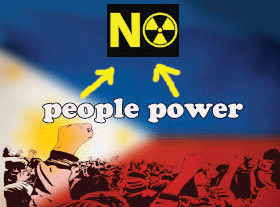 Taiwan to halt construction at fourth nuclear power plant The Taiwan government will halt construction at the island’s fourth nuclear power plant as local opposition to atomic energy continues to mount. Australia Network News 28 April 14
President Ma Ying-jeou’s Kuomintang party says a decision has been made to seal off the plant’s first reactor after the completion of safety checks.
And construction of the second reactor will be halted immediately.
The move is the latest sign of pressure on Mr Ma’s administration from opposition parties and anti-nuclear activists, who are concerned about the safety of such facilities in earthquake-prone regions of Taiwan following the 2011 Fukushima disaster in Japan.
Tens of thousands of protesters gathered in downtown Taipei over the weekend, urging the government to abandon nuclear energy……..http://www.abc.net.au/news/2014-04-28/an-taiwan-nuclear-protest/5414294
100 Taiwanese academics take to the streets in anti nuclear protest
Academics take to the streets against nuclear generation, Taipei Times, 25 April 14 By Loa Iok-sin / Staff reporter About 100 academics yesterday staged a silent march from Ketagalan Boulevard in front of the Presidential Office Building to Gikong Presbyterian
Church, where former Democratic Progressive Party chairman Lin Yi-xiong (林義雄) has been on a hunger strike since Tuesday, to urge the government to give up nuclear energy.
“Nuclear power is the most negative product of capitalism and imperialism, it’s a disaster for the disadvantaged,” said Cheng Fei-wen (鄭斐文), an associate professor of sociology at Tung Hai University. “When nuclear disaster occurs, it is the poor, the aged and children who will suffer the most. Even today, the Tao people on Orchid Island still suffer from nuclear waste storage,” he added.
National Chung Cheng University professor Chen Ruey-lin (陳瑞麟) said Taiwan was located in the so-called “Ring of Fire,” where frequent earthquakes and volcanic eruptions occur in the basin of the Pacific Ocean.
“I don’t think Taiwan is qualified to use nuclear energy,” he added…………
Taiwan Association of University Professors president Lu Chung-chin (呂忠津), who teaches electrical engineering at National Tsing Hua University, said the government should not continue to threaten the public by saying that there may be a power shortage without the Fourth Nuclear Power Plant.
“It would be better if the government could use this critical time to develop a green energy system for our future,” he said.
The group marched in silence to the church after tying yellow ribbons with the slogan: “Stop the Fourth Nuclear Power Plant; return the power to the people” on police barricades that barred them from getting close to the Presidential Office Building…….http://www.taipeitimes.com/News/taiwan/archives/2014/04/26/2003588934
Lin Yi-xiong: the Power of One very influential anti nuclear Taiwanese
In Taiwan, an Anti-Nuclear Activist With Unusual Pull WSJ China Real Time, 23 April 14 Jenny W. Hsu.A high-profile Taiwanese anti-nuclear activist began a hunger strike on Tuesday to protest construction of the island’s fourth nuclear power plant, in what could become another challenge for the already beleaguered President Ma Ying-jeou.
Lin Yi-xiong, the former chairman of the opposition Democratic Progressive Party and a longtime anti-nuclear activist, vowed to sustain on only water until the government suspends construction of the northern Taipei plant.
Less than 24 hours after Mr. Lin began his strike, both Mr. Ma and Premier Jiang Yi-hua tried to visit him, only to be turned away. Hunger strikes aren’t uncommon in the oft-fractious island, but Mr. Lin is the first striker who has received personal attention from the president and the cabinet leader…….
Analysts say that given his clout and the public’s already-ballooning opposition to nuclear power, Mr. Ma’s ruling Nationalist Party, or Kuomintang, would face more arduous battles ahead of local elections later this year if Mr. Lin dies as a result of his hunger strike.
Mr. Ma—whose approval rating is currently 14%, according to a poll by Taiwan Indicator Survey Research—relied on his accommodative China policies to win re-election in 2012. But these same policies have also become his Achilles heels recently, with more people questioning whether the warmer trade ties with China have benefited Taiwan’s average workers……At 73, Mr. Lin is regarded across party lines as one of the most influential political figures in Taiwan since the 1970s. As a dissident, he was jailed multiple times during the island’s martial law era (1949-87).
In 1980, while Mr. Lin was imprisoned as a dissident, his mother and his seven-year old twin daughters were found stabbed to death in the basement of their home. His oldest daughter survived the attack with severe injuries. The case remain unsolved, and the house, which has been turned into a church, is where Mr. Lin is staging his fast…….Other anti-nuclear activists plan to join Mr. Lin in protest by staging a demonstration in front the Presidential Office on Saturday.http://blogs.wsj.com/chinarealtime/2014/04/23/in-taiwan-an-anti-nuclear-activist-with-unusual-pull/
No Faith in Trident tour, by veteran UK anti nuclear campaigner, Bruce Kent
Anti-nuclear campaigner, Bruce Kent, brings crusade to Darlington http://www.thenorthernecho.co.uk/news/11167479.Anti_nuclear_campaigner_brings_crusade_to_Darlington/ 23rd April 2014 in News By Hannah Bryan, Report ONE of Britain’s best-known peace campaigners has brought his anti-nuclear crusade to the North-East.
Veteran peace campaigner and retired Catholic priest, Bruce Kent, spoke to crowds at the Friends’ Meeting House, in Darlington, as part of his No Faith in Trident tour.
The 84-year-old highlighted the cost of Trident – Britain’s nuclear weapons system – as well as the legal and moral issues involved with nuclear weapons. He said: “It is about getting people all around the country active in opposing the spending of £100billion on more nuclear weapons, which could instead be spent on the NHS, good education and other services. We should be getting rid of nuclear weapons which make the country more dangerous, not safer.
“The thing that matters the most to me is when people go home after my talk and do something about it, like write to their local MP or newspaper.”
Mr Kent was chair and general secretary of the Campaign for Nuclear Disarmament (CND) throughout the 1980s, and was formerly chair of War on Want.
He remains an active anti-nuclear and anti-war campaigner.
Lin Yi-hsiung, in Taiwan on hunger strike against nuclear power
Taiwan anti-nuclear activist starts hunger strike The West Australian, Taipei (AFP) 22 April 14 – Former Taiwanese opposition leader and anti-nuclear activist Lin Yi-hsiung Tuesday launched an indefinite hunger strike in protest at a nearly completed nuclear facility, while some of his supporters clashed with police.”It’s very meaningful to be doing something good for Taiwan — I feel very calm,” Lin told a crowd of reporters and supporters before he began the hunger strike.
He added he had been forced into the situation because the authorities had ignored public opinion on nuclear power. He said the majority of people in Taiwan were against a fourth nuclear power plant.
Lin, who led the main opposition Democratic Progressive Party (DPP) from 1998-2000, has devoted himself to battling the island’s nuclear power policy in the past two decades.
“If anything unfortunate should happen to me, I want my family and friends to know that (those in power) murdered me,” the 72-year-old said before entering a church in Taipei to begin his indefinite fasting.
Outside parliament, dozens of protesters briefly clashed with the police as they attempted to surround the building in a show of support for Lin. They unfurled a large yellow banner reading “Salute chairman Lin Yi-hsiung, stop building fourth nuclear (plant)”, and held placards calling for the project to be terminated.
“If Lin Yi-hsiung loses his life, it is the evil government who have caused it,” said the group’s leader Tsai Ting-kuei………
69% of Japanese want nuclear power to be phased out
 Japan’s Profound Ambivalence Over Nuclear Energy , TIME, Per Liljas, 14 April 14 Prime Minister Shinzo Abe has unveiled a pro-nuclear blueprint for the country’s energy future around the three-year mark of the disaster at Fukushima, a move that most Japanese appear to disagree with, even those who returned to Fukushima to rebuild their lives ……On a national level, too, there is a lack of consensus. Produce from Fukushima, even from villages
  unconnected to the disaster, does not inspire confidence among consumers despite official O.K.s. And nobody can agree on the future of Japan’s nuclear-energy sector…….“They want to restart the reactors because of money, but it’s irresponsible, Japan is too unsafe to have nuclear power,” says activist Kaori Echigo, before taking to a podium in front of the parliament building in Tokyo and leading a crowd in the chanting of anti-nuclear slogans. The crowd at these gatherings, which have been held weekly since the disaster, has dwindled to a few hundred. But the last time a reactor was restarted, in 2012, thousands came onto the streets—as they are likely to do again if Abe goes ahead with his plan.
A poll by the Tokyo Shimbun newspaper last month found that 69% of respondents wanted nuclear power to be phased out. That number could rise even higher if Japan makes it through another summer without blackouts…….Spread out through the village are fields covered with black plastic bags, each one filled with contaminated topsoil that has been collected from the surroundings. Watanabe says she feels life is coming back to Tamura when she sees children in the streets, but then remembers that they are only allowed half an hour’s outdoor playtime per day because of radiation fears.
“I don’t want my grandchildren to grow up here,” she says. “I don’t know which health problems they may get.” Even that old saw about marrying somebody from Tamura means nothing now. “I want my grandchildren to get married” Watanabe adds, “and I don’t know which suitors would ever come here.” http://time.com/59096/fukushima-nuclear-daiichi-japan-tamura/
Tatsuya Murakami, influential ex-mayor leads community opposition to Japan’s nuclear power push
 Ex-mayor of nation’s nuclear birthplace comes out swinging against atomic power Japan Times, BY KEIJI HIRANO, 13 April 14, KYODO THE FORMER MAYOR OF A VILLAGE THAT HAD A PIONEERING ROLE IN THE NATION’S NUCLEAR DEVELOPMENT EXPRESSED HIS OPPOSITION SUNDAY TO THE COUNTRY CONTINUING TO LOOK TO NUCLEAR POWER AS AN ENERGY SOURCE.
“It has been said that a local community can enjoy benefits by hosting a nuclear power plant, but it is just an illusion,” Tatsuya Murakami, who served as mayor of Tokaimura, Ibaraki Prefecture, for 16 years until his retirement last September, told a public gathering in Tokyo.
Around one-third of the village’s general account budget was from nuclear facilities located there while he was mayor, “but the ‘nuclear money’ has made our industrial structure disproportionately depend on nuclear-related businesses,” he said. “As a result, we have failed to cultivate other businesses.”
The village’s shipment of manufactured goods stands at only ¥30 billion, compared with that of Myoko, Niigata Prefecture, with a population almost the same as Tokaimura’s, at ¥140 billion, according to Murakami.
“The nuclear operators are just like lords of the community, and people seek cozy ties with them. To criticize the lords is taboo,” Murakami said as he talked about the situation in the village where nation’s first research reactor achieved criticality in 1957.
His comments came after the government of Prime Minister Shinzo Abe decided Friday on a national energy policy that supports the use of nuclear power now and in the future, retracting a nuclear phaseout goal introduced by the previous Democratic Party of Japan-led government in the wake of the 2011 Fukushima nuclear disaster.
Murakami has served as a co-representative of the Mayors for a Nuclear Free Japan, which comprises around 90 former and incumbent mayors supporting the nuclear phaseout policy. Incumbent mayors include those of major cities, such as Sapporo, Aomori and Nagoya………
Six months after retiring, Murakami now gives lectures several times a month around the nation to encourage people to raise their voices against nuclear power.
“I had been thinking about how to reconstruct our village in the wake of the nation’s first criticality accident in 1999,” which killed two workers at a nuclear fuel processor and exposed hundreds of residents to radiation, he said. “We were thrust into notoriety — Tokaimura was contaminated with radiation and the villagers were not being chosen as marital partners.
“I believe now that a local municipality should break away from the old mindset focusing only on economic development,” he said. “Rather, we need to create a sustainable society, taking good care of the environment as well as ourselves.”http://www.japantimes.co.jp/news/2014/04/13/national/ex-mayor-of-nations-nuclear-birthplace-comes-out-swinging-against-atomic-power/
The historic peace ship, the Golden Rule, will sail again

 World War II U.S. naval commander. Appalled by the atomic bombing of Hiroshima, he became a Quaker and, in 1955, working with the American Friends Service Committee, sought to deliver a petition against nuclear testing to the White House. Rebuffed by government officials, Bigelow and other pacifists organized a small group, Non-Violent Action Against Nuclear Weapons, to employ nonviolent resistance in the struggle against the Bomb. After the U.S. government announced plans to set off nuclear bomb blasts near Eniwetok in the Marshall Islands―an island chain governed by the United States as a “trust territory” for the native people―Bigelow and other pacifists decided to sail a 30-foot protest vessel, the Golden Rule, into the nuclear testing zone. Explaining their decision, Bigelow declared: “All nuclear explosions are monstrous, evil, unworthy of human beings.”
Shock horror! the youth of Britain are anti nuclear!
 Younger people ‘more anti-nuclear’ Courier UK By PRESS ASSOCIATION, 8 April 2014 “…….Voters aged 18-35 in the UK are more likely to oppose the like-for-like renewal of Trident – Britain’s nuclear weapons system – than their older peers, the survey carried out by ComRes on behalf of WMD Awareness found.
The findings come just two years before the Government is due to decide whether to renew the fleet of submarines that will carry the UK’s nuclear weapons.
It is the first time this decision will be made since the 1980s, when Trident replaced the previous Polaris system.
The research, based on responses from 4,207 people across Britain, found younger voters are not engaged in this issue, with only one in fifteen thinking the UK Government should prioritise spending on defence over the next 10 years.
It found that 19% of people aged 18-35 believe the UK nuclear weapon system should be renewed to maintain its current size and capacity, compared to 33% of people aged 36 and older.
51% agree that the UK nuclear weapon system should be disbanded or reduced in size and capacity, while 54% think nuclear weapons for defence purposes are too expensive for governments to maintain.
The research found 47% of people aged 18-35 disagree that nuclear weapons protect the countries which possess them from modern day threats such as terrorism.
A third (34%) believe renewing Trident is going to cost up to £5 billion, when it is actually estimated to cost up to £100 billion, according to WMD Awareness.
Young Ambassadors for WMD Awareness, who carried out the research, have responded to the findings by launching Talking Trident, a national debate to raise awareness of the issues surrounding defence and Trident renewal ahead of the Main Gate decision in 2016.
Hannah Cornford, ambassador lead at WMD Awareness, said: “Renewing Trident is the largest and most expensive British investment project.
“Yet, while support for Trident was widespread in the 1980s, our research shows that, for those born after the Cold War, spending on defence comes last on their list of government priorities.”
Madeline Held, Chair of Nuclear Education Trust, said: “The Talking Trident debate is a welcome development in stimulating a much needed discussion around nuclear weapons in the UK.
“The Nuclear Education Trust believes there should be a much deeper and wider public and parliamentary debate about whether to retain and modernise the UK’s nuclear weapons, especially given their expense at a time of austerity; the risk of accidents, and the fact that the majority of the UK’s European neighbours do not possess nuclear weapons to guarantee their security.”…… http://www.thecourier.co.uk/news/politics/younger-people-more-anti-nuclear-1.307616
Sustained Public Opposition to nuclear power restart in Japan
 In the Wake of Fukushima: Japan’s Nuclear Energy Policy Impasse 60% of Japan’s 48 viable nuclear reactors,are not as yet being considered for application to the Nuclear Regulation Agency (NRA) for restart By Andrew Dewit Global Research, April 07, 2014
Asia-Pacific Journal “………..The most recent Japanese opinion poll on nuclear restarts is the March 18 survey by the Asahi Shimbun. It indicates that 59% of the Japanese public oppose restarts of any nuclear capacity, whereas only 28% support restarts. The poll’s results not only confirm that the opposition to nuclear is holding; it also shows a great sensitivity to risk. According to the poll, a mere 12% of the Japanese public have either no or only minimal concern regarding the risk of further nuclear accidents at facilities other than the infamous Fukushima Daiichi. By contrast, 50% have a fair degree of concern, and 36% have a very high degree of concern. In addition, the poll shows that only 4% of respondents regard the lack of nuclear waste disposal facilities as of no or only minimal concern. By contrast, 19% believe it is to some extent a problem. And a massive 76% regard it as a serious problem.7
Nationwide, there are 135 local communities that lie within 30 kilometers of a reactor, and 21 prefectures that are host to one or more reactors. The news service Kyodo Tsushin surveyed these 156 local governments in mid- to late-February of 2014, and found that only 13 were ready to agree to restarts without conditions. A further 24 would agree to restarts, but with conditions. Of the remainder, 32 declared their opposition to restarts, 66 replied that they could not decide, and 21 offered no reply at all.8 The NRA decided on March 13 to prioritize Kyushu Electric’s Sendai rectors 1 and 2 (in Kagoshima Prefecture) for restart.9 But that decision itself came under criticism, due to perceptions of undue haste amid suggestions that seismically active zones are nearby………. http://www.globalresearch.ca/in-the-wake-of-fukushima-japans-energy-policy-impasse/5376899?utm_source=rss&utm_medium=rss&utm_campaign=in-the-wake-of-fukushima-japans-energy-policy-impasse
Greenpeace Activists invade French nuclear power plant
 Activists breach French nuclear plant Sky News, , Tuesday March 18, 2014 Dozens of Greenpeace activists have snuck into a nuclear power plant in eastern France at dawn.
It’s the latest break-in by the environmental group to highlight alleged security weaknesses at atomic facilities.
The activists broke into the Fessenheim plant and hung a banner reading ‘Stop risking Europe’ on the side of one of its reactors.
They did this ‘to denounce the risk of French nuclear power for the whole of Europe,’ the group said in a statement on Tuesday…….
Police detained 56 activists, he said, but 20 remained on top of the dome of one of the reactors as a police helicopter hovered above.
France, the world’s most nuclear-dependent country, operates 58 reactors and has been a leading international proponent of atomic energy.
But in a deal with the Greens before the 2012 parliamentary and presidential elections, President Francois Hollande’s Socialist party promised to cut reliance on nuclear energy from more than 75 per cent to 50 per cent by shutting 24 reactors by 2025.
Hollande has pledged to close Fessenheim, which was commissioned in 1977, by the end of 2016.
The plant, located on the banks of the Rhine, is close to the Swiss and German borders and is considered vulnerable to seismic activity and flooding.
The Greenpeace protest stunt comes ahead of a meeting by European leaders to discuss the future of the continent’s energy policy.
Greenpeace wants Hollande and German Chancellor Angela Merkel to push Europe towards a real energy transition, complaining that France relies too much on nuclear power, and Germany on coal, for electricity supplies. http://www.skynews.com.au/world/article.aspx?id=959316
Tokyo anti nuclear groups organise to promote renewable energy
Nuclear foes rally in U.S. cities on 3/11 anniversary Japan Times KYODO NEW YORK 12 Mar 14,“…..Green association forged KYODO A group of 38 local green power advocacy groups plan to set up a national association by June in an effort to break away from nuclear power generation.
The association will provide a forum for sharing information about members’ experiences in setting up community-based renewable power plants, the founders said Tuesday in Tokyo.
Members also plan to create a system for issuing certificates indicating the origin of electricity ahead of the 2016 liberalization of the retail electricity market, which will allow households to choose suppliers. Noting their wish not to have another nuclear disaster, the founders said they hope to assist companies and individuals to overcome challenges in developing locally driven power plants. http://www.japantimes.co.jp/news/2014/03/12/national/nuclear-foes-rally-in-u-s-cities-on-311-anniversary/#.UyII_j9dV9U
1 This Month
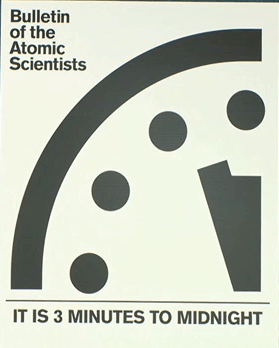
Watch the 2026 Doomsday Clock unveiling live here on January 27 at 10 a.m. EST
To see nuclear-related stories in greater depth and intensity – go to https://nuclearinformation.wordpress.com/

29 Jan. Thursday 7-8 p.m. Webinar – World’s Largest Nuclear Station in Port Hope, ON?


31st January – Challenging the War Machine – a DECLASSIFIED UK SUMMIT


Website of the Week
Now until to February 10, 2026 Radioactive waste storage in France: the debate is finally open! How to participate?
-
Archives
- January 2026 (277)
- December 2025 (358)
- November 2025 (359)
- October 2025 (376)
- September 2025 (258)
- August 2025 (319)
- July 2025 (230)
- June 2025 (348)
- May 2025 (261)
- April 2025 (305)
- March 2025 (319)
- February 2025 (234)
-
Categories
- 1
- 1 NUCLEAR ISSUES
- business and costs
- climate change
- culture and arts
- ENERGY
- environment
- health
- history
- indigenous issues
- Legal
- marketing of nuclear
- media
- opposition to nuclear
- PERSONAL STORIES
- politics
- politics international
- Religion and ethics
- safety
- secrets,lies and civil liberties
- spinbuster
- technology
- Uranium
- wastes
- weapons and war
- Women
- 2 WORLD
- ACTION
- AFRICA
- Atrocities
- AUSTRALIA
- Christina's notes
- Christina's themes
- culture and arts
- Events
- Fuk 2022
- Fuk 2023
- Fukushima 2017
- Fukushima 2018
- fukushima 2019
- Fukushima 2020
- Fukushima 2021
- general
- global warming
- Humour (God we need it)
- Nuclear
- RARE EARTHS
- Reference
- resources – print
- Resources -audiovicual
- Weekly Newsletter
- World
- World Nuclear
- YouTube
-
RSS
Entries RSS
Comments RSS
 nuclear-news
