The negative effects of more nuclear developments in Cumbria
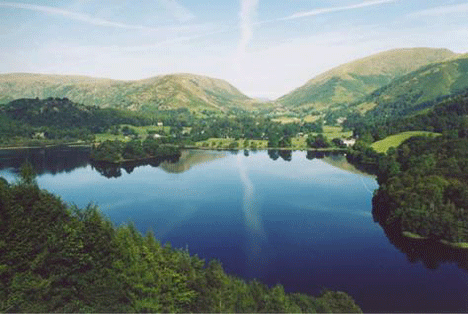 Tourism, Milk and Cheese or Nuclear? 13 Friday Feb 2015 by miningawareness “…..proximity to Moorside means that the issues are still essentially the same, as described below by the Braystones Concerns Group in their memorandum to Parliament: “Memorandum from Braystones Concerns Group (NWN 15)”
“Job opportunities, economy and economic diversity in West Cumbria.”
“1. Whilst jobs are welcome in West Cumbria, the overall effects of multiple nuclear developments would have many negative effects. What is frequently referred to as an area of outstanding natural beauty, would be greatly defaced by such extensive nuclear industrial sprawl. This would have a detrimental effect on the visitors perception of West Cumbria as a tourist destination. At a time when the area is desperately trying to diversify its economy, tourism jobs would simply be displaced by more ‘nuclear’ jobs, thus not actually increasing real jobs with the numbers being promised.It would greatly increase the economic stranglehold that the nuclear industry has on the area and would discourage many other discerning businesses that might otherwise have chosen West Cumbria. (A £45m cheese factory planned for Workington in West Cumbria did not go ahead in 2007, because of plans by Studsvik to build a radioactive waste processing plant at Lillyhall.) There are already a number of nuclear developments proliferating in West Cumbria, with Copeland and Allerdale councils trying to coax the public into accepting even more.”
“Economic/infrastructure viability of West Cumbria for nuclear power generation.”
“2. West Cumbria is not an economically suitable region for multiple reactor builds, as grid connectivity would prove particularly difficult and costly in such a remote area. West Cumbria is not where energy production is most needed.Any multiple reactor builds should be sited close to centres of high energy demand, where more suitable infrastructures and grid systems already exist. The recent devastation from flooding in West Cumbria has highlighted the wholly inadequate infrastructure throughout the region, which already struggles to service existing industrial demand. Repair and replacement of crucial bridges is currently estimated to take years. The southern sector of the main arterial route through Copeland has been de-trunked and is literally the width of a single vehicle in places. Road closures due to accident or maintenance can require alternative diversion routes 120 miles long. Major road improvements take at least 10 years to provide. If the Braystones site was developed, it would seriously compromise the existing Emergency Arrangements for the Sellafield site.” https://miningawareness.wordpress.com/2015/02/13/tourism-milk-and-cheese-or-nuclear/
Chicago Mayor Rahm Emanuel joins coalition for renewable energy, and against nuclear
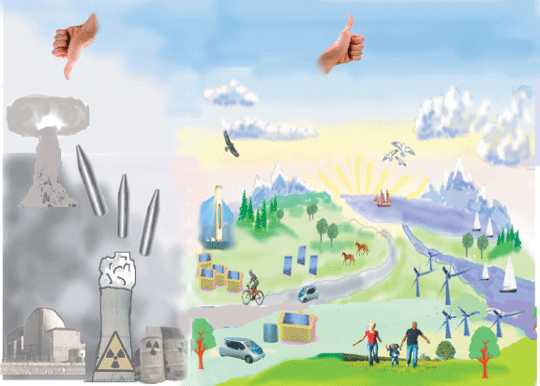
 Emanuel lines up with Exelon critics to push clean-power agenda, Crains, Chicago Business 4 Feb 15 By STEVE DANIELS Chicago Mayor Rahm Emanuel is joining a new coalition of environmentalists, renewable energy companies and labor leaders to lobby Springfield for stronger policies favoring wind and solar power, as well as energy efficiency.
The Illinois Clean Jobs Coalition, whose formation was announced today at Testa Foods on the Southwest Side, notably didn’t include Exelon, the state’s largest power generator, which is preparing to lobby state lawmakers for a financial rescue plan for its six nuclear plants in Illinois.
Emanuel’s unusual participation in the group potentially sets up the mayor as a political foe of Exelon, which in the past has counted on Chicago politicians, notably Emanuel’s predecessor, Richard M. Daley, for political support at the state level.
Speaking at a press conference, Emanuel endorsed the group’s call to boost the state’s already-ambitious renewable energy goal to 35 percent of the power generated in the state by 2030. Current state law calls for 25 percent renewable power by 2025.
The coalition also wants state lawmakers to boost energy efficiency standards to a 20 percent reduction in power consumption by 2025. State law now calls for annual improvements in efficiency, with a mandate to cut power consumption by 2 percent this year.
Finally, the group calls for “market-based strategies” to reduce carbon. One way to do that would be with a new system of charging carbon emitters for the pollution they generate. “A new revenue stream could be used to invest in areas such as workforce development, low-income bill assistance and research and development into new clean energy technology,” the coalition says in a statement.
Adoption of this agenda will create tens of thousands of jobs in Illinois over the next decade, the group claimed……….http://www.chicagobusiness.com/article/20150204/NEWS11/150209897/emanuel-lines-up-with-anti-exelon-crowd-to-push-clean-power-agenda
Activists unite to fight the ‘vampire’ technologies of fracking and nuclear
 Anti-Fracking and No Nukes Activists Join Forces Demanding Renewable Energy Revolution
These two vampire technologies suck the energy out of our planet while permanently poisoning our air, water, food and livelihoods.
The human movements fighting them have been largely separate over the years.
No more.
In the wake of Fukushima, the global campaign to bury atomic power has gained enormous strength. All Japan’s 54 reactors remain shut. Germany is amping up its renewable energy generation with a goal of 80 percent or more by 2050. Four U.S. reactors under construction are far over budget and behind schedule. Five old ones have closed in the last two years.
In New England and elsewhere, as the old nukes go down, safe energy activists shift their attention to the deadly realities of fossil fuel extraction.
The issues are familiar. Fracking in particular poisons our water and spews out huge quantities of lethal radiation. Ironically, in Ohio and elsewhere, the seismic instability it creates threatens atomic reactors still in operation.
In California, the burgeoning movement to shut the two remaining nukes at Diablo Canyon has run parallel with the powerful grassroots opposition to fracking. In both cases, water issues in this drought-plagued state have moved front and center.
Now the gap is being bridged. In a passionate hour-long dialog on saving our Earth, long-time anti-fracking activist David Braun speaks with Linda Seeley of the San Luis Obispo Mothers for Peace, the legendary grassroots group that has fought Diablo Canyon for more than four decades.
In their Solartopian radio conversation, and in a call to convene this coming spring, we see the seeds of an intertwined alliance that can help save our Earth: http://prn.fm/solartopia-green-power-wellness-hour-02-03-15/
Hind al Fayez -charismatic young parliamentarian challenges Jordan’s nuclear ambitions
 Among other concerns, Al Fayez questions how a state with such little water will be able to cool a reactor situated more than 200 miles from the shoreline, and whether Jordan has sufficient human capital (i.e., enough nuclear physicists) to safely operate the facilities. She has also expressed dismay with the $10 billion price tag, a sum roughly equivalent to Jordan’s total 2013 annual budget
The Middle East’s Next Nuclear Power? It may not be the one you’re thinking about. Politico, By DAVID SCHENKER January 28, 2015 “…….even as Western attention has focused all around Jordan—and especially on the nuclear negotiations with Iran—in a little-noticed series of moves, the Kingdom’s been edging closer to going nuclear itself. In fact, the Kingdom of Jordan, Washington’s most reliable Arab partner, is the latest Middle Eastern state considering nuclear energy that is refusing to relinquish its right to enrich.
To prevent proliferation, the US has long held that Middle Eastern states seeking nuclear energy must forego the right to enrich nuclear material. The principle of no-enrichment has underpinned the so-called “gold standard” of US-bilateral nuclear agreements……..
—in its December 2009 agreement with the US, the United Arab Emirates acquiesced to forego enrichment and reprocessing of spent nuclear fuel……….Over the past four years, the Kingdom has increasingly focused on nuclear energy, in particular the construction of two 1000-megawatt power plants…….Amman’s proposed nuclear facilities have met with opposition both at home and abroad. Washington’s stated opposition to the program revolves around enrichment. Jordan’s resolve to maintain this right has stymied efforts to reach a “123 agreement” governing US international nuclear cooperation……….
Israel, too, has taken issue with Jordan’s nuclear ambitions, primarily due to concerns about safety. Continue reading
Consumer groups in Malaysia condemn government that is “hell-bent’ on nuclear power

 Putrajaya ‘hell-bent’ on nuclear plant despite public concerns, says consumer group Malaysian Insider, 1 February 2015 Plans to build a nuclear plant in Malaysia are afoot, warned a consumer group, and said Putrajaya was misleading the public into thinking that it will consult the people on the use of nuclear energy when it had already decided to proceed with a bill to be table in Parliament this year.
Consumers Association of Penang (CAP) president SM Mohamed Idris said the government was “hell-bent” on introducing nuclear power in the country’s energy mix and highlighted statements made by energy officials over the past year and recently which indicated that Malaysia was intent on adopting nuclear energy.
As proof, he cited the setting up of the Malaysian Nuclear Power Corporation (MNPC) in January 2011, and the listing of nuclear energy as an entry point project in the Economic Transformation Programme in 2010.
“The government is hell-bent on introducing nuclear energy in the country’s energy mix.
“It is disingenuous of the government to continue misleading the public with its standard response line that a decision has yet to be made and the government is still exploring the option to go nuclear,” he said in a statement today.
Mohamed also said Putrajaya had announced its intention to table the Atomic Energy Regulatory Bill in August last year, and that the announcement was welcomed by MNPC chief executive officer, Dr Mohd Zamzam Jaafar, who said MNPC was hopeful that the bill would be approved by Parliament this year.
Malaysia, a nett oil exporter, has, in the past, floated the idea of adding nuclear power to its energy mix to meet long-term fuel needs, but such announcements were always greeted with public disapproval.
In 2010, the minister of energy, green technology and water then, Tan Sri Peter Chin, announced plans to build a nuclear plant that would start operations in 2021.
In July last year, Minister in the Prime Minister’s Department Datuk Mah Siew Keong, who oversees the MNPC, had also said that feasibility studies would be conducted on building nuclear plants as a sustainable energy option for Malaysia.
There is no indication yet of where the proposed nuclear plant would be built, but remote locations close to water sources are required in line with international rules. This would leave a limited number of states, such as Pahang, Johor and Terengganu, as possible locations……….
CAP also called upon the public to denounce the soon-to-be completed Malaysian Nuclear Power Infrastructure Development Plan as an “undemocratic and authoritarian” plan. – February 1, 2015. – See more at: http://www.themalaysianinsider.com/malaysia/article/putrajaya-hell-bent-on-nuclear-plant-says-consumer-group#sthash.2irEgUtq.dpuf
Indian Citizens’ Statement against Capitulation to the US on Nuclear Liability
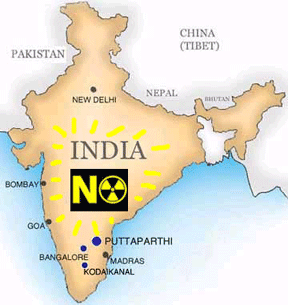 http://kashmirwatch.com/news.php/2015/01/30/indian-citizens-statement-against-capitulation-to-the-us-on-nuclear-liability.html Kumar Sundaram
We are deeply disturbed by media reports that the Indian government has capitulated to aggressive U.S. demands and agreed to a deal that indemnifies American nuclear vendors from the consequences of accidents caused by design defects in their reactors.
Preliminary reports suggest that the government has agreed to create an insurance pool, backed by public sector companies, so that any potential American liability can be redirected back to Indian taxpayers. This creates a “moral hazard”, where the Indian people could end up being responsible for mistakes made by a multinational corporation.
The 2010 Indian liability Act is already a weak law heavily biased towards the nuclear industry. It caps the total liability for an accident at a paltry Rs 1,500 crores and takes away the rights of victims to sue the supplier. The much-discussed supplier liability is very limited: the government alone, as the operator, has a right of recourse against the vendor.
So, we fail to understand the Modi government’s motivation for weakening this law even further. The U.S. has nothing attractive to offer in terms of nuclear commerce. The Indian government has agreed to purchase the AP1000 reactors from Westinghouse, and the Economic Simplified Boiling Water Reactor (ESBWR) from General Electric. Both these designs are untested. The ESBWR technology is so immature that the design received certification from the U.S. nuclear regulatory commission—the first step before a reactor can be constructed—only last September. Recent reports suggest that construction of AP1000 units has run into trouble in China.
Independent estimates suggest that the cost of electricity from these reactors may exceed Rs. 15 per unit. This is much higher than the tariff from competing sources of electricity.
Therefore, the reality behind the grandiose proclamations made by the Indian government is rather sobering. India has agreed to pay billions of dollars for immature American technology, and then ensured that American companies will not be held to account for any design defects.
We hope that progressive forces and concerned citizens throughout the country will unite to oppose this disturbing development.
Signatures: Continue reading
US govt takes 4 years to respond – and reject – petition to to close Fukushima-style nuclear reactors
 Four years later, NRC rejects Beyond Nuclear and 10,000+ co-petitioners’ call to close Fukushima-style reactors Beyond Nuclear 23 jan 15 After nearly four years of behind closed doors deliberations, on January 15, 2015, the U.S. Nuclear Regulatory Commission (NRC) issued its “Final Director’s Decision” rejecting the April 13, 2011emergency enforcement petition filed by Beyond Nuclear along with more than 10,000 co-petitioners from around the country. The public emergency enforcement petition called for the immediate suspension of the continued operation of the General Electric Mark I boiling water reactors in the U.S. that are identical to Fukushima Daiichi nuclear reactors units 1, 2 and 3 that exploded and melted down following the March 11, 2011 earthquake and tsunami in Japan.
The NRC makes its best case for dismissing the petition by arguing that “each of the Petitioner’s requests has been addressed through other actions.” We acknowledge that after four years a portion of the actions that we requested in April 2011 have been taken at some of these reactors. However, we strongly disagree with the NRC’s overall conclusion that each and every action request is addressed and that the public health and safety hazard is resolved such that the petition can be legitimately dismissed in total. We remain concerned that the agency is not capable of effective regulation and enforcement given the long standing nature of the Mark I reactor hazards and a recalcitrant nuclear industry that first considers its financial margins over public safety margins.
Regrettably, we recognize that under existing NRC provisions (Chapter 10 of the U.S. Code of Federal Regulation Part 2.206) the public has absolutely no recourse to appeal a Director’s Decision to the Commission level or legally challenge Mark I design vulnerability and its operational hazards in a court of law. This denial of due process comes in spite of the fact that agency orders and industry corrective actions referenced in dismissing the petitioner are inadequate half measures that need not be fully implemented for years still to come, if ever. In critical safety areas for the Mark I, the proposed corrective actions credited in the Director’s Decision are not even conceptually finalized nor approved by the regulator as we approach the fourth anniversary of the nuclear catastrophe. Moreover, there are numerous agency staff non-concurrences on how to even proceed with post-Fukushima action plans………….
Any one of the hazards cited for suspension of the operating licenses in the April 2011 petition serves as ample reason for why the GE Mark I reactors need to be promptly and permanently shuttered. But a primary focus remains on the threat of catastrophic failure of the Mark I containment under severe accident conditions.
The petitioners remain concerned that because the GE Mark I containment system is only 1/6th the size by volume of a typical pressurized water reactor like Three Mile Island it will not reliably serve to “contain” the tremendous pressures, extreme heat, explosive hydrogen gas and highly radioactive releases associated with an accident involving reactor core damage. In fact, this was demonstrated by a 100% failure rate of the Mark I containment systems for Fukushima Daiichi Units 1, 2 and 3 which were operating at full power at the time of the March 11, 2011 earthquake and tsunami. The current action plan is a rehash of a 1989 “fix” to deliberately vent a nuclear accident to the environment by temporarily defeating the containment concept to save it from permanent rupture. Moreover, the current NRC order to improve the reliability of containment venting systems similar to those that failed Fukushima, need not be fully implemented by industry until 2019.
Ironically, when the NRC’s Japan Lessons Learned Task Force reviewed the nuclear catastrophe for recommending modifications to the U.S. Fukushima-style reactors, the staff concluded that what was really needed was not only an enhanced hardened containment vent for the controlled release of heat, pressure and explosive gas but requiring the re-institution of the defense-in-depth concept to more reliably contain the high-level radioactive releases that would also be generated by the nuclear accident. On November 29, 2012, the Japan Lessons Learned Task Force recommended that the Commission issue an Order to all GE Mark I and Mark II boiling water reactor operators to promptly install hardened containment vents with the engineered radiation filters as a “cost-benefited substantial safety enhancement.” The nuclear industry vigorously opposed the additional radiation filter concept on economic grounds and “unintended consequences” and successfully lobbied the five-member Commission by majority vote to reject the filter recommendation on containment vents. The Commission instructed the NRC staff to take up consideration of the installation of radiation filters in a proposed rulemaking and gather independent scientific expert experience as well as public and industry comments. However, in December 2014, the NRC rulemaking staff reversed course for considering the addition of external radiation filters and now seeks to abandon the rulemaking process effectively locking out public and independent expert input.
Our common struggle for real public safety, environmental protection and energy independence remains to permanently closing down an inherently dangerous atomic power industry.
Keep your eyes on the prize and hold on. http://www.beyondnuclear.org/freeze-our-fukushimas/2015/1/21/four-years-later-nrc-rejects-beyond-nuclear-and-10000-co-pet.h
As economics slowly kill nuclear power, activists hastened the death of Vermont Yankee Nuclear Facility
Throughout the U.S. and the world, the demise of atomic energy is accelerating. Some 435 reactors are listed worldwide as allegedly operable. But 48 in Japan remain shut in the wake of Fukushima despite the fierce efforts of a corrupt, dictatorial regime to force them back on line. Germany’s transition to a totally nuke-free green energy economy is exceeding expectations. The fate of dozens proposed and operating in China and India remains unclear.
Activists Permanently Shut Down Vermont Yankee Nuke Plant Today Harvey Wasserman | December 29, 2014 The Vermont Yankee atomic reactor goes permanently off-line today, Dec. 29, 2014. Citizen activists have made it happen. The number of licensed U.S. commercial reactors is now under 100 where once it was to be 1,000.
Decades of hard grassroots campaigning by dedicated, non-violent nuclear opponents, working for a Solartopian green-powered economy, forced this reactor’s corporate owner to bring it down. Entergy says it shut Vermont Yankee because it was losing money. Though fully amortized, it could not compete with the onslaught of renewable energy and fracked-gas. Throughout the world, nukes once sold as generating juice “too cheap to meter” comprise a global financial disaster. Even with their capital costs long-ago stuck to the public, these radioactive junk heaps have no place in today’s economy—except as illegitimate magnets for massive handouts. Continue reading
Criticism in Iran of Iran’s nuclear power programme
 Nuclear Program Has ‘Hurt Iran More Than Iraq War’, Payvand Iran News, 18 Dec 14 Nuclear Program Has ‘Hurt Iran More Than Iraq War’, Payvand Iran News, 18 Dec 14 |
| By Golnaz Esfandiari, RFE/RL Iran’s nuclear activities and ambitions faced rare, blunt criticism at a roundtable at Tehran University, where one of the speakers said the damage done by the nuclear program was greater than that by the 1980-88 war with Iraq, which left tens of thousands dead and caused much devastation.
“The imposed war [with Iraq] did not damage us as much as the nuclear program has,” professor Sadegh Zibakalam said at the December 17 roundtable, according to reports by Iranian semiofficial news agencies. Zibakalam also criticized the lack of public debate about the nuclear issue. Other speakers were also critical of the nuclear program and its costs for Iranians, who have come under unprecedented U.S.-led sanctions that have made life more difficult. Speaking at the event, former reformist lawmaker Ahmad Shirzad said nothing had come out of the nuclear program, “not even a glass of water.”……. Shirzad said that he welcomed Iran’s official line, according to which the country is against building and acquiring nuclear weapons. The former lawmaker also seemed to suggest that Iran would be better off without a civil nuclear program. “Iran doesn’t have the primary resources and know-how for a nuclear program,” he was quoted as saying by ISNA. He said Iran could assert itself in areas such as petrochemistry and natural gas, where the country has the resources and the knowledge…………. Criticism of the nuclear issue has been a red line in Iran, where media face tough censorship rules in their news coverage. Shirzad said the nuclear issue has turned into a matter of “honor.” “When something becomes a matter of honor, discussing it is not possible anymore. And that has been our problem for the past 11 years,” he said. Zibakalam said that under Iran’s previous administration, criticism of the nuclear issue was impossible. “Unfortunately from 2003 to 2013, debate about the different aspects of the nuclear issue was not possible. I believe that whenever people and the press are prevented from expressing their opinions on different issues, the result is not good,” he was quoted as saying. He added that during those years whenever he would send a slightly critical piece to the press, “the editors would dump it in the closest trash can.”………http://www.payvand.com/news/14/dec/1098.html |
Malaysian NGO firmly rejects nuclear power
 NGO rejects nuclear option for Malaysia FMT | December 24, 2014
AMAN is convinced that nuclear power is neither cheap, clean nor safe. “It is not required for the generation of electricity in Malaysia,” said Aman chairman Dr. Ronald McCoy in a statement.
“AMAN therefore rejects the construction of any nuclear power plant (NPP) in Malaysia.”
AMAN, according to its statement, has taken this position, based on seven key factors: possibility of nuclear weapons proliferation; energy security; extremely expensive; vulnerable to natural disasters and accidents; a ticking time bomb; Malaysia’s existing and planned electricity by other means are sufficient; and the rate of construction of NPPs is skydiving.
AMAN was aware of the ongoing dissemination of false information by the nuclear industry and other vested interests, added the NGO, and “there has not been any genuine transparency of the government’s intentions nor sincere public consultation”.
“Our country must not make the serious mistake of investing in and constructing a nuclear power plant, particularly when there is no existing method of safely disposing the long-lasting radioactive nuclear waste, which will threaten the health of future generations of Malaysians.”
Globally, the use of nuclear power as an energy source was in decline, the statement points out.
Some figures:………….http://www.freemalaysiatoday.com/category/nation/2014/12/24/ngo-rejects-nuclear-option-for-malaysia/
Anti nuclear activists challenge pro nuclear Taiwan government
 Nuclear backers, critics clash at public meeting, Taipei Times By Sean Lin / Staff reporter 22 Dec 14 Anti-nuclear energy activists clashed with their pro-nuclear counterparts on Saturday at an event in Taipei held to gather public opinions in preparation for next month’s energy conference.
The conference is set to focus on identifying alternative energy sources after the construction of the Fourth Nuclear Power Plant in New Taipei City’s Gongliao District (貢寮) was suspended over widespread protests about the safety risks of the facility.The wide divide among advocates and critics of nuclear energy became clear soon after the northern preliminary meeting began……………
Taoyuan Local Union director-general Pan Chung-cheng (潘忠政) said he suspects that the Atomic Energy Council has mobilized many state-sponsored and pro-nuclear academics and members of related groups to attend the meetings because the public generally opposes nuclear energy.
“The government can work with academics and provide all these scientific facts about the benefits of nuclear power, but at the end of the day, the decision as to whether to adopt nuclear energy should be decided by the public,” he said.
“I do not think they really understand how people feel about nuclear energy and their actions are a violation of democratic values,” he said.http://www.taipeitimes.com/News/taiwan/archives/2014/12/22/2003607328
Austria contests EU funding for UK’s Hinkley Point nuclear project
 Austrians resist EU funding for UK’s Hinkley Point nuclear project EurActive, 18 Dec 14 Austrian premier Werner Faymann will today (18 December) protest at the British inclusion of landmark nuclear energy projects – including Hinckley Point – within its list of infrastructure eligible for funding under the proposed €315bn Juncker investment plan.
The UK has listed several nuclear-related projects within the Juncker plan, a list of 2,000 projects drawn from across all member states, which will be considered for funding under the investment plan.
“We see the need for Austria to point out that our contributions [to the Juncker plan] will not feed the demands of the nuclear energy industry,” Austrian environment minister Andrä Rupprechter told journalists in Brussels yesterday (17 December) according to a report by the Austrian Press Agency (APA)……..http://www.euractiv.com/sections/energy/austrians-resist-eu-funding-uks-hinkley-point-nuclear-project-310919
Cree anti uranium marchers reach Montreal in time to take part in hearings
 Cree march against uranium arrives in Montreal in time for hearings ROBERTO ROCHA, MONTREAL GAZETTE December 15, 2014 Three weeks after they left Mistissini on foot to protest against uranium mining in northern Quebec, a group of 20 Cree youths arrived in Montreal Monday.
The group braved blizzards and temperatures as low as minus-28 C as they marched 850 kilometres across the province to take part in environmental hearings on uranium mining.
They fear the waste from mining would contaminate the land and water of Cree communities and encroach on trap lines, and want a ban on uranium exploration.
A hearing by the Bureau d’audiences publiques sur l’environnement (BAPE) on uranium mining wrapped up on Monday, with a final report expected next May.
“The potential risks associated with uranium mining, which leaves behind thousands of years of radioactive material, that’s what concerns our people,” Chief Richard Shecapio of Mistissini told reporters shortly before the hearings began.
The Cree Nation Youth Council argues that uranium mining would affect tourism, as the region is a popular getaway for fishers………
There’s a moratorium on uranium exploration in Quebec, imposed last year by the previous Parti Québécois government. Before that time, the only uranium project seeking an exploration permit was Strateco Resources Inc.’s Matoush site in the Otish mountains, about 275 kilometres north of Chibougamau.
Yves-François Blanchet, the environment minister at the time, said no permits would be issued for the exploration or mining of uranium until an independent study on the mineral’s social acceptability and environmental impacts had been completed.
Last week, Strateco Resources filed a $190-million lawsuit against the Quebec government for blocking its project after years of ground work.
rrocha@montrealgazette.com
twitter.com/robroc http://montrealgazette.com/news/local-news/cree-march-against-uranium-arrives-in-montreal-in-time-for-hearings
Australian uranium mining project strongly opposed by Zambia’s Green Party
 the uranium mining issue a symptom of an extremely serious malaise affecting Zambia.
ZEMA and Zambia are woefully unqualified to deal with the environmental effects of the proposed uranium mining upstream of the Park and the management of the radiation and its very serious genetic impacts on people.
The Green Party of Zambia and the Lower Zambezi National Park Preserving the Zambezi ecosystem Ian Manning 16 Dec 14,The leader of the Green Party of Zambia, Peter Sinkamba, has set out their platform for the Presidential elections of 20 January 2015: to cancel the mining licence issued to Australia’s Zambezi Resources Limited for the Lower Zambezi National Park. Reading this, the electorate will wonder what could possibly be so important about the proposed mining of a National Park. And why do the Greens consider it the single most important issue facing Zambia today?
Perhaps Sinkamba sees the mining issue – as do I – as a symptom of an extremely serious malaise affecting Zambia. For the mining issue removes the trousers to reveal a suppurating Zambian ulcer on the nations bottom: the continuing existence of a dictatorial, grasping Executive, uncurbed by Government, Parliament, the Judiciary or the Constitution……………..
As a backdrop to this crime against customary people, the International Tribunal for the Rights of Nature meeting took place on 5 and 6 December 2014 in Lima, the judges referring ‘to the Rights of Nature and the Universal Declaration of the Rights of Mother Earth, from the World People’s Conference on Climate Change and the Rights of Mother Earth in Cochabamba, Bolivia in 2010’. ………….
Another reason, I would hope, for putting the mining up in lights, is that the Greens need to expose the fact that consumer capitalism is dying, and that therefore Zambia should adjust its thinking; for we live in a world of declining resources, one increasingly prone to Liebig’s Law where the amount that a species or ecosystem can produce in a given place and time is limited by the resource in shortest supply – something politicians fail to understand……………….
For mining the SNDP lists the mid-Zambezi uranium mines as coming into production – for which no strategic EIA has been conducted, let alone full environmental management plans – as a UNESCO/IUCN mission discovered – mandatory for the issue of prospecting and large-scale mining licences.
ZEMA and Zambia are woefully unqualified to deal with the environmental effects of the proposed uranium mining upstream of the Park and the management of the radiation and its very serious genetic impacts on people. Brugge & Buchner of Tufts University in 2011 concluded that ‘the strong biological plausibility of adverse effects on the brain, on reproduction, including estrogenic effects, on gene expression, and on uranium metabolism’ will not only affect mine workers but also villagers living near uranium mines and processing facilities. They ended on a chilling note, ‘As much damage is irreversible, and possibly cumulative’. In addition, no strategic socio-environmental impact study has been made of the State’s past and present programmes; nor has there been given any thought to maintaining the integrity of Zambia’s cultural and religious heritage………
The Green Party, with the Lower Zambezi National Park as its platform, has certainly provided a litmus test for the future.
For more information on the issue see:
(Archived by WebCite® at http://www.webcitation.org/6CeIIPlmD)
Future publication by I. P. A. Manning:
Out of Zambia: its history, conservation and plunder; and an alternative way http://zambeziheritage.wordpress.com/
Marathon walk by Cree youth to stop uranium mining in Quebec
Cree Youth Walk 850 km To Protest Against Uranium Mining In Quebec, Huff Post. CBC 14 Dec 14  About 20 young Cree people have walked nearly 850 kilometres to Montreal’s South Shore from their village in northern Quebec, protesting against uranium exploration in the province.
The youth left Mistissini, Que., northeast of Chibougamau in the James Bay region three weeks ago. On the way, they stopped in Quebec City to share their message. They arrived in Longueuil, just across the bridge from Montreal, Saturday.
Their final destination is downtown Montreal, where they will deliver that message to the province’s environmental protection agency, known as the BAPE, when it holds the last of a series of public hearings on uranium exploration tomorrow.
The Cree young people have endured frigid temperatures and wintry conditions, walking an average of a marathon a day. “We’ve lost a couple of toenails on this journey,” said Joshua Iserhoff, chair of the Cree Nation Youth Council.
But according to Iserhoff, it’s been worth it.
He said uranium exploration near his community could cause irreparable damage to the watershed………
Now the province is holding public hearings on uranium mining. http://www.huffingtonpost.ca/2014/12/14/cree-uranium-mining-protest_n_6322934.html
1 This Month
Chernobyl: The Lost Tapes – A good documentary on Chernobyl on SBS available On Demand for the next 3 weeks– https://www.sbs.com.au/ondemand/tv-program/chernobyl-the-lost-tapes/2352741955560

of the week–London Campaign for Nuclear Disarmament

Tell the Ukrainian Government to Drop Prosecution of Peace Activist Yurii Sheliazhenko
To see nuclear-related stories in greater depth and intensity – go to https://nuclearinformation.wordpress.com
-
Archives
- April 2026 (152)
- March 2026 (251)
- February 2026 (268)
- January 2026 (308)
- December 2025 (358)
- November 2025 (359)
- October 2025 (376)
- September 2025 (257)
- August 2025 (319)
- July 2025 (230)
- June 2025 (348)
- May 2025 (261)
-
Categories
- 1
- 1 NUCLEAR ISSUES
- business and costs
- climate change
- culture and arts
- ENERGY
- environment
- health
- history
- indigenous issues
- Legal
- marketing of nuclear
- media
- opposition to nuclear
- PERSONAL STORIES
- politics
- politics international
- Religion and ethics
- safety
- secrets,lies and civil liberties
- spinbuster
- technology
- Uranium
- wastes
- weapons and war
- Women
- 2 WORLD
- ACTION
- AFRICA
- Atrocities
- AUSTRALIA
- Christina's notes
- Christina's themes
- culture and arts
- Events
- Fuk 2022
- Fuk 2023
- Fukushima 2017
- Fukushima 2018
- fukushima 2019
- Fukushima 2020
- Fukushima 2021
- general
- global warming
- Humour (God we need it)
- Nuclear
- RARE EARTHS
- Reference
- resources – print
- Resources -audiovicual
- Weekly Newsletter
- World
- World Nuclear
- YouTube
-
RSS
Entries RSS
Comments RSS
 nuclear-news