Japanese environment groups protest against Restart of Sendai Nuclear Power

 Joint Statement to Protest Restart of Sendai Nuclear Power http://www.foejapan.org/en/energy/doc/150811.html
Government does half-hearted review, downplays risks, pretends Fukushima accident never happened
Today, the Sendai No. 1 nuclear reactor was restarted.
We strongly protest the restart of the Sendai nuclear power plant, which has been done as if the Fukushima nuclear accident never occurred.
The problems with the Fukushima accident have still not been resolved. More than 100,000 people lost their communities and are being forced to live in long-term shelters. Contaminated water is still being discharged, and radiation concentrations continue at high levels in seawater inside and outside of the bay. In Fukushima Prefecture, more than 100 children have been diagnosed with thyroid cancer, and even the prefecture’s thyroid assessment committee has had to admit that there are many cases.
The review by the Nuclear Regulation Authority is merely a facade to produce the desired result. It is no guarantee of the safety of the Sendai power plant.
The volcanic risk assessment went ahead without a volcano expert. Kyushu Electric Power. The Authority blindly accepted Kyushu Electric Power’s monitoring guidelines that pretend they can predict a major eruption. Earthquake-related reviews were done based on the Irikura method, which has been pointed out to underestimate earthquakes, and NRA’s “ aging management implementation guideline for nuclear power generation equipment ” were circumvented at the last minute in order to rush the restart of the reactors .
Evacuation plans are riddled with problems, and no one has verified their feasibility.
The problem of nuclear waste remains completely unresolved.
In public opinion surveys, nearly 60% of the public both in Kagoshima Prefecture and nationwide are opposed to the restart of the reactors. Many people demanded that Kyushu Electric Power and the national government hold briefings and public hearings, but their voices were ignored.
Many people are aware of the deceptive actions of the government and Nuclear Regulation Authority, and are raising their voices in protest.
Once again, we call on the government to acknowledge the seriousness of the Fukushima nuclear accident, to listen to the many voices demanding an end to nuclear power in Japan, and to change course toward nuclear-free policy.

Daniel Ellsberg and Takashi Tanemori join Hiroshima Day protest at Lawrence Livermore Laboratory

Daniel Ellsberg speaks during a demonstration to protest nuclear weapons outside the fence of the Lawrence Livermore Laboratory in Livermore, Calif., on Thursday, Aug. 6, 2015. Thursday marked the 70th anniversary of the nuclear attack on Hiroshima. (Kristopher Skinner/Bay Area News Group)
Bay area activists protest nuclear weapons on 70th anniversary of atomic bomb, Contra Costa Times, 7 Aug 15 By Dan Lawton dlawton@bayareanewsgroup.com LIVERMORE — About 300 activists from a wide range of Bay Area organizations converged early Thursday on Lawrence Livermore Laboratory to protest nuclear weapons on the 70th anniversary of the bombing of Hiroshima.
Similar events were held across the world.
“U.S. plans to modernize the arsenal are also underway at Livermore Lab,” said Marylia Kelley, a lead organizer and executive director of Tri-Valley Cares, which was one of about 40 organizations taking part in the protest.
Kelley said a large part of the lab’s funding in the 2016 fiscal year — about 85 percent, or $1 billion — is earmarked for weapons. Those statistics are backed up by documents from the Department of Energy. She said that money is being spent on tasks such as designing new long-range warheads and other improvements to the nuclear arsenal.
The United States is prohibited from manufacturing new nuclear weapons by a nonproliferation treaty signed in 1968……
Takashi Tanemori, who was an 8-year-old boy living in Hiroshima when the atomic bomb was dropped, told the crowd that he has made peace with losing his family in the bombing, as well as his eyesight.
“The greatest way to avenge your enemy is by learning how to forgive,” he said.
But Tanemori, dressed in flowing black robes and wearing sunglasses, also cautioned the crowd that the threat of nuclear weapons will be extremely hard to eradicate……
Also speaking at the event was Daniel Ellsberg, the whistleblower and former military contractor who released the Pentagon Papers in 1971. The documents were a top-secret study of U.S. strategy in Vietnam. Ellsberg was sentenced to 109 years in prison for his actions, but his conviction was eventually overturned.
Now a prominent anti-nuclear weapons activist, Ellsberg, 84, said he still remembered the “ominous feeling” he had when the atomic bomb dropped on Hiroshima.
“The killing at Hiroshima was mass murder,” he said…….http://www.contracostatimes.com/breaking-news/ci_28597321/bay-area-activists-protest-nuclear-weapons-70th-anniversary
UK public not supporting nuclear power and shale gas
Public support for UK nuclear and shale gas falls to new low, Guardian, Adam Vaughan, 5 Aug 15
Long-running government survey drops usual polling showing support for renewable energy, for first time. British public support for nuclear power and shale gas has fallen to its lowest ever level in a long-running official government survey, which has also briefly ceased polling showing widespread public support for renewable energy. Continue reading
The long and continuing struggle of Japan’s Hibakusha against nuclear weapons
Japan’s atomic bomb survivors continue in fight against nuclear weapons
As Japan prepares to mark the 70th anniversary of the world’s first nuclear attack, survivors ponder how to continue warning of the horrors of nuclear war, Guardian, Justin McCurry 31 July It is not as if Sunao Tsuboi needs another reminder of his violent encounter, as a 20-year-old university student, with a “living hell on earth”. The facial scars he has carried for seven decades are proof enough. But, as if to remind himself of the day he became a witness to the horrors of nuclear warfare, he removes a a black-and-white photograph and points to the shaved head of a young man looking away from the lens.

“That’s me,” he says. “We were hoping we would find some sort of medical help, but there was no treatment available, and no food or water. I thought I had reached the end.”
The location is Miyuki Bridge, Hiroshima, three hours after the Enola Gay, a US B-29 bomber, dropped a 15-kiloton nuclear bomb on the city on the morning of 6 August 1945. Between 60,000 and 80,000 people were killed instantly; in the months that followed the death toll rose to 140,000.
In the photo, one of only a handful of surviving images taken in Hiroshima that day, Tsuboi is sitting on the road with several other people, their gaze directed at the gutted buildings around them. To one side, police officers douse schoolchildren with cooking oil to help soothe the pain of their burns.
As Japan prepares to mark the 70th anniversary of the first nuclear attack in history, Tsuboi and tens of thousands of other hibakusha (atomic bomb survivors) are again confronting their own mortality.
“People like me are losing the strength to talk about their experiences and continue the campaign against nuclear weapons,” says Tsuboi, a retired school principal who has travelled the world to warn of the horrors of nuclear warfare.
The average age of the 183,000 registered survivors of the Hiroshima and Nagasaki attacks rose just above 80 for the first time last month.
While each has a unique recollection of the morning of 6 August and its aftermath, near disbelief at the scale of destruction is a theme that runs through hibakusha testimony…..
“If the hibakusha continue to speak out against nuclear weapons, then other people will follow suit. That’s why we have to continue our campaign for as long as we are physically able.”….http://www.theguardian.com/world/2015/jul/31/japan-atomic-bomb-survivors-nuclear-weapons-hiroshima-70th-anniversary
Nigeria’s Akwa Ibom State Leaders Caucus says NO to nuclear power
Nigeria: Caucus Rejects Siting of Nuclear Plant in Akwa Ibom All Africa, By Idongesit Ashameri, 7 July 15
Uyo — The Akwa Ibom State Leaders Caucus has rejected plans by the Nigerian Atomic Energy Commission (NAEC) to site a Nuclear Power plant in Itu local Government Area of the state. The group attributed their rejection of the Nuclear Power plant to disastrous consequences that failure of nuclear plants had brought in other parts of the world.
The leaders’ caucus questioned why Nigeria, which they said had a perennial incompetence in matters of safety and security, could venture into such a risky project, while countries with known competences, like Germany, Italy, USA, Russia and Japan are shutting down such plants.
Community leaders in Nigeria oppose nuclear power facility
Nigeria: Community leaders oppose nuclear plant site, Star Africa, APA July 3, 2015 The Leaders Caucus of the Akwa Ibom State in south-eastern Nigeria has rejected plans by the Nigerian Atomic Energy Commission (NAEC) to site nuclear power plant in Itu Local Government Area of the state.
He wondered what gave Nigeria, where perennial incompetence in matters of safety and security has become legendary, the impetus to venture into such a risky project, while countries with known competences like Germany, Italy, US, Russia and Japan are shutting down such plants.
Okon said that gambling with such risky issue by Nigeria was a clear and deliberate invitation to disaster of monumental proportions.
Declaring Akwa Ibom as grossly unsuitable for such projects, the leaders noted that the location of nuclear plants all over the world is done far away from human habitation, noting that Akwa Ibom is small and compact, even as there is no distance across the state that is beyond 50km……….http://en.starafrica.com/news/nigeria-community-leaders-oppose-nuclear-plant-site.html
No to nuclear for Nigeria – already hit by the health toll from uranium mining
NGO warns FG That Setting up a nuclear power plant in Nigeria would be suicidal, FunGrade, 29 June 15
Mr Nnimmo Bassey, the Director, Health of Mother Earth Foundation (HOMEF), said setting up a nuclear plant in Nigeria would be suicidal given the high level of operational challenges it would face. Bassey said this in Abuja while presenting a paper titled: “Risks and deaths as workers generate wealth’’ organised by HOMEF’s Sustainability Academy on Health and the Extractive Sector Workers. The News Agency of Nigeria reports that the programme was sponsored by the UNDP and the Federal Ministry of Environment in collaboration with HOMEF. He said that the setting up of a nuclear plant was suicidal because of the high technical and environmental demand associated with handling radioactive materials. “Uranium and nuclear power plants are inseparable. ”
Nigeria has found it difficult to run simple hydroelectric and thermal power plants. “It would be suicidal to install nuclear power plants here,’’ Bassey said. The director said the proposal to site such a facility in Akwa Ibom would not be advisable because of the serious environmental implication. “And to think of locating one in Akwa Ibom State is nothing but adding insult to injury in an already highly polluted Niger Delta. “It will also be a time bomb set against the workers,’’ he said. Bassey said that the sustainability academy was aimed at highlighting the fact that workers and communities were at the frontlines of exposure to toxic chemicals that often result in fatalities. The director further said that more than 2.3 million workers worldwide had been exposed to work-related diseases or accidents annually. He said that more than one million extractive industries workers die annually of toxic chemical across the globe.
Marshall Islander Darlene Keju honoured for her fight for nuclear test victims
 Marshall Islands advocate for nuclear test victims honoured in Taiwan Overseas Territories Review, 20 June 15 Pacific Scoop:Report – By Pacific Media Watch
Global campaign to ban nuclear from the Paris climate talks
 Ban nuclear from Paris talks, green groups urge http://www.edie.net/news/6/Ban-nuclear-industry-from-Paris-talks–urge-green-groups/ 17 June 2015, source edie newsroom Brad Allen, An international coalition of clean energy groups have launched a new campaign asking for the nuclear power industry to be barred from the UN climate talks in Paris.
The Don’t Nuke The Climate campaign is being led by the Netherland’s World Information Service on Energy (WISE), and supported by green groups from Germany, Russia, France, Austria and the US.
WISE director Peer de Rijk explained: “We are calling on 1,000 civil society organisations to join us for a campaign to block the nuclear industry’s lobby activities at COP21 and instead ensure the world chooses clean energy. It is the only real climate solution.”
Under the Kyoto Protocol, nuclear energy is excluded from the possible solutions available to reduce greenhouse gas emissions. But de Rijk claims the industry is “in collaboration with certain nations, lobbying for their dangerous and polluting technology to be sold as a climate-friendly option during the Climate COP21”.
Activism
As an initial step for the campaign, the organising groups today launched an international petition, designed to lobby world leaders in support of nuclear-free clean energy.
The coalition is also planning a “mass demonstration” in Paris on the 12 December, in the midst of the UN conference.
“Nuclear power is in no way a climate solution,” said Michael Mariotte, the president of the US-based Nuclear Information and Resource Service, which is part of the campaign.
“Nuclear power remains dirty, dangerous and expensive; is not carbon-free; and encourages nuclear proliferation.”
UK picture
No UK groups have yet joined the campaign, but the technology remains divisive.
According to the World Nuclear Association, the UK currently has 16 reactors generating about 18% of its electricity and all but one of these will be retired by 2023.
Three new generation plants – including the station at Hinkley Point – are expected to start coming online in 2023, with an estimated 19GW of capacity.
Green groups called the planning approval for the Hinkley power plant a “world record sell-out” and a “shocking decision”, but Circular Ecology’s Dr Craig Jones warned that nuclear provided valuable electricity to the UK, and if it was abandoned, the void would likely be filled by coal and gas.
Gangwon Province, China, strongly opposes nuclear power
| Voices growing in Gangwon Province against slated nuclear reactors http://english.hani.co.kr/arti/english_edition/e_national/696544.html Jun.18,2015 |
 Government’s recently released 7th Power Supply Plan mandates two new nuclear reactors by 2029After the government announced its 7th Power Supply Plan, which will depend on the construction of two more nuclear reactors by 2029, residents of Gangwon Province are becoming more vocal in their demands to cancel the construction of nuclear reactors in Samcheok.On June 17, the Gangwon Province branch of the New Politics Alliance for Democracy (NPAD) held a press conference in front of Samcheok Post Office calling for the national government to scrap its plans to build nuclear reactors in the city and to revoke its designation of the planned areas.
“In a popular referendum about building nuclear reactors that was carried out in October of last year, 85% of the citizens of Samcheok voted against the plan. A majority of Samcheok citizens are united in their position that building nuclear reactors poses an unacceptable threat to their lives and safety,” a speaker at the press conference said.

“The government means to push ahead with the construction of the nuclear reactors because of its stubborn insistence that nuclear power is the business of the state and is not subject to a popular referendum, but in the end no government can defeat its own people. We will join with the people of Samcheok to block the nuclear reactors,” said Shim Gi-jun, head of the NPAD’s Gangwon Province branch.
On June 16, Lee Yi-jae, 56, Saenuri Party representative for the cities of Donghae and Samcheok; Kim Yang-ho, mayor of Samcheok; and Chung Jin-gwon, head of the Samcheok city council met with Moon Jae-do, Second Vice Minister of Trade, Industry and Energy, in the committee room of the National Assembly‘s Trade, Industry, and Energy Committee and asked that plans to build nuclear reactors in Samcheok be omitted from the 7th Power Supply Plan, which will be confirmed at the end of this month.
“Delaying the final decision about the location of the nuclear reactors for three years until 2018 will provoke conflict and division between different regions. There is precedent for this, since Deoksan Village was removed from the list of possible nuclear reactor sites in 1999 and the construction of a nuclear waste disposal facility was shelved in 2005. I hope that public receptiveness will be given the highest priority and that the plans to build a nuclear reactor in Samcheok will be scrapped,” Lee said.
The Committee Fighting against the Samcheok Nuclear Reactor recently issued a statement of its own responding to the government’s announcement of the 7th Power Supply Plan. “The nuclear reactor construction plan should not be slyly delayed until 2018 but should be struck from the 7th Power Supply Plan at once. If the plans to build nuclear reactors are not revoked, we will step up our fight against the government,” the committee said.
The Ministry of Trade, Industry and Energy is set to submit the 7th Power Supply Plan to the National Assembly around June 20. If the plan is approved, it will be officially announced around the end of the month.
By Park Soo-hyeok, Gangwon correspondent Please direct questions or comments to [english@hani.co.kr
Filipino people against startup of Bataan Nuclear Power Plant (BNPP)
Petilla: PHL still not ready for nuclear power June 1, 2015 LINGAYEN, Pangasinan—The operation of the mothballed Bataan Nuclear Power Plant (BNPP) and the putting up of a similar one in any part of the country is next to impossible considering the mind-set of the Filipino people.
This in essence, is the opinion of Energy Secretary Carlos Jericho L. Petilla in reaction to the report that former Pangasinan Fifth District Rep. Mark Cojuangco, who is eyeing to run for governor of the province, has not abandoned his earlier call for the operation of the BNPP.
There was also a report that in order to prove that a nuclear plant is safe, he is willing to let one nuclear plant built next to his house in Sison, Pangasinan. http://www.businessmirror.com.ph/petilla-phl-still-not-ready-for-nuclear-power/
Japanese business leaders do not like nuclear power
Japan Inc not as keen as Abe government on nuclear power – Reuters poll TOKYO | BY TETSUSHI KAJIMOTO AND YUKA OBAYASHI Sun May 24, 2015 Two-thirds of Japanese companies want and expect a lesser role for nuclear power than the government is targeting, a Reuters survey showed, reflecting persistent concerns about safety four years after the Fukushima disaster.
All of the country’s 43 operable reactors are offline – the result of a tougher safety regime introduced after an earthquake and tsunami hit the Fukushima plant, causing meltdowns, explosions and plumes of radioactivity.
Prime Minister Shinzo Abe’s government last month proposed bringing nuclear energy back to account for 20-22 percent of the nation’s electricity mix by 2030, seeking to reduce Japan’s huge reliance on imported fossil fuels and lift the economy out of two decades of anaemic growth.
But slightly more than two-thirds of firms in the Reuters Corporate Survey, conducted May 7-19, saw levels of less than 20 percent as appropriate and realistically achievable given strong public opposition.
“Some nuclear power stations may resume operations, but it will be difficult to expect as many restarts as the government and utilities want,” a corporate manager at a machinery company wrote……..
A Reuters analysis last year indicated that as few as a third, and at most about two-thirds, of Japan’s reactors are ever likely to pass today’s more stringent safety checks and clear other seismological, economic, logistical and political hurdles needed to restart.
A third of reactors back online would be roughly equivalent to nuclear energy accounting for 10 percent of the country’s electricity supply while two-thirds would be about 20 percent…….
The corporate survey, conducted for Reuters by Nikkei Research, polled 481 large and mid-sized companies. Around 230, which responded anonymously, answered questions on nuclear energy prospects.
PUBLIC OPPOSITION
Most public opinion polls have put opposition to nuclear restarts at about two-to-one over support.
Local residents and activists are seeking to block the restart of all five reactors certified as meeting new safety standards from the Nuclear Regulation Authority – making it hard to predict the timing of resumption of operations.
The restart of one, the Takayama plant owned by Kansai Electric Power (9503.T), has been delayed indefinitely after a court sided with activists. The first restart could be the Sendai plant owned by Kyushu Electric Power (9508.T) but the regulator has said company plans for that to happen in mid-July are too optimistic as it needs to finalise its review……http://uk.reuters.com/article/2015/05/24/uk-japan-companies-nuclear-idUKKBN0O910A20150524
Nuclear waste dump near the Great Lakes – just a LOCAl issue?
Deep Ground Repository for nuclear waste has local support and regional opposition, Radio Canada International By Carmel Kilkenny | english@rcinet.ca Monday 18 May, 2015 , The Deep Ground Repository (DGR) proposed for Kincardine in Southwestern Ontario, will be the topic of many conversations over this annual Victoria Day holiday weekend….
A kilometre from the shore of Lake Huron,
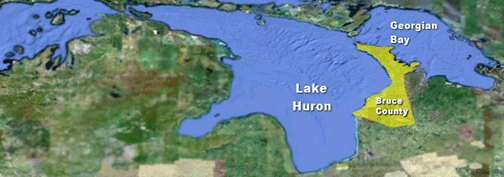
The Bruce power station is the largest operating nuclear power plant in the world, with 4,000 employees drawn from several small communities around it. The majority here support the DGR, which will store over 200,000 cubic metres of low and intermediate radioactive waste from the Bruce, as well as the Pickering and Darlington nuclear power stations.
But farther away, and in the large urban centres of Toronto, and Chicago, the DGR is the subject of a divisive debate with thousands signing petitions and filing official objections to the proposal. The biggest complaint is the proximity of the DGR to the Great Lakes basin.
Rolling Stewardship
At just over a kilometre from the shore of Lake Huron, many fear the future of 40 million people, on both sides of the Canada-US border, could be at stake in the event of an accident or an unforeseen event.
Mayor Keith Hobbs of Thunder Bay, Ontario, a vocal opponent, said in a recent interview with the London Free Press, “If you contaminate that source, we’re done. That’s life, that’s life itself.”……http://www.rcinet.ca/en/2015/05/18/deep-ground-repository-for-nuclear-waste-has-local-support-and-regional-opposition/
Cyprus, Greek and Turkish groups unite to stop Turkish nuclear plant
 Groups unit to call for halt to Turkish nuclear plant Cyprus mail, By Evie Andreou, 12 May 15 The Mediterranean must not suffer a nuclear catastrophe like those seen in Chernobyl and Fukushima said organisations from Cyprus, Greece and Turkey that joined forces on Saturday to state their opposition to the construction of a nuclear power plant on Turkey’s southern coast.
The bicommunal Cyprus Anti-Nuclear Platform, in cooperation with environmental organisations from Turkey and the support of the European Greens, organised a conference in the buffer zone to discuss the negative impact a nuclear power plant would have in the Mediterranean region and signed a declaration urging Turkey to abort plans for the construction of the plant.
They also called for the formation of a Network for a Nuclear Free Mediterranean.
Key-note speaker at the event was Rebecca Harms, co-president of the Greens–European Free Alliance group in the European parliament. Also present were Cypriot MEPs, Environment Commissioner Ioanna Panayiotou, Green Party chairman George Perdikis and members of non-governmental organisations.
Speakers said that apart from the negative impact the power plant will have on the surrounding environment, it could also be a nuclear accident waiting to happen.
Turkey is no stranger to earthquakes as it sits on a seismically active area within the zone of collision between the Eurasian Plate and both the African and Arabian Plates.
Harms said that nuclear danger should not be added in an earthquake zone. She added that earthquake-prone countries like Greece and Italy do not have nuclear power plants and neither should Turkey.
The declaration states the opposition of “the inhabitants of the Mediterranean region… to the establishment of a nuclear power station in Akkuyu, Mersin for the sake of our safety and due to our responsibility to protect the living organisms and the ecosystem in the Mediterranean”.
It adds that Turkey’s plans to construct the nuclear power plant are outdated since they date back to the 1970s and that “not only does Turkey’s decision pose a risk to the future of the Mediterranean, but it also contravenes the Mediterranean Action Plan, established under the auspices of the United Nations Environment Programme (UNEP)…, and the Barcelona Agreement… where Turkey is a member”……..http://cyprus-mail.com/2015/05/09/groups-unit-to-call-for-halt-to-turkish-nuclear-plant/
Hashtag activism a powerful force, when followed by action
a hashtag or a petition is a good start, but it must be followed up with engagement towards further action.
 The hashtag crusaders, The Saturday Paper, MIKE SECCOMBE, 9 May 15 …….Should those concerned about effecting real progressive change worry that simple identity politics is supplanting real commitment?
Or have the means of expression simply changed? Maybe the hashtag is the digital age equivalent of the bumper sticker, and the online petition the equivalent of the street march. Maybe younger people are just as committed – in many cases marginally committed – as they ever were.
If that’s the case, the future for progressive change organisations is perhaps not so dire. Certainly more people respond to hashtags than ever put stickers on their cars. Proportionally, many more people have signed on to GetUp! petitions in Australia than rallied in Central Park in 1982.
“Change.org has 2.8 million people who have used their platform, so it’s not a small proportion of the population at all,” says Rebecca Wilson, deputy director of the Centre for Australian Progress, the organisation hosting the Melbourne conference……
On the other hand, she says: “Every organisation that has an email list will tell you their membership is heavily female and middle aged or older. So it’s partially true that it’s often older people engaging. But they have the time and the resources.”
The evidence is ambiguous. What is increasingly clear, though, is that while modern means of communication such as social media can be a powerful tool, they are not a substitute for more traditional means of activism. And those seeking change face the same old problem of turning short-term protest into long-term campaigning.
“It’s too reductionist to say that there is clicktivism and then there is legitimate advocacy,” says Anat Shenker-Osorio, a US-based communications consultant specialising in cognition and linguistics.
There is, she says, “some truth” to the criticism that if you make something too easy you encourage a glib and superficial response. “But the issue is actually a lack of human-to-human engagement. The thing that sustains motivation is the creation of connection and community. The trouble with online actions is that they don’t engender that connection.
“We have for too long focused on protest instead of movement building.” Continue reading
1 This Month
19 November – Webinar – The Reality of Reprocessing
Time: 11:00 AM Pacific Time (US & Canada) / 2:00 PM Eastern / 7:00 PM UK / 8:00 PM CET
Register for the Zoom Event Here

Tell Congress: Prevent Nuclear Catastrophe in Iran

Tell Congress: Prevent Nuclear Catastrophe in Iran

Read the Public Inquiry Report, the Commissioners’ report, Surrendering Australia: The AUKUS Deception is available to download for free at aukuspublicinquiry.com. Or just watch the replay of the National Press Club Luncheon.


Shut down the radiation-damaged Heysham nuclear reactors now
To see nuclear-related stories in greater depth and intensity – go to https://nuclearinformation.wordpress.com

Say No to NASA’s Reckless Nuclear Reactor on the Moon
Say No to NASA’s Reckless Nuclear Reactor on the Moon
-
Archives
- November 2026 (166)
- October 2026 (302)
- September 2026 (339)
- August 2026 (330)
- July 2026 (355)
- June 2026 (287)
- May 2026 (306)
- April 2026 (356)
- March 2026 (251)
- February 2026 (267)
- January 2026 (308)
- December 2025 (358)
-
Categories
- 1
- 1 NUCLEAR ISSUES
- business and costs
- climate change
- culture and arts
- ENERGY
- environment
- health
- history
- indigenous issues
- Legal
- marketing of nuclear
- media
- opposition to nuclear
- PERSONAL STORIES
- politics
- politics international
- Religion and ethics
- safety
- secrets,lies and civil liberties
- spinbuster
- technology
- Uranium
- wastes
- weapons and war
- Women
- 2 WORLD
- ACTION
- AFRICA
- Atrocities
- AUSTRALIA
- Christina's notes
- Christina's themes
- culture and arts
- Events
- Fuk 2022
- Fuk 2023
- Fukushima 2017
- Fukushima 2018
- fukushima 2019
- Fukushima 2020
- Fukushima 2021
- general
- global warming
- Humour (God we need it)
- Nuclear
- RARE EARTHS
- Reference
- resources – print
- Resources -audiovicual
- Weekly Newsletter
- World
- World Nuclear
- YouTube
-
RSS
Entries RSS
Comments RSS

