Move for Grand Canyon Monument that would ban uranium mining
 Grand Canyon Monument Would Make Uranium Ban Permanent http://www.fronterasdesk.org/content/10147/grand-canyon-monument-would-make-uranium-ban-permanent By Laurel Morales October 13, 2015 Arizona Congressman Raul Grijalva introduced legislation Monday that would preserve and restore sacred lands, the watershed and the environment north and south of Grand Canyon National Park. The Greater Grand Canyon Heritage National Monument Act would set aside 1.7 million acres of public land.
The area surrounding the Grand Canyon is rich in uranium. In 2012, the Obama administration put a 20-year moratorium on new uranium mining claims. If passed, the law would make that ban permanent.
Eleven tribes connected to the Grand Canyon support the bill. And if passed, they would help manage the monument.
Havasupai council member Carletta Tilousi told a group of reporters her tribe, that lives at the bottom of the Grand Canyon, is at the front lines of groundwater contamination.
“We the Havasupai would like to keep our canyon home clean of no uranium mining,” Tilousi said. “We’d like to see our water remain clean of no uranium mining. We’d like to see our children live in a clean environment, go to our sacred mountains in peace and pray and do our offerings.” This announcement comes at a time when the National Park Service says Energy Fuels has plans to reopen an old mine and extract uranium on Red Butte, what is considered a sacred site by the Havasupai Tribe.
Supporters of the legislation say it will be difficult to get the act through Congress.
Increasing public opposition to South Korean govt’s nuclear power policy

 The Repercussions of South Korea’s Pro-Nuclear Energy Policy A long-term policy is running into increasing domestic opposition, The Diplomat, By Se Young Jang, 8 Oct 15 Se Young Jang is an associate at the Belfer Center for Science and International Studies, Harvard Kennedy School, and a non-resident Kelly fellow at Pacific Forum CSIS.
In a local referendum held in October 2014, an overwhelming majority of the residents in Samcheok, a small coastal city in Gangwon province, rejected the South Korean government’s plan to build a nuclear power plant in the city. Since Japan’s 2011 nuclear disaster in Fukushima and South Korea’s 2013 scandals over fake safety certificates for nuclear equipment, South Koreans have begun to take nuclear safety issues more seriously, which in turn has prompted a growing anti-nuclear power sentiment. A series of scandals and accidents in South Korea’s nuclear power plants have focused public attention on the effects of radioactive materials on the health of the residents who live near the country’s four nuclear power plants. Last year, a South Korean courtruled that the Korea Hydro & Nuclear Power Co., a state-run nuclear power plant operator, was responsible for the thyroid cancer suffered by a plaintiff, who has lived 7.7 km away from the Kori nuclear power plant over the past 20 years. Since then, more than 500 thyroid cancer patients living close to the nuclear power plants in South Korea have been preparing a joint legal action against the company.
Notwithstanding the anti-nuclear sentiment, nuclear energy as a share of total electricity generated increased to about 30 percent in 2014, and the South Korean government is currently constructing four new nuclear reactors with eight more being planned. Standing firm on its nuclear power plant projects, the South Korean government regarded the Samcheok referendum as not legally binding, and this position remains unchanged. Under the Second Basic National Energy Plan for 2015-2035, South Korea appear to have few options but to stick to its original plan of building more nuclear power plants, as the 2015-2035 energy plan was based on the assumption that it could not avoid raising its dependence on nuclear power.
Critics say that the government overestimated future electricity demand and underpriced electricity. According to the Sixth Basic Supply-Demand Plan for Electricity (2013-2027), South Korea will use more electricity per capita than the United States in 2024. The high population density in South Korea could translate into lower demand for electricity per capita. Moreover, estimates of electricity demand are based on cheap prices for electricity; the government calculated that the rate of increase in electricity prices in the coming years would be one third of the inflation rate. Some newspapers in South Korea report concerns about rising electricity bills as a result of a decreasing reliance on nuclear power. Still, it is interesting to note that 65.6 percent of respondents in a 2013 poll were willing to pay a higher electricity bill if it meant fewer nuclear power plants……….
Today, South Korea no longer seeks its own nuclear weapons, but Park Geun-hye still sees boosting nuclear energy industry as a great opportunity for the South Korean economy. Now a nuclear exporter, South Korea has concluded agreements with Jordan and the United Arab Emirates to construct one research reactor and four commercial reactors. …….
Korea’s success in the nuclear export market and geopolitical necessities notwithstanding, the current domestic situation is hardly favorable to the South Korean government. The 2013 scandal over hundreds of faulty components used in reactors is still unfolding. A parliamentary audit last year revealed that the temporary suspension of the operations of nuclear power plants after the scandal caused the loss of 10 trillion won (about $9.5 billion), and that some officials fired from the KEPCO E&C (Korea Electric Power Corporation Engineering and Construction) over the scandals were rehired. Worse, the result of the referendum in Samcheok is probably only the beginning of a series of hurdles which the South Korean government will have to overcome. More than half of the respondents in a recent poll conducted in Yeongdeok, in North Gyeongsang Province, which was also designated as a nuclear power plant site by the government in 2012 along with Samcheok, opposed the central government’s construction plan.
The consent of local residents will be even more important in the near future as South Korea faces a crisis over the storage of nuclear spent fuel. South Korea has nearly 9,000 tons of spent fuel stacked in temporary storage pools with about 750 tons added to the pools every year. They could reach maximum capacity by 2021. The government has been deliberating over several ways of storing spent fuel, including pyroprocessing and a medium-term solution using dry casks; but no matter what method South Korea chooses, the government will need to be able to persuade people living next to the facility, no easy task as Samcheok has demonstrated……….http://thediplomat.com/2015/10/the-repercussions-of-south-koreas-pro-nuclear-energy-policy/
The work of Russia’s anti nuclear NGO “Planet of Hope”
 Our NGO, based in Ozersk, had three programs. We educated citizens about their rights, in particular those who were victims of radioactive contamination. We did sociological research on the inhabitants. And we gave training to representatives of other NGOs in the Ozersk region.
Today, we have no way to be certain that releases into the Techa have been stopped. The factory states that the reservoirs are secure……. http://nf2045.blogspot.jp/2015/10/a-russian-antinuclear-activist-asks-for.html
South Africa’s govt will face massive resistance if it continues with nuclear power plans

 ANC warned: Abandon nuclear plans, or else, Mail & Guardian, 06 OCT 2015 MATTHEW LE CORDEUR
Greenpeace has warned the ANC that civil society will mobilise against it if the ruling party does not take nuclear energy off the table. Greenpeace has a message for the ANC ahead of its National General Council (NGC) meeting starting on Friday: drop nuclear energy, or face massive resistance.
Greenpeace executive director Kumi Naidoo said on Monday that the ANC should “take nuclear off the table”.
“The ANC needs to know that if it does go for the nuclear option as part of the (energy) mix, then they are on a collision course with the broader spectrum of the South African civil society,” he said.
“The faith organisations are mobilising and elements in the trade union federation are mobilising in the broader NGO spectrum.
“So the ANC can make that decision knowing full well that they will be blocked in the court,” he said. “There will be a robust campaign against any financial option. Any lending institution will come under tremendous pressure.”……..
Naidoo said South Africa should not be investing in nuclear at all, because it is “too expensive and too dangerous”.
“As a solution to our energy crisis, it will be delivered too little too late and will take 10 to 15 years to build one single plant.”
The Energy Department has signed agreements with several countries as part of its Nuclear Build Programme to build 9 600 MW of nuclear energy by 2030……http://mg.co.za/article/2015-10-06-anc-must-drop-nuclear-or-face-the-wrath-of-the-people
Ukraine’s Nuclear Truth: No Free Speech

 Ukraine’s Nuclear Truth: No Free Speech
Nuclear safety activists in Kiev are facing defamation charges in court, for doing nothing more than telling the truth about Ukraine’s nuclear reactors.
If you live in a neighbouring country like Bulgaria, Hungary, Romania, Slovakia, Poland, etc. you have a legal right to have your say about Ukraine’s nuclear plans. But the government in Kiev wants to ignore you, just like it doesn’t want to listen to activists at home.
Ukraine’s government is planning to extend the operations of its ageing and unsafe nuclear reactors. The lawsuit against Bankwatch’s member group National Ecological Centre of Ukraine (NECU) is an attempt to silence criticism and avoid public scrutiny.
UKRAINE’S NEIGHBOURS HAVE A RIGHT TO BE INVOLVED IN THIS DECISION.
Ukraine is obliged through international conventions to inform and consult its neighbouring countries about its plans. This hasn’t happened so far.
BUT WE WON’T BE SILENCED OR IGNORED!
Organisations in five EU countries have joined the campaign to demand that citizens in Ukraine’s neighbourhood are fully informed about these risky nuclear plans and have a say in the process.
SIGN UP TO BE PART OF OUR CAMPAIGN.
HELP CONVINCE UKRAINE TO RESPECT ITS CITIZENS AND ITS NEIGHBOURS.”
http://bankwatch.org/nucleartruth#more (CC-BY-SA-3.0, Bankwatch.org; Emphasis our own.) Sign for updates-more at link
The Chernobyl disaster taught that most of Europe is a “neighbouring country” in the event of an Ukrainian nuclear accident. In the UK and Norway, far, far away from the Ukraine, livestock-reindeer remain dangerously contaminated with both intermediate (Caesium 137) and long-lived radionuclides. http://www.environment.no/Goals-and-indicators/Goals-and-indicators/Radioactive-pollution/Limit-radiation/Geographical-distribution-of-caesium-137-in-soils-in-Norway-/Caesium-137-in-wild-reindeer-/ Impacts in Europe were splotchy in nature. Radioactive fallout impact from nuclear accidents depends on factors such as wind-direction, rain, and geography (e.g. mountains).
Under the Espoo-Aarhus Conventions there is to be meaningful participation within the Ukraine, and in potentially impacted (transboundary) countries, for environmental impacts.
Maybe we should start speaking of death-extensions of ageing nuclear reactors, rather than life-extensions?
Massive Protest Planned Against New Atomic Weapons In Germany
 US Nuclear Weapons In Europe: Massive Protest Planned Against New Atomic Weapons In Germany, IBT, By Christopher Harress @Charress c.harress@ibtimes.com on October 01 2015 Nearly 100,000 people in Germany have signed a petition protesting a plan to introduce U.S. nuclear weapons on German soil. The U.S. military was supposed to place new weapons in the country toward the end of 2015, but a statement from officials said that the transfer would likely take place closer to 2020.
However, this has not stopped the mass petition from moving forward, according to report by Russian state news site Sputnik. “Since this is about strengthening offensive weapons, we call on the federal government, the Parliament, the chancellor and the federal president to stop nuclear armaments on German soil,” the petition said……
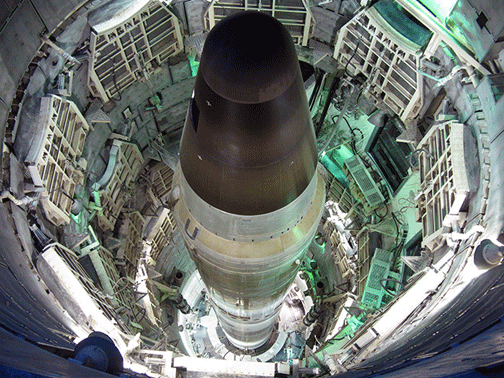
The U.S. continues to maintain nuclear carrying facilities in Germany, Belgium, the Netherlands, Italy and Turkey through a NATO sharing program. Host countries make decisions on weapons policy, maintain equipment required for the use of nuclear weapons and carry out consultations. France and the United Kingdom are the only countries in Europe that maintain state-owned nuclear arsenals.
In March 2010, a majority of German MPs decided that the government should “urge American allies to withdraw US nuclear weapons from Germany.” But instead of eliminating the weapons, the U.S. made plans to deploy 20 more, according to Sputnik. http://www.ibtimes.com/us-nuclear-weapons-europe-massive-protest-planned-against-new-atomic-weapons-germany-2122692
PICAT – A Public Interest Case Against Trident, co-ordinated by Trident Ploughshares

 The Citizen Challenge to UK’s Nuclear Weapons. Campaigners Aim to Prosecute British State http://www.globalresearch.ca/the-citizen-challenge-to-uks-nuclear-weapons-campaigners-aim-to-prosecute-british-state/5479142 By Action AWE Global Research, October 01, 2015 On 1st October campaigners will begin a new and ambitious project to institute a citizen’s prosecution of the Government and specifically the Secretary of State for Defence for breaching international law by its active deployment of the Trident nuclear weapon system.
 PICAT is co-ordinated by Trident Ploughshares and will involve groups across England and Wales in a series of steps which will hopefully lead to the Attorney General’s consent for the case to go before the courts.
Groups will begin by seeking an assurance from the Secretary of State for Defence that the UK’s nuclear weapons will not be used, or their use threatened, in such a way as to cause wholesale loss of civilian life and damage to the environment.
In the case of no response or an unsatisfactory one groups will then approach their local magistrates to lay a Criminal Information (1). If consent for the case is not forthcoming from the Attorney General the campaign will then consider approaching the International Criminal Court.
Veteran peace campaigner Angie Zelter (2), who has developed the project along with international lawyer Robbie Manson (3), said:
The government has consistently refused to give evidence to prove how Trident or any replacement could ever be used lawfully. This campaign is an attempt to find a court willing to examine objectively if the threat to use Trident
is in fact criminal as so many of us think it is. It is a matter of vital public interest.The UK, along with the other nuclear weapon states, is becoming increasingly isolated from the growing global momentum to outlaw nuclear weapons, as expressed in the Humanitarian Pledge, which has already attracted the signatures of 117 nations.(4)
Robbie Manson said:
I remain very firmly of the view that it is both an immensely worthy and worthwhile cause to pursue these matters, even in court, and with vigour given the enormity of the humanitarian need, political significance and the scale of the diplomatic hypocrisy upon which our political masters rely for the achievement of their designs.
The project is supported by an impressive list of expert witnesses (5), including Phil Webber, Chair of Scientists for Global Responsibility, Professor Paul Rogers, Department of Peace Studies at the University of Bradford, and John Ainslie of Scottish CND.
Contacts: Continue reading
Alternative Nobel Prize goes to Marshall Island’s nuclear challenger
 Marshall Islands official who challenged China and other nuclear powers wins ‘Alternative Nobel Prize’https://www.hongkongfp.com/2015/10/01/marshall-islands-official-who-challenged-china-and-other-nuclear-powers-wins-alternative-nobel-prize/ 1 October 2015 17:50 Karen Cheung
The award, which is also known as the Alternative Nobel Prize, was given to Tony de Brum and the people of the Marshall Islands.
Mr de Brum, Foreign Minister of the Marshall Islands, sought to hold all nine nuclear states responsible for their failure to abide by the provisions of the 1968 Nuclear Non-Proliferation Treaty (NPT) and customary international law by filing lawsuits in the International Court of Justice in 2014. Under the NPT, the weapon states pledged to disarm while non-weapon states promised to not acquire nuclear weapons.
The small island nation, which – for 12 years – was a testing ground for US nuclear bombs, argued that it was “justified in taking the action because of the harm it suffered as a result of the nuclear arms race”, according to the Guardian.
As a result of the “Nuclear Zero lawsuits”, India, Pakistan and the UK have accepted the courts’ jurisdiction to hear the matter and are in the midst of court proceedings that may last two to three years. In the cases, the Marshall Islands have asked the Court to hold the states in breach of their obligations related to nuclear disarmament and to force them to comply, thus putting the weapons under strict and effective international control.
“Our people have suffered the catastrophic and irreparable damage of these weapons, and we vow to fight so that no one else on earth will ever again experience these atrocities,” de Brum said. “The continued existence of nuclear weapons and the terrible risk they pose to the world threaten us all.”
In addition to his efforts regarding nuclear disarmament, de Brum has led the drafting of the Marshall Islands’ constitution and advocated for its full independence before the UN Security Council, eventually resulting in the signing of the Compact of Free Association between Marshall Islands and the US in 1986. He has also sought to fight climate change by advocating for binding measures to be adopted in the UN Climate Change Conference in Paris in December 2015.
The Awards were founded in 1980 and “honour courageous and effective solutions to secure human rights and respond to global crises”.
The award was given to ex-Guardian editor Alan Rusbridger and whistleblower Edward Snowden in 2014 “for his courage and skill in revealing the unprecedented extent of state surveillance violating basic democratic processes and constitutional rights.”
Other award laureates this year include Canada’s Sheila Watt-Cloutier for work in the Arctic, Uganda’s Kasha Jacqueline Nabagesera for her advocacy on LGBTI rights, and Italy’s Gino Strada for his medical services to war victims.
Death of heroic anti war photographer Kikujiro Fukushima
Renowned Anti-War Japanese Photographer Kikujiro Fukushima Dies at 94, Peta Pixel, September 28, 2015 by Michael Zhang Acclaimed Japanese photojournalist Kikujiro Fukushima passed away on September 24th, 2015, after suffering a stroke at the age of 94. Fukushima was known for his criticism of Japan’s decision to go to war in World War II, and he spent decades documenting both the war and the aftermath of it in his homeland.
In the early years of his career, Fukushima pointed his camera at survivors of the atomic bombs dropped on Japan. The work was published in an award-winning 1961 photo book titled “Pika Don: Aru Genbaku Hisaisha no Kiroku” (which translates to “Atomic bomb: Records of one atomic bomb survivor”).
He went on to create projects, books, and exhibitions about subjects that were off the beaten path: Japanese military secrets, social injustices, feminist movements, industrial pollution, the fight against nuclear power plants, and more.
Fukushima is the only photographer who documented the aftermaths of both the nuclear bomb dropped on Hiroshima in 1945 and the Fukushima nuclear disaster in 2011.
Both are nuclear crises but different kinds,” Fukushima told the New York Times in an interview published last year. “Hiroshima’s crisis was caused by the bomb dropped by the enemy during the war. Fukushima’s crisis, though initially triggered by the earthquake and tsunami, was not really natural. It was caused by Japan’s nuclear industry whose interests more lie in their financial gain rather than the safety of the public.”
“In Hiroshima, I photographed people who were dying. In Fukushima, it looked normal but nobody knows what is going to happen in long term. I didn’t know where to begin.”……..http://petapixel.com/2015/09/28/renowned-anti-war-japanese-photographer-kikujiro-fukushima-dies-at-94/
UK’s Labour and Scottish National Party to join forces opposing Trident nuclear weapons system
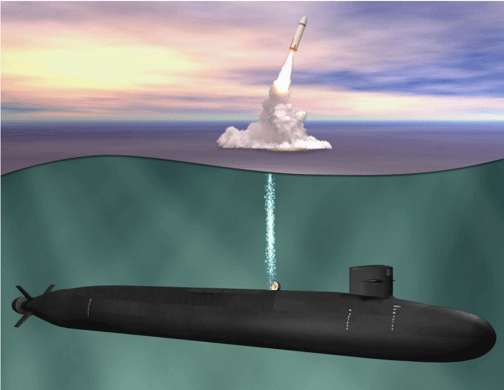 Corbyn says Labour and SNP will join forces to oppose nuclear deterrent. Irish Times, 25 Sept 15 Labour leader’s opposition to Trident puts him at odds with many in his own party The British Labour Party will work with the Scottish nationalists to try to block the renewal of the Trident nuclear deterrent in a parliamentary vote due next year, Labour’s new leader, Jeremy Corbyn, said on Friday.
The Conservative government backs the multibillion-pound renewal of Britain’s ageing fleet of nuclear-armed submarines. It has a slim majority in parliament, so some of prime minister David Cameron’s own MPs, as well as other opposition parties, would have to join with Labour and the SNP to defeat the plans.
The Scottish National Party, which won 56 out of 59 seats in Scotland in the general election in May, has long opposed renewing the weapons and had called on veteran antiwar campaigner Mr Corbyn to support them.
“My position on Trident has been very clear all of my life. I am opposed to nuclear weapons,” Mr Corbyn, who was elected as Labour’s leader earlier this month, told BBC Scotland.
“Trident should go. I do not believe that it is a form of defence. I do not believe it is something that anyone in their proper mind would ever want to use.”
Labour’s existing position is to back the renewal of Trident, although it has previously suggested reducing the number of submarines to three from four……..http://www.irishtimes.com/news/world/uk/corbyn-says-labour-and-snp-will-join-forces-to-oppose-nuclear-deterrent-1.2366935
NRC approves Maryland nuclear station, despite safety concerns
NRC says North Anna nuclear plant passes muster , The Daily Progress, Charlottesville, Virginia, September 5, 2015 By Bill McKelway, Richmond Times-Dispatch RICHMOND — The Nuclear Regulatory Commission has set aside multiple concerns raised by an anti-nuclear power group about operations at Dominion Energy’s North Anna nuclear generating facility.
In a petition filed four years ago after the meltdown of the Fukushima Dalichi facility in Japan and the 5.8-magnitude Louisa County earthquake that tripped the Louisa County nuclear facility offline, the effort by Maryland-based Beyond Nuclear came up empty-handed.
The NRC notified the group and Dominion late last month that none of 12 areas of concern reviewed by the NRC warranted changes in North Anna operations.
The group sought a re-analysis of the North Anna operation’s design basis for earthquakes, its spent fuel storage facility, its reliability of seismic activity measures, an assessment of boil-off or drain-downs of the spent fuel pool and a review of emergency evacuation plans, among other issues.
The NRC review completed late last month rejected a need for changes in 12 specific areas that the NRC agreed to look into. Beyond Nuclear had sought a suspension of operations at the plant, where a third nuclear facility is in the planning stages………
Paul Gunter, a leader with Beyond Nuclear, said the decision to close out the review “comes as no surprise.”
“The NRC continues to ignore growing concerns about high-density storage and overcrowding of high-level nuclear waste spent fuel pools on site,” he said in a written statement. Radioactivity released by a fire or explosion from a drain-down or boil-off “would produce widespread contamination that would likely overwhelm current emergency plans,” he wrote.
He said the group’s effort at least establishes a “public record for what we believe to be ‘willful negligence’ on the part of the nuclear industry and the current federal regulator.”……….http://www.dailyprogress.com/news/local/nrc-says-north-anna-nuclear-plant-passes-muster/article_d6ea2456-542e-11e5-b7c6-b7cab0860a58.html
No to uranium mining – Virginia Beach City Council
 Another no vote on uranium The Virginian-Pilot© September 1, 2015 The Virginia Beach City Council is set tonight to vote — again — on a resolution opposing uranium mining in Virginia.
The issue is still, thankfully and for all practical purposes, dead. Mining uranium is still illegal in the commonwealth. The General Assembly’s 1982 ban is still in place despite years of extensive lobbying by the company wanting to mine ore in Pittsylvania County.
But because Virginia Uranium Inc. has recently challenged the legality of the ban and asked the federal courts to force the state to treat uranium mining like any other mining process, Virginia Beach is making doubly sure everyone knows the city opposes lifting the ban.
The Roanoke River Basin Association, which is downstream from the Virginia Uranium site, does, too. As do the cities of Norfolk, Chesapeake, Roanoke and Danville. The mining site is less than 50 miles upstream of the John H. Kerr Reservoir, which provides 93 percent of Lake Gaston’s inflow — a source of drinking water for much of South Hampton Roads. If Kerr Reservoir were contaminated, then Lake Gaston would be as well……..http://hamptonroads.com/2015/08/another-no-vote-uranium
The Japanese Scientists’ Association joins strong public opinion against nuclear power
 Fukushima today: A first-person account from the field and the conference table, Bulletin of the Atomic Scientists, 26 Aug 15 Subrata Ghoshroy “…… It is hard to tell if the government’s promotional campaign is succeeding. The Abe government is continuing to push for the revival of nuclear power in Japan, as exemplified by the recent restart of the Sendai plant.
By doing so, it clearly sought to lay down a marker—and also perhaps to gauge public opinion before proceeding to restart other plants.
On the other hand, public opinion has been growing stronger in opposition—although the opinion polls have not been overwhelming. One of the significant aspects of the conference was the vigorous participation of women scientists like Miyake, who spoke out strongly against nuclear power and also challenged the male domination in the scientific community. Young mothers were participating in increasing numbers in anti-nuclear protests in Japan and also in Korea, we were told by Hye-Jeong Kim, a leader of the anti-nuclear movement in South Korea, who is also a member of the country’s Nuclear Safety and Security Commission, an equivalent of the NRC in the United States.
With these developments in mind, a scientific community that can speak with one voice and make a credible case against the government-industry publicity campaign is crucial. The Japanese Scientists’ Association envisioned its role as accurately communicating to people around the world the dangers of nuclear power and the seriousness of the damage suffered by the Japanese people. And the group hoped to use science to counter the forces that promote nuclear power in Japan, and demand that Japan give top priority to renewables……
…………Editor’s note: The conference was organized in collaboration with the International Network of Engineers and Scientists; other conference organizers included Keiiji Ujikawa, (an economics professor at Yokohama National University, Shinjiro Hagiwara (an emeritus professor of economics at the same institution), and Fujio Yamamoto, (an emeritus professor of mechanical engineering at Fukui University.)
The author had made a video presentation earlier about his visit to Fukushima at a meeting in Boston. http://thebulletin.org/fukushima-today-first-person-account-field-and-conference-table8683#.Vd6Rj7YbwEs.twitter
“Trojan horse’ – anti nuclear protest in Pretoria, South Africa
Green Peace activists protest against SA’s nuclear power plans http://citizen.co.za/652983/green-peace-activists-protest-against-sas-nuclear-power-plans/ Valeska Abreu , 25 Aug 15,
Green Peace activists have tied themselves to a four meter high Trojan horse which has been changed to a pillar at the entrance of the Department of Energy in Pretoria.

They are silently protesting against South Africa’s plans for nuclear power. Four activists are sitting on the cold cemented floor wearing white safety overalls and masks, holding up placards that read “no future in nuclear” and “solar is the solution”.
The activist group is calling for the department to focus its plans on renewable energy rather than nuclear. Melita Steele, senior climate and energy campaign manager, says nuclear energy is a trap and could bankrupt the country.
The lobby group wrote a letter of demands to the department seven days ago but say they have not received any response. “It’s indicative of how the department is engaging on the issue of nuclear,” said Steele.
She said they would remain outside the department until they received feedback.
Protest by 3 middle aged women costs nuclear firm €1million
Anti-nuclear demo ‘cost firm €1million’ http://www.bridgwatermercury.co.uk/news/13610163.Anti_nuclear_demo____cost_firm____1million___/?ref=twtrec AN anti-nuclear protest by three women that blocked the main road into Hinkley B power station cost EDF approximately one million euros, it it was claimed at Taunton Magistrates Court on Friday.
Ornella Saibene, 55, Marian Connelly, 61, and Caroline Hope, 73, effectively prevented all access to the power plant on April 1 this year when they chained themselves together and lay across the road, preventing workers from accessing the site.
The protest started just after 7am and caused a three-mile build up of traffic until they agreed to move at 90.30 a.m.
The women – all from Bristol – were each fined £200 and ordered to pay £105 costs after pleading guilty to obstructing the route. Joanne Pearce, prosecuting, said: “The closure cost one million euros. Their disregard to safety and the security of a nuclear power station cannot be tolerated.”
Connelly, Saibene and Hope argued they were exercising their democratic right to civil disobedience and had not committed a criminal offence.
She read out a statement from Green West Euro MP Molly Scott Cato comparing nuclear power stations to “ageing dinosaurs.”
PCAH says…1:04pm Wed 19 Aug 15
1 This Month
Chernobyl: The Lost Tapes – A good documentary on Chernobyl on SBS available On Demand for the next 3 weeks– https://www.sbs.com.au/ondemand/tv-program/chernobyl-the-lost-tapes/2352741955560

of the week–London Campaign for Nuclear Disarmament

Tell the Ukrainian Government to Drop Prosecution of Peace Activist Yurii Sheliazhenko
To see nuclear-related stories in greater depth and intensity – go to https://nuclearinformation.wordpress.com
-
Archives
- April 2026 (152)
- March 2026 (251)
- February 2026 (268)
- January 2026 (308)
- December 2025 (358)
- November 2025 (359)
- October 2025 (376)
- September 2025 (257)
- August 2025 (319)
- July 2025 (230)
- June 2025 (348)
- May 2025 (261)
-
Categories
- 1
- 1 NUCLEAR ISSUES
- business and costs
- climate change
- culture and arts
- ENERGY
- environment
- health
- history
- indigenous issues
- Legal
- marketing of nuclear
- media
- opposition to nuclear
- PERSONAL STORIES
- politics
- politics international
- Religion and ethics
- safety
- secrets,lies and civil liberties
- spinbuster
- technology
- Uranium
- wastes
- weapons and war
- Women
- 2 WORLD
- ACTION
- AFRICA
- Atrocities
- AUSTRALIA
- Christina's notes
- Christina's themes
- culture and arts
- Events
- Fuk 2022
- Fuk 2023
- Fukushima 2017
- Fukushima 2018
- fukushima 2019
- Fukushima 2020
- Fukushima 2021
- general
- global warming
- Humour (God we need it)
- Nuclear
- RARE EARTHS
- Reference
- resources – print
- Resources -audiovicual
- Weekly Newsletter
- World
- World Nuclear
- YouTube
-
RSS
Entries RSS
Comments RSS
 nuclear-news