Communities call on France’s government to stop EDF from setting up nuclear facilities on agricultural land.
|
Le Quotidien 20th Dec 2018 In a letter addressed to the highest authorities of the French state,
associations denounce the massive purchase of land by EDF around nuclear power plants, including that of Cattenom. They suspect the company of planning the construction of EPR and call for the respect of the right of neighboring countries, including Luxembourg, to live in a preserved environment. Following the acquisition by EDF of agricultural land around
nuclear sites, including Cattenom, defense associations are concerned about the vagueness of these purchases and the uncertainties that weigh on their future use. The Daily publishes below all of their letter addressed to the President of the Republic, the Prime Minister, the Minister of Ecological Transition and local elected representatives: “No to the extension of nuclear, yes to the protection of agricultural land http://www.lequotidien.lu/grande-region/extension-de-cattenom-vers-la-construction-dun-epr/ |
|
New nuclear station next to Minsmere wildlife reserve? Sizewell action group to hold EDF to account

 Theberton & Eastbridge Action Group on Sizewell 16th Nov 2018 Did you know that EDF wants to build two new reactors on the Suffolk coast, next to the internationally-famous RSPB Minsmere wildlife reserve and AONB?
It is to be a twin of EDF’s new Hinkley Point plant – so what is actually coming for Sizewell? Watch, share and sign up to receive our updates, and get ready to help us hold EDF to account in caring for this special place when they share their new proposals in January.
Grateful thanks to Lush Charity Pot for their support which made this video possible, and a huge shout out to UK Aerial Photography for all the Suffolk drone photography and editing the video.
https://www.facebook.com/teags.org/videos/194650268134653/
Turkish environmentalists go to the Supreme Court to stop construction of nuclear power station
|
Anti-nuclear power plant activists turn to Turkey’s highest court , Ahval, Ezgi Karataş
Turkish environmentalists are deeply concerned about the ongoing construction of the country’s first nuclear power plant and plan to bring their case to Turkey’s highest court. In the past year, environmental groups have brought up many legal cases against the plant, which is being built in Akkuyu, near Mersin, on the Mediterranean coast. Scientists have argued that the plant will adversely impact the regional ecology and economy, undermining the livelihoods of people who rely on the marine ecosystem and tourism. Last month, an appeals court upheld a local court’s decision to accept the Turkish government’s environmental impact assessment, even though several news reports said some scientists’ signatures on the report were forged.Following the appeals court’s decision, environmentalists say they plan to petition the Constitutional Court. Sevim Küçük, a lawyer and vocal member of the Mersin Anti-Nuclear Platform, believes Turkish President Recep Tayyip Erdoğan influenced the appeals court’s decision. “The president issued instructions to speed up the work one day before the hearing at the appeals court,” she said. “The judiciary was pressured by the executive. As a result, we were not expecting a just decision.” Küçük says their appeal to the Constitutional Court does not automatically indicate a motion to stay. Plant construction, which began in April 2018 with a ceremony attended by Russian President Vladimir Putin and Turkish President Recep Erdoğan via video conference, is expected to continue during the proceedings. “Lower courts did not issue a motion to stay either, so the construction was continuing during all our legal battles as well,” says Küçük. Küçük says that government assessment is out of line with scientific evidence and based on falsified expert reports. She believes the report was copy-pasted from falsified expert reports, and that the court, in its decision, copy-pasted the same reports as well. A key concern of the environmental group is the storage of nuclear waste, which the assessment does not adequately address. “While Europe, Japan, America are trying to close down their nuclear power plants, why is our government so determined to build one?” asks Küçük. “As locals we are worried that the plant will store its nuclear waste in our neighbourhoods.” Dr. Ful Uğurhan, another member of the anti-nuclear group, says that The location of Akkuyu is not suited to build a nuclear power plant, argues Ful Uğurhan, another member of the anti-nuclear group. Uğurhan says that the seawater temperatures in Akkuyu are high, which not only means spending more energy to cool down the reactors, but the process will further increase the seawater temperatures and upset the ecological balance. An active geological fault line near Akkuyu means additional risk. “Considering the effects of global climate change, it’s not safe to build a nuclear power plant anywhere,” says Uğurhan. “Storms, earthquakes, tsunamis all increase the risk involved in building a nuclear power plant, instead of ecologically safe electricity production plants.” ………https://ahvalnews.com/akkuyu/anti-nuclear-power-plant-activists-turn-turkeys-highest-court |
|
Japanese people object to US government conducting a subcritical nuclear test last December.
A 39-year-old man expressed regret over the test during a visit with his baby to the Peace Memorial Park in the city of Hiroshima, which was hit by a US atomic bombing in 1945.
He said it’s regrettable that the United States conducted the test, which no one wanted, despite people’s hope for peace.
He said for the sake of children, he does not want nuclear weapons to exist in the future.
A 52-year-old woman in the city said the administration of President Donald Trump is not moving in the right direction, while provoking the world to divide.
She said she hopes the Japanese government will have its own views, without following the US administration.
Shigemitsu Tanaka, the head of the atomic bomb survivors’ organization in Nagasaki, also criticized the subcritical test.
He said it was a move against the UN Treaty on the Prohibition of Nuclear Weapons, which was adopted last year, and the test is unforgivable.
He said he hopes the US will lead efforts to eliminate nuclear arms as the only country to have used nuclear weapons and will call on other nations to abolish them.
The most contaminated corner of Georgia? near to nuclear weapons complex and Vogtle nuclear power station
Environmental Leaders Kick Off Freedom to Breathe Tour in Georgia
The most contaminated corner of Georgia? September 30, 2018
Utilities just voted to continue Vogtle reactor construction; residents want cleanup, By Jeremy Deaton, Nexus Media
You could be forgiven for taking a Geiger counter on a visit to Shell Bluff, Georgia. The town lies just across the Savannah River from a nuclear weapons facility and just down the road from an aging nuclear power plant. The river is one of the most toxic waterways in the country. The weapons facility is one of the most contaminated places on the planet, and the power plant is about to double in size.
Locals are outraged.
“We believe that Plant Vogtle is going to exacerbate the existing contamination that’s already in the area and make things worse,” said Lindsay Harper, deputy director of Georgia WAND, a women-led advocacy group working to end nuclear proliferation and pollution. “We believe that more money should be put toward cleaning up the contamination instead of continuing to produce more.”
Organizers from Georgia WAND and other advocacy groups gathered in Atlanta recently to discuss Plant Vogtle and related environmental issues and to register voters. The town hall marked the first stop on a bus tour organized by environmental leaders from across the South.
The Freedom to Breathe Tour will highlight environmental hazards facing marginalized communities — starting with the expansion to Plant Vogtle, the only nuclear project under construction in the country.
In 2009, Southern Company began building two reactors, which are expected to go online in 2021 and 2022, respectively. The expansion has stoked fears of contamination in what is already a heavily polluted area, leading advocates to call for more testing.
“We need independent monitoring in the area that can help us to paint a larger, broader picture of what’s actually going on,” Harper said. “We need more information. We need more money for information.”
CNN Report – Plant Vogtle
Both the power plant and the weapons facility across the river produce a radioactive form of hydrogen called tritium that has been tentatively linked to Down syndrome in infants. Monitoring has found “elevated levels” of tritium in the groundwater near Plant Vogtle — too little to threaten public health, officials say, but enough to raise eyebrows.
Locals are also worried that pollution from the plant may be causing cancer. Epidemiologist Joseph Mangano found evidence of an uptick in infant mortality and cancer deaths in Burke County, seat of Plant Vogtle, after the facility went online in 1987. It is unclear if the power plant was responsible for the increase.Research has shown that children exposed to radiation are more susceptible to cancer — leukemia, in particular — but it is unclear if nuclear power plants produce enough radiation to threaten public health.
Studies in Germany and France found that the rate of childhood leukemia was significantly higher near power plants, and a study in the United States found that nuclear plant closures were followed by a decline in childhood cancer.
However, similar studies, including one undertaken by the National Cancer Institute, found no evidence of a link. To settle the matter, the federal government undertook a multi-year study on nuclear power and cancer in 2010, but it prematurely halted that effort in early 2017.
Adding to the uncertainty, the federal government stopped paying for monitoring of contamination near Plant Vogtle in 2003, believing the power plant posed little risk. To allay public concerns about radiation, the government is funding an outreach effort to reassure residents that the facilities are harmless, but locals remain unconvinced. Advocates want more rigorous testing and continued research into the risks of exposure to even low levels of radioactive waste……….
Some, however, believe that nuclear is simply too costly and have called for more investment in batteries that can store power generated by solar and wind for when it’s needed.
This is the outcome that locals are hoping for. Many Burke County residents are employed by Plant Vogtle, but they would rather work in wind or solar. “People are having to choose between feeding their families and taking a job that may contaminate their body,” Harper said, referring both to the power plant and the weapons facility. “We want to put our money towards civilians and people, clean economies and clean, sustainable jobs.” https://beyondnuclearinternational.org/2018/09/30/the-most-contaminated-corner-of-georgia/
Many UNPAID Australians speak out against nuclear plans of the PAID few nuclear industry proponents
 I am always struck by the fact that opponents of the nuclear industry are very many unpaid people. Just people who care. Some are highly educated academically. Many are not – but then they take the trouble to find out, and speak with the authority of both their local knowledge and wider information.
As for nuclear proponents they’re a small number of paid individuals, with another small number of hangers-on who expect financial benefits from the nuclear industry.
ABC Radio Adelaide Evenings with Peter Goer. Talkback 4 Oct 18. This show was inundated with hundreds of South Australians phoning in and texting about the proposed nuclear waste dump. ALL SAID NO! Are you listening Department of Industry Innovation and Science and Australian Nuclear Science and Technology Organisation !!!??…. IT’S A BIG NO FROM SOUTH AUSTRALIA!!!
“Protect Texas from Radioactive Waste Tour” on its way to Midland
Anti-nuclear waste tour to come through Midland, Meetings push to block a proposal to transport used nuclear fuel by train and store it in West Texas, MRT, by Matt Zdun, Texas Tribune , September 26, 2018 Organizers of the “Protect Texas from Radioactive Waste Tour” plan to travel to five Texas cities over the next week in protest of a proposed plan to store used nuclear materials in West Texas.Several Texas organizations gathered in Houston on Tuesday to kick off their “Protect Texas from Radioactive Waste Tour,” the beginning of a renewed push to block a proposal to transport used nuclear fuel by train through Texas and store it in West Texas.
The tour’s organizers said they want to make people aware of the “high risk” implications of a proposal to build and operate a facility for 40,000 metric tons of irradiated fuel rods at an existing site in Andrews County.
If approved by the Nuclear Regulatory Commission, the project by Interim Storage Partners, a joint venture between Waste Control Specialists and Orano USA, would transport nuclear waste from around the country to the consolidated site in Texas and store it until a long-term storage site becomes available, according to the venture’s website.
The Nuclear Regulatory Commission said in an August letter it would begin reviewing Interim Storage Partners’ license application and that its safety, security and environmental reviews of the proposal could conclude as early as August 2020.
Karen Hadden, the executive director of the Sustainable Energy and Economic Development Coalition, told The Texas Tribune that announcement triggered renewed opposition to the project and is one of the reasons for the tour.
The organizations involved — the Coalition of Community Organizations, Nuclear Information and Resource Services, Beyond Nuclear, the Sustainable Energy and Economic Development Coalition and Public Citizen — held a news conference by a railroad crossing in Houston, said Tom Smith, the special projects director of consumer rights advocacy group Public Citizen. Smith, who helped organize the tour, said in an interview with the Tribune that the news conference featured a 16-foot railroad container meant to replicate the transport cask that Interim Storage Partners would use to transport used nuclear fuel.
“We’re by the railroad tracks because we’re emphasizing that Texas businesses, hospitals and schools by the railroads are at high risk,” Hadden said. “It’s a bad idea to bring [nuclear waste] from around the country into Texas.”
The organizations instead want the used nuclear material to be kept at reactor sites in sturdier containers until a permanent storage site becomes available.
Smith said the proposed project presents a number of risks. A railroad accident would be disastrous, he said, because it could expose the public to harmful radiation and could cost municipalities hundreds of millions of dollars to clean up.
He also said nuclear waste on railcars running through densely populated areas like Houston, Dallas and San Antonio is at “high risk of terrorist sabotage.”…….
Smith said that after the news conference, the organizations planned to ask the Houston City Council to adopt a resolution against the proposed transportation of the nuclear material. He added that commissioners in San Antonio and Midland have already adopted similar resolutions.
“We’re trying to raise awareness because a lot of people don’t know this is planned,” Hadden said. She also said she hopes the tour will encourage people to submit comments on the Nuclear Regulatory Commission’s website before the Oct. 19 deadline………https://www.mrt.com/news/local/article/Anti-nuclear-waste-tour-to-come-through-Midland-13260720.php
Protest at Faslane, Scotland, against nuclear weapons
The National 23rd Sept 2018 ,SUNSHINE and a rainbow reflected the positive vibes at the Nae Nukes
Anywhere’ peaceful protest march from the peace camp in Faslane
yesterday, led by Scottish makar Jackie Kay. More 600 people from around
the world and of all ages gathered at Trident’s military base at the
gates of HMNB Clyde to urge governments around the world to ban nuclear
weapons.
http://www.thenational.scot/news/16897005.more-than-600-anti-nuclear-campaigners-stage-peace-walk-at-faslane/
The danger in transporting nuclear wastes to just a “temporary” nuclear morgue
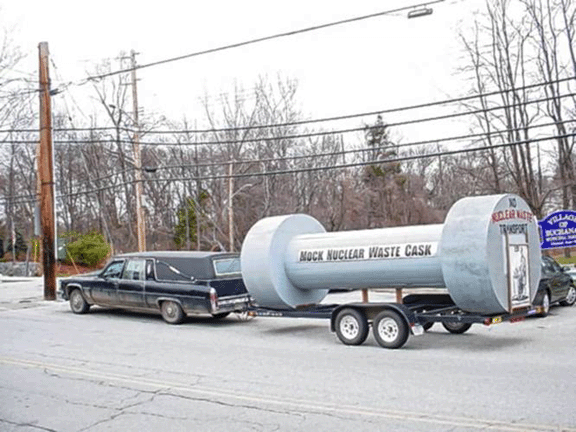
Activists rally against nuclear waste transport,
Staff Writer,Greenfield Recorder September 21, 2018 GREENFIELD — In a lot of ways it was like a party, celebrating the accomplishments of the past few years: The closures of the Vermont and Rowe nuclear plants. ……..The theme of the night? The high-level nuclear power plant waste being stored in Rowe and Vernon, Vt., must go — but only once the right and final safe place for it is decided.
“I haven’t bothered you for three or four years at this point,” leader of CAN and Rowe resident Deb Katz said. “But we’ve come back to our community to say: We need to be involved again. And I wish it wasn’t so.”
Katz and CAN just begun a tour of New England, and after spending their first two nights in Vermont, they came to Greenfield Thursday. On Friday, they will take the tour to the Statehouse on Beacon Hill.
Currently, the anti-nuclear activists are rallying against a bill that could allow for the high-level nuclear waste in Rowe and Vernon, Vt., to be shipped in canisters across the country to Texas or New Mexico. It would place the waste in what CAN is calling “parking lots” that are seen as more temporary holdings than anything else, but could be pitched as helping tthe economy in these regions in the Southwest of the country.
“Why shouldn’t we just say ‘yes, wow. Thank you so much’? The trouble is this is a really bad idea,” Katz said. “We all want the waste off the site, but we want it done right. And we want it done once.” ………
At the moment there isn’t a distinct solution on where to move the high-level nuclear waste, but Katz and fellow lead organizer Chris Williams of Vermont advovated for more science to figure out the best solution to storing waste that remains toxic for thousands of years.
“It took a lot of hard science to create this mess,” Williams said. “To get rid of this stuff properly, we’re going to have to apply real science and not just political expediency.”
The goal is to look to scientists to find the place for “deep geological storage,” Williams said.
Preaching to find a better, scientific solution was organizer and activist Kerstin Rudek from the Peoples Initiative, based out of Germany, where her neighbors have faced similar issues.
“It’s an international thing,” Rudek said, pointing to the lack of answers of what to do with the nuclear waste and the need for answers. “It’s not just a local thing.”
The meeting, which Williams described as a “little more lively than your usual nuclear waste meeting,” also included the speaker Leona Morgan, from the Navajo Nation and an Albuquerque, N.M. resident.
“It’s great news when we hear a nuclear power plant has been shut down, but it makes me nervous because it makes the push for these false solutions even harder,” Morgan said.
She described the political climate in New Mexico as pitching to residents that moving the nuclear waste there would be good for their economy, creating jobs, but ignoring the will of the residents who might be affected by it most.
“I’m here tonight to tell you we don’t want it,” Morgan said. “We don’t want this waste.”………
You can reach Joshua Solomon at: jsolomon@recorder.com 413-772-0261, ext. 264 https://www.recorder.com/Anti-nuclear-group-CAN-advocated-for-one-final-location-for-waste-at-tour-event-at-Hawks—Reed-20333471
Mock nuclear waste cask to Montpelier, in protest campaign against temporary mobile storage for high-level nuclear waste.
Anti-nuclear waste rally in Montpelier, 18 Sept 18 MONTPELIER, Vt. (WCAX) An anti-nuclear waste campaign visited Montpelier Tuesday night, delivering a replica radioactive waste cask. The event was organized by the “Citizens Awareness Network” as part of a multi-stop tour throughout New England.
Activists say they are responding to a bill now in the U.S. Senate that would establish Anti-nuclear waste rally in Montpelier, 18 Sept 18 MONTPELIER, Vt. (WCAX) An anti-nuclear waste campaign visited Montpelier Tuesday night, delivering a replica radioactive waste cask. The event was organized by the “Citizens Awareness Network” as part of a multi-stop tour throughout New England.
Activists say they are responding to a bill now in the U.S. Senate that would establish temporary mobile storage for high-level nuclear waste. The storage casks would travel from places like the Vermont Yankee Nuclear Power Plant and would be transported to southwestern states like Texas and New Mexico. The group’s goal is to leave the waste where it is, but better protected.
“We have to find a responsible way to deal with this waste and what the industry is trying to do is just get this waste off of their hands as quickly as possible,” said Tim Judson of the Nuclear Information and Resource Service.
“In New Mexico, we are concerned about not just our communities because of the storage, but the transport would impact everyone across the nation. Anywhere between a nuclear power plant and the waste site,” said Leona Morgan of the Nuclear Issues Study Group.
. The storage casks would travel from places like the Vermont Yankee Nuclear Power Plant and would be transported to southwestern states like Texas and New Mexico. The group’s goal is to leave the waste where it is, but better protected.
“We have to find a responsible way to deal with this waste and what the industry is trying to do is just get this waste off of their hands as quickly as possible,” said Tim Judson of the Nuclear Information and Resource Service.
“In New Mexico, we are concerned about not just our communities because of the storage, but the transport would impact everyone across the nation. Anywhere between a nuclear power plant and the waste site,” said Leona Morgan of the Nuclear Issues Study Group.
Community in Madhya Pradesh protest against proposed nuclear plant
 Activists, villagers raise concern over proposed nuclear plant in MP https://www.business-standard.com/article/pti-stories/activists-villagers-raise-concern-over-proposed-nuclear-plant-in-mp-118091801368_1.html
Press Trust of India | New Delhi September 18, 2018 Activists and villagers raised their concerns over a proposed nuclear power plant in Chutka in Madhya Pradesh on Tuesday, saying it would destroy nature and take away their homeland.
In 2009, Nuclear Power Corporation of India Ltd. (NPCIL) has decided to set up the atomic station in Mandla district of Madhya Pradesh to generate 1,400 MW power.
The villagers claimed they have been protesting for the past nine years over the atomic power plant and when they did not relent, compensation was put into their accounts forcefully. “MPPGCL forcefully put the compensation amount in our bank accounts and took our Aadhaar copies from the bank. We have written to the bank to remove their money,” said Meera Bai, a resident of Chutka.
Another resident, Dadu Lal Kudape, said they visited other villages where nuclear plants would be coming up and they found contaminated water and polluted environment.
“We do not want the same things to happen to us,” he said.
Padmini Ghosh, Women’s Regional Network India Coordinator, said if European countries are dismantling nuclear power plants, India is building them. “We need to review nuclear policy and install renewable energy plants,” Ghosh said.
Raj Kumar Sinha, activist working with the villagers, said they are being exploited and no amount of money could compensate for their land.
“These people are nature lovers. They can’t be bought with money,” he said.
The Women’s Regional Network said a total of 17,000 people would be displaced if the plant comes up.
 |
ReplyForward
|
French and German anti nuclear campaigners block uranium transport
 Reporterre 1st Sept 2018 [Machine Translation] Since the morning of Saturday, September 1, several anti-nuclear Franco-German militants block a uranium transport.
They climbed a bridge 140 m high near Koblenz, Germany, blocking the railway on the Moselle, informs us the group Contratom Deutschland. The blocked train carries ” Yellow Cake ” from Namibia ; it left Hamburg on Thursday for the Orano uranium conversion plant in Narbonne Malvesi, in the south of France.
In Narbonne, uranium is transformed into UF4 and then used, after several transformations and enrichment, in nuclear power plants around the world. According to Orano, the Narbonne plant processes 25% of the world’s uranium.
“If we want to get out of the nuclear industry, ” says Cécile, a French climber living in Germany who takes part in the action, ” we must stop these transports and prevent them from reaching the Orano factory in
Narbonne Malvési, the gateway to European nuclear energy.
Germany, a net exporter of electricity, unlike political discourse, does not come out quite nuclear. The transports supplying the nuclear facilities continue and the Framatome Nuclear Fuel Plant in Lingen (Lower Saxony) and Urenco’s uranium enrichment plant in Gronau (North Westphalia) continue to operate. That’s why we want to stop nuclear transport. ”
https://reporterre.net/Un-train-d-uranium-a-destination-de-Narbonne-bloque-en-Allemagne
Call for immediate removal of nuclear waste from San Onofre area

Environmental Group Wants Immediate Removal of Nuclear Waste From San Onofre Area, https://www.theinertia.com/environment/an-environmental-group-is-pushing-for-the-transport-of-nuclear-waste- away-from-san-o-stat/ Dylan Heyden, 30 Aug 18,
The ever-evolving situation at the San Onofre Nuclear Generation Station and its nuclear waste problem has become a hot-button issue for residents of San Clemente, Oceanside, and beyond. It’s immensely complex, but allow me, if you will, to oversimplify.
Spent nuclear fuel goes through a years-long cooling process in pools before it can be moved to dry storage where it further cools until it is safe for transport to long-term storage. “Long-term” storage facility, though, is a misnomer. It’s essentially the permanent resting place for nuclear waste stored in extremely thick metal canisters. The problem at San Onofre and many decommissioned nuclear generation stations across the country, though, is there is no long-term storage facility. Or rather, one was planned for an area called Yucca Mountain in Nevada, but in 2011 the Feds pulled the plug. As a result, short-term solutions have become defacto long-term solutions, which is where we are today at San Onofre.
Back in February, Southern California Edison and contractors involved in the SONGS decommissioning process began transferring spent nuclear fuel from pools to dry storage – or dry cask storage. Tens of thick metal canisters of spent nuclear fuel have since been stored on site adjacent to the generators beneath a concrete pad called the Independent Spent Fuel Storage Installation (ISFSI).
When I toured the facility back in May (more on that later), SoCal Edison employees were adamant that public safety was of the utmost importance, and that these thick metal casks were not “buried in the sand” but rather safely stored in concrete for the interim. Employees also emphasized that Southern California Edison’s goal is to move the spent fuel as expeditiously and safely as possible. “Don’t forget, our families go in the ocean nearby, too,” many said.
But Congressional gridlock and an inability to designate a feasible long-term storage site means what was once thought to be a safer short-term solution (dry storage is passive and doesn’t require energy to cool as in cooling pools) may need re-thinking.
That’s why a group of activists, called the Physicians for Social Responsibility Los Angeles recently launched a letter-writing campaign urging the California State Lands Commission to authorize the local transfer of spent nuclear fuel to an area further east in Camp Pendleton.
“3.6 million pounds of highly radioactive nuclear waste at San Onofre Nuclear Generating Station near San Diego is currently in the process of being buried on the beach, just 100 feet from the ocean and a mere few feet above the water table,” their website reads. “Send in a comment on the Draft Environmental Impact Report (EIR) and demand a better solution: the nuclear waste should be moved off the beach to a new, above-ground concrete-reinforced temporary storage facility located further east in Camp Pendleton—where it can be protected from sea level rise and potential terrorist attack.”
A sub-group of PSRLA called the Committee to Bridge the Gap has created a petition page, urging concerned citizens to put their name on a letter voicing their discontent.
According to their website, the group claims this revised plan has garnered the support of former Nuclear Regulatory Commission Chief Greg Jaczko, U.S. government advisor on nuclear waste Tom English, and retired Navy Admiral Len Herring.
The campaign explains that the failure to even consider the idea of moving the fuel east of the primary ISFSI site is a serious oversight on the part of those involved in the decommissioning process.
The letter PSRLA is urging residents to sign implores the State Lands Commission to step in. “As public servants and members of the CSLC you have a moral duty to protect our safety. Please do not take that responsibility lightly,” it says.
Aboriginal group’s unwavering struggle against uranium mining in Western Australia
 Fighting for life in the “place of death”https://beyondnuclearinternational.org/2018/08/27/fighting-for-life-in-the-place-of-death/ August 27, 2018
Traditional owners won’t give up 40-year opposition to Yeelirrie uranium mine, By Linda Pentz Gunter
In the local Aboriginal language, the name Yeelirrie means to weep or mourn. It is referred to as a “place of death.” Yeelirrie is on Tjiwarl Native Title lands in Western Australia, where it has long been faithfully protected by Aboriginal traditional owners. The Seven Sisters Dreaming songline is there. It is home to many important cultural sites. And for 40 years, due to resolute indigenous opposition, and thousands of community submissions of protest, it had been spared plans by the Canadian mining company, Cameco, to plunder it for uranium.
The earth guardians know that such a desecration would cause the extinction of multiple species of subterranean fauna. It would release death. It would destroy Yeelirrie.
Now the fate of those tiny creatures hangs in the balance, their future in the hands of three brave women, backed by environmental organizations, after the outgoing Western Australian government decided to allow the Yeelirrie uranium mine project to go forward.
That decision was made in January 2017, despite the fact that, in August 2016, the Western Australia Environmental Protection Agency (WAEPA) had recommended that the Yeelirrie project be rejected.
The Conservation Council of Western Australia (CCWA), which is engaged in contesting the uranium mining permit for Yeelirrie, said the WAEPA had rejected the Yeelirrie mine plan “on the grounds that the project is inconsistent with three of the objectives of the Environmental Protection Act — the Precautionary Principle, the Principle of conservation of biological diversity, and the Principle of intergenerational equity. The EPA decision was based on the overwhelming evidence that the project would make several species of subterranean fauna extinct.”
But former Minister for Environment, Albert Jacob, threw all that aside to approve the Yeelirrie mine in the waning days of Western Australia’s Liberal government, now replaced by Labor, which came in on a mandate to end uranium mining that it now may not be able to enforce.
In February 2018, CCWA and three members of the Tjiwarl community initiated proceedings in the Western Australia Supreme Court in an attempt to invalidate the approval decision made by Jacob. The case was dismissed by the court, a decision said CCWA executive director, Piers Verstegen, that shows that “our environmental laws are deeply inadequate,” and “confines species to extinction with the stroke of a pen.”
However, while the decision was a set-back, Verstegen said, “it’s absolutely not the end of the road for Yeelirrie or the other uranium mines that are being strongly contested here in Western Australia.”
Accordingly, CCWA and the three Tjiwarl women — Shirley Wonyabong, Elizabeth Wonyabong, and Vicky Abdullah (pictured left to right above the headline) vow to fight on, and have begun proceedings in the WA Court of Appeal to review the Supreme Court decision.
“I grew up here, my ancestors were Traditional Owners of country, and I don’t want a toxic legacy here for my grandchildren,” Abdullah told Western Australia Today in an August 2017 article.
“We have no choice but to defend our country, our culture, and the environment from the threat of uranium mining — not just for us but for everyone.”
Yeelirrie is one of four uranium mines proposed for Western Australia. The other three are Vimy’s Mulga Rock project, Toro Energy’s Wiluna project, and Cameco’s and Mitsubishi’s Kintyre project. Each of them is home to precious species, but Yeelirrie got special attention from the WAEPA because the proposed mine there would cause actual extinctions of 11 species, mostly tiny underground creatures that few people ever see.
According to a new animated short film, produced by the Western Australia Nuclear-Free Alliance, all four of these proposed mines could irreparably damage wildlife, habitat and the health of the landscape and the people and animals who depend on it. The film highlights Yeelirrie, but also describes the other three proposed uranium mines and the threats they pose.
At Mulga Rock, in the Queen Victoria Desert, the site is home to the Sandhill Dunnart, the Marsupial Mole, the Mulgara and the Rainbow Bee Eater, according to the film.
Wiluna, a unique desert lake system, could see uranium mining across two salt lakes that would leave 50 million tonnes of radioactive mine waste on the shores of Lake Way, which is prone to flooding.
The Kintyre uranium deposit was excluded from the protection of the Karlamilyi National Park within which it sits so that uranium could be mined there. It is a fragile desert ecosystem where 28 threatened species would be put at risk, including the Northern Quoll, Greater Bilby, Crest Tailed Mulgara, Marsupial Mole and Rock Wallaby.
At Yeelirrie, says the CCWA, “Cameco plans to construct a 9km open mine pit and uranium processing plant. The project would destroy 2,421 hectares of native vegetation and generate 36 million tonnes of radioactive mine waste to be stored in open pits.”
The mine would likely operate for 22 years and use 8.7 million litres of water a day.
Under Australian laws, ‘nuclear actions’ like the Yeelirrie proposal also require approval by the Federal Environment Minister. CCWA and Nuclear-Free Western Australia, have launched a campaign directed at Federal Environment Minister, Josh Frydenberg, calling for a halt to the Yeelirrie mine, given the immense risk it poses to “unique subterranean fauna that have been found nowhere else on the planet.” They point out that the Minister has the opportunity to “protect these unique species from becoming extinct.
“Species have a right to life no matter how great or small,” they wrote. “One extinction can massively disrupt an entire ecosystem. No one should have the right to knowingly eliminate an entire species from our planet forever.”
1 This Month



26 September – International Day for the Total Elimination of Nuclear Weapons


PLEASE OPPOSE HR 8255 AND S.3639 – bills would accelerate satellite deployment, with no environmental review or safeguards – https://ncstd5li.quorum.us/campaign/169331/
To see nuclear-related stories in greater depth and intensity – go to https://nuclearinformation.wordpress.com
-
Archives
- September 2026 (219)
- August 2026 (330)
- July 2026 (355)
- June 2026 (287)
- May 2026 (306)
- April 2026 (356)
- March 2026 (251)
- February 2026 (267)
- January 2026 (308)
- December 2025 (358)
- November 2025 (359)
- October 2025 (375)
-
Categories
- 1
- 1 NUCLEAR ISSUES
- business and costs
- climate change
- culture and arts
- ENERGY
- environment
- health
- history
- indigenous issues
- Legal
- marketing of nuclear
- media
- opposition to nuclear
- PERSONAL STORIES
- politics
- politics international
- Religion and ethics
- safety
- secrets,lies and civil liberties
- spinbuster
- technology
- Uranium
- wastes
- weapons and war
- Women
- 2 WORLD
- ACTION
- AFRICA
- Atrocities
- AUSTRALIA
- Christina's notes
- Christina's themes
- culture and arts
- Events
- Fuk 2022
- Fuk 2023
- Fukushima 2017
- Fukushima 2018
- fukushima 2019
- Fukushima 2020
- Fukushima 2021
- general
- global warming
- Humour (God we need it)
- Nuclear
- RARE EARTHS
- Reference
- resources – print
- Resources -audiovicual
- Weekly Newsletter
- World
- World Nuclear
- YouTube
-
RSS
Entries RSS
Comments RSS
 nuclear-news