New Mexico is strongly objecting to licensing of Holtec’s multibillion-dollar nuclear waste dump plan
New Mexico objects to license for nuclear fuel storage plan, Madison.com , By SUSAN MONTOYA BRYAN Associated Press, 23 Sept 20
-
- ALBUQUERQUE, N.M. (AP) — The state of New Mexico is strongly objecting to federal nuclear regulators’ preliminary recommendation that a license be granted to build a multibillion-dollar storage facility for spent nuclear fuel from commercial power plants around the U.S.
State officials, in a letter submitted Tuesday to the Nuclear Regulatory Commission, said the site is geologically unsuitable and technical analysis has been inadequate so far. They also say regulators have failed to consider environmental justice concerns and have therefore fallen short of requirements spelled out by federal environmental laws.
The officials pointed to a legacy of contamination in New Mexico that includes uranium mining and milling and decades of nuclear research and bomb-making at national laboratories, saying minority and low-income populations already have suffered disproportionate health and environmental effects as a result.
A group of Democratic state lawmakers also raised concerns, sending separate comments to the commission that pointed to resolutions passed by a number of cities and counties in New Mexico and Texas that are opposed to building the facility.
Elected leaders in southeastern New Mexico support the project, saying it would bring jobs and revenue to the region and provide a temporary option for dealing with the spent fuel.
The deadline to comment on draft environmental review was Tuesday. A study on the project’s impact on human safety is pending and will require another round of public comment.
New Jersey-based Holtec is seeking a 40-year license to build what it has described as a state-of-the-art complex near Carlsbad. The first phase calls for storing up to 8,680 metric tons of uranium, which would be packed into 500 canisters. Future expansion could make room for as many as 10,000 canisters of spent nuclear fuel……. https://madison.com/news/national/govt-and-politics/new-mexico-objects-to-license-for-nuclear-fuel-storage-plan/article_f13be5d3-9381-57dd-aa21-b83915cb57c0.html
Western Canadians do not want ”Small” nuclear reactors in Sakatchewan
Premier asks Trudeau to support nuclear reactors in upcoming throne speech, Yorkton This Week Michael Bramadat-Willcock – Local Journalism Initiative (Canada’s National Observer) / Yorkton This Week, SEPTEMBER 16, 2020 Premier Scott Moe has sent a letter to Prime Minister Justin Trudeau outlining Saskatchewan’s priorities ahead of the federal throne speech on Sept. 23. In it, he is asking Trudeau to support nuclear development in the province.
Moe wants the development of small modular nuclear reactors, also known as SMRs, in Saskatchewan to be part of Trudeau’s green agenda. ……..
In December, Moe signed a memorandum of understanding with the premiers of Ontario and New Brunswick to work together on further developing the nuclear industry. ……..
In his letter, the premier also focused on support for the oil and gas sectors, and pushed for pausing the carbon tax.
The Supreme Court of Canada will hear arguments on the federal carbon tax at the same time as the throne speech is delivered. …………
But western Canadians don’t all see eye-to-eye on the deployment of nuclear reactors, even small ones.
Committee for Future Generations outreach co-ordinator Candyce Paul of La Plonge at the English River First Nation earlier told Canada’s National Observer that while they haven’t been consulted on any aspects of the plan, all signs point to the north as a site for the reactors.
On Tuesday, Paul called it ironic that Moe spoke of western alienation from Ottawa when many in the north feel the same way about Regina.
“Trudeau, please represent the people of northern Saskatchewan because Scott Moe does not,” Paul said.
Paul’s group fights nuclear waste storage in Saskatchewan and was instrumental in stopping a proposal that considered Beauval, Pinehouse and Creighton as storage locations in 2011.
“When we informed the communities that they were looking at planning to bury nuclear waste up here in 2011, once they learned what that entailed, everybody said, ‘No way.’ Eighty per cent of the people in the north said, ‘No way, absolutely not.’ It didn’t matter if they worked for Cameco or the other mines. They said, if it comes here, we will not support it coming here,” Paul said in an interview last month. ………..
Paul said the intent behind using SMRs is anything but green and that the real goal is to prop up Saskatchewan’s ailing uranium industry and develop oilsands in the northwest.
“He’s put it right in the letter. His fear is they’re going to put out a green policy that will hurt the oil and gas sector,” Paul said.
“They’ve been looking for a way to bring the tar sands to northern Saskatchewan. We all know the mess that makes. Using small modular reactors is not lessening the carbon impact.”
She said in August that communities around Canada, and especially in the Far North, have long been pitched as sites for SMR development and nuclear waste storage, but have refused.
“None of our people are going to get trained for operating these. It supports people from other places. It doesn’t really support us,” Paul said.
Paul said on Tuesday that SMRs under 200 megawatts are currently excluded from environmental impact assessments, which means a lack of opportunity for public input.
She also said that interconnected water systems in the north would mean pollution would travel quickly into the ecosystem if there was a mishap at a reactor site.
Brooke Dobni, professor of strategy at the University of Saskatchewan’s Edwards School of Business, told Canada’s National Observer in August that any development of small reactors would take a long time.
“It could be a good thing, but on the other hand, it might have some pitfalls. Those talks take years,” Dobni said.
He said nuclear reactors face bigger challenges that have to be addressed before they can go ahead, such as public support for protecting the environment, the high cost of building infrastructure, and containing nuclear fallout and radiation.
“Anything nuclear is 25 years out if you’re talking about small reactors, those kinds of things to power up the city,” Dobni said.
“That technology is a long ways away and a lot of it’s going to depend on public opinion.
“The court for that is the court of public opinion, whether or not people want that in their own backyard, and that’s the whole issue anywhere in the world.”
On Tuesday, Paul asked the federal government to invest in critical infrastructure instead.
“We need money spent in a serious way. Not on small modular reactors that could happen in 25 years. We need things now. To bring us up to the standards in our health system, we need health facilities. The public doesn’t want the government subsidizing industries that are about to go bust. It’s a waste of money,” Paul said.
“We have extreme needs that aren’t being met by industry and never will be met by industry. Trudeau, put the money where you want to make some real reconciliation happen.”https://www.yorktonthisweek.com/regional-news/premier-asks-trudeau-to-support-nuclear-reactors-in-upcoming-throne-speech-1.24204052
Nuclear waste flyers heading to 50,000 households in Grey-Bruce
|
Scott MillerCTV News London Videographer @ScottMillerCTV Contact, Monday, September 14, 2020 WINGHAM, ONT. — Roughly 50,000 homeowners in Grey and Bruce County will be getting some unexpected mail this week. “South Bruce is not a willing host to a nuclear waste dump” flyers will be showing up in people’s mailboxes thanks to a group of concerned landowners near Teeswater, where Canada’s highest level nuclear waste could be permanently buried. Michelle Stein leads the group, Protect Our Waterways-No Nuclear Waste. Why would we want to take that kind of a risk with our water and the Great Lakes basin. Anything that happens in the Great Lakes Basin happens to our Great Lakes. We need to protect our water,” she says. All of the highly radioactive fuel bundles are currently stored in above ground warehouses at Canada’s nuclear reactor sites, right now. The Nuclear Waste Management Organization (NWMO) has two proposed sites to permanently bury over 5 million used nuclear fuel bundles, that once powered Canada’s nuclear reactors. One near Ignace, in Northern Ontario, and another north of Teeswater, in Bruce County. All of the highly radioactive fuel bundles are currently stored in above ground and near ground containers at Canada’s nuclear reactor sites, right now……… Stein says people far and wide should know that the NWMO plan includes walking away from the underground facility and the waste, after 50 to 75 years of operation, leaving the radioactive waste in the ground, forever. “There is no country in the world with an operational high level spent fuel DGR (deep geological repository), and history shows us that the low and intermediate level DGR’s have had failures, accidents, and leaks,” she says……. The Nuclear Waste Management wants to have a site selected, either South Bruce or Ignace, by 2023. https://london.ctvnews.ca/nuclear-waste-flyers-heading-to-50-000-households-in-grey-bruce-1.5104113 |
|
Suttsu, Hokkaido, residents oppose radioactive waste dump plan
Residents Oppose Hokkaido Town’s Radioactive Waste Site Plan https://www.nippon.com/en/news/yjj2020091000878/residents-oppose-hokkaido-town%27s-radioactive-waste-site-plan.html Suttsu, Hokkaido, Sept. 11 (Jiji Press)–Many residents of a Japanese town considering hosting a final disposal facility for high-level radioactive waste have voiced opposition to the plan at a briefing session organized by the municipal government.The meeting was the fourth of its kind for residents of the town of Suttsu in the northernmost Japan prefecture of Hokkaido. The first such session was held on Monday.
At Thursday’s meeting, which was opened to the press, Suttsu Mayor Haruo Kataoka explained the reasons for considering applying for a literature survey, the first stage of a three-stage research process to select the location of the final disposal site for high-level radioactive waste from nuclear power plants.
Some 260 residents attended the session, which lasted for over three hours from 6:30 p.m. (9:30 a.m. GMT).
Participating residents voiced concerns that the move will lead to harmful rumors about the town, and that if the town receives subsidies from the Japanese government as a result of applying for the literature survey, it will have no choice but to become a final disposal site. Some said that detailed discussions should be held after the mayoral election in the town next year.
Campaign against nuclear fuel waste storage in South Bruce, Canada
People in communities near the Municipality of South Bruce may receive a leaflet from the group Protect Our Waterways-No Nuclear Waste with information on the proposal to store used nuclear fuel deep underground near Teeswater.
Spokesman Michelle Stein said 50,000 leaflets were sent out this week to let people know some of the group’s concerns about the plan to store Canada’s nuclear waste in a Deep Geologic Repository or DGR.
Stein said the Nuclear Waste Management Organization is assembling land in the municipality of South Bruce to store irradiated nuclear fuel from 4.6 million spent fuel bundles.
“The proposed site includes the Teeswater River flowing through it, and that leads to Lake Huron. And 40 million people get their drinking water from Lake Huron,” she said.
“It’s a decision that is going to affect so many people, and change our community in such a large way, I think each individual deserves to have a vote,” she added.
Stein says 1,600 residents of South Bruce signed a petition opposing the proposed DGR. Stein wants to see a referendum on the issue, as both the Nuclear Waste Management Organization and the municipality have stated that the project needs broad community support to go ahead.
If the proposed nuclear waste dump is approved there will be two loads of spent nuclear fuel travelling by truck every day for forty years from Canada’s nuclear reactors. And if there is a radioactive leak underground it could affect 40 million people in Canada and the US,” said Stein.“People need to know the risks. Nowhere in the world is there an operating DGR for high-level nuclear waste as is being proposed here. Underground storage sites for low-medium level nuclear waste in the US and Germany have leaked radioactive material and required multi-billion-dollar clean-ups”, says Stein. “I encourage everyone who lives in a community near South Bruce to contact their own Mayor and tell them you oppose NWMO’s proposal for a nuclear waste dump.”
POW-NNW believes that the “rolling stewardship” method of managing nuclear waste is better because it maintains it in a monitored and retrievable state at all times, with continual improvements to packaging and environmental protection.
Stein added that ongoing scientific studies examine how spent nuclear fuel can be reused, reduced, and even neutralized. In its initial report to Parliament, the NWMO did not say that on-site storage at the reactor sites was unsafe or not feasible.
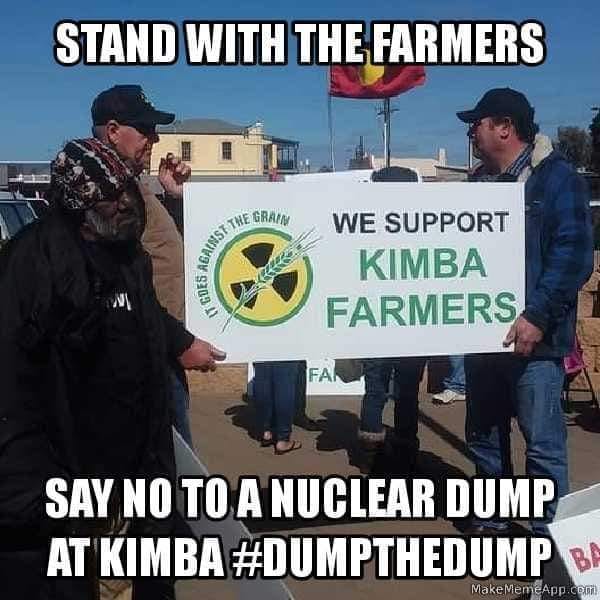
In South Australia, Farmers, Traditional Owners fight radioactive waste dump
As Woolford pointed out, of 2789 submissions received in a public consultation 94.5% oppose the facility.
Farmers, Traditional Owners fight radioactive waste dump https://www.greenleft.org.au/content/farmers-traditional-owners-fight-radioactive-waste-dump, Renfrey Clarke, Adelaide, September 8, 2020
A 160-hectare tract of farmland has been purchased near the small town of Kimba and, as inducement to deliver support for the plan, local residents have been promised a $31 million “community development package.” A non-binding ballot conducted last November among residents of the Kimba District Council area recorded 62% in favour of the scheme.
But opponents of the dump remain active and vocal. As well as farmers and townsfolk concerned for their safety and for the “clean and green” reputation of the district’s produce, those against the plan include the Barngarla First Nations people, who hold native title over the area. Continue reading
Bob Halstead has done a great job defending Nevada from nuclear waste dumping at Yucca Mountain
|
Nevada grateful for Halstead’s many years fighting nuclear waste, Las Vegas Sun , Monday, Sept. 7, 2020 On this Labor Day, t
 he Sun salutes a recently retired Nevada leader whose three decades of tireless public service unquestionably made a difference in our state. he Sun salutes a recently retired Nevada leader whose three decades of tireless public service unquestionably made a difference in our state.
Bob Halstead, who stepped down last month as the executive director for the Nevada Agency for Nuclear Projects, will be long remembered for his staunch defense of the state against the Yucca Mountain nuclear waste repository project. It’s scary to think where Nevada might be today if not for Halstead and his guard-dogging against the federal government’s attempts to shove the nation’s high-level nuclear waste down our throats.
Halstead was the state’s foremost expert on the project, a walking encyclopedia of its many flaws. His credibility, geniality and commitment allowed him to work with Republican and Democratic governors, Nevada congressional delegates, state legislators and local officials alike. That helped forge a unified front on the project that continues to this day. Outside of a few misguided officials, it’s difficult to find a Nevada leader who wants anything to do with Yucca Mountain. Halstead also spearheaded the state’s response to the feds’ 2018 secret shipments of weapons-grade plutonium to the Nevada National Security Site, among other efforts. Along the way, he became a nemesis of the Department of Energy, beating them back with legal and scientific challenges and poking their arguments full of holes…………. It’s certainly been an impressive fight, and a long one. It dates to 1987, when Congress passed the so-called “Screw Nevada” bill that designated our state as the national waste repository site — without our consent. Since then, the project has been killed and resurrected repeatedly, most recently when the Trump administration pushed for funding to restart the licensing process. When President Donald Trump finally capitulated, it was a high point for Halstead after a career of bedeviling pro-Yucca presidents, bureaucrats and Congress members who were intent on shipping waste out of their own districts and dumping it on Nevada. But as Halstead has noted, the fight isn’t over. It won’t be until there’s legislation that permanently shuts down the site. With Halstead’s departure, that means the current and next generations of Nevada leaders will have to take up the cause just as fervently as he did. We simply can’t let down our guard on this monstrosity, which would result in more than 110,000 metric tons of highly radioactive waste being shipped into the backyard of Las Vegas and stored there. Transporting the material is dangerous, especially for Las Vegas, given that one of the main routes takes shipments directly through the heart of the city. Think about the effects of an accident or a terrorist attack on a shipment going through the middle of Las Vegas. As for storage, seismic activity in the region makes Yucca Mountain a terrible place to put this waste. A leak could contaminate groundwater for thousands of years — and keep in mind that we’re talking about enough material to cover a football field about seven yards deep. There’s nothing close to scientific proof that the waste could be safely stored in the repository for the tens of thousands of years it will remain radioactive. Halstead knew this, and for 30 years he refused to yield on it……..https://lasvegassun.com/news/2020/sep/07/nevada-grateful-for-halsteads-many-years-fighting/ |
|
Canada communities don’t want the so-called “clean” Small Modular Nuclear Reactors (SMRs)

even with SMRs under 300 megawatts, nuclear waste is a byproduct.
waste generated from SMRs would become a dangerous part of the transportation system “even if they do remove it.”
“It will be big, big transports of highly radioactive stuff, driving down the roads as an easy dirty bomb
the high cost of building infrastructure and then containing nuclear fallout and radiation are all concerns before they can go ahead.
Nuclear giants team up to develop reactors in Sask. and Ontario, Michael Bramadat-Willcock / Local Journalism Initiative Reporter, National Observer, AUGUST 23, 2020
Canada’s leading nuclear industry players announced an inter-provincial corporate partnership Thursday to support the launch of a research centre that will work on developing small modular reactors (SMRs) for use in Saskatchewan.
Saskatoon-based Cameco is the world’s biggest uranium producer and has long supplied fuel to Bruce Power, Ontario’s largest nuclear power company.SMRs are designed to produce smaller amounts of electricity, between 50 and 300 megawatts,……
The secretariat is mandated to develop and execute a strategic plan for the use of “clean-energy small modular reactors” in the province. ……
No timeframe or SMR sites were included in the announcement, but the government’s plans already have some northern residents raising alarms.
Committee for Future Generations outreach co-ordinator Candyce Paul of La Plonge at the English River First Nation told Canada’s National Observer that they haven’t been consulted on any aspects of the plan, but all signs point to the north as a site for the reactors.
Paul’s group fights nuclear waste storage in Saskatchewan and was instrumental in stopping a proposal that considered Beauval, Pinehouse and Creighton as storage locations in 2011.
“When we informed the communities that they were looking at planning to bury nuclear waste up here in 2011, once they learned what that entailed, everybody said no way. Eighty per cent of the people in the north said no way, absolutely not. It didn’t matter if they worked for Cameco or the other mines. They said if it comes here, we will not support it coming here,” she said.
Paul said she sees small modular nuclear reactors as another threat to the environment and to human safety in the region.
She noted that even with SMRs under 300 megawatts, nuclear waste is a byproduct.
“Even if they’re not burying nuclear waste here, they could be leaving it on site or hauling it through our northern regions and across our waterways,” Paul said.
She said that waste generated from SMRs would become a dangerous part of the transportation system “even if they do remove it.”
“It will be big, big transports of highly radioactive stuff, driving down the roads as an easy dirty bomb. You’d be driving down the road (behind a nuclear waste transport vehicle) and not know you’re following it,” Paul said.
Paul said the intent behind installing SMRs is anything but green and that the real goal is to prop up Saskatchewan’s ailing uranium industry and develop oilsands in the northwest.
Paul said that communities around Canada, and especially in the Far North, have long been pitched as sites for SMR development and have refused.
A 2018 brief from Pangnirtung Hamlet Council in Nunavut concluded “any Arctic-based nuclear power source should be an alternative energy choice of last resort.”
“None of our people are going to get trained for operating these. It supports people from other places. It doesn’t really support us,” Paul said.
SMRs have been pitched in the north as a way to move away from reliance on diesel fuel, which can be costly. Paul said any benefits of that remain to be seen.
She said companies would need to do environmental impact assessments for smaller reactors even though the exclusion zone around SMR sites is smaller.
“Even if the exclusion zone is only a few kilometres, a few kilometres affects a lot in an ecosystem and especially in an ecosystem that is wild,” Paul said.
“I’m not feeling confident in this at all, Canadian nuclear laboratories saying that it would only be a small radius exclusion zone. Well that’s our territory. That’s our land, our waters, our wildlife.
“It’s not their backyard, so they couldn’t care less.”
Brooke Dobni, professor of strategy at the University of Saskatchewan’s Edwards School of Business, told Canada’s National Observer that any development of small reactors would take a long time.
“It could be a good thing, but on the other hand, it might have some pitfalls. Those talks take years,” Dobni said.
He said nuclear reactors face bigger challenges because of public concerns about the environment and that the high cost of building infrastructure and then containing nuclear fallout and radiation are all concerns before they can go ahead.
“Anything nuclear is 25 years out if you’re talking about small reactors, those kinds of things to power up the city,” Dobni said.
“That technology is a long ways away and a lot of it’s going to depend on public opinion.
The court for that is the court of public opinion, whether or not people want that in their own backyard, and that’s the whole issue anywhere in the world.” https://www.humboldtjournal.ca/news/nuclear-giants-team-up-to-develop-reactors-in-sask-and-ontario-1.24191077
Growing national opposition to Holtec plan for ‘temporary’ storage of nuclear wastes near Carlsbad, New Mexico

Nationwide opposition of a nuclear waste storage facility proposed to be built near Carlsbad and Hobbs continued its call for the licensing process for the project to be suspended during the COVID-19 pandemic and that the federal Nuclear Regulatory Commission deny the application altogether.
Holtec International proposed to build the site to store high-level spent nuclear fuel rods transported to southeast New Mexico from generator sites across the county.
Many of the rods are already stored in cooling pools near the generator sites, which supporters of the project said were unsafe as many are located near large bodies of water or densely populated areas.
The concept of Holtec’s consolidated interim storage facility (CISF) was to temporarily store the spent fuel in a remote location while a permanent repository was developed.
Such a facility to permanently store the waste does not exist in the U.S.
The idea faced opposition from New Mexico Gov. Michelle Lujan Grisham and State Land Commissioner Stephanie Garcia Richard along with other state lawmakers.
And during a Thursday public hearing held by the NRC, numerous nuclear watchdog groups from around the country voiced their opposition.
The NRC announced last week it would hold four such online hearings including Thursday’s with others scheduled for Aug. 25, 26 and Sept. 2 to solicit public comments on the Commission’s recently released environmental impact statement (EIS).
The EIS released earlier this year found the project would have minimal environmental impacts during the construction, operation and decommissioning of the facility.
The EIS was required for the first phase of Holtec’s plan for 500 cannisters to be stored, but the NRC also considered the company’s expressed intention to apply for future permits for 19 additional phases for a total of 10,000 cannisters of nuclear waste.
Leona Morgan of the Nuclear Issues Study Group based in Albuquerque said the online hearing process was unjust as many New Mexicans live without adequate internet or phone service to participate in electronic hearings.
While she called for the NRC to reject Holtec’s application, citing safety and environmental risks to the region of the facility and communities along the transportation routes, Morgan also questioned the hearing process itself as it continued during the global pandemic.
Leona Morgan of the Nuclear Issues Study Group based in Albuquerque said the online hearing process was unjust as many New Mexicans live without adequate internet or phone service to participate in electronic hearings.
While she called for the NRC to reject Holtec’s application, citing safety and environmental risks to the region of the facility and communities along the transportation routes, Morgan also questioned the hearing process itself as it continued during the global pandemic.
The Nuclear Issues Study Group, which held a continued presence during the past three public hearings held this year, and NRC’s scoping meetings held in 2018, would boycott the rest of the proceedings, Morgan said.
“There are a large portion of our state that lives without phone or internet service. Our organization is boycotting the rest of these proceedings. It is a sham. There is no reason to rush this process except to line the pockets of shareholders,” she said.
“We see this as a violation of our rights to submit our public comments under the National Environmental Policy Act. And it violates environmental justice. We can’t even verify that the NRC is sitting before us.”
More:Nuclear waste site near Carlsbad opposed by indigenous groups during public hearing
John LaForge, of nuclear watchdog group Nukewatch of Wisconsin also voiced his opposition to the project and ongoing proceedings, pointing to widespread opposition in New Mexico and among Tribal nations.
He demanded public hearings be held in up to 40 states other than New Mexico that could be impacted by the transportation of waste.
“There is no compelling reason at this time for these meetings to be rushed. I opposed this plan due to the governors of New Mexico and of 20 tribal nations,” LaForge said. “With these online meetings, it is apparent to me that the NRC has no interest in the public’s concerns. The people of New Mexico have said no.”
He also criticized the EIS as the NRC noted in the report it would expect no radiation release should there be an accident at the facility.
“In its review, the NRC said it assume in an accident there would be no release of radiation,” LaForge said. “That is alarming and preposterous.”
Petuuche Gilbert of the Acoma Coalition for a Safe Environment based in the Acoma Pueblo near Albuquerque also questioned the EIS as it only considered the environmental impacts of the project for 40 years and only within a 50 mile radius.
“We believe the analysis needs to go beyond the 40 year possibility of storing the waste. We all know the nuclear waste and radioactivity extends beyond that limited timeframe. It really needs to go on for hundreds or thousands of years,” Gilbert said.
“You have the possibility of accidents that could occur along the transportation corridors. The cumulative analysis is limited only to a 50 mile radius. It really needs to be more.”
Adrian Hedden can be reached at 575-628-5516, achedden@currentargus.com or @AdrianHedden on Twitter.
Resistance to nuclear waste survey in Hokkaido
SAPPORO – The mayor of Suttsu in Hokkaido, which is considering applying for a survey to host a final disposal site for high-level radioactive waste, said Friday that it might be difficult to make the decision by September as planned.
“It is difficult to make the decision after listening to many voices,” Suttsu Mayor Haruo Kataoka told reporters after meeting with the nine members of the town’s assembly. “It would not be appropriate to rush the decision by our own judgment. Our plan to decide in September might be postponed.”
Kataoka’s remarks came a day after the mayors of three municipalities neighboring Suttsu said Thursday they will urge the town to make a careful decision.
The mayors of the three municipalities unveiled the plan at a meeting with Hokkaido Gov. Naomichi Suzuki.
Of the three, Rankoshi Mayor Hideyuki Kon and Kuromatsunai Mayor Mitsuru Kamada expressed opposition to Suttsu’s move, which involves applying for a literary survey, the first stage of the process for choosing a disposal site.
Kon, Kamada and Shimamaki Mayor Masaru Fujisawa told Suzuki that they will ask Suttsu as early as this month to make a careful decision on the application. ……..
Seven other municipalities, including the town of Niseko, an internationally known ski resort, are planning to oppose the plan, sources said Friday.
Also on Friday, members of the association of fisheries cooperatives made up of nine co-ops around Suttsu, submitted to Kataoka a protest letter expressing strong opposition to the town’s plan.
Referring to the fact that the fisheries industry suffered harmful rumors following the 2011 triple core meltdown at the Fukushima No. 1 power plant, the letter said: “It is utterly unacceptable for those in the fisheries industry. It will have an immeasurable adverse impact not only on the region but also on the fisheries industry as a whole.”
Katsuo Hamano, head of the association, criticized the mayor for making an announcement on the plan even before obtaining the municipal assembly’s approval.
“It goes against the rules of parliamentary democracy,” Hamano told reporters…….
The central government offers up to ¥2 billion in subsidies to any municipality that undergoes the literary survey https://www.japantimes.co.jp/news/2020/08/21/national/hokkaido-suttsu-nuclear-waste-survey-delay/
Community opposition to South Bruce Nuclear Waste Repository
|
Residents discuss opposition to South Bruce Nuclear Waste Repository, Blackburn News, By Janice MacKayAugust 21, 2020 About 100 South Bruce Residents who oppose an underground repository for used nuclear fuel gathered recently at a fundraiser for the Protect Our Waterways – No Nuclear Waste organization.Residents also had a chance to talk about mobilization efforts against the establishment of the Deep Geological Repository in South Bruce. Ignace is the only other community under consideration for the facility by the Nuclear Waste Management Organization.
Board members of Protect Our Waterways – No Nuclear Waste also spent time updating participants on efforts so far…….. https://blackburnnews.com/midwestern-ontario/midwestern-ontario-news/2020/08/21/residents-gather-discuss-opposition-south-bruce-nuclear-waste-repository/ |
|
A real setback to UK”s Bradwell nuclear project: Colchester Council voted unanimously to reject the proposal

Blow to Bradwell B nuclear power plant as council unanimously reject plans, Maldon Standard
A motion, put forward by council leader Mark Cory, said: “This council objects to new nuclear at Bradwell due to the local environmental impacts and prefers a focus on renewable energy alternatives.”
During the debate, councillors called for a “united front” approach amongst councillors and north Essex MPs.
he Bradwell B project is a joint operation between CGN and EDF Energy. Its backers claim it will create 900 permanent jobs as well as 9,000 jobs during construction.
If permitted, it would be built alongside the decommissioned Bradwell power station, however, the proposals have generated a wave of opposition.
Campaign group Blackwater Against New Nuclear Group (BANNG) welcomed Colchester Council’s decision after submitting a statement to the council, outlining four reasons for rejecting the proposal.
Chairman Prof Andy Blowers said: “It is unacceptable for such a dangerous power station and long-term highly radioactive waste stores to be located so close to large populations such as Mersea and Colchester which would be completely unprotected in the event of a major release of radioactivity.
“And the site is unsuitable since its precious environment and heritage is irreplaceable and would be severely compromised if not altogether destroyed.”
Peter Banks, of West Mersea Town Council and co-ordinator of BANNG, added: “With my practical, scientific mind, I endorse this policy. With my passionate, environmentally pumping heart, I endorse this policy.
“BANNG is delighted that all councillors, regardless of political persuasion, have endorsed this policy.”….https://www.maldonandburnhamstandard.co.uk/news/18652490.blow-bradwell-b-nuclear-power-plant-council-unanimously-reject-plans/
£20 billion Sizewell C nuclear project ‘Costly and dangerous’- actress Diana Quick
why she opposes Sizewell C. Suffolk resident Diana Quick is perhaps taking
on one of her most important roles yet – as a leading campaigner against a
£20billion nuclear power station on the county’s coast. Having moved to
Suffolk in the 1980s, Ms Quick – also a writer and director – quickly took
an interest in plans for Sizewell B which, at that stage, were being
considered by a planning inspector.https://www.eadt.co.uk/news/diana-quick-sizewell-c-suffolk-1-6793919
Extinction Rebellion’s protest demonstration against building of Sizewell nuclear plant
beach at Sizewell against the planned expansion of the nuclear power
station. The group laid out pairs of shoes in the form of its ‘XR’ logo
in the sand to represent what it says will be future lives devoid of
wildlife and a stable climate due to the planned construction of Sizewell C.
local environment, which includes an Area of Natural Beauty and a Site of
Special Scientific Interest surrounding nearby RSPB Minsmere.
took place on Sunday August 9 and Extinction Rebellion East of England
spokesperson Rachel Smith-Lyte said 15 members had taken part in the
action. “There were some members of the public on the beach who saw what
we were doing and some of them were genuinely interested in what we were
doing and why.”https://www.eadt.co.uk/news/extinction-rebellion-holds-beach-protest-against-sizewell-c-1-6784523
Anti-nuclear protests at Kings Bay Naval Submarine Base
Anti-nuclear protests at Kings Bay https://thebrunswicknews.com/news/local_news/anti-nuclear-protests-at-kings-bay/article_8ac11cdb-6416-579b-b298-961419776e2a.html By GORDON JACKSON gjackson@thebrunswicknews.com ST. MARYS 7 Aug 20,
Organizers of an annual protest against nuclear weapons at Naval Submarine Base Kings Bay expected a large crowd to commemorate the 75th anniversary of the first atomic bomb dropped on Hiroshima, Japan, to help hasten the end of World War II.
Five people ended up standing outside a base gate Thursday holding signs with anti-nuclear weapons messages.
Glenn Carroll, coordinator of Nuclear Watch South, said the ongoing COVID-19 pandemic compelled many who were planning to attend to stay home for health concerns. But Carroll said her trip from Atlanta to join others with concerns about nuclear weapons Thursday was worth the time.
“Our mission is to stop the arms race,” Carroll said. “It’s a security risk and phenomenally expensive. This has become a business model and it’s deadly.”
Kings Bay is home to six ballistic missile submarines and two guided missile submarines. The base employs more than 9,000 civilian workers and active-duty sailors. Supporters say the ballistic missile submarines are a vital deterrent to nuclear attack.
“Thank God they were non violent,” she said. “They did highlight you cannot secure this base with this kind of power. It’s called an illusion of security.”
Grady said the military’s priorities “are all messed up” by continuing to develop powerful nuclear weapons.
“There is nothing they can do but kill,” she said.
She also expressed concerns about the length of time the growing stockpile of nuclear waste will need to be contained.
Carroll said she and others will continue to share their concerns about nuclear weapons. While Carroll said she’s anti-nuclear, she’s not anti-military.
“We need a defense,” she said. “We don’t need a weapons system unmatched on this planet.”
1 This Month
Chernobyl: The Lost Tapes – A good documentary on Chernobyl on SBS available On Demand for the next 3 weeks– https://www.sbs.com.au/ondemand/tv-program/chernobyl-the-lost-tapes/2352741955560

of the week–London Campaign for Nuclear Disarmament

Tell the Ukrainian Government to Drop Prosecution of Peace Activist Yurii Sheliazhenko
To see nuclear-related stories in greater depth and intensity – go to https://nuclearinformation.wordpress.com
-
Archives
- April 2026 (126)
- March 2026 (251)
- February 2026 (268)
- January 2026 (308)
- December 2025 (358)
- November 2025 (359)
- October 2025 (376)
- September 2025 (257)
- August 2025 (319)
- July 2025 (230)
- June 2025 (348)
- May 2025 (261)
-
Categories
- 1
- 1 NUCLEAR ISSUES
- business and costs
- climate change
- culture and arts
- ENERGY
- environment
- health
- history
- indigenous issues
- Legal
- marketing of nuclear
- media
- opposition to nuclear
- PERSONAL STORIES
- politics
- politics international
- Religion and ethics
- safety
- secrets,lies and civil liberties
- spinbuster
- technology
- Uranium
- wastes
- weapons and war
- Women
- 2 WORLD
- ACTION
- AFRICA
- Atrocities
- AUSTRALIA
- Christina's notes
- Christina's themes
- culture and arts
- Events
- Fuk 2022
- Fuk 2023
- Fukushima 2017
- Fukushima 2018
- fukushima 2019
- Fukushima 2020
- Fukushima 2021
- general
- global warming
- Humour (God we need it)
- Nuclear
- RARE EARTHS
- Reference
- resources – print
- Resources -audiovicual
- Weekly Newsletter
- World
- World Nuclear
- YouTube
-
RSS
Entries RSS
Comments RSS
 nuclear-news