Anti-nuclear groups gather in Wales
Organizations meeting to oppose nuclear energy in the north. In Caernarfon
on Saturday, a number of anti nuclear organizations came together to oppose
any plans to build new power stations on Anglesey and Trawsfynydd. The
organizations present – PAWB, CADNO, Cymdeithas yr Iaith, Welsh Anti
Nuclear Alliance and the Nuclear Free Local Authorities – claimed that
nuclear energy is not the way forward to meet Wales’ power needs. They were
also concerned about the effect that nuclear projects in Welsh speaking
areas would have on the language.
BBC 24th July 2022
Guardians of the East Coast (Gotec) fight to stop nuclear waste dumping in the sea near holiday resorts UK

As Boris Johnson forged ahead with plans to triple Britain’s nuclear output in the shift away from a reliance on Russia and fossil fuels, he pledged to build a mini-nuclear reactor in almost every garden across the country.
The outgoing prime minister’s plan was typically bombastic, yet reflected the Government’s ambitious target to deliver up to a quarter of the country’s electricity from nuclear technologies by 2050.
What is less clear, however, is exactly where to put the hazardous waste produced from
reactors. Currently, Britain stores spent nuclear fuel at a number of nuclear sites including Sellafield, in Cumbria, and Sizewell B, in Suffolk.
But these on-land sites are not intended to be a permanent solution to the radioactive material building up as a by-product of Britain’s nuclear programme. The Government’s arms-length body Nuclear Waste Services (NWS) has been tasked with finding a permanent disposal site. Bruce Cairns, chief policy adviser at NWS, says: “We’re talking about a solution that should last hundreds of thousands of years. “What do you trust the most? Do you really want to leave this stuff at the surface, where it is vulnerable to
extreme weather events, climate change, sea level rise, terrorism, war or the breakdown in society?
“Everyone reaches the same conclusion. We just can’t give any guarantees that there will be people on the surface capable of looking after it over those timescales.” Countries worldwide with nuclear programmes are all trying to find ways to store the waste so that it will not endanger future civilisations, with policy makers discussing how to make it completely inaccessible to future populations likely to
speak different languages, hold different values and have access to new technologies. The best way forward, they have decided, is to store the waste in rocks deep underground.
But finding a local area happy to host the site has its challenges, and has come up against opposition. A number of locations in Cumbria are being vetted by the Government, with the communities near Sellafield considered more amenable because they are already better acquainted with nuclear technologies and aware of the economic benefits of the industry.
However, a new entrant has emerged on the east coast. A community group assessing plans for a GDF has been set up in Lincolnshire. The facility’s entrance would be located at a former gas terminal near the village of Theddlethorpe and the popular seaside town of Mablethorpe. Underground tunnels dug out of layers of deep rocks would lead to the underwater site around six miles from the coastline. NWS and other proponents of the site point out that granting a GDF in the area will unlock significant government funding for local projects.
Yet opponents fear it would wreck the local tourism industry. A group called the Guardians of the East Coast (Gotec) are fighting the plans through protests, petitions and coverage in local and national newspapers. Ken Smith, chairman of Gotec, says: “Mablethorpe is one of the east coast’s principle bucket-and-spade holiday resorts. “I imagine that having four square miles of nuclear waste just six miles off the coast is not exactly going to encourage people to send their children along to bathe in the sea.” Local Conservative MP Victoria Atkins has also expressed reservations and held meetings with site organisers.
Telegraph 23rd July 2022
Protest against radioactivity-contaminated water, at French nuclear site

ALERT Cigéo = radioactivity = contaminated water http://burestop.free.fr/spip/spip.php?article1040&fbclid=IwAR05l37LqSVNJwx7JOKpqVBxYmfqiTd8ggXjx_YYpUxc1w1Ock_MoaMBjyY COMMUNIQUE COORDINATION CIGEO/BURE STOP – 23/07/2022,
Small rafts to warn of the danger threatening a large territory!
The Coordination Stop Cigéo organized this Saturday 23/07/2022 a symbolic action in Bar-le-Duc, to make visible what Andra does not show, to tell what Andra is silent about: operating discharges of Cigeo for 150 years, just as those resulting from an underground accident will be impossible to control.
The small wooden rafts, painted with radioactive symbols and arrows, mentioning Cigéo/Bure and Paris and thrown over the water in the Ornain, symbolized the phenomenal danger that threatens water resources, this common good.
SEE THE PICTURES ( Pictures )
Indeed, the water discharges contaminated by the operation of the site or in the event of an accident, would come out in an anarchic way on the sector in a few days, towards Saulx via the losses of Orge, towards Bar-le-Duc via Haironville, towards Saint-Dizier via Ménil-sur-Saulx, towards Joinville, haphazardly… knowing that everything would end up flowing into the Marne. The impacts of Cigeo (1) would not be confined to the ultra-local perimeter as Andra claims, but would be diluted in the hydrographic network towards Paris.
A gigantic site, a scary future
The high water consumption of the site would clearly have an impact on the local resource and its distribution… which worries many municipalities today. What will become of local waterways (fragile natural environments)? What effects on tap water? What are the impacts of chemical and radioactive releases on activities such as fishing, market gardening, etc.? All these simple but essential questions have never been addressed. Afraid to tell the truth?
Cigeo could endanger the territory and beyond, permanently, if the water were to suffer contamination and scarcity. At a time when heat and drought are becoming an agonizing and lasting reality, there is still time to refuse such an impacting project for man and nature and to change course.
Public utility, obtained on a file more than inadequate
Andra repeats that the public utility of Cigéo does not mean authorization of the project. But the recent signatures of the DUP and OIN decrees are incomprehensible, given the lack of figures on the real impact of nuclear storage on water resources and surface waters. Beyond the inadequacy of the data in the DUP file, Andra is postponing the potential conclusions of the research until later, at the stage of the creation authorization application, which according to it, would serve as an application for authorization of rejection. And that is not enough for us!
Everyone at the Bure’lesques festival, August 5-6-7, 2022 in Hévilliers
The question of water from here and water from elsewhere, threatened by nuclear power and its waste, will be at the heart of the conferences and round tables of the Bure’lesques 2022. Three days of exchanges and information but not only! Film screenings, shows, concerts and good food, a rich and beautiful program is announced for this 3 rd edition. ALL INFO on https://burefestival.org/
Stiff resistance by fishing unions to Japan’s move to dump Fukushima nuclear wastewater into the ocean.
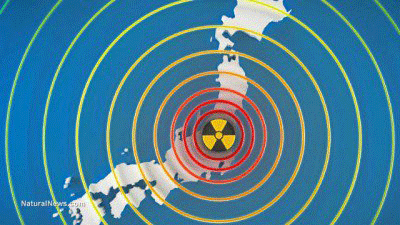
The impact of Japan’s 2011 earthquake and tsunami still ripples through
the country as the nation continues the decommissioning process of the
wrecked Fukushima Daiichi nuclear power plant. In addition to mass
evacuations of the surrounding area, the plant’s meltdown also uncovered
failings by its operator to take proper precautions, resulting in hefty
fines for four former executives.
The latest move involving the failed
plant has brought fresh criticism as Japan’s nuclear regulators approved
a plan to release water from the plant into the ocean, the government said
on Friday. The water, used to cool reactors in the aftermath of the 2011
nuclear disaster, is being stored in huge tanks in the plant, and amounted
to more than 1.3 million tonnes by July. The regulators deemed it safe to
release the water, which will still contain traces of tritium after
treatment, the foreign ministry said in a statement.
Plant operator Tokyo
Electric Power Company (Tepco) would face additional inspections by
regulators, it added. Tepco plans to filter the contaminated water to
remove harmful isotopes apart from tritium, which is hard to remove. Then
it will be diluted and released to free up plant space and allow
decommissioning to continue. The plan has encountered stiff resistance from
fishing unions in the region, which fear its impact on their livelihoods.
Neighbours China, South Korea and Taiwan have also voiced concern.
Irish Independent 24th July 2022
The Royal Society for the Protection of Birds (RSPB) condemns ludicrous Sizewell C planning approval.

The Royal Society for the Protection of Birds (RSPB) has expressed its
disappointment that “ludicrous” plans for a nuclear power plant near the
internationally-important RSPB Minsmere reserve have been approved. RSPB
chief executive Beccy Speight said: “The RSPB is extremely disappointed to
learn that the government has approved plans for Sizewell C, the proposed
new nuclear power station that will affect our nature reserve at Minsmere
in Suffolk.
East Anglian Daily Times 20th July 2022
https://www.eadt.co.uk/news/business/rspb-condemns-ludicrous-sizewell-c-planning-approval-9157422
Anti-nuclear forces gather in Wales

Anti-nuclear campaigners are gathering forces against what they say is a
“repeated narrative” that nuclear energy is viable and helps create
more jobs. PAWB (People Against Wylfa B), CND Cymru, Nuclear Free Local
Authorities, Cymdeithas yr Iaith, CADNO, the Welsh Anti-Nuclear Alliance
and Beyond Nuclear have organised a conference in Caernarfon to air their
views.
North Dot Wales 20th July 2022
Millom and Haverigg being conned by nuclear industry over waste dump, claims former councillor.

A Millom resident, who recently resigned from her local council in disgust
at the shenanigans she witnessed, has claimed that the residents and
elected members of Millom and Haverigg and surrounding villages are
‘being conned’ with lies and false promises from Nuclear Waste Services
and some members of the local South Copeland GDF Community Partnership.
Only last month, Jan Bridget founded the Millom and District against the
Nuclear Dump campaign group as a voice for local people who are opposed to
the proposal to bring a nuclear waste dump to the South-West of Cumbria.
The waste dump or Geological Disposal Facility (as Nuclear Waste Services
prefers to call it) will be final resting place for the high-level
radioactive waste generated by Britain’s civil and military programmes
over the last seventy years.
One catalyst for local opposition has been
NWS’s plan to ‘sound blast’ the Irish Sea to determine if the geology
of the seabed could host the waste dump. Almost 50,000 individuals have
signed an online petition in opposition to the plan, whilst environmental
and conservation groups have registered their concerns that the health of
marine wildlife will be seriously compromised.
To date, the local and national authorities have been deaf to these objections. Over the last
month, the Millom and District group has become an effective local force
opposing plans for a dump. Nearly 400 local people have so far joined, and
members have been active with a protest by 19 local people outside an
NWS-organised community consultation event in Haverigg, and a door-to-door
delivery campaign completed with activists posting almost 5,000 leaflets
through letter boxes. As a member of Millom Town Council, Jan spoke up for
the objectors, but, from the hostile response she received from several
fellow Councillors involved with the Community Partnership, it soon became
clear that her lone voice was unwelcome in the council chamber, and the
atmosphere turned so toxic that Jan felt unable to stay.
NFLA 18th July 2022 https://www.nuclearpolicy.info/news/millom-and-haverigg-being-conned-by-nuclear-industry-over-waste-dump-claims-former-councillor/
Let’s Replicate Chicago’s Antiwar Organizing Victory Against Boeing
Asha Ransby-Sporn & Debbie Southorn, Truthout, July 17, 2022 The news released this spring that Boeing, a corporate weapons manufacturer, is moving its headquarters out of Chicago, Illinois, is a win for the anti-militarist movement and came just weeks after an even more meaningful victory for youth organizers who blocked the company from getting a $2 million tax break before they left.
It’s a victory that organizers like us hope will inspire communities in other cities to target weapons manufacturers who are sucking up public resources via tax breaks and government contracts. By forcing local government to ask questions rather than write blank checks and by telling death-dealing corporations that they are no longer welcome, our movement can undermine the business model of pillaging public budgets in order to reap profit from militarized weapons and violence.
This victory came months after a group of young people blocked traffic to and from Boeing’s corporate headquarters last May, hanging a large banner that read “Boeing Arms Genocide” over the Chicago River that was visible from the corporate offices and commercial walkways in the city’s downtown area. Following escalated assaults on the Palestinian neighborhood of Sheikh Jarrah, which sparked protests around the world, these youth called attention to Boeing’s $735 million weapons sale to Israel, which was approved by the United States State Department in the same weeks as the assault.
In the following months, organizers with the newly formed Boeing Arms Genocide campaign presented to Chicago’s Office of Inspector General (OIG) and to Alderwoman Maria Hadden with a detailed analysis of how Boeing’s Chicago headquarters has reaped more than $60 million in tax breaks while failing to deliver on promises of job creation. (Alderwoman Hadden represents Chicago’s 49th ward, which is home to large immigrant and refugee communities.) This set in motion an OIG inquiry into the contract that had made this arrangement possible. At the end of 2021, for the first year in 20 years, Boeing declined to file for a tax reimbursement worth roughly $2 million. Then in May 2022, its leaders announced their headquarters would be leaving the city.
From the onset of the campaign, organizers had set out to ensure there would be no extension of the contract slated to end in 2021, or any new contract that would allow Boeing to continue benefiting from state and local tax breaks, after they’d received these public checks for two decades. The canvassing, petition drives, teach-ins and meetings with city officials resulted in first-time scrutiny on the company’s compliance with the minimal requirements of the contract. A Freedom of Information Act (FOIA) request confirmed, in the words of the Department of Planning and Development’s Financial Incentives Division Deputy Commissioner Tim Jeffries, “The term of the agreement is over and Boeing has stated they are not seeking reimbursement for the 2021 tax year. The contract is functionally dead.”
Up against a Fortune 500 company, a few hand-painted banners, a little public pressure, and the compelling research of a group of 20-somethings presented to a few city officials might not seem like much. A closer look, however, at the business model of a company like Boeing shows us how much they have to lose from a challenge to the idea that public resources can or should go toward the profits of a weapons manufacturer………………………………. https://truthout.org/articles/lets-replicate-chicagos-antiwar-organizing-victory-against-boeing/?eType=EmailBlastContent&eId=a0819f3e-09e9-4774-9b4a-fd30ff368bb3
Nearly 50,000 people have signed a petition calling for a full council debate and vote on the plans for seismic testing in the Irish Sea.
Anti-nuclear waste campaigners have protested over plans for seismic
testing in the Irish Sea. The research, which uses sound waves, is being
carried out to determine if the seabed contains suitable geology for
underground nuclear waste storage. Mid and South Copeland are among areas
in the UK mooted for what is known as a Geological Disposal Facility (GDF).
Nearly 50,000 people have signed a petition calling for a full council
debate and vote on the plans.
BBC 13th July 2022
Nuclear Free Local Authorities join in Seminar ‘Sizewell C: More Questions than Answers’
As decision day nears on the Sizewell-C development, the Chair and
Secretary of Nuclear Free Local Authorities will be joining local
campaigners opposed to the new build plan at a special conference in
Saxmundham on Saturday 2 July.
Councillor David Blackburn and Richard
Outram are amongst a line-up of speakers who will talk on a range of topics
related to the proposed Sizewell-C and Bradwell nuclear power plant
developments.
The public conference titled ‘Sizewell C: More Questions
than Answers’ is being hosted by local campaign group, Together Against
Sizewell C, at Saxmundham Market Hall, High St, Saxmundham, IP17 1AF from
10am until 1.30pm on Saturday 2nd July. The decision by the Secretary of
State Kwasi Kwarteng to award a Development Consent Order for Sizewell-C is
expected on 8 July, but it is anticipated to be a formality as the Minister
and his Government have already made repeated statements in favour of the
project and have pledged to take a 20% stake in the plant.
Sizewell-C has been in the news recently with media reports that the government’s French
backers, EDF, are threatening to pull out if Ministers do not make a
cast-iron commitment to take their stake by 21 July; that trades unions are
lobbying Minsters for the same commitment citing a threat to jobs; and
because of a spat between Lord Deben, Chair of Parliament’s Climate Change
Committee, and EDF over his challenge to their competence in building new
nuclear power plants and the suitability of the Sizewell-C site.
The prospects for Bradwell in Essex are even more uncertain as Chinese
involvement in British nuclear projects has now been vetoed by the
Government, with a former Conservative Party leader pointedly describing
them as ‘not a trusted vendor’.
NFLA 27th June 2022
International groups mobilise to demand that the European Parliament end plan to greenwash nuclear power.

It is time to retake the streets. In July, the European Parliament will
vote on a new taxonomy for gas and nuclear and a coalition of grassroot
groups and NGOs from across the world will show up and demand MEPs stop
this unbelievable act of greenwashing. Join the mobilisations to
Strasbourg, where the European Parliament will vote on the new taxonomy, in
the week of the 4th of July.
Not My Taxonomy 13th June 2022
Thousands March in Madrid for Peace and “NATO NO”.

Thousands March in Madrid for Peace and “NATO NO”. https://www.telesurenglish.net/news/Thousands-March-in-Madrid-for-Peace-and-NATO-NO—20220626-0005.html&source=gmail&ust=1656372213390000&usg=AOvVaw3X62tTdIvq0p0thk8VygFj The Sao Paulo Forum, the Women’s International Democratic Federation, Ecologists in Action, Pacifists Foundation; Not to war, Not to Nato; Plataforma Madrid and pacifist associations from France, Germany, Norway, Sweden and Italy, among others, emphasized the need to maintain the protests and not allow NATO to dictate the future. The Summit for Peace “NATO NO” that took place in Madrid, reiterated its rejection of militarism, while expressing its repudiation of the Atlantic alliance, and ended its deliberations with the demonstration from Atocha station to Plaza de España.
Some 10 thousand people marched today through the center of the capital in favor of peace and in rejection of the North Atlantic Treaty Organization (NATO), in particular the Summit for Peace “NATO NO” to be held here.
The parade along the Paseo del Prado, passing by the fountain and the Cibeles palace, took the Gran Vía in a march in which emblematic songs such as El pueblo unido, jamás será vencido, by the Chilean Víctor Jara, and La Muralla, based on the verses of the Cuban poet Nicolás Guillén, stood out.
The demonstrators’ posters and statements were dominated by slogans in favor of peace, repudiation of wars and invasions, interference in the internal affairs of nations through the use of military force and disrespect for the sovereignty of peoples by NATO, as well as harsh criticism of the European Union (EU).
In the Final Declaration of the so-called Madrid counter-summit, the participants from various countries indicated that “NATO 360º has become a threat to peace, an obstacle to progress towards shared and demilitarized security”.
They considered that the Atlantic alliance, which will hold its summit meeting on the 29th and 30th at the IFEMA-Madrid fairgrounds, turns its back on the real problems of the planet, namely hunger, disease, inequality, unemployment, lack of public services, land and wealth grabbing, and the climate crisis.
The alternative summit, for Peace, against NATO and against wars, underlines the obligation as a human species, to build and defend peace 360º, from north to south, from east to west. This implies renouncing militarism as a way of dealing with conflicts, said the declaration of the meeting.
The Sao Paulo Forum, the Women’s International Democratic Federation, Ecologists in Action, Pacifists Foundation; Not to war, Not to Nato; Plataforma Madrid and pacifist associations from France, Germany, Norway, Sweden and Italy, among others, emphasized the need to maintain the protests and not allow NATO to dictate the future.
Nuclear Free Local Authorities support Cumbria’s new group opposing Nuclear Waste Dump
The Nuclear Free Local Authorities have written to a new group in Cumbria
endorsing their opposition to plans to develop a nuclear waste dump. Millom
and District Against the Nuclear Dump was only established a few days ago
by a town resident and Councillor, yet the strength of feeling is such that
several hundred local people are now already backing the campaign.
Public feeling is currently running high after recent revelations by the local
campaign group, Radiation Free Lakeland, that seismic testing is due to
take place offshore over the summer. Environmentalists, marine welfare
organisations, residents, and the NFLA have all expressed their opposition
to the testing regime as there is strong scientific evidence that blasting
sound waves into the ocean repeatedly over 3-4 weeks will cause real harm
to marine wildlife.
Millom and District Against the Nuclear Dump is the latest group to manifest its opposition to testing, and in conjunction with Radiation Free Lakeland’s campaign, ‘Keep Cumbrian Coal in the Hole and
Nuclear Waste Out’, there are now joint plans to hold a public protest in
Haverigg this coming Saturday.
Now the Chair of the NFLA Steering
Committee, Councillor David Blackburn has written to the group’s founder,
Jan Bridget, offering the support of Nuclear Free Local Authorities to the
new group. Councillor Blackburn outlined the NFLA’s position on GDF:
“The NFLA has been opposed to a Geological Disposal Facility from the
start. Rather than dumping Britain’s nuclear waste in a big hole in the
ground or under the seabed, we favour near-site, near-surface storage under
rigorous supervision.
NFLA 24th June 2022
A big win for Yeelirrie — Beyond Nuclear International

Indigenous community keeps door closed to uranium mining in Australia
A big win for Yeelirrie — Beyond Nuclear International Cameco delays mean uranium mining permit not extended
By Maggie Wood, Acting Executive Director, Conservation Council of Western Australia
On April 6, we celebrated a huge step forward in our sustained campaign to keep the door closed to uranium mining in Yeelirrie.
The Minister for Environment has rejected an application by the Canadian mining company Cameco to extend their environmental approval for the Yeelirrie uranium mine.
The approval was controversially granted in 2017 in the dying days of the Barnett government and required Cameco to commence mining within five years. They have failed to do this and now they have failed in their bid to have this time extended.
This is a huge win for the local area, the communities nearby and for life itself. The special and unique lives of the smallest of creatures, endemic subterranean fauna found nowhere else on earth, would have most likely been made extinct had this project gone ahead, according to the WA EPA.
For over five decades Traditional Custodians from the Yeelirrie area have fought to protect their Country and community from uranium mining. Over this time they have stood up and overcome three major multinational mining companies – WMC, BHP and now Cameco.
We have stood united with communities to say no to uranium mining and this consistent rejection of the nuclear industry in WA has helped secure the sensible decision to not extend the approval.
“It is possible to stand up to multinational companies and stop major mining projects from destroying sacred lands and environments – we do that from a base of strength in unity and purpose, from persistent and consistent actions and most of all perseverance against all odds to stand up for what is right …” – Kado Muir, Tjiwarl Traditional Custodian.
And this couldn’t have happened without you. Hundreds of supporters like you have spent time on country with Traditional Custodians – listening, walking, connecting with country and standing up for a nuclear free future. Traditional Custodians, unions, faith groups, health groups, environmental groups, the WA and Australian Greens and WA Labor – we’ve all had a big part to play.
Thank you to everyone who has stood up, spoken out, donated, walked, written letters, signed petitions and online actions, bought artwork and t-shirts, volunteered, and organised to say no to uranium mining.
The campaign to protect Yeelirrie is not entirely over. While the approvals can’t be acted on currently, they do still exist, and an amendment could be made by a future government giving Cameco the greenlight to mine.
This is why we are now calling on the State Government to withdraw approvals for Yeelirrie along with expired approvals for Cameco’s Pilbara proposal at Kintyre and Toro Energy’s Wiluna uranium proposal. Doing this would be consistent with WA Labor’s policy and community expectations and – as Vicki Abdullah says – is the next step to a lasting solution.
“We’re really glad to hear the news that Yeelirrie’s approval has not been extended. It was a bad decision in the first place and after years in court and fighting to defend our country this news is a great relief. We will really celebrate properly when this government withdraws approvals altogether and then we can have more confidence the threat is over…” – . – Vicki Abdullah, Tjiwarl Traditional Custodian. https://wordpress.com/read/feeds/72759838/posts/4098309284
Radiation Free Lakeland joins local Haverigg Protest against the GDF (Nuclear Dump)
Today I was delighted to be able to represent LAND our Radiation Free
Lakeland campaign at the Protest against the GDF 2plans by
Locals. Twenty locals turned up today in Haverigg to protest the siting of
a Geological Disposal Facility aka Nuclear Dump for heat generating nuclear
wastes under the Irish Sea off the Millom/Haverigg coast and to stop the
seismic surveys. Millom and District Against the Nuclear Dump have a
private Facebook group with 344 members (in less than a week – mostly
locals).
Radiation Free Lakeland 25th June 2022
1 This Month

of the week – Shut Down Drone Warfare!


Tell the Ukrainian Government to Drop Prosecution of Peace Activist Yurii Sheliazhenko

Petition to revoke the licensing of the Near Surface Nuclear Disposal Facility (NSDF) at Chalk River. https://www.ourcommons.ca/petitions/en/Petition/Details?Petition=e-7247
To see nuclear-related stories in greater depth and intensity – go to https://nuclearinformation.wordpress.com
-
Archives
- April 2026 (114)
- March 2026 (251)
- February 2026 (268)
- January 2026 (308)
- December 2025 (358)
- November 2025 (359)
- October 2025 (376)
- September 2025 (257)
- August 2025 (319)
- July 2025 (230)
- June 2025 (348)
- May 2025 (261)
-
Categories
- 1
- 1 NUCLEAR ISSUES
- business and costs
- climate change
- culture and arts
- ENERGY
- environment
- health
- history
- indigenous issues
- Legal
- marketing of nuclear
- media
- opposition to nuclear
- PERSONAL STORIES
- politics
- politics international
- Religion and ethics
- safety
- secrets,lies and civil liberties
- spinbuster
- technology
- Uranium
- wastes
- weapons and war
- Women
- 2 WORLD
- ACTION
- AFRICA
- Atrocities
- AUSTRALIA
- Christina's notes
- Christina's themes
- culture and arts
- Events
- Fuk 2022
- Fuk 2023
- Fukushima 2017
- Fukushima 2018
- fukushima 2019
- Fukushima 2020
- Fukushima 2021
- general
- global warming
- Humour (God we need it)
- Nuclear
- RARE EARTHS
- Reference
- resources – print
- Resources -audiovicual
- Weekly Newsletter
- World
- World Nuclear
- YouTube
-
RSS
Entries RSS
Comments RSS
 nuclear-news