Critique No 3 [a boys-with-toys view] -BBC documentary Building Britain’s Biggest Nuclear Power Station

Building Britain’s Biggest Nuclear Power Station, BBC2, review: A boys-and-their-toys view of a divisive build. Much of the programme is devoted to emphasising just how big the plant will be: we are shown a tunnelling machine so enormous it requires a police cavalcade; we are treated to front-row seats for the “largest continuous cement pour in the UK”; we learn that Hinkley’s canteens consume 316 tons of baked beans a year.
iNews 2nd June 2021
Critique No 2 of BBC documentary Building Britain’s Biggest Nuclear Power Station
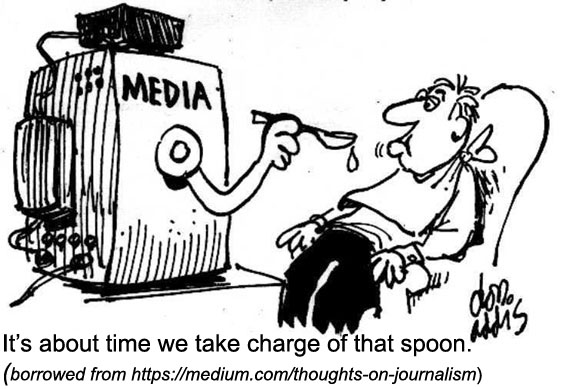
Building Britain’s Biggest Nuclear Power Station, review: why didn’t this film ask the real questions? It seemed a little odd for one local’s (admittedly very valid) complaints about traffic to be given more airtime than, say, worries over industrial espionage in a project part-funded by the Chinese state, or of ballooning budgets (from £18 billion to
£22 billion).
Two of its three intended predecessors in Finland and France remain on ice owing to “concerns over cost and quality”, a phrase both vague and serious enough to warrant further enquiry, yet any doubts were confined to the voiceover and not put to the people involved.
Telegraph 2nd June 2021
Critique No 1 of BBC documentary Building Britain’s Biggest Nuclear Power Station
One cynical but reliable rule of thumb when reporting official statements is that the more often a fact is emphasised, the less likely it is to be true. The first time we were told on Building Britain’s Biggest Nuclear
Power Station (BBC2) that the new Hinkley Point C reactor will be able to withstand the impact of a plane crash, I was mildly reassured.
After the third or fourth repetition, I was quite uneasy. And when the last 15 minutes of the opening episode in this two-parter were devoted to explaining exactly how marvellously plane-proof the design is, panic was setting in. For all the talk of double-skinned, nuclear-grade concrete and X-rayed metal seals, it was pretty obvious that one misplaced Airbus is all it takes, and Goodbye Somerset.
Daily Mail 3rd June 2021
“Fallout: The Hiroshima Cover-up and the Reporter Who Revealed It to the World”

A secondary theme in the book is the role of a free press. Blume observes that “Hersey and his New Yorker editors created `Hiroshima’ in the belief that journalists must hold accountable those in power. They saw a free press as essential to the survival of democracy.” She does, too.
Review: Lesley Blume’s “Fallout: The Hiroshima Cover-up and the Reporter Who Revealed It to the World”, Portside, June 1, 2021 Lawrence Wittner In this crisply written, well-researched book, Lesley Blume, a journalist and biographer, tells the fascinating story of the background to John Hersey’s pathbreaking article “Hiroshima,” and of its extraordinary impact upon the world.
In 1945, although only 30 years of age, Hersey was a very prominent war correspondent for Time magazine—a key part of publisher Henry Luce’s magazine empire………..
Blume reveals that, at the time of the U.S. atomic bombing of Hiroshima, Hersey felt a sense of despair—not for the bombing’s victims, but for the future of the world. He was even more disturbed by the atomic bombing of Nagasaki only three days later, which he considered a “totally criminal” action that led to tens of thousands of unnecessary deaths.
…………. Blume shows very well how this approval of the atomic bombing was enhanced by U.S. government officials and the very compliant mass communications media. Working together, they celebrated the power of the new American weapon that, supposedly, had brought the war to an end, producing articles lauding the bombing mission and pictures of destroyed buildings. What was omitted was the human devastation, the horror of what the atomic bombing had done physically and psychologically to an almost entirely civilian population—the flesh roasted off bodies, the eyeballs melting, the terrible desperation of mothers digging with their hands through the charred rubble for their dying children.
The strange new radiation sickness produced by the bombing was either denied or explained away as of no consequence. “Japanese reports of death from radioactive effects of atomic bombing are pure propaganda,” General Leslie Groves, the head of the Manhattan Project, told the New York Times. Later, when, it was no longer possible to deny the existence of radiation sickness, Groves told a Congressional committee that it was actually “a very pleasant way to die.”
When it came to handling the communications media, U.S. government officials had some powerful tools at their disposal. In Japan, General Douglas MacArthur, the supreme commander of the U.S. occupation regime, saw to it that strict U.S. military censorship was imposed on the Japanese press and other forms of publication, which were banned from discussing the atomic bombing. As for foreign newspaper correspondents (including Americans), they needed permission from the occupation authorities to enter Japan, to travel within Japan, to remain in Japan, and even to obtain food in Japan. American journalists were taken on carefully controlled junkets to Hiroshima, after which they were told to downplay any unpleasant details of what they had seen there.
In September 1945, U.S. newspaper and magazine editors received a letter from the U.S. War Department, on behalf of President Harry Truman, asking them to restrict information in their publications about the atomic bomb. If they planned to do any publishing in this area of concern, they were to submit the articles to the War Department for review…………
Hersey had concluded that the mass media had missed the real story of the Hiroshima bombing. And the result was that the American people were becoming accustomed to the idea of a nuclear future, with the atomic bomb as an acceptable weapon of war. Appalled by what he had seen in the Second World War—from the firebombing of cities to the Nazi concentration camps—Hersey was horrified by what he called “the depravity of man,” which, he felt, rested upon the dehumanization of others. Against this backdrop, Hersey and Shawn concluded that he should try to enter Japan and report on what had really happened there……….
Hersey arrived in Tokyo on May 24, 1946, and two days later, received permission to travel to Hiroshima, with his time in that city limited to 14 days.
Entering Hiroshima, Hersey was stunned by the damage he saw. In Blume’s words, there were “miles of jagged misery and three-dimensional evidence that humans—after centuries of contriving increasingly efficient ways to exterminate masses of other humans—had finally invented the means with which to decimate their entire civilization.” Now there existed what one reporter called “teeming jungles of dwelling places . . . in a welter of ashes and rubble.” As residents attempted to clear the ground to build new homes, they uncovered masses of bodies and severed limbs. A cleanup campaign in one district of the city alone at about that time unearthed a thousand corpses. Meanwhile, the city’s surviving population was starving, with constant new deaths from burns, other dreadful wounds, and radiation poisoning.
Given the time limitations of his permit, Hersey had to work fast. And he did, interviewing dozens of survivors, although he eventually narrowed down his cast of characters to six of them.
……… Ross and Shawn decided to keep the explosive forthcoming issue a top secret from the magazine’s staff.
Given the time limitations of his permit, Hersey had to work fast. And he did, interviewing dozens of survivors, although he eventually narrowed down his cast of characters to six of them.
……… Ross and Shawn decided to keep the explosive forthcoming issue a top secret from the magazine’s staff.
Groves believed that the Japanese deserved what had happened to them, and could not imagine that other Americans might disagree. ………. and he believed that an article that led Americans to fear nuclear attacks by other nations would foster support for a U.S. nuclear buildup.
The gamble paid off. Although Groves did demand changes, these were minor and did not affect the accounts by the survivors…….
On August 29, 1946, copies of the “Hiroshima” edition of the New Yorker arrived on newsstands and in mailboxes across the United States, and it quickly created an enormous sensation, particularly in the mass media. Editors from more than thirty states applied to excerpt portions of the article, and newspapers from across the nation ran front-page banner stories and urgent editorials about its revelations. Correspondence from every region of the United States poured into the New Yorker’s office. A large number of readers expressed pity for the victims of the bombing. But an even greater number expressed deep fear about what the advent of nuclear war meant for the survival of the human race.
Of course, not all readers approved of Hersey’s report on the atomic bombing. Some reacted by canceling their subscriptions to the New Yorker. Others assailed the article as antipatriotic, Communist propaganda, designed to undermine the United States. Still others dismissed it as pro-Japanese propaganda or, as one reader remarked, written “in very bad taste.”
………………………… The conclusion drawn by Blume in this book is much like Hersey’s. As she writes, “Graphically showing what nuclear warfare does to humans, `Hiroshima’ has played a major role in preventing nuclear war since the end of World War II.”
A secondary theme in the book is the role of a free press. Blume observes that “Hersey and his New Yorker editors created `Hiroshima’ in the belief that journalists must hold accountable those in power. They saw a free press as essential to the survival of democracy.” She does, too.
………… Blume has written a very illuminating, interesting, and important work—one that reminds us that daring, committed individuals can help to create a better world.https://portside.org/2021-06-01/review-lesley-blumes-fallout-hiroshima-cover-and-reporter-who-revealed-it-world
How Bill Gates bankrolls the news agenda.

Nowhere does this concern loom larger than with the Gates Foundation, a leading donor to newsrooms and a frequent subject of favorable news coverage.
During the pandemic, news outlets have widely looked to Bill Gates as a public health expert on covid—even though Gates has no medical training and is not a public official.
PolitiFact and USA Today (run by the Poynter Institute and Gannett, respectively—both of which have received funds from the Gates Foundation) have even used their fact-checking platforms to defend Gates from “false conspiracy theories” and “misinformation,” like the idea that the foundation has financial investments in companies developing covid vaccines and therapies. In fact, the foundation’s website and most recent tax forms clearly show investments in such companies, including Gilead and CureVac.
critical questions about journalists’ tendency to cover the Gates Foundation as a dispassionate charity instead of a structure of power.
Journalism’s Gates keepers, Columbia Journalism Review, By Tim Schwab AUGUST 21, 2020 ,
LAST AUGUST, NPR PROFILED A HARVARD-LED EXPERIMENT to help low-income families find housing in wealthier neighborhoods, giving their children access to better schools and an opportunity to “break the cycle of poverty.” According to researchers cited in the article, these children could see $183,000 greater earnings over their lifetimes—a striking forecast for a housing program still in its experimental stage.
If you squint as you read the story, you’ll notice that every quoted expert is connected to the Bill & Melinda Gates Foundation, which helps fund the project. And if you’re really paying attention, you’ll also see the editor’s note at the end of the story, which reveals that NPR itself receives funding from Gates..
NPR’s funding from Gates “was not a factor in why or how we did the story,” reporter Pam Fessler says, adding that her reporting went beyond the voices quoted in her article. The story, nevertheless, is one of hundreds NPR has reported about the Gates Foundation or the work it funds, including myriad favorable pieces written from the perspective of Gates or its grantees.
And that speaks to a larger trend—and ethical issue—with billionaire philanthropists’ bankrolling the news. The Broad Foundation, whose philanthropic agenda includes promoting charter schools, at one point funded part of the LA Times’ reporting on education. Charles Koch has made charitable donations to journalistic institutions such as the Poynter Institute, as well as to news organizations such as the Daily Caller News Foundation, that support his conservative politics. And the Rockefeller Foundation funds Vox’s Future Perfect, a reporting project that examines the world “through the lens of effective altruism”—often looking at philanthropy.
As philanthropists increasingly fill in the funding gaps at news organizations—a role that is almost certain to expand in the media downturn following the coronavirus pandemic—an underexamined worry is how this will affect the ways newsrooms report on their benefactors. Nowhere does this concern loom larger than with the Gates Foundation, a leading donor to newsrooms and a frequent subject of favorable news coverage.
I recently examined nearly twenty thousand charitable grants the Gates Foundation had made through the end of June and found more than $250 million going toward journalism. Recipients included news operations like the BBC, NBC, Al Jazeera, ProPublica, National Journal, The Guardian, Univision, Medium, the Financial Times, The Atlantic, the Texas Tribune, Gannett, Washington Monthly, Le Monde, and the Center for Investigative Reporting; charitable organizations affiliated with news outlets, like BBC Media Action and the New York Times’ Neediest Cases Fund; media companies such as Participant, whose documentary Waiting for “Superman” supports Gates’s agenda on charter schools; journalistic organizations such as the Pulitzer Center on Crisis Reporting, the National Press Foundation, and the International Center for Journalists; and a variety of other groups creating news content or working on journalism, such as the Leo Burnett Company, an ad agency that Gates commissioned to create a “news site” to promote the success of aid groups. In some cases, recipients say they distributed part of the funding as subgrants to other journalistic organizations—which makes it difficult to see the full picture of Gates’s funding into the fourth estate.
The foundation even helped fund a 2016 report from the American Press Institute that was used to develop guidelines on how newsrooms can maintain editorial independence from philanthropic funders. A top-level finding: “There is little evidence that funders insist on or have any editorial review.” Notably, the study’s underlying survey data showed that nearly a third of funders reported having seen at least some content they funded before publication.
Gates’s generosity appears to have helped foster an increasingly friendly media environment for the world’s most visible charity. Twenty years ago, journalists scrutinized Bill Gates’s initial foray into philanthropy as a vehicle to enrich his software company, or a PR exercise to salvage his battered reputation following Microsoft’s bruising antitrust battle with the Department of Justice. Today, the foundation is most often the subject of soft profiles and glowing editorials describing its good works.
During the pandemic, news outlets have widely looked to Bill Gates as a public health expert on covid—even though Gates has no medical training and is not a public official. PolitiFact and USA Today (run by the Poynter Institute and Gannett, respectively—both of which have received funds from the Gates Foundation) have even used their fact-checking platforms to defend Gates from “false conspiracy theories” and “misinformation,” like the idea that the foundation has financial investments in companies developing covid vaccines and therapies. In fact, the foundation’s website and most recent tax forms clearly show investments in such companies, including Gilead and CureVac.
In the same way that the news media has given Gates an outsize voice in the pandemic, the foundation has long used its charitable giving to shape the public discourse on everything from global health to education to agriculture—a level of influence that has landed Bill Gates on Forbes’s list of the most powerful people in the world. The Gates Foundation can point to important charitable accomplishments over the past two decades—like helping drive down polio and putting new funds into fighting malaria—but even these efforts have drawn expert detractors who say that Gates may actually be introducing harm, or distracting us from more important, lifesaving public health projects.
From virtually any of Gates’s good deeds, reporters can also find problems with the foundation’s outsize power, if they choose to look. But readers don’t hear these critical voices in the news as often or as loudly as Bill and Melinda’s. News about Gates these days is often filtered through the perspectives of the many academics, nonprofits, and think tanks that Gates funds. Sometimes it is delivered to readers by newsrooms with financial ties to the foundation.
In the same way that the news media has given Gates an outsize voice in the pandemic, the foundation has long used its charitable giving to shape the public discourse on everything from global health to education to agriculture—a level of influence that has landed Bill Gates on Forbes’s list of the most powerful people in the world. The Gates Foundation can point to important charitable accomplishments over the past two decades—like helping drive down polio and putting new funds into fighting malaria—but even these efforts have drawn expert detractors who say that Gates may actually be introducing harm, or distracting us from more important, lifesaving public health projects.
From virtually any of Gates’s good deeds, reporters can also find problems with the foundation’s outsize power, if they choose to look. But readers don’t hear these critical voices in the news as often or as loudly as Bill and Melinda’s. News about Gates these days is often filtered through the perspectives of the many academics, nonprofits, and think tanks that Gates funds. Sometimes it is delivered to readers by newsrooms with financial ties to the foundation.
……. In 2015, Vox ran an article examining the widespread uncritical journalistic coverage surrounding the foundation—coverage that comes even as many experts and scholars raise red flags. Vox didn’t cite Gates’s charitable giving to newsrooms as a contributing factor, nor did it address Bill Gates’s month-long stint as guest editor for The Verge, a Vox subsidiary, earlier that year. Still, the news outlet did raise critical questions about journalists’ tendency to cover the Gates Foundation as a dispassionate charity instead of a structure of power.
Five years earlier, in 2010, CJR published a two-part series that examined, in part, the millions of dollars going toward PBS NewsHour, which it found to reliably avoid critical reporting on Gates.
In 2011, the Seattle Times detailed concerns over the ways in which Gates Foundation funding might hamper independent reporting:
To garner attention for the issues it cares about, the foundation has invested millions in training programs for journalists. It funds research on the most effective ways to craft media messages. Gates-backed think tanks turn out media fact sheets and newspaper opinion pieces. Magazines and scientific journals get Gates money to publish research and articles. Experts coached in Gates-funded programs write columns that appear in media outlets from The New York Times to The Huffington Post, while digital portals blur the line between journalism and spin………
These stories offered compelling evidence of Gates’s editorial influence, but they didn’t attempt to investigate the full scope of the foundation’s financial reach into the fourth estate…………
NPR does occasionally hold a critical lens to the Gates Foundation. Last September, it covered a decision by the foundation to give a humanitarian award to Indian prime minister Narendra Modi, despite Modi’s dismal record on human rights and freedom of expression. (That story was widely covered by news outlets—a rare bad news cycle for Gates.)
On the same day, the foundation appeared in another NPR headline: “Gates Foundation Says World Not on Track to Meet Goal of Ending Poverty by 2030.” That story cites only two sources: the Gates Foundation and a representative from the Center for Global Development, a Gates-funded NGO. The lack of independent perspectives is hard to miss. Bill Gates is the second-richest man in the world and might reasonably be viewed as a totem of economic inequality, but NPR has transformed him into a moral authority on poverty.
Given Gates’s large funding role at NPR, one could imagine editors insisting that reporters seek out financially independent voices or include sources who can offer critical perspectives. (Many NPR stories on Gates don’t: here, here, here, here, here, here.) Likewise, NPR could seek a measure of independence from Gates by rejecting donations that are earmarked for reporting on Gates’s favored topics.
Even when NPR publishes critical reporting on Gates, it can feel scripted. In February 2018, NPR ran a story headlined “Bill Gates Addresses ‘Tough Questions’ on Poverty and Power.” The “tough questions” NPR posed in this Q&A were mostly based on a list curated by Gates himself, which he previously answered in a letter posted to his foundation’s website. With no irony at all, reporter Ari Shapiro asked, “How do you…encourage people to be frank with you, even at risk of perhaps alienating their funder?”
……………… If critical reporting about the Gates Foundation is rare, it is largely beside the point in “solutions journalism,” a new-ish brand of reporting that focuses on solutions to problems, not just the problems themselves. That more upbeat orientation has drawn the patronage of the Gates Foundation, which directed $6.3 million to the Solutions Journalism Network (SJN) to train journalists and fund reporting projects. Gates is the largest donor to SJN—supplying around one-fifth of the organization’s lifetime funding. SJN says more than half of this money has been distributed as subgrants, including to Education Lab, its partnership with the Seattle Times.
………… Even perfect disclosure of Gates funding doesn’t mean the money can’t still introduce bias. At the same time, Gates funding, alone, doesn’t fully explain why so much of the news about the foundation is positive. Even news outlets with no obvious financial ties to Gates—the foundation isn’t required to publicly report all of the money it gives to journalism, making the full extent of its giving unknown—tend to report favorably on the foundation. That may be because Gates’s expansive giving over the decades has helped influence a larger media narrative about its work. And it may also be because the news media is always, and especially right now, looking for heroes.
A larger worry is the precedent the prevailing coverage of Gates sets for how we report on the next generation of tech billionaires–turned-philanthropists, including Jeff Bezos and Mark Zuckerberg. Bill Gates has shown how seamlessly the most controversial industry captain can transform his public image from tech villain to benevolent philanthropist. Insofar as journalists are supposed to scrutinize wealth and power, Gates should probably be one of the most investigated people on earth—not the most admired. A larger worry is the precedent the prevailing coverage of Gates sets for how we report on the next generation of tech billionaires–turned-philanthropists, including Jeff Bezos and Mark Zuckerberg. Bill Gates has shown how seamlessly the most controversial industry captain can transform his public image from tech villain to benevolent philanthropist. Insofar as journalists are supposed to scrutinize wealth and power, Gates should probably be one of the most investigated people on earth—not the most admired. https://www.cjr.org/criticism/gates-foundation-journalism-funding.php
Rising threat of nuclear war is barely noticed. Corporate media likes it that way.
Rising Threat of Nuclear War Is Barely Noticed, Consortium news, By Caitlin Johnstone
CaitlinJohnstone.com 23 Apr 21, U.S. Strategic Command, the branch of the U.S. military responsible for America’s nuclear arsenal, tweeted the following on Tuesday:
“The spectrum of conflict today is neither linear nor predictable. We must account for the possibility of conflict leading to conditions which could very rapidly drive an adversary to consider nuclear use as their least bad option.”
STRATCOM called it a preview of the “posture statement” it submits to U.S. Congress every year. It was a bit intense for Twitter and sparked a lot of alarmed responses. This alarm was due not to any inaccuracy in STRATCOM’s frank statement, but due to the bizarre fact that our world’s increasing risk of nuclear war barely features in mainstream discourse.
STRATCOM has been preparing not just to use its nuclear arsenal for deterrence but also to “win” a nuclear war should one arise from the (entirely U.S. -created) “conditions” which are “neither linear nor predictable.”
And it’s looking increasingly likely that one will as the prevailing orthodoxy among Western imperialists that U.S. unipolar hegemony must be preserved at all cost rushes headlong toward America’s plunge into post-primacy.
The U.S. has been ramping up aggressions with Russia in a way that has terrified experts, and it looks likely to continue doing so. These aggressions are further complicated on increasingly tense fronts like Ukraine, which is threatening to obtain nuclear weapons if it isn’t granted membership to NATO, either of which would increase the risk of conflict.
Aggressions against nuclear-armed China are escalating on what seems like a daily basis at this point, with potential flashpoints in the China Seas, Taiwan, Xinjiang, Hong Kong, India and any number of other possible fronts………
The fact that those in charge of U.S. nuclear weapons now see both Russia and China as a major nuclear threat, and the fact that U.S. cold warriors are escalating against both of them, is horrifying.
The fact that they’re again playing with “low-yield” nukes designed to actually be used on the battlefield makes it even more so. This is to say nothing of tensions between nuclear-armed Pakistan and nuclear-armed India, between nuclear-armed Israel and its neighbors, and between nuclear-armed North Korea and the Western empire.
The Bulletin of the Atomic Scientists has the 2021 Doomsday Clock at 100 seconds to midnight, citing the rising threat of nuclear war:……………
As I all too frequently find myself having to remind people, the primary risk here is not that anyone will choose to have a nuclear war, it’s that a nuke will be deployed amid heightening tensions as a result of miscommunication, miscalculation, misfire, or malfunction, as nearly happened many times during the last Cold War, thereby setting off everyone’s nukes as per Mutually Assured Destruction.
The more tense things get, the likelier such an event becomes. This New Cold War is happening along two fronts, with a bunch of proxy conflicts complicating things even further. There are so very many small moving parts, and it’s impossible to remain in control of all of them.
Thousands of Starter Buttons
People like to think every nuclear-armed country has one “The Button” with which they can consciously choose to start a nuclear war after careful deliberation, but it doesn’t work that way.
There are thousands of people in the world controlling different parts of different nuclear arsenals who could independently initiate a nuclear war. Thousands of “The Buttons.” It only takes one. The arrogance of believing anyone can control such a conflict safely, for years, is astounding.
A 2014 report published in the journal Earth’s Future found that it would only take the detonation of 100 nuclear warheads to throw 5 teragrams of black soot into the Earth’s stratosphere for decades, blocking out the sun and making the photosynthesis of plants impossible. This could easily starve every terrestrial organism to death that didn’t die of radiation or climate chaos first. China has hundreds of nuclear weapons; Russia and the United States have thousands.
This should be the main thing everyone talks about. There is literally no more urgent matter on earth than the looming possibility that everyone might die in a nuclear war.
But people don’t see it.
On a recent “Tucker Carlson Tonight” appearance, former Congresswoman Tulsi Gabbard did a solid job describing the horrors of nuclear war and the very real possibility that it could be inflicted upon the U.S. due to America’s insane brinkmanship with Russia. She spoke earnestly about how “such a war would come at a cost beyond anything we can really imagine,” painting an entirely accurate picture of “hundreds of millions of people dying and suffering, seeing their flesh being burned from their bones.”
Gabbard is correct, and was right to give such a confrontational account of what we are looking at right now. But if you read the replies to Gabbard’s tweet in which she shared a clip from the interview, you’ll see a deluge of commenters accusing her of “hyperbole,” saying she’s being soft on Russian President Vladimir Putin and admonishing her for appearing on Tucker Carlson. It’s like they can’t even hear what she’s saying, how real it is, how significant it is.
Normalcy Bias & Media Malpractice
People’s failure to wrap their minds around this issue is a testament to the power of normalcy bias, a cognitive glitch which causes the U.S. to assume that because something bad hasn’t happened in the past, it won’t happen in the future. We survived the last Cold War by the skin of our teeth, entirely by sheer, dumb luck; the only reason people are around to bleat “hyperbole” is because we got lucky. There’s no reason to believe we’ll get lucky in this New Cold War environment; only normalcy bias says we will. Believing we’ll survive this Cold War just because we survived the last one is as sane as believing Russian roulette is safe because the guy passing you the gun didn’t die.
It’s also a testament to the power of plain old psychological compartmentalization. People can’t handle the idea of everything ending, of everyone they know and love dying, of watching their loved ones die in flames or from radiation poisoning right in front of them, all because someone made a mistake at the wrong time after a bunch of imperialists decided that U.S. planetary domination was worth putting every terrestrial organism at risk.
But mostly it’s testament to the ubiquitous malpractice of the Western media. It’s inconvenient to the agendas of the imperial war machine to have people protesting these insane Cold War games of nuclear brinkmanship, so their media stenographers barely touch on this issue. If mainstream journalism actually existed, this flirtation with nuclear war would be front and center in everyone’s awareness and people would be flooding the streets in protest against their lives being toyed with as casino chips in an insane all-or-nothing gamble.
This is so much bigger than any of the petty little things we spend our mental energy on from day to day……….The rising threat of nuclear war is the most urgent matter in the world and it’s absolute madness that we’re not talking about it all the time. https://consortiumnews.com/2021/04/23/rising-threat-of-nuclear-war-is-barely-noticed/
Attachments areaPreview YouTube video Tulsi Gabbard issues warning about potential war with RussiaTulsi Gabbard issues warning about potential war with RussiaPreview YouTube video Vasili Arkhipov: HeroVasili Arkhipov: Hero
Two years since Julian Assange was seized from the Ecuadorian Embassy
the Biden administration has continued Trump’s pursuit of the WikiLeaks founder—in 2010, Biden had labelled him a “high-tech terrorist”.

Two years since Assange was seized from the Ecuadorian Embassy, World Socialist Website, Thomas Scripps, 9 April 2021 Two years ago on Sunday, WikiLeaks founder Julian Assange was seized from the Ecuadorian embassy in London. He has been incarcerated ever since, fighting extradition to the United States where he faces life imprisonment in barbaric conditions for exposing war crimes, coup plots, mass state surveillance, torture and corruption.
On April 11, 2019, Assange’s political asylum status was revoked by the Ecuadorian government and British police entered the embassy building, dragging him away. The recently published diaries of former Foreign Office minister Sir Alan Duncan confirm the involvement of the highest levels of the state in this lawless operation.
Duncan explains how he watched the police raid on a live feed from the “Operations Room at the top of the Foreign Office.” Codenamed “Pelican”, Duncan recalled how one of its officials looked on, “wearing a pelican-motif tie.” Duncan’s diary entry concludes, “So, job done at last—and we take a commemorative photo of Team Pelican. It had taken many months of patient diplomatic negotiation, and in the end it went off without a hitch. I do millions of interviews, trying to keep the smirk off my face.”
The sadism of the British state’s snatch-and-grab operation was matched only by the degraded efforts of the pseudo-left to vilify Assange and blacken his reputation in support of a manufactured sexual assault investigation launched by Sweden in 2010. Rightly fearing that his extradition to Sweden would be a stepping-stone to US extradition, Assange sought asylum in the Ecuadorian embassy. While he was there, his former “media partners”, most prominently the Guardian, and an international roll call of pseudo-left groups, launched a despicable years’ long slander campaign to smear him as a sexual predator………………
The Trump administration, it was later revealed, was working with the CIA to spy on Assange, including his privileged communications with lawyers and doctors, and to steal his personal documents. CIA operatives discussed plans for Assange’s kidnap or assassination, until Ecuadorian President Lenin Moreno agreed to turn him over to the UK police.
Once in the hands of the British state, Assange was subjected to two years of pseudo-legal persecution, culminating in a degrading show trial. Hauled in front of Westminster Magistrates Court just hours after he was seized from the embassy, Assange was found guilty of violating bail. District judge Michael Snow declared, “His assertion that he has not had a fair hearing is laughable. And his behaviour is that of a narcissist who cannot get beyond his own selfish interests.”………..
Assange’s time in Belmarsh was characterised by the repeated and flagrant denial of his legal rights, aimed at crushing him and which left him suicidal. He was repeatedly denied proper access to his lawyers and to materials necessary to prepare his defence. When Assange reached the end of his sentence, District Judge Vanessa Baraitser ordered that he continue to be held in Belmarsh on remand. During the initial week of Assange’s extradition hearing, held in February 2020 at Woolwich Crown Court, he was held in a glass box, with Baraitser preventing him from speaking or communicating effectively with his lawyers. He was stripped twice and handcuffed 11 times on the first day.
In the run-up to the main hearing at Westminster Magistrates Court in September 2020, Assange was repeatedly denied bail, even as COVID-19, to which he is especially vulnerable on account of a respiratory condition, ripped through Belmarsh prison.
The US government used this time to develop its monstrous assault on democratic rights. The initial indictment of the WikiLeaks founder, unsealed on the day of his seizure from the embassy, charged him with conspiracy to commit computer intrusion, with a maximum sentence of five years. On May 23, 2019, the US unveiled 17 new charges under the 1918 Espionage Act with a combined potential sentence of 170 years. These charges have chilling implications for freedom of the press, criminalising basic journalistic practices and holding them tantamount to treason or espionage.
Another superseding indictment was issued on June 24, 2020, after one phase of Assange’s hearing had been completed and a matter of weeks before the defence was due to submit its skeleton argument for the second. Besides being a gross abuse of due process, the new indictment, based largely on testimony from FBI informants with histories of fraud and entrapment, expanded the framework of the charges to an even wider range of journalistic activity.
The immense significance of WikiLeaks’ and Assange’s journalism, and the criminality of their persecution, was underscored at his hearing in September. Dozens of witnesses spoke to WikiLeaks’ pioneering source protection and the global impact of releases like the Collateral Murder video, revealing the massacre of Iraqi civilians, journalists and first responders by a US Apache helicopter gunship. The US case was exposed as a groundless, vindictive witch-hunt designed to destroy Assange and set a dictatorial precedent for what will happen to any journalists who dare expose imperialist crimes.
With a ruling in favour of extradition considered all but assured, Baraitser delivered a surprise decision against on January 4 of this year. But her politically calculated ruling blocked the extradition request solely on the grounds that it would be oppressive by reason of Assange’s compromised mental health and his risk of suicide if he were imprisoned in the US. She accepted every other element of the prosecution’s case, including its denial of free speech and freedom of the press, and its justification of the abuse of Assange’s democratic rights.
This left the gate wide open to a US appeal. The US Department of Justice quickly responded, “While we are extremely disappointed in the court’s ultimate decision, we are gratified that the United States prevailed on every point of law raised. In particular, the court rejected all of Mr. Assange’s arguments regarding political motivation, political offense, fair trial, and freedom of speech. We will continue to seek Mr. Assange’s extradition to the United States.”………
the Biden administration has continued Trump’s pursuit of the WikiLeaks founder—in 2010, Biden had labelled him a “high-tech terrorist”. As the World Socialist Web Site and the International Committee of the Fourth International (ICFI) have warned, Assange’s persecution is integral to the war drive of US imperialism, escalated by Trump and now intensified by his successor.
Biden has engaged in an aggressive anti-China campaign and is whipping up anti-Chinese xenophobia at home, promoting conspiracy theories on the origin of COVID-19. The US and its allies stand on a cliff edge with Russia over Crimea and eastern Ukraine, with NATO’s endless anti-Russia provocations and proxy incursions threatening to spill into war.
Military conflicts of such catastrophic scope can only be pursued abroad by destroying democratic rights at home. WikiLeaks’ releases of the Afghanistan and Iraq war logs were a spark to mass anti-war sentiment all over the world. The ruling class in the imperialist countries around the world are determined to prevent their war plans and crimes being reported and have sought to crack down on left-wing, socialist and anti-war opposition. The Assange case is emblematic of this turn to dictatorship.
In the two years since Assange’s arrest, two sharply opposed political perspectives have defined themselves in the fight for his freedom. The official campaign, run by Don’t Extradite Assange (DEA), has based itself on rotten appeals to the state and its representatives. The DEA’s first champion was former Labour leader Jeremy Corbyn. Throughout the 2019 general election, as leader of the Labour Party, Corbyn maintained a politically criminal silence on Assange, blocking the development of a mass movement against British and US imperialism to secure his freedom. When Corbyn did finally speak, it was to appeal to Boris Johnson and the British justice system that had trampled Assange’s democratic rights………..
The pandemic has proved beyond all doubt that there is no constituency in the ruling class for even the most basic democratic rights, including the right to protest and assembly and the right to life. It has responded to the virus with a policy of social murder and by advancing its preparations for state repression and war on a vast scale……….
On the second anniversary of the WikiLeaks founder’s seizure, we reaffirm our demand for Assange’s immediate, unconditional freedom and our commitment to a programme of class struggle to achieve it. https://www.wsws.org/en/articles/2021/04/10/assa-j01.html?pk_campaign=assange-newsletter&pk_kwd=wsws
The Asahi Shimbun continues to warn against nuclear power -Japan’s rik of another “Fukushima -type” disaster
Asahi Shimbun 12th March 2021, Four months after the Fukushima nuclear disaster, The Asahi Shimbun called on Japan to pursue a future without atomic energy. An opinion piece published in July 2011 said, “Japan should build a society that does not depend on nuclear power generation as soon as possible.”
Since then, The Asahi Shimbun has repeatedly asserted the importance of phasing out nuclear
power generation in editorials and other stories. Our argument for weaning our nation from the use of atomic energy is driven by the fear that another nuclear accident would threaten the survival of Japanese society.
Review of film ”Fukushima 50”
Fukushima 50 review – simmering tribute to power-plant heroes https://www.theguardian.com/film/2021/mar/08/fukushima-50-review-ken-watanabe-in-simmering-tribute-to-power-plant-heroes
There’s a touch of Hollywood in this dramatised account of the 50 workers who stayed at Fukushima Daiichi in an attempt to avert catastrophe Phil Hoad, @phlode, Tue 9 Mar 2021
It is possible director Setsurō Wakamatsu has taken the Hollywood route in portraying the staff as so infallibly courageous – though Fukushima 50 is adapted from journalist Ryusho Kadota’s book, which investigated the response to the earthquake and tsunami in more than 90 interviews. Possibly to avoid lawsuits from Tokyo Electric Power Company executives portrayed here as selfish and shamefully caught on a back foot, everyone in the film is fictionalised – except for prime minister Naoto Kan, though he is never referred to by name, and plant manager Masao Yoshida. Yoshida crucially defies orders and allows the reactors to be cooled with seawater – which prevented meltdown and the possible devastation of Japan’s entire eastern seaboard. The reactors also must be “vented” for pressure manually by workers agonisingly selected for the task. Played by Ken Watanabe as a man having the ultimate bad day at work, the simmering Yoshida looks in need of a similar intervention.
Wakamatsu treats his account of these critical hours – the first direct depiction of the disaster, though Sion Sono’s Himizu (2011) was a poetic first responder – like a machine to be kept running at all costs. Often it consists of little more than technicians pelting into crisis rooms, adhering to the Akira school of screaming, with shocking gas-pressure read-outs. The civilian backstories are token, and though the film is critical of the brass, it doesn’t let this anger break into climactic outrage. Yoshida died in 2013 of unrelated oesophageal cancer: Watanabe’s big-shouldered presence makes this an ample tribute to the man, but the film could have been more than an easy clap for his workers.
Fukushima 50 is available from 8 March on digital formats.
Isolated and alone — Beyond Nuclear International
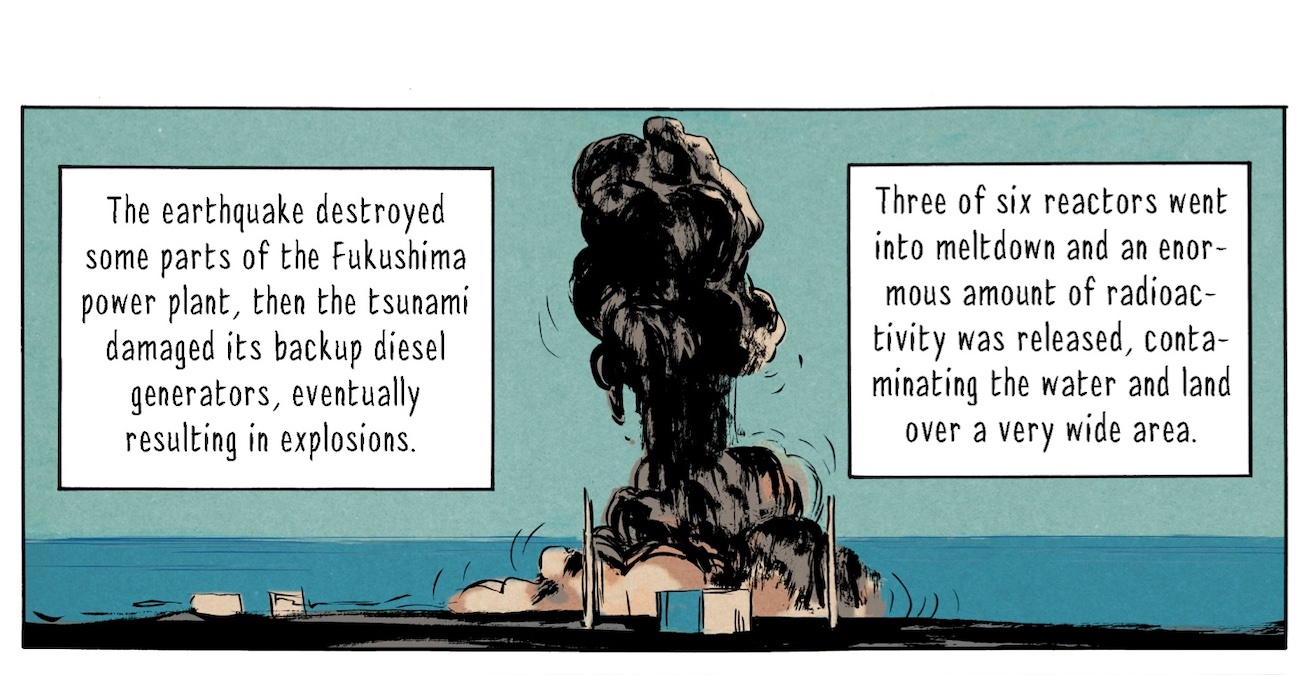
Suguru’s story reveals bullying, ostracization and government whitewash
Isolated and alone — Beyond Nuclear International

A teenager’s account of the Fukushima ordeal https://wordpress.com/read/feeds/72759838/posts/3219596582 By Linda Pentz Gunter, 7 Mar 21,Ten years after the March 2011 Fukushima nuclear disaster, how has the Japanese government responded and what is it like for the people affected, still struggling to return their lives to some semblance of normality? Here is how things look:
- Manuals are being distributed in schools explaining that radioactivity exists in nature and is therefore not something to be afraid of.
- The government is considering getting rid of radiation monitoring posts as these send the wrong message at a time of “reconstruction”.
- The Oversight Committee for Fukushima Prefecture Health Management Survey is discussing the possibility of stopping thyroid inspections at schools because they stress children out and overburden teachers and staff.
Depression and suicide rates among young people from Fukushima are likely to be triggered by being called “germs” and by being seen as “contaminated”.
- Those who speak out about radiation are more stigmatized today than they were 10 years ago.
- Those who “voluntarily” evacuated, recognizing that the so-called protection standards were not adequate for their region, are often ostracized from their new communities. They are seen as selfish for abandoning their homeland, friends and families “just to save themselves” and are bullied as parasites living on compensation funds, even though the “auto-evacuees” as they are known, received none.
- Those forced to evacuate are also bullied if they do not now return, accused of not trusting the government and its assertions that it is safe to do so.
- The taboo against speaking out for proper radiation protection and for compensation has grown worse as the rescheduled Olympics loom for this summer and Japan is determined to prove to the world it has fixed the radiation problem and beaten Covid-19.
- On March 1, 2021, it took three judges all of 30 seconds to dismiss a case brought by 160 parents and children who lived in Fukushima prefecture at the time of the nuclear accident, and known as the Children’s Trial Against Radiation Exposure. The class action suit sought 100,000 yen per person in damages from the government and the prefecture, due to the psychological stress brought on by the lack of measures to avoid radiation exposure after the accident.
These are some of the realities uncovered by France-based Japanese activist, Kurumi Sugita, as she interviewed those affected and began to compile a graphic short story about her findings, entitled Fukushima 3.11 and illustrated by French artist, Damien Vidal. The booklet is produced by the French NGO, Nos Voisins Lontains 3.11 (Our Distant Neighbors 3.11).
Fukushima 3.11, a long-form cartoon strip, is told in the first person by the youngest of Sugita’s interview subjects, Fukushima evacuee, Suguru Yokota, who was 13 at the time of the nuclear disaster.
Suguru was also one of the plaintiffs in the Children’s Trial, and noted after the devastating dismissal, just days before the Fukushima disaster’s 10th anniversary, that “we cannot give up” and that “the court hasn’t issued a legitimate verdict.”
In 2012, Sugita had traveled to Japan with a research project she helped create, financed by the French National Centre for Scientific Research where she worked, to set up an investigation into Japan’s nuclear victims. A list of 70 interview candidates was put together.
“I met Suguru in 2013 in Sapporo where he was living alone after he moved there from Fukushima,” said Sugita. “I also interviewed his mother and they were interviewed once a year over six years.”
A schoolboy at the time of the accident, the book follows Suguru’s account of his experiences. He encounters the refusal by his uncle to believe the dangers in the early days of the accident, “a typical denial case,” says Sugita, and he is ostracized at school where he is the only pupil to wear a mask.
Suguru’s only respite comes when his mother, who is equally alert to the radiation risks, sends him on a “radiation vacation” to Hokkaido, the first time he encounters peers who share his concerns.
Back at school and feeling isolated and alone, Suguru studies at home instead, eventually leaving the region for a different high school and then college.
The book weaves in essential information about radiation risks, and the clampdowns by the Japanese government, which withdrew support for auto-evacuees claiming, as Suguru relates it, that “these families are not victims. They are responsible for their fate.”
The book was first published in the magazine, TOPO, whose audience is predominantly teenagers and which reports on topics of current interest.
“It appealed to us to address an audience interested in world events, but not exclusively the nuclear issue,” said illustrator Vidal. “We thought our comic strip could be read by all those — and not necessarily just teenagers — who want to understand what the consequences of the nuclear accident were, and how it affected the inhabitants of Fukushima Prefecture.”
The book vividly brings home the psychological and emotional pain suffered by those who chose to recognize the true dangers posed by the Fukushima disaster, as well as the financial hardships and fracturing of families. And it exposes the depths of deliberate denial by authorities, more interested in heightened normalization of radiation exposure in the name of commerce and reputation.
Even as early as October 2011, an announcement is made that “rice produced in Fukushima Prefecture will supply school canteens again.” We see Suguru and his mother watching this news on their television, then the name-calling Suguru faces in school for bringing his own lunch. He is shown in the strip being called a “hikokumin”, which, explains Suguru, “is a really insulting word, used during the Second World War. It refers to people who are not worthy of being Japanese citizens.”
But that stigma has only become worse with time, Sugita says.
These days people are name-called “hoshano”. “Hoshano”(放射能) means radioactivity, but with a different Chinese character(放射脳) it means “radioactive brain – or brain contaminated by the fear of radioactivity”, she explains. And that is the slur in common circulation now.
Nevertheless, the book ends on a hopeful note. “Today,” concludes Suguru on the closing page, “I know I’m not alone. I hope other voices will be heard in Japan and around the world.”
It’s easy to say “never again.” But in order to ensure it, we must all continue to raise our voices, joining Suguru’s and others yearning to be heard.Read the English language version of Fukushima 3.11 on line for free. A version is also available in French. Hard copies (in French only), may be ordered from Nos Voisins Lontains 3.11 for 8€ plus shipping costs.
The American media sanitises the Biden administration’s killings in Syria
 Purging Inconvenient Facts in Coverage of Biden’s ‘First’ Air Attacks https://fair.org/home/purging-inconvenient-facts-in-coverage-of-bidens-first-air-attacks/ Purging Inconvenient Facts in Coverage of Biden’s ‘First’ Air Attacks https://fair.org/home/purging-inconvenient-facts-in-coverage-of-bidens-first-air-attacks/
GREGORY SHUPAK 5 Mar 21, When the Biden administration bombed Syria on February 25, the attack killed “at least 22,” most of them members of Iraqi militias, according to the Syrian Observatory for Human Rights, a London-based monitoring organization opposed to the Syrian government. The US said the bombing was retaliation for three rocket
 attacks on US bases in Iraq that it claims were carried out by groups allied with Iran (NBC, 2/25/21). In one of the attacks, rockets fired at Erbil airport killed a military contractor and an Iraqi civilian. attacks on US bases in Iraq that it claims were carried out by groups allied with Iran (NBC, 2/25/21). In one of the attacks, rockets fired at Erbil airport killed a military contractor and an Iraqi civilian.
The US does not say that its airstrike on Syria was aimed at the group that carried out the Erbil attack, which, as the New York Times (2/26/21) reported, was claimed by a previously unknown armed group calling itself the Guardians of the Blood. United States officials said it appeared to be affiliated with one or more of Iraq’s better-known militias, and Thursday’s strikes in Syria targeted facilities belonging to them. Furthermore, the site that the US bombed in Syria “was not specifically tied to the rocket attacks” (CNN, 2/25/21). A New York Times (2/25/21) report from Helene Cooper and Eric Schmitt ran with the headline, “US Airstrikes in Syria Target Iran-Backed Militias That Rocketed American Troops in Iraq.” However, the 11th paragraph of the article said that “little is known about” Guardians of the Blood, “including whether it is backed by Iran or related to the organizations that used the facilities the American airstrikes targeted on Thursday.” Manufactured amnesia CNN’s Barbara Starr, The less clear the US population is about the frequency and scale of murderous violence its government carries out, the easier it is for the US ruling class to go about its wars. Fortunately for the US state, corporate media help manufacture collective amnesia by expunging US aggression from the record. Liebermann and Nicole Gaouette (2/25/21) said the February 25 airstrikes “mark the US military’s first known action under President Joe Biden,” while their colleague Fareed Zakaria (GPS, 2/28/21) had a segment about them called “Biden’s First Military Action.” Christian Science Monitor (3/2/21) ran an editorial called “Biden’s First Use of Force Overseas.” Yet not even a month before Biden bombed Syria, the US carried out an airstrike in Iraq that it said killed ISIS commander Jabbar Salman Ali Farhan al-Issawi and nine other ISIS fighters (New York Times, 1/29/21). Furthermore, Airwars, a nonprofit monitoring group affiliated with the University of London, suspects the US of carrying out or helping to carry out four bombings in Somalia in the period between Biden’s inauguration and the attack on Syria, killing 2–4 people in one case and 6–12 on two other occasions. The US military stopped disclosing its airstrikes in Afghanistan last year, but it is unlikely that military operations in the US’s longest overseas war came to a halt when Biden took office. Purging inconvenient facts is another way of producing mass forgetfulness and confusion. Flying colors To praise Biden’s killings, corporate media pretended the US was fighting back against a bully. Max Boot of the Washington Post (2/26/21), writing that Biden “is passing his early tests with flying colors” and “is off to an excellent start,” claimed that “if Biden did nothing in response to the latest Iranian provocations, he would have risked sending a message of weakness that would have further emboldened Tehran.” In Boot’s opinion, “Biden ordered the right response: an airstrike on a Syrian base used by Iranian-backed militias.” He praised Biden for negotiating with Iran while simultaneously “engaging in a policy of active containment and deterrence to curb Iran’s destabilizing activities in the region,” which he characterized as “regional aggression.” (The Times‘ February 26 piece used similar language, writing that the prospect of a new nuclear deal with Iran is overshadowed by “the issue of Iran’s destabilizing activities across the Middle East.”)
Forget for a moment that no evidence has been provided that Iran was actually behind the relevant rocket attacks: Boot apparently doesn’t think he even has to say what “Iran’s destabilizing activities in the region” are, nor where its “regional aggression” takes place, let alone offer any proof for these claims. The US murdered an Iranian general who was revered in his country (FAIR.org, 1/21/20), invaded Iraq and causing the death of upward of 1 million people (Jacobin, 6/19/14), resupplied Israel with weaponry (Al Jazeera, 7/31/14) as it slaughtered more than 2,000 Palestinians in Gaza, played a central role in a war that has made Yemen home to the world’s worst humanitarian crisis (Middle East Eye, 11/17/17): For Boot, evidently, nothing on this nonexhaustive list of recent US crimes in the Middle East constitutes “regional aggression” or “destabilizing activities in the region” that need “active containment and deterrence.” Boot was hardly the only journalist who rationalized the American bombing by portraying the US as acting defensively. The Post‘s Jennifer Rubin (2/28/21) said Biden had “responded forcefully” to “Iranian proxy attacks,” and thereby sent an “important…signal to Iran that the new administration will not look the other way on Tehran’s regional conduct simply to encourage discussion about” Iran’s nuclear power program. Cooper and Schmitt (New York Times, 2/25/21) noted that the US dropped “seven 500-pound bombs” on Syria, and described this as Biden taking “a more measured response to the rocket fusillade in Erbil than Mr. Trump’s pitched campaign against Iran and past actions of its proxies in Iraq.” Set aside the absurdity of calling dropping nearly two tons of bombs “measured”; set aside the lack of evidence of Iranian responsibility for the deaths at Erbil; set aside that the US doesn’t claim that it bombed the parties that fired the rockets that killed the contractor and the Iraqi civilian in Erbil, and assume for the sake of argument that Iran is behind those acts. The pretense that the US defended itself by carrying out last week’s airstrikes also necessitates glossing over the fact that the country Washington actually bombed, Syria, is accused of neither sponsoring nor carrying out the rocket attacks on American bases in Iraq that should not be there in the first place. The articles I’ve examined all acknowledge that the US airstrikes hit Syria, but it’s remarkable how little attention they pay to the country, especially considering that the bombing was aimed at groups allied with the Syrian government in that country’s war, so the attack amounts to an intervention on behalf of anti-government forces there. Had the coverage paid more notice to how Biden’s bombing was carried out against a country that the US has helped to decimate (FAIR.org, 3/7/18; Electronic Intifada, 3/16/17), despite Syria not attacking or threatening to attack the US, the narrative that Biden was merely conducting a “response” to bad actors would have been that much more obviously threadbare. Securing consent for running a lethal, worldwide empire requires unremitting propaganda: Redacting the historical record and playing the victim are two useful strategies. |
|
French report on the unfairness of France’s nuclear history in Algeria

French report grapples with nuclear fallout from Algerian War https://thebulletin.org/2021/03/french-report-grapples-with-nuclear-fallout-from-algerian-war/?utm_source=Newsletter&utm_medium=Email&utm_campaign=ThursdayNewsletter03042021&utm_content=NuclearRisk_AlgerianWar_03042021&__cf_chl_captcha_tk__=32bfe924bf6171eab26d9deb08cd73459b5e69dc-1614896664-0-AWxxiguytXLkG_ERcOpFeDyCqmv7X1FYZmZBNGAnlwY6ZlI8PgWd2By Austin R. Cooper | March 4, 2021 n January, the French historian Benjamin Stora filed a report commissioned by the French President Emmanuel Macron aimed at “reconciliation of memories between France and Algeria,” which France ruled as the jewel of its colonial empire for more than 130 years.
The Stora Report addressed several scars from the Algerian War for Independence (1954–62), a bloody struggle for decolonization that met savage repression by French troops. One of these controversies stems from French use of the Algerian Sahara for nuclear weapons development.
France proved its bomb in the atmosphere above this desert, naming the inaugural blast , or Blue Jerboa, after the local rodent. Between 1960 and 1966, France detonated 17 nuclear devices in the Algerian Sahara: four atmospheric explosions during the Algerian War, and another 13 underground, most of these after Algerian Independence.
French nuclear ambitions became inextricable from the process of Algerian decolonization. The Saharan blasts drew international outrage, stalled ceasefire negotiations, and later threatened an uneasy peace across the Mediterranean.
The Stora Report signaled that radioactive fallout from the Algerian War has remained a thorn between the two nations. But the document comes up short of a clear path toward nuclear reconciliation.
A United Nations dispute. The French bomb collided with the Algerian War before the first mushroom cloud rose above the Sahara. In November 1959, Algerian allies representing independent states in Africa and Asia contested French plans for the desert in the First Committee on Disarmament at the United Nations.
Part of the French strategy at the United Nations was to drive a wedge between the nuclear issue and what French diplomats euphemistically termed the “Question of Algeria.” French obfuscation continued for decades.
France would not, until 1999, call the bloodshed a war, preferring the line that what happened in Algeria, as part of France, amounted to a domestic dispute, rather than UN business. Macron became, in 2018, the first French president to acknowledge “systemic torture” by French troops in Algeria.
The Afro-Asian challenge to Saharan explosions hurdled France’s diplomatic barricades at the United Nations. The French delegation tried to strike references to the Algerian War as irrelevant. But their African and Asian counterparts painted the desert blasts as a violation of African sovereignty.
The concern was not only for contested territory in Algeria, but also for independent states bordering the desert, whose leaders warned that nuclear fallout could cross their national borders. Radiation measurements taken in the wake of Gerboise bleue proved many of them right.
Nuclear weapons represented another piece of French imperialism on the continent.
Secret negotiations resumed in September 1961, with US Ambassador to Tunisia Walter N. Walmsley serving as France’s backchannel. The US State Department worried that French attachment to the test sites might thwart the decolonization process.
Lead Algerian negotiator Krim Belkacem asked Walmsley if prospects for a ceasefire still hinged on France retaining control of the test sites. Krim got his answer when Franco-Algerian talks resumed the following month, at the end of October 1961.
France did not abandon its goal to continue nuclear explosions in the Sahara. But the Algerian position appeared to have softened. So long as further blasts did not impinge on Algeria’s “eventual sovereignty” over the desert, as one archival document put it, a deal looked possible.
The Evian Accords marked a nuclear compromise. Finally signed in March 1962, the landmark treaty granted France a five-year lease to the Saharan test sites but did not specify terms of use.
Going underground. Advice from the French Foreign Ministry played a key role in pushing France’s weapons program beneath Saharan mountains. French diplomats suggested that underground explosions would present, according to one archival document, “significantly less serious” challenges than atmospheric ones for future relations with Algeria and its African neighbors.
This did not stop Algeria’s first president, Ahmed Ben Bella, from winning political capital with the nuclear issue. In public, Ben Bella cast Saharan blasts as an intolerable violation of Algerian sovereignty, as had his allies at the United Nations. In private, however, Ben Bella acquiesced to the Evian terms and reportedly tried to squeeze French financial aid out of the deal.
The Hoggar Massif shook 13 times before France handed over its two Saharan test sites to Algeria in 1967. An accident occurred during one of these underground blasts, dubbed Béryl, when containment measures failed. Several French soldiers and two high-ranking French officials suffered the highest radiation exposures, but roughly 240 members of “nomadic populations” in the region received lower doses.
Meanwhile, France began construction on its Pacific test range in French Polynesia, the site of nearly 200 nuclear explosions between 1966 and 1996. Most took place underground, but France also conducted atmospheric detonations in Polynesia, and these continued into the 1970s. Even though the Limited Test Ban Treaty had gone into effect in 1963—prohibiting nuclear blasts in the atmosphere, underwater, and in outer space—France refused to sign it.
Contamination and compensation. As part of its reconciliation proposal, the Stora Report encouraged Franco-Algerian cooperation on environmental remediation of the Saharan test sites. An expert report from the International Atomic Energy Agency, however, concluded in 2005 that environmental interventions were “not required” unless human traffic near the sites should increase.
The Stora Report briefly mentioned compensation linked to radiation exposure from French nuclear weapons development, but this deserves a closer look. In 2010, the French Parliament passed a law recognizing these victims and establishing funds and procedures to provide compensation for illness and injury. So far, France has earmarked 26 million euros for this purpose, but almost none of that has gone to Algerians.
Decades earlier, France’s nuclear allies turned to compensation programs in an attempt to reconcile with marginalized groups affected by weapons development without disclosure or consent. In 1993, for example, the United Kingdom settled with Australia as redress for indigenous people and personnel involved in UK explosions conducted in the former colony.
Facing similar lawsuits, the United States provided monetary compensation and health benefits to the indigenous people of the Marshall Islands, where US nuclear planners “offshored” their most powerful blasts during the Cold War arms race. Other US programs have made compensation available to communities “downwind” of the Nevada Test Site and surrounded by the uranium mines fueling the US nuclear arsenal, including Tribal Nations in the Four Corners region.
Compensation programs map a global history of colonial empire, racial discrimination, and dispossession of indigenous land, but postcolonial inequalities look particularly stark from the Sahara. Including appeals, France has granted 545 of 1,739 total requests filed by French soldiers and civilian participants in the nuclear detonations, as well as exposed populations in Algeria and Polynesia. Only 1 of 52 Algerian dossiers has proven successful.
French officials responsible for evaluating these files report that the ones from Algeria often arrive incomplete or in a shoddy state, and pin the blame on the Algerian government’s inability or unwillingness to provide the geographical, historical, and biomedical evidence that French assessment procedures demand. Claims must demonstrate that an individual worked or lived in a fixed area surrounding one of the two Saharan test sites, between February 1960 and December 1967, and suffered at least one of 21 types of cancer recognized as radiation-linked by French statute.
A step toward reconciliation. If Macron really wants to tackle France’s nuclear history in Algeria—and its aftermath—his government should start here. The French Parliament opened the door to Algerian compensation in 2010, and important revisions to the evaluation procedures took place in 2017, but there has never been a level playing field. Macron could, for example, require that French diplomats posted in Algeria help Algerians build their cases and locate supporting documents.
Another option: Macron could declassify archival materials documenting the intensity and scope of radioactive fallout generated by French nuclear blasts. Draconian interpretations of French statutes on the reach of military secrecy continue to block access to the vast majority of military, civil, and diplomatic collections on France’s nuclear weapons program—including radiation effects. Foreign archives have provided useful information, but official documentation from the French government would help exposed populations—like those in the Sahara—understand what happened, evaluate the risks, bolster their claims, and likely find these more successful.
The Stora Report did well to acknowledge nuclear fallout from the Algerian War. Giving Algerians a fair shot at compensation should mark France’s first step toward reconciliation.
In India, Google and Facebook help a vicious government campaign against environmental activists
Naomi Klein: how big tech helps India target climate activists, Guardian, by Naomi Klein 5 Mar 21, Companies such as Google and Facebook appear to be aiding and abetting a vicious government campaign against Indian environmental campaigners
The bank of cameras camped outside Delhi’s sprawling Tihar jail was the sort of media frenzy you would expect to await a prime minister caught in an embezzlement scandal, or a Bollywood star caught in the wrong bed. Instead, the cameras were waiting for Disha Ravi, a nature-loving 22-year-old vegan climate activist who against all odds has found herself ensnared in an Orwellian legal saga that includes accusations of sedition, incitement and involvement in an international conspiracy whose elements include (but are not limited to): Indian farmers in revolt, the global pop star Rihanna, supposed plots against yoga and chai, Sikh separatism and Greta Thunberg.
If you think that sounds far-fetched, well, so did the judge who released Ravi after nine days in jail under police interrogation. Judge Dharmender Rana was supposed to rule on whether Ravi, one of the founders of the Indian chapter of Fridays for Future, the youth climate group started by Thunberg, should continue to be denied bail. He ruled that there was no reason for bail to be denied, which cleared the way for Ravi’s return to her home in Bengaluru that night.
But the judge also felt the need to go much further, to issue a scathing 18-page ruling on the underlying case that has gripped Indian media for weeks, issuing his own personal verdict on the various explanations provided by the Delhi police for why Ravi had been apprehended in the first place. The police’s evidence against the young climate activist is, he wrote, “scanty and sketchy”, and there is not “even an iota” of proof to support the claims of sedition, incitement or conspiracy that have been levelled against her and at least two other young activists.
Though the international conspiracy case appears to be falling apart, Ravi’s arrest has spotlighted a different kind of collusion, this one between the increasingly oppressive and anti-democratic Hindu nationalist government of the prime minister, Narendra Modi, and the Silicon Valley companies whose tools and platforms have become the primary means for government forces to incite hatred against vulnerable minorities and critics – and for police to ensnare peaceful activists like Ravi in a hi-tech digital web.
The case against Ravi and her “co-conspirators” hinges entirely on routine uses of well-known digital tools: WhatsApp groups, a collectively edited Google Doc, a private Zoom meeting and several high-profile tweets, all of which have been weaponised into key pieces of alleged evidence in a state-sponsored and media-amplified activist hunt. At the same time, these very tools have been used in a coordinated pro-government messaging campaign to turn public sentiment against the young activists and the movement of farmers they came together to support, often in clear violation of the guardrails social media companies claim to have erected to prevent violent incitement on their platforms.
In a country where online hatred has tipped with chilling frequency into real-world pogroms targeting women and minorities, human rights advocates are warning that India is on the knife-edge of terrible violence, perhaps even the kind of genocidal bloodshed that social media aided and abetted against the Rohingya in Myanmar.
Through it all, the giants of Silicon Valley have stayed conspicuously silent. Their famed devotion to free expression, as well as their newfound commitment to battling hate speech and conspiracy theories, is, in India, nowhere to be found. In its place is a growing and chilling complicity with Modi’s information war, a collaboration that is poised to be locked in under a draconian new digital media law that will make it illegal for tech companies to refuse to cooperate with government requests to take down offending material or to breach the privacy of tech users. Complicity in human rights abuses, it seems, is the price of retaining access to the largest market of digital media users outside China.
After some early resistance from the company, Twitter accounts critical of the Modi government have disappeared in the hundreds without explanation; government officials engaging in bald incitement and overt hate speech on Twitter and Facebook have been permitted to continue in clear violation of the companies’ policies; and Delhi police boast that they are getting plenty of helpful cooperation from Google as they dig through the private communications of peaceful climate activists like Ravi.
“The silence of these companies speaks volumes,” a digital rights activist told me, requesting anonymity out of fear of retribution. “They have to take a stand, and they have to do it now.”
…………………. It is this quest for a political diversion, in other words, that helps explain how a simple solidarity campaign has been recast as a secret plot to break India apart and incite violence from abroad. The Modi government is attempting to drag the public debate away from terrain where it is glaringly weak – meeting people’s basic needs during an economic crisis and pandemic – and move it to the ground on which every ethnonationalist project thrives: us versus them, insiders versus outsiders, patriots versus seditious traitors.
In this familiar manoeuvre, Ravi and the broader youth climate movement were simply collateral damage. Yet the damage done is considerable, and not only because the interrogations are ongoing and Ravi’s return to jail remains distinctly possible. As the joint letter from Indian environmental advocates states, her arrest and imprisonment have already served a purpose: “The Government’s heavy handedness are clearly focused on terrorising and traumatising these brave young people for speaking truth to power, and amounts to teaching them a lesson.”
The still wider damage is in the chill the entire toolkit controversy has placed over political dissent in India – with the silent complicity of the tech companies that once touted their powers to open up closed societies and spread democracy around the world. As one headline put it, “Disha Ravi arrest puts privacy of all Google India users in doubt”.
Indeed, public debate has been so deeply compromised that many activists in India are going underground, deleting their own social media accounts to protect themselves. Even digital rights advocates are wary of being quoted on the record. Asking not to be named, a legal researcher described a dangerous convergence between a government adept at information war and social media companies built on maximising engagement to mine their users’ data: “All of this stems from a stronger weaponisation of social media platforms by the status quo, something that was not present earlier. This is further aggravated by the tendency of these companies to prioritise more viral, extremist content, which allows them to monetise user attention, ultimately benefiting their profit motives.”…………..
The new code is being introduced in the name of protecting India’s diverse society and blocking vulgar content. “A publisher shall take into consideration India’s multi-racial and multi-religious context and exercise due caution and discretion when featuring the activities, beliefs, practices, or views of any racial or religious group,” the draft rules state.
In practice, however, the BJP has one of the most sophisticated troll armies on the planet, and its own politicians have been the most vociferous and aggressive promotors of hate speech directed at vulnerable minorities and critics of all kinds. To cite just one example of many, several BJP politicians actively participated in a misinformation campaign claiming that Muslims were deliberately spreading Covid-19 as part of a “Corona Jihad”.
What a code like this would do is enshrine in law the double digital vulnerability experienced by Ravi and other activists: they would be unprotected from online mobs revved up by a Hindu nationalist state, and they would be unprotected from that same state when it sought to invade their digital privacy for any reason it chose……….
The new code, which will impact all digital media, including streaming and news sites, is set to take effect within the next three months. A few digital media producers in India are pushing back. Siddharth Varadarajan, the founding editor of the Wire, tweeted last Thursday that the “lethal” new code is “aimed at killing the independence of India’s digital news media. This attempt to arm bureaucrats with the power to tell the media what can and can’t be published has no basis in law.” ………….
Do not expect portraits of courage from Silicon Valley, however. Many US tech executives regret early decisions, made under public and worker pressure, to refuse to cooperate with China’s apparatus of mass surveillance and censorship – an ethical choice, but one that cost companies like Google access to a staggeringly large, lucrative market. These companies appear unwilling to make the same kind of choice again. As the Wall Street Journal reported last August, “India has more Facebook and WhatsApp users than any other country, and Facebook has chosen it as the market in which to introduce payments, encryption and initiatives to tie its products together in new ways that [CEO Mark] Zuckerberg has said will occupy Facebook for the next decade.”
For tech companies like Facebook, Google, Twitter and Zoom, India under Modi has heralded a harsh moment of truth. In North America and Europe, these companies are going to great lengths to show that they can be trusted to regulate hate speech and harmful conspiracies on their platforms while protecting the freedom to speak, debate, and disagree that is integral to any healthy society. But in India, where helping governments hunt and imprison peaceful activists and amplify hate appears to be the price of access to a huge and growing market, “all of those arguments have gone out the window,” one activist told me. And for a simple reason: “They are profiting from this harm.” https://www.theguardian.com/news/2021/mar/04/how-big-tech-helps-india-target-climate-activists-naomi-klein
Why is the media fawning over nuclear businessman Bill Gates?
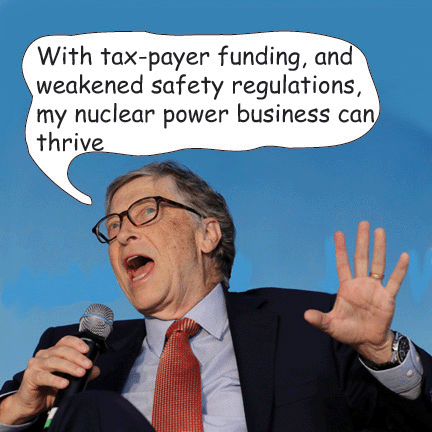
In a much-publicised interview he did on 60 Minutes Gates hyped up “advanced nuclear” fusion, SMRs and all the other tech marvels he is promoting. His interviewer, Anderson Cooper, completely ignorant of the subject, lapped it up, and failed to point out that none of these are proven technologies.
|
Why Bill Gates can’t save the world, The Fifth Estate, BY DAVID THORPE / 23 FEBRUARY 2021 Why don’t these billionaire philanthropists like Gates just stop their foundations and pay their fair share of taxes?
The media everywhere has been fawning over Bill Gates and his new book, How To Avoid A Climate Disaster. But should we really be listening to the world’s third wealthiest man for advice? If his suggestions and plans of action were wise and useful then maybe… Microsoft founder Bill Gates has an estimated net worth of $129 billion. His incalculable possessions, hugely destructive habits, and the massive investments of his opaque charitable trust, do everything to contradict his message that he’s the man with the plan to solve climate change. The fundamental point is that the richer you are, the bigger your ecological footprint. There’s no escaping it. The Gates’ fossil footprint……..Among the many $22.34 billion investments of Bill & Melinda Gates Foundation Trust, most of them are decidedly not in low carbon enterprises:
This is just scratching the surface. Journalist Tim Schwab, who has made it a mission to investigate Gate’s wealth and influence, has discovered his investments in fossil fuel companies: Gates claims to have divested from fossil fuel companies in 2019, but his foundation’s tax filing from that year shows millions of dollars in direct investments in companies like Exxon, Chevron, and Japan Petroleum Exploration. Billions more are invested in fossil-fuel-dependent industries like airlines, heavy machinery and automobiles. There’s a $1.6 billion stake in Caterpillar, for example, which makes diesel-guzzling plant used in mining. He is chairman of TerraPower, a nuclear reactor design company which has put no energy into the power grid. In October 2020, the United States Department of Energy gave TerraPower a grant of $400 million rising to $4 billion over the next seven years towards building a demonstration reactor. For reasons like this, Schwab calls Gates’ book “a long-winded advertisement for his investments”. Gates uses it to appeal to the US government to become a co-investor in TerraPower. The blind spotWhat is astonishing is the uncritical attitude of the media to Gates’ outpourings. The Financial Times last Saturday devoted the front page and a half of its Life & Arts supplement, to his “Green Manifesto”, without comment or criticism: it was free advertorial. Who else would get this treatment? Not long into the piece Gates pontificates, “The problem is simple. We can’t afford to release more greenhouse gasses.” Naturally, he doesn’t include himself in this “we” because if he did he would have to completely change his behaviour and lifestyle, something that he seems incapable of doing. This massive blind spot to his vision is also a blind spot to the media. The vast majority is in denial about his wealth. We want someone to come and lead us to salvation from the dire future we appear to be heading for. Of course, it should be a rich white man! Who else? But just as an alcoholic can’t rely on a whiskey distillery for a cure, we shouldn’t put our faith in the super-rich – because they are a huge part of this problem. Like most of the industrial-business sector, Gates imagines that the solution to climate change is technological. It can never be just that, it’s system change, it’s behavioural. In a much-publicised interview he did on 60 Minutes Gates hyped up “advanced nuclear” fusion, SMRs and all the other tech marvels he is promoting. His interviewer, Anderson Cooper, completely ignorant of the subject, lapped it up, and failed to point out that none of these are proven technologies. Gates the philanthropistBeing one of the top philanthropists in the USA, having donated billions to charity, gives Gates a powerful platform for his views. He sits on world stages amongst experts in the field who have been either democratically elected or appointed because they are experts. What is Gates’ experience or qualifications to talk about climate change? Charles Dickens used his writings to attack injustice in Victorian times. He was especially scathing of rich individuals who styled themselves as philanthropists but whose charitable acts did more to serve their own vanity than deserving causes. Nowhere is this better exemplified than in his novel Bleak House, where he puts in the mouth of one character the following aphorism: “There were two classes of charitable people; one, the people who did a little and made a great deal of noise; the other, the people who did a great deal and made no noise at all.” He satirises the former with Mrs Jellyby and Mrs Pardiggle, both of whom practice philanthropy – but at the expense of others. For both, philanthropy is more of a profession than born of genuine motivations to help. Philanthropy has become Gates’ profession, and his motivation is to assuage his guilt at the size of his wealth and ecological footprint, and to wield power. Dickens would have a field day. Can it be a coincidence that his charitable donations and investments in finding vaccines for the coronavirus, have seen his personal fortune rise $20 billion dollars as a result. That’s not philanthropy, it’s profiteering. Tim Schwab again, in the above article, quotes Anthony Rogers-Wright, director of environmental justice for the New York Lawyers for the Public Interest, as saying “These billionaires, the best they could do, some would say, would be to be stop their foundations and pay their fair share of taxes”. He observes how new tax revenues could help fund democratically devised solutions. “If Gates really wants to be effective and in a way that lifts up equity, he should be really listening to people who are being impacted the most and scaling up their solutions, rather than coming in with a parachute and with an air of white saviour-ism that actually in some cases causes more harm than good.” Christine Nobiss, founder of the indigenous people’s Great Plains Action Society, claims that Bill Gates has become the largest farmland owner in the United States. He owns nearly 100,000 hectares and is not farming it regeneratively or even sustainably. “He’s basically participating in the never-ending cycle of colonisation,” Nobiss says. The world’s most frequent flyer?Flying is one of the worst things you can do for the climate change, right? In a 2019 study of 10 celebrities and their flying habits, Celebrities, air travel, and social norms, Gates came top with the most emissions, beating Jennifer Lopez, Paris Hilton, and Oprah Winfrey. No wonder he would like the sustainable aviation fuel he dreams of in his book, and a neat way of offsetting all his carbon guilt. Let’s face it, would you rely on McDonald’s to make the world go vegan, or Putin to bring world peace? So why listen to Bill Gates, a man with a carbon footprint the size of a small country? Then there is the question of climate justice. In his book he never questions the political systems and economic models that result in climate change’s greatest impacts being on the poor and people of colour. There would be only one way for him to escape these financial conflicts of interest: let him lead by example. Let him give away all his money to the world’s poor with no strings attached. Let him live in a small apartment on $100 a week. Let him see the world from the point of view of a climate refugee – and say nothing about it. When he’s done all that, I’ll follow him. https://www.thefifthestate.com.au/urbanism/climate-change-news/why-bill-gates-cant-save-the-world-and-why-these-billionaire-philanthropists-might-do-best-to-simply-pay-fair-share-of-taxes/ |
|
‘Medical Scientific’ committee, stacked with nuclear executives, promotes nuclear power in space
 “The nuclear industry views space as a new—and wide-open—market for their toxic product that has run its dirty course on Mother Earth.”
“Now it appears that the nuclear industry has also infiltrated the National Academies of Sciences, Engineering, and Medicine that has been studying missions to Mars. ”
It’s going to take enormous grassroots action—and efforts by those in public office who understand the error of the space direction being taken—to stop it.
Nuclear Rockets to Mars?, BY KARL GROSSMAN– CounterPunch, 16 Feb 21,
A report advocating rocket propulsion by nuclear power for U.S. missions to Mars, written by a committee packed with individuals deeply involved in nuclear power, was issued last week by the National Academies of Sciences, Engineering and Medicine.
The 104-page report also lays out “synergies” in space nuclear activities between the National Aeronautics and Space Administration and the U.S. military, something not advanced explicitly since the founding of NASA as a civilian agency supposedly in 1958.
The report states: “Space nuclear propulsion and power systems have the potential to provide the United States with military advantages…NASA could benefit programmatically by working with a DoD [Department of Defense] program having national security objectives.”’
The report was produced “by contract” with NASA, it states.
The National Academy of Sciences, Engineering and Medicine (NAS) describes itself as having been “created to advise the nation” with “independent, objective advice to inform policy.”
The 11 members of the committee that put together the report for the National Academy includes: Jonathan W. Cirtain, president of Advanced Technologies, “a subsidiary of BWX Technologies which is the sole manufacturer of nuclear reactors for the U.S. Navy,” the report states; Roger M. Myers, owner of R. Myers Consulting and who previously at Aerojet Rocketdyne “oversaw programs and strategic planning for next-generation in-space missions [that] included nuclear thermal propulsion and nuclear electric power systems; Shannon M. Bragg-Sitton, the “lead for integrated energy systems in the Nuclear Science and Technology Directorate at the Idaho National Laboratory:” Tabitha Dodson, who at the U.S. government’s Defense Advanced Research Project Agency is chief engineer of a program “that is developing a nuclear thermal propulsion system;” Joseph A. Sholtis, Jr., “owner and principal of Sholtis Engineering & Safety Consulting, providing expert nuclear, aerospace, and systems engineering services to government, national laboratories, industry, and academia since 1993.” And so on.
The NAS report is titled: “Space Nuclear Propulsion for Human Mars Exploration.” It is not classified and is available here.
Bruce Gagnon, coordinator of the Global Network Against Weapons and Nuclear Power in Space, from its offices in Maine in the U.S., declared: “The nuclear industry views space as a new—and wide-open—market for their toxic product that has run its dirty course on Mother Earth.”
“During our campaigns in 1989, 1990, and 1997 to stop NASA’s Galileo, Ulysses and Cassini plutonium-fueled space probe launches, we learned that the nuclear industry positioned its agents inside NASA committees that made the decisions on what kinds of power sources would be placed on those deep space missions,” said Gagnon. “Now it appears that the nuclear industry has also infiltrated the National Academies of Sciences, Engineering, and Medicine that has been studying missions to Mars. The recommendation, not any surprise, is that nuclear reactors are the best way to power a Mars mission.”
“It’s not the best for us Earthlings because the Department of Energy has a bad track record of human and environmental contamination as they fabricate nuclear devices. An accident at launch could have catastrophic consequences.”
Stated Gagnon: “We fought the DoE and NASA on those previous nuclear launches and are entering the battle again. The nuclear industry has its sights set on nuclear-powered mining colonies on an assortment of planetary bodies—all necessitating legions of nuclear devices being produced at DoE and then launched on rockets that blow up from time to time.”
“We urge the public to help us pressure NASA and DoE to say no to nukes in space. We’ve got to protect life here on this planet. We are in the middle of a pandemic and people have lost jobs, homes, health care and even food on their table.”
“Trips to Mars can wait,” said Gagnon.
There have been accidents in the history of the U.S.—and also the former Soviet Union and now Russia—using nuclear power in space……
(Article goes on to explain how solar power can be, and is being used for space travel and research)
The NAS committee, however, was mainly interested in a choice between a “nuclear thermal propulsion” (NTP) or “nuclear electric propulsion” (NEP) for rocket propulsion…….
“Advanced nuclear propulsion systems (along or in combination with chemical propulsion systems) have the potential to substantially reduce trip time” to Mars “compared to fully non-nuclear approaches,” says the report.
An issue: radioactivity from either of the systems affecting human beings on the rockets with nuclear reactors propelling them. Back after World War II with the Cold War beginning, the U.S. began working on bombers propelled by onboard nuclear reactors—even built one. The idea was that such bombers could stay aloft for days ready to drop nuclear weapons on the Soviet Union. No crews would need to be scrambled and bombers then sent aloft.
But, as The Atlantic magazine noted in a 2019 article titled, “Why There Are No Nuclear Airplanes”:
“The problem of shielding pilots from the reactor’s radiation proved even more difficult. What good would a plane be that killed its own pilots? To protect the crew from radioactivity, the reactor needed thick and heavy layers of shielding. But to take off, the plane needed to be as light as possible. Adequate shielding seemed incompatible with flight. Still, engineers theorized that the weight saved from needing no fuel might be enough to offset the reactor and its shielding. The United States spent 16 years tinkering with the idea, to no avail”
The Eisenhower administration concluded that the program was unnecessary, dangerous, and too expensive. On March 28, 1961, the newly inaugurated President John F. Kennedy canceled the program. Proposals for nuclear-powered airplanes have popped up since then, but the fear of radiation and the lack of funding have kept all such ideas down.”……
The “synergies” in space nuclear activities between NASA and the U.S. military advanced in the NAS report mark a change in public acknowledgement. The agency was supposed to have a distinctly civilian orientation, encouraging peaceful applications in space science.
However, throughout the decades there have been numerous reports on its close relationship with the U.S. military—notably during the period of NASA Space Shuttle flights. As a 2018 piece in Smithsonian Magazine noted, “During the heyday of the space shuttle, NASA would routinely ferry classified payloads into orbit for the Department of Deense among other projects the agencies have collaborated on.”
With the formation of a U.S. Space Force by the Trump administration in 2019, the NASA-Pentagon link would appear to be coming out of the shadows, as indicated by the NAS report. The Biden administration is not intending to eliminate the Space Force, despite the landmark Outer Space Treaty of 1967 put together by the U.S., the then Soviet Union and the U.K, setting aside space for peaceful purposes. It is giving the new sixth branch of U.S. armed forces “full support,” according to his spokesperson Jen Psaki.
The NAS report says, “Areas of common interest include (1) fundamental questions about the development and testing of materials (such as reactor fuels and moderators) that can survive NTP conditions and (2) advancing modeling and simulation capabilities that are relevant to NTP.” And, “Additionally, a NASA NTP system could potentially use a scaled-up version of a DoD reactor, depending on the design.”
It declares: “Threats to U.S. space assets are increasing. They include anti-satellite weapons and counter-space activities. Crossing vast distances of space rapidly with a reasonably sized vehicle in response to these threats requires a propulsion system with high Isp [Specific Impulse] and thrust. This could be especially important in a high-tempo military conflict.”
Moreover, on December 19, just before he was to leave office, Trump signed Space Policy Directive-6, titled “National Strategy for Space Nuclear Propulsion.” Its provisions include: “DoD [Department of Defense] and NASA, in cooperation with DOE [Department of Energy}, and with other agencies and private-sector partners, as appropriate, should evaluate technology options and associated key technical challenges for an NTP [Nuclear Thermal Propulsion] system, including reactor designs, power conversion, and thermal management. DoD and NASA should work with their partners to evaluate and use opportunities for commonality with other SNPP [Space Nuclear Power and Propulsion] needs, terrestrial power needs, and reactor demonstration projects planned by agencies and the private sector.”
It continues: “DoD, in coordination with DOE and other agencies, and with private sector partners, as appropriate, should develop reactor and propulsion system technologies that will resolve the key technical challenges in areas such as reactor design and production, propulsion system and spacecraft design, and SNPP system integration.”
It’s going to take enormous grassroots action—and efforts by those in public office who understand the error of the space direction being taken—to stop it.
Karl Grossman, professor of journalism at State University of New York/College at Old Westbury, and is the author of the book, The Wrong Stuff: The Space’s Program’s Nuclear Threat to Our Planet, and the Beyond Nuclear handbook, The U.S. Space Force and the dangers of nuclear power and nuclear war in space. Grossman is an associate of the media watch group Fairness and Accuracy in Reporting (FAIR). He is a contributor to Hopeless: Barack Obama and the Politics of Illusion. more https://www.counterpunch.org/2021/02/16/nuclear-rockets-to-mars/

1 This Month
19 February – VIRTUAL EVENT-Decision Time: AI and Our Nuclear Arsenal
12:45 p.m. Central / 1:45 p.m. Eastern
To see nuclear-related stories in greater depth and intensity – go to https://nuclearinformation.wordpress.com
-
Archives
- February 2026 (145)
- January 2026 (308)
- December 2025 (358)
- November 2025 (359)
- October 2025 (376)
- September 2025 (258)
- August 2025 (319)
- July 2025 (230)
- June 2025 (348)
- May 2025 (261)
- April 2025 (305)
- March 2025 (319)
-
Categories
- 1
- 1 NUCLEAR ISSUES
- business and costs
- climate change
- culture and arts
- ENERGY
- environment
- health
- history
- indigenous issues
- Legal
- marketing of nuclear
- media
- opposition to nuclear
- PERSONAL STORIES
- politics
- politics international
- Religion and ethics
- safety
- secrets,lies and civil liberties
- spinbuster
- technology
- Uranium
- wastes
- weapons and war
- Women
- 2 WORLD
- ACTION
- AFRICA
- Atrocities
- AUSTRALIA
- Christina's notes
- Christina's themes
- culture and arts
- Events
- Fuk 2022
- Fuk 2023
- Fukushima 2017
- Fukushima 2018
- fukushima 2019
- Fukushima 2020
- Fukushima 2021
- general
- global warming
- Humour (God we need it)
- Nuclear
- RARE EARTHS
- Reference
- resources – print
- Resources -audiovicual
- Weekly Newsletter
- World
- World Nuclear
- YouTube
-
RSS
Entries RSS
Comments RSS
 nuclear-news