New documentary film ‘Downwind’ explores why testing, using nuclear weapons are deadly mistakes
St George News, by Stephanie DeGraw, January 25, 2023
PARK CITY — The tragedies of nuclear testing are not over, advocates and directors with the world premiere of the film “Downwind” told the audience at the Slamdance Film Festival in Park City Monday evening.
“Subsequent generations may suffer more than the original exposed generation,” Dr. Brian Moench, founder and president of the Utah Physicians for a Healthy Environment, said. “The faces behind the statistics we’ve heard are real human beings, but there will be more who you don’t see because they haven’t been born yet.”
The Slamdance Spotlight documentary film is still relevant today, locally and globally. The film exposes an often-forgotten chapter of U.S. history and the ongoing health consequences for Americans living downwind.
Some 928 nuclear detonations took place from 1951 to 1992 near Las Vegas, Nevada. These included the 100 atmospheric tests residents of Southern Utah could watch. Research shows St. George has above-average rates of radioactivity compared with the nationwide average.
The West Shoshone is also profoundly affected by the government’s testing. Ian Zabarte, principal man of the West Bands of the Shoshone Nation, said their sacred land continues to be cordoned off as a nuclear test site.
For 40 years, large-scale atomic weapons obliterated the landscape. It exposed people, the environment, livestock and agriculture across the country to deadly fallout. Zabarte said despite a moratorium on testing, the Nevada Test Site remains operational with the possibility of resumed testing.
“The film ‘Downwind’ is important because it provides us with an understanding of the past,” Zabarte said. “Awareness is key. If we’re going to protect future generations, we need to know what happened in the past and not repeat those mistakes.
“Testing, developing and using nuclear weapons is a mistake. America is the only nation that’s ever killed people with nuclear weapons.”
Zabarte said that atomic weapons are illegal under the new international law, the Treaty on the Prohibition of Nuclear Weapons, which was enacted on Jan. 22, 2021.
“We can protect our environment, our Mother Earth, by ending our obsession with nuclear weapons of mass destruction,” Zabarte said. “We can join the Treaty on Prohibition of Nuclear Weapons,.”………………………………………………………………………….. more https://www.stgeorgeutah.com/news/archive/2023/01/25/sdw-new-documentary-film-downwind-explores-why-testing-using-nuclear-weapons-are-deadly-mistakes/#.Y9I1onZBy5c
Under Musk, Twitter Continues to Promote US Propaganda Networks
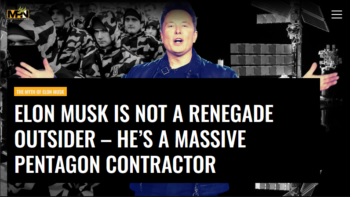
But Musk’s hot take on the Ukraine war should not be taken as proof of Musk’s anti establishment bona fides.
Far from being an establishment outsider, Elon Musk himself is a major figure in the military industrial complex, and represents the long tradition of Silicon Valley giants being thoroughly enmeshed in the military and intelligence wars.
BRYCE GREENE FAIR, 6 Jan 23
Twitter’s “state-affiliated media” policy has an unwritten exemption for US government-funded and -controlled news media accounts. Twitter even boosts these accounts as “authoritative” sources for news during the Russian/Ukrainian war.
Elon Musk’s controlled release of the documents known as the “Twitter Files” has given us some insight into the inner workings of the social media platform. The batch of docs released on December 20 is arguably the most explosive, detailing Twitter’s deliberate shielding of US propaganda operations. After getting limited access to Twitter‘s internal systems, Lee Fang of the Intercept (12/20/22) detailed how Twitter staff “whitelisted” accounts run by US Central Command (CENTCOM), the unit of the US military that oversees the Middle East, as part of covert propaganda campaigns. In other words, Twitter protected accounts engaged in US psychological warfare operations, even though they clearly violated the platform’s terms of service.
But this is far from the whole story of Twitter’s assistance with US influence operations. A FAIR investigation reveals that dozens of large accounts that are part of US overt propaganda networks are given special treatment from the company, in blatant violation of Twitter’s own policies.
Through a lopsided “state-affiliated” media policy application, Twitter has actually gone against its own mission to provide “context” to users. More acutely, in Ukraine, Twitter actively promoted US funded media organizations as part of the “Topics” feature which ostensibly aggregated “authoritative” sources. The prominence of these outlets on the platform has strengthened their influence on the national media ecosystem, and has helped shape public perceptions of the entire war.
…………………………………………………………………………………………… Twitter rigorously enforces the rules for states the US considers to be hostile. Accounts for major state agencies in Russia, China and Iran are generally labeled as state entities. Media outlets from those countries are also targeted: PressTV from Iran, RT and Sputnik from Russia, and China Daily, Global Times, CGTN and China Xinhua News from China are all labeled “state-affiliated media.”
Twitter has taken extra measures against Russia after the invasion, adding explicit warnings on any post linking to “a Russian state-affiliated media website”:
…………….. Artificial exceptions
Twitter’s policy defines “state-affiliated media” as newsrooms where the state has “control over editorial content through financial resources, direct or indirect political pressures, and/or control over production and distribution.” But there are several major media accounts that seem to fit this description that have no such warning labels.
None of the major public media outlets in the US, Britain and Canada have received the label. In 2017, NPR received 4% of its funding from the US government. The BBC receives a large portion of its funding from the British Foreign and Commonwealth Office. The CBC receives $1.2 billion in funding from the Canadian government. Yet Twitter accounts for the BBC, CBC and NPR are all unlabeled on the platform……………………………..
National Endowment for Democracy
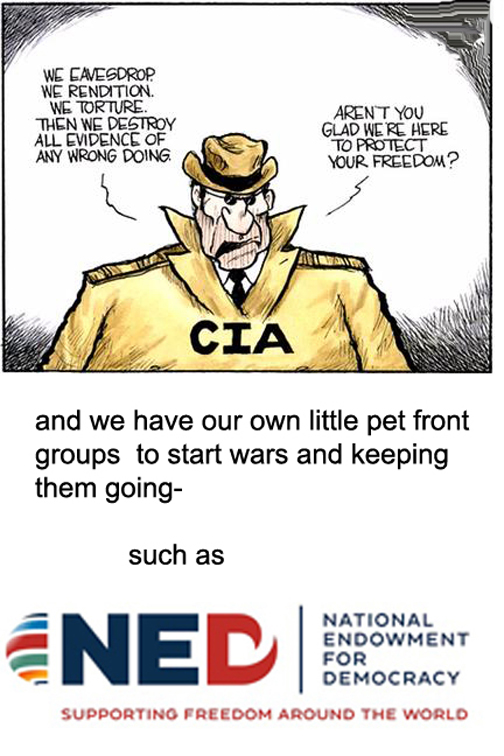
A look at the US’s soft power initiatives shows far more outlets that ought to fall under the “state affiliated” label. One such conduit for funding is the National Endowment for Democracy. The NED, created during the Reagan administration, pours $170 million a year into organizations dedicated to defending or installing regimes friendly to US policies.
ProPublica (11/24/10) described the NED as being “established by Congress, in effect, to take over the CIA’s covert propaganda efforts.” David Ignatius of the Washington Post (9/22/91) reported on the organization as a vehicle for “spyless coups,” as it was “doing in public what the CIA used to do in private.” The first NED president, Carl Gershman (MintPress, 9/9/19), admitted that the switch was largely a PR move to shroud the organization’s intentions: “It would be terrible for democratic groups around the world to be seen as subsidized by the CIA.”
NED operations in Ukraine deserve especially close scrutiny, given the organization’s role in the 2014 Maidan coup and the information war surrounding the Russian invasion. In 2013, Gershman described Ukraine as the “biggest prize” in the East/West rivalry (Washington Post, 9/26/13). Later that year, the NED united with other Western-backed influence networks to support the protest movements that later led to the removal of the president.
The history of the board is a who’s who of regime change advocates and imperial hawks. The current board includes Anne Applebaum, a popular anti-Russian staff writer at the Atlantic and frequent cable news commentator whose work epitomizes the New Cold War mentality, and Elliott Abrams, a major player in the Iran/Contra scandal who later played a key role in the Trump administration’s campaign to overthrow the Venezuelan government. Victoria Nuland, formerly the foreign policy advisor to Vice President Dick Cheney, is a key player in US foreign policy, and was even one of the US officials who was caught meddling behind the scenes to reshape the Ukrainian government in 2014. She served on the NED board in between her time in the State Department for the Obama and Biden administrations. Other former board members include Henry Kissinger, Paul Wolfowitz, Zbigniew Brzezinski and current CIA director William Burns.
After the war started, the NED removed all of its Ukraine projects from its website, though they are still available through the Internet Archive’s Wayback Machine. A look at 2021 projects shows extensive work funding media organizations throughout Ukraine with the ostensible goal of “promot[ing] government accountability” or “foster[ing] independent media.” Despite their overt funding from a well-documented US propaganda organ, none of these organizations’ Twitter accounts contain a “state-affiliated media” label. Even the NED’s own Twitter account does not reference its relationship to the US government.
This is highly relevant to the current war in Ukraine. CHESNO, ZN.UA, ZMiST and Ukrainian Toronto Television, Vox Ukraine are all part of the NED’s media network in Ukraine, yet their Twitter accounts have no state-affiliated label. Furthermore, some of the newsrooms in this network boast extensive ties to other US government organizations. European Pravda, the Ukraine Crisis Media Center and Hromadske—all founded during or shortly after the US-backed Maidan coup in 2014—boast explicit partnerships with NATO. Hromadske and the UCMC also tout partnerships with the US State Department, the US Embassy in Kyiv and the US Agency for International Development (USAID).
USAID plays a similar role to the NED. Under the protective cover of humanitarian aid and development projects, the agency serves as a conduit for US regime change operations and soft power influence peddling. Among other things, the organization has been a cover for “promoting democracy” in Nicaragua, and provided half a billion dollars to advance the coup attempt against Venezuela’s elected government.
Kyiv Post and Independent
The most popular recipient of NED funds has been the Kyiv Independent, a reconstitution of another NED-funded newsroom, the Kyiv Post. Though it claims to receive the majority of its funding through advertising and subscriptions, the Post website lists the NED as “donors who sponsored content produced by the Kyiv Post journalists.”
When the Post was temporarily shuttered in a staff dispute in November 2021, many of the journalists formed the Kyiv Independent. They did this with a $200,000 grant from the Canadian government, as well as an emergency grant from the European Endowment for Democracy, an organization headquartered in Brussels that is both modeled after and funded by the NED.
After the outbreak of war, the Independent gained over 2 million Twitter followers and attracted millions of dollars in donations. Staff from the Independent have flooded the US media ecosystem: Its reporters have had op-eds in top US newspapers like the New York Times (3/5/22) and the Washington Post (2/28/22). They often appear on US TV channels like CNN (3/21/22), CBS (12/21/22), Fox News (3/31/22) and MSNBC (4/10/22)…………………………………………..
Boosting US propaganda
Twitter’s policy effectively amounts to providing cover and reach for US propaganda organs. But this policy effect is far from the whole story. Through various mechanisms, Twitter actually boosts US-funded newsrooms and promotes them as trusted sources.
One such mechanism is the curated “Topics” feature. As part of its effort to “elevate reliable information,” Twitter recommends following its own curated feed for the Ukraine War. As of September 2022, Twitter said that this war feed for the Ukraine War had over 38.6 billion “impressions.” Scrolling through the feed shows many examples of the platform boosting US state-affiliated media, with few or no instances of coverage critical of the war effort. Despite their extensive ties to the US government, the Kyiv Independent and Kyiv Post are frequently offered as favored sources for information on the war.
The account has generated a list based on what they claim to be reliable sources on the conflict. The list currently has 55 members. Of these, at least 22 are either US-funded newsrooms, their affiliated journalists. Given the complexity of the funding channels, and the lack of information on some of these newsrooms’ websites, this number is likely an undercount:
New Voice of Ukraine (NED, State Department)
Euan MacDonald
Kyiv Post (NED)
Natalie Vikhrov
Kyiv Independent (NED)
Anastasiia Lapatina, Oleksiy Sorokin, Anna Myroniuk, Illia Ponomarenko
Zaborona (NED)…………………………….
Worldwide propaganda network
The US government currently funds other media organizations that function more blatantly as arms of the state, yet none have the “state-affiliated media” label on their Twitter accounts. These outlets are part of the media apparatus set up to promote the US point of view around the world during the Cold War. The New York Times (12/26/77) once described them as being part of a “worldwide propaganda network built by the CIA.”
The network, known as the “Propaganda Assets Inventory” within the agency, once encompassed around 500 individuals and organizations, ranging from operatives in major media like CBS, Associated Press and Reuters to smaller outlets under the “complete” “editorial control” of the CIA. Radio Free Asia, Voice of America and Radio Free Europe/Radio Liberty were at the vanguard of this propaganda operation. The Times reported in 1977 that the network resulted in a stream of US media stories that were “purposely misleading or downright false.”
The US government continues to directly operate several of these organizations. These outlets now fall under the auspices of the US Agency for Global Media (USAGM), a federal agency that received $810 million in 2022. That number marks a 27% increase from its 2021 budget, and is more than twice the amount RT received from Russia for its global operations in 2021 (RFE/RL, 8/25/21)…………………………………………………………………
Twitter, like other SiliconValley behemoths, has numerous links to the national security state. An investigation by Middle East Eye (9/30/19) revealed that one of Twitter’s top executives was also a member of one of the British military’s psychological warfare units, the 77th Brigade. Gordon MacMillan, who holds the top editorial position for the Middle East and North Africa at Twitter, joined the UK’s “information warfare” unit in 2015 while he was at Twitter. One UK general told MEE that the unit specialized in developing “the capability to compete in the war of narratives at the tactical level.” The story was met with near total silence in US and UK press (FAIR.org, 10/24/19), and MacMillan still works for Twitter.
Twitter also partners with the Australian Strategic Policy Institute, a hawkish think tank funded by the military industry and the US government, for its content moderation policies. In 2020, Twitter worked closely with the ASPI to remove over 170,000 low-follower accounts they alleged to be favorable to the Communist Party of China. More recently, Twitter and ASPI have announced a partnership ostensibly aimed at fighting disinformation and misinformation.
Twitter’s Strategic Response Team, in charge of making decisions about which content should be suppressed, was headed by Jeff Carlton, who previously worked for both the CIA and FBI. In fact, MintPress News (6/21/22) reported on the dozens of former FBI agents that have joined Twitter’s ranks over the years. Elon Musk’s controlled leak of internal communications, known as the “Twitter Files,” has renewed attention to the close relationship between the agency and the platform.
Though Twitter has previously denied directly “coordinat[ing] with other entities when making content moderation decisions,” recent reporting has revealed a deep level of integration between federal intelligence agencies, and Twitter’s content moderation policies. In part 6 of the “Twitter Files,” Matt Taibbi reported that the FBI has over 80 agents dedicated to flagging content on the platform and interfacing directly with Twitter leadership. Last year, emails leaked to the Intercept (10/31/22) showed how the Department of Homeland Security (DHS) and Twitter had an established process for content takedown requests from the agency related to election security.
The platform is clearly an important hub for pro-Ukrainian sentiment online, though not all of the activity is organic. In fact, one study (Declassified Australia, 11/3/22) released last year found a deluge of pro Ukrainian bots. Australian researchers studied a sample of over 5 million tweets about the war, and found that 90% of the total were pro-Ukrainian (identified using the #IStandWithUkraine hashtag or variations), and estimated that up to 80% of them were bots. Though researchers did not determine the precise origin of these accounts, it was obvious that they were sponsored by “pro-Ukrainian authorities.” The sheer volume of tweets undoubtedly helped shape online sentiment about the war.
It appears that Washington understands the importance of Twitter in shaping public sentiments. When Musk originally set his sights on buying the platform, the White House even considered opening a national security review of Musk’s business ventures, citing Musk’s “increasingly Russia-friendly stance.” These concerns were prompted by Musk’s plan to bar SpaceX’s StarLink system from being used in Ukraine, after a spat between Musk and a Ukrainian official. The concerns also came after Musk (10/3/22) tweeted out the outlines to a potential peace proposal between Russia and Ukraine. This proposal was met with scorn and shock among American elite circles, where escalation rather than peace is the dominant position (FAIR.org, 3/22/22).
Musk and the national security state
But Musk’s hot take on the Ukraine war should not be taken as proof of Musk’s anti establishment bona fides. Far from being an establishment outsider, Elon Musk himself is a major figure in the military industrial complex, and represents the long tradition of Silicon Valley giants being thoroughly enmeshed in the military and intelligence wars.
Musk’s rocket company, SpaceX, is a major military contractor, earning billions of dollars from the US national security state. It has received contracts to launch GPS technology into orbit to assist with the US drone war. The Pentagon has also contracted the company to build missile defense satellites. SpaceX has further won contracts from the Air Force, Space Defense Agency and National Reconnaissance Organization, and has launched spy satellites to be used by the CIA, NSA and other intelligence agencies (MintPress, 5/31/22).
In fact, SpaceX’s existence is largely owed to military and intelligence ties. One of its earliest backers of the company was the Pentagon’s Defense Advanced Research Projects Agency (DARPA), the same military research agency that gave us much of the technology that defines the modern internet age………………….
After the Russian invasion of Ukraine, Musk made headlines by offering to donate his Starlink technology to the Ukrainian government to keep the country online. Starlink, a satellite-based internet provider, was essential to Ukraine’s war effort after the Russian attack disabled much of its traditional military communications. It has enabled Ukrainians to quickly share battlefield intelligence, and connect with US support troops to perform “telemaintenance.”
Musk’s offer to “donate” the technology earned him a lot of positive press, but it was quietly revealed later that the US government had been paying SpaceX millions of dollars for the technology—despite what SpaceX officials had told the public. According to the Washington Post (4/8/22), the money was funneled through USAID, an organization that has long been a tool of US regime change efforts, and a front for covert intelligence operations………………………………………
The relationship between Musk and the security state is so strong that one official even told Bloomberg (10/20/22) that “the US government would also use Starlink in the event of telecommunications outage,” hinting at links to high-level national contingency planning.
Continuity of governance?
The conversation surrounding Twitter has centered around whether or not Elon Musk is a free-speech advocate, though little has focused on the implications of a military contractor having complete control over such an important platform. Though Musk may (or may not) be stepping down as CEO, the platform will remain his domain.
Many things have changed under Musk’s Twitter, but Twitter’s role as a megaphone for US government–funded media has not. It would take a large research study to understand precisely how much impact Twitter’s misapplication of its own policies has on the propagation. But even without this data, it is clear that the platform’s design serves to nudge users away from most media funded by Washington-unfriendly governments, and, in the case of the Ukraine War, push users toward media funded by the US government. Musk’s status as a military contractor only underscores that challenging US foreign policy objectives is unlikely to be a priority for the company. https://fair.org/home/under-musk-twitter-continues-to-promote-us-propaganda-networks/
Zelensky Expands Crackdown on Ukrainian Media
by Kyle Anzalone and Will Porter | Jan 2, 2023 https://libertarianinstitute.org/news/zelensky-expands-crack-down-on-news-media-in-ukraine/
President Volodymyr Zelensky has signed a new bill into law which strengthens government control over public access to news in Ukraine. Zelensky has already nationalized the country’s media under martial law powers invoked after Russia’s invasion last year, stoking criticism from press freedom groups.
Signed on December 29, the law expands the Ukrainian broadcast regulator’s powers over news agencies ”dramatically,” now including both print and online sources, according to the Kyiv Independent. The measure requires publications to obtain licenses to operate, and any media org without the proper paperwork can be shut down, the outlet reported, adding that the body handing out the permits will be under Zelensky’s control.
According to Ukraine’s Institute of Mass Information, under the law, the media regulator is likely to be controlled by the incumbent authorities because its members are appointed by Zelensky and the Ukrainian parliament, where his party has an absolute majority.
In March, Zelensky issued a presidential decree which nationalized Ukraine’s broadcast media, stressing the need for a ”unified information policy” to combat Russian disinformation and voices critical of the government. Around the same time, he also banned a long list of opposition political parties with alleged links to Russia, and has since taken punitive action against Orthodox churches also said to have ties with Moscow, effectively quashing all dissent under martial law powers.
While Zelensky’s power-grabs throughout the 11-month conflict have largely gone unnoticed in the American mainstream press – which has devoted ample coverage to similar wartime repression in Russia – the New York Times highlighted calls from human rights groups to rescind the law over fears that it will crush the free press.
”Ukraine will demonstrate its European commitment by promoting a free and independent media, not by establishing state control of information,” said Ricardo Gutiérrez, the general secretary for the European Federation of Journalists.
The Committee to Protect Journalists and other civil rights orgs also slammed the legislation while it was being debated by lawmakers in December. While Ukraine’s legislature agreed to strip away some of the bill’s more extreme measures, the final draft still hands the federal government near total control over Ukraine’s news media.
They’re at it again! The nuclear industry dazzles journalists with its newest hogwash – “inflection point”.

Ever inventive, the nuclear lobby has come up with this lovely new term – “inflection point” – a term pinched from geometry, and designed to dazzle journalists further into their mindless state of subservience to technical experts.
It’s quite a revealing choice of words, a 21st Century advance on their old mantra “nuclear renaissance”. That term had a comforting suggestion of biology, history, art.
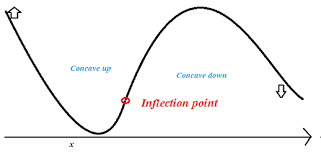
The new term moves away from all that “soft” educational rubbish, and into the world of maths and technology – which are now supposed to be the only studies that matter.
The curious thing, though, is that the term used here implies that the nuclear industry is now at a very low point. It’s unpopular, people are reluctant to invest in it, perhaps now realising that small nuclear reactors have no use except for helping the development of nuclear weapons.
And, as the diagram shows, there’s a very good chance that if, in fact, this small nuclear reactor industry really does get going, before long there will be a new “inflection point”, where the industry collapses, just like the big nuclear industry is doing.
Today’s corporate media is awash with nuclear propaganda where the journalists clearly didn’t need to do any thinking, except perhaps to add a few superlatives to the industry’s jargon handouts.
US spies pushed Twitter to censor ‘anti-Ukraine narratives’ – media
more
https://www.rt.com/news/568879-twitter-files-cia-collusion/ 28 Dec 22
New batch of of files exposes collusion with ‘other government agencies’.
The Pentagon, CIA and other US intelligence and law-enforcement agencies became increasingly “more aggressive” with takedown requests, the latest trove of Twitter files has revealed. The documents suggest the agencies were effectively pushing the platform to censor foreign-policy stories that ran against the Washington-approved narrative.
The files show the FBI acting as doorman to a vast program of social media surveillance and censorship, encompassing agencies across the federal government – from the State Department to the Pentagon to the CIA,” journalist Matt Taibbi wrote in the Christmas Eve edition of the Twitter Files, released with the blessing of the social media platform’s owner, Elon Musk.
Thousands of censorship requests flowed to Twitter from what were termed OGA” in the documents, or “Other Government Organizations,” through the FBI’s Foreign Influence Task Force.
Twitter executives often struggled to validate government claims, but were under constant pressure to find evidence to blame any foreign actor, Russia in particular.
“Found no links to Russia,” an unnamed analyst said in one of the emails, later suggesting he could “brainstorm” to “find a stronger connection.” Former Trust and Safety chief Yoel Roth admitted in another instance that he’d found “no real matches using the info.”
Internal communications show that Twitter had been getting so many requests that its executives had to improvise a system for prioritizing them. The feds had dedicated personnel tasked with tailoring takedown requests to Twitter’s policies for faster processing, which the execs acknowledged as “odd,” but even then the company often struggled to justify censorship.
“Many people wonder if Internet platforms receive direction from intelligence agencies about moderation of foreign policy news stories. It appears Twitter did, in some cases by way of the FITF/FBI,” Taibbi wrote. At least some of these directives originated at the CIA, according to former agent and whistleblower John Kiriakou, who said he “recognized the formatting.”
The feds sometimes sent massive batches of over 1,000 accounts lined up for “digital execution,” with only a brief explanation of the alleged problems. On multiple occasions they accused “Russian agents” of directing accounts that highlighted “predominantly anti-Ukraine narratives” or documented “purported rights abuses committed by Ukrainians.”
Another intelligence assessment sent to Twitter claimed that accounts spreading information about “neo-Nazis” in Ukraine were part of a Kremlin-controlled propaganda campaign and must be banned.
In what Taibbi called a “damning admission,” an unnamed former CIA-turned-Twitter executive once noted that the “government partners” were getting increasingly “aggressive” with their takedown requests.
In what Taibbi called a “damning admission,” an unnamed former CIA-turned-Twitter executive once noted that the “government partners” were getting increasingly “aggressive” with their takedown requests.
“Due to a lack of technical evidence on our end, I’ve generally left it be, waiting for more evidence,” he said about the InfoBRICS account. He further argued that since “BRICS is an inherently Russia-dominated economic organization” it was “always likely…directed by the Kremlin.”
“Our window on that is closing, given that government partners are becoming more aggressive on attribution and reporting on it…I’m going to go ahead with suspension and marking the domain UNSAFE.”
Spearheaded by Taibbi in cooperation with fellow reporters Bari Weiss, Lee Fang, and others, the Twitter Files have shed light on several controversial decisions made by the company, including material surrounding the suspension of ex-President Donald Trump, the practice of shadow banning, as well as a site-wide ban on a New York Post report about the foreign business dealings of Hunter Biden, the son of President Joe Biden.
The files also explained how the US intelligence community worked hand-in-glove with the platform to flag speech for suspension that the US government deemed “misinformation,” and showed how the FBI and Twitter locked horns over the agency’s claims of increased activity by ‘propaganda’ bots, of which Twitter said it found no evidence.
Atomic Bomb Effects Cover-up Reported in New York Times

https://www.wanttoknow.info/atomicbombcoverup— 25 Dec 22
The below article is an excellent example of how even the New York Times has twisted the facts and manipulated public opinion in order to support a deeper agenda. This revealing story covers the bombing of Hiroshima back in 1945, yet the same deceptive techniques of distortion and manipulation continue to be used today to support the profit-making war machine.
The New York Times itself acknowledged government and media complicity in hiding the effects of the Atomic bomb in an Aug. 3, 2005 Reuters article they published titled “U.S. Suppressed Footage of Hiroshima for Decades.” Read this revealing article on the Times website on this webpage.
[Note: Since this message was originally posted in 2004, the New York Times removed the article at the above link. A web search shows that no other major media have this revealing story posted. Thankfully, you can still read a copy of this Reuters article on a foreign news website.]
Here’s a quote from this Reuters article, “In the weeks following the atomic attacks on Hiroshima and Nagasaki, U.S. authorities seized and suppressed film shot in the bombed cities by U.S. military crews and Japanese newsreel teams to prevent Americans from seeing the full extent of devastation wrought by the new weapons.” The below article goes into greater detail on the depth of deception. Please help to inform others by sharing this revealing news with your friends and colleagues and exploring the “What you can do” section below.
Hiroshima Cover-up:
How the War Department’s Timesman Won a Pulitzer
by Amy Goodman and David Goodman, Aug. 10, 2004
At the dawn of the nuclear age, an independent Australian journalist named Wilfred Burchett traveled to Japan to cover the aftermath of the atomic bombing of Hiroshima. The only problem was that General Douglas MacArthur had declared southern Japan off-limits, barring the press. Over 200,000 people died in the atomic bombings of Hiroshima and Nagasaki, but no Western journalist witnessed the aftermath and told the story. The world’s media obediently crowded onto the USS Missouri off the coast of Japan to cover the surrender of the Japanese.

Wilfred Burchett decided to strike out on his own. He was determined to see for himself what this nuclear bomb had done, to understand what this vaunted new weapon was all about. So he boarded a train and traveled for thirty hours to the city of Hiroshima in defiance of General MacArthur’s orders.
Burchett emerged from the train into a nightmare world. The devastation that confronted him was unlike any he had ever seen during the war. The city of Hiroshima, with a population of 350,000, had been razed. Multistory buildings were reduced to charred posts. He saw people’s shadows seared into walls and sidewalks. He met people with their skin melting off. In the hospital, he saw patients with purple skin hemorrhages, gangrene, fever, and rapid hair loss. Burchett was among the first to witness and and describe radiation sickness.
Burchett sat down on a chunk of rubble with his Baby Hermes typewriter. His dispatch began: “In Hiroshima, thirty days after the first atomic bomb destroyed the city and shook the world, people are still dying, mysteriously and horribly – people who were uninjured in the cataclysm from an unknown something which I can only describe as the atomic plague.”
He continued, tapping out the words that still haunt to this day: “Hiroshima does not look like a bombed city. It looks as if a monster steamroller has passed over it and squashed it out of existence. I write these facts as dispassionately as I can in the hope that they will act as a warning to the world.”
Burchett’s article, headlined THE ATOMIC PLAGUE, was published on September 5, 1945, in the London Daily Express. The story caused a worldwide sensation. Burchett’s candid reaction to the horror shocked readers. “In this first testing ground of the atomic bomb I have seen the most terrible and frightening desolation in four years of war. It makes a blitzed Pacific island seem like an Eden. The damage is far greater than photographs can show. “When you arrive in Hiroshima you can look around for twenty-five and perhaps thirty square miles. You can see hardly a building. It gives you an empty feeling in the stomach to see such man-made destruction.”
Burchett’s searing independent reportage was a public relations fiasco for the U.S. military. General MacArthur had gone to pains to restrict journalists’ access to the bombed cities, and his military censors were sanitizing and even killing dispatches that described the horror. The official narrative of the atomic bombings downplayed civilian casualties and categorically dismissed reports of the deadly lingering effects of radiation.
Reporters whose dispatches [conflicted] with this version of events found themselves silenced: George Weller of the Chicago Daily News slipped into Nagasaki and wrote a 25,000-word story on the nightmare that he found there. Then he made a crucial error: He submitted the piece to military censors. His newspaper never even received his story. As Weller later summarized his experience with MacArthur’s censors, “They won.”
U.S. authorities responded in time-honored fashion to Burchett’s revelations: They attacked the messenger. General MacArthur ordered him expelled from Japan (the order was later rescinded), and his camera with photos of Hiroshima mysteriously vanished while he was in the hospital. U.S. officials accused Burchett of being influenced by Japanese propaganda. They scoffed at the notion of an atomic sickness. The U.S. military issued a press release right after the Hiroshima bombing that downplayed human casualties, instead emphasizing that the bombed area was the site of valuable industrial and military targets.
Four days after Burchett’s story splashed across front pages around the world, Major General Leslie R. Groves, director of the atomic bomb project, invited a select group of thirty reporters to New Mexico. Foremost among this group was William L. Laurence, the Pulitzer Prize-winning science reporter for The New York Times. Groves took the reporters to the site of the first atomic test. His intent was to demonstrate that no atomic radiation lingered at the site. Groves trusted Laurence to convey the military’s line; the general was not disappointed.
Laurence’s front-page story, U.S. ATOM BOMB SITE BELIES TOKYO TALES: TESTS ON NEW MEXICO RANGE CONFIRM THAT BLAST, AND NOT RADIATION, TOOK TOLL, ran on September 12, 1945, following a three-day delay to clear military censors. “This historic ground in New Mexico, scene of the first atomic explosion on earth and cradle of a new era in civilization, gave the most effective answer today to Japanese propaganda that radiations [sic] were responsible for deaths even after the day of the explosion, Aug. 6, and that persons entering Hiroshima had contracted mysterious maladies due to persistent radioactivity,” the article began. Laurence said unapologetically that the Army tour was intended “to give the lie to these claims.”
Laurence quoted General Groves: “The Japanese claim that people died from radiation. If this is true, the number was very small.” Laurence then went on to offer his own remarkable editorial on what happened: “The Japanese are still continuing their propaganda aimed at creating the impression that we won the war unfairly, and thus attempting to create sympathy for themselves and milder terms. Thus, at the beginning, the Japanese described ‘symptoms’ that did not ring true.”
But Laurence knew better. He had observed the first atomic bomb test on July 16, 1945, and he withheld what he knew about radioactive fallout across the southwestern desert that poisoned local residents and livestock. He kept mum about the spiking Geiger counters all around the test site.
William L. Laurence went on to write a series of ten articles for the Times that served as a glowing tribute to the ingenuity and technical achievements of the nuclear program. Throughout these and other reports, he downplayed and denied the human impact of the bombing. Laurence won the Pulitzer Prize for his reporting.
It turns out that William L. Laurence was not only receiving a salary from The New York Times. He was also on the payroll of the War Department. In March 1945, General Leslie Groves had held a secret meeting at The New York Times with Laurence to offer him a job writing press releases for the Manhattan Project, the U.S. program to develop atomic weapons. The intent, according to the Times, was “to explain the intricacies of the atomic bomb’s operating principles in laymen’s language.” Laurence also helped write statements on the bomb for President Truman and Secretary of War Henry Stimson.
Laurence eagerly accepted the offer, “his scientific curiosity and patriotic zeal perhaps blinding him to the notion that he was at the same time compromising his journalistic independence,” as essayist Harold Evans wrote in a history of war reporting. Evans recounted: “After the bombing, the brilliant but bullying Groves continually suppressed or distorted the effects of radiation. He dismissed reports of Japanese deaths as ‘hoax or propaganda.’ The Times’ Laurence weighed in, too, after Burchett’s reports, and parroted the government line.” Indeed, numerous press releases issued by the military after the Hiroshima bombing – which in the absence of eyewitness accounts were often reproduced verbatim by U.S. newspapers – were written by none other than Laurence.
“Mine has been the honor, unique in the history of journalism, of preparing the War Department’s official press release for worldwide distribution,” boasted Laurence in his memoirs, Dawn Over Zero. “No greater honor could have come to any newspaperman, or anyone else for that matter.”
“Atomic Bill” Laurence revered atomic weapons. He had been crusading for an American nuclear program in articles as far back as 1929. His dual status as government agent and reporter earned him an unprecedented level of access to American military officials – he even flew in the squadron of planes that dropped the atomic bomb on Nagasaki. His reports on the atomic bomb and its use had a hagiographic tone, laced with descriptions that conveyed almost religious awe.
In Laurence’s article about the bombing of Nagasaki (it was withheld by military censors until a month after the bombing), he described the detonation over Nagasaki that incinerated 100,000 people. Laurence waxed: “Awe-struck, we watched it shoot upward like a meteor coming from the earth instead of from outer space, becoming ever more alive as it climbed skyward through the white clouds. It was a living thing, a new species of being, born right before our incredulous eyes.”
Laurence later recounted his impressions of the atomic bomb: “Being close to it and watching it as it was being fashioned into a living thing, so exquisitely shaped that any sculptor would be proud to have created it, one . . . felt oneself in the presence of the supranatural.”
Laurence was good at keeping his master’s secrets – from suppressing the reports of deadly radioactivity in New Mexico to denying them in Japan. The Times was also good at keeping secrets, only revealing Laurence’s dual status as government spokesman and reporter on August 7, the day after the Hiroshima bombing – and four months after Laurence began working for the Pentagon. As Robert Jay Lifton and Greg Mitchell wrote in their excellent book Hiroshima in America: Fifty Years of Denial, “Here was the nation’s leading science reporter, severely compromised, not only unable but disinclined to reveal all he knew about the potential hazards of the most important scientific discovery of his time.”
Radiation: Now You See It, Now You Don’t
A curious twist to this story concerns another New York Times journalist who reported on Hiroshima; his name, believe it or not, was William Lawrence (his byline was W.H. Lawrence). He has long been confused with William L. Laurence. (Even Wilfred Burchett confuses the two men in his memoirs and his 1983 book, Shadows of Hiroshima.) Unlike the War Department’s Pulitzer Prize winner, W.H. Lawrence visited and reported on Hiroshima on the same day as Burchett. (William L. Laurence, after flying in the squadron of planes that bombed Nagasaki, was subsequently called back to the United States by the Times and did not visit the bombed cities.)
W.H. Lawrence’s original dispatch from Hiroshima was published on September 5, 1945. He reported matter-of-factly about the deadly effects of radiation, and wrote that Japanese doctors worried that “all who had been in Hiroshima that day would die as a result of the bomb’s lingering effects.” He described how “persons who had been only slightly injured on the day of the blast lost 86 percent of their white blood corpuscles, developed temperatures of 104 degrees Fahrenheit, their hair began to drop out, they lost their appetites, vomited blood and finally died.”
Oddly enough, W.H. Lawrence contradicted himself one week later in an article headlined NO RADIOACTIVITY IN HIROSHIMA RUIN. For this article, the Pentagon’s spin machine had swung into high gear in response to Burchett’s horrifying account of “atomic plague.” W.H. Lawrence reported that Brigadier General T. F. Farrell, chief of the War Department’s atomic bomb mission to Hiroshima, “denied categorically that [the bomb] produced a dangerous, lingering radioactivity.” Lawrence’s dispatch quotes only Farrell; the reporter never mentions his eyewitness account of people dying from radiation sickness that he wrote the previous week.
The conflicting accounts of Wilfred Burchett and William L. Laurence might be ancient history were it not for a modern twist. On October 23, 2003, The New York Times published an article about a controversy over a Pulitzer Prize awarded in 1932 to Times reporter Walter Duranty. A former correspondent in the Soviet Union, Duranty had denied the existence of a famine that had killed millions of Ukrainians in 1932 and 1933.
The Pulitzer Board had launched two inquiries to consider stripping Duranty of his prize. The Times “regretted the lapses” of its reporter and had published a signed editorial saying that Duranty’s work was “some of the worst reporting to appear in this newspaper.” Current Times executive editor Bill Keller decried Duranty’s “credulous, uncritical parroting of propaganda.”
On November 21, 2003, the Pulitzer Board decided against rescinding Duranty’s award, concluding that there was “no clear and convincing evidence of deliberate deception” in the articles that won the prize.
As an apologist for Joseph Stalin, Duranty is easy pickings. What about the “deliberate deception” of William L. Laurence in denying the lethal effects of radioactivity? And what of the fact that the Pulitzer Board knowingly awarded the top journalism prize to the Pentagon’s paid publicist, who denied the suffering of millions of Japanese? Do the Pulitzer Board and the Times approve of “uncritical parroting ” – as long as it is from the United States?
It is long overdue that the prize for Hiroshima’s apologist be stripped.
The original of the above article published on Aug. 10, 2004 is available here.
Amy Goodman is host of the national radio and TV show “Democracy Now!.” This is an excerpt from her new national bestselling book The Exception to the Rulers: Exposing Oily Politicians, War Profiteers, and the Media that Love Them, written with her brother journalist David, exposes the reporting of Times correspondent William L. Laurence. Democracy Now! is a national radio and TV program, broadcast on more than 240 stations.
Important Note: A profound 22-minute video features interviews of a number of “atomic soldiers” who were ordered to watch the nuclear bomb blasts from as close as a mile away. They were sworn to secrecy under a penalty of a $10,000 fine (roughly $100,000 in today’s dollars) or 10 years in jail and instructed never to talk to their wives or their fellow soldiers about anything they saw or experienced. Don’t miss this incredible film, available on this webpage, that the U.S. government doesn’t want you to see.
Media enthuses over “sexy”high tech nuclear energy, but ignores the really effective one – energy saving.

It’s that time of year when editors seem happy to let a few dubious stories
through. Most of the media ran with this one on yet another nuclear fusion
breakthrough- this one at the Lawrence Livermore labs in California, at the
National Ignition Facility.
Well, with the climate change threat looming,
non-fossil energy is a big issue just now- and its certainly cold out! So
is help at hand? Well no, not for some time at least. And at unknown cost.
Even if this laser based system, which was designed primarily for
replicating the physics of H-bomb ignition, can be made to deliver energy
on a large scale reliably and safely, it’s going to take a while- it’s a
very long shot.
An equally familiar but arguably much more welcome
newspaper article was this one on energy saving. As seems to be said almost
every week now, saving energy saves money. And it’s available now. But no
one seems to notice.
Energy conservation is just not sexy. Not like high
tech fusion or hydrogen- which also these days regularly gets star billing.
Well hydrogen may have some applications, but in a wide ranging critique,
Michael Liebreich, BNEF founder, says not that many.
It’s not the
wonder-fuel it’s been billed as. He is not happy: ‘we are going to waste
huge amounts of money on the wrong use cases for hydrogen and the wrong
infrastructure in the wrong places’. Few seem happy either about the
proposed new coal mine in Cumbria, but support for solar farms seems to be
missing in Tory UK, although, in the EU, there seems to be support for
putting solar in space…What an odd world. With Russia still calling many
of the shots: according to a new Parliamentary Briefing Note, ‘it is
currently the only country capable of commercially providing the more
enriched fuel needed for Advanced Modular Reactors’, which some look to the
replace the current type of nuclear technology.
Renew Extra 17th Dec 2022
https://renewextraweekly.blogspot.com/2022/12/an-end-of-year-whimsy.html
Exposed: The Most Polluted Place in the United States

A new book investigates the toxic legacy of Hanford, the Washington state facility that produced plutonium for nuclear weapons.
The Revelator The Ask, December 14, 2022 – by Tara Lohan, The most polluted place in the United States — perhaps the world — is one most people don’t even know. Hanford Nuclear Site sits in the flat lands of eastern Washington. The facility — one of three sites that made up the government’s covert Manhattan Project — produced plutonium for Fat Man, the atomic bomb dropped on Nagasaki during World War II. And it continued producing plutonium for weapons for decades after the war, helping to fuel the Cold War nuclear arms race.
Today Hanford — home to 56 million gallons of nuclear waste, leaking storage tanks, and contaminated soil — is an environmental disaster and a catastrophe-in-waiting.
It’s the costliest environmental remediation project the world has ever seen and, arguably, the most contaminated place on the entire planet,” writes journalist Joshua Frank in the new book, Atomic Days: The Untold Story of the Most Toxic Place in America.
It’s also shrouded in secrecy.
Frank has worked to change that, beginning with a series of blockbuster investigations published in Seattle Weekly a decade ago. Atomic Days offers an even fuller picture of the ecological threats posed by Hanford and its failed remediation.
The Revelator spoke with him about the environmental consequences, the botched cleanup operation, and what comes next.
Why is the most polluted place in the country so little known?
We have to understand what it was born out of, which was the Manhattan Project. There were three locations picked — Los Alamos [N.M.], Oak Ridge [Tenn.] and Hanford — to build the nuclear program.
Hanford was picked to produce plutonium and it ran for four decades, from World War II through the Cold War in the late 80s. For decades people that lived in and around Hanford didn’t know what was really going on there. It was run as a covert military operation. Even now, it’s still very much run like a covert operation because of the dangers that exist with the potential for an attack on one of the nuclear waste tanks……………….
What are the known environmental dangers?
There are 177 underground tanks that hold 56 million gallons of nuclear waste. We know that 67 of those tanks have leaked in the past into the groundwater that feeds the Columbia River.
We know that during its operation in the 50s and 60s the government was monitoring the water in the Columbia River, and even at the mouth of the Columbia they were finding radioactive fish. So we know that there have been leaks that made it to the river.
Right now, we know that there are two tanks currently leaking. The Washington Department of Ecology and the U.S. Department of Energy know about these leaks, but they can’t do anything about them because there’s no other place to safely put the waste…………………………
What has the cleanup process been like?
The big thing right now is trying to get all this waste vitrified, which is turning it into glass so it can be stored safely and permanently. The government thought that could be done in four years, but that was 30 years ago now……………………………………….
Bechtel is a privately owned corporation and we’re spending billions of dollars paying this company to not get the job done. It’s a big mess……………………………………………….. more https://therevelator.org/hanford-nuclear-book/
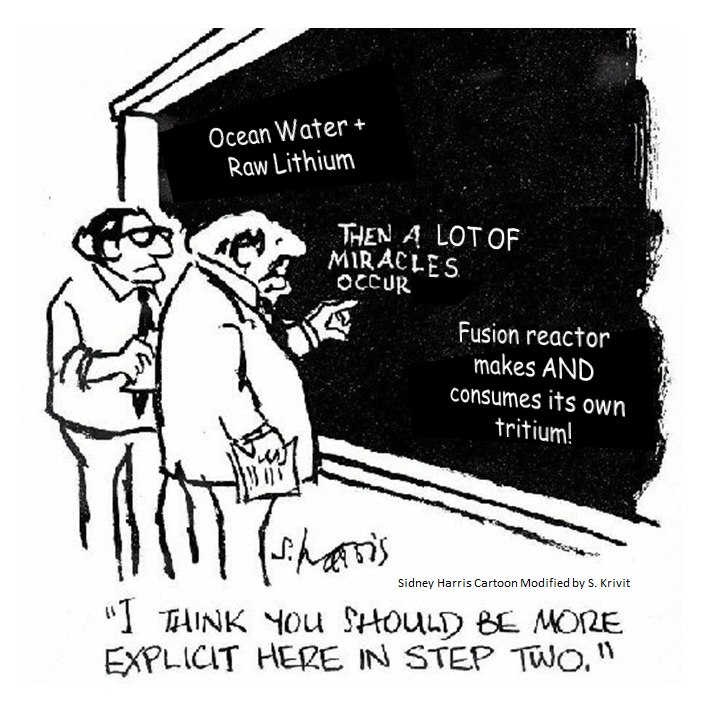
For true reporting on nuclear fusion, non-magical science is needed
We want to know about the uncertainties attending fusion research, but are the people best placed to discuss those uncertainties because they are at the coalface of technical innovation, mired in commercial, and sometimes military, incentives to underplay risk and overplay potential?
FUSION NET GAIN IS MANUFACTURED IGNORANCE, ARENA ONLINE, DARRIN DURANT, 16 DEC 2022
“…………………….. ………………. Net gain in fusion research today exploits holes in our broader culture about what we do not know we know. It is unevenly known that more power is consumed than is produced by fusion experiments. The process of manufacturing ignorance about that unevenly known fact turns on excluding uncomfortable knowledge because of the way that knowledge might threaten fusion-related institutional goals and interests.
We are not ignorant of fusion gaslighting because of some natural but temporary state of maldistribution of knowledge, nor because we just happen to have not done the relevant work of knowing. Instead, fusion hype actively makes and sustains broader ignorance. Manufacturing ignorance is an achievement which in the case of fusion relies on fuzzy measures today being masked by heroic projections about tomorrow, aided by eliding the uncertainties attending fusion technology.
THE TRUTH OF THE MATTER?
If the managing of uncomfortable knowledge is leading to the manufacturing of ignorance about fusion research, is the solution to embrace frank assessment? Unfortunately, a tension exists whereby we reasonably suspect both that experts are best placed to know of uncertainties, and that those same experts might have incentives to underplay them. Social and political analysts of techno-science represent this as the conflict between the certainty trough and the commercialisation of science.
The certainty trough is the finding that those alienated from institutions committed to a non-preferred technology are uncertain due to distrust, but that insiders or producers of knowledge are uncertain (even if only in private) due to close experience with the relevant techno-science. If the question can be established as technical, not political, then by the principle of the locus of legitimate interpretation, in science the producers of knowledge ought to be the arbiters of meaning (unlike in the Arts, where we accept that consumers can play the role of interpreters of meaning).
Yet the commercialisation of science often incentivises an instrumental function of hype in which scientists sell opportunity and underplay risk, producing warranted distrust in the delegating of meaning-making to experts. The hermeneutics of suspicion can be either crude (financial investments are said to directly undermine norms of objectivity), subtle (a medialisation process is shifting the norms of science towards the norms of marketing, entertainment, media and attention cycles), or deep (a restricted agenda of tractable uncertainties, resolvable by existing frameworks, makes invisible the limiting commitments and assumptions of any given techno-scientific project).
The NIF experiment is especially burdened by the tension between trusting and being suspicious of experts because it is a weapons project. The DOE announcement slipped in that the ‘breakthrough will ensure the safety and reliability of our nuclear stockpile’. The director for weapons physics and design at LLNL (California’s Lawrence Livermore National Laboratory) did not hide this, clarifying that fusion ignition is important because it ‘has direct application to maintaining the weapons stockpile—NIF’s (National Ignition Facility) primary mission)
The DOE’s National Nuclear Security Administration warranted the NIF ignition test as part of the Stockpile Stewardship Program, in which thermonuclear weapons are assessed and certified without the need for explosive testing. In reply, critics linked the test to concerns about proliferation and continued weapons development, and clean energy was branded a ‘convenient reason to keep the dollars flowing to dual-use weapons R&D’.
Is this tension a catch-22? Is there no escape from the mutually dependent but conflicting conditions? We want to know about the uncertainties attending fusion research, but are the people best placed to discuss those uncertainties because they are at the coalface of technical innovation mired in commercial, and sometimes military, incentives to underplay risk and overplay potential?
NON-MAGICAL SCIENCE
Maybe there is a sliver of hope. The director for weapons physics at LLNL lamented that ‘he would have preferred [the results] be released through a scientific journal. But the results were sure to leak out’. The unedifying hype accompanying fusion research trades on the image of science as magically pulling rabbits (clean, infinite power for all, tomorrow) out of hats. Distrust follows when exaggerated projections are revealed to be emperors with no clothes.
But here is a scientist, enmeshed in all the complexities of military and commercial work, still holding on to a key value of science: organised scepticism. The more scientists opt for the less sexy route of assessing results and uncertainties, checking before unveiling and opening research to scientific scrutiny before turning meaning-making over to the norms of sensationalism, the more the rest of us might have access to their distributed judgements about uncertainties.
Note there is an historical precedent: the LIGO result announcing the detection of gravity waves. LIGO detected the ripple in September 2015 but waited until February 2016 to announce it, using the time to double-check everything. The story is told by the sociologist of science Harry Collins in Gravity’s Kiss (2017), where he suggests that the result was withheld because LIGO was still hostage to the ‘science is revelatory’ image. There remained a commitment to flawless and glorious truth, and a reluctance to let science be a bit uncertain and maybe even wrong. There is historical precedent here too: some nuclear waste disposal programs have let their institutional selves be vulnerable, which is a key condition for building trust, by making their choices amenable to checking and changing by broader audiences. I am just, I guess, fusing some ideas together. https://arena.org.au/fusion-net-gain-is-manufactured-ignorance/
‘We are all downwinders’: New film discusses Nevada’s nuclear fallout
https://www.reviewjournal.com/entertainment/movies/we-are-all-downwinders-new-film-discusses-nevadas-nuclear-fallout-2695496/ By Taylor Lane Las Vegas Review-Journal, December 16, 2022
“At the end of the day, we are all downwinders.”
That’s the message directors Mark Shapiro and Douglas Brian Miller hope viewers take away from their upcoming film “Downwind,” a documentary on the health consequences of nuclear testing at the Nevada Test Site (now called the Nevada National Security Site).
The test site saw over 900 nuclear detonations between 1951 and 1992, including 100 atmospheric tests that could be seen from as far as Las Vegas, 65 miles south of the test site, and St. George, Utah, which has above-average rates of radioactivity compared to the U.S. average.
The film centers around the areas closest to the blasts in Utah and western Nevada, where communities officials once deemed a “low-use segment of the population” bore the brunt of the fallout — mainly Mormon communities, Native Americans and other rural residents, Shapiro said.
Because of its Utah focus, the filmmakers wanted to debut it in the Beehive State at the Slamdance Film Festival in Park City.PauseUnmute
The film premieres Jan. 23 and will be preceded by a panel featuring Miller and Shapiro, along with downwinder advocates Claudia Peterson and Mary Dickson, Nevada Shoshone Nation Principal Man and spokesperson Ian Zabarte and Scott Williams, a nuclear policy consultant from Heal Utah.
Shapiro and Miller said they became interested in researching nuclear fallout after reflecting on their families’ history of cancer, which is found in higher rates in communities in proximity to the test site.
The two descended down a rabbit hole of research on the widespread impacts of radiation from nuclear testing, and found out radiation is not exclusive to the Southwest.
“Even if you don’t live in St. George, the radiation impacts us globally,” Shapiro said.
Miller said he was awestruck by a map from researcher Richard Miller (no relation) that shows how far the winds blew the radiation across the U.S.
“It blasted the entire country, minus Los Angeles because of the way the wind was blowing. … It just changes your whole mindset of ‘Is this real?’ And then you continue to dig,” Miller said.
Talking with Nevadans
Miller and Shapiro spoke with many Nevadans about their experiences with nuclear fallout, including members of the Western Bands of the Shoshone Nation of Indians such as Zabarte. The test site is on the traditional homelands of the Western Shoshone.
“We wanted to make sure that we had the perspective of Ian and others from the community to talk about the significance of testing on land that they still consider theirs and theirs by treaty,” Shapiro said.
The duo found support from late Review-Journal reporter Keith Rogers, whose career at the newspaper focused on the test site, military issues and the environment. Rogers died in October.
“We looked at him as a significant contributor to this film,” Shapiro said. “(For) both Doug and I, he was like a father figure to us. He really helped guide a lot of the story.”
Rogers is featured in the film, and behind the scenes helped Miller and Shapiro connect with people who work at Atomic Testing Museum and to past test site employees.
The greatest resource Rogers gave the team, Shapiro said, was a U.S. nuclear test booklet from the Department of Energy, which detailed every test ever done at the test site.
“Each one of them has a name, it has a date, it has a location, it has the yield range — some of these bombs were several times larger than the bombs dropped in Hiroshima and Nagasaki,” Shapiro said. “This booklet that he gave me, you see notes from the government saying ‘accidental release of radiation detected off site.’ It almost gives you shivers — it’s the rabbit hole effect.”
The film also stars actor Martin Sheen, who serves as the film’s narrator and has spoken out against nuclear testing, and comedian Lewis Black, who adds humor to a dark story about America’s past and has joked about duck-and-cover drills in his stand-up routines.
“(Black) is a political commentator, and his comedy is a reflection of the time we live in,” Shapiro said.
Holding accountability
Miller hopes the film shows that residents whose lives have been changed by testing should be compensated and that Americans can find ways to prevent testing from happening again, he said.
“We have to make sure that we’re holding our government accountable for what’s happening,” Shapiro said. “While we recognize how much we love living here (in the U.S.), still, there’s accountability.”
For more information on the film, visit backlotdocs.com.
Contact Taylor Lane at tlane@reviewjournal.com. Follow @tmflane on Twitter.

NATO Narratives and Corporate Media Are Leading to ‘Doorstep of Doom’
The number of countries now signed onto the treaty to end nuclear arms has risen to 91. That most of the world is not on the side of the US is information that is absent from big journalism’s reporting. The many entreaties from governments across the globe to negotiate an end to the war in Ukraine are not on corporate news agenda.
The fact that 30 progressive politicians felt compelled to pull back a letter requesting negotiations to end the war in Ukraine the day after it was delivered to President Biden indicates the severity of the lockdown on public debate about war in the US.
FAIR ROBIN ANDERSEN 2 Dec 22
A popular cartoon aptly expresses the political angst provoked by media pundits today as they chatter on about nuclear war: Two people, both a little hunched over, burdened with the world, are walking down a city street. The woman says to the man, “My desire to be well-informed is currently at odds with my desire to remain sane.”
As we slide closer to what was once considered the ultimate insanity—nuclear Armageddon—corporate media seem to be egging on reckless leaders as they make thinly veiled threats across an imaginary nuclear line. On 60 Minutes (9/18/22), in response to the question, “What [would you] say to [Vladimir Putin] if he is considering using chemical or tactical nuclear weapons?” Joe Biden said, “Don’t. Don’t. Don’t. You will change the face of war unlike anything since World War II.” The president was, of course, referencing the US bombing of Hiroshima and Nagasaki.
Biden also reiterated the US’s goal of total victory: “Winning the war in Ukraine is to get Russia out of Ukraine completely.” Interviewer Scott Pelley did not point out that this would mean driving Russia out of Crimea—territory that Russia has long promised to defend with nuclear weapons (Diplomat, 7/11/14).
Two months into the war in Ukraine, the Wall Street Journal (4/27/22) proclaimed, “The US Should Show It Can Win a Nuclear War.” Gone are the days of rational deterrence and Mutually Assured Destruction (MAD), a doctrine based on knowledge of the deadly consequences of nuclear war: Just the threat of using such awesome destruction against an enemy would prevent the enemy’s use of those same weapons.
‘Dangerous’ peace deals
In a moment of sanity, the LA Times (8/15/22) admitted that a nuclear exchange involving only 3% of the world’s stockpiles would kill a third of the global population within two years. And The Nation (10/18/22) admonished the US and Russia both for what it called “playacting nuclear war,” each with its own nuclear games. Consortium News (10/31/22) warned that the US deploying nuclear-capable B-52s to Australia, presumably to threaten China, is “military madness.”
But other media have engaged in strained linguistic maneuvering to promote the murder of billions of people. One pretzeled headline from Insider (10/15/22): “Putin’s Nuclear Threats Are Pushing People Like Trump and Elon Musk to Press for a Ukraine Peace Deal. A Nuclear Expert Warns That’s ‘Dangerous.’” The article began, “An understandable desire to avoid a nuclear war could actually make the world more dangerous if it means rushing to implement a ‘peace.’”
Seeking to explain how we’re learning to love to bomb and give up our engagement with reasoned thought, sports writer Robert Lipsyte (TomDispatch, 10/18/22) noted that we’ve been trained to look for something huge, like a big bang or grand slam:
The dream of the game-changing home run has shaped our approach to so much, from sports to geopolitics. Most significantly, it’s damaged our ability to solve problems through reason and diplomacy.
When the Bomb is treated as the ultimate home run, the loss of reason and diplomacy lies directly at the feet of war censorship and propaganda, which have permeated corporate news since World War I. The domination of NATO narratives has followed this lead, even as the stakes have become existentially higher.
Demonize the enemy
There has been no better villain than Vladimir Putin…………………………………………………………
Beyond redemption
While rape and sexual assault are indeed military strategies in war, tales of raping and killing babies have also long served to foster outrage toward official enemies, from World War I German soldiers bayoneting babies to Kuwaiti babies yanked out of their incubators in the first Persian Gulf War.
But most Americans, especially young people, don’t recognize propaganda, because even when it is exposed at the time, it is not incorporated into the broader narratives of war. Debunked tales have gone down the Orwellian memory hole, and most of the true history of war goes down the same hole.
As Bryce Greene pointed out on Counterspin (2/24/22), the roots of the escalations leading up to the war in Ukraine were “completely omitted from the Western media.”
Because the evil enemy is always solely responsible and beyond redemption, there is no need to include an accurate history, or correct the false claims, or include the reasons for war. As FAIR (3/4/22) pointed out, the Russian invasion of Ukraine is frequently described as “unprovoked.” The explanation for war is simple: It’s good vs evil.
And the US is always good, even though the country has perpetrated a senseless, expensive and brutal war in the Middle East for the entire 21st century. When corporate media did “explain” the war in Ukraine, it “almost universally gave a pro-Western view of US/Russia relations and the history behind them” (FAIR.org, 1/28/22). Common Dreams (3/18/22) observed that journalists were more hawkish at news conferences than Biden’s press secretary, often “cheerleading for US escalation in Ukraine,” with more weapons and no-fly zones.
Getting to the edge of doom
Foreign Affairs (9–10/22), citing US officials, reported that in April 2022, two months into the war, “Russian and Ukrainian negotiators appeared to have tentatively agreed on the outlines of a negotiated interim settlement,” in a deal worked out in Turkey. This deal was scuttled, however, reportedly after British Prime Minister Boris Johnson went to Kiev and told President Volodymyr Zelenskyy that the West wasn’t ready for a deal, and that there would be no Western security for Ukraine if he signed the accord (Ukrainska Pravda, 5/5/22; see ScheerPost.com, 9/1/22).………………………………
The US has likewise continually refused to negotiate the end to the war. The Real News Network (10/28/22) reported that before the war started, the Kremlin told Biden that Russia was interested in “legally fixed guarantees that rule out NATO expansion eastward and the deployment of offensive strike weapons systems in states adjacent to Russia.” The talks were not pursued—in the context of US establishment media offering opinions that a war would hurt Russia, and would therefore be a good thing for the US (FAIR.org, 1/15/22).
Protests across the country, organized by Code Pink and the Peace in Ukraine Coalition, hit the streets in September to call for an end to the war. The organizers interrogated the ahistorical, one-sided, distorted NATO narrative that leaves out NATO’s role in the conflict. Led by the US, NATO has now expanded from 12 countries to 30. The inclusion of Latvia, Estonia, Poland and Lithuania pushed right up to Russia’s borders (Common Dreams, 9/20/22).
On a long Twitter thread (2/28/22), commentator Arnaud Bertrand cited over a dozen “top strategic thinkers” who had warned what was coming if NATO continued on the path it was taking. In 1998, George Kennan said NATO expansion would be a “tragic mistake” that would certainly provoke a “bad reaction from Russia.” John Mearsheimer, a leading US geopolitical scholar, warned in 2015 that the West was leading Ukraine down a “primrose path,” and it would result in Ukraine getting “wrecked.” Russia scholar Stephen Cohen told Democracy Now! (4/17/14) that moving NATO toward Russia’s borders would militarize the situation. These arguments are rarely included in corporate news reporting on the Ukraine War.
Further, the US supported the 2014 coup in Ukraine, and has loaded Ukraine with arms to undermine the 2015 Minsk II peace agreement. Russia and Ukraine signed the accord to end the civil war that followed the coup and left an estimated 14,000 people dead in Ukraine’s industrial Donbas region. Corporate media habitually omit Minsk II, and actively deny the documented history of fighting between the neo-Nazi Azov Battalion and Russian separatists.
‘This isn’t a card game’
Without context and accuracy, reasoned discourse and the ability to find solutions or engage in diplomacy are beyond our reach as we approach nuclear Armageddon. Corporate newsframes regularly exclude alternative voices of peace and those who call for an end to war, leaving out an entire discourse that has animated global discussions about conflict resolution for decades.
Karl Grossman (FAIR.org, 8/5/22) reported that talk of nuclear weapons proliferated in US newspapers this year—mentioned 5,243 times between February 24 and August 4, 2022—but calls for an end to the nuclear threat were rare. The Treaty on the Prohibition of Nuclear Weapons, which went into effect in 2021, was mentioned only 43 times, mostly in letters to the editor or opinion columns.
There is a reason that threatening war, and threatening violence against another state, are violations of Article 2.4 of the UN Charter. As Chris Hedges says, war itself is the greatest evil. War itself causes the ultimate humanitarian disasters.
Speaking at an event to commemorate the International Day for the Total Elimination of Nuclear Weapons, UN Secretary-General António Guterres (Axios, 9/26/22) said:
The era of nuclear blackmail must end. The idea that any country could fight and win a nuclear war is deranged. Any use of a nuclear weapon would incite a humanitarian Armageddon.
And the International Campaign to Abolish Nuclear Weapons (ICAN) observed:
This isn’t a card game, the risk of nuclear war is increasing with every threat. Using nuclear weapons or threatening to use nuclear weapons is unacceptable and this must stop now.
The number of countries now signed onto the treaty to end nuclear arms has risen to 91. That most of the world is not on the side of the US is information that is absent from big journalism’s reporting. The many entreaties from governments across the globe to negotiate an end to the war in Ukraine are not on corporate news agenda.
Choosing planet over war
Journalists and peace activists alike have argued that war in general, and the war in Ukraine exacerbate the climate crisis………………………………
The fact that 30 progressive politicians felt compelled to pull back a letter requesting negotiations to end the war in Ukraine the day after it was delivered to President Biden indicates the severity of the lockdown on public debate about war in the US………………………………………………………………….
Declassified Australia (9/22/22) detailed a “covert online propaganda operation” promoting “pro-Western narratives” for two decades, operating mostly out of the United States. Declassified Australia (11/3/22) further revealed that a team of researchers at the University of Adelaide unearthed millions of tweets by fake “bot” accounts pushing disinformation on the Ukraine war. The “anti-Russia propaganda campaign” of automated Twitter accounts flooded the internet at the start of the war. Of the more than 5 million tweets studied (both bot and non-bot), 90% came from accounts that were pro-Ukraine.
Every day we move closer
Navy Adm. Charles Richard (DoD News, 11/3/22; AntiWar.com, 11/6/22), the commander of US Strategic Command, stated that so far in Ukraine, it’s been “just the warmup.” He warned: “The big one is coming…. We’re going to get tested in ways that we haven’t been tested [in] a long time.”
Recently the US released the 2022 Nuclear Posture Review (NPR), which reported that “arms control has been subdued by military rivalry.” The position document affirmed the US doctrine allowing for the first use of nuclear weapons, and identified one use of nuclear weapons as to “achieve US objectives if deterrence fails.”
As journalist and war critic Ben Norton put it on Twitter (11/6/22), “The US empire really is threatening all life on Earth with potential nuclear apocalypse.”
Even in the face of the lack of reasoned nuclear war reporting in corporate media, nearly 60% of Americans support diplomatic efforts to end the war in Ukraine “as soon as possible,” even if that means Ukraine having to make concessions to Russia.
As Alfred de Zaya, former UN independent expert on the promotion of a democratic and equitable international order, tweeted:
If the US were a functioning democracy, US citizens would be asked whether they want billions of dollars to be given to Ukraine for war, or whether they would prefer promoting mediation with a view to a ceasefire and sustainable peace.
Corporate media are failing democracy, and failing to disclose our current, stark choice between war on the one hand and life and the planet on the other. They speak in a loud voice that shouts for more war. In doing so, they censor and poison public discourse and position Americans as targets of propaganda—the denizens of empire—instead of citizen participants in a democracy who determine their own fates.
The Bulletin of Atomic Scientists (1/20/22) warned, “The doorstep of doom is no place to loiter.” The sane alternative to war—and the humane thing to d0—would be to close the door on war, lock it, and throw away the key. https://fair.org/home/nato-narratives-and-corporate-media-are-leading-to-doorstep-of-doom/
‘Publishing is not a crime’: media groups urge US to drop Julian Assange charges

First outlets to publish WikiLeaks material, including the Guardian, come together to oppose prosecution
Guardian, Jim Waterson Media editor, 28 Nov 22
The US government must drop its prosecution of the WikiLeaks co-founder Julian Assange because it is undermining press freedom, according to the media organisations that first helped him publish leaked diplomatic cables.
Twelve years ago today, the Guardian, the New York Times, Le Monde, Der Spiegel, and El País collaborated to release excerpts from 250,000 documents obtained by Assange in the “Cablegate” leak. The material, leaked to WikiLeaks by the then American soldier Chelsea Manning, exposed the inner workings of US diplomacy around the world.
The editors and publishers of the media organisations that first published those revelations have come together to publicly oppose plans to charge Assange under a law designed to prosecute first world war spies.
“Publishing is not a crime,” they said, saying the prosecution is a direct attack on media freedom.
Assange has been held in Belmarsh prison in south London since his arrest at the Ecuadorian embassy in London in 2019. He had spent the previous seven years living inside the diplomatic premises to avoid arrest after failing to surrender to a UK court on matters relating to a separate case.
The then UK home secretary, Priti Patel, approved Assange’s extradition to the US in June but his lawyers are appealing against this decision.
Under Barack Obama’s leadership, the US government indicated it would not prosecute Assange for the leak in 2010 because of the precedent it would set. The media outlets are now appealing to the administration of President Joe Biden – who was vice-president at that time – to drop the charges.
The full letter sent by the media organisations
Publishing is not a crime: The US government should end its prosecution of Julian Assange for publishing secrets.……………………………………………………………….. more https://www.theguardian.com/media/2022/nov/28/media-groups-urge-us-drop-julian-assange-charges?CMP=Share_AndroidApp_Other
The Zaporizhzhia nuclear power plant in southern Ukraine remains under Russian control, despite media reports
The Zaporizhzhia nuclear power plant in southern Ukraine remains under
Russian control, authorities installed by Moscow in the nearby city of
Enerhodar said on Monday, after a Ukrainian official suggested Russian
forces were preparing to leave.
“The media are actively spreading fake news
that Russia is allegedly planning to withdraw from Enerhodar and leave the
(plant). This information is not true,” the Russia-installed administration
wrote on the Telegram messaging app.
Reuters 28th Nov 2022
With Kiev exposed for a lie that could have triggered a third world war, it is time to examine past deceptions that Western media promoted.
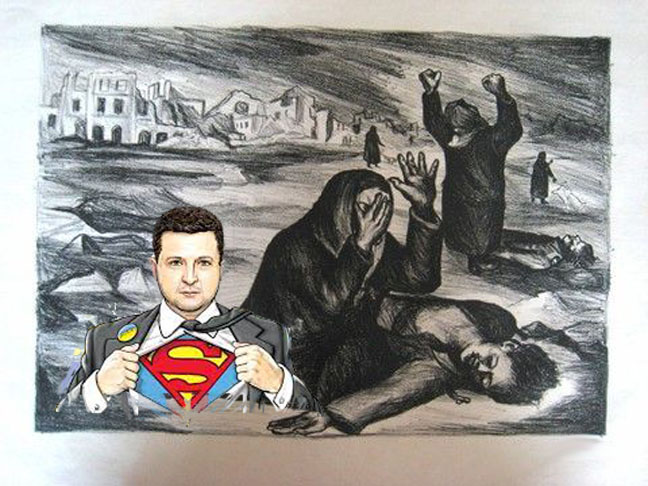
As the war grinds on, elements in the Biden administration appear to be growing impatient with the tall tales of their Ukrainian clients. “This is getting ridiculous,” an unnamed NATO official told the Financial Times on November 16. “The Ukrainians are destroying our confidence and they are openly lying. This is more destructive than the missile.”
Zelensky, media lackeys caught in most dangerous lie yet. https://thegrayzone.com/2022/11/18/zelensky-media-lie/ ALEXANDER RUBINSTEIN·NOVEMBER 18, 2022
With Kiev exposed for a lie that could have triggered a third world war, it is time to examine past deceptions that Western media promoted.
A missile that exploded on Polish soil on November 15 killed two civilians and destroyed farm equipment. Ukrainian President Volodymyr Zelensky and Western corporate media rushed to blame the explosion on Russia in apparent hopes of triggering NATO’s Article 5, which requires NATO states to defend one another militarily when attacked by a hostile force.
Polish and NATO members including US President Joseph Biden have since confirmed the missile that struck Poland was, in fact, a Ukrainian S-300 anti-aircraft missile. Yet Zelensky is sticking to his line, blaming Russia for the strike, while NATO Secretary-General Jens Stoltenberg still insists that “Russia bears ultimate responsibility.” Meanwhile, the media outlets that reflexively pointed the finger at Russia have been forced to take a step back from their initial reporting.
“Russian missiles hit Poland, the territory of our friendly country. People died,” Zelensky insisted on November 15, the night of the attack. “The longer Russia feels impunity, the more threats there will be to anyone within reach of Russian missiles. To fire missiles at NATO territory! This is a Russian missile attack on collective security! This is a very significant escalation. We must act.”
Zelensky held firm the following day, despite mounting evidence that his own country’s air defenses were responsible, declaring “I have no doubt that this is not our missile… I believe that this was a Russian missile, based on our military reports.” By this time, most analysts rejected the Ukrainian president’s assessment, including the founder of the US government-sponsored intelligence cutout Bellingcat, who wrote “At this point I think it’s fair anyone saying that a Russian missile hit Poland based on the current evidence is being irresponsible.”
A Russian attack on NATO member Poland could have triggered Article 5 of the North Atlantic Treaty Organization which compels its member states to consider “an attack against one Ally” to be “an attack against all Allies.” Such a mobilization would have amounted to World War III.
Despite the clear risk of such a catastrophic escalation – or perhaps because of it – Western corporate media immediately blamed Russia for the strike, never even posing the question of why Russia would consider Polish farmland such an important military target that it would be willing to risk a full-scale war with the 30-member NATO alliance.
Initially, the Associated Press ran with the headline “Russian missiles cross into Poland during strike on Ukraine.” The article cited a “senior US intelligence official,” and later, “a second person.”
On November 16, AP began redirecting the link to its original article to a correction that stated, “The Associated Press reported erroneously, based on information from a senior American intelligence official who spoke on condition of anonymity, that Russian missiles had crossed into Poland and killed two people. Subsequent reporting showed that the missiles were Russian-made and most likely fired by Ukraine in defense against a Russian attack.”
Time Magazine ran with the headline, “Russian Missiles Cross Into Poland During Strike, Killing Two,” and cited the AP report.
Fox News similarly announced, “Russian missiles cross into NATO member Poland, kill 2: senior US intelligence official, citing the Associated Press. MSNBC also blamed a “Russian missile” for the strike in its headline.
Then there was CNN, which reported, “Poland says Russian-made missile killed two, will consider invoking NATO Article 4.” NATO Article 4 deals with the meetings between NATO states that are to take place in the event one of them is “threatened” and would theoretically precede any invocation of Article 5. Like CNN, Reuters cited the Polish Foreign Ministry and ran the headline, “Poland says Russian rocket hit its territory as NATO weighs response.”
The New York Times stated in the second sentence of its report on the missile strike that “the blast came as Russia fired roughly 90 missiles into Ukraine.” Two lines later, the Times stated “local media suggests a Russian missile strike.” Readers of the paper of record would have to scroll down several times to even read that Russian officials denied responsibility.
Earlier in the war, in an article on “Ukraine’s online propaganda,” the New York Times sought to downplay the Ukrainian government’s penchant for pushing fake news, arguing that Kiev’s information war merely “dramatize[s] tales of Ukrainian fortitude and Russian aggression.” The article quoted an unnamed Twitter user, who wrote, “Why can’t we just let people believe some things? … If the Russians believe it, it brings fear. If the Ukrainians believe it, it gives them hope.”
The US media’s support for Ukraine’s propaganda efforts meant that it covered some of the most suspicious events without a hint of skepticism, and thereby encouraged more.
These questionable incidents included the following:
- On March 8, Western media reported that a Mariupol maternity hospital was attacked by Russian aircraft. Zelensky claimed the attack was evidence of Russian “genocide” against Ukraine. However, a key witness – a pregnant woman in the hospital photographed by AP – stated that no such airstrike occurred, and that nearby explosions were caused by Ukrainian artillery shells.
- On March 16, the Ukrainian government blamed a targeted Russian airstrike for destroying the Mariupol Dramatic Theater and causing anywhere from 300 to 600 deaths. Western corporate media promoted the Ukrainian narrative of the event despite a total absence of footage showing a missile strike, no images or evidence of large numbers of dead civilians inside, no images or evidence of any attempted rescue, and testimony by Mariupol locals asserting the Azov Battalion fighters that controlled the theater’s grounds staged the explosion to provoke NATO military intervention. Photographic evidence showed that Azov fighters removed all vehicles from the theater’s parking lot one day before the explosion.
- The Kramatorsk train station bombing that was blamed on Russia despite the fact the Tochka-U missile responsible for the blast contained a serial number matching others in Ukraine’s arsenal and originated from Ukrainian-controlled territory.
As the war grinds on, elements in the Biden administration appear to be growing impatient with the tall tales of their Ukrainian clients. “This is getting ridiculous,” an unnamed NATO official told the Financial Times on November 16. “The Ukrainians are destroying our confidence and they are openly lying. This is more destructive than the missile.”
Musk’s Money Is Playing Old Games With New Media

Cartoon from Springfield News-Sun
For all of Twitter’s problems—mean-spirited fights, harassment, bots, extremist content—the social media network has been a liberating way for writers, activists and academics to build platforms and followings free from corporate media filters. Under Musk, Twitter could become such a cesspool of hate speech (Scientific American/Nature, 11/8/22) and impersonators (CNN, 11/9/22) that it becomes unusable, or the stress caused by layoffs and the revenue losses could bring down the whole thing.
what Musk is doing to social media has long been done by monied interests to traditional media—much to the poverty of our journalistic culture.
FAIR, 18 Nov 22, Elon Musk’s takeover of Twitter has been difficult to satirize. The company is losing revenue (Reuters, 11/7/22), thanks in large part to the $1 billion in additional debt payments Musk has saddled it with. His idea to sell blue-check verifications for $8 was widely ridiculed (Variety, 11/2/22)—predictably resulting in a flood of fake posts from “verified” accounts—and mass layoffs have put the website’s infrastructure in jeopardy (MIT Technology Review, 11/8/22). A lockdown of the company offices had many wondering if Twitter would survive the pre-Thanksgiving weekend (Daily Beast, 11/17/22).
Monied parties
This would be a loss for a lot of users, but such a situation is hardly new in US media. There’s a long history of monied parties taking over media and watering them down, even breaking them up for parts. It’s just that this time it involves the world’s richest man and social media.
Look at American radio……………………… its news and talk stations are home to right-wing commentators—including, formerly, the late Rush Limbaugh (AP, 3/27/12). These owners’ biases have had enormous political implications due to the consolidation of the radio market……………………….
It’s an old story in newspaperland as well………………………………………
Advancing mogul politics
And consider for a minute that Musk, the CEO of Tesla, is the world’s richest person, while No. 2 is Jeff Bezos of Amazon, who also owns the Washington Post. Like Musk, Bezos is another rich, corporate boss who wants to influence the public discussion through control of a major media outlet. …………………………….
Moguls use their money to advance their politics, both through campaign contributions and through media acquisitions. In addition to Musk’s recent endorsement of Republican candidates, his interest in conservatism grew after the presidential election of Donald Trump. “Starting in 2017, Musk’s donations began to skew much more heavily toward Republicans than Democrats, spending nearly seven times more on GOP campaigns,” Business Insider (6/15/22) reported, adding that Musk “accepted positions on two of Trump’s White House councils.” He cheered on a coup in Bolivia (Jalopnik, 10/19/20) and is outspokenly hostile to unions (NPR, 3/3/22).
Musk’s acquisition of Twitter seems like a new chapter in history, but his choice to either skew Twitter to be friendly to the right (as his right-wing cheerleaders believe he is doing) or to run the network into the ground is only the latest episode of monied interests pillaging our communications infrastructure for financial or ideological gain. Musk’s Twitter takeover seems new, because it impacts new media rather than the old. But what Musk is doing to social media has long been done by monied interests to traditional media—much to the poverty of our journalistic culture.
For the right-wing press, Musk—who backed the Republicans in the recent midterm elections (Reuters, 11/7/22)—is a social media savior who is appalled by content moderation, factchecking and the banning of certain extremist content. Fox News (11/16/22) lauded him for reducing spending at Twitter, and others say he’s a free-speech champion trying to end Big Tech censorship (Deseret News, 11/1/22). The New York Post (11/11/22) said that the advertiser boycotts of Musk’s Twitter were signs of a liberal conspiracy to enforce wokeness online, while Matt Taibbi (Substack, 11/15/22)—who once wrote about the greed of big banks for Rolling Stone—attacked critics of the anti-union billionaire media baron for conducting a pro-conformity witch hunt.
For all of Twitter’s problems—mean-spirited fights, harassment, bots, extremist content—the social media network has been a liberating way for writers, activists and academics to build platforms and followings free from corporate media filters. Under Musk, Twitter could become such a cesspool of hate speech (Scientific American/Nature, 11/8/22) and impersonators (CNN, 11/9/22) that it becomes unusable, or the stress caused by layoffs and the revenue losses could bring down the whole thing. https://fair.org/home/musks-money-is-playing-old-games-with-new-media/
1 This Month
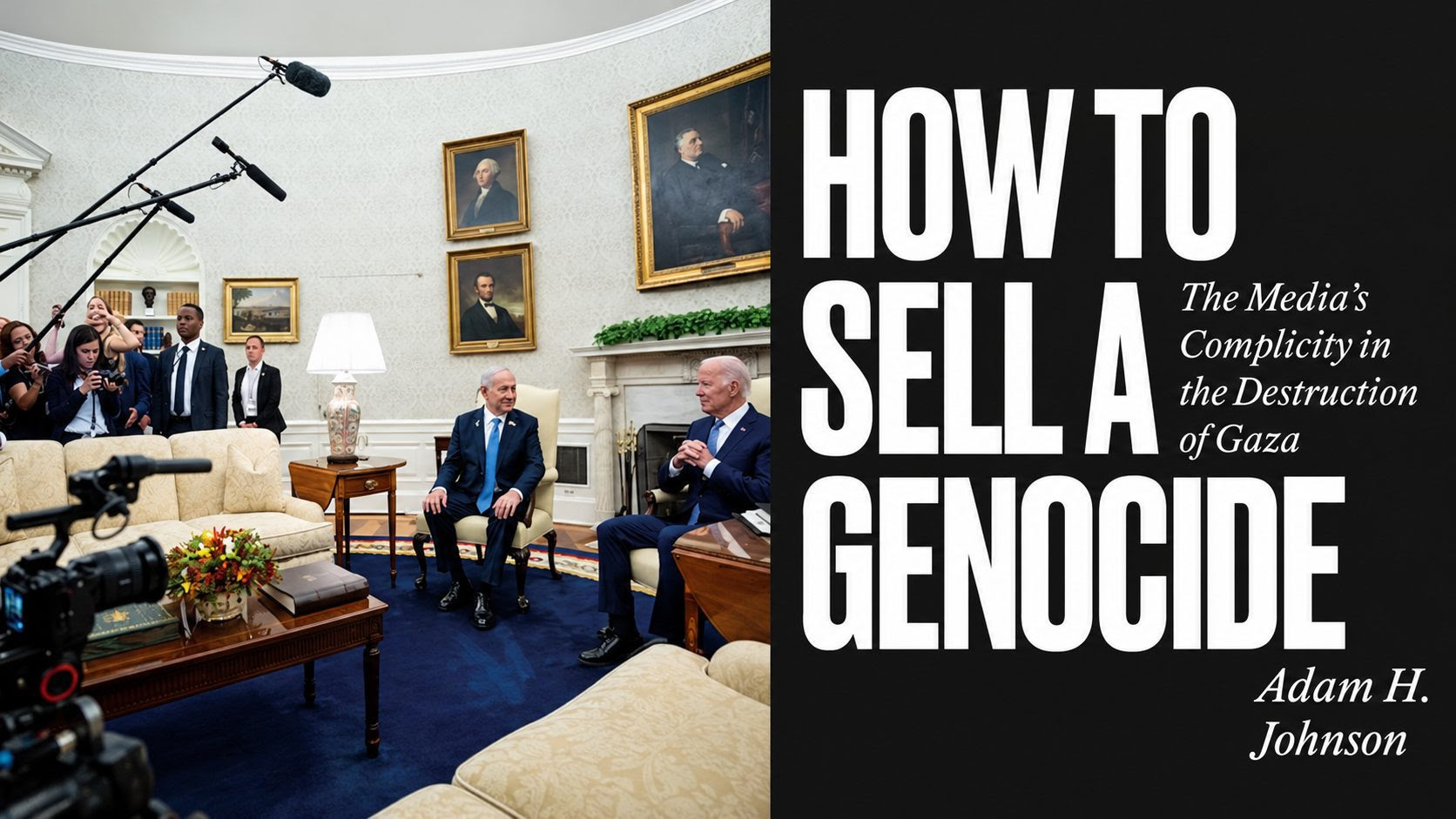


Shut down the radiation-damaged Heysham nuclear reactors now
To see nuclear-related stories in greater depth and intensity – go to https://nuclearinformation.wordpress.com

Say No to NASA’s Reckless Nuclear Reactor on the Moon
Say No to NASA’s Reckless Nuclear Reactor on the Moon
-
Archives
- October 2026 (256)
- September 2026 (339)
- August 2026 (330)
- July 2026 (355)
- June 2026 (287)
- May 2026 (306)
- April 2026 (356)
- March 2026 (251)
- February 2026 (267)
- January 2026 (308)
- December 2025 (358)
- November 2025 (359)
-
Categories
- 1
- 1 NUCLEAR ISSUES
- business and costs
- climate change
- culture and arts
- ENERGY
- environment
- health
- history
- indigenous issues
- Legal
- marketing of nuclear
- media
- opposition to nuclear
- PERSONAL STORIES
- politics
- politics international
- Religion and ethics
- safety
- secrets,lies and civil liberties
- spinbuster
- technology
- Uranium
- wastes
- weapons and war
- Women
- 2 WORLD
- ACTION
- AFRICA
- Atrocities
- AUSTRALIA
- Christina's notes
- Christina's themes
- culture and arts
- Events
- Fuk 2022
- Fuk 2023
- Fukushima 2017
- Fukushima 2018
- fukushima 2019
- Fukushima 2020
- Fukushima 2021
- general
- global warming
- Humour (God we need it)
- Nuclear
- RARE EARTHS
- Reference
- resources – print
- Resources -audiovicual
- Weekly Newsletter
- World
- World Nuclear
- YouTube
-
RSS
Entries RSS
Comments RSS

