Our news analyses of the Ukraine war come from politicians, not from genuine military intelligence
Military Situation in Ukraine: An Update by Jacques Baud The Postil
Mon, 11 Apr 2022

This allows us to deduce that the American and European political leaders deliberately pushed the Ukraine into a conflict that they knew was lost in advance — for the sole purpose of dealing a political blow to Russia.
“…………………The Conduct of Battle.
As for the course of operations, the analyses presented in our media come most often from politicians or so-called military experts, who relay Ukrainian propaganda.
Let’s be clear. A war, whatever else it is, is drama. The problem here is that our strategists in neckties are clearly trying to overdramatize the situation in order to exclude any negotiated solution. This development, however, is prompting some Western military personnel to speak out and offer a more nuanced judgment. Thus, in Newsweek, an analyst from the Defense Intelligence Agency (DIA), the American equivalent of the Direction du Renseignement Militaire (DRM) in France, noted that “in 24 days of conflict, Russia has carried out some 1,400 strikes and launched nearly 1,000 missiles (by way of comparison, the United States carried out more strikes and launched more missiles on the first day of the Iraq war in 2003).”
While the West likes to “soften up” the battlefield with intensive and prolonged strikes, before sending in ground-troops, the Russians prefer a less destructive, but more troop-intensive approach. On France 5, the journalist Mélanie Tarvant presented the death of Russian generals on the battlefield as proof of the destabilization of the Russian army. But this is a profound misunderstanding of the traditions and modes of operation of the Russian army. Whereas in the West, commanders tend to lead from the rear, their Russian counterparts tend to lead from the front — in the West they say, “Forward!” In Russia, they say, “Follow me!” This explains the high losses in the upper echelons of command, already observed in Afghanistan — but it also tells of the much more rigorous selection of staff-personnel than in the West.
Furthermore, the DIA analyst noted that “the vast majority of the airstrikes are over the battlefield, with Russian aircraft providing ‘close air support’ to ground forces. The remainder — less than 20 percent, according to U.S. experts — has been aimed at military airfields, barracks and supporting depots.” Thus, the phrase “indiscriminate bombing [that] is devastating cities and killing everyone” echoed by the Western media seems to contradict the U.S. intelligence expert, who said, “If we merely convince ourselves that Russia is bombing indiscriminately, or [that] it is failing to inflict more harm because its personnel are not up to the task or because it is technically inept, then we are not seeing the real conflict.”
In fact, Russian operations differ fundamentally from the Western concept of the same. The West’s obsession with having no fatalities in their own forces leads them to operations that are primarily in the form of very lethal air strikes. Ground troops only intervene when everything has been destroyed. This is why, in Afghanistan or in the Sahel, Westerners killed more civilians than terrorists did. This is why Western countries engaged in Afghanistan, the Middle East and North Africa no longer publish the number of civilian casualties caused by their strikes. In fact, Europeans engaged in regions that only marginally affect their national security, such as the Estonians in the Sahel, go there just to “get their feet wet.”
In the Ukraine, the situation is very different. One only has to look at a map of linguistic zones to see that the Russian coalition operates almost exclusively in the Russian-speaking zone; thus, among populations that are generally favorable to it. This also explains the statements of a US Air Force officer: “I know that the news keeps repeating that Putin is targeting civilians, but there is no evidence that Russia is intentionally doing so.”
Conversely, it is for the same reason — but in a different way — that the Ukraine has deployed its ultra-nationalist paramilitary fighters in major cities, such as Mariupol or Kharkov — without emotional or cultural ties to the local population, these militias can fight even at the cost of heavy civilian casualties. The atrocities that are currently being uncovered remain hidden by the French-speaking media, for fear of losing support for the Ukraine, as noted by media close to the Republicans in the United States.
After “decapitation” strikes in the first minutes of the offensive, the Russian operational strategy was to bypass the urban centers, and to envelop the Ukrainian army, “pinned down” by the forces of the Donbass republics. It is important to remember that the “decapitation” is not intended to annihilate the general staff or the government (as our “experts” tend to understand it), but to sunder the leadership structures so as to prevent the coordinated maneuver of forces. On the contrary, the aim is to preserve the leadership structures themselves in order to be able to negotiate a way out of the crisis.
On March 25, 2022, after having sealed the cauldron of Kramatorsk which denied any possibility of retreat to the Ukrainians and having taken most of the cities of Kharkov and Marioupol, Russia has practically fulfilled its objectives — all that remains is to concentrate its efforts on reducing the pockets of resistance. Thus, contrary to what the Western press has claimed, this is not a reorientation or a resizing of its offensive, but the methodical implementation of the objectives announced on February 24.
The Role of the Volunteers
A particularly disturbing aspect of this conflict is the attitude of European governments that allow or encourage their citizens to go and fight in the Ukraine. Volodymyr Zelensky’s call to join the International Legion for the Territorial Defense of Ukraine, which he recently created, has been greeted with enthusiasm by European countries.
Encouraged by the media that present a routed Russian army, many of these young people head off, imagining they are going — literally — on a hunting trip. However, once there, disillusionment is high. Testimonies show that these “amateurs” often end up as “cannon fodder,” without having any real impact on the outcome of the conflict. The experience of recent conflicts shows that the arrival of foreign fighters brings nothing to a conflict, except to increase its duration and lethality.
Moreover, the arrival of several hundred Islamist fighters from the Idlib region, an area under the control and protection of the Western coalition in Syria (and also the area in which two Islamic State leaders were killed by the Americans) should arouse our concern. Indeed, the weapons we are very liberally supplying to the Ukraine are already partly in the hands of criminal individuals and organizations and are already beginning to pose a security problem for the authorities in Kiev. Not to mention the fact that the weapons that are being touted as effective against Russian aircraft could eventually threaten our military and civilian aircraft.
The volunteer proudly presented by the RTBF on the 7:30 p.m. news of March 8, 2022 was an admirer of the “Corps Franc Wallonie,” Belgian volunteers who served the Third Reich; and he illustrates the type of people attracted to the Ukraine. In the end, we will have to ask ourselves, who gained the most — [in this case] Belgium or the Ukraine?
Distributing weapons indiscriminately could well make the EU — volens nolens — a supporter of extremism and even international terrorism. The result — we are adding misery to misery, in order to satisfy the European elites more than the Ukraine itself.
Three Points Deserve to be Highlighted by Way of Conclusion
1. Western Intelligence, Ignored by Policymakers
Military documents found in Ukrainian headquarters in the south of the country confirm that the Ukraine was preparing to attack the Donbass; and that the firing observed by OSCE observers as early as February 16 heralded an imminent outbreak in days or weeks.
Here, some introspection is necessary for the West — either its intelligence services did not see what was happening and they are thus very bad, or the political decision-makers chose not to listen to them. We know that Russian intelligence services have far superior analytical capabilities than their Western counterparts. We also know that the American and German intelligence services had very well understood the situation, since the end of 2021, and knew that the Ukraine was preparing to attack the Donbass.
This allows us to deduce that the American and European political leaders deliberately pushed the Ukraine into a conflict that they knew was lost in advance — for the sole purpose of dealing a political blow to Russia.
The reason Zelensky did not deploy his forces to the Russian border, and repeatedly stated that his large neighbor would not attack him, was presumably because he thought he was relying on Western deterrence. This is what he told CNN on March 20th — he was clearly told that the Ukraine would not be part of NATO, but that publicly they would say the opposite. The Ukraine was thus instrumentalized to affect Russia. The objective was the closure of the North Stream 2 gas pipeline, announced on February 8th, by Joe Biden, during the visit of Olaf Scholz; and which was followed by a barrage of sanctions.
2. Broken Diplomacy
Clearly, since the end of 2021, no effort has been made by the West to reactivate the Minsk agreements, as evidenced by the reports of visits and telephone conversations, notably between Emmanuel Macron and Vladimir Putin. However, France, as guarantor of the Minsk Agreements, and as a permanent member of the United Nations Security Council, has not respected its commitments, which has led to the situation that the Ukraine is experiencing today. There is even a feeling that the West has sought to add fuel to the fire since 2014.
Thus, Vladimir Putin’s placing of nuclear forces on alert on February 27 was presented by our media and politicians as an irrational act or blackmail. What is forgotten is that it followed the thinly veiled threat made by Jean-Yves Le Drian, three days earlier, that NATO could use nuclear weapons. It is very likely that Putin did not take this “threat” seriously, but wanted to push Western countries — and France in particular — to abandon the use of excessive language.
3. The Vulnerability of Europeans to Manipulation is Increasing
Today, the perception propagated by our media is that the Russian offensive has broken down; that Vladimir Putin is crazy, irrational and therefore ready to do anything to break the deadlock in which he supposedly finds himself. In this totally emotional context, the question asked by Republican Senator Marco Rubio during Victoria Nuland’s hearing before Congress was strange, to say the least: “If there is a biological or chemical weapon incident or attack inside the Ukraine, is there any doubt in your mind that 100% it would be the Russians behind it?” Naturally, she answered that there is no doubt. Yet there is absolutely no indication that the Russians are using such weapons. Besides, the Russians finished destroying their stockpiles in 2017, while the Americans have not yet destroyed theirs.
Perhaps this means nothing. But in the current atmosphere, all the conditions are now met for an incident to happen that would push the West to become more involved, in some form, in the Ukrainian conflict (a “false-flag” incident).
How Much Are We Prepared To Sacrifice To Help The US Win A Propaganda War Against Putin?
Once “journalists” accepted that their most important job is not to tell the truth but to keep people from thinking bad thoughts about the status quo political system, it was inevitable that they’d start enthuHow Much Are We Prepared To Sacrifice To Help The US Win A Propaganda War Against Putin?siastically cheerleading for more internet censorship. They see it as their duty, which is why now the leading proponents of online censorship are corporate media reporters.
This is a conversation which should already have been going on in mainstream circles for some time now, but it never even started. Let’s start it
https://caitlinjohnstone.substack.com/p/how-much-are-we-prepared-to-sacrifice?s=w Caitlin Johnston 17 Apr 22. One severely under-discussed aspect of the latest round of escalations in Silicon Valley censorship which began at the start of the Ukraine war is the fact that it’s an entirely unprecedented order of censorship protocol. While it might look similar to all the other waves of social media purges and new categories of banned content that we’ve been experiencing since it became mainstream doctrine after the 2016 US election that tech platforms need to strictly regulate online speech, the justifications for it have taken a drastic deviation from established patterns.
What sets this new censorship escalation apart from its predecessors is that this time nobody’s pretending that it’s being done in the interests of the people. With the censorship of racists the argument was that they were inciting hate crimes and racial harassment. With the censorship of Alex Jones and QAnon the argument was that they were inciting violence. With the censorship of Covid skeptics the argument was that they were promoting misinformation that could be deadly. Even with the censorship of the Hunter Biden laptop story it was argued that there was a need to protect election integrity from disinformation of potentially foreign origin.
With censorship relating to the Ukraine war there is no argument that it’s being done to help the people. There is no case to be made that letting people say wrong things about this war kills Ukrainians, Americans, or anyone else. There is no case to be made that disputing claims about Russian war crimes will damage America’s democratic processes. It’s just, “Well we can’t have people saying wrong things about a war, can we?”
Ask a properly brainwashed liberal why they support the censorship of someone who disputes US narratives about Russian war crimes in Bucha or Mariupol and they’ll probably tell you something like “Well, it’s disinformation!” or “Because it’s propaganda!” or “How much is Putin paying you??” But what they won’t be able to do is articulate exactly what specific harm is being done by such speech in the same way that they could when defending the censorship of Covid skeptics or the factions responsible for last year’s riot in the Capitol building.
But what does that mean exactly? It means if we accept this argument we’re knowingly consenting to a situation where all the major news outlets, websites and apps that people look to for information about the world are geared not toward telling us true things about reality, but toward beating Vladimir Putin in some weird psywar. It means abandoning any ambitions of being a truth-based civilization that is guided by facts, and instead accepting an existence as a propaganda-based civilization geared toward making sure we all think thoughts that hurt Moscow’s long-term strategic interests.
And it’s just absolutely freakish that this is a decision that has already been made for us, without any public discussion as to whether or not that’s the kind of society we want to live in. They jumped right from “We’re censoring speech to protect you from violence and viruses” to “We’re censoring speech to help our government conduct information warfare against a foreign adversary.” Without skipping a beat.
Continue readingGlenn Greenwald: The Censorship Campaign Against Western Criticism of NATO’s Ukraine Policy Is Extreme

This war has been very good indeed for the permanent Washington political and media class. And although it was taboo for weeks to say so, it is now beyond clear that the only goal that the U.S. and its allies have when it comes to the war in Ukraine is to keep it dragging on for as long as possible.
One can spread as many lies and as much disinformation as one wants provided that it is designed to advance the NATO agenda in Ukraine

It is not a mystery who is benefiting from this orgy of military spending. On Tuesday, Reuters reported that “the Pentagon will host leaders from the top eight U.S. weapons manufacturers on Wednesday to discuss the industry’s capacity to meet Ukraine’s weapons needs if the war with Russia lasts years.” Among those participating in this meeting about the need to increase weapons manufacturing to feed the proxy war in Ukraine is Raytheon, which is fortunate to have retired General Lloyd Austin as Defense Secretary, a position to which he ascended from the Raytheon Board of Directors. It is virtually impossible to imagine an event more favorable to the weapons manufacturer industry than this war in Ukraine:
https://scheerpost.com/2022/04/13/glenn-greenwald-the-censorship-campaign-against-western-criticism-of-natos-ukraine-policy-is-extreme/ April 13, 2022 Preventing populations from asking who benefits from a protracted proxy war, and who pays the price, is paramount. A closed propaganda system achieves that. By Glenn Greenwald
If one wishes to be exposed to news, information or perspective that contravenes the prevailing US/NATO view on the war in Ukraine, a rigorous search is required. And there is no guarantee that search will succeed. That is because the state/corporate censorship regime that has been imposed in the West with regard to this war is stunningly aggressive, rapid and comprehensive.
On a virtually daily basis, any off-key news agency, independent platform or individual citizen is liable to be banished from the internet. In early March, barely a week after Russia’s invasion of Ukraine, the twenty-seven nation European Union — citing “disinformation” and “public order and security” — officially banned the Russian state-news outlets RT and Sputnik from being heard anywhere in Europe. In what Reuters called “an unprecedented move,” all television and online platforms were barred by force of law from airing content from those two outlets. Even prior to that censorship order from the state, Facebook and Google were already banning those outlets, and Twitter immediately announced they would as well, in compliance with the new EU law.
But what was “unprecedented” just six weeks ago has now become commonplace, even normalized. Any platform devoted to offering inconvenient-to-NATO news or alternative perspectives is guaranteed a very short lifespan. Less than two weeks after the EU’s decree, Google announced that it was voluntarily banning all Russian-affiliated media worldwide, meaning Americans and all other non-Europeans were now blocked from viewing those channels on YouTube if they wished to. As so often happens with Big Tech censorship, much of the pressure on Google to more aggressively censor content about the war in Ukraine came from its own workforce: “Workers across Google had been urging YouTube to take additional punitive measures against Russian channels.”
So prolific and fast-moving is this censorship regime that it is virtually impossible to count how many platforms, agencies and individuals have been banished for the crime of expressing views deemed “pro-Russian.” On Tuesday, Twitter, with no explanation as usual, suddenly banned one of the most informative, reliable and careful dissident accounts, named “Russians With Attitude.” Created in late 2020 by two English-speaking Russians, the account exploded in popularity since the start of the war, from roughly 20,000 followers before the invasion to more than 125,000 followers at the time Twitter banned it. An accompanying podcast with the same name also exploded in popularity and, at least as of now, can still be heard on Patreon.
What makes this outburst of Western censorship so notable — and what is at least partially driving it — is that there is a clear, demonstrable hunger in the West for news and information that is banished by Western news sources, ones which loyally and unquestioningly mimic claims from the U.S. government, NATO, and Ukrainian officials. As The Washington Post acknowledged when reporting Big Tech’s “unprecedented” banning of RT, Sputnik and other Russian sources of news: “In the first four days of Russia’s invasion of Ukraine, viewership of more than a dozen Russian state-backed propaganda channels on YouTube spiked to unusually high levels.”
Note that this censorship regime is completely one-sided and, as usual, entirely aligned with U.S. foreign policy. Western news outlets and social media platforms have been flooded with pro-Ukrainian propaganda and outright lies from the start of the war. A New York Times article from early March put it very delicately in its headline: “Fact and Mythmaking Blend in Ukraine’s Information War.” Axios was similarly understated in recognizing this fact:
Ukraine misinformation is spreading — and not just from Russia.” Members of the U.S. Congress have gleefully spread fabrications that went viral to millions of people, with no action from censorship-happy Silicon Valley corporations. That is not a surprise: all participants in war use disinformation and propaganda to manipulate public opinion in their favor, and that certainly includes all direct and proxy-war belligerents in the war in Ukraine.
Yet there is little to no censorship — either by Western states or by Silicon Valley monopolies — of pro-Ukrainian disinformation, propaganda and lies. The censorship goes only in one direction: to silence any voices deemed “pro-Russian,” regardless of whether they spread disinformation. The “Russians With Attitude” Twitter account became popular in part because they sometimes criticized Russia, in part because they were more careful with facts and viral claims that most U.S. corporate media outlets, and in part because there is such a paucity of outlets that are willing to offer any information that undercuts what the U.S. Government and NATO want you to believe about the war.
Their crime, like the crime of so many other banished accounts, was not disinformation but skepticism about the US/NATO propaganda campaign. Put another way, it is not “disinformation” but rather viewpoint-error that is targeted for silencing. One can spread as many lies and as much disinformation as one wants provided that it is designed to advance the NATO agenda in Ukraine (just as one is free to spread disinformation provided that its purpose is to strengthen the Democratic Party, which wields its majoritarian power in Washington to demand greater censorship and commands the support of most of Silicon Valley). But what one cannot do is question the NATO/Ukrainian propaganda framework without running a very substantial risk of banishment.
It is unsurprising that Silicon Valley monopolies exercise their censorship power in full alignment with the foreign policy interests of the U.S. Government. Many of the key tech monopolies — such as Google and Amazon — routinely seek and obtain highly lucrative contracts with the U.S. security state, including both the CIA and NSA. Their top executives enjoy very close relationships with top Democratic Party officials. And Congressional Democrats have repeatedly hauled tech executives before their various Committees to explicitly threaten them with legal and regulatory reprisals if they do not censor more in accordance with the policy goals and political interests of that party.
But one question lingers: why is there so much urgency about silencing the small pockets of dissenting voices about the war in Ukraine? This war has united the establishment wings of both parties and virtually the entire corporate media with a lockstep consensus not seen since the days and weeks after the 9/11 attack. One can count on both hands the number of prominent political and media figures who have been willing to dissent even minimally from that bipartisan Washington consensus — dissent that instantly provokes vilification in the form of attacks on one’s patriotism and loyalties. Why is there such fear of allowing these isolated and demonized voices to be heard at all?
The answer seems clear. The benefits from this war for multiple key Washington power centers cannot be overstated. The billions of dollars in aid and weapons being sent by the U.S. to Ukraine are flying so fast and with such seeming randomness that it is difficult to track. “Biden approves $350 million in military aid for Ukraine,” Reuters said on February 26; “Biden announces $800 million in military aid for Ukraine,” announced The New York Times on March 16; on March 30, NBC’s headline read: “Ukraine to receive additional $500 million in aid from U.S., Biden announces”; on Tuesday, Reuters announced: “U.S. to announce $750 million more in weapons for Ukraine, officials say.” By design, these gigantic numbers have long ago lost any meaning and provoke barely a peep of questioning let alone objection.
It is not a mystery who is benefiting from this orgy of military spending. On Tuesday, Reuters reported that “the Pentagon will host leaders from the top eight U.S. weapons manufacturers on Wednesday to discuss the industry’s capacity to meet Ukraine’s weapons needs if the war with Russia lasts years.” Among those participating in this meeting about the need to increase weapons manufacturing to feed the proxy war in Ukraine is Raytheon, which is fortunate to have retired General Lloyd Austin as Defense Secretary, a position to which he ascended from the Raytheon Board of Directors. It is virtually impossible to imagine an event more favorable to the weapons manufacturer industry than this war in Ukraine:
Demand for weapons has shot up after Russia’s invasion on Feb. 24 spurred U.S. and allied weapons transfers to Ukraine. Resupplying as well as planning for a longer war is expected to be discussed at the meeting, the sources told Reuters on condition of anonymity. . .
Resupplying as well as planning for a longer war is expected to be discussed at the meeting. . . . The White House said last week that it has provided more than $1.7 billion in security assistance to Ukraine since the invasion, including over 5,000 Javelins and more than 1,400 Stingers.
This permanent power faction is far from the only one to be reaping benefits from the war in Ukraine and to have its fortunes depend upon prolonging the war as long as possible. The union of the U.S. security state, Democratic Party neocons, and their media allies has not been riding this high since the glory days of 2002. One of MSNBC’s most vocal DNC boosters, Chris Hayes, gushed that the war in Ukraine has revitalized faith and trust in the CIA and intelligence community more than any event in recent memory — deservedly so, he said: “The last few weeks have been like the Iraq War in reverse for US intelligence.” One can barely read a mainstream newspaper or watch a corporate news outlet without seeing the nation’s most bloodthirsty warmongering band of neocons — David Frum, Bill Kristol, Liz Cheney, Wesley Clark, Anne Applebaum, Adam Kinzinger — being celebrated as wise experts and heroic warriors for freedom.
This war has been very good indeed for the permanent Washington political and media class. And although it was taboo for weeks to say so, it is now beyond clear that the only goal that the U.S. and its allies have when it comes to the war in Ukraine is to keep it dragging on for as long as possible. Not only are there no serious American diplomatic efforts to end the war, but the goal is to ensure that does not happen. They are now saying that explicitly, and it is not hard to understand why.
The benefits from endless quagmire in Ukraine are as immense as they are obvious. The military budget skyrockets. Punishment is imposed on the arch-nemesis of the Democratic Party — Russia and Putin — while they are bogged down in a war from which Ukrainians suffer most. The citizenry unites behind their leaders and is distracted
from their collective deprivations. The emotions provoked by the horrors of this war — unprecedentedly shown to the public by the Western media which typically ignores carnage and victims of wars waged by Western countries and their allies — is a very potent tool to maintain unity and demonize domestic adversaries. The pundit class finds strength, purpose and resolve, able to feign a Churchillian posture without any of the risks. Prior sins and crimes of American elites are absolved and forgotten at the altar of maximalist claims about Putin’s unprecedented evils — just as they were absolved and forgotten through the script which maintained that the U.S. had never encountered a threat as grave or malignant as Trump. After all, if Putin and Trump are Hitler or even worse, then anyone who opposes them is heroic and noble regardless of all their prior malignant acts.
And that is why even small pockets of dissent cannot be tolerated. It is vital that Americans and Europeans remain entrapped inside a completely closed system of propaganda about the war, just as Russians are kept entrapped inside their own. Keeping these populations united in support of fighting a proxy war against Russia is far too valuable on too many levels to permit any questioning or alternative perspectives. Preventing people from asking who this war benefits, and who is paying the price for it, is paramount.
Big Tech has long proven to be a reliable instrument of censorship and dissent-quashing for the U.S. Government (much to the chagrin of corporate media employees, Russian outlets still remain available on free speech alternatives such as Rumble and Telegram, which is why so much ire is now directed at them). A rapid series of ostensible “crises” — Russiagate, 1/6, the COVID pandemic — were all exploited to condition Westerners to believe that censorship was not only justified but necessary for their own good. In the West, censorship now provokes not anger but gratitude. All of that laid the perfect foundation for this new escalation of a censorship regime in which dissent, on a virtually daily basis, is increasingly more difficult to locate.
No matter one’s views on Russia, Ukraine, the U.S. and the war, it should be deeply alarming to watch such a concerted, united campaign on the part of the most powerful public and private entities to stomp out any and all dissent, while so aggressively demonizing what little manages to slip by. No matter how smart or critically minded or sophisticated we fancy ourselves to be, none of us is immune to official propaganda campaigns, studied and perfected over decades. Nor is any of us immune to the pressures of group-think and herd behavior and hive minds: these are embedded in our psyches and thus easily exploitable.
That is precisely the objective of restricting and closing the information system available to us. It makes it extremely difficult to remain skeptical or critical of the bombardment of approved messaging we receive every day from every direction in every form. And that is precisely the reason to oppose such censorship regimes. An opinion or belief adopted due to propaganda and reflex rather than autonomy and critical evaluation has no value.
Nonstop Corporate News on Ukraine Is Fueling Support for Unchecked US Militarism
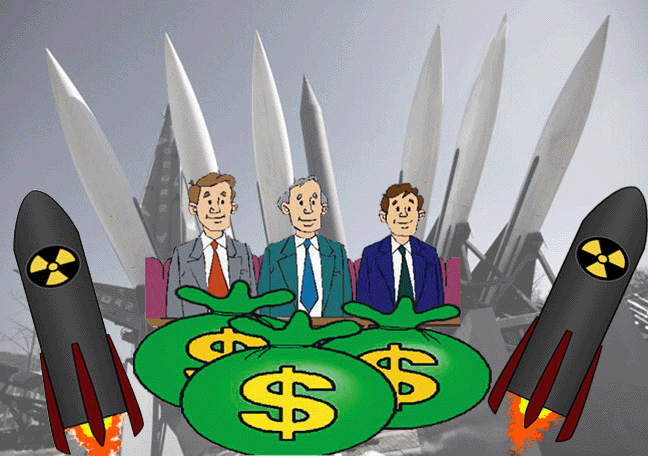
The U.S. public is being fed continuous nonstop images of technologically sophisticated weapons being used in Ukraine — in effect this appears to function as a sort of advertisement for the weapons industry, coupled with the sensational presentation of gratuitous violence
Talking heads in the dominant media landscape churn out cheap binarisms about good and evil, democracy versus authoritarianism. In doing so, they reinforce the mythic narrative that the U.S., a model of liberal innocence, is furthering the global fight for democracy, untainted in its false assertion that fascism is always elsewhere — in this case exclusively in Russia.
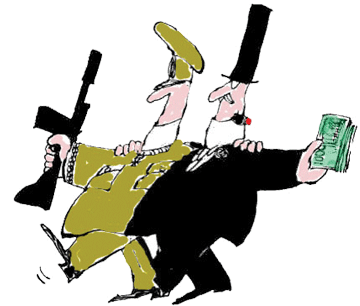
There is almost no talk about the role of the military-industrial complex, both in its push for war, and how it usually emerges as the only winner. Nor is there any talk about who profits from an embrace of war talk, the spectacularization of war and war itself.
Henry A. Giroux, Truthout, 13 Apr 22, The drums of fascism are beating louder. The catastrophe of war and outpouring of support for the millions of Ukrainians suffering under the brutal attacks by Russia has morphed into increased warmongering from the West. The shock of war has been transformed into a cinematic spectacle used to fan the flames of militarism. The sheer boldness, violence and ruthlessness of Russia’s attack on Ukraine has created a global political crisis accentuated by both a crisis of ideas and a crisis of historical reckoning, at least in the Western mainstream media.
The wider public’s inability to reflect on the underlying causes of the war is due at least in the United States to its long-standing dominant belief in its own exceptionalism, reinforced by a moral righteousness endlessly reproduced in the mainstream media.
Tragic pictures of the agonizing hardships faced by the Ukrainian people too often appear with little or no critical commentary in the corporate-controlled cultural apparatuses. Endless images of unfathomable agony by the Ukrainian people dominate the conventional news outlets and other monopolies of information governed by the spectacle of 24/7 coverage, matched almost entirely by a lack of historical analysis. While widespread moral repulsion to the tragedies of the war are understandable, what is not acceptable is the refusal of the mainstream media to reflect on the historical, political and economic conditions leading up to the war.
The U.S. public is being fed continuous nonstop images of technologically sophisticated weapons being used in Ukraine — in effect this appears to function as a sort of advertisement for the weapons industry, coupled with the sensational presentation of gratuitous violence.
Within this militarized aesthetic, operating in the service of permanent war, as cultural critic Rustom Bharucha writes, “there is an echo of the pornographic in maximizing the pleasure of violence.” The corporate media are thus rendering war as riveting, emotional and free from demanding intellectual complexities since it emerges out of an either/or view of good and evil.
Images of violence are replayed in the mainstream media over and over again, making violence not only more visible but also rootless. The sheer monopoly of such images gives them a fascist edge, all the while dissolving politics into a cinematic pathology. Writer and philosopher Susan Sontag’s observation about war coverage, made in a different historical context, is even more relevant today. According to Sontag, the endless images of war and suffering, removed from the context of rigorous historical analysis, represent a contempt for “all that is reflective, critical and pluralistic [and are] linked to forms of rabid masculinity [that] glamorizes death.”
Talking heads in the dominant media landscape churn out cheap binarisms about good and evil, democracy versus authoritarianism. In doing so, they reinforce the mythic narrative that the U.S., a model of liberal innocence, is furthering the global fight for democracy, untainted in its false assertion that fascism is always elsewhere — in this case exclusively in Russia. There is almost no talk about the role of the military-industrial complex, both in its push for war, and how it usually emerges as the only winner. Nor is there any talk about who profits from an embrace of war talk, the spectacularization of war and war itself.
When more critical explanations of the war appear, especially from those criticizing the eastward expansion of the North Atlantic Treaty Organization (NATO), which created one set of conditions for the conflict, they are often mocked, ignored, or at worst, accused of being treasonous. In this instance, a rampant militarism collapses the difference between a critical analysis and a justification for Russia’s actions………….
We have seen a similar shutting down of dissent before in the face of catastrophic events, especially in the aftermath of the 9/11 attacks and the ensuing “war on terror.” Yet, the frenetic opposition to dissent today seems more dangerous, especially given the multiple cultural platforms calling for “virtual war, for participating in it, and being manipulated by it, [including] crowd funding urban militias on Twitter, posting videos of captured tanks or ‘army cats’ to Instagram and TikTok.”
The need for community is too often now organized around a bristling war fever feeding on militaristic language in mainstream outlets such as The Atlantic, The New Republic, New Yorker, The Financial Times and The Wall Street Journal. In all cases, rightful moral outrage over the brutality of Russia’s unlawful invasion morphed quickly into a fog-of-war hysteria demanding more military aid, more punitive sanctions and bolstered by the discourse of unchecked jingoism. The call for peace or a diplomatic solution is barely mentioned.
With the war in Ukraine raging, more nuanced analyses along with dissent disappear in the suffocating discourses of hyper-nationalism and the growing bonfire of militarism fueled by what Indian essayist and novelist Pankaj Mishra, writing in the London Review of Books, calls “an infotainment media [that] works up citizens into a state of paranoid patriotism.” The military-industrial-intellectual-academic complex has reasserted itself in the face of Russia’s violation of international law, accelerating the prospect, if not welcoming, the potential of another looming Cold War, aided greatly by media apparatuses that bask in the comfort of moral certainty and patriotic inanity. In this atmosphere of hyper-war culture, military victories become synonymous with moral victories as language becomes weaponized and matters of ethics no longer inform the urgent call for peace.
In the face of the brutal Russian invasion, the concept of militarization is being amplified and put into service as a call for more upgraded weapons. Talk of war, not peace, dominates the mainstream media landscapes both at home and abroad. Such talk also fuels a global arms industry, oil and gas monopolies, and the weaponization of language itself. Militarism as a tool of unchecked nationalism and patriotism drives the mainstream and right-wing disimagination machines. Both fuel a global war fever through different degrees of misrepresentation and create what intellectual historian Jackson Lears writing in the London Review of Books calls “an atmosphere “poisoned by militarist rants.” He goes further in regarding his critique of the U.S. response to the war in Ukraine, writing in the New York Review of Books:
Yet the US has failed to put a cease-fire and a neutral Ukraine at the forefront of its policy agenda there. Quite the contrary: it has dramatically increased the flow of weapons to Ukraine, which had already been deployed for eight years to suppress the separatist uprising in the Donbas. US policy prolongs the war and creates the likelihood of a protracted insurgency after a Russian victory, which seems probable at this writing. Meanwhile, the Biden administration has refused to address Russia’s fear of NATO encirclement. Sometimes we must conduct diplomacy with nations whose actions we deplore. How does one negotiate with any potential diplomatic partner while ignoring its security concerns? The answer, of course, is that one does not. Without serious American diplomacy, the Ukraine war, too, may well become endless.
The horrific events in Ukraine have mobilized a global response against the brutal acts of violence inflicted on the Ukrainian people, but such massive acts of violence have also taken place in Syria, Afghanistan, Iraq and Yemen without eliciting comparable condemnations or humanitarian aid from the U.S. and Europe. Moreover, while public outrage in the U.S. is warranted in light of the “horrendous crimes by Russian troops against Ukrainian civilians—massacre, murder, and rape, among them,” memory fades, and the line between fantasy and historical consciousness disappears, “erasing the brutalizing crimes committed during America’s Global War on Terror.”……………………………………..
Historical amnesia and a prolonged military conflict combine making it easier to sell war rather than peace, which would demand not only condemnation of Russia but also an exercise in self-scrutiny with a particular focus on the military optic that has been driving U.S. foreign policy since President Dwight D. Eisenhower warned in the 1950s of the danger of the military-industrial complex.
The Ukrainian war is truly insidious and rouses the deepest sympathies and robust moral outrage, but the calls to punish Russia overlook the equally crucial need to call for peace. In doing so, such actions ignore a crucial history and mode of analysis that make clear that behind this war are long-standing anti-democratic ideologies that have given us massive inequality, disastrous climate change, poverty, racial apartheid and the increasing threat of nuclear war.
The horrific events in Ukraine have mobilized a global response against the brutal acts of violence inflicted on the Ukrainian people, but such massive acts of violence have also taken place in Syria, Afghanistan, Iraq and Yemen without eliciting comparable condemnations or humanitarian aid from the U.S. and Europe. Moreover, while public outrage in the U.S. is warranted in light of the “horrendous crimes by Russian troops against Ukrainian civilians—massacre, murder, and rape, among them,” memory fades, and the line between fantasy and historical consciousness disappears, “erasing the brutalizing crimes committed during America’s Global War on Terror.”……………………………………..
Historical amnesia and a prolonged military conflict combine making it easier to sell war rather than peace, which would demand not only condemnation of Russia but also an exercise in self-scrutiny with a particular focus on the military optic that has been driving U.S. foreign policy since President Dwight D. Eisenhower warned in the 1950s of the danger of the military-industrial complex.
The Ukrainian war is truly insidious and rouses the deepest sympathies and robust moral outrage, but the calls to punish Russia overlook the equally crucial need to call for peace. In doing so, such actions ignore a crucial history and mode of analysis that make clear that behind this war are long-standing anti-democratic ideologies that have given us massive inequality, disastrous climate change, poverty, racial apartheid and the increasing threat of nuclear war.
War never escapes the tragedies it produces and is almost always an outgrowth of the dreams of the powerful — which always guarantees a world draped in suffering and death. Peace is difficult in an age when culture is organized around the interrelated discourse of militarism and state violence. War has become the only mirror in which alleged democratic capitalist and authoritarian societies recognize themselves. Rather than defined as a crisis, war for authoritarian rulers and the soulless arms industries becomes an opportunity for power and profits, however ill-conceived.
Peace demands a different assertion of collective identity, a different ethical posture and value system that takes seriously Dr. Martin Luther King Jr.’s admonition that human beings must do everything not to “spiral down a militaristic stairway into the hell of thermonuclear annihilation.” This is not merely a matter of conscience or resistance but of survival itself.
Caitlin Johnstone sheds a critical gaze on media reporting on Ukraine, and asks why Julian Assange is criminalised for revealing military atrocities.

If it seems a bit hypocritical to you that the empire is blasting us in the face all day with narratives alleging Russian war crimes while that same empire is imprisoning a journalist for exposing its war crimes, that’s because it absolutely is hypocritical.
If something looks wrong about the fact that we’re about to watch a judge sign off on Julian Assange’s extradition to the United States for practicing journalism while that same United States keeps pushing out narratives about the need to protect Ukraine’s freedom and democracy, that’s because it should.
If It Feels Like You’re Being Manipulated, It’s Because You Are,
more https://caitlinjohnstone.substack.com/p/if-it-feels-like-youre-being-manipulated?s=w Caitlin Johnstone, 11 Apr 22, If you’ve got a gut feeling that your rulers are working to control your perception of the war in Ukraine, it is safe to trust that feeling.
If you feel like there’s been a concerted effort from the most powerful government and media institutions in the western world to manipulate your understanding of what’s going on with this war, it’s because that’s exactly what has been happening.
If you can’t recall ever seeing such intense mass media spin about a war before, it’s because you haven’t.
If you get the distinct impression that this may be the most aggressively perception-managed and psyop-intensive war in human history, it’s because it is.
If it looks like Silicon Valley platforms are controlling the content that people see to give them a perspective on this war that is wildly biased in favor of the US narrative, it’s because that is indeed the case.
If it seems like a suspicious coincidence that Russiagate manufactured mainstream consent for all the same shady agendas we’re seeing ramped up now like cold war brinkmanship against Moscow, internet censorship, and being constantly lied to by the mass media for the greater good, it’s because it is a mighty suspicious coincidence.
If it seems weird to you that so many self-styled leftists are responding to this war by fanatically supporting the extremely dangerous unipolarist geostrategic agendas of the most powerful empire that has ever existed, that’s because it is weird. Really, really, really weird.
If it seems a bit hypocritical to you that the empire is blasting us in the face all day with narratives alleging Russian war crimes while that same empire is imprisoning a journalist for exposing its war crimes, that’s because it absolutely is hypocritical.
If something looks wrong about the fact that we’re about to watch a judge sign off on Julian Assange’s extradition to the United States for practicing journalism while that same United States keeps pushing out narratives about the need to protect Ukraine’s freedom and democracy, that’s because it should.
If you’re beginning to get the nagging sense that the mainstream consensus worldview is a construct manufactured by the powerful, for the powerful and everything you were taught about your nation, your government and your world is a lie, that’s definitely a possibility worth considering.
If it’s starting to seem like we’re all being manipulated at mass scale to think, act and vote in a way which benefits a vast power structure that rules over us while hiding its true nature, I’d say that’s a thread worth pulling.
If you’ve a sneaking suspicion that the lies might go even deeper than that, right down to deceptions about who you fundamentally are and what this life is actually about, that suspicion is probably worth exploring.
If you’re feeling a bit like Keanu Reeves in the beginning of The Matrix right before the veil gets ripped away, I’d recommend following the white bunny and seeing how deep that rabbit hole goes.
If it has occurred to you that humanity needs to wake up from the matrix of illusion before our sociopathic rulers drive us to extinction via environmental catastrophe or nuclear armageddon, then your notes match my own.
If you believe it’s possible that these existential crises we’re fast approaching may be the catalyst we need to collectively rip the blindfold from our eyes and begin moving in a truth-based way upon this earth and creating a healthy world, then we are on the same page.
If there’s something in you that whispers there’s a good chance we make it despite the long odds we appear to be facing, I will tell you a secret: I hear it too.
The US Bubble of Pretend- our complacent acceptance of preposterous propaganda about Ukraine

PATRICK LAWRENCE: The US Bubble of Pretend, The lack of objective, principled coverage of the war in Ukraine is a degenerate state of affairs. The one thing worse is the extent to which it’s perfectly fine with most Americans. Consortium News, By Patrick Lawrence, 6 Apr 22,
Consortium News It is perfectly obvious by now, to anyone who cares to look, that mainstream media in America and the other Western powers are not reporting the Ukraine crisis accurately.
Let me try that another way: The government-supervised New York Times and the rest of the corporate-owned media on both sides of the Atlantic lie routinely to their readers and viewers as to why Russia intervened in Ukraine, the progress of its military operation, the conduct of Ukrainian forces, and America’s role in purposely provoking and prolonging this crisis.
So far as I know, this is the first war in modern history with no objective, principled coverage in mainstream media of day-to-day events and their context. None. It is morn-to-night propaganda, disinformation and lies of omission — most of it fashioned by the Nazi-infested Zelensky regime in Kiev and repeated uncritically as fact.
There is one thing worse than this degenerate state of affairs. It is the extent to which the media’s malpractice is perfectly fine to most Americans. Tell us what to think and believe no matter if it is true, they say, and we will think and believe it. Show us some pictures, for images are all.
There are larger implications to consider here. Critical as it is that we understand this conflict, Ukraine is a mirror in which we see ourselves as we have become. For more Americans than I wish were so, reality forms only in images. These Americans are no longer occupants of their own lives. Risking a paradox, what they take to be reality is detached from reality.
This majority — and it is almost certainly a majority — has no thoughts or views except those first verified through the machinery of manufactured images and “facts.” Television screens, the pages of purportedly authoritative newspapers, the air waves of government-funded radio stations — NPR, the BBC — serve to certify realities that do not have to be real, truths that do not have to be true.
This leaves us in a sad and very parlous place………………….
Ten days into the Russian intervention, the propaganda coming out of Kiev was already so preposterous The New York Times felt compelled to publish a piece headlined, “In Ukraine’s Information War, a Blend of Fact and Fiction.” This was a baldly rendered apologia for the many “stories of questionable veracity,” as The Times put it, then in circulation. I do love The Times for its delicate phrasing when describing indelicate matters.
There was the “Ghost of Kiev” story, featuring an heroic fighter pilot who turned out to derive from a video game. There were the Snake Island heroes, 13 Ukrainian soldiers who held out to the death on some small speck in the Black Sea, except that it turned out they surrendered, though not before Zelensky awarded them posthumous medals of honor that were not posthumous.
After railing against disinformation for years, The Times wants us to know, disinformation is O.K. in Ukraine because the Ukrainians are our side and they are simply “boosting morale.”
We cannot say we weren’t warned. The Ghost of Kiev and Snake Island turn out now to be mere prelude, opening acts in the most extensive propaganda operation of the many I can recall.
There was the maternity ward the Russians supposedly bombed in Mariupol. And then the theater, and then the art school. All filled with huddling citizens the Russian air force cynically targeted because “this is genocide,” as the ever-intemperate Zelensky does not hesitate to assert.
All of this has been reported as fact in the Times and other major dailies and, of course, by the major broadcasters. There have been pictures. There have been videos, all very persuasive to the eye.
And then, as evidence mounts that these incidents were staged as propaganda to frame the Russians and draw NATO forces directly into the war, a silence worthy of a Catholic chapel descends. We read no more of the maternity ward that turned out to be an improvised Azov base, or the theater, where citizens were herded, photographed in raggedy blankets, and sent away. Ditto the art school: Nothing more on this since the initial reports began to collapse. No body counts, no mention of the fact that Russian jets did not fly over Mariupol on the days in question…………………………..
Bucha is a suburb of 35,000 souls a few miles north of Kiev and one of the cities Russian forces began to evacuate on March 29 as peace talks in Istanbul progressed. Two days later the mayor, Anatoly Fedoruk, celebrated the city’s liberation in a selfie-speech to his citizenry. He made no mention of anything untoward in Bucha’s streets, backyards, or public spaces.
Four days later, April 2, a special unit of the Ukrainian national police deployed to Bucha. And suddenly the place turns out to be a hellhole: bodies in the streets — 410, according to the Prosecutor General’s office in Kiev — evidence of atrocities galore, people bound and shot point blank. The whole nine, in short.
Instant Outrage
The outrage from Washington, London and Paris — “worldwide outrage,” this would be — was instant. No demand for an impartial inquiry, forensic inspections, or any such thing. No one asked why corpses left in the street for five days appeared to be fresh, or why the relatives of the dead left them there until Kiev’s commando unit arrived.
António Guterres, the U.N. secretary-general, was level-headed enough to state, “It is essential that an independent investigation leads to effective accountability.” This is the only sound position at this point. But we know from a long history how far SGs at the U.N. get with this sort of talk.
In my read this is yet another of the false flags the Kiev regime flies almost by the day now. Paying-attention people will not miss the striking similarity between these incidents and the numerous put-up jobs that featured in Washington’s covert operation in Syria and the campaign of those famous “moderate rebels” who desperately wanted to draw the U.S. into the conflict.
As a matter of principle we must await evidence of what happened in Bucha, even as we know we are likely to see as much about events there as we have in Mariupol. We also know that to most people neither evidence nor its absence matters.
We have been told once again what to think and believe, and most of us will think and believe it.
We are to add this to various other “truths” now almost universally accepted: The Russian intervention had nothing to do with NATO expansion and was “unprovoked” — that favored term in the Biden regime. Ukrainian forces have pushed the Russians into retreat: not that the pressure on Kiev was a Russian diversionary tactic to keep Ukrainian forces away from Donbass where the fighting is.
After the Pentagon Papers came out in 1971, Hannah Arendt published an essay in The New York Review of Books called “Lying in Politics.” In it she wrote of America’s slide into a sort of collective psychosis she termed “defactualization.” Facts are fragile, Arendt wrote, in that they tell no story in themselves. They can be assembled to mean whatever one wants them to mean. This leaves them vulnerable to the manipulations of storytellers…………..
It is a half-century since Arendt published “Lying in Politics.” And it is to that time, the 1960s and 1970s, that we must trace the formation of what now amounts to America’s great bubble of pretend. The world as it is has mattered less and less since Arendt’s time, the world as we have wished it to be has mattered more and more…………………………. https://consortiumnews.com/2022/04/05/patrick-lawrence-the-us-bubble-of-pretend/
Julian Assange’s family tirelessly advocate for his freedom
https://independentaustralia.net/politics/politics-display/julian-assanges-family-tirelessly-seek-his-freedom,16208 By John Jiggens | 31 March 2022,
The fight for Julian Assange’s freedom goes on in the face of Western intransigence, writes Dr John Jiggens.
FRESH FROM attending the marriage of his son Julian Assange to partner Stella Moris, Assange’s continent-hopping father, John Shipton, will address the Palm Sunday rally in Brisbane on 10 April and attend a Q&A at a preview screening of the film Ithaka.
Produced by Julian’s brother Gabriel Shipton, Ithaka was directed by multi-award-winning director Ben Lawrence. The yet-to-be-released documentary will be a special thank-you to Julian’s many Queensland supporters.
Filmed over two years across the UK, Europe, the U.S. and Australia, Ithaka follows John Shipton’s punishing schedule to save his son.
We witness John embark on a European odyssey to rally a global network of supporters, advocate to politicians and cautiously step into the media’s glare, where he is forced to confront the events that made Julian a global flashpoint.
In marked contrast to the war in Ukraine, the Iraqi war was covered by journalists embedded with the invading forces.
Civilian deaths were dismissed as “collateral damage”.
When WikiLeaks showed us what “collateral damage” looked like from the perspective of Iraqi civilians, releasing a video of a massacre by an Apache helicopter gun crew of Iraqi civilians and two Reuter journalists, Julian Assange called it Collateral Murder.
This intervention played an important role in ending the illegal UK, U.S. and Australian invasion of a sovereign nation, and because of this, the war criminals he exposed are destroying Julian Assange with the consent of the Australian Government, claiming he is the criminal.
But Assange was a hero for peace.
For the Apache helicopter crew, the civilians on the ground were dehumanised. Like boys playing a computer game, they exclaimed “light ‘em up!” as they blew apart their victims from their unseen platform a mile in the sky.
When a good samaritan stopped to help those still living, he and his children were ruthlessly machine-gunned. The crew blamed their father, saying he shouldn’t have brought children to a war zone.
Ithaka tracks John Shipton’s journey alongside Julian’s then-fiancée, Stella Moris, as they join forces to advocate for Julian.
Stella and Julian’s marriage was a rare joyful moment for this embattled family. The mainstream media, of course, presented it as a bizarro celebrity wedding. Knowing which details to ignore, they focussed on the bride and groom’s clothes, rather than the politics.
We learned that Julian, his brother Gabriel, and Stella and Julian’s two sons, Gabriel and Max, wore tartan kilts in honour of their Scottish heritage.
Vivienne Westwood, a long-time supporter, designed and made Stella a full-length wedding dress, which was adorned with graffiti and one of Westwood’s signature corsets.
The largest contingent of the wedding party were prison guards and one of them was given the task of being the official photographer. Before saying “I do”, Stella was searched multiple times and had to pass through security scanners and sniffer dogs.
She was patted down in her wedding gown and fingerprinted four times.
Two of the couple’s six guests, U.S. journalist Chris Hedges and Scottish journalist Craig Murray (who was to be one of the witnesses) were denied entry. They stayed outside with 150 supporters.
Craig Murray, who was the British Ambassador to Uzbekistan until he was fired for exposing the CIA black sites and torture centres in that country, was told that he could not enter because he would “endanger the security of the prison”.
As Stella admitted:
“It’s not the wedding we would have planned.”
She also said:
“But we’re choosing to take control of our lives. We’re doing it for love, for each other, for our sons and because Julian’s life has been put on hold for long enough, robbing him of years with his family.”
Belmarsh’s Governor Jenny Louis ordered the couple’s family out of the prison the minute the service was over and Julian was taken back to his cell, knowing he may never get to live with his family.
As their own bizarro wedding present, the UK Supreme Court dismissed Assange’s appeal against the High Court’s decision to allow his extradition to the USA.
With Julian facing a 175-year sentence if extradited to the U.S., his family members are confronting the prospect of losing Julian forever to the abyss of the U.S. justice system.
Dr John Jiggens is a writer and journalist currently working in the community newsroom at Bay-FM in Byron Bay.
Y
Depicting Putin as ‘Madman’ Eliminates Need for Diplomacy

The Western media caricature of Putin as a psychopathic leader acting on irrational and idiosyncratic beliefs is a convenient propaganda narrative that excuses US officials from taking diplomacy seriously—at the expense of Ukrainian lives and nuclear brinkmanship
FAIR, JOSHUA CHO, 30 Mar 22, Even before Russia invaded Ukraine, Western media have depicted Russian President Vladimir Putin as an irrational—perhaps mentally ill—leader who cannot be reasoned or bargained with. Such portrayals have only intensified as the Ukraine crisis came to dominate the news agenda.
The implications underlying these media debates and speculations about Putin’s psyche are immense. If one believes that Putin is a “madman,” the implication is that meaningful diplomatic negotiations with Russia are impossible, pushing military options to the forefront as the means of resolving the Ukraine situation.
If Putin is not a rational actor, the implication is that no kind of diplomacy could have prevented the Russian invasion, and therefore no other country besides Russia shares blame for ongoing violence. (See FAIR.org, 3/4/22.) Yet another implication is that if Putin’s defects made Russia’s invasion unavoidable, then regime change may be necessary to resolve the conflict.
‘Increasingly insane’
Western media have for years been debating whether Putin is insane (Extra!, 5/14; FAIR.org, 2/12/15) or merely pretending to be—speculation that has only intensified in recent weeks:
- Guardian (2/24/22): “Decision to Invade Ukraine Raises Questions Over Putin’s ‘Sense of Reality’”
- Daily Beast (3/1/22): “The Russian People May Be Starting to Think Putin Is Insane”
- Vanity Fair (3/1/22): “Report: An ‘Increasingly Frustrated’ Putin, a Madman With Nuclear Weapons, Is Lashing Out at His Inner Circle”
- New York (3/4/22): “Putin’s War Looks Increasingly Insane”
The Guardian report (2/24/22) cited concerns raised in European official circles about Putin’s mental state:
They worry about a 69-year-old man whose tendency towards insularity has been amplified by his precautions against Covid, leaving him surrounded by an ever-shrinking coterie of fearful obedient courtiers. He appears increasingly uncoupled from the contemporary world, preferring to burrow deep into history and a personal quest for greatness.
Even when other media analysts argued that Putin’s alleged mental illness was merely a ruse to wrest concessions from the west, this was not presented as a rationale for negotiating with him, but rather as a reason to reject de-escalation and diplomacy. Forbes (3/1/22)……….
‘Detached from reality’
In the Daily Beast (3/1/22), Amy Knight, a historian of Russia and the USSR, displayed a remarkable ability to read Putin’s mind, discerning the real motivations of someone she describes as possibly “detached from reality…………………..
Reason is not going to work’
Other Western media headlines offered quite specific, though varying, evaluations of Putin’s mental state from a distance. ……..
Atlantic (4/15/14): “Vladimir Putin, Narcissist?”Independent (2/1/15): “President Putin Is a Dangerous Psychopath—Reason Is Not Going to Work With Him”USA Today (2/4/15): “Pentagon 2008 Study Claims Putin Has Asperger’s Syndrome”Sun (2/28/22): “Vladimir Putin Is Egocentric, Narcissistic & Exhibits Key Traits of a Psychopath”Fox News (3/2/22): “Russian President Vladimir Putin Has Features of a Psychopath: Expert”
These diagnoses from afar have been going on for a long time…………………………………………………..
As of this writing, Secretary of State Antony Blinken hasn’t attempted any conversations with his counterpart, Russian Foreign Minister Sergei Lavrov, while Russian military commanders are declining calls from the Pentagon, likely due to the US sharing military intelligence with the Ukrainian government. This silence on both the diplomatic and military fronts risks further escalation instead of a quick negotiated end to the war.
The Western media caricature of Putin as a psychopathic leader acting on irrational and idiosyncratic beliefs is a convenient propaganda narrative that excuses US officials from taking diplomacy seriously—at the expense of Ukrainian lives and nuclear brinkmanship (Antiwar.com, 3/10/22). Recent negotiations between Russia and Ukraine in Istanbul were hailed by both parties as constructive, with Russia vowing to reduce military activity around Kyiv and northern Ukraine as a result (NPR, 3/29/22). It’s important not to let US officials subvert peace negotiations between the two parties on the evidence-free grounds that negotiations with Russia are pointless. https://fair.org/home/depicting-putin-as-madman-eliminates-need-for-diplomacy/—
As UK government touted ”media freedom”, Julian Assange in high security Belmarsh Prison was an embarassment
JULIAN ASSANGE POSED PR PROBLEM FOR UK GOVERNMENT’S MEDIA CAMPAIGN https://declassifieduk.org/julian-assange-posed-pr-problem-for-uk-governments-media-campaign/
UK officials were worried about public reaction to their hosting a media freedom event a few miles from Belmarsh prison, where Assange is incarcerated. The Foreign Office monitored activity online, developed ‘lines to take’ and warned ‘we should be ready’, emails show.
JOHN MCEVOY23 MARCH 2022 The UK’s treatment of Julian Assange posed a public relations problem for the Foreign Office’s media freedom campaign, files seen by Declassified UK show.
In July 2019, the UK co-hosted a Global Conference for Media Freedom, a first-of-its-kind event where 50 countries gathered to form a Media Freedom Coalition.
Costing £2.4 million, the event was hailed as “a major milestone” in the UK government’s “campaign to protect journalists doing their job”.
The conference was held just months after WikiLeaks editor Julian Assange was dragged out of the Ecuadorian embassy in London.
He was transferred to Belmarsh prison, “the closest comparison in the United Kingdom to Guantánamo”, as a UK parliamentary report has described it.
Addressing the media conference, then foreign secretary Jeremy Hunt declared: “If we act together, we can shine a spotlight on abuses and impose a diplomatic price on those who would harm journalists or lock them up for doing their jobs”.
‘We should be ready’
The hosting of a media freedom event within miles of Belmarsh prison in southeast London was seen as a public relations problem. Internal Foreign Office emails show UK officials monitored online behaviour accordingly.
After Hunt announced plans for the conference in February 2019, one official complained about “a few individual crazy responses to the FS’ [Foreign Secretary’s] tweet”.
By June, officials were requesting “Lines to Take on how best to respond to questions we expect to be raised on this occasion about the UK handling of the case of Julian Assange”.
In particular, “Icelandic criticism of UK handling of [the] Assange case” was seen to be “affecting messaging on media freedom”.
This email was likely related to former Icelandic Interior Minister Ögmundur Jónasson, who had asserted in June that the Assange case put “the British justice system…on trial”
On 8 July, two days before the conference began, an unnamed official wrote about “a ramp up in activity by Assange campaigners”.
One cause for concern was Assange’s mother Christine, who had “joined calls for a tweetstorm during the conference”, as well as “accounts [which] are small scale or are run by active trolls and provocateurs”.
The official outlined rules for engagement, noting “our current approach is right and we shouldn’t engage…However, we should be ready. I’m keen that we agree ahead of time how and when our approach would evolve”.
In an email with the subject line “Media Freedom Conference – online register of interest form”, one official even questioned: “what if someone like Assange applied to attend?”
The Foreign Office emails discussing Assange remain heavily redacted for reasons of “national security”.
‘No communications strategy can make this go away’
According to a recent academic study, Julian Assange “was by far the most frequently discussed individual on Twitter” with regards to the Media Freedom Coalition.
“Numerous tweets highlighted the apparent irony that the UK was establishing and leading an international initiative on media freedom, while simultaneously undermining free media…in their handling of Assange”, the researchers found.
Since 2019, the UK has nonetheless continued to use the Global Conference for Media Freedom as a vehicle through which to claim it supports press freedom.
Rebecca Vincent, the Director of International Campaigns for Reporters Without Borders (RSF), commented:
“It is disappointing that rather than looking to address the very serious substantive concerns about the case of Julian Assange, the UK Foreign Office seems to have treated the matter as only a public relations inconvenience as it prepared to host the Global Media Freedom Conference and launch the Media Freedom Coalition.
“But the truth is that no communications strategy can make this go away. As long as Assange remains detained in the UK and as long as the US continues to seek his extradition and prosecution for publishing information in the public interest, this case will serve as a thorn in the sides of both governments and the Media Freedom Coalition itself.”
She added: “They should instead lead by example by dropping the charges, releasing Assange, and putting an end to his persecution once and for all”.
Veterans warn against no-fly zone in UK: Examine Western propaganda critically

………………………. you should question everything that you are being told by anyone and from any source. But you should still seek out alternative sources and stories to consider before thinking upon them and deciding what to believe. Only by using your critical thinking skills can you arrive at some general semblance of the truth while humbly accepting that you can never be too certain of the truth.
There are often more questions than answers. But corporate media in the United States and the West in general is not to be trusted. They generally deliver more propaganda than truth. So question what you are told. Think for yourself…………………
The Peace Press — Saturday, March 19, 2022 edition Major kudos to the organization to which I belong, Veterans for Peace, for issuing a press release warning against a No-Fly Zone over Ukraine. A no-fly-zone would be an act of war and it would represent a major escalation of hostilities by pitting U.S.-NATO planes directly against Russian military planes. This would be a major escalation that could considerably broaden the war and possibly lead to even nuclear war. The Establishment of a No-Fly-Zone must be avoided at all costs.
“VETERANS WARN AGAINST “NO-FLY ZONE” IN UKRAINE
Veterans of several U.S. wars are urging President Biden to hold fast against growing political pressure to implement a “no-fly zone.”
A No Fly Zone is an area established by a military power over which opposing aircraft are not permitted. No Fly Zones are enforced by military interception of aircraft and missiles using deadly force, and sometimes include preemptive strikes to prevent potential violations. In other words, a country that declares a no-fly zone must then be ready to enforce the protected space, putting the U.S. in direct military conflict with Russia, escalating war between two nuclear powers.”
~Veterans for Peace
………………………… let there be no mistake that the Russians bear the responsibility for invading and that is condemnable but let us also remember that the U.S.-American Empire navigated and manipulated the situation in such a manner that convinced the Russians that they had no alternative but to invade. So pinning all the blame on one side of this conflict without blaming or recognizing the actions of the other side is but an exercise in blatant propaganda by either one side or the other side. Both are culpable and both must be held to account through equal condemnations in the same breath. Good versus evil dichotomies typically only exist in fairy- tales and religion. The real world is full of nuance, gray areas, complexity and multi-layered histories working in tandem with each other. So is this case with Ukraine where to pin all the blame on only one actor is an example of propaganda.
Contrary to what is being blasted from all corners of corporate media in their attempt to paint an easy to understand narrative of good-vs-evil where we, of course, are good as is implied, this war has surprisingly little to do with Vladimir Putin. In fact, this is a Russian Establishment reactive war for which Putin himself was under massive internal political pressure to initiate. Contrary to what we are told by corporate media, Putin is not a dictator, he is an elected politician who must respond to internal pressures because his political power resides in the consent and approval of those constituencies inside Russia. The pressure to militarily intervene in Ukraine was strongly emanating from powerful quarters of the Russian political system primarily from the nationalist and military wings and also as expressed in the legislative actions of the Duma which recognized the breakaway Republics in Ukraine just prior to the invasion. Putin acquiesced to this massive political pressure.
Contrary to the madman Adolf Hitler effigy that corporate media rolls out for every new war, the reality is far more complex, convoluted, multi-layered and primarily rooted in Russian internal politics as so many wars often are rooted in internal politics. Furthermore, a lot of what we see now and saw before is baseless propaganda. To this day, there is a long list of allegations against President Putin but a vastly shorter list of actual evidence to support these many allegations. He could be guilty of such allegations but the lack of evidence does not support that view. More likely, this is all just part of a wider smear campaign designed to get everyone onboard with hating Putin and Russia. And more to the point, even if some of these allegations are true, how Russia treats its citizens and who Russia’s citizens elect to be their president is not the business of anyone but Russian citizens. We should keep our damn noses out of it. To those who propose regime change in Russia, may I remind you that there is no guarantee that what will come next will be any better than the current leadership and in fact could be far worse.
As an example of this I cite Saddam Hussein and Iraq. While Americans may think Iraq is better off now, that feeling does not square with the hundreds-of-thousands of Iraqi’s who perished in civil wars that were caused by deposing Saddam Hussein. In reality, our toppling of Saddam Hussein destabilized the Middle East, caused unimaginable suffering and massive death and destruction, so be careful what you wish for because you might just get it. But again, who or what government rules in Russia is no business of the United States of America. I say these things because I think it is very important to dispel myths and discern reality by separating fact from fiction especially now that the media is whipping people up into a frenzy of war fever.
Vladimir Putin, to his credit, exhausted nearly every diplomatic channel for the last 14 years dating back to the Munich Conference of 2008 to warn the West that both Georgia and Ukraine were red lines for Russian national security interests. These warnings were meant to avoid war and avoid what would be seen by the Russian Establishment as absolutely critical and necessary Russian military involvement if such red lines were crossed. We have long known this to be true but the U.S. Empire continued to cross those red lines, almost seemingly wanting the Russians to invade. Think about that for a moment. Who benefits from a new Cold War with Russia? Perhaps, those who reap vast profits, like weapons-makers for example? Yes, the economics of vast profits is yet another driver of war. At every turn, the U.S. rebuffed and ignored these warnings preferring instead to bask in American Exceptionalism which basically boils down to an American Empire imposed rules-based-world-order but one in which the United States Empire is conveniently exempt from obeying. In short, do as we say, not as we do otherwise known as hypocrisy.
Furthermore, ever since the U.S. American Empire got into bed with neo-Nazi elements in Ukraine and helped them overthrow a democratically-elected government in 2014, both the Russian Establishment and the ethnic Russian Ukranian population of Eastern Ukraine were completely freaked out and felt directly threatened, This fear was for good reason, as later events would clearly demonstrate namely the neo-Nazi slaugther of ethnic-Russian Eastern Ukrainians. This prompted a separtist movement that formed in response to this threat, since the separtists feared the oversized influence of neo-Nazi elements inside the Ukrainian government along with a understandable revulsion against the installed puppet regime by the United States in Ukraine. This created a major civil conflict inside Ukraine that ultimately prompted diplomatic efforts to resolve. As a result, in 2015 after many negotiations, the Minsk Accords were signed by France, Germany, Russia and Ukraine and this signaled a significant diplomatic breakthrough to resolving internal strife in Ukraine by recognizing the human rights of the ethnic Russian population of Eastern Ukraine by promoting political autonomy for them and by establishing specific guarantees to allay Russian national security concerns. This is another example of how the Russians attempted to use diplomacy to avert a war.
However, since 2015 the Ukrainian government, under heavy Imperialist pressure from the United States/American Empire, scuttled and ignored the Minsk Accords, thus essentially blocking their implementation. This action by the American Empire operating through its Ukrainian government puppet coupled with the NATO-ization of Ukraine (militarization of Ukraine) and by an array of other aggressive U.S. actions including aggressive military maneuvers and nuclear missile emplacements close to Russian borders virtually guaranteed a Russian military response. Remember that our military-industrial-complex benefits greatly reaping soaring profits from a new Cold War with Russia while the rest of us get financially screwed. That is also what this conflict is about, the wealthy want more money and war is how they intend to get it while the rest of us suffer greatly. Therefore, one cannot honestly criticize one side of this war without also laying equal blame upon the other side of this war. Meanwhile, Ukranians die at the hands of Russian guns but upon the altar of American Imperialist maneuverings that provoked this war. The American Empire is as much to blame as the Russians for this war. Every condemnation of this war should reflect that.
But how many Ukrainian civilians are actually dying in this war? One could say that even one death is too many and they would be right. But here again, civilian death totals are more prone to being twisted by propaganda from either one side or the other. While we are bombarded with an endless barrage of good-vs-evil reporting from mass media, where we are always good and the Russians are always evil, the truth is far more complex, difficult, unclear and unpleasant. While we are consistently fed the line that Russians are wantonly massacring civilians en masse, the numbers simply do not seem to support this allegation. So you should question this kind of reporting that is susceptible to propaganda. The relatively low numbers of civilian casualties 3 weeks into an invasion (less than 1000) along with the relatively slow advance of Russian forces along with the fact that Russian troops are mostly staying in areas of Eastern Ukraine along with the fact that Eastern Ukraine is primarily composed of an ethnic Russian and Russian speaking population, would all seem to suggest that the Russian military is taking great care to avoid civilian loss of life upon their ethnic Russian brethren in Eastern Ukraine, contrary to what we are being told on corporate media.
This would logically make sense since the population of Eastern Ukraine is largely comprised of ethnic-Russians who primarily speak Russian — — — -why would they want to kill their own brethren? That just doesn’t make sense (which is how I know it is likely Western propaganda — — — you just have to think for yourself just a little). So far it seems, Russian military actions are predominantly focused upon Ukrainian military targets and neo-Nazi strongholds as in Mariupol and foreign fighter bases near the Polish border and an assortment of weapons depots. There are also reports that neo-Nazi elements, particularly near their stronghold at Mariupol are blocking refugee escape corridors thus driving up civilian casualty counts unneccessarily.
………………………. you should question everything that you are being told by anyone and from any source. But you should still seek out alternative sources and stories to consider before thinking upon them and deciding what to believe. Only by using your critical thinking skills can you arrive at some general semblance of the truth while humbly accepting that you can never be too certain of the truth.
How Much Less Newsworthy Are Civilians in Other Conflicts?

A lot less, particularly when they’re victims of the US, FAIR, JULIE HOLLAR, 18 Mar 22, As US news media covered the first shocking weeks of the Russian invasion of Ukraine, some media observers—like FAIR founder Jeff Cohen (Common Dreams, 2/28/22)—have noted their impressions of how coverage differed from wars past, particularly in terms of a new focus on the impact on civilians.
To quantify and deepen these observations, FAIR studied the first week of coverage of the Ukraine war (2/24–3/2/22) on ABC World News Tonight, CBS Evening News and NBC Nightly News. We used the Nexis news database to count both sources (whose voices get to be heard?) and segments (what angles are covered?) about Ukraine during the study period. Comparing this coverage to that of other conflicts reveals both a familiar reliance on US officials to frame events, as well as a newfound ability to cover the impact on civilians—when those civilians are white and under attack by an official US enemy, rather than by the US itself.
Ukrainian sources—no experts
One of the most striking things about early coverage has been the sheer number of Ukrainian sources. FAIR always challenges news media to seek out the perspective of those most impacted by events, and US outlets are doing so to a much greater extent in this war than in any war in recent history. Of 234 total sources—230 of whom had identifiable nationalities—119 were Ukrainian (including five living in the United States.)
However, these were overwhelmingly person-on-the-street interviews that rarely consisted of more than one or two lines. Even the three Ukrainian individuals identified as having a relevant professional expertise—two doctors and a journalist—spoke only of their personal experience of the war. Twenty-one (17% of Ukrainian sources) were current or former government or military officials.
Airing so many Ukrainian voices, but asking so few to provide actual analysis, has the effect of generating sympathy, but for a people painted primarily as pawns or victims, rather than as having valuable knowledge, history and potential contributions to determine their own futures.
Meanwhile, Russian government sources only appeared four times. Sixteen other Russian sources were quoted: 13 persons on the street, an opposition politician and two members of wealthy families.
Eighty sources were from the United States, including 57 current or former US officials. Despite the diplomatic involvement of the European Union, only two Western European sources were featured: the Norwegian NATO Secretary General and a German civilian helping refugees in Poland. There were also eight foreign civilians featured living in Ukraine: three from the US, three African and two Middle Eastern.
And while political leaders certainly bring important knowledge and perspective to war coverage, so too do scholars, think tanks and civic organizations with regional expertise. But these voices were almost completely marginalized, with only five such civil society experts appearing during the study period. All were in the United States, although one was Ukrainian-American Michael Sawkiw (CBS, 2/24/22), who represented the Ukrainian Congress Committee of America (an organization associated with Stepan Bandera’s faction of the Organization of Ukrainian Nationalists, which participated in the Holocaust during World War II).
In effect, then, US news media have largely allowed US officials to frame the terms of the conflict for viewers. While officials lambasted the Russian government and emphasized “what we’re going to do to help the Ukrainian people in the struggle” (NBC, 3/1/22), no sources questioned the US’s own role in contributing to the conflict (FAIR.org, 3/4/22), or the impact of Western sanctions on Russian civilians.
The bias in favor of US officials, and the marginalization of experts from the country being invaded—as well as civil society experts from any country—recalls US TV news coverage of another large-scale invasion in recent history: the US invasion of Iraq. A FAIR study (Extra!, 5–6/03) at the time found that in the three weeks after the US launched that war, current and former US officials made up more than half (52%) of all sources on the primetime news programs on ABC, CBS, NBC, CNN, Fox and PBS. Iraqis were only 12% of sources, and 4% of all sources were academic, think tank or NGO representatives.
n other words, though the bias is even greater when the US is leading the war, US media seem content to let US officials fashion the narrative around any war, and to mute their critics.
Visible and invisible civilians
But there are striking differences as well in coverage of the two wars. Most notably, when the US invaded Iraq, civilians in the country made up a far smaller percentage of sources: 8% to Ukraine’s 45%.
n other words, though the bias is even greater when the US is leading the war, US media seem content to let US officials fashion the narrative around any war, and to mute their critics.
Visible and invisible civilians
But there are striking differences as well in coverage of the two wars. Most notably, when the US invaded Iraq, civilians in the country made up a far smaller percentage of sources: 8% to Ukraine’s 45%.
But on US TV news, antiwar sentiment appeared starkly different in the two conflicts. Of the 20 Russian sources in the study, ten (50%) expressed opposition to the war, significantly higher than the proportion polls were showing. Meanwhile, antiwar voices represented only 3% of all US sources in early Iraq coverage (FAIR.org, 5/03), a dramatic downplaying of public opposition.
Civilian-centered war coverage
The brunt of modern wars is almost always borne by innocent civilians. But US media coverage of that civilian toll is rarely in sharp focus, such that recent reporting on Russia’s invasion of Ukraine offers an exceptional view of what civilian-centered war coverage can look like—under certain circumstances.
In our study, we looked not just at sources, but also the content of segments about Ukraine. In the first week of the war, the US primetime news broadcasts on ABC, CBS and NBC offered regular reports on the civilian toll of the invasion, sending reporters to major targeted cities, as well as to border areas receiving refugees.
Seventy-one segments across the three networks covered the impact on Ukrainian civilians, both those remaining behind and those fleeing the violence. Twenty-eight of these mentioned or centered on civilian casualties.
Many reports described or aired soundbites of civilians describing their fear and the challenges they faced; several highlighted children. A representative ABC segment (2/28/22), for instance, featured correspondent Matt Gutman reporting: “This little girl on the train sobbing into her stuffed animal, just one of the more than 500,000 people leaving everything behind, fleeing in cramped trains.”
Making the impact on civilians the focus of the story, and featuring their experiences, encourages sympathy for those civilians and condemnation of war. But this demonstration of news media’s ability to center the civilian impact, including civilian casualties, in Ukraine is all the more damning of their coverage of wars in which the US and its allies have been the aggressors—or in which the victims have not been white.
They seem so like us’
Many pundits and journalists have been caught saying the quiet part loud. “They seem so like us,” wrote Daniel Hannan in the Telegraph (2/26/22). “That is what makes it so shocking.”
CBS News‘ Charlie D’Agata (2/25/22) told viewers that Ukraine
isn’t a place, with all due respect, like Iraq or Afghanistan, that has seen conflict raging for decades. This is a relatively civilized, relatively European—I have to choose those words carefully, too—city, one where you wouldn’t expect that, or hope that it’s going to happen.
“What’s compelling is, just looking at them, the way they are dressed, these are prosperous—I’m loath to use the expression—middle-class people,” marveled BBC reporter Peter Dobbie on Al Jazeera (2/27/22):
These are not obviously refugees looking to get away from areas in the Middle East that are still in a big state of war. These are not people trying to get away from areas in North Africa. They look like any European family that you would live next door to.
While US news media have at times shown interest in Black and brown refugees and victims of war (e.g., Extra!, 10/15), it’s hard to imagine them ever getting the kind of massive coverage granted the Ukrainians who “look like us”—as defined by white journalists.
‘Give war a chance’
And one can certainly think of instances in which non-white refugees are given short shrift by US news. Despite their claims of deep concern for the people of Afghanistan as the US withdrew troops last year, for example, these same TV networks have barely covered the predictable and preventable humanitarian catastrophe facing the country (FAIR.org, 12/21/21). More than 5 million Afghan civilians are either refugees or internally displaced……………………………………
‘The booms of distant wars’
As the Russian invasion of Ukraine commenced, NBC anchor Lester Holt (2/25/22) mused:
Tonight, there are at least 27 armed conflicts raging on this planet. Yet so often the booms of distant wars fade before they reach our consciousness. Other times, raw calculations of shared national interests close that distance. But as we are reminded again in images from Ukraine, the pain of war is borderless.
Holt spoke as though journalists like himself play no role in determining which wars reach our consciousness and which fade. The pain of war might be borderless, but international responses to that pain depend very much on the sympathy generated by journalists through their coverage of it. And Western journalists have made very clear which victims’ pain is most newsworthy to them. https://fair.org/home/how-much-less-newsworthy-are-civilians-in-other-conflicts/
Silence in the media and Labour “left” on Assange’s extradition danger

Silence in the media and Labour “left” on Assange’s extradition danger, WSWS, 16 Mar 22,
Thomas Scripp, Julian Assange was shunted a step closer to his would-be executioners on Monday. The UK Supreme Court issued a one-line decision refusing to hear the WikiLeaks founder’s appeal against an earlier decision ordering his extradition to the United States.
The case will now be returned to the original court as a formality before being passed to the home secretary, Priti Patel, to give the final order. Once Patel receives the case, Assange could be on a plane to the US in just four weeks’ time, except for inevitable further appeals.The Biden administration intends to prosecute Assange for charges under the Espionage Act with a potential sentence of 175 years in prison. This would be served in barbaric conditions that previous judgements acknowledged could drive him to suicide. His health has already been destroyed by years of incarceration in Britain’s maximum security Belmarsh prison.
Despite the immense danger faced by the most significant journalist of the 21st century, many major newspapers did not cover the Supreme Court decision. Those that did ran entirely perfunctory stories, largely without comment.Britain’s leading liberal newspaper, the Guardian, did not write a single critical line in its cursory 350-word article, quoting just two sentences from his legal team. The US New York Times managed, “If Mr. Assange were extradited to the United States and faced a trial, the case could raise profound First Amendment issues. His prosecution has alarmed advocates of press freedom.”
These are publications which have spent the last weeks screaming about Russian President Vladimir Putin’s censorship and attacks on free speech and journalistic freedoms. When speaking out about democratic rights lines up with imperialist war aims, they are fervent advocates. In the case of Assange, who exposed the systematic crimes of US and British imperialism, the “democratic principles” they so fiercely defend in Russia whither on the vine.
The NATO-Russia war over Ukraine has not only accelerated Assange’s persecution, but intensified his long and deliberate isolation by the corporate media.
At a briefing with the Foreign Press Association last month, to introduce his new book The Trial of Julian Assange: A Story of Persecution, UN special rapporteur on torture Nils Melzer accused the mainstream media of failing in their duty as the “fourth estate” to hold governments to account. Melzer’s book is based on his three years of efforts to end the illegal mistreatment of the WikiLeaks founder.
In it, he criticises the “too little, too late”, “tame and lame” reporting of the British, American and American press, exposing their cynical pseudo-support for Assange:“A handful of half-hearted opinion pieces in the Guardian and the New York Times rejecting Assange’s extradition are not bold enough, and so fail to convince. While both papers have timidly declared that convicting Assange of espionage would endanger press freedom, not a single mainstream media outlet protests the blatant violations of due process, human dignity and the rule of law that pervade the entire trial. None holds the involved governments to account for their crimes and corruption; none has the courage to confront political leaders with uncomfortable questions; none feels dutybound to inform and empower the people—a mere shadow of what was once the ‘fourth estate’.”
Amid the war frenzy and the need to present Britain and the US as champions of global democracy, even the days of the half-hearted opinion piece are over.
Melzer’s point extends far beyond the media. The UN rapporteur is one of just a handful of prominent public figures in any sphere with an honourable record on Assange. At his FPA event, he described his inability to seek redress “through the diplomatic channels at my disposal, or by alerting the General Assembly [of the UN] or the Human Rights Council in Geneva,” describing Assange as “the untouchable case,” kept behind a “wall of silence”.
Among the more significant silences is kept by the British “left”.
In July 2020, only 26 MPs could bring themselves to sign an early day motion, “Julian Assange, press freedom and public-interest journalism”, which asserted, “That this House notes the July 2020 statement by the National Union of Journalists, the International Federation of Journalists, Reporters Without Borders and others in relation to the WikiLeaks founder Julian Assange and affirms its commitment to press freedom and public-interest journalism.”
Among the signatories were 16 Labour MPs, including now former party leader Jeremy Corbyn and several of his shadow front benchers: John McDonnell, Diane Abbott, Rebecca Long-Bailey, Ian Lavery and Clive Lewis.
Of this rump, only one, Claudia Webbe, has spoken on Assange since the Supreme Court decision. Webbe is no longer a Labour MP, having been expelled from the party after a criminal harassment conviction. She tweeted simply, “Julian Assange should be free”……………………. https://www.wsws.org/en/articles/2022/03/16/assa-m16.html?pk_campaign=assange-newsletter&pk_kwd=wsws
Message to Biden: Help De-Escalation in Ukraine or Risk Nuclear War

https://www.commondreams.org/views/2022/03/14/message-biden-help-de-escalation-ukraine-or-risk-nuclear-war, Instead of pouring in weapons and piling on sanctions, we should call on President Biden to begin good faith negotiations with all concerned parties, respecting each of their security concerns.
GERRY CONDON, March 14, 2022 “The first casualty of war is truth.” This simple yet profound statement is attributed to many, including Hiram Johnson in a speech in the U.S. Senate in 1918, during the “war to end all wars.”………………..
As the war rages in Ukraine in 2022, actual combat is eclipsed by well-practiced information warfare. It was not surprising when the White House and State Department began shouting that the Russians were about to launch a “false flag” event to justify their pending invasion of Ukraine. After all, isn’t that the way it is always done? Isn’t that the way the US did it with the Tonkin Gulf Incident in Vietnam, babies being thrown out of incubators in Kuwait, and Weapons of Mass Destruction in Iraq. Of course, the US has a bigger challenge claiming self-defense as it invades smaller, weaker countries halfway around the globe.
Twenty-four hour news coverage is keeping Americans hyped up and dumbed down
Once the fighting commences, deception is also an important ploy on the battlefield. The ancient Greek playwright Aeschylus wrote, “God is not adverse to deceit in a just cause.” Aside from keeping the enemy guessing about when and where the next attack will be launched, it is critically important to maintain popular support for a questionable enterprise that requires the sacrifice of blood and treasure.

Totally absent from nonstop coverage of the war and condemnations of Russian president Putin is any reporting on the role of the United States and NATO in creating the crisis over Ukraine. No reports about the relentless NATO expansion up to the very borders of Russia. No mention of US missile emplacements in Romania and Poland. Nothing about the unilateral US exit from vital nuclear treaties—the Anti-Ballistic Missile Treaty (George W. Bush, 2002), and the Intermediate Nuclear Forces Treaty (Donald Trump, 2018).
Twenty-four hour cable news coverage of the ugly war in Ukraine is keeping Americans hyped up and dumbed down. The very real horror of war is on the screen for all to see. The bombed-out buildings, the mounting civilian casualties and the frightened refugees speak their own truth. Unfortunately, we rarely see the victims, the grieving families and the terrified refugees when the invader is the US. The “shock and awe” US terror bombing campaign on Baghdad was described by one network TV anchor as a “beautiful thing to see.”
Joe Biden is also worried about nuclear war, a serious concern for all modern presidents. Vladimir Putin is brandishing his large nuclear arsenal as a disincentive for direct US/NATO engagement in the Ukraine war. The US canceled a planned ICBM test launch from Vandenberg Space Force Base in California to its usual target in the much-bombed Marshall Islands. Apparently, the US did not want to risk spooking Putin, about whose mental state many people are speculating. Could it be that Putin is employing Richard Nixon’s famous “madman theory,” keeping his enemies at bay with unpredictability?
Of course, Russia has its own propaganda apparatus, but we will not be much exposed to it here in the US. Russia Today (RT) has been removed from most cable TV services as well as from YouTube. Well actually, almost everything Russian is currently being canceled, in a furious frenzy of the Russia-hating that has been central to US culture ever since World War II. The Russians are never given credit for their outsized role in defeating the Nazis, nor sympathy for the 27 million lives lost in that war.
The US routinely violates the UN Charter—and now Russia has done so
The Russian invasion is a terrible violation of the UN Charter, but hardly unprecedented. International law in no way restrained US war-making in Vietnam, the Dominican Republic, Panama, Grenada, Afghanistan, Iraq, Libya, Syria, Somalia or Yemen. Russia’s invasion was not in self-defense—except in a preemptive sense—they were not under immediate military attack.
Some say that the ongoing Ukrainian war against two breakaway Russia-aligned provinces in eastern Ukraine provided Just Cause for Russia’s invasion. Fourteen thousand people have died in the violence there since 2014, when a US-backed coup overthrew a Russia-friendly president and replaced him with someone handpicked by the US.
Another annoying factoid is the well-documented role of Nazi militias in the 2014 coup and in the current government and military. These inconvenient truths in no way can justify the blatant Russian aggression, however, which is killing hundreds of innocent civilians and has created a dangerous crisis for humanity.
The Information War Presents the Peace Movement with a Dilemma
The nonstop barrage of information, misinformation, disinformation and rallying around the flag has presented the peace movement with a dilemma. How do peace-loving people righteously condemn the Russian invasion—the destruction of cities, the killing of hundreds of civilians, the displacement of millions? How do we express our outrage and our strong disapproval of this aggression and violence without appearing to join in the war fervor that is sweeping the US?
Conversely, how do we explain the role of the US and NATO in creating this crisis without appearing to justify this horrible violence? How do we demand that President Biden stop pouring fuel on the fire by sending more weapons into Ukraine? How do we tell people that sanctions are not an alternative to war, but rather an escalation of war?
Escalation is the very last thing we want. The Ukraine war presents the entire world with an existential threat. It is not alarmist to say this is the greatest imminent threat of nuclear war since the Cuban Missile Crisis of 1962. The one where the US was reacting to Russian nuclear missiles being positioned in Cuba, way too close for comfort. Does that ring a bell?
The Danger of Nuclear War Should Focus Our Attention
The very real danger of nuclear war should focus all our attention. With both US and Russian nukes on “hair-trigger alert,” what could go wrong? And then there are the 15 or so nuclear power plants in Ukraine, several of them reportedly compromised by the war. Is that a real threat or is it war propaganda? Perhaps both. It is in EVERYBODY’s interest to end this very dangerous war as soon as possible.
Joe Biden is not new to this conflict. Biden and—famously—his son Hunter, have been involved in the Ukraine mess at least since the 2014 coup, after which a Ukrainian oil company paid Hunter Biden $50,000 a month to sit on its Board. No conflict of interest there, all the Democrats insisted. Even without family enrichment, Joe Biden has long been dedicated to the Cold War project of putting the Soviet Union—and now Russia—in its place, which is no place, and with no respect.
The United States leads NATO—the Supreme Allied Commander in Europe is always a U.S. general. President Biden probably could have headed off the Russian invasion by simply saying publicly that Ukraine would not become a member of NATO. But he refused to do that. He called Putin’s bluff, and Putin showed him it was no bluff.
President Biden Must Act Now to De-Escalate this Dangerous War
Whatever disagreements there are about how the Ukraine war came about, reasonable people should be able to agree on this: This war is very dangerous. It threatens to become a wider war in Europe. It could even lead to a civilization-ending nuclear war. It therefore must be brought to an end as soon as possible.
President Biden is in a position to make a bold diplomatic move that could bring this war to a screeching halt. Instead of pouring in weapons and piling on sanctions, we should call on President Biden to begin good faith negotiations with all concerned parties, respecting each of their security concerns.
Once the world has—hopefully—pulled back from the brink, we should begin a serious international discussion about how to abolish nuclear weapons and war once and for all. How will we avoid getting into the same kind of war with China over Taiwan? How can the United States adjust to a multi-polar world where it is no longer The Sheriff?
Veterans For Peace is offering its own Nuclear Posture Review, with sections on Russia and Europe and all the nuclear powers. It makes well-researched recommendations, such as implementing No First Use policies and taking nuclear missiles off “hair-trigger alert.” It calls on the US to rejoin the ABM and INF treaties, and to sign the Treaty on the Prohibition of Nuclear Weapons. It calls on the U.S. to initiate negotiations “to reduce and eventually eliminate all nuclear weapons,” as the five permanent UN Security Council members—the original nuclear powers—agreed when they signed the 1970 Nuclear Nonproliferation Treaty. If the United States and other nuclear powers had kept their promise to eliminate nuclear weapons, we would probably not be at war today in Ukraine, or worrying about Armageddon.
The US And Ukraine Have Every Reason To Lie About The War

The US-centralized empire is censoring and propagandizing as though it is in a hot war with Russia currently. Officially the US and its allies are not at war, but the imperial narrative management machine is behaving as though we are. This makes sense because when two nuclear-armed powers are fighting for dominance and know a direct military confrontation can kill them both, other types of warfare are used instead, including propaganda campaigns and psychological warfare.
For this reason it is necessary to take everything claimed about what happens in Ukraine with a planet-sized grain of salt, whether it’s by Russia, Ukraine, or the US and its allies. Be very skeptical of anything you hear about chemical attacks or any other narrative that can be used to get military firepower moving in a way that it otherwise would not. All parties involved in this conflict have every reason in the world to lie about such things.
The US And Ukraine Have Every Reason To Lie About The War https://caitlinjohnstone.substack.com/p/the-us-and-ukraine-have-every-reason?s=w
| Caitlin JohnstoneThe Washington Post has a new article out titled “Intelligence points to heightened risk of Russian chemical attack in Ukraine, officials say,” and I challenge you to find me any Russian state media with two opening paragraphs that are more brazenly propagandistic and bereft of journalistic ethics than these: |
The United States and its allies have intelligence thatRussia may be preparing to use chemical weapons against Ukraine, U.S. and European officials saidFriday, as Moscow sought to invigorate its faltering military offensive through increasingly brutal assaults across multiple Ukrainian cities.
“Security officials and diplomats said the intelligence, which they declined to detail, pointed to possible preparations by Russia for deploying chemical munitions, and warned the Kremlin may seek to carry out a ‘false-flag’ attack that attempts to pin the blame on Ukrainians, or perhaps Western governments. The officials, like others quoted in this story, spoke on the condition of anonymity because of the sensitive nature of the matter.”
So Russia is preparing to stage a chemical attack, and also the Russian chemical attack might look like Ukrainians or western governments committing a chemical attack, and also the evidence for this is secret, and also the details are secret, and also the government officials advancing this claim are secret, and also Russia’s military offensive is faltering. Gotcha.
The third paragraph is even better:
“The accusations surfaced as Russia repeated claims that the United States and Ukraine were operating secret biological weapons labs in Eastern Europe — an allegation that the Biden administration dismissed as ‘total nonsense’ and ‘outright lies.’”
This paragraph is awesome in two different ways. First, it’s awesome because The Washington Post goes out of its way to inform readers that Russia’s claims have been dismissed as “total nonsense” and “outright lies” after having literally just reported completely unevidenced claims by anonymous government officials with no criticism or scrutiny of any kind. Secondly, it’s awesome because at no point during the rest of the article is any mention made of Victoria Nuland’s incendiary admission before the Senate Foreign Relations Committee that Ukraine has “biological research facilities” that the US is “quite concerned” might end up “falling into the hands of Russian forces”.
Over and over again throughout the article The Washington Post takes great care to inform readers that Russian claims about biological weapons are not to be trusted, with allegations from Moscow described as “unproven accusations” made with “no verifiable evidence“, “absurd and laughable“, “outrageous claims”, “utter nonsense”, “sinking to new depths” and “baseless“.
This, again, after uncritically reporting completely unsubstantiated allegations by government officials and sheltering them from any accountability by granting them the cover of anonymity. Unproven claims by the Russian government are laughable absurdities presented without evidence; unproven claims by the US government are just The News.
The Washington Post also refers to past Russian dismissals of alleged chemical weapons attacks in Syria as false flags used to frame Damascus, while of course making no mention of the mountains of evidence that this has indeed occurred. It also says the UN human rights office “has received ‘credible reports’ of Russia using cluster bombs” which “could constitute war crimes”, making no mention of the USA’s abundant use and sale of these same munitions.
Democracy Dies in Darkness.
The fact that this Russian false flag narrative is being shoved forward with so much propagandistic fervor, not just by The Washington Post but also by government officials and CIA media pundits, makes it all the more concerning that we’re seeing things like YouTube banning the denial of “well-documented violent events” involving Russia’s invasion of Ukraine. We could soon see a chemical weapons incident occur in Ukraine, after which Silicon Valley platforms ban all accounts who express skepticism of the official western narrative about what happened.
The US-centralized empire is censoring and propagandizing as though it is in a hot war with Russia currently. Officially the US and its allies are not at war, but the imperial narrative management machine is behaving as though we are. This makes sense because when two nuclear-armed powers are fighting for dominance and know a direct military confrontation can kill them both, other types of warfare are used instead, including propaganda campaigns and psychological warfare.
There is a widespread general understanding in the west that Russia stands everything to gain by lying about what happens on the ground in Ukraine and cannot be taken at its word about occurrences during this war. There is much less widespread understanding of the fact that both Ukraine and the United States stand everything to gain by lying about this war as well and cannot be trusted either.
The Washington Post’s own reporting says that behind the scenes western governments see Russian victory in this war as a foregone conclusion. Ukraine’s only chance at stopping Russia in the near term would be if it could persuade NATO powers to take a more direct role in combat, like setting up a no-fly zone as President Zelensky has persistently pleaded with them to do. One way to get around NATO’s rational resistance to directly attacking the military forces of a nuclear superpower would be to appeal to emotion via atrocity propaganda. By circulating a narrative that Russia has done something heinous which cries out to the heavens for vengeance, regardless of the risks entailed.
The United States would also benefit from circulating atrocity propaganda about Russia, in that it would further consolidate international support behind the agenda to economically strangle the nation to death in facilitation of the empire’s struggle for unipolar planetary hegemony. Even before the invasion the US was already pushing the narrative that Russia has a list of dissidents, journalists and “vulnerable populations such as religious and ethnic minorities and LGBTQI+ persons” who it plans on rounding up and torturing.
To be clear, it is not conjecture that the US and its proxies make use of atrocity propaganda. The infamous Nayirah testimony for example helped manufacture consent for the Gulf War when a 15 year-old girl who turned out to be a coached plant falsely told the US Congressional Human Rights Caucus that she’d witnessed Iraqi soldiers taking babies out of incubators in Kuwait and leaving them on the floor to die.
Atrocity propaganda has been in use for as long as war and media have coexisted, and it would be incredibly naive to believe it won’t continue to be. Especially by power structures with a known history of doing so.
For this reason it is necessary to take everything claimed about what happens in Ukraine with a planet-sized grain of salt, whether it’s by Russia, Ukraine, or the US and its allies. Be very skeptical of anything you hear about chemical attacks or any other narrative that can be used to get military firepower moving in a way that it otherwise would not. All parties involved in this conflict have every reason in the world to lie about such things.
Western media trumpets blanket condemnation of Putin, without any consideration of the circumstances
Monbiot, let us note, has not used a single one of his weekly columns at The Guardian to highlight the years-long plight of Julian Assange, locked away in a British dungeon for revealing U.S. and U.K. war crimes in Iraq and Afghanistan. This is the gravest attack on a free press in living memory, and yet Monbiot used his most recent column to attack Assange supporters, such as veteran journalist John Pilger, for not being voluble enough in denouncing Putin.
The West’s Hands in Ukraine as Bloody as Putin’s, Consortium News, By Jonathan Cook
March 11, 2022 Jonathan Cook confronts the demand throughout the Western press and social media to not only “condemn” the Russian president, but do so without qualification.
Jonathan-Cook.net There is a discursive nervous tic all over social media at the moment, including from prominent journalists such as Guardian columnist George Monbiot. The demand is that everyone not only “condemn” Russian President Vladimir Putin for invading Ukraine, but do so without qualification.
Any reluctance to submit is considered certain proof that the person is a Putin apologist or a Kremlin bot, and that their views on everything under the sun – especially their criticisms of equivalent Western war crimes – can be safely ignored.
How convenient for all those Western leaders who have committed war crimes at least as bad as Russia’s current ones.
I have repeatedly described Russia’s invasion as illegal; I have regularly called Putin a war criminal (you may not have noticed but I just did it again in the two preceding paragraphs); and I have consistently compared Putin’s deeds to the very worst actions taken by the West over the past two decades. But none of that is enough. More is always needed.
The demand for unequivocal denunciation is a strange, if common, one and suggests that those insisting on it are being dishonest – if only with themselves. The function of the demand is not to clarify whether any particular piece of information or an argument is credible; it is intended purely as a “gotcha” meme.
I don’t remember an insistence that anyone condemn Tony Blair or George W. Bush for the invasion of Iraq in 2003 before they could be heard or taken seriously. Or that they denounce the U.S.-backed overthrow of Libyan leader Muammar Gaddafi that plunged that country into murderous chaos. Or that they deplore the West’s material support for Saudi Arabia’s slaughter of Yemen’s population, including Britain’s sale of planes, bombs and training to Riyadh. Or that they criticize the West’s backing of head-chopping jihadists in Syria (who coincidentally now appear to be drifting into Ukraine to become our allies again). Or that they decry decades of Western support for Israel as it has disappeared the Palestinian people.
And those are things for which we – meaning Westerners – are directly responsible. We elected the politicians who caused this unquantifiable suffering. Those bombs were ours. We ought to be clamoring for our leaders to be dragged to The Hague to be tried for war crimes.
By contrast, we – meaning Westerners – are not responsible for Putin or his actions. I cannot vote him out of office. Nothing I say will make him alter course. And worse, anything I do say against him or Russia simply amplifies the mindless chorus of self-righteous Western commentary intended to cast stones at Russia’s warmongers while leaving our own home-grown warmongers in place.
Westerners denouncing Putin won’t make compromise and peace more likely. It will make it less likely. Russians need to be highlighting Putin’s crimes as best they can to drive him to the negotiating table, while we need to be doing the same to our leaders to push them to the same table. As long as our attention is on Putin and his crimes, it is not on our leaders and their crimes.
Fog of War
Those who insist it is quite possible to denounce both Putin and Western leaders at the same time are precisely the people who have been so half-hearted in holding our own leaders to account.
Monbiot, let us note, has not used a single one of his weekly columns at The Guardian to highlight the years-long plight of Julian Assange, locked away in a British dungeon for revealing U.S. and U.K. war crimes in Iraq and Afghanistan. This is the gravest attack on a free press in living memory, and yet Monbiot used his most recent column to attack Assange supporters, such as veteran journalist John Pilger, for not being voluble enough in denouncing Putin.
Those who require unequivocal condemnation of Putin insist that now – in the midst of a war – is not the time to be sowing doubt or undermining morale in the rightness of “our” cause. (A small giveaway that they think of this as a Western, not Ukrainian, war with Russia.)
Again conveniently, that is precisely the message Western leaders want to send too – just ask Britain’s prime minister, Boris Johnson, whose “Partygate” scandal is now a distant memory as he seeks to evoke Churchillian gravitas in facing off with Russia. Instead, the parties in the British parliament put aside their very superficial differences this week as the Ukrainian president, Volodymyr Zelensky, rallied them with a “historic address.”
What, really, is the point of demanding Westerners denounce Putin unequivocally when the entire Western media and political class is directing our gaze exclusively at Russia’s crimes precisely so Westerners don’t look at equivalent Western crimes?
The truth is that, in power politics, unequivocal denunciations are for politicians and diplomats – and virtue-signalers. Condemnations may be emotionally satisfying, but the rest of us can put our energies to far better use.For most of us, the better course would be to blow away the immediate fog of war and instead analyze our – meaning the West’s – role in the unfolding events……………………………………………………………………………….. https://consortiumnews.com/2022/03/11/the-wests-hands-in-ukraine-as-bloody-as-putins/
1 This Month
19 February – VIRTUAL EVENT-Decision Time: AI and Our Nuclear Arsenal
12:45 p.m. Central / 1:45 p.m. Eastern
To see nuclear-related stories in greater depth and intensity – go to https://nuclearinformation.wordpress.com
-
Archives
- February 2026 (141)
- January 2026 (308)
- December 2025 (358)
- November 2025 (359)
- October 2025 (376)
- September 2025 (258)
- August 2025 (319)
- July 2025 (230)
- June 2025 (348)
- May 2025 (261)
- April 2025 (305)
- March 2025 (319)
-
Categories
- 1
- 1 NUCLEAR ISSUES
- business and costs
- climate change
- culture and arts
- ENERGY
- environment
- health
- history
- indigenous issues
- Legal
- marketing of nuclear
- media
- opposition to nuclear
- PERSONAL STORIES
- politics
- politics international
- Religion and ethics
- safety
- secrets,lies and civil liberties
- spinbuster
- technology
- Uranium
- wastes
- weapons and war
- Women
- 2 WORLD
- ACTION
- AFRICA
- Atrocities
- AUSTRALIA
- Christina's notes
- Christina's themes
- culture and arts
- Events
- Fuk 2022
- Fuk 2023
- Fukushima 2017
- Fukushima 2018
- fukushima 2019
- Fukushima 2020
- Fukushima 2021
- general
- global warming
- Humour (God we need it)
- Nuclear
- RARE EARTHS
- Reference
- resources – print
- Resources -audiovicual
- Weekly Newsletter
- World
- World Nuclear
- YouTube
-
RSS
Entries RSS
Comments RSS
 nuclear-news