New film shows the anguish and destruction of the Chernobyl nuclear disaster
| A new documentary contains “lost tapes” of the Chornobyl disaster that have never been seen before, showing the horrific destruction and anguish that occurred during and after the worst nuclear incident in history. In a new trailer for the Sky Original documentary, Chernobyl: The Lost Tapes, HBO released small snippets of footage of the heroic workers that fought to contain the fallout and of the thousands of residents evacuating the area, including the voices of locals that the documentary claims were “silenced” following the disaster. IFL 6th June 2022https://www.iflscience.com/editors-blog/lost-tapes-of-chernobyl-reveal-the-devastating-impact-of-the-worst-nuclear-disaster/ |
Caitlin Johnson, rogue journalist, on corporate control of the media

The report says that toward this end the US government has deliberately circulated false or poorly evidenced claims about impending chemical weapons attacks, about Russian plans to orchestrate a false flag attack in the Donbass…………………. So they lied. They may hold that they lied for a noble reason, but they lied. They knowingly circulated information they had no reason to believe was true, and that lie was amplified by all the most influential media outlets in the western world.
Nowadays the CIA collaboration happens right out in the open, and people are too propagandized to even recognize this as scandalous. Immensely influential outlets like The New York Times uncritically pass on CIA disinfo which is then spun as fact by cable news pundits. The Washington Post has consistently refused to disclose the fact that its sole owner has been a CIA contractor when reporting on US intelligence agencies as per standard journalistic protocol.
Ten Times Empire Managers Showed Us That They Want To Control Our Thoughts
https://caitlinjohnstone.com/2022/05/29/ten-times-empire-managers-showed-us-that-they-want-to-control-our-thoughts/ Caitlin Johnstone, 30 May 22,
The single most overlooked and under-appreciated aspect of our society is the fact that immensely powerful people are continuously working to manipulate the thoughts we think about the world. Whether you call it propaganda, psyops, perception management or public relations, it’s a real thing that happens constantly, and it happens to all of us.
And its consequences shape our entire world.
This should be at the forefront of our attention when examining news, trends and ideas, but it hardly ever gets mentioned. This is because the mass-scale psychological manipulation is succeeding. Propaganda only works if you don’t know it’s happening.
To be clear, I am not talking about some kind of wacky unsubstantiated conspiracy theory here. I am talking about a conspiracy fact. That we are propagandized by people with authority over us is not seriously in dispute by any well-informed good faith actor and has been extensively described and documented for many years.
More than this, the managers of the US-centralized empire which dominates the west and so much of the rest of the world have straightforwardly shown us that they propagandize us and want to propagandize us more. They have shown us with their actions, and they have at times come right out and told us with their words.
Here are just a few of those times.
1. Operation Mockingbird
Let’s start with maybe the best-known example. In 1977 Carl Bernstein published an article titled “The CIA and the Media” reporting that the CIA had covertly infiltrated America’s most influential news outlets and had over 400 reporters who it considered assets in a program known as Operation Mockingbird.
It was a major scandal, and rightly so. The news media are meant to report truthfully about what happens in the world, not manipulate public perception to suit the agendas of spooks and warmongers.
But it only got worse from there.
2. Intelligence operatives now just openly working in the media
Continue readingNo credibility in the way that the Ukraine war is being reported – says Colonel Richard Black (ret)

Video: Col. Richard Black — U.S. Leading World to Nuclear War, The International Schiller Institute, 27 May 22, Mike Billington with Executive Intelligence Review interviews Col. Richard Black (ret.).
”…………………………..BILLINGTON: Many flag grade officers certainly understand the consequences that you just described in a rather hair-raising way. Why is it that, while there are some generals speaking out in Italy, in France, in Germany, warning that we are pursuing a course that could lead to nuclear war, why are there not such voices from flag grade officers—retired, perhaps—saying what you’re saying here today?
BLACK: You know, there’s been a tremendous deterioration in the quality of flag officers………. we now have “yes men.” These are not people whose principal devotion is to the United States and its people. Their principal devotion is to their careers and their ability to network with other military officers upon retirement. There’s a very strong network that can place military generals into think tanks, where they promote war, into organizations like Raytheon and Northrop Grumman, and all of these defense operations, where they can get on boards and things like that. So there’s quite a personal price that you pay for saying, “Hey, stop. War is not in the interests of the American people.” If we had a better quality of individual, we would have people with the courage who would say, “I don’t care what it costs me personally.” But it is very difficult to get into the senior ranks, if you are an individual guided by principle, and patriotism, and devotion to the people of this nation. That’s just not how it works. And at some point, we need a President who will go in and shake the tree, and bring a lot of these people falling down from it, because they’re dangerous. They’re very dangerous to America.
………………. Just like I asked what’s keeping the generals from speaking out, why, and what will it take, to get Americans to recognize that we can and must sit down with Russians, and with Chinese, and with all other nations and establish a true, just world based on the dignity of man and the right to development and security?
………. at this point, the media have been so totally censored and so biased that the American people really don’t have a perception of the need for anything of that sort. It’s going to be difficult.
………… The idea that somehow we have this enormously just cause, it doesn’t strike a great deal of the world that it is just, and much of the world does not accept the latest propaganda about war crimes: this thing about Bucha. That’s probably the most prominent of all the war crimes discussions.
And what was Bucha? There was a film taken of a vehicle driving down the road in Bucha, which had been recaptured from the Russians. And every hundred feet or so there was some person with his hands, zip tied behind his back, and he’d been killed. It was not announced until four days after the Ukrainians had retaken Bucha.
Now, we knew almost nothing about it. We actually didn’t even have proof that people had been killed. But assuming they had, we didn’t know where they had been killed. We did not know who they were. We did not know who killed them. We did not know why they were killed. No one could provide an adequate motive for the Russians to have killed them. The Russians held Bucha for a month. If they were going to kill them, why didn’t they kill them during that month? And if you’re going to slaughter a bunch of people, wouldn’t they all be in one place and wouldn’t you gun them all down there? Why would they be distributed along a roadside, a mile along the way? It makes no sense!
What we do know is that four days after the mayor of Bucha joyously announced that the city was liberated, four days after the Ukrainian army had moved in, and their special propaganda arm of the Ukrainian military were there, all of a sudden there were these dead people on the road. How come they weren’t there when the Russians were there? How come they only appeared after the Russians were gone?
If I were looking at it as simply a standard criminal case, and I was talking to Criminal Investigation Division or the FBI, or military police or something, I’d say, “OK, the first thing, let’s take a look at the Ukrainians.” My guess would be, and you start with a hunch when you’re investigating a crime—my hunch is that the Ukrainians killed off these people after they moved in, and after they looked around, and said, “OK, who was friendly towards the Russian troops while the Russians were here? We’re going to execute them.” That would be my guess. Because I don’t see any motive for the Russians to have just killed a few people on their way out of town.
And nobody questions this, because the corporate media are so monolithic. We know for a fact, from the mouth of the head of a Ukrainian hospital, the guy who ran the hospital, he boasted that he had given strict orders to all of his doctors, that when wounded Russian POWs, when casualties were brought in, they were to be castrated. Now, this is a horrific war crime, admitted from the mouth of the hospital administrator, and the Ukrainian government said, “we’ll kind of look into that,” Like it’s no big thing. I can’t think of a more horrific, horrific war crime, ever. Where did you hear about it, on ABC and MSNBC and CNN and FOX News? Not a whisper. And yet the proof is undeniable. We had another clip where there was a POW gathering point, where the Ukrainians would bring POWs to a central point for processing—and this is about a seven-minute video—and the Ukrainian soldiers simply gunned them all down.
And they had probably 30 of these wounded Russian soldiers lying on the ground, some of them clearly dying from their wounds. Some of them, they put plastic bags over their heads. Now, these are these are guys who are laying there, sometimes fatally wounded with their hands zip-tied behind their backs, and they’ve got plastic bags over their heads, making it difficult to breathe. And because they can’t raise their hands, they can’t take the bags off, so that they can breathe. At the end of the video, the Ukrainians bring in a van, and there are three unwounded Russian POWs. Without the slightest thought or hesitation, as the three come off, and their hands are bound behind their backs, they gunned down two of them, right on camera and they fall over. And the third one gets on his knees, and begs that they won’t hurt him. And then they gun him down! These are crimes. And these were not refuted by the Ukrainian government. But you’d never even know that they occurred! So far, I will tell you that the only proven—I’m not saying that there aren’t war crimes happening on both sides. I’m just telling you, that the only ones where I have seen, fairly irrefutable proof of war crimes, have been on the Ukrainian side.
Now, often you hear it said, well, the Russians have destroyed this or destroyed that. Well, I’ve got to tell you, you go back to the wars that we fought when we invaded Iraq, the “Shock and Awe,” we destroyed virtually everything in Iraq, everything of significance. We bombed military and civilian targets without much discrimination. The coalition flew 100,000 sorties in 42 days. You compare that to the Russians, who have only flown 8,000 sorties in about the same period of time. 100,000 American sorties versus 8,000, in about the same time. I think the Russians have tended to be more selective. Whereas we went out — the philosophy of Shock and Awe is that you destroy everything that is needed to sustain human life and for a city to function. You knock out the water supply, the electrical supply, the heat, the oil, the gasoline; so that you knock out all of the major bridges. And then you just continue to destroy everything.
So it’s really ironic. And keep in mind, Iraq is a relatively small country. Ukraine is a huge country. 100,000 sorties in 42 days, 8,000 sorties in about the same time. A tremendous difference in violence between what we did in Iraq, and what they have done in Ukraine. So there’s simply no credibility when you actually get down to the facts and you look at the way that the war has been conducted…………… https://schillerinstitute.com/blog/2022/04/26/video-col-richard-black-u-s-leading-world-to-nuclear-war/
Hiroshima man’s anime sheds light on Fukushima nuclear project
THE ASAHI SHIMBUN 27 May 22, Hiroshima resident Hidenobu Fukumoto was astonished when he learned there was once a plan to build a nuclear power plant in his hometown, the first city devastated by a nuclear bomb.
He discovered the shocking news by chance while visiting Fukushima Prefecture, which suffered its own nuclear disaster in 2011, as a “kamishibai” picture card show artist.
“I was stunned,” said Fukumoto, who has produced about 170 kamishibai titles based on the accounts of residents affected by the disaster. “I decided to face up to the new fact about Hiroshima I discovered during my visits to Fukushima.”Hiroshima resident Hidenobu Fukumoto was astonished when he learned there was once a plan to build a nuclear power plant in his hometown, the first city devastated by a nuclear bomb.
He discovered the shocking news by chance while visiting Fukushima Prefecture, which suffered its own nuclear disaster in 2011, as a “kamishibai” picture card show artist.
“I was stunned,” said Fukumoto, who has produced about 170 kamishibai titles based on the accounts of residents affected by the disaster. “I decided to face up to the new fact about Hiroshima I discovered during my visits to Fukushima.”
The anime, titled “Fukushima Genpatsu Hajimari Monogatari: Toge” (The prologue to the Fukushima nuclear power plant: Mountain pass), portrays a man in his 60s who was born in 1949 in Okuma, a town in Fukushima Prefecture that co-hosts the now-stricken plant.
When Japan’s economy begins booming following the period of postwar poverty, the protagonist enters a university in Tokyo and enjoys his college life.
The story illustrates the major events leading up to the construction of the nuclear plant in Fukushima Prefecture at a time when people in Japan were suddenly blessed with material wealth.
The anime, titled “Fukushima Genpatsu Hajimari Monogatari: Toge” (The prologue to the Fukushima nuclear power plant: Mountain pass), portrays a man in his 60s who was born in 1949 in Okuma, a town in Fukushima Prefecture that co-hosts the now-stricken plant.
When Japan’s economy begins booming following the period of postwar poverty, the protagonist enters a university in Tokyo and enjoys his college life.
The story illustrates the major events leading up to the construction of the nuclear plant in Fukushima Prefecture at a time when people in Japan were suddenly blessed with material wealth.
Another scene shows young people in Fukushima leaving their hometown to seek jobs, while long-term residents are split over whether the prefecture should host a nuclear plant.
When the protagonist eventually returns home in Okuma and sees a massive nuclear plant standing in the town, he is left speechless.
The anime then fast-forwards to 2011, when the Great East Japan Earthquake and tsunami triggered the triple meltdown at the plant.
“The move to promote atomic power prevailed globally under the pretext of the peaceful use of nuclear energy, overshadowing even the destruction of Hiroshima brought on by the atomic bomb,” the protagonist said while living as an evacuee at the end of the story. “Ordinary people like us could do nothing about it.”………………………………………….
STORY HITS HOME
Fukumoto’s kamishibai project has struck a chord with many Fukushima residents who experienced the nuclear disaster…………………………………
Kinue Ishii, 70, who also performs kamishibai with Oka as a member of a storytelling group, said people can think deeply about the nuclear accident by learning why the nuclear plant was built in Fukushima.
“I want people to imagine themselves becoming victims of a nuclear accident by watching this anime,” Ishii said.
Hisai Yashima, 56, another member of the storytelling group, said she hopes the anime will help raise awareness of what led to the construction of the nuclear plant because people from outside Fukushima often ask her why the prefecture approved the plan.
The package of an anime DVD and a 16-page, A4-size picture book costs 2,000 yen ($16). For more details, visit the production committee’s website: https://matimonogatari.iinaa.net) (Japanese only).
(This article was compiled from reports by Miki Morimoto and Yusuke Noda.) https://www.asahi.com/ajw/articles/14604129
Extraditing Julian Assange would be a gift to secretive, oppressive regimes
Handing over the WikiLeaks founder to the US will benefit those around the world who want to evade scrutiny

Peter Oborne 22 May 22, https://www.theguardian.com/commentisfree/2022/may/20/extradite-julian-assange-investigative-journalism-wikileaks
In the course of the next few days, Priti Patel will make the most important ruling on free speech made by any home secretary in recent memory. She must resolve whether to comply with a US request to extradite Julian Assange on espionage charges.
The consequences for Assange will be profound. Once in the US he will almost certainly be sent to a maximum-security prison for the rest of his life. He will die in jail.
The impact on British journalism will also be profound. It will become lethally dangerous to handle, let alone publish, documents from US government sources. Reporters who do so, and their editors, will risk the same fate as Assange and become subject to extradition followed by lifelong incarceration.
For this reason Daniel Ellsberg, the 91-year-old US whistleblower who was prosecuted for his role in the Pentagon Papers revelations, which exposed the covert bombing of Laos and Cambodia and thus helped end the Vietnam war, has given eloquent testimony in Assange’s defence.
He told an extradition hearing two years ago that he felt a “great identification” with Assange, adding that his revelations were among the most important in the history of the US.
The US government does not agree. It maintains that Assange was effectively a spy and not a reporter, and should be punished accordingly.
Up to a point this position is understandable. Assange was anything but an ordinary journalist. His deep understanding of computers and how they could be hacked singled him out from the professionally shambolic arts graduates who normally rise to eminence in newspapers.
The ultimate creature of the internet age, in 2006 he helped found WikiLeaks, an organisation that specialises in obtaining and releasing classified or secret documents, infuriating governments and corporations around the world.
The clash with the US came in 2010, when (in collaboration with the Guardian, Der Spiegel, Le Monde, the New York Times and other international news organisations) WikiLeaks entered into one of the great partnerships of the modern era in any field. It started publishing documents supplied by the US army intelligence analyst Chelsea Manning.
Between them, WikiLeaks and Manning were responsible for a series of first-class scoops that any self-respecting reporter would die for. And these scoops were not the tittle-tattle that comprises the daily fodder of most journalism. They were of overwhelming global importance, reshaping our understanding of the Iraq war and the “war on terror”.
To give one example among thousands, WikiLeaks published a video of soldiers in a US helicopter laughing as they shot and killed unarmed civilians in Iraq – including a Reuters photographer and his assistant. (The US military refused to discipline the perpetrators.)
To the intense embarrassment of the US, WikiLeaks revealed that the total number of civilian casualties in Iraq was 66,000 – far more than the US had acknowledged.
It shone an appalling new light on the abuse meted out to the Muslim inmates at Guantánamo Bay, including the revelation that 150 innocent people were held for years without charge.
Clive Stafford Smith, the then chairman of the human rights charity Reprieve who represented 84 Guantánamo prisoners, praised the way WikiLeaks helped him to establish that charges against his clients were fabricated.
It’s easy to see why the US launched a criminal investigation. Then events took an unexpected turn in November 2010 when Sweden issued an arrest warrant against Assange following allegations of sexual misconduct. Assange refused to go to Sweden, apparently on the grounds that this was a pretext for his extradition to the United States and took refuge in the Ecuadorian embassy in London. Sweden never charged Assange with an offence, and dropped its investigation in 2019.
This was an eventful year in the Assange story. Ecuador kicked him out of the embassy and he was promptly arrested for breaching bail: he’s languished for the past three years in Belmarsh prison. Meanwhile the US pursues him using the same 1917 Espionage Act under which Ellsberg was unsuccessfully prosecuted. Assange’s defence, led by the solicitor Gareth Peirce and Edward Fitzgerald QC, has argued that his only crime was the crime of investigative journalism.
They point out that the indictment charges Assange with actions, such as protecting sources, that are basic journalistic practice: the US alleges that “Assange and Manning took measures to conceal Manning as the source of the disclosure of classified records”. Any journalist who failed to take this elementary precaution when supplied with information by a source would be sacked.
The US stated that Assange “actively encouraged Manning” to provide the information. How disgraceful! No wonder Kenneth Roth, the executive director of Human Rights Watch, has warned that: “It is dangerous to suggest that these actions are somehow criminal rather than steps routinely taken by investigative journalists who communicate with confidential sources to receive classified information of public importance.”
Despite all this, there’s no reason to suppose that Patel will come to Assange’s rescue – though there may yet be further legal ways to fight extradition.
Even if Patel wasn’t already on the way to winning the all-corners record as the most repressive home secretary in modern history, the Johnson government, already in Joe Biden’s bad books, has no incentive to further alienate the US president.
If and when Assange is put on a plane to the US, investigative journalism will suffer a permanent and deadening blow.
And the message will be sent to war criminals not just in the US but in every country round the globe that they can commit their crimes with impunity.
New book – does nuclear power have a future?
| Dave Elliott: Nuclear power’s development has been both exciting and difficult, as well as controversial. In this new book, an updated and much expanded second edition of the 2017 text that I wrote for the Institute of Physics (IoP), I look first at the early history of nuclear innovation in the 1950s, when, growing out of the weapons programme, a wide range of ideas for uranium fission reactors were tested, mainly in the USA and UK. As it attempts to show, many of the pilot projects were unsuccessful, indeed some proved dangerous, but some viable lines of power plant development were identified, mostly water-cooled reactors. The book then moves on to the present, when, with economic problems facing the current generation of water-cooled nuclear plants, some of the other older ideas are being revisited. The book looks critically at progress on these ideas so far and asks will any of them be successful, or will nuclear fission prove to be a dead end as an energy option? It also looks at the state of play with nuclear fusion, a parallel development often seen as providing the ultimate energy source for the long term, and it asks whether that is likely to be viable in time to respond to climate change. Overall, it adopts a critical approach. With renewable expanding rapidly around the world as their costs fall, the case for nuclear is, arguably, much weakened. It is still possible that it will revive, with new cheaper technology, but that case has to be made, not just assumed. Nuclear power is often promoted as a viable energy option for major expansion in the future, perhaps alongside renewables, but it clearly has significant problems. By looking back to the past, and also at current progress with new nuclear technology based on earlier ideas, this book aims to identify whether nuclear has a future. Renew Extra 21st May 2022 https://renewextraweekly.blogspot.com/2022/05/nuclear-power-past-present-and-future.html |
Disinformation’ Label Serves to Marginalize Crucial Ukraine Facts
To ignore the fact that prolonged military aid could reshape Ukraine’s politics in favor of neo-Nazi groups prevents an understanding of the threats posed to Ukrainian democracy and civil society.
These “disinformation” claims also ignore the more contemporary evidence that Western officials have an explicit agenda of weakening Russia and even ending the Putin regime. According to Ukrainska Pravda (5/5/22; Intercept, 5/10/22), in his recent trip to Kyiv, UK prime minister Boris Johnson told Volodymyr Zelensky that regardless of a peace agreement being reached between Ukraine and Russia, the United States would remain intent on confronting Russia.
https://fair.org/home/disinformation-label-serves-to-marginalize-crucial-ukraine-facts/– 18 May 22,
Disinformation has become a central tool in the United States and Russia’s expanding information war. US officials have openly admitted to “using information as a weapon even when the confidence and accuracy of the information wasn’t high,” with corporate media eager to assist Washington in its strategy to “pre-empt and disrupt the Kremlin’s tactics, complicate its military campaign” (NBC, 4/6/22).
In defense of the US narrative, corporate media have increasingly taken to branding realities inconvenient to US information goals as “disinformation” spread by Russia or its proxies.
The New York Times (1/25/22) reported that Russian disinformation doesn’t only take the form of patently false assertions, but also those which are “true but tangential to current events”—a convenient definition, in that it allows accurate facts to be dismissed as “disinformation.” But who determines what is “tangential” and what is relevant, and what are the guiding principles to make such a determination? In this assessment, Western audiences are too fickle to be trusted with making up their own mind.
There’s no denying that Russia’s disinformation campaign is key to justifying its war on Ukraine. But instead of uncritically outsourcing these decisions to Western intelligence officials and weapons manufacturers, and as a result erasing realities key to a political settlement, the media’s ultimate guiding principle for what information is “tangential” should be whether it is relevant to preventing the further suffering of Ukrainian civilians—and reducing tensions between the world’s two largest nuclear powers.
For Western audiences, and US citizens in particular, labeling or otherwise marginalizing inconvenient realities as “disinformation” prevents a clear understanding of how their government helped escalate tensions in the region, continues to obstruct the possibility of peace talks, and is prepared to, as retired senior US diplomat Chas Freeman describes it, “fight to the last Ukrainian” in a bid to weaken Russia.
Coup ‘conspiracy theory’
For example, the New York Times (4/11/22) claimed that US support for the 2014 “Maidan Revolution” that ousted Ukraine’s democratically elected President Viktor Yanukovych was a “conspiracy theory” being peddled by the Chinese government in support of Russia. The article featured an image with a red line crossing out the face of journalist Benjamin Norton, who was appearing on a Chinese news channel to discuss how the US helped orchestrate the coup. (Norton wrote for FAIR.org frequently from 2015–18.) The evidence he presented—a leaked call initially reported by the BBC in which then–State Department official Victoria Nuland appears to select opposition leader Arseniy Yatsenyuk to be Ukraine’s new prime minister—is something, he noted, that the Times itself has reported on multiple times (2/6/14, 2/7/14).
Not having been asked for comment by the Times, Norton responded in a piece of his own (Multipolarista, 4/14/22), claiming that the newspaper was “acting as a tool of US government information warfare.”
Beyond Nuland’s apparent coup-plotting, the US campaign to destabilize Ukraine stretched back over a decade. Seeking to isolate Russia and open up Ukraine to Western capital, the US had long been “fueling anti-government sentiment through mechanisms like USAID and National Endowment for Democracy (NED)” (FAIR.org, 1/28/22). High-profile US officials like Sen. John McCain even went so far as to rally protesters in the midst of the Maidan uprising.
In the wake of the far right–led and constitutionally dubious overthrow, Russia illegally annexed the Crimean Peninsula and supported a secession movement in the eastern Donbass region, prompting a repressive response from Ukraine’s new US-backed government. Eight years later, the civil war has killed more than 14,000. Of those deaths, 3,400 were civilian casualties, which were disproportionately in separatist-controlled territories, UN data shows. Opinions on remaining in Ukraine vary within the Donbass.
When the Times covered the Russian annexation of Crimea, it acknowledged that the predominantly ethnic Russian population there viewed “the Ukrainian government installed after the ouster last weekend of Mr. Yanukovych as the illegitimate result of a fascist coup.” But now the newspaper of record is using allegations of disinformation to change the record.
To discredit evidence of US involvement in Ukraine’s 2014 regime change hides crucial facts that could potentially support a political solution to this crisis. When the crisis is reduced merely to the context of Russian aggression, a peace deal that includes, for example, a referendum on increased autonomy for the Donbass seems like an outrageous thing for Ukraine to have to agree to. But in the context of a civil war brought on by a US-backed coup—a context the Times is eager to erase—it may appear a more palatable solution.
More broadly, Western audiences that are aware of their own government’s role in sparking tensions may have more skepticism of Washington’s aims and an increased appetite for peace negotiations.
Normalizing neo-Nazis
The outsized influence of neo-Nazi groups in Ukrainian society (Human Rights Watch, 6/14/18)—including the the Azov Regiment, the explicitly neo-Nazi branch of Ukraine’s National Guard—is another fact that has been dismissed as disinformation.
Western outlets once understood far-right extremism as a festering issue (Haaretz, 12/27/18) that Ukraine’s government “underplayed” (BBC, 12/13/14). In a piece called “Ukraine’s Got a Real Problem with Far-Right Violence (and No, RT Didn’t Write This Headline),” the Atlantic Council (UkraineAlert, 6/20/18) wrote:
Amnesty International, Human Rights Watch, Freedom House and Front Line Defenders warned in a letter that radical groups acting under “a veneer of patriotism” and “traditional values” were allowed to operate under an “atmosphere of near total impunity that cannot but embolden these groups to commit more attacks.”
To be clear, far-right parties like Svoboda perform poorly in Ukraine’s polls and elections, and Ukrainians evince no desire to be ruled by them. But this argument is a bit of “red herring.” It’s not extremists’ electoral prospects that should concern Ukraine’s friends, but rather the state’s unwillingness or inability to confront violent groups and end their impunity.
But now Western media attempt to diminish those groups’ significance, arguing that singling out a vocal but insignificant far right only benefits Russia’s disinformation campaign (New Statesman, 4/12/22). Almost exactly three years after warning about Ukraine’s “real problem” with the far right, the Atlantic Council (UkraineAlert, 6/19/21) ran a piece entitled “The Dangers of Echoing Russian Disinformation on Ukraine,” in which it seemingly forgot that arguments about the electoral marginalization of Ukraine’s right wing are a “red herring”
In reality, Ukraine’s nationalist parties enjoy less support than similar political parties in a host of EU member states. Notably, in the two Ukrainian parliamentary elections held since the outbreak of hostilities with Russia in 2014, nationalist parties have failed miserably and fallen short of the 5% threshold to enter Ukrainian parliament
‘Lead[ing] the white races’
Russian propaganda does overstate the power of Nazi elements in Ukraine’s government—which it refers to as “fascist”—to justify its illegal aggression, but seizing on this propaganda to in turn downplay the influence and radicalism of these elements (e.g., USA Today, 3/30/22; Welt, 4/22/22) only prevents an important debate on how prolonged US and NATO military aid may empower these groups.
The Financial Times (3/29/22) and London Times (3/30/22) attempted to rehabilitate the Azov regiment’s reputation, using the disinformation label to downplay the influence of extremism in the national guard unit. Quoting Azov’s founder Andriy Biletsky as well as an unnamed Azov commander, the Financial Times cast Azov’s members as “patriots” who “shrug off the neo-Nazi label as ‘Russian propaganda.’” Alex Kovzhun, a “consultant” who helped draft the political program of the National Corps, Azov’s political wing, added a lighthearted human interest perspective, saying Azov was “made up of historians, football hooligans and men with military experience.”
That the Financial Times would take Biletsky at his word on the issue of Azov’s Nazi-free character, a man who once declared that the National Corps would “lead the white races of the world in a final crusade…against Semite-led Untermenschen [subhumans]” (Guardian, 3/13/18), is a prime example of how Western media have engaged in information war at the expense of their most basic journalistic duties and ethics.
Azov has opened its ranks to a flood of volunteers, the Financial Times continued, diluting its connection to Ukraine’s far-right movement, a movement that has “never proved popular at the ballot box” anyways. BBC (3/26/22) also cited electoral marginalization in its dismissal of claims about Ukraine’s far right as “a mix of falsehoods and distortions.” Putin’s distortions require debunking, but neither outlet acknowledged that these groups’ outsized influence comes more from their capacity for political violence than from their electoral participation (Hromadske, 10/13/16; Responsible Statecraft, 3/25/22).
In the London Times piece, Azov commander Yevgenii Vradnik dismissed the neo-Nazi characterization as Russian disinformation: “Perhaps [Putin] really believes it,” as he “lives in a strange, warped world. We are patriots but we are not Nazis.” Sure, the article reports, “Azov has its fair share of football hooligans and ultranationalists,” but it also includes “scholars like Zaikovsky, who worked as a translator and book editor.”
To support such “patriots,” the West should fulfill their “urgent plea” for more weapons. “To retake our regions, we need vehicle-mounted anti-aircraft weapons from NATO,” Vradnik said. Thus Western media use the “Russian disinformation” label to not only downplay the threat of Ukraine’s far right, but even to encourage the West to arm them.
Responsible Statecraft (3/25/22) pushed back on the media’s dismissiveness, warning that “Russian propaganda has colossally exaggerated the contemporary strength of Ukrainian extreme nationalist groups,” but
because these groups have been integrated into the Ukrainian National Guard yet retain their autonomous identities and command structures, over the course of an extended war they could amass a formidable fifth column that would radicalize Ukraine’s postwar political dynamic.
To ignore the fact that prolonged military aid could reshape Ukraine’s politics in favor of neo-Nazi groups prevents an understanding of the threats posed to Ukrainian democracy and civil society.
Shielding NATO from blame
Much like with the Maidan coup, the corporate media’s insistence on viewing Russian aggression as unconnected to US imperial expansion has led it to cast any blame placed on NATO policy as Russian disinformation.
In “The Five Conspiracy Theories That Putin Has Weaponized,” New York Times (4/25/22), historian and author Ilya Yaboklov listed the Kremlin’s most prominent “disinformation” narratives. High on his list was the idea that “NATO has turned Ukraine into a military camp.”
Without mentioning that NATO, a remnant of the Cold War, is explicitly hostile to Russia, the Times piece portrayed Putin’s disdain for NATO as a paranoia that is convenient for Russian propaganda:
”NATO is Mr. Putin’s worst nightmare: Its military operations in Serbia, Iraq and Libya have planted the fear that Russia will be the military alliance’s next target. It’s also a convenient boogeyman that animates the anti-Western element of Mr. Putin’s electorate. In his rhetoric, NATO is synonymous with the United States, the military hand of “the collective West” that will suffocate Russia whenever it becomes weak.”
The New York Times is not the only outlet to dismiss claims that NATO’s militarization of Ukraine has contributed to regional tensions. Jessica Brandt of the Brookings Institute claimed on CNN Newsroom (4/8/22): “There’s two places where I have seen China carry Russia’s water. The first is, starting long before the invasion, casting blame at the foot of the United States and NATO.” The Washington Post editorial board (4/11/22) argued much to the same effect that Chinese “disinformation” included arguing “NATO is to blame for the fighting.” Newsweek (4/13/22) stated that Chinese disinformation “blames the US military/industrial complex for the chaos in Ukraine and other parts of the world,” and falsely claims that “Washington ‘squeezed Russia’s security space.’”
Characterizing claims that NATO’s militarization of Russia’s neighbors was a hostile act as “paranoia” or “disinformation” ignores the decades of warnings from top US diplomats and anti-war dissidents alike that NATO expansionism into former Warsaw Pact countries would lead to conflict with Russia.
Jack F. Matlock Jr, the former ambassador to the USSR warned the US Senate as early as 1997 that NATO expansion would threaten a renewal of Cold War hostilities (Responsible Statecraft, 2/15/22):
I consider the administration’s recommendation to take new members into NATO at this time misguided. If it should be approved by the United States Senate, it may well go down in history as the most profound strategic blunder made since the end of the Cold War. Far from improving the security of the United States, its Allies, and the nations that wish to enter the Alliance, it could well encourage a chain of events that could produce the most serious security threat to this nation since the Soviet Union collapsed.
Weakening Russia
These “disinformation” claims also ignore the more contemporary evidence that Western officials have an explicit agenda of weakening Russia and even ending the Putin regime. According to Ukrainska Pravda (5/5/22; Intercept, 5/10/22), in his recent trip to Kyiv, UK prime minister Boris Johnson told Volodymyr Zelensky that regardless of a peace agreement being reached between Ukraine and Russia, the United States would remain intent on confronting Russia.
The evidence doesn’t stop there. In the past months, Joe Biden let slip his desire that Putin “cannot remain in power,” and US officials’ have become more open about their objectives to weaken Russia (Democracy Now!, 5/9/22; Wall Street Journal, 4/25/22). Corporate media have cheered on these developments, running op-eds in support of policies that go beyond a defense of Ukraine to an attack on Russia (Foreign Policy, 5/4/22; Washington Post, 4/28/22), even expressing hope for a “palace coup” there (The Lead, 4/19/22; CNN Newsroom, 3/4/22).
As famed dissident Noam Chomsky said in a discussion with the Intercept’s Jeremy Scahill (4/14/22):
We can see that our explicit policy—explicit—is rejection of any form of negotiations. The explicit policy goes way back, but it was given a definitive form in September 2021 in the September 1 joint policy statement that was then reiterated and expanded in the November 10 charter of agreement….
What it says is it calls for Ukraine to move towards what they called an enhanced program for entering NATO, which kills negotiations.
When the media denies NATO’s culpability in stoking the flames of war in Ukraine, Americans are left unaware of their most effective tool in preventing further catastrophe: pressuring their own government to stop undermining negotiations and to join the negotiating table. Dismissing these realities threatens to prolong the war in Ukraine indefinitely.
Squelching dissent
As the Biden administration launches a new Disinformation Governance Board aimed at policing online discourse, it is clear that the trend of silencing those who speak out against official US narratives is going to get worse.
Outlets like Russia Today, MintPress News and Consortium News have been banned or demonetized by platforms like Google and its subsidiary YouTube, or services like PayPal. MintPress News (4/25/22) reported YouTube had “permanently banned more than a thousand channels and 15,000 videos,” on the grounds that they were “denying, minimizing or trivializing well-documented violent events.” At the same time, platforms are loosening the restrictions on praising Ukraine’s far right or calling for the death of Russians (Reuters, 3/11/22). These policies of asymmetric censorship aid US propaganda and squelch dissent.
After receiving a barrage of complaints from the outlet’s supporters, PayPal seemingly reversed its ban of Consortium News’ account, only to state later on that this reversal was “mistaken,” and that Consortium was in fact permanently banned. The outlet’s editor-in-chief Joe Lauria (5/4/22) responded to PayPal’s ban:
Given the political climate it is reasonable to conclude that PayPal was reacting to Consortium News’ coverage of the war in Ukraine, which is not in line with the dominant narrative that is being increasingly enforced.
As Western outlets embrace the framing of a new Cold War, so too have they embraced the Cold War’s McCarthyite tactics that rooted out dissent in the United States. With great-power conflict on the rise, it is all the more important that US audiences understand the media’s increasing repression of debate in defense of the “dominant narrative.” In the words of Chomsky:
There’s a long record in the United States of censorship, not official censorship, just devices, to make sure that, what intellectuals call the “bewildered herd,” the “rabble,” the population, don’t get misled. You have to control them. And that’s happening right now.
Timely release of Netflix documentary on Three Mile Island nuclear accident
| Christina Macpherson <christinamacpherson@gmail.com> | 7:18 AM (10 hours ago) |  | |
| to me |
There are those
who would maintain, despite all this, that the profit motive is fine so
long as the industry is properly regulated. Again, the Three Mile Island
affair calls this into question. Regulators tend to be appointed by
politicians. Even if they have an apolitical remit – such as, you know,
keeping people safe – their leaders tend to play close attention to
political priorities. If the political priority is to encourage nuclear
energy as an alternative to importing hydrocarbons from unreliable
partners, then they will pay attention to that.
Independent 14th May 2022
https://www.independent.co.uk/voices/three-mile-island-netflix-documentary-nuclear-power-b2078962.html
Anti- Russian hysteria
U.S. Plays ‘Dangerous Game’ in Trying to ‘Cancel’ Russia, Ambassador Says
NewsWeek, BY TOM O’CONNOR 5/11/22 MOSCOW’S ENVOY IN WASHINGTON HAS WARNED THAT A GROWING BACKLASH AGAINST ALL THINGS RUSSIA-RELATED IN THE UNITED STATES IN RESPONSE TO THE WAR IN UKRAINE HAS SURPASSED EVEN COLD WAR-ERA LEVELS, TELLING NEWSWEEK THAT NOT ONLY DIPLOMATIC TIES BUT ALSO CULTURAL, EDUCATIONAL AND SCIENTIFIC WERE UNDER UNPRECEDENTED STRAIN.
“The United States has been swamped by a wave of Russophobia fuelled by the media at the instigation of the ruling circles,” Russia’s ambassador to the U.S., Anatoly Antonov told Newsweek. “The situation has taken the worst forms of the anti-communist paranoia and witch-hunt of the McCarthy era.”
He argued that the present state of affairs has sunken below even that of the infamous “red scare” led by late Senator Joseph McCarthy in the aftermath of World War II, as he stated that the scope of targets was now broader.
“Even during the Cold War, our nations continued cultural, educational and scientific contacts,” Antonov said. “I just hope that common sense will prevail and help end the dangerous game of canceling Russia, bordering on the ideas of racial superiority.”…….
Pointing to some recent examples, he said that “anti-Russian hysteria has quickly spread to everyday life.”
Among the more high-profile incidents has been the decision by a number of major musical institutions to drop performances by Russian conductor Valery Gergiev and pianist Denis Matsuev, both prominent supporters of Putin, shortly after the conflict in Ukraine erupted. In some cases, even classical songs have been removed from the bill, including the works of 19th-century composer Pyotr Tchaikovsky, renowned for ballets such as “Swan Lake,” “The Nutcracker” and the “1812 Overture.”
Also on the chopping block have been longstanding associations between professionals in the U.S. and Russia. The Educational Commission for Foreign Medical Graduates has suspended certification for Russian citizens and the oncology group OncoAlert has severed ties with Russian doctors, both actions taken in displays of solidarity with Ukraine………………… https://www.newsweek.com/us-plays-dangerous-game-trying-cancel-russia-ambassador-says-1705770
Propaganda During Times of War

The Postil Magazine, Anne Morelli
This article, by Anne Morelli, is here translated for the first time complete. It is based on her monograph, Principes élémentaires de propagande de guerre (utilisables en cas de guerre froide, chaude ou tiède)—The Basic Principles of War Propaganda (For Use in Case of War, cold, hot, or warm), which was first published in 2001 and then revised and republished in 2010 to include the war in Afghanistan and Obama’s Nobel Peace Prize speech.
Morelli’s ten principles, or “commandments” are often accredited to Lord Arthur Ponsonby. Rather, Morelli summarized Ponsonby’s work, Falsehood in War-Time to formulate them.
The current Russian-Ukrainian conflict is just the latest iteration of the immense reach of war propaganda to fashion consent, in the form of ready sacrifice of blood and treasure.
…………………. Ponsonby’s Ten Commandments
The principles identified by Ponsonby can be easily stated as ten “commandments.” I will state them here, and we will see for each of them to what extent they have been applied by NATO’s propaganda services.
- We do not want war
- The other side is solely responsible for the war
- The enemy has the face of the devil (or in the order of “ugly”)
- The real aims of the war must be masked under noble causes
- The enemy knowingly commits atrocities. If we commit blunders, they are unintentional
- We suffer very few losses. The enemy’s losses are enormous
- Our cause is sacred
- Artists and intellectuals support our cause
- The enemy uses illegal weapons
- Those who question our propaganda are traitors
1. We Do Not Want War
Arthur Ponsonby had early noticed that the statesmen of all countries, before declaring war or at the very moment of this declaration, always solemnly assured as a preliminary that they did not want war. ………….
2. The Other Side is Solely Responsible for the War
Ponsonby noted this paradox of the First World War, which can also be found in many previous wars: each side claimed to have been forced to declare war to prevent the other from setting the planet on fire. Each government would loudly declare the aporia that sometimes war is necessary to end wars………..
,………….. in the case of this second principle (“it is the other who wanted the war”), it is obvious that it has been applied many times during the NATO war against Yugoslavia……………………..
…. The Franco-Belgian weekly Le Vif-Express ran this headline: “The dictator of Belgrade has a crushing responsibility in the misfortunes of the Serbian and Albanian people.” The insistence on the person of the leader of the enemy camp is not a coincidence. Ponsonby’s third principle insists on the need to personify the enemy in the person of its leader.
3. The Enemy has the Face of the Devil
It is not possible to hate a whole people globally. It is therefore effective to concentrate this hatred of the enemy on the opposing leader. The enemy thus has a face, and this face is obviously odious…………..
……….. as far as possible, it is necessary to demonize this enemy leader, to present him as a madman, a barbarian, an infernal criminal, a butcher, a disturber of peace, an enemy of humanity, a monster. ………….
Since the Second World War, Hitler has been considered such a paradigm of evil, that any enemy leader must be compared to him. ……………………………..
4. The Real Aims of the War must be Masked under Noble Causes
Ponsonby had noted for the 1914-1918 war that one never spoke, in the official texts of belligerents, of the economic or geopolitical objectives of the conflict. Not a word was said officially about the colonial aspirations, for example, that Great Britain expected and which would be fulfilled by an Allied victory. Officially, on the Anglo-French side, the goals of the First World War were summarized in three points:
- to crush militarism
- to defend small nations
- to prepare the world for democracy
……………………………. One might innocently ask what connection there can be between the defense of oppressed minorities and the free movement of capital, but the first type of discourse obviously conceals less avowed economic goals. Thus, 12 large American companies, including Ford Motor, General Motors and Honeywell, sponsored the 50th anniversary summit of NATO in Washington, in the spring of 1999.
……….. NATO spokesman Jamie Shea announced that the cost of the military operation against Yugoslavia would be more than offset by the longer-term benefits that the markets could realize.
…………. This is also one of the basic principles of war propaganda: the war must be presented as a conflict between civilization and barbarism. To do this, it is necessary to persuade the public that the enemy systematically and voluntarily commits atrocities, while our side can only commit involuntary blunders..
5. The Enemy Knowingly Commits Atrocities. If We Commit Blunders, They are Unintentional
Stories of atrocities committed by the enemy are an essential part of war propaganda. This is not to say, of course, that atrocities do not occur during wars. On the contrary, murder, armed robbery, arson, looting and rape seem to be commonplace in all circumstances of war and the practice of all armies, from those of antiquity to the wars of the 20th century. What is specific to war propaganda, however, is to make people believe that only the enemy is accustomed to these acts, while our own army is at the service of the population, even the enemy, and is loved by them.
6. We Suffer very few Losses. The Enemy’s Losses are Enormous
During the Battle of Britain in 1940, the British greatly “overestimated” the number of German planes shot down by British fighter and the D.C.A………………………………………………..
7. Our Cause is Sacred
God’s support for a cause is always an important asset, and for as long as religions have existed, we have happily killed each other in the name of God. War propaganda must obviously make public opinion believe that “God is on our side;………………………………………..
8. Artists and Intellectuals Support our Cause
During the First World War, with a few rare exceptions, intellectuals massively supported their own side.
9. The Enemy uses Illegal Weapons
There is nothing like affirming the deceitfulness of the enemy in war propaganda by assuring that he fights with “immoral” and condemnable weapons………………………………………
During NATO’s war against Yugoslavia, this old principle of war propaganda, noted by Ponsonby, was reused. Indeed, when the Yugoslavs revealed in June 1999 the use by NATO of depleted uranium weapons, with immeasurable human and ecological consequences, it was not necessary to wait long for the response. By August 1999, the Western media claimed that the Yugoslavs had used chemical weapons in Kosovo, thereby transgressing the rules of “civilized” war.
10. Those who Question our Propaganda are Traitors
Ponsonby’s last principle is that those who do not participate in the official propaganda should be ostracized and suspected of intelligence with the enemy.
Conclusion
As we can see from these examples, the ten “commandments” of war propaganda described by Ponsonby have lost none of their relevance in almost a century. Have they been applied intuitively by NATO propaganda officers or by following the grid that we ourselves have followed? It is always risky to think that propaganda is built by systematically staging it, according to a meticulous plan; and one would rather believe that the possibility of improvement has criss-crossed the old Ponsonby principles……………. Anne Morelli is a Belgian historian at the Université Libre de Bruxelles (ULB). https://www.thepostil.com/propaganda-during-times-of-war
Meltdown at Three Mile Island- USA’s closest nuclear close shave
Shortly after 4am on 28 March 1979, a pressure valve failed to close in
the Unit 2 reactor at Three Mile Island, a nuclear power plant on a strip
of land in central Pennsylvania’s Susquehanna River. The technical
malfunction, compounded by human error – control room workers misread
confusing signals and halted the emergency water cooling system – heated
the nuclear core to dangerously high levels.
The film The China Syndrome
was still in theaters, starring Jane Fonda as a television reporter
investigating cover-ups at a nuclear power plant whose meltdown could
release radioactive material deep into the earth, “all the way to
China”. Three Mile Island – still the worst commercial nuclear accident
in US history – was no China Syndrome, but it got terrifyingly close to
catastrophic, Chernobyl-level damage.
As the Netflix docuseries Meltdown:
Three Mile Island recounts, Unit 2 came less than half an hour from fully
melting down – a disaster scenario that would have sickened hundreds of
thousands in the surrounding area. Two days after the accident, an
explosive bubble of hydrogen gas was found in the reactor. The plant’s
operator, Metropolitan Edison, tried to downplay the risk of radioactive
releases, but panic ensued; more than 100,000 people fled the surrounding
area. Plant technicians were eventually able to slowly bleed the gas from
the cooling reactor, avoiding a deadly explosion.
Though workers inside theplant were exposed to dangerous levels of radiation, it remains unknown how
much contamination escaped the facility into the surrounding community. In
its second half, Meltdown, directed by Kief Davidson, homes in on the story
of Rick Parks, a cleanup supervisor turned whistleblower on the Bechtel
Corp, the company hired to conduct the billion-dollar cleanup by
Metropolitan Edison and supervised by the government’s Nuclear Regulatory
Commission (NRC).
“While a lot of people know about the disaster, they
don’t know about what happened in the cleanup phase and how close we were
to another disaster,” Davidson told the Guardian. “We dodged a bullet a
second time, and it was entirely due to the fact that Rick Parks and
[fellow whistleblower] Larry King stood up. “We should know about these
stories,” he added. “We should be able to look at the people who risk
everything in order to save communities from a potential disaster.”
Guardian 5th May 2022
Meltdown: Three Mile Island – powerful new Netflix documentary series
The partial meltdown at the nuclear power plant at Three Mile Island in
Pennsylvania in 1979 was a perfect coalescing of factors in two senses.
First, a series of cascading mechanical and human errors brought the plant
close to a catastrophe that would have potentially made much of the East
Coast uninhabitable, we’re told in the new documentary “Meltdown: Three
Mile Island.”
Second, coming as it did both within memory of the height
of Cold War paranoia and days after the release of the film “The China
Syndrome,” the disaster was perfectly primed to set off anxieties about
the danger of atomic energy. “Meltdown: Three Mile Island,” a new
four-part documentary on Netflix, does an elegant job of braiding those two
truths — that Three Mile Island was a narrowly averted nightmare scenario
and that it lives on in the public imagination as an argument against
nuclear energy. It can default, especially in its early going, to tools of
the trade that feel underbaked — reenactments of, say, a phone ringing in
a school where children wait for news about the disaster, the camera
somewhat schlockily pushing in to amp up what’s already dramatic enough.
But the power of the story “Meltdown” tells, as well as the insight of
those on whom director Kief Davidson trains his camera, ultimately carries
the day.
Variety 3rd May 2022
https://variety.com/2022/tv/reviews/meltdown-three-mile-island-netflix-1235256986/
Ireland condemns Russian TV for showing simulated nuclear attack off Irish coast
A Russian state TV report that simulated a nuclear attack launched off the
coast of County Donegal has caused consternation in Ireland. Dmitry
Kiselyov, a pro-Kremlin presenter on Channel One known as “Vladimir
Putin’s mouthpiece”, on Monday showed a video of an underwater missile
wreaking apocalypse on Ireland and the UK. Russia could “plunge Britain
into the depths of the sea” using an unmanned underwater vehicle called
Poseidon, he said. “The explosion of this thermonuclear torpedo by
Britain’s coastline will cause a gigantic tsunami wave up to 500 metres
high. Such a barrage alone also carries extreme doses of radiation. Having
passed over the British Isles, it will turn what might be left of them into
a radioactive desert.”
Guardian 3rd May 2022
Big Tech monopolies — Facebook, Google, and Amazon control media in the interests of American militarism
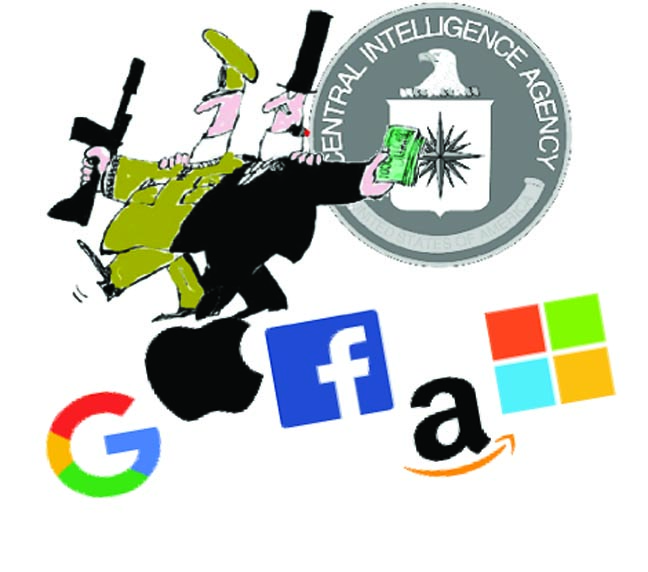
Former Intelligence Officials, Citing Russia, Say Big Tech Monopoly Power is Vital to National Security, Glenn Greenwald, Substack 20 Apr 22,
When the U.S. security state announces that Big Tech’s centralized censorship power must be preserved, we should ask what this reveals about whom this regime serves.
A group of former intelligence and national security officials on Monday issued a jointly signed letter warning that pending legislative attempts to restrict or break up the power of Big Tech monopolies — Facebook, Google, and Amazon — would jeopardize national security because, they argue, their centralized censorship power is crucial to advancing U.S. foreign policy.
The majority of this letter is devoted to repeatedly invoking the grave threat allegedly posed to the U.S. by Russia as illustrated by the invasion of Ukraine, and it repeatedly points to the dangers of Putin and the Kremlin to justify the need to preserve Big Tech’s power in its maximalist form. Any attempts to restrict Big Tech’s monopolistic power would therefore undermine the U.S. fight against Moscow.
While one of their central claims is that Big Tech monopoly power is necessary to combat (i.e., censor) “foreign disinformation,” several of these officials are themselves leading disinformation agents: many were the same former intelligence officials who signed the now-infamous-and-debunked pre-election letter fraudulently claiming that the authentic Hunter Biden emails had the “hallmarks” of Russia disinformation (former Obama Director of National Intelligence James Clapper, former Obama CIA Director Michael Morrell, former Obama CIA/Pentagon chief Leon Panetta). Others who signed this new letter have strong financial ties to the Big Tech corporations whose power they are defending in the name of national security (Morrell, Panetta, former Bush National Security Adviser Fran Townsend)………………….
Why would these former national security and intelligence officials be so devoted to preserving the unfettered power of Big Tech to control and censor the internet? One obvious explanation is the standard one that always runs Washington: several of them have a financial interest in serving Big Tech’s agenda.
Unsurprisingly, Apple CEO Tim Cook has himself pushed the claim that undermining Big Tech’s power in any way would threaten U.S national security. And there is now an army of well-compensated-by-Silicon-Valley former national security officials echoing his message. A well-researched Politico article from September — headlined: “12 former security officials who warned against antitrust crackdown have tech ties” — detailed how many of these former officials who invoke national security claims to protect Big Tech are on the take from the key tech monopolies:………………………………….
Big Tech censorship of political speech is not random. Domestically, it is virtually always devoted to silencing any meaningful dissent from liberal orthodoxy or official pieties on key political controversies. But in terms of foreign policy, the censorship patterns of tech monopolies virtually always align with U.S. foreign policy, and for understandable reasons: Big Tech and the U.S. security state are in a virtually complete union, with all sorts of overlapping, mutual financial interests:
Note that this censorship regime is completely one-sided and, as usual, entirely aligned with U.S. foreign policy. Western news outlets and social media platforms have been flooded with pro-Ukrainian propaganda and outright lies from the start of the war. A New York Times article from early March put it very delicately in its headline: “Fact and Mythmaking Blend in Ukraine’s Information War.” Axios was similarly understated in recognizing this fact: “Ukraine misinformation is spreading — and not just from Russia.”…………….
there is little to no censorship — either by Western states or by Silicon Valley monopolies — of pro-Ukrainian disinformation, propaganda and lies. The censorship goes only in one direction: to silence any voices deemed “pro-Russian,” regardless of whether they spread disinformation….Their crime, like the crime of so many other banished accounts, was not disinformation but skepticism about the US/NATO propaganda campaign………………
It is unsurprising that Silicon Valley monopolies exercise their censorship power in full alignment with the foreign policy interests of the U.S. Government. Many of the key tech monopolies — such as Google and Amazon — routinely seek and obtain highly lucrative contracts with the U.S. security state, including both the CIA and NSA. Their top executives enjoy very close relationships with top Democratic Party officials. And Congressional Democrats have repeatedly hauled tech executives before their various Committees to explicitly threaten them with legal and regulatory reprisals if they do not censor more in accordance with the policy goals and political interests of that party.
Needless to say, the U.S. security state wants to maintain a stranglehold on political discourse in the U.S. and the world more broadly. They want to be able to impose propagandistic narratives without challenge and advocate for militarism without dissent. To accomplish that, they need a small handful of corporations which are subservient to them to hold in their hands as much concentrated power over the internet as possible.
If a free and fair competitive market were to arise whereby social media platforms more devoted to free speech could fairly compete with Google and Facebook— as the various pending bills in Congress are partially designed to foster — then that new diversity of influence, that diffusion of power, would genuinely threaten the ability of the CIA and the Pentagon and the White House to police political discourse and suppress dissent from their policies and assertions. By contrast, by maintaining all power in the hands of the small coterie of tech monopolies which control the internet and which have long proven their loyalty to the U.S. security state, the ability of the U.S. national security state to maintain a closed propaganda system around questions of war and militarism is guaranteed………………………….
Who Profits From Narrative Management & Eliminating Dissent?
Who Profits From Narrative Management & Eliminating Dissent? went2thebridge – Organizing and actions to resist the moral and financial bankrupting of the U.S. through wars against the poor, at home and abroad 18 Apr 22,
When the Pentagon summons the heads of eight weapons manufacturing corporations to a classified meeting about “aid” to Ukraine, you can be sure that a whole lot more Ukranians will be dying in their civil war on steroids.
This type of aid is in reality U.S. taxpayer-funded corporate welfare for the likes of Lockheed and Raytheon, whose former board member is our current Secretary of “Defense.” The aid has been flowing so thick and fast since Russia intervened in the CIA-sponsored war on its doorstep that it’s hard to add it all up quickly enough. One tally this week put the total at $1.7 billion!
Also, why limit these already wealthy corporate entities to feeding from just the U.S. trough? Zero Hedge reports: “Besides replenishing stockpiles sent to Ukraine, the companies stand to gain from European countries increasing military spending in the wake of Russia’s invasion.”
I believe this cash bonanza explains the barrage of propaganda that liberals have fallen for hook, line, and sinker.
You would think that those who value free speech would be alarmed by the burgeoning online censorship that many independent journalists have noted.
Consider the case of Michael J. Brenner, “Professor Emeritus of International Affairs at the University of Pittsburgh and a Fellow of the Center for Transatlantic Relations at SAIS/Johns Hopkins, as well as former Director of the International Relations & Global Studies Program at the University of Texas” according to an interview in scheerpost:
…………… In an email with the subject line “Quittin’ Time,” Brenner recently declared that, aside from having already said his piece on Ukraine, one of the main reasons he sees for giving up on expressing his opinions on the subject is that “it is manifestly obvious that
our society is not capable of conducting an honest, logical, reasonably informed discourse on matters of consequence. Instead, we experience fantasy, fabrication, fatuousness and fulmination.” He goes on to decry President Joe Biden’s alarming comments in Poland when he all but revealed that the U.S. is—and perhaps has always been—interested in a Russian regime change [emphasis mine].
Or how about Scott Ritter, a former UN weapons inspector who sifts through the foggy “facts” of war to discern some truth, who had his Twitter account suspended twice in one week. Based on what he knows about the grisly details of bodies left to rot in the street, he doubted that Russian soldiers could have committed the crimes before their exit from Bucha and speculated that Ukranian militias were the only ones in the area at the time of the massacre.
Cue liberals insisting that Twitter is not the government and therefore can censor anything it likes without violating the 1st amendment. Do they not know that Twitter, Facebook/Meta, Google/YouTube, and other platforms work hand in glove with the federal government to manage the narrative or, when that fails, to eliminate dissenting views?
Are they fooled by mainstream media like the Washington Post, now owned by billionaire Jeff Bezos, ironically sporting the tagline “Democracy Dies in Darkness”?
Or do they know and not care because they’re more interested in the former president and other right-wingers being denied platforms for their views than they are interested in actual free speech?
From media watcher Caitlin Johnstone:
what exactly is the argument for censoring wrongthink about the Ukraine war? Even if we pretend that everything they’re saying is 100% false and completely immoral, so what? What harm is being done? …………
Political action and the players behind it — at every level — becomes more murky by the day. Forgive this boomer for saying, back in the day we thought a free press was foundational to reign in the excesses of the wealthy and powerful, by shining a light into their dark doings.
But late stage capitalism demands fealty to profits above all else. Even, or maybe especially, when the leader of the “free world” is busy shooting himself and his cronies in the foot.
1 This Month
19 February – VIRTUAL EVENT-Decision Time: AI and Our Nuclear Arsenal
12:45 p.m. Central / 1:45 p.m. Eastern
To see nuclear-related stories in greater depth and intensity – go to https://nuclearinformation.wordpress.com
-
Archives
- February 2026 (141)
- January 2026 (308)
- December 2025 (358)
- November 2025 (359)
- October 2025 (376)
- September 2025 (258)
- August 2025 (319)
- July 2025 (230)
- June 2025 (348)
- May 2025 (261)
- April 2025 (305)
- March 2025 (319)
-
Categories
- 1
- 1 NUCLEAR ISSUES
- business and costs
- climate change
- culture and arts
- ENERGY
- environment
- health
- history
- indigenous issues
- Legal
- marketing of nuclear
- media
- opposition to nuclear
- PERSONAL STORIES
- politics
- politics international
- Religion and ethics
- safety
- secrets,lies and civil liberties
- spinbuster
- technology
- Uranium
- wastes
- weapons and war
- Women
- 2 WORLD
- ACTION
- AFRICA
- Atrocities
- AUSTRALIA
- Christina's notes
- Christina's themes
- culture and arts
- Events
- Fuk 2022
- Fuk 2023
- Fukushima 2017
- Fukushima 2018
- fukushima 2019
- Fukushima 2020
- Fukushima 2021
- general
- global warming
- Humour (God we need it)
- Nuclear
- RARE EARTHS
- Reference
- resources – print
- Resources -audiovicual
- Weekly Newsletter
- World
- World Nuclear
- YouTube
-
RSS
Entries RSS
Comments RSS
 nuclear-news