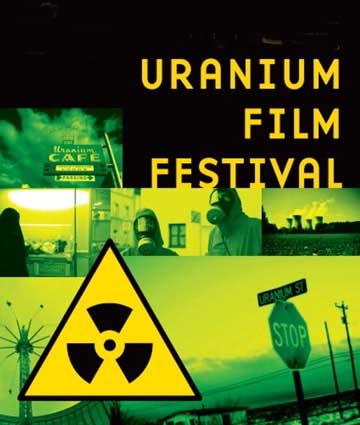
Brazilian-Japanese film director Joel Yamaji received an Honorable Mention at the 15th Uranium International Film Festival in Rio de Janeiro for his documentary “Hibakusha – Wondering Soul.” The award ceremony took place on Saturday, May 30, 2026, at the Cinematheque of the renowned Museum of Modern Art (MAM Rio).
Hibakusha – Wandering Soul is a very artistic film. The music combining modern and old (for instance The Song of the Apple of 1945) and sound-effects using the Shakuhachi flute, drums, the gong and sometimes total silence were wonderful. Also typical usages of the Japanese symbols of the Samurai (for resilience), the Origami Crane (for peace) and of the Noh-Theater (in this case for madness and devilishness and impermanence) gave the film a very distinctive Japanese character, especially for those who are not familiar with Japanese culture. What I found especially successful was the use of the shadow. In the tradition of Tanizaki Junichiro´s `In Praise of Shadows´, the black and white film successfully depicted the fleeting light of mankind and time, I thought. History, the past, passes away like a whirling lantern of memories and life is mysterious, sweet, and happy. One can have hope for the future.“ Makiko Hamaguchi-Klenner, Professor Emeritus at the Faculty of East Asian Studies, Ruhr University Bochum and Member of the IUFF Jury
AWARD ACCEPTANCE STATEMENT
“We are very happy and grateful for the Honorable Mention awarded to our film. It is a special gift for us, because it comes from a Festival grounded in humanist ideas and purposes at a time when interests in immediate technocratic power are prioritized. A Festival that, for 15 years, has dedicated itself to disseminating and promoting the exchange of cultural experiences in a world still based on the consequences of a war that, in the words of the Japanese people, was not just World War II, the War of the Atomic Bomb: it was the War of us all, it belongs to us all. This Honorable Mention is quite significant for us who made the film about atomic bomb surviver Mr. Morita Takashi, who passed away at 100 years old, lucid, professing a world for Peace, in truth. For that it also belongs to him and to all the hibakusha, victims of an act of violence imposed by men. `I learned that I should never again think of anyone as an enemy. The logic of war leaves no room for human dignity.´ The Festival, made with the vibrant joy of a team whose youthful spirit is contagious, will remain in my memory. Long live the International Uranium Film Festival!” Joel Yamaji, Screenwriter and director of “Alma Errante (Hibakusha – Wondering Soul”
“It is with immense pride and deep emotion that we celebrate the achievement of the film Hibakusha – Wandering Soul, awarded a well-deserved honorable mention at the prestigious International Uranium Film Festival. This award represents not only recognition of the technical and artistic excellence of the work, but also the validation of an urgent and vital message that documentary cinema carries with it. The award ceremony gained an even more special shine with the presence of director Joel Yamaji, who was there in person to receive the honor and masterfully represent all the dedication, talent and heart of the team that made this project a reality. The event, which has established itself as one of the main global showcases for raising awareness about nuclear issues, reflects the tireless work and vision of its organizers, Marcia Gomes de Oliveira, Founder and Executive Director of the festival, and Norbert Suchanek, Founder and General Director, who continue to open fundamental spaces for stories of such human and social impact to reach the world. Seeing `Hibakusha – Wandering Soul´be revered on a stage of such international relevance is a testament to the power of independent cinema and an unforgettable milestone for everyone involved in this transformative cinematic journey!” Producer of “Alma Errante (Hibakusha – Wondering Soul”
Brazil, 2025, Director: Joel Yamaji, Producer: Joel Pizzini and Juliana Domingos, Grão Filme, Documentary, 20 min. / The film merges poetically reconstructed documentary fragments recreated as traces of the past with dreamlike images to express the imaginary of Hiroshima survivor Takashi Morita, who emigrated to Brazil and became a peace activist, turning his life itself into a message to future generations about the horror and senselessness of war.
ABOUT THE FESTIVAL
For 15 years the International Uranium Film Festival (IUFF) raises awareness about the risks of atomic power and promotes nuclear disarmament with independent films and panels of experts around the globe. In October 2024, Hollywood’s MovieMaker Magazine named it one of the “25 Coolest Film Festivals in the World 2024”. And in 2025, the festival’s founders, Márcia Gomes de Oliveira and Norbert Suchanek, received the prestigious “Nuclear-Free Future Award” in New York City in the category education. The Uranium Film Festival especially in Rio focuses very much on the young generation.
„You’ve never seen two people get more done than the life and project-partner duo Márcia Gomes de Oliveira and Norbert G. Suchanek, who run the International Uranium Film Festival in deep collaboration with activists around the world. The festival has its grand event in Rio, but also does an extensive U.S. tour in regions impacted by uranium-related industry. Inevitably, folks wonder whether there are enough films on the subject to warrant a festival. The answer is yes. This, of course, is because the issue is expansive, impacting all 50 U.S. states and many more corners of the world than most folks realize. From the Navajo Nation to Las Vegas to Chicago and many places between, this spirited DIY art, advocacy, and activism project brings folks together in a space of support, education, shared outrage, and a good time. The Uranium Film Festival is a refreshing example of what activism and advocacy can be: inclusive, expansive, and celebratory.“ Hadley Austin, MovieMaker Magazine
Think globally, act locally.
We thank our local supporters in Santa Teresa, Rio de Janeiro: Armazém de São Thiago, Esquina de Santa, Bar do Mineiro, and Cachaça Magnífica de Faria for providing delicious local meals and drinks for filmmakers, audiences, and festival staff. And we thank our international supporter from California, the Samuel Lawrence Foundation.
All this, however, pales in comparison to the resources the U.S. has dedicated to Radio and TV Martí. Founded in 1985 by the Reagan administration, the Miami-based network boasts dozens of full-time employees and receives tens of millions of dollars from Washington annually.
Anti-government media are only a small portion of the huge array of groups Washington secretly funds and supports. From musicians and academics, to civil society, educational, and religious groups, to think tanks, charities and NGOs, there exists a vast nexus of organizations receiving vast sums of money from the U.S. government.
Amid escalating U.S. aggression towards the Cuban island through a maximum pressure campaign and the threat of military intervention, the United States government has been covertly funding a huge network of Cuban media outlets that claim to be independent in a push for regime change against the independent socialist government.
These outlets present themselves as unbiased investigative journalism, but are quietly being financed by Washington through USAID, the National Endowment for Democracy and the Open Society Foundation in order to sow discontent across the Caribbean nation, softening it up for a potentially “imminent” invasion by the Trump administration.
Cuba faces some of its worst energy blackouts in its history, thanks to the U.S. blockade, which is attempting to strange the island into submission. As a Communist state defying U.S. orders, Cuba has, since 1959, been in the crosshairs of Washington, who are attempting to overthrow the government. MintPress sheds light on this shady regime change nexus.
CubaNet is one of the most influential and well-established news outlets covering affairs on the Caribbean island. Founded by anti-government activists in 1994, the site has become the go-to source of information for corporate media, who regularly cite it, and present it as an objective and unbiased independent media (e.g., The Washington Post, The Wall Street Journal, Fox News, and The Los Angeles Times). CubaNet reporters have written op-eds in major U.S. newspapers such as USA Today, calling for an immediate change in government on the island.
‘Independent Journalism,’ Brought To You By The U.S. State Department
But CubaNet is not as independent as it seems. The outlet is bankrolled by the U.S. national security state. CubaNet has received millions of dollars in funding from USAID and the National Endowment for Democracy, as well as the Open Society Foundation.
One currently active $500,000 USAID grant, for instance, was awarded to CubaNet to “engage on-island young Cubans through objective and uncensored multimedia journalism.” While ostensibly a laudable goal, even the grant’s own one-sentence description hints that its purpose is to undermine and attack the Cuban government. It states that it will (emphasis added) “increase the free flow of information to and from Cuba in order to offset the regime’s disinformation campaigns.”
Another news organization receiving huge sums of money from Washington is ADN Cuba. Literally meaning “Cuba’s DNA,” the outlet has amassed a significant following online, boasting over 100,000 subscribers on YouTube, over 200,000 on Instagram, and over 1.3 million on Facebook. It describes itself as “an independent media outlet committed to freedom and democracy in Cuba.” Yet it is actually based in Spain. And it does not seem particularly committed to transparency about its funding.
What is clear, however, is that ADN Cuba has received millions of dollars from the U.S. national security state. In September 2024, USAID approved a $1.1 million grant to ADN Cuba – a gigantic amount of money for an organization that publishes barely one story per day on its website. This was on top of a $1.5 million allocation for the 2022-2024 period. Indeed, since 2020, ADN Cuba has received in excess of $3 million from USAID alone. This relationship is not disclosed to readers– even in stories directly covering USAID funding Cuban media– and is relegated to the footnotes of obscure U.S. government funding databases.
Diario de Cuba is another Spanish-based news outlet that publishes a wide variety of stories, all with one thing in common: a deep aversion to the Cuban government. The BBC describes it and CubaNet as key sources for impartial news, run by journalists who “report without censorship and to paint a broader picture on the country’s reality.”
And just like CubaNet, Diario de Cuba has received seven-figure funding from Washington. Between 2016 and 2020, Diario de Cuba received $1.3 million in USAID cash – almost as much as CubaNet over the same period. This generous funding has allowed it to reach a global audience, with over 600,000 followers on Facebook alone.
The Central Intelligence Agency used to directly (and secretly) sponsor hundreds of media outlets across the world. However, after a series of scandals and more information about its nefarious activities came to public attention, Washington decided to outsource many of its most controversial foreign operations to organizations such as the National Endowment for Democracy and the U.S. Agency for International Development.
“It would be terrible for democratic groups around the world to be seen as subsidized by the CIA,” Carl Gershman, the NED’s longtime president, said, explaining the 1983 decision to create his organization. NED co-founder Allen Weinstein agreed: “A lot of what we do today was done covertly 25 years ago by the CIA,” he told The Washington Post.
Under the guise of democracy promotion and human rights, the U.S. government channels money to political and social groups across the world in order to maximize its strategic goals, including regime change.
In recent years, the U.S. has used the twin organizations of the NED and USAID to bankroll anti-government protests in Hong Kong, to attempt a color revolution in Belarus, to overthrow the government of Ukraine in 2014, and to organize riots across Iran earlier this year.
In Cuba, the NED and USAID played a critical role in organizing a (failed) uprising against the government in 2021. USAID in particular spent millions of dollars funding, organizing and promoting the San Isidro Movement – a collective of musicians, artists, and journalists– to lead a counter-revolution on the island.
San Isidro members were at the forefront of a wave of nationwide protests that July. The demonstrations were immediately signal boosted by Western corporate media, top celebrities, and U.S. politicians, including President Biden. Neitzens were flooded with the astroturfed “SOS Cuba” campaign, that trended across the Internet for days.
In the end, however, the coordinated efforts of the U.S. failed to convince ordinary Cubans to take to the streets, and the movement quickly petered out.
Esteban Rodríguez, a key member of the San Isidro movement, is a producer at ADN Cuba.
When U.S. Money Is Paused, “Independent” Media Immediately Collapse
The importance of U.S. government money to the survival and operations of these outlets was underlined early last year when the Trump administration chose to freeze funding to USAID and the NED. Announcing the decision, Elon Musk, then head of the Department of Government Efficiency, described USAID in particular as a “viper’s nest of radical-left Marxists who hate America.”
The effect on Cuban media was immediate. As soon as the money stopped flowing, dozens of organizations faced immediate liquidation. CubaNet published an emergency editorial asking readers to make up the shortfall. “We are facing an unexpected challenge: the suspension of key funding that sustained part of our work.” they wrote; “If you value our work and believe in keeping the truth alive, we ask for your support.” “Without [USAID] funds, it will be extremely difficult to continue,” CubaNet director Roberto Hechavarría Pilia added.
Diario de Cuba was in similarly dire straits. Its director, Pablo Díaz Espí, noted that “aid to independent journalism from the government of the United States has been suspended, which makes our work more difficult,” asking readers to donate.
Musk’s decision accidentally revealed a sprawling network of over 6,200 reporters and nearly 1,000 outlets worldwide that were quietly being trained, supported, and bankrolled by the CIA front, all under the banner of promoting “independent” media and freedom of information.
Another supposedly independent Cuban outlet plunged into crisis was El Toque (The Touch). Founded in 2014 and receiving hundreds of thousands of dollars from the NED, El Toque publishes in Spanish and English, and attempts to manipulate the exchange rates in Cuba.
The funding cut hit them badly, with editors announcing that they would immediately have to lay off half their staff (15 people) and stop working with dozens of freelancers, while looking for alternative funding sources.
El Estornudo (The Sneeze), is also generously financed by NED. In 2021 alone, the endowment awarded the investigative journalism outlet $180,000. It also receives copious support from the Open Society Foundation, although it insists that none of this U.S. money comes with any strings attached or affects its output.
While Western media often portray the Cuban media landscape as a David-and-Goliath fight between plucky independent media facing repression, and a sprawling state-sponsored propaganda apparatus, the gigantic sums handed out to these “underdogs” make them by far and away the best funded outlets on the island. A 2023 Guardian article, for instance, profiled 24-year-old photojournalist Pedro Sosa, who worked for both El Toque and El Estornudo. It presented the pair as “offer[ing] real reporting over stodgy state media” and journalists as poor and vulnerable truth tellers standing up for “freedom,” and facing a “crackdown” from the state.
But it also let slip that working for U.S.-backed media is not as bad a career move as portrayed, and is, in fact, an extremely lucrative profession. It casually mentions that salaries at tiny El Toque are ten times that of even the most senior journalists working in Cuban state media. In reality, then, these oppressed free speech warriors are actually some of the richest individuals on the entire island, thanks to the power of the U.S. dollar, which pays them handsomely to produce a constant stream of anti-government news.
In the end, the U.S.-backed outlets need not have worried, and NED and USAID funding resumed after some restructuring.
Jobs For the Boys
All this, however, pales in comparison to the resources the U.S. has dedicated to Radio and TV Martí. Founded in 1985 by the Reagan administration, the Miami-based network boasts dozens of full-time employees and receives tens of millions of dollars from Washington annually.
Unlike the rest of the journalism industry, workers at Radio and TV Martí enjoy strong job security and six-figure wages, despite the fact that the Cuban government is able to jam and block many of their broadcasts from reaching Cuba, meaning precious few people consume its content.
Since its creation, Washington has spent at least $800 million on Radio and TV Martí.
The outlets profiled make up only a small portion of the network of anti-government media being funded by the United States. Most of the recipients of American money remain anonymous – a decision taken in part to hide their identities and preserve their credibility inside Cuba.
The National Endowment for Democracy considers Cuba a “long-standing priority,” and is currently officially funding 32 separate projects on the island.
Media related grants include one $80,000 project titled “Strengthening Access to Information,” which promises to:
“[E]nhance access to information and promote critical thinking, the organization will produce daily reporting and analysis across various formats, providing independent perspectives on issues affecting citizens’ daily lives, including freedom of expression, public safety, human rights, and other pressing social concerns.”
Another $115,000 grant, titled “Expanding Access to Uncensored Media” notes that it will:
“[P]romote independent information, the organization will provide narrative journalism on censored topics, conduct investigations, and produce in-depth articles, photo essays, and opinion pieces while strengthening the media’s operational capacity.”
Thirty-one of the thirty-two projects hide the recipient’s name and identification, meaning that those groups working with the CIA cutout organization are generally only ever identified if they advertise this relationship, or, like when U.S. money was temporarily halted in 2025, they call for help.
Anti-government media are only a small portion of the huge array of groups Washington secretly funds and supports. From musicians and academics, to civil society, educational, and religious groups, to think tanks, charities and NGOs, there exists a vast nexus of organizations receiving vast sums of money from the U.S. government.
Two of these bodies include The Observatorio Cubano de Derechos Humanos (Cuban Observatory of Human Rights, or OCDH) and lawyers’ group, Cubalex.
Both groups produce reports denouncing the Cuban government, and are regularly cited as impartial authorities on human rights on the island in Western outlets, such as The New York Times, CNN, and The Washington Post. But what readers are not told is that both organizations are bankrolled by the U.S. national security state.
Records show that USAID has given almost $1.5 million to the OCDH. NED support, meanwhile, was crucial to Cubalex’s inception in 2010, and Washington continues to pay its staff wages to this day. As the company’s executive director, Laritza Diversent said last year,
“Without the support of National Endowment for Democracy, Cubalex would not have existed; to do the work we do requires resources. For 14 years, NED has been supporting us. Last October, after trying a lot of times, we [also] achieved a state Department grant.”
Thus, there is barely a corner of the anti-government Cuban opposition that has not been reached by U.S. money, either through government organizations such as the NED or USAID, or through institutions such as the Ford Foundation and Open Societies Foundation, which have historically performed a similar role in promoting American interests abroad.
Many of these groups are headquartered in South Florida, where U.S. government money is helping to subsidize thousands of jobs for the Cuban-American community. It is therefore no exaggeration to say that a significant part of Miami economy is propped by taxpayer money funding counter-revolutionary forces. Ironic, considering that conservative Cubans often vehemently object to government welfare programs in both the U.S. and Cuba.
Digital Bombardment
In 2010, a new social media and messaging app, Zunzuneo, took Cuba by storm. From nowhere, it went viral, picking up tens of thousands of users – a very large number for the time on such an internet-sparse island.
None of its users, however, were aware that the platform had been secretly created by USAID in order to promote regime change. Their plan was to first provide an excellent service that would capture the market, then to slowly drip feed Cubans anti-government messaging, and finally to direct them to join “smart mobs”, aimed at triggering a color revolution.
In an effort to hide its ownership of the project, the U.S. government held a secret meeting with Twitter founder Jack Dorsey, aimed at getting him to invest in the project. It is unclear to what extent, if any, Dorsey helped, as he has declined to speak on the matter.
Zunzuneo was abruptly shut down in 2012, perhaps because the Office of Cuba Broadcasting (which oversees TV and Radio Marti) had already created a new program called Piramideo.
Piramideo marketed itself as an app that allowed Cubans to receive world news for free, and without censorship. Almost immediately, however, locals reported being deluged with fake news about anti-government protests that never happened. Piramideo was shut down in 2015, after reporting on U.S. government meddling in Cuba caused a scandal and diplomatic embarrassment.
Today, however, with Cubans increasingly using American social media apps, this kind of subterfuge is largely unnecessary, as it can be done out in the open. During the 2021 San Isidro protests, apps such as Instagram and Twitter were openly participating in the attempt to overthrow the government, taking no action against a massive boom of clearly fake bot accounts parroting the exact same messages (down to the typos) and using the same astroturfed hashtag. Twitter’s editorial team even placed the protests – which drew barely a few thousand people into the streets nationwide – at the top of its “What’s Happening” for over 24 hours, meaning that every user worldwide would be notified. The failed putsch has come to be known as the “Bay of Tweets.”
Unending War on Cuba
In October, for the 33rd consecutive year, the United Nations voted overwhelmingly (165-7) to call for an end to the American blockade against Cuba. This economic war was established by the Eisenhower administration, in response to the Cuban Revolution of 1959, which overthrew the U.S.-backed dictator, Fulgencio Batista.
These illegal unilateral coercive measures, which an internal U.S. government memo states are designed to “decrease monetary and real wages, to bring about hunger, desperation and overthrow of government,” cost Cuba billions every year, and severely impede its development.
The U.S. attempted to invade Cuba in 1961, and brought the world to the brink of annihilation during the subsequent Cuban missile crisis. It reportedly attempted to kill its leader Fidel Castro hundreds of times, and carried out waves of terror attacks against the country, including using biological weapons on the island.
Successive administrations continued the economic war against Cuba, which was ramped up after the fall of the Soviet Union. But the Trump State Department, run by Cuban-American Marco Rubio, has taken it to a new level, declaring the island to be one of its top priorities.
Trump himself has declared that Cuba is “next” on the list of countries being targeted for regime change. “We may stop by Cuba after we’re finished” with Iran he said last month.
In response, Cuban president Miguel Díaz-Canel said his country was ready to repel any U.S. invasion, as it did during the Bay of Pigs, stating:
“The moment is extremely challenging and calls upon us once again, as on April 16, 1961, to be ready to confront serious threats, including military aggression. We do not want it, but it is our duty to prepare to avoid it and, if it becomes inevitable, to defeat it.”
It is in this context that the U.S. government’s funding of a vast array of media outlets targeting Cuba should be seen; the media attack is just one facet of Washington’s multipronged approach to regime change.
Many of the organizations profiled here publish in English, and nearly all are used as supposedly credible sources of information on Cuba for Western corporate media, meaning that U.S. State Department narratives are laundered into the public consciousness through this network.
Many Cubans and Americans are completely unaware that their news about the island comes largely through a matrix of shady outlets quietly funded by the U.S. national security state via the NED and USAID. Their purpose is to keep up the flow of negative stories in order to soften the public up into accepting regime change on the island. After all, in war, truth is always the first casualty.
For decades, 60 Minutes stood as one of the last surviving institutions of broadcast journalism willing to challenge power, confront corruption and occasionally remind Americans what reporting looks like when it serves the public rather than corporate interests. Now, according to reports from both The New York Times and The Guardian, one of the program’s most recognizable faces has been shown the door after openly accusing CBS leadership of dismantling the very newsroom he spent decades helping build.
Scott Pelley’s firing is more than a personnel dispute. It is a warning flare over the future of corporate media.
The veteran correspondent reportedly blasted CBS News editor-in-chief Bari Weiss during a tense staff meeting, accusing her of “murdering 60 Minutes” after the network abruptly removed key producers and correspondents from the program. Pelley’s criticism came amid growing turmoil at CBS News following a dramatic restructuring led by ownership and management figures who promised to modernize the network for the digital era.
But modernization is often the language institutions use when they are really talking about control.
The most striking allegation is not that Pelley lost his job after challenging management. It is Pelley’s claim that senior executives pressured him to inject bias into reporting and that “the collapse of values at the top has become untenable.” If true, the issue extends far beyond one journalist’s employment status. It becomes a question of whether one of America’s most influential news organizations is abandoning the editorial independence that made it relevant in the first place.
The irony is difficult to ignore.
Below [on original] is the termination letter CBS executives sent to Scott Pelley—a document that offers a revealing glimpse into the growing battle over editorial independence, newsroom dissent and the future of one of America’s most respected news programs…………………………………………………………..
For years, media executives have lectured the public about the importance of defending democratic norms, protecting institutions and standing up to political pressure. Yet when journalists inside their own organizations raise concerns about editorial interference, many of those same institutions suddenly discover the virtues of obedience.
Pelley is not some fringe figure. He reported from Afghanistan, Iraq and Ukraine. He spent decades in dangerous environments documenting war, power and political deception. Whether readers agree with every story he produced is beside the point. His reputation was built through reporting, not branding.
Meanwhile, CBS appears to be replacing newsroom veterans with a leadership structure increasingly shaped by media personalities, digital strategists and executives whose expertise lies less in investigative journalism than in managing narratives and audience engagement.
Films from Canada, Spain, Germany, Brazil and the USA won the top awards at the 15th International Uranium Film Festival of Rio de Janeiro. The awards ceremony took place on Saturday, May 30, 2026, at the Cinematheque of the renowned Museum of Modern Art (MAM Rio). Bye, Bye Rio, hello Las Vegas. For those who could not make it to the Rio de Janeiro International Uranium Film Festival in time this year, you may join us in Las Vegas, Nevada. The 3rd International Uranium Film Festival in Vegas will be held this fall at the University of Nevada Boyd School of Law in cooperation with Principal Man Ian Zabarte from the Western Bands of the Shoshone Nation of Indians. The Shoshone are the most atomic bombed nation on earth. More than 900 atmospheric and underground nuclear explosions were conducted on their territory in Nevada by the US and 28 nuclear full-scale nuclear weapon detonations by the United Kingdom.
And these are the winners of the 15th International Uranium Film Festival of Rio de Janeiro, May 21 – 30, 2026.
EMERGING FILMMAKER AWARD
ALBRAUM
Germany, 2026, Directed by Maja Hohenberg, Poetic Documentary, 20 min. (Photo: Maja Hohenberg)
BEST INVESTIGATIVE DOCUMENTARY FILM
BOMBSHELL
USA, 2025, Directed by Ben Loeterman & Gaia De Simoni, Documentary Feature, 80 min.
BEST EXPERIMENTAL DOCUMENTARY
OUT OF CONTROL. REPORTS ON THE ATOMIC BOMB
Spain, 2023, Directed by Beatriz Caravaggio, Experimental Documentary, 50 min.
BEST DOCUMENTARY FEATURE FILM
THE ATOMIC SCREEN
Canada, 2025, Directed by Alain Vézina, Documentary, 52 min.
NATIVE SPIRIT AWARD
THE MOTH
Canada, 2025, Directed by: Michelle Derosier and Zoe Gordon, Short Fiction, 20 min. (Photo: Zoe Gordon)
HONORABLE MENTIONS
HIBAKUSHA – WANDERING SOUL
Brazil, 2025, Director: Joel Yamaji, Short documentary, 20 min. (Photo: Joel Yamaji)
HOLLYWOOD BOMB – HOW PRESIDENT TRUMAN AND GENERAL GROVES DESTROYED THE FIRST NUCLEAR EPIC
USA, 2026, Director: Greg Mitchell, Short documentary, 15 min.
THE ALPACA CONNECTION
USA, 2025, Director: Tom Brown, Comedy thriller short, 18 min.
TOO LATE TO LEARN
USA, 2026, Director: Thomas Kanady, Documentary, 68 min.
While pro-Silicon Valley documentaries got major distribution deals, Valerie Veatch had to struggle to get her film, about Big Tech’s dark past and future, into the world. She talked to Charlotte O’Sullivan about what some attendees called ‘the scariest movie playing at Sundance’
Valerie Veatch doesn’t want to come across as “a crazy, bitter film-maker”. But she admits it’s “triggering” to talk about the challenges she faced when making Ghost in the Machine, her blisteringly enjoyable documentary about the dark past and present of AI, which hits UK cinemas today.
From the start, Ghost in the Machine was a hard sell. As Veatch says: “I couldn’t get funding from the usual places. People weren’t interested in a film that was tech-critical.” She wanted to talk about the “father of Silicon Valley”, Dr William Shockley, and his abiding interest in eugenics, to explore the sexism and racism that underpins “breathless, gushy” discussions about “superintelligence” and the “singularity” (the hypothetical moment when AI surpasses human intelligence). “I was so full of rage. This stuff is not inevitable.”
Veatch, who was born in Seattle but is now based in Kent, has made three critically acclaimed and zeitgeisty documentaries (including 2014’s Love Child and Me at the Zoo in 2012). For the new film, she talked to more than 30 US experts about the power dynamics behind the much-hyped, eye-wateringly lucrative AI revolution. She did the Zooms, and edited the Zooms, “compulsively, in the middle of the night, for a year; I did urgent listening and, somehow, I got a cut ready for Sundance”. Once Sundance 2026 accepted the film, Veatch got a grant, which paid for all the archival footage. And her dad and aunt came in as investors, she says proudly. “So this is an almost entirely homegrown film. I don’t think we could carry the message that we’re carrying if we were at all beholden to any large studio or distribution company.”
‘What is the difference between being in the pocket of Big Tech and being an independent voice? Well, a lot!’
Irreverence is Veatch’s thing and she cites the British director Adam Curtis as the biggest influence on her work (“I wanted to utilise the archive, the way he does … I wanted it to be surreal and sardonic”). Ghost in the Machine is crammed with jolting images: we see William Shockley, on TV, spewing his racist poison with the gentle patience of a man hawking encyclopaedias. Elsewhere, phrases chime in quietly chilling ways: the Victorian originator of eugenics, Francis Galton, wants to create a “galaxy of genius”.
Also shown at Sundance this year, and distributed by the mainstream giant Focus Features in the US (and Universal Studios elsewhere), was The AI Doc: Or How I Became an Apocaloptimist. Made by Daniel Roher and Charlie Tyrell, this documentary, as its title suggests, manifests a cautious lack of pessimism on the subject of AI. Framed as a personal journey (Roher, about to become a father, wants to know if he’s bringing his baby into a safe world), it suggests this technology will always be with us. This film, which premieres at Sheffield DocFest next Friday, 12 June, and then goes on general release in the UK on 19 June, had the cooperation of the tech bros and includes on-camera interviews with Google Deepmind’s CEO, Demis Hassabis, and OpenAI’s Sam Altman. In the words of Daniela Amodei, the co-founder and CEO of Anthropic, “this train isn’t going to stop”.
Veatch draws my attention to the fact that Sundance now receives funding from Google, adding: “Last year, so I’m told, audiences clapped when film-makers said their movies didn’t contain AI … this year was so different.” Even before the festival began, she sensed unease about her project. As it happened, Ghost in the Machine connected with audiences. In fact, it was a huge success, with word of mouth suggesting it was “the scariest movie playing at Sundance”.
Still, Veatch gets infuriated when her film is compared to Roher’s. She says: “What is the difference, ultimately, between being in the pocket of Big Tech and being an independent voice? Well, a lot!”
Author and linguist Emily Bender (who appears in both Ghost in the Machine and The AI Doc) is on record as saying Veatch’s film is the better of the two. Bender says Roher “lets himself get buffeted by the imaginations of some of the most unhinged people in this space”, whereas Bender feels Veatch has “woven together an informed and engrossing essay”. Similarly, Timnit Gebru, a computer scientist and cofounder of Black in AI, who also shows up in both films, recently praised Ghost in the Machine while distancing herself from Roher’s movie. “She went on LinkedIn and said: “I reject [The AI Doc]. They used us like chocolate chips.’” Veatch nods grimly. “And they did. They sprinkled in diversity.”
‘This industry is rotten. I hate it! But this is why we need women film-makers’
Veatch insists this isn’t about individual movies getting it wrong. It’s about a trend to sideline or erase voices with a different point of view. A new British production called AI: Probably Nothing to Worry About, is showing at Tribeca this weekend. Veatch says she only heard about the movie through Bender, who was interviewed for it but didn’t make the final cut. The film-maker said something like: “Sorry we didn’t use your footage. In the end, we were just focusing on people who were in the room when big discoveries happened.” Veatch pulls a face. “In other words, ‘we focused on men’. This industry is rotten. I hate it! But this is why we need women film-makers.”
Veatch says repeatedly that she feels the need to be “aggressive” when talking about her film. That she’s willing to seem “negative”, because “what’s happening with AI is so urgent – the building of all these hyper-scale data centres is horrifying.” In the US, she says, “they’re trying to criminalise dissent”. (Wired recently reported that federal intelligence agencies and domestic law enforcement are targeting “anti-technology extremists”). Veatch jiggles in her seat. “The film’s going to get a release on PBS and YouTube in September. And we’re about to get a huge grant, to make data centres the theme of our summer push, in the US. I’ve invited Erin Brockovich [the environmental activist, who has started a database to track data centres around America] to one of our events. I’m like: “I really hope she says yes. She’s an icon. You can’t criminalise Erin Brockovich!”
Veatch says she’d “love to do something in the UK about data centres”, then pauses and, for the first and only time in the whole interview, sounds lost. She murmurs, “There are networks in the US. I don’t know anyone here …” Human contact means everything to Veatch. Concerned citizens of the UK, if you want to join forces with this formidable woman, drop her a line.
Ghost in the Machine is released in UK cinemas today, or can be rented through Kinema
The Nerve is a fearless, independent media title launched by five former Guardian / Observer journalists: investigative journalist Carole Cadwalladr, editors Sarah Donaldson, Jane Ferguson and Imogen Carter and creative director Lynsey Irvine. We cover culture, politics and tech,
The New York Times attempted to ‘balance’ Nicholas Kristof’s documentation of the systematic rape of Palestinians by Israeli forces with yet another unverified rape ‘investigation’ claiming that Hamas had weaponized sexual violence on October 7. It was written by the paper’s pro-Israel Jerusalem-based reporter, Isabel Kershner.
Nicholas Kristof’s New York Times Op-ed piece titled The Silence That Meets the Rape of Palestinians, published on May 11, was based on documentation and grueling victim testimonies of rapes that Palestinianshaveexperienced at the hands of Israeli security forces. Brutal and sadistic acts of sexual torture are described in a piece that triggered enormous attention even though human rights organizations have been documenting these same crimes for years now.
The Israeli human rights group B’Tselem has documented Israel’s sexual torture of Palestinian men, women and children calling the “Israeli prison system a network of torture camps.” Save the Children reported in July 2024 that Palestinian children in Israeli detention were facing “disease, increasing starvation, [and] abuse including sexual violence.” A Palestinian women’s rights organization warned that their documented 75 cases of rape and sexual violence against Palestinian women amounted to about 1% of what was actually happening in Israeli detention. Euro-Med Human Rights Monitor’s extensive report published on April 13, 2026, emphasized that the sexual torture was so bad it amounted to “another genocide behind walls.” They identified its purpose as a “systematic destruction of the body and identity.” The report emphasized the scope of “criminal responsibility,” by the collusion of state institutions that were creating impunity.
In a discussion about Kristof’s piece, Francesca Albanese, who has also documented brutal Israeli torture sites, told Al Jazeera’s UpFront that she had given a long interview about sexual torture to the New York Times as early as February 2024, but nothing came of it. Albanese went on to say she didn’t understand why the Times piece should have been “more important” than the extensive documentation of human rights monitors. But when Kristof finally acknowledged that Palestinians were being tortured and raped by trained dogs, (corroborated by a soldier) in Israeli prisons, it made headlines in the US and sent shock waves through Israel’s hasbara apparatus.
The agenda setting New York Times is a “paper of record,” with a journalism staff of 3000, about 7 percent of all journalists working in the US. The paper has also been a reliable source of pro-Israel messaging for years, especially after October 7, so when a well-respected human rights journalist wrote such an op-ed in its pages it was a public relations disaster for Israel and its propaganda machine went into high gear to counter the bad press. Zionists and genocide supporters protested in front of the Times building. Netanyahu was so outraged that he threatened to bring a defamation lawsuit against the paper. The Israel Foreign Ministry called the piece “blood liable” and accused Nicholas Kristof of writing “an endless stream of baseless lies and propaganda” that turned the “victims into the accused.”
It should come then, as no surprise that the paper attempted to “balance” Kristof’s essay by publishing a piece the very next day, on May 12, about another “two-year investigation” by Israel, that “concluded” that sexual violence by Hamas was widespread on October 7. Isabel Kirshner’s piece attempted to breathe new life into the thoroughly discredited and debunked original Times’ front-page ‘investigation’ titled Screams Without Words. Screams was first published on December 28, 2023, just as the South African legal case against Israel’s genocide was being presented to the International Court of Justice, and it served as a significant denial and justification for Israel’s genocidal violence at the time. Screams without Words can be described accurately (and has been) with the same words used by Israel’s Foreign Ministry to falsely describe Kristof’s piece; “an endless stream of baseless lies and propaganda.”
The timing of the now infamous rape story of 2023, along with its extravagant claims to evidence not found in the front-page article, had much to do with why, almost immediately, the piece drew critical attention from media analysts, independent investigative reporters, and human rights organizations. Withering criticisms of the story included an essay in Medium, calling it “crappy journalism,” saying it offered a “lesson on selection, slanting, and charged language, and why using words in these ways constitutes a poor substitute for solid evidence and reasoning.” An Egyptian feminist non-governmental organization (NGO) Speak Up, called the article a “disgraceful investigation,” and shamed the Times for claiming to provide readers with definitive evidence, while actually offering no evidence at all. Independent US investigators such as Electronic Intifada, The Grayzone, The Intercept, Mondoweiss and others, roundly debunked the fictionesque inventions continued within it. Sixty journalism professors wrote to the New York Times calling on the paper to commission an independent review of the article. It was “troubling to professors of journalism to see such a shoddy article be published without a retraction or an investigation,” Professor Deepa Kumar told Democracy Now! ………………………………………………………………
The paper’s 2026 version of the Hamas rape story was penned by one of the Times’ most reliably pro-Israeli reporters, Isabel Kershner, and this new ‘investigation’ once again takes seriously, discredited Israeli sources that Kershner claims to be independent and reliable…………………………………………………………………..
Isabell Kershner at the New York Times
Kershner has been providing positive reporting for Israeli Security Force for years now. With Kirshner, polishing the image of the IDF is a family affair. ………………………………………………………………………………………………………………………………………..
Balancing legitimate reporting that includes reliable witness testimony confirmed by multiple human rights investigations over a period of years cannot be not done by publishing unverified allegations from discredited sources. Alan MacLeod noted a recuring media pattern here that applies to the New York Times’ reporting on Israel; “whenever scrutiny intensifies around Israeli abuses against Palestinians, major Western outlets redirect attention toward unverified claims against Hamas to justify Israel’s genocide in Gaza.”
Balancing Kristof’s rare acknowledgment of Israeli war crimes with reporting by a pro-Israel, biased journalist citing discredited sources repeating unverifiable allegations was a shameful, and failed, attempt to appease the state of Israeli as it expands its crimes of war and occupation into Lebanon for a Greater Isreal. The Times would do better to simply report the truth and stop catering to hasbara and the false narratives that facilitate Israel’s on-going genocidal violence.
Robin Andersen is professor emerita of media studies at Fordham University and an award-winning author of a dozen single- and co-authored books. Her work examines film, television, and media coverage of war, the environment, politics, and elections. She edits the Routledge Focus Book Series on Media and Humanitarian Action, serves as a Project Censored Judge, and contributes to the annual State of the Free Press. Andersen is on the Board of Directors of Fairness and Accuracy in Reporting (FAIR), where she also writes regularly, and is an Izzy Award Judge for the Park Center for Independent Media. Her writing has appeared in CounterPunch, LA Progressive, The Progressive, Salon, Common Dreams, and ScheerPost, among others.https://scheerpost.com/2026/05/30/balancing-act-at-the-new-york-times-nicholas-kristofs-wrote-about-israels-sexual-torture-of-prisoners-the-next-day-isabel-kershner-penned-more-unverified-rape-allegations-against-h/
When the establishment journalism of Nicholas Kristof of that most establishment of papers, The New York Times, draws the ire of a foreign regime, and an unnaturally allied foreign regime at that, a pulse might be detected in the moribund state that is the Fourth Estate. In his piece alleging a campaign of sexual violence against Palestinians by Israel’s security apparatus, he shines some blistering light on practices long suspected and discussed. It begins a proposition that, “Whatever our views of the Middle East conflict, we should be able to unite in condemn rape.”
With that solemn theme declared, Kristof begins by remarking on the “brutal sexual assaults against Israeli women during the Hamas-led attack on Israel on Oct.7, 2023.” Members of the US administration and the Israeli Prime Minister, Benjamin Netanyahu, had rightly condemned them. “And yet in wrenching interviews, Palestinians have recounted to me a pattern of widespread Israeli sexual violence against men, women and even children – by soldiers, settlers, interrogators in the Shin Bet internal security agency, and, above all, prison guards.”
Brandishing his credentials as veteran war reporter, he makes it clear that, when writing about sexual violence, he knows what he’s talking about. Interest in the fate of Palestinian prisoners – especially in that way – was piqued during a visit to the activist and professor of non-violence Issa Amro. Amro had himself been sexually assaulted and suspected this to be a common practice “but underreported because of shame.” Interest then shifts to the conditions of incarceration, with something in the order of 9,000 Palestinians being held as of May. “Many have not been charged but were detained on ill-defined security grounds, and since 2023, most have been denied visits from the Red Cross and lawyers.”
Kristof then makes use of material gathered in 14 conversations with men and women who claim to have been sexually assaulted by Israeli settlers and the security forces, supplemented by the accounts of family members, investigators, officials and other sources. Reports are cited – Euro-Med, Save the Children, the Committee to Protect Journalists, the United Nations. The views of Sari Bashi, an Israeli American human rights lawyer who heads the Public Committee Against Torture in Israel are documented: “Rampant sexual abuse of Palestinian prisoners is a thing; it’s been normalized.” While he had seen no evidence such acts had been executed in accordance with a plan or program, “the authorities know it’s happening and are not stopping it.”
Kristof restates that point, finding “no evidence that Israeli leaders order rapes.” But what had germinated in recent years was “a security apparatus where sexual violence has become, as a United Nations report put it last year, one of Israel’s ‘standard operating procedures’ and ‘a major element in the ill-treatment of Palestinians’.”
And, as if we ever needed evidence to demonstrate that Israel’s prison system has become a foul stew of corruption, brutality and malice towards its Palestinian inmates, we only need witness the gloating joy of Israel’s Minister for National Security Itamar Ben-Gvir, who makes a ghoulish habit of posting videos glorying over their misfortune and suffering. (Sexual violence doesn’t tend to make the cut, but threats of execution do.) The fact that he thought such treatment appropriate for the activists of the Global Sumud Flotilla (his posted video sufficiently demonstrates this point) showed a consistent ecumenicism on cruelty: All who dare go against Israel’s interests or dare provide sympathy to the enemy (all Palestinians are, in Ben-Gvir-lese, the enemy) deserve what they get. For such a figure to boisterously thrive, the soil had to have been appropriately manured.
Reaction to the article in Israel was biliously swift and full of rage. The Israeli Prime Minister, Benjamin Netanyahu, worked himself up sufficiently to claim that Israel’s soldiers had been “defamed” by Kristof; a “blood libel about rape” had been perpetrated by an attempt to “create a false symmetry between the genocidal terrorists of Hamas and Israel’s valiant soldiers.”
In a media post, Israel’s ministry of foreign affairs announced what steps would be taken. “Following the publication by Nicholas Kristof in The New York Times of one of the most hideous and distorted lies ever published against the State of Israel in the modern press, which also received the backing of the newspaper, Prime Minister Benjamin Netanyahu and Foreign Minister Gideon Sa’ar have instructed the initiation of a defamation lawsuit against The New York Times.”
Kristof’s critics have decided to layer the blood libel allegation with sinister suggestions that writing about Israeli sexual abuses against Palestinian prisoners and detainees should not take place because it seasons pre-existing antisemitic sentiments. Avoid the talk about plans, programs and systems gone to the bad: patterns suggest conspiracy, and conspiracy suggests hidden forces in clandestine boardrooms plotting predation and cruelty. Thus, we have David Frum rumbling in The Atlantic about the increasingly violent attacks on Jews in the broader Western world as attributable to “anti-Jewish sentiment that draws on the deepest foundations of anti-Jewish myth.” Presumably, Palestinian victims of rape have added their share to that myth.
To its credit, the paper has held the line. Spokesperson Charlie Stadtlander confirmed that the accounts of the 14 men and women interviewed for the article had been “corroborated with other witnesses, whenever possible, and with people the victims confided in – that includes family members and lawyers. Details were extensively fact-checked, with accounts further cross-referenced with news reporting, independent research from human-rights groups, surveys in one case, with UN testimony.” Independent experts were also called upon through the reporting and verification phase. In a separate statement, the paper noted that the legal threat was “part of a well-worn political playbook that aims to undermine independent reporting and stifle journalism that does not fit a specific narrative. Any such legal claim would be without merit.”
Lawyers in Israel specialising in defamation law speculate about the chances of such an action credibly taking place let alone credibly succeeding. Liat Bergman Ravid of the firm Klein & Co is of the view that such a civil claim had “a low likelihood of success” seeing as the country’s Defamation Law barred collectives from bringing civil actions to court. The Attorney General might, however “file an indictment against the person who made the statement, but this is a rare event, bordering on non-existent.” Rare or non-existent, Idan Seger of Simchony, Klein, Sananes & Co was open to the suggestion. Were the case to groan into court, the paper “would face a far more stringent burden of proof in Israel than under the US standard, as a mere lack of malice is insufficient to avoid liability.” Absolute truth would have to be proved. That would be most telling on the Israeli authorities, were that allowed to happen.
Washington, D.C., May 26, 2026 — The Washington Post reported today that the Trump administration is planning a broad, government-wide nondisclosure agreement to combat leaks to the press.
The following can be attributed to Freedom of the Press Foundation (FPF) Daniel Ellsberg Chair on Government Secrecy Lauren Harper:
“The proposal by the ‘most transparent administration in history’ that millions of federal employees sign a blanket NDA is not just absurd, it’s unnecessary and dangerously secretive.
“This policy, from a president who has previously attempted to impose oppressive, corporate-style confidentiality and nondisclosure agreements on federal employees, would kneecap whistleblower protections, undermine the First Amendment, and wrongly inhibit the public’s right to know. It comes at a time when agency watchdogs are sidelined, FOIA officials are being fired, and leaks to the press — which are the sole reason the public knows about so much of this administration’s misconduct — are being demonized and prosecuted.
“We know exactly what kind of information the administration wants to bury. Look no further than the FOIA release to Freedom of the Press Foundation that showed the administration had no solid legal rationale for conducting mass deportations under the Alien Enemies Act, substantiating a leak the administration called ‘fake news’ and cited as false justification for loosening restrictions on subpoenas to reporters.
“Trying to force the entire federal government to adopt the Trump organization’s aggressive use of NDAs won’t make anybody safer and won’t improve agency processes. Its sole intent would be to protect the administration from the leak of embarrassing, politically damaging, or unlawful information.”
Deep divisions have emerged in right-wing media since President Donald Trump started a war with Iran three months ago. Some conservative media figures have loudly supported Trump’s war while others have been extremely and vocally opposed to new entanglements in the Middle East. Many figures fell somewhere in the middle, tepidly supporting the president while urging for a quick end to the conflict. With a potential deal (again) reportedly on the horizon, some voices on the right are starting to draw their hard lines for an end to the conflict.
The infighting between right-wing media pundits over the war has at times been deeply personal. This week, for example, Fox’s Mark Levin and podcaster Benny Johnson traded blows over the war. Johnson, who has been supporting Trump but also urging for a swift end to the fighting, said, “I don’t understand people like Mark Levin,” and then asked “How many people do you think are being paid by Israel?” Levin, a staunch supporter of the conflict, fired back at “BJ Benny Johnson,” saying, “He’s been a grifter.” Levin also said “Benny Johnson, a nobody, and his ilk. And his ilk, they’re the ones who trash the president. They give aid and comfort to the Iranian Islamic regime.”
With a potential deal coming, some right-wing figures are already laying out what would be tolerable for the Trump administration to accept. Ben Shapiro, who has consistently taken a hardline stance supporting the war, laid out some red lines for a deal, including claiming that the United States cannot give Iran money to rebuild its infrastructure. A Charlie Kirk Show producer said the proposed deal is “not a perfect deal” and “would be getting us back to the situation before the war.” Fox’s Martha MacCallum commented on the potential deal, saying, “It doesn’t feel like we’re any closer than we were before.” On Fox News, staunch war supporter Jack Keane said the U.S. can’t give Iran immediate sanctions relief. A Newsmax host said the reported deal with Iran “sounds like a pretty bad deal.”
The war with Iran has caused serious turmoil inside Trump’s MAGA base. With the disastrous effects of rising fuel prices accumulating and the war’s catastrophic unpopularity with the American people growing, the political need for a swift end to the conflict may butt up against MAGA hardliners who want to see Iran capitulate further.
President Donald Trump, amid ongoing negotiations with Iran and a new spate of U.S. military strikes against it, spent part of Tuesday morning watching Fox News and then posting thanks on social media to on-air commentators who praised his efforts in the region.
U.S. and Iranian diplomats are once again negotiating toward an agreement to end the three-month war. Against this backdrop, Trump spent his Tuesday morning watching Fox News, a typical source for both information that shapes his worldview and praise to salve his various grievances. We know this because he posted on social media about segments that captured his fancy soon after they aired, a phenomenon Media Matters’ Matt Gertz termed the Fox-Trump feedback loop.
Major domestic and international affairs can turn on what Trump sees on Fox, though whatever he ends up deciding to do, the network’s hosts will surely fall in line behind their Dear Leader.
Excuse me?
Newsmax host Carl Higbieresponded to a hunger strike at the Delaney Hall ICE detention center, saying “If they want to not eat, that’s on them. I don’t really care. Saves us some taxpayer money, I guess.” Fox’s Greg Gutfeldalso commented on the food in Delaney Hall, saying, “Maggots or not, the food is dietitian approved.”
Heritage Foundation president Kevin Robertsargued “there ought to be certain restrictions against not just religions, but particular political implementations of religions.”
Speaking about Iran, Fox’s Laura Ingraham admitted “All of their military sites, I guess, have not been destroyed.”
In the 19 hours following the breaking news, Fox News failed to cover the Justice Department’s new criminal investigation into E. Jean Carroll, who previously won a civil judgment against Trump that he had sexually abused and defamed her. In contrast, all 12 CNN shows that aired after the news broke covered the story, and 7 of 8 such MS NOW programs covered it.
After New York City Mayor Zohran Mamdani unveiled his plans to make affordable housing more available in the city, Fox News personalities and guests fixated on the plan’s efforts combating negligent landlords. They declared that enforcement against negligent landlords amounted to “public theft,” said it was a “throwback to Stalin,” and ranted that legal action to turn over properties from them to more responsible stewards will lead to “mass killing” and similar atrocities.
Fox hosts have also peddled the myth of tax flight, which you can read about here.
Another AI atrocity propaganda project about Iran has been unleashed, this time in the form of a movie titled “Dreams of Violets” at the Tribeca film festival.
Variety calls the flick “the first full-length, live-action film generated by AI to be accepted by a major film festival,” describing the plot as follows:
“The film, which will premiere June 10 during the festival’s 25th anniversary, is a 75-minute docudrama inspired by the protests that swept Tehran in January, highlighting five Iranians who meet in a Tehran alley before they’re executed, all witnessed from a window by Amir, a 10-year-old boy with cerebral palsy. The clashes reflect the real-world protests between Iranian authorities and civilians, which left at least 7,000 people dead and more than 50,000 people arrested, according to the Human Rights Activists News Agency.”
The film’s trailer depicts sympathetic protagonists being brutally victimized by Iranian authorities, and concludes with the image of fighter jets soaring overhead while an English-captioned Persian voiceover says “If Iran gets liberated, celebrate for me. Enjoy it for us!”
Tribeca Festival co-founder Jane Rosenthal gushed enthusiastically about the so-called “docudrama” and its implications, telling The Hollywood Reporter that “At this time in history when both artificial intelligence and Iran are central to global conversation, this film offers audiences a rare and intimate perspective into a conflict many have not been able to fully see or understand.”
Well hey, now they can see and understand the conflict! They can see and understand it with the help of completely fake AI video footage! Golly gosh, isn’t that deliciously convenient?
This follows our discussion last month about another project using AI-generated atrocity propaganda to manufacture consent for war with Iran called Generative AI for Good, which creates deepfakes of supposedly real women who say they were sexually assaulted by Iranian government forces.
“An Israel-based AI firm, Generative AI for Good, claims to be using deepfake technologies for positive ends. ‘Positive’ appears to mean creating deepfake videos to help the illegal US-Israel war on Iran.
“Generative AI for Good claims that it uses AI to ‘help survivors testify safely — in their real voice, without revealing their identity’. But Israel and its mouthpieces have been shown to have used false allegations of rapes and other atrocities on 7 October 2023 to justify its genocide in Gaza.”
The Canary notes that Generative AI for Good is staffed with Israelis who have very conspicuous agendas, including a creative director who pushes the discredited narrative about mass rapes on October 7, a marketing manager who served in the IDF’s “Psychotechnical Headquarter”, and a founder who said in early 2024 that “Artificial intelligence is a secret weapon of ours” in using the revolutionary technology to bolster the military’s efforts both online and on the ground in the information war being waged alongside the military battlefields in Gaza.
It is unsurprising that generative AI is being used to churn out atrocity propaganda to manufacture consent for imperial war projects, because these new technologies lend themselves perfectly to the task of creating realistic-looking video footage of events which never transpired. If you want to tug at people’s heart strings and push them toward anger at an empire-targeted government, generative AI is a cheap and easy tool for doing so.
We are only just beginning to catch the first glimpses of the ways in which AI-generated videos will be used to manipulate the minds of the public to advance imperial agendas. The projects we are seeing today are just the first droplets of ocean mist from a tsunami that is roaring to shore.
The empire’s war on activism and journalism continues to escalate as the Trump administration targets left-wing streamer Hasan Piker and antiwar activist Medea Benjamin for the crime of bringing humanitarian aid to Cuba.
This is yet another act of aggression in the same onslaught that has seen inconvenient truth-telling and expressions of moral clarity attacked and undermined throughout the western world at every juncture in recent years.
It is not separate from the persecution of Julian Assange for exposing US war crimes.
It is not separate from the steadily increasing escalations of internet censorship we’ve seen in the wake of Gaza, Ukraine, Covid, January 6, the 2016 US presidential election, and any other excuse the imperial narrative managers could find.
It is not separate from the Trump administration’s efforts to deport non-citizens for criticizing the state of Israel.
It is not separate from the efforts to stomp out pro-Palestine protests and university campus demonstrations.
It is not separate from the arrests of activists in the UK on terrorism charges for saying the words “I support Palestine Action”.
It is not separate from activists facing criminal charges for saying “From the river to the sea” in parts of Australia and Germany.
It is not separate from imperial efforts to crack down on BDS activism and outlaw boycotts of Israeli products.
It is not separate from Israel’s ban on foreign press from entering Gaza, nor is it separate from Israel’s systematic extermination of Palestinian journalists within Gaza.
It is not separate from the artificially manufactured hysteria about “antisemitism” in western society and the efforts of western governments to silence criticism of Israel in the name of protecting Jews.
It is not separate from Israel’s massive increase in its hasbara budget this year and the armies of paid trolls we’ve seen swarming online discourse.
It is not separate from the nonstop barrage of imperial propaganda we see every day from the plutocratic press justifying every war and slandering every dissident.
It is not separate from the way imperial oligarchs like Jeff Bezos, Elon Musk and Larry Ellison buy up news outlets like The Washington Post and CBS and social media platforms like TikTok and Twitter in order to manipulate the way the public thinks, acts, and votes.
It is not separate from the way tech platforms have been manipulating algorithms to hide dissident sources of information from the public and using bogus “fact checking” firms to suppress unauthorized facts.
It is not separate from government secrecy measures which forbid the public from knowing what their rulers are doing, and which aggressively punish anyone who tries to reveal inconvenient facts.
The empire is waging a relentless war on intellectual clarity and on moral clarity, because truth and morality are its enemies.
They do not want us to have unobstructed vision, lucid minds, functioning empathy centers and well-formed consciences, because if we did, we would instantly dismantle the empire brick by brick.
This is why they go after anyone who tries to expand the consciousness of western society using activism and journalism. In an empire built on lies and fueled by human blood, telling the truth is seen as treason and doing the right thing is seen as insurrection.
The only sane response to such a dystopian situation is to join in the revolution. Help spread unauthorized ideas and information. Take action to spread awareness of the abusive nature of the empire. They’re trying to keep it all in the dark, so we need to bring it all into the light.
They wouldn’t be fighting so hard to suppress truth and compassion if it didn’t present an immediate existential threat to their power structure.
The Complicit Lens: How Media Helped Normalize the Destruction of Gaza
On the latest episode of Scheer Intelligence, host Robert Scheer sat down with media scholar Robin Andersen for a blistering examination of how major American media institutions covered — and often concealed — the realities unfolding in Gaza.
At the center of the discussion is Andersen’s new book, The Complicit Lens: U.S. Media Coverage of Israel’s Genocide in Gaza, which argues that corporate media did far more than simply fail the public. According to Andersen, institutions like The New York Times and CNN helped manufacture a sanitized narrative that erased the historical roots of Palestinian suffering while shielding Israeli state violence from meaningful scrutiny.
Throughout the conversation, Scheer and Andersen return to a central question: What happens when the institutions tasked with informing the public become instruments of political messaging?
Andersen points to leaked newsroom directives reportedly instructing journalists to avoid words such as “occupation,” “ethnic cleansing,” and even “refugee camp.” The effect, she argues, was not merely semantic. It fundamentally stripped audiences of the historical and legal context necessary to understand Gaza itself. If Palestinians are never described as occupied people, then their resistance appears irrational rather than rooted in decades of dispossession and military control.
Scheer repeatedly stresses that this is not simply a failure of journalism, but a crisis of democracy and intellectual freedom. The conversation expands beyond Gaza into the repression seen across American universities, where students and professors protesting the war increasingly found themselves surveilled, punished, or accused of antisemitism. Andersen describes how campus protests were portrayed not as organic moral outrage, but as dangerous extremism requiring police intervention and political suppression.The interview also confronts the growing contradiction at the heart of American political discourse: criticism of the Israeli government is increasingly treated as hostility toward Jewish identity itself. Scheer, drawing from his own Jewish background, calls this “a blasphemy against the Jewish people,” arguing that the history of Jewish struggle has long been rooted in universal human rights and dissent against oppression — not unconditional allegiance to state power.
One of the most striking parts of the discussion centers on how Palestinian voices — especially journalists documenting the destruction on the ground — were marginalized by establishment media even as they risked and lost their lives reporting from Gaza. Andersen argues that social media and independent outlets became essential because they bypassed traditional gatekeepers that often repeated official Israeli talking points without verification.Scheer ultimately frames the crisis as one extending far beyond a single conflict. If governments, media institutions, and universities can collectively narrow the boundaries of acceptable speech around Gaza, then the implications for democratic society are profound. The issue is no longer only about what is happening overseas, but whether Americans themselves retain the ability to openly question power without fear of censorship, retaliation, or ideological policing.
By the end of the interview, Andersen delivers a stark warning: journalism that abandons accuracy, historical context, and moral clarity ceases to function as journalism at all. It becomes public relations for power.
And in moments of mass suffering, silence and distortion become forms of complicity.
Amid escalating U.S. aggression towards the Cuban island through a maximum pressure campaign and the threat of military intervention, the United States government has been covertly funding a huge network of Cuban media outlets that claim to be independent in a push for regime change against the independent socialist government.
These outlets present themselves as unbiased investigative journalism, but are quietly being financed by Washington through USAID, the National Endowment for Democracy and the Open Society Foundation in order to sow discontent across the Caribbean nation, softening it up for a potentially “imminent” invasion by the Trump administration.
Cuba faces some of its worst energy blackouts in its history, thanks to the U.S. blockade, which is attempting to strangle the island into submission. As a Communist state defying U.S. orders, Cuba has, since 1959, been in the crosshairs of Washington, which is attempting to overthrow the government. MintPress sheds light on this shady regime change nexus.
Independent Journalism, Funded by the State Department
CubaNet is one of the most influential and well-established news outlets covering affairs on the Caribbean island. Founded by anti-government activists in 1994, the site has become the go-to source of information for corporate media, which regularly cite it, and present it as an objective and unbiased independent media (e.g., The Washington Post, The Wall Street Journal, Fox News, and The Los Angeles Times). CubaNet reporters have written op-eds in major U.S. newspapers such as USA Today, calling for an immediate change in government on the island.
But CubaNet is not as independent as it seems. The outlet is bankrolled by the U.S. national security state. CubaNet has received millions of dollars in funding from USAID and the National Endowment for Democracy, as well as the Open Society Foundation.
One currently active $500,000 USAID grant, for instance, was awarded to CubaNet to “engage on-island young Cubans through objective and uncensored multimedia journalism.” While ostensibly a laudable goal, even the grant’s own one-sentence description hints that its purpose is to undermine and attack the Cuban government. It states that it will (emphasis added) “increase the free flow of information to and from Cuba in order to offset the regime’s disinformation campaigns.”
Another news organization receiving huge sums of money from Washington is ADN Cuba. Literally meaning “Cuba’s DNA,” the outlet has amassed a significant following online, boasting over 100,000 subscribers on YouTube, over 200,000 on Instagram and over 1.3 million on Facebook. It describes itself as “an independent media outlet committed to freedom and democracy in Cuba.” Yet it is actually based in Spain. And it does not seem particularly committed to transparency about its funding.
What is clear, however, is that ADN Cuba has received millions of dollars from the U.S. national security state. In September 2024, USAID approved a $1.1 million grant to ADN Cuba — a gigantic amount of money for an organization that publishes barely one story per day on its website. This was on top of a $1.5 million allocation for the 2022-2024 period.
Indeed, since 2020, ADN Cuba has received in excess of $3 million from USAID alone. This relationship is not disclosed to readers — even in stories directly covering USAID funding Cuban media — and is relegated to the footnotes of obscure U.S. government funding databases.
Diario de Cuba is another Spanish-based news outlet that publishes a wide variety of stories, all with one thing in common: a deep aversion to the Cuban government. The BBC describes it and CubaNet as key sources for impartial news, run by journalists who “report without censorship and to paint a broader picture on the country’s reality.”
And just like CubaNet, Diario de Cuba has received seven-figure funding from Washington. Between 2016 and 2020, Diario de Cuba received $1.3 million in USAID cash — almost as much as CubaNet over the same period. This generous funding has allowed it to reach a global audience, with over 600,000 followers on Facebook alone.
The Central Intelligence Agency used to directly (and secretly) sponsor hundreds of media outlets across the world. However, after a series of scandals and more information about its nefarious activities came to public attention, Washington decided to outsource many of its most controversial foreign operations to organizations such as the National Endowment for Democracy and the U.S. Agency for International Development.
“It would be terrible for democratic groups around the world to be seen as subsidized by the C.I.A.,” Carl Gershman, the NED’s longtime president [until 2021], said, explaining the 1983 decision to create his organization. NED co-founder Allen Weinstein agreed: “A lot of what we do today was done covertly 25 years ago by the C.I.A.,” he told The Washington Post.
Under the guise of democracy promotion and human rights, the U.S. government channels money to political and social groups across the world in order to maximize its strategic goals, including regime change.
In recent years, the U.S. has used the twin organizations of the NED and USAID to bankroll anti-government protests in Hong Kong, to attempt a color revolution in Belarus, to overthrow the government of Ukraine in 2014 and to organize riots across Iran earlier this year.
In Cuba, the NED and USAID played a critical role in organizing a (failed) uprising against the government in 2021. USAID in particular spent millions of dollars funding, organizing and promoting the San Isidro Movement — a collective of musicians, artists, and journalists– to lead a counter-revolution on the island.
San Isidro members were at the forefront of a wave of nationwide protests that July. The demonstrations were immediately signal boosted by Western corporate media, top celebrities and U.S. politicians, including President Joe Biden. Neitzens were flooded with the astroturfed “SOS Cuba” campaign, that trended across the Internet for days.
In the end, however, the coordinated efforts of the U.S. failed to convince ordinary Cubans to take to the streets, and the movement quickly petered out.
Esteban Rodríguez, a key member of the San Isidro movement, is a producer at ADN Cuba.
Pause US Money, and see ‘Independent’ Media Immediately Collapse
……………………………………………………………………………………………………………………………………………………………………………………………………………………………………………………………. Jobs for the Boys
All this, however, pales in comparison to the resources the U.S. has dedicated to Radio and TV Martí. Founded in 1985 by the Reagan administration, the Miami-based network boasts dozens of full-time employees and receives tens of millions of dollars from Washington annually.
Unlike the rest of the journalism industry, workers at Radio and TV Martí enjoy strong job security and six-figure wages, despite the fact that the Cuban government is able to jam and block many of their broadcasts from reaching Cuba, meaning precious few people consume its content.
Since its creation, Washington has spent at least $800 million on Radio and TV Martí.
The outlets profiled make up only a small portion of the network of anti-government media being funded by the United States. Most of the recipients of American money remain anonymous — a decision taken in part to hide their identities and preserve their credibility inside Cuba.
The National Endowment for Democracy considers Cuba a “long-standing priority,” and is currently officially funding 32 separate projects on the island.
Media related grants include one $80,000 project titled “Strengthening Access to Information,”…………………………………………………………………………………………………………………………….
Anti-government media are only a small portion of the huge array of groups Washington secretly funds and supports. From musicians and academics, to civil society, educational and religious groups, to think tanks, charities and NGOs, there exists a vast nexus of organizations receiving vast sums of money from the U.S. government.
Two of these bodies include The Observatorio Cubano de Derechos Humanos (Cuban Observatory of Human Rights, or OCDH) and lawyers’ group, Cubalex.
Both groups produce reports denouncing the Cuban government and are regularly cited as impartial authorities on human rights on the island in Western outlets, such as The New York Times, CNN and The Washington Post. But what readers are not told is that both organizations are bankrolled by the U.S. national security state. ……………………………………………………………………………………………………………………………………..
Digital Bombardment
In 2010, a new social media and messaging app, Zunzuneo, took Cuba by storm. From nowhere, it went viral, picking up tens of thousands of users — a very large number for the time on such an internet-sparse island.
None of its users, however, were aware that the platform had been secretly created by USAID in order to promote regime change. Their plan was to first provide an excellent service that would capture the market, then to slowly drip feed Cubans anti-government messaging, and finally to direct them to join “smart mobs” aimed at triggering a color revolution……………………………………………………………………………………………………………………………………………………….
Unending War on Cuba
In October, for the 33rd consecutive year, the United Nations voted overwhelmingly (165-7) to call for an end to the American blockade against Cuba. This economic war was established by the Eisenhower administration in response to the Cuban Revolution of 1959, which overthrew the U.S.-backed dictator, Fulgencio Batista.
These illegal unilateral coercive measures, which an internal U.S. government memo states are designed to “decrease monetary and real wages, to bring about hunger, desperation and overthrow of government,” cost Cuba billions every year, and severely impede its development.
The U.S. attempted to invade Cuba in 1961, and brought the world to the brink of annihilation during the subsequent Cuban missile crisis. It reportedly attempted to kill its leader Fidel Castro hundreds of times and carried out waves of terror attacks against the country, including using biological weapons on the island.
Successive administrations continued the economic war against Cuba, which was ramped up after the fall of the Soviet Union. But the Trump State Department, run by Cuban-American Marco Rubio, has taken it to a new level, declaring the island to be one of its top priorities.
Trump himself has declared that Cuba is “next” on the list of countries being targeted for regime change. “We may stop by Cuba after we’re finished” with Iran he said last month.
It is in this context that the U.S. government’s funding of a vast array of media outlets targeting Cuba should be seen; the media attack is just one facet of Washington’s multipronged approach to regime change.
Many of the organizations profiled here publish in English, and nearly all are used as supposedly credible sources of information on Cuba for Western corporate media, meaning that U.S. State Department narratives are laundered into the American public consciousness through this network.
Any aliens who have been monitoring radio and television transmissions streaming outwards into space from Planet Earth over the past few decades will likely be intrigued, bemused or simply horrified at humanity’s headlong drive towards climate catastrophe. No matter the urgent warnings from climate scientists, the power of billionaires, financial speculators and corporations maintains a death-like grip on governments around the world. Amid the occasional flurry of big business greenwashing and government rhetoric about ‘climate protection’ and ‘eco-friendly’ initiatives, billions of people are being held hostage by the forces that are dragging everyone to the edge of the climate abyss.
New warnings about climate change do, of course, occasionally appear in the press. But rarely, if ever, are there prominent and sustained front-page headlines and news-leading television coverage. Rarer still are impassioned editorials, high-profile presenters and commentators demanding the substantive, radical changes that are needed to avoid the most damaging predicted impacts of business as usual.
Earlier this month, the Royal Albert Hall hosted a 100th birthday party for naturalist David Attenborough, Britain’s most beloved broadcaster. Celebrities showered him with love and praise: Leonardo DiCaprio, Judi Dench, Olivia Colman, Emily Eavis, Chris Martin, Ben Fogle, Raye, Kate Winslet. And Paddington Bear. Attenborough sat in the royal box, alongside Prince William. King Charles delivered a handwritten message from Balmoral Castle via a ‘cavalcade of creature couriers’, including eagles, a red squirrel, a hedgehog, otters, ducks, a fox and deer, thanks to the wonders of CGI. All very nice; all very Disneyfied.
For many years now, Attenborough has been warning about the dangers of mass consumption, pollution, worldwide species loss and global warming. These subjects are clearly of great concern to him, although he started ringing the alarm bell very late.
But the evening gave a wide berth to such uncomfortable topics. ‘Life on Earth’? The climate crisis must be happening on a different planet entirely.
As Jonathan Liew, a Guardian sports journalist and columnist, pointed out:
‘This is, of course, the Attenborough with which our public discourse is most comfortable: depoliticised, universally adored, a man-sized Paddington Bear fit only for our veneration. Who teaches us about tree frogs and seal cubs and stick insects and asks for nothing in return.’
Of course, what Liew called ‘public discourse’ is the tightly constrained media space permitted by state and corporate power.
Liew continued:
‘And perhaps there are more difficult questions to negotiate here: the extent to which he has been a force for the meaningful and revolutionary change he seeks, and the extent to which his broad, inoffensive appeal has been more hindrance than help, allowing the powerful to feign concern for the planet while shirking the tough and bloody compromises required to secure it.’
To his credit, Attenborough has been eloquent and impassioned in recent years about the climate crisis. He addressed the COP26 climate summit in Glasgow in 2021, saying that:
‘We are already in trouble. The stability we all depend on is breaking. This story is one of inequality, as well as instability. Today, those who’ve done the least to cause this problem, are being the hardest hit. Ultimately, all of us will feel the impact, some of which are now unavoidable.’
But, even five years on, as the climate crisis worsens, the topic was deemed unmentionable by the organisers of Attenborough’s 100th birthday party.
‘Hothouse Earth’ And Collapsing Currents
In February, a new scientific report warned that runaway global warming is closer than had previously been thought. We are heading for the ‘point of no return’ after which we would be locked into a hellish ‘hothouse Earth’. Climate ‘tipping points’ would be triggered, producing rapid heating, which would lead to a domino effect of yet more tipping points and feedback loops. These include the melting of the Greenland and Antarctic ice sheets, drastic dieback of the Amazon rainforest and the weakening, and possible shutdown, of the Atlantic ocean conveyor belt known as the Atlantic Meridional Overturning Circulation (AMOC).The scientists stated that:
‘Earth’s climate is now departing from the stable conditions that supported human civilization for millennia.’
The world has already experienced a global average temperature rise of over 1.3C since pre-industrial times and is likely to surpass the Paris Agreement ‘limit’ of long-term average heating of 1.5C in the next few years. Current government and business policies are pushing us towards 2-3C of global warming, if not more, by 2100.
But, if trigger points are breached and runaway global warming occurs, we are talking about much higher temperature rises, perhaps 10C or more. This would mean almost unimaginable catastrophic effects on the climate system, global agriculture and societal infrastructure; not to mention the extinction of humans. Scientists have warned that even a rise of 3-4C means that ‘the economy and society will cease to function as we know it’.
Bill McGuire, Professor Emeritus of Geophysical and Climate Hazards at University College London, put things in grim perspective via X:
‘We are already locked-in to a return to Pliocene [around 2.6 to 5.3 million years ago] conditions (3C hotter and (eventually) ~ 20m sea-level rise)
‘Keep going as we are, and hotter Miocene [5.3 to 23 million years ago] conditions will result
‘Beyond this a return to early Eocene [around 48 to 56 million years ago] hothouse beckons – and potential oblivion’
During the Eocene, the global average temperature was well over 10C higher than present. Oblivion would hit humanity long before such a temperature rise occurred.
Earlier this month, yet another deeply disturbing scientific studyrevealed that the risk of AMOC reaching a tipping point by 2100, after which its shutdown would be inevitable, is as high as 50 per cent. Previously, this was considered ‘a low likelihood event’ of around five per cent. But even this should be held in perspective. How many of us would board a plane knowing that there was a five per cent chance that it would crash?
AMOC, of which the Gulf Stream is the best-known component, is a vital carrier of warm water from the tropics to high latitudes in the North Atlantic, returning cold water southwards. It is a primary source of heat for western and northern Europe, leading to the temperate climate here. AMOC connects with other ocean current systems in a global network that transports heat, water, nutrients and carbon around the planet. Any disturbance to AMOC, far less its collapse, would have devastating global consequences for climate, agriculture, infrastructure and even for the habitability of Earth.
Professor Stefan Rahmstorf of the Potsdam Institute for Climate Impact Research in Germany, who has studied AMOC for 35 years, said:
‘This is an important and very concerning result. It shows that the “pessimistic” models, which show a strong weakening of the AMOC by 2100, are, unfortunately, the realistic ones, in that they agree better with observational data.’
He added:
‘I now am increasingly worried that we may well pass that AMOC shutdown tipping point, where it becomes inevitable, in the middle of this century, which is quite close.’
To emphasise: the tipping point may be much earlier than 2100; it could happen by 2050, or even sooner. The vital point here is that scientists increasingly agree that the ‘safe window’ to stabilise the current by halting emissions is closing far faster than previously thought. And the public likely does not even realise it.
Rahmstorf had previously said that a collapse must be avoided ‘at all costs’. Now he added:
‘I argued this when we thought the chance of an AMOC shutdown was maybe 5%, and even then we were saying that risk is too high, given the massive impacts. Now it looks like it’s more than 50%. The most dramatic and drastic climate changes we see in the last 100,000 years of Earth history have been when the AMOC switched to a different state.’
In an English-language video for the German DW news channel, Rahmstorf explained the importance of AMOC for European and global climate, and the significance of the latest alarming results. He warned that we should expect more climate extremes in heat, cold, drought, floods and storms.
If and when the AMOC collapses, the impact on agriculture in the northern hemisphere will be devastating. The drop in harvest yields for key crops could be as high as 50 per cent. Mass starvation is a very real possibility.
Climate Shocks
……………………………………………………………………………………………………. The fact that deeply disturbing findings about a likely collapse of a vital component of the climate system were not given wider, extensive and sustained coverage is a devastating indictment of ‘mainstream’ journalism.
……………………….Scientists are warning, as loudly as they possibly can, that the present economic system of rampant capitalism is destroying the very life-support systems that made Planet Earth a habitable environment for humans to evolve and flourish.
……………………………………………………………………………………………………………………………………………….. Look at the daily, hour-by-hour obsessing over the endless maneuvering within the Labour government; every single statement from ministers and their allies scrutinised by the Westminster bubble of political correspondents.
Imagine that, instead of focusing on short-term melodramas, leading news organisations rigorously probed politicians, day in and day out, about the climate crisis.
Imagine that news editors and journalists relentlessly challenged the government about current policies that are bringing us closer to the brink of climate chaos.
Imagine that reporters investigated and exposed the deep reluctance and state-corporate obstacles, including the establishment media, that are blocking alternatives to climate Armageddon.
Since October 2023, Israel has occupied vast stretches of territory in Gaza, Syria and, most recently, Lebanon. Corporate media have been reluctant to use clear, direct language to characterize US-backed Israeli land grabs in each of these places, preferring to describe Israel’s policies with euphemistic terminology.
“Buffer” is chief among these. For instance, a Wall Street Journal article (4/9/26) told readers that “Israeli forces now hold buffer zones inside Gaza, Lebanon and Syria.”
Merriam-Webster defines a “buffer zone” as “a neutral area separating conflicting forces.” The UN defines it as “neutral space created by the withdrawal of hostile parties or a demilitarized zone.”
The Journal‘s uncritical use of the term makes it sound as if these Palestinian, Lebanese and Syrian lands are demilitarized zones, when in reality they have been taken over by a belligerent foreign army that intends to remain for the long term.
Israel has said even after the war with Hezbollah, it plans to occupy part of southern Lebanon, setting up a buffer zone inside the area and keeping security control over the territory. Some analysts say that the move could lead to the permanent displacement of communities from the region.
“Setting up” is part of the same obfuscatory process as “buffer zone.” Amnesty International’s Kristine Beckerle (3/6/26) offered this account of the evacuation orders Israel issued to over 100 villages and towns in Lebanon’s south and east, and the entirety of Beirut’s southern suburbs, key components of how Israel has gone about “setting up a buffer zone”:
The sweeping evacuation orders have sown panic and terror, displaced hundreds of thousands of people and fueled yet another humanitarian catastrophe for a population already exhausted and reeling from multiple crises.
And it’s not just “some analysts” who say that creating this “buffer” could lead to “permanent displacement.” Israeli Defense minister Israel Katz (BBC, 3/31/26) said that the state plans to maintain control over Lebanon south of the Litani River, a 19-mile stretch of territory, even after Israel’s current war on the country ends. Katz added that Israel will demolish “all houses” in Lebanese villages near the Lebanon/Israel armistice line, a move that would make the displacement of the residents of those houses seem awfully permanent. That’s not a “buffer zone”—that’s occupation.
A Washington Post report (4/12/26) noted that Israel was “continuing military operations in south Lebanon, where it says a bigger buffer zone is needed to prevent strikes by Hezbollah on northern Israel.” The article amplified Israel’s benign description of its policies in Lebanon without offering anything to contradict this description.
Another Post report (4/20/26) said “the Israeli military published a map Sunday delineating a buffer zone in southern Lebanon that it called a ‘forward defense line.’” By the time this article was published, it was clear that Katz’s threats had been actualized. A team of UN experts described Israeli actions in Lebanon thusly:
The issuance of blanket evacuation orders, combined with the destruction of urban and village housing that displaced persons would have returned to, is consistent with the pattern of domicide that was initiated during the genocide in Gaza.
“Delineating a buffer zone” sounds like part of a peace-making process, but what the UN described were acts of war.
‘Security zone’
“Security zone” is another euphemism. Who, after all, wouldn’t want to live somewhere secure? The trouble is that the “security” being created isn’t for the zone’s inhabitants. CNN anchor Lynda Kinkade (4/2/26) told viewers:
The United Nations says more than a million people, that’s about 20% of Lebanon’s population, have now been displaced. Many of them won’t be able to return home right away, even after the war, because Israel plans to set up a security zone in much of the south of Lebanon.
As Human Rights Watch (3/23/26) noted, those displaced people “have sought refuge with friends and relatives or in government-run shelters, or have simply set up camp along the coastline of Beirut, itself the site of a recent Israeli strike.”
In sum, Israeli aggression drove Lebanese people from the south of the country, causing some to camp on a beach that Israel then bombed, and CNN blithely adopted Israel’s language to sanitize it as “set[ting] up a security zone.”
A front-page Chicago Tribune piece (4/17/26) read:
Netanyahu said Israeli troops will stay in an expanded security zone in southern Lebanon “much stronger, more extensive and more continuous than before.”
“That is where we are, and we are not leaving,” he said.
The article offered no counter to Netanyahu’s characterization, nor did it put the term “security zone” in quotation marks. After a two-paragraph interval, the authors wrote, “It’s unclear when the 1 million people displaced by the war will be able to safely return.”
Netanyahu said Israeli troops will stay in an expanded security zone in southern Lebanon “much stronger, more extensive and more continuous than before.”
“That is where we are, and we are not leaving,” he said.
The article offered no counter to Netanyahu’s characterization, nor did it put the term “security zone” in quotation marks. After a two-paragraph interval, the authors wrote, “It’s unclear when the 1 million people displaced by the war will be able to safely return.”
But the million people weren’t simply “displaced by the war.” Nor were they displaced, as in CNN‘s formulation, by some unidentified force. They were displaced by Israel’s US-backed military. Without such obscurantism, the fiction that Israel is simply “setting up a security zone” would fall apart.
Ethnic cleansing erased
Such accounts also omit a rather important facet of what Israel has done in its war on Lebanon, which is to target Lebanon’s Shia Muslims. As Human Rights Watch (3/23/26) pointed out:
On March 16, Israeli Defense Minister Israel Katz said, “Shiite residents of southern Lebanon who have evacuated…will not return to their homes south of the Litani area until the safety of Israel’s northern residents is guaranteed.” Through this lens, the displacement of the Shia population looks less like a temporary military necessity and more like a move to permanently displace the civilian population based on their religion.
“Permanently displac[ing] the civilian population based on their religion” is another way of saying “ethnic cleansing,” a point raised by the UN experts (4/15/26) who condemned Israel’s forced displacements as war crimes and crimes against humanity .
BBC Verify (4/16/26) said that satellite and video images they obtained showed that “towns and villages in southern Lebanon are being leveled by Israeli demolitions.” The outlet quoted professor Ben Saul, UN Special Rapporteur on counter-terrorism and human rights:
IIn places the pattern of attacks appears aimed to “cleanse” predominantly [Shia] villages and populations from the south, collectively punishing civilian populations within which Hezbollah fighters may be mingled…………………………………………………………………………………………………………………………………………………………………………………………………………………………. https://fair.org/home/buffer-zone-is-medias-euphemism-for-israeli-occupation/


 Republish our stories! MintPress News is licensed under a Creative Commons Attribution-NonCommercial-ShareAlike 3.0 International License.