‘Environmental violence’: inside the fight to save indigenous land from becoming a nuclear dumping ground
Andrew Lawrence, Tue 25 Aug 2026, https://www.theguardian.com/film/2026/aug/25/to-use-a-mountain-documentary-interview
Nuclear energy was supposed to be our salvation, humanity’s chance to retool technology first conceived as a weapon of mass destruction into an engine of limitless prosperity. But even as the industry touted nuclear fission as an economic game-changer (never mind the astronomical startup costs), a safety paragon (never mind the spills at Chornobyl, Three Mile Island and Fukushima) and harmless fodder for an American comedy institution (never mind that glowing rod on Homer’s back or the three-eyed fish), there was no getting around the matter of what to do with all the toxic waste (never mind nuclear’s claimed green credentials).
The stagnant state of that dirty business brought Casey Carter, the director of the new avant-garde documentary called To Use a Mountain, back to his interview with a Washington state farmer who was part of a class-action lawsuit against the government over the release of radioactive material from the Hanford nuclear reservation – site of the world’s first full-scale plutonium production reactor. The farmer’s words still echo, despite ultimately being cut to fit the film’s 90-minute runtime. “He joked that nuclear power is the only faith-based energy because everyone always asks, ‘Do you believe in it?’” Carter says. “He was like, ‘You don’t have to believe in solar. It’s just a pretty good idea.’”
To Use a Mountain could exist as a coda to Christopher Nolan’s Oppenheimer, showing how the Manhattan Project physicist’s fears about nuclear technology’s vast potential for devastation proved more justified than even he could have imagined. In particular, the film trains its lens on the passage of the 1982 Nuclear Waste Policy Act – which, among other things, placed six rural communities across the US in a derby of sorts to become the permanent site for more than 90,000 tons of high-level nuclear waste.
The plan was for the waste to remain isolated for 10,000 years, and that humans would still be around to celebrate the Reagan-era edict as a triumph. But the affected communities are more inclined to believe there may be no one left to parcel out due credit once the waste leaches into groundwater, pollutes the air and contaminates the food chain. Ultimately, Nevada’s Yucca Mountain, about a two-hour drive from Las Vegas, was selected as the nuclear burial site, but after decades of scheming and development, legal challenges and obstruction from activists and prominent politicians such as Senate majority leader Harry Reid, the Yucca Mountain project was halted – leaving the US with no permanent repository for its nuclear waste. (In the meantime, the federal government pays utility companies tens of billions of dollars to hold on to their spent fuel until a place for it opens up.)
Carter’s documentary unspools like an art installation, steeped in mood and texture, as it urges viewers to reckon with the anxious state of play. Gone are the voice-of-God narrator, the talking-head experts and even basic chyrons; the subjects who appear on camera aren’t named until the film’s end credits. Instead, To Use a Mountain papier-maches reams of Department of Energy (DoE) surveys, analyses and internal memos on to contemporary footage of decaying storage sites and interviews with community members who speak to the personal and environmental damage those false starts have wrought. A sound bath that samples from salmon-rich rivers and one-room church worship only serves to further underscore the stakes.
It’s a prevailing sense of doom established in shaky handheld shots that search the sky for danger, then paid off in archival footage of Oppenheimer’s bomb going off beneath desolate US landscapes before giving way to Hiroshima and Nagasaki. “I didn’t want to have a traditional journalistic conversation,” says Casey, stressing the importance of humanizing the communities and concerns that the energy department documents treat with clinical distance. “These people were written about, mapped and diagrammed in excruciating detail. The Department of Energy was looking at them through this purely utilitarian lens, just kinda scanning the American landscape and trying to figure out which place was disposable enough.”
Not surprisingly, the Department of Energy disposal list quickly homed in on sparsely populated rural communities that mining and farming industries had left behind. In some cases, those communities were largely made up of marginalized Black and brown people whose claims to the land date back generations. Advocates against the Yucca Mountain site argue that its designation as a DoE nuclear disposal ground disregards a US government treaty obligation to the Western Shoshone tribe. (“The treaty is the supreme law of the land under Article 6, Section 2 of the US Constitution,” Zabarte said in a follow-up email to the Guardian. “The Constitution is not a suggestion. It is law.”) The area’s history of seismic activity is another reason to be wary of Yucca’s structural integrity over the ensuing millennia.
With impressionistic flourish, the film traces the arc of the resistance. Among others, it follows Ian Zabarte – a Shoshone principal who has lost family members to radiation-related diseases connected to the government’s nuclear testing on tribal lands. As he goes from testifying on Capitol Hill as a young man to hiking the desolate area decades later, Zabarte never wavers in his belief that Yucca belongs to the Shoshone, arguing effectively that eminent domain is just racism by another name. “It’s heavy, it’s tragic and unfortunately it’s an all-too-familiar state of affairs,” Carter says. “The amazing thing was having these conversations and really gaining a deeper understanding of the duration, persistence and willpower within these communities.”
In one scene drawn from archival footage from Hanford, which was fully decommissioned in the 1980s and has since been described as “the most contaminated place in the western hemisphere”, the film lowers viewers into a disused storage tank that has been leaking contaminants into the groundwater system and threatening the Columbia River – a lifeline to Portland, Oregon; Boise, Idaho; and scores of communities in between.
“In traveling to these places, you realize each one of them has dealt with issues of environmental violence or racism even prior to being nominated as a potential nuclear waste storage facility,” Carter says. “It’s gut-wrenching to think about people encountering this level of treatment from their government. It really shows how much of this anger exists in many parts of rural America, not just Maga rural America. This film is just a tour of example after example.”
Carter’s stylistic confidence suggests he’s been at this auteur thing for a while. But the truth is, To Use a Mountain is his first attempt at an ambitious, feature-length people’s history. A double major in physics and photography, Carter went to grad school for architecture in hopes of “unifying my left and right brain”, he says. That thirst for scientifically driven aesthetics, combined with formative years spent in the shadow of Oak Ridge national laboratory in east Tennessee, which also figured prominently in the Manhattan Project, compelled Carter to devote six years to retracing the US government’s slog-footed effort to bury its nuclear shame. In hindsight, there’s no missing those signatures in the CAD images Carter uses to depict Yucca Mountain and other disposal-site candidates.
Doubtless, some audiences may be tempted to return the concerns raised in To Use a Mountain to the back burner – to file it under “not my problem” because the energy department hasn’t sized up their community or their local power plant hasn’t been designated a Superfund site yet. Never mind that just last month, Idaho, Louisiana, Oklahoma, Tennessee and Utah were named as finalists for “nuclear lifecycle innovation campuses” – federal sites that would handle spent fuel and waste management. The DoE plans to pick three host states by the end of this year. Oppenheimer’s existential dread is roaring back to the fore.
If anything, Carter’s film is a reminder of how our unsolved nuclear problem connects to all the other existential threats that keep us doomscrolling through the night and calling on a higher power – God? The government? – to restore our faith that humanity can outlive the toxic waste it leaves behind. “When I started this film in the summer of 2018, Covid hadn’t happened,” Carter says. “War in Ukraine, Gaza and Iran hadn’t happened. Artificial intelligence hadn’t been invented yet. The big tech companies are advocating for microreactors to power datacenters. Even by taking this methodological approach to making the film, it’s still opened up to this kaleidoscope of impacts that touches on military history, the environmental impacts and human psychology and fear. There’s just a sprawling network of consequences associated with this material.”
To Use a Mountain is out in the US now with UK and Australia release dates to follow
How the Media Sells Genocide
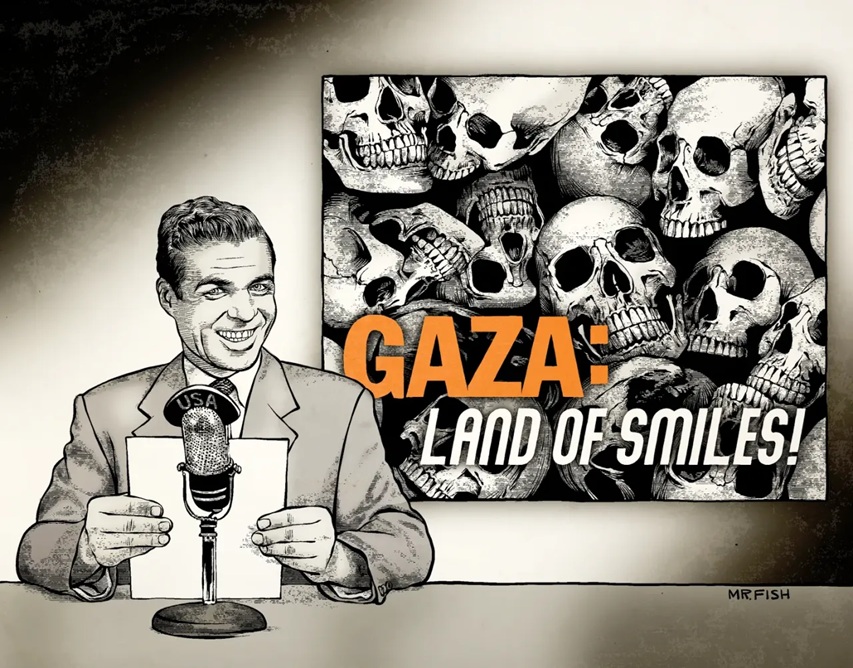
Joy to the World – by Mr. Fish
Chris Hedges ScheerPost, August 25, 2026, https://scheerpost.com/2026/08/25/how-the-media-sells-genocide/
Western media, by employing double standards, censorship, deceptive language, amplifying Israeli lies and dehumanizing Palestinians, facilitates the genocide in Gaza.
Chris Hedges ScheerPost
The Western media manufactures consent for genocide. It normalizes Israel’s decades-long military occupation and apartheid. It erases Israel’s flagrant violations of international law. It perpetuates the fallacy of Israeli victimhood. It betrays, discredits and demonizes the work of Palestinian journalists and media workers in Gaza, at least 220 of whom have been killed by Israel between Oct. 7, 2023, and August 2025. It supinely accepts draconian Israeli censorship. It acquiesces with tepid letters of protest at Israel’s refusal to allow foreign reporters in Gaza — an effort by Israel to mask its war crimes. It amplifies Israeli lies, from beheaded babies to widespread sexual assault of Israeli women on Oct. 7, to obfuscate the truth.
When writing about Gaza, verbs are in the passive tense. There is no subject. No one is accountable. Genocide, it seems, is an act of God. No different from an earthquake or tsunami. Clichés and opaque adjectives such as the “cycle of violence” or “clashes” distort and falsify reality.
“If thought corrupts language, language can also corrupt thought,” George Orwell warned.
Terms such as “genocide,” “atrocity,” “ethnic cleansing” and “occupied territories” magically disappear from media reports on Palestinians, whose resistance is routinely described as “savage” and “barbaric.” New York Times reporters are instructed by editors to avoid terms such as “Palestine,” “genocide,” “carnage,” “refugee camp,” “slaughter” and “massacre,” when referencing Palestinians.
The media slavishly regurgitates what Israel feeds it. Saturation bombing becomes “surgical air strikes.” Israel’s weaponization of famine becomes a “food shortage.” The killing of unarmed civilians — including children — becomes “clashes.” The hilltop fortress-like compounds of Jewish colonists becomes “neighborhoods.” Extrajudicial assassination of a journalist or a doctor becomes “died.”
Genocide, referred to as the “Israel-Hamas war” is justified as “self-defense,” part of the mantra of Israel’s “right to defend itself.” When schools, hospitals, clinics, ambulances, mosques, churches and other civilian targets are obliterated, they are labeled “Hamas command centers” or targeted because Hamas is “using civilians as human shields” — something Israel does routinely, when the army binds detained Palestinians and forces them to enter potentially booby-trapped buildings and tunnels ahead of Israeli troops.
When Israelis are held by Hamas, they are “hostages,” even if they serve in the military. When Palestinians — including children — are held without charges or trial and disappeared into Israeli detention centers, where torture is “widespread” and “systematic,” they are “prisoners.”
Missile attacks on tent cities or hospitals are blamed on Palestinian armed groups firing errant rockets. If Israel acknowledges the attacks — which very rarely happens — they are described as a “tragic mistake.”
Civil institutions in Gaza are characterized as “Hamas-run” to cast doubt on the veracity of what they report. The New York Times routinely qualifies announcements from the Gaza Health Ministry by noting it “does not distinguish between civilians and combatants,” masking the slaughter of tens of thousands of civilians.
The result is some of the most convoluted writing in the history of journalism, including the Nov. 5, 2023 New York Times headline that reads: “Explosions Gazans Say Was Airstrike Leaves Many Casualties in Dense Neighborhood.”
“When Middle East Eye journalists Mohamed Salama and Ahmed Abu Aziz, along with Reuters photojournalist Hussam al-Masri, and freelancers Moaz Abu Taha, and Mariam Dagga — who had worked with several media outlets, including the Associated Press — were killed in a “double tap” strike — designed to kill first responders arriving to treat casualties from initial strikes — at Nasser Medical Complex, how did Western news agencies respond?” I asked in my column The Betrayal of Palestinian Journalists.
“Israeli military says strikes on Gaza hospital targeted what it says was a Hamas camera,” the Associated Press reported.
“IDF claims hospital strike was aimed at Hamas camera,” announced CNN.
The camera belonged to Reuters, which said Israel was “fully aware” the news agency was filming from the hospital.
“When Al Jazeera correspondent Anas Al Sharif and three other journalists were killed on Aug. 10 in their media tent near Al Shifa Hospital, how was it reported in the Western press?” I asked.
“Israel Kills Al Jazeera Journalist It Says Was Hamas Leader,” Reuters titled its story, despite the fact al-Sharif was part of a Reuters team that won a 2024 Pulitzer Prize.
The German newspaper Bild, published a front page story headlined: “Terrorist disguised as a journalist killed in Gaza.”
“The linguistic gymnastics employed by the media went as far as redefining words, making them meaningless,” writes Assal Rad in “Don’t Say Palestine: How the Media Manufactured Consent for Genocide:”
‘Mainstream media failed to describe Israel’s repeated breaches of the ceasefire with the language of violation. Instead, the coverage followed the same patterns of rationalizing Israel’s attacks and uncritically parroting Israel’s claims to justify its actions. As Palestinians continued to be killed — during a ‘ceasefire’ — and the flow of aid did not reach the level of need or what was agreed to, Western media framed these flagrant violations as ‘tests’ or ‘challenges’ to a ‘shaky ceasefire.’ As leading human rights organizations like Amnesty International warned that the genocide was, in fact, not over, legacy media continued to frame it as a war with a ‘fragile ceasefire.’
Words matter. Words justify actions. If there is no genocide, if Israel is defending itself in a war, the U.S. and Israel’s European allies have the right to provide tens of billions of dollars in military aid. If this is a war begun by Hamas on Oct. 7 then it is possible to lament the obliteration of Gaza and mass slaughter by Israel as the regrettable result of the Hamas attack.
This corruption of language is designed, as Orwell noted, to defend the indefensible:
“Things like the continuance of British rule in India, the Russian purges and deportations, the dropping of the atom bombs on Japan, can indeed be defended, but only by arguments which are too brutal for most people to face, and which do not square with the professed aims of political parties. Thus political language has to consist largely of euphemism, question-begging and sheer cloudy vagueness. Defenseless villages are bombarded from the air, the inhabitants driven out into the countryside, the cattle machine-gunned, the huts set on fire with incendiary bullets: this is called pacification. Millions of peasants are robbed of their farms and sent trudging along the roads with no more than they can carry: this is called transfer of population or rectification of frontiers. People are imprisoned for years without trial, or shot in the back of the neck or sent to die of scurvy in Arctic lumber camps: this is called elimination of unreliable elements.“
Adam Johnson in “How to Sell a Genocide: The Media’s Complicity in the Destruction of Gaza,” examined over 12,000 articles from The New York Times, The Washington Post, CNN.com, Politico, Axios, USA Today, and The Associated Press, along with 5,000 TV segments aired on CNN and MSNBC. His carefully researched book is a damning indictment of the “liberal” media’s justification of the genocide.“
CNN and The New York Times instructed their editors and journalists that attacks could only be attributed to Israel after confirmation from the IDF and GPS coordinates. Johnson quotes a source at CNN:
Whether it’s in the newsroom or in the field, we couldn’t credit anything to Israel unless we were held to this impossibly high bar of having to call it an “explosion,” until we geolocated the site of the explosion, sent the coordinates to the Israelis and asked them for comment.
You can see an interview with Johnson about his book at The Electronic Intifada here.
CNN journalists reporting on Israel and Palestine must submit their work for review to the network’s Jerusalem bureau prior to airing. The CNN bureau, like all news bureaus in Israel, is required to abide by restrictions imposed by Israeli military censors.
The very few Palestinians who appear on CNN and other legacy media outlets, are routinely asked — usually before they are even permitted on air — if they “condemn” Hamas. Guests who express even tepid criticism of Israel are asked whether Israel “has a right to exist.”
No one is ever asked if they condemn Zionism, apartheid, ethnic cleansing, genocide or Israel’s 100 year war on Palestine. Nor are they asked if the Palestinians have a right to defend themselves — which under international law they do, including with weapons.
Our domesticated journalists and news organizations are, as Robert Fisk pointed out, “prisoners of the language of power.” They dutifully parrot the official lexicon. This makes them not only propagandists, but accomplices to genocide.
Those who protest the genocide, including students on university campuses — many of whom are Jewish — are smeared as “Hamas supporters” and “antisemites.” Journalists ferret out Zionist students, usually found esconced in campus Hillel houses, who claim to be “fearful for their safety,” because of the protests. The media pays little attention to the rise in anti-Muslim bigotry or the repression meted out to student protestors, which includes not only police brutality and 3,000 detainments and arrests, but suspensions, probations, expulsions, withholding of diplomas and the firing of sympathetic faculty.
Slogans which call for Palestinian liberation — including “From the river to the sea, Palestine will be free” — along with the Palestinian flag, have been criminalized.
The message is clear: Jewish lives matter. Palestinian lives do not.
“The reports of UN agencies, of respected human rights monitors, of medical journals, and of professional medical personnel, are generally treated with respect and given prominence in the mainstream media,” writes the historian Rashid Khalidi in the introduction to Robin Anderson’s book, “The Complicit Lens: US Media Coverage of Israel’s Genocide in Gaza:”
“Not in this war: instead, if such sources are cited at all, equal media treatment is given to the outrageous slanders and calumnies against these organizations and individuals, smears that are produced in profusion by Israel’s legion of professional propagandists and its myriad of defenders in the US. Besides smearing critics of Israel’s genocide as supporters of Hamas or terrorist sympathizers, the main weapon in their arsenal of defamation is their systematic and outrageous misuse of the deadly accusation of antisemitism.”
The massive defections of readers and viewers from mainstream media to social media platforms that do not filter news through the Israel lobby, the U.S. government or corporations, are a stark indicator of the media’s bankruptcy. The response to these defections has been “platformicide” — the use of algorithms, shadow banning, restriction of live streaming capabilities and the closing of accounts by social media giants such as Facebook, Instagram, X, YouTube and TikTok, to dramatically reduce the reach of reporting on Palestine.
This censorship is part of a coordinated effort to hide the horror of the genocide from the public.
By constantly referencing Oct. 7, the Western media decontextualizes the genocide. It ignores Israel’s 19-year siege of Gaza. Oct. 7 is characterized in the Western media as “unprovoked.” Israel’s massacres of unarmed Palestinians in Gaza in the winter of 2008 and 2009, along with its attacks on Gaza in 2012, 2014 and during the Great March of Return in 2018 and 2019 are ignored.
The 1948 Nakba — when European Zionists seized more than 78 percent of historic Palestine, violently expelled 750,000 Palestinians, destroyed more than 530 Palestinian villages and killed 15,000 Palestinians — is rarely referenced. Seventy percent of those driven from their homes in 1948 were forced into Gaza.
The Zionist project is predicated on fostering historical amnesia.
“Once Hamas was established as a brutal, terrorist group whose members gleefully tortured, dismembered, and beheaded babies without conscience, no further explanation was needed,” writes Anderson in her book. “The media simply avoided reporting Israel’s history of violence and as a result, establishment media also avoided the conditions of everyday life for Palestinians.”
The fiction that there is currently a ceasefire in Gaza — Israel has killed at least 1,286 Palestinians and injured 4,257 since it supposedly went into effect — has become the excuse used by Western media to turn its back on Gaza. This genocide denial has characterized the coverage since its inception. It masks not only Israel’s crimes, but Israel’s stated intention to ethnically cleanse all Palestinians from Gaza. It effectively neuters international law. And it makes a mockery of the profession of journalism.
When the last act of ethnic cleansing happens, Western media will, I am sure, continue to bombard us with Israeli agitprop, euphemisms and clichés.
It will justify the genocide until the end.
The powerful impact of six haunting minutes
by beyondnuclearinternational, https://beyondnuclearinternational.org/2026/08/03/the-powerful-impact-of-six-haunting-minutes/
A beautifully rendered animation from 1956 is the most effective anti-nuclear war message that hardly anyone has seen, writes Linda Pentz Gunter
Sometimes the most effective way to communicate the evils of nuclear war is also the most infinitely simple.
We have read books and reports and analyses about the horrors of the United States atomic bombing of the Japanese cities of Hiroshima and Nagasaki, on August 6 and 9 respectively.
And we’ve been chilled by the dramatic films On The Beach (1959), Fail Safe (1964), The War Game (1966), The Day After (1983), Testament (1983) and Threads (1984), which depicted the horrors of a nuclear attack. Even US President Reagan was supposedly awoken to the imperative of nuclear disarmament after seeing The Day After. Sadly, he sabotaged those chances in the end by clinging to the ludicrous and ineffective Missile Defense System, nicknamed “Star Wars”
There are fewer nuclear weapons today — just over 12,000 — than during the height of the Cold War when there were more than 64,000, but still enough to destroy the world many times over. And instead of disarming, the major nuclear weapons nations are once again rearming as the world becomes ever more destabilized by wars, climate pressure and the fight for control of resources. Nuclear arsenals in the US, Russia and China are growing larger and more lethal.
But the suicide path our leaders are still taking us on was anticipated well before the feature films and television dramas warning us of the omnicidal outcome of nuclear war; and before the scientist Carl Sagan and colleagues introduced us in 1983 to the concept of nuclear winter, its inevitable aftermath.
Their story, and ours, is to be found in A Short Vision, a film released in 1956. It is six minutes of agonizingly moving and even visually beautiful animation made by a British couple on their kitchen table. The film has all but disappeared from memory and public discourse but is thankfully viewable on YouTube.
A Short Vision was made by Hungarian born artist and painter, Peter Foldes and his British wife Joan with sponsorship funds from the British Film Institute’s Experimental Film Fund. The eerie and frighteningly evocative score was the work of another Hungarian emigre, Matyas Seiber. The narration is by British actor James McKechnie.
It is that haunting music that sets the mood from the moment the film opens, as we see a sinister object flying across the landscape, a dark, silent, menacing shape, almost a precursor to the more modern stealth bomber or the UFOs of science fiction. It is never named by the narrator. Nor is the word “nuclear” ever spoken in the film.
Then we see a leopard pinning a deer. Both look up. “And the deer darted free from the tearing claws, and they both hid in fear,” relates the narrator. The object, referred to only as “it”, flies on. The scene is repeated with an owl and a rat also looking up before the rat, too, is released to flee.
More beautifully drawn images follow, of families sleeping peacefully as the object flies over the nighttime lights of a city. The ordinary citizens are sleeping, but those who could have prevented what’s to come are not. “But their leaders looked up, and their wise men looked up. But it was too late.”
By now we are more than half way through the film, the music has become even more spine-chilling, but we are still waiting in dread and anticipation of what is to come. And then it happens. The giant explosion and conflagration is rendered in hundreds of flickering abstract fragments of reds, oranges and yellows as the object explodes in a massive fireball billowing into a giant mushroom cloud. The faces of the leaders begin to bleed, then peel off and melt away, leaving only skeletons.
Everyone is destroyed — those who saw it, those who didn’t, the leopard, the owl, the rat and the deer.
“When it was all over there was nothing else left but a small flame,” the narrator tells us. We watch the flame flicker, then consume the object itself, now transformed into a small moth. Then it is gone “and the flame died.” The film closes with a black screen and the simple words “THE END”. Which, indeed, it is.
After being shown at the National Film Theatre in January 1956, A Short Vision was reviewed by The Times, which described the film as “a work of sombre imagination.” The headline called the film a “cartoon”, which is how it was generally described, but visually it is closer to art, a reminder of Peter Foldes’ roots as a painter. Indeed, in the same review, The Times said the film was “a series of powerful, static drawings dissolving to show the death and consumption of all living things at the explosion that brings about the end of the world.”
But it was the film’s journey to the United States that marked the most extraordinary chapter in its brief history. On May 27, 1956 it was screened by CBS on a popular prime time variety programme hosted by Ed Sullivan, who described his choice to show the film — seen then in black and white — as “a plea for peace”.
“If you have youngsters in the living room, tell them not to be alarmed at this ‘cause it’s a fantasy, the whole thing is animated,” Sullivan said, as if somehow the fact of it not being live action made it less traumatic viewing.
Instead, the power of the film’s simplicity is what makes it arguably more effective than the longer dramas that followed.
Indeed, a review in the Post-Standard, a Syracuse, New York daily newspaper, said the film “gains power through its very simplicity. Perhaps no other medium could convey the finality of such conflict.” The reviewer added that “It should be shown all over the world, particularly in Russia. It is the best argument for peace at any price that has been presented in a long time.”
Sadly, that imperative is still true (although perhaps without singling out Russia). After its US adventure and brief theatrical release, A Short Vision disappeared into ignominy. Instead, it should be compulsory viewing today, shown in as many venues as possible. Someone should screen it on the walls of the White House and the Kremlin.
The airing on Ed Sullivan’s show engendered such a huge and largely positive response that Sullivan showed the film again on June 10. This time, however, he admonished parents “who have youngsters in your living room, it is a harrowing experience for youngsters, so would you please take them out of the room.” (My husband Paul Gunter, seven at the time, remembers disobeying that command and peeking round the corner. He has never forgotten the film.)
A year after A Short Vision’s debut, the Campaign for Nuclear Disarmament was born and, a year later, in 1958, thousands marched to Aldermaston to protest the Atomic Weapons Research Establishment there. But the arms race continued, escalating to a frightening pitch by the early 1980s.
On June 12, 1982, one million people rallied in Central Park in New York City to demand the abolition of nuclear weapons and an end to the arms race. CND marched again, bringing hundreds of thousands of protesters to Hyde Park in London in 1982 and 1983 with the same demands.
By then, Peter Foldes was dead, as were Seiber and McKechnie. But Joan Foldes, who remarried and moved to France, is still alive. She is 102. The extraordinary and powerful work she did with her husband sadly remains as resonant and important today as it was in 1956. I wonder what she makes of that?
Linda Pentz Gunter is the Executive Director of Beyond Nuclear and writes for and edits Beyond Nuclear International. She is the author of the book, No To Nuclear. Why Nuclear Power Destroys Lives, Derails Climate Progress And Provokes War, published by Pluto Press. Any opinions are her own.
‘Earth’s Greatest Enemy’ Delivers A Penetrating Insight Into The Heart Of Our Dystopia
Caitlin Johnstone, Jul 28, 2026, https://www.caitlinjohnst.one/p/earths-greatest-enemy-delivers-a?utm_source=post-email-title&publication_id=82124&post_id=208773412&utm_campaign=email-post-title&isFreemail=true&r=1ise1&triedRedirect=true&utm_medium=email
There’s a powerful new documentary out called Earth’s Greatest Enemy by Abby Martin about the ecocidal abuses of the US war machine, and it addresses the most pressing existential hurdles we face as a species like nothing I’ve seen before.
The film breaks down how the US military has become the single most environmentally destructive institution on our planet by an extremely massive margin, walking the audience through the many ways the Pentagon and its global metastases have been churning out carbon emissions, pouring toxins into the air and water, wiping out precious ecosystems for gratuitous military bases, and pummeling our sea life with sonar and noise pollution, all while gleefully salivating at the prospect of plundering the resources which lay hidden beneath our planet’s rapidly thawing polar ice caps.
Martin skillfully ties the planet-devouring behavior of the US military to the global systems of capitalism and imperialism it was built to uphold. The viewer is left with a crystal clear picture of the ways ecocide, militarism and capitalism are inseparably intertwined, and an understanding that meaningfully opposing any of these malignancies necessarily entails opposing them all. The liberal fiction that one can be pro-environment while also supporting the US military is forcefully exposed for the absurdity that it is.
It’s a jarring film with extremely dark subject matter, but it also manages to be a work of transcendent beauty and optimism. A deep love of humans and all of earth’s creatures shines through in shot after shot, while slick editing and an inspired soundtrack allow the movie to zip along at a lively and entertaining pace. Martin concludes with a galvanizing call to use our outrage to loosen the empire’s already weakening grip on humanity’s collective consciousness, because our entire world depends on it.
Perhaps the most touching aspect of the documentary is the personal element Martin chose to bring in to her overarching narrative. She discusses how she and her husband (antiwar activist Mike Prysner, who co-directed the film) had their lives forever altered when they had kids and experienced a new level of urgency to help give rise to a brighter future. Their family of four becomes a microcosm of humanity’s struggle to liberate itself from the tyranny of the machine to create a better world for our children, and we see Martin’s love for her son and daughter reflected in a great tenderness for the world as a whole.
Anyway, I’ve never felt inclined to write a film review before so I don’t know if I’ve done a good job of encouraging people to watch this thing, but for my own audience I truly cannot recommend Earth’s Greatest Enemy enough. It’s available streaming on Apple TV, Prime Video, and Watermelon Pictures. Screening tour dates and further information can be found on the Earth’s Greatest Enemy website. Be sure to leave a review on Letterboxed or IMDB if you can.
Book. The Russo-Ukrainian War: Follies of Empire

By Richard Sakwa, 22 July26 https://www.ceris.be/blog/the-russo-ukrainian-war-follies-of-empire/
Overview
The number of casualties in the ongoing Russo-Ukrainian war is rapidly approaching 1.5 million, with no resolution in sight … a staggering reality. Seeking to make what sense is possible of this catastrophic conflict, Richard Sakwa meticulously explores the origins, course, and consequences of the war in the sweeping context of global and domestic politics since 1945.
Sakwa’s balanced analysis centers on what he perceives as the five levels of the conflict: the dynamics of Ukrainian politics, the evolution of Russo-Ukrainian relations, the relationship between Russia and the West, broad changes in international politics, and the prospects for a viable and sustainable peace. In explaining―without endorsing―the logic behind actions on all sides, his goal is to contribute to a path toward that peace.
Reviews
“Sakwa offers a transcendent explanation for how the war in Ukraine fits into a decimated relationship between Russia and what he calls the US-led political West…. Even those who believe that the war grew out of a dance that Russia and the West did together, but that Russia’s choice in February 2022 is indefensible, will find much in the book to ponder and much in Sakwa’s hopes for the war’s outcome and future Russian-West relations to admire.”
— Robert Legvold, Columbia University
“In this deeply researched book, Richard Sakwa displays a balance rare in Anglophone writing on the subject of the Russo-Ukrainian war…. Sakwa’s superb account should be read by all who want to understand the origins of this tragic, unnecessary conflict, and how it might be ended.”
— Robert Skidelsky, University of Warwick
“Sakwa’s analysis advances the most articulated interpretation of the war through the lens of sovereign internationalism. A must-read for all those who want alternative explanations of the broader framework of the conflict, accompanied by detailed analysis of the course and consequences of the war.”
— Marlene Laruelle, George Washington University
Thirteen films that are essential to understanding the nuclear age
Bulletin, By Alex Wellerstein | July 16, 2026
Nuclear films are both reflections of the zeitgeist in which they are made and shapers of it. They feed off of both popular and expert anxieties, while also helping to solidify the terms on which these anxieties are engaged. While some themes are apparently universal (how many ways are there to blunder into nuclear war), some feel very much of their particular time and place…………………………………………………………………………………………..
This list has a strong Anglophone bias, and with a few notable exceptions approaches the topic from largely American points of view. This is a reflection of its author’s limitations and the film’s relative accessibility to an American. Undoubtedly lists could (and should) be created from different cultural and national perspectives. The list is presented chronologically and can be thought of as an unfolding of the nuclear perspective from the early nuclear age to the present.
Godzilla
1954, Toho. Directed by Ishirō Honda. Released in the USA as Godzilla, King of the Monsters, in 1956. Inspired in part by the 1954 Castle Bravo fallout disaster, which killed a Japanese fisherman and led to a boycott on tuna in Japan, Godzilla (Gojira in the Japanese original) is a more complicated film than just “radioactive monster attacks Tokyo.”…………………………….
On the Beach
United Artists, 1959. Directed by Stanley Kramer. The premise of On the Beach, adapted from the 1957 novel by the British author Nevil Shute, is that a future global nuclear war using cobalt bombs has both eradicated most of human civilization and created a massive, deadly cloud of fallout that is gradually circulating the globe, killing all in its path. Those in the southern hemisphere are momentarily safe, but the cloud is coming……………..
Dr. Strangelove or: How I Learned to Stop Worrying and Love the Bomb
1964, Columbia Pictures. Directed by Stanley Kubrick. Stanley Kubrick’s dark comedy about the risk of unauthorized and accidental nuclear war fundamentally altered the lexicon with which we talk about nuclear weapons…………………… . When Daniel Ellsberg, then still at RAND and having just completed a classified study into the command and control problems central to the plot, saw the film in theatres, he was amazed — it was, he wrote later, “essentially, a documentary.”
Fail Safe
1964, Columbia. Directed by Sidney Lumet. Fail Safe might be remembered as the film of mid-1960s nuclear anxiety had it not come out the same year as Dr. Strangelove and overlapped so significantly with its themes………… its management of tension has led to its retrospective status as a critical success.
The China Syndrome
1979, Columbia Pictures. Directed by James Bridges.The sole film specifically about nuclear power on this list, The China Syndrome is a taut thriller that was elevated into something even more by its historical moment. ………………………..The film would work on its own merits, but the fact that the film premiered less than two weeks before the Three Mile Island accident catapulted it to the position of prophecy—for better and for worse.
Barefoot Gen (Hadashi no Gen)
1983, Kyodo Eiga. Directed by Mori Masaki. Barefoot Gen, first a manga (Japanese comic book) published in 1976, is a fictionalized version of writer and illustrator Keiji Nakazawa’s experiences of being a six-year-old boy growing up in Hiroshima before, during, and after the atomic bombing.
The Day After
1983, ABC. Directed by Nicholas Meyer. This classic made-for-television movie about the run-up to nuclear war and its immediate aftermath ……………… The film is sometimes cited as a factor in Reagan’s willingness to initiate talks with the Soviet Union and initiate “the golden era of arms control.”
Testament
Paramount, 1983. Directed by Lynne Littman. Among the crowded field of “the day after nuclear war” films of the early 1980s, Testament stands out for its relative quiet, reasonableness, and lack of sensationalism. ………………………………..
WarGames
1983, MGM. Directed by John Badham. WarGames is simultaneously a very ridiculous film and a very intelligent one. A teenage computer hacker infiltrates a government mainframe that, unbeknownst to him, is actually an advanced supercomputer at NORAD run by a highly capable-but-flawed artificial intelligence. ………………with nuclear war, “the only winning move is not to play.”
Threads
BBC, 1984. Directed by Mick Jackson. Widely regarded as the darkest and most dismal of the “day after” genre,………………………………………………………..
When the Wind Blows
Recorded Releasing, 1986. Directed by Jimmy T. Murakami. This distinctly British animated film, adapted from a 1982 graphic novel of the same name by Raymond Briggs, follows an aging couple living in rural Sussex before, during, and after a nuclear war. Stereotypically British stiff upper lips, enhanced by blundering ignorance, keeps them in largely non-complaining good humor even as the world collapses around them. ………………………….
Oppenheimer
2023, Universal. Directed by Christopher Nolan. There have been several attempts to represent the complicated life of J. Robert Oppenheimer on film. Nolan’s is the most stylized and artistic, and it’s based on the best source material ………………………
A House of Dynamite
2025, Netflix. Directed by Kathryn Bigelow. This recent nuclear thriller depicts the 20 minutes between the detection of an unattributed missile launch heading towards the United States, and its arrival at its target……………….
Honorable mentions
There are many other films one might want to include in such a list. Those that did not make the cut, but came close to it for me, included the suppressed British nuclear aftermath pseudo-documentary The War Game (1966); the ruminative Soviet post-apocalyptic Dead Man’s Letters [Pisma myortvogo cheloveka] (1986); the impending nuclear attack cult-classic Miracle Mile (1988); the Japanese Hiroshima family retrospective Black Rain [Kuroi ame] (1989); the late-Cold War Tom Clancy submarine defection thriller The Hunt for Red October (1990); the Cuban Missile Crisis dramatization Thirteen Days (2000); and the post-Cold War Tom Clancy nuclear terrorism thriller The Sum of All Fears (2002). https://thebulletin.org/premium/2026-07/thirteen-films-that-are-essential-to-understanding-the-nuclear-age/
Walt Zlotow – Chicago Tribune misleads its readership with Bob Kustra’s imaginary commentary ‘What Ronald Reagan would do today for the people of Ukraine’.
Walt Zlotow West Suburban Peace Coalition Glen Ellyn IL, 13 July 26
It’s fitting Tribune commentator Bob Kustra would go all the way back to 1980’s “virulent anti-communist” Ronald Reagan to argue Reagan would have squandered another $175 billion to keep Ukraine destroying itself in America and NATO’s lost proxy war to weaken, isolate Russia from the European economy.
Kustra is clearly locked in virulent 1980’s anti-communist ideology that he’s transferred to non-communist Russia, ignoring 35 years of NATO expansion that doubled NATO membership to keep Russia isolated and fearing NATO’s nukes on its doorsteps. This was after the USSR vanished into the dustbin of history.
Kustra imagines Russia had nothing to fear from adding Ukraine to NATO, a red line of Russian security concern that Russian leader Putin had been warning the US and NATO about since 2007. Kustra has apparently erased the US promoted Ukraine coup in 2014 that toppled Russian leaning Ukraine President Victor Yanukovych, provoking a civil war in the Donbas that killed thousands of Russian leaning Ukrainians there. In Kustra’s worldview, Obama didn’t greenlight the coup, Trump didn’t gift Ukraine with hundreds of millions in weapons to polish off the Donbas separatists. and Biden didn’t ramp up NATO membership to Ukraine and tell Russia it was none of their damn business.
Claiming Reagan would still be arming the collapsing, failed Ukraine state is preposterous. Reagan spending $20 million in black market smuggling networks to inundate Poland with “1eaflets, posters, magazines, newspapers and radio break-ins” is a quantum leap away from funding a war with $175 billion that has near utterly destroyed Ukraine in their lost war the US provoked. As conservative as Reagan was. he was foremost a pragmatist in foreign affairs. He was out of office and battling mental decline when the Soviet Union collapsed in 1991 so everything Kustra offers is conjecture. But Reagan’s record argues strongly he’d never have engaged in the madness Obama, Trump in term one and Biden did to send Ukraine to the scrapheap of nations.
Bob Kustra knows better. So does the Chicago Tribune. Its readership deserves something a tad better than Bob Kustra’s ‘The Russians are coming, The Russians are coming.’
Francesca Albanese: “The World Is Not Sleeping—It Is Looking Away”

Francesca Albanese – by Mr. Fish
July 8, 2026, SCHEERPOST, Joshua Scheer
United Nations Special Rapporteur Francesca Albanese shares stories of the immense suffering in Palestine and laments the gutting of international law in her new book, “When the World Sleeps”.
As the humanitarian catastrophe in Gaza continues and international institutions face mounting questions over their ability—or willingness—to enforce international law, few voices have attracted as much global attention as Francesca Albanese, the United Nations Special Rapporteur on the occupied Palestinian territories. Praised by supporters for her uncompromising investigations and criticized by her opponents with equal intensity, Albanese has become one of the most prominent legal figures documenting allegations of apartheid, occupation, and genocide. In a wide-ranging conversation with Chris Hedges about her new book, When the World Sleeps, Albanese discusses the human stories behind her reporting, the treatment of Palestinian civilians and medical workers, the pressures she says have been brought against her personally, and why she believes the crisis in Gaza represents not only a regional tragedy but a profound test of the international legal order itself.
Throughout the conversation, Albanese also discusses the personal consequences of her work, from financial sanctions and frozen assets to the challenges of publishing her book in the United States. At the heart of the discussion is a question she believes the international community can no longer avoid: whether governments, institutions, and ordinary citizens will continue to remain passive in the face of mounting evidence of suffering—or act before, as her book’s title suggests, the world once again sleeps through another historic injustice.
You should read the full transcript below [on original]—and, even more importantly, the book itself—but one passage that particularly stood out was Albanese’s reflection on where power truly resides, what governments ultimately respond to, and the remarkably small number of people who control an extraordinary share of the world’s wealth. As we move toward what many fear could become an increasingly dystopian future, she argues this is not, as some dismissively claim, a conspiracy theory. It is a reality unfolding in real time.
Francesca Albanese said
“Yeah, I think those who have read the book, and then I’d like also to say a few words about how difficult it’s been to have this book made available to the US readership, because there has been such pressure from pro-Israel support groups against it. You guess why. Yeah, for me, Palestine has been a revealer. It’s not that all of a sudden, we woke up in a world that is dominated by the US, especially the world we are part of politically, militarily, strategically, the US is the dominant character here. And Israel is a sort of extension of it in the Middle East. It’s an extension of Western power and Western supremacy. I know that the Israelis do not like it, but I do also believe that they do not realize how instrumentalized they are because of interests that are above all of us. We tend to think in terms of states as the ultimate decision makers. We think of it in democracies. We think of it in dictatorships. But, in fact, I don’t think that states are the decision makers. States today, more than before, more than a few decades ago, respond to certain interests, economic, military and financial interests that are connected to the main power holders in this world. I mean, and there are numbers. What I’m saying may sound like conspiracy theories to people who might not know enough about the inequality of the world.
The Thomas Piketty Institute in its most recent inequality report mentions this data, which I found shocking, staggering, the fact that half of the world population retains altogether one third of the wealth which is retained by 50,000 people in the world. I repeat, 50,000 people in the world retain three times the wealth retained by half of the world population. How is it possible? Who are these? Clearly, they are not just individuals like you and I. They retain pockets of power. And it’s those connected to the extractive industry for the control of natural resources, those connected to securing the use of force, military power and surveillance, and those connected to financial transactions, corporations and banks and pension funds. So, these are the main powers with certain corporations like pharmaceuticals more influential than others, or those related to tourism for example. However, this is the brain power of those 50,000 people.”
Transcript ………………………………………………………………………………………………………………………………………………………………………………………………………… https://scheerpost.com/2026/07/08/francesca-albanese-the-world-is-not-sleeping-it-is-looking-away/
CNBC Helps SpaceX Pull Off Trillion-Dollar Pump-and-Dump

SpaceX’s public offering has all of the hallmarks of a pump-and-dump scheme, using a “staggered lock-up” schedule that allows insiders to sell off shares much earlier than most other publicly traded firms—enabling them to cash out while the stock is still grossly overvalued. This gambit is also called a “bagholder” scheme, as retail investors are left holding a rapidly depreciating asset.
Wilson Korik, FAIR, July 3, 2026
Elon Musk became—at least temporarily—the world’s first trillionaire on June 12 after his space, telecommunications and AI company SpaceX had the largest initial public offering in history. Initially priced at $135 per share for a valuation around $1.77 trillion, shares opened at $150 and peaked on June 16 at $225.64 (a valuation of nearly $3 trillion). The price spiked after Musk announced, before markets reopened on June 15, that he believes “SpaceX might be able to reach approximately $1T revenue in 2030” (CNBC, 6/15/26).
Since its June 16 peak, however, SpaceX’s share price has fallen, steadily declining until June 22 and settling around $160 since. Markets closed on Thursday, July 2, with a share price of $162.00.
SpaceX’s big slump coincided with a mass tech sell-off last week, prompted by mounting concerns that tech firms cannot generate the returns necessary to pay off the colossal debts financing massive AI infrastructure buildouts, especially as companies are beginning to rein in their spending on AI (404 Media, 6/24/26; TechCrunch, 6/24/26).
That was likely a surprise to viewers of CNBC, whose full-day IPO coverage pumped the stock by inviting sources with vested interests to celebrate Musk’s cult of personality and obfuscate the magical thinking behind the company’s projections.
All in on business-facing Grok
According to its own S-1 filing with the SEC, SpaceX anticipates that its greatest earnings potential does not come from the rocket business for which it is famous, but from selling AI to other businesses. The breathless CNBC discussions entirely omitted the dubious origins of SpaceX’s gargantuan estimate of its maximum potential revenue—a key investor metric known as total addressable market (TAM).
In its S-1 prospectus, SpaceX claims a TAM of $28.5 trillion, larger than the entire GDP of China.
The document separates this figure into SpaceX’s three sectors: space, connectivity and AI. Although the filing argues that space “represents the largest economic frontier in human history,” space makes up just $370 billion, or 1.3%, of SpaceX’s supposed TAM. Meanwhile, AI makes up $26.5 trillion, or 93%, the vast majority of which is for “enterprise applications.”
Enterprise AI is a broad category of business-oriented applications for firms looking to simplify and accelerate workflows, like converting text files into presentation formats, writing and debugging string code, and automating some sales, marketing, HR and IT functions. The most popular AI assistant by far is OpenAI’s ChatGPT, followed by Google’s Google Gemini and Anthropic’s Claude (TechCrunch, 6/16/26).
A closer reading of SpaceX’s S-1 filing reveals that its $22.7 trillion estimate for enterprise AI applications does not actually represent the TAM of the company’s enterprise AI, but is instead an estimate of the size of the entire digital economy—posing a hypothetical wherein xAI’s Grok Business and Grok Enterprise monopolize all digital commerce. It’s worth noting that xAI currently has extremely limited enterprise AI market share, with a March Enterprise Technology Research survey finding that just 7% of respondents use Grok (Wall Street Journal, 5/11/26).
Note also that subscriptions to xAI‘s consumer AI, SuperGrok, on X (labeled “consumer subscriptions” in the chart) alone make up $760 billion, or 2.7% of SpaceX’s TAM. That’s calculated
based on the global population of individuals aged 10 and over in 2025 … multiplied by the weighted average monthly subscription revenue of $12, resulting in an annualized market opportunity of approximately $760 billion.
So if every person on the planet over the age of 9 sends SpaceX $12 every month to use Grok, the X chatbot that spent four days last year calling itself MechaHitler and promoting the Great Replacement Theory, SpaceX will take in $760 billion per year. Sounds like a business plan!
SpaceX’s public offering has all of the hallmarks of a pump-and-dump scheme, using a “staggered lock-up” schedule that allows insiders to sell off shares much earlier than most other publicly traded firms—enabling them to cash out while the stock is still grossly overvalued. This gambit is also called a “bagholder” scheme, as retail investors are left holding a rapidly depreciating asset.
While most IPOs prevent insiders from selling shares for the first 180 days of public trading, SpaceX uses an expedited schedule that allows most insiders to sell much sooner—selling off overvalued shares to retail customers.
While this pump-and-dump began with retail consumers who bought shares on the first day of public trading, these massive wealth transfers are being thrust upon working people whether they like them or not, as Musk successfully negotiated new rules that fast-track SpaceX’s inclusion in major index funds, including the Russell 1000 and NASDAQ funds—transferring rapidly devaluing stock from SpaceX insiders to working people’s retirement accounts.
But none of this was explored on CNBC the day of the SpaceX IPO launch. FAIR could find not a single guest or anchor that mentioned that “Elon Musk’s rocket company” valued the potential for SuperGrok X subscriptions at more than twice the total projected TAM for the space industry, nor that SpaceX’s TAM is based on a scenario in which business-facing Grok controls all e-commerce—and certainly not that the IPO would essentially serve as a massive wealth transfer from retail investors to SpaceX insiders.
‘You should have bought as much as you could’
Instead, in the hours leading up to SpaceX’s first trade, CNBC viewers were primed by Squawk Box co-host Joe Kernen (6/12/26) lamenting that orders were being snatched up by large institutional investors, and hoping that trades would begin at under $300 per share. He assured viewers that, although he’s nervous, “whenever we’ve worried about any of these great tech companies…wherever it was on opening day, you should have bought them as much as you could.”
The rest of the influential three-hour morning program was as much of a commercial for SpaceX as this opening scene. Squawk Box‘s guests included SpaceX COO Gwynne Shotwell (interviewed by Morning Call host Morgan Brennan), Elon Musk biographer Walter Isaacson, long-time Musk investor David George, head of financial technology research at Citizens Bank Devin Ryan, and venture capitalist and investor Ben Narasin.
All but one of these guests have vested interests or are members of Musk’s inner circle, and used their airtime to generate excitement around the stock by focusing on Musk as a visionary key man. Kernen, co-host Andrew Ross Sorkin and guest host Melissa Lee offered no pushback………………………………………………………………………………………………………………………………………………………………………………….
‘A number so large it destroys your credibility’
This isn’t to say that CNBC’s coverage of SpaceX’s IPO was completely without critical perspectives: Squawk on the Street’s David Faber (6/12/26) spent much of his onscreen time grilling insider guests on whether they’ll sell early, and pushing back on vague, aspirational framing around the AI and space industries.
Faber repeatedly reminded his audience that the S-1 prospectus specifically sees most of SpaceX’s potential in enterprise AI. He skeptically took the projected $22.7 trillion TAM for enterprise AI as given, but pointed out that “it’s not clear” how SpaceX’s Grok could compete with other enterprise AI products:
It’s interesting, as much as we talk about SpaceX, as much as we hear Musk talking about space and then Starlink, the real opportunity in terms of addressing this enormous number is actually still the same opportunity that’s being sought after by Anthropic, and OpenAI, and Alphabet and others.
Squawk on the Street also featured the most critical guest by far, NYU business school professor Aswath Damodaran, who came closest to questioning the origin of the TAM of any host or guest on any of the programs:
When I read [the S-1], I thought Grok had written the prospectus, because we know AI is subject to hallucinations…. I don’t know if it’s a banker who wrote it, I would be embarrassed to even put that number out. I mean, it’s a big market. Why do you need to make up a number, a number so large it destroys your credibility?
But even in scrutinizing SpaceX’s prospects, or the true size of the enterprise AI market, Squawk on the Street’s criticism missed the bigger picture: SpaceX’s record-setting IPO is a pump-and-dump, and retail investments provide the exit liquidity for insiders looking to get out of a failing AI company.
Every day, dozens of guests representing various companies advertise their stock on CNBC for retail consumers, who trust the judgment of their favorite program hosts to give completely uncontentious interviews, essentially constituting a series of infomercials, rather than actual financial journalism. FAIR (3/18/09, 2/3/20) has criticized CNBC on this basis for decades.
So when CNBC invites SpaceX insiders with vested interests to pump the valuation of their stock on the air shortly before dumping it on retail consumers, it seems obvious why even the most critical host cannot alert his viewers to what is really going on: because CNBC’s reporting exists to boost stock, rather than protect consumers. https://fair.org/home/cnbc-helps-spacex-pull-off-trillion-dollar-pump-and-dump/
New York Times Reported Iran Deal From Pro-Israel, Pro-War Perspective

Uncritically parroting Israeli government talking points that frame Israel as the victim is journalistic obfuscation at best
Drew Favakeh, July 1, 2026, https://worldbeyondwar.org/the-pentagons-budget-redirected-would-exceed-our-wildest-dreams/
The New York Times, the US’s most powerful establishment news outlet, has reported on President Donald Trump’s “memorandum of understanding” with Iran from a pro-war and/or pro-Israel perspective. Why did Trump end the war without limiting Iran’s “nuclear program” and its support for “proxy forces,” or without conducting “regime” change? These are the questions that have preoccupied the paper of record’s news reporting.
As I’ve noted before (FAIR.org, 3/30/26), multiple Times employees are reporting from and currently living in Israel, despite Israel’s blanket censorship policies, not to mention its killing hundreds of journalists. Meanwhile, the paper has no reporters in Iran, a situation it blames on Iran’s press restrictions.
This editorial decision has no doubt contributed to the paper covering the memorandum from an Israeli perspective, which is not aligned with the 59% of the US adult population who say the US using military force in Iran was the wrong decision.
‘Frightening new reality’
Over its first article (6/14/26) published about the memorandum, the New York Times headline read, “In Israel, Broad Discontent Even Before Deal’s Details Are Known.” The subhead noted that “Israelis across the political spectrum have said the agreement appears to leave fundamental security threats posed by Iran unaddressed.”
The piece, by Times Jerusalem correspondent Isabel Kershner, uncritically granted anonymity to an “Israeli who had been briefed on the deal with Iran” to “discuss diplomacy.” They listed their “main problems” with the proposal: “no clear answers regarding the treatment of Iran’s stockpile of enriched uranium, and not enough curbs on Iran’s nuclear program,” no “conditions for the collapse of the Iranian government” and “no clear mechanism for forcing Iran to halt its support for its proxy forces.”
One day later, the Times (6/15/26) published an article headlined “Israel Counts the Ways That Netanyahu’s Iran Strategy Failed.” Times Jerusalem bureau chief David M. Halbfinger and Tel Aviv staff writer Ronen Bergman noted that the agreement “omits some of the most important things Israel wanted.”
These “important things” included “to curb Iran’s ballistic missile arsenal” and “its funding of regional proxies like Hezbollah in Lebanon and the Houthis in Yemen, who have attacked Israel with their own arsenals.” The deal “could help Iran bolster those proxies by easing sanctions, which would allow billions of dollars to flow into its bank accounts,” Halbfinger and Bergman added.
‘Catastrophic capitulation’
Three days later, Halbfinger published an article (6/18/26) headlined “Israel, Stunned by Trump’s Iran Deal, Sees It as a ‘Catastrophic Capitulation.’”
This time, Halbfinger wrote that:
Israel awoke to a frightening new reality on Thursday as it absorbed, with disbelief and largely in silence, the terms of President Trump’s preliminary agreement to end the war with Iran.
Halbfinger noted that “it accomplishes none of Israel’s war aims, analysts and officials said, and arguably leaves the country in worse shape on each of them.” Among those aims? “Regime change,” “ballistic missiles and proxy militias” and “Iran’s nuclear program,” listed Halbfinger.
Uncritically parroting Israeli government talking points that frame Israel as the victim is journalistic obfuscation at best: Israel privately lobbied to assassinate Iran’s lead negotiator and to “restart the war with a new round of strikes targeting the country’s oil infrastructure” (Capital and Empire, 5/28/26), and it insists it has the right to continue ethnically cleansing Lebanon.
One of the biggest challenges of his career’
One week after her first article about the memorandum was published, the Times’ Kershner wrote another article (6/21/26) headlined “Netanyahu Faces One of the Biggest Challenges of His Career.”
Her thesis was that Netanyahu “is fighting for his political survival” due to “the emergence of a peace deal that Israel is not a party to.” Kershner wrote that Netanyahu “has staked his career on preventing Iran from developing nuclear weapons, which Israel views as an existential threat.”
Kershner, like Halbfinger and Bergman, ignored the fact that Iran has upheld its promise not to build a nuclear weapon (Arms Control Association, 2/25). By contrast, Israel—not Iran—is the only country in the Middle East to possess nuclear weapons, and the US remains the only country to ever use a nuclear weapon in war.
Kershner wrote:
The agreement seeks to curtail Israel’s freedom of action in Lebanon, where the Israeli military has been fighting Hezbollah, the Iran-backed proxy militia on its doorstep. The deal makes no mention of curbing Iran’s ballistic missiles, which Iran has used to attack Israel and US Gulf allies during the wars. And it leaves the nuclear issue to be addressed in further negotiations.
Framing Israel’s killing of more than 4,100 people in Lebanon and displacement of 1.2 million since March (Drop Site News, 6/22/26), as “Israel’s freedom of action” insinuates that Israel is entitled to occupation and ethnic cleansing. And by noting that Iran has used its ballistic missiles “to attack Israel and US Gulf allies during the wars,” Kershner ignored which two countries attacked the other first, and which country used its ballistic missile arsenal to defend itself against further attacks (PBS, 6/18/26; Middle East Eye, 6/23/26).
‘A let down and reality check’
As for the Iranian perspective, the Times published an article (6/15/26) headlined “Many Iranians Express Relief Over Agreement to End the War.” The subhead read, “After enduring months of conflict, ordinary people in Iran were relieved to hear about the deal. Opposition groups were disappointed.”
The Times’ Farnaz Fassihi noted that:
Iranians expressed a range of emotions over the agreement to end a war that killed thousands across the region and brought enormous loss with no gain for millions of others.
Fassihi quoted just two sources based in Tehran, one of whom she interviewed by telephone, the other by text message. One asked, “What was the point of this war? What did it bring us exactly?” The other asked: “Is this REAL? Are they serious?”
Fassihi added that
for Iranian opposition groups and some members of the diaspora who had hoped the war would topple the Islamic Republic, the agreement was both a let down and a reality check.
Fassihi cited a social media post by Behnam Amini, a “monarchist political activist in Washington who has supported the war against Iran.”
Fassihi also noted:
In Iran, a minority within the hard-line political faction—those who ideologically favor destruction of Israel and war with the US by any means—unleashed fury at Foreign Minister Abbas Araghchi and Gen. Mohammad Bagher Ghalibaf, the lead negotiator and speaker of parliament.
The piece was unable to quote a source that expressed explicit opposition to the US/Israel’s attacks on Iran—which suggests the limitations of the Times’ long-distance approach to covering Iranian opinion.
Edge of Armageddon: why does one of the world’s top thinkers believe we’re nearing nuclear apocalypse?

Putin is so terrified of Ukraine becoming a member of Nato: that would enable the west to place nukes in the country
“With Nato weapons, Ukrainians bombed St Petersburg and they tried to bomb Moscow. So a country with nuclear weapons is being ‘bombed’ by the British. Not the British pushing the button, but the bombs come from Britain, as well as from Germany and France, with less from the US.”
In a chilling new book, theoretical physicist Carlo Rovelli says we’re back on the brink – and this time, leaders chronically lack the nous of Kennedy and Khrushchev. So why is he against rearming?
Stuart Jeffries, Thu 25 Jun 2026, https://www.theguardian.com/books/2026/jun/25/armageddon-physicist-carlo-rovelli-nuclear-apocalypse
Should European members of Nato be rearming in the face of the Russian threat? And if not, I ask Carlo Rovelli, why not? The Italian theoretical physicist seems a good person to answer these questions since his timely new book, 85 Seconds to Midnight, is subtitled A Physicist’s Argument against Rearmament.
Rovelli, 70, brown eyed, genial, with enviably luxuriant grey locks, removes his glasses before answering. “The idea of the Russian military being a threat to Europe is ridiculous. Russia can’t even get to Kyiv! A few years ago, Russia had 4% of the world’s military spending and Nato had 40%.”
At the same time, though, Russia has more than 4,000 nuclear warheads, making it the planet’s biggest stockpiler. “So we cannot take Russia down,” says Rovelli, “because it would react.” Of the three nuclear superpowers – Russia, US and China – only China has resolved not to be a first-use nuclear state. Russia, like the US, reserves the right to respond to conventional attacks with nuclear strikes.
The real problem, Rovelli suggests, is mutual fear. “We are trapped in a lack of reciprocal trust. We sleepwalk through these patterns of everybody becoming more armed, more aggressive.” He cites what happened a few weeks ago in St Petersburg. “With Nato weapons, Ukrainians bombed St Petersburg and they tried to bomb Moscow. So a country with nuclear weapons is being ‘bombed’ by the British. Not the British pushing the button, but the bombs come from Britain, as well as from Germany and France, with less from the US.”
Why was this so frightening for Rovelli? “It’s the first time a [superpower] with nuclear weapons has been actually bombed. There was a situation in which if you have nuclear weapons, you don’t get invaded. You don’t get bombed. No more.”
Rovelli invites me to consider what that bombing looks like from the Kremlin’s perspective. Moscow has long feared western aggression, he argues. A key moment came in 1962 when Americans placed nuclear missiles in Turkey. That, he argues, prompted then Soviet premier Khrushchev to put nuclear weapons in Cuba, the US’s back yard.
True, the Cuban missile crisis was de-escalated by Khrushchev and US president Kennedy, but Russian fear of western invasion persists. That’s why, Rovelli suggests, Putin is so terrified of Ukraine becoming a member of Nato: that would enable the west to place nukes in the country. Hence, Rovelli argues, Putin embarking on his full-blown invasion four years ago.
Rovelli believes this Russian aggression has caused a whirlwind of fears and clamours for rearmament in western Europe. “You have the French government saying French people should be ready again to sacrifice their children; the British government saying we should be ready for war because it might happen; the German government saying all this anti-war sentiment in schools is not good and we should change education, make war more acceptable. This is motivated by the idea that Russia is invading Europe. It’s nonsense.”
But isn’t it sometimes right to be fearful? Indeed, isn’t the lesson of the second world war that western European countries should have rearmed sooner to counter a demagogue bent on expansion? “I think everybody should read Mein Kampf,” he replies, referring to Adolf Hitler’s 1925 autobiography and manifesto. “Mein Kampf does not say, ‘We are German, we are the strongest, we are going to run the world, we are great, we are white, we are Aryans, whatever.’ It says, ‘We are weak. And the only way we have to survive is to become stronger and overcome the others.’ So what fuelled the violence of nazism was fear.”
Today’s Middle Eastern conflict has a similar basis, Rovelli contends. “What fuels the aggressiveness of Israel is fear. What fuels the aggressiveness of Hamas is fear. They are going to destroy us in Gaza unless we are aggressive. To answer fear with fear, to escalate, seems to me disgusting.”
But isn’t this naive? Putin isn’t just acting out of fear, surely, but is prompted by some warped sense of historical destiny to claim Ukraine. “That’s obviously nonsense. You create these narratives that fuel tribal ideology. And that’s exactly what we don’t want. I don’t think anybody has any natural historical right to anything.”
Why should we listen to what theoretical physicists have to say about rearmament? Yes, Rovelli is the go-to guy to explain loop gravity, the theoretical framework that merges quantum mechanics with Einstein’s general theory of relativity. He is also a great populariser of difficult ideas in such books as Seven Brief Lessons on Physics and The Order of Time. But when it comes to war and realpolitik, theoretical physicists have often proved themselves utter boobs.
“We physicists,” Rovelli concedes, “did create this thing [nuclear weapons]. It is our poisoned gift to humankind. But historically, the voices of scientists – raising awareness about the nuclear risk – have been effective.” It was thanks to the wisdom of scientists and other intellectuals, he argues, that Gorbachev and Reagan were convinced to sign the now defunct 1991 Strategic Arms Reduction Treaty (Start).
Equally true, though, is that theoretical physicists have been disastrous for humanity. Rovelli cites his countryman Enrico Fermi who in 1934 found a way to shatter atomic nuclei – giving humanity a new source of energy. “But the gift is too great,” writes Rovelli. “A small bit of uranium can release energy to demolish cities, burn alive millions of human beings and destroy civilisation itself.”
Consider too what happened in Copenhagen in 1941 when two great theoretical physicists, the Dane Niels Bohr and the German Werner Heisenberg, met. Bohr, who soon after the meeting was spirited to the US, came away from the meeting convinced that Nazi Germany was making a nuclear bomb to win the war.
Rovelli takes up the story: “Once in the US, Bohr said, ‘Look, this is a sketch given to me by Heisenberg of an atomic bomb.’ And it was definitely not. It was a sketch of a peaceful nuclear reactor. One of the outcomes of that was that the Manhattan Project was motivated by a belief that Nazi Germany was close to having nuclear bombs, which was completely unfounded.”
The unintended consequence, as Rovelli puts it in his book, was “the burning alive of 200,000 men, women and children in Hiroshima and Nagasaki”. Not, as some have argued, to end the war more quickly but as an immense demonstration of US power – or as he puts it: “The scream of the gorilla beating its chest and telling the forest that it is the strongest.”
Surely there were other and possibly better rationales to dropping nuclear weapons on Japan than that? I remind Rovelli of a conversation at Princeton he had with his friend and mentor, the late relativity theorist John Wheeler, who worked on the Manhattan Project. Wheeler believed bombing Hiroshima and Nagasaki was justified to spare the enormous number of American lives that would be lost in a mainland invasion.
“John was one of the people I admire most, and half of my thinking is based on what he did,” recalls Rovelli with a sad chuckle. “He was the one who first recognised my work.” But when Wheeler invited the young Rovelli to Princeton, the pair fell to talking about Hiroshima and Nagasaki. “I found the argument he used – it’s OK to kill many hundreds of thousands of Japanese civilians to save the lives of a few American boys – disgusting. Not a few American boys in America living a life – but sent there to conquer an island which is not American. Japan had already lost the war.”
Rovelli’s early years help explain his revulsion for rearmament. He was jailed as a student for refusing the draft in Italy. “I’m Italian and we remember fascism grew with the idea that war is beautiful. War is what makes us great. War is fantastic.”
Let’s talk about Iran, I suggest. Isn’t it entitled to have nuclear weapons if Israel and the US do? “I don’t think we should think in terms of absolute right,” says Rovelli. “We have to live together, so we have to find compromises. If Iran did not feel under threat, it probably wouldn’t feel the need to go nuclear.”
The title of Rovelli’s book comes from the 2026 edition of the Bulletin of Atomic Scientists that set the Doomsday Clock at 85 seconds to midnight, the closest we’ve ever been to nuclear catastrophe. For Rovelli, the stupidity of our leaders has increased that risk. He thinks that everybody – from Trump, Putin and Netanyahu to the leaders of Nato and Iran – lacks the good sense shown by Khrushchev, Kennedy, Gorbachev and Reagan each of whom, he believes, helped pull humanity back from Armageddon.
As we finish, Rovelli asks me: “What politician has the courage to say, ‘Rather than making my own country stronger, I want to make humankind better’?’” Perhaps it’s not just my shortcomings but the nature of humanity’s plight in 2026 that no one comes to mind.
85 Seconds to Midnight by Carlo Rovelli is published by Penguin (£9.99). To order your copy, go to guardianbookshop.com. Delivery charges may apply.
Google’s New AI-Fueled Search Bar Threatens to Further Upend Journalism Industry

publishers are being sold the idea that they can cut costs by replacing staff with AI
The irony is that the misinformation and deepfakes created by AI make the need for journalists more urgent than ever.
Independent journalism needs a lifeline to survive as Google urges readers toward AI summaries instead of article links.
Who can a reader hold accountable if a Google AI summary is incorrect?
By Negin Owliaei , Maya Schenwar , Ziggy West Jeffery , Truthout, June 9, 2026, https://truthout.org/articles/googles-new-ai-fueled-search-bar-threatens-to-further-upend-journalism-industry/?utm_source=campaign_email&utm_campaign=061826pm
Google made an announcement last month that could turn the journalism world upside down, accelerating the internet’s shift toward an overwhelmingly AI-driven landscape and serving the Trump agenda of media suppression.
At its developer conference in May, the company announced the most disruptive changes to Google Search in over 25 years. Google Search will further demote its index of the web — a list of links that information-seekers can explore as they choose. Instead of prominently displaying links, it will increasingly become a destination that answers questions directly through AI, linking only to the sources it decides to reference in its overview.
On the majority of our tests, the AI overview was followed by a heavy block of sponsored results and a combination of videos, short clips, trending posts, and discussions. Index links — for example, to articles on news sites and research studies — were given only a small fraction of real estate. Additionally, Google is aggressively pushing readers to use AI Mode, which completely removes the index links.
In practical terms, this means users of the world’s largest search engine will see, in response to their queries, a summary generated by an AI bot developed by a corporate behemoth with close ties to the Trump White House.
This seismic move builds upon the launches of AI Overview in 2024 and AI Mode in 2025, shifting toward nearly eliminating the user’s ability to search autonomously, and toward an overwhelmingly AI-driven experience of the internet (and therefore, for many people, of life).
We must take into account the political context in which this shift transpires. Alphabet (Google’s parent company), along with Facebook’s parent company (Meta), as well as Amazon, Apple, Microsoft, and Nvidia, were among major tech companies that donated to President Donald Trump’s inauguration. They have also consistently capitulated to Trump’s recent manipulations.
Last fall, Alphabet’s subsidiary YouTube agreed to a $24.5 million settlement in a lawsuit stemming from the platform’s suspension of Trump’s YouTube channel. The majority of the settlement will go toward Trump’s now-infamous White House ballroom. Meta, similarly, agreed to a $25 million settlement in 2025. $22 million of that sum was designated to go to Trump’s presidential library.
Meta, like Google, has long been making moves that have severely destabilized the news industry. Facebook CEO Mark Zuckerberg decided in 2018 that the platform would prioritize showing Facebook users posts made by their friends and dramatically reduce their ability to see posts made by news organizations that they had chosen to follow. In other words, due to a single algorithm change, the more than 758,000 people who had at the time eagerly signed up to receive links to all of Truthout’s articles in their Facebook feeds suddenly stopped seeing the majority of our posts.
This caused a major drop in traffic across the board to news sites, many of which had been persistently encouraged by Facebook to grow their brands on the platform. At Truthout, over 90 percent of our traffic from Facebook disappeared, which decreased our overall traffic by 40 percent and, consequently, the donations we rely on to survive.
Chaotic changes at Twitter also played a role in destabilizing the journalism ecosystem. In 2022, when Elon Musk finalized his takeover of that platform, the move quickly turned the social media site into a cesspool of far right trolls, disinformation, and bot-generated content. This toxicity and disinformation spiral forced many people on the left to leave X, which decreased traffic to progressive websites from the platform.
Over the course of these changes, news organizations like ours have struggled to respond to corresponding significant declines in readership and revenue, along with our readers’ understandable loss of trust in the social media platforms and search engines that initially allowed us to grow. Sudden algorithmic changes, news deprioritization, and increased implementation of AI summaries are shaking the economic foundation of journalism itself. Meanwhile, publishers are being sold the idea that they can cut costs by replacing staff with AI.
The connections to the Trump agenda aren’t hard to see. Trump has been an outspoken critic of news organizations, particularly those that are left-leaning and critical of his administration. Facebook and Google are suppressing journalism on their platforms and weakening news organizations’ ability to hold Trump to account, while also donating to Trump and settling multimillion-dollar lawsuits in his favor.
Whether Facebook and Google are capitulating to Trump due to fear of economic retribution, shared politics, or a desire to increase their stock prices or keep up with technology, the impact is devastating for journalism and democracy.
AI Is Eroding Journalism — and Obscuring Truth
We’ve already seen some corporate publishers try to jump on the AI bandwagon, arguing that AI will come for our costly but necessary industry one way or another. They frame AI as a way to solve journalism’s most intractable problem: the cost of reporting. But in reality, they’re proposing a vision of journalism resembling content without the journalists — just regurgitated slop of varying accuracy.
Take one high-profile example from last year: Just two months after the Chicago Sun-Times laid off 20 percent of its staff, the paper issued an AI-generated summer reading list sourced from a third-party company. One key problem: Several of the books on the list didn’t actually exist. Some outlets are going so far as to create AI-generated “writers,” complete with fake names and photos, to author their AI-generated articles. And in one notable case, an AI news initiative meant to provide more information in areas with limited access to local news was scrapped after it repeatedly plagiarized the local journalists actually doing that work.
The irony is that the misinformation and deepfakes created by AI make the need for journalists more urgent than ever. For example, during the height of the war on Iran, we watched AI-generated fakery wreak havoc on the sphere of public information. And it should come as no surprise that Grok, Elon Musk’s AI chatbot most known for spewing racist hate and distributing child sexual abuse material, further spread inaccuracies when users called upon it for help with fact checking. Right now, those of us who are real human journalists are still able to act as a bulwark against AI-introduced errors. What happens when we’re taken out of the mix?
These inaccuracies are perhaps one of the reasons why people are reluctant to get their news from AI chatbots in the first place. Make no mistake — these changes are being forced upon an unwilling public. Fewer than 1 percent of Americans say they prefer getting their news from chatbots, compared to other news sources, a recent Pew Research survey found. For people who do use chatbots for news, roughly a third of them say they have a hard time determining what’s actually true, and about half say they see news from chatbots that they think is inaccurate.
They are right to be skeptical. A recent study from the AI research company Forum AI found that the answers that top AI chatbots provided on questions about elections were riddled with errors; more than one-third of responses included fact errors of some type. Oftentimes those errors sounded incredibly precise, the research found, giving an undeserved air of confidence to factual inaccuracies. Those chatbots also regularly pulled from commercial sources in their summaries — even using websites like firearm retailer Ammo.com to answer questions about gun control, the researchers discovered.
Trusted news outlets have policies for issuing corrections and clarifications. Publications like ours maintain policies and avenues for offering such corrections and feedback. Who can a reader hold accountable if a Google AI summary is incorrect? Matched with the likelihood of factual errors, the lack of accountability has terrifying implications.
On a deeper level, the hyperindividualization of chatbots also poses some bleak questions about the escalating fragmentation of our shared sense of reality. For years, we’ve heard media critics sound the alarm about how social media has helped false information travel far further at much quicker speeds. Additionally, Big Tech companies, understanding that their bottom line requires eyeballs to stay on their platforms as long as possible, designed the algorithms that feed us information to be as addictive as possible by sticking us in echo chambers.
Now AI could atomize us all even further. Study after study has shown that AI chatbots are sycophantic, offering users excessive praise and telling them what they want to hear. And the timing — ahead of a high-stakes election, at a moment when trust in media is at new lows, and in a period where the future of journalism itself is at risk — could not be worse.
An Existential Threat to Journalism
As the Google Search changes take their toll, we will very likely see a new round of cost-saving measures at longstanding newsrooms. These steps will likely include massive layoffs and downsizing, more aggressively invasive revenue generation tactics, mergers, consolidation and closures. It will be harder for existing news sites to continue publishing and nearly impossible for new newsrooms to reach a large enough audience to become financially viable.
Read more: Google’s New AI-Fueled Search Bar Threatens to Further Upend Journalism IndustryOrganizations like Truthout — ones that depend on community-building and audience growth to sustain their work — will be among the most impacted.
For 25 years, Truthout has survived by publishing impactful investigative journalism and analysis; distributing full editions 365 days a year; and building a community of readers who support us with small, hard-earned donations.
Eighty percent of our $3 million yearly budget comes from small donors alone. Of those, 8,000 readers support us with monthly donations. Back in 2018, when Facebook decided to suppress the circulation of posts made by organizations, thereby cutting readers off from seeing many articles shared by the news organizations they had intentionally decided to follow, Truthout’s total traffic declined by 40 percent, as nearly all of our traffic from that platform disappeared.
The consequences of the impending changes to Google’s search engine promise to be even more explosive. Google Search is our single largest source of traffic; it’s the route by which 27 percent of our readers find us. And visitors who find us via Google Search are more likely to stay for longer, engage with our work, and donate than those who find us through social media.
If even half of that 27 percent disappears, it will have a devastating impact on our journalism.
Truthout is just one example; journalism organizations across the field will be devastatingly affected by Google’s new move, just as they were impacted by Meta’s abrupt algorithmic shift. The entire journalism ecosystem will shoulder this blow, particularly independent publishers and news sites that depend on traffic and aren’t bankrolled by large corporations.
How Do We Resist?
The sudden shift in Google Search presents us with a pointed question, not only about journalism, but about the future of humanity: How much of our autonomy will we cede to AI? To what extent will we adopt an “oh well!” mentality? Or will we seek creative ways to resist, even when it may feel impossible to confront the largest corporations on the planet?
We cannot allow ourselves to become mired in the trap of inevitability-based thinking.
When grappling with questions around the future of AI, it’s helpful to remind ourselves of how the people — yes, actual humans — are relating to all this. The truth is, most people in the United States are concerned about AI. In fact, in a deeply divided country, AI is something of a uniting cause. A significant majority of Americans rate the “societal risks” of AI as high, with majorities worried that AI will disrupt human connection and inhibit creativity. People in this country are overwhelmingly more worried than excited about how AI has become enmeshed in everyday life. Meanwhile, across political lines, most people in the U.S. oppose the building of data centers in their communities. This is a mobilizable base.
Why should an entirely AI-driven future be inevitable, when most people don’t really want one? Instead of assuming the die is cast, let’s imagine a world in which the onslaught of AI threats is fuel for a broad-based movement.
This movement isn’t just aspirational: It’s already begun. Some of the most hopeful organizing in recent years can be seen in local fights against data centers. Communities are pushing back against corporate giants like Blackstone, BlackRock, and xAI. And from Arizona to New York to Wisconsin and beyond, they’re often winning. According to Data Center Watch, in 2025, local opposition efforts prevented or stalled dozens of data centers, totaling around $156 billion in investment funds.
Meanwhile, we can all respond to Google’s shift toward AI with concrete steps to support independent media and reject the “inevitability” assumption.
Instead of jumping to social media or a search engine for our news, let’s return to visiting news websites directly. Each of us can maintain a list of trusted publications to visit each day. Bookmark your favorites, and return to them. Sign up for email newsletters from your trusted publications, and create filters so that those newsletters arrive in your primary inbox instead of in spam or “promotions.” Subscribe to print publications. Commit to simply reading the news.
Double down on media literacy, practicing discernment and critical thinking as you read and watch the news. In a time when mammoth corporations are attempting to literally tell us what to believe, these commitments are acts of rebellion.
Additionally, since Google Search’s overwhelming prioritization of AI will severely impact revenue for many publications, it’s time to support independent journalism with your money as well as your readership. If you can afford to give, do so, at any level. Without material support from readers and viewers, many independent journalism organizations will fall by the wayside amid the AI onslaught.
For foundations and major donors, there’s a clear mandate here: It’s time to fund our journalism organizations while we experiment and determine new ways of expanding our audiences and driving traffic. We need room to try things — to test out strategies to map an online world beyond Google.
Funding these experiments doesn’t just help one organization or even one sector: As journalism organizations figure out new methods to reach readers, we can share those strategies with other groups, expanding the potential for grassroots groups, unions, and more to connect with human beings in a manner not dictated by the whims of giant corporations’ platforms.
Truthful journalism is an essential public good, and as Google and Meta wage algorithmic warfare against it, it’s essential to protect it. Foundations, donors, and folks connected with money should prioritize journalism alongside other urgent issues, recognizing that trustworthy information is a bulwark against rising fascism.
Finally, we must all adopt a resistance mindset in relation to AI’s slippery slope. Each day, we have an opportunity to choose another way. Resist inevitability. Resist inertia.
Our ability to access facts — and to discern truth from disinformation — is at stake. How will we fight back?
Western Media Normalize Ethnic Cleansing of Lebanon by Viewing It Through Israel’s Eyes
Belén Fernández, FAIR, 11 June 26
In October 2024, one year into Israel’s genocidal war on the Gaza Strip and attendant assault on Lebanon, the Israeli army did a thing. It invited journalists from major Western corporate media outlets on an incursion into Lebanon’s ravaged south, accompanied by Israeli military personnel who would interpret the wreckage in Israel’s favor—not that the Western media have ever required much assistance in this regard.
Reporters from the New York Times, Washington Post, Associated Press, Reuters, BBC, Fox News and a handful of other special guests signed up for the cross-border sortie. It was, as Habib Battah and Christina Cavalcanti note in an investigation for the Public Source (8/27/25), an “awkward hybrid between a traditional embed and the kind of all-expense-paid publicity trip that journalists refer to as junkets, freebies and dog-and-pony shows.”
Never mind that it is entirely illegal for journalists or anyone else to enter Lebanon from Israel—what’s one more illegal invasion from a country that has been invading Lebanon pretty much since its founding? As Battah and Cavalcanti emphasize, these media professionals were also embedding themselves “within a national project of extraordinary transnational violence,” hosted by an “extrajudicial occupying military power—a critical point that all of them would fail to mention in their coverage.”
The Israelis certainly hit the jackpot with the coverage, as reporters excitedly discovered boots and helmets allegedly belonging to Hezbollah—clear proof that the group had been plotting a nefarious attack on Israel. New York Times Jerusalem correspondent Isabel Kershner, an old pro at conducting preemptive journalistic strikes on Lebanon, did not disappoint with her dispatch (10/13/24), “Just Over the Border From Israel, a Hezbollah Cache of Explosives and Mines.”
And in report after embedded report, Israel’s chosen journalists faithfully transmitted the tiresome and counter-logical notion that Hezbollah was somehow the aggressor in the arrangement—as opposed to the army that was busily slaughtering thousands of people in Lebanon while implementing a scorched-earth strategy.
‘Urgent evacuation warnings’
While the October 2024 embed was one of the more preposterous embodiments of Western corporate media’s special relationship with Israel, outlets continue to do a fine job of sanitizing Israeli brutality even when their reporters are not physically viewing the region from inside an Israeli armored vehicle. Since March of this year, Israel has killed at least 3,613 people in Lebanon and displaced 1.2 million, obliterating entire villages and otherwise expanding the ecocidal policy honed in the Gaza Strip.
There has been no remotely comparable destruction on the Israeli side, and a recent Reuters article (5/31/26) that had attempted to suggest some symmetry now comes with the preface: “This May 31 story has been corrected to remove a reference to tens of thousands of Israelis being displaced by Hezbollah fire, in paragraph 3.”
Like in Gaza, where genocide proceeds apace in spite of a declared ceasefire (FAIR.org, 10/21/25), the media tend to report “ceasefires” in Lebanon without caring to highlight the fact that it’s not a ceasefire when Israel is still pummeling the country and massacring people, all the while setting the stage for a massive land grab with its creeping so-called “evacuation orders.” These “evacuations” have been focused on the Shiite demographic, with Israel warning Christian and Druze communities not to allow Shiite neighbors to take refuge in their towns (New York Times, 4/1/26).
Lebanese journalist Habib Battah, co-author of the aforementioned Public Source investigation, suggested to me that such orders might be more accurately termed “ethnic cleansing directives.” But that, of course, would be way too much for corporate media outlets to handle—and so it is that we learn about Israel’s “urgent evacuation warnings” and “large-scale evacuation orders,” as though it’s some sort of public service announcement, fire drill or other fundamentally legitimate Israeli undertaking, rather than entirely illegal in addition to downright psychopathic. From a legal and moral perspective, after all, you can’t just go around ordering people in other countries out of their homes, oftentimes only to bomb them when they comply.
Then there’s the matter of the “Yellow Line” or “security zone”—more terminology borrowed from Gaza (FAIR.org, 5/19/26)—which denotes the portion of south Lebanon that Israel is currently illegally occupying. But Israel has never been very good at staying within the lines, and its latest “evacuation orders” spanned no less than one-fifth of the entire country, far beyond its own unilaterally appointed Yellow Line.
As Battah remarked to me, the media’s acceptance and deployment of such arbitrary vocabulary creates “artificial structures” and a sense of orderliness, when in reality “there’s no yellow lines, there’s no yellow, there’s no colors—these are just illegal invasions.” And because media are committed to sanitizing Israel’s behavior rather than questioning it, “colonization becomes normalized.”
‘A warning to residents’
The eagerness of journalists to do Israel’s bidding is all the more confounding given that Israel is currently the No. 1 killer of journalists in the world. A recent Associated Press article (5/29/26), for example, reduced the pulverization of Lebanon to simply “ongoing fighting in southern Lebanon between Israeli troops and Hezbollah fighters.”
A June 4 Reuters writeup blamed Hezbollah for having “rejected” the latest US-mediated “ceasefire” plan—which, mind you, would basically have given Israel the green light to seize south Lebanon outright. Reuters refrained from referencing the thousands of Lebanese casualties since March, but did allow Israel the usual space to defend its depredations: “The Israeli military, in a warning to residents of the south, said it was continuing to target Hezbollah facilities.”
This is not to say that corporate media do not report on the destruction, displacement and killing in Lebanon; they do—and sometimes even sympathetically. But the refusal to paint a consistent and properly contextualized picture of what is actually going on in the country means that they mostly just end up legitimizing Israel’s war crimes…………………………………………………………………………………….. https://fair.org/home/western-media-normalize-ethnic-cleansing-of-lebanon-by-viewing-it-through-israels-eyes/
How Pete Hegseth turned the Pentagon into a Black Box

Australia’s security commitments are structurally bound to US military decision-making through ANZUS. When the Pentagon conducts a forty-day air campaign against a nation with nuclear ambitions, Australian governments are implicated – through intelligence sharing, basing arrangements, consultation and alliance obligations – whether they say so publicly or not.
And they’re making those commitments based on whatever Washington chooses to share. The same information architecture that’s been deliberately degraded for the American press is the one feeding into allied capitals.
10 June 2026 AIMN Editorial, https://theaimn.net/how-pete-hegseth-turned-the-pentagon-into-a-black-box/
Pete Hegseth has a word for journalists who ask inconvenient questions about America’s war with Iran. Pharisees. He said it in a speech. Out loud. Seemingly proud of it.
That tells you almost everything you need to know about how Operation Epic Fury has been covered – or rather, hasn’t been.
What a wartime press blackout actually looks like
The United States is at war. But the Pentagon has forced journalists out of the building, making it harder than ever for the press to report on what’s happening. Press conferences are rare. Hegseth takes questions only from friendly outlets. No mainstream news organisations have reporters embedded with US military units in the Middle East. Pentagon sources are increasingly reluctant to talk to journalists for fear of retaliation from the administration.
That’s not conjecture. That’s the Columbia Journalism Review, published June 2026, describing conditions during an active military campaign that has killed at least thirteen American service members and reshaped the security architecture of the entire Middle East.
“The United States public hasn’t experienced this lack of official wartime information since World War II.”
Think about that for a second. Not since before television. Not since before the satellite phone. Not since before the internet existed. This is where we are.
The Iraq comparison should embarrass everyone
Critics of embedded journalism in 2003 had a point. Reporters living with military units, dependent on them for food, transport and protection, were never going to produce the most sceptical coverage. Fair enough. In 2003, the Pentagon embedded more than 500 journalists with US and coalition forces in Iraq, with several contemporary and later accounts putting the number around 600.
Six hundred. During Epic Fury: zero.
Here’s what’s genuinely perverse about that comparison. The embedded programme in Iraq was criticised at the time as sophisticated Pentagon propaganda – reporters co-opted by proximity, producing coverage that soft-pedalled civilian casualties and framed the invasion as clean. And that criticism had merit.
But even that – even the propaganda model – was more transparent than what Hegseth has imposed. When the thing that was once attacked as government spin looks like press freedom by comparison, you’ve reached a new floor. You’ve gone somewhere underneath the floor.
The playbook, step by step
Hegseth has taken a series of escalating steps to curtail the work of the press inside the Pentagon: booting legacy press outlets from their workspaces inside the building, closing the press briefing room to reporters, and restricting reporters from going into wide swaths of the building without a government escort.
The Pentagon then demanded that journalists pledge not to use any unauthorised material – including unclassified information. Hegseth put it plainly: “The ‘press’ does not run the Pentagon – the people do.”
The people. Filtered exclusively through Pete Hegseth’s pre-approved briefings and Sean Parnell’s press releases.
When the New York Times sued – and won – the response was almost comedic in its brazenness. On March 20, 2026, U.S. District Judge Paul Friedman ruled that portions of the new guidelines violated the First and Fifth Amendments and mandated that the Pentagon restore press credentials to seven Times journalists. Three days after the ruling, Parnell announced that the Defence Department would move journalists from their designated offices into a separate annex and mandate escorts – framing the changes as necessary security measures.
Court says you broke the Constitution. You wait seventy-two hours. Then you just do a version of the same thing with different language.
What you’re actually being told instead
Hegseth declared an “overwhelming victory” in the war against Iran, claiming the regime had “begged” for a ceasefire after Tehran’s missile programme was completely obliterated. “By any measure, Epic Fury decimated Iran’s military and rendered it combat-ineffective for years to come,” he said.
He also urged reporters to “get it right”: “You wouldn’t know it if you listened to the dishonest, anti-Trump media. These cameras – they have a choice. You’re either informing the American people of the truth or you’re not.”
The truth. As determined by the man who banned reporters from the building where the truth lives.
Maybe those strike figures are accurate. Maybe 80% of Iran’s air defences really were destroyed. Maybe the ceasefire really did represent a total Iranian capitulation. I genuinely don’t know – and that’s the point. Nobody outside the administration does either, because the people whose job is to verify those claims have been systematically removed from any position where verification is possible.
Why this matters beyond America’s borders
Here’s something that rarely gets said in coverage of Hegseth’s media crackdown. This isn’t only an American problem.
Australia’s security commitments are structurally bound to US military decision-making through ANZUS. When the Pentagon conducts a forty-day air campaign against a nation with nuclear ambitions, Australian governments are implicated – through intelligence sharing, basing arrangements, consultation and alliance obligations – whether they say so publicly or not.
And they’re making those commitments based on whatever Washington chooses to share. The same information architecture that’s been deliberately degraded for the American press is the one feeding into allied capitals.
When the Pentagon operates as a black box, it isn’t just American voters flying blind. It’s everyone tied to American military power – which, in the Indo-Pacific, is most of us.
The real scandal
The most disturbing thing about Hegseth’s press suppression isn’t the suppression itself. It’s that it worked. No mass public revolt. No serious congressional investigation. A court ruling that was circumvented within three days and barely registered in the news cycle.
History will eventually produce an account of what actually happened during Operation Epic Fury – what was hit, what was missed, what the real casualty numbers were, what the strategic consequences turn out to be.
When it does, the question worth asking won’t just be what Hegseth hid. It’ll be why so few people demanded to know in real time.
Hassan El Biali is a political analyst and writer specialising in US foreign policy, international security, and Middle East geopolitics. Published in Independent Australia and Counterfire. Substack: megam226.substack.com
Media’s Ceasefire Fiction Masks Continuing War

SCHEERPOST, June 7, 2026, Joshua Scheer
One of the most revealing aspects of this war has not only been the violence itself, but the language used to explain, justify, or obscure it. As the death toll has climbed and entire communities have been erased, many journalists have struggled to confront a disturbing reality: narratives that would be unthinkable in other conflicts have become routine when discussing Gaza.
Veteran journalist Kathy Gannon reflects on how certain assumptions and talking points have seeped into media coverage, often shifting attention away from those carrying out the destruction and onto those enduring it. Her observation is less about a single comment than a broader pattern—one that raises uncomfortable questions about how suffering is framed, whose voices are amplified, and how language can become a tool for sanitizing mass violence.
“A media colleague described devastated Gazans as “under the boot of Hamas,” not under the horrific bombing of Israel, or the devastating attacks that have wiped out entire families, denied food and medical supplies, subjected to enforced starvation, all by Israel. I wondered at what it could mean. It was as if it was offered, as the reason or to somehow soften Israel’s killing of Gazans by the tens of thousands, 20,000 children killed, journalists targeted, hospitals destroyed, schools devastated. Of course there are still those in the media who say Israel isn’t targeting journalists, but rather it is just not paying enough attention, just not being careful enough. Really? Israel has killed more journalists than any other country, according to the Committee to Protect Journalists, nearly 300 have been killed, scores listed as targeted.”
Kathy Gannon Substack
What Kathy Gannon lays out is what far too many newsrooms still refuse to say plainly: there is no cease-fire when Israel continues killing civilians, journalists, and entire families in Gaza and Lebanon with total impunity. Calling this a “fragile cease-fire” is not reporting — it’s participating in a lie.
Since the so‑called Gaza cease-fire was announced, Israel has killed more than 1,000 Palestinians, many of them children. It has expanded the “yellow line”, shot civilians near it — including children — and continued bombing neighborhoods where displaced families were told to shelter. These are not “violations.” This is policy.
In Lebanon, Israel has bulldozed villages, bombed civilian areas, and assassinated three senior Lebanese military officers in a targeted strike. That alone shatters any pretense of a cease-fire. And yet Western media still repeats the script.
Meanwhile, the death toll of journalists is staggering: nearly 300 journalists killed, according to the Committee to Protect Journalists — the highest number ever recorded in a single conflict. Many were targeted, not caught in crossfire. To pretend otherwise is to launder the killing of the very people documenting the war.
Israel’s own officials flaunt this brutality. National Security Minister Itamar Ben‑Gvir — a man who has openly advocated genocide — posted video of himself abusing flotilla activists protesting the slaughter in Gaza. This is the level of impunity we’re dealing with.
International law is not ambiguous. The Fourth Geneva Convention prohibits transferring settlers into occupied territory. UN Security Council Resolution 2334 declares Israeli settlements a “flagrant violation.” Yet media outlets still describe illegal settlers as merely “seen by many as illegal,” as if the law were a matter of opinion.
Hospitals, schools, and refugee camps have been bombed in Gaza — and now in Lebanon. Israel claimed Gaza’s hospitals were targeted because of tunnels. What’s the excuse for the hospitals in Lebanon?
This is why Gannon’s warning matters: the more the world normalizes Israel’s actions, the more it signals to Palestinians and Lebanese that their lives do not matter. And the more Western governments expose their own hypocrisy — preaching human rights while enabling mass killing.
If journalism means anything, it must start with refusing to repeat government talking points. Stop calling this a cease-fire. Stop sanitizing the killing of children. Stop pretending journalists aren’t being targeted. Stop turning victims into perpetrators.
We have watched journalists be killed in staggering numbers, and the refusal of empire’s defenders to even acknowledge their deaths is not only unacceptable — it is the predictable rot of a country drifting toward tyranny, where legacy media long ago bartered away its soul.
This is not fragile. This is not complicated. This is not a cease-fire. It is a war on civilians — and the world is watching, even if CBS pretends not to.
Read more here about press freedom and Israel — though it omits the daily, mounting murders of women and children under the ongoing genocide……………………………………………………………….https://scheerpost.com/2026/06/07/medias-ceasefire-fiction-masks-continuing-war/
1 This Month
23-25 October – on Zoom – World BEYOND War’s annual global conferenc


Shut down the radiation-damaged Heysham nuclear reactors now
To see nuclear-related stories in greater depth and intensity – go to https://nuclearinformation.wordpress.com

Say No to NASA’s Reckless Nuclear Reactor on the Moon
Say No to NASA’s Reckless Nuclear Reactor on the Moon

-
Archives
- October 2026 (247)
- September 2026 (339)
- August 2026 (330)
- July 2026 (355)
- June 2026 (287)
- May 2026 (306)
- April 2026 (356)
- March 2026 (251)
- February 2026 (267)
- January 2026 (308)
- December 2025 (358)
- November 2025 (359)
-
Categories
- 1
- 1 NUCLEAR ISSUES
- business and costs
- climate change
- culture and arts
- ENERGY
- environment
- health
- history
- indigenous issues
- Legal
- marketing of nuclear
- media
- opposition to nuclear
- PERSONAL STORIES
- politics
- politics international
- Religion and ethics
- safety
- secrets,lies and civil liberties
- spinbuster
- technology
- Uranium
- wastes
- weapons and war
- Women
- 2 WORLD
- ACTION
- AFRICA
- Atrocities
- AUSTRALIA
- Christina's notes
- Christina's themes
- culture and arts
- Events
- Fuk 2022
- Fuk 2023
- Fukushima 2017
- Fukushima 2018
- fukushima 2019
- Fukushima 2020
- Fukushima 2021
- general
- global warming
- Humour (God we need it)
- Nuclear
- RARE EARTHS
- Reference
- resources – print
- Resources -audiovicual
- Weekly Newsletter
- World
- World Nuclear
- YouTube
-
RSS
Entries RSS
Comments RSS

