The threat of catastrophe is assessed in Nuclear Armageddon: How Close Are We? — review
Ft.com, 19 Jan 24,
BBC documentary surveys experts in international security, diplomacy and military science to shed light on current reality
………………………………….. Nuclear Armageddon: How Close Are We?, a BBC documentary tied to the Doomsday Clock update, asks why the hands have ominously ticked to within 90 seconds of a catastrophic “midnight”, the shortest time recorded since the clock’s inception in 1947. The title strikes an alarmist tone but the show itself is built on the reporting of journalist and filmmaker Jane Corbin and insightful interviews with experts in international security, diplomacy and military science. They include a Nobel Prize winner and a physicist who has been given rare access to North Korea’s nuclear facilities……………………………………………….
Please use the sharing tools found via the share button at the top or side of articles. Copying articles to share with others is a breach of FT.comT&Cs and Copyright Policy. Email licensing@ft.com to buy additional rights. Subscribers may share up to 10 or 20 articles per month using the gift article service. More information can be found here.
https://www.ft.com/content/64d5c035-b1de-480a-95d6-06ce7b07b9ae
The documentary is balanced and informative yet it can only scratch the surface in a single hour. A longer runtime would have left room for a more thorough analysis of how the conflict in the Middle East could shape Iran’s uncertain nuclear future, and what the re-election of a man accused of keeping classified domestic documents in the bathroom of his private residence might mean for the US and the world. As Bronson notes at one point, all it takes are careless “accidents and misperceptions” to plunge us into midnight darkness. https://www.ft.com/content/64d5c035-b1de-480a-95d6-06ce7b07b9ae
Cancelling the Journalist: The Australian ABC’s Coverage of the Israel-Gaza War
- January 18, 2024, by: Dr Binoy Kampmark, https://theaimn.com/cancelling-the-journalist-the-abcs-coverage-of-the-israel-gaza-war/#
What a cowardly act it was. A national broadcaster, dedicated to what should be fearless reporting, cowed by the intemperate bellyaching of a lobby concerned about coverage of the Israel-Gaza war. The investigation by The Age newspaper was revealing in showing that the dismissal of broadcaster Antoinette Lattouf last December 20 was the nasty fruit of a campaign waged against the corporation’s management. This included its chair, Ita Buttrose, and managing director David Anderson.
The official reason for that dismissal was disturbingly ordinary. Lattouf had not, for instance, decided to become a flag-swathed bomb thrower for the Palestinian cause. She had engaged in no hostage taking campaign, nor intimidated any Israeli figure. The sacking had purportedly been made over sharing a post by Human Rights Watch about Israel that mentioned “using starvation of civilians as a weapon of war in Gaza”, calling it “a war crime”. It also noted the express intention by Israeli officials to pursue this strategy. Actions are also documented: the deliberate blocking of the delivery of food, water and fuel “while wilfully obstructing the entry of aid.” The sharing by Lattouf took place following a direction not to post on “matters of controversy”.
Human Rights Watch might be accused of many things: the dolled up corporate face of human rights activism; the activist transformed into fundraising agent and boardroom gaming strategist. But to share material from the organisation on alleged abuses is hardly a daredevil act of dangerous hair-raising radicalism.
Prior to the revelations in The Age, much had been made of Lattouf’s fill-in role as a radio presenter, a stint that was to last for five shows. The Australian, true to form, had its own issue with Lattouf’s statements made on various online platforms. In December, the paper found it strange that she was appointed “despite her very public anti-Israel stance” (paywalled). She was also accused of denying the lurid interpretations put upon footage from protests outside Sydney Opera House, some of which called for gassing Jews. And she dared accused the Israeli forces of committing rape.
It was also considered odd that she discuss such matters as food and water shortages in Gaza and “an advertising campaign showing corpses reminiscent of being wrapped in Muslim burial cloths.” That “left ‘a lot of people really upset’.” If war is hell, then Lattouf was evidently not allowed to go into quite so much detail about it – at least when concerning the fate of Palestinians at the hands of the Israeli war machine.
What also transpires is that the ABC managers were not merely targeting Lattouf on their own, sadistic initiative. Pressure of some measure had been exercised from outside the organisation. According to The Age, WhatsApp messages had been sent to the ABC as part of a coordinated campaign by a group called Lawyers for Israel.
The day Lattouf was sacked, Sydney property lawyer Nicky Stein buzzingly began proceedings by telling members of the group to contact the federal minister for communication asking “how Antoinette is hosting the morning ABC Sydney show.” Employing Lattouff apparently breached Clause 4 of the ABC code of practice on impartiality.
Stein cockily went on to insist that, “It’s important ABC hears from not just individuals in the community but specifically from lawyers so they feel there is an actual legal threat.” She goes on to read that a “proper” rather than “generic” response was expected “by COB [close of business] today or I would look to engage senior counsel.”
-ADVERTISEMENT-
Did such windy threats have any basis? No, according to Stein. “I know there is probably no actionable offence against the ABC but I didn’t say I would be taking one – just investigating one. I have said that they should be terminating her employment immediately.” Utterly charming, and sufficiently so to attract attention from the ABC chairperson herself, who asked for further venting of concerns.
Indeed, another member of the haranguing clique, Robert Goot, also deputy president of the Executive Council of Australian Jewry, could boast of information he had received that Lattouf would be “gone from morning radio from Friday” because of her anti-Israeli stance.
There has been something of a journalistic exodus from the ABC of late. Nour Haydar, an Australian journalist also of Lebanese descent, resigned expressing her concerns about the coverage of the Israel-Gaza conflict at the broadcaster. There had been, for instance, the creation of a “Gaza advisory panel” at the behest of ABC News director Justin Stevens, ostensibly to improve the coverage of the conflict. “Accuracy and impartiality are core to the service we offer audiences,” Stevens explained to staff. “We must stay independent and not ‘take sides’.”
This pointless assertion can only ever be a threat because it acts as an injunction on staff and a judgment against sources that do not favour the accepted line, however credible they might be. What proves acceptable, a condition that seems to have paralysed the ABC, is to never say that Israel massacres, commits war crimes, and brings about conditions approximating to genocide. Little wonder that coverage on South Africa’s genocide case against Israel in the International Court of Justice does not get top billing on in the ABC news headlines.
Palestinians and Palestinian militias, on the other hand, can always be written about as brute savages, rapists and baby slayers. Throw in fanaticism and Islam, and you have the complete package ready for transmission. Coverage in the mainstays of most Western liberal democracies of the Israeli-Palestinian conflict, as the late Robert Fisk pointed out with pungency, repeatedly asserts these divisions.
After her signation Haydar told the Sydney Morning Herald that, “Commitment to diversity in the media cannot be skin deep. Culturally diverse staff should be respected and supported even when they challenge the status quo.” But Haydar’s argument about cultural diversity should not obscure the broader problem facing the ABC: policing the way opinions and material on war and any other divisive topic is shared. The issue goes less to cultural diversity than permitted intellectual breadth, which is distinctly narrowing at the national broadcaster.
Lattouf, for her part, is pursuing remedies through the Fair Work Commission, and seeking funding through a GoFundMe page, steered by Lauren Dubois. “We stand with Antoinette and support the rights of workers to be able to share news that expresses an opinion or reinforces a fact, without fear of retribution.”
Kenneth Roth, former head of Human Rights Watch, expressed his displeasure at the treatment of Lattouf for sharing HRW material, suggesting the ABC had erred. ABC’s senior management, through a statement from managing director David Anderson, preferred the route of craven denial, rejecting “any claim that it has been influenced by any external pressure, whether it be an advocacy group or lobby group, a political party, or commercial entity.” They would, wouldn’t they?
Screams without proof: questions for NYT about shoddy ‘Hamas mass rape’ report
The public now knows that many Israeli noncombatants were killed by their country’s military on October 7. They know this largely thanks to the work of The Grayzone and other independent outlets. We were initially attacked for our work, but now Israeli media is demanding answers as well. Major legacy media organizations like yours continue to ignore serious political scandals like these while pursuing factually-challenged, shamefully unethical journalistic efforts aimed at legitimizing the Israeli government’s public relations objectives.
Haaretz reported on January 4, “The police are having difficulty locating victims of sexual assault from the Hamas attack, or people who witnessed such attacks, and decided to appeal to the public to encourage those who have information on the matter to come forward and give testimony. Even in the few cases in which the organization collected testimony about sexual offenses committed on October 7, it failed to connect the acts with the victims who were harmed by them.”
Were you aware, as The Grayzone documented, that Landau’s previous claims of having seen beheaded babies and a fetus cut from a dead woman’s womb on October 7 have been discredited not only by the Israeli newspaper by Haaretz, but by the Biden White House, which retracted the president’s claim that he had seen photographs of beheaded babies? In fact, only one baby is recorded among those killed on October 7, which means any claim to have seen multiple dead babies must be dismissed out of hand.
MAX BLUMENTHAL AND AARON MATÉ·JANUARY 10, 2024, https://thegrayzone.com/2024/01/10/questions-nyt-hamas-rape-report/—
After dismantling a New York Times front page feature alleging “a broader pattern of gender-based violence on Oct. 7” by Hamas, The Grayzone is demanding answers of the paper for its journalistic malpractice.
The following was submitted to New York Times editors and lead author, Jeffrey Gettleman.
The Grayzone has identified serious issues with the credibility of key sources quoted in the New York Times’ December 28 story, “Screams Without Words: How Hamas Weaponized Sexual Violence on October 7.” Authored by Jeffrey Gettleman, Anat Schwartz, and Adam Sella, the article purports to prove “a broader pattern of gender-based violence on Oct. 7” than even Israeli authorities have been willing to allege . However, the Times report is marred by sensationalism, wild leaps of logic, and an absence of concrete evidence to support its sweeping conclusion.
The Times has come under fire from family members of Gal Abdush, the so-called “girl in the black dress” who features as Exhibit A in Gettleman and company’s attempt to demonstrate a pattern of rape by Hamas on October 7. Not only have Abdush’s sister and brother-in-law each denied that she was raped, the former has accused the Times of manipulating her family into participating by misleading them about their editorial angle. Though the family’s comments have sparked a major uproar on social media, the Times has yet to address the serious breach of journalistic integrity that its staff is accused of committing.
The Israeli police have also issued a statement since the publication of the Times’ article asserting that they themselves are unable to locate eyewitnesses of rape on October 7, or to connect the testimonies published by outlets like the Times with anything remotely resembling evidence.
We call on the New York Times to publicly address the comments by the Abdush family accusing Times reporters of misleading them and lying about the circumstances of her death. The Times must also address the statement issued by Israel’s police subsequent to the article’s publication and explain why Gettleman and his co-authors apparently omitted it.
Further, we demand a response to our thoroughly sourced debunking of testimony by key witnesses quoted in the story, as well as the documented record of discredited claims and ethically dubious activity by those same witnesses.
We have provided several questions for your consideration. If you are unable to furnish responses which satisfactorily address the issues we have raised about the credibility of your article, we believe it must be retracted in full.
Family of “the girl in the black dress” accuses NYT of having “invented” rape claim
Continue readingMainstream media covers up Israeli calls to drive two million Palestinians into permanent exile
The mainstream U.S. media is almost totally ignoring incendiary statements by powerful Israeli officials who say openly they want to push Palestinians out of Gaza forever.
BY JAMES NORTH https://mondoweiss.net/2024/01/mainstream-media-covers-up-israeli-calls-to-drive-two-million-palestinians-into-permanent-exile/
Stephanie Nolen, now at the New York Times, is a veteran and excellent overseas reporter. She’s spent many years working in South Asia, Latin America and Africa. Her book 28 Stories of AIDS in Africa is a superb look at how that pandemic devastated large swaths of the continent.
So when you see that the Times is running not one but two of her articles on “looming starvation in Gaza,” you have hopes that some important truths are about to be revealed.
But you would be largely disappointed. Nolen does explain that Palestinians in Gaza are going hungry, and one of her reports goes into painful detail about the actual physical impact of severe malnutrition: she notes, for instance, that “children often fail first.”
But nowhere does she report clearly that plenty of people, both in Israel and elsewhere, charge that Israel’s policy is part of a deliberate campaign of ethnic cleansing, designed to force many of the 2 million Gazans to actually leave their homeland permanently, just as Palestinians were displaced in 1948 and 1967. Nolen’s failure is actually characteristic of the mainstream U.S. media, which is almost totally ignoring incendiary statements by powerful Israeli officials who say openly they want to push Palestinians out of Gaza forever.
(If you read between the lines in one of Nolen’s reports, you can guess what happened behind the scenes at the New York Times. She briefly outlines the “possible starvation,” but then lets an Israeli military spokesman jump in, right at paragraph 7, to “vigorously deny allegations that it is responsible for the shortage of food in Gaza.” He gets six paragraphs to lie and obfuscate, even claiming that “there is a sufficient amount of food in Gaza,” before she can even get back to the real story. There’s no proof, but you can bet that anxious editors butted in and made her add that long section.)
Mainstream media failure extends beyond Stephanie Nolen. This site has long explained that the Times, and other mainstream media, protect Israel by covering up the far-right Jewish supremacists who have been gaining even more power there in recent years. The whitewash should be even harder to maintain now, because Benjamin Netanyahu depends on the extremists, who are now actually in his government, to stay in power, and they certainly don’t keep quiet about their true views.
Here’s a recent, astonishing example of how the Times tried to hide the Jewish supremacists in the attic. The January 5 headline was: “As Pressure Mounts, Israeli Minister Proposes Plan for Postwar Gaza.” You think you are finally going to see a long report on the calls for ethnic cleansing from Itamar Ben-Gvir, the national security minister, and Bezalel Smotrich, the finance minister.
No such luck. The “Israeli Minister” in the Times headline is actually Yoav Gallant, who has the defense portfolio, and his “plan” is marginally less inhumane: it makes no mention of ethnic cleansing and calls for a “multinational task force” to eventually oversee Gaza. You have to read down to paragraph 6 to find the super extremists quoted. (In a cunning twist, the paper says Ben-Gvir’s views came in a “Facebook post,” insinuating that his opinions are offhand, and actually have little weight.) The Times article successfully diluted Ben-Gvir and Smotrich by sticking them in below Gallant. In fact, the defense minister has no political following; by contrast, Ben-Gvir and Smotrich are key elements of the ruling coalition. Without them, Netanyahu’s government will fall; he will lose a new election; and he will probably go on trial.
One of the paper’s opinion columnists, the excellent Michelle Goldberg, did partly salvage its reputation with a strong article on January 5. Her first sentence got straight to the point:
Two far-right members of Israel’s cabinet — the national security minister, Itamar Ben-Gvir, and the finance minister, Bezalel Smotrich — caused an international uproar this week with their calls to depopulate Gaza.
Goldberg, who is based in New York, found her way to the truth better than Times reporters who are prowling around on the ground in Israel/Palestine. She heard the “international uproar” that her colleagues somehow missed.
Other mainstream outlets are even worse than the Times. So far, the Washington Post hasn’t mentioned Ben-Gvir and Smotrich at all. National Public Radio has named the two in passing but never quoted their calls to push Gazans out of Gaza permanently.
The two have never appeared on CNN either. This comprehensive failure by the mainstream is actually astonishing. Ben-Gvir and Smotrich love the limelight and would certainly sing like canaries on TV. They are Israeli versions of Matt Goetz or Marjorie Taylor Greene — except that they are not outside gadflies anymore, but two of the most powerful figures inside the government.
Reporters without shame: Top ‘media rights’ organization ignores rampant killings of Gaza journalists

Eva Bartlett, RT, Sun, 07 Jan 2024
At the end of 2023, Reporters Without Borders (Reporters sans Frontieres, RSF), the international organization ostensibly advocating for freedom of information, released its annual report. The paper massively downplays the widespread and deliberate targeting of Palestinian journalists in the Israel-Gaza war.
The report’s announcement, titled, “Round-up: 45 journalists killed in the line of duty worldwide – a drop despite the tragedy in Gaza,” excludes most of the Palestinian journalists killed by Israel in 2023, particularly in the past few months. It claims 16 fewer journalists were killed worldwide in 2023 than in 2022. This doesn’t reflect reality.
The report claims that (as of December 1, 2023), only 13 Palestinian journalists were killed while actively reporting, noting separately that 56 journalists were killed in Gaza, “if we include journalists killed in circumstances unproven to be related to their duties.”
Other sources put the overall number of Palestinian journalists killed in the enclave much higher. The UN’s Office for the Coordination of Humanitarian Affairs (OCHA) reported on December 1 that 73 journalists and media workers had been killed, citing to the Palestinian Journalists’ Syndicate (PJS).
While The Committee to Protect Journalists’ (CPJ) December 20, 2023 numbers are lower (at least 61 Palestinian journalists killed since October 7), CPJ at least didn’t disregard dozens of slain Palestinian journalists like RSF did.
In fact, in contrast to RSF’s cheerful “things are much better for journalists than previous years” tone, CPJ emphasized that in the first 10 weeks of Israel’s war on Gaza, “more journalists have been killed than have ever been killed in a single country over an entire year.” It voiced its concern about, “an apparent pattern of targeting of journalists and their families by the Israeli military.”
It isn’t clear how RSF discerns which circumstances were “unproven to be related” to the duties of slain Gazan journalists, nor who is “actively reporting” when Gaza is under relentless Israeli bombardment and suffers frequent internet cuts. In fact, given the nonstop Israeli bombing (and sniping) throughout the strip, it would be nearly impossible to discern whether journalists were reporting (including from their homes) at the time of their death.
However, in the methodology section near the end of its more detailed report, RSF notes it “logs a journalist’s death in its press freedom barometer when they are killed in the exercise of their duties or in connection with their status as a journalist.”
Many Palestinian journalists in Gaza have received death threats from officers in the Israeli army precisely due to their status as journalists. And many of those threatened have subsequently been killed, along with family members, when Israeli airstrikes targeted their homes or places of shelter.
We also have the precedent in prior wars (in 2009, 2012, 2014, and 2021) of Israel bombing Gazan media buildings (including one I was in in 2009) with varying severity, damaging and finally destroying two major media buildings in 2021. This is clearly intended to stop the flow of reports from Gaza under Israeli bombs, and so is the killing of journalists.
On December 15, the Palestinian Journalists’ Syndicate criticized the RSF report, going as far as accusing RSF of complicity with Israel’s war crimes against Palestinian journalists through whitewashing.
This is the same PJS whose statistics the UN’s OCHA cites, statistics which PJS says are “accurate and based on professional and legal documentation that follows the highest standards in documenting crimes against journalists.” This documentation includes journalists who Israeli airstrikes targeted in their homes, killed precisely because they are journalists.
In response, RSF claimed it, “did not yet have sufficient evidence or indications,” to state that any more than 14 journalists in the Gaza Strip (as of December 23, the date of its response) “had been killed in the course of their work or because of it.”…………………………………………………………………………………………………………..
Israel threatens journalists, kills family members
Many Gaza journalists report being threatened by the Israeli army. CPJ noted it is “deeply alarmed by the pattern of journalists in Gaza reporting receiving threats, and subsequently, their family members being killed.”
One such incident followed a threat to Al-Jazeera Arabic reporter Anas Al-Sharif. CPJ noted he had received multiple phone calls from officers in the Israeli army instructing him to cease coverage and leave northern Gaza. Additionally, he received voice notes on WhatsApp disclosing his location. His 90-year-old father was killed on December 11 by an Israeli airstrike on their home in the Jabalia refugee camp.
On November 13, CPJ noted, “eight family members of photojournalist Yasser Qudih were killed when their house in southern Gaza was struck by four missiles. Qudih survived the attack.”
On October 25, an Israel airstrike on the Nuseirat refugee camp in the center of Gaza killed the wife, son, daughter, and grandson of Al-Jazeera’s bureau chief for Gaza, Wael Al Dahdouh.
The popular young independent journalist, Motaz Azaiza, reported receiving multiple threats from anonymous numbers urging him to cease his coverage, CPJ reported, noting that another Al-Jazeera correspondent, Youmna El-Sayed, said her husband received a threatening phone call from a man who identified himself as a member of the IDF and told the family “to leave or die.”
RSF bias: Not only in Palestine
Whereas RSF only reluctantly, as an afterthought, mentioned Palestinian journalists killed in “circumstances unproven to be related to their duties,” in a 2021 report on Syria, it stated, “at least 300 professional and non-professional journalists have been killed while covering artillery bombardments and airstrikes or murdered by the various parties to the conflict,” since 2011, going on to say, “this figure could in reality be even higher.……………………………………………………………………
In 2017, Stephen Lendman wrote of RSF’s attempt to shut down a panel sponsored by the Swiss Press Club in which British journalist Vanessa Beeley would be participating. “An organization that defends freedom of information is asking me to censor a press conference,” the club’s executive director Guy Mettan said at the time. He refused to cancel the event.
RSF’s 2023 roundup also didn’t include two Russian journalists killed this year, one by a Ukrainian cluster bomb strike and the other by a Ukrainian drone attack (targeting journalists).
Sputnik pursued the matter and reported that RSF, “refused to give any comments to Sputnik” citing “editorial policy.”
Journalist Christelle Neant likewise noted RSF’s glaring omission of the Russian journalists. She wrote about the body’s funding from various governments, and more notably from regime change agencies: the Open Society foundation, The Ford Foundation, and the National Endowment for Democracy, funded by the US Congress.
RSF’s notorious funders explain why it cherry picks or inflates its reports. The borderless organization has lines it won’t cross. It reports a grain of truth but otherwise whitewashes the crimes of Israel and Washington. https://www.rt.com/news/590224-gaza-journalists-israel-killed/
CNN Admits ‘Disturbing’ Israel-Palestine Coverage Policy ‘Has Been in Place for Years’
“It’s Israel’s way of intimidating and controlling news,” said one critic.
Common Dreams, JULIA CONLEY, Jan 05, 2024
CNN has long been criticized by media analysts and journalists for its deference to the Israeli government and the Israel Defense Forces in its coverage of the occupied Palestinian territories, and the cable network admitted Thursday that it follows a protocol that could give Israeli censors influence over its stories.
A spokesperson for the network confirmed to The Intercept that its news coverage about Israel and Palestine is run through and reviewed by the CNN Jerusalem bureau—which is subject to the IDF’s censor.
The censor restricts foreign news outlets from reporting on certain subjects of its choosing and outright censors articles or news segments if they don’t meet its guidelines.
Other news organizations often avoid the censor by reporting certain stories about the region through their news desks outside of Israel, The Intercept reported.
“The policy of running stories about Israel or the Palestinians past the Jerusalem bureau has been in place for years,” the spokesperson told the outlet. “It is simply down to the fact that there are many unique and complex local nuances that warrant extra scrutiny to make sure our reporting is as precise and accurate as possible.”
The spokesperson added that CNN does not share news copy with the censor and called the network’s interactions with the IDF “minimal.”
But James Zogby, founder of the Arab American Institute, said the IDF’s approach to censoring media outlets is “Israel’s way of intimidating and controlling news.”
A CNN staffer who spoke to The Intercept on condition of anonymity confirmed that the network’s longtime relationship with the censor has ensured CNN‘s coverage of Israel’s bombardment of Gaza and attacks in the West Bank since October 7 favors Israel’s narratives.
“Every single Israel-Palestine-related line for reporting must seek approval from the [Jerusalem] bureau—or, when the bureau is not
staffed, from a select few handpicked by the bureau and senior management—from which lines are most often edited with a very specific nuance,” the staffer said.
Jerusalem bureau chief Richard Greene announced it had expanded its review team to include editors outside of Israel, calling the new policy “Jerusalem SecondEyes.” The expanded review process was ostensibly put in place to bring “more expert eyes” to CNN‘s reporting particularly when the Jerusalem news desk is not staffed.
In practice, the staff member told The Intercept, “‘War-crime’ and ‘genocide’ are taboo words. Israeli bombings in Gaza will be reported as ‘blasts’ attributed to nobody, until the Israeli military weighs in to either accept or deny responsibility. Quotes and information provided by Israeli army and government officials tend to be approved quickly, while those from Palestinians tend to be heavily scrutinized and slowly processed.”
Meanwhile, reporters are under intensifying pressure to question anything they learn from Palestinian sources, including casualty statistics from the Palestinian Ministry of Health.
The Ministry of Health is run by Hamas, which controls Gaza’s government. The United Nations agency for Palestinian refugees said in October, as U.S. President Joe Biden was publicly questioning the accuracy of the ministry’s reporting on deaths and injuries, that its casualty statistics have “proven consistently credible in the past.”
Despite this, CNN‘s senior director of news standards and practices, David Lindsey, told journalists in a November 2 memo that “Hamas representatives are engaging in inflammatory rhetoric and propaganda… We should be careful not to give it a platform.”………………………………………….
At least 22,600 people have been confirmed killed in Gaza and 57,910 have been wounded in Israeli attacks on Gaza since October 7. Thousands more are feared dead under the rubble left behind by airstrikes. In Israel, the death toll from Hamas’ attack stands at 1,139.
Jim Naureckas, editor of the watchdog group Fairness and Accuracy In Reporting, noted that the Israeli government is controlling journalists’ reporting on Gaza as it’s been “credibly accused of singling out journalists for violent attacks in order to suppress information.”
“To give that government a heightened role in deciding what is news and what isn’t news is really disturbing,” he told The Intercept.
Meanwhile, pointed out author and academic Sunny Singh, even outside CNN, “every bit of reporting on Gaza in Western media outlets has been given unmerited weight which not granted to Palestinian reporters.”
“Western media—not just CNN—has been pushing Israeli propaganda all through” Israel’s attacks, said Singh. https://www.commondreams.org/news/israel-cnn-censor—
Analysis: Record opposition to climate action by UK’s right-leaning newspapers in 2023
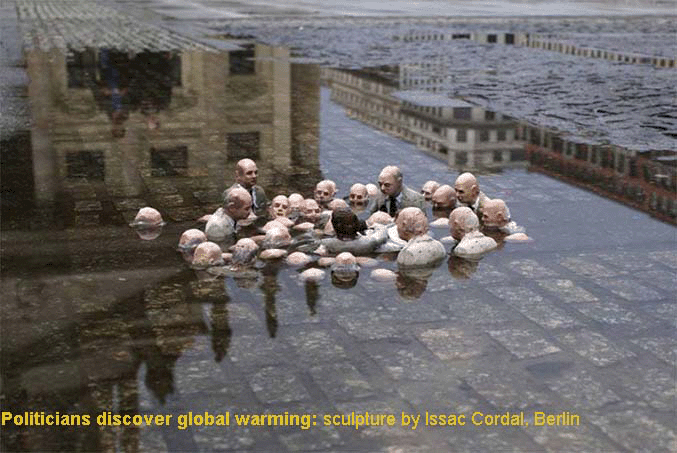
Last year saw a record number of UK newspaper editorials opposing climate
action – almost exclusively from right-leaning titles – new Carbon
Brief analysis shows.
The analysis is based on hundreds of UK national
newspaper editorials, which are the formal “voice” of the publications.
The 354 editorials published in 2023 relating to energy and climate change
add to thousands more collected in a long-running project started by Carbon
Brief. Newspapers such as the Sun and the Daily Mail published 42
editorials in 2023 arguing against climate action – nearly three times
more than they have printed before in a single year.
They called for delays
to UK bans on the sale of fossil fuel-powered cars and boilers, as well as
for more oil-and-gas production in the North Sea. In response to such
demands, prime minister Rishi Sunak performed a “U-turn” in September
on some of his government’s major net-zero policies. Last year also saw a
surge in hostility towards climate protesters, with editorial attacks
doubling compared to recent years.
Carbon Brief 9th Jan 2024
BBC Panorama to feature RAF Lakenheath nuclear weapons saga- BBC Two on Thursday, January 18
A new BBC Panorama documentary is set to look into the ongoing saga around
nuclear weapons potentially being stored at RAF Lakenheath. Fears have been
mounting that the north Suffolk airbase is set to host nuclear weapons for
the first time in 16 years. The first US nuclear bombs arrived on British
soil in September 1954, and several sources confirmed the withdrawal of the
weapons from Lakenheath in 2008. Panorama’s senior foreign affairs
correspondent Jane Corbin will speak to campaigners in Suffolk in the
documentary that is set to air on BBC Two on Thursday, January 18.
East Anglian Daily Times 6th Jan 2024
https://www.eadt.co.uk/news/24031890.bbc-panorama-feature-raf-lakenheath-nuclear-weapons-saga/
All CNN Gaza Coverage Seen by Bureau Monitored by Israeli Defense Force Before Publication
The word “genocide” is “taboo” in the outlet’s newsroom, one staffer said.
SCHEERPOST, By Sharon Zhang / Truthout, 6 Jan 24
CNN has for years maintained a policy of running all of its coverage on Israel and Palestine, including its recent Gaza coverage, past its bureau in Jerusalem, where it is subject to the censorship policies set by Israel’s military, damning new reporting by The Intercept has revealed.
The Jerusalem CNN staff who review the reporting do so under the watchful eye of the Israel Defense Forces (IDF), which, as The Intercept has previously reported, is maintaining strict media bans around the genocide in Gaza, including censorship of topics and stories that may be embarrassing to the IDF. All reporters in Israel must sign an agreement to abide by such rules set by the IDF, and Israel has reportedly censored thousands of news stories since the beginning of the current massacre in Gaza.
In practice, this means that coverage of Israel and Palestine have a strong pro-Israel bias, as one anonymous staff member explained to The Intercept………………………………………..
Further, the investigation found that CNN leaders have explicitly prescribed policies that favor Israel.
In an email sent October 26, CNN’s News Standards and Practices sent staff an email directing them to refer to the ministry of health in Gaza as “Hamas-controlled” every time they reference the Palestinian death count — a widespread practice among major outlets, despite numerous human rights groups and war experts maintaining that the Gaza health ministry’s death tolls have historically been accurate and that public health experts have independently found no evidence that the ministry has inflated death counts.
“If the underlying statistics have been derived from the ministry of Health in Gaza, we should note that fact and that this part of the Ministry is ‘Hamas-controlled’ even if the statistics are released by the West Bank part of the ministry or elsewhere,” the memo said.
Then, on November 2, CNN’s Senior Director of News Standards and Practices, David Lindsey, sent another note to staff explicitly saying that statements from Hamas leaders should not be given a platform unless highly contextualized, and that as a rule, Hamas “representatives are engaging in inflammatory rhetoric and propaganda.”…………………………………………………..
The report lends evidence to what advocates for Palestinian rights have long maintained: that major U.S. and many other western outlets have a strong anti-Palestinian bias. This has become especially potent amid the current genocide, as CNN and other major outlets have come under scrutiny for embedding themselveswith the IDF to report on Gaza, meaning that they are escorted and observed by Israeli military forces and must submit coverage to the IDF before publication, all while supposedly reporting with an “objective” lens. https://scheerpost.com/2024/01/06/all-cnn-gaza-coverage-seen-by-bureau-monitored-by-idf-before-publication/
CNN And Washington Post Busted For Pro-Israel Propaganda Shenanigans

it turns out there’s only so much propaganda spin you can put on the murder of thousands of children.
CAITLIN JOHNSTONE, JAN 6, 2024, https://www.caitlinjohnst.one/p/cnn-and-washington-post-busted-for?utm_source=post-email-title&publication_id=82124&post_id=140416461&utm_campaign=email-post-title&isFreemail=true&r=1ise1&utm_medium=email
Both CNN and The Washington Post have been caught engaging in some pretty shady journalistic malpractice with their Israel reporting in recent days.
In a new article titled “CNN Runs Gaza Coverage Past Jerusalem Team Operating Under Shadow of IDF Censor,” The Intercept reports that all of CNN’s reporting on Israel and Palestine is funneled through a bureau in Jerusalem which slants reporting to benefit Israeli information interests and is subject to regulation by Israeli military censors. The Intercept also reports that last year CNN “hired a former soldier from the IDF’s Military Spokesperson Unit to serve as a reporter” at the onset of the war on Gaza.
Unnamed CNN staff told The Intercept that CNN’s iron-fisted protocols for regulating information related to the Israel-Palestine issue have had a “demonstrable impact on coverage of the Gaza war”.
“‘War-crime’ and ‘genocide’ are taboo words,” the anonymous CNN staff member said. “Israeli bombings in Gaza will be reported as ‘blasts’ attributed to nobody, until the Israeli military weighs in to either accept or deny responsibility. Quotes and information provided by Israeli army and government officials tend to be approved quickly, while those from Palestinians tend to be heavily scrutinized and slowly processed.”
The Intercept reports that the former IDF spinmeister has been bylined in dozens of CNN stories since the attack on Gaza began, with one report being “little more than a direct statement released from the IDF.”
Kind of makes you wonder why CNN doesn’t just cut out the middleman and run all its reporting directly through IDF headquarters in Tel Aviv. Seems like it would be a bit more efficient, and certainly a lot more honest.
Meanwhile The Washington Post has been caught assigning a reporter with a history of anti-Palestinian bias to write a smear piece on independent media outlets Electronic Intifada and The Grayzone for their critical reporting on Israel’s ongoing massacre in Gaza.
Both Electronic Intifada and The Grayzone received emails from a Washington Post reporter named Elizabeth Dwoskin, who said she’s writing a piece on “efforts to minimize or misdirect information about the Oct. 7 Hamas attacks on Israel” and interrogating them about their articles casting doubt on the official narrative about what exactly happened that day.
As Electronic Intifada’s Ali Abunimah highlighted on Twitter, when Dwoskin was at Columbia University twenty years ago she was authoring Nakba denialist claims that Palestine never existed and that prior to Israel’s formation the land was inhabited only by “desert Bedouins without a sense of national identity as we know it today.”
It’s bad enough for The Washington Post to be attacking independent media for asking the critical questions and doing the real journalism the Post itself should also be doing, but to assign someone with a public history of egregiously anti-Palestinian rhetoric to the task is especially lacking in journalistic integrity.
“If I’m following, a reporter that has denied the fact that Palestinians existed before the state of Israel is allowed to cover Israel/Palestine and write about ‘misinformation’ for Washington Post?” tweeted award-winning journalist Laila Al-Arian of Abunimah’s revelation.
Neither of these instances will come as a surprise to anyone who has been paying critical attention to the amazingly awful reporting the western mass media have been churning out about the Gaza assault these last three months, but they do offer some rare insight behind the curtain into how the sausage gets made.
The biggest misconception about propaganda is that it is something that happens to other people, and is done by other countries. Westerners like to think of themselves as free-thinking people whose worldviews are formed by facts and truth, contrasting themselves with nations like North Korea and China where populations are viewed as being subjected to conformity-enforcing propaganda. They believe that if propaganda does occur in the west, it comes here from nations like Russia trying to corrupt our minds and weaken our trust in our institutions, or if the propaganda is domestic in origin it only affects people in other political parties.
In reality the typical western mind has been marinating in domestic propaganda throughout its entire life, and its worldview has been manufactured for it by powerful manipulators who benefit from its intellectual compliance with their interests. The indoctrination into the mainstream western worldview began in school, and it continues throughout adulthood with the help of mainstream media outlets like CNN and The Washington Post.
If we’re ever to have a healthy civilization, we’re going to have to wake up from the propaganda-induced coma we’ve been placed in so we can begin pushing against the cage walls we’ve been indoctrinated our whole lives into ignoring and start using the power of our numbers to force real change in the systems which govern our world. Luckily the atrocities that have been taking place in Gaza have been rapidly waking people up, because it turns out there’s only so much propaganda spin you can put on the murder of thousands of children.
The more people become aware that our civilization is built on deception and everything we’ve been told about the world is a lie, the closer we get to living in a truth-based society where nothing like the Gaza massacre would ever be permitted to occur.
TODAY. The subtle ways that the nuclear lobby manipulates corporate media. Example KISHA CLUBS OF JAPAN
Media in other countries are controlled in a similar way, but Japan has the longest and most successful story of corporate media’s obedience to the pro nuclear dogma that prevails across the world.
Paul Richards 5 Jan 24
Starting with, the source: KISHA CLUBS OF JAPAN
Japan’s Press Club System, known as “kisha clubs,” is a unique arrangement that fosters close relationships between journalists and the institutions they cover. This system is prevalent in government offices, ministries, major corporations, and other influential entities.
1] STRUCTURE OF PRESS CLUBS
Exclusive Access:
Journalists from major media outlets join these clubs, gaining exclusive access to news briefings, announcements, and events hosted by specific institutions. Each institution typically has its own press club.
Regular Briefings:
Officials provide information to journalists within these clubs, fostering a symbiotic relationship. In return for access, journalists are expected to adhere to certain unwritten rules, which can include not reporting certain sensitive topics or leaks without permission.
2] HIERCAHICAL EFFECT
Access to Information:
Press club members receive information directly from sources, creating an information hierarchy where those outside the clubs might lack timely or direct access to crucial news.
Influence and Reporting Bias:
The system can create a situation where reporters develop close ties with the sources they cover. This might lead to a reluctance to publish critical or controversial information that could jeopardise their access or relationships. As a result, it can challenge the ability of the press to hold political power accountable.
3] CHALLENGING POLITICAL POWER
Limited Critical Reporting:
While the press club system provides access, it can also limit critical reporting. Journalists might self-censor to maintain access or avoid upsetting their sources, which can indirectly challenge the media’s ability to scrutinise political power thoroughly.
Alternative Media and Challenges:
Independent or smaller media outlets not part of these press clubs might face difficulties accessing information. However, these outlets sometimes challenge the established narrative and provide alternative perspectives, albeit with limited resources and access to official sources.
While the Press Club System provides journalists with unique access to information and sources, it also poses challenges to independent and critical reporting.
The hierarchical nature of information distribution in Japan within these clubs can lead to a cosy relationship between the press and political power, impacting the media’s ability to fully challenge or scrutinise those in authority.
There have been many concerns raised about the Japanese government’s ruling parties, and pressure on media outlets indirectly, such as withholding access to information or using informal means to influence coverage.
This might affect the independence and objectivity of reporting, though direct censorship is not a prevalent practice.
Overall, Japan maintains, it has a reputation for press freedom compared to many other countries.
However, concerns persist about self-censorship, indirect influences, and the limitations of the press club system that can impact the diversity and depth of news coverage.
The nature of political control over the press in Japan tends to be more subtle and indirect rather than overt and explicit.
Why Israel Slaughters with Impunity

The Postil Magazine, C.B. Forde
We all know now that Israel can do no wrong, for it is blessed with immunity for being the eternal victim. For Israel, Hitler is the gift that keeps on giving.
We all know that the USA is complicit in the crimes, rushing more and more PMGs to Israel so it will never run short in its precise bombing of important military targets, such as churches, hospitals, schools, mosques, universities, and ordinary homes and residential high-rises.
We all know that no matter how many UN “emergency” meetings are held to rein in Israel’s bloodlust, no matter how many resolutions voted on, the bombs will continue to fall, because Israel can kill as many Palestinians as it wants. There is no one to stop them.
No one seems to know, let alone care, that all the people of Gaza (2.2 million)—not just some—cannot get enough to eat each and every day, and mass starvation is happening right now.
The usual response among most people in the West is—both sides are the same (meaning, Israelis and Palestinians); they both lie and cheat and murder, it’s hard to know where the truth lies. We should worry about our own countries.
If that were true, then why is it that as of now there is only side that has had over 8,000 bombed to pieces? That has had killed nearly 30,000, and left 55,000 people injured? That has had the only place given them to live turned into a wasteland? Why is it that ordinary citizens of one side have been heavily armed with the latest weapons, while those of the other side buy what they can on the black market?
Why is it that one side is well-fed and will not be worrying about food and water, while the other side must starve it out?
How exactly are both sides the same? How is it that both sides lie, cheat and kill?
Then the argument is made that Palestine and Israel are so far away. Let them fight it out. I have other things to worry about.
If that were true, then what about February 2022, when the entire West went into a paroxysm of Russphobia (which still shows little signs of abating), and you couldn’t go to get some milk without being told to to help the poor Ukrainians who were bring “brutally invaded” by the “dictator” Putin, etc.
Why was Ukraine not so far away, then—but Palestine is now so far away? Why was it so easy to care for one side and hate the other in 2022, but now we must be neutral?
Where is the International Criminal Court, which could not issue an arrest warrant for President Putin fast enough, but which now can see no crimes being committed in Gaza by Netanyahu and his ilk?…………………………………………………………………………………………………………………………………………………………………………………….
why does Israel slaughter Palestinians with impunity? Because Western powerbrokers and their ruling class have chosen Israel to play the role both of victim and “hero” of civilization. To that end, Palestinians (and Muslims generally) have been assigned the role of “villain,” who can only move from one outrage to the next atrocity. Just imagine the negative press if Zionism were a Muslim invention. In this way, “our values,” the “international rules-based order,” Western “civilization” are stood up against “barbarism.” When Israel kills babies, it kills for our good, for our “civilization,” for “our values.” We, in the West, are the beneficiaries of the “heroic” slaughter by the gallant IDF. Just as all those dead Ukrainians have let us keep our “democracy” and our “freedom.”
How can anyone object to dead barbarians, no matter how tiny? Perhaps a better question to ask—what have we become? https://www.thepostil.com/why-israel-slaughters-with-impunity/
Burial review – deep dive into underworld of nuclear power and its toxic legacy
Emilija Škarnulytė’s hypnotic documentary zooms into the science of uranium and radioactivity, as well as cold war politics.
Occupying the liminal space between a geological excavation and speculative realism, Emilija Škarnulytė’s hypnotic documentary effortlessly moves between the micro and the macro. Zooming into a 3D-configuration of uranium ore, the film’s opening cuts to X-ray-esque renderings of radioactive household objects, all cast in an eerie shade of sickly green. These abstractions soon give way to something seemingly concrete yet equally mysterious: the camera plunges underwater, bringing us face to face with the remains of a 1950s uranium mine in Poland, once dug out in secrecy under the Soviet Union. Slithering through the wreckage is a water python, whose glistening presence serves as a kind of cosmic counterpart to the exploitation of natural resources.
Such slipperiness, both in terms of the imagery and the camera’s point of view, recurs throughout Škarnulytė’s film. Cutting to the Ignalina nuclear power station in Lithuania, a sister plant of Chernobyl, the film uses on-screen text to describe its decommissioning process, which produced millions of cubic metres of reinforced concrete structures to be demolished. This colossal waste will, hopefully, be processed at a research facility at Meuse in France, which is situated about 500 metres below sea level.
Though moving through these highly technological spaces, Škarnulytė’s film also makes space for bursts of surrealism. The python reappears in the Ignalina plant, as its gleaming form coils around the station’s switchboards. Bringing together the lush forests, the mushroom clouds of nuclear tests, and closeups of a snake shedding its skin, Burial questions the very possibility of rebirth and transformation. Even as Ignalina is ground into dust and buried away from prying eyes, the political spectre of the Soviet Union control continues to lurk, as the film offers a final message of support for Ukraine.
Burial is available from 5 January on True Story.
Meta’s Broken Promises -Systemic Censorship of Palestine Content on Instagram and Facebook
SCHEERPOST, By Deborah Brown and Rasha Younes / Human Rights Watch, December 23, 2023
Summary
Meta’s policies and practices have been silencing voices in support of Palestine and Palestinian human rights on Instagram and Facebook in a wave of heightened censorship of social media amid the hostilities between Israeli forces and Palestinian armed groups that began on October 7, 2023. This systemic online censorship has risen against the backdrop of unprecedented violence, including an estimated 1,200 people killed in Israel, largely in the Hamas-led attack on October 7, and over 18,000 Palestinians killed as of December 14, largely as a result of intense Israeli bombardment.
Between October and November 2023, Human Rights Watch documented over 1,050 takedowns and other suppression of content Instagram and Facebook that had been posted by Palestinians and their supporters, including about human rights abuses. Human Rights Watch publicly solicited cases of any type of online censorship and of any type of viewpoints related to Israel and Palestine. Of the 1,050 cases reviewed for this report, 1,049 involved peaceful content in support of Palestine that was censored or otherwise unduly suppressed, while one case involved removal of content in support of Israel. The documented cases include content originating from over 60 countries around the world, primarily in English, all of peaceful support of Palestine, expressed in diverse ways. This distribution of cases does not necessarily reflect the overall distribution of censorship. Hundreds of people continued to report censorship after Human Rights Watch completed its analysis for this report, meaning that the total number of cases Human Rights Watch received greatly exceeded 1,050.
Human Rights Watch found that the censorship of content related to Palestine on Instagram and Facebook is systemic and global. Meta’s inconsistent enforcement of its own policies led to the erroneous removal of content about Palestine. While this appears to be the biggest wave of suppression of content about Palestine to date, Meta, the parent company of Facebook and Instagram, has a well-documented record of overbroad crackdowns on content related to Palestine. ………………………………………………………………………………………………………………….. more https://scheerpost.com/2023/12/23/metas-broken-promises/
1 This Month


Shut down the radiation-damaged Heysham nuclear reactors now
To see nuclear-related stories in greater depth and intensity – go to https://nuclearinformation.wordpress.com

Say No to NASA’s Reckless Nuclear Reactor on the Moon
Say No to NASA’s Reckless Nuclear Reactor on the Moon
-
Archives
- October 2026 (256)
- September 2026 (339)
- August 2026 (330)
- July 2026 (355)
- June 2026 (287)
- May 2026 (306)
- April 2026 (356)
- March 2026 (251)
- February 2026 (267)
- January 2026 (308)
- December 2025 (358)
- November 2025 (359)
-
Categories
- 1
- 1 NUCLEAR ISSUES
- business and costs
- climate change
- culture and arts
- ENERGY
- environment
- health
- history
- indigenous issues
- Legal
- marketing of nuclear
- media
- opposition to nuclear
- PERSONAL STORIES
- politics
- politics international
- Religion and ethics
- safety
- secrets,lies and civil liberties
- spinbuster
- technology
- Uranium
- wastes
- weapons and war
- Women
- 2 WORLD
- ACTION
- AFRICA
- Atrocities
- AUSTRALIA
- Christina's notes
- Christina's themes
- culture and arts
- Events
- Fuk 2022
- Fuk 2023
- Fukushima 2017
- Fukushima 2018
- fukushima 2019
- Fukushima 2020
- Fukushima 2021
- general
- global warming
- Humour (God we need it)
- Nuclear
- RARE EARTHS
- Reference
- resources – print
- Resources -audiovicual
- Weekly Newsletter
- World
- World Nuclear
- YouTube
-
RSS
Entries RSS
Comments RSS

