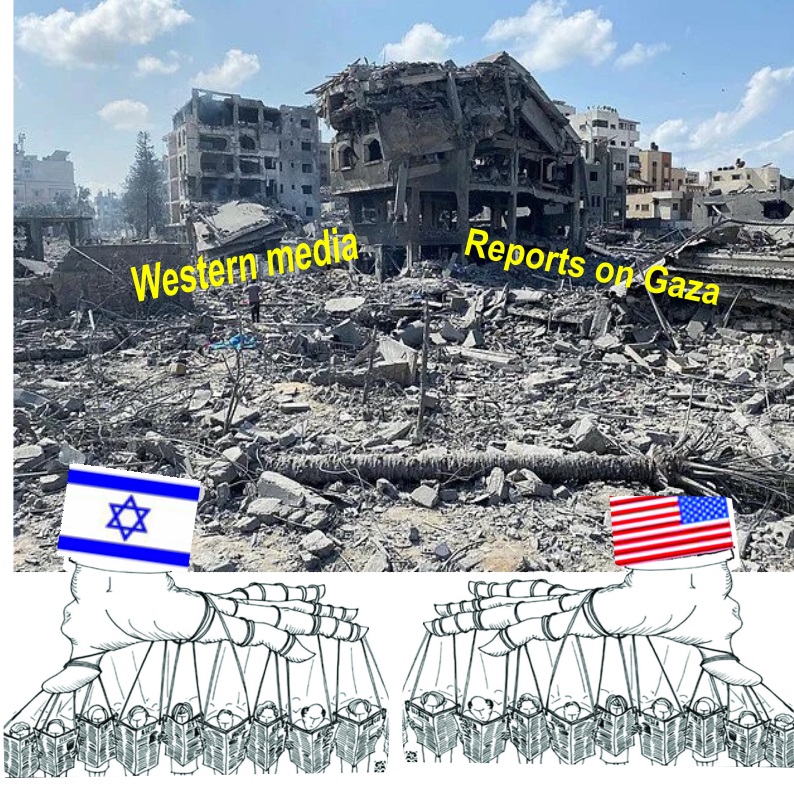
“Highly emotive terms for the killing of civilians like ‘slaughter,’ ‘massacre,’ and ‘horrific’ were reserved almost exclusively for Israelis who were killed by Palestinians, rather than the other way around,”
Got it? In Ukraine people die from bombs because Russia launched Russian airstrikes and killed them very Russianly, whereas in Gaza people get hurt by explosions because they got too close to some type of explosive material.
“…………………… “In the war of propaganda it is very difficult to defeat the United States because the United States controls all the world’s media and many European media,” Putin replied, adding, “The ultimate beneficiary of the biggest European media are American financial institutions.”
… Putin is definitely correct about the strength of the American propaganda machine. Of all the fronts one could possibly choose to challenge the United States on, propaganda is surely the least favorable. The US empire has by far the most sophisticated and effective propaganda machine ever to have existed, operating with such complexity that most people don’t even know it exists.
…………………………………………………………………In reality the nature of the US-centralized empire allows it to run a massive, nonstop international propaganda campaign through mass media platforms which are mostly privately owned. A diverse network of factors feeds into this dynamic which I’ve detailed in my unusually lengthy article “15 Reasons Why Mass Media Employees Act Like Propagandists”, but the gist of it is that anyone who’s wealthy enough to control a mass media platform is going to have a vested interest in preserving the status quo upon which their wealth is premised, and they will cooperate with establishment power structures in various ways toward that end.
The fact that these mass media outlets look independent but function as propaganda organs for the US empire allows its propaganda to fly into people’s minds without triggering any gag reflex of critical thinking or skepticism, which wouldn’t be the case if people knew those outlets were feeding them propaganda. Propaganda only really has persuasive power if you don’t know it’s happening to you.
The invisibility of US propaganda is further aided by the subtle methods by which it is administered, which we’ve seen exemplified beautifully in the coverage of Israel’s ongoing US-backed mass atrocity in Gaza.
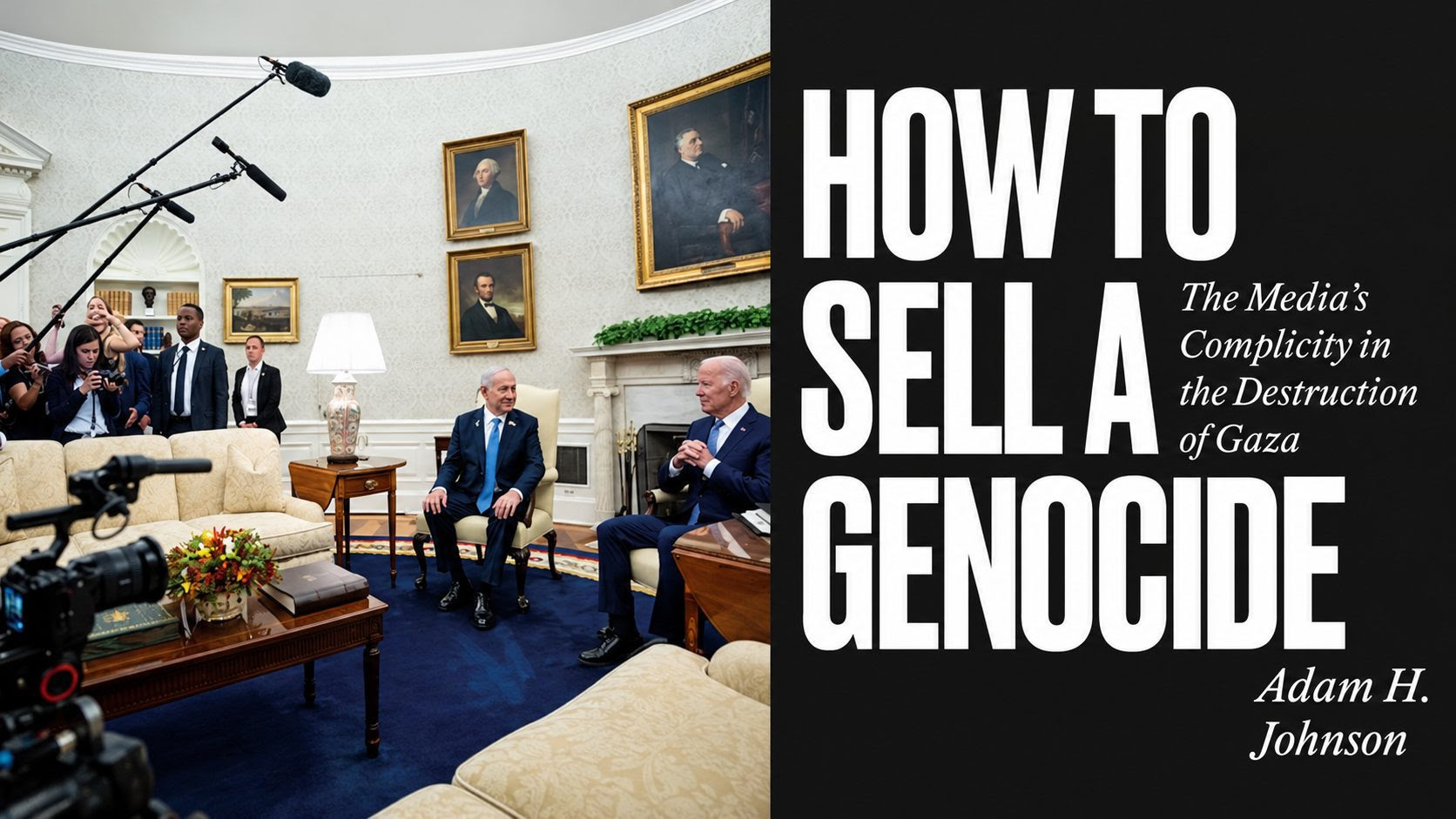
“Highly emotive terms for the killing of civilians like ‘slaughter,’ ‘massacre,’ and ‘horrific’ were reserved almost exclusively for Israelis who were killed by Palestinians, rather than the other way around,” The Intercept’s Adam Johnson and Othman Ali report. “The term ‘slaughter’ was used by editors and reporters to describe the killing of Israelis versus Palestinians 60 to 1, and ‘massacre’ was used to describe the killing of Israelis versus Palestinians 125 to 2. ‘Horrific’ was used to describe the killing of Israelis versus Palestinians 36 to 4.”
This is the sort of manipulation that a casual news consumer wouldn’t notice. Unless you’re on alert for bias and are keeping track of what words are and aren’t being used where, you’re probably not going to notice the absence of emotionally-charged words when reporting on Palestinians who are killed by Israelis.
It’s easy to spot the difference when they’re placed next to each other like I just did, but unless you’re really watching out for it and have a good background on what’s going on here you’re likely to miss what’s happening. If you’re like most people and don’t read past the headline, you’d never know from the imperial media headlines that the child was killed by Israel, and you’d certainly never know about her terrified phone call for help while trapped by IDF fire and surrounded by the bodies of her dead relatives. If you look to the legacy media and its algorithmically-boosted online iterations for information about the world, you went one more day with a distorted perspective of what’s happening in Gaza.
The western press constantly write headlines like this when trying to minimize the impact of someone’s death at the hands of a party they sympathize with, particularly with regard to Palestinians. Last month the BBC published an article titled “Record number of civilians hurt by explosives in 2023”, as though they were mishandling fireworks or something instead of being actively killed by Israeli bombs. The BBC later revised their atrocious headline, but revised it in the opposite direction, replacing “Record number” with “High number” to further minimize the impact.
Got it? In Ukraine people die from bombs because Russia launched Russian airstrikes and killed them very Russianly, whereas in Gaza people get hurt by explosions because they got too close to some type of explosive material.
Last week The Washington Post ran an opinion piece titled “Is America complicit in Israel’s bloody war in Gaza?”, which is already a ridiculously skewed headline because the answer is self-evidently yes — implying that there’s any question of this skews things in America’s favor. But even this was too much for the Post’s editors, who re-titled the piece “Has the Israel-Gaza war changed your feelings about being American?” to keep Americans from thinking too hard about Israel’s bloody war in Gaza and their country’s complicity in it.
In a Wednesday article titled “Biden Tries Again With Arab Americans in Michigan”, New York Times editorial board member Farah Stockman wrote the absolutely insane line “The Oct. 7 Hamas attack on Israel seems to be affecting Biden’s election prospects.” And then The New York Times actually printed it.
Read that line again. She’s saying Arab Americans are rejecting Biden because of the October 7 Hamas attack, which is of course absurd; they’re rejecting Biden because he’s backing a genocide in Gaza. She wrote this nonsensical line because in the New York Times you can’t say things like “Israel’s genocide in Gaza” or “the president’s facilitation of crimes against humanity”, and you won’t be hired if you’re the sort of person who’d be inclined to. Instead we’re pretending that for some inexplicable reason Arab Americans are just hopping mad at Biden because October 7 happened.
But again, these little manipulations fly under the radar if you’re not on the lookout for them. Such is the brilliance of the US empire’s invisible propaganda machine. That’s why it’s very difficult to win a propaganda war against the United States, that’s why westerners have been so successfully manipulated into accepting a status quo of endless war, ecocide, injustice and exploitation, and that’s why the world looks the way it looks right now.
Walt Zlotow, West Suburban Peace Coalition, Glen Ellyn IL 9 Feb 24
For the past 2 years now the Chicago Tribune has been misrepresenting both the nature and status of the Russo Ukraine war.
Its latest update in today’s editorial ‘Time for responsible GOP voices to step up and back Ukraine’ doubles down on both misrepresented aspects of the war.
Regarding its nature, the Trib continues spreading the false US narrative that Vladimir Putin’s reason for invading was to recreate the Soviet Union, starting with Ukraine. “Putin has made no secret of his ambitions to stitch something resembling the old USSR back together. Ukraine is by far the biggest prize in that quest. Stopping this ambition in its tracks is critical to future peace in the region.”
We know this is false. Putin spent 8 years prior to his invasion proclaiming and seeking US assurances NATO would not expand up to Russia’s border with Ukraine. While it may be easy to dismiss Putin’s words and actions prior to the invasion, it’s impossible to dismiss the words of NATO Secretary General Jens Stoltenberg and Ukraine President Volodymyr Zelensky himself.
Prior to the war Stoltenberg stated that “Russia’s NATO security demands were a precondition for not invading Ukraine.” He further stated after the invasion, “Putin went to war to prevent NATO from getting closer to Russia.”
On March 27, 2022, 5 weeks into the war, Ukraine President Zelensky admitted to an interviewer that Ukraine’s promise not to join NATO was “the first fundamental point for the Russian Federation not to invade.” He further stated “As far as I know, they started the war because of this.”
Prior to the war Stoltenberg stated that “Russia’s NATO security demands were a precondition for not invading Ukraine.” He further stated after the invasion, “Putin went to war to prevent NATO from getting closer to Russia.”
On March 27, 2022, 5 weeks into the war, Ukraine President Zelensky admitted to an interviewer that Ukraine’s promise not to join NATO was “the first fundamental point for the Russian Federation not to invade.” He further stated “As far as I know, they started the war because of this.”
Politics aside, the peace community supports any all efforts of many Republicans and a few courageous Democrats to derail squandering $61 billion more in weapons and other aid to maintain a war that will only end with a negotiated settlement.
A MintPress study of major U.S. media outlets’ coverage of the Yemeni Red Sea blockade has found an overwhelming bias in the press, which presented the event as an aggressive, hostile act of terrorism by Ansar Allah (a.k.a. the Houthis), who were presented as pawns of the Iranian government. While constantly putting forward pro-war talking points, the U.S. was portrayed as a good faith, neutral actor being “dragged” into another Middle Eastern conflict against its will.
Since November, Ansar Allah has been conducting a blockade of Israeli ships entering the Red Sea in an attempt to force Israel to stop its attack on the people of Gaza. The U.S. government, which has refused to act to stop a genocide, sprang into action to prevent damage to private property, leading an international coalition to bomb targets in Yemen.
The effect of the blockade has been substantial. With hundreds of vessels taking the detour around Africa, big businesses like Tesla and Volvo have announced they have suspended European production. Ikea has warned that it is running low on supplies, and the price of a standard shipping container between China and Europe has more than doubled. Ansar Allah, evidently, has been able to target a weak spot of global capitalism.
Western airstrikes on Yemen, however, according to Ansar Allah spokesperson Mohammed al-Bukhaiti, at least, said that they have had only a “very limited” impact so far. Al-Bukhaiti made these comments in a recent interview with MintPress News.
For full information and coding, see the attached viewable spreadsheet. [on original]
BIASED REPORTING.
The study found the media wildly distorted reality, presenting a skewed picture that aided U.S. imperial ambitions. For one, every article in the study (60 out of 60) used the word “Houthis” rather than “Ansar Allah” to describe the movement which took part in the Yemeni Revolution of 2011 and rose up against the government in 2014, taking control of the capital Sanaa, becoming the new de facto government. Many in Yemen consider the term “Houthi” to be a derogatory term for an umbrella movement of people. As Mohammed Ali al-Houthi, Head of Yemen’s Supreme Revolutionary Committee, told MintPress:
‘Houthis’ is not a name we apply to ourselves. We refuse to be called Houthis. It is not from us. It is a name given to us by our enemies in an attempt to frame the broad masses in Yemeni society that belong to our project.”
Yet only two articles even mentioned the name “Ansar Allah” at all.
Since 2014, Ansar Allah has been in control of the vast majority of Yemen, despite a U.S.-backed Saudi coalition attempting to beat them back and restore the previous administration.
Many of the articles studied, however (22 of the 60 in total), did not present Ansar Allah as a governmental force but rather as a “tribal group” (the New York Times), a “ragtag but effective” rebel organization (CNN), or a “large clan” of “extremists” (NBC News). Fourteen articles went further, using the word “terrorist” in reference to Ansar Allah, usually in the context of the U.S. government or American officials calling them such.
Some, however, used it as a supposedly uncontroversial descriptor. One Fox article, for example, read: “For weeks, the Yemeni terrorist group’s actions have been disrupting maritime traffic, while the U.S. military has been responding with strikes.” And a CNN caption noted that U.S. forces “conducted strikes on 8 Houthi targets in Iranian-backed Houthi terrorist-controlled areas of Yemen on January 22.”
Ansar Allah is responding to an Israeli onslaught that has killed tens of thousands of civilians and displaced around 1.9 million Gazans. Yet Israel and its actions were almost never described as “terrorism,” despite arguably fitting the definition far better than the Yemeni movement. The sole exception to this was a comment from al-Houthi, whom CNN quoted as calling Israel a “terrorist state.” Neither the United States nor its actions were ever described using such language……………………………………………………………………………………………………………………………… more https://www.mintpressnews.com/new-study-shows-media-pushing-us-war-yemen/286754/
One of the noblest and most important things a western journalist can do these days is help expose the propagandistic manipulations of the mainstream western press institutions who have duped our civilization into consenting to a profoundly dysfunctional status quo which does not serve the interests of normal human beings. Unfortunately this rarely happens, because western journalists tend to view the mainstream press as allies and potential employers.
This happens to be one such rare occasion, and it happened in one of the lastplaces you’d probably have guessed if you follow mass media propaganda with a critical eye. The Guardian has a great new article out titled “CNN staff say network’s pro-Israel slant amounts to ‘journalistic malpractice’” by a guy named Chris McGreal which cites multiple CNN staff members and internal documents to reveal the immense top-down pressure in the network to tilt coverage heavily in favor of Israel.
McGreal writes the following:
“CNN is facing a backlash from its own staff over editorial policies they say have led to a regurgitation of Israeli propaganda and the censoring of Palestinian perspectives in the network’s coverage of the war in Gaza.
“Journalists in CNN newsrooms in the US and overseas say broadcasts have been skewed by management edicts and a story-approval process that has resulted in highly partial coverage of the Hamas massacre on 7 October and Israel’s retaliatory attack on Gaza.
“‘The majority of news since the war began, regardless of how accurate the initial reporting, has been skewed by a systemic and institutional bias within the network toward Israel,’ said one CNN staffer. ‘Ultimately, CNN’s coverage of the Israel-Gaza war amounts to journalistic malpractice.’”
McGreal’s sources say CNN’s wildly biased coverage of Israel’s assault on Gaza is the direct result of edicts from the network’s new CEO Mark Thompson, who assumed his role two days after the October 7 attack. From 2012 to 2020 Thompson was the president and CEO of The New York Times, which is currently experiencing its own internal strife due to the pro-Israel bias of that outlet.
Before his NYT executive gig Thompson was the director-general of the BBC, where he came under fire multiple times for the pro-Israel bias he imposed on the British state broadcaster. In 2005 he held meetings in Jerusalem with then-Israeli Prime Minister Ariel Sharon with the reported aim to “build bridges with the country’s political class,” immediately after which he removed BBC correspondent Orla Guerin from Jerusalem following accusations of “antisemitism” made against her by the Israeli government. In 2009 he was hotly criticized for choosing not to air the Disasters Emergency Committee appeal for Gaza, and in 2011 he presided over the decision to censor the lyrics “free Palestine” from a performance by rapper Mic Righteous on BBC Radio 1Xtra.
This is the sort of person who gets hired to multiple executive positions in multiple highly influential western media platforms. If you’ve ever wondered why it looks like the western press function in pretty much the same way as the state propaganda services in the autocracies the west proudly sets itself apart from, this is why. The corporate media are owned and controlled by plutocrats who have a vested interest in preserving the status quo power structure upon which their kingdoms are built, and state broadcasters like the BBC have the same interest for the same reason. They decide who the executives of those outlets will be, and those executives make policy and hiring decisions which cause the outlet to function in a way that is indistinguishable from state propaganda.
These are the people who’ve been pulling the wool over the eyes of the mainstream public and manipulating the masses into thinking, speaking, working, consuming, and voting in ways that serve the interests of the ruling power structure. In this way they are able to ensure that revolutionary opposition to that power structure remains a fringe minority position, even as that power structure wages wars, sponsors genocides, destroys the biosphere, and keeps everyone poor, sick, and stupid.
Our world will never see the revolutionary changes it desperately needs until the people begin using the power of their numbers to force those changes to happen, and the people will never start using the power of their numbers to force revolutionary change as long as they are being manipulated by propagandists into accepting the status quo. Our task therefore, as people who love truth and desire a healthy world, is to begin waking the public up to the reality that everything they’ve been told about their society, their government and their world is a lie, and pointing them toward true information about what’s really going on.
That’s how humanity will awaken from its propaganda-induced coma to create a healthy world: one pair of eyelids at a time. This might sound like a slow-going project, but for every newly opened pair of eyes there is one more voice who can help wake up the others, which means exponential growth is possible. This is how we move humanity into the light of truth and begin the shift toward a truth-based society.
And we’ve got an advantage: the empire needs to use human beings to generate its propaganda. That’s what we’re seeing in CNN staff turning against their boss and reporting his malfeasance to another news outlet. As long as the empire depends on ordinary human beings to turn its gears and facilitate its horrific atrocities, there’s always the possibility that the next pair of eyes to open will be someone on the inside.
The push for more balanced coverage has been complicated by Israel’s block on foreign journalists entering Gaza except under IDF control and subject to censorship. That has helped keep the full impact of the war on Palestinians off of CNN and other channels while ensuring that there is a continued focus on the Israeli perspective.
Insiders say pressure from the top results in credulous reporting of Israeli claims and silencing of Palestinian perspectives
Insiders say pressure from thetop results in credulous reporting of Israeli claims and silencing of Palestinian perspectives
CNN is facing a backlash from its own staff over editorial policies they say have led to a regurgitation of Israeli propaganda and the censoring of Palestinian perspectives in the network’s coverage of the war in Gaza.
Journalists in CNN newsrooms in the US and overseas say broadcasts have been skewed by management edicts and a story-approval process that has resulted in highly partial coverage of the Hamas massacre on 7 October and Israel’s retaliatory attack on Gaza.
“The majority of news since the war began, regardless of how accurate the initial reporting, has been skewed by a systemic and institutional bias within the network toward Israel,” said one CNN staffer. “Ultimately, CNN’s coverage of the Israel-Gaza war amounts to journalistic malpractice.”
According to accounts from six CNN staffers in multiple newsrooms, and morethan a dozen internal memos and emails obtained by the Guardian, daily news decisions are shaped by a flow of directives from the CNN headquarters in Atlanta that have set strict guidelines on coverage.
They include tight restrictions on quoting Hamas and reporting other Palestinian perspectives while Israel government statements are taken at face value. In addition, every story on the conflict must be cleared by the Jerusalem bureau before broadcast or publication.
CNN journalists say the tone of coverage is set at the top by its new editor-in-chief and CEO, Mark Thompson, who took up his post two days after the 7 October Hamas attack. Some staff are concerned about Thompson’s willingness to withstand external attempts to influence coverage given that in a former role as the BBC’s director general he was accused of bowing to Israeli government pressure on a number of occasions, including a demand to remove one of the corporation’s most prominent correspondents from her post in Jerusalem in 2005.
CNN insiders say that has resulted, particularly in the early weeks of the war, in a greater focus on Israeli suffering and the Israeli narrative of the war as a hunt for Hamas and its tunnels, and an insufficient focus on the scale of Palestinian civilian deaths and destruction in Gaza.
One journalist described a “schism” within the network over coverage they said was at times reminiscent of the cheerleading that followed 9/11.
“There’s a lot of internal strife and dissent. Some people are looking to get out,” they said.
Another journalist in a different bureau said that they too saw pushback.
“Senior staffers who disagree with the status quo are butting heads with the executives giving orders, questioning how we can effectively tell the story with such restrictive directives in place,” they said.
“Many have been pushing for more content from Gaza to be alerted and aired. By the time these reports go through Jerusalem and make it to TV or the homepage, critical changes – from the introduction of imprecise language to an ignorance of crucial stories – ensure that nearly every report, no matter how damning, relieves Israel of wrongdoing.”
CNN staff say that some journalists with experience of reporting the conflict and region have avoided assignments in Israel because they do not believe they will be free to tell the whole story. Others speculate that they are being kept away by senior editors.
“It is clear that some who don’t belong are covering the war and some who do belong aren’t,” said one insider.
Edicts from on high
………………. In late October, as the Palestinian death toll rose sharply from Israeli bombing with more than 2,700 children killed according to the Gaza health ministry, and as Israel prepared for its ground invasion, a set of guidelines landed in CNN staff inboxes.
……………….CNN staff members said the memo solidified a framework for stories in which the Hamas massacre was used to implicitly justify Israeli actions, and that other context or history was often unwelcome or marginalised.
“How else are editors going to read that other than as an instruction that no matter what the Israelis do, Hamas is ultimately to blame? Every action by Israel – dropping massive bombs that wipe out entire streets, its obliteration of whole families – the coverage ends up massaged to create a ‘they had it coming’ narrative,” said one staffer.
The same memo said that any reference to casualty figures from the Gaza health ministry must say it is “Hamas-controlled”, implying that reports of the deaths of thousands of children were unreliable even though the World Health Organization and other international bodies have said they are largely accurate. CNN staff said that edict was laid down by Thompson at an earlier editorial meeting.
Broader oversight of coverage from the CNN headquarters in Atlanta is directed by “the Triad” of three CNN departments: news standards and practices, legal and fact-checking.
David Lindsay, the senior director of news standards and practices, issued a directive in early November effectively barring the reporting of mostHamas statements, characterising them as “inflammatory rhetoric and propaganda”.
………. one CNN staffer noted that the network repeatedly aired inflammatory rhetoric and propaganda from Israeli officials and American supporters, often without challenge in interviews.
They noted that other channels have carried interviews with Hamas leaders while CNN has not, including one in which the group’s spokesman, Ghazi Hamad, cut short questions from the BBC when he was challenged about the murder of Israeli civilians. One staffer said there is a view among correspondents that it is “agony to get a Hamas interview past the Triad
…………………………………………………….. In addition to the edicts from Atlanta, CNN has a longstanding policy that all copy on the Israel-Palestine situation must be approved for broadcast or publication by the Jerusalem bureau. In July, the network created a process it called “SecondEyes” to speed up those approvals.
…………… One result of SecondEyes is that Israeli official statements are often quickly cleared and make it on air on the principle that that they are to be trusted at face value, seemingly rubber-stamped for broadcast, while statements and claims from Palestinians, and not just Hamas, are delayed or never reported.
One CNN staffer said edits by SecondEyes often seemed aimed at avoiding criticism from pro-Israel groups……………………………..
Some CNN staff fear that the result is a network acting as a surrogate censor on behalf of the Israeli government.
“The system results in chosen individuals editing any and all reporting with an institutionalised pro-Israel bias, often using passive language to absolve the [Israel Defense Forces] of responsibility, and playing down Palestinian deaths and Israeli attacks,” said one of the network’s journalists.
……………………………………………………………. Another presenter, Sara Sidner, drew criticism for her excitable report on unverified Israeli claims that Hamas beheaded dozens of babies on 7 October.
“We have some really disturbing new information out of Israel,” she announced four days after the attack.
“The Israeli prime minister’s spokesman just confirmed, babies and toddlers were found with their heads decapitated in Kfar Aza in southern Israel after Hamas attacks in the kibbutz over the weekend. That has been confirmed by the prime minister’s office.”
………………… Gold, who was part of the SecondEyes team approving stories, again said the report had been confirmed by Netanyahu’s office and she drew parallels with the Holocaust. She responded to a Hamas denial that it had decapitated babies as unbelievable “when we literally have video of these guys, of these militants, of these terrorists doing exactly what they say they’re not doing to civilians and to children”.
Except, as a CNN journalist pointed out, the network did not have such video and, apparently, neither did anyone else………………………………….
By the time of Sidner’s broadcast there were already good reasons for CNN to treat the claims with caution.
Israeli journalists who toured Kfar Aza the day before said they had seen no evidence of such a crime and military officials there had made no mention of it. Instead, Tim Langmaid, the Atlanta-based CNN vice-president and senior editorial director, sent an instruction that President Biden’s claims to have seen pictures of the alleged atrocity “back up what the Israeli government said”.
…….. CNN insiders said senior editors should have treated the story with caution from the beginning because the Israeli military has a track record of false or exaggerated claims that subsequently fall apart.
Other networks, such as Sky News, were considerably more sceptical in their reporting and laid out the tenuous origins of the story, which began with a reporter for an Israeli news channel saying soldiers had told her that 40 children had been killed in the Hamas massacre and that one soldier had said he had seen “bodies of babies with their heads cut off”. The Israel Defense Forces (IDF) then used the claim to liken Hamas to the Islamic State.
Even after the White House admitted that neither the president nor his officials had themselves seen pictures of beheaded babies, and that they had been relying on Israeli claims, Langmaid told the newsroom it could still report the Israeli government assertions alongside a denial from Hamas.
CNN did report on the rolling back of the claims as Israeli officials backtracked, but one staffer said that by then the damage had been done, describing the coverage as a failure of journalism.
“The infamous ‘beheaded babies’ claim, attributed to the Israeli government, made it to air for roughly 18 hours – even after the White House walked back on Biden’s statement that he had seen the nonexistent photos. CNN had no access to photographic evidence, nor any ability to independently verify these claims,” they said.
……….. Some CNN staff raised similar issues with reporting on Hamas tunnels in Gaza and claims they led to a sprawling command centre under al-Shifa hospital.
The push for more balanced coverage has been complicated by Israel’s block on foreign journalists entering Gaza except under IDF control and subject to censorship. That has helped keep the full impact of the war on Palestinians off of CNN and other channels while ensuring that there is a continued focus on the Israeli perspective………………………………
The only foreign journalist to report from Gaza without an Israeli escort has been CNN’s Clarissa Ward, who entered for two hours with a humanitarian team from the United Arab Emirates.
……………. she was being prevented from conveying a fuller picture of the tragedy unfolding in Gaza because of the Israeli block on foreign journalists, putting the burden solely on a limited number of courageous Palestinian reporters who are being killed in disproportionate numbers.
“We must now be able to report on the horrific death and destruction being meted out in Gaza in the same way – on the ground, independently – amid one of the most intense bombardments in the history of modern warfare,” she wrote.
“The response to our report on Gaza in Israeli media suggests an unspoken reason for denying access. When asked on air about our piece, one reporter from the Israeli Channel 13 replied, ‘If indeed Western reporters begin to enter Gaza, this will for sure be a big headache for Israel and Israeli hasbara.’ Hasbara is a Hebrew word for pro-Israel advocacy.
Some at CNN fear that its coverage of the latest Gaza war is damaging a reputation built up by its reporting of Russia’s invasion of Ukraine, which led to a surge in viewers. But others say that the Ukraine war may be part of the problem because editorial standards grew lax as the network and many of its journalists identified clearly with one side – Ukraine – particularly at the beginning of the conflict.
One CNN staffer said that Ukraine coverage set a dangerous precedent that has come back to haunt the network because the Israeli-Palestinian conflict is far more divisive and views are much more deeply entrenched.
“The complacency in our editorial standards and journalistic integrity while reporting on Ukraine has come back to haunt us. Only this time, the stakes are higher and the consequences much more severe. Journalistic complacency is an easier pill for the world to swallow when it’s Arab lives lost instead of European,” they said.
Another CNN employee said the double standards are glaring…………………………………………………
Journalists working at CNN have varied explanations.
Some say the problem is rooted in years of pressure from the Israeli government and allied groups in the US combined with a fear of losing advertising.
During the battle for narrative through the second Palestinian intifada in the early 2000s, Israel’s then communications minister, Reuven Rivlin, called CNN ‘‘evil, biased and unbalanced”. The Jerusalem Post likened the network’s correspondent in the city, Sheila MacVicar, to “the woman who refilled the toilet paper in the Goebbels’ commode”.
CNN’s founder, Ted Turner, caused a storm when he told the Guardian in 2002 that Israel was engaging in terrorism against the Palestinians.
“The Palestinians are fighting with human suicide bombers, that’s all they have. The Israelis … they’ve got one of the most powerful military machines in the world. The Palestinians have nothing. So who are the terrorists? I would make a case that both sides are involved in terrorism,” said Turner, who was then the vice-chairman of AOL Time Warner, which owned CNN.
The resulting storm of protest resulted in threats to the network’s revenue, including moves by Israeli cable television companies to supplant the network with Fox News.
CNN’s chair, Walter Isaacson, appeared on Israeli television to denounce Turner but that did not stem the criticism. The network’s then chief news executive, Eason Jordan, imposed a new rule that CNN would no longer show statements by suicide bombers or interview their relatives, and flew to Israel to quell the political storm.
CNN also began broadcasting a series about the victims of Palestinian suicide bombers. The network insisted that the move was not a response to pressure but some of its journalists were sceptical. CNN did not produce a similar series with the relatives of innocent Palestinians killed by Israel in bombings.
Thompson has his own battle scars from dealing with Israeli officials when he was director general of the BBC two decades ago.
In the spring of 2005, the BBC was embroiled in a very public row over an interview with the Israeli nuclear whistleblower Mordechai Vanunu, who was released from prison the year before.
The Israeli authorities barred Vanunu from giving interviews. When a BBC documentary team spoke to him and then smuggled the footage out of Israel, the authorities reacted by effectively expelling the acting head of the BBC’s Jerusalem bureau, Simon Wilson, who was not involved in the interview.
The dispute rolled on for months before the BBC eventually bowed to an Israeli demand that Wilson write a letter of apology before he could return to Jerusalem. The letter, which included a commitment to “obey the regulations in the future”, was to have remained confidential but the BBC unintentionally posted details online before removing them a few hours later. The climbdown angered some BBC journalists who were enduring persistent pressure and abuse for their coverage.
Later that year, Thompson visited Jerusalem and met the Israeli prime minister, Ariel Sharon, in an effort to improve relations after other incidents.
The Israeli government was particularly unhappy with the BBC’s highly experienced Jerusalem correspondent, Orla Guerin. The Israeli minister for diaspora affairs at the time, Natan Sharansky, accused her of antisemitism and “total identification with the goals and methods of the Palestinian terror groups” after a report by Guerin about the arrest of a 16-year-old Palestinian boy carrying explosives. She accused Israeli officials of turning the arrest into a propaganda opportunity because they “paraded the child in front of the international media” after forcing him to wait at a checkpoint for the arrival of photographers.
Within days of Thompson’s meeting with Sharon, the BBC announced that Guerin would be leaving Jerusalem. At the time, Thompson’s office denied he acted under pressure from Israel and said that Guerin had completed a longer than usual posting. https://www.theguardian.com/media/2024/feb/04/cnn-staff-pro-israel-bias
At the New York Times and Washington Post, despite efforts to include Palestinian voices, opinion editors have skewed the Gaza debate toward an Israel-centered perspective, dominated by men and, among guest writers, government officials.
In the first two months of the current Gaza crisis, the Times featured the crisis on its op-ed pages almost twice as many times as the Post (122 to 63). But while both papers did include a few strong pro-Palestinian voices—and both seemed to make an effort to bring Palestinian voices close to parity with Israeli voices—their pages leaned heavily toward a conversation dominated by Israeli interests and concerns.
That was due in large part due to their stables of regular columnists, who tend to write from a perspective aligned with Israel, if not always in alignment with its right-wing government. As a result, the viewpoints readers were most likely to encounter on the opinion pages of the two papers were sympathetic to, but not necessarily uncritical of, Israel.
Many opinion pieces at the Times, for instance, mentioned the word “occupation,” offering some context for the current crisis. However, very few at either paper went so far as to use the word “apartheid”—a term used by prominent human rights groups to describe Israel’s treatment of Palestinians.
Clear calls for an unconditional ceasefire, while widespread in the real world, were vanishingly rare at the papers: two at the Times and at the Post only one, which itself was part of a collection of short responses to the question, “Should Israel agree to a ceasefire?,” which included strong opposition as well.
For guest perspectives, both papers turned most frequently to government officials, whether current or former, US or foreign. And the two papers continued the longstanding media bias toward male voices on issues of war and international affairs: the Times with roughly three male-penned opinions for every female-written one, and the Post at nearly 7-to-1.
For this study, FAIR identified and analyzed all opinion pieces published by the two papers from October 7 through December 6 that mentioned Israel or Gaza, using Nexis and ProQuest. Excluding editorials, web-only op-eds, letters to the editor and pieces with only passing mentions of Israel/Palestine, we tallied 122 pieces at the Times and 63 at the Post.
New York Times writers
During the first two months of the Gaza crisis, the New York Times published 48 related guest essays, along with 74 pieces by regular columnists, contributing writers (who write less frequently than columnists) and editorial board members (who occasionally publish bylined opinion pieces).
Of the 48 guest essays, the greatest concentration (16, or 33%) were written by Israelis or those with stated family or ancestral ties to Israel. Another 13 (27%) were written by Palestinians or people who declared ties to Palestine. Most of the rest (12, or 25%) were written by US writers with no identified family or ancestral ties to either Israel or Palestine.
The occupational category the Times turned to most frequently for guest opinions was government official, with current or former officials from the US or abroad accounting for 11 (23%) of the guest essays. (US officials outnumbered foreign officials, 6 to 5.) Journalists came in a close second, with nine (19%), followed by seven academics (15%). Six represented advocacy groups or activists (13%); four of these were Israeli and two Palestinian.
The paper also relied heavily on the opinions of men rather than women. Ninety-two of the Times opinion pieces were written by men (75%), while 30 were written by women (25%), an imbalance of more than 3-to-1.
Of the 17 pieces written by the Times‘ regular female columnists, eight came from Michelle Goldberg, and the preponderance were about domestic implications of the crisis. Examples of these include Goldberg’s “The Massacre in Israel and the Need for a Decent Left” (10/12/23) and Pamela Paul‘s “The War Comes to Stanford” (10/13/23), both of which decried the response to the Gaza crisis by the US pro-Palestinian left.
Washington Post writers
The Post published 46 pieces by regular columnists and only 17 by guest writers. Even given that the Post typically publishes fewer opinion pieces than the Times, that’s a strikingly small number of guest op-eds—roughly one every four days.
Unlike at the Times, the Post guest op-eds were dominated by US writers (7, or 41%), with only four by Israelis (24%) and three by Palestinians (18%). The Israeli-bylined op-eds expressed varied viewpoints, from hard-line support (“Every innocent Palestinian killed in this conflagration is the victim of Hamas”—10/10/23) to a call for “concrete steps to de-escalate the immediate conflict and to sow seeds for peace and reconciliation” (10/20/23). Two of the Palestinian-bylined pieces came from the same writer, journalist Daoud Kuttab (10/10/23, 11/28/23), who both times argued that Biden must recognize a Palestinian state as the only way forward.
It’s useful to compare the papers’ current representation of Palestinian voices to their historical record…………………………………..
New York Times columnists
Several New YorkTimes columnists wrote repeatedly about the Gaza crisis……………………………………………………………………………………………….
Washington Post columnists………………………………………………………………………………………………………….
A majority of the US public has supported a ceasefire since the early days of the crisis, and one poll found support increasing over time. Yet in the country’s two most prominent papers, the ceasefire debate was either mostly ignored (at the Post) or presented in a way that came nowhere close to reflecting public opinion (at the Times)…………………………………………………………………………………………….
“Top United States officials prodded Israel on Monday to do more to protect civilians in the Gaza Strip . . .”
Thus began a recent, and oh so typical, piece of war reportage. It was purveyed by the New York Times but it’s something you find in almost any mainstream source. The essence of the news is that the U.S. will continue to support Israel’s right to “defend itself” by bombing the crap out of Gaza and will keep feeding it the military equipment necessary to do so, but it sternly urges Israel to try not to kill too many babies or other civilians. Get it? War must be — and is, when we wage it — a moral undertaking.
And Yoav Gallant, Israeli defense minister — the guy who once declared that Palestinians are “human animals” — assured the world: “Unlike our enemies, we are defending our values, and we operate according to international law. The IDF is operating to minimize the harm to civilian populations.”
Yeah, this is the news! Context-free, reality-free. War is difficult, but war is necessary. When I slog through the verbiage, I can’t help but hear Pete Seeger singing: ‘We’re waist deep — we’re neck deep — in the Big Muddy, and the big fool says to push on.”
Missing from this simplistic, “objective” reportage is any awareness that you cannot kill your way to peace, let alone that humanity is in mortal danger of destroying itself unless we learn to evolve — unless we learn what we already know (except at the highest levels of power). Much of this knowledge is remarkably obvious, indeed, so obvious you’d think the New York Times and other such news outlets would be aware of it and work it into the context of their war reportage.
For instance: “Israel can never have security until Palestinians have security.”
Such a clear, basic truth is almost never part of the mainstream news . . . the Big Muddy. The words are those of Daniel Levy, former Israeli peace negotiator in the governments of Ehud Barak and Yitzhak Rabin, and current president of the U.S. Middle East Project, in an Al-Jazeera interview.
Levy also said: “I hope one day Palestinians, of course, but also Jewish Israelis experience the idea of how liberating it can be to no longer be an oppressor — because when you are oppressing people you know in the back of your mind that you are generating a desire for retribution.”
The point here is not that there’s a simple, quick-and-easy path to peace in any global conflict, but rather that there are obvious, horrific ways to prolong — eternalize — a conflict. In our Big Muddy reportage, the best thing that can happen in a conflict is that it gets “resolved,” sort of, and the violence temporarily stops. You know, a ceasefire is called. What could be better than a ceasefire? This would give surviving Gaza residents a chance to dig corpses out of the rubble in peace. What more could they ask?
Oh God. “Resolving” a conflict generally leaves the opposing sides separate from one another and still in possession of their grievances, or still enduring the hell that they are forced to live in. I would say that creating real peace is a never-ending journey, but can only happen when conflicts aren’t so much resolved as transcended. Another word for this is evolution.
What would that mean with regard to Israel and its ongoing — insane — assault on Palestine? The siege has so far resulted in over 26,000 deaths in Gaza and over 64,000 people injured, not to mention virtually everyone there suffering from hunger, lacking access to clean water, vulnerable to disease. This is madness. But in the context of mainstream reportage, this is nothing more than Israel defending itself — you know, against Hamas, a terrorist organization. Legitimate governments wage war, according to the Big Muddy. Only fringe organizations commit terrorism. Oh, by the way, committing genocide is a war crime, so you shouldn’t do it.
What I’m trying to say here is that war is nothing, nothing, nothing but terrorism and has to be stopped before any sane look at what to do next can even begin. In regard to Israel and Palestine, what might that mean? Certainly it means an end to Israel’s occupation of Gaza and the West Bank — and probably a one-state solution in which everyone has fully equal rights, which requires the creation of a society that is trans-Zionist.
As an American, I can’t think about this without deeply, painfully reflecting on my own country’s genocidal actions against the land’s original occupants and the kidnapping and enslavement of Africans. Our painfully slow process of political and social evolution is hardly finished, but we have begun creating a trans-racist society — yes, much to the distress of racist true believers. But there have been changes, which in an earlier period were probably unimaginable.
My point is not to dwell solely on the wrongs of this history, but to acknowledge that history evolves, that social structures change. While war and other forms of violence may be part of the change, lasting solutions evolve nonviolently.
I return to the words of Daniel Levy, who acknowledges, speaking of the war on Palestine: “Things look incredibly bleak.
“I don’t want to spread false optimism,” he goes on, “but perhaps this disruptive moment, where everything has been turned on its head, will cause people to stare into the abyss. Israel has proved how insecure it is when it continues down this path. The hope is that as we stare into the abyss, we can turn this around. That’s not going to happen quickly.”
But it can happen. The future is ours to create, even if we’re neck deep in the Big Muddy.
I haven’t written much about Julian Assange lately because I’ve been so fixated on what’s been happening in Gaza, but we should all be acutely aware that the 20th and 21st of February may be the WikiLeaks founder’s final chance to avoid extradition to the United States to face persecution for the crime of good journalism.
Assange and his legal team will face two High Court judges during the two-day hearing in London, who will then determine whether or not the UK will allow the Australian journalist to be dragged to the US in chains for a crooked show trial and cast into one of the world’s most draconian prison systems for exposing the war crimes of the world’s most powerful government.
Some US lawmakers are attempting to block the extradition from the other end with House Resolution 934, which asserts that “regular journalistic activities are protected under the First Amendment, and that the United States ought to drop all charges against and attempts to extradite Julian Assange.” If charges were dropped it would not only prevent the extradition but allow for Assange to be freed from the Belmarsh maximum security prison, where he has been jailed by the British government since 2019.
The fight to free Assange is a fight to protect press freedoms around the world, since the US is using the case in an attempt to set a legal precedent for extraditing and imprisoning any journalist or publisher anywhere in the world who shares information with the public that the US doesn’t want shared.
And it’s worth mentioning that this fight is not actually separate from the fight against Israel’s efforts to keep journalism out of Gaza by assassinating reporters and blocking the press from entering the enclave. It’s also not separate from humanity’s overall struggle to build a truth-based civilization, nor ultimately from our greater struggle to become a conscious species.
All throughout humanity there are pushes toward truth and seeing and pushes toward secrecy and darkness. In the press we see both: the authentic journalists like Assange who want all that is hidden to be made transparent, and the propagandists of the mainstream media who work to obfuscate and distort the truth. Those who seek the emergence of a harmonious and truth-based society want as much visibility into what’s really happening as possible, while tyrannical power structures like the US empire and Israel are constantly working to dim the lights.
Wherever you see domination and abuse, you see efforts to limit perception and keep human minds from seeing and understanding what’s going on. It’s true of empires, it’s true of governments, it’s true of cult leaders, it’s true of abusive spouses, and it’s true of the unpleasant dynamics within our own psyches that we would rather not look at. The less seeing there is, the more abusiveness is possible; the more seen things become, the closer we get to freedom.
I’m no prophet, but I strongly suspect that our future as a species will be determined by the outcome of this struggle. If the impulse toward truth and seeing wins out, we are probably headed toward a world of health and harmony. If the impulse to keep everything confused and hidden and unconscious wins, we are probably headed for dystopia and extinction.
In any case, all we can do is fight to make things more visible so that health and harmony become possible. Fight to make things conscious within ourselves. Fight to keep journalism legal in the shadow of the empire. Fight to spotlight Israel’s atrocities in Gaza. Fight to make the unseen seen. Fight to bring humanity into the light of consciousness.
WASHINGTON − Sen. Josh Hawley, R-Mo., is pushing for the Oscars to acknowledge victims of nuclear testing after the Academy announced that “Oppenheimer” leads in nominations.
Hawley sent a letter Friday urging the Academy of Motion Picture Arts and Sciences to include programming that pays tribute to the victims of nuclear testing ahead of the 2024 Academy Awards.
“Oppenheimer,” directed by Christopher Nolan, chronicles the life of J. Robert Oppenheimer, the American physicist whose stewardship of the Manhattan Project led to the atomic bomb. The Manhattan Project‘s scientists built and deployed two bombs that were dropped on Japanese cities, leading to the country’s surrender in World War II.
“Oppenheimer” leads this year with 13 nominations.
“The ‘Oppenheimer’ film tells a compelling story of these test programs. But it does not tell the story of the Americans left behind—still reckoning with the health and financial consequences of America’s nuclear research, after all these years,” Hawley wrote in the letter.
The Missouri lawmaker pointed to Americans, like those in his home state, who suffer from cancer or other medical conditions because of radiation exposure from the radioactive waste that was not cleaned up as part of the Manhattan Project.
“Congress stands poised to allow what limited compensation the government has offered victims to expire. That cannot be allowed to happen,” he wrote. “These victims deserve justice through fair compensation from their government—and you can help by telling their stories.”
Hawley has long been an advocate for those impacted by government-caused nuclear contamination.
He created a procedural hurdle as the Senate worked to pass the defense bill and voted against the bill after the compensation program was not included in its final version
for another year, CPJ excluded the imprisoned former WikiLeaks editor-in-chief from their database of jailed journalists.
Assange is a member of the International Federation of Journalists, which is the world’s largest federation of journalists.
if Assange was brought to trial that it would “effectively criminalize journalists everywhere.”
Assange is and will always be a detained journalist so long as the Justice Department pushes onward with this political case. It is too bad CPJ staff cannot get past their professional hangups and include him in their annual index. It would strengthen their opposition to the prosecution in a way that would give their advocacy even more clarity.
The Committee to Protect Journalists (CPJ) released its census report for 2023. Three hundred and twenty detained or imprisoned journalists were counted by the press freedom organization, as of December 1, 2023.
As indicated, that number is not far from the record high of 360 jailed journalists that was set in 2022.
The 2023 census takes on greater significance given the Israeli government’s war on Gaza and the military attacks and crackdown on Palestinian journalists. Seventeen journalists were jailed by Israel, the “highest number of arrests” since CPJ began tracking arrests in 1992. It is the first time that Israel has “ranked among the top six offenders.”
But at this moment, WikiLeaks founder Julian Assange and his legal team are preparing for a major hearing on February 20 before the High Court of the Justice in the United Kingdom. They view the hearing as a final opportunity to save him from extradition to the United States, where he was charged with violating the Espionage Act in 2019.
Assange needs press freedom organizations, especially those with U.S. headquarters, to strengthen their stand against the charges from the Justice Department. However, for another year, CPJ excluded the imprisoned former WikiLeaks editor-in-chief from their database of jailed journalists.
I emailed CPJ a request for comment and asked why Assange remains excluded from the organization’s annual jailed journalist census, especially given CPJ’s methodology. The response that a CPJ communications person sent me was disappointing.
“After extensive research and consideration, CPJ chose not to list Assange as a journalist, in part because his role has just as often been as a source and because WikiLeaks does not generally perform as a news outlet with an editorial process,” CPJ answered.
The statement was copied-and-pasted from a 2019 post that then-CPJ executive editor Robert Mahoney authored, where he defended the exclusion of Assange.
I pointed out to CPJ that this “extensive research and consideration” was completed in 2019, and I did so because perhaps it is time for CPJ to reassess their determination. To that, CPJ replied, “Yes, there have been many articles about our position on Assange. While you’re free to disagree, our position has been clear, transparent, and consistent for years.”
Indeed, CPJ’s position has been clear. The organization has been consistent in their exclusion of Assange from the press freedom organization’s annual census.
It is debatable whether the organization has been transparent. To my knowledge, the “extensive research and consideration” that they did to decide that Assange is not a journalist has never been shared with the public.
Also, it remains puzzling how a press freedom organization led primarily by journalists with experience in newsgathering can insist that Assange is a source. He has never held a security clearance or a position in the U.S. government that would give him access to classified documents.
The source of the documents at issue in the Espionage Act prosecution against Assange was a U.S. Army intelligence analyst known as Chelsea Manning. She had access to the classified military and government documents, submitted over 700,000 files to WikiLeaks, and Assange published them in 2010 and 2011.
My request for comment mentioned CPJ’s own methodology for labeling someone a journalist, however, CPJ ignored this part of my question.
According to CPJ, a journalist is someone who covers the news or comments on public affairs through any media—including in print, in photographs, on radio, on television, and online.”
Between 2010 and 2017, Assange appeared numerous times on news networks, such as CNN and Al Jazeera English, to comment on WikiLeaks publications as well as public affairs, like National Security Agency (NSA) whistleblower Edward Snowden, NSA surveillance, and internet freedom. He frequently appeared on the independent news program “Democracy Now!” to discuss Google, corruption within U.S. security agencies, and even the Catalonia independence movement in Spain.
Assange is a member of the International Federation of Journalists, which is the world’s largest federation of journalists. Twenty affiliates of the European Federation of Journalists (EFJ), including France, Germany, Italy, Spain, and the United Kingdom, granted Assange honorary membership.
Since 2010, Assange has also been a member of the Media, Entertainment, and Arts Alliance, a trade union in Australia.
CPJ partnered with various civil liberties, human rights, and press freedom organizations in December 2022 to send a letter to Attorney General Merrick Garland demanding that the Justice Department drop all charges against Assange.
On World Press Freedom Day in 2023, CPJ CEO Jodie Ginsberg spoke at an event hosted by the United Nations Educational, Scientific, and Cultural Organization (UNESCO) at the UN headquarters in New York.
Ginsberg called out lawfare targeting journalists and clearly stated, “One thing that the United States could concretely do is drop the charges against Julian Assange.” She noted if Assange was brought to trial that it would “effectively criminalize journalists everywhere.”
So, why the refusal to label Assange a journalist?
I asked CPJ if they have come under pressure from officials within the U.S. government and that is why they will not acknowledge Assange is a jailed journalist. After all, if the Chinese or Russian governments detained someone like Assange, that person would almost certainly be included in CPJ’s index.
The press freedom organization disregarded this portion of my request for comment.
The International Uranium Film Festival will embark on a marathon tour of the United States next year, including Vancouver in Canada.LOS ANGELES, CA, USA, October 28, 2023 /EINPresswire.com/ — The schedule for the American edition of the International Uranium Film Festival is almost set. From March 2nd to May 10th, 2024, the world’s only film festival on nuclear dangers will embark on a marathon tour across the USA and take place in 10 states and more than 12 cities including Vancouver in Canada – www.uraniumfilmfestival.org.
“We will be showing important, eye-opening films about risks and consequences of uranium mining, the use nuclear power, nuclear arms and uranium weapons,” says festival’s director and co-founder Norbert G. Suchanek. The IUFF will start in March in Albuquerque and Window Rock, the capital of the Navajo (Diné) Nation. From there, the festival will go on its marathon like round tour. Cities already included with fixed dates are Tucson, Santa Fe, Ashville (NC), Seattle, Portland, Salem, Irvine, Santa Barbara and Las Vegas.
One highlight shall be Washington DC. Here the International Uranium Film Festival (IUFF) will focus on documentaries about the use of Depleted Uranium (DU) Weapons. “It will be the first International Gathering to stop Depleted Uranium Weapons use in Washington DC held in conjunction with the International Coalition to Ban Uranium Weapons (ICBUW),” says Damacio A. Lopez, the IUFF director of the American Southwest.
In California, the festival will be held in several cities with the participation of Libbe HaLevy, Ambassador of the IUFF to the USA. Libbe is producer of the weekly radio show Nuclear Hotseat – www.nuclearhotseat.com.
Last May this year, the 12th IUFF of Rio de Janeiro at the famous Modern Art Museum Cinematheque showed 15 atomic films from around the globe including the new US productions “Radioactive: The Women of Three Mile Island” by Heidi Hutner and “Downwind” by Mark Shapiro and Douglas Brian Miller. Heidi Hutner’s film received the Best Investigative Documentary Award and “Downwind” the Best Documentary Feature Award of the festival in Rio.
In addition Students of the State School FAETEC Adolpho Bloch presented at MAM Rio a special Dance performance remembering the terrible accident with blue shining highly radioactive Cesium 137 in Goiânia in 1987: “The blue shine of death”.
Libbe HaLevy: “For the dance, about 30 students, dressed all in white, presented themselves miming normal actions – brushing hair, putting on make-up, talking, hugging in friendship. I have never thought of how dance might address nuclear issues. So to see this was both shocking and deeply moving. It challenged me, and all the audience. The cheers at the end went on for several minutes.“
“We wish we could take the FAETEC dance group with us on the tour of the USA. But for that we would need a lot more donations and sponsors,” says FAETEC teacher and IUFF executive director Márcia Gomes de Oliveira. The Uranium Film Festival depends mainly on hard and a lot of voluntary work and donations from individuals. Márcia: “We thank all volunteers and festival partners Anna Rondon from the New Mexico Social Justice Equity Institute (NMSJEI) and the Navajo Nation, Veterans for Peace in Santa Fe and Albuquerque, Jesse Andrewartha from the Atomic Photographers Guild (APG) and Cineworks Independent Filmmakers Society in Vancouver, Jad Baaklini from Washington Physicians for Social Responsibility (WPSR) in Seattle, PSR Oregon in Portland, Principal Man Ian Zabarte from the Western Bands of the Shoshone Nation in Las Vegas, Leslie Poplawski from WNC-PSR in Ashville and Kathy Altman from PSR-Az in Tucson just to name a few.“
Western Shoshone Principal Man Ian Zabarte, who lost his family members to diseases caused by radiation exposure, says it amounts to racism against Native Americans that the U.S. government detonated more than 900 atomic bombs on his ancestors’ land in secret from 1951 to 1992.
On Jan. 7, the film “Oppenheimer” snagged five Golden Globe awards. It’s a blockbuster directed by Christopher Nolan about the atomic bombs dropped on Hiroshima and Nagasaki in Japan in 1945.
But flying under the radar is a documentary called “Downwind,” another movie about nuclear weapons.
Mark Shapiro is the co-director of “Downwind,” he lives in Portland.
Ian Zabarte from Las Vegas is the Principal Man of the Western Bands of the Shoshone Nation of Indians, and is featured in the documentary.
They joined OPB’s “Weekend Edition” host, Lillian Karabaic, to discuss “Downwind” and the tragedy that inspired the documentary.
TRANSCRIPT.
Mark Shapiro: So we came across a pretty remarkable story. We found out that during the Cold War and into the nineties, from 1951 to 1992, the United States detonated 928 nuclear weapons at the Nevada Test Site, which is about an hour from Las Vegas. And we found that to be remarkable, and the radiation from all those tests impacted communities downwind.
Lillian Karabaic:You co-produced this documentary with Douglas Brian Miller. The documentary came out last summer around the same time as “Oppenheimer.” Can you tell me how you both came up with the idea to make the film and explore that connection?
Shapiro: Both of our families had cancer in our families and were impacted deeply by cancer. And, we felt like this shouldn’t be breaking news, that people should really know that for 40 years in one location, they tested a hundred nuclear weapons larger than Hiroshima and Nagasaki combined in some cases, and then over 800 underground weapons tests that also vent into the communities. And I think the biggest thing that surprised us, too, was this giant swath of land the size of Rhode Island, 1,350 square miles, is deeded Shoshone land. So that was another topic that we thought the government really took part in an unforgivable era, and we wanted to expose that.
Karabaic:Ian, one of the things that Mark just mentioned was that the Nevada Test Site sits right on your ancestors’ land, and the U.S. government launched more than 900 tests there. How could that happen?
Ian Zabarte: Well, the United States entered into treaty relationships with the Western Shoshone, the Western bands of Shoshone Nation of Indians in 1863. And that was a time when America’s need was great. So we all ourselves with the union, with the North, to help prosecute the war against the South, our lands, and our resources continue to make this nation the great land it is. Our lands bind this nation together, not just Shoshone, but all tribes and the treaties we entered into.
So, what happened was the United States came into our country in secret. They developed the US nuclear facilities, and they came to our country to test the bombs that they built, and they did this in secret. They didn’t ask our consent. They didn’t tell us what was happening, and we didn’t know the problem. That secrecy is counter to democracy, and we’re all not just the Shoshone; we’re all downwinders, and we’re all living with the burden of the adverse health effects that are known to be plausible from exposure to radiation, in this case, from radioactive fallout……………………………………………………………………………………………….. more https://www.opb.org/article/2024/01/21/documentary-downwind-nuclear-test-site-nevada-mark-shapiro-shoshone-nation-ian-zabarte/
Researchers have revealed what it would look like if a nuclear explosion occurred.
You may’ve seen – or heard, if you were in a different room watching Barbie – the sound of an atomic bomb going off in Oppenheimer, but do you know what effect one could have on its surroundings if it went off today?
Well, a team of researchers have harnessed the power of technology to predict what could happen.
A team of researchers from the University of Nicosia (UNIC) in Cyprus looked into what would happen in the event of a nuclear explosion, and how it could impact surrounding buildings and people.
Titled Nuclear explosion impact on humans indoors, the paper investigated what would happen if an intercontinental ballistic missile caused an atomic bomb explosion.
Using advanced computer modeling, the team created two videos showing how such an explosion would alter the temperature of its surroundings, alongside how the sheer force of the air the explosion would generate could impact buildings and people.
coverage of the Gaza war by the New York Times, Washington Post and Los Angeles Times “showed a consistent bias against Palestinians.” Those highly influential papers “disproportionately emphasized Israeli deaths in the conflict” and “used emotive language to describe the killings of Israelis, but not Palestinians.”
what actually happens to people being terrorized, massacred, maimed and traumatized — has remained close to invisible for the U.S. public. Extensive surface coverage seems repetitious and increasingly normal, as death numbers keep rising and Gaza becomes a routine topic in news media.
Zen wisdom tells us that the finger pointing at the moon is not the moon. Yet it’s easy to fall into the illusion that when we see news about the Gaza war, we’re really seeing the war.
We are not.
What we do routinely see is reporting that’s as different from the actual war as a pointed finger is from the moon.
The media words and images reach us light years away from what it’s actually like to be in a war zone. The experience of consuming news from afar could hardly be more different. And beliefs or unconscious notions that media outlets convey war’s realities end up obscuring those realities all the more.
Inherent limitations on what journalism can convey are compounded by media biases. In-depth content analysis by The Intercept found that coverage of the Gaza war by the New York Times, Washington Post and Los Angeles Times “showed a consistent bias against Palestinians.” Those highly influential papers “disproportionately emphasized Israeli deaths in the conflict” and “used emotive language to describe the killings of Israelis, but not Palestinians.”
What is most profoundly important about war in Gaza — what actuallyhappens to people being terrorized, massacred, maimed and traumatized — has remained close to invisible for the U.S. public. Extensive surface coverage seems repetitious and increasingly normal, as death numbers keep rising and Gaza becomes a routine topic in news media. And yet, what’s going on now in Gaza is “the most transparent genocide in human history.”
With enormous help from U.S. media and political power structures, the ongoing mass murder — by any other name — has become normalized, mainly reduced to standard buzz phrases, weaselly diplomat-speak and euphemistic rhetoric about the Gaza war. Which is exactly what the top leadership of Israel’s government wants.
Extraordinary determination to keep killing civilians and destroying what little is left of Palestinian infrastructure in Gaza has caused extremes of hunger, displacement, destruction of medical facilities, and expanding outbreaks of lethal diseases, all obviously calculated and sought by Israeli leaders. Thinly reported by U.S. media outlets while cravenly dodged by President Biden and the overwhelming majority of Congress, the calamity for 2.2 million Palestinian people worsens by the day.
“Gazans now make up 80 per cent of all people facing famine or catastrophic hunger worldwide, marking an unparalleled humanitarian crisis in the Gaza Strip amid Israel’s continued bombardment and siege,” the United Nations declared this week. The UN statement quoted experts who said: “Currently every single person in Gaza is hungry, a quarter of the population are starving and struggling to find food and drinkable water, and famine is imminent.”
Israel is waging a war toward extermination. But for the vast majority of Americans, no matter how much mainstream media they consume, the war that actually exists — in contrast to the war reporting by news outlets — remains virtually invisible.
Of course, Hamas’s Oct. 7 murderous attack on civilians and its taking of hostages should be unequivocally condemned as crimes against humanity. Such condemnation is fully appropriate, and easy in the United States.
“Deploring the crimes of others often gives us a nice warm feeling: we are good people, so different from those bad people,” Noam Chomsky has observed. “That is particularly true when there is nothing much we can do about the crimes of others, so that we can strike impressive poses without cost to ourselves. Looking at our own crimes is much harder, and for those willing to do it, often carries costs.”
With the U.S.-backed war on Gaza now in its fourth month, “looking at our own crimes” can lead to clearly depicting and challenging the role of the U.S. government in the ongoing huge crimes against humanity in Gaza. But such depicting and challenging is distinctly unpopular if not taboo in the halls of government power — even though, and especially because, the U.S. role of massively arming and supporting Israel is pivotal for the war.
“For the narcissist, everything that happens to them is a huge deal, while nothing that happens to you matters,” scholar Sophia McClennen wrote last week. “When that logic translates to geopolitics, the disproportionate damage only magnifies. This is why Israel is not held to any standards, while those who question that logic are told to shut up. And if they don’t shut up, they are punished or threatened.”
Further normalizing the slaughter are the actions and inaction of Congress. On Tuesday evening, only 11 senators voted to support a resolution that would have required the Biden administration to report on Israel’s human-rights record in the Gaza war. The sinking of that measure reflects just how depraved the executive and legislative branches are as enablers of Israel.
The horrors in Gaza are being propelled by the U.S. war machine. But you wouldn’t know it from the standard U.S. media, pointing to the moon and scarcely hinting at the utter coldness of its dark side.
_____________________________________
Norman Solomon is the national director of RootsAction.org and executive director of the Institute for Public Accuracy. He is the author of many books including War Made Easy. His latest book, War Made Invisible: How America Hides the Human Toll of Its Military Machine, was published in 2023 by The New Press.