Greg Mitchell on “Oppenheimer” & Why Hollywood Is Still Afraid of the Truth About the Atomic Bomb
The movie Oppenheimer about the “father of the atomic bomb” focuses on J. Robert Oppenheimer’s conflicted feelings about the weapons of mass destruction he helped unleash on the world, and how officials ignored those concerns after World War II as the Cold War started an arms race. Journalist Greg Mitchell says that while the film is well made and worth seeing, “the omissions are quite serious.” He says there is little mention of the dangers of radiation and no focus on the impact of the bomb on its victims in Hiroshima and Nagasaki. The film also does not question the necessity of using the bomb in the first place, upholding the “official narrative … that has held sway since 1945,” says Mitchell.
Greg Mitchell is a documentary filmmaker and the author of numerous books, including The Beginning or the End: How Hollywood—and America—Learned to Stop Worrying and Love the Bomb. He was editor of Nuclear Times magazine from 1982 to 1986 and has written about this new film for Mother Jones, on his Substack, and in an opinion piece for the Los Angeles Times headlined “‘Oppenheimer’ is here. Is Hollywood still afraid of the truth about the atomic bomb?” Transcript: https://www.democracynow.org/2023/7/2…
Why no Hollywood movie on Nagasaki A Bombing?
| Walt Zlotow, West Suburban Peace Coalition Glen Ellyn IL 06 Aug 23 |
But who piloted what plane that dropped the second A Bomb on Nagasaki just 3 days later?
The American Story has largely erased the saga of the Nagasaki mission for good reason. It was a colossal screw up that almost got the pilot court martialed; indeed, nearly detonated Fat Man over the Pacific en route.
Trouble began early on. Paul Tibbetts, fresh from his Hiroshima success, picked his friend Charles Sweeney to pilot the drop plane ‘Bockscar’ instead of its regular pilot Fred Bock. Sweeney was unfamiliar with both combat and the plane. Preparing for takeoff, Sweeney was unable to operate the reserve tank containing 640 gallons of fuel needed to get Bockscar safely back to its Tinian takeoff point. Bock may have had the familiarity with the plane to accomplish that. Regulations required the mission be scrapped so Sweeney and crew exited Bockscar. But Tibbetts overruled them and the mission was on with insufficient fuel.
Three hours in, worse trouble. Fat Man’s red detonation lights began blinking wildly. Chief weaponeer Dick Ashworth frantically searched the blueprints and realized 2 switches had been reversed in the pre flight assembly. Solving that problem, everyone relaxed till Bockscar failed to rendezvous with the second of two back up planes, one for photography and one for instruments. The instrument plane, The Big Stink, was 9,000 feet above Bockscar.
Instead of pushing on to original target Kokura, Sweeney wasted 45 minutes of precious fuel trying to link up. Big Stink pilot Hoppy Hopkins broke radio silence frantically calling Tinian asking “Is Bockscar down?” Mission officials only heard “Bockscar Down” and freaked out believing Bockscar, Fat Man and the 13 member crew were in Davy Jones Locker.
Ashford was frantic that all was lost. As tension mounted between the weaponeer and the pilot, he finally persuaded Sweeney to proceed to primary target Kokura. But a smokescreen put up by Japanese defenders responding to the Hiroshima attack caused Sweeney to go around for a second and third bomb run, wasting more fuel.
More trouble. Flack and approaching Japanese Zeros forced Sweeney to abandon Kokura to flee 100 miles to alternate target Nagasaki.
The drop made, Sweeney made a desperate dive to avoid the mushroom cloud that nearly engulfed them. But his previous delays made the return trip to Tinian impossible. Low on fuel, Sweeney began a treacherous 450 mile flight on dwindling fuel for Okinawa. All aboard Bockscar prepared to ditch. Approaching the Okinawa airfield unable to radio the tower of their emergency, Bockscar had to drop into a forced landing amid numerous other flights without control tower clearance. Bockscar bounced 25 feet in the air landing at 30 MPH over the maximum landing speed, nearly colliding with a row of fuel laden B-24’s. One engine quit on the approach and another upon touchdown. Thinking Bockscar was lost, airport personnel inquired who this strange plane was that descended out of the sky unannounced. ‘We just dropped an atomic bomb’ was the reply.
There were no celebrations for the crew of Bockscar. Officials considered a courts martial for Sweeney for his life and mission threatening delays but considered the embarrassment it would cause and decided against. Why mar the mission-perfect first nuking of civilians by Paul Tibbetts and Enola Gay?
While we’ll never get a Hollywood treatment of the Bockscar A Bomb mission, it would be a lot more exciting than ‘Above and Beyond’. An appropriate title? ‘Nearly Down and Out Over Nagasaki’.
‘Barbenheimer’ highlights U.S. ignorance of nuclear reality
Lack of images depicting the real-life horrors of the atomic bombs left a generation in the dark
BY DON CARLETON 4 Aug 23 https://www.japantimes.co.jp/commentary/2023/08/04/japan/barbie-oppenheimer-nuclear-weapons/
As we approach the 79th anniversary of the bombings of Hiroshima and Nagasaki, America is gripped in a confusing and (as some have argued) insensitive cultural moment.
The release of very different movies, “Barbie” and “Oppenheimer,” on the same day has spawned the “Barbenheimer” craze where the two come together in a strange yet symbiotic fashion. Box office records have been broken across America and it has become a trend among moviegoers to express an ironic sense of humor by seeing both films on the same day.
In addition, countless internet jokes and memes — some showing “Barbie” and “Oppenheimer” juxtaposed against the backdrop of atomic explosions — have gone viral. However, the resulting satire has led to deep offense and anger among many Japanese. Things culminated earlier this week when Warner Bros. (the makers of “Barbie”) issued an apology after their official U.S. social media account reacted positively to a Barbenheimer meme.
These memes aren’t harmless fun, because atomic bombs are never harmless. The two bombs dropped by the American armed forces on Hiroshima and Nagasaki created immense and intense human suffering. The Barbenheimer trend thus glosses over the tragedy at the core of “Oppenheimer” and points to the fact that few Americans have ever fully grappled with the enormous devastation of the atomic bombings. In large part, that’s because few Americans have ever seen that reality.
In 2018, I was approached by Hankaku Shashin Undo, the Anti-Nuclear Photographer’s Association (ANPM), who have worked since 1982 to preserve the legacy of Japanese photographers who documented the bombings and their immediate aftermath firsthand in Hiroshima and Nagasaki.
As the executive director of the Briscoe Center for American History at the University of Texas at Austin, a research center dedicated to fostering scholarly and public understanding of U.S. history, I was interested in ANPM’s invitation to collaborate. At the heart of ANPM’s activism is a desire to remove the danger of nuclear war from the world
— a motive we can all support, regardless of how we feel about the American decision to drop the bombs. In working together, we hoped to raise visual awareness of “what actually happened” in Hiroshima and Nagasaki so that a new generation of Americans might better understand the realities of nuclear war.
ANPM agreed to place a large digital archive of photographs at the Briscoe Center and I agreed to publish a book and create an exhibition of selected images. Along with two members of my staff, I visited Hiroshima and Nagasaki in 2018, meeting with museum staff, journalists and hibakusha.
The result was “Flash of Light, Wall of Fire,” a 2020 book and subsequent exhibit. Throughout the project, our goal was simple. We wanted to show Americans something that they had never seen before: comprehensive visual evidence of the devastation and suffering atomic bombs cause.
Why have Americans not seen this evidence until now?
After World War II, photographs of Hiroshima and Nagasaki were immediately suppressed by the Japanese military and later by the American occupation forces in Japan, meaning very few were published on either side of the Pacific Ocean. After the end of the occupation in the 1950s (when Japanese books documenting the bombings began to be published and the memorial museums in Hiroshima and Nagasaki were founded), few photographs made their way from Japan to the United States.
If Americans thought of the bomb at all, their only visual memory was of the mushroom cloud, not the horrors inflicted on the Japanese civilians. This void led to a strange cultural dichotomy during the 1950s.
On the one hand, Americans took the bomb very seriously, with the Cold War fueling moments of political and cultural hysteria from McCarthyism to suburban fallout shelters. On the other hand, cultural fads such as “Miss Atomic Bomb” to atomic-themed candy made light of the bombings. Today, with Barbenheimer, we see that the pattern still resonates — seriousness on one hand, silliness on another, all smushed together in our popular culture.
“Oppenheimer” is a moving and serious film that raises important questions about the consequences of nuclear weapons through the personal experiences of physicist Robert Oppenheimer. It includes harrowing depictions of the July 1945 Trinity test site explosion in New Mexico, as well as a compelling scene where Oppenheimer briefly envisions the terrifying human effects of the bombs during a victory speech.
However, there is no attempt to depict the resulting terrors from the perspective of the people of Hiroshima and Nagasaki. Director Christopher Nolan explains this decision, in part: “(Oppenheimer) learned about the bombings of Hiroshima and Nagasaki on the radio, the same as the rest of the world.” It would be unreasonable to criticize Nolan for not including longer and more graphic scenes of this nature, given his vision for the film’s focus on Oppenheimer’s perspective. But without those scenes, and without any visual record in our collective memory, it is easier to avoid the ramifications of Hiroshima and Nagasaki when our view is taken from the bomb bay doors of the Enola Gay or Bockscar.
Conversely, it is impossible to deny the terror and tragedy of the bombings when one looks through the eyes of Yoshito Matsushige, Yosuke Yamahata, Eiichi Matsumoto, Shigeo Hayashi and other photographers on the ground in 1945. Thus, when the Briscoe Center agreed to receive, display and publish photographs donated by the ANPM, the desire was to get the American mind to look from under the mushroom cloud, so to speak.
Unfortunately, the COVID-19 pandemic disrupted our project (as well as the 75th anniversary commemorations in Japan) and diminished the impact of the center’s book and exhibit. Nevertheless, next year’s 80th anniversary gives historians, archivists and curators around the world a new opportunity.
The Barbenheimer moment shows us that much work remains to be done. If Americans are going to take the very real nuclear dangers of our age more seriously than previous generations (not to mention having a clearer view of what was done to the people of Hiroshima and Nagasaki), they must be confronted with the stark visual evidence of what actually happened. On the whole, Americans are still looking at the history of Hiroshima and Nagasaki from a distance — visually, emotionally and intellectually.
As we approach the 80th anniversary of the bombings, it is time to make a renewed push to change that perspective.
I was a US nuclear missile operator. I’m grateful for the Oppenheimer film
A “Broken Arrow” is defined as an unexpected event that results in the accidental launching, firing, detonating, theft or loss of a nuclear weapon. Since the creation of nuclear weapons, there have been 32 Broken Arrows.
Cole Smith, 24 July 23 more https://www.theguardian.com/commentisfree/2023/jul/24/nuclear-war-oppenheimer-serious?CMP=share_btn_tw
The questions at the center of Oppenheimer don’t feel theoretical to me. From 2012 to 2017 I worked on nearly 300 nuclear silo alerts
Audiences are rushing to theaters to see Oppenheimer. Early buzz is that this movie will be one of the blockbusters of the summer.
One reason for the interest: the film is loaded with the philosophical questions J Robert Oppenheimer and his team faced while developing the first atomic bomb. Do nuclear weapons make us safer? Will they inspire an arms race that will push humanity into extinction? Is it possible this weapon will lead to the destruction of the world?
The questions that the film’s director, Christopher Nolan, places at the center of Oppenheimer don’t feel theoretical to me. From 2012 to 2017 I worked as a nuclear missile operator in the US air force. During that time, I worked nearly 300 “alerts”, or shifts in underground launch control centers, where I oversaw maintenance, security and launch operations for 10 nuclear-tipped intercontinental ballistic missiles (ICBMs).
It may surprise you to hear that I watched a lot of movies while on alert. To be sure, the job of air force missile operators is often very busy. But it is also a 24/7/365 shift schedule. And on those late nights, weekends or holiday shifts when nothing was going on, my crew partners and I would turn to movies to get us through our shifts. It was here that I began to notice Hollywood’s love affair with nuclear weapons.
Early on, Hollywood gave us a lot to chew on. Sidney Lumet’s 1964 film Fail Safe is as serious a commentary on the questions around nuclear deterrence as has ever been presented on the screen. The same year, Stanley Kubrick defined the absurdity of a society that uses a nuclear arsenal to achieve “peace” in his film Dr Strangelove. When these films were released, it had been less than 20 years since Americans dropped the first atomic bombs on Japan. America was just beginning its nuclear arms race with Russia and the nuclear conversation felt very much alive to the average American.
But the American public grew weary of always being on high alert. Hollywood reflected this change as the meticulous films of the 60s began to give way to a new type of cold war thriller – one in which every villain seemed to speak with a Russian accent and wield some sort of vague existential nuclear threat that would be defeated by a red-blooded American. Some of these films, like 1983’s WarGames, were self-aware enough to work. But most existed on a spectrum ranging from Steven Seagal’s Under Siege to The Core – which is to say, mildly entertaining to so bad it’s somehow maybe almost good. As a result, in the decades before the release of Oppenheimer, the nuclear thriller had become an almost taboo genre in Hollywood.
That’s a problem, because the nuclear threat never went away. If anything, it got worse. Today, the United States has about 400 nuclear tipped ICBMs, the ones I operated, ready for launch every single day. It also has a robust nuclear bomber program as well as nuclear-armed submarines. In total, the US owns approximately 6,000 nuclear warheads. What’s more, the air force is currently in the midst of developing a new ICBM nuclear delivery system, called Ground Based Strategic Deterrent (GBSD). In 2020, the air force awarded a $13.3bn sole-source contract for GBSD to Northrop Grumman. The contract was awarded by default with no other competitors for the contract and little to no press coverage or public debate.
When I was a 23-year-old missile operator in the air force, my commander once told me that a good day in nuclear missile operations is a quiet one. Most of the days in the five years I spent working in underground nuclear launch control silos were just that: quiet. But not every day in the history of the US air force nuclear missile program has been quiet. A “Broken Arrow” is defined as an unexpected event that results in the accidental launching, firing, detonating, theft or loss of a nuclear weapon. Since the creation of nuclear weapons, there have been 32 Broken Arrows.
In the five years I served as a nuclear missile operator I performed targeting on dozens of active nuclear missiles. I commanded “major maintenance” operations like warhead swaps from one ICBM to another. We even pulled entire missiles out of the ground and replaced them with refurbished ones. And never once was I worried that I might have a Broken Arrow on my hands.
The problem is that, while a good day in nuclear missile operations is a quiet one, the quiet days don’t lead to a reduction in the number of these weapons. That’s why we need engaging stories about nuclear weapons in our movie theaters. We need journalism that comprehensively unpacks this issue. In short, we need a public that is as engaged with nuclear weapons as they were during the cold war. Otherwise, it’s only on days when Vladimir Putin threatens the use of nuclear weapons, or the days that North Korea test launches its latest ICBM, that we begin to discuss the inherent dangers of a world that allows nuclear missiles to exist. And on those not-so-quiet days, it’s already too late.
In May of 2022, while Nolan was in the midst of principal photography on Oppenheimer, I sat down for lunch in New York with Kai Bird, the co-author of American Prometheus, the book from which Oppenheimer is adapted.
I asked Bird if he thought Nolan would do justice to the subject. Bird told me that Nolan shared a draft of the script with him and asked him to read it for any historical discrepancies. Bird told Nolan that almost everything looked accurate, but that the script put the casualty rate from the bomb used on Hiroshima at 70,000, a number much lower than the casualty count accepted by most historians. Nolan said that he knew this figure was low but that he had gone back and read the original transcripts from the Senate hearing and used the actual words from Oppenheimer’s mouth.
Nolan’s attention to detail is what the nuclear conversation deserves. Oppenheimer sets the stage for a new conversation about nuclear weapons in Hollywood – one that doesn’t rely on overwrought cold war tropes. It’s a more difficult conversation because it’s one where, like Robert Oppenheimer, we have to come to terms with our own actions (or inactions) in order to make decisions about our future. Do we want to live in a world free from the threat of nuclear war? Or do we want to cover our eyes and throw the dice in a world with more than 14,000 nuclear warheads? Nolan isn’t afraid to ask these hard questions. I hope other film-makers follow his lead.
Humans Might Be About to Break the Ocean? Don’t Stop the Presses

JULIE HOLLAR, FAIR, 31 July 23
When a new peer-reviewed study (Nature Communications, 7/25/23) announces that a crucial Atlantic Ocean circulation system, a cornerstone of the global climate, may collapse as quickly as two years from now, you’d think news outlets might want to put that on the front page.
The AMOC (Atlantic Meridional Overturning Circulation) moves warmer water from the tropics to the North Atlantic, where it cools, sinks and returns down the US East Coast. Its collapse would be a “climate tipping point” with, as the British Guardian (7/25/23) explained,
disastrous consequences around the world, severely disrupting the rains that billions of people depend on for food in India, South America and West Africa. It would increase storms and drop temperatures in Europe, and lead to a rising sea level on the eastern coast of North America. It would also further endanger the Amazon rainforest and Antarctic ice sheets.
The study, published by an open-access affiliate of the prestigious scientific journal Nature, used new statistical methods, rather than new observations, to make its prediction, which contradicts the IPCC’s latest assessment. The IPCC (6/14/19) deemed a full collapse this century “very unlikely,” but it relied on data that only went back to 2004. The new study, the Guardian reported, “used sea surface temperature data stretching back to 1870 as a proxy for the change in strength of AMOC currents over time.” The study projected the collapse of the ocean system between 2025 and 2095, with 2050 the most likely date, without sharp reductions in global carbon emissions.
Some climate scientists are cautious about the new study, suggesting that more observational data is needed to say the collapse could happen so imminently (Grist, 7/26/23). But as climate scientist Jonathan Foley argued (Twitter, 7/27/23), though the study doesn’t offer certainty, the consequences are so dire that “the only prudent reaction to this is to work to address climate change, as quickly as possible, to avoid these kinds of impacts.”
“I really wish that journalists and editors took this as seriously as scientists do, and reported it loudly and accurately, taking the time to get the facts right,” Foley wrote. “The planet is in trouble, and we need to have the best possible information.”
Unfortunately for the planet and those who inhabit it, corporate media would rather look the other way, at worst, and offer scary clickbait headlines with few connections to actionable policy at best.
‘Try all that we can’
At the Washington Post, editors put the news on page 12 (7/26/23). …………………………….
The Wall Street Journal, the favored newspaper of the business crowd, didn’t even bother to cover the report, ………………………………..
NPR (7/27/23) focused more on the importance of the timing of the collapse than on the collapse itself,…………………………………..
‘Plausible we’ve fallen off a cliff’
The New York Times (7/26/23) was one of the only major outlets to put the news on its front page, with a well-reported piece by Raymond Zhong. It also did better than many, mentioning “human-driven warming” in the second paragraph, and paraphrasing a scientist that “uncertainty about the timing of an AMOC collapse shouldn’t be taken as an excuse for not reducing greenhouse-gas emissions to try to avoid it.” That scientist, Hali Kilbourne, was given the last word:
“It is very plausible that we’ve fallen off a cliff already and don’t know it,” Dr. Kilbourne said. “I fear, honestly, that by the time any of this is settled science, it’s way too late to act.”
Yet even here, no connections were made to concrete policy options, and no policy experts or activists were quoted to offer them.
The only other front-page US newspaper mention FAIR could find in the Nexis database was in the Charleston Post & Courier (7/25/23), which similarly made no connections to policy.
In the context of a summer of extreme climate events, including unprecedented heatwaves, ocean temperatures and wildfires, we desperately need a media system that treats the climate crisis like the five-alarm fire that it is, and demands accountability from the politicians and industries—not least the fossil fuel industry—driving us off the cliff.
Australian media’s alarm over Chinese spy ship highlights stark double-standard
Pearls and Irritations, By Brian Toohey, Jul 31, 2023
The mainstream media has once more tried to generate alarm about the presence of two relatively innocuous Chinese electronic spy ships in international waters during the latest biennial Talisman Sabre military exercise spread across the Australian mainland and offshore oceans. It involves 30,000 troops from 13 countries. Although the Indian prime minister Narendra Modi had publicly assured his Australian counterpart Anthony Albanese that his country would attend, India did not turn up.
The unnamed enemy is China. A London based journalist reported from Townsville that the latest exercise was occurring against a “changing security landscape in which China grows evermore belligerent”. Apparently, he didn’t see any need to give evidence for this dubious claim. The defence minister, Richard Marles said Talisman Sabre provided an opportunity to practice “high-end” warfare. Just how participants such as PNG, Tonga and Fiji can do this is not clear. In a war, their role would be to let the US operate from their territory.
During the last exercise, the ABC’s national television news each night ran a video of the spy ships across the top of the screen. It hasn’t gone that far this time, but has given extensive coverage to the spy ships without explaining what harm they might be doing.
The participants don’t seem alarmed. During the last exercise, an ABC journalist asked an American soldier on an amphibious ship if he was worried about the presence of Chinese spy ships. He replied, “No, we do it to them and they do it to us”. An Australian military spokesman said this time that it had taken the appropriate precautions to ensure the spy ships don’t cause any harm. A core reason is that all signals traffic is encrypted. The reality is that the US and its allies conduct electronic intelligence gathering on a much greater scale than China can. The Pine Gap satellite ground station in central Australia, for example, generates billions of pieces of intelligence every day. This did not stop the ABC defence correspondent Andrew Green commenting on the activities of one Chinese spy ship, “If knowledge is power, China has just become more powerful”.
The RAAF’s P8A Poseidon electronic spy planes pose an aggressive threat to China by dropping sonar buoys in the South China Sea where its submarines are based on Hainan island close to the mainland. The small buoys contain an underwater microphone to pick up the sounds from submarines and relay the data to the spy planes conducting surveillance for potential military use.
Australia’s behaviour in the South China Sea is the same as if Chinese planes dropped sonar buoys outside the Fremantle base for Australian and US submarines. But the Chinese planes don’t do this. …………………………………………………………………………………
Certainly, Australian media would consider it provocative if China developed a long-range air capability and dropped sonar buoys off the submarine base at Fremantle. Albanese portrays the co-operation between the US and Australia to conduct potentially aggressive military activities in the South China Sea as part of the struggle between autocracies and democracy. Unfortunately, the draconian nature of some of Australia’s national security laws, deprive Australia of the right to call itself a liberal democracy.
Similar problems arise with Albanese’s iron grip on the Labor party’s federal conference in Brisbane on August 17-19. Although he describes Labor as a democratic party, he has effectively banned any parliamentarians attending the conference from supporting motions in favour of scrapping the AUKUS pact or the acquisition of nuclear submarines. Albanese has also banned any parliamentarian from supporting the existing conference policy of making it a priority to recognise of Palestine as a state. https://johnmenadue.com/australian-medias-alarm-over-chinese-spy-ship-highlights-stark-double-standard/
Oppenheimer’s Long Shadow
Reads on the atomic bomb and its creator.
By FP Contributors, JULY 30, 2023, https://foreignpolicy.com/2023/07/30/oppenheimer-movie-atomic-nuclear-bomb-legacy-trinity-hiroshima-nagasaki-history/
J. Robert Oppenheimer—now the subject of a Christopher Nolan-directed biopic—shaped the modern world. The American scientist helped usher in the nuclear age, along with all the destruction it wrought. In this edition of Flash Points, we revisit the legacy of the “father of the atomic bomb.”—Chloe Hadavas
‘Barbie’ and ‘Oppenheimer’ Have More in Common Than You Think
Both films attempt to atone for the complicated legacies of American icons. Only one succeeds, FP’s Jennifer Williams writes.
The Long Shadow of Oppenheimer’s Trinity Test
Today’s nukes would make the destroyer of worlds shudder, FP’s Jack Detsch and Anusha Rathi write.
America’s Nuclear Rules Still Allow Another Hiroshima
U.S. leaders must take responsibility for past nuclear atrocities, Adam Mount writes.
Is Using Nuclear Weapons Still Taboo?
The world is starting to forget the realities of nuclear weapons, Nina Tannenwald writes.
90 Seconds to Midnight – nuclear weapons are still a threat, not a lesson in history
After a weekend in which Chris Nolan’s new film Oppenheimer opened in UK cinemas to great acclaim, it would be easy to think that nuclear weapons are now a thing of the past – but the UK/Ireland Nuclear Free Local Authorities are all too aware that today’s weapons are infinitely more powerful that the rudimentary ‘gadgets’ dropped on Hiroshima and Nagasaki, and that chillingly many remain on ‘hair-trigger alert’ ready to be fired on warning, targeted at the millions of civilians who live in our cities……………………….
Robert Oppenheimer himself had doubts about the future of humanity should more powerful devices be developed after the war. He called for international control of atomic weapons and for the United States to refrain from developing far more destructive hydrogen bombs; ultimately these actions, contrary to received wisdom in foreign policy and military doctrine, took him from being the darling of the scientific and political elite to its pariah, earning him dismissal from high office and the revocation of his security clearance.
Although the thawing of US-Soviet relations during the Reagan-Gorbachev era and the ending of the Cold War led to a significant reduction in the number of nuclear warheads held by the two superpowers, from a high of around 70,000, the Stockholm International Peace Research Institute (SIPRI) reports in its latest Yearbook that there are still an estimated 12,512 warheads in January 2023, with about 9,576 in military stockpiles for potential use. Of these, an estimated 3,844 warheads are deployed on missiles and aircraft, and around 2,000—nearly all of which belong to Russia or the USA—are kept in a state of high operational alert ready to fire at short notice.
In 2023 we have nine nuclear-armed states (the USA, Russia, UK, France, China, India, Pakistan, North Korea, and Israel). The United States also currently stores air-dropped nuclear bombs in four European nations and in Turkey under a ‘hosting agreement’ to fit them to the nuclear-capable military aircraft of those NATO nations in the event of war, and, with ongoing war in Ukraine and the deployment of Russian nuclear weapons in Belarus, there is a real possibility that US nuclear weapons will soon again be redeployed to USAF / RAF Lakenheath taking us back to Cold War days.
Nuclear weapons are infinitely more powerful and more accurate than the atomic bombs dropped on Japan, and the consequences of their use are too dreadful to contemplate. Brilliant scientist and anti-bomb campaigner Albert Einstein famously said of the impact of any nuclear war that, in addition to the appalling human casualties and the complete destruction of our natural and built environment, human development would be so set back that any Fourth World War would be fought with sticks and stones!
Even the Trinity test itself, played out in a seemingly empty desert, had consequences – for those exposed to the radiation from this and countless further nuclear tests – the so-called Down-winders – suffered terribly from cancers and other fatal illnesses; this even impacted upon some of the leading stars of Hollywood. Literally dying for their art, ninety-two people involved with the production of the 1956 film ‘The Conqueror’ died from cancer. The film depicting the life of a Mongol warlord was shot in the Utah desert chosen as it resembled the vast plains of Mongolia. Unfortunately for the cast and crew, the desert was heavily irradiated from the numerous nuclear tests conducted in neighbouring Nevada, and amongst those who succumbed to the disease were the leading actors John Wayne and Susan Hayward.
The UK/Ireland Nuclear Free Local Authorities was created in response to the threat of nuclear war in the early 1980s. Ironically, its founding member city, Manchester, was the place where the atom was first split, making both nuclear weapons and nuclear power possible, but the City Council was also the first to declare itself a nuclear free city, rejecting any notion of nuclear war and any acceptance that cities are legitimate targets, and to campaign for universal nuclear disarmament.
The NFLAs remain a proud partner in ICAN (the International Campaign to Abolish Nuclear Weapons), the Nobel Peace Prize winning international coalition of campaign groups, scientists, physicians and ‘Hibakusha’ (atomic bomb survivors), which succeeded in outlawing nuclear weapons for the first time in 2021 through the enactment of a UN Treaty on the Prohibition of Nuclear Weapons. We also value our close links with Mayors for Peace, the organisation founded in 1982 by the Mayor of Hiroshima for civic leaders dedicated to working for a peaceful and nuclear weapon free world, with the NFLA Secretary also being the Mayors for Peace UK/Ireland Chapter Secretary.
Reflecting on Oppenheimer, NFLA Steering Committee Chair Councillor Lawrence O’Neill said: “Faced by the awful, awesome might of nuclear weapons, it is understandable for individuals, or even Councils, to feel powerless against the threat, but we can all do something to work to make our world more peaceful and nuclear free. Even Oppenheimer and many of the prominent scientists who played a part in the development of the atomic bomb, such as Albert Einstein and Joseph Rotblat, grew to revile it and to instead dedicate themselves to disarmament.
“I urge anyone watching Oppenheimer who leaves the film with a desire to fight nuclear weapons and the prospect of nuclear war to join their local peace group and become involved with the campaigns of ICAN and I urge all Councillors and Councils who wish to see a nuclear free world to join with the Nuclear Free Local Authorities and with Mayors for Peace to help make that future possible. With the Doomsday Clock now standing at just 90 seconds to midnight, the time to take action is now! As our Japanese friends say: ‘We want to see No More Hibakusha.’”
Nevil Shute’s ‘On the Beach’ warned us of nuclear annihilation. It’s still a hot-button issue with a new play at the Sydney Theatre Company
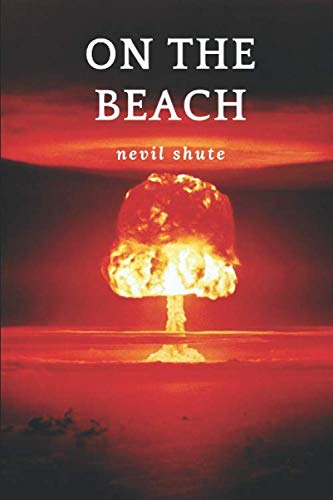
ABC News The Conversation / By Alexander Howard, 23 Jul 23
“……………………………….. the nuclear threat is still very much at the top of our collective mind.
The Sydney Theatre Company is staging the very first stage adaptation of Shute’s novel “On the Beach”. And Oppenheimer, one of 2023’s two most-hyped films, tells the story of the man referred to as “the father of the atomic bomb”.
‘Australia’s most important novel’
Journalist Gideon Haigh calls On the Beach “arguably Australia’s most important novel — important in the sense of confronting a mass international audience with the defining issue of the age”.
British-born Shute emigrated in 1950 to Australia, where he lived outside Melbourne. As well as writing novels, he worked as an aeronautical engineer.
The title of On the Beach — which started life as a four-part story called The Last Days on Earth — ostensibly referred to a Royal Navy expression for reassignment. (Shute spent time in the Royal Naval Reserve during World War II.) However, as readers of Eliot’s poetry will know, the phrase also appears late in The Hollow Men:
In this last of meeting places
We grope together
And avoid speech
Gathered on this beach of the tumid river.
As in Eliot’s poem, the characters that cluster together in the pages of Shute’s novel, set in and around Melbourne between 1962 and 1963, tend on occasion to avoid speech…………………………
The reason why the guests at Peter’s party are so keen to avoid serious talk is both simple and depressing. They are trying very hard to forget that they are all going to be dead from radiation poisoning in a matter of months.
Shute brings the reader up to speed after the dinner party wraps up. A massive nuclear war has devastated the entire northern hemisphere, wiping out all forms of life there. And the radioactive fallout generated during the conflict is now creeping — slowly but surely — into the southern hemisphere.
Shute makes it clear there is absolutely nothing anyone can do about this. In tonally dispassionate prose, he reveals that vast swathes of Australia have already been rendered uninhabitable due to radiation poisoning. The only thing the characters who remain can do is wait.
…………………………………………………………………………… This is the way Shute’s novel of nuclear extinction ends: not with a bang but with a whimper. Released at the height of the Cold War, On the Beach struck a chord with millions of concerned readers.
………………………………………………………………………Shute’s didactic inclinations are evident towards the end of the novel. “Peter,” the character Mary asks, “why did this all this happen to us?” Even at this late stage, Mary, whose radiation-racked body is spasming uncontrollably, wants to know whether things might have panned out differently. Her husband’s reply is revealing:
“I don’t know … Some kinds of silliness you just can’t stop,” he said. “I mean, if a couple of hundred million people all decide that their national honour requires them to drop cobalt bombs upon their neighbour, well, there’s not much that you or I can do about it. The only possible hope would have been to educate them out of their silliness.”
………………………..While the science in the novel was somewhat flawed, Shute’s cautionary tale undoubtedly spoke to the collective zeitgeist.
………………………………………………..
Shute’s vision of humanity’s self-inflicted destruction is eerily resonant in our time of climate emergency. The nuclear threat remains, too, in our perilous historical moment of democratic backsliding and failing nuclear states.
It seems increasingly likely the world as we know it is coming to an end — if it hasn’t already. The question remains: will it be with a bang or a whimper?
On The Beach runs at the Sydney Theatre Company July 24 to August 12, 2023, with previews July 18–21. https://www.abc.net.au/news/2023-07-23/nevil-shute-on-the-beach-nuclear-annihilation-hot-button-issue/102621052
‘Oppenheimer’ is a pitch-dark American nightmare. We cannot look away.
America – the Jesuit Review, Ryan Di Corpo, July 21, 2023
Shortly after Little Boy detonated over the morning sky of Hiroshima—choking the city with a plume of dense smoke, scorching the landscape with the white heat of the sun and in a moment banishing tens of thousands of civilians to nothing more than a memory—the 37-year-old Jesuit missionary Pedro Arrupe made his way to the wreckage.
The Basque priest, then appointed as novice master in Hiroshima, had seen the inside of a prison cell years earlier when some Japanese officials wrongly pegged him as a spy. He considered his execution to be a definite possibility, but spared an untimely death, he survived to see Hiroshima transformed into one of history’s largest cemeteries. Father Arrupe wrote that the American bomb exploded “similar to the blast of a hurricane,” and described the scene on the ground.
“I shall never forget my first sight of what was the result of the atomic bomb: a group of young women, 18 or 20 years old, clinging to one another as they dragged themselves along the road.…We did the only thing that could be done in the presence of such mass slaughter: we fell on our knees and prayed for guidance, as we were destitute of all human help.”
In its singular focus on the New York-born, Harvard-educated “father of the atomic bomb” J. Robert Oppenheimer, a man both ridiculed for his past and haunted by the future he unleashed, director Christopher Nolan mostly forgoes graphic depictions of the bombings’ aftermath and leaves the audience to envision the human misery wrought by the nuclear strikes. Perhaps taking a cue from the French filmmaker Robert Bresson, who found that “art lies in suggestion,” Nolan asks the audience to imagine the true face of the monster without fully revealing its form.
A heady, visually arresting and ultimately terrifying tour de force, “Oppenheimer” is both a startling re-examination of American history through the piercing eyes of a man who shaped it and a bleak warning about the nuclear age. Shifting between blazing color and stark black-and-white cinematography, the film is bifurcated by Oppenheimer’s leadership of the Manhattan Project, the clandestine government program to build the world’s first atomic weapon, and an infamous 1954 security hearing that saw Oppenheimer railroaded by McCarthyites for his prior left-wing sympathies.
Once venerated as an American sun god who helped usher his country out of World War II, Oppenheimer was later banished from government work for his onetime interest in communist ideology. Cillian Murphy, in an astounding performance as a man convinced of his own greatness and then tortured by his conscience, plays Oppenheimer as a self-assured, remote and intensely clinical physicist firmly committed to his work—and not much else. In the lab, at parties and in the bedroom, he wields his gaunt and nearly gothic visage as a barrier between his public confidence and increasingly unsettling private doubts. He wears a mischievous look, a gleam in his eye, as if perpetually on the verge of some “Eureka!” moment………………………………………………………………………….
In the film’s most disturbing sequence, Oppenheimer addresses a rabid crowd of patriotic Americans after the bombings, whipping them into a nationalistic frenzy and anointing himself as the man who quenched their bloodlust. “I bet the Japanese didn’t like it!” he exclaims to wild cheers and applause. But as he speaks, the sound cuts out and the crowd is suddenly suffocated by a white light. He sees a vision of a young woman (played by Nolan’s daughter) with her face peeling off, and then looks down to see his foot smashed through the charred remains of a bomb victim. He leaves the speech pallid and conscience-stricken.
…………………………………………………………………………. “Oppenheimer” arrives at a moment where concerns over nuclear power are back in the news.
………………………………………. There are two sides that form the film’s moral conundrum. The Pentagon and some scientists at Los Alamos contend that the atomic bomb must be used (and used repeatedly) to avoid further American casualties and bring a definitive end to the war. Critics opposed to the bomb point out that, by the spring of 1945, Hilter is already dead and the Japanese are poised to surrender………………………………………………………………………… https://www.americamagazine.org/arts-culture/2023/07/21/oppenheimer-nuclear-war-245720?utm_source=piano&utm_medium=email&utm_campaign=2928&pnespid=tKRjWX9aLbgL1qLZojqyGZWP5w2vX5cmduPg27M2rRxmOVvkgFko42gAhR.7PsVTW8PcIjUblQ—
What We Can Still Learn From J. Robert Oppenheimer
“We believe,” he wrote in 1945, “that the safety of this nation—as opposed to its ability to inflict damage on an enemy power—cannot lie wholly or even primarily in its scientific or technical prowess.”
By Robert C. Koehler / Common Dreams, July 21, 2023
Amere 55 years after his death, the U.S. government has restored J. Robert Oppenheimer’s security clearance, which the Atomic Energy Commission had taken away from him in 1954, declaring him to be not simply a communist but, in all likelihood, a Soviet spy.
Oppenheimer, of course, is the father of the atomic bomb. He led the Manhattan Project during World War II, which birthed Little Boy and Fat Man, the bombs we dropped on Hiroshima and Nagasaki in August 1945, killing several hundred thousand people and ending the war. What happened next, however, was the Cold War, and suddenly commies—our former allies—were the personification of evil, and they were everywhere. The American government, in its infinite wisdom, knew it had no choice but to continue its nuclear weapons program and, for the sake of peace, put the world on the brink of Armageddon.
Hello, H-bomb!
War, the building block of the world’s governmental entities for uncounted millennia, had evolved to the brink of human extinction. Official government policy amounted to this: So what?
Oppenheimer challenged this official policy and shattered his career. Indeed, he saw immediately, as the newly developed bomb was tested at Alamogordo, New Mexico, on July 16, 1945, that Planet Earth was in danger. A team of physicists had just exposed its ultimate vulnerability and he famously noted, as he witnessed the mushroom cloud, that words of Hindu scripture from the Bhagavad-Gita entered his mind: “Now I am become Death, the destroyer of worlds.”
He had not opposed dropping the bombs on Hiroshima and Nagasaki, as some of the Manhattan Project scientists, such as Leo Szilard, did, but when the war ended he became deeply committed to eliminating all possibility of future wars. One of the first actions he took, a week after the bombings, was to write a letter to Secretary of War Henry Stimson, urging him to embrace common sense regarding further development of nuclear weapons.
“We believe,” he wrote, “that the safety of this nation—as opposed to its ability to inflict damage on an enemy power—cannot lie wholly or even primarily in its scientific or technical prowess. It can be based only on making future wars impossible. It is our unanimous and urgent recommendation to you that, despite the present incomplete exploitation of technical possibilities in this field, all steps be taken, all necessary international arrangements be made, to this one end.”
Making future wars impossible! What if American political forces had sufficient sanity to listen to Oppenheimer? Several months after writing this letter, he paid a visit to President Harry Truman, attempting to discuss the placement of international control over further nuclear development. The president would have none of that. He kicked Oppenheimer out of the Oval Office.
Oppenheimer maintained his commitment to the transcendence of war, working with the Atomic Energy Commission to control the use of nuclear weapons—and standing firm in his opposition to the creation of the hydrogen bomb. He continued his opposition even as the bomb’s development progressed and nuclear tests began spreading fallout over “expendable” parts of the world. But, uh oh. Along came the McCarthy era and the accompanying Red Scare.
…………………………………………………………………. It took them about 16 years. They finally succeeded in clearing his name.
And while I applaud their enormous effort and its result, I also note it isn’t finished yet. This is more than simply a personal matter: the righting of a bureaucratic wrong done to one man. The future of humanity remains at stake. The U.S. government has spent multi-trillions of dollars on nuclear weapons development over the years, conducted a thousand-plus nuclear tests, and is currently in possession of 5,244 nuclear warheads, out of an insane global total of some 12,500. Perhaps it’s time to start listening to—and hearing—Oppenheimer’s words. https://scheerpost.com/2023/07/21/what-we-can-still-learn-from-j-robert-oppenheimer/
 | |||
| |||
Anti-nuclear groups welcome Oppenheimer film but say it fails to depict true horror

UK campaigners hope movie will draw attention to ‘real and present danger’ posed by atomic weapons
Guardian, Rachel Hall 21 July 23
Strips of translucent, flesh-toned material tear off a woman’s face in one of the closing scenes of Oppenheimer, the new film about the invention of the atomic bomb. She represents its victims in Hiroshima and Nagasaki, whose skin was burned off in the blast.
Yet the reality in Japan was far more gruesome than the artful depiction in the film, which skirts around the human suffering caused by the bomb.
Instead, the blockbuster movie from director Christopher Nolan is a pacy look at the scientific quest led by the eponymous J Robert Oppenheimer in the US to build a nuclear weapon faster than the Nazis at the end of the second world war.
The film explores Oppenheimer’s moral quandary over his role in creating the most destructive weapon ever made, but nuclear disarmament campaigners fear its power to persuade people of the existential threat posed by nuclear arms may be diminished by its focus on scientific achievement.
“The overall impact of the film is unbalanced – people leave the theatre thinking how exciting a process it was, not thinking ‘God, this was a terrible weapon of mass destruction and look what’s happened today’,” said Carol Turner, a co-chair of the Campaign for Nuclear Disarmament’s London branch.
“The effect of the [Hiroshima and Nagasaki] blasts was to remove the skin in a much more gory and horrible way – in the film it was tastefully, artfully presented. There’s nothing wrong with that, but if you look at photographs of actual survivors and read accounts of what happened to them it was a very horrifying, gory death.”
She added that although it was historically accurate to portray Oppenheimer’s ethical doubts about his invention, and his subsequent persecution by the US government, in effect this turned him into the film’s hero.
Despite these reservations, Turner considers it positive that the film is drawing people’s attention to the “real and present danger” of nuclear weapons arising from the Russia-Ukraine war, especially at a time when there is limited public discussion, for example the comparative silence around the storage of US nuclear weapons in the UK, relative to the outrage of past decades.
…………………………………………………………………………….. [Nuclear weapons] are as out of control as the climate emergency is, but it’s just getting much, much less attention.” https://www.theguardian.com/world/2023/jul/21/anti-nuclear-groups-welcome-oppenheimer-film-fails-depict-true-horror
The Dynamics of War Insanity: NATO’s Ukraine Roulette
By Alfred de Zayas / CounterPunch https://scheerpost.com/2023/07/20/the-dynamics-of-war-insanity-natos-ukraine-roulette/
Deliberate provocations of a nuclear rival, coups d’état, colour revolutions, broken promises, broken treaties, escalation of tensions, demonization, invective, double-standards — all this while asserting adherence to international legal norms and playing innocent about our aggressions, our violations of the Hague and Geneva Conventions, of articles 1(2)[1], 2(3)[2], 2(4)[3] and 39[4] of the UN Charter.
Abrams tanks, Leopard tanks, F-16, indiscriminate weapons, depleted uranium, cluster bombs. Summits illustrate how the moral compass of the collective West is lost in the avalanche of fake news[5], fake history, fake law, bellicose rhetoric, media hyperbole, serial mobbing of dissenters, persecution of whistleblowers, censorship. The Western binary mindset continues to divide the world into good and bad countries, democracies and autocracies. There is little room to accommodate a comprehensive picture of the pre-history, root causes of conflicts, and nuances. One observes an almost total absence of a sense for proportions.
The Global Majority in Latin America, Africa and Asia is increasingly alarmed by the surrealistic spectacle of a collective West that seems out of control, developing its own lethal dynamic, displaying a paroxysm of Russophobia and Sinophobia, incitement to hatred, cancel culture, refusal to entertain serious dialogue, doubling-down on eschatological demands. Many non-Western thinkers and politicians are articulating justified warnings that the on-going intestinal conflicts in the West are adversely impacting the economies of third-world countries and may ultimately result in Apocalypse for the entire planet. The West is not playing the classical Russian roulette – it has developed its own version: Ukrainian roulette, compulsive apocalyptic vabanque.
Meanwhile the Western media, notably Reuters, AP, CNN, Fox, New York Times, Washington Post, BBC, Le Monde, Figaro, FAZ, der Spiegel, even the Swiss NZZ ensure the daily indoctrination doses for the Western public, purveying skewed narratives that repeat and embellish what Washington and Brussels ordain, blithely ignoring other views and perspectives and the principle audiatur et altera pars. Freedom of the media in the collective West seems to mean the right to repeat NATO narratives ad nauseam, even when they have been proven wrong. This “freedom” also includes the freedom to ignore every critical voice about NATO and to refrain from asking critical questions at NATO press conferences.
Putting the Nuclear Genie Back in the Bottle
CounterPunch, BY KARL GROSSMAN 18 July 23
With the film Oppenheimer opening in theatres on Friday and being widely heralded by media, and this past Sunday the 78th anniversary noted of the first explosion of a nuclear device, and, so importantly, the Treaty on the Prohibition of Nuclear Weapons becoming international law, the time for putting the nuclear genie back in the bottle has arrived with great timeliness and strength.
Can it be done? Can nuclear weapons be abolished?
Yes.
Consider what the world did in the wake of World War I when the terrible impacts of poison gas had been tragically demonstrated. Mustard gas, chlorine gas, phosphene gas killed thousands on both sides of the conflict. Thereafter, the Geneva Protocol of 1925 and the Chemical Weapons Convention of 1933 outlawed chemical warfare, and to a large degree the prohibition has held.
This month The New York Time ran a front-page story headlined: “Toxic Arsenal Nears Its End, Decades Later.” The July 6th article began: “In a sealed room behind…armed guards and three rows of high barbed wire at the Army’s Pueblo Chemical Depot in Colorado, a team of robotic arms was busily disassembling some of the last of the United States’ vast and ghastly stockpile of chemical weapons. In went artillery shells filled with deadly mustard agent that the Army had been storing for 70 years. The bright yellow robots pierced, drained and washed each shell, then baked it at 1,500 degrees Fahrenheit. Out came inert a harmless scrap metal, falling off a conveyer belt into an ordinary brown dumpster with a resounding clank.”
The article continued: “’That’s the sound of a chemical weapon dying,’ said Kingston Rief, who spent years pushing for disarmament outside government and is now deputy assistant secretary of defense for threat reduction and arms control. He smiled as another shell clanked into the dumpster. The destruction of the stockpile has taken decades, and the Army says the work is just about finished.”
“They were a class of weapons deemed so inhumane that their use was condemned after World War I, but even so, the United States and other powers continued to develop and amass them,” said the piece.
The Treaty on the Prohibition of Nuclear Weapons, adopted by the United Nations in 2017—with 122 nations in favor—and entered into force in January 2021 can be the nuclear counterpart to the chemical weapons genie being, at long last, put back in the bottle.
…………………………………………………………………………………………………. “Let’s eliminate these weapons before they eliminate us,” said UN Secretary-General Antonio Guterres, the former prime minister of Portugal, at the conclusion last year of a “Political Declaration and Action Plan” for implementation of the Treaty on the Prohibition of Nuclear Weapons—“important steps,” he said, “toward our shared goal of a world free of nuclear weapons.” Guterres said that with 13,000 nuclear weapons still held across the globe, “the once unthinkable prospect of nuclear conflict is now back within the realm of possibility.”
“In a world rife with geopolitical tensions and mistrust, this is a recipe for annihilation. We cannot allow the nuclear weapons wielded by a handful of States to jeopardize all life on our planet,” he said. “We must stop knocking at doomsday’s door.”
Recently I did a TV program with Seth Shelden, a professor of law, an attorney, and UN liaison for the International Campaign to Abolish Nuclear Weapons which received the Nobel Peace Prize in 2017. The Treaty on the Prohibition of Nuclear Weapons was passed at the UN that year much due to the work of ICAN……………………………………. You can view the program by visiting www.envirovideo.com
The treaty declares that because of the “catastrophic humanitarian consequences that would result from any use of nuclear weapons, and recognizing the consequent need to completely eliminate such weapons, which remains the only way to guarantee that nuclear weapons are never used again under any circumstances,” nations agree not to “develop, test, produce, manufacture, otherwise acquire, possess or stockpile nuclear weapons.” Further, no country may “threaten to use” them.
Asked about the lack of coverage by media of the treaty creating a nuclear weapons-free world, and thus so few people being aware of it, Shelden points to “myopic framing” by media. He cites how long it took “for journalists to accept that there were not two sides to the climate crisis.” The horrendous impacts of nuclear weapons, “like the climate crisis, even more so, is a very black-and-white issue,” he says. Shelden notes that the abolition of nuclear weapons has been a focus of the UN since its formation, the subject of its first resolution. He discusses the years of work that have led to the treaty.
ICAN says: “The release of the Oppenheimer film, and the wave of (media) attention surrounding it, creates an opportunity to spark public attention on the risks of nuclear weapons and invite new audiences to get involved in the movement to abolish nuclear weapons. We can educate about the risks, and share a much-needed message of hope and resistance: Oppenheimer is about how nuclear weapons began, the UN Treaty on the Prohibition of Nuclear Weapons (TPNW) is how we end them. That is why we have put together some resources for all ICAN campaigners—or anyone who is willing to take action—to use at local theatres around the world or to join the conversation online!”
Shelden of ICAN on my Envirovideo TV program also has many suggestions for action.
The Nuclear Age Grimly Descends in “Oppenheimer”
Christopher Nolan’s somber biopic is the antithesis of summertime studio popcorn.
Vanity Fair BY RICHARD LAWSON, JULY 19, 2023
The director Christopher Nolan has never told a true story. His 2017 war film, Dunkirk, dealt with real things, but Nolan’s work has largely been less about people than about the spectacle swirling around them, the awe and terror they experience as reality bends and new consciousness blooms. (He’s also made some Batman movies.) Which perhaps makes J. Robert Oppenheimer, the so-called father of the atomic bomb, a perfect subject for Nolan’s first venture into fact-based character drama. (Opening on July 21.)
…………………………..the sorry horror at the center of Oppenheimer’s story: that his particular genius, his avid and productive curiosity about the nature of life and its surroundings, could be fashioned into a weapon.
…………………. we get to know our subject—first as a brilliant but troubled student, then as a respected academic, and finally as the main architect of perhaps the worst invention of all time.
…………………………………….At its best, Oppenheimer is a bracing wonder of heavy talk and ticking-clock suspense. As played by Cillian Murphy, Oppenheimer is a commanding, eerie figure—haughty and saturnine, haunted and consumed. His political conflicts—a dabbler in Communism and an avowed progressive, Oppenheimer was often regarded suspiciously by military and governmental brass—are nestled convincingly alongside his personal struggles.
…………………………………………… Oppenheimer is not a film that exists to demonstrate the might of the bomb. It is more of a fraught character piece than perhaps the advertising has suggested, as concerned with what happened to Oppenheimer after the war as it is with what he built during it. The film uses a framing device to hold Oppenheimer’s story in historical context: a security hearing that took place in 1954, when Oppenheimer’s enemies had him stripped of his security clearance, effectively removing him from government for the sin of questioning the advancement of the US nuclear weapons program.
………………………..Oppenheimer has the temerity to be a drama of ideas staged on a massive scale, at a time when such things are out of vogue. ……………. more https://www.vanityfair.com/hollywood/2023/07/oppenheimer-christopher-nolan-review
1 This Month
19 February – VIRTUAL EVENT-Decision Time: AI and Our Nuclear Arsenal
12:45 p.m. Central / 1:45 p.m. Eastern
To see nuclear-related stories in greater depth and intensity – go to https://nuclearinformation.wordpress.com
-
Archives
- February 2026 (127)
- January 2026 (308)
- December 2025 (358)
- November 2025 (359)
- October 2025 (376)
- September 2025 (258)
- August 2025 (319)
- July 2025 (230)
- June 2025 (348)
- May 2025 (261)
- April 2025 (305)
- March 2025 (319)
-
Categories
- 1
- 1 NUCLEAR ISSUES
- business and costs
- climate change
- culture and arts
- ENERGY
- environment
- health
- history
- indigenous issues
- Legal
- marketing of nuclear
- media
- opposition to nuclear
- PERSONAL STORIES
- politics
- politics international
- Religion and ethics
- safety
- secrets,lies and civil liberties
- spinbuster
- technology
- Uranium
- wastes
- weapons and war
- Women
- 2 WORLD
- ACTION
- AFRICA
- Atrocities
- AUSTRALIA
- Christina's notes
- Christina's themes
- culture and arts
- Events
- Fuk 2022
- Fuk 2023
- Fukushima 2017
- Fukushima 2018
- fukushima 2019
- Fukushima 2020
- Fukushima 2021
- general
- global warming
- Humour (God we need it)
- Nuclear
- RARE EARTHS
- Reference
- resources – print
- Resources -audiovicual
- Weekly Newsletter
- World
- World Nuclear
- YouTube
-
RSS
Entries RSS
Comments RSS
 nuclear-news