Award-winning Australian film-maker David Bradbury detained in India (he exposed India’s repression of its peaceful anti-nuclear activists).
The police used riot tactics and baton charges, mace and teargas to bludgeon the good people of Indinthakarai into submission. Which is the situation today. They are too scared to come out of their homes in mass protest. The Government of India, of Prime Minister Modi has become a terrorising state of its own people.

David Bradbury 14 September 24
I flew from Bangkok to Chennai Tuesday night with my two children – Nakeita Bradbury (21) and Omar Bradbury (14).
We all have visas issued by the Indian Govt in Australia before we left Sydney, last Saturday, Sept 7th.
After three days in Bangkok we flew to Chennai to begin what was to be a family holiday to remember: five major tourist destinations in two weeks.
Accommodation and internal flights (non refundable…) booked in advance in several locations.
(In Bangkok I showed my latest doco – a tribute to Neil Davis who was tragically killed in a 24 hour coup in Bangkok 39 years ago. Death is a Lady was shown at the Foreign Correspondents Club and we raised $Aust407 for the children of Gaza).
Arriving at Immigration counter at Chennai airport, my two children got their passports stamped and were able to go through no problem. When it came my turn, the perplexed official had to call for help as he laboured over his computer terminal.
Putting in my details had obviously triggered alarm bells. He called for his Supervisor who similarly winced as he looked over his shoulder. It was
2am in the morning. My kids waited patiently on the ot her side of the glass barrier between us.
Eventually I was told it would not be possible for me to enter India. I asked why not? I had a legitimate visa I told them.
And my kids were on the other side of the barrier separating us.
We were here on a family holiday we’d planned and saved for many months. With the usual Indian courtesy of avoiding the question:
‘Why not? What is wrong with my visa..?’
My kids were on one side of the border…and I was on this side. I could not join them. As they waved sadly, reluctantly Goodbye to me, I was led off down a corridor to a small room with high ceilings. Pretty disgusting room with papers and rubbish on the floor under a bed which had a filthy mattress on it, no sheets. A metal grill window that looked out to a blank corridor wall.
Occasionally a guard would come and stare through it at me.
During the course of the rest of the day and into the night various Immigration
Plainclothes police would come and interrogate me. What was I doing in India? What did I do here before in previous visit in 2012? Who did I know here in India and who have you been talking to before I came to India this time. Can you open up your phone and give it to us, please? Can we have their phone number?
I was cold and asked for my long trousers and socks which were in my suitcase and some medication I was taking for an enlarged prostrate. They never got them for me, only an hour before they forced me back onto the flight to Bangkok. My bag still hasn’t arrived here in Bangkok.
I asked if I could make a phone call to the Australian embassy in Delhi but that request was ignored.
As the plane took off from Chennai yesterday morning for Bangkok at 1.30am, it hurt my world weary heart to accept being separated from my kids and our plans to have a grand tour of the Indian subcontinent which included going to Varanasi to show my Omar how Hindus deal with death and farewelling their loved ones into the next life.(Omar lost his mum, my wife to breast cancer five months ago. We both feel strongly attached to each other).
What had caused the cancellation of my Indian Visa? Over the course of the afternoon and being interrogated by Indian Immigration plainclothes, I quickly concluded the Indian Govt had not forgiven me for writing an article for my local newspaper back in Australia and daring to enter a ‘No-go’ zone for both Indian national press and foreign media like myself in 2012.
Back then after I’d done my duties on the jury of the Mumbai International film festival, with wife Treena (Lenthall) and son Omar, then aged 3, we went and stayed in a small fishing village on the southern most tip of India. At a village called Indinthakarai where thousands of locals led by Dr Udayakamur, Catholic priests and nuns. Since the 1980’s the good fisherfolk of Indinthakarai had maintained a David and Goliath struggle against the pro-nuclear designs of the central Govt in far away New Delhi.
These people embraced Treena, Omar and I because we felt for them in their struggle against the central Government 3,000kms away in New Delhi who had run roughshod over their rights and their community. We lived in the village for the next two weeks and filmed their everyday lifestyle, their fishing in the ocean which their livelihood depended upon. I interviewed their leaders on why they were so upset with the Government. One of them, a wonderful man called Dr Udayakamur stood out. He told me why they were determined to keep on with their struggle.
It was because their Government had signed a very dodgy deal with the Russians to build six nuclear powers plants on top of a major earthquake fault line. That faultline right where a cabal of corrupt senior Indian politicians and senior bureaucrats had signed the contract with the Russians had seen 1,000 villagers swept to their deaths when the 2004 Boxing Day tsunami hit.
He told me on camera how the humble fisherfolk of Idinthakarai
whose ancestors had ploughed the ocean for millennia;
How the Delhi Govt refused to have any community consultation and refused repeated requests by the people of Indinthakarai to be given access to environmental assessment reports.
Dr Udayakamur is an earnest practitioner of Gandhi’s non violent protest actions to effect Change.
The locals under Dr Uday staged sit-down protests where they buried their bodies in the sand up to their necks on the foreshore where the nuclear plants were being built. Thousands of people marched into the sea out front of the power plants defying police orders.
In the end their actions were in vain. The police used riot tactics and baton charges, mace and teargas to bludgeon the good people of Indinthakarai into submission. Which is the situation today. They are too scared to come out of their homes in mass protest. The Government of India, of Prime Minister Modi has become a terrorising state of its own people.
Dr Uday faces 58 criminal charges which includes ’Sedition’. He faces many years in gaol and long years before that in drawn out court proceedings. It has taken its toll on his health and his family.
All this happening out of sight of reporter’s notebooks and cameras in the world’s largest ‘Democracy’.
Don’t Be Bamboozled by Nuclear Power

by Prerna Gupta, https://www.counterpunch.org/2024/09/13/dont-be-bamboozled-by-nuclear-power/
In the face of a complex and urgent problem like climate change, it’s tempting to believe in simple solutions. Just as detox teas or diet pills claim to solve health issues that truly require lifestyle changes, nuclear energy has been marketed as a quick fix for the socio-political problem that climate change is. It’s presented as an essential part of the climate solution, yet, like many health fads, it is both ineffective and harmful. Today, nuclear energy is being pushed in the form of Small Modular Reactors (SMRs)—touted as the latest technological miracle.
Jan Haaken’s latest documentary, Atomic Bamboozle, pulls back the curtain on this techno-fantasy, revealing SMRs for what they truly are: old wine in a new bottle. Haaken, a seasoned filmmaker who has tackled climate action in her recent Necessity films, unravels the fantastic narrative surrounding SMR propaganda through humor, expert testimony, and a rich history of grassroots resistance.
Haaken intersperses the industry’s lofty claims with a systematic critique from nuclear expert M. V. Ramana, who debunks the promises of SMRs. Despite their high-tech veneer, these reactors are burdened by the same issues that have long plagued the nuclear industry: exorbitant costs, proliferation risks, risk of catastrophic accidents, and the unresolved nightmare of nuclear waste. The arguments presented concisely here are expanded upon in Ramana’s recent book, Nuclear is Not the Solution: The Folly of Atomic Power in the Age of Climate Change, which offers a comprehensive critique, demonstrating that nuclear energy is neither a desirable nor feasible solution to the climate crisis.
Haaken then draws our attention to the troubled legacy of nuclear power through the resistance to the Trojan Nuclear Power Plant and the ongoing pollution at the Hanford Site. Voices like Lloyd Marbet, a key figure in the Trojan resistance, highlight the dangers inherent in nuclear projects and the struggle to hold industry accountable. Marbet recalls the safety issues surrounding Trojan, such as cracks in its steam generators and the mounting costs required to address them—which eventually led to its shutdown. Meanwhile, First Nations advocates like Cathy Sampson-Kruse and Dr. Russell Jim emphasize the environmental devastation caused by the Hanford Site. The Yakama Nation, along with other activists, have been fighting tirelessly to protect their land and the Columbia River from contamination, underscoring the toxic legacy that still requires cleanup decades later.
Haaken expertly contrasts these real-world examples of nuclear disasters with the glossy, futuristic promises of SMRs as a “clean, green” energy source. This juxtaposition slices through the propaganda and traces the roots of the narrative back to the “Atoms for Peace” program. After the devastation of Hiroshima and Nagasaki, this initiative sought to rebrand nuclear technology as a “friend” to humanity – presenting nuclear power as a powerful genie that could be safely contained within the walls of a reactor. However, the nuclear industry’s legacy of pollution, which will take thousands of years to clean up, and catastrophic accidents like Fukushima demonstrate that this reassuring image is far from reality.
One of the most dangerous effects of technological quick fixes is their ability to obscure the power dynamics underlying climate issues. Big corporations and influential individuals hide behind technological solutions, deflecting attention from the required changes to a system that disproportionately benefits them. Haaken, therefore, makes a point to focus on billionaires like Bill Gates, who are promoting SMRs. In the video clip shown in the documentary Gates awkwardly plays down the issue of nuclear safety, while Ramana reveals a deeper irony: despite Gates’ immense wealth, even he relies on public funding to push forward these risky projects. Investors seem reluctant to gamble their own money on unproven technologies like SMRs, raising serious doubts about their viability.
This brings Haaken’s sharp yet accessible critique of nuclear energy to its full conclusion, succinctly captured in the film’s title—Atomic Bamboozle. The title itself exposes the latest SMR trend for what it truly is: a sales trick designed to siphon off your tax dollars, peddling an overpriced technology through confusing jargon and false promises.
The Sierra Club Grassroots Network Nuclear Free Team is concluding its first Nuclear-free Film Series with the powerful independent film, ATOMIC BAMBOOZLE: THE FALSE PROMISE OF A NUCLEAR RENAISSANCE. As political pressure mounts in the US to meet net zero carbon goals, the nuclear power industry makes its case for a nuclear “renaissance.” This documentary by NECESSITY Director Jan Haaken follows activists as they expose the true costs of the new small nuclear reactor designs.
Physicist MV Ramana on the problem with nuclear power

Lenore Taylor Editor, Guardian Australia, 5 Sept 24
Nuclear is costly, risky and slow, Ramana says. Why then, he asks in his new book, do governments still champion it?
You would be forgiven for thinking that the debate on nuclear power is pretty much settled. Sure, there are still some naysayers, but most reasonable people have come to realise that in an age of climate crisis, we need low-carbon nuclear energy – alongside wind and solar power – to help us transition away from fossil fuels. In 2016, 400 reactors were operating across 31 countries, with one estimate suggesting roughly the same number in operation in mid-2023, accounting for 9.2% of global commercial gross electricity generation. But what if this optimism were in fact wrong, and nuclear power can never live up to its promise? That is the argument the physicist MV Ramana makes in his new book. He says nuclear is costly, dangerous and takes too long to scale up. Nuclear, the work’s title reads, is not the solution.
This wasn’t the book Ramana, a professor at the University of British Columbia, planned to write. The problems with nuclear are so “obvious”, he wagered, they do not need to be spelled out. But with the guidance of his editor, he realised his mistake. Even in the contemporary environmental movement, which emerged alongside the anti-war and anti-nuclear movements, there are converts. Prominent environmentalists, understandably desperate about the climate crisis, believe it is rational and reasonable to support nuclear power as part of our energy mix.
But with a PhD in physics, and a previous book examining why India’s nuclear programme had not worked and would not work, Ramana is well versed in not just the moral but the technical and practical arguments against nuclear. He lays these out in his new work and then looks at what he originally set out to explore: why, despite the overwhelming evidence against nuclear, governments and corporations continue to invest in it.
When we speak online, he obligingly takes me through the problems in detail. It is gone 11pm in Canada, but Ramana, who is enthusiastic and affable, patiently and carefully explains why he thinks each justification I put to him is wrong.
Perhaps most urgently, the risks of nuclear are too great, he says. …………………………………………………………….
Though major malfunctions are rare, the likelihood of them happening is exacerbated by “extreme weather patterns due to climate change”, says Ramana, and cost-cutting measures made by companies that care primarily about the bottom line.
………………………“There’s a definite relationship between your exposure to radiation and cancer,” he says, adding that there is “no evidence” showing “that below a certain threshold, there is no risk of cancer”. “The absence of evidence,” he says, “is not evidence of absence.”
This is not how nuclear is sold to communities where plants are located, he says. What do government and industry tell a community, such as Wylfa on Anglesey (Ynys Môn), where there had been talk of building another nuclear plant? That there is a small chance – small but not zero – that there might be an accident that will mean you have to leave your home and potentially never come back? Or that it is completely safe? It is almost always the latter and that is simply not honest, he says. The safest assumption is that radiation, even at the lowest levels, is dangerous. This is true for waste, too, which remains radioactive for hundreds of thousands of years and cannot currently be safely managed in the longer term, meaning it could contaminate the biosphere at some point.
What about the argument that the industry provides jobs to people who need them, and could supply energy to so many around the world who currently go without? Who are we in the developed world to stand in the way of this? Nuclear creates fewer jobs than renewables per unit of energy generated, he says in the book, and when it comes to the latter, jobs are more geographically distributed. As for supplying vast amounts of energy globally, he sayd nuclear cannot be scaled up fast enough to “match the rate at which the world needs to lower carbon emissions” or to quickly provide to those without. It takes at least 15 to 20 years to plan for and build a nuclear plant and this would probably be much more difficult in the many countries that presently do not have the infrastructure for it.
Finally, Ramana is keen to point out that the nuclear energy industry only survives because of government support. ……………………………………….
A key reason governments sink so much money into nuclear is because of how tightly bound up it is with nuclear weapons, which ostensibly guarantee a country’s security and strength,……………………
But where nuclear is not up to the task, renewables are, says Ramana, pointing to the statistics. The share of global energy produced by nuclear reactors is down from an estimated 16.7% in 1997 to 9.2% in 2022, largely owing to cost and the slow rate of deployment. Meanwhile, in the first half of 2024, wind and solar generated 30% of all of the EU’s electricity, narrowing the role of fossil fuels. The International Energy Agency suggests that by 2028, renewable energy sources will account for over 42% of global electricity generation. more https://www.theguardian.com/environment/article/2024/sep/04/mv-ramana-why-nuclear-power-not-solution-energy-needs
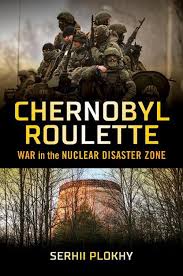
Chernobyl Roulette by Serhii Plokhy review – gripping account of wartime chaos at Ukraine’s nuclear plant
Luke Harding, Mon 2 Sep 2024, https://www.theguardian.com/books/article/2024/sep/01/chernobyl-roulette-by-serhii-plokhy-review-gripping-account-of-wartime-chaos-at-ukraines-nuclear-plant
The Ukrainian historian compellingly chronicles the singular courage and selflessness of atomic power station employees held hostage by Russian troops in 2022
Luke Harding, Mon 2 Sep 2024
On 24 February 2022, workers at the Chornobyl nuclear power station in Ukraine woke to the sound of explosions. A battle was going on, not far from the contaminated exclusion zone. By late afternoon, the Russians had arrived. A column of military vehicles pulled up at a checkpoint and an officer got out. Moscow, he said, was now in charge.
The plant’s 300 personnel – specialist operators and firefighters, plus troops from Ukraine’s national guard – became prisoners. Over the next few weeks, they kept the station’s systems going, working in cramped conditions and living side by side with their armed Russian masters. The enemy had invaded from Belarus. Its main force trundled onwards towards Kyiv.
Chernobyl Roulette by the Ukrainian historian Serhii Plokhy is a gripping account of the extraordinary events inside the plant (Plokhy spells the power station with an “e”). It is a tale of bravery and selflessness, reminiscent of the sacrifice demonstrated by the Chornobyl employees who went through the 1986 nuclear disaster, when reactor No 4 blew up. Some of those on duty in 2022 were involved in the original Soviet-era clean-up.
They included Valentyn Heiko, the 59-year-old shift foreman who was taken hostage with his colleagues. He proved to be a subtle and resilient leader. Heiko met the Russian commanders and told them they would have to follow Ukrainian safety rules and behave in a “civilised manner”. If they didn’t, he promised to unleash a radiation incident, killing them and everyone else. This was blackmail. And a bluff. It worked.
According to Heiko, some of the Russians were polite and rational. About a third of the soldiers, though, were brainwashed and often drunk. The occupiers moved into the fourth floor of the administration building. The station got crowded. There was a shortage of food, cigarettes and razors. The captive nuclear operators – unable to go home to the nearby town of Slavutych – grew beards and puffed on butts.
There were small acts of resistance. Liudmyla Kozak – one of 17 imprisoned women – refused a demand to wear a white armband. The Russians warned her she might be shot. Kozak found a white medical cap, embroidered it with a blue and yellow patch and wore that instead. An order was given to turn off the radio, which brought news of the Russian army’s setbacks around Kyiv. Staff switched it on anyway.
After three weeks, Heiko and his stressed and exhausted workmates could scarcely function. Astonishingly, 46 colleagues volunteered to replace them. The old shift exited the plant, travelled by bus through Belarus and crossed the Dnipro River in a fishing boat. Heiko carried the station’s Ukrainian flag with him. The new team went in the same way – uncertain if or when they would return.
The Kremlin’s occupation of the nuclear plant was an act of astounding recklessness. Soldiers dug trenches in the red forest, one of the world’s most toxic places. It is unclear if they suffered lasting health damage, their heads “full of sawdust”, as one gleeful Ukrainian official put it. Plokhy suggests this might be wishful thinking. Overall, though, radiation levels went up, as thousands of tracked Russian vehicles churned up deadly dust.
In the south of the country, meanwhile, another Russian unit captured the Zaporizhzhia nuclear power station, Europe’s biggest. The attackers fired rocket-propelled grenades at civilian infrastructure and damaged a reactor. Two and a half years on, the Russians are still there. Its turbine halls are stuffed with military kit and weapons. From the territory, they regularly bombard nearby Ukrainian towns with Grad missiles.
Last month, Russian soldiers started a fire in a cooling tower – an apparent warning, after Ukraine’s surprise counter-invasion of Russia’s Kursk region. Since the beginning of Moscow’s all-out attack, Vladimir Putin and his minions have issued a string of mass destruction threats directed at Kyiv and the west. State TV hosts talk about nuking London, Berlin and Paris.
The Chornobyl 2 story at least had a happy ending. On 30 March 2022, Russian servicemen fled north, as part of a pull-out from the Kyiv region. They departed with numerous items stolen from the plant: radiation dosimeters, computers and cars. In the town of Chornobyl, military looting parties carried off sacks of household goods. They even took ancient stuff: black-and-white TVs and video recorders.
The Ukrainian workers who put duty before personal survival narrowly averted another Chornobyl crisis. In Plokhy’s view, Moscow’s 2022 violent takeover of two atomic energy stations should serve as a “wake up call to the world”. It was, he argues, an act of nuclear terrorism carried out by a large nuclear power – a rogue one. The distinction between tactical nuclear weapons and civil nuclear facilities looks increasingly blurred, he says.
How the international community should respond to these alarming developments is less clear. Plokhy calls for a reform of the laws governing nuclear state behaviour and of the body that is supposed to administer them – the International Atomic Energy Agency (IAEA). When Russian tanks entered Chornobyl, the IAEA, led by Rafael Grossi, issued no condemnation of the Kremlin. Nor did it call on the occupiers to get out, appealing instead to “both sides”.
Plokhy is the author of several previous nonfiction books on Ukraine. These include Chernobyl: History of a Tragedy, which won the 2018 Baillie Gifford prize, and The Russo-Ukrainian War, an account of the conflict and its origins, published last year. Chernobyl Roulette is equally compelling. It salutes the singular men and women who stepped up – as their predecessors did before them – when protocols and governments failed.
“Dr Strangelove” – the 50th anniversary of this iconic nuclear film

THE HALF-CENTURY ANNIVERSARY OF “DR. STRANGELOVE” New Yorker, BY DAVID DENBY 14 May 14 “Mein Führer, I can walk!” screams Dr. Strangelove (Peter Sellers), the ex-Nazi nuclear scientist, rising from his wheelchair to salute the American President at the climax of “Dr. Strangelove or: How I Learned to Stop Worrying and Love the Bomb.” Stanley Kubrick’s satirical masterpiece is now a half century old (Film Forum will be playing a new 35-mm. print starting this Friday), and it remains as outrageously prankish, juvenile, and derisive as ever. Which, given the subject of nuclear annihilation, is exactly right. The movie is an apocalyptic sick joke: the demented general Jack Ripper (Sterling Hayden), who thinks the Commies are using fluoridation to destroy his bodily fluids (he withholds his essence from women), dispatches a group of B-52s loaded with H-bombs to destroy Soviet targets. President Merkin Muffley (Sellers again) tries to recall them; he even helps the Soviet Union to destroy some of the planes. But, after all sorts of misadventures, one B-52 gets through, setting off a Soviet-built Doomsday Machine—chained nuclear explosions assembled in a stunningly beautiful montage, accompanied by Vera-Ellen singing the tender ballad “We’ll Meet Again (Don’t Know Where, Don’t Know When).”……….
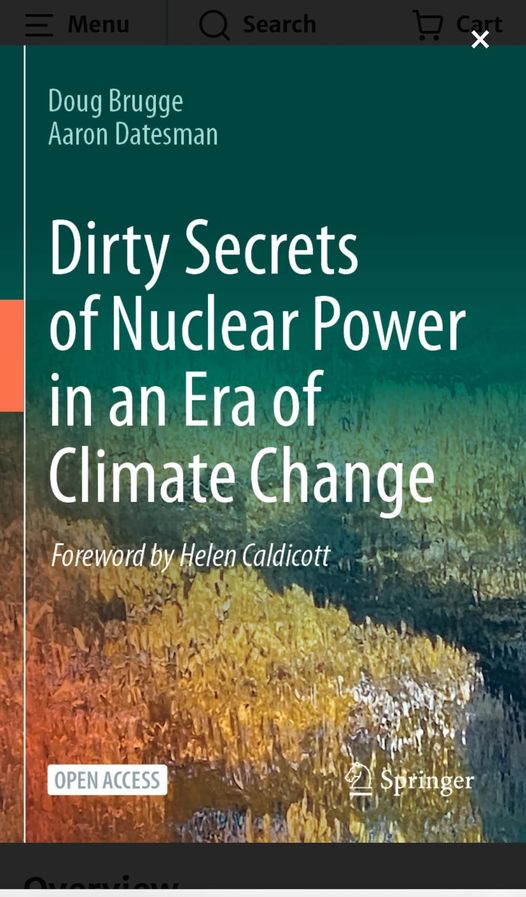
Book: Dirty Secrets of Nuclear Power in an Era of Climate Change
Book, Open Access
Overview
Authors: Doug Brugge , Aaron Datesman, https://link.springer.com/book/10.1007/978-3-031-59595-0
This book is open access, which means that you have free and unlimited access
Helps to understand the serious limitations and drawbacks to nuclear power
Conveys why nuclear power is a less than desirable option in terms of addressing climate change
Uses accessible and engaging language to appeal to a broad readership
About this book
This open access book provides a review of the serious limitations and drawbacks to nuclear power, and clearly conveys why nuclear power is a less than desirable option in terms of addressing climate change. It uses accessible and engaging language to help bring an understanding of the issues with nuclear power to a broader sector of the public, with the intention of appealing to non-scientists seeking knowledge on the disadvantages of nuclear power as a solution for climate change. The argument is made that while superficially appealing, nuclear power is too costly, fragile, and slow to implement, compared to alternative options such as wind and solar.
Dirty Secrets of Nuclear Power in an Era of Climate Change
Overview
Authors:
- Helps to understand the serious limitations and drawbacks to nuclear power
- Conveys why nuclear power is a less than desirable option in terms of addressing climate change
- Uses accessible and engaging language to appeal to a broad readership
- This book is open access, which means that you have free and unlimited access
- 1490 Accesses
- 23 Altmetric
About this book
This open access book provides a review of the serious limitations and drawbacks to nuclear power, and clearly conveys why nuclear power is a less than desirable option in terms of addressing climate change. It uses accessible and engaging language to help bring an understanding of the issues with nuclear power to a broader sector of the public, with the intention of appealing to non-scientists seeking knowledge on the disadvantages of nuclear power as a solution for climate change. The argument is made that while superficially appealing, nuclear power is too costly, fragile, and slow to implement, compared to alternative options such as wind and solar.
“As this book shows, to nowadays hold on to Nuclear Energy, a risky and extremely expensive method of create power, just does not make sense any longer.” — Prof. (em.) Andreas Nidecker, MD, retired academic radiologist, Basel, Switzerland
“Datesman and Brugge present evidence that nuclear power is an insecure and unsecureable technology, inherently incompatible with humanity and democracy; it fuels nuclear weapons technology and possession; choosing it would damage our chances at mitigating the climate crisis.” — Cindy Folkers, MS, Radiation & Health Specialist, Beyond Nuclear
“Although the government, industrial, and scientific nexus say it is safe.…I can only think of one word in Navajo “Ina’adlo'” meaning manipulation by the power that be to say it is safe. My Navajo people are dying from the uranium exposure on their health and environment. Great account of information on studies that have taken place around the world to say uranium is not good.” – Esther Yazzie, Navajo Interpreter and knowledge holder on Navajo issues.
“At a time when there is a call to triple the growth of nuclear power, Datesman and Brugge provide a timely and thorough examination of the dark-side of “romancing” the atom. With solid technical astuteness, they cover a wide field littered with unsolved and dangerous problems ranging from the poisoning of people and the environment to the failed economics, to the spread of nuclear weapons ….they point out how science and public trust have been corrupted by the lure of unfettered nuclear growth.” –Robert Alvarez, Associate Fellow at the Institute for Policy Studies in Washington, D.C.
NYT Uncritically Reported Israel’s Version of Golan Bombing

Despite multiple eyewitnesses describing an Israeli Iron Dome interceptor missile falling on the field during the time of the Majdal Shams strike (Cradle, 7/28/24), the New York Times insisted on spotlighting Israeli and US claims in its headlines, rather than genuinely assessing the facts on the ground.
FAIR, Bryce Greene and Lara-Nour Walton, 26 Aug 24
As the US-backed genocide in Gaza continues, US media assist in Israeli Prime Minister Benjamin Netanyahu’s plan to widen the war, parroting the words of the aggressor. A consequential example of US press support for escalation was Western media’s coverage of the July 27 strike that killed 12 Druze children on a soccer field near the town of Majdal Shams in the Israeli-occupied Syrian Golan Heights.
Israel and the US immediately blamed the Iran-backed Lebanese organization Hezbollah for the strike—citing Israeli intelligence reports of an Iranian Falaq-1 missile being found at the soccer field (BBC, 7/28/24).
But, in a move that Hezbollah expert Amal Saad called “uncharacteristic” (Drop Site, 7/30/24), the group adamantly denied responsibility for the attack. Saad, a lecturer in politics at Cardiff University, noted that targeting the Syrian Golan Heights—where many inhabitants are hostile towards Israel—would be “illogical” and “provocative” for Hezbollah. Further, if the organization had accidentally committed an attack, Saad pointed to a precedent of the group issuing a public apology in a case of misfire, with the organization’s leader, Hassan Nasrullah, visiting families of victims.
Despite multiple eyewitnesses describing an Israeli Iron Dome interceptor missile falling on the field during the time of the Majdal Shams strike (Cradle, 7/28/24), the New York Times insisted on spotlighting Israeli and US claims in its headlines, rather than genuinely assessing the facts on the ground.
On July 28, the Times published “Fears of Escalation After Rocket From Lebanon Hits Soccer Field,” pinning the blame squarely on Lebanon’s Hezbollah. The next day, reporting on the potential escalations, the Times headline (7/29/24) described the strike as a “Deadly Rocket Attack Tied to Hezbollah.”
While the July 29 subhead acknowledged that Hezbollah denied responsibility, the assertion in the headline undermined any reference to alternative explanations. Attribution to Hezbollah was then repeated without qualification in the first paragraph of the story.
Rebroadcasting government talking points not only does a disservice to newsreaders as Israel has a long history of misleading the public, but it also serves Netanyahu’s goals of justifying an escalation against Hezbollah. Predictably, the New York Times did not contextualize accusations of Hezbollah responsibility with information about Israel’s current objectives for wider war. This continues a long trend of US media outlets obscuring and distorting reality in order to downplay Israel’s aggressive regional ambitions (FAIR.org, 8/22/23).
Israel an unreliable source
The first problem is that the New York Times accepts narratives from Israeli military and government officials at face value. From peddling evidence-free claims about Palestinian use of human shields during Operation Cast Lead in 2009 (Amnesty International, 2009; Human Rights Watch, 8/13/09), to dodging responsibility for its assassination of Palestinian journalist Shireen Abu Akleh in 2022 (Al Jazeera, 5/22/22), to consistently attempting to conceal its use of illegal white phosphorus munitions across the Middle East (Haaretz, 10/22/06; Human Rights Watch, 3/25/09; Guardian, 10/13/23), the Israeli military has been known to circulate disinformation to the international public for decades. Neither in headlines nor in the text of its pieces does the Times acknowledge this well-established history.
The current assault on Gaza has made the central role of lies in Israel’s public relations arsenal clearer than ever. As early as October 17, there was controversy over the origin of a rocket strike on the Al-Ahli Arab hospital that killed hundreds of Palestinians (FAIR.org, 11/3/23). In the media confusion, Israel released audio it said captured two Hamas militants discussing Palestinian Islamic Jihad responsibility for the strike. However, an analysis by Britain’s Channel 4 news (10/19/23) found that the audio was the result of two separate channels being edited together. In other words, Israel engineered a phony audio clip to substantiate the notion that it had not committed a war crime……………………………………………………………………………………………………………………………………………………………………………………..
It is not possible that the writers and the editors at the Times—the supposed newspaper of record—are ignorant of this seemingly unending series of deceptions. The decision to uncritically accept the word of the IDF regarding the Golan Heights strike demonstrates a deliberate editorial decision to knowingly advance the deceitful public relations goals of a genocidal state.
Justifying a wider war
In light of Israel’s past lies, serious journalism ought to refrain from regurgitating Israeli claims without significant context or qualification. This is especially true when doing so would advance goals as disastrous as Netanyahu’s current aims.
In the case of the Majdal Shams strike, media proliferation of Israeli propaganda manufactures consent for escalating the war on the northern border—something Israel has long stated as its goal, and something American officials have long been concerned about…………………………………………………………………………………………………..
On top of neglecting to acknowledge Israel’s flimsy credibility in their Majdal Shams analysis, Times reporters failed to address this readily available information about Israeli military objectives. By ignoring Israel’s strategic aims, they are ensuring the reader doesn’t encounter further reasons to question Israel’s account about the strike.
Who fired the rocket?
When reporting on Israel’s “reprisal” assaults on Lebanon following the strike on the soccer field, the New York Times (7/28/24) again asserted Israeli claims as fact, saying in the first paragraph that “a rocket from Lebanon on Saturday killed at least 12 children and teenagers in an Israeli-controlled town,” which “prompted Israel to retaliate early Sunday with strikes across Lebanon.”
Was Lebanon—and implicitly Hezbollah—the source of the explosion that killed the 12 children? The Times does not care to examine this question, which warrants exploration. which warrants exploration. Israel’s military chief of staff declared that the damage was done with an Iranian-made Falaq-1 rocket fired by Hezbollah, a claim that was uncritically repeated as fact by the New York Times (7/30/24), despite the lack of independent corroboration. While there has been fighting in the area, and Hezbollah acknowledged that they fired Falaq-1 rockets at the nearby IDF barracks, there is significant reason to doubt that one of these rockets struck the soccer field.
The Falaq-1 was described by Haaretz (7/28/24) as a munition that targets bunkers. But, images from the aftermath of the attack show that the damage to physical structures was far from bunker-busting. In an interview with Jeremy Scahill (Drop Site, 7/30/24), the Hezbollah expert Saad cited military specialists who told her that “if [Hezbollah] had used the Falaq-1, we would have seen a much larger crater…. It would be much, much bigger and there would be much more destruction.”
As discussed above, Israel, well-known for planting or fabricating evidence for propagandistic ends, released images of rocket fragments that it alleged were found at the impact site, though the Associated Press (7/30/24) was unable to verify their authenticity.
A substantial case can be made that the projectile came from the IDF. In the immediate aftermath of the attacks, multiple eyewitnesses told Arab news outlets the projectile was a misfired Iron Dome missile (Cradle, 7/28/24; Drop Site, 7/30/24). The New York Times omitted this from its coverage of this event.
Contrary to the mythos behind the high-tech defense system, there have already been several cases of Iron Dome missiles falling on populated areas within Israel since October 7 (Al Jazeera, 6/11/23; Jerusalem Post, 12/2/23, 7/25/24; Times of Israel, 5/4/23, 8/9/24) with many such instances resulting in civilian injuries and deaths. There was even a report of an Iron Dome malfunction near Majdal Shams, months before the recent July strike.
Bolstering the case for an Iron Dome malfunction, OSINT researcher Michale Kobs noted that the sound profile of the projectile suggested that its speed was constant until it hit the ground. Hezbollah’s projectiles constantly accelerate as they fall on their targets, since they are driven by gravity, whereas Iron Dome missiles are propelled throughout their entire flight.
For their part, the Druze people in the Golan Heights—an Arabic-speaking religious community which has largely declined offers of Israeli citizenship—repudiated Israel’s displays of sympathy for their slain children, rejecting the use of their suffering to advance Israel’s plans for a broader war (Democracy Now!, 7/30/24). Locals even protested a visit from Netanyahu, chanting “Killer! Killer!” and demanding he leave the area (New Arab, 7/29/24).
In the Times reporting on the strike, Lebanese and Syrian denials of Hezbollah’s responsibility for the strikes were acknowledged and reported, but portrayed as predictable denials that did nothing to alter the narrative. By omitting the evidence pointing to Israeli responsibility for the strikes, the New York Times assists Israel in yet another propaganda campaign to mislead the public in order to justify further regional strife and bloodshed. https://fair.org/home/nyt-uncritically-reported-israels-version-of-golan-bombing/
Defence Correspondents: The Journalistic Wing of the Military?

There are stenographers – and then there are UK defence correspondents.
DECLASSIFIED UK, DES FREEDMAN, 19 August 2024
An analysis of broadcasters’ online coverage of defence spending and strategy since Keir Starmer won the election shows that reporting is virtually 100% in line with the government’s own priorities.
Critical voices, where they are included, are entirely from the right.
All 20 articles posted under ‘defence’ since 4 July – 14 from Sky, 5 from the BBC and 1 from ITV – faithfully reproduce the government’s agenda.
These include its proposals for a defence review, its promise to increase military spending to 2.5% of GDP, its commitment to Ukraine and NATO (described on the BBC by foreign secretary David Lammy as ‘part of Britain’s DNA’).
Its notion that there is a need to restore confidence in the military in order to face up to “rapidly increasing global threats” (as Sky quoted defence secretary John Healey) also features.
The only critical voices that appear are Conservative shadow ministers, hawkish think tank spokespeople and military ‘experts’, all speaking about how vital it is to boost defence spending, which currently stands at £64.6bn a year (2.32% of GDP).
Such spending is apparently necessary to confront what the army’s chief Sir Roland Walker has described as an “axis of upheaval” composed of Russia, China, Iran and North Korea.
Sky quoted Walker without comment on 23 July as saying that “there was an ‘urgent need’ for the British Army to rebuild its ability to deter future wars with credible fighting power”.
Churnalism
Much of the coverage feels like a press release from the Ministry of Defence, which is hardly surprising given that MoD statements are liberally incorporated – without challenge – into news reports.
For example, ITV News’ report of 16 July on Labour’s “root and branch” review of defence draws heavily on the MoD’s release earlier that day
Its only deviation from government spin is that it also quotes the shadow armed forces minister Andrew Bowie saying that “the country didn’t need another review, and instead ‘we just need to get on and spend more money on defence’.”
Both the BBC and Sky ran lengthy, gushing reports on the speeches given by the defence secretary and General Walker at the Royal United Services Institute’s ‘Land Warfare’ conference on 22/23 July, unambiguously pushing the line that increasing defence spending was crucial to securing peace.
None of these pieces featured comments about the huge political and economic risks of increasing defence spending and a possible acceleration, not reduction, of instability.
Guns not butter
This isn’t just a matter of excluding voices from the left arguing for a completely different set of priorities. There isn’t even room for mainstream economists like Paul Johnson from the Institute for Fiscal Studies, criticising the way recent governments have presented the proposed hike and making the obvious, if important, point that “[m]ore money for defence means less for everything else”…………………………………………………………………………………………..
‘Pre-war world’
The tone of recent coverage is, however, entirely in line with what has gone on before where news broadcasters have acted more as cheerleaders of the UK government’s strategic defence priorities than impartial journalists.
For example, following a widely reported speech in January by then defence secretary Grant Shapps, committing the UK to spending 2.5% of GDP on defence, Sky News launched a series called “Prepared for War?” in April.
This examined whether the UK was ready for the “possibility of armed conflict” and was based on interviews with defence specialists, former military officers and academics, all of whom were singing to the same pro-war hymn sheet.
It reported on the emergence of a “national defence plan” to deal with “mounting concerns about Russia, China and Iran” and uncritically embraced the idea that we are now in a “pre-war world”.
This has all the trappings of a drive to war.
Seduced
Broadcasters’ favourite defence-related stories appear to be ones where they can show dazzling images of the latest military hardware.
As Richard Norton-Taylor, former defence correspondent for the Guardian and now contributor to Declassified UK, has noted: “The MoD knows how to seduce journalists, especially those writing for specialist defence publications – often used as primary sources by mainstream journalists – by showing off new weapons.”
So in January, Sky News ran a puff piece on a new laser system, DragonFire, developed by the MoD to the tune of around £100m, that spoke of its “pinpoint accuracy” taken straight from the MoD’s own press release. ……………………………………………………………………………………………………………..
As always, an uncritical embrace of the UK’s strategic geopolitical interests comes before any commitment to transparency and even to exploring the claim that increasing military spending might not be the best way of de-escalating rising tensions across the globe.
How do we account for this deference on the part of defence correspondents?
Declassified UK has run several stories examining this question and revealing the preferential treatment of favoured journalists, sanctions against those who ask tough questions, the close contacts between correspondents and defence and security-related officials and indeed the existence of a revolving door between journalism and military PR.
When it comes to reporting on defence and security, ‘[d]eference, as much as secrecy, remains the English disease’, notes Norton-Taylor.
Indeed, all too often, it’s not a specific strategy so much as ideological congruence between the defence establishment and defence journalists about what is understood to be protecting the “national interest”.
That means that while the UK ramps up its support for Ukraine and continues to stand by Israel in defending it from possible attacks from Iran, British broadcast journalists are operating effectively as part of a coordinated effort to boost defence spending.
Their silence on stories such as the training of Israeli troops inside the UK or the number of UK military flights from Cyprus to Israel is just as troubling as their more visible and uncritical amplification of successive UK governments’ defence priorities.
This isn’t journalism but public relations https://www.declassifieduk.org/defence-correspondents-the-journalistic-wing-of-the-military/
Meta permanently bans media outlet The Cradle in latest attack on free speech
The Cradle, Mon, 19 Aug 2024, https://www.sott.net/article/494061-Meta-permanently-bans-media-outlet-The-Cradle-in-latest-attack-on-free-speech
On 16 August, Facebook and Instagram parent company Meta permanently banned The Cradle from its social media platforms for allegedly violating community guidelines by “praising terrorist organizations” and engaging in “incitement to violence.”
“No one can see or find your account, and you can’t use it. All your information will be permanently deleted,” reads the message accompanying the ban on Instagram, where The Cradle had surpassed 107,000 followers and amassed millions of views.
“You cannot request another review of this decision,” the message ends, despite the fact the ban came with little warning or any chance for review.
Comment: For the West-Israel, any organisation that it deems to be an opponent can be categorised as ‘terrorist’, and supporting a group’s resistance to the West-Israel’s war of terror can be considered ‘incitement to violence’. Regardless of whether this targeted group’s resistance is considered legitimate under international law; for example: China tells ICJ Palestinians have ‘inalienable right to use armed force’ against Israeli occupation
The Cradle is an independent, journalist-owned news website that covers the geopolitics of West Asia from a West Asian perspective. Since 2021, the publication has made a name for itself by covering regional developments with the kind of breadth and depth – and nuance – that often go missing in mainstream corporate media.
Meta’s accusations of “praising terrorist organizations” and engaging in “incitement to violence” largely stem from posts and videos that relay information or quotes from West Asian resistance movements like Hamas, Hezbollah, and Ansarallah – who are an essential part of the news stories unfolding in a region on the precipice of a major war.
It is also essential to recognize that these are major West Asian political organizations that have deep institutional and civic roots within Lebanon, Palestine, and Yemen and are part of the very fabric of these societies. They are represented in governance, run schools, hospitals, and utilities, and disperse salaries to millions of civilian workers.
Ironically, many of The Cradle’s Meta-flagged quotes on these organizations also come from Israeli and western officials:
“The intelligence information that Hezbollah has collected is accurate at the level of an advanced western intelligence organization, with observation capabilities, accurate intelligence gathering, and real-time documentation … There is almost no target in the north that Hezbollah cannot hit with over 50 percent success.” – Meta claims this two-month old post violated its guidelines, despite the quotes coming from Israeli journalists and officials.
Other posts that Meta claimed violated its rules included a reel on protesters breaking into an Elbit factory in the UK; a news headline image that reads “Israeli army approves plans for offensive on Lebanon“; and a quote from a Hamas official in Lebanon on how the “[Gaza] support fronts … achieved their goal.”
Although The Cradle had occasionally run afoul of Meta’s frustratingly unspecific community guidelines – which the publication always addressed immediately – matters appeared to come to a head following the 31 July assassination of Hamas Politburo Chief Ismail Haniyeh, when the company owned by US billionaire Mark Zuckerberg significantly tightened its grip on free speech.
In the days after Haniyeh’s assassination, Meta took down 10 posts from The Cradle’s Instagram account over 48 hours. These ranged from quotes by Hamas officials and Hezbollah Secretary-General Hassan Nasrallah condemning massacres in Gaza and the Israeli strikes in Tehran and Beirut, videos released by local resistance factions clashing with the Israeli army in Gaza, and even news headlines about Haniyeh.
One of the posts removed for violations was a headline that read, “Hamas calls for ‘day of rage’ following assassination of Haniyeh.” Another was a carousel of image quotes by Hezbollah Secretary-General Hassan Nasrallah, addressing the assassinations in Beirut and Tehran, and a likely response.
Meta informed The Cradle for the first time in early August, “You could lose our account in the future if you kept violating Meta’s community guidelines.”
Days later, Meta issued its permanent ban, targeting The Cradle’s main Instagram account and a backup account that had not violated any of the company’s guidelines. Hours later, the company disabled The Cradle’s Facebook page, which was not directly linked to the Instagram account and was registered under a completely different email. Meta clarified in its message regarding permanently removing the backup account that it does not allow “creating another account after we’ve suspended yours.” The backup account was created before the suspension.
We believe that this serves as evidence that Meta was targeting The Cradle in its entirety.
The Cradle’s business account on Instagram was clearly identified from the onset as a ‘news website/media’ company.
Other news pages on Meta, such as Middle East Eye and Al Jazeera, post similar footage and content – videos released by Hamas and Hezbollah, for example – and appear free to do so without having their posts removed. The Cradle’s description of these posts has been strictly neutral throughout.
Comment: The difference is that The Cradle is much more explicit in revealing the lies, hypocrisy, and corruption. These other outlets tend to adopt analysis that is erroneously ‘balanced’.
Journalists Demand Blinken Back Israel Arms Embargo

August 16, 2024 https://scheerpost.com/2024/08/16/journalists-demand-blinken-back-israel-arms-embargo/
The following letter was delivered to the State Department on Thursday morning with a request to meet with the Secretary of State.
August 15, 2024
Dear Secretary Blinken,
Since October 7, 2023, Israel has killed more than 160 Palestinian journalists. This is the largest recorded number of journalists killed in any war. While Israel’s indiscriminate bombing of the densely populated Gaza means no civilians are safe, Israel has also been repeatedly documented deliberately targeting journalists.
Israel’s military actions are not possible without U.S. weapons, U.S. military aid, and U.S. diplomatic support. By providing the weapons being used to deliberately kill journalists, you are complicit in one of the gravest affronts to press freedom today.
On World Press Freedom Day this year, you called on “every nation to do more to protect journalists,” and reiterated your “unwavering support for free and independent media around the world.”
As journalists, publications and press freedom groups in solidarity with the courageous Palestinian journalists of Gaza, we call on you to do more to protect journalists and show unwavering support for free and independent media by supporting an arms embargo against Israel.
Israel has gone to great lengths to suppress media coverage of its war in Gaza, imposing military censorship on both its own journalists and international reporters operating in the country; and, with Egypt’s help, blocking all foreign journalists from Gaza.
Israel shut down Al Jazeera, raided its office, seized its equipment, and blocked its broadcasts and website within Israel. The world relies only on the Palestinian journalists in Gaza to report the truth about the war and Israel’s widespread violations of international law.1
Israel’s deliberate targeting of these journalists seems intended to impose a near blackout on coverage of its assault on Gaza. Investigations by United Nations bodies, NGOs, and media organizations, have all found instances of deliberate targeting of journalists.
In a joint statement, five U.N. special rapporteurs declared:
“We have received disturbing reports that, despite being clearly identifiable in jackets and helmets marked “press” or traveling in well-marked press vehicles, journalists have come under attack, which would seem to indicate that the killings, injury, and detention are a deliberate strategy by Israeli forces to obstruct the media and silence critical reporting.”3
Israel has also killed journalists during the war outside of Gaza, such as on October 13, 2023 when an Israeli tank fired across the Lebanese border at clearly identified press, killing a Reuters reporter and injuring six other journalists.4
Under international law, the intentional targeting of journalists is a war crime.5 While all governments are bound by international law protecting reporters, U.S. domestic law also prohibits the State Department from providing assistance to units of foreign security forces credibly accused of gross violations of human rights.6 Israel’s well-documented pattern of extrajudicial executions of journalists is a gross violation of human rights.
Additionally, the First Amendment of the United States Constitution protects the American people’s right to receive information and ideas.7 Israel’s deliberate targeting of journalists follows a longstanding pattern by the Israeli government to suppress truthful reporting on its treatment of Palestinians and its war in Gaza. By providing Israel with the weapons used to kill journalists, the State Department is abetting Israel’s violent suppression of journalism.
The U.S. is providing the weapons Israel continually uses to target Palestinian journalists in Gaza. This is a violation of International law and U.S. domestic law. We urge you to immediately cease the transfer of all weapons to Israel.
Signed,
113 journalists
20 news outlets
7 press freedom organizations
Journalists – a long list of names here
Press Freedom Organizations – a long list
‘The dumbest climate conversation of all time’: experts on the Musk-Trump interview
Trump talked about ‘nuclear warming’ while Musk said the only reason to quit fossil fuels is that their supply is finite
Oliver Milman, Wed 14 Aug 2024 https://www.theguardian.com/environment/article/2024/aug/13/trump-musk-x-climate
Donald Trump and Elon Musk both made discursive, often fact-free assertions about global heating, including that rising sea levels would create “more oceanfront property” and that there was no urgent need to cut carbon emissions, during an event labeled “the dumbest climate conversation of all time” by one prominent activist.
Trump, the Republican US presidential nominee, and Musk, the world’s richest person, dwelled on the problem of the climate crisis during their much-hyped conversation on X, formerly known as Twitter and owned by Musk, on Monday, agreeing that the world has plenty of time to move away from fossil fuels, if at all.
“You sort of can’t get away from it at this moment,” Trump said of fossil fuels. “I think we have, you know, perhaps hundreds of years left. Nobody really knows.” The former US president added that rising sea levels, caused by melting glaciers, would have the benefit of creating “more oceanfront property”.
Trump, who famously once called the climate crisis a “hoax”, also said it is a “disgrace” that Joe Biden’s administration did not open up a vast Arctic wilderness in Alaska to oil drilling, claimed baselessly that farmers are having to give up their cattle because of climate edicts and that a far greater threat is posed by the prospect of nuclear war.
“The one thing that I don’t understand is that people talk about global warming or they talk about climate change, but they never talk about nuclear warming,” Trump pondered during the exchange.
Musk, meanwhile, said it was wrong to “vilify” the oil and gas industry, the key driver of planet-heating pollution, and that the only imperative to ditch fossil fuels was that they will one day run dry.
“If we were to stop using oil and gas right now, we would all be starving and the economy would collapse,” said Musk, who is also chief executive of the electric car company Tesla. “We do over time want to move to a sustainable energy economy because eventually you do run out of oil and gas.
“We still have quite a bit of time … we don’t need to rush and we don’t need to like, you know, stop farmers from farming or, you know, prevent people from having steaks or basic stuff like that. Like, leave the farmers alone.”
Musk said the main danger of allowing carbon dioxide to build up in the atmosphere was that at some point it will become difficult to breathe, causing “headaches and nausea” to people. This would occur with CO2 at about 1,000 parts per million of the Earth’s atmosphere, more than double the current record-breaking concentrations.
Scientists have been clear that current global temperatures are hotter than at any point in human civilization, and probably long before this time too, which is causing mounting disastrous impacts in terms of heatwaves, droughts, floods and the destruction of the natural world.
Governments have agreed to restrain the global temperatures rise to 1.5C above the preindustrial era, with researchers warning of cascading catastrophes beyond this point. The world faces the steep task of rapidly cutting emissions in half this decade, and then to net zero by 2050, to avoid these worst impacts.
Despite Trump’s claims of new beaches, sea levels are rising faster along the US coastline than the global average, with up to 1ft of sea level rise expected in the next 30 years – an increase that equals the total rise seen over the past century, US government scientists have found.
Instances of significant flooding have risen by 50% since the 1990s, with millions of Americans set to be affected as homes, highways and other infrastructure are inundated. In Florida, where Trump has his own coastal property at Mar-a-Lago, several insurers have decided to exit the state due to the increasing costs of flooding from the rising seas and fiercer storms.
Trump and Musk’s discussion on the climate crisis, therefore, “spelunked down into entirely new levels of stupidity”, according to Bill McKibben, a veteran climate activist and co-founder of 350.org. McKibben wrote it was “the dumbest climate conversation of all time”.
“The damaging impacts of climate change, and in particular from more extreme weather events, such as wildfires, floods, heatwaves, more intense hurricanes, are actually in many respects exceeding the predictions made just a decade ago,” said Michael Mann, a leading climate scientist and author. “It is sad that Elon Musk has become a climate change denier, but that’s what he is. He’s literally denying what the science has to say here.”
Mann said that if CO2 levels get so high breathing becomes difficult, then the impacts of the climate crisis “will be so devastating as to have already caused societal collapse. It’s actually Elon’s ill-informed and ill-premised statements that are causing headaches and nausea.”
Mann added that Trump’s statement that sea level rise will lead to more oceanfront property “does not betray a lack of understanding of climate physics. It betrays a lack of understanding of grade school geometry.”
During his election campaigning, Trump has routinely denigrated electric vehicles but has recently changed his stance towards them after an endorsement from Musk, who previously described himself as a moderate Democrat.
Trump, the former president convicted of 34 felonies, has vowed to undo the “lunacy” of Biden’s climate policies should he return to the White House, with his presidency expected to unleash a glut of new oil and gas drilling, accelerate gas exports and remove the US, once again, from the Paris climate agreement.
‘Massive disinformation campaign’ is slowing global transition to green energy

UN says a global ‘backlash’ against climate action is being stoked by fossil fuel companies
Fiona Harvey Environment editor, Thu 8 Aug 2024, https://www.theguardian.com/environment/article/2024/aug/08/fossil-fuel-industry-using-disinformation-campaign-to-slow-green-transition-says-un
Fossil fuel companies are running “a massive mis- and disinformation campaign” so that countries will slow down the adoption of renewable energy and the speed with which they “transition away” from a carbon-intensive economy, the UN has said.
Selwin Hart, the assistant secretary general of the UN, said that talk of a global “backlash” against climate action was being stoked by the fossil fuel industry, in an effort to persuade world leaders to delay emissions-cutting policies. The perception among many political observers of a rejection of climate policies was a result of this campaign, rather than reflecting the reality of what people think, he added.
“There is this prevailing narrative – and a lot of it is being pushed by the fossil fuel industry and their enablers – that climate action is too difficult, it’s too expensive,” he said. “It is absolutely critical that leaders, and all of us, push back and explain to people the value of climate action, but also the consequences of climate inaction.”
He contrasted the perception of a backlash with the findings of the biggest poll ever conducted on the climate, which found clear majorities of people around the world supporting measures to reduce greenhouse gas emissions. The survey found 72% of people wanted a “quick transition” away from fossil fuels, including majorities in the countries that produce the most coal, oil and gas. Green parties and plans may have suffered reverses in some parts of the world, he said, but in others they have gained seats, and seen policies that would once have been considered radical enter the mainstream.
Governments must take note, said Hart, who acts as special adviser on climate to the UN secretary general, António Guterres. “This should alert political leaders – those that are ambitious are not only on the right side of history, they’re on the side of their people as well.
“Climate appears to be dropping down the list of priorities of leaders,” he said. “But we really need leaders now to deliver maximum ambition. And we need maximum cooperation. Unfortunately, we are not seeing that at the moment.”
He warned that the consequences of inaction were being felt in rich countries as well as poor. In the US, many thousands of people are finding it increasingly impossible to insure their homes, as extreme weather worsens. “This is directly due to the climate crisis, and directly due to the use of fossil fuels,” he said. “Ordinary people are having to pay the price of a climate crisis while the fossil fuel industry continues to reap excess profits and still receives massive government subsidies.”
Yet the world has never been better equipped to tackle climate breakdown, Hart added. “Renewables are the cheapest they’ve ever been, the pace of the energy transition is accelerating,” he said.
Governments should also take care to ensure that their climate policies did not place unfair burdens on those on low incomes, as poorly designed measures could hurt the poor, according to Hart. “Each country will really need to ensure its transition is well planned to minimise the impact on people and vulnerable populations, because a lot of the so-called pushback comes when there’s a perception that the costs on poor and vulnerable persons are being disproportionately felt,” he said.
For that reason, the UN is calling for new national plans on the emissions reductions required under the 2015 Paris agreement, in which governments must set out clearly not just their targets but how they will be achieved through policy, and what the probable impacts are.
The new national plans, called nationally determined contributions (NDCs), should be “as consultative as possible so that whole segments of society – young people, women, children, workers – will be able to provide their perspective on how the transition should be planned and well-managed, and how it will be financed”, he said.
“Despite everything we see [in the form of extreme weather], we’re still not seeing the level of ambition or action that the world desperately needs.”
The Hidden Ties Between Google and Amazon’s Project Nimbus and Israel’s Military

By Caroline Haskins, Jul 15, 2024 https://www.wired.com/story/amazon-google-project-nimbus-israel-idf/?utm_brand=wired&utm_source=twitter&utm_social-type=owned&mbid=social_twitter&utm_medium=social
A WIRED investigation found public statements from officials detail a much closer link between Project Nimbus and Israel Defense Forces than previously reported.
On April 16, police entered Google offices in New York and California to detain several employees protesting a $1.2 billion cloud contract with Israel’s government called Project Nimbus. The deal, shared with Amazon, has met pushback from some employees at both companies since 2021, but the protests have grown louder since Israel’s renewed conflict with Hamas after the attacks of October 7, 2023.

Current and former Google and Amazon workers protesting Project Nimbus say it makes the companies complicit in Israel’s armed conflicts and its government’s illegal and inhumane treatment of civilian Palestinians. Google has insisted that it is not aimed at military work and is not “relevant to weapons or intelligence services,” while Amazon, seemingly, has not publicly discussed the scope of the contract.
But a WIRED review of public documents and statements by Israeli officials and Google and Amazon employees shows that the Israel Defense Forces have been central to Project Nimbus since its inception, shaping the project’s design and serving as some of its most important users. Top Israeli officials appear to think the Google and Amazon contract provides important infrastructure for the country’s military.
In February, at a conference dedicated to Project Nimbus, the head of Israel’s National Cyber Directorate, Gaby Portnoy, was quoted by Israeli media as crediting the contract with helping the country’s military retaliation against Hamas.
“Phenomenal things are happening in battle because of the Nimbus public cloud, things that are impactful for victory,” Portnoy said, according to an article published in People & Computers, which coorganized the conference. “And I will not share details.” Portnoy and the Cyber Directorate did not respond for comment.
Portnoy’s statement contradicts Google’s statements to media, which have sought to downplay the military connections of Project Nimbus. “This work is not directed at highly sensitive, classified, or military workloads relevant to weapons or intelligence services,” Google spokesperson Anna Kowalczyk said in an emailed statement. “The Nimbus contract is for workloads running on our commercial cloud by Israeli government ministries, who agree to comply with our Terms of Service and Acceptable Use Policy.”
Google’s terms forbid customers from “high risk activities,” defined to include situations where “use or failure of the Services would reasonably be expected to lead to death, personal injury, or environmental or property damage (such as the creation or operation of nuclear facilities, air traffic control, life support systems, or weaponry).” It is unclear how supporting IDF combat operations would fit within those rules.
Portnoy’s claim and other documents and statements reviewed by WIRED add to recent reporting that appears to confirm the Nimbus contract’s long-established military connections. Time quoted an internal Google document that said the Israeli Ministry of Defense has its own “landing zone” into the company’s Project Nimbus infrastructure. The Intercept reported that two state-owned Israeli arms companies are required to use Google and Amazon cloud services through Project Nimbus.
In response to a detailed list of questions from WIRED, Google spokesperson Anna Kowalczyk repeated the company’s boilerplate statement.
Likewise, Amazon spokesperson Duncan Neasham repeated boilerplate language Amazon has used in the past to talk about Project Nimbus, which says the company provides its technology to customers “wherever they are located” and that employees have the “right to express themselves.”
“We are committed to ensuring our employees are safe, supporting our colleagues affected by these terrible events, and working with our humanitarian relief partners to help those impacted by the war,” Neasham added. (Sasha Trufanov, a Russian-Israeli Amazon employee, is currently being held hostage by Hamas in Gaza. He was last seen alive in a hostage video released on May 28.)
Making Project Nimbus
Project Nimbus began in 2019 as a major upgrade to Israeli government technology. The multi-year project, led by the Ministry of Finance, had no specific end-date and called for the government to pick preferred cloud providers that would build new data centers to store data securely inside Israel. Like other Cloud customers, the Israeli government could use Google for data storage, and use its built-in tools for machine learning, analyzing data, and developing apps.
An early trace alluding to the Israeli military’s involvement in Project Nimbus came in a June 2020 LinkedIn post from Shahar Bracha, former chief executive officer of Israel’s National Digital Agency, then called the ICT Authority. “I am happy to update that the Ministry of Defense (in the name of the IDF) decided to join with the Cloud Center and in doing so changed the center to be greater and more attractive,” he wrote, suggesting the military would be a major user of services under the project.
Over the three-year bidding process, many other documents and public statements were explicit about the IDF’s intimate involvement in Nimbus and its expected role as a user. “Project Nimbus is a project to supply public cloud services to the government, the defense department and the IDF,” a statement provided by Israel’s Ministry of Finance in 2022 to Israeli online news outlet Mako said. . It added that “the relevant security bodies were partners of this project from its first day, and are full partners still.”
The IDF’s involvement included having a say in which companies would win the Nimbus contract. An Israel State Comptroller audit report from 2021 that says the IDF joined “to enable the transfer of declassified systems to the public cloud” and notes that “the Ministry of Defense and the IDF are crucial parts of the team working on the tender, both in creating the requirements and in assessing the outcomes.”
Ultimately, Google and Amazon won the Project Nimbus contracts, beating out Microsoft and Oracle. A May 2021 press release in English that congratulated the companies and announced “The Israeli Government is Moving to the Cloud” said that Project Nimbus is intended to serve “the Government, the Security Services and other entities.”
The Times of Israel reported the same day that Google and Amazon could not pick and choose which agencies they worked with, quoting an attorney for the Israeli Finance Ministry saying that the contract bars the companies “from denying services to particular government entities.”
That appears to still include the IDF. WIRED identified several Israeli government statements and documents published since 2022 that confirm the IDF’s continued involvement with Project Nimbus, although they do not provide details of the tools and capabilities it uses.
For instance, a government document published on June 15, 2022, that outlines the scope of the project, says “The Ministry of Defense and the IDF” will get a dedicated “digital marketplace” of services they can access under Project Nimbus.
In July 2022, The Intercept also reported on training documents and videos provided to Nimbus users in the Israeli government that revealed some of the specific Google technologies the contract provided access to. They included AI capabilities such as face detection, object tracking, sentiment analysis, and other complex tasks.
Official government pages old and new, both in Hebrew and English, feature the same boilerplate description of Project Nimbus. It calls the contract “a multiyear and wide-ranging flagship project, led by the Government Procurement Administration in the Accountant General’s Division in the Ministry of Treasury together with the National Digital Unit, the Legal Bureau in the Ministry of Finance, the National Cyber Unit, the Budget Division, the Ministry of Defense and the IDF.” The statement appears on one of the main government pages about Project Nimbus, an undated news release, a 2022 cloud strategy document, and a press release from January 2023.
A version of the statement has also been posted in an Amazon guidance document about Nimbus from January 2023, and on the event page for the 2024 “Nimbus Summit,” a privately run event that brings together tech workers from Amazon, Google, and the dozens of other companies that have played some hand in modernizing Israel’s tech infrastructure in recent years.
Close Ties
Social media posts by Israeli officials, Amazon employees, and Google employees suggest the country’s military remains closely involved with Project Nimbus—and the two US cloud companies working on it.
In June 2023, Omri Nezer, the head of the technology infrastructure unit at the Israeli Government Procurement Administration, posted a recap of a cloud conference held by the Israeli government to LinkedIn. He wrote that it was meant to bring together people from “different government offices within ‘Project Nimbus.’”
Nezer’s post mentions a panel at the conference that featured “an IDF representative” and the head of engineering IT for Rafael Advanced Defense Systems, a defense company originally created as a research and development company for the Israeli military. The Intercept reported last month that Rafael and Israel Aerospace Industries, both Israeli government-backed weapons manufacturers, are “obligatory customers” of Google and Amazon through Project Nimbus. Amazon spokesperson Duncan Neasham tells WIRED that Rafael is “not required to use AWS or Google only for cloud services” and can “also use other cloud providers’ services.”
National security agencies remain an important part of Project Nimbus. In a 2023 LinkedIn post tagged #nimbus, Omri Holzman, defense team lead at Amazon Web Services, summarized a recent event AWS put on for defense customers. “We had attendees from each security organization in Israel,” Holzman wrote, without specifying which agencies. “AWS puts a lot of focus on the National Security (NatSec) community which has its unique needs and requirements.”
Google has recently been pitching Israeli policing and national security officials on its Gemini AI model, the centerpiece of the search company’s attempts to compete with OpenAI’s ChatGPT. Shay Mor, director and head of public sector and defense for Google Cloud Israel, said in a March Linkedin post that he recently presented information about its “groundbreaking Nimbus projects” with agencies that include the Israeli Police, the Israel National Digital Agency, and the Israel National Cyber Directorate.
“It was an honor and a pleasure to present our Gemini technology and some of our groundbreaking Nimbus projects with the Israeli Police, Israel National Digital Agency, Ministry of Education, and the Israel National Cyber Directorate today at the Nimbus event,” Mor posted, referring to the same event where Portnoy the Cyber Directorate leader said Nimbus helped the battle with Hamas. Mor didn’t specify how the IDF or security agencies could use Google’s AI, but the company has said Gemini could help its cloud customers write code, analyze data, or identify security challenges.
In his own reported comments at the event, Portnoy suggested that the Nimbus project is set to deepen Amazon’s and Google’s ties with Israel’s national security apparatus. He said that the companies have been “working partners” on a new project creating “a framework for national defense” with cloud-based security tools. Portnoy likened it to Israel’s missile defense system, calling it the “Iron Dome of Cyber.”
Growing Outcry
The recent protests against Project Nimbus do not mark the first time that a cloud deal with military connections has prompted protests—in particular, protests inside Google. A former Google employee who was fired along with dozens of others after protesting Project Nimbus in April says years of trying to steer the company in a more ethical direction had left them exhausted. “I became convinced that basically, you cannot trust anything they say,” says the former employee. They protested in 2018 against Project Maven, a now-lapsed Pentagon contract that saw Google algorithms analyze drone surveillance imagery, Google’s work with US Customs and Border Protection in 2019, and Project Nimbus starting in 2021 with the group No Tech for Apartheid. “I have zero trust in these people.”
The first major action against Project Nimbus took place in October 2021, when a coalition of Google and Amazon employees published an open letter in The Guardian decrying the contract. No Tech for Apartheid also formed explicitly in response to Project Nimbus at around this time. Many of the same people who joined these early organizing efforts were also involved in No Tech for ICE, a tech worker-led movement formed in 2019 to oppose their companies working for Immigration and Customs Enforcement.
Ariel Koren, at the time a project manager at Google who helped draft the open letter, says that her manager told her in early November 2021 that she had to agree to move to São Paulo, Brazil, within 17 business days “or lose her position,” according to the Los Angeles Times. Koren announced that she had resigned in March 2022. A few weeks later, a group of tech workers and activists led protests outside Google and Amazon offices in New York, Seattle, and Durham, North Carolina, to express solidarity with Koren and her demand to wind up Project Nimbus.
Protests have escalated from there. Emaan Haseem, a former engineer for Google Cloud, was fired in April alongside 48 others after she traveled from Seattle to San Francisco to participate in a group sit-in inside the office of Google Cloud CEO Thomas Kurian. She says that No Tech for Apartheid is part of a wider movement known as Boycott Divest Sanction, using economic pressure to encourage Israel to end occupation of Palestinian territories.
Opposition to Israel’s military actions in Gaza and the West Bank, Haseem said, is a central pillar of No Tech for Apartheid. Poject Nimbus “is a contract that stands out the most for anyone who has their eyes on the genocide in Gaza currently.”
Mass Media Goons Are Still Reporting That Biden Is Getting Tough On Netanyahu
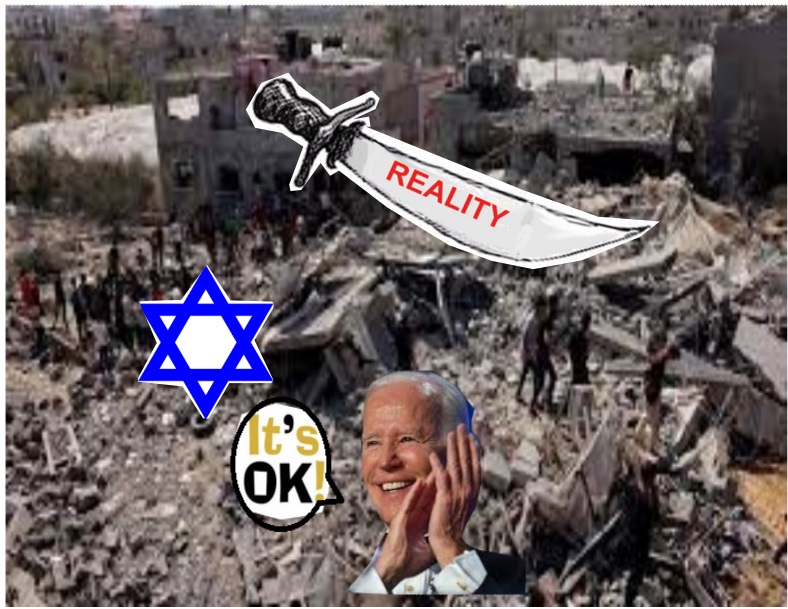
Caitlin Johnstone, Aug 03, 2024, https://www.caitlinjohnst.one/p/mass-media-goons-are-still-reporting?utm_source=post-email-title&publication_id=82124&post_id=147305961&utm_campaign=email-post-title&isFreemail=true&r=1ise1&triedRedirect=true&utm_medium=email
Another day, another Axios article falsely asserting that President Biden is really getting tough on Benjamin Netanyahu.
In a write-up titled “Biden warns Netanyahu against escalation as risk of regional war grows,” Barak Ravid reports that while Biden has pledged to support Israel against any strikes from Iran in retaliation for its insanely escalatory assassination of Hamas political leader Ismail Haniyeh in Tehran, he also told Netanyahu that he “expects no more escalation from the Israeli side” from here on out.
“President Biden privately demanded in a ‘tough’ call Thursday that Israeli Prime Minister Benjamin Netanyahu stop escalating tensions in the region and move immediately toward a Gaza hostage and ceasefire deal,” writes Ravid, citing two US officials who as usual remain unnamed.
“At the end of the meeting with Netanyahu in the Oval office last Thursday, Biden became emotional, raised his voice and told Netanyahu he needs to reach a Gaza deal as soon as possible, three Israeli officials with knowledge of the meeting told Axios,” Ravid reports.
Ravid writes:
“One U.S. official said Biden complained to Netanyahu that the two had just spoken last week in the Oval Office about securing the hostage deal, but instead Netanyahu went ahead with the assassination in Tehran.
“Biden then told Netanyahu the U.S. will help Israel defeat an Iranian attack, but after that he expects no more escalation from the Israeli side and immediate movement toward a hostage deal, the U.S. official said.”
Sure, sure. This time Biden really means it when he draws a firm line with Israel, unlike all those other times when this administration has continued to back Israel’s psychopathic actions unconditionally since October 7.
Commentators on US foreign policy are less than impressed with this report.
“It’s the umpteenth installment of ‘Biden is secretly mad at Bibi’: he became emotional! He raised his voice!” tweeted The Economist’s Gregg Carlstrom. “Can’t imagine anyone takes these self-serving leaks seriously. Least of all Netanyahu, who has ignored Biden with impunity for ten months”
“Biden reportedly told Netanyahu he’ll help defeat an Iranian attack, but expects no more escalation from Israel, warning Netanyahu that he shouldn’t count on the US to bail him out again,” tweeted Quincy Institute’s Trita Parsi, adding, “Fine, but given Biden’s record, why should Netanyahu believe him?”
Barak Ravid has made an entire career out of writing up these anonymously sourced White House press releases about how badass and un-genocidal the president is and packaging them as real news stories. Here are some of the headlines from Ravid’s reporting since October:
Biden “running out” of patience with Bibi as Gaza war hits 100 days
Scoop: Biden in “frustrating” call told Bibi to solve Palestinian tax revenue issue
Biden’s ultimatum to Bibi: Change Gaza policy or we will
White House temperature is “very high” ahead of Biden-Bibi call
“We won’t support you”: Inside Biden’s ultimatum to Bibi
Israel and U.S. deeply divided in meeting on key Rafah operation issues
Biden and Bibi “red lines” for Rafah put them on a collision course
Biden-Bibi clash escalates as U.S. accused of undermining Israeli government
Biden and Netanyahu hold first call in a month amid public split
Biden breaks with Netanyahu but sticks with Israel
Biden on hot mic: Told Bibi we needed “come to Jesus” meeting on Gaza
Biden, in rare criticism, warns Netanyahu that Israel risks losing global support
Biden, in rare criticism of Bibi, says pause in Gaza fighting should have come sooner
Scoop: Blinken warns Israeli officials global pressure will grow longer war goes on
Israeli minister lambasted at White House about Gaza and war strategy
Scoop: Biden tells Bibi he’s not in it for a year of war in Gaza
Blinken unloads on Bibi: “You need a coherent plan” or face disaster in Gaza
Scoop: White House cancels meeting, scolds Netanyahu in protest over video
Netanyahu irked by “critical” Harris comments
This is just one guy, from just one outlet. These “Biden is very upset with Netanyahu and wants him to be different” reports have been coming out throughout the US media since the early weeks of this ongoing mass atrocity, all of which are flatly contradicted by the White House taking zero meaningful action this entire time to rein in Israel’s demented genocidal aggressions.
And to be clear, none of this is actually news. “Anonymous sources say X, Y and Z about how the president’s feelings are feeling” is not a news story. These reports serve no purpose other than to create distance in the eyes of the American public between the genocidal monster Benjamin Netanyahu and the president who is unconditionally supporting his genocidal atrocities in every way possible. They are PR spin and nothing more, which would be surprising to anyone who still believes the mainstream western press exist to report the news instead of promulgate propaganda for the advancement of the information interests of the western empire.
All they’re doing here is trying to wash this administration’s hands of the horrors that are being inflicted in the middle east with the direct facilitation of this administration. Don’t let them. All the monstrous actions being perpetrated by Israel today are just as much the fault of the US government as they are of Israel itself. This is who they are. Make them own it.
The Folly of Atomic Power
by Ron Jacobs, 2 Aug 24, https://www.counterpunch.org/2024/08/02/the-folly-of-atomic-power/
This past June, a couple of my sisters and I drove from California to Minnesota. One of the states we traveled through was Idaho. We gassed up in a town called Atomic City, which advertised itself as the first city in the United States to have nuclear-powered electricity. This town is inside what grounds of the Idaho National Laboratory, an 890 square mile research site run by the Department of Energy together with various commercial and military interests. Its website currently touts its scientific expertise and its mission devoted to carbon-free nuclear energy, alternative energy and military security. There are currently over 6000 employees working at the various sites of the laboratory, which includes over fifty nuclear reactors and has an annual budget of $1.6 billion dollars. The laboratory and its web page provide a perfect example of how the business of nuclear energy as described by author M. V. Ramana in his brilliant new book Nuclear is Not the Solution: The Folly of Atomic Power in the Age of Climate Change actually works.
Indeed, the laboratory’s work is a physical and very real representation of the triple threat Ramana describes in the text: the development of nuclear energy, nuclear weapons, and, almost as an afterthought, alternative energy sources like solar and wind. Ramana, who holds the Simons Chair in Disarmament, Global and Human Security and is a Professor at the School of Public Policy and Global Affairs at the University of British Columbia in Vancouver, Canada, is a longtime opponent of the nuclear power industry and the government that collaborate and support it. His scientific background provides a solid rebuke to those in the industry and those who shill for it who repeat the same half-truths and lies whenever nuclear energy is brought up. In addition, this book is a convincing response supported by solid science (and a bit of political economy) to those who want the public to believe that nuclear power is a reasonable and affordable alternative to fossil fuels and the global climate crisis.
Chapter by chapter, Ramana addresses the health risks, the economics of, and the unbreakable link between nuclear power and the nuclear war industry. Instead of talking in terms of possibility, he focuses on the existing circumstances. To those who would try and sell the public a new nuclear plant by suggesting that the possibility of a nuclear accident at the plant is infinitesimal, Ramana writes:
“Theoretical predictions of stupefyingly low accident probabilities do not square with the empirical evidence of severe accidents at nuclear reactors.”(26)
In other words, believe what you see, not what the industry says. In another chapter, Ramana questions the method by which the private power utilities socialize the costs while privatizing the profits. Perhaps the most shocking aspect of this phenomenon is the contracts and laws that force utility companies to pay for plants that never go online (and, in some cases, are never even built.) I recall this occurring when I lived in North Carolina. South Carolina Electric & Gas Company (SCE&G) lobbied for and received the go-ahead to build two nuclear reactors. As costs mounted, the company asked the Public Utilities Commission to allow the firm to charge customers for the costs associated with building the plants. To make a long story short, customers are still paying for the plants, and the plants were never built. Ramana provides a detailed account of this story in a chapter he titles “Private Profits, Social Costs: Industry Strategies” as a perfect example of how the industry works.
In his chapter on the links between nuclear power and the nuclear war industry, the author is equally scathing. When discussing the claim made by some environmentalists who support nuclear power that the nuclear power industry and the nuclear war industry are two different things, Ramana is clear: any separation is simply an illusion. In fact, he argues that one reason governments are so willing to support the nuclear power industry is because it produces the essential element plutonium for nuclear weapons as a supposed by-product. In fact, it appears more likely that plutonium is not a mere by-product but one of the primary reasons for the ongoing governmental support for the industry.
Nuclear is Not the Solution discusses the nuclear industry in a frank and honest manner. There are no questionable claims about nuclear energy or fantastic excuses made for the industry’s mistakes and its questionable premises. The text details the industry’s lies, mistakes and cover-ups, reminding the reader that they should focus on the historical and empirical facts, not fanciful advertising and promises. He describes an industry rife with corruption and hungry for profits. Although his primary focus is on the industry in the United States, Ramana does not spare other nuclear powers from his reasoned and well-informed exposé. Those who think nuclear energy should be the future would do well to read his book. It should convince one the opposite is more likely the truth.
Ron Jacobs is the author of Daydream Sunset: Sixties Counterculture in the Seventies published by CounterPunch Books. He has a new book, titled Nowhere Land: Journeys Through a Broken Nation coming out in Spring 2024. He lives in Vermont. He can be reached at: ronj1955@gmail.com
1 This Month
To see nuclear-related stories in greater depth and intensity – go to https://nuclearinformation.wordpress.com/
12 February – Webinar The Big Push: New Nuclear Projects in Canada

Thursday, February 12, 7 pm Eastern | 2nd of 4 sessions in the 2026 Nuclear Waste Online webinar series
Join a webinar on the push for new nuclear generation in Canada. Go to Northwatch.org to register or use the registration link https://us02web.zoom.us/webinar/register/WN_ZfWOf1GITqSRIZX8CB-A9w

-
Archives
- February 2026 (127)
- January 2026 (308)
- December 2025 (358)
- November 2025 (359)
- October 2025 (376)
- September 2025 (258)
- August 2025 (319)
- July 2025 (230)
- June 2025 (348)
- May 2025 (261)
- April 2025 (305)
- March 2025 (319)
-
Categories
- 1
- 1 NUCLEAR ISSUES
- business and costs
- climate change
- culture and arts
- ENERGY
- environment
- health
- history
- indigenous issues
- Legal
- marketing of nuclear
- media
- opposition to nuclear
- PERSONAL STORIES
- politics
- politics international
- Religion and ethics
- safety
- secrets,lies and civil liberties
- spinbuster
- technology
- Uranium
- wastes
- weapons and war
- Women
- 2 WORLD
- ACTION
- AFRICA
- Atrocities
- AUSTRALIA
- Christina's notes
- Christina's themes
- culture and arts
- Events
- Fuk 2022
- Fuk 2023
- Fukushima 2017
- Fukushima 2018
- fukushima 2019
- Fukushima 2020
- Fukushima 2021
- general
- global warming
- Humour (God we need it)
- Nuclear
- RARE EARTHS
- Reference
- resources – print
- Resources -audiovicual
- Weekly Newsletter
- World
- World Nuclear
- YouTube
-
RSS
Entries RSS
Comments RSS
 nuclear-news