Hinkley Point C | Court rules that nuclear developers must follow environmental information law
Hinkley Point C | Court rules that nuclear developers must follow
environmental information law. A recent tribunal ruling has declared that
private companies involved in building and operating nuclear power plants
in the UK qualify as public authorities under environmental information
laws, obliging them to disclose information about their environmental
impact to the public.
New Civil Engineer 10th June 2025, https://www.newcivilengineer.com/latest/hinkley-point-c-court-rules-that-nuclear-developers-must-follow-environmental-information-law-10-06-2025/
Campaigners launch legal challenge against Sizewell C’s ‘secret’ flood defences
09 Jun, 2025 By Rob Hakimian, New Civil Engineer,
Together Against Sizewell C (TASC) is seeking a judicial review over the development consent order (DCO) for the Suffolk nuclear power station, citing new concerns over unapproved flood defence measures that could adversely impact the environment and local heritage.
Since 2013, the community-based voluntary campaign group opposing the Sizewell C nuclear power project in Suffolk have campaigned against the construction of the twin European Pressurised Reactors (EPRs) on the Suffolk coast, an area renowned for its rapidly eroding shoreline and precious designated natural habitats, including RSPB Minsmere and the Suffolk Coast & Heaths National Landscape. The group’s latest salvo targets the recent disclosure that Sizewell C Ltd, now under UK government control, has committed to installing sea defences not included in the DCO, which was granted in July 2022.
TASC’s concerns stem from an Office for Nuclear Regulation (ONR) assessment document April 2024 about the external hazards to the Sizewell C site which was put together as part of the process of granting it a nuclear site licence (NSL). The group has said that the process has proposed “huge” flood defences in the case of adverse climate change, which were kept “secret” from the DCO process.
The ONR’s assessment document states: “Consideration of a site’s flood hazard is a fundamental part of ONR’s assessment of site suitability and is included within ONR’s external hazards NSL assessment. Ensuring that there is confidence that sufficient defences against flooding can be constructed, is similarly important and is included within ONR’s civil engineering NSL assessments……………………………………………….. https://www.newcivilengineer.com/latest/campaigners-launch-legal-challenge-against-sizwell-cs-secret-flood-defences-09-06-2025/
Firm fined £26k after worker exposed to radiation at Teesside site

Mistras Group Limited was fined £26,000 after a radiographer was overexposed to ionising radiation while working at a site in Hartlepool.
By Nicole Goodwin, City Centre Reporter, Jade McElwee, Content Editor,
Teesside Gazette 7th June 2025, https://www.gazettelive.co.uk/news/teesside-news/mistras-group-limited-radiation-hartlepool-31808465
A global firm has been slapped with a £26,000 fine after a radiographer was exposed to ionising radiation at a North East site.
The 69-year-old man was working for Mistras Group Limited in December 2020 when the company was alerted by their approved dosimetry service that he had received a dose exceeding legal limits. The Health and Safety Executive (HSE) was also informed, leading to the prosecution of the company following an investigation.
Ionising radiation is widely used in various industries including energy production, manufacturing, medicine and research. While it offers numerous benefits to society, it’s crucial that its risks are sensibly managed to safeguard workers and the public.
The incident occurred at Mistras Group Limited’s former Hartlepool site when a gamma emitting radioactive source used for radiography failed to return to its shielded container. Due to lax adherence to the company’s own radiation safety protocols, this wasn’t promptly identified, resulting in the radiographer being overexposed to radiation.
Although no symptoms were reported, excessive exposure to ionising radiation can heighten the risk of developing certain cancers. The HSE investigation discovered that pre-use safety checks hadn’t been completed and recorded by the radiographer, reports Chronicle Live. These checks are vital stages in verifying that radiography systems are functioning properly and ensuring the safe use of equipment.
The firm Mistras Group Limited was hit with a £26,000 fine and must pay £11,353 in costs after admitting to breaches of radiation safety regulations at Newton Aycliffe Magistrates’ Court on May 22. The company, based in Norman Way, Cambridge, had provided alarming Electronic Personal Dosemeters (EPDs) and radiation monitors to employees, yet it emerged that a radiographer failed to use the equipment; this could have alerted them to dangerous radiation levels allowing for a safe retreat.
Radiation incidents had not been reported correctly. Additional failings by the company to ensure adherence to radiation protection rules and procedures included not following local rule instructions and insufficient supervision leading to a lack of compliance. Moreover, the firm previously faced enforcement actions from HSE for similar shortcomings.
Commenting on the case, HSE’s radiation specialist inspector Elizabeth Reeves stated: “Industrial radiography is a hazardous practice if not managed properly. Radiation protection is an area where employers and employees must not become complacent with.
“Safety checks and the use of monitoring equipment such as EPD’s and radiation monitors are essential elements to ensuring the safe operation of equipment and protection to personnel. This prosecution demonstrates that the courts, and HSE, take failure to comply with the regulations extremely seriously.”
The HSE’s enforcement lawyer, Jonathan Bambro, and paralegal officer, Rebecca Forman, led the prosecution in this case.
Opposition to Sizewell C Nuclear Power Station sea defence plans lodged
Campaign group Together Against Sizewell C (TASC) has filed a legal claim
over plans for additional coastal flood defences at Sizewell C Nuclear
Power Station, which were omitted from the original planning application
and which the group says could negatively impact local wildlife. The claim
comes after it emerged that developer Sizewell C Ltd had committed to
potentially building additional flood barriers which weren’t included in
the power station’s development consent order. TASC has raised concerns
that the construction of the additional barriers could disrupt nearby
protected areas of wildlife and says other less invasive flood defence
options were not pursued.
Leigh Day 5th June 2025, https://www.leighday.co.uk/news/news/2025-news/opposition-to-sizewell-c-nuclear-power-station-sea-defence-plans-lodged/
TASC’s new legal challenge against Sizewell C’s secret flood defences
by Together Against Sizewell C (TASC
ASC urgently need your help in our battle against the environmentally
damaging Sizewell C project. We have discovered that the project now
includes a stated commitment by Sizewell C Ltd to the Office for Nuclear
Regulation (ONR) to install additional sea defences in a ‘credible maximum’
climate change scenario. These defences in the form of two huge 10 metre
high ‘overland flood barriers’ were not included in the approved DCO
project. In our opinion, these flood barriers, if installed, will likely
have additional adverse impacts on the neighbouring designated wildlife
sites including RSPB Minsmere as well as the Heritage Coast and Suffolk
Coast & Heaths National Landscape. We need to ensure that the original
promotor EDF and the now UK government controlled Sizewell C Ltd are not
allowed to use climate change uncertainties as an excuse to delay
assessment and avoid public scrutiny of these additional structures for
decades. The full impact of the whole project should be assessed now.
Crowd Justice 5th June 2025,
https://www.crowdjustice.com/case/sizewell-c-legal-challenge/
New Israeli Law Allows Palestinians as Young as 12 to Be Imprisoned for Life.
Israel often accuses children of terrorism for actions like throwing stones at Israeli soldiers or at cars, with Israeli forces killing many children for stone throwing over the decades and Israeli lawmakers passing a minimum sentence of three years for the act.
May 29, 2025 , By Sharon Zhang , Truthout, https://truthout.org/articles/new-israeli-law-allows-palestinians-as-young-as-12-to-be-imprisoned-for-life/
A group of UN human rights experts is raising alarm over a recently-passed Israeli law that allows children as young as 12 years old to be sentenced to life in prison, saying that the legislation is likely a violation of international human rights law.
The experts say that the law, passed late last year, is crafted specifically to target Palestinian children, as Israeli authorities often accuse Palestinian children of terrorism while not charging Israeli children the same way — one fixture of Israel’s apartheid system.
“[A]uthorizing up to life imprisonment for children as young as 12 years old is not consistent with international law,” the experts wrote in a statement this month. “Under [the Convention on the Rights of the Child], the arrest, detention or imprisonment of a child must be used only as a measure of last resort and for the shortest appropriate period of time.”
The statement was signed by UN special rapporteur for the occupied Palestine territory, Francesca Albanese, as well as Ben Saul, special rapporteur on the promotion of human rights in counterterrorism; Farida Shaheed, special rapporteur on the right to education; and K.P. Ashwini, special rapporteur on racism and intolerance.
Israel often accuses children of terrorism for actions like throwing stones at Israeli soldiers or at cars, with Israeli forces killing many children for stone throwing over the decades and Israeli lawmakers passing a minimum sentence of three years for the act.
Israeli officials have also long framed all Palestinians, including children, as terrorists.
This has led to the detention and killing of huge numbers of Palestinian children under Israeli occupation. According to a recent report by Defense for Children International-Palestine (DCIP), the proportion of children in administrative detention — meaning that they are being held without charges — has reached a record high amid Israel’s genocide.
Citing numbers from the Israeli Prison Service, DCIP reports that nearly 40 percent of Palestinian children detained in Israeli prisons are being held without charges. This amounts to 119 of the 323 imprisoned by Israeli authorities, which represents “both the highest number and the highest proportion” in DCIP’s records on administrative detention.
“These figures highlight Israel’s continued criminalization of Palestinian childhood and its deepening disregard for fundamental legal protections,” the group wrote, adding that children and their families are frequently forbidden from contacting their lawyers by Israeli authorities.
The Israeli Knesset has sought to further punish these families in another recent law condemned in the UN experts’ statement.
That law, passed last year, allows child welfare benefits to be taken away if children are convicted of terrorist offenses. Experts say that the legislation is “overbroad” and not backed by evidence that such a punishment would deter supposed terrorist acts.
“We note that Israeli law does not withdraw benefits from children convicted of other serious offences, suggesting that the Amendment does not legitimately aim to suspend benefits that may be unnecessary while the child is in detention, but serves an ulterior punitive purpose,” the experts wrote.
This legislation, too, is aimed at punishing Palestinian children and their families, experts say, and is likely a violation of international law.
Israel was put on the UN’s list of international violators of children’s rights last year due to thousands of “grave violations” against children throughout Israel’s genocide in Gaza. However, Israel has continued to act with impunity, and UNICEF reported on Tuesday that Israel has killed or injured at least 50,000 children since October 2023 — with other estimates of casualties being far higher.
Enough Is Enough. Israel Is Committing War Crimes- Former Israeli PM

SCHEERPOST, Ehud Olmert, Haaretz, May 27, 2025 .Ehud Olmert is the former Israeli prime minister from 2006 to 2009 and mayor of Jerusalem from 1993 to 2003. Olmert was a member of the Likud party from 1973 to 2006.
The government of Israel is currently waging a war without purpose, without goals or clear planning and with no chances of success. Never since its establishment has the State of Israel waged such a war. The criminal gang headed by Benjamin Netanyahu has set a precedent without equal in Israel’s history in this area, too.
The obvious result of Operation Gideon’s Chariots is, first and foremost, the confused activity of Israeli military units deployed around Gaza. This is true particularly in neighborhoods where our soldiers have already fought, were hurt and fell while killing many Hamas combatants, who deserve to die, and many more innocent civilians. These have joined the statistics of pointless victims among the Palestinian population, reaching monstrous proportions.
Recent operations in Gaza have nothing to do with legitimate war goals. The government sends our soldiers – and the military obeys – to wander around Gaza City, Jabalya and Khan Yunis neighborhoods in an illegitimate military operation. This is now a private political war. Its immediate result is the transformation of Gaza into a humanitarian disaster area.
Over the past year, harsh accusations were voiced worldwide against the Israeli government and its military’s conduct in Gaza, including accusations of genocide and war crimes. In public debates in Israel and on the international arena, I’ve rejected such accusations firmly, though I didn’t shrink from criticizing the government. The international media listens to all voices in the public debate in Israel. It can discern between those who serve as mouthpieces for Netanyahu and his lackeys and his opponents, who view him, as the media is currently fond of saying, as the head of a crime family. I didn’t hesitate to give interviews in Ireland, Italy, the Netherlands, the U.K. and elsewhere in the international arena. Quite often, I disappointed interviewers when I vehemently asserted that Israel wasn’t committing war crimes in Gaza. Excessive killing happened, but, I claimed firmly and with conviction, in no case did a government official give orders to hit Gazan civilians indiscriminately.
The great number of innocent civilians killed in Gaza was hard to fathom, unjustified, unacceptable. But all, as I have said on every media outlet in the world, resulted from a vicious war.
This war should have ended by early 2024. It continued without justification, without any clear goal and with no political vision for the future of Gaza and the Middle East in general. The military, charged with and duty-bound to execute government orders, acted in many cases rashly, incautiously, over-aggressively. However, it did so without any order or instruction or directive from military top brass to hit civilians indiscriminately. Therefore, as I understood it at the time, no war crimes had been committed.
Genocide and war crimes are legal terms that very much refer to the intent and responsibility of the people authorized to formulate the war’s objectives, its conduct and its purpose, the boundaries of fighting and the limitations on the use of force. I took every available opportunity to distinguish between the crimes we have been accused of, which I refused to admit, and the carelessness and indifference regarding Gazan victims and the unbearable human cost we’ve been levying there. The first accusation I rejected, the second I admitted to.
In recent weeks I’ve been no longer able to do so. What we are doing in Gaza now is a war of devastation: indiscriminate, limitless, cruel and criminal killing of civilians. We’re not doing this due to loss of control in any specific sector, not due to some disproportionate outburst by some soldiers in some unit. Rather, it’s the result of government policy – knowingly, evilly, maliciously, irresponsibly dictated. Yes, Israel is committing war crimes.
First, starving out Gaza. On this issue, the position of senior government figures is public and clear. Yes, we’ve been denying Gazans food, medicine and basic living needs as part of an explicit policy. Netanyahu, typically, is trying to blur the type of orders he’s been giving, in order to evade legal and criminal responsibility in due course. But some of his lackeys are saying so outright, in public, even with pride: Yes, we will starve out Gaza. Because all Gazans are Hamas, there’s no moral or operational limitation on exterminating them all, over two million people.
Israeli media outlets, each for its own reasons (some understandable) are trying to present a moderate version of events in Gaza. But the picture displayed around the world is much broader, much more devastating. It’s impossible to view it with equanimity and a nod, as if the world’s reaction is merely a widespread outburst of antisemitism, because everybody hates us and they’re all antisemites.
Well, no. French president Emmanuel Macron is no antisemite. I know him well. I’ve been talking to him over the last few months. When the hour was at hand, the French military stood on the front line to defend Israel and cooperated in intercepting Iran’s missile attacks. “We’re fighting with you against your enemies under my direction, and you’ve been accusing me of supporting terrorism,” Macron recently said. He is a friend of Israel, as are British Prime Minister Keir Starmer, Dutch Prime Minister Dick Schoof, Italian Prime Minister Giorgia Meloni and many others who’ve joined them from within the ranks of Europe’s most outstanding and important cabinet ministers and leaders.
They’ve been hearing the voices from Gaza. They see the suffering of hundreds of thousands of civilians. They’ve been hearing the voices from Israeli cabinet meetings and realize the obvious: Israeli cabinet ministers, headed by crime boss Netanyahu, are actively, unhesitatingly and with malice aforethought are pursuing a policy of starvation and humanitarian pressure, with potentially catastrophic results.
Voices are already rising from Israel-friendly governments such as Canada, the U.K. and France, calling for concrete measures against the government, though these could cause grievous harm to Israel. ……………………………………………………………………………………………………….. https://scheerpost.com/2025/05/27/former-israeli-pm-enough-is-enough-israel-is-committing-war-crimes/
Wyoming nuclear developer Terra Power wants legal protections for private, armed security force

Cap City News, by Wyofile, May 24, 2025, By Dustin Bleizeffer
Don’t mess around at a nuclear power plant facility. If you have no business there but insert yourself anyway, you will be met with armed guards who are directed to “detect, assess, interdict and neutralize” all threats — including with lethal force.
Use of force in securing such facilities, including TerraPower’s Natrium nuclear plant underway near Kemmerer, is required by the U.S. Nuclear Regulatory Commission, according to agency officials. So are a litany of other security measures to ensure the sensitive operations don’t fall prey to “radiological sabotage” — among the highest threats to U.S. national security, they say.
Trained security guards must assume that “adversaries would be dedicated and willing to exhibit lethal force and, quite frankly, receive lethal force in return,” NRC Regional State Liaison Officer Ryan Alexander told members of the Joint Minerals, Business and Economic Development Committee on Thursday in Casper.
TerraPower officials, who will use a highly enriched uranium fuel to power an “advanced” nuclear reactor, presented a draft bill, “Wyoming Security,” to the committee. They’re asking lawmakers to extend protections against civil lawsuits to a private security force, which the company will be required to install when it begins handling nuclear materials. In addition to describing potential statutory changes to accommodate lawful “use of force” by private security guards and related civil protections, the measure refers to standard NRC security requirements and what would be considered criminal trespass.
“Wyoming law currently lacks clear legal authority for trained security personnel performing these duties without such [legal] protection,” TerraPower Nuclear Security Manager Melissa Darlington testified. Without expressed legal protection, TerraPower would still be held to federal NRC standards of security enforcement, she added, which “may result in hesitancy [upon private security personnel] in implementing their duties.”
The committee directed the Legislative Service Office to work up draft legislation based on TerraPower’s proposed language, and agreed to continue discussion at its next hearing in July…………………………………………………..
Several committee members expressed anxiety over providing civil liability protections to a private, corporate security force. Rothfuss suggested the committee should consider forming a special task force to explore the issue.
“When we’re writing statute, we don’t want to provide somebody who’s an armed-nuclear-security guard the authority to use deadly force on the other side of town,” he said. https://capcity.news/wyoming/2025/05/24/wyoming-nuclear-developer-wants-legal-protections-for-private-armed-security-force/
Hinkley Point C court hearing over complying with UK environmental information law begins

New Civil Engineer, 13 May, 2025 , By Thomas Johnson
The legal challenge centres around Nuclear New Build (NNB) Generation Company, a subsidiary of the energy firm EDF who is responsible for constructing the Hinkley Point C nuclear power plant in Somerset. The case has been brought by environment group Fish Legal, which represents anglers and has been repeatedly denied information from the developers of the nuclear power station about its methods of deterring fish from the site.
NNB had a legal obligation to use an acoustic fish deterrent, based on its approved development consent order, but changed its plans for a saltmarsh instead. It has now switched back to a plan for an acoustic fish deterrent, having discovered a new “safe and effective” method for implementing it.
Despite this, Fish Legal is continuing with the case because it is bigger than just the fish deterrent at Hinkley Point C – it believes that foreign-owned private companies building and operating nuclear power plants in the UK must comply with domestic environmental information laws and therefore provide details on environmental plans when asked.
The group has previously taken similar legal action against private water and electricity companies, winning rulings that classified these companies as public authorities for the purposes of the Environmental Information Regulations (EIR). The UK’s Information Commissioner’s Office (ICO) supported this view in the current case, asserting that NNB Generation Company falls within the scope of the EIR and thus must disclose environmental data on request………………………………………………………………………………… https://www.newcivilengineer.com/latest/hinkley-point-c-court-hearing-over-complying-with-uk-environmental-information-law-begins-13-05-2025/
Lawsuit Compels Nationwide Public Review of Plutonium Bomb Core Production
9 May 25, https://nukewatch.org/lawsuit-compels-nationwide-public-review-of-plutonium-bomb-core-production

AIKEN, S.C. — Today the National Nuclear Security Administration (NNSA), the semi-autonomous nuclear weapons agency within the Department of Energy, published a formal Notice of Intent in the Federal Register to complete a nationwide “programmatic environmental impact statement” on the expanded production of plutonium “pit” bomb cores. Pits are the essential radioactive triggers of modern nuclear weapons. The NNSA is aggressively seeking their expanded production for new-design nuclear weapons for the new nuclear arms race.
The South Carolina Environmental Law Project (SCELP) successfully represented the Gullah/Geechee Sea Island Coalition and Nuclear Watch New Mexico, Savannah River Site Watch and Tri-Valley Communities Against a Radioactive Environment in a legal challenge to NNSA’s attempt to improperly jump start dual site pit production. On September 30, 2024, United States District Court Judge Mary Geiger Lewis ruled that the NNSA had violated the National Environmental Policy Act (NEPA) by failing to properly consider alternatives before proceeding with its plan to produce at least 30 pits per year at the Los Alamos National Laboratory (LANL) in New Mexico and at least 50 pits per year at the Savannah River Site (SRS) in South Carolina.
The Court found that NNSA’s plans for pit production had fundamentally changed from its earlier analyses which had not considered simultaneous pit production at two sites. Co-plaintiffs argued that these changes required a reevaluation of alternatives under NEPA, which Defendants failed to undertake prior to moving forward and spending tens of billions of taxpayers’ dollars.
As a result of this ruling and a subsequent settlement, the Defendants are now required to newly analyze pit production at a nationwide programmatic level. This means undertaking a thorough analysis of the impacts of pit production at NNSA sites throughout the United States, including the generation of new radioactive wastes and their uncertain future disposal. Under NEPA, this will provide the opportunity for public scrutiny on NNSA’s aggressive production plans. In addition, NNSA is enjoined from building certain facilities and introducing nuclear materials to the plutonium pit plant at SRS until it completes the PEIS.
Virtual public hearings to determine the needed scope of the programmatic environmental impact statement are scheduled for May 27 and 28. The public comment period for scoping ends July 14 and can be emailed to PitPEIS@nnsa.doe.gov. NNSA expects to complete its draft PEIS within a year, after which in-person public hearings will be held in Livermore, CA; Santa Fe, NM; Kansas City, MO; Aiken, SC; and Washington, DC.
As an indicator of the potential importance of this PEIS process, SCELP and co-plaintiffs have been asked by the Nobel Peace Prize Center in Oslo, Norway, to present (by video) on “how it is possible to do activism inside the court room” on August 6, the 80th anniversary of the Hiroshima atomic bombing. Also, in recognition of its astute legal strategy, SCELP will be receiving an award from the Alliance for Nuclear Accountability comprised of some three dozen public interest organizations (including three of the lawsuit’s co-plaintiff) at a ceremony in Washington, DC, on June 10th.
As background, plutonium pits are the fissile cores of nuclear weapons. The Los Alamos Lab was assigned a mission of limited pit production after a 1989 FBI raid investigating environmental crimes abruptly stopped production at the notorious Rocky Flats Plant near Denver, CO. In 2018 the NNSA decided to pursue pit production at both LANL and SRS. The agency erroneously claimed that an outdated 2008 programmatic environmental impact statement that did not consider simultaneous production was sufficient legal justification under the National Environmental Policy Act.
No future pit production is to maintain the safety and reliability of the existing, extensively tested nuclear weapons stockpile. Instead, future production is only for speculative new-design nuclear weapons that can’t be tested because of an international testing moratorium, thereby perhaps eroding confidence in stockpile reliability. Or, instead, the first new design nuclear weapons since the end of the Cold War could prompt the U.S. to return to full-scale testing, which would have severe national and international consequences.
Independent experts have found that plutonium pits have reliable lifetimes of at least 100 years (their average age is now around 42). Moreover, at least 15,000 pits are already stored at the NNSA’s Pantex Plant near Amarillo, TX. Expanded plutonium pit production will cost taxpayers more than $60 billion over the next thirty years.
The independent Government Accountability Office (GAO) has repeatedly pointed that the NNSA has no credible cost estimates for its largest and most complex program ever, nor an “Integrated Master Schedule” between the two production sites. Further, the Department of Energy and the NNSA have been on the GAO’s “High Risk List” for project mismanagement and waste of taxpayers’ money since 1991. All of these issues and the basic need or not for expanded plutonium pit production are ripe for analysis and public comment in the now required programmatic environmental impact statement.
Ben Cunningham, SCELP’s lead attorney in this case, declared the following: “We implore the public to participate fully in the PEIS process—from attending the scoping hearings to commenting on the draft PEIS. The vast expansion of the nuclear arsenal that is facilitated by the increase in pit production will be exorbitantly expensive, will create radioactive wastes that can last for thousands of years, and the new weapons produced by this expansion could ultimately endanger hundreds of millions of lives. Please weigh in and express your concerns to the decisionmakers.”
Queen Quet, elected Chieftess of the Gullah/Geechee Nation, said: “I am thankful to SCELP and the rest of our national team that stood together to ensure that we protect our communities not only today but also for future generations. The type of compliance that we have fought for is even more crucial given the current environmental and political climate. I am looking forward to us being able to engage in the next phase of this process so that we can ensure that the waters that reach the Sea Islands will be safe.”
Tom Clements, director of Savannah River Site Watch, noted, “Given that we are armed with a decisive federal court ruling that requires the preparation of the PEIS by NNSA, we expect a thorough examination of all environmental and health impacts of pit production at all impacted sites. The draft PEIS must include an analysis of plutonium aging and pit reuse, the proliferation risks of new U.S. warheads, plans for plutonium transportation and the uncertain future disposal of plutonium wastes in the Waste Isolation Pilot Plant in southern New Mexico.”
“Prior to our lawsuit, the agency failed to include other sites involved in future plutonium pit production in its required analyses, chief among them the Lawrence Livermore Lab in California, the Kansas City Plant in Missouri, and the Waste Isolation Pilot Plant. The judge clearly saw these violations and ordered the NNSA to complete the programmatic nationwide analysis which should have been done from the outset. This is a victory for public involvement. It will hopefully result in credible alternatives that are more protective of the environment and the impacted communities,” said Scott Yundt, Executive Director at Tri-Valley CAREs, in Livermore, CA.
Jay Coghlan of Nuclear Watch New Mexico commented, “This programmatic environmental impact statement that we fought long and hard for empowers citizens to tell policy makers what they think about decisions being made in their name. Let them know what you think about the $2 trillion ‘modernization’ program to keep nuclear weapons forever while domestic programs are gutted to pay for tax cuts for the rich. We should demand that this required process under the National Environmental Policy Act becomes a public referendum on the new nuclear arms race and the hollowing out of our society.”
EDF sues Czech competition authority over Dukovany nuclear tender
05/02/2025, https://english.radio.cz/edf-sues-czech-competition-authority-over-dukovany-nuclear-tender-8849981
The French energy company EDF has filed a lawsuit against the Czech Office for the Protection of Competition (ÚOHS) with the Regional Court in Brno. EDF is challenging the authority’s decision to reject its objections to the multi-billion euro tender for new nuclear reactors at Dukovany. The Czech government chose the South Korean firm KHNP over EDF last year and is expected to sign a final agreement with KHNP on May 7. EDF argues the process violated public procurement rules and EU regulations on foreign subsidies. The court may still decide whether the lawsuit will delay the project.
Kingston Fossil Plant and Oakridge Nuclear Facility – an unholy alliance of radioactive pollution,
While no one was killed by the 2008 coal ash spill itself, dozens of workers have died from illnesses that emerged during or after the cleanup. Hundreds of other workers are sick from respiratory, cardiac, neurological, and blood disorders, as well as cancers.
The apparent mixing of fossil fuel and nuclear waste streams underscores the long relationship between the Kingston and Oak Ridge facilities.
Between the 1950s and 1980s, so much cesium-137 and mercury was released into the Clinch from Oak Ridge that the Department of Energy, or DOE, said that the river and its feeder stream “served as pipelines for contaminants.” Yet TVA and its contractors, with the blessing of both state and federal regulators, classified all 4 million tons of material they recovered from the Emory as “non-hazardous.”
A U.S. Environmental Protection Agency analysis confirms that the ash that was left in the river was “found to be commingled with contamination from the Department of Energy (DOE) Oak Ridge Reservation site.
For nearly a century, both Oak Ridge and TVA treated their waste with less care than most families treat household garbage. It was often dumped into unlined, and sometimes unmarked, pits that continue to leak into waterways. For decades, Oak Ridge served as the Southeast’s burial ground for nuclear waste. It was stored within watersheds and floodplains that fed the Clinch River. But exactly where and how this waste was buried has been notoriously hard to track.
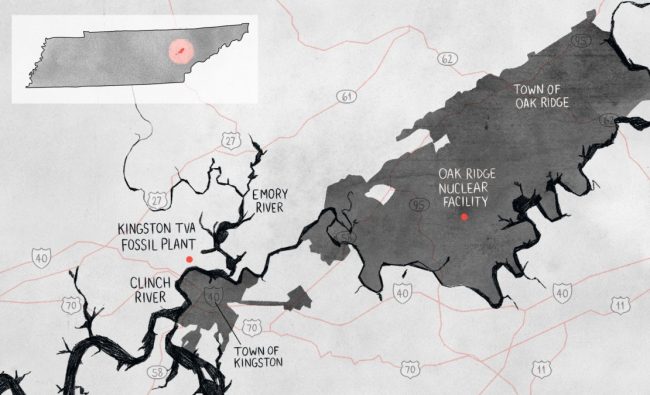
A Legacy of Contamination, How the Kingston coal ash spill unearthed a nuclear nightmare, Grist By Austyn Gaffney on Dec  15, 2020 This story was published in partnership with the Daily Yonder.
In 2009, App Thacker was hired to run a dredge along the Emory River in eastern Tennessee. Picture an industrialized fleet modeled after Huck Finn’s raft: Nicknamed Adelyn, Kylee, and Shirley, the blue, flat-bottomed boats used mechanical arms called cutterheads to dig up riverbeds and siphon the excavated sediment into shoreline canals. The largest dredge, a two-story behemoth called the Sandpiper, had pipes wide enough to swallow a push lawnmower. Smaller dredges like Thacker’s scuttled behind it, scooping up excess muck like fish skimming a whale’s corpse. They all had the same directive: Remove the thick grey sludge that clogged the Emory.
The sludge was coal ash, the waste leftover when coal is burned to generate electricity. Twelve years ago this month, more than a billion gallons of wet ash burst from a holding pond monitored by the region’s major utility, the Tennessee Valley Authority, or TVA. Thacker, a heavy machinery operator with Knoxville’s 917 union, became one of hundreds of people that TVA contractors hired to clean up the spill. For about four years, Thacker spent every afternoon driving 35 miles from his home to arrive in time for his 5 p.m. shift, just as the makeshift overhead lights illuminating the canals of ash flicked on.
Dredging at night was hard work. The pump inside the dredge clogged repeatedly, so Thacker took off his shirt and entered water up to his armpits to remove rocks, tree limbs, tires, and other debris, sometimes in below-freezing temperatures. Soon, ringworm-like sores crested along his arms, interwoven with his fading red and blue tattoos. Thacker’s supervisors gave him a cream for the skin lesions, and he began wearing long black cow-birthing gloves while he unclogged pumps. While Thacker knew that the water was contaminated — that was the point of the dredging — he felt relatively safe. After all, TVA was one of the oldest and most respected employers in the state, with a sterling reputation for worker safety.
Then, one night, the dredging stopped.
Sometime between December 2009 and January 2010, roughly halfway through the final, 500-foot-wide section of the Emory designated for cleanup, operators turned off the pumps that sucked the ash from the river. For a multi-billion dollar remediation project, this order was unprecedented. The dredges had been operating 24/7 in an effort to clean up the disaster area as quickly as possible, removing roughly 3,000 cubic yards of material — almost enough to fill an Olympic-sized swimming pool — each day. But official reports from TVA show that the dredging of the Emory encountered unusually high levels of contamination: Sediment samples showed that mercury levels were three times higher in the river than they were in coal ash from the holding pond that caused the disaster.
Then there was the nuclear waste. Continue reading
The ICJ, Israel and the Gaza Blockade

“The humanitarian aid system is facing total collapse. This collapse is by design.”
April 30, 2025 Dr Binoy Kampmark , https://theaimn.net/the-icj-israel-and-the-gaza-blockade/
The murder and starvation of populations in real time, subject to rolling coverage and commentary, is not usually the done thing. These are the sorts of activities kept quiet and secluded in their vicious execution. In the Gaza Strip, these actions are taking place with a confident, almost brazen assuredness.
Israel has the means, the weapons and the sheer gumption to do so, and Palestinians in Gaza find themselves with few options for survival. The strategic objectives of the Jewish state, involving, for instance, the elimination of Hamas, have been shown to be nonsensically irrelevant, given that they are unattainable. Failed policies of de facto annexation and occupation are re-entering the national security argot.
In yet another round of proceedings, this time initiated by a UN General Assembly resolution, the International Court of Justice is hearing from an array of nations and bodies (40 states and four international organisations) regarding Israel’s complete blockade of Gaza since March 2. Also featuring prominently are Israel’s efforts to attack the United Nations itself, notably UNRWA, the relief agency charged with aiding Palestinians.
As counsel for the Palestinians, Blinne Ní Ghrálaigh outlined the central grievances. The restrictions on “the fundamental rights of the Palestinian people, [Israel’s] attacks on the United Nations and on UN officials, property and premises, its deliberate obstruction of the organisation’s work and its attempt to destroy an entire UN subsidiary organ” lacked precedent “in the history of the organisation.” Being not only “antithetical to a peace-loving state”, such actions were “a fundamental repudiation by Israel of its charter obligations owed both to the organisation and to all UN members and of the international rule of law.
Israel had further closed all relevant crossings into the Strip and seemingly planned “to annex 75 square kilometres of Rafah, one-fifth of Gaza, to [its] so-called buffer zone, permanently. This, together with Israel’s continuing maritime blockade, cuts Gaza and its people off from direct aid and assistance and from the rest of the world.”
The submission by Ní Ghrálaigh went on to document the plight of Palestinian children, 15,600 of whom had perished, with tens of thousands more injured, missing or traumatised. Gaza had become “home to the largest cohort of child amputees in the world, the largest orphan crisis in modern history, and a whole generation in danger of suffering from stunting, causing irreparable physical and cognitive impairments.”
South Africa, which already has an application before the Court accusing Israel of violating the UN Genocide Convention, pointed to the international prohibition against “starvation as a method of warfare, including under siege or blockade.” Its representative Jaymion Hendricks insisted that Israel had “deployed the full range of techniques of hunger and starvation” against “the protected Palestinian population, which it holds under unlawful occupation.” The decision to expel UNRWA and relevant UN agencies should be reversed, and access to food, medicine and humanitarian aid resumed.
In a chilling submission to the Court, Zane Dangor, director general of South Africa’s Department of International Relations and Cooperation, detected a scheme in the cruelty. “The humanitarian aid system is facing total collapse. This collapse is by design.”
Israel’s response, one increasingly rabid to the obligations of humanitarian and international law, was best stated by its Foreign Minister, Gideon Sa’ar. In announcing that Israel would not participate in oral proceedings derided as a “circus”, he restated the long held position that UNRWA was “an organisation infiltrated beyond repair by terrorism.” Courts were once again being abused “to try and force Israel to cooperate with an organisation that is infested with Hamas terrorists, and it won’t happen.”
Then came an agitated flurry of accusations shamelessly evoking the message from Émile Zola’s “J’Accuse” note of 1898, penned during the convulsions of the Dreyfus Affair: “I accuse UNRWA. I accuse the UN. I accuse the Secretary General, I accuse all those that weaponize international law and its institutions in order to deprive the most attacked country in the world, Israel, of its most basic right to defend itself.”
The continuing blackening of UNRWA was also assured by Amir Weissbrod of Israel’s foreign ministry, who reiterated the claims that the organisation had employed 1,400 Palestinians with militant links. Furthermore, some had taken part in Hamas’ October 7, 2023 attacks on Israel. That such a small number had participated was itself striking and should have spared the organisation the savaging it received. But Israel has longed for the expulsion of an entity that is an accusing reminder of an ongoing, profane policy of oppression and dispossession.
In her moving address to the Court, Ní Ghrálaigh urged the justices to direct Israel to allow aid to enter Gaza and re–engage the offices of UNRWA. Doing so might permit the re-mooring of international law, a ship increasingly put off course by the savage war in Gaza. The cold, somewhat fanatical reaction to these proceedings in The Hague by Israel’s officials suggest that anchoring international obligations, notably concerning Palestinian civilians, is off the list.
Victory for Greenpeace Luxembourg against EDF in court transparency ruling
Thomas Toussaint – Adapted by RTL Today, Update: 28.04.2025 ,
https://today.rtl.lu/news/luxembourg/a/2297912.html
In a landmark decision for nuclear transparency, the Strasbourg administrative court has ordered energy giant EDF to disclose information previously kept under wraps about the Cattenom nuclear power station, marking a major victory for Greenpeace Luxembourg.
Greenpeace went to court to challenge EDF’s refusal to provide information on “the possible use within the Cattenom nuclear centre of parts manufactured by the Italian company Tectubi, their destination and their conformity.”
The parts had previously been inspected by Italy’s Nuclear Safety Authority, which identified shortcomings in their production process.
The suspect parts were alleged to have been used to address the well-known issue of stress corrosion, detected in several nuclear power plants, including Cattenom. Greenpeace therefore requested to be informed of the possible use of these parts at the Moselle power station.
In response, the plant’s management refused, citing trade secrecy under the Code of Public Administration Relations. This left Greenpeace with no alternative but to turn to the administrative court in July 2023.
In a ruling on 24 April 2025, the Strasbourg court confirmed that the documents requested by Greenpeace Luxembourg were not subject to secrecy and ordered the director of Cattenom to provide the information within two months. EDF has also been ordered to pay €1,500 to Greenpeace Luxembourg.
“The decision by the administrative court is an important victory for transparency and nuclear safety,” said Roger Spautz, nuclear campaigner at Greenpeace Luxembourg. “EDF cannot continue to conceal crucial information regarding reactor safety, especially when issues such as stress corrosion and cracking are concerned.”
What’s Legally Allowed in War – Gaza a dress rehearsal for U.S. war on China.

The claim that Israel has adhered to the laws of war is extremely contentious.
1977, an international agreement explicitly prohibited the intentional targeting of civilians.
Gaza not only looks like a dress rehearsal for the kind of combat U.S. soldiers may face. It is a test of the American public’s tolerance for the levels of death and destruction that such kinds of warfare entail….………………………………………………………………………………………………………………………………………………….
1 This Month
23-25 October – on Zoom – World BEYOND War’s annual global conferenc


Shut down the radiation-damaged Heysham nuclear reactors now
To see nuclear-related stories in greater depth and intensity – go to https://nuclearinformation.wordpress.com

Say No to NASA’s Reckless Nuclear Reactor on the Moon
Say No to NASA’s Reckless Nuclear Reactor on the Moon

-
Archives
- October 2026 (231)
- September 2026 (339)
- August 2026 (330)
- July 2026 (355)
- June 2026 (287)
- May 2026 (306)
- April 2026 (356)
- March 2026 (251)
- February 2026 (267)
- January 2026 (308)
- December 2025 (358)
- November 2025 (359)
-
Categories
- 1
- 1 NUCLEAR ISSUES
- business and costs
- climate change
- culture and arts
- ENERGY
- environment
- health
- history
- indigenous issues
- Legal
- marketing of nuclear
- media
- opposition to nuclear
- PERSONAL STORIES
- politics
- politics international
- Religion and ethics
- safety
- secrets,lies and civil liberties
- spinbuster
- technology
- Uranium
- wastes
- weapons and war
- Women
- 2 WORLD
- ACTION
- AFRICA
- Atrocities
- AUSTRALIA
- Christina's notes
- Christina's themes
- culture and arts
- Events
- Fuk 2022
- Fuk 2023
- Fukushima 2017
- Fukushima 2018
- fukushima 2019
- Fukushima 2020
- Fukushima 2021
- general
- global warming
- Humour (God we need it)
- Nuclear
- RARE EARTHS
- Reference
- resources – print
- Resources -audiovicual
- Weekly Newsletter
- World
- World Nuclear
- YouTube
-
RSS
Entries RSS
Comments RSS

