Friends of the Earth petitions U.S. Circuit Court of Appeals to review licensing of Diablo Canyon Nuclear Reactor
 Group Asks Court For Review Of PG&E’s Diablo Canyon Nuclear Reactor License Over Earthquake Fears http://sanfrancisco.cbslocal.com/2014/10/28/environmental-group-asks-court-for-review-of-pge-diablo-canyon-nuclear-reactor-license-over-earthquake-fears/ October 28, 2014 AVILA BEACH, San Luis Obispo County (CBS SF) — An environmental group asked a federal court Tuesday to review its claim that California’s last operating nuclear power plant is violating federal law and should be shut down at least temporarily.
In a petition filed in Washington with the U.S. Circuit Court of Appeals for the District of Columbia, Friends of the Earth said the Nuclear Regulatory Commission violated its own rules when it altered the operating license for the Diablo Canyon reactors.
The petition marked the latest development in the dispute over potential danger posed by earthquake faults near the reactors.In a statement, the group said the change, involving how risks from earthquakes are assessed, should have triggered a license amendment proceeding that would have involved public hearings. Instead, the change was made internally.
The petition asked that the change be overturned and the court order a license amendment proceeding. It also asks that the power plant be shut down until those proceedings are completed.
“The NRC acted arbitrarily, abused its discretion and violated” federal laws by approving the change without seeking the required license amendment, the petition said. The NRC and plant owner Pacific Gas and Electric Co. have long said the plant located near San Luis Obispo, midway between Los Angeles and San Francisco, is safe and in compliance with regulations.
NRC spokeswoman Lara Uselding said in an email the agency will review the filing.
The environmental group said the NRC and the company are trying to conceal that the reactors are vulnerable to strong shaking from possible earthquakes. “It is now clear that these outdated 1960s-era reactors are not built to withstand the earthquake risks that surround the plant,” spokesman Damon Moglen said in a statement. “Instead of making them address these safety issues, the NRC worked with PG&E to change the rules.”
Pakistan court stops work on nuclear plants, on environmental grounds

 Pakistan court stops construction work on nuclear plants http://www.firstpost.com/india/pakistan-court-stops-construction-work-nuclear-plants-1761153.html 19 Oct 14, Islamabad: A court in Pakistan has restrained the government from initiating construction work on two proposed nuclear power plants unless environmental safeguards are adhered to, media reports here said. The two-judge bench at the Sindh High Court restrained the Pakistan Atomic Energy Commission (PAEC) yesterday to carry out work at the proposed sites in the southern port city of Karachi without adhering to environmental laws.
The court directive was issued on a petition challenging the environmental impact assessment (EIA) report of the Sindh Environmental Protection Agency which approved the two plants.
The counsel of petitioner said that the reactors would be built by the China National Nuclear Corporation on a design known as ACP-1000 that has not been operational even in China.
“The ACP-1000 reactor so far exists only on paper and in computer programmes and any real life experience, tests and trials … on the ACP-1000 design will be from operating the reactors in Karachi,” the counsel added.
Karachi, one of the world’s most densely populated cities with an estimated population of about 21 million, lacked the infrastructure for mass evacuation of its inhabitants in the wake of a possible nuclear accident, he added.
Pakistan government had finalised plans for starting work on two nuclear power plants of 11,00 MW each – adjacent to the Karachi Nuclear Power Plant – with support from China. Besides, subsequent plans for two more plants – K-4 and K-5 – were also under consideration.
Judge Sullivan resorts to incomplete logic in order to bar world-renowned expert from testifying in “flowers” case…
“I don’t like to break the law and don’t encourage others to do so, either. But this industry has to be stopped.”
Ace Hoffman October 19, 2014
Judge Sullivan resorts to incomplete logic in order to bar world-renowned expert from testifying in “flowers” case…
Four grandmothers attempted to plant flowers to bring attention to the dangers at Pilgrim nuclear power plant. But Judge Sullivan refused to allow world-renowned pediatrician and nuclear expert Helen Caldicott to testify in their defense, because she (the judge) sees a huge difference — when pushed to see it by the District Attorney — between “potential theoretical harm” and actual imminent harm.
The defendants — four women 60 to 80 years old — are using the “necessity” defense. Is there an immediate danger? Is the illegal act (trespassing) effective in addressing and abating the danger? The judge refused to learn how quickly a nuclear power plant can explode. She refused to hear that the plans for evacuation require immediate action for millions of people around the plant. She refused to consider that the warning that it’s time to evacuate must be sent out by people who, if they fail to do their duty, will be responsible for the deaths of thousands of people, and end up in Judge Sullivan’s court (if she survives the holocaust) to be sentenced for negligent homicide.
How imminent can you get?
And sticks and stones may break my bones but planting flowers never hurt anybody.
The judge would like to turn the issue of nuclear safety away. Not her concern. Not in her courtroom. That’s for the Nuclear Regulatory Commission to decide. They say it’s safe. And for the judge, that’s the end of the “imminent threat” defense. Continue reading
13 USA election candidates who want to seize public lands for uranium mining etc
there are currently 13 candidates up for election in November who want to sell or seize public lands for drilling, mining, or logging and seven senators not up for reelection, including four Arizonans: Sen. McCain, Sen. Jeff Flake, U.S. Rep. Trent Franks, and State Rep. Andy Tobin.
 Federal Court: One Million Acres Near Grand Canyon Protected From Mining, Think Progress, BY ARI PHILLIPS OCTOBER 10, 2014 In early October, an Arizona federal judge upheld the Obama Administration’s 2012 withdrawal of over one million acres of federal lands surrounding Grand Canyon National Park from uranium mining. Originally imposed by then-Secretary of the Interior Ken Salazar, the mining industry challenged the ban arguing that the 700-page Environmental Impact Statement was inadequate, failed to address “scientific controversies”, and was unconstitutional.
and several sacred Native American sites. According to the government’s study, removing the ban would mean that 26 new uranium mines and 700 uranium exploration projects could be developed.
According Roger Clark, air quality and clean energy director at the Grand Canyon Trust, the ruling affirms conclusions by five federal agencies, including scientists from the U.S. Geological Survey — that uranium mining poses unacceptable risks to Grand Canyon’s water, wildlife, and people.
“Uranium mines threaten hundreds of the Grand Canyon seeps and springs that provide precious water to thousands of desert-dwelling species,” wroteClark. “Every new mine sacrifices cultural sites and fragments wildlife habitat, polluting the park with dirt roads, dust, heavy machinery, noise, off-road drilling rigs, power lines, and relentless truck traffic.”………
When Salazar first banned this block of 633,547 acres of public lands and 360,002 acres of National Forest land from mining in 2012, a number of politicians objected, including U.S. Senators Orrin Hatch (R-UT), John McCain (R-AZ), John Barrasso (R-WY), and Mike Lee (R-UT). Sen. Hatch said mining the land “poses no environmental threat” and that the announcement was another sign that the Obama Administration “is one of the most anti-American energy presidencies in history.”
Fast-forward two years later and there are currently 13 candidates up for election in November who want to sell or seize public lands for drilling, mining, or logging and seven senators not up for reelection, including four Arizonans: Sen. McCain, Sen. Jeff Flake, U.S. Rep. Trent Franks, and State Rep. Andy Tobin.
The uranium mining companies have 60 days to appeal Judge Campbell’s decision to the Ninth Circuit Court of Appeals and are likely to do so, according to the Center For Biological Diversity. http://thinkprogress.org/climate/2014/10/10/3577414/arizona-grand-canyon-uranium-mining-withdrawal/
No uranium mining for Grand Canyon
The Grand Canyon Will Not Be Mined for Uranium http://www.smithsonianmag.com/smart-news/grand-canyon-will-not-be-mined-uranium-180952950/?no-ist Uranium mining will be banned for the next 20 years on nearly 1 million acres of land near the Grand Canyon By Rachel Nuwer smithsonian.com October 6, 2014 For the next two decades, at least, lands near the Grand Canyon will not be dug up in search of uranium. U.S. District Judge David Campbell just upheld a 20 year ban on uranium mining for an area of nearly 1 million acres near the Grand Canyon, the Arizona Daily Sun reports.
The mining ban was originally set by the Department of the Interior in 2012 but was recently challenged by a group of mining companies led by Gregory Yount, manager of the Northern Arizona Uranium Project. Yount claimed that the 2012 decision was based on faulty science and “improperly favored Native American claims that the land was sacred,” the Daily Sun writes. “It is pretty clear that the decision was not based on the specific sites but on Native Americans’ feelings about the sacred land,” Yount said. He also added that the predicted environmental degradation of water, land and wildlife around the Grand Canyon had been “significantly exaggerated” in 2012.
Judge Campbell, however, didn’t buy into those arguments. The decision not to mine around the Grand Canyon is important for “protecting a national treasure,” he told the Daily Sun. Moreover, he agreed with evidence that mining would disrupt the lives of members of the Havasupai tribe, who live in the region and consider the land there of cultural and religious importance.
Yount—who will be 74 when the ban is lifted—says he does not plan to appeal the decision this time around. http://www.smithsonianmag.com/smart-news/grand-canyon-will-not-be-mined-uranium-180952950/#xI8meVsDAueyseTC.99
Austria to take legal action against EU approval for UK’s Hinkley nuclear power plant?

 Austria says will sue if EU regulator clears UK nuclear plant plan http://uk.reuters.com/article/2014/10/05/uk-austria-eu-edf-nuclear-idUKKCN0HU0EY20141005 VIENNA Sun Oct 5, 2014 (Reuters) – Austria will take the European Commission to the European Court of Justice (ECJ) if it approves Britain’s plans for a 16 billion-pound nuclear power plant, a spokesman for the chancellor said on Sunday.
The deal to pay a guaranteed price for the power produced in the plant faces opposition from a quarter of EU policymakers, who want to overturn approval from the top European regulator. A vote is expected on Wednesday. The project, to be built by French utility EDF (EDF.PA) at Hinkley Point in southwest England, is crucial for Britain’s plan to replace a fifth of its ageing nuclear power and coalplants over the coming decade while reducing carbon emissions. France sees it as a major export contract that will boost its nuclear industry.
But Austria’s chancellor Werner Faymann and vice-chancellor Reinhold Mitterlehner sent a letter to the European Commission’s president Jose Manuel Barroso on Friday saying Austria would “reserve” the right to take legal steps should the project gain a stamp of approval in Brussels.
“Should the EU Commission undertake this step, then it must expect a lawsuit at the highest court,” said Faymann, whose country prides itself in supporting green energy.
“Alternative forms of energy are worthy of subsidies, not nuclear energy,” he was quoted as saying by his spokesman. European Union state aid regulators are set to clear the plans for Hinkley Point, a European Commission official said last month.
Under the plan, Britain would be allowed to offer EDF a guaranteed power price of 92.50 pounds per megawatt-hour for 35 years, more than twice the current market rate.
“Hinkley Point … would set a negative precedence to open this type of subsidy for nuclear energy. The EU-Commission must prevent this, if not it must expect a lawsuit from Austria at the European Court of Justice,” Mitterlehner said.
(Reporting By Shadia Nasralla; Editing by Greg Mahlich)
Judge rules against uanium miners and for the Grand canyon environment
Ban on uranium mining at Grand Canyon upheld by Arizona court . http://www.theguardian.com/environment/2014/oct/02/ban-uranium-mining-grand-canyon-arizona-court Ruling protects national treasure against the possibility of opening it to 26 new mines and 700 exploration projects Leslie Macmillan theguardian.com, Friday 3 October 2014 In January 2012, then-US interior secretary Ken Salazar issued the ban that prohibits new mining claims and mine development on existing claims without valid permits. A subsequent mining industry lawsuit asserted that the interior department’s 700-page study of environmental impacts was inadequate and the ban was unconstitutional.
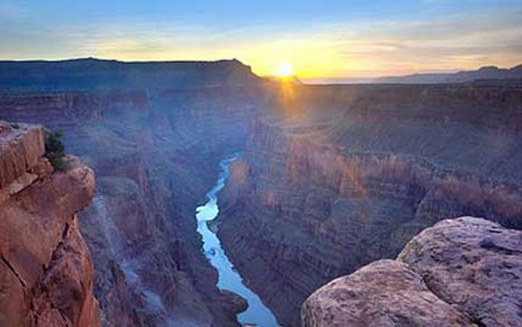
A coalition of groups including native American tribes and the Sierra Club intervened in that lawsuit, and on Tuesday the court ruled in their favour.
Judge David G Campbell of the US district court for Arizona summarised his ruling dismissing all uranium mining industry claims by stating that the secretary of the interior had the authority to “err on the side of caution in protecting a national treasure – Grand Canyon national park.”
Critics of uranium mining say that it would threaten the aquifers and streams that feed the Colorado river and Grand Canyon by releasing toxic waste.
Martha Hahn, chief of science and resource management for the Grand Canyon, says that mines would leach contaminants into watersheds, seeps and springs in the canyon, mar the landscape and impact wildlife. The seeps that make rocks slick might not look life-sustaining, but one might “feed a critter that feeds another critter, so you see the effect pretty exponentially,” said Hahn.
- According to the government’s study, removing the ban would mean that 26 new uranium mines and 700 uranium exploration projects could be developed.The Grand Canyon attracts about 4m tourists a year. Uranium mining companies have 60 days to appeal the decision
Rolls Royce fined for exposing workers to radiation
Rolls-Royce Fined as Workers Exposed to Radiation 32 Times Limit http://www.bloomberg.com/news/2014-09-30/rolls-royce-fined-as-workers-exposed-to-radiation-32-times-limit.html By Jeremy Hodges Sep 29, 2014 A Rolls-Royce Holdings Plc (RR/) unit must pay more than 375,000 pounds ($607,000) in fines and costs after a screw-sized radioactive capsule exposed workers to radiation 32 times legal levels.
Rolls-Royce Marine Power Operations, which manufactures components for submarines, was fined yesterday for breaching safety regulations at a court in Leicester, England, the U.K.’s Health and Safety Executive said. The capsule containing Ytterbium-169 used to test welding was lost for about five hours at a Rolls-Royce plant in Derby, the HSE said.
“Gamma radiation emitted by this type of radioactive source is harmful to human health,” David Orr, the HSE’s specialist inspector of radiation, said in an e-mailed statement. “The company failed its duty of care on this occasion, losing control of the source without realizing it.”
The company was investigated by the HSE and the U.K. Environment Agency after the radioactive material was lost for about five hours, exposing workers to radiation levels well above the annual permitted dose of 500 millisieverts, the HSE said.
Workers were exposed to gamma radiation when the capsule became detached from a holder and ended up inside the component being tested, the court was told in the HSE and Environment Agency joint prosecution. Welders working on the component later spotted the capsule and passed it among themselves.
The company pleaded guilty to the charges and said that it has reviewed its procedures to ensure that a similar incident can’t happen again.
“The health and safety of our workforce and the protection of the environment are our highest priorities and a matter which we take very seriously,” Andy Gordon, assurance and improvement director at London-based Rolls-Royce, said in a statement.
The company was ordered to pay a 200,000-pound fine and costs of 176,500 pounds at a hearing yesterday.
To contact the reporter on this story: Jeremy Hodges in London at jhodges17@bloomberg.net
To contact the editors responsible for this story: Anthony Aarons at aaarons@bloomberg.netChristopher Jasper
Consortium makes legal challenge against water diversion for nuclear power
 Groups appeal decision in Utah nuclear power plant case By Amy Joi O’Donoghue, Deseret News 17 Sept 14 A consortium of environmental groups are challenging a district court judge’s ruling upholding Utah’s decision to allow more than 53,000 acre-feet of water to be diverted for use in a planned nuclear power plant. SALT LAKE CITY — Environmental groups led by anti-nuclear activists HEAL Utah are challenging a judicial ruling that upheld Utah’s decision to allow Green River water to be used in a proposed nuclear power plant.
The groups contend Utah 7th District Judge George Harmond erred last fall when he upheld a decision by Utah State Engineer Kent Jones granting more than 50,000-acre feet of water for the Blue Castle Holdings plant.
Jones approved the transfer of 50,300 acre-feet of water from the Kane and San Juan County conservancy districts — water that will be ultimately diverted from the Green River in a withdrawal the groups say is not sustainable.
“The Colorado River basin is already over-allocated,” said John Weisheit, conservation director of Living Rivers, one of the groups involved in the lawsuit. “Shortages will likely begin next year for lower basin states and there is a strong chance that hydropower stops at Glen Canyon Dam before this decade is even over.”…..
Opponents to the plant — which is still undergoing the federal licensing process through the U.S. Nuclear Regulatory Commission — also challenged the decision on economic grounds.
“They’ve raised less than 0.1 percent of the total cost of these projects,” said Park City attorney John Flitton of Flitton Babalis, representing the groups.
“What they’re trying to do is get a permit to sell to someone else, and while they wait, they’re tying up water which is increasingly important.”……
Blue Castle Holdings’ president and CEO is Aaron Tilton, a former Utah lawmaker from Utah County who has said his project will withstand judicial scrutiny, meet stringent licensing and safety requirements imposed by federal regulators and provide an alternative, clean source of power for Utah consumers.
The appeal, filed before the Utah State Court of Appeals Wednesday, seeks to unravel those arguments.
“It’s past time for Tilton to admit what we all know — his nuclear scheme is all smoke and no fire,” says Christopher Thomas, HEAL Utah’s executive director. “This project costs too much, uses too much water, and produces expensive power the state doesn’t even want to buy. We hope the Court of Appeals will see that under Utah law, it should not proceed.”
Email: amyjoi@deseretnews.com http://www.deseretnews.com/article/865611130/Groups-appeal-decision-in-Utah-nuclear-power-plant-case.html
Uncompetitive nuclear industry is rigging regulations and “spinning” media in order to survive
Killing the Competition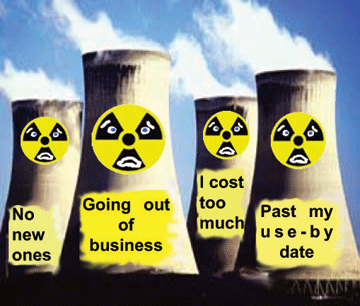
Exelon and Entergy see sustainable energy solutions—renewable energy, efficiency, conservation, etc.—as a long-term threat to
their profits. This is not because of excessive regulations or safety requirements on nuclear power: the industry has not had to implement a single safety upgrade due to the Fukushima meltdowns and faces less regulatory enforcement than it did twenty years ago. The closure of a record number of reactors since 2013 has exposed fundamental economic problems facing the industry, and a growing number of nuclear plants simply cannot compete with modern, efficient, cost-effective
energy resources.
Nuclear industry muscling in on USA’s climate standards
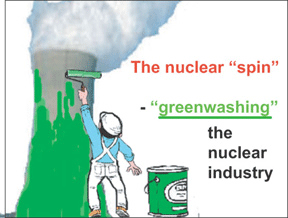 Killing the Competition The Nuclear Power Agenda to Block Climate Action, Stop Renewable Energy, and Subsidize Old Reactors, Report by Nuclear Information and Resource Center (NIRS) Sept 14
Legal action against Fukushima Prefecture and Japan’s government
 Fukushima families sue prefecture, government for radiation exposure during meltdown crisis Japan Times 1 Sept 14 FUKUSHIMA – A group of parents and children who were residing in Fukushima Prefecture when the nuclear disaster unfolded in March 2011 is suing the central and prefectural governments for failing to take sufficient steps to protect children from radiation exposure during the crisis.
The 88 plaintiffs are demanding ¥100,000 each in compensation, according to the lawsuit filed Friday at the Fukushima District Court.
In a written complaint, they said the central and prefectural governments failed to promptly release accurate data on airborne radiation levels after the nuclear crisis, neglecting their duty to prevent residential radiation exposure as much as possible, and exposing children to radiation……http://www.japantimes.co.jp/news/2014/08/30/national/fukushima-families-sue-prefecture-government-for-radiation-exposure-during-meltdown-crisis/#.VAVeS9ddUnk
A legal precedent, as TEPCO us ruled liable for a Fukushima suicide
In a first, Japanese court rules that nuclear plant operator is liable for suicide WP, By Anna Fifield and Yuki Oda August 26 at 6:07 AM TOKYO — A court in Fukushima has ruled that Tokyo Electric Power Co., the Japanese nuclear power plant operator, can be held responsible for the suicide of a woman who became depressed after the 2011 disaster.
The court ordered Tepco to pay $470,000 to Mikio Watanabe and his children after his 58-year-old wife, Hamako, killed herself a few months after the nuclear meltdown in the wake of the earthquake and tsunami forced them out of their home and destroyed their livelihoods.
The ruling was the first time that the struggling utility has been found liable for a suicide resulting from the accident, and it could galvanize others seeking redress from the company…….
The family’s attorney declared the verdict a “complete victory.”
“This ruling is significant as the precedent of a case caused by the nuclear power plant accident,” Tsuguo Hirota said. “Today’s verdict will greatly influence future lawsuits.”……..http://www.washingtonpost.com/world/in-a-first-japanese-court-rules-that-nuclear-plant-operator-is-liable-for-suicide/2014/08/26/bc43af62-6c30-4e70-8e22-ffe1895727c1_story.html
New lawsuit over US sailors’ exposure to Fukushima radiation
US sailors prepare for fresh legal challenge over Fukushima radiation, Guardian, 21 Aug 14 $1bn lawsuit accuses Tepco of failing to avoid the accident and of lying about radiation levels that have caused health problems to themselves and their families stationed in Japan
The first time it occurred to James Jackson that there could be lasting damage from his US Navy service during Japan’s tsunami and nuclear disaster came when his eldest son, Darius, was diagnosed with leukaemia.
Darius, now 15, spent a month in hospital in early 2013, soon after his diagnosis. “I thought I was going to have to bury him,” Jackson recalled. The teenager who aspired to play college basketball now has a catheter in his chest and is too frail to run the length of the court.
Jackson, a navy information technologist, was stationed with his family at Yokosuka, Japan, when an earthquake and tsunami knocked out the cooling systems at the Fukushima nuclear plant in March 2011, causing a triple meltdown.
He acknowledges he can’t know for sure why Darius got leukaemia – but Jackson remains convinced there is a connection to the radiation escape from the Fukushima disaster and he blames the Japanese electric company, Tepco.
On 25 August, a district court judge in San Diego will decide whether the Jacksons – and around 110 other US navy sailors and marines – can proceed with a $1bn lawsuit that accuses Tepco of failing to avoid the accident and of lying about the levels of radiation from the stricken reactors, putting US personnel at risk.
“I don’t think the navy or the United States government would have let us stay there in the region. They would have gotten us out of there probably within the first 48, or 72 hours if they knew then what they know now,” Jackson said. “The issue is that we have this large company, this large enterprise, feeding the Japanese government and the rest of the world bad information. They could have come to the forefront and said: ‘hey we need help’, instead of trying to put a blanket over it.”
Some 77,000 US navy sailors and marines took part in the huge relief effort after Japan’s cascading disasters, called Operation Tomodachi, or friend.
The 110 sailors suing Tepco represent only a small fraction of that number, and the lawsuit does not have the support of the US navy establishment……..
The lawsuit alleges a number of the sailors and their children suffered thyroid and other cancers, leukaemia, birth defects, and a variety of medical conditions including infertility after they were exposed to dangerous levels of radiation. Some of the sailors were also diagnosed with post-traumatic stress disorder (PTSD). One of the sailors named in the lawsuit, helicopter mechanic Theodor Holcomb, who served on the USS Reagan aircraft carrier, died of a rare cancer on 24 April. The lawsuit seeks $1bn for a medical monitoring and treatment fund.
The case is one of a number of lawsuits brought against Tepco in US and Japanese courts after the accident on 11 March 2011…….
A judicial panel in Japan on 31 July said three former Tepco executives should face criminal charges for the disaster, finding they overlooked the risk of an earthquake or tsunami, and failed to take adequate measures to prevent an accident…….http://www.theguardian.com/environment/2014/aug/20/us-navy-sailors-legal-challenge-fukushima-radiation-tepco
Chem-Nuclear ordered by Court to protect groundwater from radiation
Court urges Chem-Nuclear safety The Augusta Chronicle, By Sarita Chourey Morris News Service Thursday, July 31, 2014 COLUMBIA — The South Carolina Court of Appeals is ordering Chem-Nuclear to better protect the groundwater from contamination at the Barnwell County’s low-level radioactive waste disposal site. Under the order, the site operator and the S.C. Department of Health and Environmental Control have 90 days to turn in a plan to reach compliance.
The Sierra Club, represented by the South Carolina Environmental Law Project, had not asked for Chem-Nuclear’s license to be revoked, but rather that it improve waste-handling procedures at the 235-acre site near the town of Snelling.
In its ruling Wednesday, the three-person court said DHEC had not enforced the law on several parts of the regulation, and that the Administrative Law Court was wrong when it found Chem-Nuclear to be in compliance.
In one part of Wednesday’s decision, the court said the trenches at the site have no system to collect liquids that have drained or percolated through radioactive materials.
“DHEC and Chem-Nuclear argue Chem-Nuclear is justified in not having a … collection system due to ‘concerns regarding the radioactive exposure to workers handling and processing (it),’” wrote the court. “We fail to see how the danger of radioactive contamination to workers actually justifies releasing it into the groundwater without testing and remediation. Rather, it seems the danger to health and safety requires testing and remediation.”………
Tritium results from the manufacture of nuclear power, and is found in radioactive waste generated by nuclear power plants.
In 1999 a nearby church property was contaminated by radioactive material due to Chem-Nuclear’s disposal practice of pumping contaminated water out of a trench into lined ponds. ……. http://chronicle.augusta.com/latest-news/2014-07-31/court-urges-chem-nuclear-safety?v=1406837686
1 This Month



26 September – International Day for the Total Elimination of Nuclear Weapons


PLEASE OPPOSE HR 8255 AND S.3639 – bills would accelerate satellite deployment, with no environmental review or safeguards – https://ncstd5li.quorum.us/campaign/169331/
To see nuclear-related stories in greater depth and intensity – go to https://nuclearinformation.wordpress.com
-
Archives
- September 2026 (219)
- August 2026 (330)
- July 2026 (355)
- June 2026 (287)
- May 2026 (306)
- April 2026 (356)
- March 2026 (251)
- February 2026 (267)
- January 2026 (308)
- December 2025 (358)
- November 2025 (359)
- October 2025 (375)
-
Categories
- 1
- 1 NUCLEAR ISSUES
- business and costs
- climate change
- culture and arts
- ENERGY
- environment
- health
- history
- indigenous issues
- Legal
- marketing of nuclear
- media
- opposition to nuclear
- PERSONAL STORIES
- politics
- politics international
- Religion and ethics
- safety
- secrets,lies and civil liberties
- spinbuster
- technology
- Uranium
- wastes
- weapons and war
- Women
- 2 WORLD
- ACTION
- AFRICA
- Atrocities
- AUSTRALIA
- Christina's notes
- Christina's themes
- culture and arts
- Events
- Fuk 2022
- Fuk 2023
- Fukushima 2017
- Fukushima 2018
- fukushima 2019
- Fukushima 2020
- Fukushima 2021
- general
- global warming
- Humour (God we need it)
- Nuclear
- RARE EARTHS
- Reference
- resources – print
- Resources -audiovicual
- Weekly Newsletter
- World
- World Nuclear
- YouTube
-
RSS
Entries RSS
Comments RSS
 nuclear-news
