Austria appeals taxonomy ruling

Austrian Government 20th Nov 2025, Vienna (OTS) – https://www.ots.at/presseaussendung/OTS_20251120_OTS0136/oesterreich-legt-rechtsmittel-gegen-taxonomie-urteil-ein
On September 10, the General Court of the European Union (EGC) dismissed Austria’s action against the classification of nuclear energy as a “sustainable investment” under the EU taxonomy. Following a thorough legal review of this ruling, the Austrian Federal Government has decided to appeal.
“As the Federal Government, we stand firmly for an honest and fact-based sustainability policy. Classifying nuclear power as sustainable is misguided and contradicts the fundamental principles of the taxonomy. Therefore, we are taking this further legal step,” emphasizes Environment Minister Norbert Totschnig. “We remain firmly committed to ensuring that European regulations actually promote the expansion of renewable energy sources. We stand behind our Austrian approach – no nuclear power, but rather a push to expand renewables.”
Background:
The appeal is based primarily on the argument that, from an Austrian legal perspective, the court applied an incorrect standard of review and that the contested regulation was adopted in violation of important procedural rules. Furthermore, from an Austrian perspective, the regulation governs fundamental policy issues, which constitutes a breach of Article 290 TFEU. In addition, Austria maintains that several provisions of the Taxonomy Regulation have been violated. The appeal was filed within the prescribed time limit.
The Knesset and the ‘Post–9/11 Method’

On Monday, Nov. 10, the Knesset voted 39 to 16 in favor of a bill that will allow Israel to execute those it arrests as “terrorists”
The Zionist-nationalists who now determine Israel’s direction are on the way to passing a law that makes legal what is illegal according to the U.N. Charter, international law, and whatever else we count as the international framework that determines the conduct of nations.
November 18, 2025 By Patrick Lawrence ScheerPost
Maybe you saw the video that went public on Nov. 1 wherein Itamar Ben–Givr stands above a row of Palestinian prisoners lying face down with their heads in bags and their hands bound behind their backs. “Look at how they are today, the minimum of conditions,” the ultra–Zionist minister of national security in Bibi Netanyahu’s fanatic-filled cabinet, says as he turns to his entourage. “But there is another thing we need to do. The death penalty to terrorists.”
Those lying on their bellies were reportedly members of al–Nukhba, the special forces unit of al–Qassam, Hamas’s military wing. Ben–Givr, a militant settler who proves, time and again, utterly indifferent to international law, the laws of war, or any sort of accepted norms, wants the Zionist state to kill prisoners of war. This is what it comes down to.
If you haven’t seen the video (and here is a version with good English subtitles), maybe you heard the outrage that subsequently echoed around the world (except in the United States). The footage of the vulgar Ben–Givr has been all over digital media — on YouTube, Facebook, Instagram. Al Jazeera put it out on “X.” I took the version linked here from CNN, one of the few mainstream American media to cover it.
That was then, this is now: On Monday, Nov. 10, the Knesset voted 39 to 16 in favor of a bill that will allow Israel to execute those it arrests as “terrorists” — so long, this is to say, they are Palestinians and not Israeli settlers, who have been on an escalated rampage of terror in the West Bank for many months. “Any person who intentionally or through recklessness causes the death of an Israeli citizen, when motivated by racism, hatred, or intent to harm Israel, shall face the death penalty,” the bill reads in part. It disallows any reconsideration of a death sentence once it is imposed.
This vote was on the legislation’s first reading, of which there are to be three per Israeli parliamentary procedure. But Prime Minister Benjamin Netanyahu and his government support the bill, according to The Times of Israel and Haaretz. Gal Hirsch, a former IDF military commander and the man who oversaw all the negotiations that led to the recent release of captives on both sides, told Haaretz the bill is “a tool in the toolbox that allows us to fight terror.”
The media coverage was yet more extensive this time — although not, once again, in the United States — and I found it better than one might expect. The BBC had it, reporting that the bill covers “people Israel deems terrorists.” Reuters referred to “Palestinian militants” instead of “terrorists.” These are modest steps in the right direction — away from the Zionist state’s account of what it is doing, this is to say. Al Jazeera also covered the vote, as to be expected. Anadolu Ajansi, the Turkish wire service, reported that Ayman Odeh, an Arab member of the Knesset, got into an altercation with Ben–Givr that nearly came to fisticuffs. I wish it had, to be honest.
Anadolu then quoted Ben–Givr as bragging on social media: “Jewish Power is making history. We promised and delivered.” Jewish Power, Otzma Yehudit in Hebrew, is the party Ben–Givr heads, which counts the infamous Meir Kahane, madman of all Zionist madmen, among its inspirations.
On the NGO side, I was pleased to see Amnesty International step forward boldly. “There is no sugarcoating this,” Erika Guevara Rosas, Amnesty’s senior research director, stated. “A majority of 39 Israeli Knesset members approved in a first reading a bill that effectively mandates courts to impose the death penalty exclusively against Palestinians.” The headline on this report was just as good: “Israel must immediately halt legislation of discriminatory death penalty bill.”
Apartheid Israel will not halt anything, of course; the more indecent the proposition the more certainly this is so. And here we go. On Thursday and Friday, Nov. 13 and 14, the IDF made mass arrests in the West Bank, all arrestees detained as “terrorists.” The Times of Israel puts the number at 50, The Jerusalem Post 40. Just to complete the picture, on Thursday a pack of Israeli settlers descended on a mosque 18 km southwest of Nablus — this just before morning prayers were to begin — and, after scrawling racist graffiti on its walls and burning copies of the Quran, attempted to set the mosque ablaze.
Take a sec, as I did, to consider these events side-by-side, with the law now pending in the Knesset in mind. What are we in for here, 40 or more mass executions at some point not far down the road? And how many after that? And Israeli settlers will go on their terrorizing way?
I am right with Amnesty and all others condemning the racism implicit in legislation that makes the repulsive Ben–Givr so pleased. But I don’t quite get the reasoning. Would the Knesset bill be OK if it also extended to settler violence and, so, wasn’t discriminatory? Not sure I understand the point here.
No, I see a larger matter at issue in this bill. It is this: The Zionist-nationalists who now determine Israel’s direction are on the way to passing a law that makes legal what is illegal according to the U.N. Charter, international law, and whatever else we count as the international framework that determines the conduct of nations. The Knesset and the Netanyahu regime, in other words, implicitly argue that Israeli law supersedes what the jurists of international law may count as beyond the boundaries of legality.
We are going to make it legal to execute prisoners so long as we call them terrorists, and all we have to do to make this legal is say it is legal by ruling on our own conduct: This is the Israeli position, fairly stated.
This, the consecration of lawlessness in national law, tips us into another line of inquiry altogether. To put the case very simply, where does the Zionist state get off attempting this stunt? The bitter truth is that the United States, world leader in lawlessness for a long time now, has licensed the Israelis to go unabashedly down this road. We should be clear about this for the sake of our integrity: What the Israelis are about to do is nothing the Americans have not already done.
The most obvious case in point is the bundle of secret memoranda Justice Department attorneys wrote to construct the legality of the kidnappings, the detentions without charge, the torture, the offshore “black sites,” Guantánimo — the whole horrific schmear — after the 9/11 attacks. The commander-in-chief was acting legally in a time of war. The Geneva Conventions did not apply because all those people fighting on their own soil against American soldiers were “unlawful combatants,” and the United States had no obligation under the laws of war to afford them legal protections. The waterboarding, the beatings, the electrodes, the rectal feedings and all that wasn’t torture: It was “enhanced interrogation techniques,” which even got an acronym, EITs. The black sites were OK because they were beyond U.S. borders and the U.N. Convention Against Torture therefore did not apply.
The extent to which these lawyers twisted law and logic into pretzels was truly diabolic, as readers may recall. And the worst of these despicable punks, well-deserving to be named, was John Yoo, who drafted a number of the memos that “authorized” the CIA to torture human beings. Yoo is now 58 and holds an endowed chair as a professor of law at the University of California, Berkeley. I suppose it follows naturally, given what the late-phase imperium counts important.
Yoo and his colleagues at Justice had a job to do, making lawlessness lawful, and they got it done, at least at home and on paper. My argument is very simple: What goes around keeps going around. There is a straight line, I mean to say, between Washington’s post–9/11 abuses of international law and the vote in the Knesset last Monday.
Four years ago, a very fine correspondent named Vincent Bevins published a book called The Jakarta Method (Public Affairs, 2021), in which he made the case that the CIA–sponsored mass killings following the 1965 coup that brought Suharto to power in Indonesia reflected the modus operandi of the United States the whole of the Cold War. The book got all sorts of awards and across-the-board accolades, all deserved.
I’m looking for a similar name, a name for how the United States has conducted its business during the two dozen years since the 9/11 attacks. There must be one, surely, or there ought to be one in any case, because there is a method to all the madness, lawlessness its defining principle, and Israel is the nation most eagerly — or baldly, better put — adopting it.
After the events of September 2001 John Whitbeck, the international lawyer living in Paris, published an essay on the meaning and instrumentalized use of the word “terrorism” that has been republished many times since in many places. And after two dozen years it is still superbly pertinent. The Floutist, the Substack newsletter I co-edit, reprinted it last year under the headline, “‘Terrorism,’ this insidious word.” That version of Whitbeck’s piece is here. It begins:
The greatest threat to world peace and civil society today is clearly “terrorism” — not the behavior to which the word is applied but the word itself. Since the word “terrorism” (like the behavior to which the word is applied) can never be eradicated, it is imperative to expose it for what it is — a word.
No nation has made more profligate use of this term than the United States. Its list of Foreign Terrorist Organizations, FTOs, runs to several pages; President Trump has added 19 names to it so far this year and proposes to add more. Drug traffickers are terrorists; Nicolás Maduro, Venezuela’s president, is a terrorist with a $50 million bounty on his head; antifa protesters are terrorists; the immigrant population in the United States, legal and illegal, is infested with terrorists; so are those demonstrating against Israel’s brutalities in Gaza and the West Bank. Label some organization or someone a “terrorist” and all manner of extra-legal behavior is excused. I cannot say the Israelis learned the power of this word from the Americans, but it is from the Americans they have learned how effectively to use it — which is to say, incessantly.
So much of what “the Jewish state” is doing in its Zionist-nationalist phase derives from what the Americans have “legitimized” by doing it first. This is the point we ought not miss.
The Israeli military’s attacks on the Gaza aid flotillas this last summer — drones, fire bombs, eventually the boarding of these vessels and the arrests of their crew and passengers, all of this in international waters: It is sheer piracy on the open seas. Do you think the Israelis would have dared these breaches of law had the Americans not set the bar when it seized the cargo of four Iranian vessels en route to Venezuela four years ago? At the moment the Trump regime is in legal contortions worthy of John Yoo to justify its extrajudicial executions of fishermen sailing in the Caribbean and the eastern Pacific — claiming they are, but what else, “narco-terrorists.”
The U.S. imperium entered an era of desperation after 9/11, and in this condition it has led the world back to a state of lawlessness — flagrantly this time, with an assumption of collective impunity shared among the Western powers and their appendages — that humanity thought it had superseded after the 1945 victories. So has it licensed by its own example others to ignore international law and the institutions created by common effort to define and enforce it.
Israel is not alone in partaking aggressively of this march to chaos. There are terrorists, terrorists, terrorists everywhere, to listen to the Europeans tell of it. The European Union now debates how it will structure the theft of €140 billion, about $163 billion, from Russia’s frozen assets to keep the war going in Ukraine. No, there are others. But the Israelis are first in adopting — at last I have a name for it — let’s call it “the post–9/11 Method.” https://scheerpost.com/2025/11/18/patrick-lawrence-the-knesset-and-the-post-9-11-method/
Environmentalists FILE FEDERAL LAWSUITAGAINST HOLTEC’S UNPRECEDENTED PALISADES ATOMIC REACTOR RESTART.
Coalition Challenges Lawfulness of Exemption Request Key to High-Risk Scheme.
COVERT TOWNSHIP, MICHIGAN and WASHINGTON, D.C., NOVEMBER 17, 2025–An environmental coalition opposed to Holtec’s unprecedented and high-risk scheme to restart the Palisades atomic reactor on the Lake Michigan shoreline has filed a federal lawsuit seeking a permanent injunction against the impending return to nuclear power operations. The Complaint for Declaratory and Injunctive Relief was submitted to the U.S. District Court for the Western District of Michigan on November 17, 2025. The Court is headquartered in Grand Rapids, but the case will very likely be transferred to a federal judge in Kalamazoo, who has jurisdiction over Van Buren County, where Palisades is located.
The case is entitled Beyond Nuclear, Don’t Waste Michigan, and Michigan Safe Energy Future (Plaintiffs) versus the United States Nuclear Regulatory Commission and Holtec Decommissioning International (Defendants). Attorneys Terry Lodge of Toledo, Ohio and Wallace Taylor of Cedar Rapids, Iowa serve as co-counsel for the environmental coalition.
Arnold Gundersen, the coalition’s expert witness, a nuclear engineer with 54 years of experience, stated: “Holtec wanted its cake while eating it too on Palisades since 2022. They claimed that regulations like technical specifications, such as on anti-corrosion water chemistry, did not apply because the plant was in decommissioning mode. At the same time, they claimed that the plant still had an active legal license, the supposed legal basis for their NRC-approved regulatory pathway to restart. So Holtec is claiming that Palisades was both dead and alive at the same time. For the last three years, it has been both dead and alive simultaneously.”
“Holtec’s hiding behind decommissioning phase regulatory relief and waivers, and NRC compliantly allowing and enabling it, has resulted in serious, negative safety consequences, which could lead to a reactor core meltdown on the Great Lakes shore,” said Kevin Kamps of Beyond Nuclear, who resides in Kalamazoo, Michigan, 35 miles downwind.
On January 14, 2025, an NRC staff person affirmed that Holtec did not implement the proper “wet layup” on Palisades’ steam generator tubes, from 2022 to 2024. This resulted in widespread, accelerated degradation, with potentially very serious safety implications.
Wallace Taylor, Iowa-based co-counsel for the environmental coalition, said: “This lawsuit alleges that the NRC and Holtec didn’t just bend the regulations. They both broke the law to resurrect a reactor that was fifty plus years old, poorly maintained and could not compete in the open market. Palisades is not needed, way too expensive even with massive public subsidies, and unsafe.”
Holtec took over from the previous owner, Entergy, at Palisades on June 28, 2022. On September 9, 2022, Holtec and Michigan Governor Gretchen Whitmer jointly announced Palisades would be restarted by Holtec, breaking the promise made years earlier that Holtec would decommission Palisades instead.
“This bait and switch trick, con job, and big lie is how Holtec got ahold of Palisades in the first place, even though we had officially resisted it from the get-go, because we knew Holtec could not be trusted, even with decommissioning, let alone the zombie reactor restart,” said Kamps of Beyond Nuclear. “Now it is clear the NRC likewise cannot be trusted to obey, uphold, and enforce applicable laws and even its own regulations and mandates,” Kamps added.
On September 28, 2023, Holtec applied to NRC for an exemption from regulations in order to rescind the permanent shutdown certifications filed by Entergy, and docketed by NRC, in June 2022, after Entergy had shut down Palisades for good on May 20, 2022. The permanent shutdown had been announced in and planned since early December 2016.
The three environmental organizations, along with allies Nuclear Energy Information Service of Chicago and Three Mile Island Alert of Pennsylvania, have contested Holtec’s Palisades restart before the NRC’s Atomic Safety and Licensing Board (ASLB) ever since. Ironically, in early 2025 the coalition and Holtec actually agreed that the contested Exemption Request should not be included as a part of ASLB proceedings. However, the ASLB panel, by a 2-1 split decision, sided with NRC staff, and retained the Exemption Request as part of the licensing proceeding, effectively blessing NRC staff’s ultimate approval of the Exemption Request on July 24, 2025, “despite the exemption not qualifying for approval pursuant to the provisions of [10 Code of Federal Regulations Part] 50.12,” the coalition lawsuit argues.
The Complaint begins: “Plaintiffs seek a declaration from the Court that an ‘exemption’ granted by the U.S. Nuclear Regulatory Commission from the requirements of the Atomic Energy Act of 1954…which would allow the owner of a permanently shutdown commercial nuclear power plant to be restored to commercial generation is unlawful.”
The coalition alleges violations of the Atomic Energy Act, the Administrative Procedure Act, and NRC’s own implementing regulations.
“When those certifications were provided in connection with the decommissioning of a reactor, they legally prohibited any further operation of the Palisades reactor or replacement of the fuel into the Palisades reactor vessel,” the coalition argues in its lawsuit.
The coalition cited NRC’s 10 CFR Part 50.82, “Termination of license” regulations. At (a)(2), the regulation states: “Upon docketing of the certifications for permanent cessation of operations and permanent removal of fuel from the reactor vessel…the 10 CFR part 50 license no longer authorizes operation of the reactor or emplacement or retention of fuel into the reactor vessel.”
The environmental groups have brought the lawsuit on behalf of their members and supporters, some of whom live just 0.75 miles from the Palisades atomic reactor. The standing declarants are concerned the restart, especially considering Palisades’ age-related degradation and the high risks of a release of catastrophic amounts of hazardous radioactivity, could significantly and irreparably harm their health, safety, security, property, and the environment. Radioactivity releases even during so-called routine operations, Holtec’s lack of experience operating a reactor, and the company’s controversial history, were also cited as reasons for the lawsuit.
The coalition’s co-counsel argue:
“Before NRC grants the exemption Holtec seeks…it must be analyzed under the explicit limitations imposed…Additionally, the District of Columbia Circuit has limited the granting of exemptions to exigent circumstances…
Section 50.12 provides a mechanism for obtaining an exemption from the procedures incorporated in section 50.10, but one that may be invoked only in extraordinary circumstances. The Commission has made clear that section 50.12 is available “only in the presence of exigent circumstances, such as emergency situations in which time is of the essence and relief from the Licensing Board is impossible or highly unlikely…
The Commission has similarly emphasized that [Part] 50.12 exemptions are to be granted sparingly and only in cases of undue hardship…So Holtec bears an extremely heavy burden to justify its request for an exemption.” (Emphasis added)
The suit contends: “The underlying statutory intention is that a new license application must be sought post-shutdown to ensure that a ‘new’ nuclear power plant meets all contemporary licensing requirements and expectation.”
Along similar lines, in a February 7, 2023 ExchangeMonitor article entitled “To restart shuttered Palisades plant, Holtec would need to start ‘from scratch,’ NRC commissioner Crowell says,” Bradley Crowell, who is still serving as a commissioner at the agency, was quoted:
As for NRC’s role in a potential restart, Crowell — who joined the commission in August [of 2022] — said it would be difficult for the safety regulator to prepare for such a development because of the uncertainty surrounding Palisades’ fate.
I feel like it’s difficult to get our ducks in a row for that because it changes almost on a monthly basis,” Crowell said. “I understand they [Holtec] are in a posture of wanting to find a buyer to do it… but I think at this stage of the game, you’re gonna have to start from scratch.” (Emphasis added)
The lawsuit concludes:
“WHEREFORE…Plaintiffs request that the Court find and declare that the granting of the exemption by the NRC was arbitrary, capricious, an abuse of discretion, or otherwise not in accordance with law; in excess of statutory jurisdiction, authority, or limitations, or short of statutory right; and without observance of procedure required by law; and that consequently, Plaintiffs further request that the Court issue preliminary and permanent injunctions prohibiting the approval of the exemption requested by Holtec because Plaintiffs have suffered an irreparable injury…of having a dangerous nuclear plant being allowed to restart, in violation of the law and regulations.”
For its part, Holtec has continued to say it will restart Palisades by the end of 2025, in the lead up to an announced Initial Public Offering in early 2026, where it hopes to raise $10 billion in private investment.
For more information, see Beyond Nuclear’s “Newest Nuke Nightmares at Palisades, 2022 to Present”. It is a one-stop-shop of web posts dating back to April 2022, when Holtec CEO Krishna Singh first floated “Small Modular Reactor” construction and operation at Palisades, and Michigan Governor Gretchen Whitmer first floated restarting the closed-for-good reactor.
Beyond Nuclear brings interim storage case back to Supreme Court.
Nov 14, 2025, https://www.ans.org/news/article-7537/beyond-nuclear-brings-interim-storage-case-back-to-supreme-court/
The U.S. Supreme Court may once again scrutinize the Nuclear Regulatory Commission’s authority to license consolidated interim storage facilities for commercial spent nuclear fuel. The antinuclear group Beyond Nuclear has filed a petition with the court for a writ of certiorari review of an August 2024 appeals court decision rejecting the group’s lawsuit against the licensing of Holtec International’s New Mexico storage facility, the HI-STORE CISF.
Beyond Nuclear is arguing that the NRC’s decision to license the HI-STORE CISF and deny the group’s hearing request violated the Nuclear Waste Policy Act (NWPA) and the Administrative Procedure Act, as well as the constitutional separation of powers doctrine. The group also contends that the NRC manipulated the hearing process to deny the group its right to a “day in court.”
The petition was filed on October 31 and docketed on November 4, with docket No. 25–540.
Litigating the merits: The U.S. Supreme Court in June ruled against Texas in its case regarding the licensing of Interim Storage Partners’ proposed CISF in Andrews County, Texas. The court found that plaintiffs Texas and Fasken Land and Minerals did not have standing as “parties aggrieved” to challenge the NRC license, sending the case back to the 5th Circuit Court of Appeals to be dismissed. As directed by the Supreme Court, the 5th Circuit dismissed the petitions against both the ISP and Holtec CISFs on October 20.
In NRC v. Texas, however, the Supreme Court did not weigh in on the NRC’s authority under the Atomic Energy Act and the NWPA to license private companies to store spent nuclear fuel at away-from-reactor sites.
In its petition to the Supreme Court, Beyond Nuclear claims that Holtec’s NRC license violates the NWPA, as the law prohibits the Department of Energy from taking any ownership of spent fuel until a deep geologic repository is licensed and operating.
Beyond Nuclear, together with Fasken, made similar arguments in their 2024 petition to the D.C. Circuit Court of Appeals. The court, however, rejected that argument, finding that because Holtec “sought a license for the lawful storage of privately owned spent fuel, and only the conditional storage of DOE-titled fuel if such storage became lawful, the Commission concluded that Beyond Nuclear had failed to raise a genuine dispute of law or fact.”
New Mexico pause: In October, Holtec canceled its agreement with the Eddy-Lea Energy Alliance, its partner in building the HI-STORE CISF. The company cited ongoing state resistance to the facility for the decision. In addition, Holtec said the canceled agreement would allow the company to work with other states that may be interested in interim storage projects.
Beyond Nuclear, however, has denigrated Holtec’s announcement as a “ruse,” claiming the company could be waiting until the political environment is more favorable to the project, or that Holtec may sell its license to another company for development in New Mexico.
Residents outraged as US nuclear plant gets greenlight to dump radioactive waste into major river: ‘Potential long-term consequences’
“We really don’t know enough.”
The Cool Down, by Kristen Lawrence, November 5, 2025
A federal court has ruled that a nuclear plant in New York can dump radioactive waste into the Hudson River, a decision that overrides a 2023 ban on releasing treated wastewater into the river.
What’s happening?
As Surfer Magazine reported, the ruling will allow Holtec, a nuclear-power-focused energy company, to release around 45,000 gallons per year of treated wastewater from the decommissioned Indian Point plant into the Hudson.
The site is only 40 miles from Rockaway Beach, one of the most popular surfing locations in the state and the only one within NYC’s limits.
U.S. District Judge Kenneth Karas ruled that federal authority over nuclear regulation supersedes the prior ban that was the result of the “Save the Hudson” campaign, which was in response to a proposal by Holtec to release radioactive wastewater into the river.
Holtec will now be allowed to dump the materials — mostly tritiated water, which Surfer explained “contains the nuclear-energy byproduct tritium — into the Hudson, with around 1.5 million gallons expected to enter the river in the next several years.
Even though the 45,000 gallons set to be dumped annually is within safe limits, according to the federal government, the public and environmental organizations like Riverkeeper worry about how the waste will affect people’s health and the surrounding ecosystem……………………………
“We really don’t know enough about how tritium behaves in the environment [at diluted levels] to assess potential long-term consequences to the environment, to the food chain, and ultimately to humans,” Timothy Mousseau, biologist at the University of South Carolina, told Chemical & Engineering News.
There are also concerns that fewer people will want to surf and swim in the Hudson because of the new regulations.
Surfer reported that the river had only recently become a “viable recreational waterway” and that dumping radioactive waste may deter people from visiting…………………………….. https://www.thecooldown.com/green-business/radioactive-waste-hudson-river-nuclear-plant/
Danish Arbitration Court has decided against Greenland Minerals A/S case to develop uranium industry.

Energy Transition Minerals is an Australian company (formerly Greenland Minerals Limited)
On 28 October 2025, the Arbitration Court ruled on whether the case brought by Greenland Minerals A/S against Naalakkersuisut can be heard by an arbitration court. The Arbitration Court has decided that the issue of the right to exploit minerals at Kuannersuit cannot be brought before an
arbitration court and that the Danish state cannot be a party to the case.
The case was brought before the Arbitration Court by Greenland Minerals A/S on 22 March 2022. According to Greenland Minerals A/S’ claim,
Naalakkersuisut should be ordered to grant the company a permit to exploit minerals at Kuannersuit.
The case arose from the adoption of the Uranium
Act, which prohibits preliminary investigations, exploration and
exploitation of uranium. The Act prevents a permit for exploitation from
being granted in the company’s license area, as the uranium values exceed
the Uranium Act’s de minimis limit.
The Greenland Government was surprised that the company chose to bring the case before an arbitration court, as the Greenland Government’s discretionary decisions can only be brought before the courts, and the Greenland Government has maintained throughout the case that the arbitration court does not have jurisdiction to decide
the case. The arbitration court’s decision was therefore expected.
Naalakkersuisut 28th Oct 2025, https://naalakkersuisut.gl/Nyheder/2025/10/2810_voldgiftsretten
International Court of Justice Delivers Opinion on Israel’s Obligations

Voltaire Network | 25 October 2025, https://www.voltairenet.org/article223043.html
At the request of the UN General Assembly, the International Court of Justice (ICJ), the internal court of the United Nations, issued an advisory opinion on 22 October on the “Obligations of Israel with regard to the presence and activities of the United Nations, other international organizations and third States in and in connection with the Occupied Palestinian Territory”
he Court is of the opinion that the State of Israel, as the occupying power, must fulfil its obligations under international humanitarian law. These obligations include:
ensuring that the population of the Occupied Palestinian Territory has access to the essentials of daily life, including water, food, clothing, sleeping materials, shelter and fuel, as well as medical items and services;
accepting and facilitating to the fullest extent possible relief actions for the population of the Occupied Palestinian Territory as long as they are inadequately supplied, as has been observed in the Gaza Strip, including relief actions by the United Nations and its entities, in particular the United Nations Relief and Works Agency for Palestine Refugees in the Near East, and by international organizations and third States, and not to prevent such actions;
respecting and protecting all emergency and medical personnel, as well as their premises;
respecting the prohibition of forcible transfer and deportation to the Occupied Palestinian Territory;
respecting the right of protected persons in the Occupied Palestinian Territory who are detained by the State of Israel to receive visits
respecting the prohibition of the use of starvation as a method of warfare against civilians. Furthermore, the Court is of the opinion that, as the occupying power, the State of Israel has an obligation under international human rights law to respect, protect and fulfil the human rights of the population of the Occupied Palestinian Territory, including through the presence and activities of the United Nations, other international organizations and third States in and in connection with the Occupied Palestinian Territory;
It is of the view that the State of Israel has an obligation to cooperate in good faith with the United Nations by giving it full assistance in any action undertaken by it in accordance with United Nations’ Charter, including through the United Nations Relief and Works Agency for Palestine Refugees in the Near East, in and in connection with the Occupied Palestinian Territory;
It is of the view that the State of Israel has an obligation under Article 105 of the United Nations Charter to ensure full respect for the privileges and immunities accorded to the United Nations, including its structures and organs, and its officials, in and in connection with the Occupied Palestinian Territory;
It is of the view that the State of Israel has an obligation under article II of the Convention on the Privileges and Immunities of the United Nations to ensure full respect for the inviolability of the premises of the United Nations, including those of the United Nations Relief and Works Agency for Palestine Refugees in the Near East, and the exemption of the property and assets of the United Nations from all forms of coercion.
Finally, it is of the view that the State of Israel has an obligation, under articles V, VI and VII of the Convention on the Privileges and Immunities of the United Nations, to ensure full respect for the privileges and immunities accorded to United Nations officials and experts on mission for the United Nations, in and in connection with the Occupied Palestinian Territory.
Israel and US Scorn ICJ Ruling Against Starving Civilians as Method of Warfare
The World Court says Israel has a duty as the occupying power to cooperate with UN relief efforts, not impede them.
By Marjorie Cohn , Truthout. October 24, 2025
World Court) told Israel what seems obvious to any reasonable person — that it cannot starve civilians as a method of warfare. But Israel does not act in accordance with international law, as evidenced by its two-year campaign of genocide against the Palestinian people in Gaza, during which it has killed over 68,000 Gazans (more likely 680,000, UN Special Rapporteur Francesca Albanese said on September 15).
In its 71-page advisory opinion, issued on October 22, the ICJ reiterated that Israel is illegally occupying the Gaza Strip. The court unanimously held that as the occupying power, Israel has obligations under international humanitarian law to ensure that the population of the Occupied Palestinian Territory, including Gaza, has essential supplies of everyday life, including water, food, shelter, clothing, bedding, and fuel, as well as medical equipment and services. The court also held that Israel must respect and protect all medical and relief personnel and facilities.
The ICJ ruled 10-1 in its advisory opinion that Israel has an obligation to facilitate humanitarian relief by the United Nations Relief and Works Agency for Palestine Refugees in the Near East (UNRWA) and other international organizations and third states, and must refrain from impeding that relief.
And the court unanimously held that Israel must respect the prohibition on deportation and forcible transfer in the Occupied Palestinian Territory, and the right of the Palestinian prisoners held in Israel to be visited by the International Committee of the Red Cross. The court noted that transfer is forcible not just when it is achieved by physical force, but also when people have no choice but to leave because the occupying power has inflicted conditions of life that are intolerable.
The ICJ rejected Israel’s bogus defense that its national security trumped its obligations under international humanitarian law, saying that the protection of security interests is not a “free-standing exception” allowing a state to violate its international humanitarian law obligations………………………………………………………………………….
Impacts of ICJ Advisory Opinions
Although advisory opinions of the ICJ are nonbinding, they carry great moral, political, and diplomatic weight with third states. On July 19, 2024, the ICJ held that Israel’s occupation of Palestinian territory is illegal and all states have an obligation not to recognize as legal the situation arising from the unlawful presence of Israel in the Occupied Palestinian Territory, and not to render aid or assistance in maintaining that situation. As a result of that ruling (and domestic pressure), several states have now recognized Palestine as an independent state…………………………………………………………………………………………………………….
The Israeli Foreign Ministry said that it “categorically rejects” the ICJ’s October 22 advisory opinion, stating that the court ignored the “extensive evidence” Israel provided of what it claimed was UNRWA’s “infiltration” by Hamas and UNRWA’s complicity in terrorist activities. “This is yet another political attempt to impose political measures against Israel under the guise of ‘International Law,’” the ministry alleged.
Likewise, the U.S. State Department called the advisory opinion “corrupt,” claiming that it “unfairly bashes Israel and gives UNRWA a free pass for its deep entanglement with and material support for Hamas terrorism.”………………………………………………………………………………………………………………………………………………………………………………………………….
The Current Situation
Before the October 10 ceasefire deal between Israel and Hamas took effect, UN-supported global experts warned that over 640,000 Palestinians were facing catastrophic levels of food insecurity and that there was an “entirely man-made” famine in Gaza City.
Since the ceasefire began, Israel has started allowing some aid into Gaza, but nowhere near enough to meet its legal obligations and assist the starving Gazans. The UN World Food Program is getting about 750 tons of food aid into Gaza daily, still far below its target of 2,000 tons per day. Although the ceasefire agreement requires 600 trucks per day of food and other humanitarian supplies, only 263 trucks entered Gaza on October 20, and 281 trucks entered Gaza on October 22, less than half of the agreed-upon number.
The Gaza Humanitarian Foundation has suspended operations, as it runs out of money and faces leadership problems and logistical obstacles to a resumption of its work.
Meanwhile, the ICJ is considering the merits of South Africa’s case against Israel that alleges Israel breached the Genocide Convention. Arrest warrants for Israeli Prime Minister Benjamin Netanyahu and former Defense Minister Yoav Gallant for war crimes and crimes against humanity — for intentionally and knowingly depriving the civilian population in Gaza of objects indispensable to their survival and intentionally directing an attack against a civilian population — are pending in the International Criminal Court.
During the past two years, millions of people globally have demonstrated in solidarity with the Palestinian people, and the Boycott, Divestment, Sanctions movement has achieved widespread popular support.
The new advisory opinion issued by the ICJ will continue to shame Israel in the eyes of the world. https://truthout.org/articles/israel-and-us-scorn-icj-ruling-against-starving-civilians-as-method-of-warfare/
International Court of Justice Finds Israelis Broke Law by Starving Palestinians of Gaza
Juan Cole10/23/2025. https://www.juancole.com/2025/10/israelis-starving-palestinians.html
Ann Arbor (Informed Comment) – The International Court of Justice, established by the UN to adjudicate issues among nations, issued an advisory opinion on Wednesday branding the Israeli blockade on food and medical aid into the occupied Gaza Strip illegal.
I mean, surely this conclusion is simple common sense. You can’t starve people. That’s not only illegal, that is the height of immorality and cruelty. The war criminals who head up the Israeli government hold that they can do whatever they want to people on the grounds that they are Palestinians, or that millions are terrorists, or that there are no innocents among certain populations. No one with a heart and a mind agrees with them. Unfortunately, there are lots of heartless mindless people in the world, some of them extremely powerful.
In a world where International Humanitarian Law is increasingly brazenly flouted, as a way of undermining it and ensuring that its violators retain impunity, the Court upheld the Fourth Geneva Convention of 1949 on occupied populations, as well as the International Covenant on Economic, Cultural and Social Rights of 16 December 1966 (hereinafter the “ICESCR”), a UN instrument that Israel signed.
The Court reminds us, “As an occupying Power, Israel is obliged to ensure the basic needs of the local population, including the supplies essential for their survival. Obligations to this effect are set out in Articles 55 and 56 of the Fourth Geneva Convention.” The obligation is also implied by the UN Charter, to which Israel is a signatory.
The Court adds, “Israel is not only required to perform the positive obligation to ensure essential supplies to the local population “to the fullest extent of the means available to it”, but it is also under a negative obligation not to impede the provision of these supplies or the performance of services related to public health.”
Instead of fulfilling these obligations, the Israeli government created a famine in Gaza by blocking the entry of UN food trucks: “According to the IPC, by 12 May 2025, half of the population of the Gaza Strip faced emergency levels of food insecurity . . . and nearly half a million people faced catastrophic levels of food insecurity.”
Israel also has an obligation to avoid killing aid workers. Even where an aid worker might engage in resistance activities, Israel can only kill this person while they are actively engaged in warfare, not while they are in scrubs operating on a patient. The ICJ notes, “that, according to the United Nations, between 7 October 2023 and 20 August 2025, at least 531 humanitarian workers, including 366 United Nations personnel, were killed in the Gaza Strip . . .”
That is, Israeli has a positive obligation to ensure that the population it occupies is well-fed and gets health care. But it also has a negative obligation, where it fails in the positive one, to avoid interfering with the provision of such aid by the UN, UNRWA and other aid agencies, to ensure Palestinians are not malnourished or deprived of medical care.
The Court notes that the Geneva Convention prohibits the forcible expulsion of civilian populations from occupied territories, as does the UN Charter.
But, “According to some participants, including the United Nations, the Israeli military has issued numerous displacement orders, ‘forcing hundreds of thousands of people into overcrowded areas and restricting the United Nations’ ability to deliver urgently needed essential supplies.”
The Court upheld the UN-mandated role of the United Nations Relief and Works Agency (UNRWA) in providing aid to Palestinian refugees. It quotes a UN document that
Israeli officials alleged that UNRWA was extensively penetrated by Hamas. The Court did not find these allegations credible, writing, “the Court finds that Israel has not substantiated its allegations that a significant part of UNRWA employees ‘are members of Hamas . . . or other terrorist factions.’” UNRWA had 17,000 employees in Gaza and the Court could not rule out that a handful were dirty, but it finds that the UN and UNRWA investigated all credible charges and that the organization’s neutrality is not in doubt.
The Likud-led government of Israel throws the accusation of “terrorist” around without any evidence at all almost as indiscriminately as it does the accusation of “antisemitism.” In fact, virtually anyone who gets in the way of Likud schemes is smeared with both adjectives. The problem for this extremist Israeli propaganda is that it cannot stand up in the eyes of seasoned jurists, who make their judgments not out of fear or tribalism or emotion but out of a gimlet-eyed review of the evidence.
From my own point of view — the ICJ did not come out and say this, though it perhaps implies it — the Likud officials wanted to starve the Palestinians of Gaza. UNRWA got in the way of this genocidal project. They therefore slandered and banned UNRWA.
The Court pointed out that no other organization has UNRWA’s capacity to deliver aid to the Palestinians in Gaza. It admits that it would be permissible for Israel, as the occupying power, to ensure the health and well-being of the Palestinians it occupies using other organizations. The ICJ points out, however, that Israel has not in actuality provided any such mechanism, and that the now-disbanded “Gaza Humanitarian Foundation” was fairly useless and certainly did not replace UNRWA. The Israelis cared so little about actual food aid that this past summer the UN concluded that they had fostered a famine in Gaza.
In the end the Court concurred with UN Secretary-General António Manuel de Oliveira Guterres that ” “there is currently no realistic alternative to UNRWA that could adequately provide the services and assistance required by Palestine refugees.”
“The Peace Palace in The Hague, Netherlands, the seat of the International Court of Justice.” Public Domain. Via Wikimedia Commons.
Israel may also not keep out other aid organizations (as it has done): “Article 59 of the Fourth Geneva Convention refers to aid provided by ‘States or by impartial humanitarian organizations’. Thus, as long as the population remains inadequately supplied and Israel is not itself operating a system of humanitarian support that is in accordance with its obligations under international humanitarian law, Israel is obliged under Article 59 to agree to and facilitate relief schemes provided by third States or impartial humanitarian organizations such as the ICRC.”
In the end, the Court found that it has jurisdiction over Gaza; that it has the prerogative of issuing this advisory opinion; and that it is doing so.
It unanimously finds that Israel has the duty:
“to ensure that the population of the Occupied Palestinian Territory has the essential supplies of daily life, including food, water, clothing, bedding, shelter, fuel, medical supplies and services;”
It also finds that Israel has an obligation to let UNRWA do its job in Gaza.
Of 11 justices, only the Ugandan Christian Zionist Julia Sebutinde dissented on this one.
Also, Israel has to stop destroying hospitals and killing or abducting doctors (this one was also unanimous.)
The Israelis have to stop mass expulsions of Palestinians (unanimous).
Basically, the ICJ found that the entire conduct of the war on Gaza by Israel has been carried out in an illegal manner.
Shamefully, the US State Department under Marco Rubio denounced the ICJ advisory opinion. The US after WW II showed itself a leader in erecting the structure of International Humanitarian Law, in hopes of forestalling another global conflict. Some 64 million people were killed in WW II, almost the entire population of today’s UK or France. Now America is tearing down the edifice of law that it helped build. And that will come back to bite us on the posterior.
About the Author
Juan Cole is the founder and chief editor of Informed Comment. He is Richard P. Mitchell Professor of History at the University of Michigan He is author of, among many other books, Muhammad: Prophet of Peace amid the Clash of Empires and The Rubaiyat of Omar Khayyam. Follow him on Twitter at @jricole or the Informed Comment Facebook Page
After Bombing Boats, Trump Tells Congress US Is in ‘Armed Conflict’ With Drug Cartels.
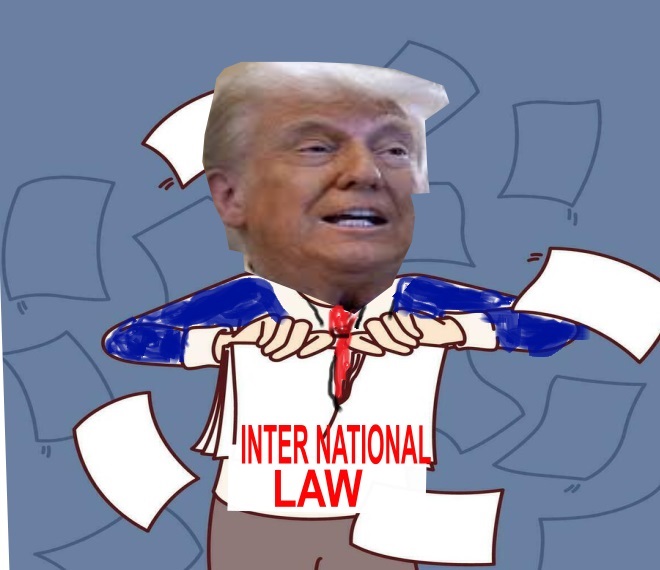
“This is not stretching the envelope,” said a retired judge advocate general lawyer. “This is shredding it. This is tearing it apart.”
October 3, 2025, Jessica Corbett, https://www.commondreams.org/news/trump-venezuela
President Donald Trump’s administration claimed that the United States is in an “armed conflict” with drug cartels in a confidential notice to Congress this week intended to justify his deadly bombings of alleged smuggling boats in the Caribbean.
Democrats in Congress and legal officials have been challenging the legality of the three military strikes Trump announced last month. A woman who identified herself as the wife of one of the at least 17 people extrajudicially killed in the US bombings said her husband was a fisher.
“Congress was notified about the designation by Pentagon officials on Wednesday,” according to The Associated Press, one of several outlets that obtained the notice. The New York Times reported that it “was sent to several congressional committees.”
NewsNation‘s Kellie Meyer posted the full memo on social media: https://x.com/KellieMeyerNews/status/1973817299053269376?ref_src=twsrc%5Etfw%7Ctwcamp%5Etweetembed%7Ctwterm%5E1973817299053269376%7Ctwgr%5Eed7e0a4e5fa28e5d3a356b95835b5dd3057f6b22%7Ctwcon%5Es1_&ref_url=https%3A%2F%2Fwww.commondreams.org%2Fnews%2Ftrump-venezuela
After citing a relevant section from the National Defense Authorization Act for fiscal year 2024, the notice describes decades of law enforcement efforts to stem the flow of illicit narcotics into the United States as “unsuccessful,” and says that cartels “illegally and directly cause the deaths of hundreds of thousands of American citizens each year.”
“The president determined these cartels are nonstate armed groups, designated them as terrorist organizations, and determined that their actions constitute an armed attack against the United States,” the document continues. Trump also “determined that the United States is in a non-international armed conflict with these designated terrorist organizations” and directed the US Department of Defense, which he has dubbed the Department of War, “to conduct operations against them.
“The United States has now reached a critical point where we must use force in self-defense and defense of others against the ongoing attacks by these designated terrorist organizations,” adds the memo, which notes the second strike on September 15.
Lawmakers and legal experts again challenged the administration’s claim that, as the notice put it, Trump directed the bombings under “his constitutional authority as commander in chief and chief executive to conduct foreign relations.”
As the Times reported:
Geoffrey S. Corn, a retired judge advocate general lawyer who was formerly the Army’s senior adviser for law-of-war issues, said drug cartels were not engaged in “hostilities”—the standard for when there is an armed conflict for legal purposes—against the United States because selling a dangerous product is different from an armed attack.
Noting that it is illegal for the military to deliberately target civilians who are not directly participating in hostilities—even suspected criminals—Mr. Corn called the president’s move an “abuse” that crossed a major legal line.
“This is not stretching the envelope,” he said. “This is shredding it. This is tearing it apart.”
New York University School of Law professor Ryan Goodman, who served as special counsel to the general counsel of the Defense Department during the Obama administration, said on social media that Corn was “completely right.”
“Drug cartels not = ‘armed conflict,‘” Goodman added, stressing that the “people killed” in such strikes “are civilians.”
Rutgers University law professor Adil Haque similarly pushed back on social media, saying: “The United States is not in a ‘non-international armed conflict’ with drug cartels. Cartels are not organized as armed groups, nor are they engaged in intense hostilities. These are dangerous criminal organizations and should be confronted using law enforcement tools.”
Members of Congress also publicly weighed in, including Senate Armed Services Committee Ranking Member Jack Reed (D-RI), who said that “every American should be alarmed that President Trump has decided he can wage secret wars against anyone he labels an enemy. Drug cartels must be stopped, but declaring war and ordering lethal military force without Congress or public knowledge—nor legal justification—is unacceptable.”
At least two of the strikes have occurred off the coast of Venezuela, elevating fears of an armed conflict with the country.
“Trump’s actions are illegal, unconstitutional, and dangerous,” Sen. Ed Markey (D-Mass.) said in response to the new memo. ”He is leading us willy-nilly into war with Venezuela. I have ‘determined’ that this is a terrible idea.”
US Military Doctrine – Goodbye to Geneva
1 October 2025 AIMN Editorial, By Andrew Klein, https://theaimn.net/us-military-doctrine-goodbye-to-geneva/
Recent developments in the United States of America and the performances of President Trump and his Secretary of War Pete Hegseth should be concerning to us all.
There are indeed reports and analyses indicating that Secretary Hegseth is pursuing a significant overhaul of the U.S. military’s legal framework, with the stated goal of empowering commanders and adopting a more aggressive approach to warfare.
Policy Shifts and International Law
The planned changes have raised concerns among observers about their potential impact on the international rules-based order.
Overhauling Military Lawyers
Reports note that Hegseth has made it a priority to “retrain” military lawyers (the Judge Advocate General’s corps, or JAGs) so they provide advice that allows commanders to “pursue more aggressive tactics” and take a “more lenient approach in charging soldiers with battlefield crimes.” Critics of the JAG corps have argued that their interpretation of rules of engagement, such as the requirement to positively identify an enemy combatant, has been too restrictive.
Historical Context and Criticism
This effort is not happening in a vacuum. During the George W. Bush administration after the 9/11 attacks, JAG lawyers resisted the administration’s view that it could lawfully direct the military to ignore the Geneva Conventions regarding detainees.
A Stated Vision for Warfare
In his writings, Hegseth has been explicit about his philosophy, questioning the value of the Geneva Conventions and suggesting that the U.S. military should fight wars on its own terms, with less regard for the opinions of other countries or international courts. He has publicly argued that modern fighters “face lawyers as much as enemies” and that adversaries should receive “bullets, not lawyers.”
When evaluating these developments, it is helpful to consider the following perspectives:
A Deliberate Agenda
The evidence suggests that the actions of Secretary Hegseth are not ad hoc but part of a coherent, long-held belief system aimed at reducing legal constraints on the battlefield, which he views as detrimental to a “warrior ethos.”
A Contentious Debate
This shift represents one side of a long-standing and profound debate within military and international circles. It pits a view prioritising maximum operational freedom against one that holds that adhering to laws of war is a strategic and moral necessity, a stance historically defended by military lawyers themselves.
The potential consequences of altering the U.S. military’s relationship with international humanitarian law are a significant subject of global concern and analysis.
Starmer’s new nukes break Non-Proliferation Treaty, legal experts say
Keir Starmer’s plans to splash out on new nukes are in breach of
international law, according to new legal opinion obtained by the Campaign
for Nuclear Disarmament (CND).
The Prime Minister announced his intention
earlier this year to expand Britain’s nuclear capabilities, pledging to buy
nuclear-capable F-35A fighter jets from the US as well as ploughing on with
Trident renewal.
It would mean that, for the first time in decades, Britain
could launch weapons of mass destruction from both air and sea, despite
being a signatory to the nuclear Non-Proliferation Treaty (NPT). By signing
the NPT, Britain committed to “pursue negotiations in good faith on
effective measures relating to cessation of the nuclear arms race at an
early date and to nuclear disarmament and on a treaty on general and
complete disarmament under strict and effective international control.”
Arguing Sir Keir’s plans breach this obligation, the legal opinion from
international law experts Professor Christine Chinkin and Dr Louise
Arimatsu commissioned by the CND argues: “The decision of the UK to
purchase F-35a fighter jets rather than any other model is precisely
because the aircraft can ‘deliver both conventional and nuclear weapons’
and thereby enable the RAF to reacquire ‘a nuclear role for the first
time since 1998.’
Morning Star 26th Sept 2025, https://morningstaronline.co.uk/article/starmers-new-nukes-break-non-proliferation-treaty-legal-experts-say
Federal Judge Strikes Down New York’s “Save the Hudson” Nuclear Discharge Ban
A federal judge has sided with Holtec International in a dispute over a New
York law that barred the discharge of radioactive materials into the Hudson
River during the decommissioning of the Indian Point nuclear facility. The
ruling underscores the primacy of federal oversight in nuclear safety
decisions.
On Wednesday, U.S. District Judge Kenneth Karas held that a 2023
New York statute (commonly known as the “Save the Hudson” law) was
preempted by federal law. The judge found that the state statute, which
prohibits radioactive discharges in connection with decommissioning,
“categorically precludes Holtec from utilizing a federally accepted
method of disposal.”
Oil Price 24th Sept 2025, https://oilprice.com/Latest-Energy-News/World-News/Federal-Judge-Strikes-Down-New-Yorks-Save-the-Hudson-Nuclear-Discharge-Ban.html
David versus Goliath: the battle of a small indigenous community against a federal radioactive waste dump.
There are fewer than 500 of them, but they have managed to put a stop to a federal nuclear waste dump project worth several hundred million dollars…
Anne Caroline Desplanques, Journal de Montréal, September 19, 2025, https://tinyurl.com/mwuymkjp
Federal authorities plan to store the remains of the Bécancour nuclear power plant, Gentilly-1, in a dump in Chalk River, on the edge of the drinking water source for millions of Quebecers.
At a time when the Carney government is promoting nuclear power as one of the ways to make Canada an energy superpower, our investigative team has obtained rare access to this ultra-secure complex, which Ottawa wants to hand over to the Americans. We spoke with citizens and experts who are concerned about the environment and the country’s sovereignty.
There are only 365 Anishinabeg living in the tiny Kebaowek First Nation reserve in Abitibi-Témiscamingue. But through their lawyers, they have succeeded in putting a hold on a multi-million-dollar federal radioactive waste dump project on their traditional territory.
In February, the Federal Court ruled that the Canadian Nuclear Safety Commission had not obtained the free, prior, and informed consent of Indigenous peoples before authorizing the construction of the dump, in violation of the United Nations Declaration on the Rights of Indigenous Peoples.
In March, the court determined that the project endangers several species, including the spotted turtle, a threatened species less than 30 centimeters long that lives for about 50 years and reproduces infrequently, as it does not reach sexual maturity until around 20 years of age.
Federal lawyers have appealed both decisions. If they fail to convince the courts, Canadian Nuclear Laboratories (CNL) and Atomic Energy of Canada Limited (AECL) will have to go back to the drawing board and resume consultations. In the meantime, the project, called the “near-surface waste management facility,” is on hold.
A geotextile membrane to contain radioactivity
It is intended to be a permanent storage and disposal site for up to one million cubic meters of radioactive waste. The waste will be placed on a layer of clay, sand, and geotextile approximately 1.5 meters thick, and covered with another layer of sand, rock, and a membrane.
This is not enough to protect the environment from PCBs, asbestos, heavy metals, and dozens of radioactive elements that CNSC plans to bury there, fears physicist Ginette Charbonneau of the Ralliement contre la pollution radioactive (Coalition Against Radioactive Pollution).
” Radioactive waste cannot be disposed of, it can only be isolated. For that, you need more than a membrane,” she insists.
CNSC assures that this buried waste will have “low-level” contamination and will therefore no longer pose a danger to the environment and health in 500 years, at the end of the containment cells’ useful life.
A pile of waste
But nuclear chemist Kerry Burns has his doubts. Retired from Atomic Energy of Canada since 2010, he was tasked with analyzing waste from the Chalk River laboratories to determine its radioactive content.
He explains that, in the past, CNL buried tons of waste in the sand, which they now plan to exhume and place in their new landfill. However, there are no records indicating the precise level of contamination, he says, describing a gigantic pile of mixed waste.
The project site has too much risk to leave anything to chance, insists the scientist: the landfill will be only one kilometer from the Ottawa River in sandy, porous soil.
“If the contamination escapes from the cells, it will very quickly find its way into the water, and it will be extremely difficult to measure and stop,” he warns.
Like Ms. Chabonneau, Mr. Burns argues that the materials should be isolated in a deep geological repository far from water sources.
This is the method used by one of the American companies chosen to manage CNL, Amentum: it isolates low-level waste in New Mexico in the Waste Isolation Pilot Plant (WIPP), which has isolation chambers 660 meters underground.
A killing at sea marks America’s descent into lawless power

The people on board were not given the chance to surrender. No evidence was presented. No rules of engagement were cited. The administration claimed authority to kill on suspicion alone. A vessel in international waters is not a lawful target simply because officials say so.
International law does not permit such action.
The peremptory strike on a speedboat is a warning to all who serve. Remember your oath.
Jon Duffy, September 8, 2025, https://www.defenseone.com/ideas/2025/09/killing-sea-americas-descent-lawless-power/407949/?oref=defense_one_breaking_nl&utm_source=Sailthru&utm_medium=email&utm_campaign=Defense%20One%20Breaking%20News:%209/9%20killing&utm_content=C&utm_term=newsletter_d1_alert
The United States has crossed a dangerous line.
Last week, an American military platform destroyed a small vessel in the Caribbean, killing 11 people the Trump administration claims were drug traffickers. It was not an interception. It was not a boarding with Coast Guard legal authority. It was a strike—ordered from Washington, executed in international waters, and justified with little more than “trust us.” Defense Secretary Pete Hegseth told Fox that officials “knew exactly who was in that boat” and “exactly what they were doing.” He offered no evidence.
This was not a counterdrug operation. It was not law enforcement. It was killing without process. And it was, to all appearances, against the letter and the spirit of the law.
For decades, the U.S. military and Coast Guard have intercepted drug shipments in the Caribbean and Eastern Pacific under a careful legal framework: Coast Guard officers would tactically control Navy ships, invoke law enforcement authority, stop vessels, and detain crews for prosecution. The goal is not execution; it is interdiction within international law.
This week’s strike ripped up that framework. The people on board were not given the chance to surrender. No evidence was presented. No rules of engagement were cited. The administration claimed authority to kill on suspicion alone.
International law does not permit such action. A vessel in international waters is not a lawful target simply because officials say so. Contending that narcotics pose a long-term danger to Americans is at best a weak policy argument, not a legal justification for force. Unless this boat posed an imminent threat of attack—which no one has claimed—blowing it out of the water is not self-defense. It is killing at sea. A government that ignores these distinctions is not fighting cartels. It is discarding the rule of law.
Beyond the gross violations of the law and the Constitution lies an enormous strategic danger. By redefining traffickers as legitimate military targets, the administration has plunged the United States into another war without limits.
Who is the enemy? “Cartels,” we are told. But cartels are not armies. They are networks that span countries and blend with civilians. Declaring war on them is like declaring war on poverty or terrorism—a plunge into an endless campaign that cannot be “won.”
Where is the battlefield? The Caribbean? Venezuela? Central America? Overnight, officials shifted their story about the destroyed vessel’s destination: first, it was “probably headed to Trinidad or some other country in the Caribbean,” then it was among “imminent threats to the United States.” If geography is that malleable, there is no limit to where the next strike may fall.
And what is the objective? To “blow up and get rid of them,” in the words of Secretary of State Marco Rubio. That is not strategy; it is bravado. We have tried it before, in Iraq, Afghanistan, Yemen. Killing “high-value targets” didn’t end the war on terror.
The U.S. is drifting into an undeclared war of assassination across half a hemisphere, led by unaccountable officials who equate explosions with effectiveness.
Even more dangerous is the backdrop: the Supreme Court’s ruling that presidents are immune from prosecution for “official acts.” Experts warned this would give the commander-in-chief license to commit murder. The majority waved those fears away. Now the president has ordered killings in international waters.
Eleven people are dead, not through due process but by fiat. The defense secretary boasts about it on television. And the president will face no consequences.
This is no longer abstract. The law has been rewritten in real time: a president can kill, and there is no recourse. That is not strength. That is authoritarianism.
What does this mean for the principle of civilian control, when those who wield it face no consequence for abuse? What does it mean for our military, when they are ordered to carry out missions that violate the standards they have sworn to uphold?
What happens abroad does not stay abroad. A government that stretches legal authority overseas will not hesitate to do the same at home. The same commander-in-chief who ordered a strike on a boat in international waters has already ordered National Guard troops into American cities over the objections of local leaders. The logic is identical: redefine the threat, erase legal distinctions, and justify force as the first tool. Today it is “traffickers” in the Caribbean. Tomorrow it will be “criminals” in Chicago or “radicals” in Atlanta.
This strike is not only about 11 lives lost at sea. It is about the precedent set when the military is unmoored from law, and when silence from senior leaders normalizes the abuse.
The cost will not be measured in a destroyed boat. It will be measured in the corrosion of law, strategy, and trust. Legally, the U.S. has abandoned the framework that distinguished interdiction from assassination. Constitutionally, presidential immunity has been laid bare: the commander-in-chief of the most destructive military power in history has been placed beyond the reach of law. Strategically, we have entered another endless war against a concept, not an enemy. Internally, the erosion of boundaries abroad feeds the erosion of boundaries at home.
The laws of war, the principles of proportionality, the training drilled into every officer—all run counter to what happened in the Caribbean. Yet silence has prevailed. And silence is acquiescence. Each concession ratifies the misuse of force until it becomes routine. That is how institutions corrode. That is how democracies die.
The strike in the Caribbean is not the action of a strong nation. It is a warning. This is about whether the U.S. military remains an institution of law and principle, or whether it becomes an obedient weapon in the hands of a lawless president.
A republic that allows its leaders to kill without law, to wage war without strategy, and to deploy troops without limit is a republic in deep peril. Congress will not stop it. The courts will not stop it. That leaves those sworn not to a man, but to the Constitution.
The oath is clear: unlawful orders—foreign or domestic—must be disobeyed. To stand silent as the military is misused is not restraint. It is betrayal.
Jon Duffy is a retired Navy captain. His active duty career included command at sea and national security roles. He writes about leadership and democracy.
1 This Month
23-25 October – on Zoom – World BEYOND War’s annual global conferenc


Shut down the radiation-damaged Heysham nuclear reactors now
To see nuclear-related stories in greater depth and intensity – go to https://nuclearinformation.wordpress.com

Say No to NASA’s Reckless Nuclear Reactor on the Moon
Say No to NASA’s Reckless Nuclear Reactor on the Moon

-
Archives
- October 2026 (231)
- September 2026 (339)
- August 2026 (330)
- July 2026 (355)
- June 2026 (287)
- May 2026 (306)
- April 2026 (356)
- March 2026 (251)
- February 2026 (267)
- January 2026 (308)
- December 2025 (358)
- November 2025 (359)
-
Categories
- 1
- 1 NUCLEAR ISSUES
- business and costs
- climate change
- culture and arts
- ENERGY
- environment
- health
- history
- indigenous issues
- Legal
- marketing of nuclear
- media
- opposition to nuclear
- PERSONAL STORIES
- politics
- politics international
- Religion and ethics
- safety
- secrets,lies and civil liberties
- spinbuster
- technology
- Uranium
- wastes
- weapons and war
- Women
- 2 WORLD
- ACTION
- AFRICA
- Atrocities
- AUSTRALIA
- Christina's notes
- Christina's themes
- culture and arts
- Events
- Fuk 2022
- Fuk 2023
- Fukushima 2017
- Fukushima 2018
- fukushima 2019
- Fukushima 2020
- Fukushima 2021
- general
- global warming
- Humour (God we need it)
- Nuclear
- RARE EARTHS
- Reference
- resources – print
- Resources -audiovicual
- Weekly Newsletter
- World
- World Nuclear
- YouTube
-
RSS
Entries RSS
Comments RSS


