 Lawsuit Warns $234B In Aid To Israel Violates US Law Against Supporting Secret Nuclear States, Mint Press, By Kit O’Connell | Follow on Facebook | @KitOConnell | August 16, 2016
The lawsuit warns that the U.S. gave Israel about $234 billion in foreign aid since the passage of the International Security Assistance and Arms Export Control Act of 1976, despite a ban on support for secret nuclear weapons programs.
By Kit O’Connell AUSTIN, Texas — A lawsuit warns that U.S. aid to Israel violates a law meant to prevent nuclear weapons proliferation, even as the United States prepares to increase the already massive Israeli aid program.
Filed Aug. 8 by Grant Smith, director of the Institute for Research: Middle East Policy, or IRMEP, in the U.S. District Court for the District of Columbia, the suit alleges that U.S. aid to Israel violates two amendments to the 1961 Foreign Assistance Act, known as the the Symington and Glenn Amendments, which collectively ban support for countries engaged in clandestine nuclear programs.
In the lawsuit, Smith alleges that violating these amendments means that Israel has received approximately $234 billion in illegal aid since the passage of the International Security Assistance and Arms Export Control Act of 1976.
The lawsuit reads:
“This lawsuit is not about foreign policy. It is about the rule of law, presidential power, the structural limits of the U.S. Constitution, and the right of the public to understand the functions of government and informed petition of the government for redress.”…….
Israel’s dangerous ‘nuclear ambiguity’
The IRMEP lawsuit argues that Israel’s policy of official secrecy on its nuclear weapons program perfectly fits the definition of the 1976 Export Control Act, and that the U.S. government broke the law through its “failure to act upon facts long in their possession while prohibiting the release of official government information about Israel’s nuclear weapons program, particularly ongoing illicit transfers of nuclear weapons material and technology from the U.S. to Israel.”
Smith wrote that the U.S. offers material support to Israel’s nuclear program while helping suppress information about the program. He continued:
“These violations manifest in gagging and prosecuting federal officials and contractors who publicly acknowledge Israel’s nuclear weapons program, imposing punitive economic costs on public interest researchers who attempt to educate the public about the functions of government, refusing to make bona fide responses to journalists and consistently failing to act on credible information available in the government and public domain.”
This policy of secrecy goes by many names, he noted. “These acts serve a policy that has many names all referring to the same subterfuge, ‘nuclear opacity,’ ‘nuclear ambiguity,’ and ‘strategic ambiguity.’”
Although long denied by both American and Israeli politicians, Israel’s nuclear program was first revealed by whistleblower Mordechai Vanunu, who spent 16 years in prison for sharing secret details of the program with Britain’s Sunday Times in 1986, and has been repeatedly arrested for continuing to publicly speak out.
Although the program is still not officially acknowledged, a November report by the Institute for Science and International Security suggested the Israeli government has amassed enough material to create at least 115 nuclear warheads. That would put Israel, a country roughly the size of New Jersey, on nearly equal nuclear footing with India and Pakistan…….http://www.mintpressnews.com/lawsuit-warns-234b-aid-israel-violates-us-law-supporting-secret-nuclear-states/219502/
April 19, 2017
Posted by Christina Macpherson |
Israel, Legal, USA |
Leave a comment
Court rulings permitting restart of NPPs are irresponsible http://www.japan-press.co.jp/modules/news/index.php?id=10497 April 5, 2017 Akahata editorial
The Osaka High Court and the Hiroshima District Court permitted in quick succession the restart of the currently-suspended Nos.3 and 4 reactors at the Kansai Electric Power Takahama Nuclear Power Plant (Fukui Pref.) and the continuation of operations at the No.3 reactor at the Shikoku Electric Power Ikata Nuclear Power Plant (Ehime Pref.). A point that must not be overlooked is that the two courts determined that the go-ahead for these reactors given by the government based on the Nuclear Regulation Authority standards is “not unreasonable”. In short, the judicial institutions relinquished their legal role of handing down their own decisions by just confirming governmental approvals. Cases over reactivation of offline reactors are pending in many courts in Japan. The courts should fulfill the judicial authorities’ role to protect the daily life and livelihoods of the general public.
‘Safety myth’ may again run rampant
If deeming that as long as the NRA gives a green light to resuming operations of nuclear reactors, courts do not need to judge whether or not such operations are appropriate, they would no longer be judicial apparatuses independent from the government. The Abe Shinzo Cabinet in principle reactivates NPPs which meet the NRA regulatory standards. It is tantamount to reinforcing the “safety myth” about the NRA screening itself.
Courts formerly did not make judgements about the “state policy” of NPPs as the policy is a government decision. However, the “safety myth” of NPPs completely collapsed after the dangers of NPPs came to light, especially after the 2011 nuclear meltdowns at the Tokyo Electric Power Fukushima Daiichi Nuclear Power Plant (Fukushima Pref.) occurred. In lawsuits filed in the wake of the Fukushima accident, the district courts in Fukui and Otsu issued a temporary injunction order stopping operations of Nos. 3 and 4 reactors at the Oi NPP (Fukui Pref.) and Nos.3 and 4 reactors at the Takahana NPP, both operated by Kansai Electric Power Company.
Both of the court rulings state that people have the right to seek to protect their lives and livelihoods from NPP-related risks as the Constitution guarantees “personal rights”. The two judgements point out that the investigation into the cause of the 2011 Fukushima nuclear meltdown is totally insufficient. Concerning the NRA quakeproofing and tsunami-proofing criteria that the state used in approving the restart of NPPs, the court decisions criticized the criteria as “too lax”, which is of grave significance. The Fukui and Otsu district courts refused to blindly follow the government’s pro-nuclear policy and made independent decisions, clearly highlighting the collapse of the “safety myth”.
However, the recent decisions by the Osaka High Court and the Hiroshima District Court were completely unlike the previous two courts’ decisions. Regarding the nuclear safety standards that the NRA employed in allowing the reactivation of the reactors, the rulings by the two courts acknowledged the safety standards as “not unreasonable”, claiming that they reflect lessons learned from past accidents as well as the latest scientific and technical knowledge”. The Hiroshima ruling not just followed the state policy but abandoned the principle of judicial independence. It asserted that inconsistencies among court judgements will lead to confusion and that the Hiroshima court made the decision in line with the April 2016 decision by the Fukuoka High Court Miyazaki Branch which allowed the operation of Nos 1 and 2 reactors at the Kyushu Electric Power Company Sendai NPP (Kagoshima Pref.). If the judiciary keeps taking such a stance, it will be unable to protect people’s lives and their human rights.
Safeguard people’s rights
In the first place, the Constitution guarantees people’s right to go to court. It is a matter of course that judges should make their own decisions without being influenced by the state.
The latest rulings by the Osaka High Court and the Hiroshima District Court had to admit that evacuation plans in case of a serious accident at the Takahama and Ikata NPPs are insufficient. The Fukushima nuclear meltdown proved that an accident at a NPP will cause long-lasting, irreversible damage affecting wide areas. Courts should reject the “safety myth” and fulfil their role to protect people’s lives and livelihoods.
April 17, 2017
Posted by Christina Macpherson |
Japan, Legal |
Leave a comment
 Almost Everyone Agrees that the U.S. Strikes Against Syria are Illegal, Except for Most Governments, Opinio Juris, 9 Apr 17, by Julian Ku The blogosphere is now so fast that we can get an enormous sampling of expert opinion in a very short time. So within 24 hours of President Trump’s military strikes on Syria, we have already heard from former Bush State Department Legal Advisor John Bellinger, former Obama State Department Legal Advisors Harold Koh and Brian Egan, former DOJ officials and law profs Jack Goldsmith and Ryan Goodman, as well as numerous law profs and other experts including our very own Deborah Pearlstein and Edward Swaine. The bottom line: Almost everyone (except for Harold Koh) thinks the strikes violate the U.N. Charter and many think it also violates the U.S. Constitution.
Most of what I have to say I said in 2012-13 on this issue, but I am struck by one group of important actors who seem relatively untroubled by the “illegality” of the U.S. strikes under the UN Charter: states. With the notable exception of the Russian government, very few states have come out to criticize the U.S. strikes as a violation of international law. No one is saying it is illegal, but it is striking how few are willing to say it is illegal. I’ve gathered a few statements and links below.
China’s Ministry of Foreign Affairs:……….
France and Germany (President and Chancellor):…….
United Kingdom Defence Minister:…….
European Union, President of European Council:….
Turkey, Deputy Foreign Minister:……
Japan, Prime Minister……
This survey is not comprehensive and some large players, like India, have yet to weigh in. But it seems only Russia and Iran have condemned the strikes vigorously. The general support for the attacks in Europe, the Middle East, along withChina’s acquiescence, seems to show that many states are not very troubled by the violation of Article 2(4) most scholars think has occurred here. Is this because it is a one-off attack? Or does it suggest Article 2(4) has very little pull with many foreign governments these days?
On the domestic US law front, FiveThirtyEight has counted 69 senators have already issued statements supporting the Syria Strikes and while there are critics on constitutional grounds, it doesn’t seem like close to a majority in Congress.
Of course, none of this means that the experts are wrong on the law. But it is at least worth noting the limited impact of the law so far on governmental actors, as the debate on the legality of the Syria Strikes continues. http://opiniojuris.org/2017/04/07/almost-everyone-agrees-that-the-u-s-strikes-against-syria-are-illegal-under-international-law-except-for-most-governments/
April 10, 2017
Posted by Christina Macpherson |
Legal, USA |
Leave a comment

 Girl, 9, sues Indian government over inaction on climate change http://news.trust.org/item/20170407113847-vw8c4 by Rina Chandran | @rinachandran | Thomson Reuters Foundation, 7 April 2017 India is home to four of the 10 worst ranked cities in the world for air pollution MUMBAI, – A nine-year-old girl has filed a legal case against the Indian government for failing to take action on climate change, highlighting the growing concern over pollution and environmental degradation in the country.
In the petition filed with the National Green Tribunal (NGT), a special court for environment-related cases, Ridhima Pandey said the government has failed to implement its environment laws.
“As a young person (Ridhima) is part of a class that amongst all Indians is most vulnerable to changes in climate, yet are not part of the decision making process,” the 52-page petition said. The petition called on the tribunal to direct the government “to take effective, science-based action to reduce and minimise the adverse impacts of climate change”.
The tribunal has asked the Ministry of Environment and the Central Pollution Control Board to respond within two weeks.
A spokesman from the Ministry of Environment told the Thomson Reuters Foundation that they would respond as directed by the tribunal.
India is home to four of the 10 worst ranked cities in the world for air pollution. Along with China, India accounted for more than half the total number of global deaths attributable to air pollution in 2015, according to a recent study.
Despite several laws to protect India’s forests, clean up its rivers and improve air quality, critics are concerned that implementation is poor, and economic growth often takes precedence over the environment.
Flash floods and landslides in the Himalayan state of Uttarakhand, where Ridhima lives, killed hundreds of people and left tens of thousands homeless in 2013.
The devastation affected Ridhima, the daughter of an environmental activist, said Rahul Choudhary, a lawyer representing her.
“For someone so young, she is very aware of the issue of climate change, and she is very concerned about how it will impact her in future,” he said. “She wanted to do something that can have a meaningful effect, and we suggested she could file a petition against the government,” he told the Thomson Reuters Foundation.
Ridhima is not the first child in India to take the government to task over inaction to protect the environment.
Last year, six teenagers filed a petition with the NGT over air pollution in New Delhi which has the worst air quality in the country.
India is taking some action to mitigate the damage. As a signatory to the Paris agreement on climate change, it is committed to ensuring that at least 40 percent of its electricity is generated from non-fossil-fuel sources by 2030.
In her petition, Ridhima asked the court to order the government to assess industrial projects for climate-related issues, prepare a “carbon budget” to limit carbon dioxide emissions, and create a national climate recovery plan.
“That a young girl is doing so much to draw the government’s attention is something. We hope the case puts some pressure on the government to act,” said Choudhary. (Reporting by Rina Chandran @rinachandran, Editing by Belinda Goldsmith; Please credit the Thomson Reuters Foundation, the charitable arm of Thomson Reuters, that covers humanitarian news, women’s rights, trafficking, property rights, climate change and resilience. Visit news.trust.org to see more stories.)
April 8, 2017
Posted by Christina Macpherson |
climate change, India, Legal |
Leave a comment
Court overturns injunction on Takahama nuclear plant http://www.asahi.com/ajw/articles/AJ201703280059.html March 28, 2017 Kansai Electric Power Co. won a major victory in its bid to restart the Takahama nuclear plant on March 28, with the Osaka High Court overturning a lower court’s unprecedented injunction to shut down the plant in operation.
The decision came after the Osaka-based utility had appealed the Otsu District Court’s March 2016 ruling, in which it was ordered to suspend operations of the No. 3 and No. 4 reactors at the plant in Takahama, Fukui Prefecture.
In the ruling on March 28, the high court sided with Kansai Electric, which argued that its reactors met the regulatory requirements instituted in 2013 by the Nuclear Regulation Authority.
With the decision, Kansai Electric, which relies on nuclear energy more than many other utilities, is expected to begin procedures to restart the Takahama plant.
In the injunction, the district court in Shiga Prefecture concluded that merely fulfilling the new NRA requirements is not enough to secure safety at the plant, saying they were set when the investigation into the 2011 Fukushima disaster was only halfway complete.
The lower court also said a thorough survey of geological faults around the Takahama plant has yet to be conducted, and that Kansai Electric’s claim that its reactors have a sufficient safety cushion to withstand the largest tremors projected there is doubtful.
Kansai Electric countered that the new requirements fully incorporate lessons learned from the triple meltdown at the Fukushima No. 1 nuclear plant by obliging operators to prepare for a more powerful earthquake, tsunami and other natural phenomenon that could trigger an accident.
The court challenge was filed by a group of 29 residents in Shiga Prefecture, which shares a border with Fukui Prefecture, in January 2015. The injunction marked the first time a court in Japan had ordered an operating reactor to be taken offline.
March 29, 2017
Posted by Christina Macpherson |
Japan, Legal |
Leave a comment
Texas sues feds — including Rick Perry — for failing to license nuclear waste facility TEXAS TRIBUNE BY JIM MALEWITZ, MARCH 15, 2017 In a lawsuit filed Tuesday, Texas Attorney General Ken Paxton accuses U.S. agencies of violating federal law by failing to license a nuclear waste repository in Nevada. Texas is trying to take the federal government to task for failing to find a permanent disposal site for thousands of metric tons of radioactive waste piling up at nuclear reactor sites across the country.
In a lawsuit filed Tuesday night, Texas Attorney General Ken Paxton accuses U.S. agencies of violating federal law by failing to license a nuclear waste repository in Nevada — a plan delayed for decades amid a highly politicized fight.
Paxton’s petition asks the U.S. Court of Appeals for the 5th Circuit to force the Nuclear Regulatory Committee to cast an up-or-down vote on the Yucca Mountain plan. It also seeks to prevent the federal Department of Energy from spending billions of dollars in fees collected from utilities on efforts to find another disposal site before such a vote……
Karen Hadden, executive director of the Sustainable Energy and Economic Development Coalition, a group fighting the Andrews County site’s expansion, agreed with Paxton’s criticism of the Yucca Mountain process — “a waste of money,” she said. But Hadden worries that the lawsuit could force the government to permit a site ill-equipped to protect public health and safety.
“It’s really important that we get a permanent repository in place that will isolate this waste so we don’t have cancer effects or deaths from contamination today or into the future,” Hadden said. “My concern is that [Paxton] has another Texas permanent disposal site in mind.”https://www.texastribune.org/2017/03/15/texas-sues-feds-rick-perrys-agency-included-over-nuclear-waste/
March 17, 2017
Posted by Christina Macpherson |
Legal, USA, wastes |
Leave a comment
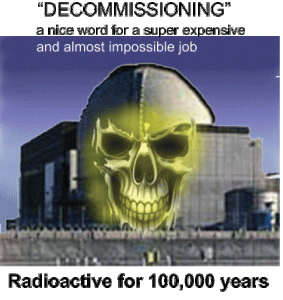
New regs for Wednesday: Nuclear, The Hill, 13 Mar 17
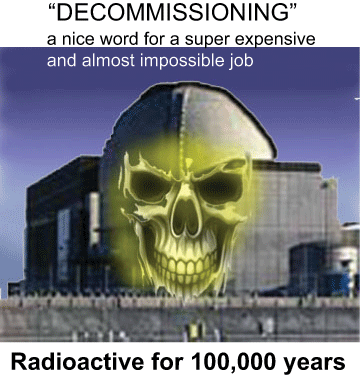
“………..The Nuclear Regulatory Commission (NRC) is drafting new rules for nuclear power reactors that are being decommissioned.
The rules will “provide for an efficient decommissioning process” and “reduce the need for exemptions from existing regulations.”
The public has 90 days to comment.http://thehill.com/regulation/323851-new-regs-for-wednesday-prepaid-cards-nuclear-water
March 15, 2017
Posted by Christina Macpherson |
Legal, USA |
Leave a comment
 This climate lawsuit could change everything. No wonder the Trump administration doesn’t want it going to trial, WP, By Chelsea Harvey March 9 A groundbreaking climate lawsuit, brought against the federal government by 21 children, has been hailed by environmentalists as a bold new strategy to press for climate action in the United States. But the Trump administration, which has pledged to undo Barack Obama’s climate regulations, is doing its best to make sure the case doesn’t get far.
The Trump administration this week filed a motion to overturn a ruling by a federal judge back in November that cleared the lawsuit for trial — and filed a separate motion to delay trial preparation until that appeal is considered.
The lawsuit — the first of its kind — argues the federal government has violated the constitutional right of the 21 plaintiffs to a healthy climate system.
Environmental groups say the case — if it’s successful — could force even a reluctant government to reduce greenhouse gas emissions and take other measures to counter warming.
“It would be huge,” said Pat Gallagher, legal director at the Sierra Club, who is not involved in the case. “It would upend climate litigation, climate law, as we know it.”
[Trump’s proposed climate agency cuts would disarm our coasts in the face of rising seas, scientists say]
The landmark lawsuit was originally filed during the Obama administration. The 21 plaintiffs, now between the ages of 9 and 20, claim the federal government has consistently engaged in activity that promotes fossil fuel production and greenhouse gas emissions, thereby worsening climate change. They argue this violates their constitutional right to life, liberty and property, as well the public trust doctrine, while holds that the government is responsible for the preservation of certain vital resources — in this case, a healthy climate system — for public use.
While legal experts are uncertain as to the lawsuit’s likelihood of success, few have disputed its pioneering nature. Similar cases have been brought on the state level, but this is the first against the federal government in the United States. And in November, the case cleared a major early hurdle when U.S. District Judge Ann Aiken denied motions filed by the Obama administration, as well as the fossil fuel industry, to have the lawsuit dismissed, ordering that it should proceed to trial.
The move allowed the case to join the ranks of climate lawsuits filed in other nations, which could upend the way environmental advocacy is conducted around the world. Just last year, a court in the Netherlands ordered the Dutch government to cut carbon emissions by a quarter within five years. Similar climate-related suits have been brought and won in Austria, Pakistan and South Africa.
Shortly after President Trump’s inauguration, the plaintiffs submitted a request that the Department of Justice preserve all documents that could be relevant to the lawsuit, including information on climate change, energy and emissions, and cease any destruction of such documents that may otherwise occur during the presidential transition. The request came just days after reports began to surface of climate information disappearing from White House and certain federal agency websites.
“We are concerned with the new administration’s immediate maneuver to remove important climate change information from the public domain and, based on recent media reports, we are concerned about how deep the scrubbing effort will go,”Julia Olson, chief legal counsel for the plaintiffs and executive director of the advocacy group Our Children’s Trust, said in a statement at the time. “Destroying evidence is illegal and we just put these new U.S. Defendants and the Industry Defendants on notice that they are barred from doing so.”…….https://www.washingtonpost.com/news/energy-environment/wp/2017/03/09/this-climate-lawsuit-could-change-everything-no-wonder-the-trump-administration-doesnt-want-it-going-to-trial/?tid=ss_tw&utm_term=.14eb9ea766c0
March 11, 2017
Posted by Christina Macpherson |
climate change, Legal, politics, USA |
Leave a comment
 http://www.sanluisobispo.com/news/business/article134769964.html The Associated Press TALLAHASSEE, FLA. 24 Feb 17 The Florida Supreme Court is upholding a lower court ruling that ordered a massive nuclear plant expansion to be redone to meet environmental and other concerns.
Justices in a brief-one page order on Friday rejected an appeal filed by Florida Power & Light.
Last year, the 3rd District Court of Appeal in Miami reversed a 2014 decision by Gov. Rick Scott and the Cabinet to approve construction of two nuclear reactors by FPL at its Turkey Point plant near Homestead. The project, costing up to $18 billion, would add about 2,200 megawatts of electric power or enough to supply 750,000 homes.
A three-judge panel ruled the governor and Cabinet failed to account for environmental regulations meant to protect the Everglades and endangered birds that make their home in the wetlands.
February 25, 2017
Posted by Christina Macpherson |
Legal, USA |
Leave a comment
 Nuclear Deal: Case to stop SA from bankrupting itself begins https://www.dailymaverick.co.za/article/2017-02-22-nuclear-deal-case-to-stop-sa-from-bankrupting-itself-begins/#.WK9qo9KGPGg REBECCA DAVIS SOUTH AFRICA 22 FEB 2017
While Finance Minister Pravin Gordhan was throwing around some big figures in Parliament on Wednesday, an even bigger one was looming over the Western Cape High Court: R1-trillion, the estimated cost of South Africa’s nuclear deal with Russia. The legal challenge mounted by two environmental NGOs to the nuclear deal hit the court this week, with an accompanying bevy of protesters. It has been termed one of the most significant state capture court cases South Africa has yet seen. By REBECCA DAVIS.
“No nukes, no bankrupting SA, no enriching Zuma and Co,” read one sign. “Nuclear costs SA equivalent of 1.2-billion buses!” proclaimed another. On a day when South Africa’s economy was already in the spotlight, the small crowd assembled outside the Western Cape High Court had one particular aspect of its future in mind. “Phantsi secret nuclear deal phantsi!” the protesters chanted.
In the legal ring: two NGOs, Earthlife Africa and the Southern African Faith Communities’ Environment Institute (SAFCEI), squaring up against Energy Minister Tina Joemat-Pettersson’s pursuit of 9,600 megawatts of nuclear power. One media outlet referred to it as a “David vs Goliath battle”. That’s accurate in the sense that the two NGOs behind the legal battle are modestly resourced. But when David took on Goliath, he didn’t have one of the most lethal advocates in the country leading his legal team.
Acting for the NGOs is David Unterhalter, who has appeared in countless of South Africa’s most high-profile legal matters – including representing Deputy President Cyril Ramaphosa at the Marikana Commission. In this case, David is armed and dangerous.
The court challenge will not deal with the question of whether or not nuclear power is the right energy source to meet the country’s needs. Opening the arguments for the applicants on Wednesday, Unterhalter said that his team would show that the inter-governmental nuclear agreement with Russia “fails to comply with what is required constitutionally”.
While the government contends that this kind of international agreement is an instance of “executive action”, and thus beyond the purview of review, the applicants maintain that it is “a fairly straightforward case of administrative action” which should have gone before Parliament for resolution. While the Russian agreement was tabled in Parliament, it was not subject to a debate and a resolution of Parliament, despite the state law adviser’s counsel to Minister Joemat-Pettersson that this was required.
Lawyer Adrian Pole subsequently told journalists that they will also argue that the public should have been granted more of a voice in discussions about South Africa’s energy future.
This point was emphasised by the protesters outside court. Criticising the government for making use of “flawed” processes and failing to carry out public hearings, Earthlife Africa’s Makoma Lekalakala described the nuclear process as “shrouded in secrecy”.
Lekalakala said: “This case was filed in the public interest to hold those in government accountable and prevent secret deals leading to corruption.” She also hit out at the possible environmental damage of a large-scale nuclear programme. South Africa is currently dependent on a fossil fuel economy, Lekalakala said. “With nuclear it becomes much worse – it’s not just a question of pollution, but also of [how to dispose of nuclear] waste.”
South Korean activist Kim Yong-Bock was outside court on Wednesday in solidarity with South African protesters – and bearing an urgent message focusing on nuclear safety. Kim said that the local court case was similar to the ongoing debate in Japan about the constitutionality of nuclear plants.
“The security of life in your country is supposed to be protected by your Constitution,” Kim said, warning that after the 2011 Fukushima nuclear disaster in Japan, wrangling continues as to the liability of the Tokyo Electric Power Company. To the nuclear industry, Kim suggested, “it doesn’t really matter if you die or not”.
Looking around at the South Africans gathered outside the court, Kim said: “You are potential victims.”
The issue of the prohibitive cost of the nuclear build was also prominent among the protesters’ concerns. “There are many ways of providing the electricity we need now and in the future without spending R1-trillion or more,” SACSEI’s Ven Tsondru said. Both sun and wind, she suggested, could generate electricity quicker and cheaper than nuclear energy.
Tsondru explained that the court case’s major function was to force government to share both the reasoning behind, and financial details of, the nuclear deal.
The legal proceedings have already forced the government’s hand in revealing certain aspects of the previously secretive nuclear deal. The original court application was filed in October 2015. From papers revealed to the applicants in 2016, the NGOs said that it appeared that despite denials from the governments of both Russia and South Africa, a binding commitment to buy a fleet of nuclear reactors from Russia had already been signed.
On Wednesday morning, protesters were keeping one eye on Parliament, where Finance Minister Pravin Gordhan was due to deliver his Budget speech that afternoon. Ears would be pricked for reference to the nuclear deal, which President Jacob Zuma did not mention in his State of the Nation Address a fortnight ago.
Earthlife Africa’s Lekalakala told the small crowd outside the Western Cape High Court that they expected the Finance Minister to announce in the Budget that afternoon that “we cannot go ahead with nuclear now”. If he were to give endorsement to the nuclear deal, she said, he would be “undermining you and me”.
As it turned out, Minister Gordhan’s Budget did not mention the nuclear deal at all – unless you count a veiled reference to protecting future generations from today’s debt.
To SAFCEI’S Liz McDaid, this was a positive sign.
“We applaud the Minister of Finance for acting in the public interest and not wasting money on the nuclear deal,” McDaid told the Daily Maverick. “We will continue to monitor government with respect to the nuclear deal. If we are successful with our court case, the decision to procure nuclear will be overturned.”
February 25, 2017
Posted by Christina Macpherson |
Legal, South Africa |
Leave a comment
Antinuclear lobby groups say government’s secrecy is embarrassing
Two groups are asking the high court to declare the alleged nuclear deal with Russia‚ signed by Energy Minister Tina Joemat-Pettersson‚ unlawful, Business Live 22 FEBRUARY 2017 PETRU SAAL The court battle between lobby groups and the government over the alleged R1-trillion proposed nuclear deal with Russia — ostensibly the biggest procurement by the government to date — resumed in Cape Town on Wednesday.
Earthlife Africa Johannesburg and the Southern African Faith Communities’ Environment Institute (Safcei) have taken the Department of Energy to court for procuring this arrangement under a veil of secrecy.
They have asked the court to declare the deal‚ signed by Energy Minister Tina Joemat-Pettersson‚ unlawful and unconstitutional.
Spokesperson for Earthlife Makoma Lekalakala said it was “embarrassing” that they had to turn to the courts because the government refused to divulge details of the deal, which was of great public interest.
“We wondered why the government wanted to build nuclear plants especially after what happened in Hiroshima. Nuclear is also very costly so this deal is on the brink of bankrupting the country‚” Lekalakala said…… Finance Minister Pravin Gordhan made no mention of the deal in his budget speech.https://www.businesslive.co.za/bd/national/2017-02-22-antinuclear-lobby-groups-say-governments-secrecy-is-embarrassing/
February 25, 2017
Posted by Christina Macpherson |
Legal, South Africa |
Leave a comment
Algerians take steps to prosecute France for nuclear tests https://www.middleeastmonitor.com/20170215-algerians-take-steps-to-prosecute-france-for-nuclear-tests/#.WKqZtaGEIJo.facebook
The top human rights organisation in Algeria announced yesterday that it has contacted the UN Human Rights Council regarding France’s refusal to admit to the crimes of its nuclear test programme. The French government carried out 17 nuclear tests in the Algerian desert, causing the death of 42,000 individuals; thousands more were left chronically ill due to being exposed to nuclear radiation.
The details were revealed in a statement by the National Secretary of the Algerian League for the Defence of Human Rights, Houari Kaddour, who is tasked with this issue, during an interview with Anadolu news agency. Kaddour stressed that his organisation “is trying to use all legal means to put the French authorities on trial and prosecute them in all international legal bodies, as well as in the EU, for their crimes.”
Algeria marked the 57th anniversary of the French nuclear tests two days ago. They were carried out between 1960 and 1966; Algeria gained independence from France in 1962. The French authorities still refuse to admit to these crimes and instead have announced that they will pay financial compensation to the victims.
According to Kaddour, his organisation contacted the UN Human Rights council and requested it to look into the crimes. “We also urged the Algerians in Europe to help us find lawyers specialising in international law to file a lawsuit against France in the next three months, before the Office of the High Commissioner on Human Rights in the EU. We also plan to prosecute France in the local courts in Switzerland which specialise in international crimes.”
Kaddour said that his organisation is coordinating with a number of human rights and international bodies in this regard, including all international human rights organisations, international organisations against nuclear testing, and French human rights groups. He noted that the Algerians had submitted over 730,000 compensation cases that were rejected by the compensation committee due to the impossible conditions imposed on the victims. Civilian victims, he added, are not recognised.
The Algerian League for the Defence of Human Rights accused the Algerian authorities of “not putting enough pressure on France to admit to these crimes.”
February 22, 2017
Posted by Christina Macpherson |
France, Legal |
Leave a comment

 Pro-consumer Florida energy bills would expand solar, repeal nuclear fees http://protectingyourpocket.blog.mypalmbeachpost.com/2017/02/21/pro-consumer-florida-energy-bills-would-expand-solar-repeal-nuclear-fees/
A Florida Senate bill filed this week would allow property owners to generate and distribute solar energy to residents and tenants.
Senator José Javier Rodríguez, D-Miami, this week filed a series of energy-related bills aimed at protecting the environment and protecting consumers’ pocket books.
- SB 456, allowing property owners to generate and distribute solar energy to residents and tenants on their own property. The bill is supported by a broad range of groups including business groups, agricultural interests, and consumer advocates.
- SB 974, if passed, would create a mechanism to prevent utilities from passing on to customers the cost of remediating environmental damage the utility caused, offered in response to the water contamination issues at Florida Power & Light’s Turkey Point nuclear power plant in Miami-Dade County.
- SB 976, if passed, would create a progressive rate schedule for utilities customers by requiring utilities to charge residential customers a 25 percent lower rate for the first 500 kilowatt hours consumed, benefitting low-income and fixed-income residents.
- SB 1100, if passed, would repeal advanced nuclear cost recovery in Florida, dubbed the “nuclear tax” since it allow utilities to charge for nuclear power plants that may never be built. FPL wants to build two more nuclear reactors at Turkey Point, but has not been granted a license yet.
“Consumers in Florida continue to subsidize an outdated energy system in Florida that stifles innovation, shuts out competition and hurts our environment — the bills I have filed will address those issues while giving consumers a much-needed break,” Rodriguez said.
February 22, 2017
Posted by Christina Macpherson |
Legal, politics, USA |
Leave a comment
Nuclear power struggle winds up in court, Herald and Review, TONY REID H&R Staff Writer, 19 Feb 17 CLINTON – Smoldering resentment over the new law that saved Clinton Power Station – and its 700 jobs – has now flared into a federal lawsuit.
February 20, 2017
Posted by Christina Macpherson |
Legal, USA |
Leave a comment
Fortunately, there is a bit of good news in his heap of radioactivity. Last November, a settlement was reached between the US Department of Justice, Bechtel Corp. and AECOM (formerly URS) for a whopping $125 million. The civil lawsuit alleged taxpayer funds were mismanaged and that both companies performed shoddy work. The lawsuit also claimed that government funds were illegally used to lobby members of Congress. Brought on by whistleblowers Gary Brunson, Donna Busche, and Walter Tamosaitis (Busche and Tamosaitis’s sagas were highlighted in two Investigative Fund reports I authored for Seattle Weekly in 2011 and 2012), the settlement was one of the largest in DoE history.
No doubt it was a substantial victory for whistleblowers and government accountability, despite the fact that the defendants did not admit guilt. Now, Washington State legislators are pushing HB 1723, a bill that would protect and treat Hanford workers for certain health problems that are a result of the work they’ve done at the facility, such as respiratory problems, heart issues, certain cancers like bone, breast, lung and thyroid, as well as neurological issues.
 Good News and Bad News at Hanford, America’s Most Polluted Site http://www.counterpunch.org/2017/02/09/good-news-and-bad-news-at-hanford-americas-most-polluted-site/FEBRUARY 9, 2017“The people running Hanford need to have a moral compass that directs them in the right way, as human beings, to do the right thing to protect these people,” retired Hanford employee Mike Geffre, who worked at Hanford for 26 years, told KING 5. “They’re trying to save money and save face. They’re standing behind their old position that there’s no problem. That’s absurd. They need to accept the fact that they made mistakes and get over it.”

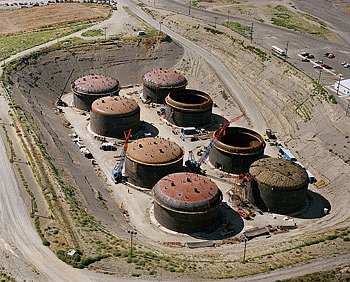
by JOSHUA FRANK It’s a new year and new administration, but the strong radioactive stench is the same out at Hanford in eastern Washington, home of the world’s costliest environmental cleanup. In January, a dozen workers reported smelling a toxic odor outside the site’s tank farms, where nuclear waste is stored underground. From April to December 2016, 70 people were exposed to chemical vapors emanating from the facility — and 2017 is off to the similar start.
Toxic odors at an old nuclear depot? This would be startling news anywhere else. But this is Hanford after all, where taxpayer money freely flows to contractors despite the snail-paced half-life of their work. Twenty years and $19 billion later, Hanford is still a nightmare — likely the most toxic site in the Western Hemisphere. Not one ounce of nuclear waste has ever been treated, and there are no indications Hanford will be nuke free anytime soon. To date, at least 1 million gallons of radioactive waste has leaked and is making its way to the Columbia River. It’s an environmental disaster of epic proportions — a disaster created by our government’s atomic obsession during the Cold War era.
No doubt, Hanford is a wreck in search of a remedy, yet the costs covered by American taxpayers appears to be growing exponentially. At the tail end of 2016, the estimated cost of turning the radioactive gunk into glass rods bumped up a cool $4.5 billion (adding to the ultimate price tag for the remaining Hanford cleanup, which had already reached a whopping $107.7 billion). These sorts of increases are so common they hardly make news anymore.
Donald Trump’s pick for Department of Energy Secretary, Rick Perry, who infamously stated he’d like to do away with the DoE altogether, now admits that Hanford’s one of the most dangerous facilities in the nation. But his commitment to cleaning up the fiscal and nuclear boondoggle remains to be seen. The plant that is to turn the waste into glass rods is set to open in 2023, but it’s a safe bet that won’t be happening. It’s already two decades behind schedule.
Meanwhile, workers on the front lines of the cleanup are often put in situations that are poorly monitored and exceedingly unsafe. Over the past three years KING 5 News in Seattle has tracked dozens of employees who were exposed to chemical vapors at Hanford and found their illnesses to include “toxic encephalopathy (dementia), reactive airway disease, COPD, and painful nerve damage.”
“The people running Hanford need to have a moral compass that directs them in the right way, as human beings, to do the right thing to protect these people,” retired Hanford employee Mike Geffre, who worked at Hanford for 26 years, told KING 5. “They’re trying to save money and save face. They’re standing behind their old position that there’s no problem. That’s absurd. They need to accept the fact that they made mistakes and get over it.”
Fortunately, there is a bit of good news in his heap of radioactivity. Last November, a settlement was reached between the US Department of Justice, Bechtel Corp. and AECOM (formerly URS) for a whopping $125 million. The civil lawsuit alleged taxpayer funds were mismanaged and that both companies performed shoddy work. The lawsuit also claimed that government funds were illegally used to lobby members of Congress. Brought on by whistleblowers Gary Brunson, Donna Busche, and Walter Tamosaitis (Busche and Tamosaitis’s sagas were highlighted in two Investigative Fund reports I authored for Seattle Weekly in 2011 and 2012), the settlement was one of the largest in DoE history.
No doubt it was a substantial victory for whistleblowers and government accountability, despite the fact that the defendants did not admit guilt. Now, Washington State legislators are pushing HB 1723, a bill that would protect and treat Hanford workers for certain health problems that are a result of the work they’ve done at the facility, such as respiratory problems, heart issues, certain cancers like bone, breast, lung and thyroid, as well as neurological issues.
“Currently, many Hanford workers are not receiving necessary medical care because they are put in the impossible situation of being unable to specify the chemicals to which they have been exposed, and in what concentrations, making it difficult for their doctors to connect their disease with their exposures,” Randy Walli, Business Manager for the pipefitters union, Local 598, told King 5.
Compensation for whistleblowers and employees whose health is impacted by their work are steps in the right direction. But Hanford’s contractors and the DoE that oversees them still have much to do to make the increasingly expensive nuclear cleanup at Hanford, safe, effective and transparent.
This piece first appeared at The Investigate Fund.
February 10, 2017
Posted by Christina Macpherson |
Legal, USA, wastes |
Leave a comment














 nuclear-news