Is nuclear power compatible with human rights in Constitution? Asahi Shimbun July 24, 2017 One year has passed since an evacuation order was lifted on July 12, 2016, for most parts of the Odaka district of Minami-Soma, Fukushima Prefecture, which lies within a 20-kilometer radius of the crippled Fukushima No. 1 nuclear power plant.
Stores and schools in the district are gradually being reopened. Voices of high school students are heard echoing through the streets at times of the day when they go to school and return home. At the same time, though, many stores remain shuttered and grass is running wild in the yards of many houses.
City government figures show that Odaka was home to only 2,046 residents as of July 12, less than one-sixth of the corresponding figure at the time of the 2011 disaster at the nuclear plant, which is operated by Tokyo Electric Power Co. (TEPCO).
The nuclear disaster, triggered by the Great East Japan Earthquake and tsunami, deprived many people of their “lives as usual,” which should have been guaranteed under the Constitution of Japan.
DISASTER HIGHLIGHTED ESSENTIALS OF CONSTITUTION
Katsuaki Shiga, a 68-year-old fisherman, has given up hope of returning to Odaka.
His home, which he had just built near the coastline, was inundated by the tsunami. The home went dilapidated while he was banned entry to the premises in the wake of the nuclear disaster, and Shiga had no choice but to have it dismantled.
“(The disaster) changed not just my life but also the lives of all people in our community,” Shiga said. “That made me think about the essentials of the Constitution, such as the right to life and fundamental human rights.”
The government of Minami-Soma in May last year distributed a brochure containing the entire text of the Constitution to all households in the city.
Yasuzo Suzuki (1904-1983), a scholar of constitutional law who hailed from Odaka, included an explicit mention of the right to life in a draft outline of Japan’s Constitution, which he worked out immediately after World War II ended in 1945.
“The people shall have the right to maintain wholesome and cultured living standards,” the draft said, in a prelude to Article 25 of the current Constitution.
Katsunobu Sakurai, mayor of Minami-Soma, wanted the city’s residents to cast their minds back to a starting point at a time when life had taken a sudden turn for the worse for many of them.
Several tens of thousands of inhabitants of Fukushima Prefecture remain evacuated either within or outside the prefecture’s borders. Countless people have lost their longtime livelihoods or dwellings, which means their freedom to choose and change their residences and to choose their occupations (Article 22), along with their right to own or hold property (Article 29), were severely violated.
Many children were no longer able to attend schools in their hometowns, which means their right to an education (Article 26) was also compromised.
And most importantly, the tragedy drove many people into “disaster-related deaths.”
“The nuclear disaster has made it impossible to maintain the sort of life that is described in the Constitution,” Sakurai said emphatically. “That is unconstitutional, isn’t it?”
CONSTITUTION AS PILLAR AND POST
The Fukui District Court in May 2014 issued an injunction against the planned restart of reactors at Kansai Electric Power Co.’s Oi nuclear plant in a lawsuit filed by residents living near the power-generating facility in Fukui Prefecture.
“The use of nuclear energy is meant to fulfill the socially important functions of generating electric power, but that is inferior in standing to the core part of personal rights in light of the Constitution,” the court said in its decision.
Akiko Morimatsu said she was given hope by that court decision, which based itself on the Constitution. The 43-year-old heads a group of plaintiffs from the Kansai region in a group lawsuit filed by evacuees from the nuclear disaster, who are demanding compensation from the central government and TEPCO.
Worried about her two young children’s exposure to radiation, Morimatsu fled to Osaka from Koriyama, Fukushima Prefecture, although the area she was from was not under an evacuation order.
Voluntary evacuees like her, who constitute a minority, have had to face unfriendly eyes both in and outside of Fukushima Prefecture, and have received little help from administrative organs and scanty damage payments from TEPCO.
She said she wondered if she had made the right choice, and she took a fresh look at the Constitution, which she had studied in her student years. She thereupon found such statements as “all peoples of the world have the right to live in peace, free from fear and want” (preamble) and “all of the people shall be respected as individuals” (Article 13).
“This should be the pillar and post for me,” Morimatsu said she thought.
She argued that it is up to individual freedom to choose between evacuating and staying, and that all individuals, no matter which option they have chosen, should be granted assistance that allows them to realize the sort of life that is guaranteed under the Constitution.
Seventy years after the Constitution came into force, people are still turning to the supreme law of Japan as a weapon in their fight to win back their “lives as usual.” That reality should not be forgotten and should be taken seriously…… http://www.asahi.com/ajw/articles/AJ201707240022.html
July 26, 2017
Posted by Christina Macpherson |
Japan, Legal |
Leave a comment

 This could be the next big strategy for suing over climate change.
Two California coastal counties and one beach-side city touched off a possible new legal front in the climate change battle this week, suing dozens of major oil, coal, and other fossil fuel companies for the damages they say they will incur due to rising seas.WP, By Chris Mooney and Brady Dennis July 20 2017, Two California coastal counties and one beach-side city touched off a possible new legal front in the climate change battle this week, suing dozens of major oil, coal, and other fossil fuel companies for the damages they say they will incur due to rising seas.
The three cases, which target firms such as Chevron, ExxonMobil, BP and Royal Dutch Shell, assert that the fossil fuel producers are collectively responsible for about 20 percent of global carbon dioxide emissions between 1965 and 2015. They claim that industry “knew or should have known” decades ago about the threat of climate change, and want companies to pay the costs of communities forced to adapt to rising seas.
“We’re already living the impact of sea level rise,” said Marin County Supervisor Kate Sears. She said a county vulnerability study found hundreds of county businesses and other assets could be at risk in coming years.
“This lawsuit is a natural next step in how we address the expense we’ve already had in planning for and trying to remediate the impacts of sea level rise, but also in addressing the impacts we expect in the future.”…….
The California cases are also proceeding under a legal doctrine called “public nuisance” (among other claims), which charges that under California common law, the companies have injured the counties and city by contributing to rising seas, and more frequent and severe flooding as a result.
But the difference is that this time, they are making state level nuisance claims rather than federal ones, which have already failed as courts pointed out that those worried about climate change had other recourses, such as EPA action.
The lawsuits were filed in California courts by Marin and San Mateo counties and the City of Imperial Beach, which sits south of San Diego near the Mexico border. Each cites specific damages expected from rising seas.
San Mateo cited worries about the flooding of the San Francisco Airport, along with up to $24 billion in assets being put at risk.
Marin County estimated nearly $16 billion of homes and businesses were threatened, and that with 6.7 feet of sea level rise, 7 percent of coastal roads would be “exposed to higher average sea level and storm threats at several locations.”
Imperial Beach cited the potential for “over $106 million” in property damages because of coastal erosion and argued the town has few resources to adapt to rising seas.
Vic Sher, a partner at the firm of Sher Edling who is helping lead the legal challenge, said the goal behind the lawsuits is to shift the “very real and very large costs of dealing with sea level rise” from ordinary citizens to the companies responsible for knowingly contributing to global warming.
He likened the cases to past litigation that sought to hold tobacco companies accountable for the public health toll of smoking, as well as efforts to force lead paint manufacturers to renovate homes where health risks remain……..
A strength of the lawsuit, note some legal observers, lies in the fact that sea level rise is easily measurable, constant (unlike climate-affected weather events), and very strongly linked to a warming planet. Moreover, analyses have become more and more precise when it comes to mapping which locations will be inundated, or subjected to greater flooding risks, for a given level of rising seas.
Bookbinder said there could be a time when the science is powerful enough to try to assess blame for other climate related changes, such as droughts, but that sea level rise is a stronger and simpler case right now. ……… https://www.washingtonpost.com/news/energy-environment/wp/2017/07/20/this-could-be-the-next-big-strategy-for-suing-over-climate-change/?utm_medium=twitter&utm_source=dlvr.it&utm_term=.af0543ecd151
July 22, 2017
Posted by Christina Macpherson |
climate change, Legal, USA |
Leave a comment
Residents fail in court battle to halt Ehime nuclear reactor http://www.asahi.com/ajw/articles/AJ201707210051.html, THE ASAHI SHIMBUN, July 21, 2017 MATSUYAMA–Eleven local residents have lost their court bid to shut down the Ikata nuclear power plant’s No. 3 reactor, which was restarted in August 2016.
The Matsuyama District Court on July 21 turned down the request for a temporary injunction to halt operations.
The court said there is nothing unreasonable in the new safety standards introduced by the Nuclear Regulation Authority (NRA) after the 2011 Fukushima nuclear disaster and in the safety measures taken by the plant’s operator, Shikoku Electric Power Co.
The residents intend to appeal to a higher court.
The nuclear power plant in Ikata, Ehime Prefecture, is located near the “median tectonic line fault zone,” one of the largest active fault lines in Japan.
It is also at risk if a large tsunami is caused by a powerful earthquake along the Nankai Trough off the coast of western Japan.
After the powerful quakes that hit Kumamoto Prefecture in April 2016, the Ehime residents filed an injunction with the court in May the same year, three months before the restart of the No. 3 reactor.
They said that as earthquakes could also occur around Ikata, it was necessary to continue the suspension of operations.
Since then, the residents have battled with Shikoku Electric Power at five hearings and through the exchange of documents.
The points of dispute were whether the NRA’s new safety standards are reasonable and whether the biggest tremors assumed by Shikoku Electric Power are of the appropriate level.
As for injunctions against nuclear power plants, the Fukui District Court decided in April 2015 to suspend operations of the No. 3 and the No. 4 reactors at the Takahama nuclear power plant in Fukui Prefecture. The Otsu District Court in the neighboring prefecture of Shiga also made a similar decision about the reactors in March 2016.
However, those decisions were nullified in subsequent rulings.
(This article was written by Yosuke Okawa and Yoshitaka Unezawa.)
July 22, 2017
Posted by Christina Macpherson |
Japan, Legal |
Leave a comment
 Nuclear energy development under the spotlight http://bereamail.co.za/114003/nuclear-energy-development-under-the-spotlight/, 1 July 17
“The money planned to build the power stations can be used to improve our ailing education system.” THE jury is still out on why a country like South Africa, rated number five on the world as best suitable for renewable energy, would want to build eight new nuclear power stations at cost of R1 trillion.
Should the 9,600MW of nuclear capacity project go ahead, it could be one of the world’s biggest nuclear contracts in decades. The South African Faith Communities Environmental Institute (SAFCEI) and the South Durban Community Environmental Alliance (SADCEA) held a Nuclear Court Case Feedback workshop, at Diakonia on Friday, following their landmark victory at the Western Cape High Court, which saw government’s notorious nuclear deal agreements with Russia, the United States and South Korea set aside and declared unlawful and unconstitutional.
According to Lydia Mogano, who is Safcei’s regional coordinator, a nuclear energy development in South Africa will have negative socio-economic and environmental implications on ordinary citizens.
“Electricity tariffs are already high, with residents paying close to R1.50 per unit, but with nuclear energy they will pay R1.80 and above, making it even more difficult for them survive. Even the government’s own research done by the CSIR, shows that we do not need nuclear at all and renewable energy will be much cheaper. Nuclear energy demand is on the decline across the world, it takes 10 to 15 years to build a nuclear power station. Research done by CSIR shows that solar provides 70 percent of energy globally,” Mogano said.
Despite critics saying the country does not have the money, necessary skills to procure, build, operate, maintain and regulate six new nuclear power stations, Presient Jacob Zuma, addressing Parliament last month, said government still intended to pursue the acquisition of nuclear power stations at a “pace and scale” that the country could afford. He further added that building nuclear power stations would “bring dividends and profits for many thousands of years to come.”
However, Mogano said funds planned to build the power stations could be used to improve our ailing education system, the backlog of houses millions of people still needed houses and improvements could be made to the country’s water and sanitation systems.
Legal representative for Safcei and Earthlife, Adrian Pole, who was also in attendance said: “Transparency in the nuclear procurement process, including access to cost estimates and feasibility studies, has been at the heart of this case. Public participation without that kind of information being made available would render it, in itself, unfair.”
Environmental activist Desmond D’sa said should the nuclear energy development not go ahead, the R240 million that has already been spent on two years of research needs to be accounted for. According to industry executives, regulators and scientists with proper management, vigilance and safety enhancements, a nuclear power plants lifespan is 40-70 years and the decommission costs the same amount as when you build it.
July 21, 2017
Posted by Christina Macpherson |
Legal, politics, South Africa |
Leave a comment
, Reuters 19 Jul 17
*Olkiluoto nuclear project almost decade late* Finnish TVO, French Areva claim billions from each other
* Final decision seen coming in early 2018 (Adds comments, detail)
By Jussi Rosendahl and Benjamin Mallet HELSINKI/PARIS, July 20 – Finnish utility Teollisuuden Voima (TVO) said on Thursday it had received another favourable partial decision from the International Chamber of Commerce (ICC) in its long-running dispute with nuclear reactor supplier Areva.
The companies are claiming billions of euros from each other due to years of delays and cost overruns on the Olkiluoto 3 EPR reactor project in southwest Finland.
The new partial ruling addressed preparation, review, submittal, and approval of design and licensing documents on the project…..
The cost of Olkiluoto 3 was initially estimated at 3.2 billion euros ($3.7 billion), but Areva in 2012 estimated the overall cost at closer to 8.5 billion euros……http://www.reuters.com/article/tvo-areva-arbitration-idUSL5N1KB1V4
July 21, 2017
Posted by Christina Macpherson |
Finland, Legal |
Leave a comment

 Express 18th July 2017, The Government admitted an agreement made in September last year over theHinkley Point C nuclear power station means operators EDF can claim
compensation if there is a change in British, EU or international law,
policy or guidance, which forces the £24bn project to close early.
Richard Harrington, the energy and industry minister, confirmed the payments could
be “up to around £22bn” in a written answer to Labour’s Dr Alan
Whitehead at the beginning of July. Mr Harrington said: “We remain firmly
committed to bringing forward the UK’s first new nuclear power plants in
a generation. http://www.express.co.uk/news/uk/830098/Brexit-EDF-Hinkley-Point-C-compensation-nuclear-power-Euratom-Treaty
July 19, 2017
Posted by Christina Macpherson |
business and costs, Legal, UK |
Leave a comment
July 17 2017 Terry R Scheidt Seems like Terry is the only responder, is there anyone else, It is July 2017, been writing to Trump to use his EO but he never responds either. Boy is this America?
January 12, 2014 Aloha, It is now 01/2014 (24 years) since RECA was enacted. We are still waiting for justice. Our country denied, deceived, has no integrity or values by denying victims of radiation they caused. The justice system denied and dismissed most litigation cases claiming the Congress had to enact better laws to address radiation.
They claimed radiation does not cause cancer, of course we know better in the PACIFIC, Micronesia, Guam, Johnston
Island and many other location. The unfortunate thing is 70 years have passed and many have already died which is our countries hope.
May 13, 2017 It is now May 2017, yes Terry is still alive and still seeking equity, HA. Our delegates never heard such a word, denial is more like it. I will advocate for loyalty till I die. Hard to believe our nation does things I thought only others did.
I was a range rat, many friends on Midway, Eniwetok, Wake, French Frigate Shoals, Christmas, Johnston, Jarvis, Canton damn so many.
*************************************************************************************************************
 Way back in 2010, we made a small post about the the plight of residents of Guam, who were suffering from illnesses resulting from radiation exposure. Research presented to the National Academy of Science and National Research Council described the effects on this community, of atmospheric testing of nuclear weapons. The Pacific Association for Radiation Survivors, a nonprofit organization, was lobbying U.S. Congress to include Guam in the Radiation Exposure Compensation Act Program, so that they could receive help and compensation for their radiation-induced illnesses.
Well, what happened about this?
Thanks to one reader of this website, we have been kept up to date over the years:
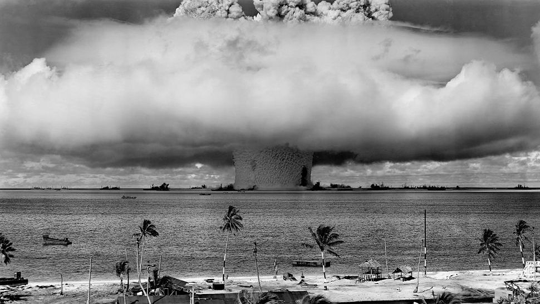
TERRY R SCHEIDT by Terry R Scheidt January 6, 2011 I WAS A 1962 JOHNSTON ISLAND PARTICIPANT. I WAS AT GROUND ZERO AND EXPOSED TO HIGH LEVELS OF RADIATION FOR WHICH I GOT CANCER. I HAVE NOT BEEN COMPENSATED UNDER THE DOE/EEOICPA ACT BECAUSE I DID NOT WORK FOR DOE. I WAS DENIED. I RECEIVED UNEQUAL COMPENSATION FROM DOJ (RECA) BUT AT A MUCH LESSER AMOUNT THAN DOE (EEOICPA). NO MEDICAL AND LESS THAN HALF THAT OF DOE. PLEASE SUPPORT HR 5119/S3224.
April 23, 2011 Do our representatives really care? Why have both HR5119/S3224 both died in committee. Our government does not live up to responsibility. They cause us harm than ignore us as if we do not exist. Aloha.
April 26, 2011 I am a 1962 ground zero victim of the Johnston Island PPG. Senators Pangelinan, Udalls and Rep Lujan have done nothing. All legislation died in committee. They turned their backs on us again. Shame.
June 25, 2012 Continue reading →
July 17, 2017
Posted by Christina Macpherson |
health, Legal, OCEANIA, PERSONAL STORIES, USA |
3 Comments
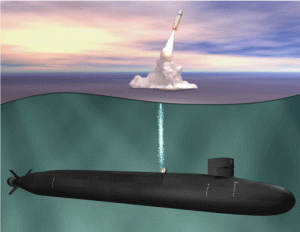 Using Trident would be illegal, so let’s phase it out https://www.theguardian.com/commentisfree/2016/jul/15/trident-illegal-nuclear-britain-arsenal?CMP=share_btn_fb, Geoffrey Robertson Nuclear doom is nearer than most of us believe, experts warn. Britain must set a moral lead by becoming the first of the ‘big five’ powers to reduce its arsenal. The most portentous decision for every new prime minister is what to write in the secret “letter of last resort” to Trident submarine commanders telling them what to do with their nuclear missiles if the British government is wiped out. In Monday’s debate on the renewal of Trident, Theresa May should tell parliament what life-or-death decision she has made in her letters of last resort.
It is said that Margaret Thatcher ordered our nukes, trained on Moscow, to be fired so as to cause maximum destruction to the enemy – ie to its civilians. That order, even for a nuclear “second strike”, would today be illegal.
It is ironic that although Chilcot produced so much condemnation of Blair for joining an unlawful war, MPs are now being asked to vote for a weapons system that cannot be used without committing a crime against humanity. This was defined in 1998 by the Rome Statute, which set up the international criminal court, as “a systematic attack directed against a civilian population, resulting in extermination or torture, or an inhumane act intentionally causing great suffering”.
The same statute additionally makes it a war crime to intentionally launch an attack in the knowledge that it would cause incidental loss of civilian life or severe damage to the natural environment, out of proportion to military advantage.
Trident’s 200 thermonuclear bombs, each 10 times more powerful than those that struck Hiroshima and Nagasaki, are illegal because they cannot discriminate between military targets and hospitals, churches and schools; because of their capacity to cause untold human suffering for generations to come; and because their consequences (eg ionising radiation, which tortures victims and lingers for half a century) are beyond the control or knowledge of the attacker, who cannot judge the proportionality of their use.
As the international court of justice put it, back in 1996: “The destructive power of nuclear weapons cannot be contained in space or time. They have the potential to destroy all civilisation and the entire ecosystem of the planet.”
So why is our law-abiding government spending tens of billions on a weapons system that cannot lawfully be used?
First, because its advisers wrongly think that nuclear weapons are legal in certain circumstances. Back in that 1996 case, the UK argued that it could lawfully drop “a low-yield nuclear weapon against warships on the high seas or troops in sparsely populated areas”.
This scenario has now been shown up as fantastical: “first use” in these circumstances by the UK would trigger a nuclear reprisal with inevitable damage to the atmosphere, the oceans and the “sparsely populated” area (which would henceforth be entirely unpopulated). In any event, Trident’s weapon-bays will not carry “low-yield” bombs, and if they did the result would be better achieved by conventional weapons, making nuclear deployment unnecessary and disproportionate.
The world court ruled that the threat or use of nuclear weapons would “generally” be contrary to war law but might be lawful “in extreme circumstances of self-defence, in which the very survival of a state would be at stake”. This was a time-warped view of war law in 1996 that is not tenable today. The court, to be fair, predicted as much, saying that it expected international law to “develop” towards a total ban on the use of the bomb. It soon did, with the Rome Statute and subsequent development of the principle that a state has no right to preserve itself at the expense of damage to other states and to the rights to life of millions of citizens.
It is absurd to suggest that it would have been lawful for Hitler, his back to the bunker wall, to start a nuclear Götterdämmerung to save the Nazi state (Nuremberg decided it was not lawful for him even to fire doodlebugs). Given what we now know about the uncontrollable and devastating propensities of modern nuclear weapons, it is unlawful to fire them at all.
There is a further legal reason for allowing Trident to wear out. It is Article VI of the nuclear proliferation treaty (NPT), by which parties undertake to proceed in good faith to “general and complete” nuclear disarmament.
The world court’s 1996 ruling decided that this imposed not a “mere” obligation but a binding legal obligation on existing nuclear states to reduce the number of their bombs gradually, to zero. It is contrary to the spirit of article VI to upgrade rather than downgrade the fleet.
A decision to phase out Trident would help Britain recover some of the clout it has lost through Brexit. It would show moral leadership, and shame other nuclear powers that have failed to live up to their NPT obligations (especially the US; President Obama’s Nobel prize was prematurely awarded in part for envisaging “a world without nuclear weapons”).
Moral leadership from a nuclear-weapons state is urgently needed. The latest US defence budget allocates $1tn for future modernisation of its nukes and it has acquired new sites for them, in Poland and Romania. President Putin has promised in return a new generation of nuclear-tipped intercontinental ballistic missiles. The American most knowledgeable on the subject – Bill Clinton’s defence secretary William J Perry – has just published a book warning that “nuclear doom” is closer today than it ever was during the cold war.
Although possession of nuclear weapons is not per se unlawful, the UK is under a duty to reduce its arsenal: the vice of refurbishing Trident is that it encourages other states to do the same, and remains a constant stimulus for countries – particularly in the Middle East and Asia – to acquire arsenals of their own.
When negotiating to buy Polaris (Trident’s predecessor), back in 1962, Harold Macmillan confided in his diary that “the whole thing is ridiculous”, but consoled himself with the thought that “countries which have played a great role in history must retain their dignity”.
A half-century later, the best way for Britain to regain its dignity post-Brexit is not to throw vast sums of money away on a weapon that cannot lawfully be used, but rather to appear as the first of the “big five” powers to shoulder its legal obligation to disarm under article VI of the NPT. It will be many years before the mushroom cloud becomes a hallucination, but at least Britain would be able to boast that it had led the way.
July 17, 2017
Posted by Christina Macpherson |
Legal, politics international, Religion and ethics, UK |
Leave a comment
French Minister Sticking to Planned Nuclear Power Cuts https://financialtribune.com/articles/energy/68481/french-minister-sticking-to-planned-nuclear-power-cuts., 17 July 17
France should define a clear roadmap to fulfill its pledge to cut the share of nuclear power in its electricity generation to 50% by 2025, French ecology minister said in an interview in the Sunday edition of regional daily Ouest-France.
A 2015 law requires France to reduce within eight years the share of atomic power generation to 50% from over 75% currently and include more renewable wind and solar generation, Reuters reported.
Nicolas Hulot also said in a radio interview that for France to meet that target, it might have to shut down up to 17 of its 58 nuclear reactors operated by state-controlled utility EDF.
His comments drew questions from observers on how nuclear-dependent France, a net power exporter in Europe, could possibly shut down 17 reactors and continue to guarantee adequate power supply.
Hulot clarified that he did not say 17 reactors must close, but that if the 2015 law were respected, the reactors would have to close.
Newly-elected French President Emmanuel Macron has maintained the target of cutting French nuclear production by 2025.
“We have to define realistic and possible scenarios, otherwise it will be brutal,” Hulot said. Hulot, an environmental campaigner who was appointed ecology minister by Macron, said that since the 2015 law was passed, little has been done and there was no clear strategy on how France would meet the 50% target.
“I want to engage in planned course of action, especially on a social and economic level,” Hulot said. “Nuclear power plants cannot be closed without taking into account the reality of jobs. We must model scenarios and build a roadmap.”
The closure of nuclear plants is a hot-button issue in France with trade unions and some political parties saying the plan would cripple the French nuclear sector.
Hulot also said state-controlled utility EDF would have to accelerate its development of renewable energies.
“The French authorities could stimulate the development of these energies by implementing tax incentives, easing regulatory processes and cutting the length of potential litigations,” he said.
July 17, 2017
Posted by Christina Macpherson |
France, Legal, politics |
Leave a comment
 Judge Rules Against WCS – EnergySolutions Merger http://www.ladailypost.com/content/judge-rules-against-wcs-energysolutions-merger, by Chris Clark June 24, 2017 , CCNS News: Federal District Judge Sue L. Robinson entered her sealed opinion Wednesday in favor of the U.S. Department of Justice and prohibited Waste Control Specialists (WCS) and EnergySolutions from moving forward with the proposed $367 million merger of the two-nuclear waste storage and disposal companies.
The judge’s decision was based on anti-trust law.
In a written statement, Andrew Finch, acting assistant attorney general of the Justice Department’s Antitrust Division, said, “Substantial evidence showed that head-to-head competition between EnergySolutions and Waste Control Specialists led to better disposal services at lower prices.”
He continued, “
Today’s decision protects competition in an industry that is incredibly difficult to enter. While EnergySolutions’ preference was to buy its main rival rather than continue to compete to win business, today’s decision ensures that customers will benefit from the competitive process.”
In anticipation of the antitrust trial and the growing expenses involved in expanding WCS’s business to include the storage of plutonium fuel from U.S. nuclear power plants, in April, WCS asked the Nuclear Regulatory Commission (NRC) to temporarily suspend review of its application.
WCS applied for a 40-year license to build and operate a consolidated interim storage facility for 44,000 tons of high-level radioactive waste. WCS planned to build the de facto parking lot dump on its 14,900 acres on the New Mexico-Texas border, five miles east of Eunice, New Mexico.
June 26, 2017
Posted by Christina Macpherson |
Legal, USA, wastes |
Leave a comment
 US sailors who ‘fell sick from Fukushima radiation’ allowed to sue Japan, nuclear plant operator http://www.telegraph.co.uk/news/2017/06/23/us-sailors-fell-sick-fukushima-radiation-allowed-sue-japan-nuclear/ Julian Ryall, in Tokyo 23 JUNE 2017
A US appeals court has ruled that hundreds of American navy personnel can pursue a compensation suit against the government of Japan and Tokyo Electric Power Co. for illnesses allegedly caused by exposure to radioactivity in the aftermath of the 2011 accident at the Fukushima Dai-ichi nuclear plant.
The 9th US Circuit Court of Appeals in San Francisco ruled on Thursday that the 318 sailors who have so far joined the $1 billion (£787 million) class action lawsuit do not need to file their case in Japan.
Most of the plaintiffs were aboard the USS Ronald Reagan, an aircraft carrier that was dispatched to waters off north-east Japan after the March 2011 meltdown at the Fukushima plant. Three reactors suffered catastrophic meltdowns and released large amounts of radiation into the atmosphere after their cooling units were destroyed by a magnitude-9 earthquake and a series of tsunami.
The California-based law firm representing the plaintiffs say they have been affected by a range of complaints, ranging from leukaemia to ulcers, brain cancer, brain tumours, testicular cancer, thyroid illnesses and stomach complaints.
The suit claims that TEPCO is financially responsible for the sailors’ medial treatment because it failed to accurately inform the Japanese government of the scale of the problem.
The Japanese government, the suit alleges, also failed to inform the US that radiation leaking from the plant posed a threat to the crew of the USS Ronald Reagan and other US assets dispatched to assist in “Operation Tomodachi”, meaning “friend” in Japanese.
The case was originally filed in San Diego in 2012, but has been delayed over the question of where it should be heard. The US government has also vehemently denied that any personnel were exposed to levels of radiation that would have had an impact on their health during the Fukushima recovery mission.
Interviewed for the San Diego City Beat newspaper in February, William Zeller said: “Right now, I know I have problems but I’m afraid of actually finding out how bad they really are.”
Formerly a martial arts instructor, he now uses a breathing machine when he goes to sleep due to respiratory problems he blames on his exposure aboard the USS Ronald Reagan in 2011.
“I literally just go to work and go home now”, he said. “I don’t have the energy or pain threshold to deal with anything else”.
June 24, 2017
Posted by Christina Macpherson |
Legal, USA |
1 Comment
Former Senator John Edwards Representing Thousands of United States Veterans Injured in Nuclear Disaster http://www.businesswire.com/news/home/20170622006227/en/Senator-John-Edwards-Representing-Thousands-United-States Ninth Circuit Rules Sailors Will Get Their Day in U.S. Court, June 22, 2017 RALEIGH, N.C.–(BUSINESS WIRE)–Today, the United States Ninth Circuit Court of Appeals ruled in favor of the U.S. sailors who were exposed to dangerous levels of radiation assisting in humanitarian relief efforts to Japan following an earthquake and tsunami in 2011. Based on the ruling, the sailors are able to continue their suit against Tokyo Electric Power Co. Holdings Inc. (TEPCO) allowing the sailors to pursue their case in the District Court in San Diego. It is possible that the nuclear meltdown at the Fukushima plant affected up to 75,000 U.S. citizens, even after TEPCO deemed the conditions safe.
After meeting with attorneys from both sides last December, the United States Government submitted an amicus curiae brief expressing its belief that nothing should prevent the sailors from litigating their case here in America. Today’s Court of Appeals ruling reinforces the government’s desire that the sailors’ fight for justice will take place in the United States and not Japan as TEPCO and the Government of Japan had previously requested.
“These members of the United States Navy deserve their day in court, and they will get it,” said former Senator Edwards. “These American heroes served the United States and were innocent victims in a nuclear disaster that never should have happened. This case has broad U.S. interests, both because of our nation’s long-standing relationship with Japan, and because plaintiffs in this case are members of the U.S. military harmed while on a humanitarian mission.”
As recently as this week, three former executives from TEPCO were charged criminally in Japan with contributing to deaths and injuries stemming from the meltdown at the Fukushima nuclear power plant. In addition, the Japanese government investigated the nuclear disaster and found that TEPCO was grossly negligent.
In 2011, U.S. sailors aboard the aircraft carrier U.S.S. Ronald Reagan were poisoned by radiation during Operation Tomodachi (“friend”). The humanitarian mission was in response to a 9.0 magnitude earthquake which triggered a tsunami in Japan that led to the Fukushima nuclear disaster. Relief efforts included delivering food, supplies and clothing to the people ravaged by the earthquake and tsunami.
The plaintiffs, led by Lindsay R. Cooper and other members of the U.S. Navy and their dependents, have suffered and continue to be diagnosed with extensive injuries including blindness, thyroid cancer, leukemia and brain tumors. The lawsuit is not only against TEPCO, but several other co-defendants, including General Electric, EBASCO, Toshiba Corp. and Hitachi.
Former Senator Edwards, his daughter Cate Edwards and California-based attorneys Charles Bonner, Cabral Bonner and Paul Garner are continuing to expand their suit against TEPCO. If you are a U.S. Sailor affected by this, you can reach attorneys working on this litigation at 844.283.9434 or http://fukushima.edwardskirby.com/
June 24, 2017
Posted by Christina Macpherson |
Legal, USA |
1 Comment
Opponents fight nuclear subsidy in court http://blog.timesunion.com/capitol/archives/275743/opponents-fight-nuclear-subsidy-in-court/Note: This story by Rick Karlin originally appeared in Tuesday’s edition of the Times Union. 20 June 17
Representatives of the state Public Service Commission were in court Monday defending their decision last August to award a multibillion dollar, 12-year subsidy to a group of upstate nuclear power plants along Lake Ontario. Opponents say it is a corporate giveaway, but state officials contend it will cut down on greenhouse gases.
The commission has “broad authority” to regulate power production in the state, said PSC lawyer John Graham, who was moving to dismiss a lawsuit filed by a coalition of activists who oppose the deal.
“This isn’t a small change. It’s a dramatic change,” said John Parker, a lawyer representing the Hudson River Sloop Clearwater ,which has opposed the deal with the New York Public Interest Research Group and other groups.
The arguments unfolded before acting Supreme Court Justice Roger McDonough in Albany. The plaintiffs maintain the PSC overstepped last August when it approved the subsidies for the Ginna, FitzPatrick and Nine Mile Point plants in Wayne and Oswego counties.
While the PSC views the subsidies as a way to control carbon emissions as the state moves toward more renewable energy sources, critics believe the Cuomo administration, which supported the plan, was intent on avoiding the job losses that would have come with plant closures in the hard-pressed region where the plants operate.
“You really have the executive branch extending its authority to this agency,” said David Barrett, a lawyer with the Coalition for Competitive Electricity. To read the full version of this story, click here.
June 21, 2017
Posted by Christina Macpherson |
Canada, Legal |
Leave a comment
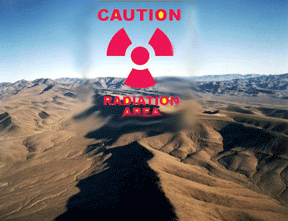 Nevada sues Texas for trying to kick-start Yucca Mountain funding http://news3lv.com/news/local/nevada-wants-us-court-to-reject-texas-bid-to-prod-nuke-dump-06-15-2017, by Associated Press LAS VEGAS (AP) — Nevada wants a federal appeals court to dismiss a bid by the state of Texas to kick-start government funding and licensing for a long-fought plan to entomb the nation’s most radioactive waste in the desert outside Las Vegas.
Republican Gov. Brian Sandoval on Wednesday called his state’s filing against a Texas lawsuit pending before the 5th U.S. Circuit Court of Appeals an important step in Nevada’s effort to prevent burial of 77,000 tons of spent nuclear fuel at Yucca Mountain.
Congress approved Yucca Mountain for nuclear waste storage in 2002, over Nevada’s objection.
It then cut off funding after former U.S. Sen. Harry Reid became Democratic majority leader in 2007.
Nevada notes the Trump Administration is already seeking $120 million from Congress to restart the licensing process.
It accuses Texas of trying to usurp the budget process.
June 19, 2017
Posted by Christina Macpherson |
Legal, USA |
Leave a comment
Reuters 16th June 2017, The European Commission said on Friday it had approved Germany’s plan to
create a public fund to deal with radioactive waste. Germany intends to
take over the liabilities relating to management of radioactive waste and
spent fuel from nuclear power plant operators.
They would have to pay in about 24.1 billion euros ($26.9 billion). This is made up of a basic amount
equivalent to the provisions already set aside by the operators for this
purpose and a risk premium aimed at covering the risk of cost increases in
the future.
The Commission concluded that the move did involve state aid
because of uncertainties over the cost of a repository for waste and the
possibility of cost overruns. Germany regards the measure as necessary as
it seeks to phase out nuclear energy production by 2022. http://www.reuters.com/article/us-germany-eu-nuclearpower-subsidies-idUSKBN197144
June 19, 2017
Posted by Christina Macpherson |
Germany, Legal |
Leave a comment







 nuclear-news