France’s nuclear company EDF fined a measly 300 million euros for its decades of deception and misuse of its position
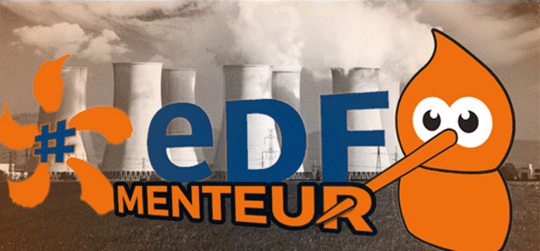
The French Competition Authority imposes a fine of 300 million euros on
EDF. The organization accuses the French company of abuse of a dominant
position and illegal collection of its customers’ data.
No less than seventeen years of anti-competitive practice. EDF was fined 300 million
euros by the Competition Authority for having misused its position as a
historical player in electricity since the opening of the market to
competition for companies in 2004, until 2021. The company does not
dispute the facts and has benefited from a negotiated procedure allowing
it to reduce the pain.
According to the law, a fine for this type of
practice could have cost it up to 10% of its annual worldwide turnover,
that is to say 7.6 billion, specifies in its decision the Authority of the
competition.
Le Figaro 22nd Feb 2022
Maryland Couple Conspired to Sell Nuclear Secrets
Maryland Couple Conspired to Sell Nuclear Secrets Sarah Coble News Writer, Info-Security Magazine, 21 Feb 22, A married couple from Maryland has admitted conspiring to steal nuclear secrets from the United States and sell them to a foreign nation.
Annapolis residents, Jonathan and Diana Toebbe, were arrested by the FBI and the Naval Criminal Investigative Service on October 9 2021 after placing an SD card containing stolen restricted data at a pre-arranged ‘dead drop’ location in Jefferson County, West Virginia.
At the time of his arrest, Jonathan Toebbe was employed as a nuclear engineer by the Department of the Navy, who had assigned Toebbe to the Naval Nuclear Propulsion Program, also known as Naval Reactors.
Toebbe used the national security clearance he had obtained through the Department of Defense to access restricted data. Among the data Toebbe worked with and had access to was information concerning naval nuclear propulsion, which included data on military sensitive design elements, operating parameters and performance characteristics of the reactors for nuclear-powered warships………
On February 14, 43-year-old Jonathan Toebbe pleaded guilty to conspiracy to communicate Restricted Data related to the design of nuclear-powered warships. Diana Toebbe, 46, pleaded guilty on February 18 to the same offense. …….. https://www.infosecurity-magazine.com/news/maryland-couple-conspired-nuclear/
Legal action on Fukushima nuclear disaster’s impact on health
 | |||

Fukushima Disaster’s Impact on Health Will Be Challenged in Court https://thediplomat.com/2022/02/fukushima-disasters-impact-on-health-will-be-challenged-in-court/
A link between radiation from the Fukushima nuclear disaster and cancer will be the focal point of the civil court case against operator TEPCO. By Thisanka Siripala, February 17, 2022
Almost 11 years have passed since the Fukushima Daiichi nuclear power plant catastrophe. But even as Fukushima prefecture gets ready to launch a new revitalization slogan – “Making Fukushima’s reconstruction a reality one step at a time” – it is still struggling to overcome the lingering aftereffects of the accident. Earlier this month, a group of six men and women diagnosed with thyroid cancer as children filed a class action case against Tokyo Electric Power Company (TEPCO), seeking $5.4 million in compensation.
Eastern Japan was hit by a massive magnitude 9.1 earthquake and 15-meter tsunami on March 11, 2011. The disaster shut off power and cooling to three reactors at the Fukushima Daiichi nuclear power plant, triggering the release of radiation for up to six days.
The plaintiffs, who are aged between 17 and 27, are seeking to hold TEPCO responsible for the thyroid cancer they developed. Two have had one side of their thyroid removed and four others have had a complete thyroidectomy and are planning or undergoing radiation therapy. The treatment has forced them to drop out of school or college and give up on their dreams. The plaintiffs argue that their thyroid cancer has created barriers to their education and employment as well as marriage and starting a family.
The Fukushima Daiichi meltdown was the worst nuclear accident since Chernobyl in 1986, which was followed by a spike in cancer cases in the region. In Japan a health survey conducted by the Fukushima prefecture found 266 cases of cancer among the 380,000 people aged under 18 at the time of the accident. The lawyers representing the plaintiffs argue that pediatric thyroid cancer is extremely rare, with an annual incident rate of two cases in one million people
The plaintiffs added that in the past decade they have been forced to stay silent due to social pressure and the risk of public outrage over speaking out about the connection between the Fukushima nuclear accident and their thyroid cancer.
The Federation of Promotion of Zero-Nuclear Power and Renewable Energy, a civic group that includes five former Japanese prime ministers, sent a letter to the EU urging the elimination of nuclear power. In the letter, they stated that many children are suffering from thyroid cancer as a result of the Fukushima nuclear power plant accident.
However, the Japanese government believes there is no causal link between exposure to radiation from the accident and the children developing thyroid cancer. Prime Minister Kishida Fumio said at a House of Representatives Budget Committee meeting that “it is not appropriate to spread false information that children from Fukushima are suffering from health problems.”
At a press conference Takaichi Sanae, chairperson of the ruling LDP’s Policy Research Council refuted the letter sent by the federation. She stressed the government’s position that the cases of childhood thyroid cancer have been assessed by experts who have determined the accident is unlikely to have caused cancer.
Fukushima prefecture’s expert panel say there could be the possibility of “over-diagnosis” due to increased vigilance after the disaster, suggesting that some patients diagnosed with cancer did not need treatment. They say they are continuing to investigate the nature of each diagnosis. The Ministry of Environment also said they will continue to disseminate knowledge based on scientific findings to dispel rumors about the health effects of radiation.
Last week, the Fukushima reconstruction and revitalization council met to discuss the “diverse needs of the prefecture” and a long term response to support evacuees. Governor of Fukushima Uchibori Masao acknowledged that the prefecture is “facing many difficulties including the reconstruction and rehabilitation of evacuated areas and rebuilding the lives of evacuees and victims of the disaster.” There are also plans to establish a new national research and education organization in Fukushima that will devise measures to prevent and dispel rumors fueling discrimination toward evacuees and Fukushima food.
Taiwan recently lifted its blanket food import ban on Fukushima produce introduced in the wake of the disaster but there are 14 countries and regions that still maintain import restrictions. Additionally, Japan’s decision to discharge more than one million tonnes of low-level radioactive water from the crippled Fukushima nuclear power plant into the sea is another issue attracting negative publicity abroad.
Julian Assange appeals to the Supreme Court.
Julian Assange appeals to the Supreme Court, https://www.bindmans.com/insight/updates/julian-assange-appeals-to-the-supreme-court, Kate Goold, 03 FEBRUARY 2022.
In December 2021, the High Court ruled that Julian Assange could be extradited to the USA, reversing a previous decision of Westminster Magistrates’ Court that extradition would be unjust or oppressive due to Mr Assange’s mental condition.
The ruling of the High Court was based on a package of diplomatic assurances provided by the US government about how and where Mr Assange would be detained if extradited and/or convicted. The assurances had been provided after the Magistrates’ Court found that Mr Assange was at a high risk of suicide if imprisoned in the very harsh regime that can be imposed on prisoners, who are considered a threat to national security, by the US. These fresh assurances were said by the USA to be sufficient to meet that concern, and the High Court agreed.
Among the assurances were undertakings that Mr Assange would not, at this time, be subject to Special Administrative Measures (SAMs), restricting his correspondence, visits and use of the telephone, nor detained at USP Florence ADMAX (ADX), a maximum-security prison in Colorado.
Crucially, however, these assurances were subject to the caveat that the US retained the power to impose such conditions if Mr Assange were to commit any future act that meets the tests for the imposition of SAMs or designation to ADX.
Application to the Supreme Court
As anticipated, Mr Assange sought permission to appeal the High Court judgment to the Supreme Court on the basis that there is a point of law of general public importance involved in the decision. He argued that the Supreme Court’s guidance was required on three questions of law regarding the assurances.
Firstly, he submitted that the Supreme Court ought to consider the question of whether a court can consider assurances that are introduced for the first time on appeal.
The second and third questions related to the caveat in the assurances concerning future acts. Mr Assange questioned whether it could be lawful to allow for potential exposure to conditions under SAMs or in ADX if the imposition of those prison regimes was judged by the US authorities to be justified by his own conduct. In Mr Assange’s case, this was said to be particularly important because conduct could involve speech, and also because it was accepted that he suffers from a severe mental condition.
On 24 January 2022, only the first question was certified by the High Court as an issue of general public importance:
In what circumstances can an appellate court receive assurances from a requesting state which were not before the court of first instance in extradition proceedings.
In the view of the High Court, this point of law is settled, but the High Court has certified a point of law of general public importance with regards to the provision of assurances at a later stage in proceedings, as the Supreme Court has not yet considered this specific question. The High Court concluded that the Supreme Court should have an opportunity to do so, since assurances are at the heart of many extradition proceedings and are increasingly relied on.
In extradition proceedings, assurances are not currently classed as ‘evidence’, but as ‘issues’, and therefore do not necessarily attract the same scrutiny. This also means they can be introduced after all evidence has been heard and tested.
The Supreme Court itself will now decide whether or not it should hear the appeal on this point.
Extradition practitioners largely welcome Supreme Court guidance on this point as late assurances designed to alleviate the court’s concerns about human rights violations following extradition have become a highly contentious issue, especially when provided by States with a poor record in human rights themselves.
It is of note that the High Court refused to certify the point of law with regards to future acts and did not appear to be overly concerned regarding the conditional nature of the diplomatic assurances provided. Mr Assange’s lawyers argued that the principle of absolute protection against inhuman or degrading treatment, contrary to Article 3, should also apply in cases where an individual’s mental condition is such that even if they are moved to a severe regime due to their behaviour (including speech), extradition should still be barred as oppressive (s91 Extradition Act) because the severity of the regime will cause such a deterioration in their mental health. The assurances provided do not rule out this possibility. This would have been an interesting issue for the Supreme Court to have considered, but that opportunity is no longer available.
Wider issues
Meanwhile, Mr Assange is likely to appeal to the High Court those grounds where he was unsuccessful before the District Judge at Westminster, as he was unable to cross appeal while the US appealed the District Judge decision. These grounds will largely focus on political motivation, freedom of speech and fair trial issues. If leave to appeal on the certified point is refused by the Supreme Court, Mr Assange still therefore has an opportunity to appeal to the High Court and his fight continues.
Legal challenge to license for EDF to dump radioactive mud in the Bristol Channel and Severn Estuary
Campaigners are calling on the government to prohibit energy giant EDF
from dumping contaminated mud in the Bristol Channel and Severn Estuary.
They say mud from the new Hinkley power station development is ‘a risk to
human health, threatens protected marine habitats and damages a treasure of
Britain’s natural world’.
EDF says all waste from the site is controlled
and regulated to ‘ensure the environment and public are protected’.
But Save the Severn, organised by a collaborative group of scientists and
environmental activists, is urging people to get behind its campaign to
halt further waste – including chemical and radioactive contaminants –
getting dumped in an international marine protected area near Portishead.
Campaigners will also challenge the legality of a license granted by the
Marine Management Organisation (MMO) to EDF for dumping waste in March,
when they will present a legal challenge against the company at a judicial
review.
Weston Mercury 15th Feb 2022
https://www.thewestonmercury.co.uk/news/campaign-group-wants-to-save-the-severn-8692070
Judicial review on the dumping of Hinkley Point C radioactive mud
A group campaigning against the dumping of sediment from the site of a
decommissioned nuclear power station has succeeded in securing a judicial
review challenging the legality of a licence to dump waste into the River
Severn.
The Save the Severn Estuary / Cofiwch Môr Hafren campaign involves
the Geiger Bay coalition and groups from the English side of the estuary
and is seeking to halt the dumping of sediment from the construction of the
Hinkley C power station in the Marine Protected Area (MPA) near Portishead,
Bristol.
In 2018, EDF, which is building the plant, dumped mud and sediment
off the coast of Cardiff despite fierce objections. The Campaign group says
that millions of tonnes of contaminated mud and sediment will contaminate
the waters and beaches used by local communities, and that by choosing to
ignore legal safeguards, energy giant EDF is threatening the health of
families and animal life.
Save the Severn Estuary / Cofiwch Môr Hafren say
that EDF are now trying to avoid further opposition and negative media
attention by moving the operation to Portishead, Bristol as a ‘soft
touch’ location after initially applying for a new license to dump more
waste off the Cardiff coast. At the judicial review on 8 March the campaign
group will challenge the legality of the licence granted by the Marine
Management Organisation (MMO), stating that several important procedures
haven’t been met and that an alternative to dumping at Portishead should
be adopted.
Nation Cymru
Nation Cymru 12th Feb 2022
UK court should slap down the US Justice Department in the Assange case

UK court should slap down the US Justice Department in the Assange case https://thehill.com/opinion/judiciary/591776-uk-court-should-slap-down-the-us-justice-department-in-the-assange-case?fbclid=IwAR1FwC11pSY_hGdiCvIdBqIj6mttfTheEDtcNR3EUpQG38xWS3-ZRC6TLhw
BY JAMES C. GOODALE, 6 Feb 22, As the lead attorney for the New York Times in the “Pentagon Papers” case in 1971, I’ve been doing a slow burn ever since over the government’s behavior in that instance: lies, disregard of court rules, arrogance, destruction of documents. All of this was brought to mind earlier this week when a British court hinted in the Julian Assange case that the U.S. government has acted in the same way once again.
It asked Britain’s supreme court to determine the appropriateness of a late filing by the government that completely undercut a ruling that Assange could NOT be extradited to the U.S. This followed British trial court Judge Vanessa Baraitser, who was hearing Assange’s extradition case, ruling that Assange might commit suicide if held in a U.S. prison in solitary confinement under what is called Special Administrative Measures (SAMs) and, so, he could not be extradited.
As soon as she announced her decision, the U.S. government filed assurances that Assange would not be held in that kind of detention, although it reserved the right to revoke the assurance if circumstances changed.
The judge was unmoved by this assurance, but she was reversed on appeal. The U.K.’s supreme court has now asked to consider the timeliness of this filing.
I do not believe the U.S. government’s assurances are worth the paper on which they have been written. Its behavior in this case has been rampant. Most outrageously, the CIA discussed a plot to kidnap Assange from the Ecuadorian Embassy in London, where he was holed up, and to kill him. The CIA also tapped into conversations in the Ecuadorian Embassy, including those with Assange’s lawyers.
There is not much question whether all of this is true. There was testimony about it in open court, and Mike Pompeo, the CIA director at the time and later secretary of State during the Trump administration, has conceded that there is “some truth” in the foregoing.
I do not pretend to be particularly familiar with the extradition laws of the U.K. But common sense tells me that you deliver highly important documents about a case — such as government assurances — before the case begins, not after it has been decided. U.K. counsel representing the U.S. disagrees, saying he can deliver documents when he wants and if he loses the appeal, he will start the extradition proceedings all over again.
This is the very same arrogance that was on display in the Pentagon Papers case, in which then-U.S. Solicitor General Erwin Griswold said the usual rules of evidence did not apply. His view of the law manifested itself in his introduction of new evidence in the case anytime the government was so moved. The claims were always extravagant: Publication of the new evidence would be a disaster for the country’s national security, etc., etc. They never were. Indeed, most of them turned out to be previously published.
The other principal fallacious claim made by the government back then was that the Times had revealed that the United States had broken the Vietnamese code. This also proved to be so much hogwash.
The government also destroyed — or, in its words, “lost” — New York Times briefs in the case. It prevailed upon me to give them these briefs to protect national security and to be returned if the government indicted the Times. A later research request evoked the response “they were lost.”
We do not know if the U.K.’s supreme court will take the Assange case to determine the issue of the timing of the U.S. government’s filing. Let’s hope that it does and then decides the U.S. government should not get away with the latest example of its less than appropriate behavior in a national security case.
James C. Goodale is the former general counsel and vice chairman of the New York Times and the author of “Fighting for the Press: The Inside Story of the Pentagon Papers and Other Battles.”
THE ILLEGALITY OF NATO

THE ILLEGALITY OF NATO, By John Scales Avery, Popular Resistance.6 Feb 22, Recent threats of war over Ukraine.
Russia understandably fears the eastward expansion of NATO. Recently NATO countries, led by the United States, have supplied arms to Ukraine. There is a threat that the tensions building up in the region will lead to war. Such a development would be catastrophic for the entire world. Against this backdrop, let us examine the question of NATO’s illegality.
Violation of the UN Charter and the Nuremberg Principles
In recent years, participation in NATO has made European countries accomplices in US efforts to achieve global hegemony by means of military force, in violation of international law, and especially in violation of the UN Charter, the Nuremberg Principles.
Former UN Assistant Secretary General Hans Christof von Sponeck used the following words to express his opinion that NATO now violates the UN Charter and international law: “In the 1949 North Atlantic Treaty, the Charter of the United Nations was declared to be NATO’s legally binding framework. However, the United-Nations monopoly of the use of force, especially as specified in Article 51 of the Charter, was no longer accepted according to the 1999 NATO doctrine. NATO’s territorial scope, until then limited to the Euro-Atlantic region, was expanded by its members to include the whole world”
Article 2 of the UN Charter requires that “All members shall refrain in their international relations from the threat or use of force against the territorial integrity or political independence of any state.” This requirement is somewhat qualified by Article 51, which says that “Nothing in the present Charter shall impair the inherent right of individual or collective self-defense if an armed attack occurs against a Member of the United Nations, until the Security Council has taken measures necessary to maintain international peace and security.”
Thus, in general, war is illegal under the UN Charter. Self-defense against an armed attack is permitted, but only for a limited time, until the Security Council has had time to act. The United Nations Charter does not permit the threat or use of force in preemptive wars, or to produce regime changes, or for so-called “democratization”, or for the domination of regions that are rich in oil. NATO must not be a party to the threat or use of force for such illegal purposes.
In 1946, the United Nations General Assembly unanimously affirmed “the principles of international law recognized by the Charter of the Nuremberg Tribunal and the judgment of the Tribunal”. The General Assembly also established an International Law Commission to formalize the Nuremberg Principles. The result was a list that included Principles VI and VII, which are particularly important in the context of the illegality of NATO:
Principle VI: The crimes hereinafter set out are punishable as crimes under international law:
a) Crimes against peace: (I) Planning, preparation, initiation or waging of a war of aggression or a war in violation of international treaties, agreements or assurances; (ii) Participation in a common plan or conspiracy for accomplishment of any of the acts mentioned under (I).
b) War crimes:……………….
Violation of the Nuclear Nonproliferation Treaty
At present, NATO’s nuclear weapons policies violate both the spirit and the text of the Nuclear Nonproliferation Treaty in several respects:………………………………….. https://popularresistance.org/the-illegality-of-nato/
‘Nuclear is neither green nor sustainable” – Austria to sue European Commission if it approves nuclear power for financial incentives

Austria’s chancellor responded to the news by saying “nuclear power is neither green nor sustainable”. “I cannot understand the decision of the EU,” Karl Nehammer said. He said he would back his environment minister, Leonore Gewessler, in pursuing legal action at the European Court of Justice if the plans go ahead.
“This decision is wrong,” Ms Gewessler said. “The EU Commission today agreed its greenwashing programme for nuclear energy and [the fossil fuel] natural gas.” Luxembourg has also said it will
join in legal action. The EU has set itself a goal of becoming climate neutral by 2050 and the Commission argues that to get there, a great deal of private investment is needed. Its proposals are meant to guide
investors.
BBC 3rd Feb 2022
https://www.bbc.co.uk/news/world-europe-60229199
Austria, Luxembourg to take green label for nuclear and gas to EU courts
Austria, Luxembourg to take green label for nuclear and gas to EU courts https://www.euractiv.com/section/politics/short_news/austria-luxembourg-to-take-green-label-for-nuclear-and-gas-to-eu-courts/
By Nikolaus J. Kurmayer | EURACTIV.de 4 Feb 22, The EU’s sustainable finance rules presented on Wednesday will award a “green” label to gas and nuclear power, which has prompted Austria and Luxembourg to announce a lawsuit.
The European Commission’s proposal would primarily satisfy the “wishes of the nuclear power lobby,” explained Austrian minister for climate protection Leonore Gewessler.
The Commission’s delegated act “is a greenwashing programme,” she said. As soon as the taxonomy enters into force, Austria “will bring a lawsuit to the European Court of Justice.”
“Luxembourg strongly reaffirms its opposition to the inclusion of nuclear & fossil gas in the decision on EU Taxonomy for ‘sustainable’ finance of the EU Commission,” explained Luxembourg’s minister for energy Claude Turmes. “We will consider further legal steps together with Austria.”
The taxonomy would enter into force on 1 January 2023 at the earliest and a definitive decision by the courts could be expected in late 2023.
Austria’s EU Commissioner Johannes Hahn had already made his displeasure known by being one of three Commissioners to oppose the decision to include nuclear and gas in an internal Commission vote.
(Nikolaus J. Kurmayer | EURACTIV.de)
Give Nuclear Exposure Victims a Break
Those who become sick as a result of work in the nuclear weapons manufacturing and testing industry are eligible for health care benefits and compensation from those two federal programs: the Radiation Exposure Compensation Program (RECP) and the Energy Employees Occupational Illness Compensation Program (EEOICP).
Give Nuclear Exposure Victims a Break https://progressive.org/op-eds/give-nuclear-victims-break-stephens-220202/
My experience working with nuclear weapons and uranium workers has shown me that we must continue to provide essential benefits to workers and their survivors.
BY R. HUGH STEPHENS, FEBRUARY 2, 2022 Every month or so, my law office will get a call from the spouse of a nuclear weapons or uranium worker who has been diagnosed with terminal cancer. We help file a claim for the worker with the Department of Justice or the Department of Labor, both of which run a compensation program.
Typically, these claims can be handled in a matter of weeks. Modest compensation provided through these programs provide help with medical bills and certain other financial obligations.
Most people don’t realize that these programs exist, or even that our nuclear weapons system affects so many people across the country.
Originally known as the Manhattan Project, the U.S. nuclear weapons program in 1945 produced its first nuclear blast, the Trinity Test, in Alamogordo, New Mexico. But the impact of this testing has not been limited by either time or geography. Every day, downwinders, on-site participants, uranium miners, millers and ore transporters are diagnosed with cancers, pulmonary fibrosis and other serious illnesses from exposures that happened decades ago. Even today, nuclear weapons workers are being made ill at facilities across the country.
Those who become sick as a result of work in the nuclear weapons manufacturing and testing industry are eligible for health care benefits and compensation from those two federal programs: the Radiation Exposure Compensation Program (RECP) and the Energy Employees Occupational Illness Compensation Program (EEOICP).
The programs, not unlike the Veterans Affairs program that provides benefits for U.S. soldiers, provide vital benefits to workers who have borne the brunt of the physical and financial toll imposed by the nation’s nuclear weapons program.
Currently pending bills would extend the RECP and allow on-site participants and downwinders to receive medical care for their accepted conditions under the EEOICP. This would make their claims more similar to the other beneficiaries, including uranium miners, millers and ore transporters, thereby eliminating a flaw in the RECP that prevents on-site participants throughout the country and downwinders in the southwest from receiving the same medical benefits as uranium miners, millers, and ore transporters receive.
Without action from Congress and the president, RECA will expire in July of this year. One path forward is a set of bipartisan bills introduced by Representative Leger Fernandez (H.R. 5338) and Senator Mike Crapo (S.2798). These bills extend and make important improvements to these compensation programs.
My experience working with nuclear weapons and uranium workers has shown me that these programs continue to provide essential benefits to workers and their survivors, whose lives have been disrupted by participation in the nuclear weapons program. Both of these programs should be extended and improved.
We owe that, at least, to those who have sacrificed their health in the service of the nation’s nuclear ambitions.
Fight Over Africa’s Sole Atomic Plant Entangles Energy Minister Mantashe
Mantashe sued over suspension of activist from the board
Eskom plans to extend Koeberg plant’s operating lifetime, Bloomberg, By Antony Sguazzin, 2 February 2022, South African Energy Minister Gwede Mantashe is being sued following the suspension of a National Nuclear Regulator board member who also works with a civil society group fighting against the lifetime extension of the continent’s only power reactors.
The suit filed by Peter Becker, who in addition to serving on the nuclear regulator’s board is a spokesman for the Koeberg Alert Alliance, will be heard by the High Court of Cape Town on Feb. 8, according to public documents seen by Bloomberg. South Africa is legally obliged to appoint a nuclear regulatory board member who represents communities potentially affected by industry decisions…………..
Becker, who was suspended on Jan. 18, argues in the documents that Mantashe didn’t have the legal authority to suspend him from performing his duties on the regulatory board. “The role of a board member representing the interests and concerns of communities is defined by the National Nuclear Regulatory Act” and “while I am suspended, decisions are being taken by the board without that representation,” he wrote in a reply to questions.
The court case highlights the difficulties Eskom Holdings SOC Ltd. is facing in its fight to keep its Koeberg nuclear plant in Cape Town operating until 2044. Mantashe, a former coal mining unionist and chairman of the ruling African National Congress, has emerged as a vocal supporter of the nuclear industry, while drawing criticism from environmental activists. ……………… https://www.bloomberg.com/news/articles/2022-02-02/fight-over-africa-s-sole-nuclear-plant-ensnares-energy-minister
In 2022, compensation funds for the nuclear-affected ”Downwinders” are due to expire
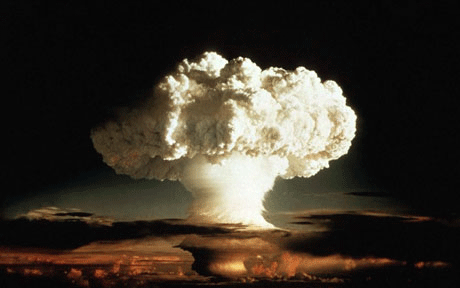
Funds for those impacted by nuclear weapons tests set to expire in 2022 https://www.thedenverchannel.com/news/national/funds-for-those-impacted-by-nuclear-weapons-tests-set-to-expire-in-2022 By: Bo Evans, , Feb 01, 2022
Raymond Harbert may not have the words to describe it.
“It is really hard to relay all the feelings you get from one of those megaton tests,”
But he never forgot the details of the detonation of a nuclear bomb well.
“If you can imagine, 40 miles away, and you can feel the heat when it arrives. It arrives at a separate time. It’s a prickly heat, and then the pressure wave coming—the brightness. The feeling when they finally say, you can take your glasses off. Those are memories that will stick with me for the rest of my life,” said Harbert.
In this 2005 interview conducted by the University of Nevada Las Vegas, Harbert lays out an experience shared by thousands of Americans exposed to radiation from nuclear weapons tests between 1945 and 1962.
The fallout has lasted for decades.
“People don’t realize over 200 above-ground tests were done between 1945 and 1962, and an additional 900+ were done after that below ground. Which exposed Nevadans, people in Utah, Arizona, Colorado, places that were downwind of these tests to fallout,” said Dr. Laura Shaw.
Shaw works with the Nevada Radiation Exposure Screening & Education Program or RESEP at UNLV to provide medical services and cancer screening to people who are known as downwinders.
We review their history, we look at their medications, we offer additional screenings that include colon cancer screening, lung imaging, labs that screen for diabetes, anemia, cholesterol, so we do a lot,” said Shaw.
It’s all paid for by the Radiation Exposure Compensation Act or RECA. The law was passed in 1990. The fund is set to expire in July 2022.
“These people have another 30, 40 years, hopefully, to live that were potentially exposed, so we need this program much, much longer,” said Shaw.
Some in Congress are attempting to extend and expand the fund.
“Tragically, for some, it is already too late. We’ve lost Idahoans Sheri Garmin, Teresa Valberg, and Srgt. 1st Class Paul Cooper to Cancer,” said Sen. Mark Crapo, (R) Idaho, in a congressional hearing.
The Radiation Exposure Compensation Act Amendments of 2021 have been introduced in both the House and Senate and have been referred to committees.
Dr. Shaw remains hopeful it will pass.
“Cancer is still going to happen. These people are going to develop problems associated with their previous exposure. Cancer can happen years later, and it’s not going to pay any attention to any deadlines,” she said.
Forensic experts are working to recover texts deleted by ex-FirstEnergy CEO Chuck Jones after he was fired

Forensic experts are working to recover texts deleted by ex-FirstEnergy CEO Chuck Jones after he was fired Cleveland.com : Jan. 28, 2022, By Jeremy Pelzer,
COLUMBUS, Ohio — Forensic experts have been working to recover text messages deleted by former FirstEnergy Corp. CEO Chuck Jones in October 2020, shortly after the utility fired him for violating company ethics policies amid the House Bill 6 scandal, according to a recent civil lawsuit filing.
The filing was part of a submission made Thursday by attorneys representing FirstEnergy shareholders suing company officials for not stopping a massive bribery scheme to pass HB6. In addition, the filing says the content of the deleted messages remains unknown, and it did not disclose any recipients…………..
A federal complaint against ex-Ohio House Speaker Larry Householder and several allies accuses them of using $60 million in FirstEnergy bribe money to secure the passage of HB6. The complaint says that Jones and Householder emailed and texted each other several times a week about the issues with the legislation, which offered a $1 billion-plus bailout to two Northern Ohio nuclear power plants owned by a then-subsidiary of FirstEnergy………………….
Jones has so far not been accused of any crime, and he denies any wrongdoing. However, a civil lawsuit filed by Attorney General Dave Yost accuses him and two other former FirstEnergy executives of engaging in extortion, money laundering, coercion, intimidation and an attempted coverup.
Cleveland.com has reached out to a spokesman for Jones for comment.
Thursday’s court filing states that plaintiffs in the civil suit have reviewed more than 400,000 pages of documents so far and are preparing to start depositions on Feb. 10. The filing states that plaintiffs will be ready to go to trial by this August.
Read the full filing here: https://www.cleveland.com/news/2022/01/forensic-experts-are-working-to-recover-texts-deleted-by-ex-firstenergy-ceo-chuck-jones-after-he-was-fired.html
US and British governments are effectively using “lawfare” to ensure Assange’s continued detention
Although the threat of imminent extradition has been stayed, Assange stands on thin ice. What began as a case on the most fundamental rights of journalists to expose war crimes and torturehas been whittled away by the British judiciary to the single question of how “assurances” of Assange’s safety should be given by one criminal state to another.
Whatever the outcome, the US and British governments are effectively using “lawfare” to ensure Assange’s continued detention, even though he has been convicted of no crime.
Assange granted leave to appeal to UK Supreme Court against extradition, https://www.wsws.org/en/articles/2022/01/24/assa-j24.html?pk_campaign=assange-newsletter&pk_kwd=wsws Oscar Grenfell, Thomas Scripps, 24January 2022
The UK High Court has provided WikiLeaks founder Julian Assange a route to appeal to the Supreme Court in his extradition case against the United States government.
Assange is seeking to overturn the High Court’s direction last December that he be extradited, against the earlier ruling of the lower Magistrates’ Court that to do so would be “oppressive” on health grounds.
The High Court upheld a US appeal against the Magistrates’ Court ruling despite accepting evidence of Assange’s intense physical and psychological ill-health. It also did not contest the likelihood that the conditions he would be subjected to in the US, as discussed throughout the entire preceding court process, would likely result in his death by suicide.
The December ruling was overwhelmingly based upon supposed US assurances, issued months after deadlines had elapsed, that Assange’s conditions in an American prison would not be as bad as previously accepted.
With numerous caveats and loopholes, the US assurances asserted that Assange would not be held under Special Administrative Measures (SAMs), a regime of total isolation, to which those convicted of terrorism offenses, along with drug lords and major serial killers, are sometimes subjected in federal prison.
The High Court found that the Magistrates Court should have solicited such assurances prior to its ruling.
In response to Assange’s request for leave to appeal this decision yesterday, the judges certified a single point of law of public importance, the requirement for an issue to be heard in the Supreme Court. This was: “In what circumstances can an appellate court receive assurances from a requesting state which were not before the court of first instance in extradition proceedings [in this case, the magistrates’ court].”
Assange’s lawyers had argued that “profound issues of natural justice arise where assurances are introduced by the Requesting State for the first time at the High Court stage… These issues have never been addressed by the Supreme Court.”
As his solicitors elaborated in an explanatory note, “There has long been a general approach by the courts that requires that all relevant matters are raised before the District Judge appointed to consider the case in the Magistrates’ Court,” but this has been undermined by the treating of assurances as “issues” rather than “evidence”, allowing them to be introduced at a later stage in proceedings.
“The defence argument is that despite being as demanding of close evidential scrutiny as the evidence already heard, and despite the content of the assurances being applicable to the testimony of witnesses already heard but not to be heard again, assurances have been afforded a different procedural position.”
The assurances in question, accepted in “good faith” by the High Court, are given by a state with a decades-long history of lies and dirty tricks whose record in the Assange case was exposed a month before the High Court ruling as including plans to kidnap and assassinate the heroic journalist.
Based on the statements of 30 former US officials, Yahoo! News revealed that the Trump administration and the Central Intelligence Agency (CIA) had discussed kidnapping or assassinating Assange when he was a political refugee in Ecuador’s London embassy in 2017. The US indictment was first conceived of as a pseudo-legal cover for a possible CIA rendition.
The character of that indictment, as a concoction from spies and criminals, had been proven in June 2021. Sigurdur “Siggi” Thordarson, whose testimony still forms a crucial part of the indictment, admitted that all his substantive allegations against Assange were lies proffered in exchange for immunity from US prosecution. The star US witness is reportedly facing prosecution in Iceland on fraud charges, having been convicted of child molestation and embezzlement offenses prior to his latest collaboration with the American government.
Although the threat of imminent extradition has been stayed, Assange stands on thin ice. What began as a case on the most fundamental rights of journalists to expose war crimes and torturehas been whittled away by the British judiciary to the single question of how “assurances” of Assange’s safety should be given by one criminal state to another.
The Magistrates’ Court upheld the sweeping US attacks on democratic rights contained in the attempt by a state to prosecute a journalist for publishing true information about its unlawful activities. This forced Assange to defend the US appeal on the grounds of the threat to his mental health posed by extradition and imprisonment in the US. The High Court’s acceptance of the US appeal means Assange’s defence is now limited to the question of when assurances should have been provided.
In keeping with the UK’s courts’ trashing of democratic rights throughout this case, the High Court rejected out of hand the point of appeal that the assurances are worthless because the US asserts the right to withdraw them if Assange violates, or is alleged to have violated, certain conditions.
Assange’s lawyers argued “oppressive treatment” is barred, “whether or not the requesting state justifies its imposition by reference to conduct.”The High Court replied that it did not consider these arguments to “raise certifiable points” for the Supreme Court’s consideration.
It is now technically down to the Supreme Court to agree to hear Assange’s case; it would be highly unusual, though not impossible, for it to refuse to consider an issue certified by the High Court.
If Assange’s appeal is unsuccessful and his case is sent to Home Secretary Priti Patel to rubber-stamp his extradition, then his lawyers can seek to cross appeal the Magistrates’ Court’s original decision on the substantive issues of the case—press freedom, the espionage act and the bar on extradition for political offences. But leave to do so is not assured and would mean years more incarceration as the new appeal works its way through the courts.
Whatever the outcome, the US and British governments are effectively using “lawfare” to ensure Assange’s continued detention, even though he has been convicted of no crime.
He remains in the maximum-security Belmarsh Prison, dubbed the UK’s Guantanamo Bay. With the British government allowing the mass spread of Omicron, in the latest stage of its homicidal “herd immunity” policy, the prison has reportedly been hit by COVID outbreaks. Assange, because of his fragile health, is at intense risk of succumbing to the virus. The repeated prison lockdowns intensify his isolation.
1 This Month

29 Jan. Thursday 7-8 p.m. Webinar – World’s Largest Nuclear Station in Port Hope, ON?


31st January – Challenging the War Machine – a DECLASSIFIED UK SUMMIT



Website of the Week
Now until to February 10, 2026 Radioactive waste storage in France: the debate is finally open! How to participate?
-
Archives
- January 2026 (259)
- December 2025 (358)
- November 2025 (359)
- October 2025 (376)
- September 2025 (258)
- August 2025 (319)
- July 2025 (230)
- June 2025 (348)
- May 2025 (261)
- April 2025 (305)
- March 2025 (319)
- February 2025 (234)
-
Categories
- 1
- 1 NUCLEAR ISSUES
- business and costs
- climate change
- culture and arts
- ENERGY
- environment
- health
- history
- indigenous issues
- Legal
- marketing of nuclear
- media
- opposition to nuclear
- PERSONAL STORIES
- politics
- politics international
- Religion and ethics
- safety
- secrets,lies and civil liberties
- spinbuster
- technology
- Uranium
- wastes
- weapons and war
- Women
- 2 WORLD
- ACTION
- AFRICA
- Atrocities
- AUSTRALIA
- Christina's notes
- Christina's themes
- culture and arts
- Events
- Fuk 2022
- Fuk 2023
- Fukushima 2017
- Fukushima 2018
- fukushima 2019
- Fukushima 2020
- Fukushima 2021
- general
- global warming
- Humour (God we need it)
- Nuclear
- RARE EARTHS
- Reference
- resources – print
- Resources -audiovicual
- Weekly Newsletter
- World
- World Nuclear
- YouTube
-
RSS
Entries RSS
Comments RSS
 nuclear-news