Senate extends nuclear liability-limiting law without public scrutiny. Here’s why we should care.
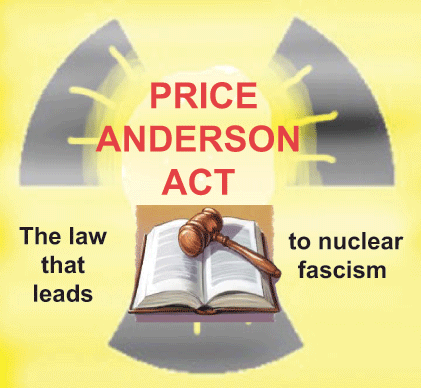
The chief problem with the Price-Anderson Act is the difference in how the law affects the public and the nuclear firms. In view of federal preemption of nuclear licensing, the public has essentially no say in the siting of a nuclear power plant and so must accept the associated accident risk. Nuclear vendors, however, are freed from all liability for offsite consequences of a nuclear accident, and so have nothing to worry about, either financially or legally.
Bulletin, By Victor Gilinsky | August 22, 2023
By Victor Gilinsky | August 22, 202
On the night of July 27, the US Senate passed the National Defense Authorization Act for fiscal year 2024. The Senate-approved bill included a 20-year extension of the Price-Anderson Nuclear Industries Indemnity Act, which provides that if there are any offsite lives and property lost in a severe reactor accident, nuclear industry manufacturers and builders cannot be held liable. The extension of the act also includes another controversial provision—the adequacy of funds provided by the act for compensating victims of a nuclear accident.
The approval last month of this extension came without any public hearings and was introduced in Congress in a rather troubling manner. The extension’s backers, knowing it would face rough sledding in an open hearing, first attached it to the Accelerating Deployment of Versatile, Advanced Nuclear for Clean Energy (ADVANCE) Act of 2023, which was then placed on the Senate legislative calendar on July 10 and added to the “must-pass” National Defense Authorization Act. While it has yet to pass the House, the act bears powerfully on the country’s commitment to nuclear energy, and especially on safety standards for nuclear power plants and therefore should not escape public scrutiny.
The Price-Anderson Act was first approved in 1957, soon after the Atomic Energy Act of 1954 permitted private nuclear energy activity. Firms like General Electric and Westinghouse, among others, told Congress they would not build commercial nuclear power plants—a technology with which there was essentially no experience—if they faced vast liability for possible accidents. To promote rapid investment in nuclear power plants, the government gave the builders and vendors freedom from liability for offsite accidents. It added provisions for public compensation after a catastrophic accident. But both provisions need updating in view of what we have learned in the last 60-odd years.
The act currently provides about $13 billion for post-accident public compensation, with the funds coming over time from a self-insurance scheme funded by the owners of nuclear power plants. But the estimated cost of the 2011 Fukushima accident—several hundred billion dollars—dwarfs the Price-Anderson amount. Yet, there is more. If an accident was to lead to widespread and long-term nuclear plant shutdowns, as occurred in Japan, it isn’t clear the owners would be able to meet their financial obligations. What’s clear is that after a severe nuclear accident, the issue of compensation would land in the lap of Congress.
At a 2014 Nuclear Regulatory Commission hearing on a safety upgrade for the 19 US plants essentially identical to the ones at Fukushima, the staff of the US Nuclear Regulatory Commission (NRC) told the commissioners that a fire in only one of the pools in which nuclear plants store highly radioactive used fuel could release much more radioactivity, conceivably 20 times more, than in the 2011 Fukushima accident. The commissioners at the time dismissed the concern on grounds that such an event was so improbable it failed the NRC’s cost-benefit analysis. But, however remote, the possibility remains.
The chief problem with the Price-Anderson Act is the difference in how the law affects the public and the nuclear firms. In view of federal preemption of nuclear licensing, the public has essentially no say in the siting of a nuclear power plant and so must accept the associated accident risk. Nuclear vendors, however, are freed from all liability for offsite consequences of a nuclear accident, and so have nothing to worry about, either financially or legally.
According to the NRC, calculations using “probabilistic risk assessment” serve as proof that the probability of severe nuclear accidents at US nuclear plants is extremely remote. But large nuclear vendors like General Electric and Westinghouse evidently don’t believe these numbers; otherwise, they would accept liability and would not fear risking their stockholders’ investment. If reactor builders won’t accept paying for the consequences of a possible nuclear accident, why then should members of the public, whose health and communities would be affected?……………………………………………………….
The current exuberance over “advanced” reactors” has some of the same boosterish markings as the earlier AEC episode, with the advocates so sure they are right that they think cutting corners is okay—like dispensing with public hearings on Price-Anderson Act extension.
The Price-Anderson Act extension is part of a larger program that would pull out the stops on granting generous subsidies to private nuclear firms, speeding approvals of nuclear license applications and promoting nuclear reactor exports—all supposedly in the interest of “reestablishing America’s preeminence as the global leader in nuclear energy in the 21st century.”
We need to stop and think as a society before it’s too late. Rather than a hastily and quietly passed 20-year extension, we need first a thorough public examination of the Price-Anderson Act’s fundamental provisions and their effect on nuclear reactor safety and licensing standards. https://thebulletin.org/2023/08/senate-extends-nuclear-liability-limiting-law-without-public-scrutiny-heres-why-we-should-care/?utm_source=Newsletter&utm_medium=Email&utm_campaign=ThursdayNewsletter08242023&utm_content=NuclearRisk_NuclearLiabilityLimiting_08222023
Marshall Islands reacts to US expansion of nuclear compensation
Marianas Variety, By Giff Johnson – For Variety Aug 21, 2023
MAJURO — Within days of United States congressional leaders and executive branch officials telling Marshall Islands leaders there was no more money for nuclear test compensation, the U.S. Senate passed legislation expanding nuclear compensation to more Americans in the U.S. mainland and also living on Guam.
The Senate legislation seeks to expand the Radiation Exposure Compensation Act of 1990. This law currently provides compensation to American Downwinders who lived near the Nevada Test Site, uranium miners, and people who worked at nuclear sites.
The new legislation expands the time period of eligibility for uranium miners from the previous deadline of 1971 to 1990, which means many more workers will be eligible. It also aims to support compensation for people in Guam — who live over a thousand miles away from the Bikini and Enewetak test sites in the Marshall Islands — and other U.S. jurisdictions affected by nuclear testing.
In the Marshall Islands, however, the U.S. definition of those “exposed” is limited to four atolls despite U.S. government studies that show many more islands in the country were exposed to nuclear test fallout. Prior to it running out of compensation funds in the late 2000s, the Nuclear Claims Tribunal compared fallout exposures of American Downwinders and Marshallese. It noted that the highest exposures among American Downwinders were lower than the lowest exposures of Marshallese.
The irony of the U.S. nuclear test compensation disparity is not lost on Marshallese.
“As nuclear test victim ourselves, we support compensation for American victims of nuclear tests, whether they are Downwinders or worked at nuclear test sites or worked in uranium mines,” Marshall Islands Speaker Kenneth Kedi, who represents Rongelap, was quoted Friday in the Marshall Islands Journal. “But the fact that U.S. authorities can tell the Marshall Islands there is ‘no more money’ for nuclear test exposure for people who lived through 67 of the largest US nuclear weapons tests ever conducted while at the same time preparing to expand compensation coverage for Americans is astounding.”
The U.S. government launched its Radiation Exposure Compensation Act in 1990 with a $100 million appropriation from the Congress. Over 30 years later, the U.S. Justice Department has paid out awards amounting to over $2 billion because when additional compensation was needed, the U.S. Congress appropriated more funding.
In contrast, for the Marshall Islands, which was subjected to weapons testing over 90 times the megatonnage of the Nevada nuclear tests, the U.S. provided the Marshall Islands with a $150 million fund as the “full and final” compensation and has refused to respond to Marshall Islands government requests to provide additional compensation in the ensuing 37 years since the first Compact of Free Association went into effect. Despite the fact that the Nuclear Claims Tribunal was an entity created by the first Compact of Association to adjudicate nuclear claims, the Marshall Islands government’s entreaties to the United States for funding to pay the over $3 billion in Tribunal awards have received a cold shoulder.
“We have no issue with people of Guam qualifying for U.S. nuclear compensation,” Kedi commented. “But if the people of Guam, who are 1,400 miles away from Bikini, are eligible for compensation, what about the many Marshallese who lived much closer to the testing who according to the U.S. are not radiation affected?”
The Tribunal award for Rongelap Atoll, which was not paid for lack of funds, is the largest of the Tribunal awards for four U.S.-acknowledged nuclear affected atolls of Bikini, Enewetak, Rongelap and Utrok — in part due to the need to fund cleanup of dozens of islands that remain radioactive from a snowstorm of radioactive fallout from the 1954 Bravo hydrogen bomb explosion at Bikini…………………………………………………….more https://www.mvariety.com/news/marshall-islands-reacts-to-us-expansion-of-nuclear-compensation/article_72b6eb98-3f55-11ee-ac0f-53b4fd3eeff1.html—
Assange Be Weary: The Dangers of a US Plea Deal

August 18, 2023
By Binoy Kampmark / CounterPunch, https://scheerpost.com/2023/08/18/assange-be-weary-the-dangers-of-a-us-plea-deal/
At every stage of its proceedings against Julian Assange, the US Imperium has shown little by way of tempering its vengeful impulses. The WikiLeaks publisher, in uncovering the sordid, operational details of a global military power, would always have to pay. Given the 18 charges he faces, 17 fashioned from that most repressive of instruments, the US Espionage Act of 1917, any sentence is bound to be hefty. Were he to be extradited from the United Kingdom to the US, Assange will disappear into a carceral, life-ending dystopia.
In this saga of relentless mugging and persecution, the country that has featured regularly in commentary, yet done the least, is Australia. Assange may well be an Australian national, but this has generally counted for naught. Successive governments have tended to cower before the bullying disposition of Washington’s power. With the signing of the AUKUS pact and the inexorable surrender of Canberra’s military and diplomatic functions to Washington, any exertion of independent counsel and fair advice will be treated with sneering qualification.
The Albanese government has claimed, at various stages, to be pursuing the matter with its US counterparts with firm insistence. Prime Minister Anthony Albanese has even publicly expressed his frustration at the lack of progress in finding a “diplomatic solution” to Assange’s plight. But such frustrations have been tempered by an acceptance that legal processes must first run their course.
The substance of any such diplomatic solution remains vague. But on August 14, the Sydney Morning Herald, citing US Ambassador to Australia Caroline Kennedy as its chief source, reported that a “resolution” to Assange’s plight might be in the offing. “There is a way to resolve it,” the ambassador told the paper. This could involve a reduction of any charges in favour of a guilty plea, with the details sketched out by the US Department of Justice. In making her remarks, Kennedy clarified that this was more a matter for the DOJ than the State Department or any other department. “So it’s not really a diplomatic issue, but I think there absolutely could be a resolution.”
In May, Kennedy met members of the Parliamentary Friends of Julian Assange Group to hear their concerns. The previous month, 48 Australian MPs and Senators, including 13 from the governing Labor Party, wrote an open letter to the US Attorney General, Merrick Garland, warning that the prosecution “would set a dangerous precedent for all global citizens, journalists, publishers, media organizations and the freedom of the press. It would also be needlessly damaging for the US as a world leader on freedom of expression and the rule of law.”
In a discussion with The Intercept, Gabriel Shipton, Assange’s brother, had his own analysis of the latest developments. “The [Biden] administration appears to be searching for an off-ramp ahead of [Albanese’s] first state visit to DC in October.” In the event one wasn’t found, “we could see a repeat of a very public rebuff delivered by [US Secretary of State] Tony Blinken to the Australian Foreign Minister two weeks ago in Brisbane.”
That rebuff was particularly brutal, taking place on the occasion of the AUSMIN talks between the foreign and defence ministers of both Australia and the United States. On that occasion, Foreign Minister Penny Wong remarked that Australia had made its position clear to their US counterparts “that Mr Assange’s case has dragged for too long, and our desire it be brought to a conclusion, and we’ve said that publicly and you would anticipate that that reflects also the positive we articulate in private.”
In his response, Secretary of State Blinken claimed to “understand” such views and admitted that the matter had been raised with himself and various offices of the US. With such polite formalities acknowledged, Blinken proceeded to tell “our friends” what, exactly, Washington wished to do.
Assange had been “charged with very serious criminal conduct in the United States in connection with his alleged role in one of the largest compromises of classified information in the history of our country. The actions that he has alleged to have committed risked very serious harm to our national security, to the benefit of our adversaries, and put named sources at grave risk – grave risk – of physical harm, and grave risk of detention.”
Such an assessment, lazily assumed, repeatedly rebutted, and persistently disproved, went unchallenged by all the parties present, including the Australian ministers. Nor did any members of the press deem it appropriate to challenge the account. The unstated assumption here is that Assange is already guilty for absurd charges, a man condemned.
At this stage, such deals are the stuff of manipulation and fantasy. The espionage charges have been drafted to inflate, rather than diminish any sentence. Suggestions that the DOJ will somehow go soft must be treated with abundant scepticism. The pursuit of Assange is laced by sentiments of revenge, intended to both inflict harm upon the publisher while deterring those wishing to publish US national security information. As the Australian international law academic Don Rothwell observes, the plea deal may well take into account the four years spent in UK captivity, but is unlikely to either feature a complete scrapping of the charges, or exempt Assange from travelling to the US to admit his guilt. “It’s not possible to strike a plea deal outside the relevant jurisdiction except in the most exceptional circumstances.”
Should any plea deal be successfully reached and implemented, thereby making Assange admit guilt, the terms of his return to Australia, assuming he survives any stint on US soil, will be onerous. In effect, the US would merely be changing the prison warden while adjusting the terms of observation. In place of British prison wardens will be Australian overseers unlikely to ever take kindly to the publication of national security information.
Judge tosses charges against executive in South Carolina nuclear debacle, but case may not be over
A judge has ordered criminal charges dropped against the final executive
accused of lying about problems building two nuclear reactors in South
Carolina that were abandoned without generating a watt of power. The judge
tossed the charges Wednesday because ratepayers of the utility that lost
billions of dollars on the project were improperly allowed on the grand
jury that indicted Westinghouse Electric Co. executive Jeffrey Benjamin.
But federal judge Mary Geiger Lewis also ruled that nothing is stopping
prosecutors from properly seeking another indictment.
Daily Mail 3rd Aug 2023
US rejects Australian plea to drop Assange case

29 July 23, https://www.rt.com/news/580512-blinken-rejects-assange-australia/
Secretary of State Antony Blinken insisted that the WikiLeaks founder caused “serious harm” to US national security
US Secretary of State Antony Blinken has confirmed that Australia has raised the case of Julian Assange’s continued prosecution, but declared that Washington will not cease seeking the extradition of the former WikiLeaks boss and intends to try him for espionage.
Speaking alongside Australian Foreign Minister Penny Wong in Brisbane on Saturday, Blinken said that while he understands “the concerns and views of Australians,” Assange’s alleged actions “risked very serious harm to our national security, to the benefit of our adversaries, and put named human sources at grave risk – grave risk – of physical harm, and grave risk of detention.”
Assange, he said, was “charged with very serious criminal conduct” and had allegedly taken part in “one of the largest compromises of classified information in the history of our country.”
An Australian citizen, Julian Assange is currently being held in London’s Belmarsh Prison. He is fighting extradition to the US, where he faces 17 charges under the Espionage Act and potentially a 175-year prison sentence. Human-rights and press-freedom activists have demanded his release, citing his deteriorating mental and physical health, while Australian Prime Minister Anthony Albanese said in May that he was “working through diplomatic channels” to press the US into dropping the case.
The charges against Assange stem from his publication of classified material obtained by whistleblowers, including Pentagon documents detailing alleged US war crimes in Iraq and Afghanistan, and more than 250,000 diplomatic cables exposing US efforts to – among other things – spy on its allies and influence foreign elections.
While Assange did not personally steal these documents, he is nevertheless being prosecuted for espionage. He and his supporters argue that WikiLeaks’ publication of this material is protected by the First Amendment of the US Constitution.
“We have made clear our view that Mr Assange’s case has dragged on for too long,” Foreign Minister Wong said on Saturday. “We’ve said that publicly and you would anticipate that that reflects also the position we articulate in private.”
The extradition of Assange from Britain to the US was approved in 2020 by then-UK Home Secretary Priti Patel. The publisher lodged his final appeal against the decision in June, after all eight grounds of a previous appeal were rejected by a British High Court judge.
Responding to Blinken’s comments on Saturday, Assange’s brother, Gabriel Shipton, said that it is now up to Prime Minister Albanese to make a public appeal for Assange’s freedom, during his upcoming visit to the US.
Legal action over dangerous crowding of satellites and debris in space

2 The Global Network Against Weapons & Nuclear Power in Space is involved in a legal action against the FCC (Federal Communications Commission) to pressure them to create rules/guidelines for the launching of satellites in space. Lower Earth orbit (LEO) is becoming dangerously crowded and NASA scientists are concerned about growing space debris and likely cascading collisions in orbit (Kessler Syndrome). The US is moving quickly to grab as many of the remaining orbital parking spaces as possible in order to deny Russia, China, India and other nations from deploying satellites in LEO.
The Space Force today contends that it will ‘control and dominate space’ and use space tech to win wars on the Earth below.
Our lead lawyer recently sent the GN this report (linked above) on the current legal challenge and the issues involved……….. more https://space4peace.org/legal-action-against-fcc/
If Albanese’s such a buddy of Biden’s, why is Assange still in jail?

An initial refusal from Biden is only an invitation to ask a second time, in a firmer voice
Bob Carr Bob Carr was NSW’s longest-serving premier and is a former Australian foreign affairs minister. 27 jul 23, https://www.theage.com.au/politics/federal/if-albanese-s-such-a-buddy-of-biden-s-why-is-assange-still-in-jail-20230721-p5dqci.html
Julian Assange is in his fourth year in Britain’s Belmarsh prison. If the current appeal fails, he will be shackled and driven off in a prison van and flown across the Atlantic on a CIA aircraft for a long trial. He faces likely life imprisonment in a federal jail, perhaps in Oklahoma.
In 2021, then opposition leader Anthony Albanese said, “Enough is enough. I don’t have sympathy for many of his actions, but essentially, I can’t see what is served by keeping him incarcerated.”
As prime minister, Albanese said he had already made his position clear to the Biden administration. “We are working through diplomatic channels,” he said, “but we’re making very clear what our position is on Mr Assange’s case.”
So we can assume that at one of his seven meetings with US President Joe Biden he has raised Assange, even on the fringes of the Quad or at one of two NATO summits. Or perhaps in San Diego when they launched AUKUS, under which Australia will make the largest transfer of wealth ever made outside this country. This $368 billion is a whopping subsidy to American naval shipyards and to the troubled, chronically tardy British naval builder BAE Systems.
But it clinches Australia’s reputation as a deliriously loyal, entirely gullible US ally. It gives President Biden the justification for telling Republicans or Clinton loyalists in his own party that he had no alternative but to end the pursuit of Assange. “Those Aussies insisted on it. They’re doing us all these favours … we can’t say no.”
In addition to the grandiose AUKUS deal, Biden could list other decisions by the Albanese government that render Australia a military stronghold to help US regional dominance while materially weakening our own security.

Candid words, but they aren’t mine. They belong to Sam Roggeveen of the Lowy Institute in this month’s edition of Australian Foreign Affairs. In a seminally important piece of analysis, Roggeveen nominated Australia’s decision to fully service six American B52 bombers at RAAF Tindal, in the Northern Territory, as belonging on that list. It is assumed these are aimed at China’s nuclear infrastructure such as missile silos. “It is hard to overstate the sensitivity involved in threatening another nation’s nuclear forces,” Roggeveen writes.
In his article, he reminds us we’ve also agreed to host four US nuclear subs on our west coast at something to be called “Submarine Rotational Force-West”. Their mission would be destroying Chinese warships or enforcing a blockade of Chinese ports.
The east coast submarine base, planned most likely for Port Kembla, will also directly support US military operations. It’s another nuclear target. As Roggeveen says, all these locations raise Australia’s profile in the eyes of the Chinese military planners designing their response in the event of war with the US.
In this context, I can’t believe the US president is not on the point of agreeing to the prime minister’s request to drop charges against Assange.
Apart from the titanic strategic favours, two killer facts help our case. One, former US president Barack Obama commuted the sentence of Chelsea Manning, who had supplied Assange with the information he published. The Yank is free, the Aussie still pursued.
Two, the crimes Manning and Assange exposed involved US troops on a helicopter gunning down unarmed civilians in Baghdad. They are directly comparable to the alleged Australian battlefield murders in Afghanistan we are currently prosecuting.
An initial refusal from Biden is only an invitation to ask a second time, in a firmer voice.
It’s possible to imagine an Australian PM – Fraser, Hawke, Keating, Howard or Rudd – being appropriately forceful with a US president. There would be an inflection point in their exchange – prime minister to president – when the glint-eyed Australian says, “Mr President, it’s gone on too long. Both sides of our politics are united. Your old boss commuted Chelsea Manning, an American, in the same case.”
A pause. A beat. Then the killer summation. “Mr President, I speak for Australia.”
Surely this counts.
I don’t believe the president can shake his head and say, “nope”, given all we have gifted – the potent symbolism of B52s, nuclear subs and bases on the east and west coast. It would look like we have sunk into the role of US territory, as much a dependency as Guam or Puerto Rico.
US counter-intelligence conceded during court proceedings there is no evidence of a life being lost because of Assange’s revelations. Our Defence Department reached the same view.
If Assange walks out the gates of Belmarsh into the arms of his wife and children it will show we are worth a crumb or two off the table of the imperium. If it’s a van to the airport, then making ourselves a more likely target has conferred no standing at all. We are a client state, almost officially.
Sizewell C faces fresh legal action in fall out over water supply

Campaigners opposed to the Sizewell C nuclear plant in Suffolk have
launched fresh legal action following concerns about the water supply for
the plant.
In July 2022, then business secretary Kwasi Kwarteng granted
permission for the 3.2 gigawatt power station being developed by French
energy provider EDF to be built alongside the existing Sizewell B nuclear
plant, in the Suffolk Coast and Heaths Area of Natural Beauty (AONB).
This was despite the Planning Inspectorate noting that NNB Nuclear Generation, a
subsidiary company created by EDF, was unable to identify a permanent water
supply for the project, without which it said it “could not be licensed
and could not operate”.
In August 2022, campaign group Together Against
Sizewell C (TASC), represented by law firm Leigh Day, brought a judicial
review against the decision on the grounds that Kwarteng had failed to
assess the implications of the project as a whole by ignoring the issue of
whether a permanent water supply could be secured – the group argued it
is clear a new desalination plant will be required to guarantee supply.
Last month this challenge was dismissed by High Court judge Justice Holgate
who found the approach to the water supply was lawful, and that Kwarteng
did not need to take into account the impact of the water supply. However,
TASC has now announced that it is appealing this ruling. Specifically, the
group has said that the judge was “wrong” to say that NNB Generation
Company Limited was “unable to identify a permanent supply of potable
water”.
ENDS 11th July 2023
https://www.endsreport.com/article/1829565/sizewell-c-faces-fresh-legal-action-fall-water-supply
Daniel Kovalik: Why Russia’s intervention in Ukraine is legal under international law

One must begin this discussion by accepting the fact that there was already a war happening in Ukraine for the eight years preceding the Russian military incursion in February 2022. And, this war by the government in Kiev against the Russian-speaking peoples of the Donbass – a war which claimed the lives of around 14,000 people, many of them children, and displaced around 1.5 million more even before Russia’s military operation – has been arguably genocidal. That is, the government in Kiev, and especially its neo-Nazi battalions, carried out attacks against these peoples with the intention of destroying, at least in part, the ethnic Russians precisely because of their ethnicity.
The argument can be made that Russia exercised its right for self-defense
10 July 23 https://www.rt.com/russia/554166-international-law-military-operation-ukraine/
Daniel Kovalik teaches International Human Rights at the University of Pittsburgh School of Law, and is author of the recently-released book Nicaragua: A History of US Intervention & Resistance.
For many years, I have studied and given much thought to the UN Charter’s prohibition against aggressive war. No one can seriously doubt that the primary purpose of the document – drafted and agreed to on the heels of the horrors of WWII – was and is to prevent war and “to maintain international peace and security,” a phrase repeated throughout.
As the Justices at Nuremberg correctly concluded, “To initiate a war of aggression … is not only an international crime; it is the supreme international crime differing only from other war crimes in that it contains within itself the accumulated evil of the whole.” That is, war is the paramount crime because all of the evils we so abhor – genocide, crimes against humanity, etc. – are the terrible fruits of the tree of war.
In light of the above, I have spent my entire adult life opposing war and foreign intervention. Of course, as an American, I have had ample occasion to do so given that the US is, as Martin Luther King stated, “the greatest purveyor of violence in the world.” Similarly, Jimmy Carter recently stated that the US is “the most war-like nation in the history of the world.” This is demonstrably true, of course. In my lifetime alone, the US has waged aggressive and unprovoked wars against countries such as Vietnam, Grenada, Panama, the former Yugoslavia, Iraq (twice), Afghanistan, Libya, and Somalia. And this doesn’t even count the numerous proxy wars the US has fought via surrogates (e.g., through the Contras in Nicaragua, various jihadist groups in Syria, and through Saudi Arabia and the UAE in the ongoing war against Yemen).
Indeed, through such wars, the US has done more, and intentionally so, than any nation on earth to undermine the legal pillars prohibiting war. It is in reaction to this, and with the express desire to try to salvage what is left of the UN Charter’s legal prohibitions against aggressive war, that a number of nations, including Russia and China, founded the Group of Friends in Defense of the UN Charter.
In short, for the US to complain about Russia’s invasion of Ukraine as a violation of international law is, at best, the pot calling the kettle black. Still, the fact that the US is so obviously hypocritical in this regard does not necessarily mean Washington is automatically wrong. In the end, we must analyze Russia’s conduct on its own merits.
One must begin this discussion by accepting the fact that there was already a war happening in Ukraine for the eight years preceding the Russian military incursion in February 2022. And, this war by the government in Kiev against the Russian-speaking peoples of the Donbass – a war which claimed the lives of around 14,000 people, many of them children, and displaced around 1.5 million more even before Russia’s military operation – has been arguably genocidal. That is, the government in Kiev, and especially its neo-Nazi battalions, carried out attacks against these peoples with the intention of destroying, at least in part, the ethnic Russians precisely because of their ethnicity.
While the US government and media are trying hard to obscure these facts, they are undeniable, and were indeed reported by the mainstream Western press before it became inconvenient to do so. Thus, a commentary run by Reuters in 2018 clearly sets out how the neo-Nazis battalions have been integrated into the official Ukrainian military and police forces, and are thus state, or at least quasi-state, actors for which the Ukrainian government bears legal responsibility. As the piece relates, there are 30-some right-wing extremist groups operating in Ukraine, that “have been formally integrated into Ukraine’s armed forces,” and that “the more extreme among these groups promote an intolerant and illiberal ideology… ”
That is, they possess and promote hatred towards ethnic Russians, the Roma peoples, and members of the LGBT community as well, and they act out this hatred by attacking, killing, and displacing these peoples. The piece cites the Western human rights group Freedom House for the proposition that “an increase in patriotic discourse supporting Ukraine in its conflict with Russia has coincided with an apparent increase in both public hate speech, sometimes by public officials and magnified by the media, as well as violence towards vulnerable groups such as the LGBT community.” And this has been accompanied by actual violence. For example, “Azov and other militias have attacked anti-fascist demonstrations, city council meetings, media outlets, art exhibitions, foreign students and Roma.”
As reported in Newsweek, Amnesty International had been reporting on these very same extremist hate groups and their accompanying violent activities as far back as 2014.
It is this very type of evidence – public hate speech combined with large-scale, systemic attacks on the targets of the speech – that has been used to convict individuals of genocide, for example in the Rwandan genocide case against Jean-Paul Akayesu.
To add to this, there are well over 500,000 residents of the Donbass region of Ukraine who are also Russian citizens. While that estimate was made in April 2021, after Vladimir Putin’s 2019 decree simplified the process of obtaining Russian citizenship for residents of the Donetsk and Lugansk People’s Republics, this means that Russian citizens were being subjected to racialized attack by neo-Nazi groups integrated into the government of Ukraine, and right on the border of Russia.
And lest Russia was uncertain about the Ukrainian government’s intentions regarding the Russian ethnics in the Donbass, the government in Kiev passed new language laws in 2019 which made it clear that Russian speakers were at best second-class citizens. Indeed, the usually pro-West Human Rights Watch (HRW) expressed alarm about these laws. As the HRW explained in an early-2022 report which received nearly no coverage in the Western media, the government in Kiev passed legislation which “requires print media outlets registered in Ukraine to publish in Ukrainian. Publications in other languages must also be accompanied by a Ukrainian version, equivalent in content, volume, and method of printing. Additionally, places of distribution such as newsstands must have at least half their content in Ukrainian.”
And, according to the HRW, “Article 25, regarding print media outlets, makes exceptions for certain minority languages, English, and official EU languages, but not for Russian” (emphasis added), the justification for that being “the century of oppression of … Ukrainian in favor of Russian.” As the HRW explained, “[t]here are concerns about whether guarantees for minority languages are sufficient. The Venice Commission, the Council of Europe’s top advisory body on constitutional matters, said that several of the law’s articles, including article 25, ‘failed to strike a fair balance’ between promoting the Ukrainian language and safeguarding minorities’ linguistic rights.” Such legislation only underscored the Ukrainian government’s desire to destroy the culture, if not the very existence, of the ethnic Russians in Ukraine.
Moreover, as the Organization of World Peace reported in 2021, “according to Ukraine’s National Security and Defense Council Decree no. 117/2021, Ukraine has committed to putting all options on the table to taking back control over the Russian annexed Crimea region. Signed on March 24th, President Zelensky has committed the country to pursue strategies that . . . ‘will prepare and implement measures to ensure the de-occupation and reintegration of the peninsula.’” Given that the residents of Crimea, most of whom are ethnic Russians, are quite happy with the current state of affairs under Russian governance – this, according to a 2020 Washington Post report – Zelensky’s threat in this regard was not only a threat against Russia itself but was also a threat of potentially massive bloodshed against a people who do not want to go back to Ukraine.
Without more, this situation represents a much more compelling case for justifying Russian intervention under the Responsibility to Protect (R2P) doctrine which has been advocated by such Western ‘humanitarians’ as Hillary Clinton, Samantha Power, and Susan Rice, and which was relied upon to justify the NATO interventions in countries like the former Yugoslavia and Libya. And moreover, none of the states involved in these interventions could possibly make any claims of self-defense. This is especially the case for the United States, which has been sending forces thousands of miles away to drop bombs on far-flung lands.
Indeed, this recalls to mind the words of the great Palestinian intellectual, Edward Said, who opined years ago in his influential work, ‘Culture and Imperialism’, that it is simply unfair to try to compare the empire-building of Russia with that of the West. As Dr. Said explained, “Russia … acquired its imperial territories almost exclusively by adjacence. Unlike Britain and France, which jumped thousands of miles beyond their own borders to other continents, Russia moved to swallow whatever land or peoples stood next to its borders … but in the English and French cases, the sheer distance of attractive territories summoned the projection of far-flung interest …” This observation is doubly applicable to the United States.
Still, there is more to consider regarding Russia’s claimed justifications for intervention. Thus, not only are there radical groups on its border attacking ethnic Russians, including Russian citizens, but also, these groups have reportedly been funded and trained by the United States with the very intention of destabilizing and undermining the territorial integrity of Russia itself.
As Yahoo News! explained in a January 2022 article:
“The CIA is overseeing a secret intensive training program in the U.S. for elite Ukrainian special operations forces and other intelligence personnel, according to five former intelligence and national security officials familiar with the initiative. The program, which started in 2015, is based at an undisclosed facility in the Southern U.S., according to some of those officials.
The program has involved ‘very specific training on skills that would enhance’ the Ukrainians’ ‘ability to push back against the Russians,’ said the former senior intelligence official.
The training, which has included ‘tactical stuff,’ is ‘going to start looking pretty offensive if Russians invade Ukraine,’ said the former official.
One person familiar with the program put it more bluntly. ‘The United States is training an insurgency,’ said a former CIA official, adding that the program has taught the Ukrainians how ‘to kill Russians.’”
(emphasis added).
To remove any doubt that the destabilization of Russia itself has been the goal of the US in these efforts, one should examine the very telling 2019 report of the Rand Corporation – a long-time defense contractor called upon to advise the US on how to carry out its policy goals. In this report, entitled, ‘Overextending and Unbalancing Russia, Assessing the Impact of Cost-Imposing Options’, one of the many tactics listed is “Providing lethal aid to Ukraine” in order to “exploit Russia’s greatest point of external vulnerability.”
In short, there is no doubt that Russia has been threatened, and in a quite profound way, with concrete destabilizing efforts by the US, NATO and their extremist surrogates in Ukraine. Russia has been so threatened for a full eight years. And Russia has witnessed what such destabilizing efforts have meant for other countries, from Iraq to Afghanistan to Syria to Libya – that is, nearly a total annihilation of the country as a functioning nation-state.
It is hard to conceive of a more pressing case for the need to act in defense of the nation. While the UN Charter prohibits unilateral acts of war, it also provides, in Article 51, that “[n]othing in the present Charter shall impair the inherent right of individual or collective self-defense… ” And this right of self-defense has been interpreted to permit countries to respond, not only to actual armed attacks, but also to the threat of imminent attack.
In light of the above, it is my assessment that this right has been triggered in the instant case, and that Russia had a right to act in its own self-defense by intervening in Ukraine, which had become a proxy of the US and NATO for an assault – not only on Russian ethnics within Ukraine – but also upon Russia itself. A contrary conclusion would simply ignore the dire realities facing Russia.
High nuclear crimes don’t pay
by beyondnuclearinternational, By Linda Pentz Gunter
Politicians and executives snared for their roles in bribery and racketeering schemes
Breaking: On June 29, former Ohio Speaker of the House, Republican, Larry Householder, was handed down the maximum sentence of 20 years in prison for his role in the high crimes described below. His co-conspirator, Matt Borges, the former Ohio GOP Chairman, was sentenced on June 30 to fiveyears in federal prison.
This is part one of a two-part story on bribery and corruption in the nuclear power realm and the questionable ethics of legal lobbying. The original article was published in its entirety in Capitol Hill Citizen, a print-only newspaper published by Ralph Nader. These articles are reproduced with kind permission of the editor. Part two will be published in the next few weeks. Capitol Hill Citizen comes out in print only. To subscribe or purchase single copies, click here.
It all began when Ohio nuclear power plant owner, FirstEnergy, began “bleeding cash” in a desperate effort to keep its aging and uneconomical Davis-Besse and Perry nuclear power plants solvent.
The effort bankrupted FirstEnergy subsidiary, FirstEnergy Solutions, then owner of the two nuclear plants. The shareholders wanted out. FirstEnergy threatened to close the plants. But Ohio House Republican, Larry Householder, had other plans.
Householder concocted a nefarious scheme to extract $61 million from the failing company to ensure his re-election and that of enough political allies to guarantee his return to the House Speakership.
This, in turn, would secure enough votes to ensure passage of a $1.3 billion bailout bill, known as HB6, that would rescue the two nuclear plants along with struggling coal plants.
And it worked. For a while.
Householder, who had previously held the Ohio House Speakership from 2001-2004, was duly re-elected to that position in January 2019. Millions of dollars also poured into the campaign war chests of 21 political candidates in order to stack the House with votes in favor of the bailout bill. It duly passed the House on May 29, 2019 and the Senate on July 17, 2019. But the July 23, 2019 Ohio House concurrence vote passed the bill by only one vote. And then it all unraveled.
On July 21, 2020, Householder and four others were arrested for what investigating US Attorney for the Southern District of Ohio, David DeVillers, described as “the biggest criminal racketeering conspiracy in Ohio history.”
Householder, who was re-elected to the Ohio House shortly afterwards and refused to resign, was unanimously voted out as Speaker on July 30, 2020. Eleven months later the House voted 75-21 to expel Householder.
After a seven week trial, Householder and fellow conspirator, former GOP Chairman Matt Borges, were found guilty of racketeering conspiracy on March 9, 2023. The jury took just nine hours to reach their verdict. Householder was sentenced on June 29 to 20 years in prison — the maximum penalty. Borges was sentenced on June 30 to five years in federal prison. Both men said they would appeal.
The U.S. District judge in the case, Timothy Black, scolded Householder at sentencing, saying: “Beyond financial greed, I think you just liked power. You weren’t serving the people. You were serving yourself.”
Assistant U.S. Attorney Emily Glatfelter described Householder as “the quintessential mob boss, directing the criminal enterprise from the shadows and using his casket carriers to execute the scheme”, in a sentencing memorandum to the judge.
FirstEnergy Corp. was also charged with conspiring to commit honest services wire fraud, but the company signed a deferred prosecution agreement that could see the charges dismissed. FirstEnergy also agreed to pay a $230 million monetary penalty.
But an ongoing civil lawsuit against FirstEnergy alleging insider trading and other offenses has brought documents to light released by Ohio Consumers’ Council that reveal the true depth and scope of involvement of its executives in the scheme to ensure passage of HB6.
Nevertheless, Householder defense attorney, Steve Bradley, argued during the trial that Householder was just “being a good politician” and is simply “good at fundraising”. Never mind that Householder hid the source of the $61 million by funneling it through a murky 501(c)(4) called Generation Now, then redirected around $500,000 of it to pay off his personal credit card debt, settle a lawsuit, and repair a Florida home.
The flow of dark money to Generation Now, which FirstEnergy has now admitted supplying, also paid for a disinformation campaign to suppress a public petition drive to repeal HB6, launched by a coalition called Ohioans Against Corporate Bailouts. ……………………………………………………..
It remains to be seen whether the fate of those politicians and corporate executives who fell prey to greed and deception and to whom punishment will now be meted out, will serve as an adequate deterrent against further such conduct.
Linda Pentz Gunter is the international specialist at Beyond Nuclear and writes for and curates Beyond Nuclear International. https://beyondnuclearinternational.org/2023/07/02/high-nuclear-crimes-dont-pay/
Biden Would Need His Pound of Flesh From Assange
The case of David Hicks, an Australian imprisoned by the United States in Guantanamo Bay is relevant. Hicks ultimately was released by the U.S., after pressure from the Australian government, when he agreed to a so-called Alford Plea, in which he pled guilty to a single charge, but was allowed to assert his innocence at the same time. on the grounds that he understood he would not receive a fair trial.
The U.S. president would not likely move on the case without some face-saving measure to ward off pressure from the C.I.A. and his own party, writes Joe Lauria.
By Joe Lauria / Consortium News 23 June 23 https://scheerpost.com/2023/06/23/biden-would-need-his-pound-of-flesh-from-assange/
The coming days or weeks could be the most pivotal in imprisoned WikiLeaks publisher Julian Assange’s four-year legal drama. There are five possible scenarios:
- Assange may have his appeal against extradition heard by the High Court;
- He may have his appeal rejected and be put on a plane to the United States;
- That plane may be stopped by an injunction from the European Court of Human Rights;
- A last-minute plea deal may be worked out guaranteeing Assange’s eventual freedom or, least likely
- the U.S. may abruptly drop its charges against him.
Following the decision by High Court Judge Sir Jonathan Swift this month to reject Assange’s application to appeal his ordered extradition to the United States to stand trial on espionage charges, Assange’s legal team filed a new application to the High Court last week. The decision on this application could come any day.
If it is refused, Assange will have run out of legal options in Britain, and could only be saved by the intervention of the European court. There is also still a chance of a plea deal in which President Joe Biden would need to exact punishment of Assange to cover his political posterior.
Given new revelations in the UC Global case in Spain about C.I.A. spying on Assange there’s even an outside chance the Biden administration may drop the case to avoid exposure in the media circus that would ensue in Alexandria, VA if Assange is extradited to stand trial there.
Rollercoaster
Assange and his supporters have been on a rollercoaster since the beginning of May.
Expectations grew in Australia last month that a deal may be in the works to liberate him. The hopes began with the clearest statements yet on the case from Australian Prime Minister Anthony Albanese. On May 4, he said for the first time that he had spoken directly to U.S. authorities about Assange; that he wanted the prosecution to end and that he was concerned for his health.
Optimism grew further when five days later, Caroline Kennedy, the U.S. ambassador to Australia and daughter of slain President John F. Kennedy, agreed to meet a group of six, pro-Assange, Australian MPs, from three different parties, plus an independent.
It is highly unlikely that Kennedy would have invited them to the U.S. embassy for lunch to discuss Assange’s case without approval from at least the State Department, if not the White House.
A few days after that, Albanese said Assange would have to play his part in any deal to be freed. That was widely interpreted to mean that Assange would have to agree to some sort of plea deal, in which he agreed to plead guilty to a lesser charge, perhaps serve a short sentence in Australia and then walk free.
All this was leading up to President Joe Biden’s scheduled May 24 visit to Australia to meet with Albanese. Speculation ran wild that a deal to release Assange might be announced.
A rally in Sydney’s Hyde Park was planned for the day of Biden’s visit. One of his London lawyers, Jennifer Robinson, and Julian Assange’s wife, Stella Assange, made plans to be in Australia, her first ever trip to her husband’s native country.
Biden canceled his trip to Sydney, he said because of the then debt crisis, and met instead with Albanese in a bilateral meeting in Japan on the sidelines of the G7 Summit. There is no indication Assange was discussed.
Stella Assange went to Australia anyway with Robinson and both addressed the National Press Club in Canberra on May 22. Stella Assange called this period the “end-game, the closet my husband has been to release.”
Robinson said for the first time on behalf of Assange’s legal team that they would consider a plea deal.
Robinson said:
“We are considering all options. The difficulty is our primary position is, of course that the case ought to be dropped. We say no crime has been committed and the facts of the case don’t disclose a crime. So what is it that Julian would be pleading to?”
Two days later, Stella Assange and Assange’s brother and father whipped up a huge crowd of Assange supporters at the Hyde Park rally.
The Alford Plea
It is hard to imagine Assange admitting to having done anything wrong, when the case against him, as argued in his extradition hearing, appears to prove no wrongdoing at all.
The case of David Hicks, an Australian imprisoned by the United States in Guantanamo Bay is relevant. Hicks ultimately was released by the U.S., after pressure from the Australian government, when he agreed to a so-called Alford Plea, in which he pled guilty to a single charge, but was allowed to assert his innocence at the same time on the grounds that he understood he would not receive a fair trial.
Can an Alford Plea be a face-saving solution for both Biden and Assange? Can Assange’s team frame it as Assange denying participation in any crime while at the same time having to plead guilty to at least a lesser charge?
FBI Continues Probe
Some of this optimism was punctured on May 31 when The Sydney Morning Herald reported that the F.B.I. was still carrying out its investigation of Assange, three years after issuing its last superseding indictment.
The Herald reported that the F.B.I. in May sought an interview in London with Andrew O’Hagan, who worked as a ghostwriter on Assange’s autobiography in 2011. The London Metropolitan Police’s counterterrorism command sent the letter to O’Hagan, which said: “The FBI would like to discuss your experiences with Assange/WikiLeaks …”
O’Hagan told the Herald: “I would not give a witness statement against a fellow journalist being pursued for telling the truth. I would happily go to jail before agreeing in any way to support the American security establishment in this cynical effort.”
What could this mean in the context of speculation about negotiations over a plea deal? Did the F.B.I. want to bolster its case to make it easier for Assange to accept a plea on the lesser charge of conspiracy to commit computer intrusion? Or was it just trying to strengthen a very weak case against him?
Assange’s Australian lawyer, Stephen Kenny, told the Herald:
“I would think it is of some concern because we have been working to try to secure an arrangement that would see Julian come home. It would be very unusual if the FBI was trying to gather evidence that could help clear his name.”
Judge Rejects Application to Appeal
The rollercoaster plunged further with the news that a single judge on the High Court of England and Wales rejected Assange’s 11-month old request to cross appeal the lower court ruling in his case as well as the home secretary’s decision to extradite him.
Judge Swift, who has manifest conflicts of interest, rejected the 150-page application for appeal of the home secretary’s decision to extradite Assange to the U.S. as well as a cross appeal of the lower court judge who initially released Assange on health grounds and conditions of U.S. prisons but who agreed with the U.S. on everything else.
Swift took just three pages to dismiss the 150-page application to appeal, complaining about the length of the submission in the process. He called Assange’s appeal “new evidence,” which he rejected, while the same court accepted the new evidence of U.S. assurances not to mistreat Assange to overturn the lower court’ decision to release him on health grounds.
Assange’s legal team has one last chance with the court. On Tuesday last week they submitted a 20-page document to the High Court arguing why it should listen to the appeal against extradition. His team will get no more than a humiliating 15 minutes of a 30-minute hearing to argue before two judges on the High Court, according to former British diplomat Craig Murray.
If this application is refused there are no more legal steps for Assange in Britain and he could be theoretically put on a plane to the U.S. that day.
At that point, only an injunction from the European Court of Human Rights can stop the plane from taking off until that court examines the case. Assange’s lawyers filed a submission to the ECHR in December.
But there is also the possibility of a last-minute plea agreement or the U.S. dropping the case.
What Biden Needs
This flurry of bad news for Assange, after weeks of encouraging developments, has buried talk of a plea agreement. But a last minute deal cannot be ruled out.
Biden would need his pound of flesh from Assange if he would allow his administration to offer a plea. Assange would most likely have to plead guilty to something and serve more time, likely in Australia, before Biden would entertain ending the case.
Though he was never charged for the Democratic National Committee or the C.I.A. leaks, Assange is the continuing target of their ire, and would be unlikely to look kindly on Biden letting him go, especially a year before a U.S. presidential election. Biden knows he’s wrong on Assange, if he can remember it. He clearly stated his position on Assange on Meet the Press in December 2010.
Vice President Biden told the program that Assange could only be indicted if it could be proved he conspired to steal the published documents. That could not be proved and the Obama-Biden administration did not indict Assange. The Trump administration did. But only on the original 2010 espionage charges.
The U.S. indictment does not accuse Assange of stealing U.S. government documents, but only receiving them. If Biden stuck to his original principles he would have these charges dropped and let Assange go. But it’s political dynamite for him.
The C.I.A. and DNC would likely be furious with Biden so he will need something in return to show them for letting Assange go. Whether that satisfies them is another matter.
Dropping the Case
The last, long-shot possibility, is that the U.S. drops the case altogether. This is what Assange’s supporters, parliamentarians around the world, human rights and press freedom groups, journalists’ unions and even WikiLeaks‘ five corporate media partners have been calling for.
But until now it’s been like talking to a marble wall in Washington. Yet, developments in the UC Global case in Spain and the upcoming U.S. presidential election might provide conditions for the U.S. to want to get out of its pursuit of Assange.
A recent development in the Madrid criminal trial against UC Global chief David Morales for violating Assange’s privacy by spying on him in Ecuador’s London embassy with 24/7 live surveillance for the Central Intelligence Agency as well on his privileged conversations with his lawyers has solidly confirmed the C.I.A’s role.
Would Langley want that exposed at Assange’s trial federal court in Alexandria, VA, where U.S. media interest would be intense?
Also, would Biden welcome during a presidential campaign the protests in the plaza before the Alexandria courthouse, highlighting his administrations efforts to convict a journalist for publishing accurate information exposing U.S. state crimes, handing his political opponents a cudgel to expose his hypocrisy about defending press freedoms?
It might indeed be in Biden’s and the C.I.A.’s interests to wash their hands of this filthy endeavor once and for all. (There is precedence for this in the Katharine Gun case.)
In one way or the other, the coming weeks appear to be leading to a climax in the extradition phase of arguably the most important press freedom case in U.S. history.
Legal challenge against Sizewell C nuclear power plant rejected
High court judge rules in favour of government decision to let EDF build plant on the Suffolk coast.
Rob Davies, 23 June 23, Guardian
A legal challenge against the government’s decision to build the Sizewell C nuclear power plant has been rejected.
The campaign group Together Against Sizewell C (Tasc) had launched a judicial review against the government’s decision to give the green light to the 3.2 gigawatt plant on the Suffolk coast, which is being built by French energy company EDF.
The group said the government had failed to consider alternatives to nuclear power to meet its emissions targets when approving the project. It cited the threat to water supplies in an area officially designated as seriously water-stressed, the threats to coastal areas from the climate crisis, and environmental damage.
Mr Justice Holgate rejected the group’s challenge against the secretary of state for energy security and net zero in a written ruling at the high court on Thursday. Holgate ruled the government’s decision was in keeping with energy policy intended to achieve “diversity of methods of generation and security of supply”…………
Tasc said it would continue its campaign and was examining options for how to do so…………………………… more https://www.theguardian.com/business/2023/jun/22/legal-challenge-against-sizewell-c-nuclear-power-plant-rejected
Judge Who Ruled Against Assange Built Career as Barrister Defending UK Government
“absurd that a single judge can issue a three-page decision that could land Julian Assange in prison for the rest of his life and permanently impact the climate for journalism around the world.”
Jonathan Swift, the High Court judge who has just rejected Julian Assange’s attempt to halt his extradition to the US, is the government’s former top lawyer and previously defended the Defence and Home Secretaries.
SCHEERPOST, By Mark Curtis / Declassified UK, 19 June 23
- Swift was entrusted to act for the Defence and Home Secretaries in at least nine legal cases
- His “favourite clients were the security and intelligence agencies” while representing the government
onathan Swift, the High Court judge who has rejected Julian Assange’s appeal against extradition to the US, has a long history of working for the government departments that are now persecuting the WikiLeaks founder.
Swift, who ruled against Assange on 6 June, was formerly the government’s favourite barrister.
He worked as ‘First Treasury Counsel’ – the government’s top lawyer – from 2006 to 2014, a position in which he advised and represented the government in major litigation.
Swift acted for the Defence and Home Secretaries in at least nine cases, Declassified has found.
…………………….. It was reported in 2013 that Swift had been paid nearly a million pounds – £975,075 – over the previous three years for representing the government.
Swift now presides over Assange’s extradition case being fought by the Home Office for whom he previously worked.
As with previous judges who have ruled against Assange, the case raises serious concerns about institutional conflicts of interests at the heart of the UK legal system…………………………………………
Ruling
In his rejection of the appeal by Assange’s lawyers, Swift curtly dismissed all eight grounds to their arguments as “no more than an attempt to re-run the extensive arguments made to and rejected by the District Judge”, who previously ruled on the case.
Media freedom group Reporters Sans Frontieres said Swift’s ruling brought Assange “dangerously close to extradition”.
It added it was “absurd that a single judge can issue a three-page decision that could land Julian Assange in prison for the rest of his life and permanently impact the climate for journalism around the world.”
The US government seeks to extradite Assange in order to try him in connection with WikiLeaks’ publication of leaked classified documents that informed public interest reporting around the world.
Assange faces a possible 175 years in prison and would be the first publisher prosecuted under the US Espionage Act. https://scheerpost.com/2023/06/19/judge-who-ruled-against-assange-built-career-as-barrister-defending-uk-government/
The Imminent Extradition of Julian Assange and the Death of Journalism
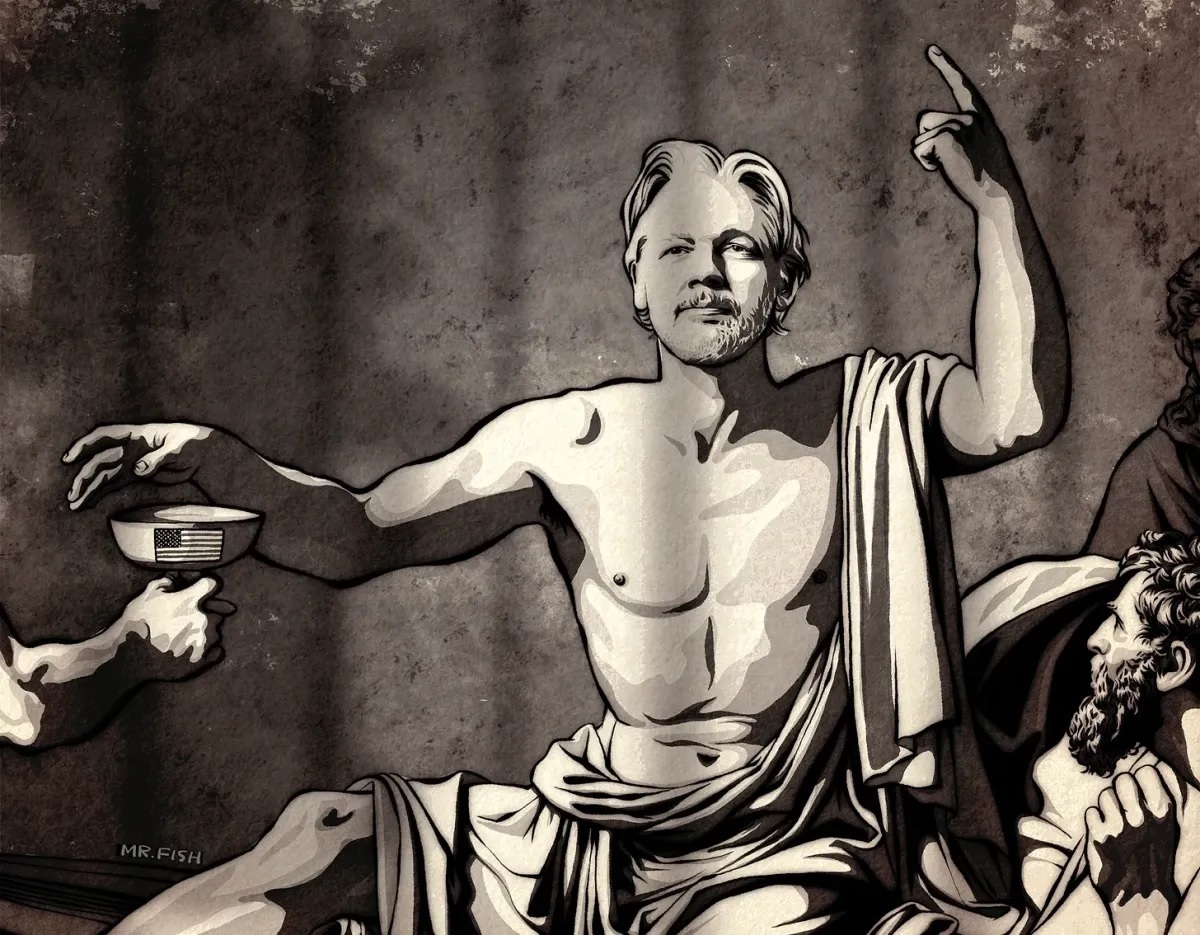
Julian Assange’s legal options have nearly run out. He could be extradited to the U.S. this week. Should he be convicted in the U.S., any reporting on the inner workings of power will become a crime.
By Chris Hedges / Original to ScheerPost more https://scheerpost.com/2023/06/18/chris-hedges-the-imminent-extradition-of-julian-assange-and-the-death-of-journalism/?utm_source=rss&utm_medium=rss&utm_campaign=chris-hedges-the-imminent-extradition-of-julian-assange-and-the-death-of-journalism
High Court Judge Jonathan Swift — who previously worked for a variety of British government agencies as a barrister and said his favorite clients are “security and intelligence agencies” — rejected two applications by Julian Assange’s lawyers to appeal his extradition last week. The extradition order was signed last June by Home Secretary Priti Patel. Julian’s legal team have filed a final application for appeal, the last option available in the British courts. If accepted, the case could proceed to a public hearing in front of two new High Court judges. If rejected, Julian could be immediately extradited to the United States where he will stand trial for 18 counts of violating the Espionage Act, charges that could see him receive a 175-year sentence, as early as this week.
The only chance to block an extradition, if the final appeal is rejected, as I expect it will be, would come from the European Court of Human Rights (ECtHR). The parliamentary arm of the Council of Europe, which created the ECtHR, along with their Commissioner for Human Rights, oppose Julian’s “detention, extradition and prosecution” because it represents “a dangerous precedent for journalists.” It is unclear if the British government would abide by the court’s decision — even though it is obligated to do so — if it ruled against extradition, or if the U.K. would extradite Julian before an appeal to the European court can be heard. Julian, once shipped to the U.S., would be put on trial in the U.S. District Court for the Eastern District of Virginia where most espionage cases have been won by the U.S. government.
Judge Vanessa Baraitser at Westminster Magistrates’ Court refused to authorize the U.S. government’s extradition request in Jan. 2021 because of the severity of the conditions Julian would endure in the U.S. prison system.
“Faced with the conditions of near total isolation without the protective factors which limited his risk at [Her Majesty’s Prison] Belmarsh, I am satisfied the procedures described by the U.S. will not prevent Mr. Assange from finding a way to commit suicide,” said Baraitser when handing down her 132-page ruling, “and for this reason I have decided extradition would be oppressive by reason of mental harm and I order his discharge.”
Baraitser’s decision was overturned after an appeal by U.S. authorities. The High Court accepted the conclusions of the lower court about increased risk of suicide and inhumane prison conditions. But it also accepted four assurances in U.S. Diplomatic Note no. 74, given to the court in Feb. 2021, which promised Julian would be well treated. The U.S. government claimed that its assurances “entirely answer the concerns which caused the judge [in the lower court] to discharge Mr. Assange.” The “assurances” state that Julian will not be subject to Special Administrative Measures (SAMs).
They promise that Julian, an Australian citizen, can serve his sentence in Australia if the Australian government requests his extradition. They promise he will receive adequate clinical and psychological care. They promise that, pre-trial and post-trial, Julian will not be held in the Administrative Maximum Facility (ADX) in Florence, Colorado. No one is held pre-trial in ADX Florence. But it sounds reassuring. ADX Florence is not the only supermax prison in the U.S. Julian can be placed in one of our other Guantanamo-like facilities in a Communications Management Unit (CMU). CMUs are highly restrictive units that replicate the near total isolation imposed by SAMs.
None of these “assurances” are worth the paper they are written on. All come with escape clauses. None are legally binding. Should Julian do “something subsequent to the offering of these assurances that meets the tests for the imposition of SAMs or designation to ADX” he will, the court conceded, be subject to these harsher forms of control.
If Australia does not request a transfer it “cannot be a cause for criticism of the USA, or a reason for regarding the assurances as inadequate to meet the judge’s concerns,” the ruling read. And even if that were not the case, it would take Julian 10 to 15 years to appeal his sentence up to the U.S. Supreme Court, which would be more than enough time to destroy him psychologically and physically.
No doubt the plane waiting to take Julian to the U.S. will be well stocked with blindfolds, sedatives, shackles, enemas, diapers and jumpsuits used to facilitate “extraordinary renditions” conducted by the CIA.
The extradition of Julian will be the next step in the slow-motion execution of the publisher and founder of WikiLeaks and one of the most important journalists of our generation. It will ensure that Julian spends the rest of his life in a U.S. prison. It will create legal precedents that will criminalize any investigation into the inner workings of power, even by citizens from another country. It will be a body blow to our anemic democracy, which is rapidly metamorphosing into corporate totalitarianism.
I am as stunned by this full frontal assault on journalism as I am by the lack of public outrage, especially by the media. The very belated call from The New York Times, The Guardian, Le Monde, Der Spiegel and El País — all of whom published material provided by WikiLeaks — to drop the extradition charges is too little too late. All of the public protests I have attended in defense of Julian in the U.S. are sparsely attended. Our passivity makes us complicit in our own enslavement.
Julian’s case, from the start, has been a judicial farce.
Former Ecuadorian President Lenin Moreno terminated Julian’s rights of asylum as a political refugee, in violation of international law. He then authorized London Metropolitan Police to enter the Ecuadorian Embassy — diplomatically sanctioned sovereign territory — to arrest a naturalized citizen of Ecuador. Moreno’s government, which revoked Julian’s citizenship, was granted a large loan by the International Monetary Fund for its assistance. Donald Trump, by demanding Julian’s extradition under the Espionage Act, criminalized journalism, in much the same way Woodrow Wilson did when he shut down socialist publications such as The Masses.
The hearings, some of which I attended in London and others of which I sat through online, mocked basic legal protocols. They included the decision to ignore the CIA’s surveillance and recording of meetings between Julian and his attorneys during his time as a political refugee in the embassy, eviscerating attorney-client-privilege. This alone should have seen the case thrown out of court. They included validating the decision to charge Julian, although he is not a U.S. citizen, under the Espionage Act. They included Kafkaesque contortions to convince the courts that Julian is not a journalist. They ignored Article 4 of the U.K.-U.S. extradition treaty that prohibits extradition for political offenses. I watched as the prosecutor James Lewis, representing the U.S., gave legal directives to Judge Baraitser, who promptly adopted them as her legal decision.
The judicial lynching of Julian has far more in common with the dark days of Lubyanka than the ideals of British jurisprudence.
The debate over arcane legal nuances distracts us from the fact that Julian has not committed a crime in Britain, other than an old charge of breaching bail conditions when he sought asylum in the Ecuadorian Embassy. Normally this would entail a fine. He was instead sentenced to a year in Belmarsh prison and has been held there since April 2019.
The decision to seek Julian’s extradition, contemplated by Barack Obama’s administration, was pursued by the Trump administration following WikiLeaks’ publication of the documents known as Vault 7, which exposed the CIA’s cyberwarfare programs designed to monitor and take control of cars, smart TVs, web browsers and the operating systems of most smart phones, as well as Microsoft Windows, MacOS and Linux.
Julian, as I noted in a column filed from London last year, is targeted because of the Iraq War Logs, released in Oct. 2010, which document numerous U.S. war crimes, including images seen in the Collateral Murder video, of the gunning down of two Reuters journalists and 10 other civilians and severely injuring two children.
He is targeted because he made public the killing of nearly 700 civilians who had approached too closely to U.S. convoys and checkpoints, including pregnant women, the blind and deaf, and at least 30 children
He is targeted because he exposed more than 15,000 unreported deaths of Iraqi civilians and the torture and abuse of some 800 men and boys, aged between 14 to 89, at Guantánamo Bay detention camp.
He is targeted because he showed us that Hillary Clinton in 2009 ordered U.S. diplomats to spy on U.N. Secretary General Ban Ki-moon and other U.N. representatives from China, France, Russia, and the U.K., spying that included obtaining DNA, iris scans, fingerprints, and personal passwords, all part of the long pattern of illegal surveillance that included eavesdropping on U.N. Secretary General Kofi Annan in the weeks before the U.S.-led invasion of Iraq in 2003.
He is targeted because he exposed that Obama, Hillary Clinton and the CIA backed the June 2009 military coup in Honduras that overthrew the democratically-elected president Manuel Zelaya, replacing him with a murderous and corrupt military regime.
He is targeted because he released documents that revealed the United States secretly launched missile, bomb and drone attacks on Yemen, killing scores of civilians.
He is targeted because he made public the off-the-record talks Hillary Clinton gave to Goldman Sachs, talks for which she was paid $657,000, a sum so large it can only be considered a bribe, as well as her private assurances to Wall Street that she would do their bidding while promising the public financial regulation and reform.
For revealing these truths alone he is guilty.
The U.S. court system is even more draconian than the British court system. It can use SAMs, anti-terrorism laws and the Espionage Act to block Julian from speaking to the public, being released on bail, or seeing the “secret” evidence used to convict him.
The CIA was created to carry out assassinations, coups, torture, kidnapping, blackmail, character assassination and illegal spying. It has targeted U.S. citizens, in violation of its charter. These activities were exposed in 1975 by the Church Committee hearings in the Senate and the Pike Committee hearings in the House.
Working with UC Global, the Spanish security firm in the embassy, the CIA put Julian under 24-hour video and digital surveillance. It discussed kidnapping and assassinating him while he was in the embassy, which included plans of a shoot-out on the streets with involvement by London Metropolitan Police. The U.S. allocates a secret black budget of $52 billion a year to hide multiple types of clandestine projects carried out by the National Security Agency, the CIA, and other intelligence agencies, usually beyond the scrutiny of Congress. All these clandestine activities, especially after the attacks of 9/11, have massively expanded.
Senator Frank Church, after examining the heavily redacted CIA documents released to his committee, defined the CIA’s covert activity as “a semantic disguise for murder, coercion, blackmail, bribery, the spreading of lies.”
The CIA and intelligence agencies, along with the military, all of which operate without effective Congressional oversight, are the engines behind Julian’s extradition. Julian inflicted, by exposing their crimes and lies, a grievous wound. They demand vengeance. The control these forces seek abroad is the control they seek at home.
Julian may soon be imprisoned for life in the U.S. for journalism, but he won’t be the only one.
Why Biden Wants Assange in Jail: Case at the Tipping Point
15 Jun 2023 A London High Court judge rejected Wikileaks editor Julian Assange’s appeal against his extradition to the United States. He now faces up to 175 years in prison — despite public opinion around the world and in his home country, Australia. The UN has declared his detention “arbitrary,” which usually results in the release of the detainee, but not so far. The fate of the man who revealed so many of the hidden crimes of the US empire hangs in the balance. Brian Becker is joined by Joe Lauria, editor in chief of Consortium News
1 This Month


Shut down the radiation-damaged Heysham nuclear reactors now
To see nuclear-related stories in greater depth and intensity – go to https://nuclearinformation.wordpress.com

Say No to NASA’s Reckless Nuclear Reactor on the Moon
Say No to NASA’s Reckless Nuclear Reactor on the Moon
-
Archives
- October 2026 (256)
- September 2026 (339)
- August 2026 (330)
- July 2026 (355)
- June 2026 (287)
- May 2026 (306)
- April 2026 (356)
- March 2026 (251)
- February 2026 (267)
- January 2026 (308)
- December 2025 (358)
- November 2025 (359)
-
Categories
- 1
- 1 NUCLEAR ISSUES
- business and costs
- climate change
- culture and arts
- ENERGY
- environment
- health
- history
- indigenous issues
- Legal
- marketing of nuclear
- media
- opposition to nuclear
- PERSONAL STORIES
- politics
- politics international
- Religion and ethics
- safety
- secrets,lies and civil liberties
- spinbuster
- technology
- Uranium
- wastes
- weapons and war
- Women
- 2 WORLD
- ACTION
- AFRICA
- Atrocities
- AUSTRALIA
- Christina's notes
- Christina's themes
- culture and arts
- Events
- Fuk 2022
- Fuk 2023
- Fukushima 2017
- Fukushima 2018
- fukushima 2019
- Fukushima 2020
- Fukushima 2021
- general
- global warming
- Humour (God we need it)
- Nuclear
- RARE EARTHS
- Reference
- resources – print
- Resources -audiovicual
- Weekly Newsletter
- World
- World Nuclear
- YouTube
-
RSS
Entries RSS
Comments RSS

