An arms embargo on Israel is not a radical idea — it’s the law

In July, the International Court of Justice (ICJ), the highest global court, ruled that Israel’s occupation of the West Bank, East Jerusalem, and Gaza was illegal. The Court held that the regime of segregation that the Palestinian people live under—complete with separate roads, rationed access to water, and a separate legal system based on military law—amounts to apartheid. The Court ordered Israel to withdraw its settlers from the occupied Palestinian territory, pay reparations, and respect the Palestinian right to self-determination.
Halting military aid to Israel is the bare minimum the U.S. can do to stop the Gaza genocide. An arms embargo is not only supported by 80% of Democratic Party voters, it is demanded by international and U.S. law.
By Yoana Tchoukleva August 31, 2024, https://mondoweiss.net/2024/08/an-arms-embargo-on-israel-is-not-a-radical-idea-its-the-law/
As Israel launches its largest military assault in the West Bank in twenty years, I cannot stop thinking about the people I met in the occupied territory. I think of the mother in Jenin who was on the phone with her two sons seconds before their house was burned in an Israeli raid. I think of the wife of a man who was being held in an Israeli prison without charge or trial asking me, “Is there anything you can do? My husband is dying.” I think of the farmer who gifted me a melon even though he could barely put food on his own table and I was there only for a short period of time, traveling and volunteering with Faz3a, an international protective presence organization.
While all eyes have been on Gaza, Palestinians in the West Bank are undergoing what many call a “slow genocide”. Every day, Israeli settlers attack Palestinian families to push them off their private land. They destroy water wells, burn houses, and assault families. Palestinians who remain on their land risk arrest. In the last 10 months, 9,000 Palestinians from the West Bank have been arrested and detained without charge or trial, many experiencing torture.
In July, the International Court of Justice (ICJ), the highest global court, ruled that Israel’s occupation of the West Bank, East Jerusalem, and Gaza was illegal. The Court held that the regime of segregation that the Palestinian people live under—complete with separate roads, rationed access to water, and a separate legal system based on military law—amounts to apartheid. The Court ordered Israel to withdraw its settlers from the occupied Palestinian territory, pay reparations, and respect the Palestinian right to self-determination.
A day later, American friends of mine were violently attacked by settlers in the West Bank. They were accompanying Palestinian farmers to their olive groves when settlers from the nearby Esh Kodesh settlement descended and beat them with metal pipes. This month, another unarmed American volunteer with the international protective presence organization Faz3a was shot in the leg by the Israeli army. The U.S. State Department has remained largely silent.
As the Democratic Party vies for votes, many have demanded the U.S. impose an arms embargo on Israel as a way to signal to Prime Minister Netanyahu that he cannot continue to violate international law with impunity. What few people know is that an arms embargo is not only what 60% of Americans and nearly 80% of Democratic voters want — it is, in fact, already required by law.
U.S. federal law is clear—countries that receive U.S. military funding must meet human rights standards or risk losing their funding.
The Foreign Assistance Act holds that no assistance can be provided to a country “which engages in a consistent pattern of gross violations of internationally recognized human rights.” The Leahy Law prohibits the provision of weapons “to any unit […] of a foreign country if the Secretary of State has credible information that such unit has committed a gross violation of human rights.”
Gross violations include “torture, cruel, inhuman, or degrading treatment or punishment, prolonged detention without charges and trial, […] and another flagrant denial of the right to life or liberty”, all acts Israel is found to have committed by the ICJ, United Nations and even Israel’s own human rights experts and courts.
Our U.S. laws, therefore, demand that we pause military funding to Israel until it remedies its human rights record by agreeing to a permanent ceasefire in Gaza and complying with the ICJ order to end the occupation of Palestinian territories.
Such a pause—or an “arms embargo”—is not without precedent. In 2021, the U.S. withheld $225 million in funding from Egypt and paused the sale of offensive weapons to Saudi Arabia due to these countries’ human rights violations. So why is the U.S. enforcing its laws selectively?
On February 8, President Biden signed National Security Memorandum 20 which at least gave a nod to our federal laws. The Memorandum required the Secretary of State to obtain “credible and reliable written assurances” from foreign recipients of military aid that they are using U.S. weapons in compliance with international law. Those that fail to provide such assurances, or make claims not backed evidence, should have their aid paused.
In March, the State Department admitted there were “credible reports of alleged human rights abuses by Israeli security forces, including arbitrary or unlawful killings, enforced disappearance, torture, and serious abuses in conflict.” Still, the Department rubber-stamped Israeli government’s “assurances” and the White House continued to approve billions of dollars in weapons transfers despite recognized violations of international law.
According to a recent Israeli Defense Ministry report, the U.S. has sent over 50,000 tons of arms and military equipment to Israel since October 7, an average of 2 arms shipments per day.
All of this would crush me if it weren’t for my Palestinian friends who taught me what unwavering faith and commitment to life look like.
So I ask you, Vice President Harris—if you were elected President, will you “take care” that the laws of the United States “be faithfully executed,” as required by our Constitution? Will you consistently uphold federal laws that ban funding foreign governments that commit human rights violations, regardless of how powerful those governments or their lobbies are? Will you honor your commitment at the Democratic National Convention “to end this war such that Israel is secure, the hostages are released, the suffering in Gaza ends and the Palestinian people can realize their right to safety, dignity, freedom and self-determination?”
Doing so requires that we walk our walk, not just talk our talk. It requires that we change policy, not just express concerns. Pausing military funding to Israel is the bare minimum needed to stop the bombing of innocent people and to remind ourselves that we are, after all, a nation of laws.
Sellafield apologises after pleading guilty to cybersecurity failings
By Ollie Rawlinson @ORawlinsonNews, Reporter
The charges, brought by the Office for Nuclear Regulation (ONR), cover a four-year period from 2019 to 2023 and were heard in Westminster Magistrates Court.
According to The Guardian newspaper, the court heard that three-quarters of Sellafield’s servers were vulnerable to cyberattacks, leaving the world’s largest store of plutonium exposed to potential threats.
The ONR revealed that sensitive nuclear information (SNI) had been left at risk due to outdated technology, including the use of Windows 7 and Windows 2008.
It was also discovered that critical IT health checks, which Sellafield claimed were being performed, were not conducted.
A report by external IT firm Commissum found that even a ‘reasonably skilled hacker’ could have accessed and compromised sensitive data.
Sellafield CEO Euan Hutton apologised in a written statement, asserting that the company has since addressed these issues………………………………….
Chief Magistrate Paul Goldspring is expected to deliver a final sentencing in September. Sellafield has agreed to pay £53,000 in legal costs.
The case marks the first time a nuclear site has been prosecuted for cybersecurity offences.
Carlisle News & Star 14th Aug 2024
UK’s most dangerous nuclear site pleads guilty after endangering national security

More than 11,000 people work at the nuclear site in Cumbria, Sellafield, which holds the world’s largest store of plutonium and was called UK’s ‘most dangerous’
By WILLIAM MORGAN, Fri, Aug 9, 2024 https://www.express.co.uk/news/uk/1933985/UK-dangerous-nuclear-site-guilty-endangering-national-security
Europe’s largest nuclear site and the world’s largest plutonium storage facility has admitted putting Britain’s national security at risk, after a series of cybersecurity failings at the vast former nuclear power plant in Cumbria, Sellafield.
The company running the site, Sellafield Ltd, has apologised after pleading guilty to charges relating to information technology security from 2019 to 2023. Westminster Magistrates Court heard that, during this period, three quarters of the nuclear site’s servers were vulnerable to attack.
A Guardian investigation into nuclear industry practices also found that contractors could get unsupervised access to Sellafield computers and could plug external drives into the Sellafield systems. The company’s own report into the issue found that any “reasonably skilled hacker or malicious insider” could take advantage of these weaknesses.
The court heard from the nuclear watchdog that information which could pose a threat to national secrity lay vulnerable for years, with many of the critical security checks that Sellafield Ltd said they were completing, were simply not being done. The site has an otherwise poor reputation, often called “the most dangerous” site in the UK, employing 11,000 people to process nuclear waste and decommission equipment.
Tests of the vulnerable IT systems found that someone could access Sellafield’s servers and install phishing softward “without raising any alarms”. Raising further fears of information vulnerabiliy in key UK infrastructure to threats from hostile actors.
During their prosecution for failing to secure their systems, it emerged that 13 files marked “official/sensitive” had mistakenly been sent to outside contractors, alongside 4000 other files. Somehow, this did not trigger any elerts in their computer system, which was blamed in part for using “obsolete” software – including Windows 7 and Windows 2008.
At a court hearing on Thursday, a statement was read out from Sellafield Ltd’s CEO, Euan Hutton, who was present but did not speak.
The statement read: “I again apologise on behalf of the company for matters which led to these proceedings … I genuinely believe that the issues which led to this prosecution are in the past.”
The company is not due to be sentenced until September. The Office for Nuclear Regulation said after the August 8 hearing: “Sellafield Ltd had previously pleaded guilty to those offences in June, and while a hearing did take place today, Chief Magistrate Senior District Judge Paul Goldspring did not pass sentence.
“We expect Sellafield Ltd to be sentenced in September, when further details will be provided on our website and social media channels.”
Sellafield apologises after guilty plea over string of cybersecurity failings
Nuclear site awaits sentencing over breaches that it admitted could have threatened national security
Anna Isaac and Alex Lawson, Fri 9 Aug 2024 https://www.theguardian.com/business/article/2024/aug/08/sellafield-apologises-guilty-plea-security-failings-nuclear–
Sellafield has apologised after pleading guilty to criminal charges relating to a string of cybersecurity failings at Britain’s most hazardous nuclear site, which it admitted could have threatened national security.
Among the failings at the vast nuclear waste dump in Cumbria was the discovery that 75% of its computer servers were vulnerable to cyber-attacks, Westminster magistrates court in London heard.
Information that could threaten national security was left exposed for four years, the nuclear watchdog revealed, and Sellafield said it had been performing critical IT health checks that were not, in fact, being carried out.
Late last year, the Guardian’s Nuclear Leaks investigation revealed a string of IT failings at the state-owned company dating back several years, as well as radioactive contamination and toxic workplace culture.
Sellafield is a sprawling rubbish dump for nuclear waste from weapons programmes and decades of atomic power generation. It has a workforce of about 11,000 people and is part of the Nuclear Decommissioning Authority, a taxpayer-owned and -funded quango.
The Guardian’s investigation also revealed concerns about external contractors being able to plug memory sticks into Sellafield’s system while unsupervised and that its computer servers were deemed so insecure that the problem was nicknamed Voldemort after the Harry Potter villain because it was so sensitive and dangerous.
Sellafield pleaded guilty to charges brought by the Office for Nuclear Regulation (ONR) in June, which relate to information technology security offences spanning a four-year period from 2019 to 2023.
The firm is now awaiting final sentencing, whichthe chief magistrate, Paul Goldspring, said would happen within weeks. The ONR has said it expects sentencing to take place in September.
At a sentencing hearing on Thursday, the court heard that a test had found that it was possible to download and execute malicious files on to Sellafield’s IT networks via a phishing attack “without raising any alarms”, according to Nigel Lawrence KC, representing the ONR.
The site, the world’s largest store of plutonium, was left vulnerable to internal and external cyber-attacks and 75% of its servers were insecure, Lawrence said, citing a report by Atos, a subcontractor at the site.
Sellafield’s own report, from the external IT company Commissum, found that any “reasonably skilled hacker or malicious insider” could access sensitive data and insert malware – computer code – that could then be used to steal information.
Euan Hutton, chief executive of Sellafield, apologised for failures spanning years in a written witness statement referred to by Paul Greaney KC, representing the company. Hutton said: “I again apologise on behalf of the company for matters which led to these proceedings … I genuinely believe that the issues which led to this prosecution are in the past.”
Hutton was in court but did not speak at the hearing.
Greaney said the company had tried to address its cybersecurity failings by changing IT management at the site and creating a new secure datacentre.
The barrister said some problems identified in recent years had been “turbo-charged” by the prosecution. Greaney said the failings were not a result of cost-cutting. “There was no penny-pinching,” he added.
The court also heard that a subcontractor was sent 4,000 files by mistake, 13 of which were classed as “official/sensitive”, without any alarm being triggered.
Sensitive nuclear information (SNI), the industry’s special classification system, was left vulnerable in part because of the use of “obsolete” technology including Windows 7 and Windows 2008, Lawrence said.
SNI is a mode of categorising information that may have national security implications, and has a special status in law, like other classified materials handled by the British security services or the civil service. Details are given SNI status if they are “deemed to be of value to an adversary planning a hostile act”, according to the ONR.
While all parties said the failings were very serious, the judge said he would need to balance the cost to the taxpayer with the need to deter others in the sector from committing similar offences.
The sentencing would be “new territory for all of us”, Goldspring said, given that no nuclear site had been prosecuted in this way before.
The National Audit Office, Britain’s public spending watchdog, launched an investigation this year into costs and risks at Sellafield.
The Guardian reported last year that the site systems had been hacked by groups linked to Russia and China in December last year, embedding sleeper malware that could lurk and be used to spy or attack systems.
At the time, Sellafield said it did not have evidence of a successful cyber-attack. Greaney told the court that there was no evidence found for an “effective” cyber-attack on Sellafield. The court heard that Sellafield’s operations centre was found to be “unable to adequately alarm and respond to tested attacks”.
A spokesperson for the company said: “We take cybersecurity extremely seriously at Sellafield, as reflected in our guilty pleas. The charges relate to historic offences and there is no suggestion that public safety was compromised.
“Sellafield has not been subjected to a successful cyber-attack or suffered any loss of sensitive nuclear information. We’ve already made significant improvements to our systems, network, and structures to ensure we are better protected and more resilient.”
The ONR declined to comment. Sellafield has agreed to pay £53,000 in legal costs
Assange, CIA Surveillance and Spain’s Audencia Nacional
Australian Independent Media, August 1, 2024, Dr Binoy Kampmark
The sordid story on the CIA-backed operation against the WikiLeaks publisher Julian Assange during his time cramped in London’s Ecuadorian Embassy continues to froth and thicken. US officials have persisted in their reticent attitude, refusing to cooperate with Spain’s national high court, the Audiencia Nacional, regarding its investigation into the Agency’s espionage operations against the publisher, spearheaded by the Spanish security firm Undercover (UC) Global.
Since 2019, requests for assistance regarding the matter, including querying public statements by former CIA director Mike Pompeo and former head of counterintelligence, William Evanina, along with information mustered by the relevant Senate Intelligence Committee, have been made to US authorities by judges José de la Mata and Santiago Pedraz. These have been treated with a glacial silence.
On December 12, 2023, the General Subdirectorate of International Legal Cooperation furnished the US authorities “an express announcement” whether such judicial assistance would be denied.
Spain’s liaison magistrate in the US, María de las Heras García, duly revealed that the tardiness to engage had been occasioned by ongoing legal proceedings being conducted before the US District Court of the Southern District of New York. As Courtney E. Lee, trial attorney at the US Justice Department’s Office of International Affairs explained, supplying Spain’s national high court with such information would “interfere” with “ongoing US litigation”. Hardly a satisfactory response, given requests made prior to the putative litigation.
The litigation in question involved a legal suit filed in the US District Court of the Southern District of New York by civil rights attorney Margaret Ratner Kunstler, media lawyer Deborah Hrbek, and journalists John Goetz and Charles Glass.
In their August 2022 action, the complainants alleged that they had been the subject of surveillance during visits to Assange during his embassy tenure, conduct said to be in breach of the Fourth Amendment. The plaintiffs accordingly argued that this entitled them to money damages and injunctive relief from former CIA director Mike Pompeo, the director of the Spanish security firm Undercover (UC) GlobalDavid Morales, and UC Global itself.
On December 19, 2023 District Judge John G. Koeltl granted, in part, the US government’s motion to dismiss while denying other portions of it. The judge accepted the record of hostility shown by Pompeo to WikiLeaks openly expressed by his April 2017 speech and acknowledged that “Morales was recruited to conduct surveillance on Assange and his visitors on behalf of the CIA and that this recruitment occurred at a January 2017 private security industry convention at the Las Vegas Sands Hotel in Las Vegas, Nevada.
The litigants found themselves on solid ground with Koeltl in the finding that they had standing to sue the intelligence organisation. “In this case, the plaintiffs need not allege, as the Government argues, that the Government will imminently use their information collected at the Ecuadorian Embassy in London.” The plaintiffs would “have suffered a concrete and particularized injury fairly traceable to the challenged program and redressable by favorable ruling” if the search of the conversations and electronic devices along with the seizure of the contents of the electronic devices were found to be unlawful.
-Advertisement-
The plaintiffs also convinced the judge that they had “sufficient allegations that the CIA and Pompeo, through Morales and UC Global, violated their reasonable expectation of privacy in the contents of their electronic devices.” But they failed to convince Koeltl that they had a reasonable expectation of privacy regarding their conversations with Assange, given the rather odd reasoning that they were aware the publisher was already being “surveilled even before the CIA’s alleged involvement.” Nor could such an expectation arise given the acceptance of video surveillance of government buildings. Problematically, the judge also held that those surrendering devices and passports at an Embassy reception desk “assumed the risk that the information may be conveyed to the Government.”
Sadly, Pompeo was spared the legal lash and could not be held personally accountable for violating the constitutional rightsof US citizens. “As a presidential appointee confirmed by Congress […] Defendant Pompeo is in a different category of defendant from a law enforcement agent of the Federal Bureau of Narcotics.”…………………………………………………………………………..
As long as the Agency stifles and drags out proceedings on the grounds of this misused privilege, the Justice Department is bound to remain inert in the face of the Spanish investigation. https://theaimn.com/assange-cia-surveillance-and-spains-audencia-nacional/
Netanyahu’s Visit to Congress Underscores US Contempt for International Law
Netanyahu is getting cozy with Congress, just days after the ICJ told UN members to stop aiding the Israeli occupation.
By Marjorie Cohn , Truthout July 24, 2024
he U.S. has long ignored many commands of international law, but its casual disregard of the International Court of Justice (ICJ) has come into sharp focus this week as the U.S. Congress extends a warm welcome to Israeli Prime Minister Benjamin Netanyahu, just five days after the ICJ notified all UN member states that they have a legal “obligation not to render aid or assistance in maintaining the situation created by Israel’s illegal presence in the Occupied Palestinian Territory.”
The World Court’s historic 83-page advisory opinion, which was issued on July 19 and held that the Israeli occupation of Palestinian territory is illegal, was quickly hailed by Middle East political expert Nomi Bar-Yaacov as a “legal earthquake” and the strongest decision that the court had ever issued.
Unsurprisingly, however, both the Israeli and U.S. governments denounced the ICJ’s ruling and proceeded with their plans — including Netanyahu’s visit to Washington, D.C. — as if it had never occurred.
The purpose of Netanyahu’s trip is to shore up U.S. support for his ongoing genocidal campaign against the Palestinians in Gaza and for his crusade against Iran.
“The Jewish people are not occupiers in their own land, including in our eternal capital Jerusalem nor in Judea and Samaria, our historical homeland,” Netanyahu declared after the ICJ issued its decision. “No absurd opinion in The Hague can deny this historical truth or the legal right of Israelis to live in their own communities in our ancestral home.”
Joe Biden’s administration meanwhile conveyed that it is “concerned that the breadth” of the decision will “complicate” the “efforts to resolve the conflict.” The U.S. State Department said the ICJ’s order that Israel withdraw from the Palestinian territories is “inconsistent with the established framework” for resolving “the conflict.” Parroting Israel’s mantra, the State Department said the resolution should occur through negotiations.
Negotiations have proved worthless in ending Israel’s illegal occupation and its genocide in Gaza and achieving justice for the Palestinians. Although the Biden administration has advocated a two-state solution, its unbridled support for the Zionist regime, which continues to carve up occupied Palestinian territory into noncontiguous enclaves, makes that “solution” impossible.
The U.S. government enables Israel’s illegal occupation by providing $3.8 billion annually and it has sent Israel an addition $15 billion in military aid since October 7, 2023. This helps fund Israel’s genocide, which has killed nearly 39,000 Palestinians by the official Gaza Health Ministry count, although the true death toll is likely much higher. Moreover, the U.S. has vetoed three Security Council resolutions that would have demanded a ceasefire in Gaza.
In order to comply with the ruling of the World Court, the U.S. government would have to end its military assistance to Israel and stop providing political and diplomatic cover to enable Israel’s occupation of Palestinian territory.
The ICJ’s Legal Findings
The ICJ ruled that Israel’s occupation of the West Bank, East Jerusalem and Gaza violates international law, which prohibits the acquisition of territory by threat or use of force and enshrines the right of the Palestinian people to self-determination. “The sustained abuse by Israel of its position as an occupying Power, through annexation and an assertion of permanent control over the Occupied Palestinian Territory and continued frustration of the right of the Palestinian people to self-determination, violates fundamental principles of international law and renders Israel’s presence in the Occupied Palestinian Territory unlawful,” the court wrote…………………………………………………………………………………………………………….
Consequences of the Ruling
The World Court’s advisory opinion was issued in response to a request by the General Assembly. Although not legally binding, the decision carries great moral weight………………………………………………………………………………………….. more https://truthout.org/articles/netanyahus-visit-to-congress-underscores-us-contempt-for-international-law/
A $36.8 billion lesson from Georgia- “The most expensive electricity in the world”
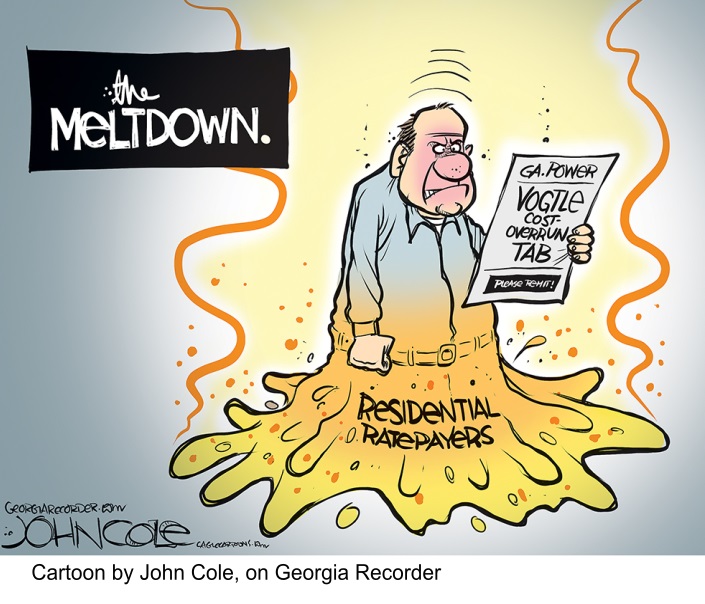
In May, the plaintiffs along with four other prominent Georgia consumer groups released a report, Plant Vogtle: The True Cost of Nuclear Power in the United States. The analysis detailed how the U.S. Department of Energy, Georgia Power, and the Georgia Public Service Commission (PSC), conspired to force Georgians into purchasing the most expensive electricity in the world, costing ratepayers $10,784 per kilowatt, compared to $900 to $1,500 per kilowatt (KW) for wind or solar. Recent Georgia Power electricity bills have shown the bill increase to be in the 30-40% range.
Again and again, the Georgia Public Service Commission (PSC) was warned about the astronomical cost of the Vogtle reactors and the financial toll it will bear on Georgians for decades to come.
Ratepayers beware. New nuclear power plants will gouge customers
From Georgia Conservation Voters Education Fund and Georgia WAND
Georgia consumer groups have filed a major lawsuit against the State of Georgia [AF1] in federal court, alleging Georgia lawmakers violated the state’s constitution by unilaterally postponing Georgia Public Service Commission (PSC) elections. According to the lawsuit, the PSC election’s unlawful postponement allowed the sitting commission members to rubberstamp the largest utility rate increases in Georgia history and grant utility companies the authority to charge Georgians for cost-overruns and mishaps. The groups argue that the charges may not have been passed onto consumers if elections were held as regularly scheduled.
House Bill 1312, which Georgia legislators passed in April, delays the election of new PSC members until at least 2025, giving multiple sitting PSC members an extra two years in office. Georgia’s constitution requires that PSC terms shall be six years, and therefore cannot be lengthened without a constitutional amendment. All PSC members have had their office terms extended to eight years, and one nine years as a result.
…………………………………….Brionté McCorkle, plaintiff and executive director of Georgia Conservation Voters Education Fund, said: “Georgians are fighting every month to stay ahead of rising costs for food, housing, and now energy. These aren’t optional costs. They’re things we need to survive. Public Service Commissioners like Tricia Pridemore, Fitz Johnson, and Tim Echols have allowed Georgia Power to take money out of the pockets of hard-working Georgians – and it has to end.”
In May, the plaintiffs along with four other prominent Georgia consumer groups released a report, Plant Vogtle: The True Cost of Nuclear Power in the United States. The analysis detailed how the U.S. Department of Energy, Georgia Power, and the Georgia Public Service Commission (PSC), conspired to force Georgians into purchasing the most expensive electricity in the world, costing ratepayers $10,784 per kilowatt, compared to $900 to $1,500 per kilowatt (KW) for wind or solar. Recent Georgia Power electricity bills have shown the bill increase to be in the 30-40% range.
Additional Key findings in the May Vogtle report included:
- Plant Vogtle allowed Georgia Power to expand its rate base, the assets on which they earn a guaranteed rate of return, by over $11 billion. Yet their share of Vogtle is 1,020 megawatts, making it the most expensive electricity in the world at $10,784/KW. Normal (wind, solar, natural gas) generation prices range from $900 to $1500/KW.
- Vogtle Units 3 & 4 took 15 years to build and cost $36.8 billion, well over twice the projected timeline and cost.
- Vogtle independent construction monitors documented that Georgia Power provided materially false cost estimates for at least ten years, falsehoods used to justify expanding Plant Vogtle. Similar false cost estimates sent South Carolina utility executives to jail for that state’s failed nuclear plant, which started construction at the same time as Plant Vogtle.
Patty Durand, consumer advocate, founder of Cool Planet Solutions and a recent candidate for the Georgia PSC, said:
“Again and again, the Georgia Public Service Commission (PSC) was warned about the astronomical cost of the Vogtle reactors and the financial toll it will bear on Georgians for decades to come. Commissioners repeatedly declined to protect ratepayers from cost overruns and ignored PSC staff recommendations to cancel the project. People went to prison for actions like this in South Carolina, yet we have had no accountability for the same, and worse, behavior here. Instead, the state legislature decided to shield current commissioners from facing voters by delaying PSC elections indefinitely. This is clearly unconstitutional. This is un-American.” https://beyondnuclearinternational.org/2024/07/28/a-36-8-billion-lesson-from-georgia/
Two legal actions against the hasty commissioning of Flamanville nuclear reactor

Flamanville EPR, still at the heart of scandals, is heading towards a hasty start,
Sortir du Nucleaire, CRIIRAD, CRILAN, Global Chance, Robin des Bois, and the “Exit from Nuclear Power” Network,23 July 24
On May 7, 2024, we denounced the decision to commission the Flamanville EPR. Today, we are raising the alarm through two legal actions about this hasty commissioning while questions remain unanswered. We are filing an appeal with the Council of State against this commissioning decision, and a complaint against X in order to shed full light on the irregularities noted by the Nuclear Safety Authority on parts of the EPR.
We are filing an appeal against the hasty commissioning of the EPR to the detriment of safety requirements
On 7 May 2024, the Nuclear Safety Authority (ASN) gave its approval for the Flamanville EPR to be commissioned, i.e. for it to receive its first fuel load. A decision taken above all to avoid the legal consequences of yet another postponement. Indeed, the commissioning of the Flamanville EPR has already been postponed by decree twice in the past , in 2017 and 2020 , because the facility was not ready to start up.
One might have thought that these two postponements would provide EDF with a comfortable margin to ensure that its installation could start up safely in 2024. However,
despite the additional time granted to the operator, it has not managed to commission the Flamanville EPR within the allotted time:
The nuclear reactor should have been commissioned before April 10, 2024, according to the creation authorization decree. It finally took place almost a month later, on May 7, 2024. Problem: the commissioning deadlines exist to protect the population and the environment from a project that has become too old. It was
the ASN itself that indicated in an opinion that these deadlines aim to
“avoid the commissioning of an installation whose environment would no longer be compatible with its operation and/or not to allow the creation authorization to continue for an installation whose operator would not be able to complete construction” .
The deadline for examining the commissioning application, which can last one or two years if the file is complex, was also not respected. …………………………………………
We are filing a complaint to shed light on the irregularities noted on certain parts of the EPR
This decision to put it into service is even more surprising in light of the revelations of the ASN, which, during its 2024 press wishes, revealed new problems of counterfeiting, falsification and suspicion of fraud (CFS) . [ 1 ]
These cases, according to the ASN, are distinguished by the significant scope of materials potentially affected, as well as by the potentially significant consequences for the safety of the reactors . The Nuclear Safety Authority has therefore reported these facts to the courts and has since refused to give us further information under cover of the confidentiality of the investigation [ 2 ] .
It was an
article from Reporterre that allowed us to obtain more information on this affair and learned that these cases concerned, among others, two companies producing materials intended for the EPR reactor in Flamanville. The article states that
“it was during the examination of the EPR commissioning authorization [that the ASN] allegedly noted irregularities in certificates of conformity, particularly for valves, pipes, etc.”
At this point, with the elements we have, we can ask ourselves:
- Have components that do not comply with essential safety requirements been placed on the market?
- Were false documents drawn up and used to cover up these defects?
- Did EDF properly monitor its suppliers to prevent the installation of non-compliant parts on its EPR?
We demand answers to these questions………………………………………………………………….more https://www.sortirdunucleaire.org/L-EPR-de-Flamanville-toujours-au-coeur-de
The World Court Has Cleared the Fog Hiding Western Support for Israel’s Crimes
The Unz Review, JONATHAN COOK • JULY 24, 2024
The legal ruling by the world’s highest court obliges western states not just to end their persecution of the boycott movement but to take up that cause as their own
Don’t be fooled. The ruling by the International Court of Justice (ICJ) on 19 July that Israel’s occupation of Palestine is unlawful is earth-shattering. Israel is a rogue state, according to the world’s highest court.
For that reason, the judgment will be studiously ignored by the cabal of western states and their medias that for decades have so successfully run cover for Israel.
Doubters need only watch the reception Israeli Prime Minister Benjamin Netanyahu receives during his visit to the United States this week.
Even though he is currently being pursued for war crimes by the chief prosecutor of the International Criminal Court, the US Congress will give him a hero’s welcome when he addresses its representatives on Wednesday.
The warm handshakes and standing ovations will be a reminder that Netanyahu has had the full backing of western powers throughout the nine-month slaughter of at least 16,000 Palestinian children in Gaza – with another 21,000 missing, most of them under rubble.
The welcome will be a reminder that western capitals are fully on board with Israel’s levelling of Gaza and the starvation of its population – in what the same court concluded way back in January amounted to a “plausible genocide”.
And it will serve as a heavy slap in the face to those like the World Court committed to international law – reminding them that the West and its most favoured client state believe they are untouchable.
Western politicians and columnists will keep emphasising that the World Court is offering nothing more than an “advisory opinion” and one that is “non-binding”.
What they won’t point out is that this opinion is the collective view of the world’s most eminent judges on international law, the people best positioned to rule on the occupation’s legality.
And it is non-binding only because the western powers who control our international bodies plan to do nothing to implement a decision that doesn’t suit them.
Nonetheless, the ruling will have dramatic consequences for Israel, and its western patrons, even if those consequences will take months, years or even decades to play out.
‘Top secret’ warning
Last week’s judgment is separate from the case accepted in January by the ICJ that put Israel on trial for genocide in Gaza. A decision on that matter may still be many months away.
This ruling was in response to a request from the United Nations General Assembly in December 2022 for advice on the legality of Israel’s 57-year occupation.
That may sound more mundane a deliberation than the one on genocide, but the implications ultimately are likely to be every bit as profound.
Those not familiar with international law may underestimate the importance of the World Court’s ruling if only because they had already assumed the occupation was illegal.
But that is not how international law works. A belligerent occupation is permitted so long as it satisfies two conditions.
First, it must be strictly military, designed to protect the security of the occupying state and safeguard the rights of the occupied people.
And second, it must be a temporary measure – while negotiations are conducted to restore civilian rule and allow the occupied people self-determination.
Astonishingly, it has taken 57 years for the world’s highest court to deliver a conclusion that should have been staring it – and everyone else – in the face all that time.
The military nature of the occupation was subverted almost from the moment Israel occupied the Palestinian territories in June 1967.
Within months, Israel had chosen to transfer Jewish civilians – mostly extreme religious nationalists – into the occupied Palestinian territories to help colonise them.
Israel knew that this was a gross violation of international law because its own legal adviser warned it of as much in a “top secret” memo unearthed by the Israeli journalist Gershom Gorenberg some two decades ago.
In a declaration enlarging on the ICJ’s reasoning, Court President Nawaf Salam specifically referenced the warnings of Theodor Meron, who was the Israeli foreign ministry’s legal expert at the time.
In September 1967, his memo cautioned that any decision to establish civilian settlements in the occupied Palestinian territories “contravenes explicit provisions of the Fourth Geneva Convention”. Those provisions, he added, were “aimed at preventing colonization”.
Nine days later, the Israeli government rode roughshod over Meron’s memo and assisted a group of young Israelis in setting up the first settlement at Kfar Etzion.
Sham peace-making
Today, hundreds of illegal settlements – many of them home to what amount to armed militias – control more than half of the West Bank and much of East Jerusalem.
Rather than protecting the rights of Palestinians under occupation, as international law demands, the Israeli military assists Jewish settlers in terrorising the Palestinians. The aim is to drive them off their land.
In the words of the Israeli government, the settlements are there to “Judaise” Palestinian territory. In the words of everyone else, they are there to ethnically cleanse the Palestinian population.
Which brings us to Israel’s second violation of the laws of occupation. In transferring hundreds of thousands of settlers into the occupied territories, Israel intentionally blocked any chance of a Palestinian state emerging.
The settlements weren’t makeshift encampments. Some soon developed into small cities, such as Ariel and Maale Adumim, with shopping malls, parks, public pools, synagogues, factories, libraries, schools and colleges.
There was nothing “temporary” about them. They were there to incrementally annex Palestinian territory under cover of an occupation that Washington and its European allies conspired to pretend was temporary.
The whole Oslo process initiated in the early 1990s was a switch-and-bait exercise, or a “Palestinian Versailles”, as the Palestinian scholar Edward Said warned at the time.
Israel was never serious about allowing the Palestinians meaningful statehood – a fact the then-Israeli prime minister, Yitzhak Rabin, admitted shortly before he was killed by a far-right settler in 1995………………………………………………………………………..
Apartheid rule……………………………………………………………………………………….
Acts of aggression……………………………………………………
Complicit in war crimes
But the implications don’t just apply to Israel………………………………………………………
The fog clears
Israel’s supporters will take comfort from the fact that an earlier judgment from the World Court on Israel was roundly ignored by both Israel and its western patrons.
Asked for an advisory opinion, the judges ruled in 2004 that, under cover of security claims, Israel was illegally annexing swaths of territory by building its 800km-long “separation wall” on Palestinian land………………………………………………………………………………………………..
Words have power. They are our route to understanding reality. And the World Court has just cleared away the fog. It has wiped clean the mist on the window.
The West will do its level best once again to shroud Israel’s crimes. But the World Court has done the Palestinians and the rest of mankind a service in unmasking Israel for what it is: a rogue, criminal state. https://www.unz.com/jcook/the-world-court-has-cleared-the-fog-hiding-western-support-for-israels-crimes/
Hundreds protesting Netanyahu visit arrested at US Capitol

The protesters belonged to the Jewish Voice for Peace activist group
News Desk, JUL 24, 2024, https://thecradle.co/articles/hundreds-protesting-netanyahu-visit-arrested-at-us-capitol
Around 200 pro-Palestine protesters were detained on Capitol Hill on 23 June, ahead of Israeli Prime Minister Benjamin Netanyahu’s address to the US Congress the day after.
The protest took place in the Canon House Office Building. The demonstrators, wearing shirts with the slogan “Not in our name,” were organized by the Jewish Voice for Peace group.
According to police, the protesters were warned that demonstrating in the Canon House Office Building was illegal.
Executive Director of Jewish Voice for Peace, Stefanie Fox, said the Israeli premier’s speech in Congress on Wednesday was the reason for the demonstration.
“For nine months, we’ve watched in horror as the Israeli government has carried out a genocide, armed and funded by the US. Congress and the Biden administration have the power to end this horror today. Instead, our president is preparing to meet with Netanyahu and Congressional leadership has honored him with an invitation to address Congress,” she said.
Republican representative Mike Lawler called the protest an “embarrassment” and accused the Jewish Voice for Peace activists of being “pro-Hamas.”
Netanyahu’s address to Congress was announced in late May by Mike Johnson, Republican Speaker of the US House of Representatives. At the time, the International Criminal Court (ICC) had announced its decision to seek arrest warrants against Netanyahu and his defense minister.
Johnson threatened during his announcement in May that the US “should punish” the ICC for its decision.
The Israeli prime minister arrived in Washington on Monday, ahead of his speech at Congress on 24 May and a meeting with US President Joe Biden, scheduled for the following day.
The ICC said on Tuesday that it has accepted 64 filings by states, individuals, and organizations to intervene regarding arrest requests against Netanyahu and others, including Hamas leaders.
It is highly expected that Netanyahu’s address will focus on the idea of continuing the war in Gaza until Hamas’ defeat – in line with his government’s stated goals and in stark contradiction to efforts to reach a ceasefire deal.
The premier’s much-anticipated address in Congress comes on the 292nd day of Israel’s genocidal war against the Gaza Strip, which has killed over 39,000 people – mainly women and children – and has injured over 90,000.
What the top UN court’s ruling means for Israel
Though non-binding, the ICJ’s rulings on the ongoing Gaza massacre strip away the Jewish state’s ability to obfuscate its crimes
Tarik Cyril Amar, a historian from Germany working at Koç University, Istanbul, on Russia, Ukraine, and Eastern Europe, the history of World War II, the cultural Cold War, and the politics of memory 22 July 24, https://www.rt.com/news/601411-icj-israel-palestine-genocide/
The 15 judges of the International Court of Justice (ICJ), the highest judicial organ of the United Nations, have issued what everyone agrees is a landmark finding. “Legal Consequences Arising from the Policies and Practices of Israel in the Occupied Palestinian Territory, including East Jerusalem,” is, in essence, a devastating condemnation of Israel’s policies and crimes in the territories which it conquered more than half a century ago, as a consequence of the Six Day War of 1967, which it still holds today.
The ICJ finding also, inevitably, means (whether the judges intend it or not) that not only Israel’s policy in these specific territories, but the Zionist project as such, is based on the irreparable injustice of violently depriving the Palestinians of their inalienable right to national self-determination. Make no mistake, this is not “merely” a blow to the crimes of Israeli occupation and annexation; it calls into question the foundations of Israel as a state, as it is built around the systematic defiance of justice, law, and elementary ethics.
One feature enhancing the impact of the ICJ finding is its comprehensiveness. The 80-page document is the outcome of a long and thorough process that started in late 2022, when the General Assembly of the UN requested what is known as an “advisory opinion.” Detailed and closely argued, the findings are based, among other things, on the combined expertise of some of the best jurists in the world and hearings that involved almost 60 states. (Israel, clearly aware that its position was less than promising and generally contemptuous of international law, shunned the opportunity to state its case, which adds to the absurdity of its current rage over the result.)
However, while similarly meticulous legal assessments tend to generate complicated outcomes, that is not the case here. As has been widely acknowledged, the findings are devastating for Israel and, at least in legal terms, a clear triumph for the Palestinians and Palestine. In the words of Erika Guevara Rosas, senior director for research, advocacy, policy, and campaigns at Amnesty International, the ICJ’s “conclusion is loud and clear.”
The ICJ has recognized without qualifications that Israel’s holding of territories it seized during the Six Day War – including East Jerusalem (which Israel has officially though unlawfully annexed) and the West Bank (which it pretends to “occupy” but is, in reality, annexing) is illegal and needs to end asap.
In particular, the ICJ made it clear that all settlement must cease and that the settlers already on these territories must leave. That decision alone means that between 700,000 and 750,000 Israeli illegals (here, that term is, for once, exactly correct) should not be where they are. Not only do all of them have to leave the over 100 settlements they never had a right to establish; the Israeli state has an obligation to evacuate them. Moreover, Israel’s expropriations of land are also illegal, that is, simply put, theft. The ICJ has ordered it to return what it has stolen, that is, tens of thousands of acres.
The Israeli state is, of course, deeply implicated in the illegal acts the ICJ has ordered it to stop and even reverse. Israel’s longstanding policies of incentivizing its Jewish citizens – including de facto colonial settlers from anywhere in the world – to move into the illegally held territories and steal Palestinian land and resources is fundamentally criminal, among other reasons, because it is inconsistent with international law, particularly the humanitarian law enshrined in the Geneva Conventions.
Regarding the Gaza Strip, long a de facto concentration camp for its Palestinian inhabitants and since October 2023 the site of Israel’s ongoing genocidal massacre against them, the ICJ has clearly rejected the all-too-frequently heard Israeli argument that its forces retreated from it in 2005.
In reality, as honest legal experts have long maintained and the ICJ has now confirmed explicitly, Israel has always exerted so much stifling control over this area that it has remained an occupying power, with all the attendant obligations, whether its forces were on the ground inside the Gaza Strip or abusing its inhabitants while stationed around it.
The ICJ also clarified the issue of apartheid. As should be well known, apartheid is a recognized crime under international law (it is not merely a name for one specific criminal regime once practiced in South Africa). Under, for instance, the Rome Statute of the International Criminal Court – not to be confused with the ICJ – the “crime of apartheid” is defined as a “crime against humanity” akin to, for instance, murder, extermination, enslavement, or torture. Also according to the Rome statute, what makes apartheid special is that it is “an institutionalized regime of systematic oppression and domination by one racial group over any other racial group or groups and committed with the intention of maintaining that regime.”
Put simply, apartheid is, literally, one of the worst crimes a regime and the people supporting and working for it can possibly commit. In the case of Israel, unbiased experts and various human rights organizations have long argued that it is committing this crime as well. The ICJ has addressed this issue, noting arguments “that Israel’s policies and practices in the Occupied Palestinian Territory amount to segregation or apartheid, in breach of Article 3 of CERD,” that is, the “Convention on the Elimination of All Forms of Racial Discrimination” (also known as the International Convention on the Elimination of All Forms of Racial Discrimination, ICERD).
Article 3 of the CERD imposes on states the duty not only to “condemn racial segregation and apartheid,” but also to “undertake to prevent, prohibit and eradicate all practices of this nature in territories under their jurisdiction.” The ICJ has concluded that Israel, by its “legislation” and “measures,” that is, really by everything it does as a state, is in breach of this key provision.
Israel is, in sum, a state practicing the crime against humanity of apartheid, de facto annexing and settling territories it has no conceivable legal claim on, and systematically denying a whole nation, the Palestinians, their right to self-determination. The court has also finished off any pretense that Israel can justify its continuing, pervasive criminality by alleged “security” needs. Those are only some of the ICJ’s key findings. Others concern Palestinian rights to restitution, return, and reparations, for instance. For anyone even vaguely familiar with how the Israeli state operates, it is obvious that these ICJ findings have declared its core principles illegal, as they are.
Many states, at least those with enough power, break international law, some quite habitually (the US, for instance), some “only” occasionally. Israel, however, is special: By virtue of its own, freely chosen policies informed by a nationalist ideology of supremacy and colonial settlement, it has made breaking international law its reason of state: without it, it is hard to even imagine how it can continue. Note, in this respect, that its minister of defense and its prime minister are on the verge of having warrants issued against them for crimes against humanity and war crimes by the International Criminal Court, while the ICJ has already found that genocide is a plausible possibility in Gaza and, since Israel has brutally disregarded all its injunctions, will most likely confirm that finding in a final judgment in the not-too-distant future.
One thing that the ICJ findings confirm is, of course, that the Palestinians have a right to armed resistance under international law. Another thing that follows is that many things that Israel and its Western backers pretend are up for negotiation are not: Palestinians have a right to get their land back; Israel has no right to use it, in any way, not even as a bargaining chip.
A third thing also follows, but from the Israeli response: The whole Israeli political spectrum, not only Prime Minister Netanyahu and the other extremists in his cabinet, has rejected the ICJ findings. Hence, the illusion that the problem with Israel is just a few radicals in power must be buried once and for all: Unfortunately, its delusions of domination and supremacy are widespread throughout its political sphere and its society. Israel is the worst rogue state in the world, and it is also a dead end. For that, it cannot, as its elites usually do, blame external enemies or “anti-Semitism.” In reality, its own arrogance and outrageous violence against the Palestinians and its neighbors are to blame.
Of course, these ICJ findings, as many cynics will remind us, will not compel Israel to change. Indeed, as UN Special Rapporteur Francesca Albanese has pointed out, Israel’s usual response to being called out is to commit even more crimes, as if to make a point about its defiance of international law. Yet it is shortsighted to believe that the ICJ’s condemnation is irrelevant.
For one thing, the ICJ has been explicit that all other states have a duty to “co-operate with the United Nations” to bring about “an end to Israel’s illegal presence in the Occupied Palestinian Territory and the full realization of the right of the Palestinian people to self-determination.” In addition, the judges also reiterated, in great detail, that not only other states, but also “international organizations, specialized agencies, investment corporations and all other institutions” must not “recognize, or cooperate with or assist in any manner in, any measures undertaken by Israel to exploit the resources of the occupied territories or to effect any changes in the demographic composition or geographic character or institutional structure of those territories.”
In essence, the ICJ has put all governments on this planet on notice that they are not free to do as they please about Israel and its crimes, but that they are bound by laws to help stop them and to abstain from being accomplices. That, of course, is an aspect of the findings that should concern the many hypocrites and accomplices in the EU and the US, such as German Chancellor Olaf Scholz, for instance, who cannot see anything but a “comprehensive compliance with international law” when he looks at Israel. But then, that’s the same Olaf Scholz, of course, who can’t figure out who blew up his country’s gas pipelines. Likewise, the leaders of the UK, with “Labour-friend-of-Israel” and, embarrassingly, human rights lawyer Keir Starmer in the lead, and those of the US, in the process of co-perpetrating the genocide in Gaza, should feel at least some discomfort: Standing by Israel will not be cost-free much longer.
Ultimately, the single most important result of these ICJ findings has to do with the enormous role that systematic obfuscation – in plain language: lying – plays for the Israeli regime and its society. All those who have long named Israel’s systemic crimes and called for resistance to them, whether outside or inside Palestine, now have, in effect, the highest court of the world on their side. There is no more room for debate about what Israel is doing, and once that has been settled, there is no argument left for defending it. The ICJ findings won’t suddenly change the world, but when the world does change, they will have played an important role.
Overwhelming ICJ Ruling against Israeli Occupation Highlights Need for UN Action

The US government’s use of the veto must be shamed and condemned. The UN General Assembly must assert the will of the world.
SAM HUSSEINI, JUL 19, 2024, https://husseini.substack.com/p/overwhelming-icj-ruling-against-israel?utm_source=post-email-title&publication_id=201840&post_id=146793552&utm_campaign=email-post-title&isFreemail=true&r=9zi1x&triedRedirect=true&utm_medium=email
The International Court of Justice ruled today: the State of Israel has the obligation to make reparation for the damage caused to all the natural or legal persons concerned in the Occupied Palestinian Territory;
the State of Israel’s continued presence in the Occupied Palestinian Territory is unlawful;
the State of Israel is under an obligation to bring to an end its unlawful presence in the Occupied Palestinian Territory as rapidly as possible;
the State of Israel is under an obligation to cease immediately all new settlement activities, and to evacuate all settlers from the Occupied Palestinian Territory;
all States are under an obligation not to recognize as legal the situation arising from the unlawful presence of the State of Israel in the Occupied Palestinian Territory and not to render aid or assistance in maintaining the situation created by the continued presence of the State of Israel in the Occupied Palestinian Territory;- international organizations, including the United Nations, are under an obligation not to recognize as legal the situation arising from the unlawful presence of the State of Israel in the Occupied Palestinian Territory; and
- the United Nations, and especially the General Assembly, which requested the opinion, and the Security Council, should consider the precise modalities and further action required to bring to an end as rapidly as possible the unlawful presence of the State of Israel in the Occupied Palestinian Territory.
See video and background via here.
The UN Security Council has been prevented from action by the US (and British) veto.
As I have argued, the General Assembly must act, especially using Uniting for Peace. See my piece: “‘Uniting for Peace’ is Next Step in Invoking Genocide Convention Process to Protect Palestine.”
This is a major organizing challenge to people around the world; to get as many countries as possible to back as strong action as possible against Israel’s crimes.
Some resources are in my piece, above. Another key is action should be in NYC in front of the UN and various missions to the UN.
International Court of Justice Tells Israel to End Occupation of Palestinian Territories, Pay Reparations

Racism in Israel is not a flaw in the system; it is the system.
Unlike the framing commonly put forth by politicians and mainstream media, it is not “complicated.” It is not “an age-old religious feud.” And, it is not “a conflict by extremists on both sides.”
While the Biden administration continues its insincere rhetorical support for the two-state solution, the U.S. has remained Israel’s staunchest supporter, always using its veto power to shield it from accountability and prevent Palestinian statehood despite Israel’s repeated violations of international law and UN Security Council resolutions.
Seventy-Five Percent of All UN Member States Recognize the State of Palestine
In an advisory opinion, the International Court of Justice reaffirmed the Palestinian right to self-determination.
By Michel Moushabeck , TRUTHOUT, July 19, 2024 https://truthout.org/articles/icj-tells-israel-to-end-occupation-of-palestinian-territories-pay-reparations/
In a landmark opinion issued today, the International Court of Justice (ICJ) has said that Israel’s 57-year occupation of the West Bank, East Jerusalem and the Gaza Strip is in breach of international law.The proceedings came out of a UN resolution passed in December of 2022. In the resolution, the UN General Assembly requested an advisory opinion from the International Court of Justice on “Israeli practices affecting the human rights of the Palestinian people in the Occupied Palestinian Territory, including East Jerusalem.”
The ICJ, also known as the World Court, is the UN’s principal judicial organ that adjudicates disputes between member states and provides advisory opinions on international legal matters.
This case is separate from the one brought forth by South Africa last year, in which the ICJ provisionally ruled that Israeli practices in Gaza are plausibly genocidal. Following that ruling, Israel indicated that it rejects the ICJ’s findings.
In a post on X, Prime Minister Benjamin Netanyahu wrote, “Nobody will stop us – not The Hague, not the axis of evil and not anybody else.”
Public hearings on Israel’s occupation of Palestine were held at The Hague on February 19 and lasted for six days, during which 52 countries participated and presented arguments. The panel of 15 judges on the court was asked by the UN General Assembly to consider “the legal consequences arising from the ongoing violation by Israel of the right of the Palestinian people to self-determination, from its prolonged occupation, settlement and annexation of the Palestinian territory occupied since 1967.”
The hearings commenced with remarks by Palestinian Foreign Minister Riyad al-Maliki, in which he asserted the rights of Palestinians to live “in freedom and dignity in their ancestral land.” He asked the ICJ to recognize the Palestinian people’s right to self-determination and called on the court to “declare Israel occupation is illegal and must end it completely and unconditionally.”
Israel did not participate in the oral arguments, but the Office of the Prime Minister issued a statement saying, “Israel does not recognize the legitimacy of the discussion at the International Court of Justice in The Hague regarding the ‘legality of the occupation’ — a move designed to harm Israel’s right to defend itself against existential threats.”
Israel’s Occupation Is Sustained by a Combination of State-Sponsored Violence and Apartheid
Israel was born of British colonialism; it was created through a mixture of state violence and vigilante terrorist acts that displaced Palestinians and dispossessed them from their homes and land; it is supported — financially, militarily and diplomatically — by Western, primarily U.S., imperialism-serving war profiteers; and it is sustained by a combination of state-sanctioned violence and a system of apartheid that denies Palestinians — who form half the people in the land under Israeli control from the river to the sea — their equal rights.
After the Nakba of 1948, the State of Israel was established on 78 percent of the land of what had been British Mandate Palestine. During the June 1967 war, Israel took over the West Bank, Gaza and Arab East Jerusalem, the remaining 22 percent of historic Palestine, now known as “the Occupied Territories.” In 1980, Israel unilaterally formalized its annexation of East Jerusalem — a move that was condemned as illegal by the international community.
Over the past 57 years, successive Israeli governments have brutally terrorized Palestinians, demolished homes, confiscated large tracts of Palestinian lands, expanded Israeli settlements in the West Bank — considered illegal under international law — and added many new ones that effectively rendered the “two-state solution” impossible. Now West Bank settlers number more than 700,000; they are heavily armed and are constantly terrorizing Palestinian residents in neighboring villages in an effort to force them to leave, as described in a report by Amnesty International.
According to the Palestinian Health Ministry, since October 7,575 Palestinians — of whom 138 are children — were killed in the occupied West Bank and East Jerusalem by soldiers and armed settlers.
Israel employs oppression, violence, persecution, checkpoints, house demolitions, displacement, expulsion, imprisonment, land theft, torture of children and collective punishment to ethnically cleanse non-Jewish inhabitants.
Continue readingWhy Julian Assange couldn’t outrun the Espionage Act
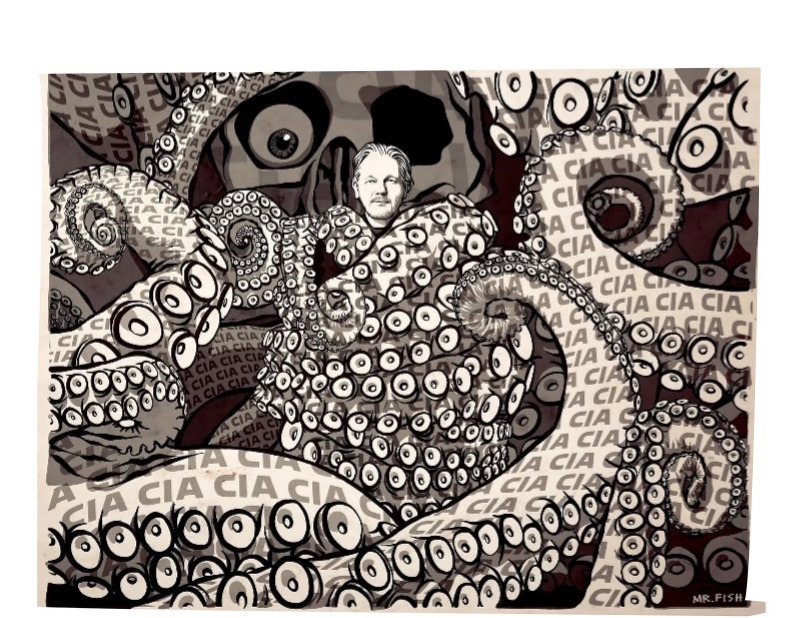
the grave threat the Espionage Act poses to journalism and the First Amendment
SOTT, Jordan Howell The FIRE, Wed, 26 Jun 2024
Julian Assange spent seven years in self-exile in London’s Ecuadorian Embassy avoiding arrest, and five more in prison, for publishing classified documents on WikiLeaks.
Julian Assange is a free man, and one of the most contentious press freedom controversies in living memory may finally be coming to a close.
The WikiLeaks founder reached a plea deal with the Department of Justice on Monday after spending five years in an English prison fighting extradition to the United States. Federal officials sought to charge Assange with conspiracy to obtain and disclose national security information under the Espionage Act of 1917.
Assange and WikiLeaks shocked the world in 2010 by publishing hundreds of thousands of secret military documents and diplomatic cables related to the wars in Iraq and Afghanistan that were leaked by Army intelligence analyst Chelsea Manning. Months later, Assange was on the run and Manning was in jail.
Assange claimed that by receiving and publishing confidential information, what he did was no different than the type of routine news reporting that journalists around the world engage in every day. As the Supreme Court ruled in New York Times Co. v. United States (1971), better known as “The Pentagon Papers” case, publishing leaked documents is protected under the First Amendment.
FIRE has long opposed use of the Espionage Act to curtail the rights of journalists to source information. And in December 2022, FIRE signed an open letter organized by the Committee to Protect Journalists along with 20 other civil liberties groups calling on the federal government to drop its charges against Assange.
“We are united . . . in our view that the criminal case against him poses a grave threat to press freedom both in the United States and abroad,” we argued. “[J]ournalists routinely engage in much of the conduct described in the indictment: speaking with sources, asking for clarification or more documentation, and receiving and publishing official secrets. News organizations frequently and necessarily publish classified information in order to inform the public of matters of profound public significance.”
Assange’s 12 year ordeal, including seven years in self-exile in the Ecuadorian Embassy in London before his arrest and imprisonment, underscores the continued threat that the century-old Espionage Act still poses to civil liberties today — and not just in the United States. Assange is not a U.S. citizen, nor was he ever a resident. But because of modern extradition treaties, there were few places in the world where he could travel to escape the Act’s reach,
Under the terms of Monday’s deal, Assange pleaded guilty to the charges and was sentenced to 62 months incarceration, but with credit for time served, according to documents filed with the U.S. District Court for the Northern Mariana Islands.
Ultimately, freedom of the press is what was at stake with the government’s case against Assange. It was never only about him. The precedent that would have been set by his extradition and trial would have sent a chilling message to journalists across the country and the world: You can run, but you can’t hide from the Espionage Act.
What is the Espionage Act?……………………………………………………………………………………….Based on the Defense Secrets Act of 1911, the Espionage Act of 1917 included much stiffer penalties — including the death penalty — for sharing secret or confidential information or otherwise interfering with the operations of the U.S. military.
The Espionage Act made it a crime to obtain information regarding national defense “with intent or reason to believe” that doing so would hurt the U.S. or to advantage another country. While subsequent amendments and court decisions have refined its language and scope, its core purpose remains the same.
Espionage Act and the Supreme Court
The law was immediately controversial because its use was not limited to actual acts of espionage. Rather, the Espionage Act allowed the government to clamp down on anyone who opposed the war effort.
In Schenck v. United States, in 1919, the Supreme Court upheld the conspiracy conviction against socialist Charles Schenck under the Espionage Act for distributing anti-war leaflets that urged people to boycott the draft.
The problem with the Court’s ruling in Schenck, as subsequent decisions would affirm, is that Schenk’s speech was not calling for violence or even civil disobedience. Rather, his speech was precisely the kind of political expression that decades of subsequent Supreme Court decisions would ultimately uphold. Numerous convictions under the Espionage Act would make their way to the Court, including that of socialist presidential candidate Eugene Debs, who was arrested for giving a speech opposing the war.
Since then, one of the most nefarious uses of the Espionage Act has been to silence journalists. At least insofar as publishing the leaked documents on the Wikileaks website, what Assange did was little different than what The New York Times and The Washington Post did in 1971 when they published and reported on thousands of pages from a classified report about the war in Vietnam.
……………………………………….As the Supreme Court has ruled, freedom of the press is a foundational principle, enshrined in the Bill of Rights. And though Julian Assange is finally free, FIRE continues to have serious concerns about the grave threat the Espionage Act poses to journalism and the First Amendment. https://www.sott.net/article/492768-Why-Julian-Assange-couldnt-outrun-the-Espionage-Act
The Release of Julian Assange: Plea Deals and Dark Legacies

It ultimately goes to the brutal exercise of US extraterritorial power against any publisher, irrespective of outlet and irrespective of nationality…………….. the measure extracts a pound of flesh from the fourth estate. It signals that the United States can and will seek out those who obtain and publish national security information that they would rather keep under wraps under spurious notions of “harm”.
June 27, 2024, by: Dr Binoy Kampmark https://theaimn.com/the-release-of-julian-assange-plea-deals-and-dark-legacies-2/
One of the longest sagas of political persecution is coming to its terminus. That is, if you believe in final chapters. Nothing about the fate of Julian Assange seems determinative. His accusers and inquisitors will draw some delight at the plea deal reached between the WikiLeaks founder’s legal team and the US Department of Justice. Others, such as former US Vice President, Mike Pence, thought it unjustifiably lenient.
Alleged to have committed 18 offences, 17 novelly linked to the odious Espionage Act, the June 2020 superseding indictment against Assange was a frontal assault on the freedoms of publishing and discussing classified government information. At this writing, Assange has arrived in Saipan, located in the US commonwealth territory of Northern Mariana Islands in the Western Pacific, to face a fresh indictment. It was one of Assange’s conditions that he would not present himself in any court in the United States proper, where, with understandable suspicion, he might legally vanish.
As correspondence between the US Department of Justice and US District Court Chief Judge Ramona V. Manglona reveals, the “proximity of this federal US District Court to the defendant’s country of citizenship, Australia, to which we expect he will return at the conclusion of proceedings” was also a factor.
Before the US District Court for the Northern Mariana Islands, he will plead guilty to one count of conspiracy to obtain and disclose national defence information under the Espionage Act of 1917, or section 793(g) (Title 18, USC). The felony carries a fine up to $10,000 and/or up to 10 years in prison, though Assange’s time in Belmarsh Prison, spent on remand for some 62 months, will meet the bar.
The felony charge sheet alleges that Assange knowingly and unlawfully conspired with US Army intelligence analyst Chelsea Manning, then based at Operating Base Hammer in Iraq, to receive and obtain documents, writings and notes, including those of a secret nature, relating to national defence, wilfully communicated those documents from persons with lawful possession of or access to them to those not entitled to receive them, and do the same from persons unauthorised to possess such documents.
Before turning to the grave implications of this single count and the plea deal, supporters of Assange, including his immediate family, associates and those who had worked with him and drunk from the same well of publishing, had every reason to feel a surreal sense of intoxication. WikiLeaks announced Assange’s departure from London’s Belmarsh Prison on the morning of June 24 after a 1,901 day stint, his grant of bail by the High Court in London, and his release at Stansted Airport. Wife Stella regularly updated followers about the course of flight VJ199. In coverage posted of his arrival at the federal court house in Saipan, she pondered “how overloaded his senses must be, walking through the press scrum after years of sensory depravation and the four walls” of his Belmarsh cell.
As for the plea deal itself, it is hard to fault it from the emotional and personal perspective of Assange and his family. He was ailing and being subjected to a slow execution by judicial process. It was also the one hook upon which the DOJ, and the Biden administration, might move on. This being an election year in the US, the last thing President Biden wanted was a haunting reminder of this nasty saga of political persecution hovering over freedom land’s virtues.
There was another, rather more sordid angle, and one that the DOJ had to have kept in mind in thinning the charge sheet: a proper Assange trial would have seen the murderous fantasies of the CIA regarding the publisher subject to scrutiny. These included various possible measures: abduction, rendition, even assassination, points thoroughly explored in a Yahoo News contribution in September 2021.
One of the authors of the piece, Zach Dorfman, posted a salient reminder as news of the plea deal filtered through that many officials during the Trump administration, even harsh critics of Assange, “thought [CIA Director Mike] Pompeo’s extraordinary rendition plots foolhardy in the extreme, and probably illegal. They also – critically – thought it might harm Assange’s prosecution.” Were Pompeo’s stratagems to come to light, “it would make the discovery process nightmarish for the prosecution, should Assange ever see trial.”
From the perspective of publishers, journalists and scribblers keen to keep the powerful accountable, the plea must be seen as enormously troubling. It ultimately goes to the brutal exercise of US extraterritorial power against any publisher, irrespective of outlet and irrespective of nationality. While the legal freight and prosecutorial heaviness of the charges was reduced dramatically (62 months seems sweetly less imposing than 175 years), the measure extracts a pound of flesh from the fourth estate. It signals that the United States can and will seek out those who obtain and publish national security information that they would rather keep under wraps under spurious notions of “harm”.
Assange’s conviction also shores up the crude narrative adopted from the moment WikiLeaks began publishing US national security and diplomatic files: such activities could not be seen as journalistic, despite their role in informing press commentary or exposing the venal side of power through leaks.
From the lead prosecuting attorney Gordon Kromberg to such British judges as Vanessa Baraitser; from the national security commentariat lodged in the media stable to any number of politicians, including the late California Democrat Dianne Feinstein to the current President Joe Biden, Assange was not of the fourth estate and deserved his mobbing. He gave the game away. He pilfered and stole the secrets of empire.
To that end, the plea deal makes a mockery of arguments and effusive declarations that the arrangement is somehow a victory for press freedom. It suggests the opposite: that anyone publishing US national security information by a leaker or whistleblower is imperilled. While the point was never tested in court, non-US publishers may be unable to avail themselves of the free speech protections of the First Amendment. The Espionage Act, for the first time in history, has been given a global, tentacular reach, made a weapon against publishers outside the United States, paving the way for future prosecutions.
1 This Month
23-25 October – on Zoom – World BEYOND War’s annual global conferenc


Shut down the radiation-damaged Heysham nuclear reactors now
To see nuclear-related stories in greater depth and intensity – go to https://nuclearinformation.wordpress.com

Say No to NASA’s Reckless Nuclear Reactor on the Moon
Say No to NASA’s Reckless Nuclear Reactor on the Moon

-
Archives
- October 2026 (243)
- September 2026 (339)
- August 2026 (330)
- July 2026 (355)
- June 2026 (287)
- May 2026 (306)
- April 2026 (356)
- March 2026 (251)
- February 2026 (267)
- January 2026 (308)
- December 2025 (358)
- November 2025 (359)
-
Categories
- 1
- 1 NUCLEAR ISSUES
- business and costs
- climate change
- culture and arts
- ENERGY
- environment
- health
- history
- indigenous issues
- Legal
- marketing of nuclear
- media
- opposition to nuclear
- PERSONAL STORIES
- politics
- politics international
- Religion and ethics
- safety
- secrets,lies and civil liberties
- spinbuster
- technology
- Uranium
- wastes
- weapons and war
- Women
- 2 WORLD
- ACTION
- AFRICA
- Atrocities
- AUSTRALIA
- Christina's notes
- Christina's themes
- culture and arts
- Events
- Fuk 2022
- Fuk 2023
- Fukushima 2017
- Fukushima 2018
- fukushima 2019
- Fukushima 2020
- Fukushima 2021
- general
- global warming
- Humour (God we need it)
- Nuclear
- RARE EARTHS
- Reference
- resources – print
- Resources -audiovicual
- Weekly Newsletter
- World
- World Nuclear
- YouTube
-
RSS
Entries RSS
Comments RSS

