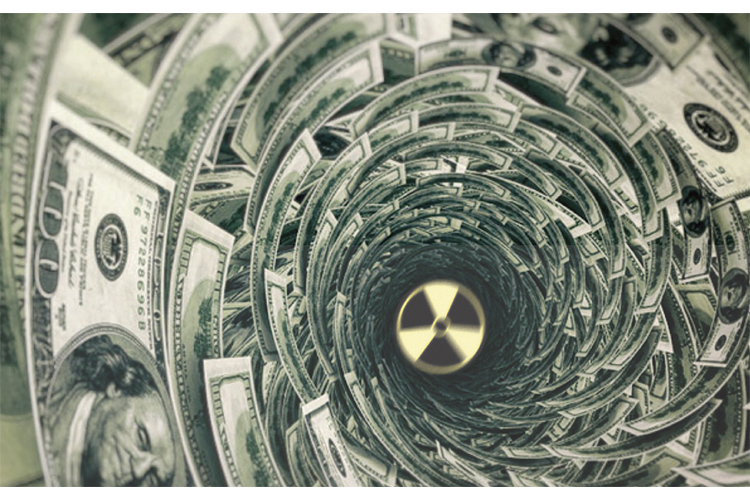
Plutonium just had a bad day in court

In a major decision whose consequences are still being assessed, a federal judge declared that plutonium pit production — one ingredient in the U.S. government’s $1.5 trillion nuclear weapons expansion — has to be performed in accordance with the nation’s strongest environmental law
SEARCHLIGHT NEW MEXICO, by Alicia Inez Guzmán, October 17, 2024
Most Americans don’t seem aware of it, but the United States is plunging into a new nuclear arms race. At the same time that China is ramping up its arsenal of nuclear weapons, Russia has become increasingly bellicose. After a long period of relative dormancy, the U.S. has embarked on its own monumental project to modernize everything in its arsenal — from bomb triggers to warheads to missile systems — at a cost, altogether, of at least $1.5 trillion.
Los Alamos National Laboratory plays a vital role as one of two sites set to manufacture plutonium “pits,” the main explosive element in every thermonuclear warhead. But as a recent court ruling makes clear, the rush to revive weapons production has pushed environmental considerations — from nuclear waste and increases in vehicular traffic to contamination of local waterways, air and vegetation — to the wayside.
That just changed dramatically. On Sept. 30, United States District Judge Mary Geiger Lewis of South Carolina ruled that the federal government violated the National Environmental Policy Act — the “Magna Carta” of federal environmental law — when it formulated and began to proceed with plans to produce plutonium pits at LANL and the Savannah River Site, in Aiken, South Carolina.
“[T]he Court is unconvinced Defendants took a hard look at the combined effects of environmental impacts of their two-site strategy,” Lewis wrote of the Department of Energy (DOE) and the National Nuclear Security Administration (NNSA), which together oversee America’s nuclear weapons stockpile.
The ruling was momentous for the anti-nuclear community. But it was also mystifying, because Judge Lewis didn’t provide a roadmap for how to move forward with this extraordinarily complicated policy dispute. Rather than bringing pit production to a halt — which plaintiffs argued for in their original complaint, filed in 2021 — the judge instead ordered the parties to reach some sort of “middle ground” among themselves and submit a joint proposal by Oct. 25. What that will consist of is anybody’s guess. The judge was clear on one point, though — she’ll be keeping a close eye on the matter by maintaining jurisdiction over the case. Injunctive relief, she added, could still be in the cards.
NEPA’s rules require that agencies take a “hard look” at potential environmental impacts. NEPA does not, however, dictate what decision should be made once those impacts are identified.
Previous impact statements have spelled out a vast array of potential hazards for nuclear facilities. These have included an “inadvertent criticality event,” which happens when nuclear material produces a chain reaction and a pulse of potentially fatal radioactivity. Another risk is fire igniting inside a glovebox — the sealed enclosure where radioactive materials like plutonium are handled — and then resisting suppression, leading to widespread contamination. Other possibilities: a natural gas explosion at vulnerable nuclear sites or a wildfire on LANL’s sprawling campus, which is bounded on all sides by the towns of Los Alamos and White Rock, the Pueblo of San Ildefonso, the Santa Fe National Forest and Bandelier National Monument.
“Perhaps more significantly,” Judge Lewis stated, those impact statements “provide a springboard for public comment,” a kind of mechanism for citizens to express criticism and concern and, in some cases, identify a project’s blindspots — risks to people and places that have not been properly taken into account.
An announcement from the DOE the following day was telling, if not defiant: The first plutonium pit manufactured as part of this modernization program was ready to be deployed into the stockpile. That pit — made at LANL but the product of multiple facilities across the nation’s nuclear weapons complex — is intended for a new warhead, which will be strapped into a new intercontinental ballistic missile called the Sentinel. The Sentinel program, at $140 billion, is one of the costliest in the history of the U.S. Air Force……………………………………………………………………….
Now, almost 40 years later, the court found that the agencies charged with reviving the nuclear weapons complex have not properly evaluated the perils that could come with turning out plutonium pits at two different sites, thousands of miles apart. For the plaintiffs in this case — which include Nuclear Watch New Mexico, Savannah River Site Watch, Tri-Valley Communities Against a Radioactive Environment and the Gullah/Geechee Sea Island Coalition — Lewis’s decision to intervene is a milestone.
“We’ve had a pretty significant victory here on the environmental front,” said Tom Clements, the director of Savannah River Site Watch. “Nonprofit public interest groups are able to hold the U.S. Department of Energy accountable.”
………………………………………………………………………………………………….. For LANL, which sits on the kind of forested land typical of the Pajarito Plateau, wildfire is a major risk. …………………………………………………..
A “parade of horribles”
The array of sites that play some role in this latest phase of pit production goes well beyond LANL and SRS, and includes existing facilities in Amarillo, Texas; Kansas City, Missouri; and Livermore, California. Hypothetically, if the feds ever produce the kind of environmental impact statement plaintiffs demand, it could potentially cover this entire constellation, requiring public hearings at each location and in Washington, D.C………………………………………… more https://searchlightnm.org/federal-judge-ruling-plutonium-pits-environmental-impact/?utm_source=Searchlight+New+Mexico&utm_campaign=ae33d0dc0a-10%2F15%2F2024+%E2%80%93+Plutonium&utm_medium=email&utm_term=0_8e05fb0467-ae33d0dc0a-395610620&mc_cid=ae33d0dc0a&mc_eid=a70296a261
Environmental groups challenge the nuclear industry’s portrayal of its energy as “clean” and “non-emitting,” citing health risks and long-term radioactive waste

By James Murray, October 16, 2024,
https://www.netnewsledger.com/2024/10/16/environmental-groups-challenge-the-nuclear-industrys-portrayal-of-its-energy-as-clean-and-non-emitting-citing-health-risks-and-long-term-radioactive-waste/
Competition Bureau Asked to Investigate Misleading Nuclear Energy Claims in Canada
Ottawa, 16 October 2024 – Seven Canadian environmental advocates have filed a formal complaint with the Competition Bureau, urging it to investigate the Canadian Nuclear Association (CNA) and its members for promoting nuclear energy as “clean” and “non-emitting.”
This latest action, under Section 9 of the Competition Act, calls for the Bureau to address what the complainants argue are false and misleading claims about nuclear energy.
“Legislation against greenwashing should spur the Bureau to act on the misuse of terms like ‘clean’ and ‘non-emitting.’ These claims are misleading and repeated by uninformed officials,” said Dr. Ole Hendrickson.
“Nuclear reactors emit carcinogenic substances and produce dangerous radioactive waste—hardly ‘clean’ by any reasonable definition,” added J.P. Unger, a science writer and policy analyst. “The industry’s survival depends on misleading the public and securing subsidies.”
The complaint highlights the continuous emission of carcinogenic gases and the production of long-lived radioactive waste by nuclear reactors, which pose significant health risks to current and future generations. According to the applicants, the CNA’s portrayal of nuclear energy as clean misleads the public, especially given the severe environmental impact of its waste.
The group points out that these claims have unfairly bolstered nuclear energy’s image, positioning it to secure public funding intended for genuinely clean energy projects. They also criticize nuclear industry campaigns, such as educational initiatives targeted at schools, for perpetuating these misconceptions.
This action follows an earlier complaint filed in February, which was dismissed by the Competition Bureau. At the time, the Bureau deemed CNA’s statements to be political rather than promotional. However, the new complaint emphasizes that the CNA’s messaging aims to sway public opinion and secure financial benefits by falsely categorizing nuclear energy as environmentally friendly.
“Israel must be expelled from the United Nations”

International legal expert Fabio Marcelli makes the case that, following the attack on UN peacekeepers, the conditions are ripe for a UN General Assembly vote on Israel’s expulsion from the latter
Thomas Fazi, Oct 13, 2024, https://www.thomasfazi.com/p/israel-must-be-expelled-from-the—
Israel must be expelled from the United Nations: the conditions are ripe
by Fabio Marcelli, international legal expert, research director of the Institute for International Legal Studies of the Italian National Research Council and member of the International Association of Democratic Lawyers
Originally published in Italian on the website of Il Fatto Quotidiano.
The deliberate and criminal attack on the Italian Sassari Brigade and other UNIFIL (United Nations Interim Force in Lebanon) international contingents marks a new and unprecedented stage in Netanyahu’s efforts to devastate the neighbouring peoples of Israel, threaten global peace, and lead his own country to self-destruction, which now seems closer than ever.
[Italian Defense] Minister Crosetto’s condemnation of the attack as a war crime is commendable, as is his commitment that UNIFIL will not yield to blackmail or threats and will continue to carry out its mission. His assertion that Italy does not take orders from Israel is also notable.
However, it is crucial to closely monitor the fulfilment of this commitment, especially given the contradictory stance of the Meloni government, which has consistently supported Israel’s crimes. This contradiction becomes even more apparent when Western-supplied weapons, including a significant contribution from Italy’s military-industrial complex, are used against Italian forces. Unfortunately, Crosetto’s position seems unlikely to bring about meaningful consequences, especially given the silence from other Italian leaders, such as prime minister Giorgia Meloni and president Sergio Mattarella — a silence that must be harshly criticised considering the severity of the affront to Italy and the dangers to global peace.
UNIFIL must remain on the ground and, indeed, should be strengthened and equipped with appropriate equipment and weapons to effectively respond to any potential Israeli aggression. Similarly, steps should be taken to establish a comparable military protection force in Gaza and the West Bank to ensure the safety of the Palestinian people, who have paid a huge price in blood and continue to pay it every day in terms of civilians killed, mutilated and subjected to starvation, thirst and lack of medical supplies, denied by the genocidal occupation.
At the core of the expanding conflict, which now poses a serious threat to global peace, lies the persistent violation of the Palestinian people’s right to self-determination. This ongoing crisis stems from over fifty years of impunity granted to Israeli governments that have continually defied international law and the UN — and are now brutally attacking the organisation, declaring Secretary-General Guterres persona non grata and bombing his peacekeeping forces, including the cream of the Italian Armed Forces.
Given such sustained and repeated criminal behaviour, there are grounds for Israel’s expulsion from the United Nations. According to Article 6 of the UN Charter, “a Member of the United Nations which has persistently violated the Principles contained in the present Charter may be expelled from the Organization by the General Assembly upon the recommendation of the Security Council”.
However, it is clear that Western states in the Security Council, particularly the United States — complicit in Netanyahu’s criminal actions — will use their veto power to block such a proposal, once again obstructing the proper functioning of the international organisation and the enforcement of international law. Nonetheless, it would be equally important for the UN General Assembly to vote on such a resolution, giving free expression to the condemnation of Israel that now comes from the vast majority of the world’s countries as well as from international public opinion.
Such a declaration of principle should be followed by the imposition of sanctions under Article 41 and, if these measures prove insufficient, it could lead to multilateral military action under Article 42. This would complete the procedural steps outlined in Chapter VII of the Charter to end threats to international peace and security.
The adoption of these measures by the General Assembly and by a large number of states represents a necessary response to the grave threat to world peace posed by the criminal policies of the Netanyahu government, determined to provoke a nuclear conflict to avoid legal accountability, as well as by the equally criminal complicity of Western nations, led by the United States, today headed by a president who is a shadow of himself and therefore the shadow of a shadow.
Moreover, there are significant precedents in international law since World War II, such as the “Uniting for Peace” resolution adopted by the General Assembly when the Security Council failed to act. Such measures must now be considered in the face of the current danger to international peace.
Are DOE and NNSA Complying with the National Environmental Policy Act?

The Court found the DOE’s plan had fundamentally changed from the one site plan to its two site plan. DOE did not consider alternatives while moving forward and spending tens of billions of taxpayers’ dollars. The Court found that the plaintiffs had standing to challenge DOE’s two-site plan.
October 10th, 2024, https://nuclearactive.org/
On Monday, September 30th, United States District Court Judge Mary Geiger Lewis ruled that the Department of Energy (DOE) and its National Nuclear Security Administration (NNSA) violated the National Environmental Policy Act (NEPA) because the federal agencies failed to take a “hard look” at the alternatives to fabricate plutonium pits, or the triggers, for nuclear weapons at two of its sites. Los Alamos National Laboratory (LANL) was created to design and fabricate the atomic bombs used during World War II. The Savannah River Site in South Carolina has never fabricated pits for nuclear weapons.
In the late 2000s, DOE released for public review and comment its Complex Transformation Supplemental Programmatic Environmental Impact Statement stating that pit production would take place exclusively at LANL. https://www.energy.gov/nepa/doeeis-0236-s4-complex-transformation-supplemental-programmatic-environmental-impact-statement
Yet in 2019 DOE expanded its proposal to improve the resiliency, flexibility and redundance of the nuclear security enterprise to also fabricate plutonium pits at the Savannah River Site in South Carolina. DOE failed to prepare a new NEPA document for public review and comment detailing how the two sites would interact to fabricate up to 80 plutonium pits per year.
A coalition of non-governmental organizations challenged DOE’s action in the United States District Court of South Carolina. The plaintiffs are the Gullah/Geechee Sea Island Coalition https://gullahgeecheenation.com/gullahgeechee-sea-island-coalition/ , Nuclear Watch New Mexico https://nukewatch.org/home/ , Savannah River Site Watch https://srswatch.org/ , and Tri-Valley Communities Against a Radioactive Environment, or Tri-Valley CARES https://trivalleycares.org/ , and individual Tom Clements. They are represented by Ben Cunningham of the South Carolina Environmental Law Project https://www.scelp.org/ .
The Court found the DOE’s plan had fundamentally changed from the one site plan to its two site plan. DOE did not consider alternatives while moving forward and spending tens of billions of taxpayers’ dollars. The Court found that the plaintiffs had standing to challenge DOE’s two-site plan.
Cunningham said, “This is a significant victory that will ensure NEPA’s goal of public participation is satisfied. Public scrutiny is especially important because the activities at issue here, by their very nature, result in the production of dangerous weapons and extensive amounts of toxic and radioactive waste. I hope the public will seize the upcoming opportunity to review and comment on the federal agencies’ assessment.”
The Court ordered the parties to confer and present the Court with a joint proposal about appropriate remedies to resolve the case, including “Plaintiffs’ request for injunctive relief.” The proposal is due to the Court on Friday, October 25th.
To access the Court documents, go to: https://nukewatch.org/wp-content/uploads/2024/10/Court-Rules-U.S.-Nuclear-Weapons-Production-Plan-Violates-Federal-Law.pdf
Finally Free, Assange Receives a Measure of Justice From the Council of Europe

In the U.S., “the concept of state secrets is used to shield executive officials from criminal prosecution for crimes such as kidnapping and torture, or to prevent victims from claiming damages,” the resolution notes. But “the responsibility of State agents for war crimes or serious human rights violations, such as assassinations, enforced disappearances, torture or abductions, does not constitute a secret that must be protected.”
In his first public statement since his release, Assange said, “I’m free today … because I pled guilty to journalism.”
By Marjorie Cohn , Truthout, October 4, 2024
he Parliamentary Assembly of the Council of Europe (PACE), Europe’s foremost human rights body, overwhelmingly adopted a resolution on October 2 formally declaring WikiLeaks founder Julian Assange a political prisoner. The Council of Europe, which represents 64 nations, expressed deep concern at the harsh treatment suffered by Assange, which has had a “chilling effect” on journalists and whistleblowers around the world.
In the resolution, PACE notes that many of the leaked files WikiLeaks published “provide credible evidence of war crimes, human rights abuses, and government misconduct.” The revelations also “confirmed the existence of secret prisons, kidnappings and illegal transfers of prisoners by the United States on European soil.”
According to the terms of a plea deal with the U.S. Department of Justice, Assange pled guilty on June 25 to one count of conspiracy to obtain documents, writings and notes connected with the national defense under the U.S. Espionage Act. Without the deal, he was facing 175 years in prison for 18 charges in an indictment filed by the Trump administration and pursued by the Biden administration, stemming from WikiLeaks’ publication of evidence of war crimes committed by the U.S. in Iraq, Afghanistan and Guantánamo Bay. After his plea, Assange was released from custody with credit for the five years he had spent in London’s maximum-security Belmarsh Prison.
The day before PACE passed its resolution, Assange delivered a powerful testimony to the Council of Europe’s Committee on Legal Affairs and Human Rights. This was his first public statement since his release from custody four months ago, after 14 years in confinement – nine in the Ecuadorian Embassy in London and five in Belmarsh. “Freedom of expression and all that flows from it is at a dark crossroads,” Assange told the parliamentarians.
A “Chilling Effect and a Climate of Self-Censorship”
The resolution says that “the disproportionately harsh charges” the U.S. filed against Assange under the Espionage Act, “which expose him to a risk of de facto life imprisonment,” together with his conviction “for — what was essentially — the gathering and publication of information,” justify classifying him as a political prisoner, under the definition set forth in a PACE resolution from 2012 defining the term. Assange’s five-year incarceration in Belmarsh Prison was “disproportionate to the alleged offence.”
Noting that Assange is “the first publisher to be prosecuted under [the Espionage Act] for leaking classified information obtained from a whistleblower,” the resolution expresses concern about the “chilling effect and a climate of self-censorship for all journalists, editors and others who raise the alarm on issues that are essential to the functioning of democratic societies.” The resolution also notes that “information gathering is an essential preparatory step in journalism” which is protected by the right to freedom of expression guaranteed by the European Court of Human Rights.
The resolution cites the conclusion of Nils Melzer, UN Special Rapporteur on torture and other cruel, inhuman or degrading treatment or punishment, that Assange had been exposed to “increasingly severe forms of cruel, inhuman or degrading treatment or punishment, the cumulative effects of which can only be described as psychological torture.”
Condemning “transnational repression,” PACE was “alarmed by reports that the CIA was discreetly monitoring Mr. Assange in the Ecuadorian embassy in London and that it was allegedly planning to poison or even assassinate him on British soil.” The CIA has raised the “state secrets” privilege in a civil lawsuit filed by two attorneys and two journalists over that illegal surveillance.
In the U.S., “the concept of state secrets is used to shield executive officials from criminal prosecution for crimes such as kidnapping and torture, or to prevent victims from claiming damages,” the resolution notes. But “the responsibility of State agents for war crimes or serious human rights violations, such as assassinations, enforced disappearances, torture or abductions, does not constitute a secret that must be protected.”
Moreover, the resolution expresses deep concern that, according to publicly available evidence, no one has been held to account for the war crimes and human rights violations committed by U.S. state agents and decries the “culture of impunity.”
The resolution says there is no evidence anyone has been harmed by WikiLeaks’ publications and “regrets that despite Mr Assange’s disclosure of thousands of confirmed — previously unreported — deaths by U.S. and coalition forces in Iraq and Afghanistan, he has been the one accused of endangering lives.”
Assange’s Testimony
The testimony Assange provided to the committee was poignant. “I eventually chose freedom over realizable justice … Justice for me is now precluded,” Assange testified. “I am not free today because the system worked. I am free today after years of incarceration because I pled guilty to journalism.” He added, “I pled guilty to seeking information from a source. I pled guilty to obtaining information from a source. And I pled guilty to informing the public what that information was.” His source was whistleblower Chelsea Manning, who provided the documents and reports to WikiLeaks. “Journalism is not a crime,” Assange said. “It is a pillar of a free and informed society.”………………………………………………………………………………
PACE Urges US to Investigate War Crimes
The resolution calls on the U.S., the U.K., the member and observer States of the Council of Europe, and media outlets to take actions to address its concerns.
It calls on the U.S., an observer State, to reform the Espionage Act of 1917 to exclude from its operation journalists, editors and whistleblowers who disclose classified information with the aim of informing the public of serious crimes, such as torture or murder. In order to obtain a conviction for violation of the Act, the government should be required to prove a malicious intent to harm national security. It also calls on the U.S. to investigate the allegations of war crimes and other human rights violations exposed by Assange and Wikileaks.
PACE called on the U.K. to review its extradition laws to exclude extradition for political offenses, as well as conduct an independent review of the conditions of Assange’s treatment while at Belmarsh, to see if it constituted torture, or inhuman or degrading treatment.
In addition, the resolution urges the States of the Council of Europe to further improve their protections for whistleblowers, and to adopt strict guidelines to prevent governments from classifying documents as defense secrets when not warranted.
Finally, the resolution urges media outlets to establish rigorous protocols for handling and verifying classified information, to ensure responsible reporting and avoid any risk to national security and the safety of informants and sources.
Although PACE doesn’t have the authority to make laws, it can urge the States of the Council of Europe to take action. Since Assange never had the opportunity to litigate the denial of his right to freedom of expression, the resolution of the Council of Europe is particularly significant as he seeks a pardon from U.S. President Joe Biden. https://truthout.org/articles/finally-free-assange-receives-a-measure-of-justice-from-the-council-of-europe/
Nuclear Waste Storage Site in Texas Draws Supreme Court Review

by Bloomberg, Greg Stohr, Saturday, October 05, 2024 https://www.rigzone.com/news/wire/nuclear_waste_storage_site_in_texas_draws_supreme_court_review-05-oct-2024-178321-article/
The US Supreme Court will consider reviving a plan to store as much as 40,000 tons of highly radioactive waste at a temporary west Texas site, accepting a case that could be a turning point after decades of wrangling over spent fuel from the nation’s commercial reactors.
Agreeing to hear appeals from the Biden administration and the joint venture that would build and run the facility, the justices said they will review a federal appeals court ruling that the Nuclear Regulatory Commission lacked authority to issue a crucial license.
The above-ground site outside the town of Andrews in the Permian Basin oil field would be the first of its kind, designed to take waste from commercial reactors around the country until a long-running fight over a permanent storage location is resolved.
The plan has the backing of the nuclear power industry. It’s opposed by Texas Governor Greg Abbott and a coalition of landowners and oil and gas operators who call the planned facility a public-health hazard.
In its appeal, the Biden administration said the 5th US Circuit Court of Appeals upended more than 40 years of NRC practice by concluding the Atomic Energy Act didn’t authorize the license. The decision put the 5th Circuit, perhaps the country’s most conservative federal appeals court, in conflict with other appellate panels.
The ruling “disrupts the nuclear-power industry by categorically prohibiting the commission from approving offsite storage of spent fuel, despite the agency’s longstanding issuance of such licenses,” Solicitor General Elizabeth Prelogar argued. She also contends that Texas and other opponents lack the legal right to challenge the decision in court.
Texas Attorney General Ken Paxton urged the justices not to hear the case. He said federal law expressly requires the nation’s nuclear waste to be stored at Yucca Mountain, Nevada, where efforts to build a facility have been scuttled by local opposition.
“Congress specified that the nation would dispose of its nuclear waste at a government-owned facility at Yucca Mountain,” Paxton argued. “By no means can the commission solve its Yucca Mountain problem by disregarding clear statutory language.”
Fasken Land and Minerals Ltd., which owns hundreds of thousands of acres in the Permian Basin, told the justices that the NCR has never authorized a comparable facility, saying that existing temporary storage sites are either owned by the government, located on the sites of decommissioned reactors or in one case set up a half-mile from a working reactor.
The company that would run the site, Interim Storage Partners LLC, joined the federal government in urging Supreme Court review. Interim is a joint venture owned by a unit of Orano SA and J.F. Lehman & Co.’s Waste Control Specialists LLC. The joint venture envisions having nuclear waste shipped by rail from around the country and sealed in concrete casks.
The business-backed Nuclear Energy Institute said the 5th Circuit ruling “will have far-reaching and destabilizing consequences for the nuclear industry if allowed to remain standing.” The group told the justices in court papers that the Texas facility would save the industry more than $600 million as compared to continued onsite storage.
The fight is likely to determine the fate of Holtec International Corp.’s separate planned facility in New Mexico. The 5th Circuit blocked that project in March, pointed to its earlier decision in the Texas case.
The Supreme Court will hear arguments, likely early next year, and rule by early July.
The cases are Nuclear Regulatory Commission v. Texas, 23-1300, and Interim Storage Partners v. Texas, 23-1312.
Sellafield Fined for Cybersecurity Failures at Nuclear Site
Sellafield Ltd has been fined £332,500 ($437,440) for cybersecurity
failings running the Sellafield nuclear facility in Cumbria, North-West
England. The fine was issued by Westminster Magistrates Court following a
prosecution brought by the Office for Nuclear Regulation (ONR), the UK’s
independent nuclear regulator.
Sellafield Ltd has also been ordered to pay
prosecution costs of £53,253.20 ($70,060). The offences relate to
Sellafield’s management of the security around its information technology
systems between 2019 to 2023 and breaches of the Nuclear Industries
Security Regulations 2003.
Infosecurity 4th Oct 2024 https://www.infosecurity-magazine.com/news/sellafield-fined-cybersecurity/
Sellafield ordered to pay nearly £400,000 over cybersecurity failings

Nuclear waste dump in Cumbria pleaded guilty to leaving data that could threaten national security exposed for four years, says regulator
Guardian, Anna Isaac and Alex Lawson, Thu 3 Oct 2024
Sellafield will have to pay almost £400,000 after it pleaded guilty to criminal charges over years of cybersecurity failings at Britain’s most hazardous nuclear site.
The vast nuclear waste dump in Cumbria left information that could threaten national security exposed for four years, according to the industry regulator, which brought the charges. It was also found that 75% of its computer servers were vulnerable to cyber-attack.
Sellafield had failed to protect vital nuclear information, Westminster magistrates court in London heard on Wednesday. Chief magistrate, Paul Goldspring, said that after taking into account Sellafield’s guilty plea and its public funding model, he would fine it £332,500 for cybersecurity breaches and £53,200 for prosecution costs.
The state-owned company has already apologised for the cybersecurity failings. It pleaded guilty to the charges – which relate to IT security offences spanning a four-year period from 2019 to 2023 – when they were brought by the Office for Nuclear Regulation (ONR) in June.
Goldspring said the case fell into a category “bordering on negligence” and a “dereliction of responsibilities”.
Sellafield might also “foreseeably have caused harm” and a loss of data could “have had huge risk adverse consequences for workers, the public and the environment”, he said.
Sellafield, which has a workforce of about 11,000 people, is a sprawling rubbish dump on the Cumbrian coast that stores and treats decades of nuclear waste from atomic power generation and weapons programmes. It is the world’s largest store of plutonium and is part of the Nuclear Decommissioning Authority, a taxpayer-owned and -funded quango.
Late last year, the Guardian’s Nuclear Leaks investigation revealed a string of IT failings at the state-owned company, dating back several years, as well as radioactive contamination and a toxic workplace culture. The Guardian reported that the site’s systems had been hacked by groups linked to Russia and China, embedding sleeper malware that could lurk and be used to spy or attack systems.
The Guardian investigation revealed that Sellafield’s computer servers were deemed so insecure that the problem was nicknamed “Voldemort”, after the Harry Potter villain, because it was sensitive and dangerous. It also revealed concerns about external contractors being able to plug memory sticks into its system while unsupervised.
In sentencing, Goldspring added that the prosecution did not offer any evidence of a successful cyber-attack, even if it asserted that it was impossible for Sellafield to prove that the nuclear site had not been “effectively attacked”.
As a result, the court could only sentence Sellafield on the basis that there was no evidence of “actual” harm arising from any attacks.
The fine was reduced by one-third as the nuclear site pleaded guilty at the first opportunity. The judge also noted that Sellafield has sought to improve its cybersecurity in recent months. The fine was further reduced as it is ultimately dependent on public funding to operate as a not-for-profit business.
At an earlier hearing in August, Goldspring had said that, while all parties said the failings were very serious, he would need to balance the cost to the taxpayer with the need to deter others in the sector from committing similar offences in deciding the size of the fine.
At that hearing, the court heard that a test had found that it was possible to download and execute malicious files on to Sellafield’s IT networks via a phishing attack “without raising any alarms”, according to Nigel Lawrence KC, representing the ONR.
An external IT company, Commissum, found that any “reasonably skilled hacker or malicious insider” could access sensitive data and insert malware that could then be used to steal information at Sellafield.
Euan Hutton, chief executive of Sellafield, has apologised for the failing and said he “genuinely” believes that “the issues which led to this prosecution are in the past”.
Paul Fyfe, senior director of regulation at the ONR, said: “We welcome Sellafield Ltd’s guilty pleas.
“It has been accepted the company’s ability to comply with certain obligations under the Nuclear Industries Security Regulations 2003 during a period of four years was poor.
“Failings were known about for a considerable length of time but despite our interventions and guidance, Sellafield failed to respond effectively, which left it vulnerable to security breaches and its systems being compromised.”
There have, however, been “positive improvements” at Sellafield during the last year under new leadership, the ONR added…………………………………….. https://www.theguardian.com/business/2024/oct/02/sellafield-ordered-to-pay-nearly-400000-over-cybersecurity-failings
US Supreme Court to hear nuclear waste storage dispute
By Nate Raymond, October 5, 2024, https://www.reuters.com/legal/us-supreme-court-hear-nuclear-waste-storage-dispute-2024-10-04/
- Summary
- Biden administration appeals lower court ruling
- Nuclear waste storage facility planned for Texas
- U.S. agency sued by Texas, New Mexico, oil interests
Oct 4 (Reuters) – The U.S. Supreme Court agreed on Friday to decide whether the Nuclear Regulatory Commission has the authority to license nuclear waste storage facilities following a judicial ruling that upended decades of practice by declaring it does not.
The justices took up appeals by President Joe Biden’s administration and a company that was awarded a license by the NRC to build a waste storage facility in western Texas of the lower court’s ruling. The license was challenged by the states of Texas and New Mexico, as well as oil industry interests.
The Supreme Court will hear arguments in the case in its new term, which begins on Monday, and a decision is expected by the end of June.
The Supreme Court, which has a 6-3 conservative majority, has shown skepticism toward the authority of federal regulatory agencies in several major rulings in recent years.
The NRC, the federal agency tasked with regulating nuclear energy in the United States, issued the license in 2021 to Interim Storage Partners, a joint venture of France-based Orano and Dallas-based Waste Control Specialists.
While two other federal appeals courts rejected legal challenges to the license, the New Orleans-based 5th U.S. Circuit Court of Appeals ruled in favor of the plaintiffs and decided that the NRC lacked authority under a federal law called the Atomic Energy Act of 1954 to issue the license at all.
The administration has said the ruling would disrupt the nuclear energy sector.
The NRC has issued licenses like the one at issue in this case for the temporary storage of spent fuel produced by nuclear reactors since 1980 in recognition that the nuclear-power industry would need more space for the off-site storage of the radioactive waste.
It did so pursuant to its authority under the Atomic Energy Act to issue licenses to possess nuclear material. Such sites have continued to be licensed, with a proposal to permanently store the nation’s radioactive waste at Yucca Mountain north of Las Vegas stalled following decades of opposition in Nevada.
In the 5th Circuit ruling against the license, Judge James Ho, an appointee of Republican former President Donald Trump, cited a different law, the Nuclear Waste Policy Act, that was amended in 1987 to designate Yucca as the sole permanent storage site for such radioactive waste.
Interim Storage Partners planned to operate its nuclear storage facility in Andrews County, Texas. The plan drew opposition from oil- and gas-related organizations because the facility would be operated within the Permian Basin, the highest-producing oil field in the country.
Texas and New Mexico were joined in the litigation challenging the license by Fasken Land and Minerals, a Texas-based oil and gas extraction organization, and a nonprofit group called the Permian Basin Coalition Of Land And Royalty Owners And Operators.
The plaintiffs argued that allowing the proposed facility to be built posed environmental risks to watersheds covering nearly all of New Mexico and Texas, and that a radiation leak could be economically disastrous for oil and gas operations.
“For years, the Nuclear Regulatory Commission and two private corporations have attempted to force Texas and New Mexico into accepting stockpiled radioactive waste,” Monica Perales, an attorney for Fasken Oil & Ranch, said on Friday.
The commission “lacks the authority to issue licenses for consolidated interim storage of spent nuclear fuel in a region hundreds and even thousands of miles away from the reactors that generated the waste,” Perales added.
Trial in New Hampshire of protesters against Elbit Systems – supplier of weapons for Israel.
(the above video is actually from a few months ago when Bruce (alone) was arraigned.
Here’s a link to the video about this week’s trial of all the Elbit 8: https://www.wmur.com/article/protesters-guilty-elbit-systems-merrimack-100124/62474455)
Space for Peace – Organizing Notes, Thursday, 3 Oct 24 Bruce Gagnon – Bruce Gagnon is coordinator of the Global Network Against Weapons & Nuclear Power in Space.
On Monday eight of us stood trial before a judge in a New Hampshire District Court. The nature of our charges (Trespass and Resisting Arrest) under N.H. law do not allow a jury trial.
The first several hours of the trial were dominated by local, county and state police officers testifying about the nature of the March 22 action by our protest group that blocked the entrance of Elbit Systems. The early morning blockage, prior to workers arriving, lasted about five hours before cops (from various N.H. police departments) cleared the protest.
(Elbit makes weapons for Israel’s genocidal attacks on Palestine, Lebanon and others. Elbit has weapons facilities in dozens of nations around the world. This is likely done to create jobs in the host country in hopes of ‘buying international support’ for Israel’s colonial apartheid system.)
After lunch the defense team began our case. The judge would not allow the full testimony of one expert witness who tried to make the case about the rights and impacts of protest movements
Then came the testimony of an Iraqi immigrant young doctor who attended medical school in New Hampshire and now works in Portland, Maine. Yusuf was arrested with us at Elbit and spoke beautifully about the human toll of Israeli’s genocidal attacks on the Palestinian people – thus his reason for joining the action. Surprisingly the judge let him talk so Yusuf was able to make many strong moral statements.
I testified next and talked about my role that day as police liaison. I described how I had previously taken this role at large protests in Portland and at the BIW naval shipyard (the destroyers built there are attacking Yemen in support of Israel). I noted that the Portland Chief of Police thanked me for playing that role in a protest where arrests were made. Sadly the Merrimack police had no interest in communication with me once I introduced myself. I was quickly arrested, hours before the others were.
………………………………………………………………………………………………………. I closed by saying that I know that the Nuremberg Law Principles have been adopted as international law. This legal framework resulted from Hitler’s WW2 army having committed genocide against the Jewish people across Europe. Nuremberg proclaims that all citizens have the legal right and duty to intervene to prevent such crimes when they are happening before our eyes. Still on the witness stand, I turned to the judge and said ‘Even this court is required to honor Nuremberg Law’. The judge didn’t buy this offer to join the resistance against US-UK-Israel-NATO war crimes.
Another of our expert witnesses (Lisa Savage was to talk about what Elbit does at the Merrimack facility) was pulled when the judge made it clear that he didn’t wish to listen to another expert witness.
Once the closing statements were done, by the state prosecutor and our defense lawyer, the judge took a 15 minute break. When he returned to the courtroom the verdicts were announced. He held all of us guilty of trespass and declared that three of us were not guilty of Resisting Arrest (RA) but the other five were. I was one of the three that beat the RA rap.
We will have a sentencing meeting with the judge via zoom-type tech on October 7. We are facing considerable fines to cover costs of Merrimack police on the day of the protest event.
Since I was the first arrested (early in the protest) I sat in a cop car hands cuffed behind my back for two hours listening to the police radio and heard calls for the ‘bomb squad’, paddy-wagons to take protesters away and reports of more police arriving from other nearby cities. During my testimony I described how I counted at least 50 cops and our attorney asked what they did. I answered that they stood around enjoying the ‘show’ and often laughing. One local reporter in Merrimack once told me that he’d worked for his media outlet for 20 years, ‘but had never seen anything like this [protest] before’. ……………………………………
https://space4peace.blogspot.com/2024/10/elbit-systems-protest-trial-in-new.html
Unrealisable Justice: Julian Assange in Strasbourg
October 2, 2024, by: Dr Binoy Kampmark, https://theaimn.com/unrealisable-justice-julian-assange-in-strasbourg/
It was good to hear that voice again. A voice of provoking interest that pitter patters, feline across a parquet, followed by the usual devastating conclusion. Julian Assange’s last public address was made in the Ecuadorian Embassy in London. There, he was a guest vulnerable to the capricious wishes of changing governments. At Belmarsh Prison in London, he was rendered silent, his views conveyed through visitors, legal emissaries and his family.
The hearing in Strasbourg on October 1, organised by the Committee on Legal Affairs and Human Rights of the Parliamentary Assembly of the Council of Europe (PACE), arose from concerns raised in a report by Iceland’s Thórhildur Sunna Ævarsdóttir, in which she expressed the view that Assange’s case was “a classic example of ‘shooting the messenger’.” She found it “appalling that Mr Assange’s prosecution was portrayed as if it was supposed to bring justice to some unnamed victims the existence of whom has never been proven, whereas perpetrators of torture or arbitrary detention enjoy absolute impunity.”
His prosecution, Ævarsdóttir went onto explain, had been designed to obscure and deflect the revelations found in WikiLeaks’ disclosures, among them abundant evidence of war crimes committed by US and coalition forces in Iraq and Afghanistan, instances of torture and arbitrary detention in the infamous Guantánamo Bay camp facility, illegal rendition programs implicating member states of the Council of Europe and unlawful mass surveillance, among others.
A draft resolution was accordingly formulated, expressing, among other things, alarm at Assange’s treatment and disproportionate punishment “for engaging in activities that journalists perform on a daily basis” which made him, effectively, a political prisoner; the importance of holding state security and intelligence services accountable; the need to “urgently reform the 1917 Espionage Act” to include conditional maliciousness to cause harm to the security of the US or aid a foreign power and exclude its application to publishers, journalists and whistleblowers.
Assange’s full testimony began with reflection and foreboding: the stripping away of his self in incarceration, the search, as yet, for words to convey that experience, and the fate of various prisoners who died through hanging, murder and medical neglect. While filled with gratitude by the efforts made by PACE and the Legal Affairs and Human Rights Committee, not to mention innumerable parliamentarians, presidents, prime ministers, even the Pope, none of their interventions “should have been necessary.” But they proved invaluable, as “the legal protections that did exist, many existed only on paper or were not effective in any remotely reasonable time frame.”
The legal system facing Assange was described as encouraging an “unrealisable justice”. Choosing freedom instead of purgatorial process, he could not seek it, the plea deal with the US government effectively barring his filing of a case at the European Court of Human Rights or a freedom of information request. “I am not free today because the system worked,” he insisted. “I am free today because after years of incarceration because I plead guilty to journalism. I plead guilty to seeking information from a source. I plead guilty to informing the public what that information was. I did not plead guilty to anything else.”
When founded, WikiLeaks was intended to enlighten people about the workings of the world. “Having a map of where we are lets us understand where we might go.” Power can be held to account by those informed, justice sought where there is none. The organisation did not just expose assassinations, torture, rendition and mass surveillance, but “the policies, the agreements and the structures behind them.”
Since leaving Belmarsh prison, Assange rued the abstracting of truth. It seemed “less discernible”. Much ground had been “lost” in the interim; truth had been battered, “undermined, attacked, weakened and diminished. I see more impunity, more secrecy, more retaliation for telling the truth and more self–censorship
Much of the critique offered by Assange focused on the source of power behind any legal actions. Laws, in themselves, “are just pieces of paper and they can be reinterpreted for political expedience.” The ruling class dictates them and reinterprets or changes them depending on circumstances.
In his case, the security state “was powerful enough to push for a reinterpretation of the US constitution,” thereby denuding the expansive, “black and white” effect of the First Amendment. Mike Pompeo, when director of the Central Intelligence Agency, simply lent on Attorney General William Barr, himself a former CIA officer, to seek the publisher’s extradition and re-arrest of Chelsea Manning. Along the way, Pompeo directed the agency to draw up plans of abduction and assassination while targeting Assange’s European colleagues and his family.
The US Department of Justice, Assange could only reflect, cared little for moderating tonic of legalities – that was something to be postponed to a later date. “In the meantime, the deterrent effect that it seeks, the retributive actions that it seeks, have had their effect.” A “dangerous new global legal position” had been established as a result: “Only US citizens have free speech rights. Europeans and other nationalities do not have free speech rights.”
PACE had, before it, an opportunity to set norms, that “the freedom to speak and the freedom to publish the truth are not privileges enjoyed by a few but rights guaranteed to all”. “The criminalisation of newsgathering activities is a threat to investigative journalism everywhere. I was formally convicted, by a foreign power, for asking for, receiving, and publishing truthful information about that power while I was in Europe.”
A spectator, reader or listener might leave such an address deflated. But it is fitting that a man subjected to the labyrinthine, life-draining nature of several legal systems should be the one to exhort to a commitment: that all do their part to keep the light bright, “that the pursuit of truth will live on, and the voices of the many are not silenced by the interests of the few.”
DOE Plutonium Pit Plan Found To Violate Environmental Law
By Daniel Wilson (September 30, 2024,) — A South Carolina federal judge on Monday backed antinuclear groups’ challenge to a U. S. Department of Energy plan to boost production of plutonium cores used in nuclear weapons, saying the DOE hadn’t properly considered the potential environmental impact of the plan. . . …….. (Subscribers only) more https://www.law360.com/articles/1884130/doe-plutonium-pit-plan-found-to-violate-environmental-law
In the Woomera Manual, International Law Meets Military Space Activities

by David A. Koplow, September 12, 2024, https://www.justsecurity.org/100043/woomera-manual-international-law-military-space/
The law of outer space, like so much else about the exoatmospheric realm, is under stress. The prodigious growth in private-sector space activities (exemplified by SpaceX’s proliferating Starlink constellation, and other corporations following only shortly behind) is matched by an ominous surge in military space activities – most vividly, the creation of the U.S. Space Force and counterpart combat entities in rival States, the threat of Russia placing a nuclear weapon in orbit, and China and others continuing to experiment with anti-satellite weapons and potential techniques. The world is on the precipice of several new types of space races, as countries and companies bid for first-mover advantages in the highest of high ground.
The law of outer space, in contrast, is old, incomplete, and untested. A family of foundational treaties dating to the 1960s and 1970s retains vitality, but provides only partial guidance. Space is decidedly not a “law-free zone,” but many of the necessary guard rails are obscure, and few analysts or operators have ventured into this sector.
A new treatise, the Woomera Manual on the International Law of Military Space Activities and Operations, has just been published by Oxford University Press to provide the first comprehensive, detailed analysis of the existing legal regime of space. As one of the editors of the Manual, I can testify to the long, winding, and arduous – but fascinating – journey to produce it, and the hope that it will provide much-needed clarity and precision about this fast-moving legal domain.
Military Manuals
This Manual follows a grand tradition of prior efforts to articulate the applicable international military law in contested realms, including the 1994 San Remo Manual on Naval Warfare, Harvard’s 2013 Humanitarian Policy and Conflict Research Manual on Air and Missile Warfare, and the 2013 and 2017 Tallinn Manuals on Cyber Operations. The Woomera Manual was produced by a diverse team of legal and technical experts drawn from academia, practice, government, and other sectors in several countries (all acting in their personal capacities, not as representatives of their home governments or organizations). The process consumed six years (slowed considerably by the Covid-19 pandemic, which arrested the sequence of face-to-face drafting sessions).
The Manual is co-sponsored by four universities, among other participants: the University of Nebraska College of Law (home of Professor Jack Beard, the editor-in-chief), the University of Adelaide (with Professor Dale Stephens on the editorial board), the University of New South Wales—Canberra, and the University of Exeter (U.K.) The name “Woomera” was chosen in recognition of the small town of Woomera, South Australia, which was the site of the country’s first space missions, and in acknowledgement of the Aboriginal word for a remarkable spear-throwing device that enables greater accuracy and distance.
Comprehensive Coverage of a Broad Field
Three features of the Woomera Manual stand out. The first is the comprehensive nature of the undertaking. The Manual presents 48 rules, spanning the three critical time frames: ordinary peace time, periods of tension and crisis, and during an armed conflict. There may be a natural tendency to focus on that last frame, given the high stakes and the inherent drama of warfare, but the editors were keen to address the full spectrum, devoting due attention and analysis to the background rules that apply both to quotidian military space activities and to everyone else in space.
Complicating the legal analysis is the fragmentation of the international legal regime. In addition to “general” international law – which article III of the Outer Space Treaty declares is fully applicable in space – two “special” areas of law are implicated here. One, the law of armed conflict (also known as international humanitarian law) provides particularized jus in bello rules applicable between States engaged in war, including wars that begin in, or extend to, space. But the law of outer space is also recognized as another lex specialis, and it accordingly provides unique rules that supersede at least some aspects of the general international law regime. What should be done when two “special” areas of international law overlap and provide incompatible rules? The Woomera Manual is the first comprehensive effort to unravel that riddle.
The Law as It Is
A second defining characteristic of this Manual is the persistent, rigid focus on lex lata, the law as it currently is, rather than lex ferenda, the law as it may (or should) become. The authors, of course, each have their own policy preferences, and in their other works they freely opine about how the international space law regime should evolve (or be abruptly changed) to accommodate modern dangers and opportunities. But in this Manual, they have focused exclusively on describing the current legal structure, concentrating on treaties, customary international law, and other indicia of State practice. This is not the sort of manual in which the assembled experts “vote” on their competing concepts of the legal regime; instead, Woomera addresses what States (the sources and subjects of international law) say, do, and write. The authors have assembled a monumental library of State behaviors (including words as well as deeds, and silences as well as public pronouncements), while recognizing that diplomacy (and national security classification restrictions) often impede States explaining exactly why they did, or did not, act in a particular way in response to some other State’s provocations.
One feature that enormously facilitated the work on the Manual was a phase of “State engagement.” In early 2022, the Ministries of Foreign Affairs and Defense of the government of the Netherlands circulated a preliminary draft of the Woomera Manual to interested national governments and invited them to a June 2022 conference in The Hague to discuss it. Remarkably, two dozen of the States most active in space attended, providing two days of sustained, thoughtful, constructive commentary. The States were not asked to “approve” the document, but their input was enormously valuable (and resulted in an additional several months of painstaking work in finalizing the manuscript, as the editors scrambled to take into account the States’ voluminous comments and the new information they provided).
Space as a Dynamic Domain
Third, a manual on space law must acknowledge the rapidly-changing nature and scope of human activities in this environment, and the great likelihood that even more dramatic alterations are likely in the future. Existing patterns of behavior may alter abruptly, as new technologies and new economic opportunities emerge. The Manual attempts to peer into the future, addressing plausible scenarios that might foreseeably arise, but it resists the temptation to play with far-distant “Star Wars” fantasies.
The unfortunate reality here is that although the early years of the Space Age were remarkably productive for space law, the process stultified shortly thereafter. Within only a decade after Sputnik’s first orbit, the world had negotiated and put into place the 1967 Outer Space Treaty, which still provides the cardinal principles guiding space operations today. And within only another decade, three additional widely-accepted treaties were crafted: the 1968 astronaut Rescue Agreement, the 1971 Liability Convention, and the 1975 Registration Convention, as well as the 1979 Moon Convention (which has not attracted nearly the same level of global support and participation). But the articulation of additional necessary increments of international space law has been constipated since then – no new multilateral space-specific treaties have been implemented in the past four decades, and none is on the horizon today.
Sources and Shortcomings of International Space Law
The corpus of international space law is not obsolete, but it is under-developed. We have the essential principles and some of the specific corollaries, but we are lacking the detailed infrastructure that would completely flesh out all those general principles. Some important guidance may, however, be found in State practice, including the understudied negotiating history of the framework treaties for space law, particularly the Outer Space Treaty. The Manual provides important insights in this area, notably with respect to several ambiguous terms embedded in the treaties.
The authors of the Woomera Manual, therefore, were able to start their legal analysis with the framework treaties – unlike, for example, the authors of the Tallinn Manuals, covering international law applicable to cyber warfare, who had to begin without such a structured starting point. Still, the Woomera analysis confronted numerous lacunae, where the existing law and practice leave puzzling gaps. The persistent failure of the usual law-making institutions to craft additional increments of space arms control is all the more alarming as the United States, NATO, and others have declared space to be an operational or war-fighting domain.
Conclusion
It is hoped that the process of articulating the existing rules – and identifying the interstices between them – can provide useful day-to-day guidance for space law practitioners in government, academia, non-governmental organizations, the private sector, and elsewhere. The prospect of arms races and armed conflict in space unfortunately appears to be growing, and clarity about the prevailing rules has never been more important. It is a fascinating, dynamic, and fraught field.
Nuke waste confusion continues with D.C. Circuit ruling
Kennedy Maize, https://energycentral.com/c/um/nuke-waste-confusion-continues-dc-circuit-ruling. 13 Sept 24
The D.C. Circuit appeals court has upheld the authority of the U.S. Nuclear Regulatory Commission to license private, away-from-reactor storage of spent nuclear fuel, adding confusion to the gnarly issue of what to do with high-level nuclear waste. With federal circuit courts in collision, it may take the U.S. Supreme Court to sort it out.
On Aug. 27, a three-judge D.C. Circuit panel rejected a challenge to a 2021 Nuclear Regulatory Commission license to Interim Storage Partners, a subsidiary of Orano USA, for a private, above-ground “temporary” waste storage site in West Texas near the New Mexico state line. Not long after that, the NRC granted a similar license to Holtec International for an above-ground storage site in eastern New Mexico, close to the Texas line.
In granting the Holtec license, the NRC rejected petitions to intervene by Beyond Nuclear, a Maryland anti-nuclear group, the Sierra Club, and Texas-based Fasken Land and Minerals, a Permian Basin oil and gas producer.
Almost exactly a year ago (Aug. 25, 2023), the ultra-conservative Fifth Circuit Court of Appeals, with jurisdiction in Texas, Louisiana, and Texas, rejected the NRC license for the Texas site in a case brought by Texas Gov. Greg Abbott and Fasken. The Fifth Circuit ruled that neither the Atomic Energy Act nor the Nuclear Waste Policy Act authorized private, away-from-reactor storage of spent fuel, at least until a final federal underground repository is available. That prospect is far in the future, if at all.
In March, the Fifth Circuit expanded its ban of the Texas project to Holtec’s New Mexico waste project, despite it being outside the court’s jurisdiction. In an unpublished decision, the circuit court wrote, “Because this court’s holding in Texas v. NRC dictates the outcome here, we GRANT Fasken’s and PBLRO’s petition for review and VACATE the Holtec license.” The court also rejected an NRC petition to move the case to the D.C. appeals court.
That led to the anti-nuclear filing in D.C., challenging to NRC’s decision to deny them intervenor status in the Holtec license case. In the denial of the petition last month, Judge Neomi Rao wrote for the panel that “the Commission reasonably declined to admit petitioners’ factual contentions and otherwise complied with statutory and regulatory requirements when rejecting the requests to intervene.”
Rao also took on some of the Fifth Circuit’s ruling about the authority for away-from-reactor, above-ground storage. Rao wrote, “According to Beyond Nuclear, the [waste policy act] prohibits DOE from taking title to private spent nuclear fuel until a permanent repository for the disposal of spent nuclear fuel is built, so it is unlawful for the Commission to consider the application.” That’s an assertion the Fifth Circuit also made.
Citing a 2004 D.C. Circuit decision, Rao found, “Even if the NWPA prohibits DOE from taking title to private spent nuclear fuel until a permanent repository for the disposal of such fuel is built, a point we assume without deciding, the statute does not affect ‘the NRC’s authority under the AEA to license and regulate private use of private away-from-reactor spent fuel storage facilities.’
” The Commission correctly determined that Beyond Nuclear did not raise a genuine dispute of law or fact, so we deny its petition for review.”
Rao, 51, a Trump appointee, has served on the D.C. Circuit Court since March 2019.
As the online legal site Justia noted, “Additionally, the court determined that Fasken’s late-filed contentions were procedurally defective, untimely, and immaterial.”
An analysis by the D.C. law firm Hogan Lovells commented, “This decision is contrary to recent Fifth Circuit decisions, but in line with prior D.C. Circuit and Tenth Circuit decisions—further deepening the circuit split on such authority and increasing the likelihood the Supreme Court will consider the issue in its upcoming term.”
The analysis noted that “commercial interim storage” (CIS) “was initially challenged in federal courts in the early 2000s, when the NRC was licensing the first commercial CIS, known as the Private Fuel Storage facility. At that time, a number of court challenges were brought contesting the NRC’s authority to license a CIS facility, and in two circuit court decisions—specifically, in the D.C. Circuit and the Tenth Circuit—the court upheld the NRC’s authority to license the CIS under the AEA. For NRC licensing decisions, as a general matter, the federal circuit courts have direct appellate review, and the appeal can be brought in either the D.C. Circuit or the circuit court where the proposed facility is located.”
FBI Sued For Withholding Files On Assange And WikiLeaks
Kevin Gosztola, Sep 12, 2024, https://thedissenter.org/fbi-sued-for-withholding-files-on-assange-and-wikileaks/
“With the legal persecution of Julian Assange finally over, the FBI must come clean to the American people,” Chip Gibbons, policy director for Defending Rights & Dissent.
The civil liberties organization Defending Rights and Dissent sued the FBI and United States Justice Department for withholding records on WikiLeaks and its founder Julian Assange.
“For nearly a decade and a half, we’ve been trying to get at the truth about the U.S. government’s war on WikiLeaks,” declared Chip Gibbons, the policy director for Defending Rights and Dissent.
Gibbons added, “With the legal persecution of Julian Assange finally over, the FBI must come clean to the American people.”
On June 25, 2024, U.S. government attorneys submitted a plea agreement [PDF] in the U.S. District Court for the Northern Mariana Islands after Assange agreed to plead guilty to one conspiracy charge under the U.S. Espionage Act.
Assange was released on bail from London’s Belmarsh prison, where he had been jailed for over five years while fighting a U.S. extradition request. He flew on a charter flight to the Northern Mariana Islands, a U.S. territory where a plea hearing was held.
The plea agreement marked the end of a U.S. campaign to target and suppress Assange and WikiLeaks that spanned 14 years and first intensified after WikiLeaks published documents from U.S. Army whistleblower Chelsea Manning that exposed crimes committed in U.S. wars in Iraq and Afghanistan as well as U.S. complicity in human rights abuses in dozens of countries around the world.
“As soon as we began publishing newsworthy stories about US war crimes in 2010, we know the US government responded to what was one of most consequential journalistic revelations of the 21st century by spying on and trying to criminalize First Amendment-protected journalism,” stated WikiLeaks editor-in-chief Kristinn Hrafnsson.
Hrafnsson continued, “While WikiLeaks has fought for transparency, the U.S. government has cloaked its war on journalism in secrecy. That’s why Defending Rights & Dissent’s lawsuit is so important, as it will help unmask the FBI’s efforts to criminalize journalism.”
On June 27, Defending Rights and Dissent requested [PDF] “all records created, maintained, or in the custody of the FBI that mention or reference: WikiLeaks; Julian Assange.”
The FBI separated the request into two requests—one for files mentioning “WikiLeaks,” one for files mentioning Julian Assange. And by August 19, the organization was informed by the FBI that it would take around five and a half years (2,010 days) to “complete action.”
Previously, on June 22, 2021, Defending Rights and Dissent submitted a nearly identical request. It took the FBI two years to respond and notify the organization that the documents could not be provided because there was a “law enforcement” proceeding that was pending against Assange.
The FBI became involved in pursuing an investigation against Assange and WikiLeaks in December 2010.
In 2011, FBI agents and prosecutors flew to Iceland to investigate what they claimed was a cyber attack against Iceland’s government systems. But as Iceland Interior Minister Ögmundur Jónasson told the Associated Press in 2013, it became clear that the FBI agents and prosecutors came to Iceland to “frame” Assange and WikiLeaks.
The FBI was interested in interviewing Sigurdur Thordarson, a serial liar and sociopath who embezzled funds from the WikiLeaks store and sexually preyed on underage boys. As I recount in my book “Guilty of Journalism: The Political Case Against Julian Assange,” Thordarson subsequently became an FBI informant or cooperating witness.
“When I learned about it, I demanded that Icelandic police cease all cooperation and made it clear that people interviewed or interrogated in Iceland should be interrogated by Icelandic police,” Jónasson added.
A little more than a year before the U.S. government’s prosecution against Assange collapsed, the FBI approached three journalists who had worked with Assange but had a falling-out with him. Each refused to help U.S. prosecutors further their attack on journalism.
“The decision to respond to reporting on U.S. war crimes with foreign counterintelligence investigations, criminal prosecutions, and dirty tricks continues to cast a dark shadow over our First Amendment right to press freedom,” Gibbons said.
Gibbons concluded, “We will work tirelessly to see that all files documenting how the FBI criminalized and investigated journalism are made available to the public.”
1 This Month
23-25 October – on Zoom – World BEYOND War’s annual global conferenc


Shut down the radiation-damaged Heysham nuclear reactors now
To see nuclear-related stories in greater depth and intensity – go to https://nuclearinformation.wordpress.com

Say No to NASA’s Reckless Nuclear Reactor on the Moon
Say No to NASA’s Reckless Nuclear Reactor on the Moon

-
Archives
- October 2026 (231)
- September 2026 (339)
- August 2026 (330)
- July 2026 (355)
- June 2026 (287)
- May 2026 (306)
- April 2026 (356)
- March 2026 (251)
- February 2026 (267)
- January 2026 (308)
- December 2025 (358)
- November 2025 (359)
-
Categories
- 1
- 1 NUCLEAR ISSUES
- business and costs
- climate change
- culture and arts
- ENERGY
- environment
- health
- history
- indigenous issues
- Legal
- marketing of nuclear
- media
- opposition to nuclear
- PERSONAL STORIES
- politics
- politics international
- Religion and ethics
- safety
- secrets,lies and civil liberties
- spinbuster
- technology
- Uranium
- wastes
- weapons and war
- Women
- 2 WORLD
- ACTION
- AFRICA
- Atrocities
- AUSTRALIA
- Christina's notes
- Christina's themes
- culture and arts
- Events
- Fuk 2022
- Fuk 2023
- Fukushima 2017
- Fukushima 2018
- fukushima 2019
- Fukushima 2020
- Fukushima 2021
- general
- global warming
- Humour (God we need it)
- Nuclear
- RARE EARTHS
- Reference
- resources – print
- Resources -audiovicual
- Weekly Newsletter
- World
- World Nuclear
- YouTube
-
RSS
Entries RSS
Comments RSS