What Project 2025 Would Do to the Environment – and How We Will Respond

The policy playbook from the Heritage Foundation would strip away our rights to clean air, clean water, and a healthy planet.
By Earthjustice November 12, 2024, https://earthjustice.org/article/what-project-2025-would-do-to-the-environment-and-how-we-will-respond
When Donald Trump takes office for the second time in January, we expect his administration to dramatically dismantle environmental protections. We see the shape of what’s coming not just from battling his first administration, but because of the blueprint laid out in Project 2025.
Project 2025 is 900 pages, and 150 of them are about how to destroy the environment. This deregulatory agenda, written by former Trump government officials and Heritage Foundation staff, would strip away our rights to clean air, clean water, and a healthy planet.
Earthjustice is built for moments like this. We’re the legal arm of the environmental movement, with more than 200 attorneys wielding the power of the law to defend the planet and its people. We filed more lawsuits on behalf of clients against the last Trump administration to protect the environment than any other organization – and we won 85% of our cases.
We’ve shown that we can take on the Trump administration’s worst ideas and win.
We’ve studied the proposed tactics in Project 2025, including undermining government staff who are charged with safeguarding health and environmental protections. We are prepared to defend the environment and communities from what comes next, no matter how long it takes. Here are some of the Project 2025 recommendations we’re most concerned about:
Taking a hatchet to bedrock environmental laws
What Project 2025 says:
- Gut the Endangered Species Act (ESA): Project 2025 would rewrite the most successful legal tool we have for protecting wildlife in ways that would harm imperiled species. It specifically calls for removing protections from gray wolves and Yellowstone grizzlies.
- No need for national monuments: Another proposal would repeal the Antiquities Act, which would strip the president of the ability to protect priceless public lands and waters as national monuments.
- Weaken the Clean Air Act: Project 2025 would nix the part of the law that requires the Environmental Protection Agency (EPA) to set health-based air quality standards.
- Less say for communities in environmental decisions: The plan would undermine key portions of the National Environmental Policy Act (NEPA), which ensures you have a voice in major projects built near you.
Why we’re prepared:
- Defending endangered species: The Trump administration went after both Yellowstone grizzlies and the Endangered Species Act itself. Both times, Earthjustice went straight to court. One of our cases spared the grizzlies from planned trophy hunts, and the Biden administration subsequently reversed some damaging changes to the ESA.
- Defending national monuments: When the Trump administration gutted Bears Ears and Grand Staircase-Escalante National Monuments in Utah, Earthjustice immediately sued. Protections for the monuments have now been restored. We also helped defend the monuments from a later legal challenge by the state of Utah that attacked the Antiquities Act itself.
- Defending NEPA: This summer, when 21 state attorneys-general sued to block important updates to NEPA, we intervened to fight back. The updates will ensure that critical infrastructure needed for the clean energy transition is built quickly and equitably and is resilient to climate change.
More mining and fossil fuel development on public lands
What Project 2025 says:
- Prioritize oil and gas: Project 2025 tells the agencies that manage federal lands and waters to maximize corporate oil and gas extraction. It calls for approving more pipelines like Keystone XL and Dakota Access.
- Willow? Make it bigger: The agenda explicitly aims to expand the Willow Project, which is already the largest proposed oil and gas undertaking on U.S. public lands.
- Target iconic landscapes: The project also calls for drilling in Alaska’s Arctic National Wildlife Refuge and mining in Minnesota’s Boundary Waters wilderness, among other irreplaceable natural treasure
Why we’re prepared:
- Fighting on all fronts: Under the Trump administration, Earthjustice challenged an aggressive extractive agenda at every turn. Our victories included winning protections for 128 million acres of ocean and hundreds of thousands of acres of sage-grouse habitat threatened by oil and gas development.
- We’ve defended many of the places Project 2025 targets:
- We have been defending the Arctic National Wildlife Refuge from fossil fuel development since the 1980s, and we celebrated last year when the government canceled a set of illegal oil leases
- Our litigation and advocacy has helped secure a 20-year mining ban in the Boundary Waters.
- Currently, we are fighting the Willow Project in court.
- Undermining science and the regulation of toxic chemicals
- What Project 2025 says:
- Trust the chemical companies: Project 2025 tells the EPA to be more open to industry science and to stop funding major research into toxic chemical exposure.
- Make it harder to regulate chemicals: The plan calls for the EPA to meet an absurdly high standard of proof that a chemical is hazardous before deciding to regulate it. This would give chemical companies greater freedom to put toxic substances into our air, water, and products.
- Forever chemicals are fine: Project 2025 would walk back the determination that PFAS — the “forever chemicals” linked to reproductive harms, developmental delays, and increased risk of cancer — are a hazardous substance.
Why we’re prepared:
- Fighting for the full use of the law: The government has the authority to protect us from harmful chemicals under a critical law called the Toxic Substances Control Act, or TSCA. Earthjustice is fighting to force the Biden administration to use this law more effectively.
- Pushing for transparency: When the Trump administration EPA understated the risks of deadly chemicals, Earthjustice sued under TSCA.
- Taking on PFAS: Earthjustice has fought for an array of protections against PFAS. We have helped protect communities from PFAS incineration, defended the public’s right to know about PFAS releases, pushed for stronger state laws regulating PFAS in water, and more.
Ending government efforts to address the climate crisis
What Project 2025 says:
- The plan’s authors are climate skeptics: The document refers pointedly to “the perceived threat of climate change.”
- Climate solutions? Don’t need ‘em: Project 2025 calls for undoing many of the clean energy investments in the Inflation Reduction Act, the largest climate solutions bill in history. It also supports Congressional efforts to repeal the law entirely.
- Shut down climate research: The plan would get rid of more than a dozen government offices and agencies that study climate change.
Why we’re prepared:
- Confronting government with climate reality: We have fought every administration in recent decades to include climate change impacts in various decisions. Earlier this century, we joined in a suit that became a landmark Supreme Court ruling, Massachusetts v. EPA, which found that carbon emissions are air pollutants and consequently the EPA must set limits on such pollution. We will defend the necessity to combat climate change — but further delays will hurt us all. An analysis from Energy Innovation found that enacting Project 2025 would increase carbon emissions by 2.7 billion tons by 2030 — equivalent to the annual emissions of India. These policies would cost households $32 billion in higher energy costs, result in 1.7 million lost jobs, and decrease the U.S. GDP $320 billion per year by 2030.
- Fighting for science: Earthjustice has previously defended the critical role of scientific experts within the government. In 2020, we won a lawsuit challenging the Trump administration’s illegal decision to remove independent science advisors from the EPA.
Eliminating environmental justice programs
What Project 2025 says:
- Environmental justice is not the government’s problem: Project 2025 questions whether the government should address the ways that communities of color and low-income communities are disproportionately exposed to dangerous pollution.
- Get rid of staff who work on these issues: The plan calls for disbanding offices with the Department of Justice and the EPA that focus on environmental justice.
Why we’re prepared:
- An environmental justice first: In 2021, after years of pushing by Earthjustice and our partners, the Justice Department opened its first-ever environmental justice investigation, looking into whether an Alabama county was managing sewage in a way that disproportionately harmed Black communities.
- Raising our voice: We helped advocate for billions of dollars of funding from the Inflation Reduction Act to go to the communities that need it most.
What You Can Do
- Take action: Join Earthjustice to fight back against Project 2025
Fighting for More Evidence of Assange’s Political Prosecution
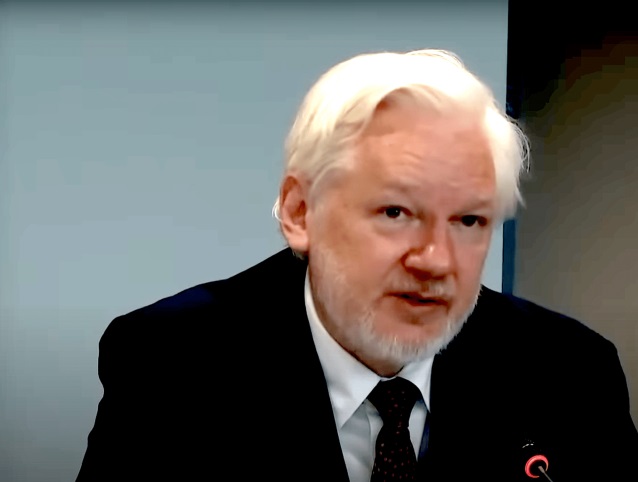
Italian journalist Stefania Maurizi has been in court trying to get some missing emails — or data about them — that could further expose the political motivation behind the prosecution of the WikiLeaks publisher.
Joe Lauria and Mohamed Elmaazi / Consortium News, October 23, 2024
A tribunal in Britain is set to decide whether to order the government’s Crown Prosecution Service (CPS) to prove it deleted emails that may have covered up more evidence of a politically motivated prosecution of Julian Assange.
The three judges heard arguments on Sept. 24 in the nearly decade-long freedom of information saga regarding the emails that top British prosecutors say were deleted.
They involved an exchange with Sweden during a Swedish prosecutor’s attempt, beginning in 2010, to extradite the WikiLeaks publisher from Britain. ……………………………………………………….
It was only when the U.S. realized it would lose on appeal after a four-year extradition battle that the Department of Justice cut a plea deal with Assange who was released on June 24 and returned to his native Australia.
Assange had been charged in the United States under the Espionage Act for possessing and publishing defense information, which revealed evidence of U.S. war crimes.
Britain took an active role in Assange’s prosecution. Its Crown Prosecution Service sought to stop Sweden from going to the embassy to question him.
Seeking to learn more about Britain’s role against Assange, Italian investigative journalist Stefania Maurizi first made a Freedom of Information Act (FOIA) request in 2015 for all emails between the British and Swedish governments concerning Assange.
Some of the emails she obtained showed political motivation on the part of the lead British prosecutor, Paul Close. One email Maurizi obtained from the Swedish Prosecution Authority (SPA) revealed that Close appeared to be pressuring Swedish prosecutors to continue seeking Assange’s extradition instead of dropping the case or questioning him at the Ecuadorian embassy, where Assange had been granted asylum………………………….
After Maurizi noticed a sizeable gap in the emails released to her she filed another FIOA seeking to obtain the missing emails.
The CPS first claimed that it had destroyed the emails. It said that when Close retired, his account along with his emails, were automatically destroyed.
But Maurizi did not buy it. She asked the court at the hearing last month to order the CPS to turn over “metadata” — data about data, such as file creation and modification dates, email sender and recipient addresses, timestamps, email routing information, keywords, and subject lines — proving the emails really were deleted and when.
“We have NO certainty whatsoever” that the emails were destroyed, Maurizi wrote in a message to Consortium News. Maurizi is in court because she believes the allegedly deleted emails could provide additional evidence of a politically motivated prosecution of Assange.
……………………………………………‘When, How & Why’ Were the Emails Deleted?
Maurizi, who travelled to London from Rome to attend the Sept. 24 hearing at the First-Tier Tribunal (General Regulatory Chamber), is challenging the ongoing failure of the CPS to respond adequately to her December 2019 FOIA about the missing emails.
………………………………………………………………….Maurizi is betting the tribunal will agree with her that metadata is clearly information that can be requested under the Act and which can clearly be provided with little difficulty. If she succeeds, future FOIA requests will also be able to demand metadata if and when an individual thinks it may be useful.
Hillary, who was called to testify for the CPS, freely admitted to the tribunal that she could easily provide the metadata Maurizi requested and that she would be happy to do so, as long as any information which identified individuals is redacted.
The tribunal will also consider whether to “order the CPS to carry out a proper, full search for information held” as to “when, how and why?” the thousands of emails were allegedly deleted while Assange’s Swedish extradition case was still very much active.
No date has yet been set for the announcement of the tribunal’s decision. https://consortiumnews.com/2024/10/23/fighting-for-more-evidence-of-assanges-political-prosecution/
Environmental groups challenge the nuclear industry’s portrayal of its energy as “clean” and “non-emitting,” citing health risks and long-term radioactive waste

By James Murray, October 16, 2024,
https://www.netnewsledger.com/2024/10/16/environmental-groups-challenge-the-nuclear-industrys-portrayal-of-its-energy-as-clean-and-non-emitting-citing-health-risks-and-long-term-radioactive-waste/
Competition Bureau Asked to Investigate Misleading Nuclear Energy Claims in Canada
Ottawa, 16 October 2024 – Seven Canadian environmental advocates have filed a formal complaint with the Competition Bureau, urging it to investigate the Canadian Nuclear Association (CNA) and its members for promoting nuclear energy as “clean” and “non-emitting.”
This latest action, under Section 9 of the Competition Act, calls for the Bureau to address what the complainants argue are false and misleading claims about nuclear energy.
“Legislation against greenwashing should spur the Bureau to act on the misuse of terms like ‘clean’ and ‘non-emitting.’ These claims are misleading and repeated by uninformed officials,” said Dr. Ole Hendrickson.
“Nuclear reactors emit carcinogenic substances and produce dangerous radioactive waste—hardly ‘clean’ by any reasonable definition,” added J.P. Unger, a science writer and policy analyst. “The industry’s survival depends on misleading the public and securing subsidies.”
The complaint highlights the continuous emission of carcinogenic gases and the production of long-lived radioactive waste by nuclear reactors, which pose significant health risks to current and future generations. According to the applicants, the CNA’s portrayal of nuclear energy as clean misleads the public, especially given the severe environmental impact of its waste.
The group points out that these claims have unfairly bolstered nuclear energy’s image, positioning it to secure public funding intended for genuinely clean energy projects. They also criticize nuclear industry campaigns, such as educational initiatives targeted at schools, for perpetuating these misconceptions.
This action follows an earlier complaint filed in February, which was dismissed by the Competition Bureau. At the time, the Bureau deemed CNA’s statements to be political rather than promotional. However, the new complaint emphasizes that the CNA’s messaging aims to sway public opinion and secure financial benefits by falsely categorizing nuclear energy as environmentally friendly.
Sellafield Fined for Cybersecurity Failures at Nuclear Site
Sellafield Ltd has been fined £332,500 ($437,440) for cybersecurity
failings running the Sellafield nuclear facility in Cumbria, North-West
England. The fine was issued by Westminster Magistrates Court following a
prosecution brought by the Office for Nuclear Regulation (ONR), the UK’s
independent nuclear regulator.
Sellafield Ltd has also been ordered to pay
prosecution costs of £53,253.20 ($70,060). The offences relate to
Sellafield’s management of the security around its information technology
systems between 2019 to 2023 and breaches of the Nuclear Industries
Security Regulations 2003.
Infosecurity 4th Oct 2024 https://www.infosecurity-magazine.com/news/sellafield-fined-cybersecurity/
Former Sellafield consultant claims the nuclear complex tampered with evidence
Whistleblower Alison McDermott claims former employer Sellafield tampered with metadata in letters used in evidence during an employment tribunal.
Tommy Greene, Bill Goodwin, Computer Weekly, 22 Apr 24
A former consultant at Sellafield has claimed that metadata in letters used against her in a tribunal hearing by the nuclear facility has been interfered with.
A tribunal has heard that three letters produced by managers at the vast nuclear complex and submitted as evidence in the employment dispute were “fabricated” and “tampered with”.
Alison McDermott lost a whistleblowing claim against the Cumbrian nuclear facility and is now fighting a demand to pay £40,000 costs.
The former Sellafield consultant said the metadata for one of the three letters was “wiped” by legal representatives for Sellafield.
She formally withdrew the allegations in her first employment tribunal claim against the nuclear complex.
The 2021 tribunal judgment determined that the letters were not “fabrications”.
“These letters are not fabrications, as had previously been asserted by the Claimant,” it found.
However, the ex-contractor raised her claims about the letters’ production and of alleged tampering during last week’s tribunal when defending herself from allegations she had acted “unreasonably” in the legal action with Sellafield and a regulatory body.
Sellafield maintains that McDermott’s allegations are “untrue”.
McDermott, a human resources (HR) consultant, signed a two-day-a-week contract with Sellafield worth £1,500 per day and was tasked in 2018 with looking at an employee’s sexual harassment allegations.
But within days of submitting a report that found the HR team was viewed as “broken and dysfunctional” by some staff, her contract was ended.
She has contested cost awards as a litigant-in-person during a one-day hearing in Leeds.
Summarising her arguments, tribunal judge Stuart Robertson said McDermott had suggested that the three letters used against her by Sellafield during the employment case over the termination of her contract were “fabricated and not genuine”.
Deshpal Panesar KC, who represented Sellafield at the tribunal, accused McDermott of “making baseless claims of the most damaging sort – representing an existential threat to the careers of multiple public servants”.
Panesar said McDermott had accused Sellafield and its regulatory body, the Nuclear Decommissioning Authority (NDA), of “illicit conduct, fabrication of evidence and false representations” when making her case.
McDermott sought to challenge cost awards made against her, amounting to £40,000, in a previous tribunal decision.
The employment tribunal claim she brought against Sellafield in 2021 was unsuccessful. But an appeal judge found aspects of her case “troubling” and she was subsequently recognised as a whistleblower under UK employment law.
Robertson, a new tribunal judge, is now considering whether McDermott’s claims and conduct have been “unreasonable”.
McDermott claims she suffered a number of detriments when her contract was terminated. She has since spoken out publicly against Sellafield, branding its workplace culture as “toxic”.
Sellafield and the NDA have contested the claims robustly, initially arguing McDermott’s work was ended for “financial reasons” and later as a result of her “poor” performance.
Suspicious of the letters
The three letters have been a central point of contention in McDermott’s court battle.
The Information Commissioner’s Office ruled in early 2021 that Sellafield had acted unlawfully, having broken data laws and committed security breaches for, among other things, failing to supply McDermott with the letters after she had made a data subject access request.
Sellafield subsequently used the critical letters against McDermott in the employment tribunal case she brought over the termination of her contract.
McDermott told Thursday’s tribunal that the letters had caused her “significant detriment”………………………………………………………………………………………………………………………………………… more https://www.computerweekly.com/news/366581793/Former-Sellafield-consultant-claims-the-nuclear-complex-tampered-with-evidence
Nuclear waste clean-up company to be prosecuted over alleged cyber blunders

Sellafield Ltd accused of lax IT security at Europe’s largest nuclear facility
Jonathan Leake, 28 March 2024 , https://www.telegraph.co.uk/business/2024/03/28/sellafield-nuclear-waste-prosecuted-cybersecurity/
A state-owned company responsible for cleaning up decades of nuclear waste at the Sellafield site in Cumbria is being prosecuted over alleged cybersecurity blunders.
It follows an investigation prompted by fears that the business’s digital defences were breached by hackers acting for hostile states such as Russia and China.
Sellafield is Europe’s largest nuclear facility, serving as a testing ground and waste dump since 1947. It houses a massive range of highly radioactive wastes, including 140 tonnes of plutonium – a key ingredient for nuclear weapons.
The Office for Nuclear Regulation (ONR) has told Sellafield Ltd, the business tasked with clean-up, that it will be prosecuted under the Nuclear Industries Security Regulations 2003.
The charges relate to alleged information technology security offences during a four-year period between 2019 and early 2023.
The announcement coincides with reports today that Richard Meal, who is chief information security officer at the Cumbrian site, is to leave later this year.
It follows the departure of Mark Neate, the director responsible for safety and security, who announced in January that he intended to quit in a move that had been planned for some time.
Sellafield has denied claims the site had suffered serious security breaches and the ONR has supported this. The new charges are thought to relate to alleged failures in compliance – meaning they are more about lax security than actual breaches.
An ONR spokesman said there was no suggestion that public safety had been compromised. Details of the first court hearing will be announced when available.
Sellafield Ltd is owned by the Nuclear Decommissioning Authority, a quango overseen by the Department for Energy Security and Net Zero, which is tasked with cleaning 17 decaying nuclear sites across the UK. Sellafield is the most expensive, costing taxpayers £2.5bn last year.
Some government estimates suggest the total cost of the clean-up will reach £263bn, with Sellafield accounting for the largest portion. The site employs 11,000 people and comprises more than 1,000 buildings, many not designed to house the radioactive material now stored in them.
Sellafield is so expensive that the Office for Budget Responsibility, which monitors threats to the UK Government’s finances, has warned that it and other legacy sites pose a “material source of fiscal risk” to the country.
The ONR investigation is in addition to another by the National Audit Office, Britain’s public spending watchdog, which is probing risks and costs at Sellafield and is due to report this autumn.
A Sellafield spokesman said: “The ONR’s Civil Nuclear Security and Safeguards (CNSS) has notified us of its intention to prosecute the company relating to alleged past nuclear industry security regulations compliance. As the issue is now the subject of active court proceedings, we are unable to comment further.”
It follows separate reports by Radioactive Waste Management Ltd (RWM), another government-owned company, that hackers unsuccessfully attempted to breach its defences using LinkedIn.
RWM, now part of Nuclear Waste Services, is the company tasked with designing the long-awaited Geological Disposal Facility (GDF) project, a vast underground nuclear waste store which would become the final destination for toxic waste now stored at Sellafield.
Nuclear Waste Services is currently seeking a site that would be geologically stable for the millions of years the waste would need to become safe – and which would be acceptable to the local communities hosting it.
Two sites remain in the running, one off the coast of Cumbria and the other off the coast of Lincolnshire, with the choice of site still surrounded in secrecy.
The development is expected to cost taxpayers up to £53bn.
A report filed at Companies House by Nuclear Waste Services said the attempted hacks had failed.
Julian Assange and the Plea Nibble

Barry Pollack, one of Assange’s legal representatives, has not been given any indication that the department would, as such, accept the deal, a point he reiterated to Consortium News: “[W]e have been given no indication that the Department of Justice intends to resolve the case.”
March 23, 2024 by: Dr Binoy Kampmark https://theaimn.com/julian-assange-and-the-plea-nibble/
Be wary of what Washington offers in negotiations at the best of times. The empire gives and takes when it can; the hegemon proffers and in equal measure and withdraws offers it deems fit. This is all well known to the legal team of WikiLeaks’ founder Julian Assange, who, the Wall Street Journal “exclusively” reveals, is in ongoing negotiations with US Justice Department officials on a possible plea deal.
As things stand, the US Department of Justice is determined to get its mitts on Assange on the dubious strength of 18 charges, 17 confected from the brutal Espionage Act of 1917. Any conviction from these charges risks a 175-year jail term, effectively constituting a death sentence for the Australian publisher.
The war time statute, which was intended to curb free speech and muzzle the press for the duration of the First World War, was assailed by Wisconsin Republican Senator Robert La Follette as a rotten device that impaired “the right of the people to discuss the war in all its phases.” It was exactly in time of war that the citizen “be more alert to the preservation of his right to control his government. He must be most watchful of the encroachment of the military upon the civil power.” And that encroachment is all the more pressing, given the Act’s repurposing as a weapon against leakers and publishers of national security material. In its most obscene incarnation, it has become the US government’s political spear against a non-US national who published US classified documents outside the United States.
The plea deal idea is not new. In August last year, the Sydney Morning Herald pounced upon comments from US Ambassador to Australia Caroline Kennedy that a “resolution” to the Assange imbroglio might be on the table. “There is a way to resolve it,” the ambassador suggested at the time. Any such resolution could involve a reduction of any charges in favour of a guilty plea, subject to finalisation by the Department of Justice. Her remarks were heavily caveated: this was more a matter for the DOJ than the State Department or any other agency. “So it’s not really a diplomatic issue, but I think there absolutely could be a resolution.”
The WSJ now reports that officials from the DOJ and Assange’s legal team “have had preliminary discussions in recent months about what a plea deal could look like to end the lengthy legal drama.” These talks “remain in flux” and “could fizzle.” Redundantly, the Journal reports that any such agreement “would require approval at the highest levels of the Justice Department.”
Barry Pollack, one of Assange’s legal representatives, has not been given any indication that the department would, as such, accept the deal, a point he reiterated to Consortium News: “[W]e have been given no indication that the Department of Justice intends to resolve the case.”
One floated possibility would be a guilty plea on a charge of mishandling classified documents, which would be classed as a misdemeanour. Doing so would take some of the sting out of the indictment, which is currently thick with felonies and one conspiracy charge of computer intrusion. “Under the deal, Assange could potentially enter that plea remotely, without setting foot in the US.” Speculation from the paper follows. “The time he has spent behind bars in London would count toward any US sentence, and he would be likely to be free to leave prison shortly after any deal has concluded.”
With little basis for the claim, the report lightly declares that the failure of plea talks would not necessarily be a bad thing for Assange. He could still “be sent to the US for trial”, where “he may not stay for long, given the Australia pledge.” The pledge in question is part of a series of highly questionable assurances given to the UK government that Assange’s carceral conditions would not include detention in the supermax ADX Florence facility, the imposition of notorious Special Administrative Measures, and the provision of appropriate healthcare. Were he to receive a sentence, it would be open to him to apply and serve its balance in Australia. But all such undertakings have been given on condition that they can be broken, and transfer deals between the US and other countries have been plagued by delays, inconsistencies, and bad faith.
-ADVERTISEMENT-
The dangers and opportunities to Assange have been bundled together, a sniff of an idea rather than a formulation of a concrete deal. And deals can be broken. It is hard to imagine that Assange would not be expected to board a flight bound for the United States, even if he could make his plea remotely. Constitutional attorney Bruce Afran, in an interview with CN Live! last August, suggested that a plea, taken internationally, was “not barred by any laws. If all parties consent to it, then the court has jurisdiction.” Yes, but what then?
In any event, once on US soil, there is nothing stopping a grand volte face, that nasty legal practice of tagging on new charges that would carry even more onerous penalties. It should be never forgotten that Assange would be delivered up to a country whose authorities had contemplated, at points, abduction, illegal rendition, and assassination.
Either way, the current process is one of gradual judicial and penal assassination, conducted through prolonged proceedings that continue to assail the publisher’s health even as he stays confined to Belmarsh Prison. (Assange awaits the UK High Court’s decision on whether he will be granted leave to appeal the extradition order from the Home Office.) The concerns will be how to spare WikiLeaks founder further punishment while still forcing Washington to concede defeat in its quest to jail a publisher. That quest, unfortunately, remains an ongoing one.
The Show Trial against Julian Assange

If the US authorities succeed in convicting a journalist for exposing war crimes, this would have another serious consequence. In the future, it would become even more difficult and dangerous to expose the sordid reality of wars,
How US and British authorities are bending the law and undermining press freedom
FABIAN SCHEIDLER, FEB 24, 2024 ore https://fabianscheidler.substack.com/p/the-show-trial-against-julian-assange
“Those who tell the truth need a fast horse,” says an Armenian proverb. Or they need a society that protects the truth and its messengers. But this protection, which our democracies claim to offer, is in danger. As a journalist, Julian Assange has published hundreds of thousands of files documenting war crimes committed by the USA and its allies in Afghanistan, Iraq, Guantanamo and elsewhere. The authenticity of the documents is beyond question. However, none of the perpetrators have been brought to justice or convicted. In contrast, the messenger has been incarcerated in a high-security prison in London for five years with life-threatening health problems, having previously spent seven years locked up in the Ecuadorian embassy. He has been charged with no crime in the UK, in any EU country or in his home country of Australia. The only reason for his grueling deprivation of liberty is that the US government has initiated extradition proceedings accusing the journalist Assange of espionage, invoking a law dating back more than a hundred years to the First World War: the Espionage Act.
Never before has a journalist been charged under this law. The extradition process therefore sets a dangerous precedent. If it is successful, every journalist on Earth who exposes US war crimes would have to fear suffering the same fate as Assange. That would be the end of freedom of the press as we know it. Because it is based on the capacity to bring to light the dark sides of power without fear of punishment. Where this freedom is extinguished, it is not only the freedom of journalists that dies, but the freedom of us all: the freedom from the arbitrariness of power.
For this reason alone, this extradition process should never have been accepted by the courts in a functioning legal system. Julian Assange did not act as a spy in any way, but as a journalist and as such is subject to special protection. Incidentally, the key witness for the espionage charge was the notorious fraudster and convicted paedophile Sigurdur Ingi Thordarson, who admitted in 2021 that he had lied on behalf of the FBI and had been granted immunity from prosecution.
Let us imagine the case with reversed roles: Suppose an Australian journalist had published war crimes committed by the Russian military and intelligence services and sought protection in a Western European country. Would the courts seriously consider extradition proceedings to Moscow for espionage, especially if the key witness is a convicted criminal?
Assange is facing the absurd sentence of 175 years in the USA. It is to be feared that he will not survive the extremely harsh conditions in the notorious US prison system. For this reason, the London Magistrates’ Court initially halted his extradition in 2021. The US government then published a paper stating that Assange would not face solitary confinement. However, according to Amnesty International, this declaration is “not worth the paper it is written on”, as the non-binding diplomatic note reserves the right for the US government to change its position at any time. The Court of Appeal, however, found this paper sufficient to clear the way for extradition – a travesty of justice, as Amnesty noted.
The hearings, which took place on February 20 and 21 at the High Court in London and whose verdict is expected in March, are the last opportunity for Assange to obtain an appeal against this extradition decision. However, there is a high risk that the law will once again be turned on its head. As the investigative platform Declassified UK reports, one of the two judges, Jeremy Johnson, previously worked for the British secret service MI6, which is closely intertwined with the CIA and whose illegal activities came to public attention through the work of Julian Assange.
For Julian Assange, the trial itself has already become a punishment. Nils Melzer, the UN Special Rapporteur on Torture, concluded after detailed investigations that Assange had been subjected to systematic psychological torture for years. The fact that the US was prepared to go even further came to light in September of the same year: according to reports in the Guardian, senior intelligence officials, including the then head of the CIA and later Secretary of State Mike Pompeo, planned to kidnap and murder Assange in 2017.[v]
The background:
Wikileaks had published documents that year that became known as “Vault 7”. They show the CIA’s massive activities in the field of cyber warfare and prove how the secret service systematically and comprehensively intervenes in web browsers, IT systems in cars, smart TVs and smartphones, even when they are switched off. This was one of the most sensational revelations by Wikileaks since the leaks by Edward Snowden, who uncovered the massive illegal surveillance by the NSA. The CIA was not to forgive Assange for this coup and subsequently classified Wikileaks as a “non-state hostile intelligence service” – a momentous neologism that allowed journalists to be declared enemies of the state. After Pompeo became Secretary of State in 2018, the US government initiated the extradition proceedings. This move replaced Pompeo’s original kidnapping and killing plan, with the goal remaining the same: the destruction of an inconvenient journalist.
The revelations of whistleblowers such as Edward Snowden and Chelsea Manning and journalists such as Julian Assange have shown that in the shadow of the so-called war on terror, a vast parallel universe has emerged in recent decades that is obsessed with the illegal spying on its own citizens and the arbitrary imprisonment, torture and killing of political opponents. This world is largely beyond democratic control, indeed it is undermining the democratic order from within.
However, this development is not entirely new. In 1971, leaks revealed a secret FBI program for spying on, infiltrating and disrupting civil rights and anti-war movements, which became known as COINTELPRO. In the same year, the New York Times published the Pentagon Papers leaked by whistleblower Daniel Ellsberg, which showed that four successive US administrations had systematically lied to their citizens about the extent and motives of the Vietnam War and the massive war crimes committed by the US military. In 1974, Seymour Hersh revealed the CIA’s secret programs to assassinate foreign heads of state and the covert operation to spy on hundreds of thousands of opponents of the war, which ran under the code name “Operation CHAOS”. Driven by these reports, the US Congress convened in 1975 the Church Committee, which carried out a comprehensive review of the secret operations and led to greater parliamentary control of the services.
Julian Assange is part of this venerable journalistic tradition and has made a decisive contribution to its renewed flourishing. However, there is one important difference to the 1970s: Today, the most important investigative journalist of his generation is openly persecuted, criminalized and deprived of his freedom. When states declare the investigation of crimes to be a crime itself, society enters a dangerous downward spiral, at the end of which new forms of totalitarian rule can emerge. As early as 2012, Assange remarked, at the time with regard to the increasingly comprehensive surveillance technologies: “We have all the ingredients for a turnkey totalitarian state”.
If the US authorities succeed in convicting a journalist for exposing war crimes, this would have another serious consequence. In the future, it would become even more difficult and dangerous to expose the sordid reality of wars, especially those wars that Western governments like to sell as civilizing missions with the help of embedded journalists. If we do not learn the truth about these wars, it becomes much easier to wage them. Truth is the most important instrument of peace.
Julian Assange has not yet been extradited and sentenced. Over the years, a remarkable international movement has formed for his release and the defense of press freedom. Many parliamentarians around the world are also raising their voices. The Australian parliament, for example, supported by Prime Minister Anthony Albanese, passed a resolution by a large majority calling for Assange’s release. A group of over 80 members of the German parliament have joined in. However, the German government is still refusing to exert any serious pressure on Joe Biden’s government, which continues to persecute Assange. German Foreign Minister Annalena Baerbock, who as the Green Party’s candidate for chancellor had spoken out in favor of freeing Assange, has persistently avoided questions on the subject since joining the government. Her ministry has left questions from MPs about the case unanswered for months, only to then make elusive rhetorical excuses. The leading politicians of the governing German coalition, who like to loudly present themselves as the guardians of democracy and the rule of law, must finally take action in this case of political justice and unequivocally demand the release of Julian Assange before it is too late. However, this would require overcoming the cowering attitude towards the godfather in Washington and actually standing up for the much-vaunted values of democracy.
Chris Hedges: Julian Assange’s Day in Court

The defense must convince the two judges that the District Judge made serious legal errors to see an appeal granted.
They argued that espionage is, as a matter of law, a political offense and that the extradition treaty with the U.S. prohibits extradition for political offenses. They focused on the extensive UK law, common law and international law that defines espionage as a “pure political offense” because e it is directed against a state apparatus. For this reason, those charged with espionage should be protected from extradition.
The hearing was, after those in 2020 that focused on Julian’s mental and psychological health, refreshing in that it discussed the crimes committed by the U.S. and the importance of making them public.
Julian Assange’s lawyers — in a final bid on Tuesday to stop his extradition — fought valiantly to poke holes in the case of the prosecution to obtain an appeal.
By Chris Hedges https://scheerpost.com/2024/02/21/chris-hedges-julian-assanges-day-in-court/
LONDON — By the afternoon the video link, which would have allowed Julian Assange to follow his final U.K. appeal to prevent his extradition, had been turned off. Julian, his attorneys said, was too ill to attend, too ill even to follow the court proceedings on a link, although it was possible he was no longer interested in sitting through another judicial lynching. The rectangular screen, tucked under the black wrought iron bars that enclosed the upper left hand corner balcony of the courtroom where Julian would have been caged as a defendant, was perhaps a metaphor for the emptiness of this long and convoluted judicial pantomime.
he arcane procedural rules — the lawyers in their curled blonde wigs and robes, the spectral figure of the two judges looking down on the court from their raised dais in their gray wigs and forked white collars, the burnished walnut paneled walls, the rows of lancet windows, the shelves on either side filled with law books in brown, green, red, crimson, blue and beige leather bindings, the defense lawyers, Edward Fitzgerald KC and Mark Summers KC, addressing the two judges, Dame Victoria Sharp and Justice Johnson, as “your lady” and “my lord” — were all dusty Victorian props employed in a modern Anglo-American show trial. It was a harbinger of a decrepit justice system that, subservient to state and corporate power, is designed to strip us of our rights by judicial fiat.
The physical and psychological disintegration of Julian, seven years trapped in the Ecuadorian Embassy in London and nearly five years held on remand in the high-security HM Prison Belmarsh, was always the point, what Nils Melzer the former U.N. Special Rapporteur on torture calls his “slow-motion execution.” Political leaders, and their echo chambers in the media, fall all over themselves to denounce the treatment of Alexei Navalny but say little when we do the same to Julian. The legal farce grinds forward like the interminable case of Jarndyce and Jarndyce in Charles Dickens’ novel Bleak House. It will probably grind on for a few more months — one can’t expect the Biden administration to add the extradition of Julian to all its other political woes. It may take months to issue a ruling, or grant one or two appeal requests, as Julian continues to waste away in HM Prison Belmarsh.
Julian’s nearly 15-year legal battle began in 2010 when WikiLeaks published classified military files from the wars in Iraq and Afghanistan — including footage showing a U.S. helicopter gunning down civilians, including two Reuters journalists in Baghdad. He took refuge in London’s Ecuadorian embassy, before being arrested by the Metropolitan Police in 2019 who were permitted by the Ecuadorian embassy to enter and seize him. He has been held for nearly five years in HM Prison Belmarsh.
Julian did not commit a crime. He is not a spy. He did not purloin classified documents. He did what we all do, although he did it in a far more important way. He published voluminous material, leaked to him by Chelsea Manning, which exposed U.S. war crimes, lies, corruption, torture and assassinations. He ripped back the veil to expose the murderous machinery of the U.S. empire.
The two-day hearing is Julian’s last chance to appeal the extradition decision made in 2022 by the then British home secretary, Priti Patel. On Wednesday the prosecution will make its arguments. If he is denied an appeal he can request the European Court of Human Rights (ECtHR) for a stay of execution under Rule 39, which is given in “exceptional circumstances” and “only where there is an imminent risk of irreparable harm.” But the British court may order Julian’s immediate extradition prior to a Rule 39 instruction or may decide to ignore a request from the ECtHR to allow Julian to have his case heard by the court.
District Judge Vanessa Baraitser in January 2021, at Westminster Magistrates’ Court, refused to authorize the extradition request. In her 132-page ruling, she found that there was a “substantial risk” Julian would commit suicide due to the severity of the conditions he would endure in the U.S. prison system. At the same time, she accepted all the charges leveled by the U.S. against Julian as being filed in good faith. She rejected the arguments that his case was politically motivated, that he would not get a fair trial in the U.S. and that his prosecution is an assault on the freedom of the press.
Baraitser’s decision was overturned after the U.S. government appealed to the High Court in London. Although the High Court accepted Baraitser’s conclusions about Julian’s “substantial risk” of suicide if he was subjected to certain conditions within a U.S. prison, it also accepted four assurances in U.S. Diplomatic Note no. 74, given to the court in February 2021, which promised Julian would be treated well. The “assurances” state that Julian will not be subject to Special Administrative Measure. They promise that Julian, an Australian citizen, can serve his sentence in Australia if the Australian government requests his extradition. They promise he will receive adequate clinical and psychological care. They promise that, pre-trial and post-trial, Julian will not be held in the Administrative Maximum Facility in Florence, Colorado.
Continue readingThe ICJ’s Provisional Orders: The Genocide Convention Applies to Gaza

January 27, 2024, Dr Binoy Kampmark, https://theaimn.com/the-icjs-provisional-orders-the-genocide-convention-applies-to-gaza/—
On January 26, legal experts, policy wonks, activists and the plain curious waited for the order of the International Court of Justice, sitting in The Hague. The topic was that gravest of crimes, considered most reprehensible in the canon of international law: genocide. The main participants: the accused party, the State of Israel, and the accuser, the Republic of South Africa.
Filed on December 29 last year, the South African case focused on its obligations arising under the Convention on the Prevention and Punishment of the Crime of Genocide and those of Israel. Pretoria, in its case, wished that the ICJ adjudicate and declare that Israel had breached its obligations under the Convention, and “cease forthwith any acts and measures in breach of those obligations, including such acts or measures which would be capable of killing or continuing to kill Palestinians, or causing or continuing to cause serious bodily or mental harm to Palestinians or deliberately inflicting on their group, or continuing to inflict on their group, conditions of life calculated to bring out its physical destruction in whole or in part, and fully respect its obligations under the Genocide Convention.”
The latter words derive from Article II of the Convention, which stipulate four genocidal actions: the killing of the group’s members; the causing of serious bodily or mental harm to those group’s members; the deliberate infliction of conditions calculated to bring about the physical destruction, in whole or in part, of that group and imposing measures to prevent births within the group.
The sheer extent of devastation being wrought by Israeli Defence Forces in Gaza, justified by the Netanyahu government as necessary self-defence in the aftermath of the Hamas attacks of October 7, led the South African team to also seek immediate provisional measures under Article 41 of the Court’s statute. (The review on the case’s merits promises to take much longer.) They included the immediate suspension of the IDF’s military operations in and against Gaza, the taking of all reasonable measures to prevent genocide, and desisting from committing acts within Article II of the Convention. The expulsion and forced displacement of Palestinians should also stop, likewise the deprivation of adequate food, water and access to humanitarian assistance and medical supplies and “the destruction of Palestinian life in Gaza.”
By 15-2, the court accepted that “the catastrophic humanitarian situation in the Gaza Strip is at serious risk of deteriorating further before the Court renders its final judgment.” (Over 26,000 Palestinians have been killed, extensive tracts of land in Gaza pummelled into oblivion, and 85% of its 2.3 million residents expelled from their homes.) Measures were therefore required to prevent “real and imminent risk that irreparable prejudice will be caused to the rights found by the Court to be plausible, before it gives its final decision.”
The grant of provisional measures was, however, more conservative than that sought by Pretoria. Conspicuously missing was any explicit demand that Israel pause its military operations. That said, the judgment did little to afford Israel’s leaders and the IDF comfort from the obligatory reach of the Genocide Convention, an instrument they had argued was irrelevant and inapplicable to the conduct of “innovative” military operations.
To that end, Israel was obligated to take all possible measures to prevent the commission of acts under Article II of the Genocide Convention, including by its military; prevent and punish “the direct and public incitement to genocide” against the Palestinian populace in Gaza; permit basic services and humanitarian assistance to the Gaza Strip; ensure the preservation of, and prevent destruction of, evidence related to acts committed against Gaza’s Palestinians within Articles II and III of the Convention; and submit a report to the ICJ on how Israel was abiding by such provisional measures within one month.
As is very much the form, the justice from the country in the dock, in this case, Israel’s Aharon Barak, could see nothing inferentially genocidal in his country’s campaign. South Africa, he insisted, had intentionally ignored the role played by Hamas in its October 7 attacks, and “wrongly sought to impute the crime of Cain to Abel.”
-ADVERTISEMENT-
Inevitably, the singular experience of the Holocaust survivor, the sui generis Jewish view of trauma, used as solid armour against any possibility that Israel might ever commit genocide, became a point of contention. Genocide “is the gravest possible accusation and is deeply intertwined with my personal life experience.” Israel had a firm commitment to the rule of law, and to accept that it was committing genocide “is very hard for me personally”. Tellingly, he suggested that Israel’s campaign in Gaza be examined, not from the viewpoint of the Genocide Convention but international humanitarian law.
With classic casuistry, Barak did vote for the measure requiring Israel to do everything “within its power to prevent and punish the direct and public incitement to commit genocide in relation to members of the Palestinian group in the Gaza strip.” But having identified nothing in the way of such intent, the issue became a moot one. With some relief, Barak could state that certain measures sought by South Africa, including an immediate suspension of military operations, were rejected by the ICJ, which preferred “a significantly narrower scope”.
From the other side of the legal aisle, the South African foreign minister, Naledi Pandor, wished that the ICJ had grasped the nettle to order a halt in military operations. But, with some deft reasoning, she was satisfied that the only way Israel could implement the provisional measures would be through a ceasefire. Much the same view was expressed by the Associated Press: “The court’s half-dozen orders will be difficult to achieve without some sort of cease-fire or pause in the fighting.” That logic is clear enough, but the actions, given the various statements from Prime Minister Benjamin Netanyahu and his officials alleging slander and a blood libel against their country, are unlikely to follow.
Tokyo High Court holds Japan government not liable for Fukushima nuclear disaster
Sean Nolan | Southwestern Law School, US, DECEMBER 28, 2023
Tokyo’s High Court found the government of Japan not liable Tuesday for damages related to the 2011 Fukushima nuclear disaster and associated mass evacuations, leaving responsibility solely with plant operator the Tokyo Electric Power Co. (TEPCO).
The ruling also reduced the damages amounts of a previous court order from $414,400 to $165,000 for 44 of 47 petitioners. The decision mirrors a previous ruling in 2022 which found that the government “was highly unlikely to been able to prevent the flooding” that damaged the plant. Ultimately, the court held that more stringent regulatory actions would have been insufficient to prevent the disaster since the size, direction and scale of the tsunami exceeded estimations for such an event. This is the latest in a series of decisions with different outcomes over the last several years including court cases in 2020 and 2017 which litigated the government’s role in failing to prevent the disaster. There is also a 2022 court case that found TEPCO executives personally liable.
Motomitsu Nakagawa, a lawyer, representing the evacuees expressed dismay with the decision and raised the possibility of another appeal calling the decision a “copy and paste” of the previous Supreme Court ruling. The nuclear disaster has already caused $82 billion in damages to victims, decommissioning work and storage for contaminated materials. While TEPCO has been responsible for all the decommissioning, including contaminant storage, it’s financial position has deteriorated over the last few years amid the massive costs associated with the work and multiple postponements due to technological challenges.
Legal fallout has also extended to the cleanup itself with court cases from South Korea fisheries and Japanese fisherman over the release of radioactive wastewater into the Pacific Ocean. The discharge also sparked international concern from neighboring countries and protests from activists who fear pollution and widespread destruction of wildlife and marine ecosystems.
 | |||
| |||
Judge Rules Assange Visitors May Sue CIA For Allegedly Violating Privacy

Kevin Gosztola, Dec 19, 2023, The Dissenter
A federal judge ruled that four American attorneys and journalists, who visited WikiLeaks founder Julian Assange while he was in the Ecuador embassy in London, may sue the Central Intelligence Agency (CIA) for their role in the alleged copying of the contents of their electronic devices.
The Americans sufficiently alleged that the CIA and CIA Director Mike Pompeo—through the Spanish security company UC Global and its director David Morales—“violated their reasonable expectation of privacy” under the Fourth Amendment of the United States Constitution.
Richard Roth, attorney for the four Americans, reacted, “We are thrilled that the court rejected the CIA’s efforts to silence the plaintiffs, who merely seek to expose the CIA’s attempt to carry out Pompeo’s vendetta against WikiLeaks.”………………………………………………………………………………………………………………………………………
The U.S. government on behalf of the CIA will likely appeal the decision. Nevertheless, it is a remarkable development because there is a distinct possibility that there may be a civil trial, where CIA spying on Americans is challenged. And all while the U.S. government pushes forward with the unprecedented act of putting a publisher on trial for engaging in journalism. https://thedissenter.org/judge-assange-visitors-may-sue-cia-for-spying/?ref=the-dissenter-newsletter&fbclid=IwAR1S-KR9qxfueGXiIYf0quxldvaXEus_rLZsBUQbwIbPaTmZ_VjSft9KBzI
Anti-Nuclear Activist Goes on Trial Amid the Fallout of Oppenheimer’s LegacyKansas City’s Ties To The Bomb
Flatland, Clarence Dennis, cdennis@flatlandkc.org 10 Nov 23
At time zero the first thing I noticed was that although facing away from ground zero, it felt like someone had slapped my face: it was of course the heat radiation from a most successful test.”Hugh Richards, Ph.D., “Through Los Alamos, 1945: Memoirs of a Nuclear Physicist”
Last month, Ann Suellentrop, 71, stood before a judge in the 16th Judicial Court of Missouri.
A retired maternal-child nurse and lifelong activist, Suellentrop was one of three people arrested for trespassing during a Memorial Day protest organized by PeaceWorks KC at the National Security Campus of the National Nuclear Security Administration (NNSA) in south Kansas City earlier this year.
The only property line crosser who would plead not guilty, Suellentrop represented herself in court on Oct. 25. She argued that intentionally crossing the alleged boundary line by 10 feet or less, approximately three-fourths of a mile from the NNSA facility, was not trespass, but a peaceful, “limited protest” on a matter of principle and should not result in fines or jail time.
Facing a $500 fine, six months in jail, or both, the defendant argued her action was an expression of her First Amendment rights and stressed that advanced notice and planning of the annual protest was communicated to police and NNSA campus officials.
In front of more than a dozen supporters sporting bold black stickers that read “NO NUKES Y’ALL,” Suellentrop raised points to Judge Anne LaBella about her own character, the nature of her peaceful protest and the threats nuclear weapons and nuclear terrorism pose to human health and society.
Facing a slew of objections based on relevance and witness testimony from the NNSA campus security guard who was on duty during the protest and warned the protesters to step off the property, all signs pointed to a guilty verdict.
Moments after all arguments were heard and the city rested its case, the prosecutor asked the judge to amend the charge to include NNSA campus administrator Honeywell Federal Manufacturing and Technologies.
Judge LaBella said the request came too late and she would not amend the charge. She then promptly announced her ruling on Suellentrop’s case.
Not guilty.
Modern-Day Peaceniks
A member of PeaceWorks KC and the Alliance for Nuclear Accountability, Suellentrop has been arrested twice before in protests at the NNSA campus. The facility manufactures 80% of the non-nuclear components that go into the national nuclear stockpile……..
“Our ultimate goal is to convert the plant into a peaceful production of hopefully something that can fight the environmental crisis that’s going on. We need those brains, those skills and that money to convert it into something we really need,” Suellentrop said ahead of the trial.
Immediately following the verdict, Suellentrop and her peacenik partners picked up where her testimony left off. The group of mostly older adults gathered outside of the Jackson County Courthouse, taking turns passing a child’s toy microphone, celebrating the win and speaking about the threat nuclear weapons present to anyone who would listen.
“Because there is a group of old people, it doesn’t mean we are wrong. Historically, civil disobedience has played a big role in changing things,” said PeaceWorks KC board chair Chris Mann.
Mann, 73, participated in her first protest in college – a silent vigil during the war in Vietnam.
“Our group is becoming increasingly younger… a tradition of civil disobedience is only one of the measures,” Mann said, speaking to the makeup of PeaceWorks KC. “We think that younger people have a hard way to go now.”…………………………………….
The experience, plus an admiration for Australian physician, author and anti-nuclear advocate Helen Caldicot, fueled a lifetime of activism for Suellentrop, particularly in anti-nuclear efforts.
As for what keeps her civil disobedience going into her 70s, Suellentrop points to her faith.
“Like any person, I have fears and worries and self-doubts and what have you, but I just go to God and prayer,” Suellentrop said. “I get an overwhelming feeling of, ‘I got this.’ God is good and he’s opposing this – and this is an unspeakable evil.”…………………………………………………………………………………………………… more https://flatlandkc.org/news-issues/anti-nuclear-activist-goes-on-trial-amid-the-fallout-of-oppenheimers-legacy/
Rosen Law Firm, a global investor rights law firm, to investigate allegations that NuScale may have issued misleading business information
Rosen Law Firm, a global investor rights law firm, announces an
investigation of potential securities claims on behalf of shareholders of
NuScale Power Corporation resulting from allegations that NuScale may have
issued materially misleading business information to the investing public.
Rosen Law Firm (accessed) 29th Oct 2023 https://rosenlegal.com/case/nuscale-power-corporation/
Lawyers circle nuclear startup NuScale over claims a 24-reactor deal will fail
Short seller brands blockchain firm Standard Power a “fake customer”
October 27, 2023 By Peter Judge https://www.datacenterdynamics.com/en/news/lawyers-circle-nuclear-startup-nuscale-over-claims-a-24-reactor-deal-will-fail/
Nuclear power startup NuScale is facing investigation by lawyers after a short-seller’s report alleged that it has sold 24 reactors to a “fake customer.”
NuScale announced a deal earlier this month to supply blockchain firm Standard Power with 1,848MW of power provided by 24 of NuScale’s small modular reactors (SMRs), to power two US data center sites.
Last week its share price dropped around 10 percent after a scathing report from short seller Iceberg Research claimed that the deal, estimated at $37 billion, had “zero chance of being executed.” The shares bounced back around six percent earlier this week, when NuScale responded, saying the Iceberg claims were “riddled with speculative statements with no basis in fact.”
NuScale has contracted to provide Standard Power with 1,848MW of power, but Iceberg predicts Standard Power will be unable to support the contract. Among other things, Iceberg points out that Standard Power’s CEO Maxim Serezhin has an outstanding $54k tax warrant in New York, rendering his assets vulnerable to seizure, adding that a former Standard Power leader, Adam Swickle, was found guilty of securities fraud in 2003.
The Standard Power deal is massively bigger than NuScale’s only other contract, with the government-backed Carbon Free Power Project (“CFPP”) to provide Utah Associated Municipal Power Systems (“UAMPS”) with 462MW, and is also bigger than Standard Power’s other major deal, a 200MW contract for nuclear power at Shippingport Pennsylvania.
Iceberg says NuScale has “around 15 months before its cash runs out,” and says the UAMPS contract is reaching a crucial stage, claiming: “NuScale has been given till around January 2024 to raise project commitments to 80 percent or 370 MWe.”
Iceberg also cast doubt on NuScale’s commercial partner Entra1, saying it was set up in 2021 to finance NuScale reactors, has only one employee, and was “very unlikely to be able to finance even a portion of this contract.”
NuScale said it “will not engage in a point-by-point rebuttal of every falsehood,” but issued statements on several points, saying that NuScale has a “solid balance sheet,” and that US Department of Energy (DOE) support for the CFPP “has advanced our SMR technology to the point of commercialization.”
DOE support has been a key factor in NuScale’s development, helping it bring nuclear power down to a commercial price point, however, the price of nuclear electricity from its projected plans has been creeping up, from an initial estimate of $55 per MWh to around $90 per MWh, making it less competitive.
NuScale said it “will not engage in a point-by-point rebuttal of every falsehood,” but issued statements on several points, saying that NuScale has a “solid balance sheet,” and that US Department of Energy (DOE) support for the CFPP “has advanced our SMR technology to the point of commercialization.”
Iceberg suggests that it may not be able to fully deliver without further support from the US government, which it says will “dilute” shareholder value. NuScale went public with a SPAC in May 2022.
Lawyers investigated NuScale on behalf of investors over “possible violations of federal securities laws,” include Howard G. Smith, which issued a press release this week, and Rosen Law Firm, which is planning a class action lawsuit. These releases are classed as “attorney advertising.”
Overall shares in NuScale have fallen around 75 percent since their peak in late 2022, from around $14 to around $3.5.
1 This Month
23-25 October – on Zoom – World BEYOND War’s annual global conferenc


Shut down the radiation-damaged Heysham nuclear reactors now
To see nuclear-related stories in greater depth and intensity – go to https://nuclearinformation.wordpress.com

Say No to NASA’s Reckless Nuclear Reactor on the Moon
Say No to NASA’s Reckless Nuclear Reactor on the Moon

-
Archives
- October 2026 (231)
- September 2026 (339)
- August 2026 (330)
- July 2026 (355)
- June 2026 (287)
- May 2026 (306)
- April 2026 (356)
- March 2026 (251)
- February 2026 (267)
- January 2026 (308)
- December 2025 (358)
- November 2025 (359)
-
Categories
- 1
- 1 NUCLEAR ISSUES
- business and costs
- climate change
- culture and arts
- ENERGY
- environment
- health
- history
- indigenous issues
- Legal
- marketing of nuclear
- media
- opposition to nuclear
- PERSONAL STORIES
- politics
- politics international
- Religion and ethics
- safety
- secrets,lies and civil liberties
- spinbuster
- technology
- Uranium
- wastes
- weapons and war
- Women
- 2 WORLD
- ACTION
- AFRICA
- Atrocities
- AUSTRALIA
- Christina's notes
- Christina's themes
- culture and arts
- Events
- Fuk 2022
- Fuk 2023
- Fukushima 2017
- Fukushima 2018
- fukushima 2019
- Fukushima 2020
- Fukushima 2021
- general
- global warming
- Humour (God we need it)
- Nuclear
- RARE EARTHS
- Reference
- resources – print
- Resources -audiovicual
- Weekly Newsletter
- World
- World Nuclear
- YouTube
-
RSS
Entries RSS
Comments RSS

