International Law is now challenged by the “normalisation” of nuclear weapons

 Amid Nuclear Entanglement, International Law May Well Have to Ban the Weapons Altogether https://thewire.in/law/amid-nuclear-entanglement-international-law-may-well-have-to-ban-the-weapons-altogether
As long as the conventionalisation of nuclear weapons is taking place, no binding treaties will be able to stop the proliferation of or regulate nuclear weapons. Olha Bozhenko, 22/JUN/2018
Nuclear weapons enjoy a separate and unique regime under international law. The majority of states struggle to establish a complete prohibition of nuclear weapons, as in the case of other categories of Weapons of Mass Destruction (WMD). In fact, in its only authoritative pronouncement on the matter, the International Court of Justice (ICJ) stressed ‘the unique characteristics of nuclear weapons, and in particular their destructive capacity’.
Yet in view of some recent developments, to be discussed below, this distinction has been gradually disappearing, with the line between nuclear and conventional weapons becoming blurred. This means that nuclear weapons are not stigmatised as their WMD counterparts, but rather conventionalised.
This piece is an attempt to, first, ascertain the progressing conventionalisation among the current trends related to nuclear weapons and, second, delineate its consequences for the international legal regulation of armaments.
Paths of conventionalisation
Nuclear weapons conventionalisation has been referred to as ‘nuclear entanglement’, which essentially means the merger of nuclear and conventional weapons. Broadly understood, it manifests itself in the following ways.
Increased reliance on non-strategic (tactical) nuclear weapons:
As early as in his Dissenting Opinion to the Nuclear Weapons Advisory Opinion, Mohamed Shahabuddeen, a judge of the ICJ suggested that assuming tactical nuclear weapons could be no more destructive than conventional weapons, they should not be less lawful than the latter. Hence, placing nonstrategic nuclear weapons (NSNW) at the top of ‘conventionalisation agenda’ is not a brand-new idea. Besides, it has recently been emphasised in national strategies.
The most striking example is, of course, the US 2018 Nuclear Posture Review (NPR), which radically departs from its predecessor in mandating the development of a range of nonstrategic low-yield nuclear options. The Trump administration considers this departure necessary as a response to Russia’s substantial reliance on and expansion of non-strategic nuclear arsenal, which considerably outstrips that of the US. At face value, this means that the two most powerful nuclear-weapon states have embarked upon the rapid expansion of their non-strategic nuclear options.
Such an approach depicting NSNW as quite a usable tool to advance military and non-military goals significantly lowers the threshold for the actual use. Such reliance on a limited nuclear strike can well lead to the full-blown nuclear escalation, which the ICJ considered among the possible consequences of using low yield nuclear weapons.
Integration of nuclear and conventional planning and operations:
The integration of nuclear and conventional capabilities also contributes to the conventionalisation. This is ‘nuclear entanglement’ in the original meaning of the term. The integration includes equipping dual use means of delivery with nuclear and non-nuclear warheads, merging nuclear and conventional support facilities, as well as integrating planning and training for both nuclear and non-nuclear forces. China and Russia are said to pursue this strategy whether deliberately or as a matter of historical legacy. Furthermore, US’s NPR specifically mandates ensuring ‘the ability to integrate nuclear and non-nuclear military planning and operations’ to ‘deter limited nuclear escalation and nonnuclear strategic attacks’.
These developments are frowned upon for a number of reasons. They tend to erode the line between nuclear and conventional forces in the most palpable manner. They also increase the risk of adversary’s misinterpretation of the nature of an attack, which can simultaneously target ‘entangled’ capabilities.
Expanding range of scenarios for the use of nuclear weapons:
Much has been said on the expanded range of scenarios where US contemplates first use of nuclear weapons, also in response to non-nuclear threats. Although the US strategy is most widely discussed owing to its considerable departure from the previous pattern, other nuclear-weapon states either preserve deliberate ambiguity with regard to the possible use of nuclear weapons (eg UK and France) or explicitly declare their readiness to balance an adversary’s conventional superiority with a nuclear strike (eg Russia and Pakistan).
Expanding the role of nuclear weapons beyond deterring nuclear threats alludes to an increased rationality and military utility of a nuclear strike. This further undermines the arguments that there exists opinio juris (an opinion of law) prohibiting recourse to nuclear weapons, except for the purposes of deterrence. In view of such developments, it is understandable why the ICJ refused to acknowledge that the non-recourse to nuclear weapons since 1945 had been due to such opinio juris rather than the absence of military necessity.
Nuclear saber rattling:
Finally, never before has it been so common for political leaders to boast of their states’ nuclear capacities. One may recall Vladimir Putin’s threats to deploy nuclear weapons in the course of Crimea crisis and against Baltic states, or his most recent brandishing cutting-edge nuclear technology with animated nukes striking Florida in an address to the parliament. Along the same lines, Donald Trump publicly threatened North Korea with ‘fire and fury’ and even with ‘total destruction’.
Although the ICJ refused to differentiate between nuclear and conventional weapons, when assessing the legality of the threat of nuclear weapons use (para 48), the state practice seems to have accepted a special standard for nuclear threats which is measured against the strategy of deterrence. For instance, UK’s High Court of Justiciary stated that ‘deployment of nuclear weapons in time of peace … is utterly different from the kind of specific ‘threat’ which is equated with actual use’ . Under this approach, states would only cross the line of nuclear deterrence and resort to the threat of using nuclear weapons if such a threat is specific enough, i.e. directed against a specific target.
Considering that the arbitral tribunal went so far as to equate the phrase ‘to face consequences’ to a threat of the use of force in Guyana vs Suriname, it is doubtful that states are still within the safe harbour of deterrence when directing their nuclear threats explicitly and specifically against other states.
Consequences for international law
Driven by analogy with other types of WMD, international law seeks to raise the threshold for using of nuclear weapons (or even contemplating such use) as high as possible. The adoption of the Treaty on the Prohibition of Nuclear Weapons (TPNW) is among the most notable developments to this end. Still, there is an observable tension between the movement towards nuclear weapons ban as enshrined in the TPNW and the trends described above.
International legal instruments like the TPNW are grounded on humanitarian considerations. In this particular case, the TPNW is meant to stigmatise nuclear weapons to the extent of their total abandonment by nuclear-weapon states. Considering that nuclear-weapon states refused to take any part in the ‘ban campaign’ leading to the adoption of the TPNW, it is reasonable to assume that such progressive stigmatisation (which can eventually generate a parallel customary prohibition) is the only way to endow the TPNW with pragmatic force. Analogy may be drawn with other disarmament treaties such as Convention on Anti-Personnel Mines Ban and Convention on Cluster Munitions: they contributed to the establishment of the customary prohibition of respective armaments even without directly binding all states possessing them.
However, when nuclear weapons are postured to be as usable as conventional ones, the normative boundary between the two is not hardened at all. No stigma is likely to appear for weapons possessing which is dictated and justified by strong military utility. As long as the conventionalisation of nuclear weapons is taking place, no binding obligations will probably proceed from the newly established TPNW regime, either as treaty rules or as a crystallising custom.
Along with the TPNW, the Treaty on the Non-Proliferation of Nuclear Weapons (NPT) is to bear a major part in the ramifications. The core obligation of non-proliferation under Article II is likely to be affected, since nuclear weapons, if conventionalised, make their acquisition by non-nuclear-weapon states more conceivable. Additionally, the deployment of tactical nuclear devices makes nuclear weapons more accessible and ‘proliferable’ in the technical sense, spurring their acquisition by non-state actors, particularly, by terrorist groups. This is an alarming possibility considering that the non-proliferation to non-state actors still constitutes a legal gap largely left to Security Council Resolution 1540.
Besides, the conventionalisation of nuclear weapons invites their advancement, which is hardly in line with the (allegedly customary) obligation of nuclear disarmament under Article VI of the NPT. States are not in compliance with their disarmament obligation ‘to achieve a precise result – nuclear disarmament in all its aspects’ when they engage in the ‘vertical proliferation’ (i.e. modernising their nuclear arsenals or expand the range of scenarios to deploy nuclear weapons).
Should the described trends gain traction, their impact will in no way be limited to nuclear weapons regulation, but extend to the whole set of rules on the use of force. In particular, the gradually vanishing line between the threat of use of force and nuclear deterrence will further blur. It is questionable whether teetering on the brink of threats to use nuclear weapons is still justifiable under the concept of nuclear deterrence, which the ICJ was careful to characterise as practice ‘adhered to by states’. Consequently, it is doubtful whether nuclear deterrence should enjoy such leniency with respect to the standard of the threat of use of force.
The jus ad bellum (right to war) requirements for self-defence may also be affected by nuclear entanglement. For instance, it is highly questionable whether a limited strike with tactical nuclear weapons to preclude a massive conventional attack fails to meet the standard of proportionality. Similarly, it is not that clear whether anticipatory nuclear strike against a missile equipped with non-nuclear warhead is unlawful, since a state intercepting such a missile can be misled by its dual-use capacity in view of nuclear entanglement.
The questions of similar nature will arise with respect to jus in bello (laws of war). With the gap between nuclear and conventional weapons narrowing, there is less room to assert that employing nuclear weapons should be contrary to the proportionality principle. Correspondingly, what concerns the lawfulness of belligerent reprisals conducted with the use of nuclear weapons, a pre-defined approach exclusively based on the ‘nuclear element’ is likely to give ground to the qualification irrespective of the type of weapons. To put it bluntly, the ICJ’s reasoning that the legality of the use of nuclear weapons shall be considered on the basis of case-to-case compliance with jus in bello seems to be regaining relevance.
Conclusions
While any radical transformation of the international legal regime governing nuclear weapons is still unlikely, there is definitely room for considering its adequacy for current challenges. In the near future we should be ready to make a choice of either raising the bar on the conventionalisation of nuclear weapons or easing this process. Simply put, international law may find itself in need of deciding whether it is better to ban nuclear weapons altogether rather than to regulate them.
This article originally appeared on Arms Control Law.
USA Department of Veterans Affairs conveniently lost hundreds of claims for children, grandchildren of contaminated veterans
 VA lost or misplaced hundreds of claims for children, grandchildren of contaminated veterans http://www.wfla.com/8-on-your-side/investigations/va-lost-or-misplaced-hundreds-of-claims-for-children-grandchildren-of-contaminated-veterans/1194448265, Steve Andrews May 23, 2018
Trial of French activists who entered Cruas nuclear plant to demonstrate vulnerability of spent fuel storage pools
Liberation 17th May 2018 [Machine Translation] At Greenpeace activists’ trial, nuclear safety is no exception. At the trial of 22 activists of Greenpeace, the court tried Thursday to limit the debates to the facts – their intrusion in November in the nuclear site of Cruas-Meysse (Ardèche) – without being able to avoid the question of the safety of the power plants, that the NGO is  questioning.
This action, preceded by a first in Cattenom (Moselle), had the same objective for its authors: to show flaws in the safety of spent fuel storage pools. The hearing was held under high police protection while a rally to support these “whistleblowers” was held all day in front of the courthouse. http://www.liberation.fr/societe/2018/05/17/au-proces-de-militants-greenpeace-la-securite-nucleaire-n-echappe-pas-aux-debats_1650850
Mediapart 18th May 2018 Against Greenpeace, state prosecutes civil disobedience. Sentences of reprieve and imprisonment were required against the twenty-three activists of Greenpeace who illegally entered the Cruas nuclear power plant in November 2017. For the public prosecutor, as for EDF, “it is time it stops. It is no longer possible to tolerate these repeated intrusions . ”
https://www.mediapart.fr/journal/france/180518/contre-greenpeace-l-etat-fait-le-proces-de-la-desobeissance-civile
2018 Goldman Environmental Prize goes to South African anti nuclear activists
Makoma Lekalakala and Liz McDaid, 2018 Goldman Environmental Prize, South Africa
South African activists awarded Goldman Environmental Prize for fight against nuclear power deal http://www.abc.net.au/news/2018-04-24/two-south-african-women-stopped-international-nuclear-deal/9691528, The World Today By Sally Sara
U.S. Supreme Court considers forcing changes to reduce Savannah nuclear sites leaking into the river.
The State 18th April 2018 ,Four decades after radiation leaked from a landfill for nuclear waste near
Barnwell, unsafe levels of radioactive pollution continue to contaminate
groundwater near the site, as well as a creek that flows toward the
Savannah River. Now, after 13 years of legal battles between the landfill’s
operator and environmentalists, the S.C. Supreme Court is considering
whether to force changes that would make the site less likely to leak
radioactive contaminants, landfill critics say. http://www.thestate.com/latest-news/article209093444.html
Japanese Court sides with power company over Oma nuclear plant
Court sides with power company over Oma nuclear plant http://www.asahi.com/ajw/articles/AJ201803190056.html, By KAZUKI NUNOTA/ Staff Writer, March 19, 2018 HAKODATE, Hokkaido–A court in northern Japan on March 19 dismissed a lawsuit to halt construction of a nuclear power plant in Aomori Prefecture on grounds there was no realistic possibility of a serious accident occurring.
Electric Power Development Co. (J-Power) is overseeing construction of the Oma nuclear plant in Oma, across the sea from Hakodate.
The facility is undergoing screening by the Nuclear Regulation Authority to ensure it meets new safety standards imposed after the 2011 Fukushima disaster.
Presiding Judge Chikako Asaoka at the Hakodate District Court said in her ruling, “At the moment, it is difficult to readily recognize the tangible danger of a grave accident likely to occur at the plant.”
The lawsuit focused on whether an active seismic fault existed in the seabed near the construction site, the dangers posed by the possibility of volcanic eruptions in the area and concerns about using only mixed-oxide (MOX) fuel, consisting of plutonium and uranium, as nuclear fuel.
The suit was filed in July 2010 by a group of 1,000 or so plaintiffs.
Los Alamos Study Group takes legal action against National Nuclear Security Administration on costs of plutonium pits
Lawsuit seeks LANL study detailing costs, risks of plutonium work http://www.santafenewmexican.com/news/local_news/lawsuit-seeks-lanl-study-detailing-costs-risks-of-plutonium-work/article_89fdccf6-41fd-5ff0-9577-fc9a94fb1844.html By Rebecca Moss | The New Mexican, 15 Mar 18
- An Albuquerque-based nonprofit that advocates for nuclear disarmament filed a lawsuit this week asking a U.S. District Court judge to order the release of federal documents detailing the costs and risks of plutonium work planned at Los Alamos National Laboratory.
In its lawsuit, filed Wednesday in the federal District Court in Albuquerque, the Los Alamos Study Group accuses the National Nuclear Security Administration of improperly withholding a study that it says should be released upon request under the federal Freedom of Information Act.
While congressional staff members and some lab officials have been briefed on the document, argues the nonprofit — a longtime critic of the lab and the U.S. Department of Energy — the unclassified study has not been released to the public and has not been provided to the group, despite a request made under the public records law more than three months ago.
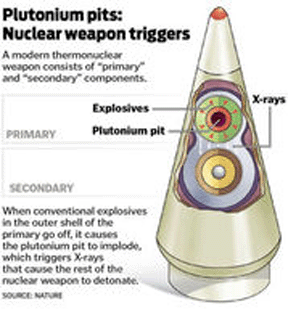 Energy Department sites.
The Los Alamos lab has been producing pits — the grapefruit-size fission triggers that ignite nuclear weapons — on a smaller scale for decades, and New Mexico’s congressional delegation has been pushing to keep that work in the state as the nation’s mission to modernize its nuclear weapons arsenal ramps up.
A summary of the National Nuclear Security Administration’s study, leaked in December, shows that Los Alamos and the Savannah River Site in South Carolina are the final contenders for the pit factory, expected to cost up to $7.5 billion and take 10 to 20 years to complete.
According to the leaked material, which was reviewed by The New Mexican, the work would take longer to complete in Los Alamos and costs would be higher there.
The Los Alamos Study Group also contends the risks of pit production at Los Alamos are significant and should be disclosed to the public.
The nonprofit’s director, Greg Mello, said in a statement Thursday, “We believe [pit production] is proceeding ‘under cover of darkness’ on purely ideological grounds, and not on any defensible managerial basis. … It is a vast waste of resources, though lucrative for a few contractors.”
The organization believes the U.S. already has an excess of pits in its weapons stockpile and that future production would present a grave risk to the public while wasting public funds. The U.S. arsenal contains 23,000 pits, the group says in its suit, at least a third of which its says are viable and would last through 2063.
Residents in the Rocky Flats area spent more than two decades entangled in a lawsuit with the plant’s operators after plutonium was found to have traveled to thousands of homes.
Los Alamos has had its share of nuclear safety violations, as well.
The lab’s plutonium facility, which restarted pit production in 2015 following a yearslong pause over safety concerns, was cited for a series of violations in the last year alone. Several workers were contaminated with radiation in 2017, and a small fire burned one worker. The lab was fined several million dollars for mishandling an out-of-state shipment of plutonium, and federal inspectors raised concerns recently about how the lab manages the toxic metal beryllium.
Contact Rebecca Moss at 505-986-3011 or rmoss@sfnewmexican.com.
Group tries to get reparation funds for people exposed to Trinity Nuclear Test
http://www.krqe.com/news/new-mexico/group-tries-to-get-reparation-funds-for-people-exposed-to-trinity-test/1032459155, By: KRQE Media Mar 12, 2018 ALBUQUERQUE, N.M. (KRQE) – A group is wanting to convince Congress that New Mexico should get reparation funds, decades after testing the first nuclear bomb at the Trinity Site.
Lawyers kept busy with the chaos of South Carolina’s failed nuclear project

Lawyers are benefiting from chaos of South Carolina’s failed nuclear project, By Andrew Brown  abrown@postandcourier.com Feb 18, 2018
Nuclear power critics to testify in Vermont Yankee case
VT Digger, By Feb 12 2018 State regulators will consider the testimony of two prominent nuclear power critics in deciding whether a cleanup company should be allowed to buy Vermont Yankee.
Can the president be prosecuted for war crimes in the event of a nuclear strike?
 https://www.dallasnews.com/opinion/commentary/2018/02/12/can-president-prosecuted-war-crimes-event-nuclear-strike, Anthony J. Colangelo,
Can U.S. nuclear strike planners and executors be prosecuted for war crimes? Short answer, yes. And the planners are more vulnerable to prosecution than world leaders, such as President Donald Trump.
A preliminary question, of course, is what would constitute an illegal nuclear strike order. It is fairly clear that any use of nuclear weapons to achieve military objectives that conventional weapons can otherwise achieve would be illegal.
The reason is that the nuclear option would violate principles of the law of war, or what’s called humanitarian law, by causing indiscriminate and disproportionate loss of life and superfluous injury, since nuclear weapons are far more catastrophic than conventional weapons. If conventional weapons could achieve the same military objectives, then any order to use nuclear weapons instead would be manifestly illegal, leading to allegations of war crimes. But heads of state like Trump are generally immune from prosecution, at least while they remain in office, even for serious violations of international law like war crimes and crimes against humanity.
However, the whole reason heads of state enjoy immunity is that the state would be unable effectively to represent itself in its dealings with other states if these individuals were stuck in foreign states’ docks. Thus high-ranking members of the U.S. Strategic Command and other planning bodies likely fall outside the scope of immunity, and the farther down the chain one goes, the less immunity applies. In turn, only heads of state and perhaps other extremely high-ranking officials would have immunity.
But where could these planners and executors be prosecuted? One option would be in U.S. domestic courts or military tribunals, especially if there is a change in administration. Another option would be foreign tribunals. Because war crimes are subject to what’s called universal jurisdiction, any nation in the world may prosecute the perpetrators of these crimes. This is not just theoretical or academic.
The practice of universal jurisdiction has spiked in recent years when it comes to serious violations of international law, such as torture, crimes against humanity and certain acts of terrorism.
Nuclear strike planners have a duty under international and domestic U.S. law to reject illegal nuclear strike orders. If they do not, they can be held liable in both domestic and foreign courts. Immunity will not shield them from prosecution.
Anthony J. Colangelo is a law professor at Southern Methodist University and a senior associate at the Nautilus Institute for Security and Sustainability. He wrote this column for The Dallas Morning News. Email:colangelo@smu.edu
Lawsuit against Georgia Regulators Over Nuclear Decision
Vogtle Opponents Sue Georgia Regulators Over Nuclear Decision, WABE, • Opponents of a nuclear power expansion in Georgia are suing over it. Environmental groups claim state regulators didn’t follow their own rules when they decided to let construction at Plant Vogtle continue.
Depleted uranium “helped sow deaths and illnesses” in Italian soldiers
 Uranium caused cancer – probe http://www.ansa.it/english/news/politics/2018/02/07/uranium-caused-cancer-probe_560c540f-b60e-4f90-8ce4-29c0dc42cd6d.html But expert denies saying there was causal link, Redazione ANSA, 7 Feb 18 ANSA) -Rome – The final report of a commission on depleted uranium said Italian soldiers had been exposed to “shocking” levels of it in Italy and on foreign missions, and that it had “helped sow deaths and illnesses”.
However, the doctor whose expert opinion informed the panel’s conclusions denied a link between uranium and cancer. Levels of uranium in the sectors of security and workplace health for soldiers had been toxic and deadly, said the report from the parliamentary commission of inquiry. The report highlighted that military chiefs had been in “denial” on the phenomenon, and also stressed the “deafening silences maintained by government authorities.” Experts heard by the panel had verified the links between exposure to depleted uranium and tumours, the report said.
Commission Chair Gian Piero Scanu of the Democratic Party said “repeated judicial sentences have consistently affirmed the existence of a causal link between exposure to depleted uranium and the pathologies cited by the soldiers: this is a milestone and now those who were exposed will have the possibility of getting justice without having to struggle as they have done so far”.
The relatives of soldiers who died of uranium-linked cancer have been suing the government for years and pursuing cases in the courts, amid denials from military authorities.
In 2016 a Rome appeals court upheld a guilty verdict for the defence ministry in the 1999 death from leukemia due to depleted uranium exposure of 23-year-old Corporal Salvatore Vacca who handled uranium-tipped munitions during a 150-day mission in Bosnia in 1998-99.
The court found the ministry guilty of not having protected Vacca.
It ordered the ministry to pay more than one and a half million euros in compensation to Vacca’s family.
The families of other victims are suing the ministry for deaths allegedly due to depleted uranium exposure on several Italian missions.
Domenico Leggiero of the Military Observatory group said the sentence was “historic, because it confirms that the ministry was aware of the danger the soldiers sent to those zones were subject to”.
He said “I am sure Defence Minister Roberta Pinotti will bear this ruling in mind when she appears before the parliamentary depleted uranium commission”.
Italian authorities consistently played down the uranium risks
1 This Month

To see nuclear-related stories in greater depth and intensity – go to https://nuclearinformation.wordpress.com
-
Archives
- September 2026 (174)
- August 2026 (330)
- July 2026 (355)
- June 2026 (287)
- May 2026 (306)
- April 2026 (356)
- March 2026 (251)
- February 2026 (267)
- January 2026 (308)
- December 2025 (358)
- November 2025 (359)
- October 2025 (375)
-
Categories
- 1
- 1 NUCLEAR ISSUES
- business and costs
- climate change
- culture and arts
- ENERGY
- environment
- health
- history
- indigenous issues
- Legal
- marketing of nuclear
- media
- opposition to nuclear
- PERSONAL STORIES
- politics
- politics international
- Religion and ethics
- safety
- secrets,lies and civil liberties
- spinbuster
- technology
- Uranium
- wastes
- weapons and war
- Women
- 2 WORLD
- ACTION
- AFRICA
- Atrocities
- AUSTRALIA
- Christina's notes
- Christina's themes
- culture and arts
- Events
- Fuk 2022
- Fuk 2023
- Fukushima 2017
- Fukushima 2018
- fukushima 2019
- Fukushima 2020
- Fukushima 2021
- general
- global warming
- Humour (God we need it)
- Nuclear
- RARE EARTHS
- Reference
- resources – print
- Resources -audiovicual
- Weekly Newsletter
- World
- World Nuclear
- YouTube
-
RSS
Entries RSS
Comments RSS
 nuclear-news