France arrests activists blocking ship over alleged Russia uranium links
Police arrested four Greenpeace activists on Monday for blocking a cargo ship in France that they alleged was transporting uranium from Russia for the country’s nuclear power plants.
By:RFI, 02/03/2026 ,
https://www.rfi.fr/en/france/20260302-france-arrests-activists-blocking-ship-over-alleged-russia-uranium-links-ukraine-war
Around 20 protestors carrying signs reading “Stop toxic contracts” and “Solidarity with Ukrainians”, blockaded the Mikhail Dudin at the northern port of Dunkirk early on Monday morning, to prevent it from unloading its cargo, a journalist from French news agency AFP observed.
French authorities then arrested four individuals, Dunkirk police told AFP, adding that the blockade was lifted around 9am local time.
Greenpeace has repeatedly accused France of maintaining ties with Russia’s state-owned energy company, Rosatom, despite President Vladimir Putin’s war in Ukraine.
Activists, some on kayaks, had impeded the ship while a large banner stretched across the lock read, “Uranium: EDF loves Putin” – a jab at the French state-owned energy giant.
In 2018, France’s EDF signed a 600-million-euro deal with a Rosatom subsidiary, Tenex, for reprocessed uranium from French nuclear power plants to be sent to Russia to be converted and then re-enriched before being reused in power production.
Rosatom has the only facility in the world – in Seversk in Siberia – capable of carrying out key parts of the conversion of reprocessed uranium to enriched reprocessed uranium.
“This trade, which indirectly fuels Putin’s war, must stop,” said Pauline Boyer, an energy campaigner for Greenpeace France on Monday.
The environment group alleges it has “on numerous occasions” observed the Mikhail Dudin unloading Russian natural and enriched uranium in France.
An AFP analysis of Global Fishing Watch tracking data shows the Mikhail Dudin has made more than 20 round trips between Dunkirk and the Russian ports of Vistino, Ust-Luga and Saint Petersburg since Russia’s full-scale invasion of Ukraine began on 24 February, 2022.
The Baltiyskiy-202 – another vessel that Greenpeace alleges has transported uranium between France and Russia – has completed more than 15 round trips during the same period.
Both sail under the Panamanian flag and are owned by companies registered in Hong Kong, according to the International Maritime Organisation’s register.
EDF did not immediately respond to AFP’s request for comment.
In 2022, France ordered EDF to halt its uranium trade with Rosatom when Greenpeace first revealed the contracts in the wake of Russia’s invasion.
But in March 2024, Jean-Michel Quilichini, head of the nuclear fuel division at EDF, said the company planned to continue to “honour” its 2018 contract.
France in March 2024 said it was “seriously” looking at the possibility of building its own conversion facility to produce enriched reprocessed uranium.
AFP analysis of French customs data shows that in 2025, France imported at least 112 tonnes of enriched uranium and its compounds from Russia, accounting for a quarter of total purchases by volume – a level stable compared to 2024.
These imports however fell significantly between 2022 and 2024.
Trump’s war on international justice
By Hassan Elbiali | 29 January 2026
When the U.S. sanctions international judges to shield Israel, power decides who is accountable, not law. Hassan Elbiali reports.
SINCE RETURNING to office in January 2025, U.S. President Donald Trump has launched an aggressive campaign to dismantle international legal accountability.
His Administration imposed sweeping sanctions on International Criminal Court (ICC) personnel investigating Israeli conduct in Gaza — not just a policy disagreement, but an assault on the institution itself.
The Trump Administration sanctioned judges, prosecutors and Palestinian human rights organisations that cooperated with ICC investigations. By December 2025, nine ICC staff members faced economic penalties. These sanctions cut them off from banks, credit card companies and platforms like Amazon, treating international judges the same way the U.S. treats Russian oligarchs.
The executive order Trump signed in February 2025 declared the ICC had engaged in actions targeting America and its ally Israel, calling the arrest warrants baseless. The Administration expanded sanctions in June, August and December, each time targeting those involved in the Gaza investigation.
ICC judges reported losing access to credit cards, having purchased e-books vanish from devices and Amazon’s Alexa stopping responses. One sanctioned judge told reporters she now appears on lists with terrorists and organised crime figures — punishment for doing her job.
The Gaza reality
The stakes couldn’t be higher because the underlying facts demand accountability. By January 2025, Gaza’s Health Ministry reported at least 46,645 Palestinians killed, with the vast majority being civilians. Independent research suggests far worse. A Lancet study estimated that total violent deaths by October 2024 exceeded 70,000, with 59% being women, children and the elderly.
A November 2025 Max Planck Institute study estimated total violent deaths between 100,000 and 126,000, of which 27% were children under 15. UNICEF reported that 74 children were killed in just the first week of 2025 alone.
The pattern of destruction meets definitions that scholars and institutions can no longer ignore. Multiple human rights groups and numerous international law scholars have recognised what’s happening as genocide. UN satellite analysis found that nearly 78% of all structures across Gaza had been destroyed.
The starvation component particularly demonstrates intent. For extended periods, humanitarian aid was blocked, with Israeli officials declaring that restricting aid was official policy. When food becomes a weapon against a population of over two million, including one million children, legal frameworks either mean something or they don’t.
Western complicity
Trump’s sanctions represent the most brazen effort to shield Israel from accountability, but complicity runs deeper.
The U.S. has supported Israel’s military campaign by continuing to supply billions in military aid throughout the genocide. The Trump Administration sanctioned three Palestinian human rights organisations – Al-Haq, Al Mezan Centre for Human Rights and the Palestinian Centre for Human Rights – for documenting violations and asking the ICC to investigate, effectively criminalising the documentation of war crimes.
Britain applied similar pressure. Then-Foreign Secretary David Cameron privately warned ICC prosecutor Karim A A Khan in April 2024 that the UK would defund and withdraw from the ICC if it issued arrest warrants against Netanyahu and Gallant. Cameron told Khan that pursuing warrants would be like “dropping a hydrogen bomb.”
U.S. Senator Lindsey Graham threatened Khan with sanctions if he applied for the warrants, warning that “if they do this to Israel, we’re next”.
When powerful states actively work to prevent accountability for mass atrocities, they expose the conditional nature of their commitment to international law.
Power always shaped law
International law never existed independently of power. Law and power are constituted together and are therefore interdependent. When the balance of power shifts, the legal order shifts with it.
The post-1945 system reflected American dominance and Western liberal values. As that power wanes and new centres emerge –China, India, the Global South – the legal architecture must change. This isn’t collapse; it’s reconfiguration.
History proves the point. During the 1930s, the League of Nations failed when Nazi Germany rose to power, Italy invaded Ethiopia and the USSR fought Finland. Yet international law survived, adapted and emerged stronger after World War II.
What this means
The Hague Group, founded by Bolivia, Colombia, Cuba, Honduras, Malaysia, Namibia, Senegal and South Africa in January 2025, responds to growing cracks in international legal enforcement and its politicised, selective application. These states seek to reshape international law around different principles than those that dominated the past 70 years.
If you’re analysing global politics, understand that we’re not witnessing the end of international law — we’re watching its transformation through the crucible of Gaza. But the Gaza genocide and Western efforts to prevent accountability reveal something more troubling.
When powerful states systematically dismantle legal institutions investigating their allies’ war crimes, they demonstrate that international law applies selectively based on political alignment rather than universal principles.
Trump’s sanctions, combined with continued weapons shipments to Israel, expose the hypocrisy at the heart of the current system. UN experts called the sanctions an attack on the global rule of law that undermines international justice. When the world’s most powerful state treats international judges like criminals for investigating genocide, the pretence that law governs power becomes untenable.
What you’re witnessing isn’t the end of international law — it’s the painful birth of a multipolar legal order. Whether this transition happens through negotiation or conflict will determine if the coming decades bring greater justice or greater chaos.
The difference now is that Gaza has exposed this reality so starkly that denial becomes impossible. When thousands of children die while powerful states actively block accountability, the question becomes whether any international legal system can emerge that commands genuine respect rather than cynical compliance.
The answer will shape not just Palestinian lives but the prospects for justice everywhere.
The end of sovereign immunity: America’s new doctrine of capture.

the United States will act as judge, jury and gaoler.
We are entering a “Legal Wild West”.
By Imran Khalid | 19 January 2026, https://independentaustralia.net/politics/politics-display/the-end-of-sovereign-immunity-americas-new-doctrine-of-capture,20584
By seizing a sitting head of state, Washington has replaced international law with a doctrine of unilateral reach, writes Imran Khalid.
FOR NEARLY FOUR centuries, the global order has rested on the foundation of Westphalian sovereignty: the idea that a state has exclusive authority over its territory and that a head of state is shielded from the jurisdiction of foreign courts.
Recently, that principle was not merely challenged; it was dismantled. The capture of Nicolás Maduro and his wife, Cilia Flores, by U.S. special forces in Caracas and their transfer to U.S. custody – initially aboard the USS Iwo Jima before being flown to New York – marks the birth of what we might call the “Decapitation Doctrine”. It is a shift that moves the world away from universal law and toward a system where geography determines your level of immunity.
The Trump Administration’s rationale for “Operation Absolute Resolve” is framed as a law enforcement action rather than an act of war. By relying on a narco-terrorism indictment filed in the Southern District of New York, Washington has bypassed the United Nations and the traditional mechanisms of international conflict.
The message is as clear as it is jarring: the United States no longer views the recognition of a foreign leader as a barrier to domestic prosecution. If a leader is deemed a criminal by the Department of Justice, they are subject to the same reach as any common cartel boss.
This development is a logical, if extreme, conclusion to a decade of eroding global norms. We have seen the steady decline of multilateral institutions and the rise of transactional diplomacy. But by “running” Venezuela – as President Trump promised on 3 January – the United States is doing more than pursuing a fugitive. It is declaring a new Monroe Doctrine for the 21st Century.
This updated version suggests that within its own hemisphere, the United States will act as judge, jury and gaoler. It is a return to a “sphere of influence” model where the rules of the road are written by the regional hegemon.
To understand the gravity of this moment, one must look at the history of sovereign immunity. Since the mid-17th Century, the international system has functioned on the “fiction” of equal sovereignty. Whether a nation was a global empire or a tiny principality, its leader was considered the personification of the state and thus beyond the reach of foreign domestic law.
This was not a moral judgment, but a practical one designed to prevent a cycle of endless retributive litigation between nations. By breaking this seal, the United States has effectively signalled that sovereignty is no longer an absolute right, but a privilege granted by the powerful to the compliant.
The legal community is understandably alarmed. If the U.S. can arrest Maduro based on a domestic indictment, what stops other powers from doing the same? We are entering a “Legal Wild West”.
Imagine a future where a court in Tehran issues an arrest warrant for a European defense minister, or a tribunal in Moscow indicts a Baltic leader for “crimes against the Russian state”. By removing the shield of sovereign immunity, the United States has introduced a level of personal vulnerability for world leaders that will inevitably lead to a more paranoid and defensive international climate.
This concern is already manifesting in UN Security Council debates over the operation’s legality, with Russia expelling U.S. diplomats in retaliation and China halting debt talks with Venezuela.
This “judicialisation” of foreign policy also creates a dangerous precedent for domestic politics. When foreign policy is conducted through the lens of criminal law, it becomes harder to engage in the necessary compromises of diplomacy. You cannot negotiate a peace treaty with someone you have labelled a common felon.
In the past, the United States often used “golden bridges” to allow dictators to leave power gracefully — think of Ferdinand Marcos or Jean-Claude Duvalier. By opting for a New York courtroom instead of a quiet exile, the U.S. may find that future dictators will choose to fight to the bitter end rather than risk a life sentence in a Brooklyn cell.
Indeed, on 5 January, Maduro and Flores pleaded not guilty in Manhattan’s federal court, with Maduro declaring himself “kidnapped” and a “prisoner of war” while his wife appeared with visible injuries from the raid — a gash over her eye and a forehead welt.
Furthermore, the transitional oversight of Venezuela by American officials – backed by the initial presence of the USS Iwo Jima – creates a political vacuum that may be impossible to fill legitimately.
While Vice President Delcy Rodríguez has been named acting president by the Venezuelan Supreme Court and has received “unconditional support” from Maduro’s son even as she extends an olive branch to Trump, the reality on the ground is one of American leverage. Any successor to Maduro will now face the “proxy problem”.
In an era of intense nationalism, a leader who is seen as being installed or protected by Washington will struggle to gain the internal legitimacy required to govern. This is compounded by Cuba’s report of 32 officers killed in the raid, Venezuela’s nationwide manhunt for Maduro supporters and Switzerland’s freeze on Maduro-linked assets.
We are witnessing the transition from a world of rules to a world of reach. The United States has demonstrated that its reach is unrivalled, but the long-term stability of the international system depends on more than just the ability to snatch a dictator from his bedroom. It depends on a shared understanding of where one state’s power ends and another’s begins.
By blurring that line in Caracas, Washington may have achieved a tactical masterstroke, but it has left the global order in a state of profound and dangerous uncertainty, with oil markets surging and protests rippling across U.S. cities in response.
Militant Zionist Group Ceasing Operations In New York Following Settlement with Attorney General.

The far-right Zionist organization has agreed to a $50,000 suspended fine that it will only be forced to pay if it violates the terms of the agreement, which require it to stop engaging in organized harassment campaigns encouraging violence and making direct threats against its political opponents.
Although branded as a fringe group on the outskirts of the American Zionist establishment, evidence of the political influence of Betar U.S. became increasingly evident following the return of President Donald J. Trump to the White House.
Betar U.S. has deemed it cannot continue to operate if it is unable to engage in terroristic tactics.
blueapples, Jan 15, 2026, https://ddgeopolitics.substack.com/p/militant-zionist-group-ceasing-operations?utm_source=post-email-title&publication_id=1769298&post_id=184510757&utm_campaign=email-post-title&isFreemail=true&r=1ise1&triedRedirect=true&utm_medium=email
By virtue of its standing as the global center of the Jewish diaspora, New York City emerged as the main battleground in the United States for the fight between American Zionists and their opponents amid the deterioration of public support for Israel accelerated by its war against Hamas in the Gaza Strip. While critics of the State of Israel participating in widespread protests across the city have been branded as Jihadists by their opponents for protesting against the slaughter of innocent Palestinians at the blood-stained hands of the Israel Defense Forces (”IDF”), it is a pro-Israel group that has been exposed for engaging in a campaign of terrorism in the latest fallout from that ideological conflict. Betar U.S., the American chapter of an international militant organization created by the founder of the Zionist paramilitary the Irgun, has chosen to cease its operations in New York following a settlement with the office of the state’s attorney general after an investigation uncovered systemic campaigns of harassment, intimidation, and political violence led by the group.
In the wake of political unrest across the U.S. beginning in 2024 centered around protests against Israel on the campus of Columbia University, Betar U.S. engaged in organized harassment campaigns of pro-Palestinian protesters and activists, culminating in an investigation against them. The investigation into the organization began in March 2025, following a series of formal complaints made against the group. According to a statement from the office of New York Attorney General Letitia James announcing its settlement with Betar, “The Office of the Attorney General investigation determined that Betar U.S. engaged in a pattern of violence and harassment driven by explicit hostility toward protected groups.” The investigation also uncovered that despite registering with the Internal Revenue Service as a nonprofit in 2024, Betar U.S. never registered itself with the New York State Charities Bureau, despite soliciting donations while operating in the state.
The far-right Zionist organization has agreed to a $50,000 suspended fine that it will only be forced to pay if it violates the terms of the agreement, which require it to stop engaging in organized harassment campaigns encouraging violence and making direct threats against its political opponents. Betar U.S. will be required to file annual compliance reports for the next three years proving it has not violated the terms of the settlement to avoid paying the suspended fine. As a result of the settlement, Betar U.S. will dissolve its nonprofit status in New York and has told the attorney general’s office that it intends to cease its operations within the state. Despite agreeing to the settlement, a spokesperson from Betar U.S. has denied any wrongdoing.
Although branded as a fringe group on the outskirts of the American Zionist establishment, evidence of the political influence of Betar U.S. became increasingly evident following the return of President Donald J. Trump to the White House. In late January 2025, shortly after Trump was inaugurated, the far-right Zionist group provided his administration with a list of students participating in anti-Israel protests whose identities it uncovered in order to have them deported from the country. Shortly after being sent that list, President Trump signed an executive order creating a task force against antisemitism. In response to continued protests against Israel, Trump signed another executive order to deport college students and other non-permanent U.S. residents in the country on green cards and visas by equating their participation in the demonstrations with support for terrorism. That decision emboldened Betar U.S. to launch what it named Operation Wrath of Zion as a coordinated doxing campaign to leak the personal details of protesters.
Evidence of the harassment campaigns the New York Attorney General’s office found Betar U.S. to have engaged in has been replete across social media since the group was revived in June 2023, just months before the conflict between Israel and Hamas led to full-scale war in the Gaza Strip following the attacks of October 7th, 2023. The group regularly posted threats on X, going as far as to publish videos of its members committing acts of violence against pro-Palestine protesters. Following a Mossad-led operation dubbed Operation Grim Beeper, in which Israeli intelligence targeted Hezbollah officials by detonating thousands of handheld pagers across Lebanon and Syria, leading to thousands of civilian casualties, Betar U.S. posted videos of its members taking to the streets of New York City to hand-deliver beepers to anti-Israel activists as an intimidation tactic. Jewish anti-Zionist activist Norman Finkelstein was one such critic of Israel whom Betar U.S. targeted in this coordinated harassment campaign, calling him a “fucking Holocaust denying piece of shit” when placing a beeper into the front pocket of his jacket.
Although Betar U.S. targeted pro-Palestinian activists with its militant tactics, the extremist ideology of the group also put it at odds with other Jewish groups like the Anti-Defamation League. The group accused the ADL of being too lenient on opponents of Israel, creating an irreconcilable schism between the two. The animosity it fostered led to the ADL putting Betar U.S. on its database of extremist groups, making it the only Jewish organization to earn that distinction.
In response to the announcement of its settlement with the New York Attorney General, Betar attempted to distance itself from the renewed attention placed on its militant ideology. “Betar is mainstream Zionism, an organization without which the State of Israel would not exist,” a spokesperson told The Times of Israel. Despite this protestation, Betar is impossible to separate from militant Zionist extremism. The organization was originally established by Ze’ev Jabotinsky in Riga, Latvia in 1923 as a fascist youth movement created to advance his ideology of Revisionist Zionism.
The sect of Revisionist Zionism created by Jabotinsky advocated for the reform of the Zionist ideology in opposition to the left-wing Labor Zionism movement led by the eventual first Prime Minister of Israel, David Ben-Gurion. In contrast to Labor Zionism, the ideology of Revisionist Zionism centered around the idea that the Jewish people had the right to sovereignty over the whole of what it saw as the Land of Israel, including the entirety of British Mandatory Palestine and Transjordan. Revisionist Zionism has served as the foundation for the right wing of modern Israeli politics, influencing the creation of the Likud party, now led by Israeli Prime Minister Benjamin Netanyahu, as well as the Jewish supremacist Kahanism movement, which the Jewish Power party, led by Israeli Minister of National Security Itamar Ben-Gvir, arose out of.
Jabotinsky was also behind the founding of the Irgun, a Zionist paramilitary organization that operated in Mandatory Palestine from 1931 until years after his death in 1940, when it was eventually absorbed into the IDF following the establishment of the State of Israel in 1948. In its years operating as a Zionist paramilitary, the Irgun was responsible for acts of terrorism against Palestinian Arabs and other groups it labeled as opponents of its Zionist worldview, such as the Deir Yassin Massacre and the King David Hotel Bombing committed against the administrative headquarters of the British authorities of Mandatory Palestine in 1946. Betar served as a recruiting pipeline for the Irgun, in a manner like that in which the Hitler Youth was constructed.
It wasn’t until six years after the Zionist paramilitary was founded by Jabotinsky that the U.S. branch of Betar was established in 1929. Throughout its existence, opposition to its radical ideology and militant tactics had fragmented its operations in America. However, following its latest iteration being established in 2023, support from high-ranking Israeli political leaders has allowed it to flourish. During a visit to the U.S. in September to speak before the United Nations General Assembly, Israeli Prime Minister Benjamin Netanyahu met with leaders of Betar U.S. in New York City. Yet, even that tacit support from the Israeli government was not enough to overcome the scrutiny the group has faced due to its militant tactics.
In the wake of the announcement of its settlement with the Office of the New York State Attorney General, Betar U.S. returned to its X account to continue to push propaganda framing itself as a victim of antisemitism. Betar U.S. accused New York Attorney General Letitia James of barring it from operating in the state. In reality, all the attorney general’s office has required of Betar U.S. is to stop targeting its opponents with campaigns of harassment, intimidation, and violence, or face paying a paltry $50,000 fine. That requirement alone was enough for Betar U.S. to voluntarily cease its operations. Given that it postures itself as a mainstream pro-Israel organization, the fact that Betar U.S. has deemed that it cannot continue to operate without engaging in those terroristic tactics is a damning distillation of what Zionism truly stands for.
Trump sanctions on UN Special Rapporteur Francesca Albanese are illegal and represent further U.S. complicity in genocide.
The Trump administration’s sanctions against UN Special Rapporteur Francesca Albanese show how far the U.S. is willing to go to ensure impunity for Israel as it commits genocide.
By Craig Mokhiber July 10, 2025, https://mondoweiss.net/2025/07/trump-sanctions-on-un-special-rapporteur-francesca-albanese-are-illegal-and-represent-further-u-s-complicity-in-genocide/
Craig Mokhiber
Craig Mokhiber is an international human rights lawyer and former senior United Nations Official. He left the UN in October of 2023, penning a widely read letter that warned of genocide in Gaza, criticized the international response and called for a new approach to Palestine and Israel based on equality, human rights and international law.
Fresh from face-to-face meetings in Washington with fugitive from justice Benjamin Netanyahu, indicted by the ICC for crimes against humanity, U.S. Secretary of State Marco Rubio took the extraordinary step of declaring sanctions against the United Nations Special Rapporteur on human rights in the occupied Palestinian territory, Francesca Albanese.
The announcement was accompanied by a flurry of false and defamatory statements by Rubio attacking Albanese, further demonstrating the lengths to which the Trump administration (and the Israel proxies empowered within it) are willing to go to buttress the impunity of the Israeli regime.
Rubio’s lawless action has been condemned and rejected by international organizations, experts, and human rights defenders across the globe as a moral outrage.
Indeed, outside of Washington (and the Israel lobby groups that hold dangerous sway there), Rubio’s smears and his lawless imposition of sanctions will bring only condemnation of Rubio and the Trump administration. Special Rapporteur Francesca Albanese is a highly respected expert and human rights defender, well known globally as an advocate who has dedicated her life to opposing all forms of bigotry and oppression and to promoting the cause of universal human rights.
She has been widely praised for carrying out her United Nations mandate with honor and with the highest degree of competence and integrity, particularly during the Israeli regime’s twenty months of genocide in Palestine.
But this action by the U.S. government is not only a moral outrage. It is also entirely unlawful.
The sanctions order and its accompanying statements are a direct breach of the United Nations Charter, the Convention on the Privileges and Immunities of the United Nations, and the Agreement Regarding the Headquarters of the United Nations (Host Country Agreement).
They represent a deliberate obstruction of the human rights mission of the United Nations. And given that this action is taken to insulate Israel and other perpetrators (including the corporations named in the Specials Rapporteur’s latest report) from accountability for war crimes, crimes against humanity, and genocide, it is also a breach of U.S. obligations under the UN Genocide Convention (under which Israel is currently on trial in the International Court of Justice), and under Common Article 1 of the Geneva Conventions of 1949 (obliging the U.S. to ensure that Israel and other parties respect the Conventions).
Furthermore, as this act by the Government of the United States was explicitly connected by the Secretary of State to its (also unlawful) sanctions against the International Criminal Court, it is also an offense against the administration of justice as codified by Article 70 (1) (c ) of the Rome Statute, for which territorial jurisdiction may be secured through the locus of the Court (the Netherlands, a state party to the Rome Statute), and through which Special Rapporteur Albanese may be entitled to reparations as a victim of the unlawful conduct.
Additionally, Special Rapporteur Albanese may be entitled to compensation for civil wrongs (torts) for economic and reputational damage, given the defamatory nature of Secretary Rubio’s statements, and their manifest basis in “actual malice” and a “reckless disregard for the truth,” recognized by US courts as exceptions to sovereign immunity.
Of course, as recent years have demonstrated, the U.S. cares little about international (or even domestic) legality. But external pressure and action are inevitable.
Outside the U.S., moves are underway to demand that the United States withdraw the sanctions and compensate Special Rapporteur Albanese for any and all economic, reputational, or emotional harms caused to her or her family, and compensate the United Nations for any damages done to her vital mandate.
The United Nations and all UN member states and regional organizations (like the EU) can and must publicly reject the sanctions, use all mechanisms at their control (of which there are many- legal, financial, political, and diplomatic) to insulate the Special Rapporteur from their effects, speak out clearly in her defense, and use diplomatic channels to press the United States to lift the sanctions and compensate the Special Rapporteur.
If the many statements already issued by influential members of the international community are any indication, the lawless U.S. government may soon learn that, in attacking Francesca Albanese in this way, it has crossed a bridge too far in its campaign for Israeli impunity.
And regardless of the short-term harms of this shameful act by the Trump administration, we can be certain that the U.S. will not succeed in its ultimate objectives of silencing Albanese and the broader UN, intimidating other human rights defenders, and guaranteeing the Israeli regime’s impunity for war crimes, crimes against humanity, apartheid, and genocide. To the contrary, such brazen acts of lawlessness and complicity in genocide will only stoke the flames of resistance to these historic crimes, and to their co-perpetrators in Washington and Tel Aviv.
The global movement for solidarity with Palestine is growing. And, as has been evident since Rubio’s latest shameless act, that movement stands unapologetically with Francesca Albanese. And so do I.
Trump’s rap sheet is long, but this may top them all
The International Atomic Energy Agency (IAEA) has not blown the whistle as claimed by the Australian government, nor has the UK or our European allies.
any resolution to condemn the bombing of Iran will be vetoed by the US , presumably with the support of Australia
The Age, Geoffrey Robertson , 24 June 25, – (print version)
Although few may bother to point this out, Trump has just committed a crime much worse than all the others on his rap sheet.
It is the war crime of aggression- the “supreme” war crime, according to the judgement at Nuremberg. It is constituted by using armed force against a felloe United Nations member with such “character, gravity and scale” that it violates the UN charter prohibition on one member country attacking another. A “spectacular military success, the bombing of Iran’s nuclear facilities may have been, but it was, as a matter of international law, no different from Russia’s attack on Ukraine, or the George W Bush Tony Blair, John Howard invasion of Iraq. These a all cases of a breach of the world order agreed after the last war and likely to encourage emulation.
This is not about saving Iran, or the danger of making Putin look better. If any government in the world deserves to be destroyed, it is the mullahs without mercy in Iran. Many of them were involved in the mass slaughter of political prisoners in1988 – the worst crime against POWs since the Japanese death marches. – and ever since their record of killing peaceful protestors, women and dissidents has been disgusting. Iran has bankrolled terrorist organisations and wagedpropaganda wars against the Big (US) and Little (UK) Satan, but it has not invaded Israel or done anything to America to justify its aggression.
Were some hypothetical war crimes court ever to get its hands on Israeli Prime Minister Benjamin Netanyahu, it would reduce his sentence by taking Iranian provocation into account – but the man would still be guilty as charged. He could not argue self-defence, which requires the threat defended against to be reasonably proximate. The threat of Iran building and using nukes is much further away than the threat of Israeli submarines, said to be already stationed within range of Tehtan.
It is not even clear that Iran is close to building a nuclear weapon – several dozen countries also signatory to the nuclear weapons treaty by which they forswear any such development. could build nukes within a few months. The International Atomic Energy Agency (IAEA) has not blown the whistle as claimed by the Australian government, nor has the UK or our European allies.. And just like Saddam Hussein’s “weapons of mass destruction” there is no reason to think Iran has completed a project that in fact started under .the Shah in the 1970s.
Only last wee, Trump said in effect to the Ayatollah, in the tone of a gangster “Wee know where you live”, but he promised the cleric he would be safe “for now” and gave him two weeks. He bombed three days later (This is a man on whose word Australia has just made a down payment for AUKUS).
The true disaster of Trump’s attack is that it is another nail in the coffin of the rules-based world order that provided some protection for international pdeace and security since it was put in place in 1945.
It is now unfit for its purpose declared in the UN Charter to stop the slaughter of war. The General Assembly is a talking shop, while all power resides in the permanently poleAxed Security Council which cannot function because of the big power veto.
Resolutions for peace in Ukraine are vetoed by Russia, for peace in Gaza they are vetoed by America on behalf of Israel, and any resolution to condemn the bombing of Iran will be vetoed by the US , presumably with the support of Australia.
Besides, the problem with Iran goes beyond nuclear weapons. It’s a conflict between the rights of its people and the wrongs of its dictatorship. That is a conflict that only its people can resolve, however much the West may wish to help.
Trump has already made a mockery of US law, from which his Supreme Court has declared him immune. Hewill now make a mockery of international law, roo.
Geoffrey Robertson KC is an expert in international and human rights law. He is the author of Mullahs Without Mercy and Crimes Against Humanity.
Hinkley Point C court hearing over complying with UK environmental information law begins

New Civil Engineer, 13 May, 2025 , By Thomas Johnson
The legal challenge centres around Nuclear New Build (NNB) Generation Company, a subsidiary of the energy firm EDF who is responsible for constructing the Hinkley Point C nuclear power plant in Somerset. The case has been brought by environment group Fish Legal, which represents anglers and has been repeatedly denied information from the developers of the nuclear power station about its methods of deterring fish from the site.
NNB had a legal obligation to use an acoustic fish deterrent, based on its approved development consent order, but changed its plans for a saltmarsh instead. It has now switched back to a plan for an acoustic fish deterrent, having discovered a new “safe and effective” method for implementing it.
Despite this, Fish Legal is continuing with the case because it is bigger than just the fish deterrent at Hinkley Point C – it believes that foreign-owned private companies building and operating nuclear power plants in the UK must comply with domestic environmental information laws and therefore provide details on environmental plans when asked.
The group has previously taken similar legal action against private water and electricity companies, winning rulings that classified these companies as public authorities for the purposes of the Environmental Information Regulations (EIR). The UK’s Information Commissioner’s Office (ICO) supported this view in the current case, asserting that NNB Generation Company falls within the scope of the EIR and thus must disclose environmental data on request………………………………………………………………………………… https://www.newcivilengineer.com/latest/hinkley-point-c-court-hearing-over-complying-with-uk-environmental-information-law-begins-13-05-2025/
Kingston Fossil Plant and Oakridge Nuclear Facility – an unholy alliance of radioactive pollution,
While no one was killed by the 2008 coal ash spill itself, dozens of workers have died from illnesses that emerged during or after the cleanup. Hundreds of other workers are sick from respiratory, cardiac, neurological, and blood disorders, as well as cancers.
The apparent mixing of fossil fuel and nuclear waste streams underscores the long relationship between the Kingston and Oak Ridge facilities.
Between the 1950s and 1980s, so much cesium-137 and mercury was released into the Clinch from Oak Ridge that the Department of Energy, or DOE, said that the river and its feeder stream “served as pipelines for contaminants.” Yet TVA and its contractors, with the blessing of both state and federal regulators, classified all 4 million tons of material they recovered from the Emory as “non-hazardous.”
A U.S. Environmental Protection Agency analysis confirms that the ash that was left in the river was “found to be commingled with contamination from the Department of Energy (DOE) Oak Ridge Reservation site.
For nearly a century, both Oak Ridge and TVA treated their waste with less care than most families treat household garbage. It was often dumped into unlined, and sometimes unmarked, pits that continue to leak into waterways. For decades, Oak Ridge served as the Southeast’s burial ground for nuclear waste. It was stored within watersheds and floodplains that fed the Clinch River. But exactly where and how this waste was buried has been notoriously hard to track.
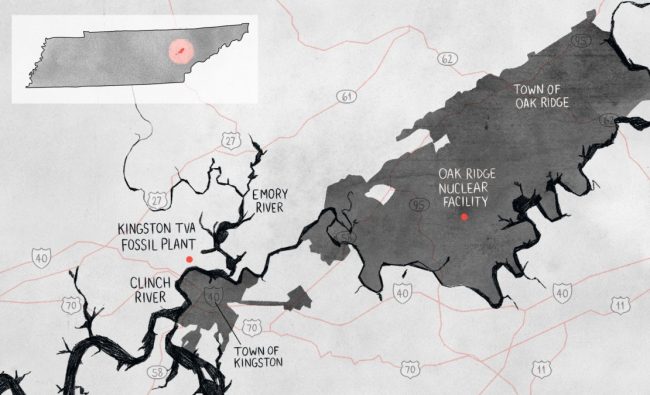
A Legacy of Contamination, How the Kingston coal ash spill unearthed a nuclear nightmare, Grist By Austyn Gaffney on Dec  15, 2020 This story was published in partnership with the Daily Yonder.
In 2009, App Thacker was hired to run a dredge along the Emory River in eastern Tennessee. Picture an industrialized fleet modeled after Huck Finn’s raft: Nicknamed Adelyn, Kylee, and Shirley, the blue, flat-bottomed boats used mechanical arms called cutterheads to dig up riverbeds and siphon the excavated sediment into shoreline canals. The largest dredge, a two-story behemoth called the Sandpiper, had pipes wide enough to swallow a push lawnmower. Smaller dredges like Thacker’s scuttled behind it, scooping up excess muck like fish skimming a whale’s corpse. They all had the same directive: Remove the thick grey sludge that clogged the Emory.
The sludge was coal ash, the waste leftover when coal is burned to generate electricity. Twelve years ago this month, more than a billion gallons of wet ash burst from a holding pond monitored by the region’s major utility, the Tennessee Valley Authority, or TVA. Thacker, a heavy machinery operator with Knoxville’s 917 union, became one of hundreds of people that TVA contractors hired to clean up the spill. For about four years, Thacker spent every afternoon driving 35 miles from his home to arrive in time for his 5 p.m. shift, just as the makeshift overhead lights illuminating the canals of ash flicked on.
Dredging at night was hard work. The pump inside the dredge clogged repeatedly, so Thacker took off his shirt and entered water up to his armpits to remove rocks, tree limbs, tires, and other debris, sometimes in below-freezing temperatures. Soon, ringworm-like sores crested along his arms, interwoven with his fading red and blue tattoos. Thacker’s supervisors gave him a cream for the skin lesions, and he began wearing long black cow-birthing gloves while he unclogged pumps. While Thacker knew that the water was contaminated — that was the point of the dredging — he felt relatively safe. After all, TVA was one of the oldest and most respected employers in the state, with a sterling reputation for worker safety.
Then, one night, the dredging stopped.
Sometime between December 2009 and January 2010, roughly halfway through the final, 500-foot-wide section of the Emory designated for cleanup, operators turned off the pumps that sucked the ash from the river. For a multi-billion dollar remediation project, this order was unprecedented. The dredges had been operating 24/7 in an effort to clean up the disaster area as quickly as possible, removing roughly 3,000 cubic yards of material — almost enough to fill an Olympic-sized swimming pool — each day. But official reports from TVA show that the dredging of the Emory encountered unusually high levels of contamination: Sediment samples showed that mercury levels were three times higher in the river than they were in coal ash from the holding pond that caused the disaster.
Then there was the nuclear waste. Continue reading
Victory for Greenpeace Luxembourg against EDF in court transparency ruling
Thomas Toussaint – Adapted by RTL Today, Update: 28.04.2025 ,
https://today.rtl.lu/news/luxembourg/a/2297912.html
In a landmark decision for nuclear transparency, the Strasbourg administrative court has ordered energy giant EDF to disclose information previously kept under wraps about the Cattenom nuclear power station, marking a major victory for Greenpeace Luxembourg.
Greenpeace went to court to challenge EDF’s refusal to provide information on “the possible use within the Cattenom nuclear centre of parts manufactured by the Italian company Tectubi, their destination and their conformity.”
The parts had previously been inspected by Italy’s Nuclear Safety Authority, which identified shortcomings in their production process.
The suspect parts were alleged to have been used to address the well-known issue of stress corrosion, detected in several nuclear power plants, including Cattenom. Greenpeace therefore requested to be informed of the possible use of these parts at the Moselle power station.
In response, the plant’s management refused, citing trade secrecy under the Code of Public Administration Relations. This left Greenpeace with no alternative but to turn to the administrative court in July 2023.
In a ruling on 24 April 2025, the Strasbourg court confirmed that the documents requested by Greenpeace Luxembourg were not subject to secrecy and ordered the director of Cattenom to provide the information within two months. EDF has also been ordered to pay €1,500 to Greenpeace Luxembourg.
“The decision by the administrative court is an important victory for transparency and nuclear safety,” said Roger Spautz, nuclear campaigner at Greenpeace Luxembourg. “EDF cannot continue to conceal crucial information regarding reactor safety, especially when issues such as stress corrosion and cracking are concerned.”
GOP states sue NRC to deregulate SMR licensing
17 Apr 25, https://beyondnuclear.org/gop-states-sue-nrc-to-deregulate-smr-licensing/
The GOP governors and their respective offices of state attorneys general (in one case the top GOP state legislators) in Texas, Utah, Florida, Louisiana, and Arizona have joined together with a number of fledgling nuclear start-up companies still in the design development phase for new, unproven small modular reactors (SMR) in a lawsuit filed in U.S. District Court for the Eastern District of Texas Tyler Division against the U.S. Nuclear Regulatory Commission (NRC).*
The lawsuit argues that reactor licensing requirements for microreactors and SMRs—with power outputs ranging from 1 to 300 megawatts electric (MWe)—do not need to be as stringent on safety requirements as the nation’s predecessor of behemoth commercial nuclear power plants in operation today. The plaintiffs claim, that because SMRs are significantly smaller they are inherently safer such that states regulatory authorities in collaboration with the nuclear industry would be sufficient to take control of licensing of SMR development from the NRC. This would include reactor independent design safety certification and construction. The plaintiffs have further claimed that offsite radiological emergency planning and environmental protection from a nuclear accident would no longer be necessary much farther than the reactor site exclusion fence line and can be safely operated within denser population zones.
This premise ignores the fact that the intent of the modular design allows for multiple units to be co-located, closely congregated and even operated from a single control room on a power scale potentially larger than even current conventional commercially light water nuclear reactor stations generating thousands of megawatts. Numerous common mode failures from singular, simultaneous and cascading events including internal design and material failures, external events including severe floods, earthquakes, and deliberate acts of malice cannot be totally ruled out.
With various SMR design concepts still in the development phase and some launching pilot ventures in the United States, they still face numerous challenges to demonstrate operational safety, obtain necessary approvals, build supply chains that including higher enriched nuclear fuel and develop a customer base. But the same issues of failure to control projected cost-of-completion and meet projected time-to-completion have already arisen in SMR development even to meet their goals on paper.
For example, the US Department of Energy’s much touted pet project in Idaho, NuScale Power’s 50 MWe VOYGR™ SMR power plant is the only design thus far that managed to eke out a contorted “conditional” design safety certification in 2023 from an obliging NRC and build its projected market with a power purchase agreement with the Utah Municipal Association of Power Suppliers (UAMPS) in several western states. The 50 MWe certified design itself instead turned out to be a “house-of-cards” and collapsed when uncontrolled costs and delays for the implementation of the design proved uneconomical for commercial production. Nevertheless, the state and the nascent industry plaintiffs are proceeding with their argument that it is NRC’s regulations and overly safety-oriented bureaucratic barriers that are stifling the deployment of otherwise innovative and “inherently safe” reactors.
The industry and its supporters have further blamed the NRC’s burdensome regulations as responsible for the collapse of the nation’s first attempt at its so-called “nuclear renaissance” with advanced Generation III reactor projects launched by the congressional passage of the Energy Policy Act of 2005 (EPACT). In fact, EPACT was tailored by Congress and a very willing NRC to streamline a new combined operating license process (COL), a one-stop construction and power operations permit. EPACT bolstered the industry launch with billions of dollars in federal production tax credits and loan guarantees. EPACT also ramrodded a twenty year extension of the Price-Anderson Act further indemnifying nuclear corporations with limited liability from the potentially astronomical costly radiological damages of severe nuclear accidents by the so-called “inherently safe” Generation III light water reactor designs.
Despite Congress’ thorough greasing of the skid for a new generation of reactor development and deployment, by 2007, the industry had proposed 34+ new units cited to the Congressional Research Service for construction. Of the pledged units, the industry submitted COL applications to the NRC for 25 units. The NRC and industry efforts managed to approve COL permits for 14 units. Of those 14 units, the nuclear industry (even with the taxpayer backed federal loan guarantees and tax credits) only risked the financing for the construction of four units (Vogtle 3 & 4 and V.C. Summer 2 & 3). Only two units of the four units managed to complete construction and go into commercial operation in 2023 and 2024—more than double their original estimated cost-of-completion (roughly $36+ billion for Vogtle Units 3 & 4 in Georgia) and seven years behind schedule. The V.C. Summer units proposed for South Carolina were abandoned mid-construction in July 2017 with uncontrolled costs and recurring delays resulting in nearly $10 billion in sunk costs largely passed onto captured state electric ratepayers. The remainder of the industry applications were suspended or withdrawn by the utilities without the financial confidence to break ground for construction.
In our view, after curtailing streamlining the new licensing process, the NRC steamrolled new combined construction and operations licensing over the public’s due process to fully participate in the process. However, rather than solely fault the NRC, it was the historic, recurrence of uncontrollable cost overruns and prolonged delays in the new reactor licensing process, environmental reviews and unreliable reactor time to completion of construction that actually stifled the deployment of new reactor technologies internationally and not at all unique to the United States and NRC licensing oversight.
This is now compounded by Congress’ 2024 passage of the Accelerating Deployment of Versatile, Advanced Nuclear for Clean Energy (ADVANCE) Act to fundamentally remove any pretense of the NRC mission statement’s focus from,
“The NRC licenses and regulates the nation’s civilian use of radioactive materials to provide reasonable assurance of adequate protection of public health and safety and to promote the common defense and security and to protect the environment”
to now,
“The NRC protects public health and safety and advances the nation’s common defense and security by enabling the safe and secure use and deployment of civilian nuclear energy technologies and radioactive materials through efficient and reliable licensing, oversight, and regulation for the benefit of society and the environment.”
The nuclear industry, including the plaintiffs Last Energy, Next Generation, Deep Fission and Valar Atomics are now calling upon the US federal district court to rule upon a very dangerous and inestimably expensive course to deregulate federal control of commercial nuclear power development essentially by exemption and turn it over to the nuclear industry to instruct the individual states.
*CORRECTION: The two top legislators for the GOP majority Arizona State House [Senate President Warren Petersen (R-Gilbert) and House Speaker Steve Montenegro (R-Goodyear)] separately filed as parties in the NRC law suit.
“We will not back down:” Court tells Greenpeace to pay billion dollar damages bill to oil and gas company
The case has been mired in controversy from the outset with many jurors holding unfavourable views of the protests and it was reported that more than half the jurors selected to hear the case had ties to the fossil fuel industry.
the US decision is a good indicator about what may be in store for Australia.
Royce Kurmelovs, Mar 20, 2025,
https://reneweconomy.com.au/we-will-not-back-down-court-tells-greenpeace-to-pay-billion-dollar-damages-bill-to-oil-and-gas-company/
A jury in the US has hit Greenpeace with $US660 million ($A1.04 billion) in damages for defamation and other claims for the green group’s part in a campaign led by First Nations people against an oil pipeline in 2016 and 2017.
The Standing Rock protests marked a major turning point in the movement against new oil and gas infrastructure, when the Standing Rock Sioux Tribe led a campaign against the construction of the Dakota Access pipeline.
Right wing organisations and groups mobilised in response to the protests that became a flashpoint in the broader fight over climate change, with sweeping anti-protest laws rolled out across the United States.
The case against Greenpeace is the latest reaction to the protest with Dallas-based oil and gas company, Energy Transfer Partners, alleging it lost $70 billion as a result of the campaign. It pursued Greenpeace in the courts alleging defamation and incitement of criminal behaviour against the project.
The lawsuit relied upon a US-specific statute, the Racketeer Influenced and Corrupt Organizations Act (RICO), that was initially written to target the mob, but has since been used to prosecute international football federation FIFA for corrupt conduct and ExxonMobil for its role in attacking the science of climate change.
By seeking hundreds of millions in compensation against an organisation that played a minimal role in the protests, legal experts have described the litigation known as “strategic litigation against public participation”, or a “SLAPP Suit”. These are cases brought by large corporation to shut down public criticism or protest about a company’s activities.
The case has been mired in controversy from the outset with many jurors holding unfavourable views of the protests and it was reported that more than half the jurors selected to hear the case had ties to the fossil fuel industry.
Greenpeace made multiple attempts to move the hearings to another venue over concerns it would not get a fair hearing but were denied.
Following the verdict, Greenpeace International Executive Director Mads Christensen linked the decision to a broader corrosion of the right to protest in the US under the Trump administration.
“We are witnessing a disastrous return to the reckless behaviour that fuelled the climate crisis, deepened environmental racism, and put fossil fuel profits over public health and a liveable planet,” Christensen said.
“The previous Trump administration spent four years dismantling protections for clean air, water, and Indigenous sovereignty, and now along with its allies wants to finish the job by silencing protest.”
“We will not back down. We will not be silenced.”
David Mejia-Canales, a senior human rights lawyer from the Human Rights Law Centre, said the US decision is a good indicator about what may be in store for Australia.
SLAPP suits are not new in Australia, but the US lawfirm representing oil company Santos in the recent Munkara decision that ruled against the Environmental Defenders Office used an approach similar to US-style RICO litigation.
Coalition leader Peter Dutton has already pledged to defund the Environmental Defenders Office after the ruling in Munkara found its lawyers had behaved improperly, but has recently proposed to formally introduce RICO-style laws into Australia if elected.
Mejia-Canales said it was early days on the opposition leader’s proposal that seemed “a bit of a thought bubble” but said that should these laws be introduced, they had “potential to be abused”.
“In a way, the Greenpeace decision in the US is peering a little bit into our own future,” he said. “What we are seeing happening in the US today might be happening here tomorrow.”
“If these RICO type laws get introduced in Australia, they’re not doing it for the greater good or the greater purpose, it’s to stop us critiquing these massive companies whose behaviour leads to a whole lot of criticism and we should be able to do that safely.”
The Human Rights Law Centre is working to draft a bill that would introduce a set of principles for Australian courts to follow when confronted by a SLAPP litigation.
SCOTUS goes nuclear: Justices’ decision could seal spent fuel storage options for decades.
Ultimately, the Supreme Court will not be hearing technical, economic, or social arguments in this case; the matters of interest are purely legal. These legal interpretations, however, will have profound implications for how commercial spent nuclear fuel is handled until plans for permanent repositories are developed.
Bulleting of Atomic Scientists, By Riley Fisher, Muhammad Abdussami, Aditi Verma | February 20, 2025
US nuclear waste policy is at a critical turning point. Mired in decades of disappointments and shortcomings, the monkey on nuclear power’s back is just weeks away from being freed—or being strapped in place. The issue at hand: whether the Nuclear Regulatory Commission (NRC) had the legal authority to grant a permit for the construction and operation of a privately-owned temporary spent nuclear fuel storage facility in Texas.
On March 5, 2025, representatives from the NRC and the state of Texas will convene in Washington, D.C., to argue this issue in front of the United States Supreme Court. The NRC v. Texas case will end a battle of nearly three and a half years over the legality of privately-owned interim nuclear waste storage in the United States. However, while the Supreme Court’s ruling will settle the battle, it will resolve only one aspect of the US nuclear waste management problem.
A ruling favoring the NRC would help the nuclear waste problem in the short term but might harm the long-term management situation, allowing the consolidation of spent nuclear fuel at interim storage facilities—a state of affairs that could place new constraints on the permanent solution of geological disposal. Conversely, a ruling against the NRC would hurt the waste problem short-term by halting interim storage plans—including those of Interim Storage Partners in Texas and Holtec International in New Mexico—but it would leave future permanent storage options unconstrained.
Temporary storage. For more than 40 years, temporary, consolidated nuclear waste storage has been a hot-button issue. The Nuclear Waste Policy Act of 1982 tasked the president and the Energy Department with identifying, constructing, and operating nuclear waste storage facilities in underground repositories. With this act, Congress intended to create a program that permanently stowed away the hazardous waste produced by nuclear power operations.
The original provisions of the Nuclear Waste Policy Act gave the president four years to start the construction of a geologic repository site following congressional approval. During this process, nuclear power plants were still operating and producing spent nuclear fuel, and Congress clarified that plant operators were primarily responsible for waste management while the executive branch did their repository siting and construction work. Under exceptional circumstances, however, the federal government was allowed to provide a limited amount of “interim” storage before the waste was transferred to a permanent facility. The federal interim storage program would temporarily consolidate spent fuel away from reactor sites that have limited capacity.
But when efforts for a permanent repository at Yucca Mountain in Nevada stalled, the role of consolidated interim storage was put in a precarious position. Spent fuel continued to accumulate at nuclear power plants across the country, the federal government could not provide more temporary storage because it would violate the Nuclear Waste Policy Act, and the NRC did not have explicit authority to license an external body to create temporary storage. This tension is the impetus for NRC v. Texas case now at the Supreme Court.
There are a variety of arguments both for and against temporary storage of commercial spent nuclear fuel in the United States. Proponents cite that reactor host communities should not be subjected to living near radioactive waste for more time than they initially consented; interim storage, they say, would increase safety and economic efficiency through consolidation. Critics, in contrast, argue that a community near an interim facility risks the same fate of non-consent in the event of further delay in creating a permanent waste repository and that the safety risks from additional transportation and shuffling outweigh the benefits of consolidation.
Ultimately, the Supreme Court will not be hearing technical, economic, or social arguments in this case; the matters of interest are purely legal. These legal interpretations, however, will have profound implications for how commercial spent nuclear fuel is handled until plans for permanent repositories are developed.
Lower court’s contradictory ruling. Two main questions will be argued in NRC v. Texas. The first is a matter of administrative process and pertains to whether Texas had the legal right to challenge the NRC in the first place. Texas first challenged the commission under the 1950 Hobbs Act (which is not the Hobbs Act used in criminal prosecutions of organized crime), an administrative law statute that gives “aggrieved parties” the right to challenge federal agency actions. The NRC claims Texas did not follow proper procedure to be considered an aggrieved party and, therefore, did not have authority to challenge the license.
The second question is a matter of the function and authority of the NRC and is rooted in the language of the Atomic Energy Act of 1954. Texas argues that the NRC only has authority to grant temporary spent nuclear fuel storage licenses on the site of the reactor from which the waste originated. Therefore, Texas claims, the commission had no right to grant the license for a temporary storage facility in the state. The NRC, however, cites multiple previous court decisions that uphold this authorization. These federal-state disputes make a case like this ripe for Supreme Court intervention.
Like most other Supreme Court cases, NRC v. Texas is an appeal of a previously decided case in a lower court: Texas v. NRC. …………………………………………………………………………………………………………
NRC’s appeal. The Supreme Court may decide in a variety of ways concerning Texas’ authority under the Hobbs Act and the NRC’s authority under the Atomic Energy Act and the Nuclear Waste Policy Act. While clarification as to whether Texas was a proper “party aggrieved” is certainly important, it is likely the Supreme Court will take the opportunity to define the scope of the NRC’s abilities regardless of the interpretation of the Hobbs Act. Even if the Supreme Court finds that Texas was not a proper “party aggrieved,” the Court will still have the ability to hold the issued license void despite improper administrative procedures taken by Texas.
………………………………………………………. Because there is no explicit authorization in either act, the Supreme Court will likely rule that the NRC lacks clear congressional approval. If this is the case, then the Supreme Court will have to decide whether private, off-reactor spent fuel storage is a matter of major national significance— also known as a “major question.” While the Supreme Court has yet to hear arguments on this specific issue, there are reasonable explanations for either ruling.
……………………………………Some legal experts argue that private off-reactor waste is not a major question. Because on-site storage is exorbitantly expensive, a consolidated interim facility operated by a private entity will likely alleviate taxpayers’ burden. The West Virginia case was decided partially on its nationwide economic implications, but such implications are not present in this case. Another argument is that the NRC issued its regulations for private off-reactor storage two years before the Nuclear Waste Policy Act was passed. The fact that Congress did not revoke this authority from the NRC when passing the act could be interpreted as implicit approval. If the Supreme Court agrees with this perspective, it will likely allow Interim Storage Partners’ license to stand, even if the NRC did not have the explicit authority to issue that license.
Other arguments exist for this issue being a major question……………………………………
No perfect ruling. Either ruling will no doubt have vast consequences on the US nuclear waste management problem. A ruling in favor of the NRC would provide support for the nuclear industry’s ability to manage spent fuel, particularly during the continuous delays in permanent repository development. This result could also encourage private investment in nuclear energy by providing clearer pathways for managing waste, potentially revitalizing confidence in the industry’s long-term viability. However, a decision in NRC’s favor would not resolve all concerns with nuclear waste management. Many communities oppose the siting of temporary storage facilities, citing safety risks and the lack of a permanent solution. Resistance will continue to grow at local and state levels if these broader concerns go unaddressed. Congress will need to continue developing directives that strengthen and complement private solutions to waste management. A ruling in favor of the NRC would undoubtedly be a win for the nuclear industry, the federal government, and reactor host communities, as short-term pressures caused by on-site waste storage can finally be addressed. In the long term, this ruling will do little to permanently solve the waste problem and may place the nuclear industry into a false sense of security amidst concerns of interim facilities becoming de facto repositories.
If the Supreme Court rules against the NRC, it will create substantial uncertainty for the nuclear industry by rejecting the NRC’s authority to license private off-site storage facilities. Other corporations that currently plan to construct such facilities, such as Holtec International in New Mexico, will risk the revocation of their licenses. Decommissioned reactors with on-site storage may face danger to their storage license renewals, which will force active reactor sites to take in external waste while still generating their own. Situations like these can heighten safety and security risks, as many sites lack the infrastructure or oversight necessary for long-term storage and management.
However, a ruling against the NRC may bring increased attention to the issue and compel Congress to act decisively. ……………………………………… . A ruling against the NRC will likely be to the immediate detriment of the nuclear industry, the federal government, and reactor host communities. These pressures, however, may urge lawmakers to develop a new, permanent solution once and for all.
In the context of the nuclear waste problem, a ruling in favor of the NRC will be a short-term benefit but bring long-term risks. A ruling against the NRC will be a short-term detriment but may spur renewed action for long-term solutions. Regardless of the Supreme Court’s decision, Congress must dictate a permanent solution, which will be less likely to occur if short-term pressures are alleviated by ruling in favor of the NRC. In the absence of immediate Congressional intervention, the nuclear industry and the Energy Department must still work closely and in good faith with host communities. Anything else will result in complete failure of fair and democratic planning—as has been observed time and time again.
Editor’s note: Arguments on the NRC v. Texas case will be held before the Supreme Court on March 5, 2025. Summaries, audio files, and opinions will be accessible here after the hearing. The Supreme Court will issue its opinion before recess in late June 2025. Proceedings and orders will be made available as they come here. https://thebulletin.org/2025/02/scotus-goes-nuclear-justices-decision-could-seal-spent-fuel-storage-options-for-decades/
The legal decision on the Murdoch media – what does it mean for us?

NOEL WAUCHOPE, DEC 13, 2024, https://theaimn.com/the-legal-decision-on-the-murdoch-media-what-does-it-mean-for-us/
There is nothing either good or bad, but only thinking makes it so.
Shakespeare’s profound idea applies to that recent legal case, about the Murdoch Family Trust, in the Probate Court in Nevada.
The 93 year-old Rupert Murdoch sought to change the existing “irrevocable trust” which is to govern the arrangements of his media empire, after his death. The issue was that the trust should be in “the best interests” of the Murdoch children.
Rupert Murdoch argued that after his death, his children would benefit best if control of his media empire were to be changed from the existing trust arrangement which gives control to four of his children – Lachlan, Elizabeth, James and Prudence. Murdoch wanted that changed to control by only eldest son Lachlan. The other three disagreed, and took the case to court.
Rupert Murdoch’s given reason was that the whole media enterprise would thus be more profitable, – so all four children would get more money. That way, Elizabeth, James, and Prudence would not have control, but would be richer, and this would be “in their best interest”. Under the present unchanged “irrevocable” trust arrangement, they would share the control with Lachlan, but they would be less rich.
Many commentators are arguing that Rupert Murdoch’s real goal is power and influence – so that is why he wanted the very right-wing Lachlan to be in charge of the media show. Perhaps this is true.
The case was heard in a secret court, but the core of Rupert Murdoch’s argument was that the children’s monetary gain was in their best interest, rather than them having any control of the media and its content.
Apparently the three did not think so, and neither did Commissioner Edmund J Gorman, who ruled in the children’s favour, concluding that Murdoch and his son Lachlan, had acted in “bad faith”, in a “carefully crafted charade”.
Lachlan shares the same right-wing views as his father does, even more so,- while Elizabeth, James and Prudence are reported as having more moderate views. Murdoch has controlling interests in Fox News and News Corp , the Wall Street Journal, in the UK the Times and the Sun, the Australian and others. Apparently it is assumed by all, that the media empire will continue its current record profits only under Lachlan’s leadership. In 2023–24 the Fox Corporation’s net income was US$1.5 billion (A$2.35 billion).
This case raises the question – what is the purpose of the news media ?
According to the Murdoch argument, the purpose is to enrich the owners of the media. That would include all the shareholders, too, I guess. The means by which this is done is to provide entertainment and information to the public. And this is central to Rupert Murdoch’s stated argument.
Some people, including many journalists, and perhaps the Murdoch children, might see the informational role of the news media as its main purpose, with excessive profitability as a secondary concern.
Apparently Elizabeth, James and Prudence preferred to have some control in the media empire, even if that meant less money for them. They thought that “having a say” in the business was in their best interest. It is possible that they might take some pride in news journalism that would be more accurate and balanced than the Murdoch media is now.
Only thinking makes it so
The best example of “Murdoch media thinking” -is in its coverage of climate change. For decades, the Murdoch view was pretty much climate denialism – climate concern seen as a “cult of the elite” and the “effects of global warming have so far proved largely benign”. But more recently, this view was moderated, towards concern that some action should be taken to limit global warming – coinciding with the new right-wing push for nuclear power as the solution to climate change.
In the USA, Murdoch media has a powerful influence, supported by the big corporations, and the right wing in general, and by the Trump publicity machine, but it does have some competition from other right wing outlets like Breitbart and the Daily Wire, and in talk radio, and blogs. It has lost some influence in the UK, following its phone hacking scandal in 2011.
That Murdoch interpretation contradicts the view of thousands of scientists, yet is welcomed by the fossil fuel industries, the nuclear industry, and the right-wing governments that they support. Similarly, the Murdoch media’s view on international politics generally favours military action that the USA supports – on Ukraine’s side, by Israel, and now in Syria. All this is seen to be good – by the USA weapons manufacturers and salesmen, US and UK politicians, and presumably by the public.
In the USA, Murdoch media has a powerful influence, supported by the big corporations, and the right wing in general, and by the Trump publicity machine, but it does have some competition from other right wing outlets like Breitbart and the Daily Wire, and in talk radio, and blogs. It has lost some influence in the UK, following its phone hacking scandal in 2011.
In Australia, Murdoch media is far more pervasive, and has been described as a virtual monopoly – with the only national newspaper, newspapers in each state, (often the only newspaper), and News Corp controls radio and television in Australia through a number of assets.
So – what now, after this remarkable probate court decision?
Commissioner Gorman’s recommendation could still be rejected by a district judge. Murdoch’s lawyers can appeal the decision. Even if the decision is finally upheld, it will be a complicated process to rearrange the control of the media in the event of Rupert Murdoch’s death – and that might not happen for a decade or more. News Corp has a dual-class share structure which gives the family 41% of company votes, despite having just 14% of an overall stake in the company. Shareholders might change this arrangement.
In the meantime – fertile ground for endless speculation on what it all might mean – for the share price, for the future direction of the media, for the Murdoch family relationships.
Only thinking makes it so
Some see this legal decision as such a blow to the Murdoch empire – leading to its fatal collapse. And that thought can be viewed as a bad outcome. Even if Rupert Murdoch overturns the decision on appeal, it might have dealt a big blow to the empire.
Some welcome it, visualising a change in direction, with a more progressive media, directed by the three siblings with their more moderate opinions. For Australians who don’t like Donald Trump, and fear a Peter Dutton election win in 2025, well, it really doesn’t matter much. For the foreseeable future, the political right wing is still hanging on to its grip on news and information across this continent, thanks to the Murdoch empire.
What Project 2025 Would Do to the Environment – and How We Will Respond

The policy playbook from the Heritage Foundation would strip away our rights to clean air, clean water, and a healthy planet.
By Earthjustice November 12, 2024, https://earthjustice.org/article/what-project-2025-would-do-to-the-environment-and-how-we-will-respond
When Donald Trump takes office for the second time in January, we expect his administration to dramatically dismantle environmental protections. We see the shape of what’s coming not just from battling his first administration, but because of the blueprint laid out in Project 2025.
Project 2025 is 900 pages, and 150 of them are about how to destroy the environment. This deregulatory agenda, written by former Trump government officials and Heritage Foundation staff, would strip away our rights to clean air, clean water, and a healthy planet.
Earthjustice is built for moments like this. We’re the legal arm of the environmental movement, with more than 200 attorneys wielding the power of the law to defend the planet and its people. We filed more lawsuits on behalf of clients against the last Trump administration to protect the environment than any other organization – and we won 85% of our cases.
We’ve shown that we can take on the Trump administration’s worst ideas and win.
We’ve studied the proposed tactics in Project 2025, including undermining government staff who are charged with safeguarding health and environmental protections. We are prepared to defend the environment and communities from what comes next, no matter how long it takes. Here are some of the Project 2025 recommendations we’re most concerned about:
Taking a hatchet to bedrock environmental laws
What Project 2025 says:
- Gut the Endangered Species Act (ESA): Project 2025 would rewrite the most successful legal tool we have for protecting wildlife in ways that would harm imperiled species. It specifically calls for removing protections from gray wolves and Yellowstone grizzlies.
- No need for national monuments: Another proposal would repeal the Antiquities Act, which would strip the president of the ability to protect priceless public lands and waters as national monuments.
- Weaken the Clean Air Act: Project 2025 would nix the part of the law that requires the Environmental Protection Agency (EPA) to set health-based air quality standards.
- Less say for communities in environmental decisions: The plan would undermine key portions of the National Environmental Policy Act (NEPA), which ensures you have a voice in major projects built near you.
Why we’re prepared:
- Defending endangered species: The Trump administration went after both Yellowstone grizzlies and the Endangered Species Act itself. Both times, Earthjustice went straight to court. One of our cases spared the grizzlies from planned trophy hunts, and the Biden administration subsequently reversed some damaging changes to the ESA.
- Defending national monuments: When the Trump administration gutted Bears Ears and Grand Staircase-Escalante National Monuments in Utah, Earthjustice immediately sued. Protections for the monuments have now been restored. We also helped defend the monuments from a later legal challenge by the state of Utah that attacked the Antiquities Act itself.
- Defending NEPA: This summer, when 21 state attorneys-general sued to block important updates to NEPA, we intervened to fight back. The updates will ensure that critical infrastructure needed for the clean energy transition is built quickly and equitably and is resilient to climate change.
More mining and fossil fuel development on public lands
What Project 2025 says:
- Prioritize oil and gas: Project 2025 tells the agencies that manage federal lands and waters to maximize corporate oil and gas extraction. It calls for approving more pipelines like Keystone XL and Dakota Access.
- Willow? Make it bigger: The agenda explicitly aims to expand the Willow Project, which is already the largest proposed oil and gas undertaking on U.S. public lands.
- Target iconic landscapes: The project also calls for drilling in Alaska’s Arctic National Wildlife Refuge and mining in Minnesota’s Boundary Waters wilderness, among other irreplaceable natural treasure
Why we’re prepared:
- Fighting on all fronts: Under the Trump administration, Earthjustice challenged an aggressive extractive agenda at every turn. Our victories included winning protections for 128 million acres of ocean and hundreds of thousands of acres of sage-grouse habitat threatened by oil and gas development.
- We’ve defended many of the places Project 2025 targets:
- We have been defending the Arctic National Wildlife Refuge from fossil fuel development since the 1980s, and we celebrated last year when the government canceled a set of illegal oil leases
- Our litigation and advocacy has helped secure a 20-year mining ban in the Boundary Waters.
- Currently, we are fighting the Willow Project in court.
- Undermining science and the regulation of toxic chemicals
- What Project 2025 says:
- Trust the chemical companies: Project 2025 tells the EPA to be more open to industry science and to stop funding major research into toxic chemical exposure.
- Make it harder to regulate chemicals: The plan calls for the EPA to meet an absurdly high standard of proof that a chemical is hazardous before deciding to regulate it. This would give chemical companies greater freedom to put toxic substances into our air, water, and products.
- Forever chemicals are fine: Project 2025 would walk back the determination that PFAS — the “forever chemicals” linked to reproductive harms, developmental delays, and increased risk of cancer — are a hazardous substance.
Why we’re prepared:
- Fighting for the full use of the law: The government has the authority to protect us from harmful chemicals under a critical law called the Toxic Substances Control Act, or TSCA. Earthjustice is fighting to force the Biden administration to use this law more effectively.
- Pushing for transparency: When the Trump administration EPA understated the risks of deadly chemicals, Earthjustice sued under TSCA.
- Taking on PFAS: Earthjustice has fought for an array of protections against PFAS. We have helped protect communities from PFAS incineration, defended the public’s right to know about PFAS releases, pushed for stronger state laws regulating PFAS in water, and more.
Ending government efforts to address the climate crisis
What Project 2025 says:
- The plan’s authors are climate skeptics: The document refers pointedly to “the perceived threat of climate change.”
- Climate solutions? Don’t need ‘em: Project 2025 calls for undoing many of the clean energy investments in the Inflation Reduction Act, the largest climate solutions bill in history. It also supports Congressional efforts to repeal the law entirely.
- Shut down climate research: The plan would get rid of more than a dozen government offices and agencies that study climate change.
Why we’re prepared:
- Confronting government with climate reality: We have fought every administration in recent decades to include climate change impacts in various decisions. Earlier this century, we joined in a suit that became a landmark Supreme Court ruling, Massachusetts v. EPA, which found that carbon emissions are air pollutants and consequently the EPA must set limits on such pollution. We will defend the necessity to combat climate change — but further delays will hurt us all. An analysis from Energy Innovation found that enacting Project 2025 would increase carbon emissions by 2.7 billion tons by 2030 — equivalent to the annual emissions of India. These policies would cost households $32 billion in higher energy costs, result in 1.7 million lost jobs, and decrease the U.S. GDP $320 billion per year by 2030.
- Fighting for science: Earthjustice has previously defended the critical role of scientific experts within the government. In 2020, we won a lawsuit challenging the Trump administration’s illegal decision to remove independent science advisors from the EPA.
Eliminating environmental justice programs
What Project 2025 says:
- Environmental justice is not the government’s problem: Project 2025 questions whether the government should address the ways that communities of color and low-income communities are disproportionately exposed to dangerous pollution.
- Get rid of staff who work on these issues: The plan calls for disbanding offices with the Department of Justice and the EPA that focus on environmental justice.
Why we’re prepared:
- An environmental justice first: In 2021, after years of pushing by Earthjustice and our partners, the Justice Department opened its first-ever environmental justice investigation, looking into whether an Alabama county was managing sewage in a way that disproportionately harmed Black communities.
- Raising our voice: We helped advocate for billions of dollars of funding from the Inflation Reduction Act to go to the communities that need it most.
What You Can Do
- Take action: Join Earthjustice to fight back against Project 2025
Fighting for More Evidence of Assange’s Political Prosecution
Italian journalist Stefania Maurizi has been in court trying to get some missing emails — or data about them — that could further expose the political motivation behind the prosecution of the WikiLeaks publisher.
Joe Lauria and Mohamed Elmaazi / Consortium News, October 23, 2024
A tribunal in Britain is set to decide whether to order the government’s Crown Prosecution Service (CPS) to prove it deleted emails that may have covered up more evidence of a politically motivated prosecution of Julian Assange.
The three judges heard arguments on Sept. 24 in the nearly decade-long freedom of information saga regarding the emails that top British prosecutors say were deleted.
They involved an exchange with Sweden during a Swedish prosecutor’s attempt, beginning in 2010, to extradite the WikiLeaks publisher from Britain. ……………………………………………………….
It was only when the U.S. realized it would lose on appeal after a four-year extradition battle that the Department of Justice cut a plea deal with Assange who was released on June 24 and returned to his native Australia.
Assange had been charged in the United States under the Espionage Act for possessing and publishing defense information, which revealed evidence of U.S. war crimes.
Britain took an active role in Assange’s prosecution. Its Crown Prosecution Service sought to stop Sweden from going to the embassy to question him.
Seeking to learn more about Britain’s role against Assange, Italian investigative journalist Stefania Maurizi first made a Freedom of Information Act (FOIA) request in 2015 for all emails between the British and Swedish governments concerning Assange.
Some of the emails she obtained showed political motivation on the part of the lead British prosecutor, Paul Close. One email Maurizi obtained from the Swedish Prosecution Authority (SPA) revealed that Close appeared to be pressuring Swedish prosecutors to continue seeking Assange’s extradition instead of dropping the case or questioning him at the Ecuadorian embassy, where Assange had been granted asylum………………………….
After Maurizi noticed a sizeable gap in the emails released to her she filed another FIOA seeking to obtain the missing emails.
The CPS first claimed that it had destroyed the emails. It said that when Close retired, his account along with his emails, were automatically destroyed.
But Maurizi did not buy it. She asked the court at the hearing last month to order the CPS to turn over “metadata” — data about data, such as file creation and modification dates, email sender and recipient addresses, timestamps, email routing information, keywords, and subject lines — proving the emails really were deleted and when.
“We have NO certainty whatsoever” that the emails were destroyed, Maurizi wrote in a message to Consortium News. Maurizi is in court because she believes the allegedly deleted emails could provide additional evidence of a politically motivated prosecution of Assange.
……………………………………………‘When, How & Why’ Were the Emails Deleted?
Maurizi, who travelled to London from Rome to attend the Sept. 24 hearing at the First-Tier Tribunal (General Regulatory Chamber), is challenging the ongoing failure of the CPS to respond adequately to her December 2019 FOIA about the missing emails.
………………………………………………………………….Maurizi is betting the tribunal will agree with her that metadata is clearly information that can be requested under the Act and which can clearly be provided with little difficulty. If she succeeds, future FOIA requests will also be able to demand metadata if and when an individual thinks it may be useful.
Hillary, who was called to testify for the CPS, freely admitted to the tribunal that she could easily provide the metadata Maurizi requested and that she would be happy to do so, as long as any information which identified individuals is redacted.
The tribunal will also consider whether to “order the CPS to carry out a proper, full search for information held” as to “when, how and why?” the thousands of emails were allegedly deleted while Assange’s Swedish extradition case was still very much active.
No date has yet been set for the announcement of the tribunal’s decision. https://consortiumnews.com/2024/10/23/fighting-for-more-evidence-of-assanges-political-prosecution/
1 This Month
10 March A LIVE WEBINAR THE REAL EFFECTS OF NUCLEAR POWER
What the Industry Isn’t Telling Us
1:00 PM Mountain, 2 pm Central, 3 pm Eastern. Live on the Keepers of the Water Facebook page



18 March Webinar @ 1 PM EST: An Assessment of SMR Projects: The Case of Canada
register for the zoom:
https://us02web.zoom.us/webinar/register/WN_o8BIIOUvQ2ONJR1nta65DQ#/registration


of the week – STOP SMALL MODULAR REACTORS IN CANADA
To see nuclear-related stories in greater depth and intensity – go to https://nuclearinformation.wordpress.com
-
Archives
- March 2026 (99)
- February 2026 (268)
- January 2026 (308)
- December 2025 (358)
- November 2025 (359)
- October 2025 (376)
- September 2025 (258)
- August 2025 (319)
- July 2025 (230)
- June 2025 (348)
- May 2025 (261)
- April 2025 (305)
-
Categories
- 1
- 1 NUCLEAR ISSUES
- business and costs
- climate change
- culture and arts
- ENERGY
- environment
- health
- history
- indigenous issues
- Legal
- marketing of nuclear
- media
- opposition to nuclear
- PERSONAL STORIES
- politics
- politics international
- Religion and ethics
- safety
- secrets,lies and civil liberties
- spinbuster
- technology
- Uranium
- wastes
- weapons and war
- Women
- 2 WORLD
- ACTION
- AFRICA
- Atrocities
- AUSTRALIA
- Christina's notes
- Christina's themes
- culture and arts
- Events
- Fuk 2022
- Fuk 2023
- Fukushima 2017
- Fukushima 2018
- fukushima 2019
- Fukushima 2020
- Fukushima 2021
- general
- global warming
- Humour (God we need it)
- Nuclear
- RARE EARTHS
- Reference
- resources – print
- Resources -audiovicual
- Weekly Newsletter
- World
- World Nuclear
- YouTube
-
RSS
Entries RSS
Comments RSS
 nuclear-news