A first: Navajo’s recent court win over uranium miners
 Imperial nuclear power
Examiner.com Ann Garrison 27 May 09 Corporations mined uranium all over the Navajo Nation’s famously scenic mountains, mesas and canyons after World War II,
as the U.S. built its nuclear power, weapons, and war machine.
In “Uranium mining and weapons poisoning, on the Navajo Nation,” I told the story of eight Navajo veterans who died of uranium weapons poisoning within two years of returning from the Gulf War, and, of the toxic legacy of uranium mining on the Navajo Reservation. These histories inspired me, over the past five years, to study the uranium mining industry, most of all in indigenous country in the United States, Canada, Australia, and Africa.
Earlier this month the Navajo Nation won a victory in a U.S. federal appeals court, which supported the Diné Natural Resources and Protection Act of 2005, a ban on uranium mining, and, the only indigenous assertion of sovereignty over natural resources of its kind.
Anyone who might be persuaded by the argument that nuclear power is a clean, green “solution” to global warming , including California Governor Arnold Schwarzenegger, and San Francisco Mayor and gubernatorial candidate Gavin Newsom, should consider the devastating impact of uranium mining, the first step in the nuclear process, on indigenous peoples and environments all over the world.
http://www.examiner.com/x-8257-SF-Energy-Policy-Examiner~y2009m5d27-Imperial-nuclear-power?#comments
Uranium mining and weapons poisoning, on the Navajo Nation
Uranium mining and weapons poisoning, on the Navajo Nation – Examiner.com Ann Garrison 27 May 09 “………………
He had almost gone to Flagstaff to enlist just before the Gulf War, in 1991, but had gotten a job making better wages on the reservation instead. Eight of his friends had gone, and all eight had returned alive, but then, all eight had died of cancer, within two years. All eight had believed that uranium weapons poisoning caused their cancers; all eight had been on the deck of an aircraft carrier when a black cloud of munitions blowback descended upon them.
The Veterans Administration denied that their cancers had anything to do with uranium weapons, or, any sort of other toxic exposure in the Gulf,……………. I’m not going to name my friend, or the friends he lost, because the recruiting pressure in Native America is like nothing I’ve ever seen outside New Orleans.
I also learned about the horrific, ongoing post-World War II legacy of uranium mining contamination in Navajoland, which had killed many Navajo people and left many others suffering birth defects and illnesses, including cancer in numbers far disproportionate to the general population.
The uranium in the weapons that the Navajo vets had believed to be the reason they were dying might well have been mined, in their own poisoned homeland, as the U.S. built its post World War II nuclear power, weapons, and war machine.
SF Energy Policy Examiner: Uranium mining and weapons poisoning, on the Navajo Nation
Native rights declaration challenges ‘settler’ nations
Native rights declaration challenges ‘settler’ nations
By Haider Rizvi May 25, 2009 – UNITED NATIONS, May 6 (IPS) – The United States is considering whether to endorse a major U.N. General Assembly resolution calling for the recognition of the rights of the world’s 370 million indigenous peoples over their lands and resources………………………….
Approved by a vast majority of the U.N. member states in September 2007, the General Assembly resolution on the declaration was rejected by the George W. Bush administration over indigenous leaders’ argument that no economic or political power has the right to exploit their resources without seeking their “informed consent.”
Three other “settler nations” of European descent, namely Canada, New Zealand and Australia, also voted against the declaration, which states that indigenous peoples have the right to maintain their cultures and remain on their land…………………However, last month, the new left-leaning government in Canberra reversed its position, announcing support for the declaration.
Abandoned uranium mines pose health risk to New Mexicans
Abandoned uranium mines pose health risk to New Mexicans Study: The New Mexico Independent Increased likelihood of kidney disease and diabetes among people who live close to mines by Marjorie Childress 5 May 09
ALBUQUERQUE — New Mexico legislators are in Washington D.C. this week to press the federal government to help clean up hundreds of abandoned uranium mines that dot the state’s landscape.
The trip comes on the heels of an appropriation of $150,000 included in this year’s state budget to help complete the painstaking work of assessing the extent of the problem………………
…………The abandoned mines are found literally all over the state. But the overwhelming concentration is in the “Grants uranium belt” in western New Mexico. Uranium mining began in earnest on Navajo land in the 1950s and lasted until the late 1980s. This was the “Grants uranium boom,”……………………………
Data on the health impacts of uranium mining on communities is hard to come by. While studies have been done on miners themselves, studies looking at the effects on entire communities have been limited in scope.
Dr. Johnnye Lewis, director of the Community Environmental Health Department in the College of Pharmacy at UNM’s Health Sciences Center, is currently heading up an effort to assess the health impact of uranium mines in 20 chapters of the Eastern Agency of the Navajo Nation…………………….
Lewis’s team has only finished the first stage of the study, but initial findings show an increase in likelihood of kidney disease and diabetes among people who live close to mines, she said.
The findings have to take into account a higher prevalence of these health problems among Navajo and Hispanic populations in general, she said. However, a longterm medical monitoring program conducted in Fernald, Ohio has also shown an increase in kidney disease among people living near and drinking water contaminated by uranium. The initial findings in New Mexico support those results, she added…………………………….
The Mount Taylor Uranium Mine also faces a lot of scrutiny from the Navajo Nation, the Hopi Tribe, and the pueblos of Zuni, Acoma, and Laguna, which consider Mount Taylor a sacred site and pushed for its designation by the state last year as a traditional cultural property, as a direct result of the increased interest in uranium mining.
New Mexico Independent » Abandoned uranium mines pose health risk to New Mexicans
Navajo uranium mine workers seek health assistance
Navajo uranium mine workers seek health assistance— By Brendan Giusti — The Daily Times 4/22/2009 — A grassroots effort to help uranium mine workers’ children affected by diseases and birth defects is picking up steam on the Navajo Nation.The Navajo Nation Dependents of Uranium Workers Committee will meet for the second time in a month to update community members and hear feedback from residents who suffer from cancer, kidney disease, birth defects and other illnesses resulting from prolonged radon exposure from uranium mines……………………
uranium mine workers were exposed to high levels of radon, which has caused inter-generational bouts of illnesses in communities across the Navajo Nation.
“A lot of people don’t want to talk about this in the public,” Harrison said………………………….
momentum in the fair-compensation movement is growing.
Community members, especially those directly affected by the lingering health issues, are ready to travel to Washington to lobby the federal government for compensation, said Gilbert Badoni, president of the Navajo Nation Dependents of Uranium Workers Committee, a co-sponsor of the meeting.
The group plans to hold meetings across the Navajo Nation before making the trek to the nation’s capital later this year.
Badoni estimates there are 15,000 dependents of uranium mine workers affected today from various diseases and birth defects.
From 2004 to 2005 only 8 percent of Navajo claims were paid, Harrison said.
This, according to Harrison, is because many Navajo don’t have the proper medical records, marital records, birth certificates, proof of residency or work history required under the act.
Navajo uranium mine workers seek health assistance – Farmington Daily Times
Why one remote Taiwan village is giving nuclear waste the red carpet treatment
Why one remote Taiwan village is giving nuclear waste the red carpet treatment Minnesota Post By Jonathan Adams21 April 09 “……………………Critics of the plan say this poor village is merely being bought off by the government’s generous compensation proposal, and is low-balling the health risks. The debate highlights the growing problem of nuclear waste, as more nations — and especially, neighboring China — turn to this “cleaner” energy source to fuel their economies. It also points to a global phenomenon. Whether it’s inner-city America or a remote Aboriginal village in Taiwan, toxic and other waste often ends up dumped near the poorest, most marginalized communities. In Taiwan, Nantian Village is about as poor and marginal as they come……………….. Taiwan’s Aborigines — 2 percent of the population — are the island’s least advantaged, with poverty and alcoholism rates similar to those on Native American reservations in the U.S. Villagers talk about 5 billion — the payout, in New Taiwan dollars (about $150 million) — that the power company has said will go to the county. How much of that would go directly to these villagers is still unclear………………………..” http://www.minnpost.com/globalpost/2009/04/20/8193/why_one_remote_taiwan_village_is_giving_nuclear_waste_the_red_carpet_treatment
Canada urged to sign up to UN Declaration on Indigenous Rights
OTTAWA, April 3 /CNW Telbec/ – Assembly of First Nations National Chief Phil Fontaine ……………………
 "I congratulate and commend the Australian government, Prime Minister
Kevin Rudd and the people of Australia for showing real leadership in endorsing
the United Nations Declaration on the Rights of Indigenous Peoples," National
Chief Fontaine said. "First Nations call on the Canadian government to follow
Australia's lead.................Under the previous Howard government, Australia had opposed the UN
Declaration and was one of only four countries in the world to vote against it
at the United Nations. The other three were Canada, the United States and New
Zealand. There are indications that President Obama may reverse the United
States' position and sign-on to the Declaration.
    "Canada is increasingly marginalized and isolated on the international
stage because of its opposition to the UN Declaration," the National Chief
stated......................Adopting the UN Declaration is the next logical step towards creating a
comprehensive plan that will affirm our rightful place in Canada, give life to
our rights and our Treaties, and give substance to the government's Apology
and promise of reconciliation made on June 11th of last year. This was a
promise not only to First Nations, but to all Canadians. It is time for Canada
to move forward and join the international community in endorsing the United
Nations Declaration on the Rights of Indigenous Peoples."
Nuclear waste storage a boon for Taitung?
Nuclear waste storage a boon for Taitung?
The China Post 31 March 09 “…………………….a preferred storage site for such low-radiation waste is somewhere reasonably remote with a small population………………………..Taipower has selected two sites they believe are best suited as storage locations. The first is Wan-an Township located on the Penghu archipelago’s Dongji Island. The second site is Taitung County’s Da-ren Township. Predictably, many of the residents of both sites are strongly against the proposal. The opposition is fiercest in Wan-an where some 90% are said to be against the plan……………………Many at the two proposed sites feel as if their ancestral lands are being polluted. Therefore, the company is offering a NT$5 billion (US$146 million) “friendly-neighbor” payment to the residents of the selected site…………………….Taitung is one of the poorest counties in Taiwan and is home to a significant number of Paiwan aboriginal people……………….hopefully through consultations and outreach, Da-ren Township will come to see that this plan could be in their interest.
NIGER: Desert residents pay high price for lucrative uranium mining | Economy Environment Health & Nutrition Conflict Water & Sanitation | Feature
NIGER: Desert residents pay high price for lucrative uranium mining IRIN 1 April 09 DAKAR, – After a visit in late March from French President Nicholas Sarkozy to Niger, residents in the uranium-exporting desert country continue questioning whether AREVA, a company primarily owned by the French government, will honour its promise to protect communities from mining hazards.
Studies and residents’ testimonies have pointed to health and environmental dangers from mining operations owned and operated by both AREVA’s subsidiaries and the Niger government…………………… The AREVA majority-owned mine called COMINAK (Mining Company of Akouta) commissioned an environmental study of its operations in Arlit in 2006, which reported that the number of deaths linked to respiratory infections was twice as high in the mining town (16 percent) as in the rest of the country.
Arlit’s population is 110,000.
“The wind carries dust contaminated with the long-lasting radium [time required for it to lose toxicity is more than 1,600 years] and lead…Samples taken from 5km within site…Sandstorms [and] atmospheric waste from mines could be aggravating factors for pulmonary [illnesses] in the region,” the researchers wrote in COMINAK’s environmental study. ………………. Radioactive waste – possibly used in road construction – may be responsible for the abnormally high levels of radiation, according to CRIIRAD. In 2007 CRIIRAD researchers wrote that radiation levels were up to 100 times above average in front of the AREVA-funded hospital near the COMINAK mine…………………… But environmental studies carried out by CRIIRAD and Sherpa in 2005 in mining communities showed water radiation levels up to 110 times higher than World Health Organization (WHO) safe drinking water standards in industrial areas
Nuclear power and indigenous peoples
The Nuclear Goliath: Confronting Industrial Energy TOWARD FREEDOM Frank Joseph Smecker 30 March 2009 – “……………………………………. the deleterious effects of uranium mining imposed on the environment have been felt worldwide–from Saskatchewan all the way to Rum Jungle in Australia, which is perhaps the world’s worst case of negligent mining.
………………………………………It is, by far, the indigenous peoples of the world who have most felt the encroaching and damaging effects of the nuclear industry. The aboriginals of Australia, perhaps the oldest human cultures of any still in existence, are threatened daily by the encroachment of uranium mining and the deadly legacy of uranium tailings.
In the U.S., the land surrounding Yucca Mountain (a proposed nuclear waste repository and current weapons testing site) is not U.S. territory, but legally belongs to the Shoshone Nation (
In Canada, ten lakes within the Lake Huron region are now radioactive waste sites due to uranium mining. Uranium mined from Elliot Lake in Ontario was used for U.S. nuclear weapons and the area is now infecund, emitting dangerous levels of radiation, immiserating the Northern Ojibwa peoples…………………
Sarkozy in Niger to back deal
Sarkozy in Niger to back deal news 24.com 27/03/2009 (SA)
Nairoby/Niamey – French President Nicolas Sarkozy arrived in Niger on Friday to back a deal by French firm Areva to exploit uranium deposits in the north of the West African country.
………………Niger is Africa’s biggest uranium producer and a vital source for Areva………………..However, mining has caused problems in the north, where nomadic Tuareg are fighting the government, saying they have remained poverty-stricken despite the mineral uranium riches.
France 24 | Sarkozy backs Areva’s uranium deal in Niger | France 24
Sarkozy backs Areva’s uranium deal in Niger
FRANCE 24.com 27 March 2009
Sarkozy is expected to back a controversial deal signed in January between French nuclear giant Areva and Niger’s government that would lead to the exploitation of the Imouraren mining site in northern Niger, the world’s second biggest uranium deposit……………………………
France takes great pride in a civilian nuclear program that it says is the key to its energy independency. But the reality is more complex, says Yves Marignac, director of the World Information Forum on Energy.
“One hundred percent of uranium in France comes from abroad,” he says. “A large part comes from Niger. With this contract, its share could increase.” The visit comes a day after Areva chief executive Anne Lauvergeon signed an agreement for mining research and exploration with the Congolese government, on the sidelines of Sarkozy’s visit to the Democratic Republic of Congo.
Niger has one big asset compared with rival uranium exporters Australia and Canada, Martignac adds. “It is the only country that has a uranium contract that doesn’t prevent France from using the ore for something else than a civilian nuclear program.”…………………………….
But the deal has come under scrutiny in France. Environmentalists have warned Areva against the temptation to enforce poor safety and environmental standards in the mostly desert region.
There are also mounting allegations that the Niger government expelled nomadic Tuareg tribes to make way for the French operation. Tuareg rebels have threatened to attack the uranium mine and transport as they did once in 2007.
It is a tense situation that contributes to blurring the line between trade relations and neo-colonialism.
“A vice-director of Areva has been quoted saying that the nuclear company has urged the French government to help Niger’s government stamp out the rebellion,” Martignac says.
France 24 | Sarkozy backs Areva’s uranium deal in Niger | France 24
Uranium: Wealth or Woe?
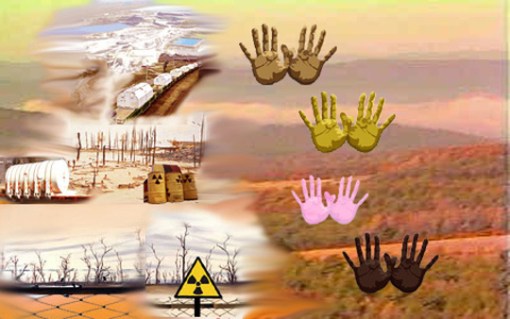
Uranium: Wealth or Woe World Sihk News Gunter Wippel and Norbert Suchanek 26 March 09 Whilst tragic results of the atomic bombs dropped on Hiroshima and Nagasaki are well documented, the environmental and health problems that are a consequence of uranium exploration are less well known by the general global public.
During the development of the atomic bomb, thousands of mines were built in the Southwest of the United States and Northern Canada. The radioactive waste, known as tailings, that builds up in huge piles of rocks and slush outside the mines continues to threaten the wellbeing of local populations and contaminates the environment.
The sad truth is that Governments are fully aware of the dangers but still refuse to implement adequate protection measures.
Uranium is not only radioactive but chemically toxic too. 80% of the radioactivity of the original uranium ore is left behind in highly acidic ‘tailings’. It remains radioactive for hundreds-of-thousands of years and should be kept safely isolated from the environment.
Uranium can cause a wide variety of health problems. Miners and local communities drink contaminated water, eat contaminated food and breathe in radon gas and dust from the tailings. In addition to this, the extraction and processing of uranium ore uses huge amounts of highly sought-after water that cannot be recycled.
It has been argued by mining companies that uranium extraction brings jobs to local populations, thus creating better living conditions, and for a few this was true. However the companies also quietly ignore the health and environmental effects of the process. ……………….After 30 years living alongside uranium mines, the Tuareg of Niger refer to uranium as a ‘curse’ rather than a blessing. They say the North of Niger “suffer[s] from its wealth’, rather than reap supposed rich rewards. ………………………t appears that financial institutions within the country, such as the Bank of Namibia, have found the potential income that mining may bring too attractive to reject. This is despite studies in other African countries that demonstrates only a small percentage of the worth of the resources extracted actually stay in the country.
The killing uranium fields of Topnaar Nama
NAMIBIA: Topnaar Nama people in Namibia are going through tough times even as the government is giving exploration licences to international companies. The Topnaar people now fear for their lives and existence. Uranium mining poses a considerable threat to general health, and lifestyle because of effects on underground and surface water resources………………………Whilst tragic results of the atomic bombs dropped on Hiroshima and Nagasaki are well documented, the environmental and health problems that are a consequence of uranium exploration are less well known by the general global public.
During the development of the atomic bomb, thousands of mines were built in the Southwest of the United States and Northern Canada. The radioactive waste, known as tailings, that builds up in huge piles of rocks and slush outside the mines continues to threaten the wellbeing of local populations and contaminates the environment.
…………………Uranium can cause a wide variety of health problems. Miners and local communities drink contaminated water, eat contaminated food and breathe in radon gas and dust from the tailings. In addition to this, the extraction and processing of uranium ore uses huge amounts of highly sought-after water that cannot be recycled…………………………The problems associated with uranium mining are set to continue with its rising price as demand from nuclear power plant companies increases. Africa is especially at risk because companies are attracted by the lack of strict regulations.One community that is particularly at risk from uranium extraction is the Topnaar Nama, one of fourteen groups of Nama people. These groups traditionally lived in the southern parts of the Namib, which today is part of Namibia and adjacent to South Africa. This nomadic group breed their own livestock such as goats and cows, which, along with !Nara fruits make-up their main food staples. They now live their traditional way of life in the area of the Kuiseb River and canyon, south of Walvisbay and Svakopmund.
There are currently two mines operating in the Topnaar territory with the Namibian Government recently issuing more uranium exploration licenses to various international companies.
The lack of water, and other environmental issues related to uranium mining have other impacts on the Topnaar. ………………….It has been reported that workers of the Roessing mine, amongst them Topnaar people, are becoming ill and are dying. One Topnaar reported that his friend, a miner, had died a few weeks ago because of what the doctor referred to as ‘old mans illness’. He was only 60, and those within the Topnaar villages that have never worked in the mines live beyond 80 without any ‘old mans illness.’It is clear from the issuing of uranium exploration licenses that the Namibian Government is less than supportive towards the Topnaar peoples’ situation. This is despite the fact that the Namibian constitution states that traditional chiefs (captains or kings) of different tribes be included in parliament.
The killing uranium fields of Topnaar Nama | 12 March 2009 | www.commodityonline.com
Indigenous Leaders Call For End To Uranium Mining
Indigenous Leaders Call For End To Uranium Mining allheadlinenews.com
Windsor Genova – AHN News Writer 26 Feb 09Takoma Park, MD (AHN) – Indigenous activists and leaders of Native American, Australian aboriginal and Tuareg communities are in Washington, D.C. Friday to press elected officials at Capitol Hill to stop uranium mining.
Leaders of the group said the extraction of uranium ore needed to produce nuclear weapons and fuel for nuclear reactors are being done in indigenous communities contaminating scarce water supply there and causing cancer to Native Americans, aborigines in Australia and Tuaregs in Niger.
Tuareg activist Sidi-Amar Taoua said uranium mining in Niger has devastated its landscape, destroyed the fauna and flora around the mines and contaminated the land, air and water with radioactive dust, gases and liquids.
“The depletion of already scarce water supplies threatens the very survival of the Touareg as well as the local communities around the mines who are already suffering the many illnesses caused by the uranium mines,” Taoua said.
Dr. Bruno Chareyron, director of the French investigative lab that has conducted radiological testing at nuclear sites in France and around the world, and actor James Cromwell are backing the group and campaign against uranium mining.
“When my laboratory went to the mining towns in Niger we found radioactive scrap metal from the uranium mill being sold on the city market; uranium contamination of drinking water that exceeded World Health Organization standards; and radioactive tailings from the uranium mill stored in the open air,” Chareyron said. “The situation is equally bad in France where tailings have been paved into school playgrounds and parking lots. But the French nuclear corporation, Areva, denies in its own press release that there is any contamination from the Niger mines. This is simply not true.”
Meanwhile, a plan to allow uranium mining in New Mexico’s Mt. Taylor will be opposed, said Acoma Pueblo spokesman Manuel Pino. “We are not going to let that happen. We will fight that industry tooth and nail to the very end,” Pino said. Indigenous Leaders Call For End To Uranium Mining | AHN | February 27, 2009
1 This Month


PLEASE OPPOSE HR 8255 AND S.3639 – bills would accelerate satellite deployment, with no environmental review or safeguards – https://ncstd5li.quorum.us/campaign/169331/
To see nuclear-related stories in greater depth and intensity – go to https://nuclearinformation.wordpress.com
-
Archives
- September 2026 (194)
- August 2026 (330)
- July 2026 (355)
- June 2026 (287)
- May 2026 (306)
- April 2026 (356)
- March 2026 (251)
- February 2026 (267)
- January 2026 (308)
- December 2025 (358)
- November 2025 (359)
- October 2025 (375)
-
Categories
- 1
- 1 NUCLEAR ISSUES
- business and costs
- climate change
- culture and arts
- ENERGY
- environment
- health
- history
- indigenous issues
- Legal
- marketing of nuclear
- media
- opposition to nuclear
- PERSONAL STORIES
- politics
- politics international
- Religion and ethics
- safety
- secrets,lies and civil liberties
- spinbuster
- technology
- Uranium
- wastes
- weapons and war
- Women
- 2 WORLD
- ACTION
- AFRICA
- Atrocities
- AUSTRALIA
- Christina's notes
- Christina's themes
- culture and arts
- Events
- Fuk 2022
- Fuk 2023
- Fukushima 2017
- Fukushima 2018
- fukushima 2019
- Fukushima 2020
- Fukushima 2021
- general
- global warming
- Humour (God we need it)
- Nuclear
- RARE EARTHS
- Reference
- resources – print
- Resources -audiovicual
- Weekly Newsletter
- World
- World Nuclear
- YouTube
-
RSS
Entries RSS
Comments RSS
 nuclear-news